

Midlife Male With Greg Scheinman
Posted by John Livesay in podcast | 0 comments

It is often said that midlife is the time when men’s life starts to “die.” But more often than not, it’s actually the time most men really begin to figure life out, and that’s what Greg Scheinman talks about in this episode. Greg is a performance coach and author of Midlife Male, a genuine guide for men to live happier, healthier, and much more fun lives. As Greg always says, if it’s not fun, then we’re done! Tune in and learn all about Greg’s journey in writing the book, how he overcame through the heaviest years, how he received his wake-up call to actually live a better life, and how you can make all of that, too!
—
Listen to the podcast here
Midlife Male With Greg Scheinman
Our guest on the show is Greg Scheinman, the author of The Midlife Male. He says, “Show me your calendar and I’ll show you your priorities.” Also, his whole philosophy is, “If it’s not fun, then we’re done,” and finally, how deprivation is not sustainable. Enjoy the episode.
—
Our guest is a friend, Greg Scheinman, who is a performance coach, the host of The Midlife Male Podcast and the Creator of Midlife Male, the premier digital media community for middle-aged men seeking to maximize their lives. In 2018, he launched the Midlife Male Movement to help men like him in their 40s and 50s to strive to be their best selves by getting active, curious, naked and real. Greg has played many roles in his life such as a filmmaker, a sports video producer, a TV host, a fitness studio owner, an insurance broker, a performance coach, an executive athlete and most importantly, a friend, father, husband, brother and son. Welcome to the show, Greg.
John, thank you for that introduction. It’s great to be here. I’m like, “Have I done any of that stuff?”
I love to ask my guests their stories of origin. You can go back to your childhood because I know your dad played a big part in your life. You can go back to when you got into fitness or wherever you want to take us to start your story.
I appreciate it. I’ll work backward a little bit. You mentioned my father. One point of origin for me is that my father was 47 when he passed away. One of the things I speak about is that at 47, that’s when my life began. It’s the beginning of what I call the next and best phase of my life. We’re here in early November 2022 and I’ll be 50 in December 2022. It’s been that kind of a journey. You may call me a slow learner or a late bloomer but here we are.
As far as my origin, I was born and raised in Long Island, New York. I was super close to my dad. My parents were great. I’ve got two younger brothers. I had nowhere to go but down, in a way, from where we were raised. We were raised in an upscale, privileged community. It was an interesting way to grow up. I learned a lot as I got older.
Unfortunately, my father passed away when I was 17 and he was 47. I was heading off to college. I was moving to different locations. I went to school in Michigan and Florida. I also spent time in California. I learned a lot. I’m a slow learner and a late bloomer. It was the origin of where my life started. Here we are, where my life has transformed and begun again.
You’ve had quite the journey. I follow you on Instagram. It’s @GregScheinman for anyone who wants to follow you. Congrats on having over 10,000 followers. That’s not an easy feat either. You talked about your son going to college. I was moved by the lessons that you had for him. Since I have more context and texture on your dad dying when you were seventeen, I’m guessing your son was around that age when he went off to college.
I was seventeen and was heading off to school. Our son’s a little bit older. He’s nineteen. He was eighteen when he left for school. It was the same age and the same stage.
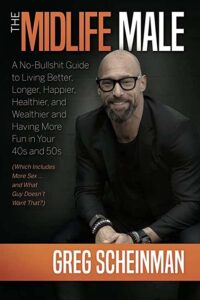
The Midlife Male: A No-Bullshit Guide to Living Better, Longer, Happier, Healthier, and Wealthier and Having More Fun in Your 40s and 50s (Which Includes More Sex … and What Guy Doesn’t Want That?)
Were you able to say some things to your son about life lessons that you wished your dad had lived long enough to tell you?
I say way too much to my son. I over-index in that area based on maybe what I’ve gone through. I’m the waterworks guy. I’m a sensitive, vulnerable person. I’m the, “You’re not letting me go. I’m not letting you go,” kind of guy. To me, this is all bonus time so I don’t know how to behave. I didn’t get to see that from the other side. I go on pure emotion and pure heart. I’m like, “The more time I get with you, the more that I can share with you and the more that I could expedite your learning curve, share experiences and maybe save you from the pitfalls, failures and things that I got wrong along the way.”
I also keep thinking about all the things I still haven’t gotten to. Nobody taught me how to play poker and how to tie a tie. It was all the little things. I was like, “Am I covering this? Did I get to that?” I read all these other books about fathers teaching their kids things, life lessons and quotes. That is a long-winded answer to saying, “I throw up all over him.”
In your book, The Midlife Male, one of the six Fs that you have in there is Family. Let’s dive into that a little bit beyond that situation. Do you remember off the top of your head some of those beautiful tips? Whether you’re a man or a woman reading this, I feel that everyone wants to give the people in their life, whether they’re a parent or not, uncle or whomever some life lessons, tips or mentorship. You had so many beautiful ones. Do you remember a couple that you could share of what you wanted? The big takeaway for me from the outside looking in was that you love him unconditionally. In other words, he’s not having to go to college to prove himself to you.
That’s certainly one and I’ll touch on that a little bit. I spent a lot of years chasing authenticity and doing things that maybe you’re supposed to do or you think you’re supposed to do but be successful. You go to college and get a job. You’re supposed to dress a certain way or look a certain way. You’re then supposed to maybe make a certain amount of money. You get married. It seems like there’s a path for men.
In a lot of ways, for men, success is defined as salary and title. Everything else comes secondary, tertiary and so on. I try not to give advice. I’d rather share experiences. Once I changed the framework from viewing success as salary and title, over-indexing in those areas, what was outward facing, whether that was money, car, title, job or house and flipped it inward, it was the more holistic view of success. That is where my success came from. What does success look like to me? It is family, fitness, finance, food, fashion and fun. These are the things I’m into for a variety of different reasons.
You are quite the snazzy dresser. Even your shoes are always on point.
When I say, “People are fashion,” people are like, “What do you mean by fashion?” What I mean there is style and confidence. What makes you feel good? What makes you feel like you? I spent a lot of years in the professional service industry. There was a certain look. It never felt like me in there. It is attributes like that when success went from a one-dimensional approach to a more holistic approach. What does your total life portfolio look like? That’s when everything got better. One of the things I try to talk to both of my boys about is doing what makes them happy and feel fulfilled.
[bctt tweet=”Deprivation is not sustainable.” username=”John_Livesay”]
You were in your 30s when you built this award-winning sports DVD business. It got bought by Michael Eisner who used to run Disney. You are not just theoretically talking about, “Success is empty. For some people, that’s all you have.” You experienced it and therefore realized there’s more to life than just making money.
I’ll give you a story arc. You’re a storyteller. The story arc is everything’s going along fantastic. I’m seventeen years old when my dad passes away. It was the first adversity I’ve ever experienced in my life. I go off to college and go off the rails. I’m like, “Nobody’s watching and controlling me.” In my twenties, I landed my first job as Harvey Weinstein’s assistant right out of college. I thought I wanted to be in the film business. At the time, he was the top of the food chain. My big claim to fame early on was telling Harvey to eff off twenty years before the #MeToo era. I had such a big ego that it never occurred to me that I still couldn’t be successful in the film industry.
I went out, produced a few films and realized that wasn’t a healthy scenario. In my 30s, I get out of entertainment altogether, move to Houston and end up starting this video production company which ends up getting me back into the Hollywood situation by virtue of acquisition and the partnership with Eisner. Once they pull you out, they pull you back in. I realize that wasn’t what I wanted either in terms of entrepreneurship and success. I fell off the rails again.
Many people, whether they had success in multiple industries or they said, “I went to law school. I hate being a lawyer but I feel like I have to stay and do this the rest of my life. I don’t think I can do anything else to make that kind of money,” you are inspiring people in this community you’ve created. It is to say, “It’s never too late to change.” That’s my big observation of what you’re doing.
I’ll keep saying I am a slow learner or a late bloomer. I believe that it’s never too late. We have the opportunity to live again and be healthier, happier, longer, wealthier and stronger than ever before.
Let’s pick up the story again. You’re like, “That is not for me. Working for Harvey was not the thing. Even this DVD thing as an entrepreneur is not the thing. I’m going to do something else.” You have a little bit more tragedy. Somehow, your brother gets put in prison.
My brother was in prison for seven years. With what he did, he was very successful at it. Unfortunately, what he did was not legal. That’s what happened there. There are two things. You lose your life or you lose your freedom. Both of them change the way you see things and they did for me. I didn’t want to squander these opportunities anymore. I didn’t want to squander my life or my freedom, whether that was through a job, not taking care of myself or anything.
Sometimes, these things happen around the occurrence. For me, they happened over a long period to get to a place that maybe should have happened sooner or differently to go, “Haven’t you figured out that you could get sick and die? Haven’t you figured out that you could lose your freedom? Haven’t you figured out that you shouldn’t smoke or drink? How many times do you need to be hit over the head with these lessons before you start to make changes in your lifestyle and show up?”

Midlife Male: Today, we have the opportunity to live healthier, happier, longer, wealthier, and stronger than ever.
That leads to the fitness thing. For those of you who haven’t seen Greg in person or on his website, he is 4% body fat or something amazing. Yet, you also talk that at one point, you struggled with weight, which so many people aren’t going to even fathom. When they see somebody so fit, they go, “He has been fit their whole life. He’s continued that. It’s too late for me. I was never fit so I’m continuing to get worse.” You’re like, “No.”
When I was ten years old, my mom took me shopping to go back to school. She’s like, “I’m sorry. You’re going to have to buy these pants size that is called husky.” I was humiliated. I knew that was a polite word for a fat kid. That image we have of ourselves at ten can carry on. I’m not the only one that gained a lot of weight during the pandemic. I’m like, “This so doesn’t fit anymore.” There is all that stuff. What I love about what you’re doing is you’re helping people not only have financial expertise. The fiscal, you’re combining that with the physical. Those two things go hand in hand a little bit, don’t they?
For me, that bucket that I talked about of family, fitness, finance, food and fashion is all connected. It is what you put on your body, what you put in your body and how you show up. It is the preparation, consistency and accountability. That’s in the gym. That’s outside of the gym. It’s not about having the biggest bank account or being the most jacked.
There is a lot of white space between all of this. It’s about what success looks like for you and what the best version of you is. Aesthetics are a bonus or a benefit of healthy living. It doesn’t mean all that much. I rarely ever get sick and I’ve been sick. I can tell you aesthetics are meaningless. How you feel is everything.
It’s that reminder. What I find fascinating about your framework of the six Fs is that food and fitness are equal. For most people, they think, “If I’m going to be a fitness person. I’m giving up my love of pizza or my love of food, in general, and rich foods.” You’re like, “You can still enjoy food.” That is a very unique take as well. I don’t think I’ve ever seen anybody combine all of these into one framework where you can have all of these things working with you. Probably for someone who tends to eat too fast and not taste the food because they’re eating compulsively or emotionally, that’s what happens. Talk a little bit about how you changed your relationship with food and how you help other people do that.
For one, I love food and my wife loves food. We wish our boys love food as much as we do in terms of an expansive pallet. We’re going to get there. The point being is that deprivation is not sustainable. I talk about it a lot. It’s sustainability, longevity and lifestyle. I don’t particularly care for words like diet deprivation. Supplements are way overused and over-indexed. They’re to supplement things that you’re deficient in. If you’re not deficient, you don’t need supplements, per se, in there. I talk about the use of science in a lot of ways too in terms of getting your blood work done, getting your physicals done and understanding what your body responds well to what it does.
Far too often, we’re jumping on these bandwagons. We’re like, “I should be keto. I should be paleo. I should do intermittent fasting. I should not eat carbs.” We don’t know as far as how we respond to these things. I tend to slant more toward the 80/20 side. I eat clean 80% of the time. By clean, I have foods that are proven for me. I know my body responds well to them. Are they perfect? No. Do I count macros, calories and fat? There is none of that. I’ve got a 30-year body of work.
Here’s the other thing. It is a lifestyle. It’s been good, it’s been bad and it’s been better when you figure stuff. I say that even food is one of the Fs. There is fitness too. Fitness is health. Fitness means a lot of different things. First of all, you got to like it or see if you want to keep doing it. Try different things. Food is the same way. You’ve got to enjoy what you’re eating.
[bctt tweet=”If it’s not fun, then we’re done.” username=”John_Livesay”]
What I’m hearing is that variety is one of your secrets, whether it’s a workout or the kinds of foods you’re eating to keep yourself motivated to keep doing it even.
Fun is one of them too in there. The motto is, “If it’s not fun, then we’re done.” Who wants to eat, day in and day out, things that they do not like? To me, that doesn’t sound like a whole lot of fun no matter what the result is. Often, we look at the outcome and picture. When we look at the meal, people say, “What did you eat?” It’s consistency over time as you’re living a life by design that gets you to maintain, look, feel and perform the way you want.
That is what you mean when you say you are a performance coach. You’re not saying, “I coach athletes to perform in the Olympics.” You’re talking about performing at your best in an obvious situation you’re in, whether it’s work or personal.
That is in life. The way that I coach and work with guys across the country is in all of these areas. It is conceptually about turning these Fs into As. Some guys have a different F. Some guy is like, “I don’t care about the fashion side or the style side of things.” This is not about being on the cover of GQ magazine either. It is about getting dressed, showing up and looking a certain way about how you perceive yourself and how you want others to perceive you. You can wear jeans and a t-shirt every single day. Quite frankly, there’s a right way and a wrong way to do that. If you’re also in shape, eating well and well-groomed, it’s all connected in a way.
I remember once hearing somebody talk about a woman say, “I can never meet any guys on airplanes.” I hear other women meet guys on airplanes. Her girlfriend said to her, “Have you seen what you wear on an airplane? You look like you crawled out of bed.” When I worked at a fashion magazine, we used to say, “Everybody puts on clothes but not everybody gets dressed.”
It’s so true. The old saying used to also be, “Clothes make the man.” It’s not about spending a lot of money. We’ve all seen guys in five-figure suits that look like crap, quite frankly. It’s not about spending. It’s how you carry yourself and put yourself together. It gets back to confidence, pride and a number of these characteristics.
I feel and perform better when I’m dressed a certain way for a certain activity. If I’m going to work out and train, I want to look a certain way because I feel more powerful. I’ll wear a certain pair of shorts, a t-shirt and a pair of shoes. Whatever it is, I want to be geared up for that activity. It’s the same thing in business. If you want to negotiate with me or talk to me about a deal, those calls are scheduled on my calendar after I finish my workout and never before because I feel my strongest then. There is a strategy to these things to design your days.
One part is a surprise for some people. It is fun. You’re like, “Do I have to schedule fun like I scheduled my workout?” I’m guessing I know the answer but I would love to hear you talk about that a little bit.

Midlife Male: Happy and fulfilled people do well in life and everywhere.
One of the rules is, “Show me your calendar and I’ll show you your priorities.” Fun is one of the Fs that I discussed for a while about including it. At the onset, some of the feedback was that fun sounded juvenile. They were like, “Where does fun fit in this area?” Quite frankly, while fun is number six there, you could argue you should flip it around. In a way, it should be right at the top because what are we doing anything in life if we’re not having fun?
For people like you who like to work out, you have fun doing it. For people who hate to work out, it’s drudgery. For people like you who put your family first, you’re going to your son’s game after this interview. That’s not a family first for you but I’m guessing it’s fun for you to watch your son play.
We can all define fun differently in what our priorities are. There’s good fun and there’s maybe not such good fun. I had a lot of not-such-good fun for a lot of years. There was a period in my life when even that worked. My fun is very different. I happen to enjoy working out. I enjoy taking on certain challenges. That is fun for me. I don’t consider that the same level of motivation or discipline because I have a natural gravitation towards that.
In a lot of ways that I work with people, that may not be where they naturally gravitate. They’ve never felt fun before. We have to find things that are fun for them that provide what I call the minimum effective dose. What do you got to put in to get the result you want no more, no less? This isn’t something you truly want to do on your own in there and you go into those areas. Fun is vital. Middle-aged men, in general, are not happy.
There are all kinds of health risks and all kinds of stuff. In addition to people hiring you to coach them and be in your community, you are hired as a keynote speaker. Who hires you? Who’s your ideal audience? What’s your topic?
I learned so much from you about this area because this is a newer part of my journey. When you talk at the onset about it never being too late, I’m getting started in this area. One of my bucket list dream items was to speak on a big stage. Here, you and I are walking around backstage in Detroit and you’re telling me stories. I’m looking at this and it’s amazing.
One, I hope that the takeaway is it’s never too late to do anything. For me, that was writing and speaking. For who hires me and who brings me on, the message is applicable to anyone and everyone regardless of age or stage. I happen to stay narrow and deep in midlife men because that’s where I am.
It’s in the audience’s shoes if that’s whom you’re speaking to.
[bctt tweet=”Midlife does not have to be a crisis.” username=”John_Livesay”]
Some companies and organizations want their people to feel better about themselves and to understand, in a way, that they might not be the CEO of the organization that they work with but they are the CEOs of their lives. They are empowered and able. Quite frankly, if they take care of themselves, prioritize health and fitness, have a personal operating system, watch their sleep and have hobbies and side projects, they’re going to perform better in your organization.
Happy people fulfill people who are good husbands, providers, partners, fathers and parents. These people that are doing well in life do well everywhere. It’s all connected. Those types of organizations hire me because I’ve been on the other side. I have been the entrepreneur who started a company and succeeded. I’ve been the entrepreneur who started a company and failed. I’ve done fifteen years in large-scale professional service companies going from 45 people to 200 people.
I’ve been to every sales meeting imagined. I’ve been to every retreat you can imagine. I’ve had commissions slashed. I’ve had incentive trips and offers. I’ve had speakers up on stage talking to us when we’ve sat there in the audience going, “I can’t believe they paid this guy $30,000 and they got our commission of 20%.” I get it. What motivates you? What drives you?
When we talk about corporate culture, the culture starts with you. Companies don’t care about people. People care about people. Those types of organizations and groups bring me in. These are events, experiences and men’s groups. Women’s groups and organizations, quite frankly, love this because of what they want to know, which is what middle-aged men are thinking. Forty percent of my coaching inquiries come from women. It is not for themselves. They’re like, “Would you work with my husband?”
Speaking of that, that’s what makes this book a wonderful holiday gift for Father’s Day, Christmas, Hanukkah or whatever your thing is around the holidays. What a great gift to give your dad or uncle for Thanksgiving. I’m so grateful to have you in my life as a role model. Your book could not be coming out at a better time. The book is called The Midlife Male. If anybody wants to follow you on social media, they can put that in with your name. Your website is MidlifeMale.com. Do you have any last thoughts or quotes that you want to leave us? Thank you so much for sharing all your passion with us.
This is great. Thank you so much for having me. You touched on a couple of key points. I’ll leave a few takeaways. One is it is never too late. My number one message is to start. People spend a lot of time thinking about when the right time is to start. Whatever that is, whether it’s a health journey, starting a new job, leaving a new job or picking up a hobby, start before it’s perfect. It will never be perfect. Put one foot in front of the other. Get going. You will build momentum. You will ultimately be successful if you are consistent.
The second thing is knowing what’s important is what’s most important. You got to know. I’m going to leave you with another thing. Sit down. Take the time to think about what is most important to you. What are your non-negotiables? What are your priorities? Write them down. Back to the last thing. Back into it. Reverse engineer it. Put it on your calendar. That goes back to, “Show me your calendar and I’ll show you your priorities.” If your calendar is not reflective of what is most important to you in life no matter what your Fs may be, whether it is family, fitness, food, fashion, finance or fun, the numbers don’t lie.
What a treat. I am so excited for people to get this book for themselves and the men in their lives. This is going to be something that people are going to re-read, buy multiple copies of and get people thanking them for giving it to them. You’re a gift. Greg, thanks for giving us your gift of you.
Thank you so much, John. Everyone’s got a story. I appreciate you allowing me to share some of mine. You know how important this stuff is. I appreciate you.
Important Links
- The Midlife Male
- The Midlife Male Podcast
- @GregScheinman – Instagram
- MidlifeMale.com
- https://MidlifeMale.com/About
Wanna Host Your Own Podcast?
Click here to see how my friends at Podetize can help
Purchase John’s new book
John Livesay, The Pitch Whisperer
Share The Show
Did you enjoy the show? I’d love it if you subscribed today and left us a 5-star review!
- Click this link
- Click on the ‘Subscribe’ button below the artwork
- Go to the ‘Ratings and Reviews’ section
- Click on ‘Write a Review’
Love the show? Subscribe, rate, review, and share!
Join The Successful Pitch community today:
- JohnLivesay.com
- John Livesay Facebook
- John Livesay Twitter
- John Livesay LinkedIn
- John Livesay YouTube
Real Business Connections Network With Ben Albert
Posted by John Livesay in podcast | 0 comments


We all took a hit when COVID-19 struck the world. Many businesses closed, and many more became unemployed. Ben Albert was one of those people. Furloughed from work, he went on a downward spiral towards depression and battling imposter syndrome. Fortunately, this was only the start of his hero’s journey. Now, he hosts a network of five podcasts called Real Business Connections Network and is the owner of Balbert Marketing LLC. What is the key to his success? Join this episode as he sits down with John Livesay to fill in the gaps of his story of reinvention, overcoming his feelings of being unworthy, and starting an incredible marketing firm. You just might find the missing piece to your own success story!
—
Listen to the podcast here
Real Business Connections Network With Ben Albert
Our guest on the show is Ben Albert, who has a real hero’s journey story of how he reinvented himself and overcame the Imposter syndrome to start an incredible marketing firm. He said, “The true key to success is finding your unique combination and unlocking it.” Enjoy the episode.
—
When COVID hit, Ben Albert was furloughed from work. He found himself down and out staring at an empty handle of Jim Beam whiskey. He was unemployed, depressed and felt unworthy. Presently, he opened his MacBook and started reaching out to strangers on LinkedIn. This spearheaded his entrepreneurial journey. The rest is history. Ben hosts a network of five podcasts called Real Business Connections, runs a massively successful marketing firm, Balbert Marketing and has replaced his established sales income in over a year.
Ben found his way. Once an underdog, now a successful entrepreneur. Ben is passionate about helping other underdogs find their way and achieve their dreams. He’s on a mission to move the needle on 1 million lives 1 conversation at a time. I’ve had the pleasure of being on his podcast and I am thrilled to bring him to my audience and readers. Ben, welcome to the show.
John, I’m humbled to be here. Your episode has been one of my favorites and one of my reader’s favorites. You always over deliver and that’s why I love hanging out with you.
Thanks. Let’s talk about your story of origin. Take us back before COVID, if you don’t mind, when you were saying, “I want to get into this business, whether it’s sales or marketing.” What were you doing that got you into the world of marketing in the first place?
Feel free to dissect this because I am here to learn something new every single day in every single conversation. It’s funny because I didn’t see myself as a marketer, promoter or podcaster. When I was a kid, I was the quietest kid in school and very reclusive. I got bullied so I’d make myself even smaller. Everyone starts to hit a growth spurt. I stayed the same height.
I’m the second smallest kid. There was a little Asian girl that was a little shorter. I was always proud of myself for not being the shortest but I also had a basketball jersey for every single day of the week because I wanted to be the next Vince Carter and Michael Jordan. Imagine what happens to the shortest kid in school that’s bullied and is too quiet that wants to be the next Michael Jordan. The probability of getting there was pretty low.
I was always identified as an underdog. I didn’t quite realize it at the time but I was developing this love of learning and a growth mindset. I didn’t have a sense of belonging at the time. It wasn’t until around high school that I started to, as a late bloomer, find my way. It was a friend, Brendon Gansemer, who introduced me to the music industry. I became obsessed with music.
There’s a local band. I don’t know if anyone’s heard of him, Giant Panda Guerilla Dub Squad but I love them. They’re a great band. Before you know it, I was the one handing out flyers, selling merchandise and setting up MySpaces at the time. I found that I was in alignment with great people that uplifted each other and it was something I was passionate about. I was no longer the quiet person. I still wasn’t the best musician per se but my sweet spot was quite amplifying musicians and being the promoter and the marketer.
I wasn’t going to school for marketing. I didn’t even know what I wanted to be when I grew up at the time. I started developing this love of promoting underdogs and at the time musicians. I found my way in marketing by accident. It was a sales job and I wanted to make a lot of money. I realized in that role that I was passionate about connecting with people, taking their businesses and helping them reach the next level by listening first.
[bctt tweet=”Keep doing it to get over feeling like an imposter.” username=”John_Livesay”]
I like to joke, “I get to ask questions for a living.” In the podcast, it’s all about interviewing incredible people like you to learn about storytelling and then learn tangible tips. Learn through their stories and what they have learned throughout. Ultimately, take their wisdom, put it into practice and multiply their wisdom. In the marketing firm, I’m still that curious growth-minded person so it’s asking questions for a living and determining the best fit if I can serve them.
Knowing that I’m not a good fit for everyone and every company’s different, I went in, asked questions and learned that I once had no sense of belonging and was sad with an alcoholic father. They joke about this in psychology. People get into psychology because they’re trying to figure themselves out. I got into podcasting and marketing because I’m trying to figure myself out.
A lot of people will talk about podcasting as a great networking tool or a way to monetize your content. I started my show 450 some episodes ago. I realized that I had some fears about it. I had to put a face on them. For me, it was the fear of, “How do I even do this? I’ve been a guest but how do I be a host?” I found someone that does that for me.
The fear of the unknown of the tech part went away. There was the fear of rejection, “What if I ask people to be on the show and they say no?” I’ve been in sales like you. We don’t take rejection personally and then the fear of failure. “What if I launch it and nobody listens? I’ll waste time and money. I’ll be embarrassed.” Did you have any of those fears, Ben?
At that time, I didn’t have too much to lose because you touched on it in the bio. I was furloughed for my sales executive role. I was able to replace my income by starting my marketing firm but it was because I had been through so much failure and struggle and learning experiences to get me there. I grew up with an alcoholic father. When I started binge drinking when COVID hit, I saw myself. Imagine, you know where the North Star is and you’re running backward in the wrong direction. Since I’m running backward, I can still see that North Star.
I know how to get there but whether it’s binge eating or drinking, I was doing all the wrong things and I knew better. It wasn’t until I started the podcast with nothing to lose. Granted, let’s be transparent. The government was cutting me checks for being unemployed. It was the weirdest time in human history. I was getting these fat checks for being unemployed. What I did is I lived very humbly, took that money from the government and reinvested in the business knowing the power of podcasting.
I didn’t necessarily do it to monetize the podcast. I did know that podcasts don’t make money on their own but I knew that if I could network with the right people and obtain the right knowledge, that would be worth its weight in gold. The rest is history. We’ve got a couple of hundred episodes plus. I’ve built a good community and a great company but it’s by learning from brilliant people like John.
What’s your biggest surprise in hosting a podcast?
No one’s ever asked me that before. The biggest surprise was what you had mentioned as one of your fears and it still is a fear sometimes when you’re stepping out to ask someone out of your league. I’ve had so many people on. You’ll be able to go listen to it. Chris Van Vliet was on my show. He is a four-time Emmy Award-Winning Host. He’s been nominated for eleven. I’m stumbling forward, networking well and learning as I go but I’m no Chris Van Vliet.

Real Business Connections: Part of building a lifestyle business is not working with people that are completely misaligned with your vision and your truth.
He was willing to put his chips on me, the little guy, knowing that there is a high potential that even if we reach 1,000 people and change 100 of those people’s lives, he thinks it’s worth his time to spend 45 minutes with me. I’m humbled every single day at the ability to connect and learn from such brilliant people. You do get the nerves because you have that Imposter syndrome feeling like you’re unworthy sometimes when you reach out to some of these big names.
Let’s talk about Imposter syndrome. I’ve certainly suffered from it. I remember once I was engaged to be one of the speakers at the Coca-Cola Summit for the CMOs of brands that carry Coca-Cola at movie theaters and quick service restaurants. They create this beautiful brochure that’s in the hotel room. I’m reading all the bios of all the other speakers whom all went to Yale and Harvard and have New York Times bestsellers. My Imposter syndrome kicked in big time.
I thought, “I didn’t go to an Ivy League school. I went to a good school, don’t get me wrong but it’s not Harvard or Yale. I have a book that sold well but it wasn’t a New York Times.” I started getting all this anxiety like, “The VP who hired me, she’s going to get fired for bringing me in.” I did talk myself off the ledge and say, “Maybe she knows what she’s doing. She’s been here a long time. Maybe she saw something in your speaker video that she thought she liked.”
I was able to talk myself off the ledge by saying, “Do I care where somebody went to school when I hear them speak? No. Do I care how many books they sold? No. I care about how they make me feel and think and if I learn something that I can use.” That is the only way I was able to get out there and not be so intimidated. What tips do you have for people when they find themselves feeling like an imposter?
First, I’d like to say that it’s not going to get easier but you’ll get better. The number one tip is to go do it. If you do it and you’re not getting the result that you expect, seek a mentor because they can shorten that curve, create a bridge and maybe even connect or introduce that person in some scenarios. Learn because for every single one of these failures, there are great opportunities. Sit back and decompress, “What did I do wrong here? What can I change?” Be a scientist.
Sometimes the Imposter syndrome starts before you even open your mouth or do anything. One of your real strengths is the preparation that you do for each guest. One of my favorite quotes is from Arthur Ashe, the famous Tennis pro, who said, “The key to success is confidence and the key to confidence is preparation.” Internal thoughts are a strong way to dial down Imposter syndrome. Can you speak about the preparation you do as a podcast host, as a template for success? How important do you think it is to do it?
Preparation begins the moment you open your eyes in the morning. Everything beyond that is going to be unique. Brad Lee, a big sales mentor says, “There is no key to success. It’s a combination lock.” The true key is finding your unique combination because no two are alike as how no two fingers are similar. If you were to try to break into my phone, you’d have to cut my finger off and tape it to your finger. I don’t even know if that would work.
It’s possible but it’s not the best route. The preparation begins the moment you open your eyes. You have to ask yourself, “What’s the end in mind? What am I looking to achieve here?” Everyone’s going to be different. I don’t over-prepare but I want to prepare enough that I know at least a little bit about the person’s bios and their audience.
For me, the biggest piece of preparation in a podcast is taking a minute to ask them a couple of questions and get a feeling like, “What are you looking to accomplish? What’s bringing joy to your life? Is there anything that you’d like to promote,” and sudden attention of explaining who the audience is, whom they’re speaking to then go in. John, I used to prepare much more than I did. I’ve got a three-page sheet of questions. I created those questions on episode one. I did come in very prepared for episode one but now, I don’t use that cheat sheet because I know the general narrative.
[bctt tweet=”Create, Connect, and Community.” username=”John_Livesay”]
What’s more important and things that I’ve learned from people like you are giving people permission to tell their unique stories in a way that lights them up. The biggest preparation I can do and I’m not going to go into every little detail is to have a morning routine, work on myself first so I can show up to that podcast interview energized, prepared, ready to go and allow them to be their best self. All I am is a bit of a Sherpa or a guide. I guide the conversation. However, they choose the destination and the story.
You are very excited and grateful about the success you’re having in Balbert Marketing. Tell us who your ideal client is and how you find them.
I joke about this. I don’t work with craps. That’s a start. I immediately get rid of surprisingly a lot of people.
I saw Justin Bieber doing some little meme thing and he was asked to do something. He went, “Immediately no.” That’s my favorite. You don’t have to think about it. It’s like someone said to me, “Would you like to eat raw liver?” “Immediately no.”
I’m not there yet. I’m still on the journey like most people, readers and anyone else. I want to build a lifestyle business. Part of building a lifestyle business is not working with people that are misaligned with your vision and truth and growth-minded people that care about their community. I like to have a little bit of fun. When it comes to growth, community building and fun, those are three major values.
I’ll work with someone that don’t have those three values but for the most part, I’m trying to vet and work with people that have similar alignment and we’re looking to grow this thing and have fun doing it. We do want our pockets to overflow but overflow into everyone we meet and get to affect and collective impact we get to create as business people.
Do you have specific industries that you’ve helped with their brands or is it most individuals that are small business owners?
This is where you see that I’m an entrepreneur who has a new startup. The first thing you do when you’re an entrepreneur, they tell you to do all this planning. No one does it. Honestly, you could plan and fail. I dived in. Small to medium size businesses are 50 employees or less. Once you get to a certain size, there are marketing teams, a lot of checks and balances and hoops.
Part of the lifestyle business is I don’t want to jump through a lot of hoops. I like someone who’s agile, small and an underdog with massive growth potential but you can see that I’m an entrepreneur. I got started in the fact that I would take on about any client. As long as they fit those standards, I work with an aesthetician, a realtor, an eyecare clinic or a tech startup. The goal, which isn’t quite clear yet is to double and triple down on specifically podcasting and LinkedIn. Social selling, in addition to that, how to use podcasting and LinkedIn for social selling because quite honestly, that’s where 98% of my clients come from.

Real Business Connections: The amount of impact we can make is more valuable than the time it takes to do.
Why am I selling all these different services to fifteen different people when I can focus on what drives revenue for my business and teach other businesses how to do it? I’m still in that analysis paralysis working with multiple different companies. I’m very humbly proud to say that everyone I work with, we have an alignment of values. That’s still going to be the most important thing to me but long-term, I’ll niche down.
What’s the biggest mistake people make before they work with you in their marketing?
I’d say the biggest mistake most people make is not acknowledging the fact that it’s a long-term investment. Most marketing professionals guarantee an ROI. I’d have to see the metrics but in most of the cases, they’re crap. They can’t guarantee you to be first on Google unless you’re paying for ads to be there. The moment you stop paying for the ad, if you don’t have organics, you’re not going to come up. There are a lot of misconceptions. A lot of times, it’s salespeople creating a falsified vision of what they’re going to get out of marketing, people get burned time and time again then no one knows whom to trust.
Since you’ve been in sales and then you’re in the marketing side of things, there typically is a lot of animosity between the two departments. Salespeople say, “Marketing is not giving us good enough leads.” Marketing says, “The salespeople aren’t closing. They’re not saying the right message and not consistent.” You’ve been on both sides of the fence able to help your clients with that so that it doesn’t work against each other but work together.
It’s funny because I sold marketing. Since I sold online marketing, day one, I walked in the door and had no clue what I was doing. I had a CRM. We click dial and their name would pop up. I was so nervous and such an imposter and did so uncomfortable that I would try to transcribe every word they said. I’d call John and Elizabeth would pick up, the executive assistant, and say, “This is Elizabeth. How are you?” I’d be writing down the name Elizabeth.
She told me the name. I don’t need to write it down but I was so caught in my head and struggling. Over time, what we learned in this organization was to sell features and benefits. It wasn’t entirely unethical but it was more of a boiler room approach than it was like a Sherpa consultant being a guided approach. I learned to hammer down and create at that time. I didn’t realize what I was saying or know what I was doing. We were creating a false narrative of the results that they were going to get.
The number one reason I started to do well in my job is I started to pivot and not do what everyone else did. I started asking a bit more questions. I was okay jumping up on. If they didn’t buy the first time, I still would follow up. I would do all the friendly essentials and got better at it. I got to a level where I was one of the top producers kicking butt. I started to want to learn more about the products because I’m obsessed with that growth mentality.
I’m researching Google, looking up the keywords and starting to learn not as well as them at the time but what the marketers were doing on their end and fulfilling the orders. I would hear people saying things that were wrong. I would call them out on it and I had the door slammed in my face one time. My sales manager said, “Fix this,” and close the door on me with my trainer. What I was doing was questioning the narrative that was creating sales but we were the issue, John.
We were in the weeds in understanding the wrong way to do things and the value of marketing. Being able to paint a picture and how people realize and see their goals but not doing a great job fulfilling them or creating a false narrative ate away at me. I’m talking about years in the past and we can fast forward. When I started my company, it was to do everything differently from what I was taught. I had been in the weeds so I had seen the opportunity. Marketing creates billionaires when done the right way. My goal is to do it the right way.
[bctt tweet=”The preparation begins the moment you open your eyes.” username=”John_Livesay”]
I see one of your goals is to be a keynote speaker on the power of networking. Talk to us about how did you pick that topic and what your talk was about the topic of networking.
One thing I like to talk about is what I call the CCCCAN system. I didn’t realize the concept of the CCCCAN system when I started my business. I started to quantify everything twelve months later. If I had only known this going in, it would’ve taken me a quarter of the time. There are lots of Cs. I like adding Cs. I’m a big C guy. Create, Connect, Collaborate, Community And Networking. Creation is the reason and purpose for my networking. I can create content and network. We can build community and network.
When you go into a networking conversation with a creation-driven mindset and a can mindset like, “I can collaborate. Let’s look for collaborators,” you put on a different lens. It’s not like, “I do this for this person and I’m looking for this referral. Do you have them? Here’s a business card. If you don’t, maybe you’ll call me.” Who am I alignment with so that I can create something fun? Who can I create and network with?
I like the word fun a lot because it’s part of your culture. In addition to not being crap is, “Let’s have fun while we’re working together.” I believe people buy energy. With your energy and passion, fun comes through any marketing materials or websites. The other thing I want to ask you about is one of your goals is raising money for cystic fibrosis. Is there a story there that makes you pick that charity?
To give you the short version, I spent most of my life not giving back. I was raised Jewish and in Jewish, they call them a mitzvah. Mitzvahs are good deeds. The best mitzvah you can give is the ones that can’t be repaid. For example, in Judaism, helping bury a body is a great mitzvah because there’s no way in the world that they could ever repay you. I was raised on doing good deeds in mitzvahs. I was raised a certain way and then anxiety hits you and you start smoking weed and drinking in college. You’re following all the shoulds that people tell you, “Go to school, get a job this or that.” You forget to give back.
My connection with cystic fibrosis transparently wasn’t a personal one. It was as simple as I was so mad at myself for going so long selfishly that they asked me and I said yes. In doing so, we raised a lot of money and I love it. I raised $3,000 for cystic fibrosis in a grassroots campaign with 60 donors. We raised on under $5,000 for the Alzheimer’s Association. I’m looking to build an event for diabetes. My brother has diabetes. My mother had multiple sclerosis.
This was always within me but I did the wrong thing for so long that quite transparently, Cystic Fibrosis Foundation was the first person that asked and I gave him an emphatic yes. I’m happy I did because I realized the impact I get to make. My time is valuable but the amount of impact we can make is more valuable than the time it takes to.
Let’s double-click on that. Somebody at that foundation had the courage to reach out to you and ask. They happen to catch you at the right time. What a wonderful full circle moment. That’s what marketing is, knocking on the door going, “This is something you want to explore,” and not attached to the results.
To create another circle around that circle, I met him through networking on LinkedIn when I launched my podcast. I was meeting people like crazy. One thing that was happening to me all the time is people were saying yes. They were putting their chips on Ben and coming on a podcast that a lot of people said yes to before it even existed yet. The moment someone came to me with an ask, I said yes.

Real Business Connections: How can I serve you that I maybe haven’t served you yet?
My final question is, is there a question that you wished someone had asked you on a previous podcast or that I had asked you on this show that I haven’t asked you yet?
I ask questions like this once in a while, John. I stump people and I’m stumping myself. I probably thought about a question that hasn’t been asked.
Is there a question that you wish somebody would ask you, whether it’s about networking, charity, marketing, podcasting or anything?
How do I listen to John Livesay on your show?
The whole focus is on how can you be of service. I felt that as your guest and I strived to make you feel the same way. Welcome, cared about and surprise you with questions that maybe other people haven’t asked. That’s always been a goal of mine, doing a little deeper dive than maybe somebody else would’ve done, the preparation we talked about. If someone is intrigued and I’m sure many people are saying, “This guy sounds amazing. I want to have fun. I want some marketing that’s out of the box and someone who’s going to take the time to be empathetic to my needs,” what’s the best way for them to find you?
I want to connect and have a one-to-one conversation. I don’t have anyone running my social media. It’s just me so you’ll speak to me. To touch on that question, people have asked me this before but how can I help you? It always goes both ways. I never want the conversation to end at the end of a podcast conversation.
If there’s any way I can serve you, yes. If there’s any way you can serve me, yes. I want that everybody to be asking that question forever. How can I serve you that I maybe haven’t served you yet and find a way to collaborate? If anyone wants to connect with me, you can go to BalbertMarketing.com. The website is under construction for a little bit. It’s a landing page with all my links in one spot.
In there, you’ll get the podcast, social media and LinkedIn but reach out and send me a DM. Let’s figure out how we can work together. I found this in my past. I would listen to a podcast, I’d love it and six weeks later, nothing happened. Forgot everything about it. If you’re reading this and you haven’t reached out to John yet, reach out to him. Say hello. You can reach out to me as well but subscribe. Start a conversation and we’d be humbled to chat with you.
Ben, thanks for bringing your wonderful story and warmth to the episode. It’s been great.
Thanks, John.
Important Links
- Ben Albert
- Real Business Connections
- Podcast – Past Episode on Real Business Connections featuring John Livesay
- Giant Panda Guerilla Dub Squad
- Chris Van Vliet – Past Episode on Real Business Connections
- Alzheimer’s Association
- Cystic Fibrosis Foundation
- Better Selling Through Storytelling Method Online Course
Wanna Host Your Own Podcast?
Click here to see how my friends at Podetize can help
Purchase John’s new book
John Livesay, The Pitch Whisperer
Share The Show
Did you enjoy the show? I’d love it if you subscribed today and left us a 5-star review!
- Click this link
- Click on the ‘Subscribe’ button below the artwork
- Go to the ‘Ratings and Reviews’ section
- Click on ‘Write a Review’
Love the show? Subscribe, rate, review, and share!
Join The Successful Pitch community today:
- JohnLivesay.com
- John Livesay Facebook
- John Livesay Twitter
- John Livesay LinkedIn
- John Livesay YouTube
Personal Socrates With Marc Champagne
Posted by John Livesay in podcast | 0 comments

As humans, we tend to lean on emotions when reacting to everything that’s happening personally and professionally. We get carried away and come up with our own narrative in our heads. And with all the noise around us, it’s easy to give in, get stressed, lose our identity and lose focus on what we were trying to achieve. If your plans are not working out and the reset button is out of sight, this is the podcast for you. Marc Champagne shares mental fitness practices and reflective questions to help you find your way back to the right track. So tune in and learn how you can tap into your Personal Socrates and find clarity and intentionality.
—
Listen to the podcast here
Personal Socrates With Marc Champagne
Our guest on the show is Marc Champagne, the author of Personal Socrates. In that book, he interviews two people that have also been on the show, Cal Fussman and Chip Conley. We have lots of mutual friends. His big takeaway is how important it is to make time for quiet reflection. When he was out of a job and trying to figure out what he was going to do next, he said his full-time job was working on his mind. Enjoy the episode.
—
Our guest is Marc Champagne who unpacks the mental fitness practices and reflective questions, shaping the lives of some of the most successful and brilliant thinkers in the world. He is the author of Personal Socrates, a bestselling book exploring the pointed questions that stimulate our mental fitness and teach us how to direct our internal narrative to work for us instead of against us. He studies the prompts and practices of legends such as Kobe Bryant, Maya Angelou, Coco Chanel, Stephen Hawking and our mutual friend, Cal Fussman.
He is the host of the Top 50 rated podcast Behind The Human and cofounded the journaling app Kyō, which reached 86.9 million people without any paid advertising. He studied mental fitness practices for over a decade and consults with Fortune 500 companies as a mental fitness strategist and practitioner. His favorite quote is, “We are all one question away from a different life.” Marc, welcome to the show.
Thank you, John. What an intro. I am jazzed to be here.
I always comment when something is so impressive and then it’s 86.9 million. We’re almost at 87 million. This is hilarious. It only shows your integrity to be so specific. Before we get into this wonderful book, which you were kind enough to send me a copy of and I was commenting on the packaging and these interviews are fascinating, it’s one of the things I so enjoyed reading on my trip. I could pick and choose where I wanted to go. I want to hear a little bit more about your story. You talk about it in your book but if you can start your story earlier, in high school, college or wherever you want that you got this entrepreneurial bug.
The entrepreneurial bug was never there at the beginning, to be honest. At least, I think that was the case. I remember I didn’t come out of university thinking, “I’m going to start my business or anything like that.” I wanted to get into sales. I had an uncle in the Toronto area and I was from a smaller city four hours outside of Toronto. It’s a mining blue-collar town. It wasn’t exposed to the world of business and sales. As a young kid, I used to spend the summers in Toronto with my aunt and uncle. My aunt was a VP over at Sharp Electronics and my uncle was the Candyman. He used to work for Hershey. Anytime he would show up, the trunk of the car would open and it was a party.
What I was interested in was the connection with all these different people, specifically with my uncle. He was one of those people that had a certain pulse and energy in the room that you had a good time with. You wanted to continue the conversation. He used to pick me up early in the morning and we’d go for these coffees. He got a hot chocolate for me and this was before university. He would pepper me with questions. “How are you doing? How is your grandmother? When’s the last time you went for a visit?”
[bctt tweet=”We are either in thrive or survive mindset.” username=”John_Livesay”]
The more I reflect on the path that I’m on and this lens of living life through a curious mind and having a book that’s called Personal Socrates loaded full of questions, it was those early days of being asked the questions and pausing to start to think and be more curious that fueled that journey into where I’m at. Before that, out of school, it was sales, which is asking a lot of different questions, being curious and trying to be as present as possible.
I had stints in analytics and market research until eventually, I got to this point which is where I was aiming for, get into product management and brand management in the healthcare space. While I was doing all of that, I had these mental fitness practices in the morning, which I wasn’t calling mental fitness because I didn’t have a terminology for it but it was essentially reading positive, uplifting content early in the morning before starting my day to put my mind in a state that was thriving, motivated or excited. It started when I was in sales because I remember at that time, they used to hire batches of people essentially.
We’d all be trained up in a matter of a few weeks altogether. I’m thinking, “If this is a sales role, how am I going to stand out of the pack if we’re all being trained in the same way?” That’s what sparked these early morning mental nutrition sessions essentially. I quickly started to realize that it doesn’t matter whether I was reading Success Magazine or biographies. Everyone that was coming up had this time where they were prioritizing reflection and journaling. I would write those questions down that they were leaving in the interviews or books. I would write or journal on them based on what was going on in my life. That essentially is what has led me to everything I’m doing.
If I heard you correctly, one of the big takeaways is to make time for quiet reflection. That’s one of the keys through lines you see from all these people that you’ve interviewed. Would that be accurate?
One hundred percent. It’s the superpower that a lot of people don’t talk about. Since the beginning of time, it doesn’t matter who you’re studying or where you’re going back. You can see those moments where there’s time. It was Ryan Holiday who brought this up in one of his books where US President Kennedy during the Cuban missile crisis was taking these long walks with no meetings just to think. It’s because we have the answers to our questions. We only need to let our minds process it.
Do you think there’s a connection there of where creative ideas come from? Even if we’re not under stress, people get their best ideas in the shower or taking a walk. Sometimes I’ll wake up in the middle of the night and have to have a notepad next to my bed. I’m like, “This wants to come through.” I hope it’s brilliant or I can read my handwriting in the morning. Sometimes they say your dreams are trying to communicate but when you have an idea like that, whether it’s a walk, a shower or the middle of the night, “What about this,” it keeps flowing, that only comes when you quiet down and for some of us, it’s when we’re sleeping.

Personal Socrates: We’re in a thriving state of mind where we feel energized, excited, and ready to go, or in a survival state of mind. We are never in both at the same time and we go back and forth all the time.
Sleeping, in the shower or doing some exercise where you’re in a flow state. The consistent thing that’s not present is typically that negative looping, fear state or anxiousness. It’s all of the things that arise when you turn on the news or hit social media. We’re getting hit day in and day out with that energy because it’s hard. We’re only ever in one of these states of mind. We’re either in the thriving state of mind where we feel energized, excited and ready to go or in a survival state of mind. We’re never in both at the same time.
We go back and forth all the time but the key is that can we recognize when we’re in those states of, “I’m feeling anxious and tight,” and acknowledge that and slow down. This is where the mental fitness stuff helps. You release that and get back into that state. When you’re sleeping, you’re typically not fighting to survive.
I love that a lot. I had an experience myself where I was dealing with so many challenges and phone calls. I’m trying to get my mom’s healthcare issues handled. I’m sitting in the parking lot of the dry cleaners taking call after call, responding to text questions and this and that. There are so many moving pieces and your brain is going, “What if this doesn’t happen and then that can happen?” If I reflect on that, I’m like, “That was a survival mode.”
When you’re in that mode, your brain can’t even retain information. It’s like somebody asked me a question and five minutes later, I’ve already forgotten what they asked me or what I’m supposed to do next. I’m writing something down every five seconds. If I could, at that point go mentally fit, I’m being stretched and I was already not resting, to begin with. It’s like an athlete.
It’s the standard state for most of the population, myself included.
We’re already a step behind. It’s like trying to run a marathon and you haven’t been training. It’s the same thing with mental fitness. Unless you’re giving yourself some downtime to replenish the tank, it keeps getting more deleted, is what I’m hearing.
[bctt tweet=”At any point, we are one question away from a different life. ” username=”John_Livesay”]
Let’s use your example as a use case because outside of the specific details related to your mother, there are a lot of similarities there. There are a lot of moving parts, decisions and actions to be taken. The stakes are high. It’s a situation that came somewhat out of the left field and rocks your routine and all of those things. That could be most people’s days.
Let’s put you back in the car at that moment and even take a few deep breaths to reset the body and slow it down. Often, you’re probably sitting there a little bit crunched over and tight. You can notice yourself doing that even working at your computer. You loosen up a bit, take a few deep breaths and that often resets things. This is where the prompts come in. “What is within my control in this situation?”
Logically, what’s the best next step in breaking down a couple of those steps that you have full control over like, “I need to do this.” You can layer on. This stuff is not new. This is coming back into stoicism practices but it’s a moment. Everything isn’t impermanent. A perspective shift of, “This sucks. No doubt. This is a rocky routine but this isn’t permanent.” In the blip of your entire life and for everyone reading, when we’re in these high-stress situations, it’s a line in the chapter. It’s not even the chapter often.
Sometimes it’s subtle shifts. This is what I was picking up in the reading in the early morning. You’re reading these passages and all of a sudden, whatever is going on in your world is put into a different perspective. It allows you then to step into the day or wherever you’re at in the day and continue on your terms versus staying in that loop. That loop is where there’s so much unnecessary mental suffering that we all put ourselves through.
Speaking of suffering, let’s hear the story of your business.
You had to hype up that big number, didn’t you?

Personal Socrates: Loosen up a bit and take a few deep breaths. That often resets things and helps you assess what’s within your control.
Yes. That’s the dream of a lot of entrepreneurs. Any hero, and you’re the hero on the show, has its set of challenges. There’s even a whole term about the valley of despair or the trough of despair. I’m thinking when people hear this story, they’re going to say, “That’s a real trough of despair.” Also, how this mental fitness, if it worked for you to get out of that, might work for me. That’s why there’s a real value in the way you write about it in the book. It is so engaging like a James Bond movie. Set the stage for us. Give us when this all started and what happened.
Thank you, John. That’s high praise from the story master himself. The stage was simply this. I found myself about three years into the journey. I had left this stable career in the healthcare space. I had this idea for a mental fitness app and specifically something very similar to what you can expect with a Headspace or Calm app where they guide you into meditation. At that time, there was nothing that would do that from a reflection standpoint or modern-day journaling.
That’s what Kyō was. I left that corporate space after doing some due diligence, testing and seeing that there was a market for it and went all in. After over probably two years is where I found myself sitting in this co-working space in Toronto, Canada. I’ve got the Apple dashboard up showing all the metrics for the app. I’m looking at one number and it’s 86.9 million. I’m specific with the number because I can never forget that number.
I’m looking at this and the next step is to hit delete from App Store. All the wrong questions start flying through my mind. How could we fail at such a colossal level? Most apps don’t even reach the eyeballs of a handful of people given the volume of apps and here we are. We had all of those Apps Store impressions. I’m deleting it. The flashbacks of my ex-colleagues that I was telling about this new idea and that I was leaving to pursue it and how they’re like, “You’re so courageous,” it’s almost like they wanted to say, “I have an idea too but good on you for doing it.” Now, what am I going to say?
There’s a whole story behind it and essentially, the business model of that app failed. I’m sure, we probably could have stuck around and figured it out but we were out of cash and mental capacity. Being in the space of mental fitness, I was starting to feel like a hypocrite. “How can I be trying my best to help as many people out there when I feel like my mind is about to explode given the stress of where we were at?” It felt like the right thing to do, even though at the moment, it blew up my world because it was a moment where essentially, it felt like I was deleting my identity for the last few years.
That is everything right there. I know that when I got laid off. After fifteen years, I felt like I lost my identity, not only my job. People who focus on their careers can relate to this as a challenge. “When something I’ve worked on and put my heart and soul into goes away for whatever reason, who am I without that title, job or all those success metrics?” That is why that story is so global and touching. As a society, you are what you drive, live, your job title and business card. “I am so and so.” Usually, it’s followed by your title.
[bctt tweet=”Do everything possible to start the day in a motivated state.” username=”John_Livesay”]
People go, “That’s the guy that started Kyō or Daily Calm.” It’d be like Tesla going out of business for Elon Musk. You’d be like, “He’s got some other things going on.” I’m sure that would be challenging. Part of why I wanted to interview you is this perception that the nonstop running, the avoidance of the quiet reflection, in my opinion, watching myself and others, is based on a fear of, “It’s never going to be enough. I can never rest on my laurels because the minute I do, it’s all going to fall apart and I’m going to be homeless.” You catastrophize everything.
You’re having all this incredible growth. There must’ve been a moment when you congratulated yourselves for achieving a goal, hitting a certain number and the press is coming. Not that you got cocky or took your eye off the ball. It goes back to health issues. I remember watching my dad die several years ago and realized, “Sometimes the doctors can do everything right. He can take his medicines on time and he still is going to die.”
That was the hardest part of that journey for me because I felt like anyone that has put their heart and soul into a project or a company and given everything, how could it come to the point where I have to shut that down?
It almost doesn’t seem logical, let alone fair.
It’s not fair. Once I was able to stabilize my mind, which took some time and I’m happy to share how that came to be, but in retrospect, the way I look at it coming back to that chapter of my life, that for sure was a chapter. That was a good chunk but it was a chapter into almost writing a new story for myself because, at the same time, I was hitting delete. I went into that project with the question, “What’s the worst that can happen?” If it all explodes and doesn’t work, I’m not leaving my job unhappy. I’m pursuing something so I don’t have regrets about not having tried it. During that journey, I realized that this is 100% the work that I need to be doing.
Delete the app and shut down the business. The backup plan does not feel aligned. Now, what? That’s when it felt like all hope was essentially pulled out of the wind out of my sails. Those were the dark moments but also, the moments where I came to that realization. I’m sure you saw the quote on the back of the book that we’re all one question away from a different life. Had it not been for the question that I was gifted by the gentleman that’s on the cover and a mutual friend of ours, Chip Conley, I don’t know where I would be.

Personal Socrates: If you just take the first step in your marathon training or your running training, then all of a sudden it becomes easier and easier and you’re doing it intuitively.
I was headed into a depression because I worked in mental health before that in my past life. I saw the signs. I felt physically sick in the morning waking up and not knowing. It was the first time in my life that I didn’t have a plan. I had no idea. Everything blew up and I was left rudderless trying to figure out, “What am I going to do?”
Let’s paint the exposition a little bit. It’s not like you’re this 25-year-old single guy and no one’s depending on you. You’re married and have a child.
I’m married and we have a child. We’re in Toronto, the most expensive city in Canada and in a place that was always supposed to be temporary. We were before that living in Montreal. We sold our condo and rented this place.
That’s the exposition that I love reading about in the book. The pain of all of that is like, “That’s gone. Why am I here? I’m in the wrong city. Everything I’m doing is wrong.”
It felt hopeless. It was a physically and mentally painful time but because of the work and exposure to having interviewed hundreds of people in this space, they took that time to still their minds. They were asking a very different set of questions. They weren’t asking questions like the ones that I was asking that were driving me into a hole like, “How could it fail at such a colossal level?” There are no issues with asking why-type questions to see where you can learn and develop. Those are dangerous questions that can loop and continue to keep you in there.
It’s the difference between, “I made a mistake and I’m a bad person. I’m a stupid person. I’m worthless.” That distinction is getting a C in school and you’re not a D person. You had all these interviews as part of your company that you had done for the app and that’s how you were able to turn this into a book. Is that how that evolved?
[bctt tweet=”My full time job was working on my mind. – Marc Champagne” username=”John_Livesay”]
Yes, but before that though, while I was in that spiral, the key priority that I focused on was I said, “I have to continue and keep the gym membership even though I can’t afford it.” I need that morning time to do everything possible to start the day in somewhat of a motivated state.
It’s a level of self-love going on there. It’s not selfishness and this is what I want the readers to take away from this. There’s a difference between, “I’m going to go get a facial and I’m keeping my gym membership for my sanity.” I’m not going to splurge on a two-week vacation when I don’t have money coming in but I need this. If I don’t have this foundation and this stress release, everything is going to get even worse and not better.
My full-time job was on my mind during that time. It had to be because it was those sessions at the gym and in the middle of the day when I felt like the pressure was rising, I would stop, take a quick walk around that neighborhood and reset. It was in those moments where the realization was made, “Who have I interviewed or networked do I feel comfortable asking for some advice?” That’s when I wrote the email to Chip Conley explaining a bit of the background of what happened. As you know, Chip, replies to all these things usually in short emails but it was probably the shortest and the most impactful email. It’s because he provided a question. He said, “What do you want for your life?”
For me, that was the question that paused the loop and the path into depression and led to many other questions like, “If this is what I want, what does my day look like? Who do I need to speak to?” It started to bring the plan back, the motivation, the hope and all of that. That’s when the idea sparked for the book. I have been collecting and curating questions for years because of the business and the podcast.
I still do that on the show but this was the first time that I’ve ever been in a situation where one question changed everything. I felt like the app was a medium in the work that I’m still doing. If you were able to see the app, you’d probably be like, “The book is similar in the sense of the objective of providing interesting narratives with powerful questions and practices.” That’s what the app was.
That’s the other big takeaway I want to pause for a second for everyone to connect those dots. The time, the creativity and the outcomes of things you’ve worked on that may not still exist are not worthless. They’re still in you and they can be repurposed and make you the Phoenix of coming out of all of that, which is what your story is and that’s why it’s so powerful. Was there someone you interviewed? Some of these people are alive and someone people were gone. Was there anybody you wanted to interview that you’re like, “That’s a big wish list,” and when they said yes, it even exceeded your expectations?
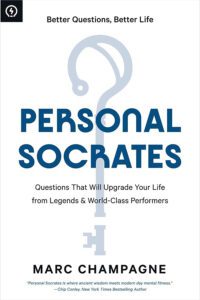
Personal Socrates: Questions That Will Upgrade Your Life from Legends & World-Class Performers
Cal Fussman for sure. Cal’s the opening chapter of the book for a reason. I didn’t put two and two together but you said a couple of lines about the conversation you have with Cal. I was like, “I listened to that episode.” It probably was when all this stuff was going around in my life. During those walks and gym sessions, I had podcasts in my ear very strategically picked. I wasn’t listening to long rambles on Joe Rogan. I was listening to stuff that I knew would be uplifting and motivating.
I sent a cold email to Cal because his shows were so motivating and are needed in that mental state that I was in. I asked him to come to the show and he agreed. It was one of those moments that I write about in his chapter. I’ll never forget this because I was still in that house in Toronto. I was at the kitchen table. I almost unplugged the fridge because I don’t want to make any noise. No one can see us but I’m in a podcast recording booth at this point. We’ve evolved a bit but I remember Cal shows up on the screen.
From someone that considers himself an interviewer or someone that wants to continue down that track, he’s one of the best. I remember I asked the first question and all I could think about was, “I’m going to mute the mic, shut the hell up and let him go.” That was a powerful moment. As the book started to materialize and I started to look at a mix of the people that I had interviewed that would be good for those chapters, Cal came to mind and full circle, which was a beautiful moment for me. I’m still very grateful for when I sent him the book, he invited me on his show and that hit the heart.
That’s a big moment. That show has had so many incredible people on it. To be in the same category has always been a thrill for me as well. Things are fantastic. Not only is the book a hit but companies are hiring you to come in and give mental fitness to their teams. Tell us what else is going on and who’s your ideal audience.
The team front is exciting. I wish I had this stuff when I was in sales or product management. I’m coming back to some of those companies I used to work at as a mental fitness strategist essentially and showing what’s possible. If I think of some of the things that I used to do putting together these brand strategies on these $100 million brands, I want my mind to be as clear, focused and thriving as possible so that I can think at my best, feel good and have a good time. That’s what these practices do.
For me, it’s a mix of showing, “Let’s take a look individually at your rituals and routines or how your days are structured and set up. Let’s first spend some time getting clear on where you’re at and where you want to be personal but also with your business and the brand. It’s no different. Let’s get intentional with, ‘If this is where you want to be.’” It’s like when I was left with the question, “What do you want for your life?” “If this is where I want it to be, then what do I need to do? How do my habits, systems and my calendar support that journey?” Lots of times when we slow down to look, we’re almost self-sabotaging.
[bctt tweet=”When the mind stops working, so does the business and the brand.” username=”John_Livesay”]
It’s almost like if you use the analogy of, “I want to get physically fit, not only mentally fit,” I look at my calendar of activities, “Did I go swim, go to the gym or do anything physical? Did I stop at Amy’s Ice Creams three times a week? Did I order pizza twice a week? Is that the calendar of someone who’s into fitness?” Probably not. It’s the same for mental fitness. I love this so much.
Marc, you’ve given us so many quotes and questions. I can’t wait to share them all. “My full-time job was my mind,” has got to be one of my all-time favorite quotes from anyone who’s ever been between jobs. If people want to find out more about the book and you or hire you to come in and get the team mentally fit, where should they go?
Thank you so much. We could talk for hours so this was a treat. BehindTheHuman.com is my site and that’s the book, the podcast and all the details for the teams I’ve been working on. If you’re one of those teams, I’d love to chat with you. At the end of the day, when a mind stops working so does the business and the brand or whatever is around that. I feel that having gone through all of this, it almost feels like a moral obligation to get these practices out because they’re all accessible.
It’s only a matter of reaching people on the other side with a narrative that makes sense and is relatable. Why I keep the podcast running is because I always have new narratives, new stories and entry points. If you take the first step in your marathon or running training, all of a sudden, it becomes easier. You’re doing it intuitively. When we can train our minds like that, we feel good.
“When the mind stops working so does the business.” That’s the mic drop moment. Thanks again, Marc.
Thank you.
Important Links
- Personal Socrates
- Cal Fussman – Previous Episode
- Chip Conley – Previous Episode
- Behind The Human – Apple Podcasts
- Kyō
- Better Selling Through Storytelling Method Online Course
Wanna Host Your Own Podcast?
Click here to see how my friends at Podetize can help
Purchase John’s new book
John Livesay, The Pitch Whisperer
Share The Show
Did you enjoy the show? I’d love it if you subscribed today and left us a 5-star review!
- Click this link
- Click on the ‘Subscribe’ button below the artwork
- Go to the ‘Ratings and Reviews’ section
- Click on ‘Write a Review’
Love the show? Subscribe, rate, review, and share!
Join The Successful Pitch community today:
- JohnLivesay.com
- John Livesay Facebook
- John Livesay Twitter
- John Livesay LinkedIn
- John Livesay YouTube