

Top Storytelling Keynote Speaker Statistics: USA 2026
Posted by John Livesay in Research | 0 comments
A powerful story can inspire, motivate, and change the way people think, but only if it’s told by the right person. As organizations continue to invest in keynote speakers to create memorable event experiences, the factors that influence speaker selection have become just as important as the stories themselves.
To find out what 234,185 opinions of meeting planners in the US were about the top storytelling keynote speakers, we utilized AI-driven audience profiling to synthesize insights from online discussions over 12 months, ending on June 10th, 2026, to a high statistical confidence level. The results reveal what builds trust, drives booking decisions, and separates a compelling speaker from a truly memorable one.
Index
- 48% of meeting planners always book a storytelling keynote speaker for an awards ceremony or gala dinner, 45% always book a speaker for an association or trade industry summit and 1% often book for these events, 3% always book these speakers for team training or professional development days, 2% do so for annual sales kickoffs or company conferences, and 1% always book for leadership or executive retreats
- A storytelling keynote speaker’s social media presence and following is the most important factor for 44% of meeting planners when shortlisting speaker options, it’s a strong influence for 43%, and some influence for 3%, while past event testimonials and reviews are the most important factor for 2%, 6% agree these have a strong influence, and 2% say they have some influence over their shortlist decisions
- While storytelling keynote speaker’s signature topic or framework first captures 20% of meeting planners attention when looking at their profiles and 6% find this relevant, 18% first look for media appearances and press features, and 12% find this somewhat relevant, 21% are first captivated by credentials and corporate experience they find somewhat relevant, and 15% say that audience engagement style is an important factor, followed by 6% who feel the same about high profile client logos catching their attention, and 2% who see this as having partial relevance
- 52% of meeting planners evaluate a speaker’s fit before booking by checking references from similar events, 38% review their published content and books, 7% request a live discovery or chemistry call to gauge the connection, 2% read audience survey feedback, and 2%watch full-length keynote recordings to weigh up their suitability
- 48% of meeting planners assess a storytelling keynote speaker’s quality by the originality of their storytelling framework, 39% rely on audience feedback scores from past events, and 13% on stage presence in demo videos
- The breadth of options available is absolutely essential to 54% of meeting planners in their current keynote speaker provider, and 24% find this very important, while transparent and straightforward pricing is crucial for 6%, 8% find it very important, 1% very important, and 2% not important at all, while 3% cite an ongoing relationship beyond the event as absolutely essential for a provider
- The ability to customize content to their audience is somewhat important for 47% of meeting planners when making a final selection of storytelling keynote speaker, while it’s a strong influence for 12%, and another 12% find chemistry during the discovery call somewhat important. 5% feel the same about strong referrals from trusted peers, but 6% say this has a strong influence on their final decisions, followed by 9% who are influenced by a speaker’s reputation in their industry, and 7% who are swayed by proven ROI from past keynotes
- A virtual keynote via Zoom or similar platform is the ideal format for 89% of meeting planners, and it’s a good option for 2%, but it’s not 7%’s preference, while just 2% prefer a keynote followed by a breakout workshop as their chosen format
- 65% of meeting planners prefer to engage a storytelling keynote speaker directly through the speaker’s own website, 19% prefer to do so via a full-service speaker bureau, 14% prefer engaging with a speaker at a live showcase or preview event, 2% want to work through a preferred vendor list or RFP, and1% via a recommendation from a planner peer
- Building resilience through personal narrative is the storytelling theme that is somewhat relevant to 52% of meeting planners’ audiences, and winning clients through persuasion and pitch is somewhat relevant for 22%, while 14% find leadership storytelling for culture change somewhat relevant, but 11% don’t find this theme very relevant
- 83% of meeting planners work in organizations that fall under financial services and insurance, 15% are in healthcare and life sciences, and 2% in real estate and construction; all of these industries are very people-and worker-centric
- 40% of meeting planners are based in Chicago, 28% in Austin, 24% in San Francisco, 7% in New York City, and 2% in Los Angeles, creating a spread across major business hubs
- The story doesn’t end with the keynote
- About the data
What events do meeting planners commonly book a storytelling keynote speaker for?
48% of meeting planners always book a storytelling keynote speaker for an awards ceremony or gala dinner, 45% always book a speaker for an association or trade industry summit and 1% often book for these events, 3% always book these speakers for team training or professional development days, 2% do so for annual sales kickoffs or company conferences, and 1% always book for leadership or executive retreats.
Two types of events dominate speaker bookings:

Meeting planners’ online discussions about storytelling keynote speakers are heavily focused on celebratory, high-profile business events.
Awards ceremonies and gala dinners generate the most conversation, with 48% of meeting planners indicating that they always book storytelling keynote speakers for these events. Association and trade industry summits follow closely behind, with 45% always booking a storytelling speaker for these events, while a further 1% often do so. These two event categories dominate the conversation due to the strong connection between storytelling and audience engagement at large gatherings.
Other event types attract considerably less attention. 3% of our audience always books storytelling keynote speakers for training or professional development days, while 2% book for annual sales kick-offs and company conferences. Leadership and executive retreats generate the smallest share of conversation, with 1% of meeting planners always booking storytelling keynote speakers.
This suggests that storytelling speakers are most closely associated with events designed to inspire, celebrate achievements, or bring large groups together, but that they also have a place in smaller, more intimate settings.
What influences meeting planners’ shortlisting decisions when finding a storytelling keynote speaker?
A storytelling keynote speaker’s social media presence and following is the most important factor for 44% of meeting planners when shortlisting speaker options, it’s a strong influence for 43%, and some influence for 3%, while past event testimonials and reviews are the most important factor for 2%, 6% agree these have a strong influence, and 2% say they have some influence over their shortlist decisions
Shortlisting depends on various factors:

Online visibility dominates the discussion around how meeting planners shortlist storytelling keynote speakers. Social media presence and following account for the overwhelming majority of conversation, with 44% of our audience viewing it as the most important factor, 43% describing it as a strong influence, and 3% associating it with some influence. Mentions of social media being unimportant are almost non-existent, at less than 1%. The scale of this conversation reinforces the value placed on a speaker’s digital profile, audience engagement, and ability to build recognition beyond the stage.
Other influences generate far less attention. Past testimonials and reviews account for 2% of discussions around the most important factor, while 6% focus on them as a strong influence, and 2% as having some influence. A speaker’s published book or broader thought leadership attracts only a negligible share of conversation, with less than 1% considering it the most important factor.
A strong focus on being visible online
A 2023 consumer poll highlights the growing importance of online brand recognition when evaluating speakers, indicating that 90% of people support brands they follow on social media platforms such as TikTok, Facebook, and Instagram. Additionally, more than half (53%) of the consumers surveyed indicated an increased likelihood of supporting a business accessible through social media platforms.
Active social media platforms provide a window into a speaker’s personality, communication style, and audience connection, making it easier for planners to assess relevance and credibility before adding a candidate to their shortlist.
What aspect of a storytelling keynote speaker’s profile captures meeting planners’ attention?
While storytelling keynote speaker’s signature topic or framework first captures 20% of meeting planners attention when looking at their profiles and 6% find this relevant, 18% first look for media appearances and press features, and 12% find this somewhat relevant, 21% are first captivated by credentials and corporate experience they find somewhat relevant, and 15% say that audience engagement style is an important factor, followed by 6% who feel the same about high profile client logos catching their attention, and 2% who see this as having partial relevance.
Meeting planners’ attention is captured by a mix of a storytelling keynote speaker’s expertise, relevance, and presentation. Conversation is strongest around a speaker’s signature topic or framework, with 20% identifying it as an important factor and a further 6% viewing it as somewhat relevant.
Media appearances and press features also attract significant attention, generating 18% of conversation around important factors and 12% around somewhat relevant considerations. Meanwhile, credentials and corporate experience account for 21% of the discussion in the somewhat relevant category, indicating that professional background remains firmly on planners’ radar during the evaluation process.
Audience engagement style is identified as an important factor by 15%, emphasizing the value placed on a speaker’s ability to connect with a room and deliver memorable experiences.
Research shows that the presence of recognized client brands on a website can help reinforce credibility and trust by up to 70%, making them a valuable inclusion. However, amongst our audience, the display of high-profile client logos on a speaker’s profile isn’t a major talking point: just 6% agree they are an important factor in catching their attention at first, and 2% say they are somewhat relevant.
While reputation markers matter, meeting planners are clearly most interested in what a speaker talks about, how they communicate it, and whether their expertise aligns with the event’s goals.
How do meeting planners evaluate a storytelling keynote speaker’s fit before booking?
52% of meeting planners evaluate a speaker’s fit before booking by checking references from similar events, 38% review their published content and books, 7% request a live discovery or chemistry call to gauge the connection, 2% read audience survey feedback, and 2%watch full-length keynote recordings to weigh up their suitability.
When evaluating whether a storytelling keynote speaker is the right fit, meeting planners are heavily focused on proven performance in comparable settings. Checking references from similar events accounts for 52% of the conversation, making it the most frequently mentioned approach by a considerable margin.
Reviewing published content and books follows at 38%, highlighting the importance of understanding a speaker’s ideas, expertise, and communication style before making a booking decision. These two methods dominate the discussion, suggesting that meeting planners place significant value on evidence of experience and thought leadership.
Other evaluation methods attract far less attention. 7% of our audience requests a live discovery or chemistry call before booking, indicating that direct interaction plays a role, though it is not discussed as often as reviewing existing materials. Only 2% read audience survey feedback, while watching full-length keynote recordings generates just 1% of mentions.
This points to a preference for assessment tools that are easy to access and compare across multiple candidates. References and published content provide a clear picture of a speaker’s track record and perspective, helping planners build confidence in their decision before moving forward with a booking.
How do meeting planners assess storytelling keynote speaker quality?
48% of meeting planners assess a storytelling keynote speaker’s quality by the originality of their storytelling framework, 39% rely on audience feedback scores from past events, and 13% on stage presence in demo videos.
Speaker quality assessment relies on three main points:
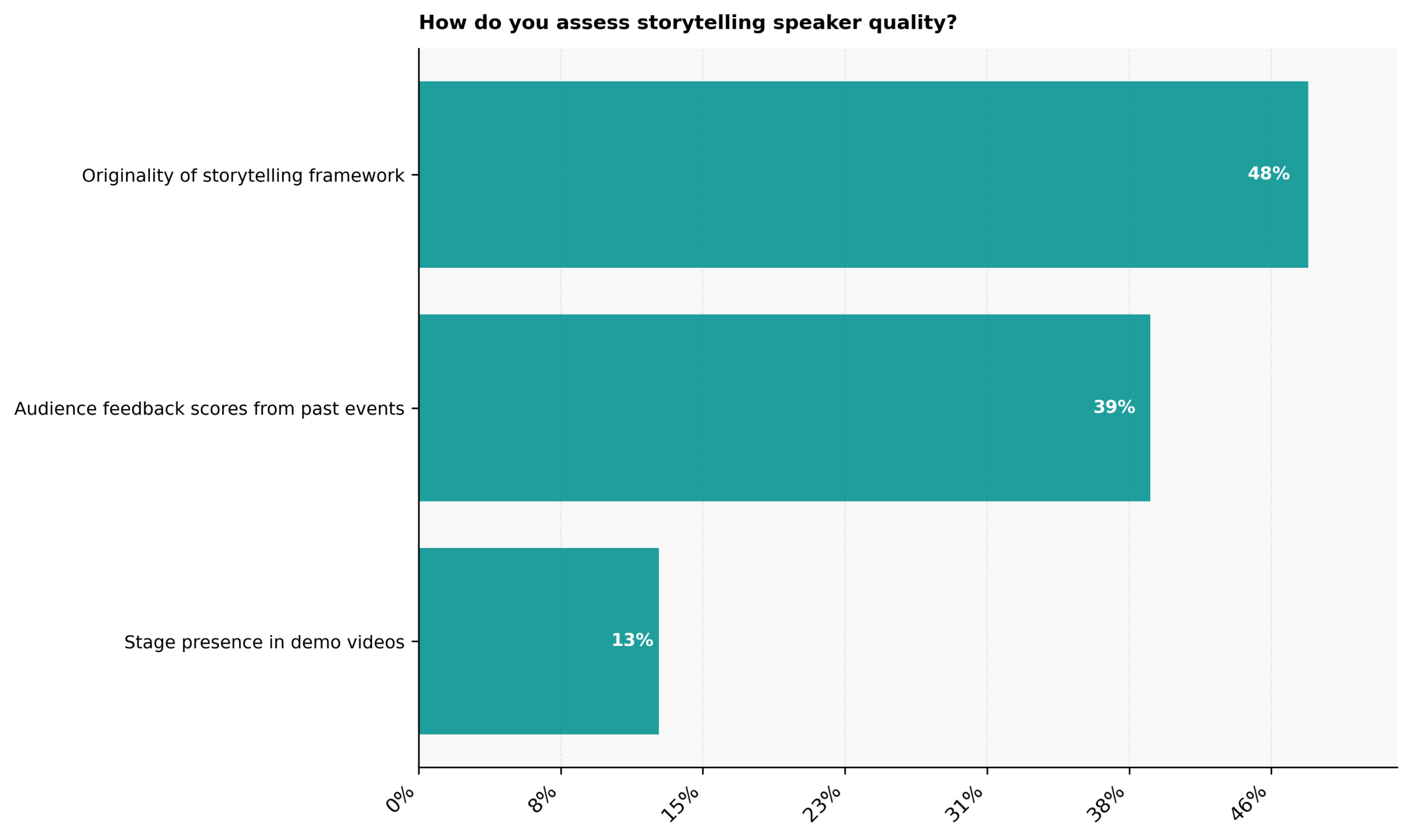
Storytelling speaker quality is largely measured by the strength and originality of a speaker’s storytelling framework. Nearly half of meeting planners (48%) cite this factor as the most frequently referenced indicator of quality. The volume of attention suggests that meeting planners place significant value on speakers who bring distinctive ideas, fresh perspectives, and memorable narrative structures to their presentations.
Audience feedback scores from past events are used by 39% to assess speaker quality, which shows the importance of demonstrated audience engagement and real-world reception. Stage presence in demo videos accounts for 13% of the conversation, proving that presentation style remains relevant but attracts less attention than content and proven impact.
The ability to tell compelling stories is often viewed as a powerful communication and leadership tool that can build credibility, inspire action, and make complex ideas more memorable, which may explain why framework quality and audience feedback stand out so much with our audience.
What do meeting planners value most in a storytelling keynote speaker provider?
The breadth of options available is absolutely essential to 54% of meeting planners in their current keynote speaker provider, and 24% find this very important, while transparent and straightforward pricing is crucial for 6%, 8% find it very important, 1% very important, and 2% not important at all, while 3% cite an ongoing relationship beyond the event as absolutely essential for a provider.
Current providers need to deliver in key areas:
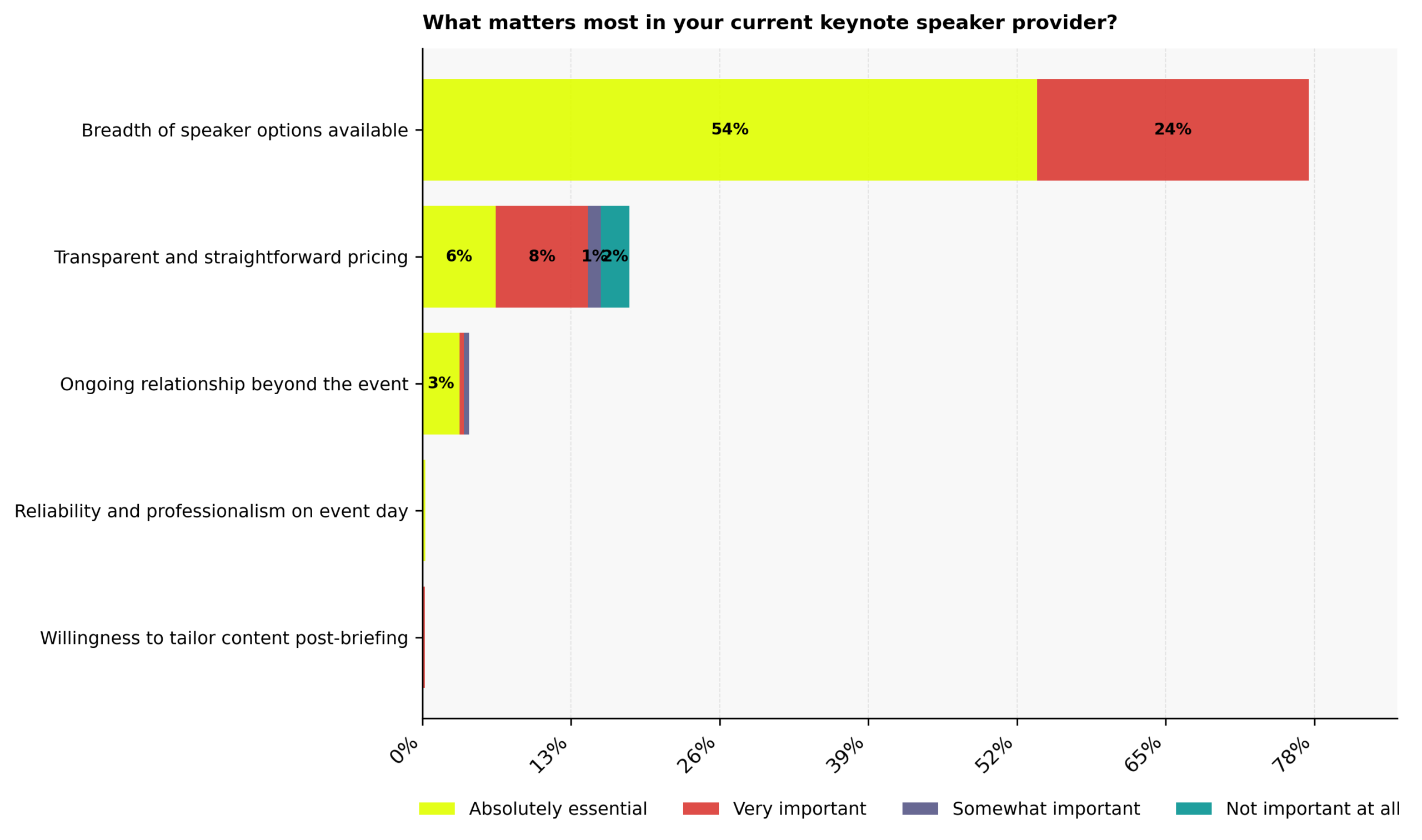
Conversations about keynote speaker providers are overwhelmingly focused on the breadth of speaker options. 54% of meeting planners rate this as an absolutely essential factor for their current provider, and 24% as very important, making it a dominant consideration by a wide margin. This concentration of discussion makes it clear that access to a diverse speaker roster is a priority, allowing planners to find the right fit for different audiences, themes, and event goals.
Other factors attract modest levels of attention. Transparent pricing is rated as absolutely essential for a keynote speaker provider by 6%, very important by 8%, somewhat important by 1%, and not important at all by 2%. Ongoing relationships beyond the event account for 3% who say it’s absolutely essential, with less than 1% agreeing it’s very important, and fewer than 1% who find it somewhat important.
Reliability and professionalism on event day, and the willingness to tailor content post-briefing, didn’t garner any opinions, as there’s a definite preference for choice and flexibility above all other provider attributes.
What drives meeting planners’ final selection of a storytelling keynote speaker?
The ability to customize content to their audience is somewhat important for 47% of meeting planners when making a final selection of storytelling keynote speaker, while it’s a strong influence for 12%, and another 12% find chemistry during the discovery call somewhat important. 5% feel the same about strong referrals from trusted peers, but 6% say this has a strong influence on their final decisions, followed by 9% who are influenced by a speaker’s reputation in their industry, and 7% who are swayed by proven ROI from past keynotes.
Drivers behind final decisions differ somewhat:

When choosing a storytelling keynote speaker, audience relevance takes center stage. 47% of meeting planners consider the ability to customize content somewhat important, 12% agree it strongly influences their final decision, and less than 1% cite it as a deciding factor. The prominence of personalization reflects the value many meeting planners place on presentations that feel directly relevant to their audiences, especially as personalized events can encourage emotional connections, helping audiences feel understood and valued.
Other considerations attracted lower but still notable levels of discussion. Chemistry during the discovery call is somewhat important for 12%, while fewer than 1% view it as not a factor in making a final selection. Strong referrals from trusted peers strongly influenced 6% and 5% rated this as somewhat important.
At the lower end, discussions about the speaker’s reputation in the industry drew attention from just 1% who said it was a strong influence and 8% who viewed it as somewhat important. Proven Return on Investment (ROI) from past keynotes attracted 7% of discussion as somewhat important, while fewer than 1% considered it not a factor. These insights point to a clear preference for tailored content, with referrals, reputation, chemistry, and demonstrated results playing supporting roles.
What format do meeting planners prefer for a storytelling keynote?
A virtual keynote via Zoom or similar platform is the ideal format for 89% of meeting planners, and it’s a good option for 2%, but it’s not 7%’s preference, while just 2% prefer a keynote followed by a breakout workshop as their chosen format.
Virtual keynotes are by far the most preferred:

Discussion around storytelling keynote delivery is heavily concentrated on virtual formats. For 89% of meeting planners, a virtual keynote delivered via Zoom or a similar platform is the ideal format. A further 2% views virtual delivery as a good option, while 7% indicate it is not their preference.
The prominence of this format reflects the widespread adoption of online event technology, with Zoom maintaining a leading position (55.91%) in the global conferencing market and serving over 300 million users worldwide.
Alternative formats attract far less attention. Just 2% of discussions identify a keynote followed by a breakout workshop as the ideal format. As online communication continues to play a central role in professional events, planners appear to value formats that make it easier to connect speakers and audiences regardless of location.
How do meeting planners prefer to engage a storytelling keynote speaker?
65% of meeting planners prefer to engage a storytelling keynote speaker directly through the speaker’s own website, 19% prefer to do so via a full-service speaker bureau, 14% prefer engaging with a speaker at a live showcase or preview event, 2% want to work through a preferred vendor list or RFP, and1% via a recommendation from a planner peer.
How meeting planners prefer to engage a storytelling keynote speaker is strongly concentrated on direct digital access. 65% of meeting planners want to engage with a storytelling keynote speaker directly through their own website. This indicates a preference for streamlined, first-hand discovery where planners can review content, positioning, and availability in one place.
Other engagement routes generate significantly lower discussion. Full-service speaker bureaus represent 19% of mentions, reflecting continued reliance on curated intermediaries. Live showcases or speaker preview events account for 14%, indicating the value placed on seeing speakers in action before making booking decisions.
Preferred vendor lists or Request for Proposal (RFP) processes account for just 2% of the conversation, while peer recommendations from other planners account for 1%. Overall, there’s an obvious leaning toward direct engagement channels, likely driven by efficiency, transparency, and the ease of comparing speaker profiles and content online when making shortlist decisions.
Which storytelling theme resonates most with meeting planners’ audiences?
Building resilience through personal narrative is the storytelling theme that is somewhat relevant to 52% of meeting planners’ audiences, and winning clients through persuasion and pitch is somewhat relevant for 22%, while 14% find leadership storytelling for culture change somewhat relevant, but 11% don’t find this theme very relevant.
Not all themes resonate the same: 
Conversations around storytelling themes reveal a clear preference for messages centered on resilience and personal growth. For 52% of meeting planners, the storytelling theme that resonates most with their typical audience and is always somewhat relevant is one that focuses on building resilience through personal narrative. The prominence of this theme reflects the continued interest in navigating change, uncertainty, and professional challenges. Leadership research from ResearchGate highlights resilience and adaptability as valuable qualities in modern organizations, which helps to explain why stories of overcoming obstacles continue to resonate so strongly.
Other storytelling themes attracted more moderate levels of attention. 22% of our audience agrees that winning clients through persuasion and pitch is a topic that’s always somewhat relevant, indicating ongoing interest in practical communication and business-development skills.
Leadership storytelling for culture change generated a more mixed response, with 14% viewing it as somewhat relevant and 11% considering it not very relevant. Based on these opinions, meeting planners are particularly drawn to storytelling topics that feel personally relatable, while leadership and sales-focused narratives remain relevant but appeal to more specific audience interests.
Which industry best describes meeting planners’ organizations?
83% of meeting planners work in organizations that fall under financial services and insurance, 15% are in healthcare and life sciences, and 2% in real estate and construction; all of these industries are very people-and worker-centric
Industries are split into three categories:
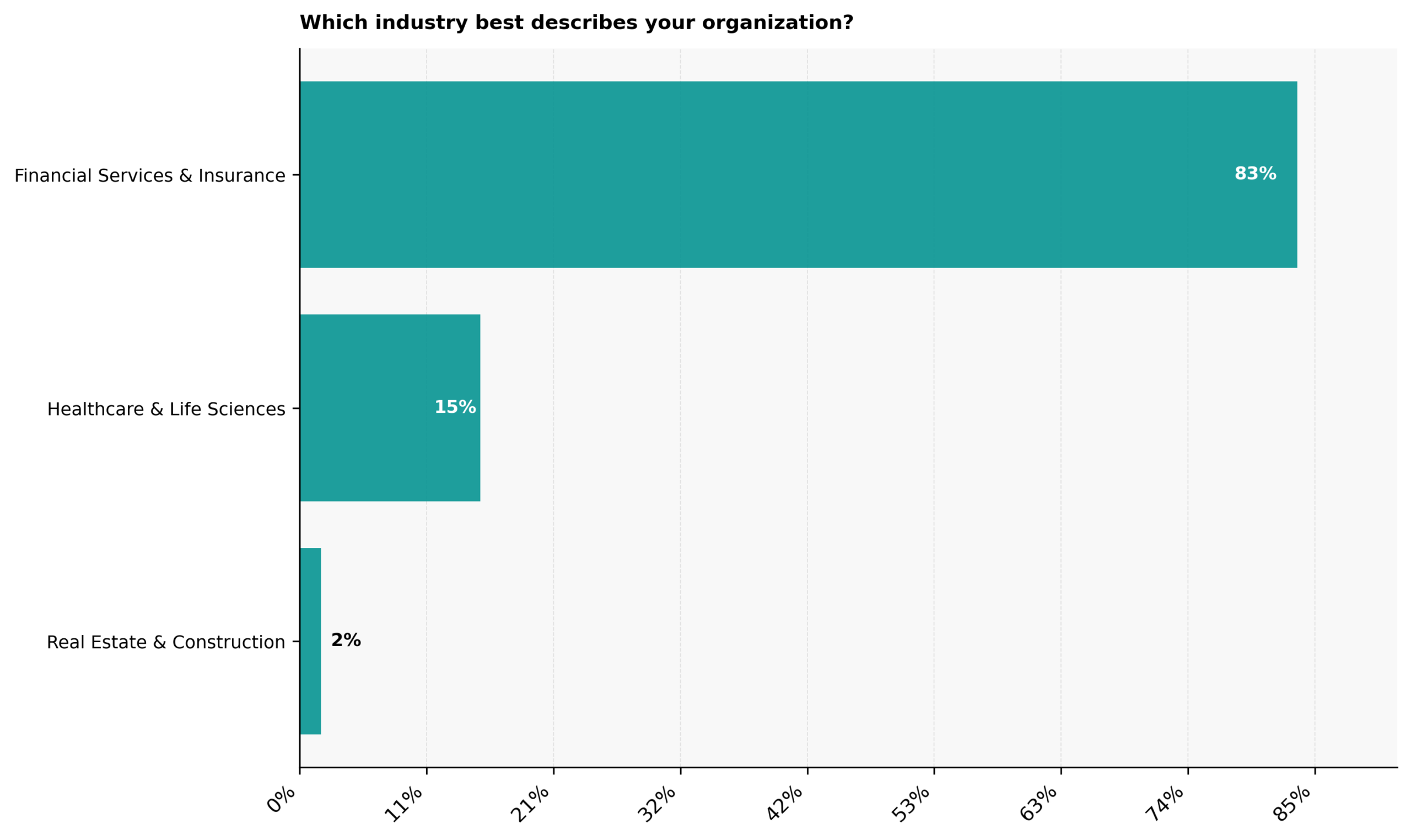
For 83% of meeting planners in our audience, the financial services and insurance industry best describes their organization. This strong presence of financial organizations is not unusual, given the consistent annual growth and current scale of the sector in the United States. Over 8.6 million people are employed in finance and insurance as of 2026, and this large ecosystem naturally creates substantial demand for conferences, meetings, and keynote presentations.
In contrast, 15% of meeting planners work in healthcare and life sciences organizations, establishing it as the second most visible industry group. Real estate and construction represented a smaller share at 2%. While the latter sectors attracted less attention, their presence reinforces the broad appeal of storytelling-focused keynote presentations across different professional environments.
Which city are meeting planners based in?
40% of meeting planners are based in Chicago, 28% in Austin, 24% in San Francisco, 7% in New York City, and 2% in Los Angeles, creating a spread across major business hubs.
Chicago takes the lead for meeting planners:
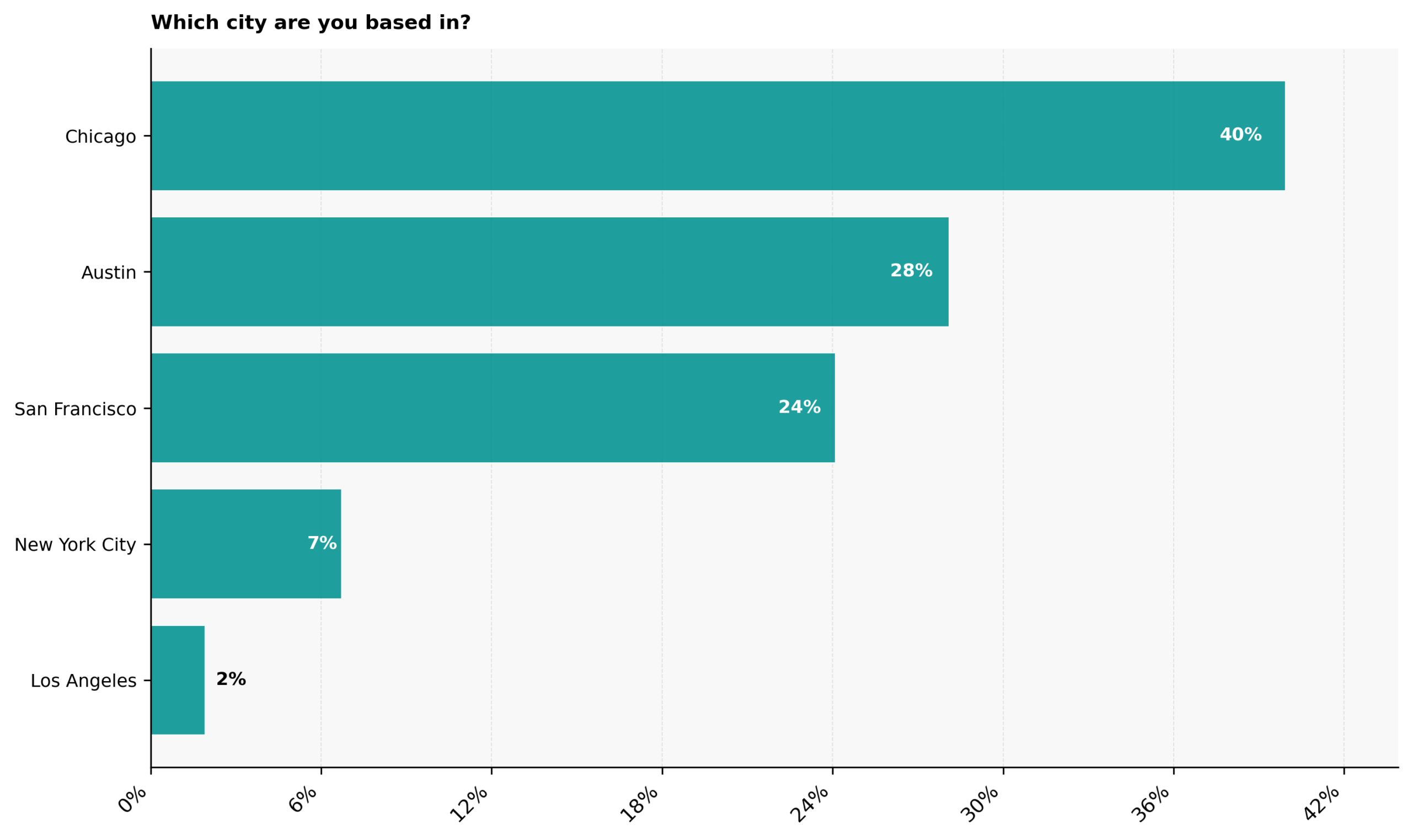
A small number of major business and events hubs emerged as the locations where our audience of meeting planners is based. Chicago accounted for the largest share at 40%, well ahead of other cities. Austin followed with 28%, while San Francisco accounted for 24%.
A further 7% of our audience is based in New York City, while 2% are in Los Angeles. Although these shares were smaller, they demonstrate that interest in storytelling-focused events extends across several influential metropolitan areas.
The story doesn’t end with the keynote
These opinions reveal that meeting planners are looking for substance as much as stage presence. They want speakers with a clear point of view, a credible track record, and stories that feel relevant to their audience rather than a one-size-fits-all performance.
A great storytelling keynote is designed to do more than hold an audience’s attention for an hour. The most successful speakers create ideas that spark conversations, reinforce event themes, and leave attendees with messages they can apply long after they leave the room.
Explore John’s storytelling keynote for sales teams and the reasons planners hire him for an event with lasting takeaways.
About the data
Sourced using Artios from an independent sample of 234,185 opinions of meeting planners in the USA across X, Quora, Reddit, Bluesky, TikTok, and Threads. Responses are collected within a 95% confidence interval and 5% margin of error. Results are derived from what people describe online, from opinions expressed, not actual questions answered by people in the sample.
Book John for your sales kickoff
Planning a sales kickoff? Bring John Livesay’s Revenue Rockstar keynote to your team. Ask about booking John.