

Chasing Failure With Ryan Leak
Posted by John Livesay in podcast | 0 comments

While most people try to steer away from obstacles to avoid failure, there are those who go straight at them. And most of the time, these are the successful people. They have figured out that the path to success is to chase what others are afraid of: to fail. In this episode, Ryan Leak, the author of Chasing Failure, shares some lessons he has learned from failure and how it has helped him succeed. Looking at it from a psychological standpoint, he discusses how the fear lies in shame and embarrassment. Take a pause for a moment today and try to look at your biggest obstacles as the greatest opportunity to succeed. Tune in to this inspiring conversation as Ryan gives us a new perspective on what it takes to succeed.
—
Listen to the podcast here
Chasing Failure With Ryan Leak
Our guest on the show is Ryan Leak, the author of Chasing Failure. In this episode, he talks about how there is no version of your life that is not risky, so you might as well take some risks that follow your dreams and that you can’t get better if you don’t get started. Enjoy the episode.
—
Our guest is Ryan Leak, who is an executive coach, author, filmmaker, and motivational speaker that trains over 15,000 leaders and speaks to over 200,000 people each year. He teaches leaders how to solve problems that keep them from winning in life and business. He’s known as an ultimate risk-taker from his two documentaries, The Surprise Wedding and Chasing Failure. His most recent project is Chasing Failure, where he went on a journey to conquer his fear of failure by trying out for the Phoenix Suns. Through his books, films, and keynotes, Ryan gives organizations the tools they need to see their biggest obstacles as their greatest opportunities. Ryan, welcome to the show.
John, it is an absolute pleasure to be on your show. We got to connect a few months back, and I am super excited to chat with you.
One of the things that grabbed me when I first met you was your energy. I watched your speaking videos and thought, “Here’s an example of someone being completely authentic on and off the stage.” That is not always the case, whether you’re a speaker or an entertainer. I know a lot of people were sometimes surprised by certain talk show hosts not being the same person they were on the show as they were off stage. I want to talk about authenticity. Before we get into that, let’s talk about your story since this is all about the successful pitch and how to tell your story in a way that makes you memorable. You can go back to childhood or school. Where did you get the idea that this is the career you wanted?
My dad was a pastor, and he had a stroke when I was in fifth grade. I was super young, so I had to grow up pretty independent. I looked at my mom and said, “Keep dad alive. I’ll figure everything else out,” type of deal. I felt like I became an entrepreneur in sixth grade. I felt like I had to do that not to succeed but to survive. Throughout all of that, I noticed that whenever I was asked to speak or if I was asked for advice, it went well. It was one of those things where the way I view communication, speaking, and conversations are I’m always looking to serve the other person, and how can I add value to somebody else’s life.
What I learned is that whether it’s through consulting, coaching, or speaking, I learned that the way that I felt like I could add the most value to the world around me was through communication. That was a craft that even to this day, I would go, “I’m a good speaker.” Now, I would go, “I’m a dedicated and motivated speaker.” That so happens to be a book. For me, I don’t wake up going, “I got this.” I wake up every morning going, “How can I get better? How can I fine-tune some things in order to add value to people that are listening or watching?”
That’s a key thing for everyone, no matter where you are in your career. There’s this phrase that I used to have when I was in college, which was, “As soon as this happens, I’ll be happy. As soon as I graduate, as soon as I get out of the cold weather, as soon as I have this job, this car, house, or whatever.” It’s a very elusive way of not being in the present moment, but this thing you said, Ryan, is particularly interesting.
A lot of people think, “As soon as I get to this level, then I can take the foot off the accelerator and coast through the rest of my life and not have to learn anything new or make anything better. Good enough is good enough, and I’ll be fine.” The irony is it’s not a very satisfying way to live. Great athletes and actors are constantly working on their craft. For a lot of people who aren’t aware of speaking as a craft, you’re certainly someone who could speak to that. Do you look at footage of yourself like an athlete does?
I work with a few different NBA teams, and I very much relate to them more than any other industry in terms of the amount of travel, sleeping in different places in different cities and different time zones, what you put your body through, and all of those things. I’m not running on a court, but the travel does take a toll on you physically. Also, having to be on at a very high level.
I very much approach it how someone might approach it in an athletic competition. I’m watching the footage in real-time, taking notes on what didn’t work or what was working. I’m always trying a new story, illustration, or joke. Sometimes I’ll say something on accident that people think is hilarious, and I went, “That’s interesting.” There are some times when I tell a joke that I think is hilarious, that nobody thinks is funny.
It doesn’t land. This is an interesting topic. I had the same experience when I was talking with somebody, “I read this research that taking a cold shower burns fat, fights depression, and reduces inflammation.” I go, “You had me at burns fat,” and he started laughing. I thought, “I wasn’t trying to be funny. I was just being me.” I wonder if an audience would think that’s funny.
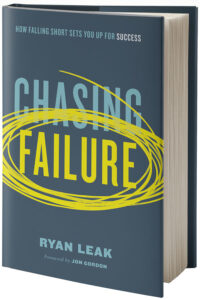
Chasing Failure – https://www.ryanleak.com/chasingfailure
I tested it, and they laughed. I’m like, “All right,” but sometimes the audience doesn’t laugh, and you’re like, “How bizarre is that?” Is it because of the time of day? Is it the delivery? What are your thoughts on that? If something’s funny 90% of the time, but not 10% of the time. Stand-up comics and Jerry Seinfeld is constantly refining what he does. What do you think is the reason? Should you throw it out then, or do you go, “No, this usually works?”
What I try to do is what I call my first base jokes. They’re jokes that I don’t you to be falling out of your seat laughing. I only need to know, “Do you smile?” Where are we at? Are we a target group? Are we a Walmart group? If you’re doing an event in Boston versus Atlanta, it’s two completely different mindsets about the world. There’s Southern hospitality in Georgia. There’s a natural emotional response to speakers that you’ll get in the South.
I went to Boston 4 or 5 times in 2022. Every time I landed there, the Uber driver was pissed off from the jump. If there’s a Southern hospitality, I call it sometimes a Northern pissivity. There’s a little bit of an edge already that you have to earn their respect a little bit more. I usually will kick off with things that don’t need to be funny, but let’s just see where their humor is and where everybody’s at. I’m always trying new things, trying to add, and trying to get better.
Your book Chasing Failure is a topic I want to talk about because so many of us feel like we focus on what doesn’t work the one time. If things work 9 times out of 10, but it didn’t work one time, then here’s where I see, myself included. I had to stop this behavior, which is all the way back to school. If I didn’t get an A and I got a C or something, I must be a failure. I’m a loser. Am I a great speaker if the audience didn’t laugh as much as they normally do?
I’m curious to see if you have this experience. Maybe you’re thinking, “I don’t know. This is going okay. It’s not going great. I’ve had to have the audience be a lot warmer.” You then get off stage, and people come up to go, “I loved what you said.” You’re like, “Somebody liked it out of the 500 people or whatever it was.” We can’t judge ourselves on what we’re experiencing at the moment. Is that what you’re saying?
Absolutely. Think of it like this. Somebody sends you a link to something funny. It’s a video. It’s an Instagram clip. It’s a meme. You might respond with a crying laughing emoji but you’re not. You’re like, “That’s funny,” in real life, but on text, you’re the furthest thing from crying or laughing. That’s what audiences are doing sometimes. We have to give ourselves some grace. Sometimes they’re going, “That was pretty funny,” but there’s no noise.
I did an event for a company where I spoke to 500 of their employees, and then they did two breakouts where they split the group in half and said, “Ryan, you’re going to speak to the whole group at 9:00, and then you’re going to speak to half of the group at 11:00. We’re going to break from lunch, and then you’ll speak to the second half at 1:00.” It’s pretty simple. I get my baseline by speaking to everybody in the morning. I go to that first half and a different talk, but that room was rocking. I’m like, “I know these people. I’ve spent the day with them.” I did the same talk at 11:00 that I did at 1:00. It flopped at 1:00, and it crushed at 11:00.
This is so valuable for everyone to read.
It’s the exact same slides, one room falling over laughing at some of the stories. There is some research out there that says after people have had lunch, they’re in that mode. A client will say, “What time do you want to speak?” I’m like, “I’ll speak whenever.” All time slots are not created equal. There are times when you’re the first thing in the morning at 7:30. I’m speaking. I’m doing a diversity, equity, and inclusion breakfast at 7:30 AM.
You have to prepare a little bit differently than your normal 10:00 AM keynote. One of the things that I have to tell myself before I speak is to make sure that I have fun, even if nobody else does. Enjoy the fact that you are one of the very few people on the planet that get an opportunity to talk for an hour and get paid for it. That’s amazing. I never let that leave me. I’ve never arrived. I’ve never like, “You all owe me this.” This is a privilege that I have, and I tell a lot of my professional athletes that too. I go, “Just in case you forget, you’re paid to play a game.”
[bctt tweet=”Make sure you have fun, even if nobody else does.” username=”John_Livesay”]
This is a dream very few people get to achieve.
Imagine somebody walking up to you and going, “Do you want to play Monopoly? We’re going to pay you to play Monopoly.” That’s your life. I feel the same way when it comes to speaking. I pinch myself every day to go, “I can’t believe I get to do this and get to add value to people’s lives.” Whether there’s a standing ovation or not, I say, “I want to make sure that at least I have a good time. I enjoy the fact that I get to be here and try to help people.” I am not trying to impress you. I am trying to help you go to the next level.
When I keep that at the forefront, then I’m not looking for affirmation from the audience anymore. I’m trying to help them. It positions you differently. Your countenance is different. One of the largest insurance companies in the world was having me speak. One of the questions I asked in pre-event calls is I say, “Who have you spoken to before that you love and why? Who have you had in the past? You don’t have to say their name, but I want you to tell me what they did that made you say we’re never going to have them again.”
I always like to make sure I don’t step on a landmine. This insurance company says, “The best figure we’ve ever had was Doc Rivers.” I was like, “Doc Rivers is a well-known NBA coach. That’s great.” It’s not a crazy surprise, but then I said, “Why was he the best figure you’ve ever had?” They said, “He was agendaless.” I thought, “Agendaless isn’t even a word.” However, it changed my approach to even how I work with clients going, “This next hour is not the Ryan show. It’s not about me. In fact, my only agenda is to help you.”
Here’s the interesting thing. Doc Rivers never used the word, “I’m agendaless.” It can be felt. There is something about a stage presence where people can feel when a speaker is trying to impress them versus going, “I’m here to talk about failure, and here’s what I realize about you. Sometimes it holds you back. Now, I’m going to help you reframe how you’ve seen this thing that has terrorized your career before.”
Right away, there is a difference, authority, and command of the room, “I don’t need you to like me. I want to help you overcome something in your life that’s holding you back. I’m going to tell you about some things that have happened in my life on how failure gave me a whole career. I keep trying to fail something every single day, and it has revolutionized my business.”
From there, you are more in command because you’re not trying to win them over. It’s like, “I’m trying to help you solve a problem.” When that’s the forefront of your brain, it’s amazing how relaxed and funnier you are because what you’re doing is you’re taking everyone’s guard down a little bit of going, “This guy’s a real guy. He’s an authentic guy. He’s not trying to sell me something right now.” I literally will watch people in the audience go from a folded arms position to a relaxed position.
The best I can ever get is when someone would come up to me after the talking, “I usually don’t pay attention to somebody talking that long. I’m on my phone or my mind wanders but those stories kept me engaged.” I’m like, “Great.” This concept of being agendaless is another version that is not being attached to whether someone likes us or what the outcome is. As you said, I’m not going to let my self-esteem go up and down based on whether I get a standing ovation or not.
No matter what your career is, do I need my boss to give me a rave review on my annual review, or do I know I did a great job or all those constant outside things that can make you feel less than others? This concept around chasing failure is interesting because most people, as you said, are terrorized by it, which is a great word. Why would I ever chase something that terrorizes me?
Can you tell us some of the lessons that are in the book that would get someone to go from, “If I ever meet a saber-toothed tiger, I’m running the other way, and I don’t care what you say?” This is not that kind of fear. This is fear of failure. Is it because we’re so in our heads, worried about what people think of us?

Chasing Failure: When you look at the fear of failure from a psychological standpoint, it’s really the fear of shame and embarrassment.
There’s a lot that goes on with that. When you look at the fear of failure from a psychological standpoint, it’s the fear of shame and embarrassment. What I’ve found is that there’s typically a particular person or group of people that we want to impress, somebody that we don’t want them to see us fail. It means that they were right. It means that our ex-girlfriend or ex-boyfriend will go, “Yes. I made a good decision.”
There is something underneath the hood of going, “If I fail, there’s somebody that’s watching, or at least, I think that they’re watching.” If they knew how this story ended, that’s what I’m afraid of. How I guide people through getting past this fear of putting themselves out there is a couple of things. One, every single person we look up to, admire, and read about has all failed.
We don’t realize that. We think, “This person’s always had success after success after success. Everything they touch turns to gold,” which is not true.
We have to dismantle the story we tell ourselves about other people that we watch their lives online. It’s not true. I’ll prove that it’s not true. I have a family photo. I’m on Zoom quite a bit. People are like, “What a beautiful family you have there. That’s great.” This is not indicative of how the day went at all. It was one of the worst days of our life. One of the kids was throwing up tons of stuff.
This was the only one picture of the thousands that we were taking that day because he was just trying to find one good photo and trying to get them in matching outfits and whatever, yet people will get my Christmas card and think, “What a beautiful family. This is how it always is.” It’s like, “No. That’s never how it is.” We can’t get them to sit on the couch for two seconds. If we’re honest, we don’t ever post our true story anyways. We post our very best and hide the rest. Everyone’s doing that. For you to be a failure, you have to deem somebody else successful. Why do you deem them successful?
It’s because of what they posted or because of what they showed you, but they won’t show you their pain. They won’t show you their scars, and oftentimes, they won’t show you their failures. What I started doing is I started showing people my behind-the-scenes. I started sharing about the different failures that I experience on a daily basis where I completely whipped it with a pre-event call or a sales call or completely lost a client. It’s like, “We won’t share that on LinkedIn, but it’s true. It happened all the time.” We’ve got to dismantle this belief that there’s somebody successful, that’s how I view success, and there’s me over here. It’s because usually, for us to be a failure, we have to be a failure compared to somebody else.
It’s a frame of reference.
We first have to navigate that. The second thing that is vitally important is whenever you’re thinking about trying something new or putting yourself out there, there’s no version of your life that is safe. There’s no version of your life that isn’t risky. Some people think, “I’m going to take my ball and play it safe in the corner. I’m going to do my 9:00 to 5:00.” Salesforce just laid off 8,000 people.
Companies are laying off thousands of people at the same time, and you’re going, “I thought you said it was safe.” Tell me, what is safe? I know so many people that have degrees from Stanford, Harvard, and Princeton that aren’t looking for jobs. Someone, please show me the safe route. I’ve yet to see it. The average CEO tenure is five years.
With CMOs, it’s eighteen months.
[bctt tweet=”If you learn from a failure, then you are not failing.” username=”John_Livesay”]
If you’re telling me, “My goal is to get here, and then I will feel secure,” that’s not a secure job. If you’re talking about doing it at a publicly-held company, good luck, buddy.
Look what happened at Disney. Bob Iger leaves, and then they promote somebody up. In less than two years, Bob’s back, and you’re out. Imagine that guy’s mindset.
I tell people, “There’s no version of your life that isn’t risky.” If there’s no version of your life or career that isn’t risky, you might as well do something that moves you toward your dreams. The other thing that is vitally important to understand about failure is you got to learn from it. If you are learning from your failures, you’re not failing. As long as you are taking notes on your failures, you are winning.
If you continue to fail the same way twice, you are just not taking notes. You’re not paying attention. You shouldn’t fail the same way twice. You should be tweaking something, a different angle, or something. The other thing that I write about in the book is as motivational speakers, we’re supposed to tell people to never give up. That’s terrible advice, especially if you’re talking to 1,000 people.
There are people that definitely should give up. We’ve seen them on American Idol. We’ve seen them on The Voice, and we went, “Somebody told you to never give up, but they should have told you instead to say, ‘Let’s see what some of these failures can teach us not to do.’” Again, you’re still learning. There are some things that I went, “Maybe I could. In my company, we tried doing Instagram 60-second documentaries.”
I thought it was going to be a hit. It flopped. It was terrible. It sounded like a great idea until it was fully flushed out. It was like, “No, it’s just an expensive 60-second video that people are just going to scroll by.” I learned that lesson. The platform isn’t designed for that. While I was trying to be innovative, sometimes you have to know when to give up.
One of the chapters in the book is to never gives up-ish. I’m like, “Go for it, but be smart.” Take some notes to go, “We’re going to try some things.” In the book, I laid out the top 100 companies in the world. I added up their research and development budgets. It’s billions. They’re failing on purpose every day in spending money to say, “We have to figure out a way to get this right.”
It’s because if we don’t, the competition will. If you look at Blockbuster, they used to be on every corner. The thought that that wouldn’t exist forever was like, “What else could ever place this? How did we live without this?” You also give a keynote talk on sales leadership. I love what you’ve said about putting your own spin on things. If you have heard of the concept leaders are readers, I like to say leaders or storytellers as well. You may not be somebody who likes to sit down and read a book. You found a way that works for you. Would you share what that is?
There are a couple of ways that I go about consuming content. One, I’m an Audible guy. I love listening to books. I can do that in a terminal. I can do that while I’m walking. I can do that while I’m exercising. Your brain can hear two times faster than it can talk. That’s why that scale is there on a lot of our audio devices to be able to do that.
Also, there’s another app called Blinkist, which gives you summaries of some of the top books in the world. There are some books that, for me, I love the person, but if I already know what you’re going to say, I am very familiar with a lot of your content, and I follow you, I only need the cliff notes. I need the one-liners. I need the overarching idea because that’s all I’m going to walk away with, anyway. I subscribed to Blinkist, and it’s amazing. You can get through a Blinkist in eleven minutes.

Chasing Failure: What people see is not always the true story of what it costs to be that person.
It’s another great tool. Your book is on Audible, Chasing Failure. Did you narrate it?
Yes.
I figured you did, as a speaker. That’s a whole process too. The concept that people think that you sit down and read your whole book in one take is not the case. Nobody usually has a session go more than two hours because you can’t keep the energy up. They listen to all the mistakes you made. You got to rerecord it and do pickups. If you’ve never thought about it or you go, “That Ryan is flawless in his reading.”
That is not the truth.
I mentioned Hoda in my book, and they’re like, “You’ve totally mispronounced her last name. We got to redo that.” I’m like, “Okay.” It is everything. Everything is a constant refinement of writing and recording your book. At the end of the day, people buy you. They buy your energy, vulnerability, transparency, and authenticity. That’s why you speak so frequently. I get it. You walk your talk. You don’t judge yourself, and therefore, people don’t feel judged when they’re in your presence. At least, that was my experience of being here.
One of the questions I often ask people is, “What does it cost to be you?” It’s a very important question because what people see is not always the true story of what it costs to be that person. They don’t see our flight schedule.
They only see the glamour.
They see the great photo, the arena, and the video highlights. They don’t see flight delays. They don’t see you jumping on one plane to catch another one. Whenever I see somebody that I admire most, I am like, “What does it cost to be you?” When people ask me for book advice, I say, “Don’t do it.” I don’t know that you have it. It’s not that I don’t think that you’re smart. It’s not that I don’t even that you can write a book, but writing a book is the easiest part about doing a book. Selling a book, marketing a book, and getting it into people’s hands are different. Do you have the schedule to sit in a studio and the patience and the cadence? You were like, “I want to tell my story.” It isn’t that easy. It’s not that simple. I’m like, “Unless you want this to be a thing, it’s going to cost you more than you think.” Know the cost. It’s not that I don’t believe in you. I’m only letting you know. It is harder than it looks.
When I had a corporate job and I would have to travel and there would be a delay, I’d be like, “As if this job isn’t hard enough. Now, I got to deal with that.” Now, when I have a travel delay and I’m speaking, I’m like, “I will put up with anything because I love what I do so much,” versus I like my job, but not enough to want to get up at 3:00 in the morning to catch a plane to be in New York in time for a cocktail party or whatever was required.
When you figure out what it is, then your home mindset of being instead of the angry Uber driver, you’re doing something you love, and you go, “That’s the cost.” The joke is we speak for free, and they pay us to travel. People go, “What do you mean?” You’re like, “The odds of a crying baby, a mechanical, and the weather is up there and/or a cab ride that has a flat tire.” It’s 101 things. I look at everything as, “This will make a great story.” That’s how I look at it, or, “I wouldn’t have met this person had I not missed that plane because the connection was delayed or whatever.”
[bctt tweet=”You can’t get better if you don’t get started.” username=”John_Livesay”]
Otherwise, you can’t show up and be fully present and alive. Also, whether you’re watching an athlete an actor, or a speaker, they shouldn’t have to know what you went through. They want to, “I’m here now. Wow me. Entertain me,” or whatever. Nobody cares about your drama unless they want to go into it. You have to be able to let all that go and not walk on the stage with a chip on your shoulder for God’s sake. As you said, it’s a privilege.
It is a privilege. Being in DFW, I’ve had mostly great travel experiences. Kudos to all of the different airlines that service our business, but DFW is a pretty good place to travel out of.
I often have to go there, “There’s no nonstop, so you’re going through Dallas.” “Okay.” It’s out of Austin. Any last thought or quote that you want to leave us? This question is great, “What does it cost to be you? There’s no version of your life that’s not risky.” You’ve given us so many incredible things to think about and reframe how we see failure and how we see ourselves, especially other people, and not compare ourselves so much and come up short.
The last line I would leave everyone with is you can’t get better if you don’t get started. You can’t make a book better if you don’t start writing. You can’t make a talk better unless you write one. Stop waiting for an audience. The greatest tool that a speaker or anybody that’s wanting to do something public-facing is social media. It’s the great equalizer. You might speak for Coca-Cola now, and I might speak for Facebook tomorrow, but guess what? Both of us have the opportunity to record something for Instagram right now.
It will show you if that resonated or not, “You got so many views on that,” versus this other thing I posted, “I got a lot of views. What’s the difference?” It’s instant data feedback. You’re like, “That works.”
There are things that I’m constantly trying on the internet every day. The biggest difference between myself and somebody that may be struggling to get some things off the ground is I’m willing to fail every day. I’m willing to fail more than most people. I’m willing to write a chapter that’s just okay, “I wrote a chapter, and you didn’t.” I’m willing to post a video that doesn’t get that much engagement.
In fact, the videos that will get the least engagement get the most. The videos that I think will get the most engagement get the least. It is one of those things where, as I said at the beginning, I don’t think you ever arrive. You consistently put yourself in the position of a student of, “Here’s what I’m learning. Here’s what I’m seeing. Here’s how I’m going to utilize that information to help the people around me.” You can’t improve something you never got started in the first place. If you don’t start the podcast, write the book, or start the business, you can never improve something that doesn’t exist. That’s what I want to leave people with.
Thank you. The book again is called Chasing Failure. If you want to find out more about Ryan or book him as a speaker, go to RyanLeak.com. Ryan, thanks again.
I appreciate it, John.
Important Links
- Chasing Failure
- Ryan Leak
- Blinkist
- RyanLeak.com
- Better Selling Through Storytelling Method Online Course
Wanna Host Your Own Podcast?
Click here to see how my friends at Podetize can help
Purchase John’s new book
John Livesay, The Pitch Whisperer
Share The Show
Did you enjoy the show? I’d love it if you subscribed today and left us a 5-star review!
- Click this link
- Click on the ‘Subscribe’ button below the artwork
- Go to the ‘Ratings and Reviews’ section
- Click on ‘Write a Review’
Love the show? Subscribe, rate, review, and share!
Join The Successful Pitch community today:
- JohnLivesay.com
- John Livesay Facebook
- John Livesay Twitter
- John Livesay LinkedIn
- John Livesay YouTube
The Magic Behind Shazam With Chris Barton
Posted by John Livesay in podcast | 0 comments


The guest today likes to create magic and bring that magic to music. Chris Barton, the Founder of Shazam, shares the magic behind Shazam and how he overcame the naysayers who say his idea to identify music out of thin air is impossible. Our brain is wired in a certain way due to societal pressures and the world we work in, so Chris implores everyone to start from zero by resettling the way our brain works. He discusses the five methods of starting from zero and dives deep into the concept of creative persistence. Tune in to this episode to know what he means by that!
—
Listen to the podcast here
The Magic Behind Shazam With Chris Barton
In this episode, our guest is Chris Barton, the Founder of Shazam, the wonderful app that lets you know what song is playing. He talks about how we had to overcome the noise of people saying that will never happen, as well as the noise that’s happening in the room when you’re trying to get the app to figure out what song’s playing, as well as how to scale it and how to get every single song that is available onto that app. He said we need to have creative persistence. Find out what he means. Enjoy the episode.
—
When Chris came up with the idea to identify music out of thin air, everyone said it was impossible. He embarked on a journey to make it possible through not just one but many innovations. He’s continued to innovate and learn from these amazing innovators during 8 years at Google, 4 years at Dropbox, and as the Founder of his new company Guard. You might also know him from being the Founder and first CEO of Shazam which was acquired by Apple in 2018 for $400 million. Chris, welcome to the show.
Thank you for having me.
I’m always fascinated when someone has such a huge accomplishment like that on their resume, CV or whatever you call it, to ask what’s your story of origin. How did you get so passionate? I’m guessing you might have started with technology first versus music but take us back to childhood, school or wherever you want.
As a child, I wasn’t diagnosed, but I did in retrospect have dyslexia and ADHD, which explains a lot of things. It made things a struggle. I was lucky enough to get into college at UC, Berkeley. I remember when I was choosing my classes and my major, I would go into one of the buildings and look at the syllabus of every class.
I would choose all the classes and the majors that had the least books on the list. It would take me so long to read books. I embarked on a career after college in Management Consulting and enjoy the analytical side of that. I had this desire to create something that was this lingering desire. As a child, I always loved projects and creating my haunted house for the neighborhood.
A haunted house that anyone could come to and go crawl through cardboard boxes with strobe lights flashing, bake sales and all the typical things that little young entrepreneurs like to create. It’s a lingering thought. I’d love to create something on what’s my outlet going to be and how am I going to do it. I didn’t hone in on the idea of starting a company until I was already doing my MBA at UC, Berkeley.
While I was doing this MBA, I had thought I would use it as a pivot point to go from a telecommunications expert to becoming an internet expert and partnerships expert. One day, I was sitting in a computer lab. This was in the first couple weeks of my two-year MBA. Next to me was another guy working. He was a year ahead of me and doing his second year of the MBA.
I said, “What are you working on?” He said, “I’m starting a company.” I said out of curiosity, “What did you do before your MBA?” He said, “I was an Air Force pilot.” That was the moment I thought, “He was an Air Force pilot. There’s no relevance in flying jets to starting a company. He’s just a go-getter. If it means being a go-getter can start a company, then I should start a company.”

Shazam: When you introduce two problems simultaneously, pattern recognition often becomes impossible or extremely difficult.
Right in those first couple of weeks of my MBA program, I decided to embark on starting a company. I felt like it would allow me to achieve this dream of creating something and combine it with my expertise and my business career. That was the beginning. The next step was coming up with the idea, forming the team and all that stuff. I can get into that as it makes sense for you and this chat.
A lot of people reading are going to be interested to know how you overcame all those naysayers. Let’s talk about Shazam. You like to create magic and you come up with this idea. First of all, the name is fantastic. It implies magic. It tapped into my younger inner child, Shazam. I can hold something up. I understand Bluetooth technology but somehow magically this comes through. What did you do to ignore the naysayers saying your idea was impossible?
The first initial set of naysayers came from the fact that once I came up with this idea of identifying songs over a mobile phone, it turned out that technology did not exist anywhere. It wasn’t as simple as hiring some smart engineer to build it. It was more comparable to inventing a breakthrough drug to cure cancer in the sense that you have to invent something and not just build something.
That makes it very different from starting a company like Google, Snapchat or Facebook, where you’re building something. There’s no unknown. You just have to build. In our case, we’re trying to invent something. We had all these PhDs in Electrical Engineering Signal Processing from MIT and Stanford telling us that not only was there no technology to do it but also they knew of no way to do it. They didn’t know how it could be done. It had to be invented.
The reason that they said it was so difficult is it was pattern recognition. With pattern recognition, when you introduce two problems at the same time becomes often impossible or extremely difficult. Those two problems are Noise and Scale. Noise in Shazam is you’re identifying music by using the sound, coming from the microphone on the phone.
In the background along with the music are noises of people talking, cars honking and all different things. There’s also Scale. The database you’re identifying against is not the top 50, top 100 songs or all the 100,000 songs played on the radio. It’s 100 million songs that Apple has in its database. The way I like to describe what makes noise and scale so difficult is to imagine the following.
Imagine you’re in a small party of about 30 people. You look across the room and I say, “Show me where your sister is.” You point to her. I put you in Wembley Stadium and I say, “Across the stadium, your sister’s sitting in the crowd. Tell me where she is.” You can’t do it. That’s your brain challenged by noise and scale at the same time, a huge scale of people and a lot of noise. It makes pattern recognition very difficult.
The naysayers were people saying, “You’re not going to be able to invent this.” There were other types of naysayers along the way who say, “This is not going to take off. No one’s going to want to use it. It’s a feature, not a product.” What I found is that whenever I came across a naysayer, it motivated me more rather than less. The more that I thought something was impossible, the more I thought I wanted to get and achieve it because people say it’s impossible.
[bctt tweet=”Noise and scale are the big challenges.” username=”John_Livesay”]
All founders face a form of that, don’t they? You’ve put that distinction that there’s noise in the marketplace. If you’re doing something that a bunch of other people is doing, they’re like, “You’re too late to the market.” All investors want businesses to scale. Those words have different meanings separate from the creation of Shazam. You have this interesting passion for inventing things.
You have twelve patents and not just Shazam. You did something for Google and Dropbox. When I think of Google, I don’t think of them as a company that’s reaching out to the people who don’t work there saying, “Please, invent something for us.” I think of them as the opposite. You have to come up with something that Google hasn’t thought of inventing themselves for them to want to buy. There must be a good story there.
I worked at Google for eight years. During that time, I came out with two patents. While at Dropbox, I did another five patents. In my role at both Google and Dropbox, I was the first mobile partnerships employee.
Not just an employee at Google but the first one focused on the mobile cutting edge.
I joined Google with 2,000 people while it was a private company. There was no one working on mobile at all. I had founded Shazam so I had a mobile background. I was out flying on planes around the world to meet with the big mobile phone companies like AT&T, Verizon, Vodafone, Nokia, Blackberry and so on. When Android came about, I was among the first couple of people doing all the Android carrier partnerships and creating a framework.
Android was this very complicated ecosystem. It was not just about making money. It was about creating a successful even playing field for everyone that wanted to play a role in smartphones, including mobile device manufacturers like Samsung and Motorola and mobile carriers like AT&T and Verizon. Also, all the people that make apps and other bits of hardware.
We’re talking about how you like to invent things and create patents. When you create something for a company you’re working for, they get the patent, not the employee, correct?
I should be clear, with those companies, Google and Dropbox, it is their patents. I invented it and I’m listed as the lead author on them. It wasn’t in my job title. I would not say the typical partnerships person at Google or Dropbox has filed patents. No one said, “Chris, you need to file some more patents.” We’re relying on your inventions here.

Shazam: It was not just about making money. It was about creating a successful, even playing field for everyone.
You travel the world as a keynote speaker. Tell us how that journey started. A lot of companies want to have someone with this incredible background and teach them about innovation for one thing.
It’s my main focus along with a startup company that I’m starting as a keynote speaker. I’m focused on innovation but also telling firsthand stories from having created, conceptualized and ideated ideas. I created Shazam from the ground up and overcome all the obstacles and barriers that we encountered along the way. I draw on all these firsthand stories from Google and Dropbox and being part of those pioneering teams.
I love to tell those stories and inspire people. I’ve identified five key ways of thinking differently. They’re not the default ways that we think. They’re ways that by default we don’t think. That’s one of the things that hold us back from these game-changing innovations like what led to creating Shazam and how we do it. Anyone can do this. Anyone can create these great innovations. It’s not that we were geniuses. It’s more about the approach and the way of thinking.
As a storytelling keynote speaker, a lot of people say, “You’re a gifted storyteller. It’s natural for you. Maybe you studied it.” It’s like being an athlete or a Broadway performer. If I don’t have those skills, I can never be a good storyteller. Everyone can learn how to be a good storyteller. You’re saying everyone can learn how to be an innovator and you have the process of Start From Zero. Can you expand a little about what that means?
I call it Start From Zero. I’ve given this name and brand for this set of methodologies. The best way to think of it is you’re resetting the way your brain thinks. Your brain is wired to think in a certain way. Due to the pressures of society and the world that we work in, you think in a certain way. That way can disable your opportunity in terms of creating a game-changing innovation. In Start From Zero, there are these five methods. One of them I call Build From Basic Truths. It’s coming up with new ideas in a different way.
Not thinking from the familiar or analogy to what we already know, which is how our brain is wired to think because that’s much more efficient but instead, taking a taxing approach, questioning all your assumptions and breaking down to what you know are the basic truths. This is otherwise academically known as First Principles Thinking. It’s used by people like Elon Musk, Steve Jobs, Henry Ford, Leonardo da Vinci and a lot of many great innovators.
Another one is what I call Creative Persistence. I believe that great innovation is not just about one idea. It’s a sequence of ideas and problems that you solve very creatively that allows you to get from your original vision to the endpoint of having a truly game-changing innovation that has a breakout success. When I look at the Shazam story, it was much more than, “Let’s identify a song out of thin air and invent this technology.” There were many problems we had to solve related to the creation of the music database, the search engine and the partnerships with mobile phone company integrations that we had to overcome.
We had to do things that had never been done before to get to the end goal of a delightful single push of a button to get an answer. There are several others around eliminating friction making experiences to be seamless and trying to eliminate everything that you have to think or do and trying to make something Shazamable that people talk about.
[bctt tweet=”Creative persistence is the key.” username=”John_Livesay”]
It’s all about creating magic. Shazam set a new bar. When Shazam is out there, people thought, “You can touch a button and get this delightful experience that solves a problem.” Many companies will think, “How could we create our Shazam of something? How can we make it easy to book your airplane flight or have your house remodeled?” You could pick any business. How can we make it super simple and delightful like Shazam?
People use that a lot with Uber when they’re pitching for startups like, “We’re the Uber of this.” Uber said, “We’re going to deliver food. How do we make this Shazamable?” You talk about in your keynotes making things that people love and referencing Steve Jobs, making people love the iPad when it first came out and still do. I have an emotional connection to what you’re creating for me.
You said something else I want our readers to take away, which is if you create magic, you’re surprising and delighting people. I can’t believe it’s almost like magic like, “Now I know the name of that song that I could think of. It was driving me crazy. Now I can share it with my friends or download it.” It changes their life.
The other thing is this concept of Creative Persistence. We all have to sell ourselves. I talk to a lot of sales teams about storytelling as a tool but this concept of how do you be persistent without being pushy? How do you be persistent in following your dreams when you get obstacles and noes from clients and objections? There’s a creative way to be persistent. It’s just no to the grindstone is what I heard you say.
It’s truly all about creativity. I’ll give you one example with Shazam. We needed to build a music database from scratch. We were a little startup. We didn’t have music. There were no databases of digital music. We didn’t own every CD out there and we certainly didn’t want to have to go buy every CD out there, cash startup. It wasn’t just about persistence. We went and found the big retailers of CDs in our first market, which was the United Kingdom. Those were Virgin Megastore and HMV. We found a distributor that had even more CDs than the retailers. This huge distributor had a warehouse of every single CD available for sale in the United Kingdom and they would sell the CDs to the retailers.
We approached the distributor. This is 2000. The world is moving to digital. Napster was in its early days. We said, “The world’s moving to digital. Don’t you think it’d be great to have a digital copy of your entire CD catalog? Don’t you want to be ready?” They’re like, “We do want to be ready. We could put about 30 18-year-olds right there on site and have them turn all your CDs into a digital database from scratch for no charge.”
That’s hard to say no to. How smart. I love the way that you ask the question, “Don’t you want to be ready for the future? Here’s a way to do it that will benefit both of us and won’t cost you anything,” talking about creative parameters. That comes from taking your science skills and applying them to people skills is what I’m hearing.
You’re inventing things along the way. You’re solving little problems. People think of entrepreneurs as persistent person that has much determination and breaks down brick walls. What I saw at Google is it’s not just about breaking brick walls down and being highly persevering. It’s about being inventive. Google said, “We want to have every book.” I remember when I joined Google, I said, “What’s your mission?” They said, “Our mission is to organize the world’s information and make it universally accessible.”

Shazam: How lucky we all are to be able to work on things that are exciting, feel impactful, and give you a sense of purpose.
I said, “When I interviewed there, I thought you already do that. I search Google and then I can get to the world’s information.” They said, “No, that’s just the web.” They embarked on a project to get every book into Google as well. Do you know how they went about it? They realized books are in paper form so they invented from scratch a device that turned pages physically one-by-one in books so they could scan every single page of every single book and get it all into Google.
Speaking of your need to keep creating an innovator and I’m extremely interested in this, you have started something as a former lifeguard Guard Vision, which is using AI to prevent drowning in swimming pools. I don’t think most people realize what a problem that is. Is there a personal story connected to this swimming pool drowning situation that caused you to want to help?
There is a story but luckily no personal story of anyone drowning. The company’s called Guard. The website is Guard.Vision just to play on computer vision. It’s stemming from a lifeguard. The inspiration ultimately was that I wanted to do my next startup an impact-driven startup, not measured by trying to be a multibillion-dollar company but measured by having an impact on saving lives.
If I were to deploy this product success release and let’s say it got into 5% of US private swimming pools, I would save 2 lives a month. Not only that but I would know when and where. I would be in Tucson, Arizona on Saturday at 2:30 PM and save the life of a nine-year-old boy named Jason. This is all cloud-connected. That was the vision.
The personal aspect of it came from a couple of things. One is that I grew up around a lot of water. I grew up surfing in San Diego and was on a swim team in ninth grade. I have a lot of respect for the water and what it means to spend a lot of time in the water. Secondly, I have a young son. When I came up with the idea for this, he was a little younger. He was spending a large portion of his time at his mom’s house where there was a small pool put in the ground. I realize to someone who doesn’t know how to swim a pool is like a bottomless fiery pit. I thought of the risk of it. Those were both sources of inspiration.
The third component of inspiration is the need that we have for this. There’s the opportunity with computer vision. I love doing things that are cutting-edge technology. Computer vision or AI is a new technology that can change the world. What happens is the best people in this space, companies like Google and the best engineers, go after the biggest markets. They go after self-driving cars. That’s where you’re going to make multibillion-dollar businesses.
They don’t chase something small. This is not a billion-dollar or a million-dollar company. It’s small but it’s meaningful. It’s the number one cause of death for children under the age of five in the United States of accidental death. CDC reports that. That means children under the age of five in the United States more often die from drowning than from car crashes, poisonings or gunshots. It’s a real recurring issue and problem. We need to do the best we can to stop it.
It reminds me of that poem, “If I can help one robin’s egg back in the nest, I will not have lived in vain.” It doesn’t matter how much money the company makes in this situation, if I save one child’s life under five, it will be worth all of the time and money spent to create something like this. If people want to know if you are the right speaker for their audience, do you have a sweet spot for audiences that you love to talk to in any particular industries or types of people?
[bctt tweet=”There’s no unknown. You have to build.” username=”John_Livesay”]
I don’t focus on industries because their takeaways are agnostic to industry. There are ways of thinking. While I tend to tell a lot of stories from Shazam specifically, that’s what people are most interested in. I do draw a little from Google and Dropbox. Although these are technology companies, they’re mainstream consumer technology companies that almost everyone is used so people can relate. Do a Google search, throw your file in a Dropbox folder or push that button in Shazam.
I do keynotes to 4,000 or 5,000 people that are part of educational groups and so on. Sometimes 30 CEOs of executives are all invited to an event inspiring around innovation. It ranges across the board. What I love is that almost everyone is using Shazam. I’ll sometimes say, “Who here uses Shazam?” You can see how much interest there is in the audience but it’s almost never anything less than 60% of the hands going up.
If people want to find you, your website is ChrisJBarton.com. Any last thought or quote you’d like to leave us with?
The last thought is a reminder of how lucky we all are to be able to work on exciting things, feel impactful and give us a sense of purpose. That’s what gets me going and what I love to talk about. I’d love hearing other people’s stories of what they’re working on, what moves them and what gives them a sense of purpose. Gratitude is our main thought.
Way to end the episode. Thanks for joining us and sharing your wisdom, excitement and passion for life.
Thanks for having me, John.
Important Links
Wanna Host Your Own Podcast?
Click here to see how my friends at Podetize can help
Purchase John’s new book
John Livesay, The Pitch Whisperer
Share The Show
Did you enjoy the show? I’d love it if you subscribed today and left us a 5-star review!
- Click this link
- Click on the ‘Subscribe’ button below the artwork
- Go to the ‘Ratings and Reviews’ section
- Click on ‘Write a Review’
Love the show? Subscribe, rate, review, and share!
Join The Successful Pitch community today:
- JohnLivesay.com
- John Livesay Facebook
- John Livesay Twitter
- John Livesay LinkedIn
- John Livesay YouTube
What Drug Dealers Taught Me About Trust With Pamela Barnum
Posted by John Livesay in podcast | 0 comments


What does trust look like in the criminal underworld? In this episode, John Livesay sits down with Pamela Barnum, who has been an undercover drug officer and a prosecuting attorney. She has an amazing story of how she met her husband while they were both undercovers, and we talk about what drug dealers taught her about trust. Pamela also shares strategies to improve trust and build rapport by looking at body language and other nonverbal communication techniques. Stay tuned!
—
Listen to the podcast here
What Drug Dealers Taught Me About Trust With Pamela Barnum
Our guest is Pamela Barnum, who has been an undercover drug officer and a prosecuting attorney. She has an amazing story of how she met her husband while they were both undercovers. We talk about what drug dealers taught her about trust. Enjoy the episode.
—
Our guest is Pamela Barnum. Since 2012, she has been coaching and consulting on sales and trust building. In 2015, she began sharing her strategies to improve negotiations and increase sales through intentional communication and body language. Prior to this, Pam spent over twenty years working in the criminal justice system first as an undercover police officer in the drug enforcement section and later as a prosecuting attorney. Welcome to the show, Pam.
Thank you, John. I am honored to be here. I feel like we have so much to talk about. I want to interview you. That’s where I want to go.
That’s sweet. We had a fun pre-chat getting to know each other a little bit. Readers, you are in for a treat but before we get into all these amazing stories of what it was like to be undercover, change your identity, tell a different story to yourself, and how you keep the story straight, let’s get to your story a little bit. Did you dream of getting into this business? Did you dream of first being a lawyer? How did it all start?
I look back on that. I’m one of those people. When you looked at the fork in the road when you were younger, I would have ended up in law enforcement or having to be dealt with by law enforcement on a pretty regular basis. I had a family member who was a police officer who inspired me. We were talking about television shows and that thing earlier. I don’t know if you remember the show NYPD.
I love the music alone or that theme song.
Diane in the show played by Kim Delaney was working undercover for part of those different seasons. I remember thinking, “That’s so interesting and fascinating.” I didn’t have the desire to do that but when I was approached by the drug unit to come and work undercover, I remember thinking back to those episodes because it was happening almost at the same time. That was in the early ’90s when I was watching that show. It was in the early-mid-’90s when I started in drug enforcement. I was inspired and fascinated by that.
When you decided to become a police officer, is it like becoming a lawyer where you typically go, “I‘m going to may have this practice area as a lawyer?” My sister is a lawyer. It’s like, “You either specialize in wills or whatever.” There are so many different practice areas. It’s the same thing for the police. I‘m guessing there’s additional training to become undercover. Tell us, how did you decide that you wanted to do undercover? Secondly, I want to hear a story of one of your favorite experiences, how long it lasted, and everything.
[bctt tweet=”How you say something is just as important as what you say.” username=”John_Livesay”]
Everyone goes through the police academy. You start as a uniform officer. With the force that I was working with, you had to have at least five years of experience on the road as a uniform officer before applying to a specialized unit. However, I was recruited into drug enforcement after three years on the road. I had a real knack for finding drugs, cultivating informants, dealing with people, and all of the things that happen in drug enforcement. I was the only woman working undercover when they recruited me. There were a couple of other women in the unit. They didn’t do undercover work. They did some other things.
I moved around all the time. I was getting used here, there, and everywhere on different projects because people didn’t expect a woman to be an undercover cop. There were additional challenges that come with that because we talk about the #MeToo Movement, the glass ceiling, and all of that thing. In the criminal underworld, especially in drugs, drug dealers, and bikers, the glass ceiling is pretty much bulletproof. I spoke at a conference of undercover officers. Nothing has changed. There are so many changes as far as technology and all of this but the underlying culture remains.
I found it very interesting. I spoke with one woman who was working undercover. I felt like I was reliving my history with some of her stories and the things that happened. The more things change, the more they stay the same. I was recruited into drug enforcement. I loved it. It was interesting. There were some challenges for me because I was in graduate school at the time. I was going to graduate school part-time to get my Master’s degree. I remember going for my interview with who became my boss and then his boss that oversaw everything.
I remember them thinking that was going to be a real headache for them. I was going to graduate school. They started telling me this story about one of the other officers who had a parrot that got in the way of him doing his job. I thought, “They’re comparing graduate school and having a pet parrot.” I was fascinated by that. I got into the unit. I moved around quite a bit. I loved it. I met my husband working undercover. He wasn’t a drug dealer. I want to clarify that. He was another undercover officer.
We had to pretend to be married. We never met before they partnered us up. I was driving 5 or 6 hours from home. He was driving a few hours from where he was located. We had to meet in this town, set up an apartment, and set up this whole background story about how we were in this common-law relationship never having met. Ten months later, we end up in a real relationship and decide to get married. We call it our government-prearranged marriage.
Instead of parents setting them up, it was the government.
The government paid us to be a couple, and then there we were.

Trust: In the criminal underworld, the glass ceiling is pretty much bulletproof.
Talk about buying into your story. It was so believable that you began to believe it. Let me ask some questions about this. You’re a woman undercover. Isn’t there tremendous pressure to take the drugs?
It depends on how you set up your background story. There’s a lot of training. We talk about training to become an undercover officer. It’s a very intensive course that you go to for a few weeks. Most people that get into law enforcement don’t have a huge background in illicit drugs and dealing with criminals, at least hopefully if the background checks have been effective. You learn about all of that. You learn about pricing, usage, simulation techniques, and setting yourself up as a business person, not necessarily as a user. There are all sorts of things that play into making your career more effective and hopefully safer.
Your TEDx Talk is What drug dealers taught me about trust. What a great topic. Can you give us a takeaway from the TEDx Talk? What did you learn about trust? You had to build trust to get the drug dealers to even feel like they could openly talk to you. What is one of the things you did to build trust with drug dealers, which I would imagine would be some of the most skeptical people in the world?
They’re paranoid. They don’t like new people. They don’t like to do business with new people. There were all of those circumstances. This thread has carried through in all of my careers and when I talk to people about negotiation skills and sales skills. When you refuse to look at people from an us versus them mindset, when you look at people as human beings doing the best they can at the moment that they’re in, and I do maintain that a lot of the drug dealers I met were in that scenario, and when you can have empathy and confidence in what you’re doing and who you are as a person, you will effectively build, gain, and maintain trust.
The most successful undercover officers that I ever worked with and that were in my experience didn’t view themselves as different or separate from the people that they were working with. They knew what their job was. Their career was different but as human beings, they didn’t see the difference. That’s an important distinction.
Let’s double–click on each of those words. I‘ve heard before that when you show empathy for someone, they trust you because they go, “You get me. You must be stressed out. This must be hard for you to trust somebody new,” or whatever you say to build the unspoken objection. You’re voicing it with empathy but the interesting thing is I haven’t heard anybody combine it with confidence to build trust. Let’s have you explain the difference between confidence and arrogance, especially in the drug world because they look very similar. How in the world does coming across as confident help you get someone to trust you? That would be helpful in any scenario.
If you don’t feel confident and you don’t express confidence, you won’t inspire confidence in what you’re saying and what you’re doing. It won’t happen. People want to deal with people that know what they’re doing. People want to deal with people that can be effective and help them achieve whatever that goal is. There are goals for drug dealers, goals for CEOs of companies, and goals for all sorts of different professionals and tradespeople.
[bctt tweet=”How to tell if someone is anxious or deceptive.” username=”John_Livesay”]
You can express confidence primarily in your nonverbals because oftentimes, the things that we say can come across and be misinterpreted as arrogant or overly aggressive even. How we say those things and how we show up in our body language and the nonverbal way is going to impact that person and send messages to their brain because it’s what science tells us. I am not a neuroscientist by any stretch. I love to read books about neuroscience and leadership.
What they found by doing fMRI testing and looking at all sorts of different research is that people will make a decision within 50 milliseconds or less than the blink of an eye. They see someone, and their brain starts translating, fight, flight, or freeze. We like or dislike. We feel comfortable or uncomfortable with someone. We start looking for reasons to back that up.
If we can show up in our nonverbals and immediately express confidence tempered with empathy and compassion, that sends a different message than showing up uber-confident and aggressive, which in my case would not have worked. For some scenarios, perhaps that’s the way you need to be. The pounding on the chest confidence has its set of circumstances but for me and the job that I was doing, I needed to be seen as very competent because as a woman in those scenarios, that was not their initial thought. I needed to show up in a way that could help at least start a little bit differently. The things that I would do and say would back up that initial impression.
When you’re talking about nonverbal body language, there are mirror neurons where we match. If someone is smiling, we smile back. We’re matching people’s moods. If someone is cranky or angry, you don’t try to come in so happy maybe. Is that part of what it is?
Those mirror neurons are for sure happening. There’s an exercise that I did working undercover when I was a prosecuting attorney or a federal prosecutor and now as someone who does keynotes, speaks, and consults, here’s the thing that will work well in building initial rapport. You can do this virtually. It’s much easier and better in person. In-person meetings are better. When you first get to have a conversation with someone, it’s mirroring slightly and very subtly their body language.
You don’t want to come across like Simon Says, that game when you were kids, because that’s going to look weird. You want to do subtle nuances. They have crossed their leg. Maybe 15 to 20 seconds later, you’re going to do the same, or you move your coffee cup or your beer on the bar or wherever you happen to be. You’re going to use some of their languages. Let’s use an example. If they refer to someone as a vendor, and you usually call them a seller, then you’re going to take their language as a vendor and use similar terminology. You’re going to pay attention to that and repeat it back.
Subtlety is the key. Within 3 to 5 minutes of doing that, you should be feeling a shift hopefully. When we start building rapport, we get that feeling when we’re with someone that things seem to be going well. What I encourage people to do at that point is to then subtly change their positioning, a gesture, or a word. If you see the other person mimic and mirror that, then you’re in sync. If you’re in a negotiation, it’s a good time to bring up pricing, dates, timelines, or something that could be a little bit more controversial. That helps you solidify, first of all, building that rapport because people like people who are like them. They feel that they know them and that they can trust them. That’s what we’re working toward.

Trust: If you don’t feel confident and you don’t express confidence, you won’t inspire confidence in what you’re saying and in what you’re doing.
One of the most common things that people always need help negotiating is price no matter what you’re selling, whether you’re selling a home, a car, a product, or a speaker fee. Is there anything that you can share with us about pricing and negotiating pricing?
At Northwestern University, there’s the Kellogg School of Trust. They have amazing research. That’s something interesting. I would go there because I follow them quite a bit. They did a study on what they call the virtual handshake. This can happen in person, over the phone, or online. If you have small talk about the weather, your kids playing a certain sport, a holiday place, or anything that has nothing to do with the negotiation and you do that for at least five minutes, and so often we get caught up not wanting to do small talk, and we want to get right into it or we only talk about that issue, what they found is that people were negotiating higher fees and closing better deals. That was one portion of it.
Another thing that was found, which was very interesting to me, is a nonverbal technique. It’s clothing. I’m never going to give fashion advice to anybody. That’s for sure. They did negotiation exercises. It was only men that were in these studies. I’m not sure why that was but they took men because women have some different parameters around that. The men were dressed more formally with more tailored suits and darker colors. The other negotiating study was with people in a more casual type of clothing. The more formally dressed negotiated deals in the $2.1 million profit range. The people who were in the more casual clothing were around $650,000 to $680,000 or somewhere in that range.
The only difference was the clothing. They’re thinking, “Is it the impression that the other person has of you? What is it?” They took a deeper dive. What they found was that when we’re dressed more formally, we have more expansive thinking. There’s some confidence around that but also, our abstract thoughts are quicker and easier to recall. We have this confidence in us when we are engaging in negotiations. We’re sending messages when someone sees us but it’s how our brain is interpreting that and what we’re able to accomplish. Those are simple things that don’t require a whole history lesson or study.
That’s so interesting that it’s not just people reacting to us dressed more formally but how it impacts us. We’re different people dressed up versus not. Hence the need to not wear sweatpants. If you’re going to go to your corporate work from home, maybe you should dress up a little at home to get your brain to think differently, “I‘m at work now.”
They did a study about people begging for money. There was a guy dressed casually and then a guy dressed in a suit with no tie. The guy with the suit and the tie was going, “I lost my wallet. Will you loan me $5?“ People were much more willing to believe the more well–dressed person needed the money than somebody who looked like they needed it. They didn’t believe they were telling the truth.
I had to do that on the undercover course. That was one of the things. We go out without giving too much information about what that looks like. You are dropped off in a major city with no ID and no money. There’s nothing except yourself. They try to put you in places that would make you very uncomfortable. The whole goal of that is to be able to get enough money to get back because you have a two-hour bus ride, hitchhike, or whatever you have to do to get back to where the course is happening.
[bctt tweet=”People like people like them. They feel that they know them and that they can trust them.” username=”John_Livesay”]
I’m only a study of one. I was in a group. There were 30 of us. It wasn’t a real comprehensive study by any stretch but that was true. You had the opportunity to dress in whatever way you wanted. They didn’t control that but they searched you for ID and money so you couldn’t have anything of value on you but you could dress the way you wanted. People feel more comfortable and relaxed in that scenario.
Back to your story of being undercover with your now–husband and he was undercover, a lot of people might be curious as I am. Who fell in love with whom first? How did you know it was real and not the undercover part of you being in the story so much?
I would recommend this to anyone who’s looking to have a long-term relationship, not necessarily working undercover. Kevin and I are placed in this location. We have this very stressful job to do. We have all these different things happening. We had no interest in each other. I was not attracted to him remotely. He was not attracted to me remotely. You’re living with someone. You come out of the shower. Your hair is not done. You’re using the bathroom and leaving dishes in the kitchen.
You’re not trying to impress him.
We became great friends. We would tell each other about the personal aspects of our lives when we weren’t working and shared past relationship failures, successes, and all of the different things that you talk about with the buddy that you work with. There was no pressure to develop this relationship. I tell a much more romantic version of it. Kevin will say something like, “Undercover went under the covers,” or this whole little motion thing. We look back on those times and our true personalities. You know what it’s like if you go on a first date or somebody sets you up. People meet online.
We’ve got masks on.
You’re trying to put your best foot forward. That makes sense. It’s like an interview. I didn’t care what he thought. He’s got to pretend to be married to me or in love with me. I don’t have to have to do anything to impress this guy. He felt the same. When you are your authentic self, and I believe that to be true in negotiations, building trust, and all of the different parts of our life and have that authenticity with ease, you will shine and attract the right people at the right time.

Trust: When you are your authentic true self, when you can have that authenticity with ease, you will shine and attract the right people at the right time.
That’s so beautiful. My last question for you is this. You’re such an expert in helping people tell the difference between anxiety and deception. Is there one tidbit you can share with us about how we know if someone is full-out deceiving us or they’re nervous or anxious?
It’s the same whether it’s someone you know well or someone you’ve met. That comes down to having a baseline. If you’ve talked to people who do polygraphs for a living or are in the behavioral sciences, and I have several friends who still do that for a living, they talk a lot about the baseline. The research backs that up if we can see someone in their natural way even when it’s stressful. When people are coming in to be interviewed by the police, they’re very stressed, whether they have done something wrong or not. If you get pulled over, you’re super stressed out even if you’ve done nothing. It’s nature.
You go in to get a physical. They’re taking your blood pressure. You’re like, “Why is it so high?” You’re more scared than you thought, “I‘m in a hospital.” It’s that setting alone.
It’s having that baseline. You will observe someone in their baseline. If you want to get to the bottom of something and find out if there has been some deception, my recommendation is this. There is no such thing as a human lie detector. Anyone who says they are is lying or delusional in some way. There are science-backed things that they have found that can tell but you have to be experienced and intuitive to find those things.
I’m going to give you an overarching example. When you have that baseline, you see someone stressed or not stressed. You start asking some questions again that have nothing to do with what you’re talking about, see how they react, and then present the stimulus. That is what you want to know about. It could be a piece of evidence, a text message you found on somebody’s phone, or whatever it is. You present the stimulus and then watch what they do. If within five seconds they do one of the verbal or nonverbal triggers, and I’ll share a couple of those with you if we have a moment, then that should be a red flag. You’re looking for two or more reactions to happen. It can’t just be one.
For example, let’s say you and I are having a chat. I suspect you of maybe not giving me all of the information or deceiving me in some way. I have this suspicion. I might ask you directly or show you something that will trigger a reaction. Let’s say for example that you have a verbal-nonverbal disconnect. You’re telling me something is true but you’re shaking your head even subtly, or you tell me something and preface it with, “I swear to God. Allah is my witness. On a stack of Bible.” You use religion in some way.
“To be honest with you.”
[bctt tweet=”Most people don’t want to lie and when they lie, it triggers something.” username=”John_Livesay”]
There are long pauses. You will have noticed that in your previous conversation where you’re getting the baseline, some people take a long time to think about things before they say something. You need to know. Is that different now that you’ve presented the stimulus? We are not going to have a polygraph attached to someone to look at their blood pressure and whether or not their body temperature has gone up. Are they touching their face a lot? We have this fight, flight, or freeze mechanism.
Most people don’t want to lie. When they lie, it triggers something. They want to get away or fight. Their blood will go to their limbs, fingers, and feet. It will drain from their face. It may cause a little bit of an itch and sweat. We’re going to see people touching their faces a little bit more often. Maybe they hadn’t touched it at all, and now all of a sudden, they’re touching their face.
It’s almost like self-soothing a little bit.
Another thing is grooming, picking lint off, and stroking. You see people stroking their legs. We’re looking for those pacifying types of motions as well. They have to be different enough that you would notice, and two or more. The first one has to happen within the first five seconds of the stimulus being presented.
Isn’t that crazy that we can do all that quickly, and it’s all subconscious? What a fascinating conversation this has been with Pam Barnum, the Trust Agent. If people want to find out more about you and hire you as a speaker, where should they go?
They can go to PamelaBarnum.com or TheTrustAgent.com. It all ends up in the same place. I’m more active on LinkedIn and Instagram. It’s my name on both.
Thank you so much for sharing your incredible training, wisdom, and personal story of you and Kevin. I thought that was the highlight of the whole episode for me. Thanks again, Pamela.
Thank you.
Important Links
- Pamela Barnum
- What drug dealers taught me about trust – TEDx Talk
- LinkedIn – Pamela Barnum
- Instagram – Pamela Barnum
- Better Selling Through Storytelling Method Online Course
Wanna Host Your Own Podcast?
Click here to see how my friends at Podetize can help
Purchase John’s new book
John Livesay, The Pitch Whisperer
Share The Show
Did you enjoy the show? I’d love it if you subscribed today and left us a 5-star review!
- Click this link
- Click on the ‘Subscribe’ button below the artwork
- Go to the ‘Ratings and Reviews’ section
- Click on ‘Write a Review’
Love the show? Subscribe, rate, review, and share!
Join The Successful Pitch community today:
- JohnLivesay.com
- John Livesay Facebook
- John Livesay Twitter
- John Livesay LinkedIn
- John Livesay YouTube