

Heads In Beds : 3 Winning Sales Strategies One Las Vegas Hotel Executed To Be Fully Booked
Posted by John Livesay in blog | 0 comments
How does a hotel get “heads in beds?” From measuring the results of ads to getting the sales team to win the big events that book many rooms, hotels have to come up with new and creative ways to stand out so they are not seen as a commodity. If you have ever wondered how to get out of the pricing game for room rates, this is for you.
When I sold ads for W magazine at Conde Nast, I was involved with convincing The Cosmopolitan Hotel of Las Vegas to run their launch campaign with us. The strip is filled with so many hotels I wondered what they were going to do to stand out. They told me they didn’t want to just compete with the Bellagio, they wanted to attract customers that didn’t necessarily like to visit Vegas.
Their whole focus was on “unexpected luxury” and wanted to take that to a whole new level. They planned to do everything from an art exhibit in the lobby to having unique fashion boutiques that were nowhere else to be found in Las Vegas. Because W magazine’s editorial was at the intersection of art and fashion, they decided our audience was a fit.
The next step was to get awareness and buzz around the launch. They looked to me and my marketing team at W to come up with an idea to provide added value for their ad spend. We decided to have a fashion show, using clothes from their boutiques, at night around their swimming pool during the MAGIC trade fashion show. The promoted it and aired the show live on their billboard above the strip. They built a runway over the water in the pool and everyone in the fashion business who was attending the trade show came to the fun fashion show that got picked up by the national press.
Then I suggested they have their sales team start marketing to all the fashion brands who would be returning to Las Vegas for the next trade show to book their rooms now as they would continue to have unique and custom events. The result was The Cosmopolitan of Las Vegas sold out their rooms and then continued to get those guests to tell their friends they had to stay there. Once you give influencers a great experience, they become your brand ambassadors.
In my book, Better Selling Through Storytelling, I talk about the journey of going from invisible to irresistible. Think of these as rungs on a ladder and you have to figure out how to move up one rung at a time.
Invisible—The hotel was new and nobody had heard of them.
Insignificant—Even for the few people who saw it being built they didn’t think it was worth their time investigating staying there during fashion week.
Interesting—When we started describing the fashion show around the pool at night we started getting requests to attend.
Intriguing—People wanted to know more. How could you have the models “walking on water?” was a question they got after seeing the teaser on the invitation.
Irresistible—The pool area could only accommodate a fixed number of people and this became the must-attend party with a waiting list!
The key to going from invisible to irresistible to drive sales for your hotel is to first realize where you are on the ladder with your ideal clients. To get the big events that book blocks of rooms make sure you are offering them more than just a place for heads in beds. Give them a wow experience that will make your property irresistible.
The Front Row Factor with Jon Vroman
Posted by John Livesay in podcast | 0 comments
Episode Summary:
Some days, we unknowingly find ourselves standing in the back row, looking at all those people who are having the time of their lives. We then think how nice it must be to be just like them. Jon Vroman tells you that you can! He is a keynote speaker, bestselling author, and the co-founder of Front Row Foundation, a charity that creates incredible once-in-a-lifetime experiences for kids and adults with life-threatening illnesses. Jon gives some inspiring advice on being able to come out of the darkness and into the light at the front row of your life. He lets us in on how to be a moment maker ourselves, to learn about life from the people fighting for it, and to be able to lift them up.
—
Listen To The Episode Here
The Front Row Factor with Jon Vroman

Front Row
Our guest is Jon Vroman. He Co-Founded in 2005 the Front Row Foundation, which is a charity that creates incredible once-in-a-lifetime experiences for kids and adults with life-threatening illnesses by literally giving them a front row experience at the live event of their dreams. That recipient and their family use that experience as a metaphor to live every day of their lives it in the front row. Jon’s a keynote speaker and a number one bestselling author who inspires people to live life in the front row by teaching the art of moment making. He’s also the host of the number one radio podcast, The Front Row Factor and the host of The Front Row Dads Retreat and The Front Row Dads Podcast. Jon, welcome.
Thank you so much. It’s fun to be here.
You have got the branding thing down through the podcasts and the book. I tell people that is the key to be known for one thing and you certainly have done that. I would love to hear your own story of origin before you started The Front Row Foundation. Did you always want to be an author and a podcaster and a speaker?
All kidding aside, my mom would say that I was quite the storyteller. She would tell me this since I was a little kid. I would go off to school with a friend and my friend’s mom and they would drop me off back at home and this is the story my mom would tell me. My friend would look at me and say, “Your son is quite the storyteller. Here’s what he told us.” I do think there was an element of that. My childhood was very much wanting to be noticed, wanting to be loved and wanting to help elevate a situation, whatever it would be. That both worked for me and against me and there are obvious reasons why that would serve both sides of that coin. I grew up in a military family, I have lovely parents. I’m grateful. I have an awesome sister who I work with to this day in Front Row Foundation. We moved around a lot. That was challenging in certain ways but also gave me a chance to see the world and learn how to adapt and make friends. One of the superpowers that I developed in life is the appreciation for great friends and that came from moving around quite a bit.
Probably the biggest thing about my origin story that made a difference of how I operate now is that I was short in high school, not like a little short but I’m talking like 4’10, 85 pounds in my junior year. I ended up going to an endocrinologist who gave me some growth hormone shots where it spurred my growth. I grew seven inches in one year, but it was enough time to feel unnoticed. I spent enough time feeling unnoticed and unappreciated. I didn’t fit in. I wasn’t good enough to date or to play sports or any of that stuff. Why I’m grateful for that now is that it gave me a sensitivity to people, a compassion. I’m passionate about the underdog. Now my whole life is built around wanting to shine the light on people and make them feel amazing. I know that comes from the pain. We know many examples of where somebody’s pain becomes their purpose and this is just what it was for me. Looking back, as many people have said, you can more easily connect the dots but I can see it now. How this ended up being my path in life, wanting to help people to step up and be engaged. The metaphor of the Front Row is just getting close to the people, places, things and thoughts that make you come alive. That’s the idea.
Was this your own health challenge or someone in your family that made you decide I want to help people?
This is a timely conversation because I just had a scare with my son where we thought he had a tumor. I’m so grateful. I’ve never battled anything like that personally and had anybody that was super close to me even around the time that we started the charity. I had a great respect for life. I had a great respect for wanting to live a full life and I could easily see if that very thing that I have cherished was being threatened, that would be tough to deal with. I could see enough of that back. When we started this charity back in 2005, there were three things that happened all around the same time. I was at a Tony Robbins event. As you go through all the categories of your life and rate yourself on a one to ten scales and I remember looking at contribution and thinking, “I’ve spent a lot of time focused on me and what could I get, how can I get the next promotion, where was I going to travel, but not a lot of time on giving back to the world.” I knew that was an area of life that I wanted to expand.
The second thing that happened was a buddy of mine had come to me and said, “Let’s go run a double marathon.” I wasn’t even a runner, but I reluctantly agreed to this crazy adventure or at least it felt crazy to me at the time and people have done way bigger adventures. I had this thing happening in my life, this ultra run and then I was at a Jason Mraz concert. These are the three things that are all happening in the same period of a couple months. I’m at this Jason Mraz concert, I’m in the very back row and I looked to the front and I saw these people having the time of their life and then I looked in the back and I saw people checked out and they became fascinated with the idea that people can be in the same moment of life and having a drastically different experience. It got me thinking about how we approach life and how I went through a lot of my life in the back row looking and observing. It was safe. I could get out early, I could beat traffic and my back was against the wall. I could see everybody, but nobody could see me. I spent a lot of my life like that.
[bctt tweet=”You can learn about life from people fighting for it.” username=”John_Livesay”]
Then I thought about the people who have had the courage to be in the front row though. The people that could sing and dance or stand and participate. That moment for me was like, “I’m tired of being in the back row of life. I want to be in the front row to the things that I care about. I want to step up. I want to show up. I want to speak up.” All this happened and all of a sudden, I was on this run with it a buddy who was training for this ultramarathon and he’s like, “We should raise money for a charity.” You can see where all this is coming together now. “We should contribute” I was like, “What if we started our own charity?” What started out as a funny question ended up becoming Front Row Foundation. That’s quite valuable for anybody to play this exercise in their life, to do this exercise in their life, which is what do you fear the most? What do you love the most? There’s a lot of thought to be revealed there and what I feared the most was not living a full life like. It’s how people have said, “Getting to the end, looking back and regret things. Live it fully.” That was my greatest fear and then my greatest love was these moments and experiences where I would come alive, these epic moments in life. I thought, “What if we helped people who are fighting for their lives to have an epic moment?” That was how it all started.
That’s such an inspiring story. I love the concept that you’re at the same moment like everybody else but you’re having a completely different experience depending on your perspective and literally, in this case where you’re sitting. Whether you’re invisible or visible and have the courage and just be in the front row of your own life and not take a supporting character role in your own life. These were some great analogies there. You decided to start this charity, run these two marathons and then you say, “We’re going to get venues to donate Front Row tickets,” or do you go to the artist? How does that come together?
We had no idea what to do but we figured that out along the way. One of the things that hit me on the run, the 53-mile ultramarathon that we used to raise money was this concept. When your why has heart, your how gets legs. What I realized is we had no idea how to start a charity. We literally like, “Let’s do that,” and we’re like, “How do we do it?” I don’t know, but I’m sure that if we have a big enough reason why, we’ll figure out how to do it. That’s not the hard part. People will say to me, “Jon, how do you start a charity?” I’m like, “LegalZoom.com.” Starting one is easy, running one, raising the money, serving people and doing that for an extended period of time, that’s different. For us, it’s a matter of just figuring out why we wanted to do this and ultimately it wasn’t hard to get attached emotionally to this. Right away when we told our friends we were going to do this, we had one of our close friends, his mother was battling cancer and one of my buddies had come to me and said, “Remember Mike’s mom?” I said, “We’ve got to do an event for her right away.”
One of our friends was the president of a casino in Atlantic City and we reached out. She’s a big fan of Brooks & Dunn, her name was Effie Huboky and she was battling for her life. We were able to send Effie on February 6, 2006, to go see Brooks & Dunn and she walked up to the ticket counter. I’ll never forget her telling me this. She wrote me a card at the end. She said, “I walked up to the counter, they slid the tickets across and they said, ‘I don’t know who you know to get these tickets but enjoy the show.’” She sat front and center at Brooks & Dunn and had the most incredible night and we raised money and then we just figured it out along the way. It’s a lot of relationships. That’s what it comes down to. I’ve had moments where I’ve posted a two sentence post on Facebook, “A nine-year-old boy is a NASCAR fan fighting for his life. Can you help out?” Suddenly my friend who’s going to school in New Zealand sends it to a blogger who then posted on his blog and next thing you know, one of the guys from NASCAR reads the blog and calls me and within 24 hours, he’s overnighting me. Hot seats, backstage passes, the whole deal. It’s like pit passes. It’s amazing to see people come when you are doing these things for the right reasons, the network opens up. The amount of kindness and generosity is incredible.
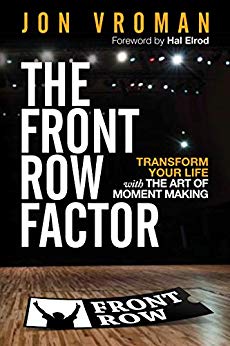
The Front Row Factor: Transform Your Life with the Art of Moment Making
What I love is that it’s not just for children, but it’s all ages, which is great. One of the things you talk about in your book, The Front Row Factor, is this concept of being a moment maker. Can you elaborate on what that means?
One of the driving questions of our organization, a value that we hold dear, is the asking of questions. The question that dominates my life is, “How can I consciously create an experience and celebrate the meaningful moments of life?” There’s a couple of things that hit me over time when it comes to making the most of our moments. One, is there a finite amount of them? I remember being on a plane one time. I pulled out my journal and I wrote a little dot on the left and it said, “Birth.” I wrote a little dot on the right, it said, “Death,” and at that time I was around about 40 years old and I put a little dot there are about 40 where I thought that would be. Let’s say I live to be 100. That’s the chart I was using. Let’s say that I have 80 amazing years. I don’t know what’ll happen to my health after that. Hopefully, that’s awesome, but I’m guessing 80. I said, “I’m right there at the halfway line and the minute that I started to see things as finite, all of a sudden my moments became more valuable.”
I have two boys, a nine-year-old and a four-year-old and I remember my buddy and I had a discussion about, “This summer, we get sixteen weekends.” Saturdays become more valuable when we know we only had sixteen of them with our kid. What do we say yes to, what do we say no to when we’re clear about those priorities? I started to get clear about the power of our moments in life and then beyond that, I started to look back at all these experiences and I realized you can learn a lot about living life from people who are fighting for it. We interview a hundred plus recipients and we asked them about their experience, about living life to the fullest and making the most of their time and what did facing death bring to them that they maybe hadn’t seen or felt or experienced before? Here’s what we realized. There were three things. There were three qualities, three values of being a moment maker. They’re hope, celebration and presence.
This is the whole spectrum. You think about life and this covers it all. Hope is the future, a celebration is what’s happened in the past and our present moment is what we’re trying to remain as much as possible. I like to think of it like a pendulum. Life swings like a pendulum. We’re looking into the future, we’re thinking about what’s next, what we’re about to say next, what we’re about to do next, what’s the next thing on our list, what we got to do later today. We’re looking into the future and then we’re constantly looking back saying, “What just happened? What did that person say? How do I feel about that?” We’re looking at what just happened and sometimes moments that have just passed or hours ago or whatever it is, but we’re looking back. Then we’re attempting through this journey to be present in the moment, to truly listen to somebody and to listen to ourselves. To be in the moment and experience the very thing that we’re trying to like enjoy about life, whatever that might be in it. In our case, it’s oftentimes a concert or performance or whatever where we’re experiencing these emotions in life.
What we’ve realized is that to be a moment maker is to fully embrace these three qualities and that we have to be not only hopeful and looking into the hope. Hope is the power of bringing future possibilities into the present moment. Some people think that hope is this wishful thinking, but that’s very different. Hope is not wishful thinking. We have a recipient named Thomas Kaye who was going to go see the Rugby World Cup in New Zealand and he was in a wheelchair at the time. Every day when he went to physical therapy, he fought extra hard to stand. He said, “I will stand for the national anthem,” and that is the power of hope because it affects how we operate in the present moment. Celebration is the same way. We have heard people say, “Don’t live with that rear view mirror syndrome. Always looking back,” but that’s very different than celebrating. Looking back and seeking out the highlight moments of our life, the highlight moments of our day or whatever they are. There’s a lot of proof around that. The research about gratitude and looking back, finding the highlight moments.
[bctt tweet=”When your why has heart, the how gets legs.” username=”John_Livesay”]
For our recipients, we initially thought it was just going to be all about the day. We thought it was all about the experience and the event. We underestimated the picture album that we gave them, the videos that we made for them. Families would call us ten years later and say, “That’s the greatest memory I have of my son, brother, my mom.” I remember a sixteen-year-old sitting in his bed hooked up to every tube imaginable, his name is Mike and he went to go see this incredible pirate show. He was flipping through his photo album. Nobody knew it at that time, but he was days away from taking his last breath and he was smiling looking at this photo. That’s the power of celebration. Your question about how do we be a moment maker? We’ve got to look at all three of these elements. Past, present and future. “How can we consciously create?” That’s the hope. “How can we consciously experience?” That’s the present moment. “How can we celebrate?” That’s the past, the meaningful moments of life’ When we do that, we become moment makers. When we become awakened aware of that idea, we can be moment makers.
It’s valuable to structure the past and the future within the framework of a pendulum. The unexpected reliving of happy moment that can take you back there. When you focus on that, then the pain of whatever illness you might be suffering from is not in your head because you can’t be grateful and anxious or grateful and angry or grateful and sad at the same time. That pulls in. I also love what you said, Jon about we only have sixteen weekends left in the summer. I remember hearing Tony Robbins talk about telling people to go get a mentor, but he said, “How was your mentor?” The mentor is 60. That means he has not a lot of hours left in his life if he lives to be 85. Why should he give you one of those? That awareness is a key thing. “You can learn about life from people who are fighting for it.” My own sister is in that situation with ovarian cancer and it’s interesting to see how she doesn’t sweat the small stuff anymore and she’s focused on kindness more than ever. What things have you seen that people are learning about life while they’re fighting for it?
I get to pick from a menu of incredible stories from incredible people. I’ll tell you one. Nikki, who I had the privilege of taking her and her fiancé to a football game. This was about a year and a half ago. They were Dallas Cowboys fans and Nikki was fighting breast cancer. She had lost her hair because of her treatments and she was wearing a hat and we were on the experience. We’re in the limousine, we’re about to go to dinner. I don’t remember how we got there, but she had brought up the point that sometimes when she’s in public that people will look at her and they’ll look at her with a look of disgust because of her hair being gone. Her body’s been beaten by these treatments that she’s on. She talks about how to get all these different types of looks and immediately when she said that people look at her with disgust, I felt myself getting angry. I felt myself like if I could just get a hold of that person, I felt myself wanting to stand up for her and to try to be in pain with her but very quickly I realized she wasn’t in pain about it.
In fact, she said, “That makes me happy.” I said, “Tell me more. How does that make you happy? Now I’m fascinated you got me.” She said, “Jon, it makes me happy because if they’re looking at me with disgust, that means that they have no context to my situation because anybody that’s ever loved somebody that’s battling cancer or knows it themselves would recognize this and they would never look at me that way. I’m happy for that person that they have no context to my situation.” Isn’t that incredible? This was just a quick comment in a bigger conversation but that little comment stuck with me and I wrote about that in the book. I’ve talked about that and I think about that. It challenges me to see the beauty in situations where I would have otherwise found anger and hate towards somebody where she found compassion. She found love and she found joy. That to me is one of the most remarkable things. Sometimes when I have a cold, I’m a terrible person to be around and let alone somebody who is battling weekend, week out, month in a month, year after year and how they approach life, their mindset.
In The Front Row Factor book, we talk about that there are three things to living life in the front row outside of the three areas of focus I just talked about, which are relationships, mindset and environment. If you want to own your life, you want to take a look at those three things. Who are your friends? Who are the people that you surround yourself with? What does your environment look like? Your environment plays such a role and we can talk about that a lot and then the other one is just your mindset and that is the thoughts you’re having, the questions, the beliefs, the blueprints, all of that. To me, watching people with those three things in their life, how they mastered those three, the environments they chose to be in as they fight for their life. How do they set up their home? How do they decorate their hospital room? All those things were part of how they managed their emotional state and you can see all these affect each other. They’re all blended together on some level but the relationships, the people that we connect with and then the mindset, that’s what I’ve learned over the years. I’ve learned how people bond together. They come together, they support each other. Like you said, sometimes the things we used to care about no longer matter anymore. Meaning the unimportant things I should say to be very specific. It’s like all of a sudden that doesn’t matter because what matters is connecting with you, what matters is writing that letter, what matters is love. Those are the things that matter.

Front Row: Life swings like a pendulum. We’re looking into the future, and then we’re constantly looking back.
This concept of the mindset is interesting to me because my sister was in the hospital for seventeen days after the surgery, which is unusual with all the complications. My personal frustration is when things don’t go linearly. If you’re going to run a marathon, you train and you run this many miles. There’s a whole structure and if you do all that, you’ll be ready for the marathon. It’s the same thing with writing a book. If you spend this much time writing, you will eventually have a book but health challenges are not necessarily that linear. You’re like, “I thought we fixed that and now that problem’s back?” Those kinds of mindset things can throw, not just the patient, but the whole family into unexpected outcomes that you’re not anticipating. Do you have any thoughts or observations from what you’ve done with Front Row?
I have lots of thoughts around that subject for sure and I could take that in a couple of different places but I’ll just go with where my heart wants to go in this one right away. What you just said, which is interesting, is that when one person battles cancer, the whole family battles cancer. Everybody’s in their own fight in some unique way and I’ve seen this in hundreds of different families and the dynamics are always different. I’ll give you one of the examples, one of my best friends who just beat cancer. He’s the top donor to our charity and became a recipient. My buddy Hal Elrod who wrote a book called The Miracle Morning and he has been a big supporter. I’ve known him for many years. His first book was called Taking Life Head On! because he was hit by a drunk driver at nineteen. His heart stopped for six minutes, brought back to life and went on to become a motivational speaker. He wrote The Miracle Morning book and at the height of his career and still climbing, he got diagnosed with acute lymphoblastic leukemia. What’s interesting is I remember getting a phone call from Hal when the day he was diagnosed. What’s amazing is how quickly he accepted that diagnosis. Clearly, it was emotional for him. It’s not that he doesn’t have emotions, it’s that he just recognized that he said, “I’m going to attack this the way I would attack anything,” and he quickly went into, “I’m going to do this no different than how I would approach anything else.” He has unwavering faith, absolute persistence, a deep belief and, “I’m just going to learn everything I can learn.”
It was just amazing to see that. Then you get the chance to watch how one person can do cancer, how they can approach it, how they can go through their battle, their highs and lows. I saw at all with Hal, but here’s what I got to see that was interesting also. How did this affect his wife? I got to see and more intimately than ever before because he lives near me and he’s a close friend, I got a chance to have those conversations with his wife, Ursula. When he’s battling cancer, she’s got a whole new battle of her own. The fear of losing her husband, taking on two kids by herself. She handled all the finances and insurance and all that stuff. She had her own fight, her own battle. Then you see the kids, the impact on the kids, how does it affect them? In situations where one kid has cancer, brothers and sisters, I remember many times he was talking about his kid, he said, “My son who has cancer, he gets a lot of attention. He gets a lot of connection and attention from a lot of people and as he should, but who gets left out are my other two kids. They are constantly put on the back burner and they’re affected by this too.” Everybody’s in a fight, everybody’s fighting their own fight at something I didn’t have respect for at the beginning of how much when one person battles, everybody battles.
[bctt tweet=”Have the courage to be in the Front Row of Your Life.” username=”John_Livesay”]
I wanted to ask you one more question from your book. You talked about the Front Row pose. What is that and how can we do it?
This is our logo. If you google Front Row Foundation, you’ll see it. It’s a person with their hands up, two fingers pointing into the sky. We can talk about this for quite a bit. There’s research on people who have been blind since birth. This is a pose that they would do in a moment of pride or moment of celebration. You watch how many movies and people do this naturally. They’ve reached the top of the mountain. They throw their hands up and for us, it’s a moment. It’s celebrating a moment. It’s celebrating what we call a front row moment and all of our pictures, we have pictures of people all over the world having front row moments. Whether that’s witnessing a sunset or the birth of a child. Literally speaking of how, when his first was born, Sophie, he sent me a picture from the parking lot. They’re wheeling out Ursula. She’s got the baby and he’s behind her doing the front row pose and it’s just moments of celebration. They’re just great moments.
I want to share something that is an important piece of this front row concept that people can take with them into the day-to-day. We’ve all heard the idea of like not being on the sidelines and getting in the game. We hear that a lot and it’s wonderful because sometimes we need to get off the bench and get in the game. I clearly understand what that means. I also don’t want to underestimate the power of somebody being on the bench. I don’t want to underestimate the power of somebody being in the front row of a concert because I’ve had people tell me they go, “Jon, if you’re in the front row, I don’t want to be there. I want to be on stage” and I go, “I totally get it. Me too.” I was a professional speaker for ten years. I get it, but here’s the thing, what we should not underestimate is the power of lifting other people up. We should not underestimate the power in your life that you have when you put somebody else onstage and when you shine the light on them. Yes, you should get on stage sometime and yes you should play the game, but let’s not make people feel bad who are trying to cheer somebody on. Who are trying to shine the light and make somebody else the star and lift them up because that’s the essence of being in the front row.
It’s a spirit of service. It’s a spirit of giving. I always say the best fans get the best show because if you need to get the most out of life, you got to give. You give to the band, they play better for you. That’s how life works. You’ve got to go around being fans of people. In the book, we talk about writing out your top eight friends and we’ve all done that exercise where you identify your top relationships, but we’d like to take it one step further and say, “Do you know what your top eight relationships and what their dreams and goals are?” Most people cannot identify that. It’s very difficult to even write out their top eight relationships in order of importance, but then if they’re challenged to write down what that person’s number one dream or goal is, we oftentimes don’t know it. While we at Front Row Foundation make a lot of dreams come true, everybody listening to this show can become a front row moment maker for somebody you know. Find out what their dreams are, get it in their front row, cheering them on, lift them up and that is the approach that we want to teach about living life. That’s living life in the front row.
I’m certainly a fan of yours and everything you’re doing. You can count me as one of the people cheering you on and the book again is called The Front Row Factor: Transform Your Life with the Art of Moment Making. If you ever need someone to come in and motivate your team, Jon is certainly an amazing speaker as well. Thanks for being on the show.
Thanks for having me.
Links Mentioned:
- Front Row Foundation
- The Front Row Factor
- The Front Row Dads Retreat
- The Front Row Dads Podcast
- LegalZoom.com
- The Miracle Morning
- Taking Life Head On!
- The Front Row Factor: Transform Your Life with the Art of Moment Making
- https://FrontRowFactor.com/
- Quantmre.com
Wanna Host Your Own Podcast?
Click here to see how my friends at Brandcasting You can help
Get your FREE Sneak Peek of John’s new book Better Selling Through Storytelling
John Livesay, The Pitch Whisperer
Share The Show
Did you enjoy the show? I’d love it if you subscribed today and left us a 5-star review!
-
- Click this link
- Click on the ‘Subscribe’ button below the artwork
- Go to the ‘Ratings and Reviews’ section
- Click on ‘Write a Review’
Three Challenges Top Level Recruiters Face
Posted by John Livesay in blog | 0 comments
In today’s competitive job market, where unemployment is at a low, employees have many choices. It is much like the housing market where it is either a buyers market or a seller’s market. In this environment, you are likely going to face these three challenges. Read on and I will show you three simple strategies to overcome them.
Challenge 1: You have had a great year and wonder how you are ever going beat your sales revenue from last year. This is a common issue many recruiters faces year after year.
Solution 1: Look for things that your competition is not doing or is unwilling to do as a way to get new growth.
Michael Phelps has won the most gold medals in Olympic history, but he didn’t start at the top. In 2006, I spoke with him at an event I had organized, and I asked him how he achieved greatness.
“Everyone says you’re so successful in the water because you’re tall and your feet are huge and you’ve got this lung capacity. I’m guessing there’s something else to it.” He replied, “Years ago, my coach said to me, ‘Hey Michael, are you willing to work out on Sundays?’ to which I said, ‘Yeah.’ He goes, “Great. We just got 52 more workouts in than your competitors, because most people take Sundays off.”
Knowing this one success secret as a professional or leader can prove to be valuable time and time again. The question to ask yourself if “What am I willing to do that my competition is not?” That’s what going to set you apart.
Challenge 2: How do you build trust with a new client?
Recruiters have to build trust to get a company to use them. Recruiters also have to build trust with executives who are happy in their job to consider the job opportunities at a time when they are “not looking.”
Solution 2 Many people think that if they give out enough information about how many successful placements they have made or all the benefits that come with a job that people will suddenly want to take action. The mistake is thinking if you get people to know you and the offering, they will then like you and eventually trust you.
The order is all wrong! People have to first trust you, which is a gut thing. In fact the handshake came about to show you didn’t have a gun in your hand. Then it moves to the heart where people decide if they like you or not. Then it moves to the head where people think “Can I see myself in this job?” Or “Can I see myself working with you?”
Once you know to start from the gut and work your way to the heart and then the head you will handle the trust issue.
Remember:
- Trust (Gut)
- Like (Heart)
- Know (Head)
Challenge 3: You and your recruiting firm are seen as commodities. The common objection is “you are all the same.”
Solution 3: The key to standing out so that people remember you when they are hearing a pitch is to tell a story! The person who tells the best story gets the sale.
A good story has 4 elements:
- Exposition-Paint the picture of who, what and where
- Problem-Describe a problem someone else faced so the client sees themselves in your story.
- Solution –Tell a story that shows you overcoming an obstacle and going the extra mile for a client
- Resolution –What is life like after working with you? How happy is the new employee in their new job? How much revenue has the new employee you placed generated for the company?
Now you know how to build grow your business beyond your previous success, new ways to build trust and how to make sure your story is compelling and memorable. To be the best and stay on top, you must let go of the old way of selling and pushing out information. The new way of selling is to tell stories that pull people in and make you irresistible. Start using storytelling to become a revenue rock star!