

Radio And Podcast Marketing In 30 minutes with Jim Beach
Posted by John Livesay in podcast | 0 comments

Episode Summary
One of the great ways to promote your business is through radio shows and podcasts. Jim Beach, entrepreneur and author of Free Radio & Podcast Marketing in 30 Minutes, guides us on how to do it. Helping not only your marketing but search engine optimization as well, Jim talks about making your content searchable and ranking out there. He shares the secret to creating a good pitch, laying down the do’s and don’ts of pitching and why you have to make it both informative and entertaining.
—
Listen To The Episode Here
Radio And Podcast Marketing In 30 minutes with Jim Beach
We have a returning guest whose name is Jim Beach. He’s an experienced author and entrepreneur and he hosts School for Startups Radio. He’s been dubbed the Simon Cowell of venture capital by CNN and he’s been interviewed by hundreds of media outlets including NPR, MSNBC and the New York Times. Jim has a book called Free Radio & Podcast Marketing in 30 Minutes. Jim, welcome to the show.
Thank you so much for having me. It’s an honor to be with you again.
You always bring such incredible energy and content and ideas that it’s always great to have someone like you back. You’ve got such a wide depth of experience in this area of radio and podcast marketing and having so many successful shows yourself. What made you want to write this book for people?
I hadn’t planned on doing it. It was very much serendipity. It had been something that I had put together mentally. I have done some presentations on it and I taught some classes on this. I was interviewing somebody one day for my show, the owner and publisher of the In 30 Minutes series. That series is like For Dummies, but if the For Dummies books are too confusing for you, then you go with In 30 Minutes. The For Dummies books are 300 or 400 pages sometimes. They have a lot of information. Our book was designed to be read in 30 minutes. This was the 21st in the series. I was speaking to the publisher. He was a guest and I said, “I got to talk to you afterward.” We finished the interview and I was like, “I have a book idea and this is it. I believe that this is something that’s valuable for small business owners. It can save them so much money. It’s been so successful for me.” In ten to twenty seconds, he was like, “I get it. I want that book. You’re signed up.” I got a book deal from conception. I had the idea to deal with the publisher in twelve minutes.
[bctt tweet=”Make your pitch unique, compelling and sexy.” username=”John_Livesay”]
That’s under 30 minutes, which is what you promise. One of the things that people have a misconception of is that AM/FM radio is not being utilized or listened to anymore. That’s not the case at all, is it?
Everything in the book is for radio and podcast. It’s the exact same. The methods are 100% the same. I used the words almost interchangeably in the book and in real life. Most podcasters think of themselves as communicators like a radio host. There is no real difference there. The distribution method is a massive distinction there. To your first point, AM/FM is still huge. The number of people who get in their car and simply let the radio wash over them as they drive home, especially with these channels that give the traffic and the weather is still very popular. They’re not growing and they’re having trouble financially. I don’t care if my stations are having trouble financially. That still has listeners. My 24 stations add up to about 200,000 listeners a day. That’s still 200,000 people that I’m reaching. I also do a podcast version of the exact same show and I get double the bang.
What I find so fascinating is how clear this book is of who this is for. It’s for anyone who has a book out, anyone who’s a speaker, but also someone who’s running for office or wanting to get their message out. This book shows the reader how to use radio and podcasting to get on shows and get your message out without having to spend hundreds of thousands of dollars on public relations, for example.
No matter what your business is or what you’re trying to sell, there are bunches of podcasts out there that want to have you as a guest. I was the world’s worst chemistry student. In the 10th grade, Dr. Ramsey kicked me out of chemistry because I was too stupid to take chemistry. A few months ago, I got my first patent for chemistry. I and a bunch of five other people invented a paint that blocks Wi-Fi signals. You will ask, “Why?” The single most detrimental thing worse than mothers smoking, worse than caffeine in your cereal, for a baby is Wi-Fi signal. The data from Harvard and everyone that has studied it has found overwhelming evidence that one of the worst things you can expose your baby to is Wi-Fi. It’s so bad that they have banned Wi-Fi in all schools in France and Europe is about to follow suit. I thought, “We need to solve this problem. That’s a problem. How can we protect my babies?”
[bctt tweet=”Quote the host you are pitching.” username=”John_Livesay”]
I have four children and I don’t want them exposed to this. The idea for a Wi-Fi blocking paint came about. There are over 4,000 podcast and radio shows for parents. How many of them are going to want to talk to me about my Wi-Fi blocking paint? I predict all of them. I get to go on for 12 to 30 minutes and get to talk about how awesome my Wi-Fi blocking paint is. I give out my URL and now I have convinced eight to twelve people to go buy my product. Now 1,000 other people know about it and half of them are going to tell their friends, “You’re not going to believe what I heard on the radio podcast the other day about how horrible Wi-Fi is. I know you’re decorating your new baby’s nursery and maybe you want to think about it.”
It can be an ideal gift for a baby shower, this paint, instead of another pair of booties.
For free, I have gone out there and gotten all of the marketing that I would have paid thousands of dollars for. There’s an additional advantage as well. When I run a commercial, I’m a jerk running a commercial. When I’m on your podcast talking about how much I care about my four babies, I am an expert, a thought leader and someone to be trusted. Therefore, my paint should be bought.
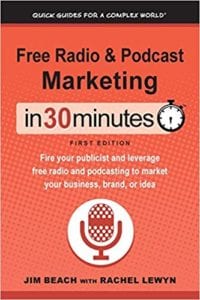
Free Radio & Podcast Marketing In 30 Minutes: Fire your publicist and leverage free radio and podcasting to market your business, brand, or idea
The other thing that your book, Free Radio & Podcast Marketing in 30 Minutes, talks about is that it’s also a great way to get yourself to show up in a Google Search. A lot of people are spending a lot of money on AdWords and they don’t know how to get to their business to pop up. Tell us a little bit about how being on radio and podcast can help our Google Search Optimization.
Every single time you’re on a show, the host or the producer puts up a page about you. It’s where the audio file you can be listened to on the host website. There is also a picture of you, a little bio and a link to your website. That link to your website gives you SEO, Search Engine Optimization, juice. They think that 70% to 80% of Google’s score for you or how high you rank in search engines is determined by how many websites linked to you. It makes sense. If two websites linked to you, are you important? A little bit. If 200 web sites linked to you, are you important? If 200 other people think your website is important enough to link to, therefore you deserve to rank higher. If I’m going on one or two podcasts a week, I go out there and I’m getting a new Google link to my website once or twice a week. These are quality links too, not from a directory or something like that. A podcast link is one of the best links you can get. Let’s say you’ve done 100 interviews over a year. You’re going to have 100 quality links that will drive your SEO juice. I promise you, if you have 100 links, you’re going to be on the first page of almost any search.
I have experienced that myself being on many podcasts and being called the Pitch Whisperer. If somebody googles the Pitch Whisperer, all that content comes up. They don’t have to remember my name or even the name of one of my books. People tend to remember that little hook and they can find me that way. That’s such great value. You also talk about how to use social media as a way to get on radio and podcast shows. Would you mind picking one or two of those platforms and explaining your secret sauce?
The platform is irrelevant, but every time I’d make a post on LinkedIn and someone comments on it, I get an email about that. We all do. That’s the way that the platforms work. I know who is posting about me. Let say if I were to comment on every other tweet, if I make six tweets in a week and you comment on three of them, eventually I’m going to notice that. I’m going to say, “Who is this person? Who likes me so much that every time I tweet, they are giving it a thumbs up or giving it likes?” You’re going to get curious. For example, Ken Blanchard who doesn’t do their own social media. You’re not going to be able to get to him. That’s not going to work with him, but for 99% of the people you want to get in contact with, this works for sales or venture capital or anyone that you’re trying to reach out.
If you follow them and pay attention to their social media, we are such a narcissist that we will notice that. You like five or six of my post, I’m going to know what your name is and then you reach out to me and say, “I’ve been following you on Twitter for six months now and you have some great things to say. I’ve been enjoying getting to know you. I think I’d be a great guest on your show also. I seem to have a lot in common with you, but I’d be a good guest.” The answer is going to be yes because you’ve already done me twelve favors. Every time you liked something of mine, I owe you. The first thing that goes through my mind is, “You’ve done me a bunch of favors. The least I can do is highlight your business for twelve minutes.” It’s a great way of getting on someone’s radar and it all goes back to narcissism. If you like me, I like the fact that you liked me.
[bctt tweet=”No matter what your business is and what you’re trying to sell, there are a bunch of podcasts out there that want to have you as a guest.” username=”John_Livesay”]
It’s almost the micro matching neurons. If somebody smiles, you tend to smile back at them. Except this is done digitally. You have a whole chapter devoted to the do’s and don’ts of pitch writing and you have ten commandments. The one that is so important is to be relevant to topical news stories. Can you explain what that is and how people can use that?
That’s the way to get on a generic radio. That’s not going to work for podcast quite as well because so many podcasts are delayed. Most podcasts are pre-recorded a week, two weeks, a month, three months in advance. It’s hard to be topical there, but if there is another article that comes out about Facebook giving away your data and you are a Facebook company, you should call every radio station in your city or in the United States. You should call them all and say, “I am a Facebook marketing expert. I’m an expert on the news article that you’re going to be talking about on the news. Quote me. I’m available at 7:22 when you do your live segment.” In other words, make yourself available on the topical news of the day and then let the reporters, the people, the podcast host, everyone know that “I’m an expert on this. If that topic ever comes up or if you ever need a hurricane expert because there was a hurricane coming your way, I’m the guy that you should call.”
Remind them when the hurricane is coming by saying, “We spoke six months ago about hurricane preparedness and there’s a hurricane coming in. If you need to get any reports, I’d love to be on your show to talk about it.” You can take this to the limit. It is the National Ice Cream Cone Day. I have a world record for ice cream cone eating. If that’s relevant to me, then that’s your hook. You call up the radio station or the host or the producer. We can talk about how to find that person and say, “I don’t know if you know, but a few weeks from now is national ice cream cone day. I was the eighth-grade ice cream cone eating champion of Dubuque. I think it would be a great segment to talk about that.” That would be the thing that they need. All these people are desperate for content. They have to fill up the time. They need somebody. The unique, compelling and sexy pitch is going to get you on the air. It’s going to get you on the podcast.
There are a couple of things you said there, have a unique, compelling and sexy pitch. You also talk about the importance of a good pitch being both informative and entertaining. Some people have one and not both. That’s a big part. The other thing you said that is so relevant is if you’re going to pitch yourself as the expert in anything from a hurricane to ice cream cones, don’t forget to remind people when that topic is coming up again. You build the relationship up front and then it’s already easy for you to reach out. Don’t wait for the last minute for that to be in the news. If you can build that relationship with a producer or a host before, it makes a big difference.

Podcast Marketing: People have to trust you first, then they like you, and then they decide whether they want to know you or not.
There’s a man here in Atlanta on one of the local TV stations and he’s been doing the news here in Atlanta for 30 years. He interviewed me for a thing. The interview went well and we connected. Six months later, I saw him at a train show. I wasn’t going to the train show. The room next to where I was speaking was a train convention. I bumped into him and said, “I don’t know if you remember me, but we’ve talked.” We had a long conversation about trains. I told him about my train set as a kid. Because we have a relationship, I can get anything I want on the air with him.
Another pitch secret from your book is bust a myth. Tell us what that means.
Anything that the entire world believes, if you tell me the opposite is true and say you can prove it, I want to hear about that. “I’m a little bit of a contrarian. I don’t believe that we’re ever going to run out of gas. I sat down and started researching it and I can prove it. We’re never going to run out of gas. Eventually, we’ll switch to another technology and there still billions of gallons of gas in the Earth.” People hear that and they’re like, “I’ve heard of peak oil, I know about gas. We’re going to run out of gas. We’ve been predicting that for 40 years.” Now the person is interested, they’re engaging and they’re fighting back. “Do you have some data that you can prove that?” “I will give you my seven reasons that were never going to run out of gas on my interview segment with you.” I’m booked. They love that.
They love things with numbers. They love things that are contrarian. The myth is this and this. I’m going to argue the opposite side. There are two guys that wrote a book saying that we’re not going to have twenty billion people 50 years from now on the Earth. The population of the Earth is going to peak twenty years then started going down, which is scarier than it is going up. They’re very contrarian and they’re everywhere now. They’ve done 200 interviews in the last six weeks promoting that book. Because it’s so contrarian, I’ve heard the same thing again and again. I’ve had vanilla every time and now you’re giving me chocolate. Now I want some chocolate because I’m tired of vanilla.
[bctt tweet=”Everyone in the world knows that entrepreneurship is 100% yes.” username=”John_Livesay”]
I loved that as one of the favorite ways of grabbing people’s attention too. The example I use is, the myth is if people know you, then they like you and then they trust you. I said, “That order is completely wrong. People have to trust you first. Then they like you and then they decide if they want to know you or not.” If you start trying to throw a bunch of information that people are thinking, “If they know enough about me and my product, they’re going to buy,” you’re doing it all wrong. That gets people to go, “That’s a myth that the order is wrong.” Anything can be busting a myth there.
My very first book was with McGraw-Hill. The thesis of that book was that entrepreneurship has nothing to do with creativity, risk or passion. Everyone in the world knows that entrepreneurship is 100% creative people taking risks, building businesses that they are passionate about. The thesis of the book was, “No, that’s entirely wrong.” McGraw-Hill said, “I want to see the defense of that thesis.” Then under a week, I had my first book deal with McGraw-Hill because that pitch was so compelling and so unique that they wanted to have it. It’s also sexy because what’s the takeaway? If it’s not about creativity, risk or passion, then anyone can do a sexy thought.
It also has to do with the way our brains are wired. As you said, “Vanilla, vanilla, vanilla. Chocolate, shiny new thing.” Our brain craves new information or looking at something in a different way. That’s how you break people up and break through all the clutter that’s in our brain from the constant barrage of ads and social media posts and tweets and everything else. You alluded that you have some tips on how to get in front of a host or producer. Can you share what those are since you are one? What are some of your favorite ways that people reach out to you?
The last thing I want you to do is to call me. That’s true for most people now. That leaves either the mail or email or what we were talking about before going in the back door through their social media and becoming their Twitter buddy. The easiest and best way to do it is still an old-fashioned email. I used to spend five or six hours every weekend watching football, watching something on television and researching the names of podcast hosts. It’s very simple. You go to Google and type in food health podcasts because I have a food book and I want to be on those podcasts that talk about healthy eating. You will find that there are thousands of podcasts that meet those exact requirements. The trick is to scour them and to try to find the host name. The host of a podcast is a narcissist. I googled food podcasts as I was talking about it and there are 4.2 million hits. That doesn’t mean there are that many shows, but it’s a popular thing to the podcast and talk about.

Podcast Marketing: You don’t buy the first time you see a product; it takes more than that.
Those podcasters or the hosts want to be in communication. Tons of the websites will have a button that says, “Be a guest,” and they’ll give you the instructions on how to be a guest. On my website, you will find it says, “To be a guest, simply email Jim,” and then it gives my email address. They want to be found. They’re not there to be invisible. You’d go through and create a list of 500 podcasts that are appropriate to your market and get the host information. If you’re good at this, you will learn something about the host. I don’t do it that way anymore. I go on Upwork.com and for $50 or even $30, I will have someone there create a list of 500 spirituality podcast host emails. For $30 to $50, I have bought 500 email addresses. They have to do that research. They go out and somehow, they scour the same way I do. Now I have 500 people to contact. I then sit down or hire some pitch whisperer to create the perfect pitch for my product and put together a beautiful email. I send it out to all these hosts. I’m going to say, “I love your podcast.”
They want to know that you have listened to their podcast. If you’re a podcast listener and can prove that you have listened to their show, those people are going to put you on their show. You say, “I listened to your episode with John. He was awesome and I thought he had some good points. I especially liked when he said this. I loved it when you said this.” Quote the host back to himself. He’s going to put you on the show. I build those lists of 500 people. I spend several hours crafting a four or five paragraph email. One of those paragraphs changes for each and every host. “I saw your pitch on your food podcast. I loved when you were talking with Sally Reaves about her no sugar diet. It was the funniest thing ever when you said this and this and I just connected with you. I am working on this and I thought I would be a good guest for your show.” You’re going to get on the show.
That’s specific, not just saying, “I like your show. It’s good. It’s funny.” Quoting the host back when you pitch yourself is the secret sauce that you just gave us. It’s important and few people take the time to do it. Few people know how to do it. Jim, that is gold. Thank you.
I don’t do it. I pay someone to create that moment for me to find the quote. I’m a liar. I didn’t listen to your show. I had someone find me a great quote from your show and I’m quoting it back to you, but I’m doing it in bulk.
[bctt tweet=”Market every day for 30 minutes.” username=”John_Livesay”]
I love stories and you’d have a whole chapter devoted to all in the stories and how people remember stories after we forget everything else. You’ve given us some great stories already, but let’s talk about the one that you talk about in the book, which is about your wife running an Amazon business.
The keyword there is Amazon. A good story is worth telling well. A good story has emotional things like anticipation and fear that I don’t hear the end of the story. If I’m doing an interview on that topic or on entrepreneurship, early in the interview I will drop, “Creativity, that’s totally useless. For example, my wife started a business with $500 on December 26th.” I add in the details because that makes the story truer. “I bought her a book for Christmas on how to start a business. The next day she read it. She was so motivated that she started her business on the 26th. She started making money in January and she made $78,000 in her first year while working a full-time job, while cooking dinner for four kids, while raising four kids, while putting up with an impossible husband like me on the weekends.” I’ll tell you at the end of the interview, “If you remember to ask me, Mr. Host, at the end of the interview, I’ll tell you what the business was.”
That’s an open loop and you were talking about the details of the exposition. What I like about what you wrote in your own book is the impact, what I call the resolution. The unexpected outcome after growing a business like that is and I’m going to let you reveal what that is.
My wife is a shy introvert. We used to go to trade shows together and she would point to something and tell me to go ask about it. Now, she goes to trade shows by herself and comes home with a bag full of 500 booths that she has visited. She now teaches classes on how to run an Amazon business and she organizes and puts it on in our living room. Her career has exploded. She’s had three major promotions and her salary has tripled because of the confidence that she gained by running her small little Amazon business. She now has learned that she can make a living from the living room if she has to.
[bctt tweet=”A good story is worth telling.” username=”John_Livesay”]
That would pull anybody in and that would get any host of any show to want to have somebody come on and talk about that. The outcome of not just making money but the self-esteem going up is what makes that story great in my opinion.
She’s become a whole new woman because of it. It’s amazing to see the progression of her career, her personality and her ability to do all of this stuff. That’s one of the things I love about entrepreneurship. It does that to people. The question you asked is the stories. I know when I go into an interview, I have a basket of ten stories. I’m going to have time to whip out three of them. I do know that a year from now you won’t remember my name, but you will remember the stories that I told.
The last thing that I want to talk about which is in your book, Free Radio & Podcast Marketing in 30 Minutes, is this post show carrot. Since we’re at the end of our time together, you can explain what it is and let us know if you have one for our audience.
The whole point of being on your podcast is to sell my paint, but 99% of the time you have to touch somebody on average seven times before they’re going to buy from you. That’s why ads are repetitious. You don’t buy the first time you see a product. It takes more than that. I can’t market to you if I don’t know who you are. The only way for me to know who you are is to get your email address. I will do anything to trick you into giving me your email address. You see this all the time. We all know about funnel marketing. You have to go and collect the names to start the funnel. How do you do that? You go on radio shows and offer something. I do happen to have a free carrot. If you email me and ask for one of my lists, I will give you my list of 500 sports podcast to be a guest on, 500 relationship podcasts to be on, 500 spirituality podcasts to be on, 500 small business podcasts to be on. I got three or four more topics that I can’t even remember, like religion. I got twelve of these lists that I have built over time. I will send you my list of 500 for whatever category your business is in and help get you started down the path.
The book is called Free Radio & Podcast Marketing In 30 Minutes. Jim, is there any last thought or quote or moments of inspiration you want to leave us with?
Anyone can be successful with this method and use radio and podcast marketing. Don’t worry about your accent. Don’t worry about anything. Sit down and plan out what you want to say. Create a great pitch and I promise this will work for any business. No matter what you’re trying to sell, it will work. I’ve seen it work in every category in the book. In the early chapters, there’s a list of 70 different industries that I’ve seen this work for. We have 10,000 recording opportunities a day for various podcasts. That number has gone up since the research, but that’s 10,000 opportunities a day for you to go out there and get free marketing. Do it. You’re crazy not to do this.
One of my big things is I spend the first 20 to 30 minutes of everyday marketing. Whether I have a business or not, whether I have a project due that day, I know that once the project is going to be turned in, I need a new customer so I better market. I spend fifteen to 30 minutes every day. The first thing I do is I send out three or four requests to three or four podcasters, “I’d love to be on your show.” Two of them say yes and there I am marketing. It works. You can do it. If you’re reading this, I’d love to have you on my show if you can figure out how to get in touch with me.
That is a great offer. I’d be fascinated to see how many people will take you up on that. This concept of scheduling marketing time because if it doesn’t get scheduled, it doesn’t get done. You left us with yet another great tip. Jim, thanks for being on the show.
It’s been my pleasure. Thanks for having me.
Links Mentioned:
- Free Radio & Podcast Marketing in 30 Minutes
- School for Startups Radio
- For Dummies
- Upwork.com
- http://TimelessChair.com/
- http://InternationalEntrepreneurship.com/
- http://SchoolForStartupsRadio.com/
- https://www.Amazon.com/Free-Radio-Podcast-Marketing-Minutes/dp/1641880201
- Quantmre.com
Wanna Host Your Own Podcast?
Click here to see how my friends at Brandcasting You can help
Get your FREE Sneak Peek of John’s new book Better Selling Through Storytelling
John Livesay, The Pitch Whisperer
Share The Show
Did you enjoy the show? I’d love it if you subscribed today and left us a 5-star review!
-
- Click this link
- Click on the ‘Subscribe’ button below the artwork
- Go to the ‘Ratings and Reviews’ section
- Click on ‘Write a Review’
Create And Elevate Your Value with Tim Riesterer
Posted by John Livesay in podcast | 0 comments


Episode Summary
Valuing yourself before valuing your business is an ideal order when gearing towards success. Chief Strategy and Research Officer of Corporate Visions Tim Riesterer believes that decision science is key towards delivering more value to anyone aiming to succeed both in business and life. He talks about how he has helped companies build messages that are aligned with the invisible forces at work in the customer decision. The values of conversion creating, elevating, capturing customer value, and creating expanded value are key in elevating value in a company. He shares about the implementation of all of these values, including the introduction of an unconsidered need in creating pricing uncertainty. Overall, Tim suggests that inspiring somebody to decide to change and considers doing it with a leader or mentor are what value creation and decision science are all about.
—
Listen To The Episode Here
Create And Elevate Your Value with Tim Riesterer
Our guest is Tim Riesterer who is a Chief Strategy and Research Officer of Corporate Visions. Tim is responsible for leading the direction of the company, thought leadership positioning and product development. He leads the company’s consulting team globally. He has more than twenty years in marketing and sales experience. Prior to that, he was the customer message management where he was the CEO until it was acquired. Before that, he worked in the whole world of marketing and communication. He’s the co-author of several books, Customer Message Management: Increasing Marketing’s Impact on Selling and Conversations That Win the Complex Sale: Using Power Messaging to Create More Opportunities. Tim, welcome to the show.
John, thanks for having me.
I always like to ask my guests to take me back to their story of origin. You’re living in Wisconsin now. Were you born there? Did you know that you wanted to get into messaging and marketing? How did this all come about?
I was born and raised in Wisconsin. I didn’t have a clue. I went to school for journalism. Nowadays, there is a job called a corporate journalist. This was back before there was such an idea. I was hired at a big company that did medical devices to go out, ride with salespeople, interview doctors, hospital administrators and technologists about their medical equipment. How it was impacting them and their market. What I discovered writing along with salespeople, asking customers questions and writing stories to put in trade magazines or newsletters, was that everything the company wanted to say about their products was nothing that the customer had to say about their products.
I say now that companies live in their own story and customers live in their own story. We have to stop forcing customers into our story. We have to join the customer story. Customers would talk about mission and outcomes. I wanted to talk about an MRI system, the algorithms and the features. That’s where companies’ stories and customer stories clashed. It sent me and my journalism in an entirely new trajectory to understand the science of how people make decisions, how they frame value, and how they make choices. I help companies build messages and tell stories that better aligned with these invisible forces at work in the customer decision.
You approached it from a journalistic standpoint and you have some data to back it up. Let’s double click on what is decision science and how can people use it.
I triangulate three disciplines. It’s neuroscience, social psychology, and behavioral economics. In every one of these cases, there are decades of studies and science that has been published by professors. The only problem with the existing science there in those three areas is it was most often conducted on grad students, convicts, and gamblers. The three of them are captive audiences who don’t require much incentive to participate in this study. What we’ve done is a contract with scientists at Stanford in the states and work with a business school outside of London. We run simulation tests, in this case, primarily on B2B decision makers because everybody tends to believe B2B decision makers use no emotion in their decisions.
What we try to validate is how do B2B decision makers respond to different messages and to different stories based on the scenarios they’re in. If they’re in a new purchase decision, do they react differently to certain messages versus if they’re in a renewal purchase decision, do they react differently to different messages? We put simulations on top of existing science and we go to the audience who were trying to help our clients sell to. After that simulations, we do controlled field trials to see these things at work in actual B2B engagements. The science of decision making is documented for 40 years. We’re bringing it into the B2B buying audience and building applicable frameworks for storytelling across the different parts of a buyer’s journey.
Can you give us an example or a story of a client you’ve helped you use this? How they were doing it wrong before using it and the insights they’ve learned?
If you think about most storytelling that companies do, if we look at their collateral, their PowerPoint decks, their website, they try to answer this question for customers and prospects, “Why us? Why we’re different? Why we’re better? Why you should go with us?” The problem is that in acquiring new customers, 80% of the people you’re talking to are not ready to ask or answer the “why you” question. They’re still trying to answer the “why change” question. Why should I change? Why should I do anything differently? The problem is most of your messaging, most of your content, most of your presentations are aimed at answering a question that only a fraction of the people you’re talking to want to know the answer to. The majority have not made a decision to leave their status quo.
The reason I get the number 80% is when we work with companies and look at their leads and pipeline, 60% to 80% end up making no decision. They don’t do anything different. They take you through your paces and they go, “I think we’re fine.” That wasn’t a loss to a competitor. That was a loss to inertia. That was a lost to risk aversion. That was a loss to no decision and that means somebody didn’t see why they needed to make a change. What happens is the psychology of asking someone to make a change is different than the psychology of trying to say, “Why you’re different from your competitor?” We focus companies in new customer acquisition, how to tell a why change story that disrupts their status quo bias enough, helps them see the need to change and do something different because their status quo is no longer acceptable. It’s no longer sustainable. It’s no longer safe. It’s no longer tenable.
You have to defeat the causes of status quo bias in your message. Most companies don’t even know that exists so none of their stories encompass that or address that. We’ve helped companies move from 60% stalled deals down to 50% stalled deals. That 10% is a huge upside opportunity. We had one company who took their new why change message and they went to 119 stalled deals. They looked at their pipeline and they said, “There are 119 deals over the last six months that landed exactly where you said. We built a new story using our wide change framework and the science behind it.” They reignited and created new opportunities with 115 of those 119 stalled deals. They didn’t change the salesperson. They didn’t change the product or service. They only changed the story. That shows you how powerful having the right story framework for the right moment can be.

Decision Science: In acquiring new customers, 80% of the people you’re talking to are not ready to ask or answer “why you” question; they’re still trying to answer the “why change” question.
It reminds me of a client I’m working with who’s in the executive search industry. They have two different kinds of challenges. They have obviously other executive search firms. They have big companies that are saying, “We’re not using any executive search firms. We’re having our own internal HR department to find people.” Their messaging is very different if they keep going in going, “Here’s why we’re the best search firm.” They’re like, “We’re not even looking for a search firm.” It was like, “Here’s a story of another company in your industry that had the same thought process and we don’t need all of your searches. We do have some searches that you may not have access to the people in India or Dubai that you need to find or you’re only limiting your search for the next CEO in the US when there are people in Europe that you could be looking at.”
They have to paint that picture of what you were describing of getting over this inertia of, “We don’t want to spend money. We’ll find that it’s been working so far.” That’s a very different message in that awareness of what’s more challenging. They’re being disrupted. Back then, everyone in a certain company level was just hiring recruiters. Now they’re like, “Why are we paying all those commissions?” Not only they have their competition, but they also have the internal struggle and it’s a fascinating use of your model here.
Status quo bias is the design point for your message. What you have to do is identify how many different status quo bias scenarios you speak to. There are two. One status quo bias is I already use an existing outsourced partner. Another status quo bias is “I’m a do-it-yourselfer.” Your message has to change based on what their status quo bias is. Here’s the problem most messaging and stories do is they go, “I’m going to talk to the head of HR. I need a head of HR message.” I’m like, “No, you don’t. You need a message based on the situation they’re in.” There’s an interesting piece of science called fundamental attribution error where we assigned way too much credit to that person’s disposition in terms of driving their behaviors and the real driver behaviors are their situation.
The reason this head of HR might make a change is if they have an outsource partner they’re not happy with or they have an internal situation they’re not sure of, but those are two totally different scenarios. If you aim at the head of HR and tell a generic head of HR story, you don’t aim it at the particular status quo bias, you will have missed the catalyst for change, which is their situation. It’s not their title, not their role, not their disposition. The catalyst for change is the situation they’re in and your story should start with what situation status quo bias are they living in.
There are three value conversations and that’s the key. No matter what industry you’re in, it seems oftentimes as a commodity or you’re a premium price company, whether you’re an architecture firm. You’re all the same. You’re all expensive. I don’t see the value of this. You said, “How to create it, how to elevate it, and how to capture customer value.” Let’s take a little step on each one. How do we create value, Tim?
I want to talk about the fourth value conversation that our new research found. It’s the expanded value. Let’s start with create value. Think of what you’re trying to accomplish with the customer. Create value is this idea of you have to create enough value for them to see the need to do something different. You need to create enough value for them to see you as different. Create value is about creating opportunity, creating that motion and that idea of, “I think I need to change and I need to do something different and I need to do it with someone different.” Create value is how you create a pipeline. You inspire somebody to see the need to change and consider doing it with you, but then you get stuck. I call this constipated pipeline.
[bctt tweet=”Do you use Decision Science when you sell?” username=”John_Livesay”]
A lot of people get stuff in the top of the funnel where maybe they inspired somebody to go, “Maybe I should change.” It just slams into a wall. It’s usually because now you’ve got to talk to a different kind of buyer. The business buyer or the financial buyer shows up. This excited person brings you in and says to the executive buyer, “What do you think?” The executive buyer says, “It’s interesting, but I’m going to need to have some business case, some justification, some ROI, some other things to help validate this decision and have the urgency to do it now.” The question that’s answered in elevate value is why now? In create value, we answer the question of why change, all the science behind the change and getting someone inspired to change but you’re not done yet. You’ve got to answer the question of why now so people make a decision and not differ. That’s a different story, a different framework, and a different question you must facilitate the answer to. That’s elevate value. We have create value and elevate value.
Capture value is this idea that you’ve built the demand. You’ve got some executive sign off, but they’re going to send you through a negotiation process before they’re done with you. There’s the gauntlet of procurement, purchasing or at a minimum, somebody is like, “We’ve got to change. We got a business case here. We can justify it. I want the lowest price possible.” It’s create, elevate, and capture value. Capture value is to make sure you capture all your value. You don’t leak it out in the negotiation process. You manage the tension. You continue to position and bring enough value to protect margin, avoid unnecessary discounting. You hold the line on your premium pricing.
What happens for people is these are three distinct moments with three different buyers’ psychologies. As a result, you as a communicator need to engage them differently in each of these moments yet string it together. We wrote a book that’s three sections, create, elevate, capture that distinctly tells you how to be great in each moment. Once you master those three moments, now you’ve mastered that whole buying cycle. That’s where that comes from. That’s how we distinctly identify those value moments. Why should I pay that much for you? You’ve got to answer those questions because, in the psychology of decision-making science, you are helping them facilitate a decision. You’ve got to realize it’s not one decision. It’s a series. Why Change? Why now? Why pay?
You have this new one called expand. What’s the why there?
Why should I stay with you and why should I do more with you? Once they become a customer, the big question is, “Why should I stay with you and why should I do more with you?” We call that why evolve. What happens is people came up to us and said, “Do you take the same approach psychologically if someone is a prospect working with someone else as when they’re an existing customer and you might have a subscription renewal or you might have an upgrade or an add on sale?” We said, “We better study that.” The reason now there’s expand value and it’s not just a rinse and repeat of the other three value conversations. Here’s the difference. When you are trying to disrupt their status quo bias, you’re the outsider trying to get in.
What happens when you are on the inside and you are their status quo bias, it turns out you better not disrupt it. Don’t disrupt the status quo bias when you are the status quo bias. In fact, lean into it. We call it the incumbent advantage. In politics, we all know what an advantage incumbent have holds true in business too. You have an unfair competitive advantage as the incumbent. If you start telling, a start all over story, “Here’s all my new stuff,” to your existing customer, you just opened the door to other new people coming in because they’re like, “If I’ve got to change that much and if it’s so new, I ought to investigate all my options.” Instead of talking about incrementally, “Here’s what we’ve done together. Here’s what you’ve accomplished with us. Here’s what you’ve already invested.”

Decision Science: Capture value is making sure you capture all your value and don’t leak it out in the negotiation process.
If you change now, you’ve got to put that progress and that investment at risk. Let’s keep moving forward. The discussion is looking like building on that upward to the right momentum as opposed to starting fresh with every conversation. The moment you talk to an existing customer in a revolutionary way, they throw it all open and everybody else going, “Why would I assume you’re the best at this? I better take a look at all the others out there if it’s so revolutionary.” Even if you have something revolutionary, the science says you should portray it not like that because it disrupts the bias towards you.
Has your research or your experience with clients helped you with this? A lot of clients will say, “We’ve got some part of the market share of this client giving us their business, but we want to expand it. Our strategy is simply more onsite visits. I make sure they know all the things we can do for them.” I’m like, “That’s a lot of information stuff again and I don’t hear any stories in there.” It’s spending time with them and keeping your face in front of them constantly pushing the sales people to go onsite and take them to lunch. They won’t leave. Relationships are fine, but I’m guessing that you have some other tips around that.
When you are an incumbent, you get to know the inside of their company well. Sometimes because you’re implementing something and doing something, you often get to talk to a lot of people across different departments and functions, not just that decision maker you’re taking to lunch. You might talk to people where you’ve got some insights that that person wants to know. You may be observing some challenges inside and some sticky areas. You should introduce them to emerging trends and share them some hard truths. The idea to evolve a customer from doing one thing with you to doing two things with you is you use your position as a partner and the inside information you have because you’re working with that company. The outside information you have because you work with many companies who look like them. You bring that into a story that says, “Here are the evolving trends that we’re seeing in the industry and here are the hard truths about how you are or aren’t responding to that.”
Because of your position as having other customers like them, you bring in the evolving trends. Because you’re working with them inside, which is a unique position that your competitors don’t have, you can share hard truths. They will thank you for marrying those two things. Here’s what we’re seeing other companies do. Here’s how we’re seeing it in your organization. We call it emerging trends and hard truths. Only as a partner, do you have that unique two-way view on this? That’s what you should talk about at lunch, not your new stuff. What’s your new stuff at third? It’s in the context of the emerging trends and hard truths that you say. What’s interesting is we got something for that. It’s contextualized to what you know from the outside, what you know from the inside and you have a view that is unique to you and particularly interesting to them.
You are also a keynote speaker on this very topic. What is one of your favorite keynotes to give and who’s the ideal audience for that?
I give speeches to marketers, salespeople or customer success people. That’s a new discipline inside of companies. They want to know how I handle renewals or quarterly business reviews. Salespeople want to know how I build pipeline, close that pipeline and upsell my clients. Marketers want to know all of the above because they’re the story builders. They’re trying to provide messaging and content in all of those situations. Many times, they’re not in the same room. I’ll give speeches at discrete events to each of those audiences. Sometimes when the planets align and I give a kickoff meeting keynote to a company, they’re all in the same room. That’s when I can stem wind it and talk about the alignment you must have between marketing sales and customer success to help enable the customers to decide.
[bctt tweet=”Why change versus why stay?” username=”John_Livesay”]
My favorite speech is to talk about the deciding journey using these questions and showing them the science behind each question, the science behind how customers think and the science behind the answer you must facilitate with a framework for each of those. Here’s your framework for why change, here’s your framework for why now, here’s how you frame up a why pay conversation, here’s a why stay conversation and later for upsells, the why evolve question. I love any keynote that allows me to talk about one or more of those and introduced the science and the framework behind it. The people in the audience leave going, “I learned how to do something slightly different and counter-intuitive.” As I sit back, I go, “That is stupidly obvious.”
That’s the favorite moment. It’s not like, “Is that hard? Is that different? Is that abstract? Is that theoretical?” No. Here’s your four-step why change the conversation. It’s four moves. It’s a simple choreography. Here’s your five-step why stay conversation. They leave with a framework. Either on all of those audiences, I love bringing the science because they’re like, “That’s legit. There’s some testing behind it. It’s not just my opinion.” Even not only my personal experience, I like pointing at all my scientist buddies and saying, “It’s not just my personal experience. This has been tested.”
Do you have a story of how you’ve helped a particular client with the structure on why pay because that’s such a valuable thing? You don’t have to give the whole structure. Maybe a couple of little hints if someone’s saying, “Why should we pay this design fee, this commission fee or whatever your premium price for anything.” As you said, there are different questions during the journey. As a salesperson, you’re responsible for answering those questions and having different stories that go along with it. This why pay and how do I capture value when someone says their budget has been cut or whatever the issues are. Give us a story of someone that walked out of there going, “It’s obvious, but they weren’t doing it.”
I don’t know if it’s always obvious. When you see it, it becomes obvious, but it’s certainly not like it’s under your nose. For example, in the why pay, I could tell you four quickies, but I’m going to start with one. In the why pay and capture value, what everybody tries to do is make you look and sound like all your competitors. They want to tell you that you’re the same. Humans use contrast to make a decision. How is this different? You think of contrast as the ultimate decision maker. If they can make the same, the thing that creates the contrast then it’s the best price. What you’ve got to do is give them another contrast. What we say is people will give you a list of needs, requirements and ask you how you will fulfill those needs and requirements.
Your job is to introduce additional needs, not additional capabilities. If you just introduce additional capabilities, people go, “That’s why you cost so much more.” If you introduce a couple of additional needs like, “These are important.” Companies like you are usually not thinking of this one and this one so that’s why we want to talk about. Those new needs are solved by a couple of additional capabilities. We call it introducing the unconsidered need in order to create pricing uncertainty. At that moment where they know exactly what the requirements are and every company is coming back with similar responses to those requirements, they have pricing certainty. Your job is to introduce pricing uncertainty and the best way to do that is to introduce a couple of unconsidered needs for them. They now can’t unseen and can’t unheard it. Why would we not want to solve for those? It seems risky.
In fact, the needs they didn’t think of are often the ones they think of as most risky because they’re like, “I didn’t see that one coming.” If you can put a little story around it like the size and the speed of that unconsidered need of how big is it and how fast is it coming, they have to add it to their consideration pile. Now that they see maybe it takes a couple of additional things to solve for it, they now don’t know what that should cost. That would be the big number one idea I’d give you. There are others like coming in with what we call set a high target. In negotiations, people used to talk about the one who speaks first loses and that’s not true. In negotiations, the first person to put a price on the table doesn’t lose. They win.

Decision Science: Contrast is the ultimate decision maker. Humans use contrast to make a decision.
If you say, “What’s your budget? What do you get for this?” They’re going to low ball you. Are you going to spend all this time trying to eke them up? If you come in and say, “This is what this cost,” now you might have to discount slightly. We know there’s going to be a big gap between discounting off your high target as opposed to trying to eke them up from their low target. We talk about setting high targets and expanding the range of reason. You give all these reasons unconsidered needs between there. Every time there’s a gap between you trying to eke them up and them taking you down a little bit, set high targets and make first offers. Don’t wait. It’s too late. There’s a little bumper there. Don’t wait because it’s too late when it comes to making the first offer and setting a high target for your price.
You’ve given such great value to the audience. This concept of when the buyers make you all look and sound the same, you are seen as a commodity. I see this time and again with architects or recruiters. They come in and they say, “We’re global.” The buyer says, “We know. We’re looking at everyone that is global.” That’s no longer a selling point. That differentiates you or justify your pricing. We’re a global company working with only global people. For you to come in and say that is some unique selling benefits or justification of pricing without a story to back it up or tell some additional needs of what this global can bring to you is great.
We did some research. When people introduce the so-called value-added services, that’s what they call those things. “Here are value-added services.” People don’t hear value-add. They hear cost add and complexity add. The receiver of the information process said, “This is why you cost more and this is potential stuff I won’t need so I’m paying for something I don’t need and something that could make this complicated.” Complicated things fail. It’s the science of choice overload. If you can keep dropping what you think are value-added services into your story, you will perform worse than if you would’ve just told a commodity story. That’s our research. You just made it harder for them to decide and they think you’re expensive, hard and complicated. To your point, you must tell a story about a need that leads them to that thing that’s interesting. When you push that interesting thing into the story as a value-added service, it backfires on you.
It’s like, “We’ll keep throwing as much stuff against the wall. You could do this and we could do this.” The confused mind always says no. Everybody is looking for the opposite. It reminds me back in the day when you would buy something to record your TV shows. You’re like, “I don’t need to record ten shows. I just want one.”
You and I can talk about those examples when there was a separate box to do that. They would oversell all the features and you would be overwhelmed. As a result, you’d say, “That’s why your boxes are too expensive and your box might make me fail because it’s too hard. I don’t want to fail and I don’t want to overpay.” That’s what they hear or hears.
If you have one last piece of advice for the audience on how to create value, what would it be?
[bctt tweet=”Don’t wait to give the first offer.” username=”John_Livesay”]
Value is an abstract complicated idea. Creating value and helping people see the need for change requires contrast. Inherently, the decision-making part of the brain that makes this choice to change is not the part of the brain that contains the capacity for language. It’s the emotional intuitive brain. The thing it reacts best to is simple concrete contrasting visuals. Too many people use PowerPoints and put bullets up there. Too many people use PowerPoints and put stock photography up there. Too many people create PowerPoints and they put metaphorical images up there. Even metaphor sometimes are powerful, but if done wrong, they’re distracting.
They take the reader, the listener or the viewer to a different place than you intended so you’ve got to be careful with that. We’re very big on simple concrete contrasting visuals that show you the current state and all the risks, all the challenges, all the threats, and all the missed opportunities. We show a corresponding contrasting future state where that’s all resolved and things are better. It’s in that contrast that the brain will perceive value, but you have to give it to that brain because it doesn’t intuit it from your words. You have to show it the contrast and help that part of the brain processed the contrast. Showing the current state versus future state visual stories is essential for change because the decision-making part of the brain needs that contrast to see the value. That’s how it makes a decision.
That’s why good stories always have a resolution. If you’re talking about somebody who helped as a case study and you say, “Now their life is like this after working with us.”
In fact, the great case study doesn’t just have the end. It has the beginning and the end.
This is what their life was like before us, this is how we help them, and now their life is like this.
Everybody wants to tell a story about the good ending, but the person that’s listening to you doesn’t even identify yet with that ending because they don’t even know they have a problem.

Decision Science: Creating value and helping people see the need for change requires contrast.
Tim, how can people follow you and what website should they be checking out your information?
The company is called CorporateVisions.com. We have a tab for all of our research and all the topics we researched. You should check out our new research on apologies. That would be an exciting place to start. On Twitter or LinkedIn, it’s Tim Riesterer. It’s not an easy name. I need a stage name like your name. Your name is too cool. Follow me on Twitter. I tweet about all our research. It’s a great way to get these nuggets of wisdom that we just give away. We believe in the abundance mentality. You can be better. We’ll help you be better. Maybe someday you’ll work with us, but at a minimum, we want you to be better.
When you give from that mindset, that is the key to attracting the right ideal customers who appreciate that. Thanks, Tim for sharing your great insights. We look forward to learning more about how we can all create value.
Thanks, John.
Links Mentioned:
- Tim Riesterer
- Corporate Visions
- Customer Message Management: Increasing Marketing’s Impact on Selling
- Conversations That Win the Complex Sale: Using Power Messaging to Create More Opportunities
- Twitter – Tim’s Twitter
- LinkedIn – Tim’s LinkedIn
- https://CorporateVisions.com/
- https://www.Amazon.com/Three-Value-Conversations-Customer-Long-Lead/dp/0071849718/ref=sr_1_2?keywords=tim+riesterer&qid=1558115565&s=gateway&sr=8-2
- Quantmre.com
Wanna Host Your Own Podcast?
Click here to see how my friends at Brandcasting You can help
Get your FREE Sneak Peek of John’s new book Better Selling Through Storytelling
John Livesay, The Pitch Whisperer
Share The Show
Did you enjoy the show? I’d love it if you subscribed today and left us a 5-star review!
-
- Click this link
- Click on the ‘Subscribe’ button below the artwork
- Go to the ‘Ratings and Reviews’ section
- Click on ‘Write a Review’
Financial Peace Of Mind with Michael Nathanson
Posted by John Livesay in podcast | 0 comments

Episode Summary:
While being a lawyer and financial planner, Michael Nathanson was diagnosed with a brain tumor that completely changed his life. Realizing how we need a specialist in the medical field, he believes that the same should be true with our financial health. Now, Michael is the Chairman and Chief Officer of The Colony Group. He shares the reasons why going to someone who knows what they are doing is key to achieving financial peace of mind. Discover the five pillars for getting financial peace of mind and financial independence and learn some tips on finding the right advisor for you.
—
Listen To The Episode Here
Financial Peace Of Mind with Michael Nathanson
Our guest is Michael Nathanson, who is the Chairman and Chief Executive Officer of The Colony Group. He’s been recognized ten times by Barron’s Magazine as one of the top 100 independent financial advisors in the nation and has been selected six times as a super lawyer as published in the Massachusetts Super Lawyers. He’s been included in Worth Magazine’s list of the countries top 250 wealth advisors. He’s published articles on a wide variety of financial, tax and legal topics and has a book out that we’re going to be talking about. That book is called Personal Financial Planning for Executives and Entrepreneurs, which is a path to financial peace of mind. Michael, welcome to the show.
Thank you for having me, John.
I always like to ask my guest to take us back to their own story of origin. You can go back as far as childhood, college or wherever you want. You are a lawyer and a financial planner. I’d want to get a sense of when did it all start and what came first. Is it the interest in legal stuff or financial stuff?
I grew up in the days of a show called LA Law.
[bctt tweet=”Riches are in the niches.” username=”John_Livesay”]
I remember that show. Harry Hamlin, Susan Dey and the whole gang.
It was a great show. You mentioned the Harry Hamlin character whose name was Michael Kuzak. I loved that character and that’s what I wanted to be. My father is a lawyer as well. He always has been an inspiration for me. I always wanted to be a lawyer. I got into a great law school. It turns out that when I got to law school and looked around, there was a guy named Barack Obama. In all my first-year classes, we were in the same section. Neil Gorsuch was in our class, who is now in the Supreme Court. We had quite the group of very inspirational group of people to be around. You can imagine the dynamic when I went to school having a class comprised of such people. I thought I would always practice law and I wanted to be a litigator. I went to a great law firm and got interested in investment management companies. I started doing legal work for some of these companies. I practiced tax law primarily but became a business lawyer as well. Over time, I found this company, The Colony Group. It became one of my clients. At the time, it was a small company and I liked the group of people there. They recruited me to leave my law firm, which was a very hard decision. That’s how I got myself into financial services. As a tax lawyer, it was a natural transition for me.
I have interested myself in becoming an executive and in becoming an entrepreneur. I had been a great practitioner and had a great career for thirteen years and was looking to do something different. While all this was happening, I received one of those diagnoses that can change your life. In the year 2000, I was diagnosed with a brain tumor. Fortunately, it was not cancer but unfortunately, it was not something that can be operated on. That event changes your perspective on things. My story is one where I was on a clear path and I thought for sure I’d practice law my whole life, my whole career. I never imagined that I would be someone talking about having a brain tumor, but things happen. I had this great client, The Colony Group, that I wanted to go and join. I had this life-altering experience. The way stories go, sometimes you know the ending and sometimes you have no idea. I found myself where I am right now and I’m very happy to be where I am right now.
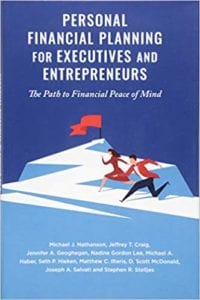
Personal Financial Planning for Executives and Entrepreneurs: The Path to Financial Peace of Mind
I must ask the question that I’m sure all the readers are asking themselves. You still have a brain tumor that’s still inoperable, but it’s not cancer so you’re still alive. Is that what you’re saying?
I do. I have a three-centimeter brain tumor. I used to not talk about it because it was something that I was afraid would diminish me and something that people would say, “That guy has got a brain tumor. He’s not long for the world. He’s got some diminished capacity.” I got into physical fitness and I met someone at the gym. This is the way stories transpire. You never know what’s going to happen. I met someone whose daughter happened to have a brain tumor. He was raising money for the National Brain Tumor Society, which is the largest nonprofit brain tumor organization in the country. Long story short, he recruited me to get involved in the organization. I became a board member in 2011 and in 2013, I became chairman of the board. I served as chairman from 2013 until the end of 2018.
When you have a position like that and you have a leadership role in a community in need, you’ll learn to talk about it. You’ll learn to own it and have pride in who you are and what you have. I’m very fortunate. My tumor should not end my life. It’s something that is treatable with medication. It’s inoperable because of its location, but it is treatable with medication that keeps it from growing. It doesn’t make it go away. I’m very fortunate. I must go get an MRI every year to make sure that I’m stable. I’ve been stable now for just about twenty years. I’m in good shape and I’m very grateful for the experience because while I would never have wished to get a brain tumor, I’m very happy to be part of this community. It’s a great community. It’s a community in need and one where I feel that I’ve made a difference in life.
You also talk about the similarities between medical and financial. You compare financial planning advice to medical advice. Can you expand on that?
I drive from my experience in the brain tumor community. I’m not a doctor or a researcher, but I’ve learned a lot about medical research. It occurred to me that as we make greater and greater advances in the medical space, there’s this thing called precision medicine. Precision medicine is the concept that some of the best and most effective treatments are treatments that are designed specifically for an individual. It’s not necessarily the same treatment that your neighbor would have. It’s designed for the specific DNA, the specific circumstances of a particular individual. Some of the most effective treatments are precise in nature. I also think from the medical space that there’s this concept generally in specialization.
[bctt tweet=”Financial peace of mind starts with a plan.” username=”John_Livesay”]
As you think about specialization, if you have a neurological issue, you tend not to go see a cardiologist. You might go see a general practitioner, but you want to see someone who’s a specialist that deals with your needs. As I got more and more into the world of financial planning and financial services, what I realized was that there were too many people trying to be everything to everybody. What we need to be thinking about is to provide the most effective type of financial planning service. It has to be targeted, it has to be precise in nature and it has to be delivered by specialists who understand the specific needs of the recipient.
I love that because I’m always saying the riches are in the niches.
For example, you mentioned our book. It’s about corporate executives and entrepreneurs. Corporate executives and entrepreneurs are very different from the professionals, from a lawyer, from an accountant, from a professional athlete. These are people who have very specific needs. They have very specific DNA. I believe that the right kind of service requires specialization and a precise approach.
There is such a difference because entrepreneurs do not have a lot of money to invest because we’re putting it all into the company. Who is your ideal client? How do you work with entrepreneurs? Are they people who’ve already raised series A and B versus starting out?

Financial Peace Of Mind: The decisions we make at the beginning of getting into a business starts with what choice you want to make in terms of what kind of entity to operate out of.
Certainly both because some of the best entrepreneurs are those that are just starting out. Often, you get someone who’s an entrepreneur that’s already done something before and now they’re on to another project. Let me just talk a little bit about the subject. The executive is a broad term that can include entrepreneurs. Many entrepreneurs are themselves, executives. It’s quite common to create a company and to have a product and to go get some financing. That person may have a title like a chief executive officer, chief financial officer, chief operating officer and yet that person is also an entrepreneur, which is why we wanted to write about both.
What we did was we wrote about the example of two people, and we tell a story around this where one person is a startup entrepreneur and one person pursues a more traditional executive at a large company type of opportunity. Their needs are related but different. The entrepreneur, especially in startup mode, should be thinking about foundational decisions such as choice of an entity that needs to be made at the very beginning in order to achieve the best financial results. Whereas the executive at the more mature company is going to have another series of needs and those needs will include the need to be thinking about employment agreements and equity compensation.
It sounds like you have a lot of advantages of being both a financial planner and a lawyer. It’s not like you have to go back and forth and say, “You need a contract. You need to put your LLC together here in Delaware,” or whatever the needs are that fit into the overall picture of financial planning. Would that be accurate?
That would most certainly be accurate. Our philosophy at The Colony Group is that we believe that effective financial planning advice should be delivered by a team that includes lawyers. In fact, we have around twenty lawyers that work for us because lawyers provide their own perspective. That is not just in the area being able to think about things like choice of the entity or thinking about provisions in a will or trust. Lawyers also have the ability and are trained to understand risk and to measure risk and to manage risk. I think that’s an important part of providing advice.
[bctt tweet=”Some of the best entrepreneurs are those that are just starting out.” username=”John_Livesay”]
Can you expand for people who may not know what choice of entity is since you’ve mentioned it a couple of times?
Choice of entity is when you begin in a business, that starts without an entity like a corporation or a partnership or a limited liability company around the business. It may start as a sole proprietorship, but the decisions that we make at the beginning of getting into a business start with what choice you want to make in terms of what kind of entity to operate out of. Do you want to be a corporation, an LLC, a partnership? It’s a complex set of choices. About what the right choices are, it depends on the facts. It also depends on the state of the law. The law has changed with the Tax Cuts and Jobs Act of 2017. There are lots of nuances that go into that decision.
You also talk about the five pillars of financial peace of mind, not just peace of mind. Let’s give the audience a quick little description. The first one is maximizing the rewards of working as an executive. What do you mean by that?
In order to answer that question, we have to understand why corporate executives are different. Executives are different for a variety of reasons. One of the reasons is that they often are employed under formal agreements. Many people are what we call employees at will, but executives tend to have some formal agreement in place. What we mean by maximizing the rewards of being an executive, first and foremost, is looking at your agreement. It’s negotiating appropriately and respectfully a good agreement. It’s understanding what’s in your agreement so you can harvest the benefits of your employment agreement. Maximizing the rewards of being an executive also includes understanding corporate benefit plans. It also incorporates understanding of equity incentives and other incentives that are put in place. Sometimes they’re cash related such as long-term and short-term incentive plans and making sure that the executive is well positioned to maximize the benefits of those programs while also observing the other four pillars.

Financial Peace Of Mind: The greatest strength of an entrepreneur is their passion. They have this courage where they don’t fear the risk.
The next one is achieving financial independence. What does that mean for you? Does that mean I never have to work again if I choose? How much money does someone need to have financial independence these days?
I want to be clear what that concept is. The concept of financial independence is a personal determination. It’s different for different people. This is not about, “If I have this much retirement and I take out 4% a year, I can be in retirement for this many years before I pass away.” This is beyond thinking about retirement. This is the concept of understanding what the person’s goals are and what their needs are going to be. Do they want to own two homes? Do they have kids that they want to educate? Do they want to leave money to their children in the future? When they do retire, what will their needs be from a lifestyle perspective? Understand all of that and come up with a plan to get to the point at which work is no longer necessary. That does not mean that you will retire at that point. It simply means at that point, you have the ability to do whatever you want. That’s what financial independence is. It’s understanding where you need to be. It’s getting to that place and then deciding at that point whether that may mean retirement or maybe it doesn’t mean retirement.
Planning and minimizing taxes is more important than ever now with the new laws. Certain states are not letting you deduct as much as they used to in terms of state taxes.
That’s right. Putting a cap on state and local taxes was a huge bite, especially in high tax states including some of the states on the East and West Coast. The third pillar is minimizing taxes. This is where many people go wrong, especially among executives and entrepreneurs. There are so many opportunities to minimize taxes. Whether that’s in the area of simply maximizing opportunities to defer taxable income, to maximizing use of deductions, to understanding the benefits of having capital gain versus ordinary income, to understanding how we’re using equity incentives by using a good tax approach that allows you to minimize taxes over the years. That in itself can generate a return that can sometimes exceed the great investment returns that we’ve been able to see over the last several years. People need to focus on a regular basis on the need to minimize taxes.
[bctt tweet=”Financial independence means understanding where you need to be.” username=”John_Livesay”]
Finally, planning for others. I don’t think most people think about that. Tell us a little bit about that one.
Planning for others, the fourth pillar, is the act of thinking about those that we love but also the causes that we care about. Planning for others is thinking about our dependence, thinking about people that we want to take care of while we’re here and while we’re not here after we pass away. That includes some traditional estate planning and thinking about dependent care planning, but it also goes beyond that. It’s also thinking about what are the causes that are important to an executive or entrepreneur. We find that most of our clients do have a passion for helping others and from making a difference in the world for what I called legacy planning. Think about what your legacy is going to be when you’re no longer on this earth. A big part of the planning exercise is identifying those causes and then figuring out the best ways to help those causes, not just economically but also in terms of providing your own services or just being part of the organization in some way. It’s complex. Choosing the right organization, understanding which organizations to get involved with and how to support them is itself a very complex undertaking.
Managing risk is so interesting to me because when you’re pitching to get your startup funded, you must minimize the risk for the investors by showing them that you’ve got proof of concept and who’s on the team and all those things. Even selling yourself in any situation to get people to change their behavior or the way they’re doing something with your product or service is also part of managing the risk that’s involved. How do you approach this for your clients?
Managing risk is something that we think about in many different perspectives. We must think about it in some of the most obvious perspectives, which would include from an investment perspective and talking about stories. One of the inspirations for writing this book is thinking about companies like Enron, WorldCom, Global Crossing, Bear Stearns or Lehman Brothers. I could go on. Years ago, these were companies that executives were just thrilled to be at. These were companies that the whole world admired. Those that had too much risk in those companies and those that had too much invested in those companies paid a very heavy price when each one of those companies suffered a very uncomfortable demise.
We think about investment risk. Investment risk can simply be asset allocation. It’s thinking about asset allocation strategy, thinking about the concentration of wealth issues, thinking about what your goals are and only taking the amount of risk necessary and no more to achieve those goals. That’s the more obvious way of thinking about it. A slightly less obvious way of thinking about it is thinking about the use of insurance. That insurance is life insurance. It’s casualty insurance. It’s directors and officer’s insurance. It’s thinking about all the ways that we’re exposed to risk and utilizing insurance to hedge that risk. Then we get to the broader and more nebulous areas of risk, which are the ones you were touching on.
Think about your business and think about all the risks that you take in your business. Most people don’t even have a clue as to how bad that risk can be. You get people who are so passionate about what they’re doing. That’s the greatest strength of an entrepreneur. The greatest strength of an entrepreneur is their passion. It’s their vision. Some people don’t have that kind of vision. That’s what makes the entrepreneurs the best. They had this courage. They don’t fear the risk. Fears are the instinct that we don’t always have. Fear is designed to make you exercise caution. As we operate our businesses, you should take as much risk as you need to take and hopefully know more than that. It is part of the business plan as well thinking about how much risk you’re taking to achieve your objectives.
You’re also talk about the criteria that people should use to decide what financial planner they should do. Should everyone have one? How do I find a good one?
There are studies that talk about executives. One of the studies that we talk about in our book indicates that executives worry more than other wealthier people about financial planning in every single category of financial consideration. They’re worried a lot. You might think that, therefore they’re also all going to be likely to go and hire someone to help them. That is true, but to some extent, it’s not true. We find that executives are prone to want to work with a planner, but only when they can partner with that planner. They don’t want to just completely delegate. They want to partner with an advisor that they can work with on a regular basis to achieve the best results. It may be a little bit of a surprise or an irony and that you think of an executive as someone who delegates. In fact, the larger group is the group of executives that want to partner with an advisor. There is a number that also wants to do it on their own, but they do understand that this is very important. What we found was that about two-thirds acknowledged the need for some third-party expertise.
[bctt tweet=”Fear is designed to make you exercise caution.” username=”John_Livesay”]
Whether that’s a formal financial advisor or whether they’re trying to do it themselves and work with a series of people like a lawyer, an insurance professional, an accountant, about two-thirds of executives want to work with someone. What are the choices? The choices generally relate to a couple of different service models. Most people are unaware of these models. One is what I’m going to call the suitability model. There is a legal standard called the suitability standard, and this is what is generally applicable to what we call wirehouses, the big brokerages. The standard at these brokerages is that the advisors there are bound by a standard that requires them to make sure that anything they do for a client is suitable in nature. They’re taking into account their personal circumstances, but they’re allowed to have conflicts of interest and operate in a way that may benefit them at the expense of the client provided what they’re doing for the client is suitable in nature.
That may sound like a negative way of saying it. That is the standard. I do want to be clear that there are many excellent people at these organizations who do great work for their clients. It’s about getting the right person. The other standard is the standard to which we adhere and are required by law to adhere is called the fiduciary standard. That is the standard by which an advisor must always put the client’s interest first. There will still be conflicts of interest. There are always going to be conflicts of interest, but they must be mitigated. You’ve got to mitigate your conflicts of interest and put your client’s interests first. That’s the preferred standard. You can get great advisors on both sides. It’s about getting the right person. It’s important to think about what the right standard is. Someone who goes to a fiduciary-based advisor is more likely to be able to get peace of mind that they know that their interests are being put first.
Michael, I can’t thank you enough for sharing your wisdom and your personal story. You inspire us all to not give up, have a plan and get some financial peace of mind.
It’s my pleasure, John. Thank you for having me.
Links Mentioned:
- Personal Financial Planning for Executives and Entrepreneurs: The Path to Financial Peace of Mind
- The Colony Group
- Quantmre.com
Wanna Host Your Own Podcast?
Click here to see how my friends at Brandcasting You can help
Get your FREE Sneak Peek of John’s new book Better Selling Through Storytelling
John Livesay, The Pitch Whisperer
Share The Show
Did you enjoy the show? I’d love it if you subscribed today and left us a 5-star review!
-
- Click this link
- Click on the ‘Subscribe’ button below the artwork
- Go to the ‘Ratings and Reviews’ section
- Click on ‘Write a Review’