

The Attention Switch With Itzik Amiel
Posted by John Livesay in podcast | 0 comments

Did you know that networking is all about listening? John Livesay’s guest in this episode is Itzik Amiel, the founder of EyeRon™ Group and author of The Attention Switch. Itzik shares his deeply personal story about the hug of life. It’s when the bus he was supposed to ride in exploded. Do you know what made him miss the bus and narrowly escape death? It’s hugging his girlfriend, who’s now his wife. From then on, he never passed by any opportunity to establish true connections with fellow human beings.
The only way to make real connections is by giving attention. If you want to succeed in networking, you need to learn how to pay close attention to the people you’re interacting with. Are you ready to get the success you always wanted? Then this episode’s for you. Tune in!
—
Listen to the podcast here
The Attention Switch With Itzik Amiel
Our guest on the show is Itzik Amiel, who is the author of The Attention Switch. We go into great detail about the different kinds of attention, how to get attention and how to keep it. He said, “Where energy flows, that’s where the attention is going. Attentional networking is the art of being you.” Enjoy the episode.
—
Our guest is Itzik Amiel, who has extensive experience for decades, gained as an international tax and M&A lawyer where he’s worked with companies around the world in the trust and financial situations. He founded a company called EyeRon. It’s the leading global expansion company where he listens to client’s needs and helps them grow their business internationally. There are lots of things you can imagine that you need to know and each country has a different situation.
He and his team operate in over 27 countries with a special focus on BRIC countries and emerging markets. He also founded the Power Networking Academy, which is the number one provider of business networking and relation capital. He is traveling all the time, has been featured on all kinds of international business TV channels, and has a great book out called The Attention Switch. He is working on a new mastermind for those people who qualify. We’ll find out more about that. Welcome to the show.
Thank you very much, John. I’m so excited to be here. I was listening to how other people introduced me because I’m learning about myself. The older you get, you start forgetting what you’re doing in your life and not appreciating it enough. When somebody else is talking about it, what goes in your mind is, “Is that me? Is that everything about me?”
I love the quote about your book being considered the Dale Carnegie super upgrade for the cyber age, which is fascinating. I want to ask you your own story of origin. You can go back to childhood or school, call it law school, wherever it was. When did you start having an interest in law and international? Did that lead to networking or did it start with networking?
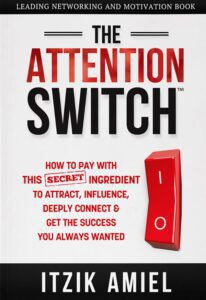
The Attention Switch: How to Pay with This Secret Ingredient to Attract, Influence, Deeply Connect & Get the Success You Always Wanted
You touched a very interesting one that nobody ever asked me in any show. You told about the book and about the fact that it was compared to Dale Carnegie. Here’s a secret I never share to nobody. The first book I ever read in my life was from Dale Carnegie, How to Win Friends & Influence People. I’m an Israeli originally. I read it in the Hebrew language. I remember finding it on the shelf in my room. It was owned by my father. He declined that he ever read that book. He doesn’t know about this book. I know it looks like, but I could not find this book anymore.
Since that day, it has influenced my life. I used to give it to a birth or for friends, but I never used to talk about it. It’s almost taboo in the legal world to talk about how to influence people and win friends while you are miserable. You have to do it. Nobody will understand. It’s almost like Napoleon Hill’s Think and Grow Rich. If people go, “I don’t want to be rich,” it’s not about that. It’s about thinking, mindset, ability and skills. We’re celebrating them but many years ago, nobody did.
I was embarrassed to say that I love people. Can you imagine? That’s a true story. This is my real story that my bestselling book, The Attention Switch, starts with. I hid this story for all my life as a lawyer. It’s from February 25, 1996. At the time, I used to live in Israel and work for a law firm in Tel Aviv. I’m originally from Jerusalem. My girlfriend then, which is my wife now, was working as an au pair in Jerusalem.
You know with boyfriend-girlfriend, I’ll sneak few times a week to Jerusalem and stay with my girlfriend. Early in the morning, I go to the bus station and from there to the center station to go to the Tel Aviv office. In that morning on 25th of February, ‘96, I woke up. If you work with me, I’ll have coffee. I was about to go to get the bus. At the station, my girlfriend hugged me. I ran and I missed the bus. It’s always the same routine. People stay in the same place. You’re going to know it because if you miss this bus, you miss the next connection and you’ll be late.
I remember being annoyed to wait there. Twenty minutes later came another bus. I was on the way to the center station in Jerusalem. There were police who stopped the bus. In the ‘90s, there was a lot of incidents in Israel, terrorists attack, all kind of stuff. We were curious about what was going on because we had to go from a different way to the central station. We asked the bus driver if he could open the radio so that we could hear what happened exactly. At that moment I heard that the first bus I was going to take exploded and everybody died.
You wouldn’t be with us if you got on that bus.
[bctt tweet=”Give attention when you love somebody.” username=”John_Livesay”]
I never shared that story. If you go over to Jerusalem, that’s a big place, though. It was the biggest terrorist attack we had. They had the same bus, same number and same hour the week after again, which was a very crazy incident. I will never think once I was miserable. I had power within myself. I was very successful. If you’re asking me, John, what was the time that I endorsed life and people? That was the moment.
My girlfriend is my wife now. This hug that I talked about is the act that I based all my life, the act of giving attention. It is the period of Corona. I guarantee you, John, if you go to an event, people meet and start hugging each other, count on me. Feel the feeling that people can transfer to each other but just warm hug. Without talking, pitching or anything, you can transfer it to another human being so much more warmth, love, care and empathy. “I’m here for you.” It’s everything you want with just a hug. That can be an act of giving attention.
That brings me to one of the things in your book, where you call it The Hug of Your Life. Can you tell us that story?
That’s exactly the hug of my life. When my girlfriend hugged me, because of that, I have my life. I will talk about this metaphorically, but also strangely enough, when I speak on stages around the world, it’s not in my culture. We don’t hug in Israel for business. People are thinking we hug, maybe in the Middle East but not in Israel. When I spoke on stage, people came around and hugged me. It’s unbelievable. I even caused people to hug each other. For me, more than the symbol, it’s a way of people understanding human-to-human. “I don’t care who you are or where you are from.” Nobody can ever convince me.
I don’t necessarily look like an Israeli or a Jewish. I could look like an Indian, Brazilian, Spanish or Arabic. I look like everything. I use that all my life to show people how miserable we are when we judge people. You’re missing so many opportunities. John, when I was speaking on the big stages and you know yourself, there are many very known figures. I’m the unknown guy doing the big stages. Everybody that’s there was Les Brown, Dalia Lama and Richard Branson. I’m the unknown guy.
I will not sit in the green room, John. There is so much bullcrap there. We don’t like that. I’ll sit between the audience somewhere in the back. I’ll talk to people. I look at the brochure. In the brochure, whose picture is there? It’s the speaker. They’ll say, “Who’s this guy? Who’s the speaker” It’s me, but I say, “Let’s see what they’re going to tell us.”

Attention Switch: Scientists prove that attention is a muscle of the brain. You need to practice the muscle of attention.
Suddenly from the big stage, they announced, “Ladies and gentlemen, our next speaker is Mr. Itzik Amiel.” “That’s my turn. I have to go.” People will look at me and say, “I’m sorry.” I’m going to use that because in the middle of my presentation, I’ll ask this person to stand up. “How did you feel you didn’t know who I am? I was not important, but you connect me out of authenticity.”
When people stand in line and they want to hug you and take a picture of you, I’m not sure what they want. I always believe you build a relationship for a reason, season or lifetime. I’m begging each one that’s reading to stop building a relationship for a reason or season because you’ll be miserable. Every relationship we build, build it for a lifetime. When I look at a person, I said, “Will I be a friend of this person the rest of my life?” If the answer is no, don’t walk away from them because it’s embarrassing. Run away from them. You don’t want these people in your life.
There are so many things you’ve said here that I want to recap for the readers. One is when you don’t have something go exactly the way you think it is. I was flying back from surprising my sister for her birthday party in Chicago to Austin. The plane was delayed. I’m like, “I’m not going to get home until after midnight.” You can get frustrated and annoyed or you can zoom out again and go, “There must be a reason I’m not supposed to be on that plane.”
The other thing I love about who you are as a person is I can feel your energy come through. That is a reminder to everyone that what you’re offering people is your energy. I remember once I was interviewed for a speaking gig and the agent emailed me, “Congrats, they picked you. They liked your energy.” I thought, “There it is in writing.” It’s not our credentials or the outcomes we’re going to give people. The client said, “I felt so good after talking to you. I figured you could make all of the people in the audience feel the same way. We want to learn about ROI and all that other good stuff.”
Whatever it is you’re selling, whether it’s to get funded, get people to join your team, start using your app or buy your product, if you can remember that you’re selling energy and money is energy in action, it totally shifts how you interact with people. You’re a walking talking example of that, which is why we become friends. I love it.
The other thing I want to ask about is this beautiful visual you’ve created called The Rainbow of Attention. You’ve got some great distinctions. Let’s go through all of them because they merit a chat. We all know what a rainbow is, but we don’t realize that there are some differences between giving attention versus getting attention. How did you come up with this wonderful concept of a rainbow?
[bctt tweet=”Build relationships for a lifetime, not a season. ” username=”John_Livesay”]
The first is out of frustration, for example, in our days in social media. If you look at it, every marketing on social media online is based on the act of getting and grabbing the attention of the audience. People measure your success by how many likes you get and how many people give you attention. I don’t care about that. I care about those people watching it. They say, “Why don’t I get likes? Why did I get only two? I’m miserable. I’m nobody.” You see all this stuff. I hate it because I feel bad for those people. It’s not true. I wanted to show it, so I’m helping more than 25,000 professionals that don’t go to some LinkedIn or somewhere else.
I’m doing everything behind the scenes, like in the messaging. I’d build the relationship. By showing them, they’re getting huge deals. If you look at the profiles, it’s like, “I’m a miserable person. I get only two likes and then a few posts,” but behind the scenes, the opportunities, the relationship building is unbelievable. We have the biggest scars in our world of getting and giving attention. How many people, when you talk to them, shut up their mouths and listen to your story? In networking, what I teach is you don’t need to speak. The introvert among us knows that. It’s not about talking. There are other network jerks many times. Listen from the bottom of your heart.
Stephen Covey talks about seven ways of listening, synthetic, inactive and disactive, whatever it is. Listen with all your heart and soul. Not dreaming what you’ll eat at dinner while speaking to another human being. Not floating around with a face while talking to somebody. Being there in the moment, you’re going to magnetize the soul of the other people. They don’t even know what happened, but they felt in their gut, “I want more from that.” You don’t even have to give them your business card or tell them the name. I promise you, they are going to find you who you are because they want more of that. They will find an only excuse to find again where you are to go there to invite you. They’ll pitch you on themselves.
John, don’t get me wrong. It’s frightening to a lot of people. Some people talk to me where they met me as a stranger and within minutes, they’re telling me the deepest secrets of their life. There comes a moment where they look at me and say, “I don’t know why I told you the story.” I said, “Relax. Enjoy it.” Attention is not an artificial thing. Attention, as proven by scientists, is a muscle of the brain like you have muscle on the body. It’s like if you go to the gym to practice your muscles, you also need to practice the muscle of attention.
Let’s give our readers a little exercise. Let us ask each one of you there, what do you hear in the room where you are? Maybe it’s the birds, a car driving, some screaming children, the pot or TV. What is out there? It was a tricky question, John. All those things are there all the time, but their brain is choosing to give attention to us. Do you see what the power of it is? From all the noises in the world, from all the sounds over there, they shut them all off and give full attention to one human being. That’s why in English, you say, “You pay attention.” It’s a financial term. Which other thing could you pay with? If you could pay with attention, they’d be a billionaire without money.
One of the biggest compliments I can ever give someone or that I can ever receive is that someone would say to me, “I feel safe to be myself with you.” That goes back to what you were talking about, the magnetizing of the soul that causes someone to open up because they feel like you’re not going to judge them. That sends any kind of basic rapport 101 because you’re getting an emotional connection, which is how we all want to connect.

Attention Switch: Speak slowly and articulate the word.
That’s why people are missing an opportunity in networking. A lot of interesting people in networking don’t stand in the middle of the floor. They’re somewhere on the side. Think about it. If you’re a CEO of a big company, you don’t want to see people to bother you if you want to come and listen to whatever lecture. You’ll sneak in the back and stand.
You’re a speaker. I’m a speaker. When we go and sneak in to watch another speaker on stage before we’re done, where are we going to go? We’re going to go in the back of the room. If you want to connect with people, find them in the side of the room. You will be surprised by what amazing people they are. Everybody will miss it because everybody looks at these people in the middle. They’re talking to everybody there. Talk to the one in the side. The one in the room, don’t worry. You’ll meet them one at a time. The one on the side, they are many times crazier than great people. I promise you. You’ll be surprised how amazing people you meet. Only give them attention. That’s all that you need to do.
You also have a distinction between positive attention and negative attention. My first thought is, “If I do something stupid like trip or drop food on myself, that gets me negative attention.” I’m guessing you have a different meaning here.
When I wrote this chapter, I was in a hotel in whatever conference. I was sitting with friends and talking about it. We start discussing philosophically. I don’t remember exactly the detail, but there was an incident that happened with the lady there. I could see the look on her. She didn’t have to say much, but it looked like, “I’m going to kill you,” with the eyes. You know that’s not positive attention, but she gave you the entire message by her two eyes looking at you.
I remember even when I was a child, my mother used to open her eyes and we know exactly that we didn’t behave nicely. These are the ability to transfer. You could use it. It’s positive-negative but not in the sense of discouraging you but more of warning you and stuff like that. Some of them is awareness alerts. “I’ll wait from here. You’ll be in danger. Don’t put yourself in danger.”
Attention is a muscle. You need to learn how to play with it. I’m playing with it a lot in airports, John. It’s also connected to body language. I used to think that attention is about eyes. I thought people give attention with their eyes. When I did the book, I found the research. It’s bullcrap. Do you remember the time you called somebody? You’re on the phone and suddenly they’re silent. “Are you still there?” We need the sign of attention. People do it in different languages, cultures or ways. They will do something or symbolize it. You know they’re giving you the attention. It has nothing to do with the eyes. A lot of it is based on the brain, how the brain works or the brain need symbols.
[bctt tweet=”Don’t put yourself in danger. Pay attention. ” username=”John_Livesay”]
Here’s another tip for people. If you want to get people to listen to you to know that you’re given attention and even you are the best expert in the world on this subject, you know so well everything about it, if somebody asks you a question, count 1, 2, 3, and now go out and answer the question. Why? It’s because the brain of the other person has to perceive you’re listening and giving attention. If you don’t give this time of silence and you answer right away because you’re the expert and you know the answer, the other brain said, “You didn’t give attention to me,” and then you lost them.
I’m big on teaching people about the concept that confident people are comfortable with silence and pauses. That completely supports what you said. You might be the expert. If you’re the expert, you don’t have to prove anything to someone else. You can be comfortable with that silence of three seconds or whatever it is before you answer, not without worrying about, “People think I don’t know the answer.” No, you own the room.
It’s the same thing when you get up to speak. You don’t necessarily have to start talking fast right away. You look at the room and the audience. You take it in and then you begin, but that takes a lot of confidence to be comfortable with not rushing through what you want to say. It’s a very unconscious thing sometimes when people talk too fast. It’s nerves plus the fear that, “I’m losing the audience. What I’m saying isn’t interesting enough, so I have to talk fast.” If you’re comfortable, you can take a pause between your thoughts.
That’s a very good one because I had to learn that myself. I tend to speak fast because I think fast, but with an audience, if I don’t think fast and I start speaking slowly, they’ll think I’m thinking they’re idiots, but it’s not true. What you said is exactly right. If the idiot will speak slowly, articulate the word and give poses, they let it sink and go even deeper in them. They get you more and they’re with you.
This is why I talk about speakers or people speaking. For example, if you go to the audience, you come in the morning and you know those speakers come in the morning, they say, “Good morning, everybody.” There are two people who answer, “Good morning.” Some of us goes, “I said good morning, everybody.” Everybody shouted. That moment, you lost the trust of the people because they gave you what they want and now you manipulate them. It takes fifteen minutes to get the attention back.
That’s why the pauses are so important because what you get is the biggest gift people give you and that’s the biggest commodity of their times, the thing that does not come back. It’s something that Microsoft did in 2005. Probably every entrepreneur know this, they do not know that Microsoft did it, but they searched the attention span of a human being. They found that in 2000 it used to be twelve seconds. 2013 was eight seconds. In 2021, who knows where it is? Do you remember what has one second more attention span from the human being? Do you know which one was that?

Attention Switch: When you let your brain relax, it will show you where the opportunities are.
Is it a goldfish?
Exactly. Don’t ask me how. I tried to see a goldfish in the aquarium. I couldn’t get its attention, but that’s what the research shows. That’s how sad it is. When it comes from that point of view that is declining, you need to know what people pay attention to because they’re going to be more and more things coming our way to steal this attention. More instruments, TV, iPad, telephone, people, all these things. How do you select what to give attention to? That’s the skill. If you know, you’ll succeed. If you give it to the wrong thing, you lose. The time’s gone.
It’s the same to network. You go to an event. You need to know who the people you want to meet are. You enter the room with 5,000 people. How will you know who to talk to? You have a two-day event. You know you’re not going to meet everybody. How will you meet the right people? Here’s a secret, John. It’s shown by research. When you go to the room, do you agree with me, John, that you are probably going to see maybe 10, 15 faces? You pick them up. The person with these glasses or the lady with the red scarf. What happened? Here’s what the research shows.
With all the 5,000 faces, your brain scans the room. The brain compares them to the library you have in your head because you have the library all the time. You cross the street. You see strangers. Your brain said, “Like, don’t like.” The brain is doing it all the time. It’s updating the library. When you’re in a room, the brain compares all these 5,000 people and shows you on the silver tray that you have 10 or 15 people you must go and speak to because something awesome comes out of it.
What most people do is push the delete button and start talking to everybody. Let the brain relax and it will show you. If you don’t have a good memory, take a pen and paper. Write it down, “The person with the red glasses. The lady with the blue scarf.” Now talk to these people. I promise you. You’re going to be so shocked. You’re going to find commonalities and opportunities in seconds. Within an hour of networking with ten people, you get opportunities. You have two days to enjoy. You have no stress. You don’t need to meet anybody else. Everything else is a bonus. This is a new thing.
The artificial intelligence inside of our brain is scanning. We just have to trust our gut. Is that what you mean when you talk about spontaneous attention versus planned attention?
[bctt tweet=”You have to be careful when you introduce the wrong people because you build relationships for years. ” username=”John_Livesay”]
That’s more out of frustration. In most of the professions I know, when they build relationships, they build it on most serendipitous attention. They go there and meet some nice people. They maybe follow up something to get you a referral. “Networking works.” To those people reading who want to build everything on serendipitous networking, do yourself a favor.
Don’t go to a networking event. When the world comes back to normal, sit at the airport in your country and meet awesome people. Each one of them could be a client. You’re not going to go wrong every day. If that’s what you want, but that’s not how you build a business because it’s not predictable. When you build a business, you need both, the planned and serendipitous.
Serendipitous is a cherry on the pie. It sounds nice, but if you have planned, then you know who you give attention to, why you give attention and when do you give attention, you’re going to get results and everything above it is an extra. This is the fun thing. Unfortunately, a lot of professionals build their business only on the serendipitous without any predictability on the model. In networking, most people don’t have predictability. They don’t know what they do. They just want somebody who told them to go to events.
All those are important things, we forget them. It doesn’t take the authenticity of it. It’s not manipulation. A lot of it is preparation. You prepare and you know who you meet. Nowadays, people are doing things online. Before you meet people physically, start building a relationship online. When you meet them physically, you feel like you met them years ago, but you just met them the first time. That’s the power of it.
I teased it out in the introduction that you have a mastermind. Can you tell us who that’s for and how you decide who you let in?
That’s a way to bring yourself back. As you know, I own Switch, which is a big training company, as well as Done For You Services for a lot of professionals around the world, but there’s one thing I was missing. My career was as a lawyer and accountant. I was helping companies expand internationally. This is my expertise in tax, legal and M&A but also in other subjects of the matter.

Attention Switch: Start building relationships online.
That’s where I started my career as an entrepreneur. I wanted to do that because I felt like the big companies know how to do it that maybe medium and a small entrepreneur doesn’t know. Some people have an amazing product, but they’re not okay. “I need to sell it somewhere else, but how do I do it? I don’t have the money to travel.”
I used to travel every two months to Brazil, India, China and Ukraine. I was traveling the world. No one paid me. The boss paid the bills. Each travel like that is $5,000, $10,000. That’s a lot of money for a small entrepreneur. The idea was, how do you find them the right opportunities faster? They don’t need to build twenty years of relationship, but they have the product. That’s all I did. It’s shaping and hopefully, we’ll go out with it for the first group. It’s very limited. It’s about 8 to 10 people because we wanted to get the business. It’s not theoretical teaching or something. All I did behind it was tap into what I call network intelligence or the power of the crowd.
There’s a lot of knowledge in there that people do not know and can solve the solution, thing that looks like, “How do I do it?” People solved it before. If you get your people to solve it and give you the answer, then you don’t need to look for consultants to do it. That’s always cheaper but also more valid and specific. They were in the franchise, so it’s not a book to read or something. We build it around global expansion. It’s mainly for entrepreneurs that are successful, maybe selling the product locally and want to expand to a new market but also those who have a good product that didn’t sell it locally. If you have lifeguard services, but you live in this area, you don’t sell it inside. You need to look.
Don’t get upset. Don’t bankrupt yourself. Maybe you’re in the wrong market. Maybe the other market is dying to have your product. I have a lot of companies that I helped in the past that I was shocked to see that they didn’t sell a single product in the local market. Let me tell you this. Many people who specialize are using that. They’ll buy it for pennies because they know they can take it to another market and sell it for a lot more money.
For example, the Canadian Goose, the coats. Once it starts declining, the German guy, after many years trying, has to sell it. The next person who bought it, within five months, sold it in a new market and made 100 times more money. People are doing things in the wrong market. There are lots of opportunities, but for me, it’s more selecting the right people that cannot be mass destruction with hundreds of people. It’s dedicated work and relationship-driven. They seem to know CEOs of company or top levels of relationship as well. You have to be careful when you introduce the wrong people because it’s something you have built for years.
When it’s up, I’ll let you know. We call it The Global Expansion Incubator. It’s not a mastermind. You know what a mastermind is. A lot of people, unfortunately, misuse the word mastermind to not make a mistake. It’s a place where you take people and expand the business internationally. That’s what I did behind it.
[bctt tweet=”Where attention goes, energy flows. ” username=”John_Livesay”]
You’re uniquely qualified for that. That’s for sure. The book is called The Attention Switch. If people want to reach out to you or follow you, what’s the best place to send them?
LinkedIn is the best place to find me. I’m always answering and active over there as well. Unfortunately, I don’t do much on Facebook. I have there a lot of followers but don’t look for me there. If you want to have the book, The Attention Switch, go to AttentionSwitch.com. The reason for it first is the limited edition. I have two versions of my book. The limited edition is four chapters more. I signed the book. It’s a free gift as training but also the most important thing, the money goes to charity to support the kidney foundation in the Netherlands because my mother died from kidney disease. It’s the same price like Amazon, I promise you, but it’s a different version of the book I made as a lawyer.
She’s 1 of the 4 women that you dedicated the book to, I saw as well.
My mother is the reason I’m speaking as a lawyer. People ask me, “How did you shift from being a successful lawyer? This is strange.” A lot of people don’t even know I was a lawyer because every brand is so good that I’ve hidden there. If you look at my profile, you won’t find it. I’m no lawyer than a speaker.
A short story is there were thousands of people at my mother’s funeral. I didn’t get it. I was like, “My mother is not a celebrity.” I asked one lady at my mother’s funeral, “How did you know my mother?” She said, “I don’t know your mother.” I said, “What are you doing at her funeral?” She said, “Your mother was a very special person. If somebody was sad in the corridor in the office, she would encourage them, speak to them, tell them good things and then she’d go back to her room. We didn’t know your mother, but we knew that’s the lady sits in that room.” When the lady in that room died, they all came to her funeral.
I remember sitting with my father and my four sisters on Memorial Day, which is the seventh day when we do it in Israel. I knew my mother never knew it. I said, “I hope she could see that because she never knew it in a lifetime that she touched so many people.” I promised myself that was the time for me. During my lifetime, I want to feel that I helped a lot of people. I don’t want to wait until I die. That’s the shift that I made of what I’m doing and the rest is history.
Thank you so much for bringing your energy, your wonderful stories and teaching us how to pay more attention and how to get it without being pushy.
Thank you very much, John, for the opportunity. Remember, where attention goes, energy flows.
Important Links
- The Attention Switch
- How to Win Friends & Influence People
- Think and Grow Rich
- LinkedIn – Itzik Amiel
- Better Selling Through Storytelling Method Online Course
Wanna Host Your Own Podcast?
Click here to see how my friends at Podetize can help
Purchase John’s new book
John Livesay, The Pitch Whisperer
Share The Show
Did you enjoy the show? I’d love it if you subscribed today and left us a 5-star review!
- Click this link
- Click on the ‘Subscribe’ button below the artwork
- Go to the ‘Ratings and Reviews’ section
- Click on ‘Write a Review’
Love the show? Subscribe, rate, review, and share!
Join The Successful Pitch community today:
- JohnLivesay.com
- John Livesay Facebook
- John Livesay Twitter
- John Livesay LinkedIn
- John Livesay YouTube
Unbias With Stacey Gordon
Posted by John Livesay in podcast | 0 comments


Unconscious bias stops you from seeing someone qualified enough to do the job. John Livesay’s guest in this episode is Stacey Gordon, author of UNBIAS: Addressing Unconscious Bias at Work. Stacey discusses with John how experiencing exclusion as a black female herself inspired her to write this book. People often hire people who look like them. We have a misguided notion that whatever we have done is the best way to do it. We dislike difference and change. Listen to this episode to discover how we can work our way to diversity and inclusion. Tune in and be unbiased!
—
Listen to the podcast here
Unbias With Stacey Gordon
Our guest on the show is Stacey Gordon, the author of UNBIAS. She said people recruit for differences but hire for sameness. Find out what she means. She also said a coworker is not a relationship, it’s a label and that real leaders do, in fact, see color. Enjoy the episode.
—
Our guest is Stacey Gordon, who is leading the intersection of diversity, inclusion and workplace culture. In her role as an Executive Advisor and Diversity Strategist, Stacey coaches and counsels executive leaders on these strategies while offering a no-nonsense approach to education for the broader employee population. She’s the creator of the number one resume course at LinkedIn Learning and an Unconscious Bias course which has consistently been the second-highest viewed course on the platform. It is translated into at least four languages and featured by LinkedIn, Microsoft, and Virgin America, which is now Alaska Airlines. Stacey, welcome to the show.
Thank you, John.
I see that you also teach at Pepperdine, where you got your MBA. My friend, Claudio Ludovisi, has been in the Marketing Department attracting people like you to come to take their MBA. It’s certainly a beautiful campus and a beautiful place. You have a book out called UNBIAS: Addressing Unconscious Bias at Work.
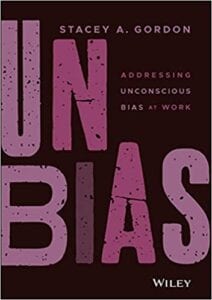
UNBIAS: Addressing Unconscious Bias at Work
It was released, and we are still promoting and talking about it and spending a lot of time focusing on the tenets of the book.
Before we dive into the book, let’s do a little background on your story of origin. You can take us back to childhood, school or wherever you want to start your story.
I always say, “Where do I start on this journey?” There are so many places I could go with it. I’d like to talk a little bit about the fact that the work that I do, I think my background, my childhood helped me prepare for this, which I did not know. Because I have always been the odd person out and it makes it very easy for me to relate to others, to be comfortable talking to different types of people and inserting myself in things even when I probably wasn’t invited or I wasn’t expected to show up. It’s like, “I’m here.”
Did you grow up in Southern California?
No. I grew up in London and then my family moved to Brooklyn, New York.
What was it about that place that made you feel like you didn’t fit in?
I did not fit in London because I was always one of the only black kids in my school. It was pretty tough for a little while there. I had friends that stopped talking to me because their parents told them that they couldn’t play with me anymore because I was black. I had kids that would hurl stuff at me and also, I remember being in that era too, where there’s a lot of very large Indian and Pakistani population. A lot of the cornerstones over there are owned by individuals who were Indian or Pakistani. There was a lot of hate crime, stores being burned down, swastikas being put up on the walls and a lot of riots and things going on. I was a kid and I don’t remember exactly what was happening, but I remember being scared.
One of the whole premises of childhood is to try and feel safe and I’m sure that was hard on your parents if they felt like you didn’t feel safe.
It was probably why we moved to Brooklyn. My mom’s family lives in Brooklyn and everyone there was black, so we’ll all get along. It’s like, “Not really,” because now I’m a black kid with a British accent in Brooklyn.
You still stand out. How did you decide you wanted to come to the West Coast, go to Pepperdine and focus on this particular niche? Obviously, you have lots of choices of what to do with your degree.
I spent a lot of time in New York City. It was expensive and again, being a person of color, it was like, “Do I want to stay in Brooklyn? At the time, we had a lot of crime and a lot of things going on. Is this where I want to grow up and raise a family eventually?” I lived in Manhattan for a couple of years. We couldn’t afford to continue to do that and realized that we had to leave in order to try to be able to make our dollars stretch, which is how we ended up on the West Coast and eventually in the LA area. We have been here longer than I’ve lived anywhere else.
That’s funny when you cross that mark. I grew up in the suburbs of Chicago for the first 21 years and then I remember passing 21 years in California before moving here to Austin and I was like, “I’ve been in California longer than I was in my childhood.” Let’s dive into the book and your website is Rework Work. That’s intriguing to me. Tell me how did you come up with that story.
[bctt tweet=”Coworker is not a relationship; it is a label. People recruit for difference but hire for sameness. ” username=”John_Livesay”]
I love the title and the name of our company. It came out of frustration as a lot of things sometimes do. I was working as a recruiter. I was running a recruiting company and at the time, I was operating under the Gordon Group. That was the name of my company. I was talking about that the usual, client work and the things that were going on. I was so frustrated. I said, “We need to rework recruiting, onboarding, training, advancement, and everything. We need to rework work.” I thought, “I like that. I wonder if anyone’s using that.” No one was using it. I did a trademark search and did the whole thing. It was like, “Wow.”
I’ve spoken to a lot of recruitment firms for their annual meetings, whether they’re Korn Ferry or another company, they all have to compete to sell themselves to get hired by a big company to find their next C-Suite level people. That was an interesting journey to look at their business model and how similar it is to other companies like architects. They have practice areas where people specialize in a special kind of thing.
A lot of recruitment firms are trying to get diversity within their own company, as well as offer diverse choices to companies that are hiring. The thing I keep hearing, and I want to get your opinion on this, is there’s not a lot of choices out there that fit that criteria. Has that always been the case? Do you see it changing if that is the case? For example, in the venture capital world, there are very few women, let alone women of color. If they want to fix it but don’t have people that have the skills to hire to fix it, how do you advise them?
They have the skills. There are very few women in the venture capital world because we won’t hire women in the venture capital world. They exist. I have to keep telling people like, “We’re not tooth fairies or the unicorns. We do exist.” The problem is that unconscious bias stops you from seeing me as somebody who was qualified enough to do the job when honestly, I’m probably twice as qualified as half the people there to do the job and I’m being real. There are people who are absolutely positively qualified to do it, but they are not seen as qualified as such. If we use the example of one of the women who is now going to be representing America in track, a black woman. She got blue hair. I’ve seen different pictures with different-colored hair. She’s got tattoos all over her. She is queer and got long nails. Here we are. We’re celebrating her. She’s going to represent the United States.

Unbias: Unconscious bias stops you from seeing someone qualified enough to do the job.
If that woman showed up at your job and said that she wanted to be hired, you would usher her out. She wouldn’t even get her foot in the front door. Here we are celebrating this person for being able to do the job she’s tasked to do regardless of how she looks. We have to realize that always we have been able to do the job, but because of how we look, we have not been seen as able to do the job. We have been turned away. We have been discriminated against, ignored and passed over. It is time for that to change.
One of the things you talk about is unconscious bias. It’s one thing if someone says, “I want to work with people that look and sound like me.” That’s obviously conscious bias.
Conscious bias is discrimination.
It’s one thing for people to know they’re doing it and maybe own up to it internally or whatever, but the problem from my perspective is there’s a lot of people who are unaware. That’s what your expertise is that it’s not biased, it’s unconscious bias. I’ve seen this when I was selling advertising at Condé Nast and I had worked at different magazines. I’m like, “All the women here are brunettes,” or at another place, “All the women here are blonde.” It was on some weird level, people are hiring people who looked like them and that’s within the same race. I can only imagine and I think that was an unconscious choice. The blondes wanted to hire blondes and vice versa.
We have a misguided notion that whatever we have done is the best way to do it. Others who do it the way that we do it, we like them. We don’t like difference and change. We recruit for difference, and then we onboard for sameness.
People hire for difference, is that what you’re saying?
We recruit for difference and we onboard for sameness or hire for sameness.
You’re saying, “I want to look at a lot of different kinds of people,” but at the end of the day, you hire someone who’s like everybody else in the company.
The thing is though, we go out there and we say, “We want diversity and difference,” but when you hire that person and you bring them in, you then say, “Do it the way it’s always been done.”
You need to fit into our culture. Don’t be yourself basically.
It’s like, “Why did you bother to go out and look for diversity in the first place?” When they don’t fit in the box that you want them to fit in, then you fire them or you say, “They weren’t a good fit. It didn’t work out.” The other thing is this notion that because there are fewer people that they’re not as qualified and that is so far from the truth. Every time I hear someone say, “I’d love to hire a woman in tech, but I don’t want to lower the bar.” I’m going to be honest. I want to punch them in the nose because that is so insulting. There are so many people who have not been given the opportunity and I get it all the time.
People say, “I treat everyone fairly. We hire people for skills.” That’s absolute BS because when you have your friend, Mark, who you’ve been hanging out with for months or years, that person gets the benefit of information and mentoring from you and learning the ropes informally. When it is time to promote, he’s ready because you’ve been grooming this person, but everyone else, you don’t talk to them. You don’t invite them to lunch, hang out with them on the weekends, golf with them and provide them with the same level of access.
One of the things you talk about is you help employee resource groups. Can you tell us a little bit about what that is and how that works?
[bctt tweet=”Conscious bias is discrimination.” username=”John_Livesay”]
Employee resource groups, you have an employee business group, business resource group, they used to be called affinity groups. A lot of companies now are creating them if they don’t already have them. There has been some controversy with that, too. It’s like, “Why are we separating? Why do we need to have a women’s group, black group, LGBTQ group, and Asian group?” The reason is that we have to focus on what are the systemic problems within the company that are affecting that so that we can all work towards fixing them. It’s not a group that is only for black people to join, it is a group that is focused on what is preventing black people from being promoted within your company. It’s not a group for only the gay people to join. It’s a group that everyone gets to participate in to look at what might be some of the barriers and some of the obstacles that we have created that would be problematic in this workplace.
It wasn’t that long ago. I would say even in the ’80s, they were looking for people who had families to promote because they’re like, “We like to have a guy who’s got a wife and maybe a kid or two, so they’ve got all this responsibility, mortgage, and child support to pay that they’re not going to take any risk and leave the company or start their own thing.” That’s our world. If you were single regardless of your gender preference or race, that alone used to ixnay you if you weren’t married. The list was so long of what was expected. Now that we’ve identified it clearly, I don’t think it’s a surprise to anyone reading, except maybe the depth of it might be a little eye-opening hopefully, but how do you help companies solve this problem?
The way that we do it is by exactly what you said. There’s a laundry list. There’s no point looking at the laundry list of things that we need to fix. It’s not about the individual laundry list of demographics and issues. If you’re single, you get discriminated against for this reason. If you have a baby, you’re discriminated against for that reason. You’re tall, short, blonde, fat, ugly, white, or whatever. As humans, we are always going to find reasons to exclude people. It is in our DNA.
The job is to know that and to counteract it. We have to be aware. That is the first step in the book. It’s awareness. We’ve got to be aware. We have to open ourselves up, be educated, and realize that this is a problem. We all do it and be open to realizing that this is what we all do, so then when we make decisions, we can remind ourselves that, “I need to make this decision and not make one that is going to be based on my gut feel, fit, or anything that I can’t quantify. Instead, I’m not only about to make a decision. I need to make sure that I’m going to make this decision based on facts and actual data that I have at my fingertips.”
So many people pride themselves on making gut decisions on the hiring and you’re saying, that’s probably going to tap into some unconscious bias. The other thing you talk about is leaders lead teams who trust and I’d love to hear how you help leaders build trust.
One of the ways that leaders build trust is by being open and being authentic, even getting to know people. We show up to work every day and we believe that we have a relationship with somebody because they’re a coworker. A coworker is not a relationship status, it is a label. We think that it’s okay. I’ll use this example because this used to drive me nuts. When I was pregnant, people would walk up to me and they would touch my belly without my permission. We’ve now come to realize that’s probably a little skeevy. We probably shouldn’t be touching people regardless of the fact that they’re pregnant. I used to complain about it and people would say, but they want to participate in the joy of you bringing a child into the world. “You, sir, are a stranger. I don’t care.”
It’s not about you. It’s not about what you want.
It’s the same thing. We want to get into these tough conversations. We want to have difficult conversations about race, sex, politics, etc., but I don’t know you. We haven’t created a relationship. Before you can dive in, we have to create a relationship. I need to get to know a little bit about you. I don’t need to know your intimate, deepest, darkest secrets, but I do need to know who you are as a person. I do need to know that you give a crap about me as a person. Once I know that, then we can start to develop some trust, then we can start to have some of these difficult conversations. Instead, we want to pull together a bunch of strangers, throw them in a room, and say, “Let’s have this conversation.” It’s like, “Whoa, Nelly! I’m not ready.”

Unbias: We have to focus on the systemic problems within the company affecting that group so we can fix them.
Until trust is built, then it’s someone’s sense of entitlement that allows them to touch a stranger’s belly without their permission. There are actual statistics taking females alone, let alone any other diversity, that female CEOs tend to outproduce men in the roles and yet, excuse predominantly male. There’s actual data, if I’m correct, that backs up that companies that have more diverse people working there have more diverse ideas and therefore, it can even be a competitive advantage than a company that does not. Is that accurate?
The statistics they are out there. If you look at Deloitte, McKinsey, and Catalyst, there are tons of statistics around the benefits of having a diverse workforce. The piece that’s missing though, is we also have to remember that we have to be inclusive because when you have a diverse workforce without inclusion, you have tokenism. We’re got putting people of color into positions strictly for window dressing.
We had a client and their job was to go out and do the sales pitch to get the work. They would make sure that they brought a woman and/or a person of color on that pitching team, but then those two people didn’t get to participate in the actual work. They didn’t get the opportunity to work on the project. Their face got to be on the project, on the documents and everything that went out. They got to be part of the pitching team, but they didn’t get to actually have the benefit of working on that project. That is tokenism. That is using somebody’s likeness to get ahead and that is not something that we want to be doing. That’s diversity with no inclusion.
You also talk about leaders’ need to not build trust, but listen. Obviously, if someone has, “I don’t like strangers touching my belly when I’m pregnant or anytime,” I’ve experienced this as an openly gay man where people say insensitive jokes and you feel like, “Should I say something? Who do I say it to?” If I say something, they’re like, “For God’s sake. Just get a sense of humor. Don’t be so sensitive.” Do you see that happening a lot around all kinds of things?
There are two things about that. One is, there is the sense that, “No one’s got a sense of humor anymore. We can’t joke anymore. Everyone’s so sensitive.” My response to that is we’ve always had to watch our mouths. We have parents. There are people in our lives who we respect and when we respect those people, we take into account their sensitivities and we pay attention to that. If my mother does not want me to curse, but I happen to curse like a sailor when I’m with my friends, when I get home, I find a way to somehow stop the F-bombs from coming out of my mouth. If I go to church and I talk to my pastor, I’m going to find a way to talk to that person and be respectful. Why is it that if you know that somebody doesn’t want to hear this specific joke or doesn’t think that’s funny that you want to be able to say, “No, it’s my right to be able to be an a-hole,” which is fully what it boils down to? You don’t respect that person enough to be sensitive to how they would like to be treated.
The final thing I want to talk to you about and you talk about it in your book, UNBIAS, is leaders see color. I think, again, an unconscious comment that white people can say to people of color is, “I don’t see color.” They think it’s a good thing to say and it sounds like you’re saying it’s not.
It’s absolutely not because it’s a lie. When we talk about building trust, how can I trust anything that comes out of your mouth when you start with something that is false on its face? You see color. You see that I’m black. This is not something that you do not see. You are not blind. It’s the first thing you see about me. You may even notice that before you notice that I’m female. When you say that, it puts everything else that you say into question because you start with something that is an absolute lie. What you should say is what you were trying to say instead, which is that I treat people the same regardless of color, ethnicity, or gender and then my question to that would be, “Do you? Let’s look into that.” The reason you won’t say that is because I can counter with that question and you would have to answer it, and that will be tough for you to have to do.
[bctt tweet=”When we respect people, we take into account their sensitivities, and we pay attention to that. ” username=”John_Livesay”]
Or even look at. It’s easier to gloss over it. I’ve never heard anyone frame it that way that it’s a lie and therefore, everything else is not based on truth. No relationship, work or personal without that foundation of truth is a house of cards. Any last thoughts or quotes you want to leave us with before we tell people how to reach you? Obviously, the book again, UNBIAS: Addressing Unconscious Bias at Work.
I want to say thank you. Our goal is to reach as many people as possible. However, we can do that, whether it’s purchasing the book, for your companies, for your company leaders, sending it to a friend, watching the Unconscious Bias course on LinkedIn Online Learning and all of those different things. What I’m seeing is that people are impacted positively and are realizing that they need to make a change. That honestly is the beginning and that’s what we need. We’ve got to start somewhere.
Let’s start with increasing our awareness. Stacey, thank you so much. Congratulations on all your success and I’m going to be cheering you on every step of the way as I watch you continue to grow.
Thank you.
Important Links
- Stacey Gordon
- UNBIAS: Addressing Unconscious Bias at Work
- Unconscious Bias – LinkedIn Learning
- Better Selling Through Storytelling Method Online Course
Wanna Host Your Own Podcast?
Click here to see how my friends at Podetize can help
Purchase John’s new book
John Livesay, The Pitch Whisperer
Share The Show
Did you enjoy the show? I’d love it if you subscribed today and left us a 5-star review!
- Click this link
- Click on the ‘Subscribe’ button below the artwork
- Go to the ‘Ratings and Reviews’ section
- Click on ‘Write a Review’
Love the show? Subscribe, rate, review, and share!
Join The Successful Pitch community today:
- JohnLivesay.com
- John Livesay Facebook
- John Livesay Twitter
- John Livesay LinkedIn
- John Livesay YouTube
Bend The Healthcare Trend With Mark Gaunya
Posted by John Livesay in podcast | 0 comments


No matter who you are or where you are in life, you should give kindness freely because leaders know how to adapt and blend with people. Learn and grow your business by being the right kind of leader. Join your host John Livesay as he talks with Mark Gaunya about the healthcare system, his passion for health and well-being, and its exponentially positive cultural and financial impact on businesses and organizations. Mark develops innovative solutions to complex challenges to save clients time and money. He is the Co-author of Bend the Healthcare Trend, a book written to demystify consumer-driven health and wellness plans with client case studies to share theory and show application. He discusses gratitude, learning, insurance and much more. As a leader, we need the inspiration to grow personally and professionally, and this episode boosts that and your leadership mindset.
—
Listen to the podcast here
Bend The Healthcare Trend With Mark Gaunya
Our guest is Mark Gaunya who is an entrepreneur on a lifelong mission to make healthcare easier and more affordable for everyone. He’s been recognized by the Benefits Pro as a Top 5 Broker of the Year finalist, and the Benefits Adviser as a Top 30 Thought Leader nationally. He develops innovative solutions to complex challenges to save clients time and money.
He’s passionate about consumerism, health and wellbeing, the exponentially positive cultural and financial impact on like-minded businesses. He’s the co-author of Bend the Healthcare Trend, which is a book that helps to demystify consumer-driven health and wellness plans. He is also the co-author of Inspire to Act and Inspire to Act For Kids, which are two books about living with an attitude of gratitude with 100 short stories about paying it forward. I can’t wait to know more about that. Mark, welcome to the show.
[bctt tweet=”Kindness has no age restriction. ” username=”John_Livesay”]
Thank you, John. I appreciate the opportunity to be with you.
Would you take us back to your own story of origin? You can go back to your days when you were at the University of Rhode Island or before that. How did you get interested in wanting to be involved in the healthcare world and insurance in particular?
My story of origin goes back all the way to my parents. My mom and dad were healthcare people. My mom was a nurse and my dad was a physical therapist by training. They were both very passionate about helping people and they are entrepreneurs. They built a company from the ground up. It was outpatient physical therapy. They had six facilities in three different states. After I graduated from the University of Rhode Island, I went to work with them for the first five years of my career. As a kid growing up, I learned all about the health care system, how it works, and how it was designed to help people. I learned how healthcare is delivered to people from the provider side of healthcare.
When I helped my parents sell their company and retire, I decided I wanted to learn how the insurance side of the business works. To be honest, the story was I want to go where the checks are written rather than where you wait to receive income. I went to go work for Blue Cross Blue Shield in Washington DC. That’s where I cut my teeth in the insurance business. I had a guy, my first mentor in the business, who put me into a leadership role with no sales management experience. He saw something in me and gave me an opportunity. Fortunately, I parlayed that into a career in insurance. I did a couple of what I call tours of duty in the insurance business.
I lived in Chicago for a period of time. I worked for Cigna Healthcare out there. I then left Cigna to be part of a startup health insurance company called Destiny Health, which is the expansion of an international organization firm that was based in Johannesburg, South Africa. They’re the ones who were pioneers in the whole notion of consumer-driven healthcare. It’s what we now know as health savings accounts. I moved away from Chicago back to the New England area where I’m originally from and met my now business partner, Jennifer. Through that journey, she and I became business partners in 2005. We run an employee benefits brokerage, consulting firm, and also a regional and national program called Captivated Health for a middle-market organization. The net of it is I’ve worked on the provider side, the consumer and the employer side. I have a 360-degree view of how healthcare works.

Bend The Healthcare Trend: How Consumer-Driven Health and Wellness Plans Lower Insurance Costs
That’s a fascinating perspective. As a child, you had a front-row seat as to how it all worked and what was wrong, and then you decided to get experience in every area of everyone who’s at the table. That’s the way I would describe that.
That’s an accurate way to state that. I’m not a clinician. I never have science in me. I appreciate it. I was not clinically gifted but I am business gifted. The business of health care and decided to learn the business of healthcare from every angle so that I could do something about it in my future years.
Don’t you think that gives you empathy and credibility? When you’ve been in someone’s shoes, it gives you both empathy and credibility. That’s the case for me when I get up in front of sales organizations and speak. I know what it feels like to have quotas, deadlines and to not take rejection personally, and all those things that everyone is struggling with on a day-to-day basis. Suddenly, I know you also speak to the industry. You have so much empathy and credibility because you’ve been there. Before we started the pre-chat, we talked about your friendship starting before your business relationship with Jennifer at Borislow Insurance. Can you tell us a little bit about how that evolved?
Jennifer was on the broker advisory council for an insurance carrier who was looking to do a joint venture with that company, Destiny Health. That council had to approve the transaction and I was the sales leader for that insurance company. The two of us hit it off instantly. The transaction went through and they asked me to head back to New England to head up the strategic partnership. My parents were retired and they were living in Cape Cod. This would give me a chance to be close to them which was a great decision because my mom passed away. I wouldn’t have had that time with her hadn’t I done that.
I met Jennifer and we became very good friends with each other. When I landed here in the Boston area, she was the person I would call and say, “What’s the market saying about my product and service?” She would tell me things that I didn’t necessarily want to hear but I needed to hear them. Truth be told, if I’m being honest about it, she and I are both passionate golfers. We spent a six-hour round in the golf course which is long, in the same cart together. That’s where our friendship was formed. She then tried to recruit me to go work for her. I didn’t have any desire to be employee number fourteen for her. At the time, it was a small benefit firm. We talked about becoming business partners and came together. As I always say to everybody, our business partnership was born out of friendship as opposed to the other way around, which makes it special.
You have a second edition. You told me that you were quite innovative and mailed that out. I’m going to ask you about that in a second. This concept of, “Why is health insurance expensive?” It’s basic because healthcare is expensive. There is a way to give people some power and knowledge. That seems to be the intent of the book. Who’s this book for?
[bctt tweet=”Empathy and credibility are a winning combination.” username=”John_Livesay”]
The book is for employers who are sponsoring health insurance and health benefits for their employees. It’s written for CEOs, CFOs and leaders of HR who are looking for a practical guide to transform their culture into one that educates people. If you look at the healthcare literacy rate in this country, according to the Kaiser Family Foundation, it’s 14%. That’s not okay that people are walking around not even understanding the language of healthcare. How are we going to expect them to be educated about making decisions if they can’t even understand the language?
We created this as a practical guide for employers to understand and demystify or debunk a lot of the myths that are promoted in the media or in the healthcare space by the players who designed the healthcare system. When you look at that, you say, “How do we navigate that?” What we did through this book is we created a practical guide that was ten chapters. It shared the theory in each chapter and then it would share a practical case story of a client who benefited and deployed that theory into practical application and what the impact was to their plan.
One of the things you have in your book that I love is this culture of health and wellness. Certain companies will give credit to help encourage people to join a gym and things like that. I’m guessing there are some other things that people can do when they have a company, big or small, to have a better culture for health and wellness.
We believe in the five-element construct of creating a culture of health and wellbeing. It even transcends wellness into overall health and wellbeing. Our five elements are physical, financial, workplace, community, mind and spirit. We look through those elements at any client we work with, and any business can do this and meet your people where they are. You can make progress in each one of those and we call that the whole person concept.
If we think about it, everybody wants to be physically and financially well. They want to understand the purpose of the work they’re doing and are tied to a bigger vision than that of themselves. They want to give back to the community and they need to spend some time taking a breath, meditating, doing yoga or whatever the case might be because life is still very busy. When you wrap all those five things together, you can transform the culture of any organization or elevate a company that’s already focused in those areas, but help their employees and family members ascend to an even higher level of wellbeing.
One of my favorite phrases is, “If it’s not measured, it doesn’t get done. If it’s not scheduled, it doesn’t get done.” We have something in chapter eleven called The Report Card. What is that about?

Healthcare Trend: A manager is somebody you have to follow, and a leader is somebody you choose to follow.
The report card essentially is our way of coming back to measuring the data, so taking a baseline assessment. When we work with a client, the first thing we’ll do is get any data analytics we can get our hands-on. It depends on the size of the employer, but demographic information, claims information, and we’ll do an environmental survey. We’ll go and look at the environment that the employers are working in. Especially with COVID, you see a lot of people are working at home. That environment has been somewhat challenged, but understanding the environment. The third is interests. What are the employees interested in? It’s those three data elements. Financial and data metrics, environment metrics and employee interests that you can then use as your raw material to measure, “What areas do we want to focus on and improve? What does the data tell us? What are the areas where we need to focus and improve?”
You and Jennifer went on to co-author Inspire to Act. You talk about how important a simple act of kindness is. When I speak to sales teams, the old way of selling is ABC, Always Be Closing and coffee is only for closers. I did that with ABK instead of ABC, which is Always Be Kind, starting with the way you talk to yourself. We can’t possibly be kind to our coworkers, let alone clients, if we’re not starting with some kind of internal thoughts ourselves. You collected this wonderful book of which all these stories of how positive connections with people have a direct impact on how we feel about ourselves. Is there a story in Inspired to Act that you want to share?
This idea or this book is born out of our culture of living an attitude of gratitude. We held a holiday party every year for our employees and we decided to shake things up a little bit. What we did was two weeks before our holiday party, we gave everybody $100 with a letter of instruction. At the time, we had twenty employees roughly. We had them go out into the community and do random act or acts of kindness. The only requirement was they had to come back to the holiday party and tell everybody what they did with the money.
The stories, many of them made you tear. One story, in particular, I can remember is one of our employees who went into the hospital emergency room. There was a family, they had a $100 copay at the emergency room and this person was fighting for his life. They didn’t have the money to pay the copay and the hospital was giving them a hard time. Our employee walked in and paid the $100 copay so that the family member could get the care. At that moment in time, he happened to be in the emergency room when something like that happened. It made a real big difference in that person’s life.
I always say when you tug at people’s heartstrings, they open the purse strings. That’s the power of storytelling. You start to imagine yourself in that story and what it would feel like that $100 could cause someone you love to not get the care they need to live. How would you feel if you were in that situation? On the flip side, how great would you feel if you had the money to help them? That’s a great example of that story. Many people say, “I don’t know if I’m a leader.” You have got this great quote in your book from John Quincy Adams, “If your actions inspire others to dream more, learn more, do more and become more, you’re a leader.” I love that so much because you and Jennifer didn’t have thousands of people working with you when you first started, but yet you were both leaders. Can you speak to aspiring people who want to become leaders?
First of all, Jennifer was one of the kindest people I know on the planet. She shared with me a quote that I’ll never forget when we first started working together, “No one cared about how much you know until they know how much you care.” When she shared that with me, I stopped and looked at her. I’m like, “What makes the two of us a great partner is that’s what we both not only believe but how we behave.” Leaders are somebody that people follow even when they don’t have to. A manager is not that. A manager is somebody you have to follow and listen to. A leader is who you choose to follow and listen to.
Jumping back to your other book, I want to close that open-loop I created. You sent copies at your own expense of that book to whom and to help them understand what they were dealing with because they weren’t healthcare experts. Can you tell that story?
[bctt tweet=”Creating a culture of health and well-being is a must. ” username=”John_Livesay”]
This was back in 2009. I co-authored the book and we were debating the Affordable Care Act, otherwise known as Obamacare at that point in time. I wanted our senators to stop, think and understand how the healthcare system works and from a prescriptive standpoint, how they could understand the principles that would set the foundation to change things for the better for people. I authored a letter and sent it out to all 100 US senators.
Sadly, I only received three thank you notes. Not even one from my home state of Massachusetts. That’s the sad part of the story. I did get three. One from Senator Collins up in Maine. She’s a wonderful human being. She’s become a friend of mine because I do a lot of work in the public policy area. I’m the Legislative Chair for the National Association of Health Underwriters. I get a chance to work with her and other people like that. I got a thank you note from Senator Hatch in Utah who was a very big believer in health savings accounts and consumerism. I also got a thank you note from Senator Inouye in Hawaii. A pretty good geographic dispersion but nobody from my own home state. I’m pretty sure most of them did not take a look at the book. Nonetheless, we made an effort to make a difference there.
We got to acknowledge the people who did send you a thank you, which is great. One of the reasons we’re aligned is the power of kindness and storytelling. I was working with an orthopedic surgeon who has created some new products for his industry and wanted some help on crafting stories to explain that to potential investors and other doctors. He said, “One of the benefits of learning how to become a better storyteller is with my child.” He has a seven-year-old daughter who used to say, “Daddy, tell me a story. Don’t just read me one.” He said, “Honestly, I was a deer in the headlights. I didn’t know how to tell a story until I started working with you. Now, I cannot just use storytelling from my career but with my child.” You and Jennifer took this Inspired to Act and have a new edition for children with the line, “Kindness has no age restriction,” which has got to be one of my all-time favorite quotes. How are people using this with children?
If you think about the whole notion of gratitude, it’s not something you’re born with. You have to be taught how to demonstrate gratitude. We believe that starts at a very young age. I have three children and I had them contribute stories to this but the idea would be, you don’t have to have $100. It doesn’t even have to be about money. How about you opened the door for somebody, or you say please and thank you when you want and get something, or you offer to be there for somebody as a shoulder to cry on when things are not going well? That book was written for kids 6 to 16 so that they can develop that habit of gratitude.
When you develop the habit of gratitude, it then becomes something ingrained in you. As an adult, I still write handwritten thank you notes and I do it every week. I do it because no one receives mail now. Most people don’t or a text. That’s a part of that person. In my case, it’s me. I’m putting a part of me on paper with my handwriting, telling you that you impacted my life in some magical way, or I’m amazed at how you conduct your life or whatever the case might be. That practice gets you out of yourself and focused on other things, which I think many of us get trapped in our heads. I know I do from time to time. That’s why the act of gratitude or meditation has been a huge gift.
That leads to helping children and what you’re doing as a Founding Principal and CEO of Captivated Health with helping schools. Can you tell us how you’re helping schools get control of their health care future?
We created Captivated Health in 2014. We do a lot of work with private schools where you might send your child to what you would be called a prep school. You pay for your child to attend the school. It could be a boarding or day school. We work with over 100 of them all across the country and growing in that space. We had three risk consortiums, three groups of schools that were buying together in their state but not buying together on a national basis. What we did is when Obamacare came into existence, it was going to make it very challenging for those schools to continue to purchase together.
Yours truly had to go and figure out, “How are we going to keep these guys together and help them overcome some of these challenges?” That’s how Captivated Health was born. Ten of our schools decided to be the founders of this program with us. We didn’t build this on our own. We collaborated with our school clients to create a community that was focused on four principles. Those four principles are members first, consumerism, health and wellbeing, and self-governance. If you look at those four principles, it’s table stakes.
The first principle of members first, I ask our team all the time, always ask yourself this question before you come in and advance an idea, “If you are a member of this health plan, would you want whatever it is you’re about to tell me?” If the answer is no, then please don’t bring it forward even if you know it will save us money. Principals and consumers, and everybody in the program, the employers offer a health savings account, which these plans have been beaten up by the media that they’re high deductible. Who wants to buy a high deductible plan? Nobody does. Who wants to buy a lower premium plan? Everyone will raise their hand. The idea of using words to help people understand healthcare.

Healthcare Trend: If we step back from the healthcare system and understand that it wasn’t a system built for the people, we could be aware that we can take control of our future by first acknowledging that.
As I mentioned to you, the literacy rate is 14%. Making sure people understand the language of healthcare is how you help liberate them to make better choices in the future because they understand the language. We use the slogan, “Knowledge is in power,” but if you look at the reflection, “Knowledge is me power.” The third element is creating a culture of health and wellbeing, which you and I already talked about in terms of the five elements. The fourth and final principle is self-governance. These groups and schools are taking the risk of what we call self-insuring the medical expenses of their people. They reinsurance to protect them from any person who might have a bad year or bad illness. They use other protection to give them a little bit of their financial liability but there’s risk involved based on how their plan performs from one year to the next.
What the self-governance principle does is created a set of bylaws. Those bylaws mirror our own US Senate, where it doesn’t matter the size of the school. They have one vote. Our Northern New England schools, their original ten pioneers, were very passionate about this because they said, “As this grows in scope and scale over time and larger schools come into the next, we don’t want our voices to be lost.” They created a structure with a chair and a vice-chair, and then they created four committees. Governance, membership, finance and engagement.
Those committees are staffed with HR and CFO executives who collaborate together in areas of concentration and represent their members. They have an annual meeting of the membership every year we hold in October, where they get together. They share stories of the programs that they’re running and the differences they’re making in the lives of their people. Is saving money and creating margin cuts for all non for profit important? Yes, but it’s not the driving force. The driving force is to make healthcare easier and more affordable for their people and schools.
At the end of the day, everybody wants to feel, be seen, heard and appreciated. Whether you’re managing people, your children or in this case, schools, everyone’s voice is equal regardless of the size. Mark, if people want to reach out to you in any of these areas, whether it’s learning more about gratitude, about how you can help them with their insurance or other schools, what’s the best way?
[bctt tweet=”No one cares about how much you know until they know how much you care.” username=”John_Livesay”]
My personal email address is [email protected], or they could go to our website, www.Borislow.com or in the example I shared with you about our program Captivated Health if they wanted to learn more about that. It’s spelled exactly as it sounds, www.CaptivatedHealth.com.
Any last thought or quote you want to leave us with?
If we step back from the healthcare system and understand that it wasn’t a system built for the people, understand that we can take control of our future by first, acknowledging that. Secondarily, understanding that the key to unlocking our future is to educate our people. We can find the interest of the people in the organization so everybody can get the same or higher quality healthcare at a fraction of the cost. They can reinvest those dollars in other areas to make whatever value proposition they’re providing their area a lot more powerful.
Thanks again, Mark.
Thank you, John.
Important Links
- Bend the Healthcare Trend
- Inspire to Act
- Inspire to Act For Kids
- Borislow Insurance
- Captivated Health
- [email protected]
- Better Selling Through Storytelling Method Online Course
Wanna Host Your Own Podcast?
Click here to see how my friends at Podetize can help
Purchase John’s new book
John Livesay, The Pitch Whisperer
Share The Show
Did you enjoy the show? I’d love it if you subscribed today and left us a 5-star review!
- Click this link
- Click on the ‘Subscribe’ button below the artwork
- Go to the ‘Ratings and Reviews’ section
- Click on ‘Write a Review’
Love the show? Subscribe, rate, review, and share!
Join The Successful Pitch community today:
- JohnLivesay.com
- John Livesay Facebook
- John Livesay Twitter
- John Livesay LinkedIn
- John Livesay YouTube