

Lighthearted Leadership With Lizette Warner
Posted by John Livesay in podcast | 0 comments


The world we live in can sometimes be really depressing. We turn on the TV, watch the news and all we see is pain and suffering. Learn how to convert those depressing thoughts into something more lighthearted. Transform your stress into positive energy. Join your host, John Livesay and his guest Lizette Warner as they discuss lighthearted leadership. Lizette is the Head of Clinical Science Global, MR Therapy of Philips and the Executive Coach of Optimum Vobis. Join in the conversation to learn how to take things slower. To take a break and just let things be more lighthearted. We don’t need to be stressed out for eternity, join in to find happiness today.
—
Listen to the podcast here
Lighthearted Leadership With Lizette Warner
Our guest on the show is Lizette Warner, who has a whole program about how to be a lighthearted leader. Whatever things are, start your meetings off with music. She has some wisdom from sixth grade about, “The news is depressing. I don’t want to be.”
—
Our guest is Dr. Lizette Warner, a wife, mother, Executive Coach, Podcast Host of Lighthearted Leadership and a busy global leader in healthcare. She’s passionate about helping people reach their best and unleash their inner superheroes in a fun way. She started her Lighthearted Leadership podcast as a way to shed optimism and lightheartedness on the pile of heavy topics bringing down her busy healthcare leaders. She’s got an Electrical Engineering background and has worked in telecom and pursued her PhD at the Mayo Clinic. She was then snatched right up by a healthcare company and has worked there ever since. Welcome to the show.
John, thanks for having me.
I always like to ask my guests to take us back to their own story of origin. You can start in childhood or school, wherever you want to start this story of how did you get to be you.
I feel like you’ve already given the readers a good overview here. I could go all the way back to the beginning like when I was a little kid. I was pretty much like the butt of everybody’s jokes. I was the youngest too, which always makes that difficult. The thing with that is that I grew up very super serious and always expecting people poking fun at me. I was also super gifted, only I didn’t know it. I assumed everybody else did math problems without having to write them down. I assumed everybody could read and remember everything about all the homework and things.
[bctt tweet=”In coaching, you learn to love that feeling of bringing out the best in people.” via=”no”]
It was surprising to me like, “You can’t?” I just assumed that. As a result, I went for my Electrical Engineering degree. I graduated and went into work in telecom. That was fun. I lived in different countries and meeting a bunch of different people. It was exotic from that perspective. My mom graduated from third grade. That was as far as she made it. The thing is my mom is one of the smartest people I know. She can do like geometry because she’s a seamstress. She was always good at these math things.
Growing up, I didn’t know this. I picked this up later in life. I never knew she didn’t have this concept of being able to do the math. It was something assuming everybody else can do stuff and know stuff. I remember going to her with this intractable problem that I had in high school. I went up and I don’t know I’m explaining the whole problem, telling her what’s going on in class and she’s sitting there essentially coaching me through this whole thing. What can you do? What is possible? All of a sudden, I walked away thinking my mom is the smartest person on the planet because she helped me solve this problem.
As I went through school, I didn’t even know what a coach was. I went to school and work. I was living in all these different countries. I wanted to get my PhD and for some reason, the Mayo Clinic accepted me. I ended up studying there still with this mindset of everybody knows more than I do. When I finished, I was snatched up by a healthcare company. I was exposed to a certain extent before that to coaching but that’s where I got a picture of coaching. As I climbed through, I had a team of my own and I started coaching them.
I fell in love with being able to bring out the best in these really bright people and bringing able to bring out the best in them to unleash great stuff. What I discovered through all of that, I started laughing with my clients. That’s why I do this whole Lighthearted Leadership is because in working with my clients and trying to curate topics, content and articles for them, I was looking up lighthearted content. The whole thing about being lighthearted is people think that you can be lighthearted or you can have fun but not at work. That’s for that after-work stuff. Being lighthearted doesn’t mean that you can’t have fun.
Also, that you’re not smart. You’ve got your PhD. Let’s talk about some of the work you do at Philips and then we’ll talk about some of the work you do with coaches. Your head of clinical science globally, not the US around oncology, which is not normally a topic people think, “Cancer, let’s have a blast.” You’re working with scientists. Your job is to manage these studies and see what is possible in terms of fixing things, I’m imagining or improving things. Do you have a story of a particular research study that you’ve worked on that you were able to put some humor in?

Lighthearted Leadership: People think that you can be lighthearted only after work, that it’s reserved only for after-work. But being lighthearted means you can have fun wherever, whenever.
That’s the thing. We’ve worked with a number of collaborators globally. The thing about putting, let’s say, a lighthearted spin to it is even starting off the meetings. Because some of the topics that we get into are very heavy or they’re very physics loaded. It means there’s a whole lot of thinking but there’s also this aspect of let’s back off and see what’s the ramification, the global outlook for this. There’s not a specific story that comes to mind. It’s more the aspect of when we launch in, checking in. There’s sometimes where I have like music going at the beginning of a call. It can be people globally. I ended up speaking to a lot of lawyers and regulatory people. They’ll log onto the call and there’s music going. It’s a thing that’s like, “Where am I?” People start grooving a little bit and it breaks the ice so that we can start talking about these deeper topics that can be legal, regulatory or a clinical study that’s ongoing but that habit tends to bring people a little bit closer together. Bringing people together and telling a story that people can be a part of. With that music, that tells us sometimes. This is not a specific humorous story.
You also talk about on your show this concept of long working hours killing us. Certainly, people can be workaholics. Now with the pandemic, a lot of people that found that blur between work and home, that they’re working more hours than when they went to an office. What are your thoughts on that? What can leaders do to prevent people from burning out?
You’ve seen a lot of this with working with a lot of the people that you talked to as well and the space that you work with but that is the thing. There is that blurred boundary of having all your work now at home. Instead of being chained to a desk, you’re now chained to your home office or your kitchen table or whatever and not being able to step away. One of the things that we did as a leadership team when the whole pandemic first started, my organization, at least my team, we have always been remote-based. We were able to tap into the wisdom from my team on, “How do you guys do this?” That was the thing. At the very beginning, people were able to appreciate that, “You guys do this all the time.” Now people are starting to appreciate that, “This is tough.” Some of the takeaways that we had shared as a leadership team were this concept of putting things in your calendar including a break time where you work for a chunk of time and then stop, pause, step away, go outside, take a breath of fresh air, go walk the dog or do something away from the workpiece.
I’ve heard of this in terms of changing your state. If you’re sitting, stand up. If you’re standing, sit down. When you physically change your state, it also helps mentally hit a reset button.
It does and even doing different things like having that music break. One of the things that I talked about on the podcast were these back-to-back meetings that people schedule and I think that is an energy suck. It’s like that vampire at work. It pulls all the life out of you. There are ways to deal with that too. If it’s a case of like making that mental commitment to yourself that, “I’ve got another meeting following this one.” For my sanity and everybody else’s, I’m going to have to bail 5, 10 minutes early so I can prep.
You have something on here about your sixth-grade wisdom, “The news is depressing and I don’t want to be.” Tell me a little bit about that. That’s hilarious.
[bctt tweet=”Start off your meetings with music, schedule breaks to prevent burnout.” via=”no”]
It was funny. I was having this conversation with a client. When I was in sixth grade, that was the first thing that was weighing heavy on my mind is the news. Every day I would come into school and I’m like, “This is so depressing.” I was in sixth grade and I don’t even know what was going on but I knew it was heavy. Psychologists recommend to people read, do not watch the news. We have these mirror neurons. I don’t know if you’re familiar with this. It’s a finding from neuroscience. This concept that what you see, what you envision, what you pick up from others, you take that on yourself physiologically. If you’re watching a stressful, scary movie, your body is picking up on those stressors as if you were there.
It’s not good to watch the fire or when 9/11 happened. People were constantly watching that happening over and over again and reliving it every time you watch it.
That is exactly what’s happening. Your body is releasing all of these neurohormones, neurotransmitters and you can be having a stress reaction. My sixth-grade wisdom somehow picked up on this. I’m like, “This stinks. I am not watching the news ever again.” Since then, every once in a while I’ll go back to watching the news. It’s about since sixth grade. I started watching the late shows and comedy. I started reading comedy things. That’s where the whole lightheartedness came from this Lighthearted Leadership Podcast. It was something simple. I was trying to curate lighthearted articles to send to my leaders and I was coming up empty.
I found an article from a few years ago. I found another article from over here. I found a book here but when you’re trying to curate stuff, to give it to your leaders so that they can have something to read, I was like, “This stinks.” I was reminded of my sixth-grade wisdom. I’m like, “That’s going to change.” That’s why I started Lighthearted Leadership. With all these heavy news topics but I could bring a lightheartedness to it. I do take on topics like, “Are Long Working Hours Killing You? Let’s talk about it.”
You were coaching some executives and what I love about what you do there is it’s very niche and you’ve also been in their shoes. Can you tell us about that?

Lighthearted Leadership: People need to have a calendar and put a break time where you work for a chunk of time and then stop. They need to go outside, take a breath of fresh air, and do something away from work.
It is intriguing. Being able to bring in the native knowledge, having worked in the field and knowing what it’s like to have back-to-back meetings, to have them yourselves at the same time as I’m coaching certain clients. Having that, there’s an ability to be able to relate. It goes back to your story of giving that story that people can feel that they’re a part of is them being able to relate that, “I know exactly what that’s like.” I’ve managed a household with little kids moving across the country and trying to go to school. I remember when I was trying to get my PhD, I already had little kids at that time and everyone else who was going for their PhD did not.
They came straight from college into the PhD track and maybe they got married during that timeframe but we already had little kids. They all looked at me like, “How are you doing this with kids?” I’m like, “They are the great equalizer. They’re the ones who keep me on track. At home, I’m doing my thing and I have a time limit. I get all my stuff done. Somebody is taking a nap so I have this much time to work on this. My colleagues were more of the aspect of like, “Let’s go to the bar. Let’s go do this.“ I was always very focused again a little bit of the serious and bringing in that balancing with the kids, that whole life parted aspect of somebody drew on the walls of the house with a permanent marker. That’s fun.
I remember talking to a colleague once. She said, “Do you know how much energy it takes to come to work and be fully present in the meetings and sales calls? That’s how much energy it takes when I go home. That’s my second job.” What do you think about that? Is that your experience as well?
Maybe a little bit different. I didn’t take that tactic with the kids. With them, it was stressful but also fun in a certain way because here you are helping someone else grow and get that wisdom and learn. It’s almost like coaching. There’s always a discovery moment for the coach, as well as for the client in any conversation. It’s the same with parenting. In parenting, it was always the same. I was constantly learning something else about myself. Whether it’s, “What are my limits? I’m going to murder this child if he does not get out of his pajamas and get some clothes on so we can go to school.”
What are some of the big struggles you see with the clients that you’re coaching? Are there unique stresses or challenges if someone’s in healthcare that they’re seeing people sick and die that typical people, let’s say, maybe in accounting don’t deal with?
The issues may be different but the overarching is there’s a lot of similarity between different areas whether you’re talking finance or physics. Especially now, some of those things are being so busy and having to do so much more with less. That’s something that pervades both healthcare in the industry as well. Even some of the entrepreneur clients that I have, happens as well. I have some non-profit clients that I work with and that’s a thing. Along with a work-life balance, it’s the multiplicity of things whether those things are personalities, conflicts and different tasks. It’s the weight of all that compounded and then one person to deal with all those complexities.
[bctt tweet=”The intuitive mind is a sacred gift and the rational mind is a faithful servant.” via=”no”]
That’s the piece that intrigues me because for my day job, for the work that I do, that’s my role. That’s what I’ve been doing for the past several years and that is what clinical science is essentially. You sit in between all these different stakeholders. Everyone’s pulling or pushing you or knocking you down in a certain direction and you have to stay upright and keep your sales going and keep somehow moving forward with this delicate balance of all these different pieces.
What advice would you have for people who want to make their leadership more lighthearted besides music and maybe sending articles that are lighthearted? Is there something they can do to get people who are overwhelmed and stressed out to find the humor in something?
Ordinarily, I would say, “Tap into your unique wit and wisdom. You don’t have to be anyone other than who you are. Everyone has their own unique wit, wisdom, humor.”
A lot of people go around going, “I’m not funny. I’m not a comedian. I don’t have wit. I’m not witty.” You’re saying we all have some level of it.
Absolutely because to be lighthearted doesn’t mean you’re a comedian. A comedian is their own profession. Nobody’s asking you to be a comedian. For me, it’s bringing some music in. It may be asking, “What fun thing did you do this week or where did we fail this week as a team?” It doesn’t have to be funny all the time. You don’t have to have a marching band running through whatever the not office, which sometimes it is the kids or the dog or whatever but it doesn’t have to be those things. It can be what is unique to you and bring that out because there’s beauty in that.

Lighthearted Leadership: Do not watch the news. Read the news because what you see is what you take on to yourself physiologically.
Is there a favorite quote or a book you’d like to recommend before we sign off?
There are many good books. Some of the quotes that come to mind are there’s one from Albert Einstein, “The intuitive mind is a sacred gift and the rational mind is a faithful servant.” We live in a society that honors the servant and has forgotten the gift so tap into that intuitiveness.
It doesn’t get better than that. If people want to reach out to you, follow your podcast or hire you as a coach, where should they go?
They should check me out at LightheartedLeadership.com or send me an email at [email protected]. It’s either/or.
Thanks for that wonderful closing quote. It’s a perfect fit for who you are and what you’re bringing to the world. Thanks for being you.
Thank you so much for having me, John.
Important Links
- Lighthearted Leadership
- Are Long Working Hours Killing You? – Episode on Lighthearted Leadership Podcast
- [email protected]
- Better Selling Through Storytelling Method Online Course
Wanna Host Your Own Podcast?
Click here to see how my friends at Podetize can help
Purchase John’s new book
John Livesay, The Pitch Whisperer
Share The Show
Did you enjoy the show? I’d love it if you subscribed today and left us a 5-star review!
- Click this link
- Click on the ‘Subscribe’ button below the artwork
- Go to the ‘Ratings and Reviews’ section
- Click on ‘Write a Review’
Love the show? Subscribe, rate, review, and share!
Join The Successful Pitch community today:
- JohnLivesay.com
- John Livesay Facebook
- John Livesay Twitter
- John Livesay LinkedIn
- John Livesay YouTube
Don’t Get Stuck In The Spam Dog House With Patrick Baynes
Posted by John Livesay in podcast | 0 comments

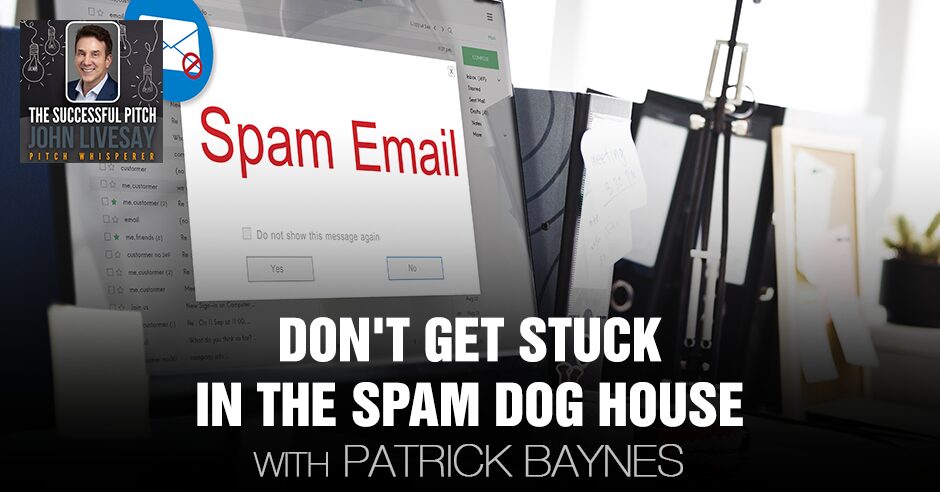
Annoyed by your emails getting caught by spam filters? You need to have a go-to-market plan so you don’t get stuck in the spam dog house. Stay on the right side of the internet and build a positive reputation as a sender. Join your host John Livesay and his guest Patrick Baynes as they discuss how you can increase productivity for better sales. Patrick is the CEO of Nerdwise and he is helping clients by giving out solutions that will help them on their sales journey. Learn how to generate leads and use the internet to your advantage.
—
Listen to the podcast here
Don’t Get Stuck In The Spam Dog House With Patrick Baynes
Have you ever wondered why your emails end up in the spam doghouse? Our guest Patrick Baynes, the CEO and Founder of Nerdwise has the answers for how you can avoid that happening. He’s got a lot of other answers too in terms of how salespeople should be spending their time to get those numbers where they need to be. He said, “Stop hitting brick walls by having bad systems in place. Find out how you can help companies transform their open rates on emails as well as their sales.” Enjoy the episode.
—
Welcome to the show. Our guest is Patrick Baynes who’s the Founder and CEO of Nerdwise. He’s an award-winning entrepreneur and marketing executive. His career started at LinkedIn in 2007, which led to the founding of Peoplelinx in 2009, which was acquired by Frontline. In 2015, Patrick became the CEO of Nerdwise where he leads vision, execution and customer relationships. Welcome to the show, Patrick.
Thank you, John. It’s great to be here. Thanks for having me.
I’m always interested to hear people’s stories of origin. We’ll get to this interesting way to start your career at LinkedIn, which is quite intriguing. Take us back if you would to childhood or school when you went, “I’m interested in computers or connections.” Was it always a dream to run your own company? How did that all start?
I had a moment when I was 16 or 17 sitting in class when I became self-aware. I don’t know if this happens to other people but I remembered having an out-of-body experience and recognizing who I was as an individual and how I was maybe different or unique from other people. I can still remember it clear as day when it happened. I had a little bit of enlightenment around wanting to find my own path and do things my own way.
That’s always been there but the other factor, which is a big opportunity for everyone, is when I was growing up, I only knew about 2 or 3 different career options. My dad was in the military. My neighbors were in financial services. Maybe I knew a football player or a WWE star. I didn’t know a few other people besides what you see on TV. I had an uncle who owned his own company and that made it accessible to me. I could see that path. Tech wasn’t a thing at the time. When I was in high school, AOL was coming up but you don’t think about getting jobs at startups. In any case, the dots connected for me in terms of my career in tech.
In 2006, I saw a video about what it was like to work at Google. They promoted a lot of free-thinking creativity. You spend 20% of your time on the things that you want to work on. You wear what you want to work. Culturally, creatively, it seemed like the best fit for me to look for opportunities in the tech startup sector but also aligned with my interest in starting a business and having my own business one day. That sent me to the search engines looking for tech startups. I got very lucky. That was clever at the time.
I use Google News search regionally. In the regions I was considering moving to, I was typing in a startup tech company, seeing who was making headlines in those various areas. That landed me at an article about LinkedIn opening a customer service headquarters in Omaha, Nebraska. At the time, I didn’t even have a LinkedIn profile. There was like, “If you’re interested in applying, email April Kelly.” It had her email address on there. I sent her a very polite email. I said, “I’m considering moving to Omaha after college and would love to come to check out what you guys are doing.” It was in Omaha because it’s the same founder as PayPal. A lot of the same people. They have about 4,000 employees in Omaha. In any case, I found my way into LinkedIn in the early days and started my track into tech and entrepreneurship.
[bctt tweet=”Spend time on targeted follow-through.” username=”John_Livesay”]
Many people have a dream of making these lists, 30 under 30, Forbes. You made 40 people under 40. Tell us about that.
I’ve coached a few other people who had asked me how I did it. A lot of those lists have a dark side to them. A lot of accounting firms post these top entrepreneurs regionally, nationally and so do a lot of publications like The Business Journals, Forbes, Fortune and Fast Company. The dark side to it is they want to get all of these up-and-coming companies submitting their information so they know who the CEO and founder are. They know all their financial data. Court is a polite word. They court you into being an advertiser, essentially. They give you an award and invite you to dinner. The dinner is $250 ahead if you want to come. They treat you like a piece of meat, to be honest, but it is nice.
Was it Ernst & Young? Is that who you were trying to think of?
That’s what it is. They’re building their database. For Ernst & Young, there might be 40 but they get 4,000 applicants. They get the CEO, founder, their email, financials and a lot of great info. The point is if you want to make one of those lists, you have to know what they’re looking for and they’re looking for prospects. You want to pump up. If it’s a media publication, they’re looking for ad dollars. You want to show that you’re making some money. You can spend some money. They care about things like headcount and revenues.
Maybe if you align a little bit with their brand or their image, similarly for the accounting firms. At the end of the day, it’s the story that you can tell to get those awards. The work that you’ve done, the work you’ve put in to tell those stories is what’s going to get you noticed and get you those awards but there’s a dark side to them.
Were you already at Nerdwise when you got that?
I was at PeopleLinx, if PeopleLinx shot my profile to the moon for a few years when we raised a bunch of venture funding and things. At Nerdwise, we’ve been bootstrapped so not quite as much attention.
The thing that also was interesting to me is the kinds of clients you have at Nerdwise. The one that jumped out at me is years ago. I was selling LexisNexis as a service to lawyers. The premise was if you go into court and your competitor, opposing counsel, has access to the latest case and it’s not in the library yet, they’re going to have a huge advantage over you. It was crazy expensive per minute way before Google Search words on how to find those cases. That is a fascinating company. It’s not the car company for those of you who heard Lexus and thought of the car company. It’s spelled slightly differently. Tell us about that client and what made them pick Nerdwise.
LexisNexis, an amateur where you’re pulling that as a client reference, they’re PeopleLinx client. They were a great client and a great partner. They were a reseller of PeopleLinx, as well as a customer.

Email Spam: In professional services, it’s your people that are driving the business. They are in many cases, the brand, the sales force.
You’re one of the few people I’ve interviewed and I’ve done over 350. When you have someone who’s a customer and a buyer on the other side of the fence, investors love that because you would love it enough as a customer to want to invest in it and vice versa. Maybe let’s back up and explain to people what PeopleLinx did that made LexisNexis want to work with them on both sides of the table like that.
We were the first enterprise level. We could work with smaller companies. LinkedIn focused LinkedIn management platform to help optimize your employee profiles, the types of connections they were making and then the content that they were sharing. We get companies to control over. They could configure, “John, you should have this description of LexisNexis. You should share this article. You should connect with general councils or principals at law firms,” whatever it may be. You could figure those types of recommendations and have teams within your organization that were on a leaderboard competing to be the best on LinkedIn against each other.
It allowed us to provide all this interesting data around how we were improving branding, connectivity into the marketplace, content reach and distribution. We were a little bit early at the time but we were the first in that category. We took off like a rocket ship in professional services because, in professional services, it’s your people that are driving the business. They are, in many cases, the brand, the salesforce. We had all the big four management, consulting companies. We had a lot of the Am Law 100. A lot of financial services companies, Prudential, Allianz, all of them were using PeopleLinx.
We were the most famous company that LinkedIn ever cut API access on as well, which is a whole another story. LinkedIn, not knowing how they want to do, build their ecosystem of partners. They opened up their API. Like any good developer, we built on it. We were a learning platform. We started adding LinkedIn inputs and then LinkedIn said, “We think we want to be in this business. We’re not sure but we think we do.” I spent about six months petitioning them. They cut us off along with dozens of other people. We were a few years ahead of everyone else. That led to the selling of PeopleLinx and getting out of that game.
Was LexisNexis the first customer?
They approached us. They had their eyes on us because we were getting so popular in the legal industry. When either ILTA which is a legal technology conference or another one came around, we had a booth at it. They beelined right for us and said, “We’re so-and-so. We want to learn what you guys are doing.” They knew that it was a hot space. They were hoping we could be a connector between LinkedIn data. They have a CRM at LexisNexis as well. The name is escaping me but it was their CRM group that contacted us initially.
They liked our current client base. They said, “We like reseller programs.” It was like an inbound partner lead. I learned a lot at this stage of my career. I was 27, 28 years old and I was leading partnerships at a fast-growing company. I was learning a lot. They flew up to Philly. We all went out to dinner and then our CEO was right as we were in the room about to sign the reseller and partner papers. Our CEO goes, “Shouldn’t you guys be a customer if you’re going to be reselling us?” They go, “Yes, we should. What does that look like?” We drew up the customer contract right there. They’re getting ready to arm their sales team to resell us. It makes all the sense in the world.
Two weeks later, I flew down to their headquarters. I was training their sales teams on reselling our solutions. It was a great customer and partner for us. For the time being, we’re still very good friends with the whole exec team over there. Many have moved on but we’re all still buddies.
Let’s cut to January 2015. You see a need in the marketplace. Let me ask you the story of origin because I love this as well. What made you come up with Nerdwise?
I made a lot of mistakes out of the gate. In 2015, I was a little bit bright-eyed and bushy-tailed. I learned a lot at my last venture and I’m thinking, “I can do this on my own. I don’t need to raise outside capital.” I had a little bit saved up from my days at LinkedIn and PeopleLinx. I thought, “Building a business is going to be easy this time around.” Essentially, what happened is when I started off, it was a little too product-focused. I’ll spare some of the details but it took me a couple of years. Maybe in the first year, I started to pivot. I listen to our customers and to the market a little bit more.
[bctt tweet=”Don’t punch a brick wall with a bad sales system.” username=”John_Livesay”]
One thing I was good at was generating leads for myself. I learned how to build a lead gen engine at PeopleLinx. I knew how to run sales operations and that side of the house I was pretty good at. I had a good lead flow. One of our first customers, a company by the name of Reflective Energy Solutions, saw me winning all of these new franchise clients. We had a franchise revenue stream that we were going after. He said, “How are you guys getting all of these customers?” I explained my system for generating leads. He said, “Could you do that for us?” I said, “I could do that for you guys.” That moved us.
What we were doing at the time was a form of social media content automation. We had some other bolt-on services and then we started implementing a prospecting system into this one client. It went very well and I realized these guys were willing to spend more money. They get more value out of our service than where I was focused. Over the next few years, we’ve been building out that solution stack, including our own software platform and services. It was a constant iteration. Not maybe the sexiest story there. I’ve learned a lot.
You saw the big problem. You were solving it for yourself and people started saying, “Can you help us grow faster than we currently are? We’re not sure if the problem is we don’t have enough leads, we’re not closing those leads, the competition is beating us in presentations because our technologies maybe not be the best or our pricing’s too high. We don’t know what the problem is but we know that we have to figure out how to hit our goals.” Why it’s so successful and needed is because you don’t take one part of the funnel. You’re tapping into getting more meetings to drive more potential in the pipeline. I don’t see other people doing this.
The increased productivity, how to get two or more selling hours a day is a great premise and what a smart foundation. Every salesperson I have ever worked with when I was in the field, we hate meetings. It’s a waste of time. Do we need to listen to everyone else’s projections for the next three months? Yet you’re supposed to be a team player. We’re going to have another meeting on this.
Sometimes when you burn people out on meetings and many of them being virtual, the core reason for having a meeting is like, “Let’s practice what we’re going to pitch and customize it to this client.” The energy’s not there because there’s another meeting and they’re not differentiating them. That’s my experience and observation. I would love to hear if you agree with that or if you say, “The real problem is or how we help people spend more time selling instead of being in meetings is.”
I do one thing personally that drives 7 out of 10 of my prospects from nuts, which is a surprise to me. It shows where the world is going. I don’t do Zoom calls until I have to. My first call is a phone call and I want to know, “Is this a fit? Is this not a fit?” We then can move down to what I would consider being more of a structured meeting where we block the time. We plan on going through a little bit of a deeper dive. I have prospects sometimes who say, “Where’s the ZoomInfo? I didn’t see ZoomInfo the meeting.” I’m like, “I got five of these. I want to talk first and let’s figure out if it makes sense to do that.” Have a process that you can put people through that make your day and your life that much easier.
I could put on a blindfold and earmuffs and run through my sales process over and over again at this point. It’ll be effective because it’s taken a long time to get it there. In terms of giving salespeople more of their time back, as it turns out in 2020, in 2021 and beyond, there’s a lot of great technologies out there that can augment the activities that we do and the way that we go to work every day. The problem is those technologies require other resources to come together for them to work.
The classic example I use is people will spend tens of thousands of dollars on Marketo, Pardot and Outreach. They’ll buy these expensive platforms for their teams and never get used. It turns out that the sales reps don’t know how to use them, don’t want to use them or the marketing leader tried it for a little while and it fell by the wayside.
I’m starting at a high level. We could put a system here that will take sales activities, make these tools productive and take sales activities. Drive them on behalf of teams using technology but also give them a roadmap so it’s repeatable. We can go back to the well anytime and continue to drive that productivity. I’ll give you an example. If you’re selling into local healthcare, you’re working the old way, pounding phones, researching the next health care company, digging around on their website, figuring out the email and doing all those mundane rat wheel activities. You don’t have to be doing that anymore.

Email Spam: In 2020 and beyond, there are a lot of technologies that can augment your everyday activities. The problem is that those technologies require other resources to come together for them to work.
That’s why ZoomInfo is a $15 billion company because people don’t want to spend their time doing list research. Right there, you’ve taken a valuable sales activity by providing qualified lists to your reps so that they can work off of those lists. What if you could also augment their outreach using an Outreach tool like Outreach.io or Mixmax and so forth? It turns out you need messaging, plan and all these things.
What we’ve done at Nerdwise is almost like a prescription. We interview our clients, learn about where they want to be in the market, where they have the most traction, what their value prop is or what they think it is and then give them a prescription around, “Here’s a system that we can implement very quickly that will help your sales team do these activities that you want them doing anyway.” The key is that there were augmenting real core activities that they should be doing to give them that lift and also give them more direction on how they should be spending their time and taking it off of some of those rat wheel activities.
That’s what we do at the end of the day. A sales rep who’s using Nerdwise doesn’t have to do a lot of the initial research, the initial outreach and follow-up. They get a regular flow of replies meetings. Where we’re going is around marketing intelligence tracking who’s in your funnel but not taking action and giving that to the individuals that we’re working with so they can do what we call targeted follow-through. That’s where reps should be spending their time on the follow-through on opportunities, not on the outreach and follow-up to create those opportunities. They need to have a lot of that work done for them in advance. At least if you can, you should.
I’m looking at one of your case studies with Tech Advisors. You were able to get them an average open rate of 50%. Fifteen is usually way higher than the norm. Are you crafting the content for the emails per client that gets those open rates that the reps maybe don’t know how to write?
In marketing and sales, people will say, “There’s always this tension between marketing and sales.” They’re right. Those two worlds don’t always play nice together but there is so much magic when they do. More and more so, marketing and sales are holding hands and skipping down the street together. That’s happening more often than it used to.
Down to the emails that the reps are sending, we are bringing marketing best practices and marketing elements into their emails that most reps would never have the acumen or experience to do themselves. One example is the go-to-market plan that I talked about. That enables you to know who your audience is very explicitly. If I know that I’m intentionally going after financial services companies, I’m going to use a unique language that’s unique to financial services companies. I’m going to talk about the outcomes that they care about, not generic outcomes.
In financial services, they don’t want sales. They don’t talk about funnels or even leads. It’s about relationships and clients. Maybe pipeline gets talked about a little bit there, effectiveness, closing, reducing, cycles or timeline to your next client, whatever it may be. That language is going to be different. The outcomes are going to be a little bit different. To get those 50% open rates, 50% as low, we’ll go. We have clients at 70%, 80% open rates. It takes a number of factors to get there but you have to start small. There’s lots of testing. I can tell you some fun subject lines if you want.
Let’s hear those. I tell people, “If you think of an email like an ad, a headline that grabs your attention, that subject line is everything.” Most people don’t spend any time on it. They’re following up or whatever, something boring.
The subject line can get you the open but then you got to have the rest if you want to get some action. One thing that we use pretty universally that’s effective is the recipient’s name in the subject line but not in a generic way like, “John, are you interested in this?” We don’t do that but it might be like intro, John Smith/Patrick Baynes. I’m like, “Is this an intro? Am I getting introduced to somebody?” The one that triggers a lot of action and high open rates is sending a reply to that first email so it goes out as a legitimate reply. It’s like, “John, did you see my email? Please, let me know if this Thursday at 2:00 PM works for you.” Some go, “This isn’t automated. That person went back and replied to that.”
[bctt tweet=”Marketing and sales should join hands.” username=”John_Livesay”]
There’s another one that’s fun. This one got me a few months ago and we brought it to our clients. It’s cute and clever touching base. It’s like, “What are we touching base about?” I clicked it. As soon as I clicked it, they got me. Some of those work. I got one with no subject from somebody trying to sell to me and that got my attention. I’m like, “What is it?” Only people who know you might send you a no subject. I pay attention and see what gets me but then you got to have the rest of the story in there.
I want to go back to what you said about how important it is for salespeople to be spending time on targeted follow-through as opposed to trying to find leads. One of the keys to my success, when I was in sales, I was adamant about the follow-through. If I promised somebody I’d have a proposal to them and they said, “Call me back in a week,” or whatever it was, I would do it. I was amazed at the number of people who didn’t.
To me, that’s table stakes. That alone separates you from half of the herd of those who don’t follow up because they’re so distracted by 101 other things. They don’t have a system in place for that targeted follow-up. What have you found works when people are following up versus have you said yes or no yet? Sometimes the follow-up can be like, “Congrats. I saw your quarterly earnings were up. I saw you got some great press.” It doesn’t always have to be pitching something.
It shouldn’t be, almost never pitching something. One of my favorite sayings in sales is, “How do you catch a cat?” Do you know how to catch a cat, John?
I know you don’t grab its tail.
You let it come to you. Even if you’re following up, you don’t go to grab it. You don’t go, “Are you interested? Are we moving forward?” You don’t try to go forward. You got to play it cool. You also have to give them time. You got to be a little bit cool about it. When I do my follow-ups, typically, I’m saying something like, “Does it make sense for us to connect later this week or sometime next week?” It doesn’t make sense. Another one is you can ask, regardless of the sale, “Do you have ten minutes to connect this week?” It’s a quick one. Also, give people an out. If you’re not interested say, “Let me know. I don’t want to keep bugging you.”
Can we talk about the other case study you have here a little bit before I let you go, which is Lynk? I always love when a case story starts with some exposition. Paint the picture. How long ago did they approach you? Where are they? The problem is they’re not growing as fast as they want you to get market share. How do they find you? Where were they in their market share? How did they even become aware they had that problem?
We found them using the same system that we sell to our clients. We generated our own lead from Lynk. When we reach out to clients, from our perspective, we’re offering a way to help them generate more leads, accelerate their pipeline and get them to market faster. There’s a lot of that language in there that resonated with them. They’re a very interesting company. It’s like a blockchain FinTech, very cutting-edge stuff. What we were able to do for them is get them out of their own heads where they were so heavily focused on the technology that they had, where the market was going and all of these things but their target client doesn’t care about any of that stuff.
There are two dots I want to connect. One of your early mistakes was focusing too much on your own product development, which is a common thing that most tech people do. They love it. Their head is down on that. I’m assuming that what’s important to me is important to the people who will need our products. You’re not speaking the language that grabs people’s attention is what I’m hearing. When someone like you comes in and goes, “You got some cool stuff here, blockchain and all that other stuff but nobody cares about how it works. They just care about the outcome.”

Email Spam: You don’t have to do Zoom calls until you really have to. Your first call is a phone call and then you can move down to a more structured meeting.
Even if I had gone back to when I started Nerdwise and I knew that lesson a little bit in a more hardened way, I may be a different business because I would have been so much better at marketing and selling the stuff that I was doing but they got us at the right time. We met them at the right time as well. There was the whole system that we put into play. There was an accelerator but the biggest change that we made to their sales process, their sales outreach, to the stuff that they were doing was getting them out of their heads, showing them, “This is what this should look like to your target client.” The case study says 90 meetings for 30 days. It was outrageous. 1 in every 8 people we reached out to took the meeting.
Did you find a lot of people that work with you don’t have a system in place or the system they have in place needs to be tossed out and you start using yours? Are you starting from scratch? Are you redoing something that exists?
It’s a mix. When I went to a trade show in San Francisco, it was a lot of tech companies and people would say, “What do you do?” I said, “Does your company run outreach sequences for you guys? Do they do any sales orders?” They go, “Yes.” I go, “How’s it going?” A lot of people say, “It sucks. Sometimes it’s good. I don’t know.” Most people don’t know how it’s going. When you get to the person who’s running it and you said 15% open rates, if you have 15% open rates, that means for every 100 prospects you reach out to only 15 of them are even reading your email. You’re punching a brick wall. You’re never going to make headway with that type of performance.
When we engage with the client, either they have no system in place or they’re not getting the performance that they need. I always wish I had like, “Here’s a crystal ball, silver bullet. This is going to get you guys.” People always want to know like, “What messaging you’re using? What subject line is it?” I won’t tell you all my messaging. I’ll tell you all of the subject lines. There were about fifteen things you have to get right for a program like this to work well. I could try to go through all fifteen. There’s a lot of them. Did you know that if you have multiple links in your email, it’s going to get caught in spam filters? Did you know email signatures oftentimes carry 3 to 4 to 5 URLs? Did you know that there are volume issues and trigger words?
Some people are using the wrong technology to do things. Some people have hurt their reputation by throwing 100 prospects into a machine and blasting them and suddenly, they’re in the spamdoghouse. It all starts with a good go-to-market plan. You have to know who your audience is. There’s something called warming up a domain, which is critical. You can Google that term. Microsoft, Google and all of the big players provide clear instructions on how to do this right because people do it so wrong. It’s how you stay on the right side of the internet and build a positive reputation as a sender. That’s how you can get and keep a very high open rate engagement rate with your emails. All of these factors are critical.
The thing that comes to mind is you’re like a master chef. If you only want to make a basic hamburger, that’s not that complicated but if you want a gourmet meal with multiple courses and having it all get done at the right time, that’s a big part of serving a meal.
If you want to serve 100 customers, 5 people, 10 salespeople or 3 markets.
You leave one ingredient out. The temperature’s wrong. You open the oven and it doesn’t rise. That analogy is helpful. It’s not just one thing that makes a great meal nor does one thing that makes a great campaign. Therefore, you need your expertise because you’ve been moving those like what a master chef does. Put one more sprinkle of salt and it’s going to ruin the taste. Without it, it’s bland. That helps people understand what your secret sauce is playing on that analogy. There’s a recipe that you’ve created and it’s your own proprietary. You clearly are getting stellar results that people don’t even know are possible. If someone wants to figure out, “Are we good for what Nerdwise is offering? Will it work for us or not?” What are the criteria? Is it only B2B?
It’s anything in B2B that we can work with. The only challenges I run into are when folks are working on super niche industries like government contracts or something where this may not be the right fit. Sometimes the people don’t have enough of a sales operation, meaning that it’s still an owner-operator, maybe nine folks on delivery or whatever the mix maybe. Even though that can work well, a little bit of maturity around your sales ops helps.

Email Spam: What Nerdwise does is learn where their client wants to be in the market. What their value prop is or what they think it is. Then they give them a prescription of activities that will help them in their direction.
The other thing to go with that chef analogy and I love that I’m walking away here with a story that I can use to go and sell with is chef prep. They need their ingredients the day before. They need to prepare and line up those ingredients. They need to know where they’re going with everything. There’s so much before that comes before the dish, before the next dish and so forth. All of that is critical as well.
Most companies don’t even have a sous chef in sales development or they’re going to the farmer’s market at the wrong time and all the good stuff has gone. That means it continues to work in a lot of ways. Nerdwise.com. You’ve got your own website, PatrickBaynes.com. Anything else you want to leave us with a quote or a favorite takeaway?
A big high five and a thank you, John. I appreciate the opportunity. Great conversation.
Thanks for sharing your insights. What a wonderful story. Thanks, Patrick.
Important Links
- Patrick Baynes
- Nerdwise
- Peoplelinx
- LexisNexis
- Prudential
- Allianz
- Reflective Energy Solutions
- Marketo
- Pardot
- Outreach.io
- Mixmax
- ZoomInfo
- Lynk
- Tech Advisors
- https://www.Nerdwise.com/blog/how-to-leverage-the-power-of-storytelling-in-sales-with-john-livesay
- Better Selling Through Storytelling Method Online Course
Wanna Host Your Own Podcast?
Click here to see how my friends at Podetize can help
Purchase John’s new book
John Livesay, The Pitch Whisperer
Share The Show
Did you enjoy the show? I’d love it if you subscribed today and left us a 5-star review!
- Click this link
- Click on the ‘Subscribe’ button below the artwork
- Go to the ‘Ratings and Reviews’ section
- Click on ‘Write a Review’
Love the show? Subscribe, rate, review, and share!
Join The Successful Pitch community today:
- JohnLivesay.com
- John Livesay Facebook
- John Livesay Twitter
- John Livesay LinkedIn
- John Livesay YouTube
Mental Fitness With Rob Roell
Posted by John Livesay in podcast | 0 comments


Who says fitness is all about the physical? Rob Roell, Executive Coach at Equilibrium Coaching, believes we also need the mental stamina to unlock our true potential for professional success. In this episode, he joins John Livesay to talk about mental fitness, what it is, and why we need it. He dives deep into the imposter syndrome, the ways social media amplifies it, and how we can overcome that through mental fitness. Offering some great tools, Rob discusses the book Positive Intelligence, where he highlights how we can be more productive and fight off what is called mental saboteurs. Achieving success is not just about having the physical capacity to work towards our goals. It is also about having the mental part taken care of that helps us see through the challenges along the way, especially in this modern world. Join Rob in this conversation as he helps us become mentally fit.
—
Listen to the podcast here
Mental Fitness With Rob Roell
Our guest is Rob Roell, who is an Executive Coach that helps clients unlock their true potential for professional success so they can increase their performance without all the anxiety and stress. He has created a wonderful book called Positive Intelligence, PQ if you will. It’s a simple yet powerful operating system that allows you to become mentally fit like with physical fitness require some practice. This Positive Intelligence is developed with coaching in mind. He has been able to improve clients’ progress with their goals.
—
Rob, welcome to the show.
Thank you very much. I need to correct you. The book is not my book. The book was written by Shirzad Chamine, which is a great opportunity to give him credit for the foundation that I work from.
I have had some people do that with other people’s work. They give credit, whether it’s Simon Sinek’s Start With Why. It’s so wonderful when someone creates something so valuable that other people can be credited and make it a basis for a foundation and get the training directly from that.
This stuff is incredible work. It’s foundational for me. I use it as a foundation for all of my clients.
Tell us a little about your own story of origin. You can go back to childhood or school. How did you get involved or interested in coaching and helping people?
Years ago, I was at a Tony Robbins program. One of the trainers that I was working with saw something in me that can happen like a bubble went off in my head. This was something that I wanted to do. When it came together like one of those meant to be moments, I was talking to a friend of mine after the program. He’s like, “Rob, have you ever done this before?” Without even blinking or missing a note, I said off the top of my head, “It’s funny. I have been doing this all my life. I’ve never got paid for it.” It’s true. I have always been that person in every group of friends that people come, seek out advice, knowledge from and the shoulder to cry on like, “Rob, can you come over here? I need to talk to you about something.”
It fascinates me because of your background. You have a Master’s in Electrical Engineering. Nothing against engineers but as a species, you guys are exactly known for being right brain, warm and fuzzy. You toggle back and forth.
There is a reason that we use that term binary. Engineers tend to be left-brain cerebral thinkers. History-wise, my last run in the corporate world was what would be called a sales or a systems engineer, which is the person on the sales team that helps the customer to understand technology. That’s something you wouldn’t traditionally think of as an engineering role. It’s one of those places that I have always been in that unusual space between what traditionally I was trained for and what comes naturally to me.
[bctt tweet=”Celebrate your wins.” username=”John_Livesay”]
In a way, you are a translator of tech to something understandable. The same thing seems to be happening to me with this Equilibrium Coaching because a lot of people say, “I’m great at decision making. People like and respect me and yet in my personal life, I feel like I don’t have the same skills.” You can help them translate that.
I’m a little bit of that. What we tend to focus on are those things that aren’t working optimally in the business realm. The beauty is, call it stealth coaching, call it whatever you want, all of those things that they learn to use in the business world to make themselves feel more productive, happier, less stressed, translate over into the personal life, whether it’s a relationship with a partner, with kids or fitness. Whatever it is, it all translates.
Many people, no matter how successful they are, even celebrities, suffer from impostor syndrome. Let’s define what that is and what that looks like. I know I have certainly struggled with it when I was speaking at a Coca-Cola summit. I looked at all the other speakers who had MBAs from Harvard and New York Times bestsellers, I’m like, “That’s going to trigger any insecurities that would do it.” I’m a big proponent of not comparing myself to other people. I find we still all tend to do that sometimes, don’t we?
A lot of it is cultural. Nowadays, we like to bang on social media. Social media is the source of many issues. I’m a fan of the fact that social media is the accelerator. All of that stuff was there. Social media made it easier to put it all out into the public. Impostor syndrome, at the end of the day, it’s a part of what goes on with people. It’s that part of you that doubts, that judges yourself about, “Am I good enough? Have I done enough about this?” It’s that thing that keeps us up at night thinking, “Did I do everything? Did I check all the boxes to move me on powerfully?” Unfortunately, we are in a society that reinforces this idea, “You’ve got to get it done. You’ve got to get through. It’s going to be tough. It has to be tough to be worthwhile.” In some ways, that may be true. It doesn’t have to be tough on you emotionally, physically and mentally. It doesn’t have to be Pollyanna but you can do everything that you do from a positive perspective, rather than trying to attack it from the negative perspective. It’s going to get you there. It’s going to get you some success. Are you going to be happy? Are you going to be fulfilled? Likely, not.
I will never forget. I was friends with an actress when I was living in LA that had the Malibu summer house on the beach with all the other celebrities and was on a sitcom. She was miserable. She said, “No one wants to hear it,” because she’s living the dream of an actor. Getting on a show and having that lifestyle, then you are still miserable. She didn’t like the show, not well written and was embarrassed to do it. The stress of it is going to be canceled or not. Nobody wants to hear that. They want to hear you on Malibu and show. You must be happy. If you are not happy, don’t talk about it.
We could go down a deep rabbit hole about all of our societal issues with mental health. People don’t want to hear when their version of you, what they see of you is everything they think that they want.
You are busting the illusion. As soon as I had this concept, if I had that, I would be happy. I understand why I’m not happy. If you tell me that if I get that, I’m still not going to be happy, you are going to blow my circuits.
A Buddhist saying or wherever it comes from, you think about what comes first is, is success generates happiness or is it happiness that generates success?

Mental Fitness: People don’t want to hear when their version of you and what they see of you is everything they think they want.
We see all these famous people like Kate Spade or that amazing chef who committed suicide, Anthony Bourdain. I ask myself, “There it is again.” If you are not happy, all the money, fame and whatever in the world that you could want, what you are doing is crucially important. If we do this as soon as I get this, I will be a happy game. It’s a zero-some game. We have to be happy where we are, is what I’m hearing you say. Many of us are going to need some coaching to get there.
Honestly, I love it. There was some point in reading your book. There was this one saying that we are kindred spirits here. You talk about this internal voice that tries to protect us. I have the quote here, “The internal voice that tries to protect us by diminishing us and critiquing our performance.” The world I work from the positive intelligence mental fitness, we call those the saboteurs.
It’s valuable to label it. You are like, “Who’s speaking?” If I’m the thinker thinking these thoughts, “Who’s in my head telling me all these horrible mean things?” What I’m fascinated by with positive intelligence is that it’s so measurable. We know if we have worked out, we can measure our waist or our biceps. We go, “I’m getting results.” There are actual ways not to try to boost your mental fitness but measure it. Can you explain how that works?
The way that you can measure your mental fitness, Positive Intelligence gives us some great tools. If you already go to their website, they have several assessments. One is you can measure your PQ score like you can do an IQ test. Nowadays, emotional intelligence and EQ is a big thing, especially in the executive business world. You can also measure your PQ. It’s a ratio of how often you use positive reinforcement and positive perspectives to rule your life versus how much you use the negative. Where it becomes important is you get a score of 0 to 100. The target is you want to be above 75%. If you want, I can go into the science that goes behind it.
Let’s hear a little bit about Science. Here’s what a friend of mine who writes for Inc Magazine told me, anything that they write with a headline or an article about how our brain works get more clicks than anything else. Good to know. I get a chance to interview someone as knowledgeable as you that understands and can give us some valuable information on how our brain works or why something works for our brain. It seems to me that the data is there that people are interested in this. Let’s hear the highlights of it.
Look at that ratio. 75% to 25%, that’s a 3:1 ratio. The idea is that the saboteurs I mentioned live predominantly in that primitive part of your brain. The part that wants to see the leaves rustling out in the jungle just in case there’s a tiger there to come after you. It’s served a purpose at some point in our human development. Not so much now. Aside from Houston, there are not many suburban areas you are going to find a tiger rustling the tree. What that does is your brain is tuned on this 3:1 ratio to look more for something that’s going to go wrong than for something that’s going to go right. You want to be above a 3:1 ratio to be able to have an opportunity to override that tendency of your primitive brain.
It’s a survival mechanism. I heard something similar when I interviewed Steve Rohr, who wrote Scared Speechless talking about you and I are both speakers. Our brain is wired to never be separate from the tribe. When you are standing in front of people, your fight or flight response is kicked in and says, “What are you doing? The tribe is out there. You are all alone. You are going to get picked off.” I think there are some interesting things there. This concept that we are always looking for what’s wrong or could go wrong is part of the pre-wiring. He talks about when you are standing on stage in front of people, your brain is wired to say, “The tribe is out there. You are up here by yourself. You are in danger. You could get picked off by a predator.” We have to override that. That’s why people get so scared to speak. The same thing is true in our everyday life about what is going on that feels like we are not enough. We think hard to try to do this.
Going back to social media as an amplifier, you almost get this badge for being in that negative space. You post something negative on social media and everybody goes, “That’s so cool.” There are a lot of positive voices. It would be interesting to see. Is there a 3:1 ratio in that sense on social media?
[bctt tweet=”Treat mental fitness like it was physical fitness.” username=”John_Livesay”]
In journalism, if it bleeds, it leads. All of that click-through. I wrote something about this whole process of moving. I have done this a few times. Every time, I’m like, “By the time I move in, all the joy has been sucked out.” With the endless requests for the loan, problems with this, delays and you have your house inspected. Your whole focus is on everything that needs to be fixed.
It starts with that 3-inch stack of paperwork you have to sign to finalize the house.
You are thinking, “I am determined.” Ten things need to be fixed in the house, even a new house. That’s part of the process. We always have a choice toggling back and forth of, “Am I going to complain or am I going to be grateful? I have a roof over my head.” It is challenging when you keep getting knocked down or it’s one thing after another. The movers break something. There’s a leak in your roof. The laundry list is huge of what you can focus on to be upset about or you take a breath and go, “You broke something. Take a picture. I will claim, next.”
In the positive intelligence contacts, what you are talking about there is switching. We mentioned these saboteurs. Saboteurs are all within us. Let’s start there. To counter that is another part of us that’s also within us is the sage. It’s that part of us that wants to operate from the good. The sage starts with a sage perspective that everything in life that every challenge brings with it a gift and an opportunity. That resonates where you are now.
I always think this is going to make a great story, even it’s horrible. I can turn this into a story. I have heard people who write for movies go, “They are always looking for all. This is going to make a great script.” With that sage advice for me, I would love your opinion on this about zooming out. I do the 555 thing I made up, which is will this matter in 5 minutes, 5 days, 5 weeks, keep going. You realize, “Five days, zoom out. I’m so upset because this happened.” You are like, “This ability to have a sage perspective.” Ideally, the longer we live, the more of a sage we become. I have lived through this. That’s some good times and bump times. I have seen them all. I’m still here. That philosophy is sometimes difficult if you are younger. I see people get so obsessed with, “I thought I would be more successful by the time I hit this age. I probably making the 30 under 30 Forbes lists,” whatever their mindset is. How do you help people who, even if they are not “older,” are still so unhappy with where they are? You think, “As soon as I’ve got this, I would be happy.” You get that and you are not happy.
When we get there, we tend to focus on the thing we miss. In reality, we haven’t taken account of all the things that we gained along the way. There’s a famous speaker and one of his quotes is, “Shoot for the moon and the worst thing that happens is you land amongst the stars.”
That’s from an old Bette Davis movie.
Realistically, that’s true, especially when you talk about high-achiever mentality people. We look at the goal. If we don’t reach the goal, it’s a total failure. We don’t celebrate our wins along the way. Quite often, we don’t even define clearly what that goal is.

Positive Intelligence: Why Only 20% of Teams and Individuals Achieve Their True Potential and How You Can Achieve Yours
It’s always elusive. I remember when I was ten years old, I thought my dentist was so great. I thought maybe I will be a dentist. I was talking to him about it. He goes, “I settled on dentistry. I wanted to be a plastic surgeon.” I was like, “What? You settled on being a dentist.” Everyone has got this, “I’m still not happy. It’s not my dream.” From the outside looking in, you think it is. As you said, we have similar philosophies. This concept of perfectionism is a curse. I would say we need to reinvent and come up with a new word progressionist. You and I are progressionist to help other people to celebrate their progress.
The human brain and existence are geared around progress like a core coaching tenant are helping clients create progress. We also know it was one of the big personal development quotes. It’s like progress over perfection. You will hear me quote Tony a lot, I volunteer in his environment. I hear his stuff continually in my head. Tony says, “Perfection is the worst goal of attainment because it’s unattainable.”
It creates a barrier. If you come across perfect, no one can relate to you. There’s no connection. I know you pride yourself as a speaker on having this bond with the audience. Talk a little bit about how you do that.
I know you are a fan of the story. For me, my story was speaking. I was speaking in the corporate world. I was very powerful as a systems engineer or sales engineer however, I never felt like I was connected to my audience. I could spew the data, tell good stories and do well in that sales environment. When I first hired my speaking coach, that was the one thing I wanted to tackle more than anything. He’s like, “Rob, it’s very simple.” Throw away all that BS garbage that speaking coaches tell you about looking over everybody’s head. He’s like, “Find one person in the room and have a conversation with them and then find another person and have a conversation with them.” I know you have spoken from stage. Anybody that’s ever spoken from stage, you get the fact that when you speak to that one person, you get that radius effect. 10 to 20 feet out, everybody thinks you are speaking to them and then you feel connected. They feel that. It builds on itself.
Even if you go to a concert where you listen, sometimes the singer will say, “I want to tell you.” You feel like they are talking to you. There are thousands of people that are in the dark. That is fascinating, whether it’s 300 people in a ballroom or how many people Staples Center holds. That successful banter in between the songs creates that emotional connection. The other thing that I’m fascinated to ask you about. I have noticed that people who stay curious are the ones that seem to live long, healthy lives. People who are bored easily seem to be miserable all the time and tend to have unhealthy lives and not live so long. It’s the people who are like, “I decided I learned another language.” You are 80 years old. They are like, “I want to learn something new.” You are constantly up-to-date on what’s going on in the world and staying curious. What are your thoughts on being curious? I know it’s a big outcome of what mental fitness looks like. Are there things that people can do to increase their curiosity if they are not naturally curious?
One is bringing attention to it. Creating intent, when you create intent around wanting to be curious, part of it is like anything else. Creating that mental muscle to be curious takes practice. You have to remind yourself consciously from time to time, it’s being intentional about being curious. I mentioned the sage earlier. The sage has five powers. One of those sage powers is explored. The power game we play around sage explore is the fascinated explorer. Think of yourself as Indiana Jones. You notice how I’m leaning in. It’s having that posture of leaning in, listening closely and intently. Being curious has all of that around it. I get goosebumps talking about that.
The outcome besides being happier is this increase in productivity. Can you speak to how mental fitness helps us be more productive?
We were talking about these negative voices that go on inside of our heads. If you were to sit down and journal about how much of your time you are spending combating that. If you were to minimize those voices in your head, how much more productive would you be? At the end of the day, the studies show us that average people are over 30% more productive when they are coming from a positive mindset rather than a negative mindset in everything they do.
[bctt tweet=”Social media is the source of so many issues.” username=”John_Livesay”]
That’s huge. I didn’t know it would be that high. That’s a very surprising statistic. I would think maybe 10%, but 30%. Imagine, if you decided, “I can start work 30%.” I don’t have to work five days a week if I’m hitting my goals if I’m thinking more positively.
The high achievers out there going, “I still work five more days.”
I would keep Elon Musk. I would go to the moon. I would take us here.
The thing that’s nice about that extra productivity, you are not only more productive, but you are also happier while you are doing it. One of the metaphors that I love that Shirzad loves to talk about. He used to be an instructor at Stanford. He would talk about these concepts at Stanford. His students nicknamed this Jedi Mind training. I remember when I watch Return of the Jedi, Luke training with Yoda out on that planet Dagobah. It’s like, “I want to train with Yoda.” That’s what it was all about. How could Luke be calm, clear and focused in the middle of all the chaos of battle and everyday life?
That reminds me of what I watched in the documentary about Tiger Woods and how his father would constantly distract him while he’s practicing so that he had to get into the zone. When all the pressure was on, he could tune it all out. If athletes have to do that, when we are called on to perform as a speaker, in a business situation, you are pitching to win new business or whatever it is, if you are distracted by the hum or a look someone gave you, 101 things can distract us. Your phone going off and all that. Maybe you turn the distractions off that way. As you talk about laser focus, your ability is so important to mental fitness. That requires some work, doesn’t it? It’s got to get cleaning away some stuff.
Let’s put some foundation around this idea of mental fitness. To state the obvious, it’s based on the idea of physical fitness. When you are physically fit, you can climb a steep hill. You can jog down the street without losing your breath and without having physical stress. The same thing with mental fitness. When you are mentally fit, you can deal with life’s challenges without all the stress, anxiety, doubt and frustration that can come up all of the negative emotions from being in life. To be mentally fit, it’s not something that you can turn on just like that for the average person. To be physically fit, you have to train regularly to be there. Michael Phelps didn’t become a world-class swimmer by going to the pool once a week.
I have a story. When he was young, his coach said to him, “Michael, are you willing to work out on Sundays?” He said, “Yes.” He goes, “We’ve got 52 more workouts from the competition.” People go, “It’s not his physique. It’s not he got lucky genetically. In the end, he put in that extra work.” That’s important for people to realize you don’t suddenly get into shape overnight physically. Why would you think you could mentally with a few affirmations?
At the end of the day, mental fitness is a concept of being more positive than negative. It’s creating a practice around that. It’s something you do regularly. For me, knowing that I was nervous coming in here, I did somewhat we call them PQ reps, positive intelligence reps. There are about ten seconds a piece that help you to become more body-centric and centered. To put it, it helps the part that minimizes those saboteur voices in your head nice. When you are there, that gives you that opportunity to choose to take on the sage perspective.

Mental Fitness: When you are mentally fit, you can deal with life’s challenges without all the stress, anxiety, doubt, and frustration that can come up from all of the negative emotions in life.
I call it stacking your moments of certainty. 2 or 3 times, when you knew you had a good interview, you are like, “I know John likes me. He’s going to make me look good. Whatever saboteur voices I have in my head, this is not one of those gotcha interviews. This is going to be fun. I’m going to be of service. People are going to love what I say. There’s a technical glitch here and there. Who cares? We will figure it out. It’s not the end of the world.” We have the perspective so we can zoom out.
One of the other things I love about your work and what you do is, as you mentioned at the beginning, go from, “I’ve got to get this out and white knuckle it almost,” to the concept of, “I can take action. I move through life with grace and ease. Things always work out for me.” Many people are presenting the concept. I have watched people have visceral, angry reactions. “That’s not true. It’s not about working smarter. You’ve got to work hard. Everything has to be hard.” There’s no such thing about being in the flow. That’s why I love teaching people how to become storytellers. When you tell a story, you are in the flow. You are pulling people in. The action they want to take is like landing a plane. It’s not this surprise push at the end. Speak to how you help people get in the flow.
Let me back up again, add a little bit of science to this. Realistic as to where Shirzad came up with all of this in his studies, he’s worked with hundreds of CEOs around the world. We talked about the Stanford students that he’s worked with. He’s worked with world-class athletes. At this point, hundreds of thousands of people that are participated in his Positive Intelligence program. In working with them, what they did is they work from this idea of what’s called factor analysis, specifically root factor analysis where you are trying to find the root of why things are. What root factor analysis gives us is a radical simplification of why things are and why. That’s what resulted in the nine saboteurs. There are ten. There’s the judge saboteurs, the principal, and nine accomplices and the sage with the five sage powers.
To give you an idea of what root factor analysis is, we all know that of all of the thousands of colors that exist in our beautiful world, three colors exist at the root of all of that, red, green and blue. That’s when you look at a monitor. Those of us that are old enough to remember used to refer to monitors as RGB monitors. It’s a similar thing here with mental fitness. The root factor analysis with all of these people resulted in these ten saboteurs. Be very clear about the 1 sage and 5 sage powers. Also, what we learned from the root factor analysis, three main muscles create mental fitness. The saboteur interceptor muscle. It’s the idea of understanding when a saboteur is in your presence and acting on your mentality. To put it very simply, the saboteur interceptor muscle is a negative emotion. When you recognize your negative emotion, you equate that with the existence of a saboteur.
Labeling that helps take some of the chaos in our head and rip above it, doesn’t it?
It does. Having that interceptor muscle be strong, whether it’s personal development or coaching. The difference between having that a-ha moment and acting on that a-ha moment is like, “What are those things? What are the saboteurs that are keeping me acting powerfully on this?” That comes from, “I’m scared of this or I’m getting stressed. I’m getting anxious about it.” Noticing that you have the opportunity to do something about it. That brings up the second muscle. It’s the sage muscle. Knowing that the sage operates from everything as a gift and an opportunity, you have these five powers of the sage with the power games that go along with them. You can leverage those to help you make that shift as well.
The third muscle is where these PQ reps come from. The idea of the PQ reps is to exercise that third muscle so that you recognize you are in saboteur mode. You can do PQ reps to bring that voice down in your head. Now, you can powerfully bring the sage up. All of these things are all ready, just like your physical muscles are part of you. All of these three mental fitness muscles are already a part of you. You have to exercise them. You have to create a practice around it to strengthen them so that when the saboteurs come up, you can go, “That’s a saboteur.” If you want to identify this saboteur, “That’s the controller or stickler. The stickler wants to get everything right.” You could identify it to that level. The idea of knowing that saboteur is powerful in and of itself, and choosing the sage perspective and making the shift.
If someone wants to get ahold of you, what’s the best way to do that?
[bctt tweet=”Creating that mental muscle to be curious takes practice. You have to remind yourself consciously from time to time.” username=”John_Livesay”]
The best way to get ahold of me is very simply my name [email protected].
Rob, any last thought or quote you want to leave us with?
I would love to offer to anybody that’s reading, if they want to have a conversation with me, schedule 30 minutes with me. You can go to my website, EquilibriumCoach.us/contact. If you go there, it will give you a website/contact/connect. You get access to my calendar. You can schedule a 30-minute. We can sit down and talk about how mental fitness might work for you.
Thank you. It has been fun hearing about how we can all get a little more mentally fit from you, Rob. Thanks again.
Thank you, John. I appreciate you.
Important Links
- Equilibrium Coaching
- Positive Intelligence
- Start With Why
- Steve Rohr – Past Episode
- Scared Speechless
- [email protected]
- EquilibriumCoach.us/contact
- Better Selling Through Storytelling Method Online Course
Wanna Host Your Own Podcast?
Click here to see how my friends at Podetize can help
Purchase John’s new book
John Livesay, The Pitch Whisperer
Share The Show
Did you enjoy the show? I’d love it if you subscribed today and left us a 5-star review!
- Click this link
- Click on the ‘Subscribe’ button below the artwork
- Go to the ‘Ratings and Reviews’ section
- Click on ‘Write a Review’
Love the show? Subscribe, rate, review, and share!
Join The Successful Pitch community today:
- JohnLivesay.com
- John Livesay Facebook
- John Livesay Twitter
- John Livesay LinkedIn
- John Livesay YouTube