

Humbitious – The Power Of Low Ego, High Drive Leadership With Amer Kaissi
Posted by John Livesay in podcast | 0 comments


The best leaders often do not see themselves as above anyone. They recognize the things they don’t know thus, striving to become even better not only for themselves but for others. If we could name the qualities that this point, it would be humility and being ambitious. Award-winning Professor of Healthcare Administration at Trinity University, Amer Kaissi, Ph.D. put the two together and came up with what he called Humbitious —which is also the title of his new book. In this episode, he joins John Livesay to shed light on these qualities and why he thinks they are important for leaders. He talks about the power of low ego, high drive leadership and being both compassionate and decisive, breaking down misconceptions in seeing kindness as a weakness. When leaders behave with both compassion and action, humility and ambition, good things happen. Let this conversation show you.
—
Listen to the podcast here
Humbitious – The Power Of Low Ego, High Drive Leadership With Amer Kaissi

Humbitious: The Power of Low-Ego, High-Drive Leadership
Our guest is Dr. Amer Kaissi, who is an award-winning Professor of Healthcare Administration at Trinity University, which is a top fifteen national program. He is the author of the book Intangibles, which has won the 2019 Healthcare Book of the Year award. At Trinity, Dr. Kaissi teaches courses in Leadership, Professional Development and Public Speaking and is the Director of the Executive Program. His research interests include leadership and strategy. He’s a national speaker with the Studer Group and a faculty member with the American College of Healthcare Executives.
He is also a certified Executive and Physician Coach. He works with MEDI as an Executive Coach, where he consults with hospitals and healthcare organizations in their strategic planning efforts. He lives in San Antonio, Texas, down the street from me as they say here in Austin. What is also very exciting is he has a new book coming out that I am looking forward to hearing more about. It’s called Humbitious instead of ambitious, combining humility with there, I’m guessing. Welcome to the show.
Thank you, John. Thanks for having me. I’m excited about this.
Let’s hear your own story of origin. You’ve got such an impressive background. You’ve got your PhD, obviously and all of these things. You can go back to childhood or when you were getting your PhD. How did you get so interested in EQ and all of these issues?
I will go back into childhood a little bit. As the audience can tell from my accent, I wasn’t born in the US. I was born in Beirut, Lebanon. My childhood coincided with the Lebanese Civil War, which some audiences may be aware of. It was not a regular childhood per se but I would say it was a happy childhood. One of the main things that influenced me growing up was that my mom worked as a Director of an orphanage. A Civil War was happening so there were a lot of orphans. With the nature of her job, she had to be there 24/7. My mom worked long days. She worked weekends, holidays and summers. During those times, I would go with her to the orphanage.
[bctt tweet=”Humility is being open-minded.” username=”John_Livesay”]
As a child, you will go through the orphanage, what are you going to do? You are going to play with the kids. For years, I played with the kids every single day, I ate and spent time with them. I felt like I was one of them. I was the son of the director but kids don’t care about this stuff. These experiences started teaching me about the value of humility. The value of not seeing yourself as above anyone else because your parents have more money, you have more education or whatever it is.
At the time, I didn’t realize it was humility but now reflecting back at it, that experience influenced my personality and primed me to start becoming a little bit more interested in this topic of humility. The rest of my childhood was normal. The war in Lebanon ended. I ended up going to college. I did an undergrad in Public Health. I then started focusing on Healthcare Administration. I always knew that I loved teaching.
For some reason, teaching was my passion. I call it my first love. I knew that if I wanted to work in higher education in teaching, I needed to get a PhD. I started looking at PhD programs. We didn’t have 111 so I looked at programs in the US. When you are overseas and looking at a program in the US like Nebraska or in Oklahoma, it all sounds the same. I ended up going to Minnesota in the middle of the winter. That’s where I did my PhD.
I was young when I started my PhD. I was 23. I had no business doing a PhD at age 23. No one should do that. That’s my advice to the audience. Don’t do a PhD at that age but for a variety of reasons, I did that. Going into the PhD program, I was thinking to myself, “I’m a pretty smart guy. I’m book smart. How hard could it be?” I didn’t know what I didn’t know.
I went into this program and the people who were doing their PhD, at that time, were at least 15 or 20 years older than me and they have work experience. They had done stuff with my life and I was a 23-year-old kid. I knew nothing. That also taught me another aspect of humility, which is to recognize what you don’t know and to try to know what you don’t know.
In that situation, I did what everyone should do, which is I stayed quiet. I listened because I had not much to contribute to the conversations that were happening in the classroom. Here, I was sitting next to people who had worked and healthcare for years. They had experience and had stories. I had nothing. All I had was book-smart. I learned from them and I started to improve.
I would say these two major experiences primed me for studying humility later on in my life. I then finished my PhD. I’ve got the job here at Trinity in San Antonio. I started teaching graduate students in healthcare administration. For the audience that is not familiar with healthcare administration, this is preparing people to manage hospitals. It’s like an AI program but for healthcare administration. I started working with graduate students who wanted to work in hospitals.
One thing I started to realize is that both our educational system as well as our organizations do not value humility. If you are going to think about it, in the classroom, this is something that I admit that I used to do earlier on in my career, we reward the loud students. We reward the students that are raising their hands all the time and talking before they speak.
We reward that behavior but we don’t reward the students that are a little bit more humble in terms of, they want to take their time to think about things. They don’t want to open their mouth before thinking. That was happening in the classroom but I also noticed that organizations didn’t value humility that much. When they’re hiring for leadership positions, typically you tend to hire the person who is self-promoting, who is charming, maybe a little bit of narcissism in there. Whereas like the humble person, the humble people tend to get passed on for promotions for development in the organization. So all of this stuff together made me think more and more of what the value of humility in our lives and especially within the context of leadership.
All of this stuff together made me think more about the value of humility in our lives, especially within the context of leadership. One major study that I’ve looked at got me into starting to study that in a more formal way. In 2014, the Harvard Graduate School of Education published a report in which they interviewed middle school and high school students. They asked them, “What is the most important thing for you? What is your priority as a 12, 14 or 16-year-old? What do you want to achieve?” The middle schoolers and the high school about half of them said that their priority is an achievement, which is not surprising. They said, “I want to get good grades. I want to go into college. I want to get a good job.” That was not surprising. A little bit less said that their primary priority is happiness. “I want to chill. I want to have a good life. I want to have fun.” As my kids would say, “I want to vibe.”

Humbitious: Organizations don’t value humility that much when they’re hiring for leadership positions. They typically hire the person who is self-promoting, charming, and maybe a little bit narcissistic.
That wasn’t surprising either but what surprised me was about only 22% of the middle schoolers and high schoolers said that caring for others was a priority for them. Think about this, 1 in 5 younger Americans say that caring for others is a priority for them. That got me concerned, especially as an educator, because I started thinking about it. I’m like, “These kids are in middle school and high school now, which means that in a few years, they are going to be in my classroom. More importantly, a few years later, these are going to be the people leading our organizations.”
Only 1 of 5 of them said that, “Caring for others is important.” I dug a little bit more into the values of empathy, compassion at work and how that impacts individual outcomes but also team outcomes and organizational outcomes. I started doing more research on that. I ended up writing the book that you mentioned earlier Intangibles and that’s why I published my second book called Humbitious.
[bctt tweet=”Leaders should have agility, humility, and kindness.” username=”John_Livesay”]
One of the other guests I had on the show, Dr. Diana Hendel was talking about her 100th day as the CEO of the hospital all the tragedy happened with a former employee coming in and killing some people. If you are not prepared with some compassion, as a leader in that situation, if you are only good with spreadsheets, let’s say or leading from your ivory tower, that is not nearly enough in those situations.
That’s why leaders of countries and the president of our country, whoever it is at the time when there’s a tragedy like that, people need to see compassion for what people have gone through and empathy skills in those situations. You may not think that will ever happen to you or under your watch. If you haven’t done any work on developing that skill, you are going to be seen as coming up short in those situations.
In the story that you shared, every leader has one of these stories where there’s some crisis, a major negative event where you have to show up as a leader with humility, compassion and empathy. I agree with you 100%. This is important for leaders but I would say it’s not enough. In addition to compassion, what people want from you is action and decisiveness. That’s where I start talking about the importance of compassion but also courage.
You mentioned the title of my book. It’s not only humility. It’s humility and ambition. These traits, humility, compassion and empathy, I would say they are necessary but not sufficient. If you only have that, you are not going to be successful as a leader, whether during a crisis or during regular times. You need to add more to that. You need to add more tools in your toolbox if you will and have action, competence, courage, ambition.
Let me share with you a story that many people may be familiar with because it happens at the world stage. I don’t know if you are familiar with the Prime Minister of New Zealand. Her name is Jacinda Ardern. You have heard of her and I’m sure many of the audience have heard of her. Jacinda Ardern became the Prime Minister of New Zealand a few years ago. She was the youngest female leader in the world.
Typically, when that happens, people are a little bit skeptical and they were like, “What does she have to offer? Is she going to rise up to the challenges?” She had a challenge right away. Right after she became the Prime Minister, they had a shooting attack in the sound of Christchurch. It’s very similar to the story that you shared. There was an event, deaths involved, victims, mourning and all of that. The first thing that she did showed up as a compassionate leader and was there with the families of the victims mourning with them.
That wasn’t all she did because right away, she went into action. One of the first actions she took was to go to her parliament and force them to pass Gun Control Law. Now, I don’t want to get into the politics of Gun Control Law because I know people agree or disagree with that. I want to focus on the actions themselves, which was Gun Control Law in New Zealand worked fast two weeks after the attack.
That shows that leaders can do both. You can be compassionate, humble, empathetic, and be there with the victims and people who need you. You can also be courageous and take action. You need to have the competence to get things done in these situations. I realized that example because it shows how we can combine these two traits.
Fast forward to the COVID crisis. Again, when New Zealand, like any other country, was facing a global pandemic. What the first thing Prime Minister Jacinda Ardern did was action. They closed their borders. You can agree or disagree with her actions but she was decisive and at the same time, every single day, she was on LinkedIn, social media, talking to the people in her country and trying to understand what are the concerns of the small business owners. She’s trying to emphasize with them and tell them how the government is going to help them to stay above the surface while the lockdown was happening.
[bctt tweet=”Humility is in the value of not seeing yourself as above anyone else.” username=”John_Livesay”]
I have been following New Zealand on what’s happening there for a while now because that interests me. In June of 2020, they had zero active cases of COVID-19 in New Zealand. It’s a small country. It’s an island different than the US. The point remains that when leaders behave with both compassion and action when they behave with humility and ambition, good things happen.
The other thing that you talk about is kindness. That’s something that I resonate with as well. I interviewed the author of a book about deep kindness and the old way of selling, which is my background it’s Always Be Closing, ABC. I have changed it to a new acronym of ABK, which is Always Be Kind. I have people write it on Post-it notes, post it on their mirrors, phones and their computers.
If we can’t be kind to the way we talk to ourselves, how can we possibly give it out to others? I would love to hear how you incorporate kindness, compassion and humility into leaders. I also interviewed Tim Sanders and he goes, “Sometimes people confuse being nice with being weak and it’s not true at all that nice and smart people are successful.” It’s not being kind. Much like you were saying, humility is not something to be avoided but instead, embraced.
I agree with that. Many people have this misconception that being kind is being weak. “She’s sweet or He is so nice.” That’s not what we are talking about here within the context of leadership. We are talking about being kind in a way that you care about the other person, whether the other person is your employee, a client that you are trying to sell something or you care about them. You want good things to happen to them with that concept of kindness, compassion and humility. My background is in healthcare so I want to share with you this healthcare story.
This is a story that was told to me by a physician, a friend of mine who I was working with. Let’s call him Dr. Lee. That’s not his real name. Let’s call him Dr. Lee for the sake of the story. Dr. Lee told me about the time when his diabetic patients came to see him. The patient was there for a regular foot exam. Now that specific patient was severely obese. We are talking about someone very big. Now the patient came in for the foot exam. After the foot exam was over, the patient was sitting on the chair but was having a hard time putting on his socks and shoes back because of his size.
What Dr. Lee did, he noticed that the patient was struggling so very quietly and gently, he went towards that patient. He knelt on his knees and kindly helped that patient. He slipped his socks on, put his hand behind his foot and allowed him to put his shoes on. At the moment, that patient was at first embarrassed but then he started feeling an overwhelming sense of gratitude. He thought to himself, “Look at this prestigious doctor. He’s kneeling in the very humble way, in a compassionate way to help me put my socks on and my shoes on.”
Six months later, that patient came back to Dr. Lee having lost 60 pounds. He told him, “I have been trying to lose weight all of my life. I have never been able to lose more than 5 pounds at a time but because of the act of humility and compassion that you showed me that day, I lost 60 pounds. I have always been sabotaging myself when I tried to lose weight but because you showed me that compassion, I was able to show that compassion to myself.”
He said, “Mark my word, in six months, I’m going to come back having lost another 60 pounds.” That story shows the power of kindness, compassion and humility. When we talk about these traits, we are not only talking about the basic stuff like saying, “Please and thank you,” and all of that. We are going beyond that. We are talking about an act that transformed the life of the other person because you show them how much you care about them.

Humbitious: The real test is how do we behave when the world punches us in the mouth? When we’re in crisis, when someone on our team commits a mistake, when you, yourself, make a mistake. Are you still humble, kind, and compassionate?
When we are talking about leaders in organizations, they all can do similar stuff that showed their employees that you care about them as whole human beings. Same with entrepreneurs or salespeople. You can do similar acts of kindness towards the person that you are working with to show them that this is not only a transaction. “I don’t care about me selling you this product. I want to build a relationship with you because I want what is in your best interest.” That’s how I understand and I studied these concepts within the context of business.
The need to be seen, heard and acknowledged that we have as a child when you jump in a pool and I watch me swim or whatever it is to your parent it doesn’t go away in a job. When you can make employees or patients feel seen and heard, not only a cog in a wheel, then you get incredible results from them because they feel seen and heard.
The flip side of all this is we still get triggered. We hope that our best self shows up and we have acts of kindness and compassion. There can be situations where we get embarrassed. You wrote about this in a blog about this one-second gap that we can have between feeling angry, scared or whatever the issue is before we relax. Can you talk a little bit about that?
[bctt tweet=”Another aspect of humility is recognizing what you don’t know to try to know what you don’t know.” username=”John_Livesay”]
A great philosopher once said, “Everybody has a plan until they get punched in the mouth.” Do you know who that great philosopher is? Mike Tyson. How does this connect to your question? I believe that most of us want to be humble, kind and compassionate, especially when the world around us is behaving the way that we want it to behave.
When I wake up in the morning, the sun is shining, it’s a beautiful day, I have my morning coffee, my kids are listening and there’s no traffic on the road, I tend to be very humble, kind and compassionate but that is not the real test. The real test is how do we behave when the world punches us in the mouth? When they are in crisis, when someone on your team commits a mistake, when you, yourself, make a mistake. Are you still humble, kind and compassionate? That’s why it’s so important to remain calm under pressure. It’s important to delay the response.
Viktor Frankl once said, “Between stimulus and response, there is a space. In that space is our freedom. Freedom to choose how we are going to react.” We are all are getting stimuli from the environment. We are all getting stuff that’s happening to us that irritates us. It may be a colleague in a meeting that rolls their eyes on you, your boss that dismisses your idea, a client that you are going to see or you call who behaves rudely. All of these are happening around us.
We can’t control that but what we can control is our reaction to it. What we can control is how to fall. That’s the One-Second Rule. It could be more than one second. It’s about giving yourself space to react intentionally, rather than to react on autopilot, to lose your cool, yell and scream or get upset, irritated and all of that.
You can still do that later on if it’s appropriate but at least you are doing it intentionally. You are driving the emotion rather than the emotion is driving you. There’s a concept in psychology that people refer to is called the Amygdala hijack. Very briefly, this region in our brain says the emotional region. When we don’t take time to pause, when we are reacting emotionally, the amygdala literally takes over the whole brain and the rational parts of the brain stopped.
There’s no rationality and no logic anymore. An example of that is when you get an email that annoys you and you reply right away in all caps. Five seconds later, you are like, “What have I done? Why did I act in this way?” The One-Second Rule may be the One Night’s Rule, which is sleep on it. Don’t reply to this email right away but allow yourself to be calm, controlled and think about it before you react with it. This is not a call to be submissive or accept everything that people tell you. Not at all.
You can still send an angry email in the morning but at least, now the anger is controlled. You are intentional about you being angry may be appropriate to go and confront that colleague that dismissed your idea but when you do it, you are doing it in a way that you are driving the emotion, rather than the emotion is driving you.
That’s key because where the thinker is thinking our thoughts and not the other way around. I remember Dr. Wayne Dyer, when he was alive said, “When you squeeze an orange, you’ve always got an orange juice. Doesn’t matter what time of day. You squeeze it in the corner, it’s still orange juice,” but what happens when someone squeezes us, we are pressured and in the corner? Do we still get kindness and love or do we get a little anger?
[bctt tweet=”In addition to compassion, what people want from leaders is action. ” username=”John_Livesay”]
I was parked in a parking lot. I wasn’t driving and someone bumped me with their car. I was like, “For God’s sakes, I’m not even driving.” He bumped into my car and I was like, “Take a breath.” When I looked and he didn’t damage the car. It was this big truck and I had said to the driver, “Back up,” and they dinged it again, then my amygdala got hijacked because I was like, “What? You made the same mistake twice?”
You realized that person probably got their amygdala hijacked. They were so nervous. They went the wrong way and didn’t do it intentionally. Once I calmed down I thought, “You have made the same mistake more than once sometimes yourself,” but you don’t have a lot of compassion for somebody when your brain has been hijacked like that.
Let’s get back to reminding everybody if they want more of this insight, skills and takeaways, the book again is called Humbitious: The Power of Low Ego, High Drive Leadership that allows people to realize that they are not mutually exclusive, you can have a low ego and still be a high drive high-performance leader.
To dig a little bit deeper into this concept of humility, what does this concept mean and how do we combine it with ambition, sometimes when you look at the word, it helps you go back to the origin of the word. Sometimes I do that. I’m a professor. I went through the Latin origin of the word humility. Now the Latin origin is humus. What humus mean is close to the ground or close to the Earth. Think of that definition and its application to leadership, and business situations. For someone humble and close to the ground or the Earth, how does that look like in a real-life leadership position?
Let me share with you the story of a leader that not a lot of people are familiar with. Although, he was the CEO and Founder of one of the biggest companies that we all know. This is a story of a guy called Jim Sinegal, the Cofounder and CEO of Costco. We all know Costco. I don’t think anyone is not aware of Costco. We all love Costco.
Jim Sinegal, when he was CEO of Costco and when he cofounded it, if you want us to go and talk to him on any given day, you couldn’t find him in his office. The company headquarters is in Washington State but he was never there. The reason he was never there, it’s because every single day, he still kept playing and visited a different Costco store. Think of that.
Some days he would visit more than one store. Why did he do that? He would show up like that with a name tag that said, “Jim.” He would go into the store with no entourage, no fanfare and he would start talking to the employees working at that specific store. In a very informal conversation, he would ask them, “What do you like about working at Costco? What are some things that you need so you can do your job better? How can we help you? How can we support you?”
[bctt tweet=”When leaders behave with both compassion and action, when they behave with humility and ambition, good things happen. ” username=”John_Livesay”]
In the same way, he would walk up to customers and say, “Why do you like shopping at Costco? There’s a stem club down the road. Why don’t you shop there?” Every single week he would do that, then on Friday, he would fly back to the offices, meet with his executive team and make decisions based on what he learned.
When we think about, what does humility mean? What does this abstract concept mean? That’s what it means. It’s close to the ground or the Earth. Being close to the people that you are leading. He didn’t stay in his ivory tower, in his corner office, closes the door and makes decisions based on what he thought was the right way to do it. He listened to the people and that’s how he made the decision.

Humbitious: One of the main aspects of humility is to be open-minded to realize that you do not have a monopoly over the truth.
One of the main aspects of humility is to be open-minded to realize that you do not have a monopoly over the truth. You are confident in your abilities, experience, qualification. You have done this before but still, you don’t know everything. That’s why you need to be open-minded. In humility research, we call it teachability, that you are willing to be teachable, whether you are talking to a fellow executive or the janitor in your organization. You go into that conversation with curiosity. You go into it with the open-mindedness that, “I’m going to learn something new from this conversation. I don’t know everything.”
I have been reading a lot of autobiographies of movie Directors like Mike Nichols. They obviously have their own ideas, they were also open to other people, the actor’s ideas. If somebody else had an idea of how an ending should come that they were struggling with, they were open to anybody’s input. I love the Costco story. It wasn’t only talking to customers but talking to the employees and getting feedback from both.
I think that shows the willingness to hear both sides of how you can improve and not like, “I don’t care what the employees think. I care what the customers think,” and vice versa. You need both, which is it’s great. Any last thought or do you want to send someone to a particular website to learn more about you as a speaker or a coach?
[bctt tweet=”One of the main aspects of humility is to be open-minded to realize that you do not have a monopoly over the truth.” username=”John_Livesay”]
They can go to my website AmerKaissi.com as well as to anywhere where books are sold. They can get themselves a copy of Humbitious. My hope is we change the way with humility. Let’s stopped doing it as a weakness but we recognize that it’s a strength. It takes courage to be humble, especially when we are combining it with ambition and with competence.
You remind me of the research that Brené Brown does on shame. You are doing it on humility, which obviously the world needs both. Thank you so much for your work and for sharing your insights with us.
I appreciate that. That’s the ultimate form of flattery to be in the same sentence as Brené Brown.
Thanks again.
Thank you. I appreciate it.
Important Links
- AmerKaissi.com
- Trinity University
- Intangibles
- Humbitious
- Studer Group
- American College of Healthcare Executives
- MEDI
- Diana Hendel – Past Episode
- Tim Sanders – Past Episode
- Better Selling Through Storytelling Method Online Course
Wanna Host Your Own Podcast?
Click here to see how my friends at Podetize can help
Purchase John’s new book
John Livesay, The Pitch Whisperer
Share The Show
Did you enjoy the show? I’d love it if you subscribed today and left us a 5-star review!
- Click this link
- Click on the ‘Subscribe’ button below the artwork
- Go to the ‘Ratings and Reviews’ section
- Click on ‘Write a Review’
Love the show? Subscribe, rate, review, and share!
Join The Successful Pitch community today:
- JohnLivesay.com
- John Livesay Facebook
- John Livesay Twitter
- John Livesay LinkedIn
- John Livesay YouTube
How Badly Do You Want It?
Posted by John Livesay in blog | 0 comments
This is a question we have to ask ourselves in all areas of our life.
The new year is often a time when people want to get in better shape. All the nutritionists and trainers will ask people the same thing, “How bad do you want this improvement?”
If you want to launch or grow your own business, people typically set goals for the new year. Again, the question is “How badly do you want it?” If you give up at the first sign of struggle or rejection, you will probably not achieve your goals.
For me, seeing live theatre is food for my soul. When Broadway shows shut down during the pandemic, I missed them. When vaccines became available in Spring 2021, Broadway shows started to slowly reopen that summer, and I started to plan my trip to New York City to see shows at the end of December.

If there is one thing life constantly teaches us, it is that just because we make plans or think, “Surely by that time things will be ‘back to normal,’” that is not always the case.
With the outbreak of the Omicron variant hitting New York City especially hard, some people thought I was crazy to still go. I thought often about the question: “How badly do I want to see shows and feel alive and moved?”
Then my decision to still go was put to the test even more. Right before I was scheduled to fly non-stop from Austin to New York, flights started getting canceled because crews were sick. The night before my non-stop flight, I received the news that my flight was no longer running.
I was luckily able to rebook through St. Louis with an hour and a half layover. I thought to myself “If everything goes well, I should still get to NY in time to see my first show about the life of Tina Turner.”
While both flights were slightly delayed, I still got to NY in time, only to find out that the Tina Turner show was canceled because the cast was sick, so I decided to see if there were tickets to another show. It was two hours before the curtain, and I was able to get tickets to see Caroline or Change.
The show was emotionally moving and visually creative with the costumes.
My theatre pal Phillip Sherman had flown in from LA was there, too, and we were both up for the last-minute change. We both decided to be happy regardless of the outcome and enjoy being in New York during the holidays.
Next up was Music Man with Hugh Jackman. This is the hot ticket of the season, and I am a big fan after I saw him perform live at the Hollywood Bowl.
That night we went to see the show with Hugh Jackman who radiates charisma and charm while also dancing up a storm. It was a great show full of energy, and I was impressed by all the performers. The next morning it was announced Hugh had Covid, and the show would be dark until early January.
Music Man has had its own journey of being ready to open before the pandemic, canceling, and then now reopening. Live theatre is always about capturing a unique experience, but seeing this show after what it went through to get on Broadway gave me a whole new sense of appreciation.
Next up, we saw Patti Lupone in Company. The creator Stephen Sondheim recently passed away shortly after he attended opening night, and as a result, the show’s message of “being alive” took on new meaning. It might well be the last musical Patti Lupone does as she was “retired” before being talked into coming back to do this show.
At intermission, I talked with a mom and her 20-something daughter who flew in from Chicago. She said they, too, decided to come to New York now because their mental health was just as important as their physical health. They needed to get out of the house and felt safe enough with their vaccinations and masks. Everyone at all the shows really wanted to be there and showed their enthusiasm with intense applause.
We were then supposed to see Moulin Rouge, but that was canceled, so we decided instead to go to the Whitney Museum to see the Jasper John exhibit as another way to feed our souls. There is nothing like seeing art in person, rather than virtually. Having lunch on the penthouse floor while looking out at city views was exhilarating.
Next up, we saw To Kill A Mockingbird, starring Jeff Daniels who had only recently returned in the drama. He left the show shortly after we saw it, and it was another stellar performance by a seasoned actor.
After the matinee, we came out and found ourselves directly across the street from Sardi’s. I said, “Let’s go in and see if we can get a table.” They normally require a 3-month reservation, but it was early, and the restaurant had been closed for over 600 days. We got in! What a special treat.
We finished the visit by watching the fun Mrs. Doubtfire which had recently been closed for 10 days. It was the perfect light-hearted way to end the visit. After I got back to Austin, they announced they would be dark for 90 days.
The future is always unknown, and we are all making choices based on what we value. Seeing artists and performers at the top of their game, who give their all, inspire me to do the same. In a way, we are all artists even if we don’t act, sing, or dance. We tell our stories in the way we live our lives and support what we treasure.
Exceptional Stories For Exceptional People With Karl Pontau
Posted by John Livesay in podcast | 0 comments

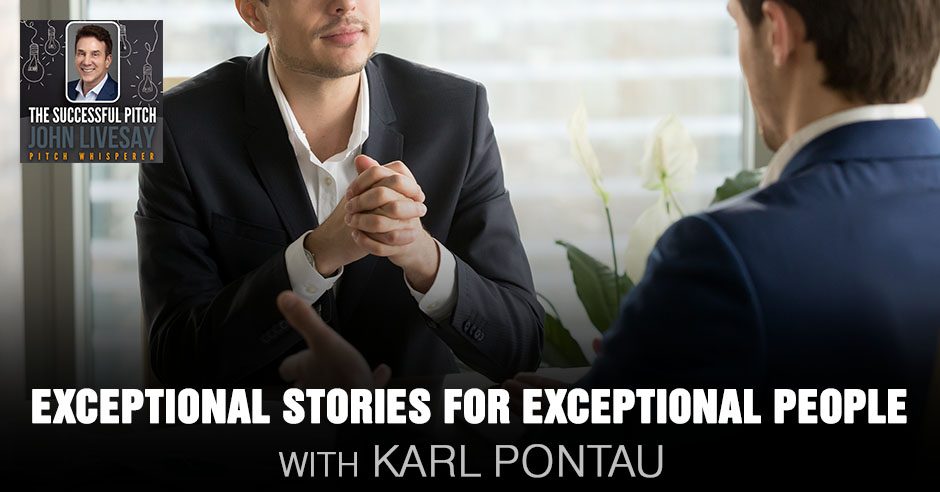
Imagine listening to a bunch of technical jargon and you have no clue what he or she is talking about. It’s because, as humans, we react to things on an emotional level. This is why Pixar movies work so well, it’s all because of their exceptional stories. Join your host John Livesay and his guest Karl Pontau as they unravel the power of storytelling and how you can sell products with it. Karl is the founder of Squash and Stretch Productions. He helps companies attract and maintain clients by the use of storytelling. Listen to the conversation to know how our brains work and why we resonate with personal stories. Learn how to catch your market’s interest with animation and storytelling today.
—
Listen to the podcast here
Exceptional Stories For Exceptional People With Karl Pontau
Our guest on the show is Karl Pontau, who says, “Exceptional stories create exceptional connections with people.” He has a company, Squash & Stretch, that creates animation for people to take complex concepts, and turn them into stories that target those heartstrings. Enjoy the episode.
—
Our guest is Karl Pontau, who is the Owner of Squash & Stretch Productions. When companies need to explain complex concepts, generate more revenue or strengthen their brand presence online, Karl and his team help them by telling exceptional stories using high-quality, custom animated content. The key to explaining complex concepts is not to throw information at your audience, but rather tell a story that provides context and structure. You can see why he’s on the show because we’re singing from the same songbook. Karl, welcome to the show.
Thank you. I’m glad to be here.
Our mutual friend, Caroline, who edited my book, is someone that recommended you. One of the things I love about that is I talk about how trust is transferred. That is an example of that in action. Let’s hear your story of origin of how you got into this.
I’ve been an artist my entire life. I grew up drawing, painting, sculpting big Legos kid. I got my passion for storytelling from my dad. He’s a good storyteller. I knew I wanted to study animation when I saw the first Toy Story film. I was like, “I’ve got to do that. That’s cool.” Beginning of 2002, I started to feel like something wasn’t quite right with me physically. I’ve been a competitive swimmer my whole life. I knew what that was supposed to feel like. It wasn’t like my shoulder hurts. It’s like a general blah feeling, but by August, they still hadn’t figured out what was wrong with me. I had lost 50 pounds and had sunken cheeks. I was pale. I started to get bad headaches.
My parents took me for an MRI up in Walnut Creek. We were waiting around for another appointment when my pediatrician called and said he’s going to drive up from Pleasanton to come to talk with us. We saw him walking up with this big envelope in his hands. You could tell he had been crying. He brought us into a little side meeting room. I remember I was sitting knee-to-knee with him in this big U-shaped chair with high armrests leaning forward towards him. He pulled out the results of the MRI and showed me I had two brain tumors. It felt like I got punched in the chest. I moved backward in my chair.
[bctt tweet=”When someone who has more experience than you gives you advice, take it and apply it.” username=”John_Livesay”]
For the next two weeks, everything sounded like the adults from Peanuts. I never had the flu, never broke any major bones, never been stung by a bee. I’m pretty sure I’ve never been bitten by a mosquito, so to get a brain tumor diagnosis at fifteen is a complete sucker punch out of nowhere. I got so much help from friends and family. My high school adjusted my schedule and got me a tutor so I can still graduate on time. People I barely knew were giving food, gifts and other supports. That inspired me to want to give back and help as many people as I could because I’d probably be dead if it wasn’t for all the help that I got.
In undergraduate school as I was studying Animation, there was a big student Digital and Design competition I participated in. There was a big screening at the end of 1,000 people in this big auditorium. It may be ten people in the room. When everyone laughed at the joke in my animation, I was like, “It’s so cool. I can connect with people and have a bigger impact with animation and storytelling.”
After grad school, I started my company. We tell exceptional stories for exceptional people helping tech, biotech, health and wellness companies explain complex concepts, answer common questions, increase revenue and strengthen their brand presence online. A lot of people think they can explain something to us by throwing information at their audience. We use that story that puts information in context and structure by helping these companies that are working on huge problems facing the world like reversing climate change, renewable energy, battling cancer and preventing Alzheimer’s.
If we can help accelerate those processes by improving the company storytelling abilities, more people in the world get their problems solved and their lives improved. Our client’s business does better, we get a happy client, everyone wins. It’s a way for me to have a bigger, positive impact on the world around me. That’s why I do what I do.
There’s a lot to unpack there. Let’s start with the competitive swimmer. I was also a competitive swimmer. I talk about that in my TEDx Talks, “Be the lifeguard of your own life.” Unlike in a hurricane, no one is going to come to rescue us. We have to rescue ourselves. The lessons we learned from being a competitive swimmer are incredible. I want to hear what your big takeaway was from being a competitive swimmer. Mine was when I was racing against somebody in breaststroke, he always beat me. In this one race, I beat him by a few tenths of a second. They said, “You stayed focused on the wall. He turned his head to see if he was ahead of you.” By turning his head, I was like, “When I focus on my own progress and stay focused on my own goals, I win.” That’s true in business as well. We’re not comparing ourselves. Do you have a story of what you learned from being a competitive swimmer?
Exceptional Stories: The key to explaining complex concepts is not to throw information at your audience but to tell a story that provides context and structure.
One of the biggest things I learned from that was the importance of having a coach, listening to a coach and following the advice of someone who’s been there before, plays that trunk and knows how you can move forward. Something I’ve carried over into my business and in work life is that when someone who has more experience than the expert says, “Here’s what I recommend you do,” I don’t assume I know better than them. I’ll take that advice in him and apply it. It’s been a huge help.
I also think about racing someone else. I performed better, pushed to do more and achieve more. There is a sense of competition between someone else, not necessarily looking at them but you know they’re in the lane next to you. You’re both going for that wall and trying to get their first competitor in practice assuming against yourself. It’s hard to be super motivated when you can tell that someone is going for the same goal.
When you interact with that person, there’s a level of a relationship there. It makes an effort easier to find than dig deep and trying to achieve that goal first because there was a competition there. One of the things I’m trying to do with my company is going to build a community of people that are all going for the same goal, what I’m calling Collabetition. They know each other exist and they can share some ideas. I don’t want to say patent. They are not going to be giving away treats.
By knowing they’re going after the same goal and being in the same space, they’ll be pushed to do even greater things because they are not competing as each other. Instead of being super siloed and swimming in their own pools at their own pace, it’s getting in a race against someone else where you’re a little more aware of where they are and stuff. That way, everyone achieves the goals quicker.
The tweet for that is when competition and collaboration meet, everybody wins. You’re telling that story of a coach. When I was selling advertising for a fashion magazine called Speedo down in Southern California, I convinced them to advertise with me because I came up with a solution that they had not thought of with a fashion show around a hotel swimming pool of the sportswear and treating it like fashion.
They brought Michael Phelps in since he was on the payroll during the Olympics. I went up to him and I said, “Everyone says you’re so successful, Michael, because your feet are like fins and your lung is bigger than most. I’m guessing there’s something else.” He said, “Yes, John. When I was younger, my coach said to me, ‘Michael, are you willing to work out on Sundays?’ ‘Yes, coach.’ We got 52 more workouts in a year.” I thought, “If we want to be at the Olympic level of what we’re doing, the question becomes, “What are we willing to do that other people aren’t?” I’m imagining you have a story around something like that in what you do that other people in animation aren’t doing. Do you have something that you can share with us on that?
[bctt tweet=”When competition and collaboration meet, everybody wins.” username=”John_Livesay”]
What amazed me when Phelps is winning all the medals and breaking the records in the Olympics season where he kept racking up gold after gold was there’s a behind-the-scenes documentary style video they did showing what his routine was, his training regimen, and how much he had to sacrifice and give up to be that good at swimming. His life was wake up, eat, swim, eat, sleep, wake up, eat. He would eat thousands of calories because he’d burn them all off in the next three hours of the swimming session. Seeing that story behind what made him be able to achieve all those medals in the Olympics is what humanized him and made the difference between the person and the icon. The icon is standing on the podium with the gold medals or is on promoting Speedo. You can’t relate to him until you see the story and see what allowed him to get to that point.
One thing that makes my company different is that we focus on the story, not just the animation. The animation does have the icons, the logos and the graphics, but if it’s not telling a powerful story, no one’s going to relate to it. It’s the story that makes people resonate with the message, the animation, and follow the call to action. People have an animation about this on my homepage. People don’t invest in animation because it’s an animation. They invest in something because it gives them the desired result.
Animation is a tool to tell a great story. The story is a great tool to inspire people, to follow a call to action or to respond a certain way. When we’re making animations for a client, the first thing we start with is, “What are you trying to achieve? Who is your target audience? What story is going to inspire them to do the thing you want them to do? How can we connect you from where you are to where you want to be through those key points?” Creating any content and throwing it up online doesn’t work anymore. You have to have that high-quality story and custom content to get the results.
You’ll agree with me that good stories show the hero having some vulnerability. Michael Phelps did a documentary called The Weight of Gold, where he talks about his battle and another Olympic athlete’s battle with depression after the Olympics is over. Who are you after the parades are done, all the adoration is over and you’re not an Olympic athlete anymore, especially if you’ve been doing it for ten or more years like he was? It is a crisis of identity. That made me connect to him even more that he was vulnerable enough to share that. I love to hear the story of origin. You’ve got a great one of the purpose of Squash & Stretch. Can you explain a little bit about what that is and how that became the name of your company?
I’ll touch on Michael Phelps, the crisis of identity and depression. I see him as a spokesperson for an online mental health service, which is perfect. The times ruin the importance of mental health and people being so aware of it. It’s perfect because you have that whole pressure. Your life is the one thing that you stopped doing and then you’re like, “What do I do?” I agree there. The Squash & Stretch name is homage to Disney because when we were starting the company, that’s Disney Studios, which is his second studio. His first business failed, which is a testament to not giving up for any entrepreneurs out there.
Back then, there wasn’t a best practice for animation that had been established. If you look at the content made around then, it’s pretty bad by standards. He sat down with his animation team and they came up with twelve animation principles that if their work is going to be considered good, complete, done and have these twelve aspects to it. Number one on that list is Squash & Stretch. If you take any one-on-one animation class, the first thing you learn on day one is the same twelve principles. The tools have changed a lot since Disney’s day, but what makes animation work is still based on the same twelve principles. It’s homage to the giants who shoulders anyone who animates standing on. Whenever other animators see my business name, they’re amazed and everyone else goes, “What?”

Exceptional Stories: Focus on the story, not just the animation. It’s a story that really makes people resonate with the message and the animation.
Let’s talk about how you use this in healthcare. Give us a story of a healthcare company that’s very detailed if you’re talking about bloodstream or something. Sometimes, they have a product to sell. It’s complex, and yet they want to get it across quickly and ideally in a story. Do you have an example of a healthcare company that you’ve helped?
We’ve done some work for a company that helps place people in clinical trials that can qualify participants. We made up some animations explaining the clinical trial process for a few of their trials. One of them had to deal with premature babies with respiratory issues. You’re trying to explain to people. The new parents are freaking out because their kid has breathing problems. They’re going to try and see this type of test, if there is a nebulizer and this system to help improve the lung function of these premature babies. It’s trying to explain the risks and everything going on to people that are already emotionally stressed and beyond the normal amount of stress and lack of sleep of a new parent. These are the ones with the kid who has some health issues. Being able to clearly explain what’s going on with the study and get the information clearly is valuable.
Let’s talk about that because I haven’t heard anybody describe it quite like that. You did such a good job of painting the picture of you’re a new parent, you’re stressed out from your child not being well on top, the lack of sleep that new parents have anyway. Imagine that you, as a new parent, are trying to process information. That’s fairly complex about clinical trials in this case. You’re emotional and you’re exhausted. I know myself when my sister was diagnosed with ovarian cancer, she had to record what the doctor was saying because you are in a state of shock that you can’t even hear what they’re saying, let alone remember it or understand it. You’re solving that problem by being able to show people. We’re wired differently to hear information versus watch an animation and absorb a story like we do Pixar.
Part of our brain devoted to a sensory input analysis, 80% of that goes to vision. Also with animation, you get the audio and the visuals. The brain can engage and helps with recognition or memory and all that stuff.
You’ve also worked with tech companies. That’s a whole other very left-brain kind of thing, not necessarily related to technology and healthcare. My whole premise is that people buy emotionally and then back it up with logic, even for the most technical thing.
You might not be surprised to hear after the first story I told that I’m very interested in how the brain works. Reading a number of books on the subject, on the topic, we make decisions on the lower brain, which controls emotion and decision-making. Unless we’re presented with something that challenges our preconceived worldview or the way we see things. Our brains are lazy and designed to conserve energy as a survival mechanism. Unless we’re challenged by our worldview challenges information, you have a brain that isn’t even engaged when it comes to decision-making.
[bctt tweet=”Can you solve my problems?” username=”John_Livesay”]
The lower brain would take in something and think, “They’re not going to clash on what I think the world is.” We bounce it up to the upper brain, have the ratio and logic. Analyze this stuff and see if I can figure out how this will fit with my worldview. The brain kicks in, figures some stuff out and passes it back down to the lower brain when you make a decision. If you’re presented with something that doesn’t, can I call it to clash with how you see things? It doesn’t even kick in when it comes to decision-making.
When people are making decisions about all things, it’s 100% based on emotion and rationalized later if needed. That’s the reason why telling the stories is powerful and important, even for industries that are considering very left-brain and technical. Engineers often speak engineers. They don’t speak layman’s English. There’s one example of how we help a tech company. Early in 2021, we worked with a company called Enovix. They make next-generation lithium-ion battery technology.
They were spending about 45-minutes to 1 hour-long sales meeting trying to explain to other battery engineers how their technology can produce about twice as much energy and lasts about 30% longer than existing batteries. It’s about the same production process with a few drops in tweaks. We made this two-minute animation concisely explained the differences between their technology and the current technology and how they want to use this stuff. They loved it and they put it on their website for a while.
A couple of weeks after they posted it, they announced they’re acquiring a publicly-traded company and the valuation after the merger is $1.13 billion. Early in July 2021, they were awarded a $350 million contract with the US Army to make batteries for all the wearable tech soldiers wear. It saved them a ton of time and helped make their ability to explain the value of what their product does. It was two minutes instead of 45 minutes.
I have a premise that a good story should be clear, concise and compelling. With the steps that you’re using in your animation, it does all of that and more. When it’s compelling or you tug at heartstrings and people open the purse strings, people see themselves in the story and then they want to go on the journey with you. You talk about this in the steps about the appeal of a cartoon character has to correspond to what we would call charisma in an actor. Part of what people don’t realize is, “How am I being moved by a cartoon character? Why am I feeling something here?” Whether it’s Pixar or even something about the battery lasting longer than you would normally expect. If it’s helping save a life of a soldier, we’re involved emotionally. It’s no longer just, “That would be nice to have.”
It doesn’t have to be super cartoony either. There’s a ton of different styles in animation that are possible. When we’re picking a visual style for a client, we look at their existing brand, their target audience and figuring out what’s going to appeal to that audience and fit their brand. It’s popular and trending. It’s not all super cartoony. Things that are aimed at kids can be very sophisticated, more believable, realistic than other people would expect. You want to have the right characters because people empathize with characters on screen, empathize with people more than objects or concepts. You don’t even have to have a super detailed character, but as long as you’re talking about someone, you explain how they’re feeling and what they’re struggling with, what the conflict is and how they’re feeling about that, those situations or things that people can empathize with.

Exceptional Stories: Part of our brain is devoted to sensory input analysis. Around 80% of that goes to vision. Animation has audio and visuals, so the brain can engage at once.
If you’re trying to hook an audience, sorting your story with, meet this character, here’s what they care about, feeling, struggling with, people who share those feelings in situations are going to go, “I get this person. I want to see what happens to them.” If that’s your target audience of who you’re trying to reach, then showing them going through the experience of working with your business and how they’re going to feel during that experience and at the end, showing the results and how they feel afterward, how much their life is better because they hired your business for whatever you do, bought whatever product or whatever you’re trying to get them to do, showing that journey and that experience get people to be like, “I want that response.”
Once they have that and you share your call to action, that’s what inspires people to get off their butts and do something else. I’ll click on the computers because no one is going anywhere much. That story is powerful. A lot of people make the mistakes of not setting up the character right and not setting up the conflict right. Jumping right to what they do. Unless you establish why people should care in that first eight seconds or so, no one is going to watch the rest. All they talk about themselves too much is huge, companies talking about themselves too much on their websites and other content is about them. People only care about two things, which is to share my values, “Are you here to help me?” The weird thing our brains do when we’re presented with something new is subconsciously ask, “Is this going to kill me?”
It’s the leftover survival mechanism from back on the Savannah days if there’s a rustling bush in the distance. If you weren’t afraid there was a lion and when there was a lion, you got eaten. All the people that survived ran away when it rustled, even if it wasn’t a lion. You still have to provide enough information about your business that makes sure people know they can trust you and that you share their values. If they show, “Can you share my values? Can you solve my problem?” Then go right back to talking about the clients that they’re experiencing, how you’re going to help them improve the quality of life that they’re looking for. Most people talk about themselves too much, and people don’t care.
You gave us some real value bombs there. Let me highlight a few of them. What I heard you say was the better we describe a problem someone’s having before we jump into what our solution is, the more people are involved in this story. The other key element that I teach everyone when I’m teaching them how to tell stories as a sales tool is you must have a resolution to the story. The story doesn’t end when you say what your solution is. We fix the problem. We need to know what life is like after the problem has been fixed. We see it in classic stories like the Wizard of Oz. Imagine if that movie ended when she got in the balloon to go back to Kansas. There wasn’t that great scene of her with all those insights about no place like home and all that stuff.
This concept of once we feel safe and that people share our values is, “Can you solve my problem?” The big unspoken question everybody has when they watch a video, listen to someone present or pitch is, “Will this work for me?” They might trust you and like you but if they don’t think it’s what you have to offer will work for them, then they’re not going to buy.
[bctt tweet=”Exceptional stories can change the world. ” username=”John_Livesay”]
The magic of storytelling is you pull someone into the story enough where they are in the journey with the character and they go, “This person is like me. If it worked for them, I guess it will work for me.” Until that journey and that embodiment of who you’re taking on the journey unless you’re in the story is left-brain analytical, “Nice for them that that happened, but I don’t think it’s going to happen for me.” There’s where the big gap is between why people aren’t closing more sales or getting more people to understand what they’re doing. It’s because they’re not seeing themselves in the story.
They’re talking about themselves too much. When you’re telling a story like that, the clients are the hero, the company is the guide and helping them along the way. It’s not about you. When you show the results, it’s about the results for the other clients and how much better their lives are. I love that example of the balloon. It’d be funny to see a compilation of famous endings of films to cut them all off before that’s a complete entity. Triggered people get anxious or annoyed if they didn’t see the entire resolution.
That open loop is very annoying. It’s big to have explainer videos on websites. People don’t want to read. They want a short little video. It’s much more impactful if there’s some animation, music and all that versus just a talking head. What is the best way for someone to reach out to you?
They can visit www.SquashAndStretch.net. We also offer a free story assessment service on the website. There’s a five-point assessment we go through for their website and give them a report that shows where they can improve. We offer them some next steps that will help them close the gap themselves, or they can do a gap assessment and figure out how we could work together to make sure that their storytelling on their website and their other media is as optimized as possible. They can check me out on LinkedIn. Search for Karl Pontau and reach out that way.
Karl, thank you so much. Many people are drowning in the sea of sameness. There are many other people that do what we do, whether it’s insurance, coaching or whatever it is. With your skillset of animating and bringing your story to life that’s going to cut through the clutter and make people stand out and become memorable, a lot of people are going to be interested in exploring how you can help them do that.
Thank you.
Important Links
Get more business storytelling tips and exclusive deals directly to your inbox. Join the Squash and Stretch Productions Community!
https://www.bit.ly/SnSP-JoinCommunity
Wanna Host Your Own Podcast?
Click here to see how my friends at Podetize can help
Purchase John’s new book
John Livesay, The Pitch Whisperer
Share The Show
Did you enjoy the show? I’d love it if you subscribed today and left us a 5-star review!
- Click this link
- Click on the ‘Subscribe’ button below the artwork
- Go to the ‘Ratings and Reviews’ section
- Click on ‘Write a Review’
Love the show? Subscribe, rate, review, and share!
Join The Successful Pitch community today:
- JohnLivesay.com
- John Livesay Facebook
- John Livesay Twitter
- John Livesay LinkedIn
- John Livesay YouTube