

What Is Your Competitive Edge? With Jose Palomino
Posted by John Livesay in podcast | 0 comments

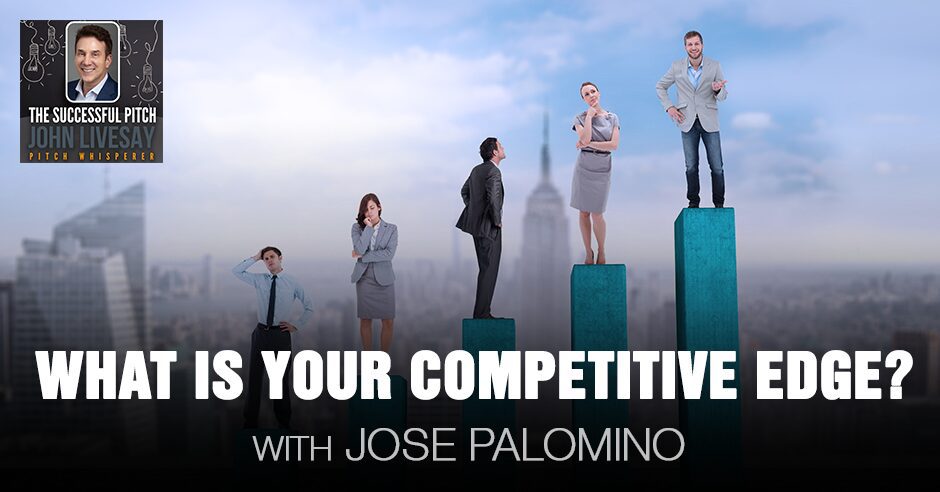
Do you know what your competitive edge is? It’s what sets you apart from your competitors and attracts customers. In this episode, Jose Palomino, CEO of Value Prop Interactive and expert in value proposition, defines what competitive edge and how you can determine what it is for your business! He gives tips on making the most of your operational advantages and turning them into customer magnets. Want to learn more? Jose also discusses The Competitive Edge Program, which walks people through designing, deploying, driving, and getting those incremental wins that set you apart—in less than 12 months. Find out more about Value Prop’s powerful new program and how it can help you win more business!
—
Listen to the podcast here
What Is Your Competitive Edge? With Jose Palomino
Do you know what your competitive edge is? If you want to get some insights on how to define it, then this episode with Jose Palomino, who’s an expert in value proposition, is for you. He said, “Not only do you have to show that you’re saving time and money but you have to show how you’re reducing the hassle of the whole experience as well as reducing the risk.” Enjoy the episode.
—
Our guest is Jose Palomino, who’s the CEO of Value Prop. He’s helped over 100 business-to-businesses unlock over $250 million in new growth. He’s got decades of experience helping these business-to-business owners work through and overcome their strategic marketing and sales challenges. He’s also the author of the foundational book Value Prop and host of The Revenue Throughput Podcast. He holds an MBA and teaches candidates strategic marketing management. Welcome to the show.
It’s great to be here, John. Thanks for inviting me.
Let’s go back to your own story of origin, Jose. You can go back to school, college or your youth. How did you get interested in business in general and specifically, finding your niche in B2B?
That’s a long story, so I’ll give you the very short version of it. I didn’t start out knowing I wanted to be in business. I wanted to be a comic book artist. I was a comic book collector. I started taking courses in some of the New York City-based where I was born and raised, art schools like Parsons and FIT to learn anatomy and things like that. I was doing that but meanwhile, I didn’t pay the rent or even buy a bag of chips. I have to figure something out. I started working doing whatever. It led to me working in back-office operations for a major brokerage house.
I had a real affinity for numbers, processes and working hard. I learned at the age of 20, 21, what it meant to bang out work if you had to do it. That became something where I said, “I will never be outworked.” I could be outsmarted maybe, but I won’t be outworked. Everyone wants to say it’s a four-hour workweek, this and that. The reality is most of successful people know how to work hard when they have to work hard. That journey took me into starting a business a couple of years later, notably in selling comics to collectors.
[bctt tweet=”Be innovative, indispensable, and inspirational.” username=”John_Livesay”]
Through that, I had to learn programming to build an inventory system on one of the first IBM PCs that were available. That’s how I got into technology and business entrepreneurship. Since that journey, I ended up mostly going into IT-based companies, ended up working as an analyst working for some large IT companies, including one very large computer manufacturer. That’s when I transitioned to sales and marketing. I moved into sales roles whilst carrying a bag as it were. I didn’t look back from there.
What’s interesting about your background to me, Jose, is you have toggled back and forth between sales and marketing. You were CMO, as well as being a sales director. I don’t see a lot of people doing both. They usually pick a lane and stick with it. Sometimes as you probably know, marketing and sales don’t get along so well at big companies. There is a lot of pointing of fingers. What a wonderful perspective you bring to your clients. What is the big myth that you think is out there those salespeople have about marketing and vice versa?
A lot of them are based on some facts. Maybe it’s not a myth but a real belief. Sales think that marketing is only concerned with aesthetics, the look of the brand, the material, stuff like that. You’ll hear statements like this, “They don’t get it.” Marketing’s thinking like, “We’ve given these guys and gals everything they could need to be successful. Why aren’t they putting points on the board?” You have this sense from both sides, especially those who are in large companies where those things get very siloed shortly. The reason we are not getting to the top of the mountain is because of the other guys.
Success has many fathers. If we’re kicking butt, then everybody’s happy, high fives all around. The stress points are always when things are a little bit not great and you have to figure that out. What’s changing is the move, especially in larger companies. The technology towards what’s being called account-based marketing will come downstream, which is account management for large accounts. They have to give it a new name and so on.
There’s going to be an increasing melding of those disciplines. Things that used to be seen as strictly marketing activities, salespeople have to be good at. The big change there, John, I see is this. Marketing by definition, has a longer time horizon as they look at things. They have to look at a 1-year, 3-year plan or maybe the 6-month plan if they incorporate things like event marketing and things like that. They have a schedule for the future.
Competitive Edge: Value Prop
Your sales team, on the other hand, in a lot of organizations, have to live week by week. I’ve seen multibillion-dollar companies have a weekly stand and deliver calls on the pipeline. A salesperson is thinking, “I got to make this stuff happen now.” The marketing person is saying, “We have to make this thing happen this year.” That’s the disconnect. Until they understand that one feeds the other both ways, that’s when you have that separation. It’s a hard thing to crack.
I’ve worked with companies where within different sales divisions they’re siloed. Marketing is pulling their hair out saying, “Why aren’t we growing an existing client with another division but the other divisions have no clue what the other ones are doing? There are no even intros being made.” That’s B2B and law firms. It’s this lack of cross-selling and marketing. We don’t need to keep spending the same money if we already have a relationship with a client, a hospital or whatever the industry is. I see that as a big problem that I’m guessing you might have some ideas around solving.
It all comes down to this, especially sales, more so than marketing. Marketing folks with formal marketing titles like chief marketing officer, director of marketing, so on usually have some very small or no variable compensation in their package. It’s very negligible if it’s there at all. Gunning for raises is what you’re doing.
Sales is all about variable comp by and large, still in B2B. If you tell me there’s a sister division that has a great product that would be useful for my customer, the first question I’m going to ask because I’m carrying a bag is, “How will I get paid for that introduction?” “You got to be a good corporate citizen.” That’s fine. I agree. I should be a good corporate citizen.
Meanwhile, I tell my boss that when he’s hammering me to hit my goal, unless you’re going to give me a goal and align me to it financially, I’m incentive to ignore it no matter how well you tell it. I’ve seen bosses from the front of the room. “We’re going to bring the year synergy. This is a year we bring it all together. We’re going to deliver the total value to our customers.”
I say, “Yes, but your comp plan doesn’t reflect any of that.” Salespeople are always going to say, “You can tell me whatever you tell me but whatever the comp plan says is what I’m going to do.” In substantial, you want people to be good corporate citizens and high in integrity. Those are the things that you don’t pay for in a general sense.
This is the thing I always emphasize when I probably work with sales teams. In an average selling year, you have at most 220 selling days in a year, 55 selling days a quarter, 17 per month. It’s rough math. If you asked me to use up 2 or 3 of those 17 selling days in a month, you’re cutting into bone. Unless you’re going to give me some either quota relief on the other side say, “We need you to focus 20% of your time here,” reducing your quota, that’s never going to be the way it’s going to go. It goes the other way.
You’re not going to get the behaviors you think you should get. No amount of fist-pounding is going to get a few. You can try to browbeat people. You got to bring alignment and say, “What’s in it for you?” It is the question you have to answer for your customers but you have to answer that for your internal stakeholders as well.
Let’s bust another myth. I see a lot of sales management saying, “These reps are doing well. He or she killed it. They exceeded their quota. Let’s hire another salesperson and break that territory in half, then we’ll get even more.” The rep is furious. The myth is, “Let’s hire more salespeople to get more sales.” You say that’s not true. Tell us what you mean.
[bctt tweet=”Show your offer reduces hassle and risk.” username=”John_Livesay”]
Especially in the mid-market, it’s different if you’re talking about a company that routinely has 100 territory reps like billion-dollar companies. If you’re owner-led or in the mid-market, you’re a $10 million, $20million, maybe a $50 million company, maybe you have 8 sales reps. You are attracted to that kind of thinking because you’re thinking, “I don’t have to be a rocket scientist to say if I have 10 people and add 1 rep, that’s 10% growth. It should be.” The challenge I would say to that leadership team is this. If you hire the right or wrong person, you’re going to be into it for $100,000, $150,000 in costs, all of that, plus the possibility of deflating your top performers.
There are all these negative things that can happen but I’m not saying never hire a salesperson. The reason you’re looking to hire salespeople is because you’re having some struggles and you think you need to increase sales. You say, “I need to have more coverage.” Then I would say, “Take a look at your sales process first and the other moving parts of your sales continuum from the customer’s point of view.”
Are you sharply focused on your right target market? Have you thought through of your value proposition in the last year? Supply chains are still being stretched. That’s very different than what the world looked like years ago. Have you rethought your value proposition in that context? Have you thought through your lead generation? Things are changing. Things that work technique-wise, LinkedIn blasting don’t work anymore. Emails work differently. Trade shows as a strategy. Does your industry still have its trade show?
Until you ask those questions and get at, “Do I have my house in order?” It’s like your house is laid and being built. You say, “I’m going to add some carpenters to it.” Maybe it’s the plumbing that’s holding you up or the electrician. Maybe you’ve had bad weather and having another carpenter means another payroll. That isn’t going to get the house built any faster. You have to get to the root of it before you start designing solutions.

Competitive Edge: “What’s in it for you?” It is the question you have to answer for your customers, but you have to answer that for your internal stakeholders as well.
Also, are your current sales reps doing things the way you think they should have? You look at how they do things. Are they making customers happy? Last but not least is critical, especially where we are where supply chain and expectations are being all over the map. People don’t know what to expect. If you said yes to all of the above, are you delivering successfully on your promises as a company? That will unwind sales. That makes people that were loyal customers go back into the markets and say, “I got to find a different solution.” This happens time and again.
Adding a salesperson could be the exact right thing to do but not until you’ve checked off. It’s a few things, value prop, target market, your marketing programs, are they creating the leads for you? Are you delivering on your promises? Do you have a sales process? If you bring your sales team into a room with a whiteboard and you say, “Draw our process,” if they’re drawing like customer calls, we call back, make proposals, sell the deal, that’s not a sales process unless you’re purely transactional and you’re selling paperclips.
A lot of challenges that I hear lately in the marketplace, especially since the pandemic, in the healthcare industry, where pharmaceutical or medical equipment reps, talk to doctors between surgeries, especially if the rep is allowed in the surgery. Bought by the office, drop off some Starbucks and catch the doctor between patients, that’s gone. I don’t see it returning anytime fast.
These are people that have never been trained on how to formally request an appointment or they have to present on Zoom and not in person. There are all kinds of obstacles that people are having for the first time in their career. Do you have some insights into that? Do you see that happening with your clients?
Here’s the thing. Probably within the first six months of COVID becoming a real thing, from March of 2020 towards the fourth quarter of 2020, there was a sense among many people I talked to that when we get back to where we were. That isn’t happening and we see that with workers not wanting to go back to the office. I talked to one sales team that had huge success. They’ve embraced and leaned right into it. It’s all Zoom all the time. They were like a ten-person team. They saved $500,000 on their travel budget. It’s real money. It’s a big organization that scales.
[bctt tweet=”The reality is most of the successful people know how to work hard when they have to work hard.” username=”John_Livesay”]
Here’s the other thing. A lot of customers are saying like, “It’s okay. I don’t need to spend three hours entertaining somebody when we can have a half-hour call and get to the thing of it.” I’m not saying face-to-face doesn’t matter. Relationships matter. All those things matter. The reality is they mattered at the beginning of a relationship. They matter less over time. Have you ever seen the old Ed Sullivan show? There’s a lot less energy needed to keep the plates going.
You’ve got trust built up. If you’re delivering on your promises, you’re in good shape.
You don’t need to do all of that. I would say to that team, “Whatever it is that’s keeping you from what was normal to you years ago, go with a blank sheet of paper and say, ‘If I landed from Mars and I had to make a living doing this job, what would I say is possible within what I see with my eyes, not with my nostalgic eyes?’” Your eyes will get you in trouble. You’re hoping for something that may never come back.
Always think about it this way. Where are you now? This is very often overlooked, John, but where are your customers? What do they want? How do they want to be dealt with? That’s the thing you have to zero in on. How does the buyer want to buy? We can’t give a buyer a script and say, “When I say this, you say that,” if it were that easy.
The traditional way of a sales funnel is you reach out to somebody, develop a rapport, maybe set up a meeting to do some needs analysis or they send out an RFP that describes what the needs are. I’m hearing more often that clients are less willing to share what their needs are. It’s on the RFP or we’re interested to talk to you but we don’t want to spend any time sharing what our challenges are or our pain points. Is that the lack of time or is it not even a trend? What are your thoughts around that?
It is a very big trend and it depends on the category. For example, if an executive is looking to hire an executive coach, they’re going to open up and have a much more open dialogue because they want to see how they feel about that. That’s one example. Let’s say I’m buying a 3D printer for manufacturing. There are $300,000 machines available from three different manufacturers. My expectation is I can totally investigate, get the specs, see the testimonials, the machine and operation online before I talk to anybody. Further, I expect that a salesperson can look me up on LinkedIn. They can look up my company website and they should know.
Let’s cut to the chase is going to be a more common theme. You’ve hit on something very strong and true, John. Chit-chat is going to be far less. I know that people will say, “How are you going to build a relationship?” You build it through trust. Trust means that you say what you mean, you mean what you say and you deliver on what you promise. That’s what a buyer in an industrial B2B category is most looking for. “Can I count on you?”
From that, you earn the right to say, “I’m glad we got this 3D printer installed. There are some other applications that we’re finding some clients are having success with. Can I ask you a few questions around your situation to see maybe there’s something there that you can use and save 20% of production time?” All of a sudden, a person says, “Sure, because you made me look good.”

Competitive Edge: As much as sales veterans don’t like this, the buyer is increasingly at the wheel of the process.
As much as sales veterans don’t like this, the buyer is increasingly at the wheel of the process. They probably always were but we felt like we could do Jedi mind tricks. We could set up funnels. We’re running through people through stages and stuff. The buyer is saying, “No, I’m not having any of that.” They’re not playing along any longer. Sales teams that adapt to that reality will do well. Those that try to squeeze the buyer back into the nice, neat submarine of stages and stuff like that, you’re going to find a lot of kicking back.
You talk about getting back to some basics, which is making sure that the sales and the marketing messages fit the value proposition. Do you have an example of a company that has a great value prop and maybe one that didn’t? That would be helpful. We can talk about the confusion that can happen with marketing and sales don’t understand it.
I’ll give you two quick examples that might help frame the idea of what value proposition is. At the end of the day, value proposition is the idea that answers the question, “Why should anyone buy X from you at Y price?” It’s not the tagline. The tagline comes from a good value proposition. It’s the actual truth. I always say, “Stay true truth your business or your product line if you have multiple product lines.”
I had one client that delivered home heating oil. That’s a declining market. That’s existentially threatened. There’s nothing you could do about that. You can’t do anything to the oil itself. Automatic delivery of heating oil is done on the basis of a timeworn algorithm that all the oil companies use. It allows them to figure out when Bob McAllister is going to run out of oil out of his 285-gallon tank. There’s no Wi-Fi or anything like that. It’s all done through this algorithm as usage, weather, dewpoint, things like that.
This company, a client of mine, was having a lot of overtime runs because they had to do last-minute runs on a Saturday, so it costs a lot of money. They commissioned a superior algorithm. They spent a lot of money on it. I asked him about it. I said, “How’s that worked out?” He said, “We did 60,000 deliveries.” I said, “How many did you miss?” We’re supposed to be exact. He said, “9 over 60,000.” That’s like 99.999. I said, “Is anyone even close to you?” “No one’s even close.”
We started marketing a no run-out guarantee. We said, “If we let you run out of oil, we will fill the tank for free at our expense.” That’s a big thing. 285 gallons is $4 or $5 a gallon. It’s a lot of money. They were able to do that confidently. What ended up happening is they acquired, as a result, the higher end of that market. Even as the customer said, “I don’t want to tolerate any risk of me having a cold winter night where my oil company lets me run out of oil.” We were able to turn an operational advantage into a marketing and sales advantage.
[bctt tweet=”You have to get to the root of it before you start designing solutions. ” username=”John_Livesay”]
Another company in a totally different category, a pure B2B, made a machine that mixes powder. They’ve had it for years. There are lots of companies that do this, but they have unique technology and they are like the best-kept secret. The person who bought the company did very well, operationalizing, efficiencies and how they build a machine. We realized something talking through it. I said, “This machine does what the alternative technology would require three machines.” You need one to do the same thing and it does it like twice as fast. Those are huge advantages that they have to take forward.
They did a lot with video on their website. They promoted this one-stop-shop advantage and sure enough, the company has grown. It’s done very well. The principle of what makes a good value prop is a lot of things. In my book, Value Prop, I talk about I3. It says, “Is it innovative? Are you bringing something new to your market? Is it indispensable? Is it useful over time? Is it inspirational?” Is your execution something that somebody in the trade would go, “That’s pretty cool how they did that?”
Somebody not at a trade may find that very boring. That looks like steel. They don’t care but somebody in the trade would take it. I’d also say there are four things from a selling to marketing perspective that is essential for any value proposition to be effective in B2B. There are four things that buyers are always going to look for. “Can you save me time? Can you save me money or make me money? Can you reduce my hassle factor?” Especially in times like this, where everything seems like a drag and a hassle. “Can you reduce my risk?”
“I don’t know you and I’m buying you a 3D printer. I’ve never used your model before. What assurances do I have? What if you don’t perform as well as your demo say you do?” You have to look at those four things in your value proposition and your promises to the customer. You have to say, “This is how we’re going to save you time, money, hassle and risk.” If you can do that, you’re going to win a lot of business and at least get an at-bat.
What I love about that is most people are talking about saving time and money. If you’re the one that’s talking about personal issues like what keeps you up at night, the hassle factor is, “I can set it and forget it. I’m done. You’re in.” It’s all that kind of stuff because it’s an emotional buy even if it’s B2B. Those are some emotional solutions that you’re giving to someone. Is this making my life easier or harder?
We’re in the process of shopping for a new refrigerator. We had a built-in. It’s getting old, so we need to replace it. I said, “You’re going to take it out of my house?” They said, “We don’t do that.” I’m thinking like that’s like half the solution. What I want is the new refrigerator in the spot where the old one was. I don’t want to deal with the 250 pounds, all refrigerator, having to dispose it and call people up. Make sure that whatever you’re offering your customers is a complete answer to their question, not half of it. If their thing isn’t quite as good as yours but they solved my whole problem, they’re going to get the business.

Competitive Edge: Make sure that whatever you’re offering your customers, especially now, is a complete answer to their question, not half of it.
You were generous enough to offer a free gift, which is your book to the readers. What websites should people go to get the free book?
Our book has been on Amazon and still on Amazon in hard copy but if they want and I’m happy for them to have a PDF of the book Value Prop, it’s available at ValueProp.com/book. They can download a free copy of our foundational book for our programs Value Prop.
You’re also coming out with something new to give people a Competitive Edge because I’m always dealing with clients that say, “We feel like we’re drowning in a sea of sameness. Everyone sees this as a commodity. “Give us a little hint about what that is.
The Competitive Edge takes value prop to the next level. It’s saying this and it’s a powerful thought, especially in the mid-market, “Not every company is going to be able to create Apple.” They’re not going to be able to create the next Google. It’s reality. You’re a $20 million company making a small machine or apart. You’re not going to be the Apple.
Think about the Olympics. In the Olympics, the winner wins by a fraction of a second but they get the entire gold medal. They don’t get a fraction of the gold medal. They get the whole gold medal. In B2B, especially in the mid-market, when you win the deal, your competitor did not. They don’t make you share the deal.
If you lose, you might get a phone call that sounds like this, “You were close. We liked your proposal.” You try to tell that to your boss, “We were close but you can’t cash.” The Competitive Edge program walks people through how to get those incremental wins that set you apart at a very practical level in your day-to-day competition. To find out more about it, we have a nice page set up to describe the details of this program. It’s at ValueProp.com/edge.
I hear a lot of clients say, “We’re tired of coming in second place when we pitch against our competitors.” Unlike the Olympics, there’s no medal and money for second place. What a great way to frame. Let us all zoom out a little bit and figure out what is the value prop. Put yourself in the other person’s shoes. I know that this book, PDF and this additional edge will help a lot of people start closing more sales and get along with marketing better. Thank you so much, Jose.
It’s my pleasure, John. Thanks for having me.
Important Links
- Jose Palomino
- Value Prop
- The Revenue Throughput Podcast
- ValueProp.com/book
- ValueProp.com/edge
- Better Selling Through Storytelling Method Online Course
Wanna Host Your Own Podcast?
Click here to see how my friends at Podetize can help
Purchase John’s new book
John Livesay, The Pitch Whisperer
Share The Show
Did you enjoy the show? I’d love it if you subscribed today and left us a 5-star review!
- Click this link
- Click on the ‘Subscribe’ button below the artwork
- Go to the ‘Ratings and Reviews’ section
- Click on ‘Write a Review’
Love the show? Subscribe, rate, review, and share!
Join The Successful Pitch community today:
- JohnLivesay.com
- John Livesay Facebook
- John Livesay Twitter
- John Livesay LinkedIn
- John Livesay YouTube
The Accidental Entrepreneur With Alec Melman
Posted by John Livesay in podcast | 0 comments

The road to entrepreneurship isn’t always a one-way path. For example, today’s guest considers himself an accidental entrepreneur. Alec Melman is the CEO and co-founder of Gotham Artists. In this episode, he chats with host John Livesay about how he went from journalism to law school and now manages his own business using all his accumulated skills. Plus, Alec discusses what makes Gotham Artists stand out from other speaker agencies and why forging relationships is valuable. Stay tuned for a fun conversation on entrepreneurship and how it’s not too late for you to make it too!
—
Listen to the podcast here
The Accidental Entrepreneur With Alec Melman
Our guest for this episode is Alec Melman, who’s the CEO and Cofounder of Gotham Artists. He tells a great story of how he got from law school into being a cofounder of a talent agency that represents speakers and entertainers. He talks about himself as an accidental entrepreneur who takes risks. His one big secret is creating a seamless experience for buyers. Enjoy the episode.
—
Our guest is Alec Melman, who was raised in Brooklyn, New York, long before he became cool. He is a graduate of the University of Maryland and New York Law School. He’s also a member of the New York State Bar and Notary. For some reason, we’ll find out why. He is an East Coast guy. He is also someone that is involved in the world of entertainment and speakers. He founded Gotham, which is something that is a unique hybrid, from what I can see, of not just entertainers and comedians but also speakers. Alec, welcome to the show.
Thanks for having me, John.
Let’s go back and hear your own little story of origin. I don’t get many speaking bureau founders or talent agency founders who also have a Law degree. I’m sure that came in handy but you can go back to childhood. Did you have a passion for certain comics or something? How did this all evolve from that to law school to where you are?
I grew up in Brooklyn. I thought I was going to be in entertainment, an entertainer, writer, performer or something like that. I went to Stuyvesant High School, which is my greatest academic achievement.
Tell us why that’s impressive for those of us who don’t know.

The Accidental Entrepreneur: We’re always going to send that extra email to check on something.
It has a harder rate of acceptance than Harvard does, for example, based on the number of students in New York City who apply for the specialized high schools. I got in by the skin of my teeth, a couple of points and it changed the direction and course of my life. I met some of my high school friends in various ways. They’ve come back to help me. To that end, my friend from high school and I wanted to be writers. I went to Maryland. I studied Journalism there and didn’t know what to do next.
The job market wasn’t great. I said, “Here’s a great idea. Let’s go to law school.” The thinking was, “If the writing career or acting career doesn’t take off, let me focus on entertainment law in law school. I could at least be a resource to my talent and friends and help them navigate that world.” I focused on copyright law, intellectual property and things like that. As everything is in this world, it’s not what you know. It’s who you know.
One of the benefits of growing up in a big city like New York City is you know a lot of people by virtue of you are around a lot of people. I needed part-time work to help pay the bills. My Aunt knew a woman who works for a solo practitioner, Larry Fabian. He was into entertainment law. I said, “Let’s try this.” I worked for him for a year or so. He had a client named Greater Talent Network, which was a big speakers agency. It was acquired by United Talent Agency.
It was around for years and I met the folks there. That’s was my first job right out of law school. I went from law school, took the bar exam, passed the bar exam and then jumped right into working there. I worked there for about three years. I knew immediately I didn’t want to be a lawyer. On the second day of law school, I was like, “This was a mistake.”
I should have sat in on a class at least one time. If I can give any advice to anyone thinking about going to law school, it’s, “Go sit on one class,” which I’d never done. I was like, “This is what it is.” All things happened for a reason. I wouldn’t change anything. With law school, I went to work for that attorney. With that attorney, I met the folks at Greater Talent Network and because of that, I met my former business partner and cofounder, Daniel Ymar. In 2009, he convinced me to go out on our own and we’ve been at it ever since. In 2021, I took on the CEO role and more of the head of the company.
What I hear often from founders of startups, and you would consider your company a startup years ago, when people are in partnership, what seems to work well is skills that are complementary as opposed to the same. If you’re both great at marketing but nobody has any tech skills, let’s say if it’s a tech startup, that’s not great if you’re both great at tech and no one knows how to market. Would you say that the two of you brought different skills that were complimentary to making Gotham Artists successful?
[bctt tweet=”Entrepreneurs are not afraid to take risks. ” username=”John_Livesay”]
What Daniel brought was the spark. He had the vision. Every time I had an objection, “How are we going to do this,” he had a reason why we could. It was his motivation that got me thinking about it. I remember I was going in for an annual review. I was doing pretty well at the other company. This is 2009. I said, “I want to work from home 1 day in 1 month. I want a higher commission, the basic stuff.” I was rebuffed and I went to Daniel. I was like, “What was that conversation we were talking about?”
That’s so timely with the Great Resignation going on. The fact that you were so cutting edge going, “One day a month.” People are like, “How about 3 days in 1 week?” That’s fascinating.
He gave me the courage to try. It was your classic startup story. I got a $15,000 loan from my sister. He got one from his brother, a family affair from jump street. We worked out of my girlfriend, now wife and mother of my two children’s apartment on the Westside. She would go off to work as a teacher, and her roommates would go off to work. Little did they know that Daniel and I were going to the apartment working all day from there and hustling. Daniel was about to be the father of twins, his first children. We quit a month before his kids were born. I don’t know what he was thinking but I was not married, had no kids, no mortgage and not a lot to lose. It was good timing for me.
You’re growing the business. Did you start representing speakers first or performers first? How did it all begin?
The name ‘Gotham Artists’ is chosen on purpose. It doesn’t say speakers in the title. We were a little bit fortunate that the URL, New York Speaker Bureau, was already taken because we had considered that, but Gotham Artist was available. My mom is the one who came up with the name. We wanted it to be broad enough that we could have flexibility.
One of our angles was we wanted to be the buyer’s advocate. That was the difference in how we were going to approach it. Whereas the bigger speaker agencies with the exclusive clients and big talent agencies represent the talent and artist but who’s looking out for the buyer? In that case, nobody. Our pitch was, “We have access to all the same people. We’re going to be your advocate in the negotiating process and help you get it at the best price of the most seamless experience.” We built up the buyer side.

The Accidental Entrepreneur: Our default is “no harm in asking.”
The other benefit we had was there are a lot of speakers in the market who aren’t exclusive. Bob Woodward is an example we always love to go to. He’s one of our favorite speakers of all time and a delight to work with. He was the same price whether you booked it through Gotham or 1 of 10 other agencies. We had a parody with our much bigger competitors on pricing. They couldn’t beat us on pricing on those non-exclusive so we focused on the non-exclusives and building up buyer relationships.
What happened over time is we got so many great buyer relationships. One of my favorite data points of the company is how much business we retain. We have repeat customers that opened us up to opportunities with speakers because buyers would ask us to go find someone who would open up a relationship with that person. The next thing you know, we started booking with that person. Over the years, while we’re still buyer focus, we’ve taken on a couple of exclusive clients and looked to grow that piece of it but always the person writing the checks is who comes first. That is the client, the buyer and then the talent.
You gave us a great soundbite, a tweet, if you will. “Create a seamless experience for buyers.” That is the essence of what you’re saying here. I know myself as a sales keynote speaker, oftentimes, clients say, “You were so easy to work with and responsive.” That is as important to us as the content and the outcome that we’re seeking, that you’re easy to work with. Can you talk a little bit about what a seamless experience looks like for the buyer?
I can’t tell you how much business we’ve gotten and how many conversations we’ve started with. I worked with so and so in 2021, and it was less than ideal. It’s the polite way to put it. We’re always going to send that extra email to check on something. We’re not afraid to ask. We’re the default. While a lot of companies say, “No. He or she won’t do that,” our default is, “No harm in asking. Let’s check.”
We’ve seen this experience over and over again, especially high-profile talent or A-List talent. They get on-site and the meeting planner finally meets them. They say, “It’s too bad. You couldn’t do that meet and greet.” They say, “I would’ve been happy to do a meet and greet.” Their big talent agencies should look out for their client and their talent’s interests.
It’s almost to a fault where they’re not going to bother them for things that are like, “We’re going to go the extra mile and look for speakers that go the extra mile.” We tend to recommend people that we know are going to do all the extras, customize the content, get on another phone call with them and make the buyer feel like the most important person in their lives for that period. It does not stress on their back to do so.
[bctt tweet=”Relationships are forged in a time of crisis. ” username=”John_Livesay”]
Sometimes it’s the little things, Alec. For myself, if I’m hired to go to a live event, I will text or email the event planner letting them know I’ve arrived on time. That’s one less thing for them to worry about, especially with the weather, canceled flights and who knows what else. You as Gotham Artists, one of the things I’m sure that you’re caring about is if God forbid, something happened that a speaker couldn’t get to an event, you have a whole well of talent of people who are quick to respond, can hop on a plane, do whatever they need, get in a car, whatever they need to do to get to something so that the event planner is not left with this big gaping hole to open their event.
Some of the best relationships we have with buyers are forged in times of crisis. It’s easy to look good when everything goes right but when something hits the fan, that’s when we have our chance to shine. We’ve pulled rabbits out of hats with 24-hour cancellations, getting people on private planes and doing whatever it takes. That is what I’ve seen. When there’s a cancellation or a problem, usually it’s how we act in those situations that will lead to long, strong relationships with people. It’s not that I’m looking for crises to solve.
It’s the same thing when you’re on an airplane. You want that pilot if, God forbid, has to land in the Hudson, he can do it. He’s got the training and all that stuff. This concept that relationships are forged in times of crisis reminds me of what I do as a storytelling keynote speaker that describes those stories that have some drama in them. The stakes are high. That’s why you care about what happens.
In this case, the buyer is the hero and you are the mentor, the Sherpa, if you will, or Yoda, making sure that that event planner doesn’t have an egg on their face. Behind the scenes, things that the audience will probably never know happened. That is the key. When someone like a buyer or client feels like you have their back, then the relationship is solid. Show it, instead of saying it like a story. A good story is you’re showing something instead of telling it. It’s the same thing. It becomes an amazing story for you to share with potential new clients who are trying to decide if Gotham Artists is the right place for them or not.
I’d be remiss if I didn’t say it was because of the team. Samantha Conine, who’s our COO, is on top of it. This is a relationship and person-to-person business. It’s the fact that people know that they can reach her, me or anyone on the Gotham team if there’s a problem. We can fight for the answers. You’re going to be blamed for something that isn’t your fault but 9 times out of 10, our buyers recognized that if something’s going wrong, it’s not our fault. We are all working very hard in unison to solve it. That’s what I mean by forging it in times of crisis. They can see that our hearts are on our sleeves with that.
When you and Daniel started Gotham Artists, did you have in mind what the culture was going to be and the types of clients you wanted or has that evolved? You did say that the culture’s fairly relaxed.

The Accidental Entrepreneur: It’s easy to look good when everything goes right, but when something hits the fan, that’s when we have our chance to shine.
It’s evolved. We’re much like any living thing, which Gotham is. It’s matured over time. We’ve exited our childhood and we’re in young adulthood as a company. When we started, we didn’t have a lot of long-term visioning. Remember, it was my first job out of law school. The thinking was along the lines of we want to do it our way. We want a place where we can drink, smoke, mess around and get the job done but do it in a more relaxed environment, our way, as Daniel would say. That was it.
The company has grown and we have fifteen people. I have a responsibility to them and I take my leadership role seriously. It can’t be all messing around anymore, unfortunately, but we always try and save time to have a little fun. We want that work hard, play hard balance to always be in place but working hard is the first part and play hard is the second.
I want to give a shout-out to Paul Epstein, who introduced us because you talk about living in a big city or being out in the world allows you to meet people and that ability to get those warm introductions make such a difference in terms of are you willing to have a conversation? I always say, “It allows you to realize there’s some trust that’s being transferred when you have a warm introduction.”
It’s going to sound corny but it’s Dale Carnegie, How to Win Friends & Influence People, of which every business book since I feel is in some way a child or an offspring of that seminal text. I go back and read it at least once a year, and make everyone who joins the company read it. We printed the principles and they hung them in the office. It’s something we turn to often.
I bring it up because people would argue that some people have a natural inclination towards it. I happen to be an extrovert and that’s a good quality to have if you’re going to be selling. I like being the center of attention in certain circumstances or lighting up a room with a joke. I feel like most of the agents at this company fit that mold as well.
We were going down that line of warm introductions, trust being transferred and the importance of relationships so that if you’re getting an introduction to a potential new client and it came from a warm introduction versus you getting a cold email. It’s a night and day thing. You have to build trust with one person for them to feel they want to make those introductions.
[bctt tweet=”We never want to make promises that we can’t keep.” username=”John_Livesay”]
It’s a blessing and a curse. It’s the New Yorker in me. I’m a straight talker, straight shooter and blunt. Curt might be another word for it. Sometimes it bites me when I’m too honest but by and large, when people are interacting with me, they would say that I mean what I say and I say what I mean. That comes through pretty quickly.
That’s my definition of integrity. A lot of the readers are always curious about any agency, whether it’s a talent agency or an agency like yours that represents talent and speakers. What are the criteria to decide whether you take on a speaker or not? Do they have to be as famous as Bob Woodward? What is the decision on a process for that?
As we’ve grown as a company, the metrics and benchmarks have changed. I’ll be very candid. We’re looking for speakers that are already doing about $300,000 or 400,000 a year in top-line sales. That’s the ideal. We want to grow them from that to $900,000, which would be exponential growth. What I’ve said for a long time is we’re not great at getting a stopped train moving but we’re good at getting a moving train up to a very high rate of speed. We can add fuel to the fire.
With that being said, there are still passion projects where it’s like, “I love this person and I want to work with them.” I’m going to reach out to them. We have two levels that we’ve developed. We have exclusive, The Gotham Collective, and then one level below that, which is called Preferred Bureau Relationship. We list this on your website and start recommending you but the expectations are a lot lower too because we never want to make promises that we can’t keep.
If that person in the preferred relationship starts to take off, 10 to 15 events, then we elevate. We have a conversation about becoming fully exclusive. That’s what we’re looking for. I reached out to someone who has done zero speaking engagements but I saw an amazing article about them in the New York Times where I was like, “This is a great story. I’m going to take some time out of my day. I’ll get this guy some speaking gigs because I believe in it.” There’s always one of those.
If you have an exclusive speaker, that means any inquiries they get from other bureaus have to be booked through you but other bureaus can still recommend them and get them jobs.

The Accidental Entrepreneur: You put in the work, and good things will come out of it.
We have Kate DesRosier in our office who’s amazing at the bureau relationships. She’s making sure that they know to recommend our people and we give them a healthy commission. Everyone is incentivized by that and is happy. We’re trying to build that piece more.
The other thing that intrigued me about Gotham Artists is this creative section and that great quote from Dorothy Parker, “Creativity is a wild mind and a disciplined eye.” That fits your brand a lot. You’re doing a lot of amazing things from an inventive culinary setting to performing arts. Do you have a story of a client that you said, “We’ll get you a speaker?”
That’s my colleague Laurie Barnett, who is up in a godsend. She has come in. She used to work for Anthony Bourdain. She’s had such a storied career before she even came to Gotham. She brought the culinary piece to us. To be honest, it was what saved us, not just financially but mentally, during the pandemic. The culinary events and cooking demos that we did, where we would send packages of food and have a celebrity chef cook along, were the most fun events that we did and the ones that felt almost we were making a community. She led the charge on that with the culinary.
We do music as well. My colleague Ben handles the Music Department. Back to why we have such a vague name like Gotham Artists was we wanted to be broad enough to do all that. The newest person we brought on is Magdalena. She’s an influencer marketing expert. That’s brand ambassadorships, things like social media influencing and those paid types of deals, which are in a parallel but completely different lane than booking a speaker. There are enough similarities that we think we can expand to that. We’re trying to make our company more recession-proof, COVID-19 proof, live events and disaster-proof. That’s part of the strategy of becoming more well-rounded as a company.
Is there any last thought, word of advice or a quote you want to give to the readers before we sign off?
I Am An Accidental Entrepreneur is the title of my forthcoming book. I’m working on it. I’ve copyrighted it. It’s been a blessing. Take risks when you’re young. Be honest with yourself and with others. I’m a firm believer that if you put in the work, good things will come out of it. I was lucky and blessed. My sister helped. I had family and support. I had a law degree, which became very useful later in my career. When you want to start your own company, you need to figure out all these documents. I can’t believe my advice is almost going to be to go to law school. Do anything but don’t go to law school is my advice.
If people want to reach out, find out more about you and Gotham Artists, it’s GothamArtists.com. You have an impressive LinkedIn profile that you post things on that people can comment, like and stay in touch with what you’re doing. Do you have any other final words or ways for people to reach out?
We show up on Google. Shout-out to Gail Davis and Shawn Hanks. They inspired me to participate because you made them look so good.
That’s so kind. I’m sure they’ll be thrilled to hear that. Thanks so much for sharing your story. It was fascinating, fun and inspiring. Who could ask for more from a guest? Thanks, Alec.
Thanks, John.
Important Links
- Gotham Artists
- New York State Bar
- Notary
- United Talent Agency
- Daniel Ymar
- Bob Woodward
- Samantha Conine
- How to Win Friends & Influence People
- The Gotham Collective
- Kate DesRosier
- Laurie Barnett
- Ben Anshutz
- Magdalena Boujenah
- LinkedIn – Alec Melman
- Better Selling Through Storytelling Method Online Course
Wanna Host Your Own Podcast?
Click here to see how my friends at Podetize can help
Purchase John’s new book
John Livesay, The Pitch Whisperer
Share The Show
Did you enjoy the show? I’d love it if you subscribed today and left us a 5-star review!
- Click this link
- Click on the ‘Subscribe’ button below the artwork
- Go to the ‘Ratings and Reviews’ section
- Click on ‘Write a Review’
Love the show? Subscribe, rate, review, and share!
Join The Successful Pitch community today:
- JohnLivesay.com
- John Livesay Facebook
- John Livesay Twitter
- John Livesay LinkedIn
- John Livesay YouTube
Energize! With Dr. Michael Breus
Posted by John Livesay in podcast | 0 comments


What do we usually do when we feel tired? We may feel like we don’t have enough energy to continue on our daily activities, and that’s the time we know that we need rest! How important is sleep? In this episode, Dr. Michael Breus shares his expertise on sleep medicine and how we can actually maximize and energize our bodies. Dr. Michael shares some of the techniques and methods on where we can get and replenish energy aside from sleeping, and that is through intermittent fasting, diet, exercise, or movement schedule. Not every person is the same. So Dr. Michael shares the different chronotypes of people to identify the correct fasting for you. Listen and be energized!
—
Listen to the podcast here
Energize! With Dr. Michael Breus
The reason we sleep is so we have energy the next day, which makes perfect sense that The Sleep Doctor, Dr. Michael Breus, has written a book about how to energize ourselves through movement, eating, and even intermittent fasting. He said that movement is what prevents stagnation and that when we change our sleep, we change our life. Enjoy the episode.
—
We have a guest that’s very special to me. We were great friends. It’s Michael Breus. He is a PhD. He’s a clinical psychologist who is both a Diplomat of the American Board of Sleep Medicine and a fellow of the American Academy of Sleep Medicine. He’s 1 of only 168 psychologists in the world to have passed the Sleep Medical Specialty Board without going to medical school. He was named the top sleep specialist in California by Reader’s Digest and 1 of the 10 most influential people in sleep. The reason I’m excited for all of you to get to know him is he has a book out called Energize!: Go from Dragging Ass to Kicking It in 30 Days that he co-authored. Dr. Michael, welcome to the show.
Thank you so much for having me. I certainly appreciate it. Everybody should know John and I are dear friends. We have been friends for quite a while. He has been a big supporter of my work, all of my projects and products. I want to thank you from deep in my heart.
Before we get into this wonderful book and congrats on the branding and the colors, I love the bright orange Sutton images and yellow. Let’s know a little about your own personal story. I was reading the opening of the book, and you smartly took the readers to have a dramatic moment in your life. Let’s go back in time. Was sleep always on your radar as a student or as a kid? How did you find your passion?
My dad used to often say he would wander into my room when I was in high school on Saturday morning at 1:00 in the afternoon, which was morning still for me. He would say, “What are you doing with your life? Are you just going to sleep your life away?” I’m doing something that’s not too far away from that. To be fair, I had no interest in sleep.
I went to graduate school to get a degree in Clinical Psychology. I wanted to specialize in sports and Sports Psychology. I want to work with athletes to make them throw faster, run harder, and all these super fantastic, wonderful psychological things but the best program in the country, which is the one that I wanted to go to, was at the University of Mississippi Medical Center in Jackson, Mississippi.
They had a specialty program. I was interested in eating disorders and athletes because I wanted to combine my two areas of interest and see if I could be helpful. To be truthful, if you didn’t go to Harvard, Princeton or Yale, you weren’t getting into this program. It was one of those super high echelon programs but they had a sleep track on the side where they were asking people if they had an interest in sleep.
I had worked my way through graduate school in the Electrophysiology department. I’m the wonky geeky guy that likes to take apart EKG machines, put them back together and make sure that they work. I know how all those signals were coming in and out of the body. That was how I was making my living going through graduate school. They use the same machines for sleep.
[bctt tweet=”You change your sleep, you change your life.” username=”John_Livesay”]
I was like, “This is going to be easy. I’m going to tell them I’m going to be the sleep guy. I get into the program, and then I will transfer as soon as I get there. No problem.” I applied. I’ve got into the sleep track, which nobody from my program had ever done before. As soon as I’ve got there, I raised my hand. I said, “Doctor, I would like to transfer over to that other program.” They said, “Hold tight, Mr. Breus.” I was not a Dr. Breus at that time. They said, “You promised us, and we filled that spot for you. You are going to do six months there, and then you can do six months in whatever you want to transfer to.” I was like, “How tough could this be? It’s sleep, for God’s sake.”
By the third day, I fell in love with clinical sleep medicine, and I knew I was never going to go anywhere else. I help people like this. It’s unbelievable when somebody is suffering, and you can identify something that’s going on with them and give them practical, useful advice to change something that’s important in their life. I say it all the time, “You change your sleep, you change your life.” I’ve got the lucky job of doing that and I love it. It’s a lot of fun. I have been very fortunate. I have gotten a chance to have a varied career. I have done things with WebMD.
I was the WebMD sleep expert for fifteen years. I have been on Dr. Oz for 40 times. It’s crazy when you think about a sleep doctor getting to do all these fun, funky things, and then the book, Energize!, is out and pretty exciting. My fourth book out of all the things that I have done. I can’t believe I’ve got four books on the shelf. That’s fun. You are going to have another one coming out.
My fourth, The Sale Is In The Tale.
You and I were contemporaries in our authorship. We are crawling up that library very quickly. I’m excited to have that out with my co-author, Stacey Griffith. For folks who don’t know, Stacey was the founding trainer of SoulCycle, the indoor bicycle inside the class. She helped us develop a wonderful program looking at movement and why movement is important. The book Energize! is a different program. “Why is a sleep doctor writing a book about energy?” It’s usually the question that most people want to know like, “Michael, you are the sleep guy and not the energy guy.”
Since we are talking business here, as well as personal, one thing is I needed to expand the brand. There’s nothing wrong with sleep but it’s a niche universe. Having been the sleep doctor for a long time, I wanted to expand the brand and go more into energy, how to feel bigger, better, happier, and all of those different things. Let’s be honest, why do we sleep? We sleep to wake up to feel good, to spend time with the people that we love, and to have energy.
I started thinking through that as an idea, and then, to be honest with you, it was a little scary because it’s easy to measure sleep. How do you measure energy? I knew how to measure sleep. I have been trained on it. I have been doing it for many years. EEG, electrodes, and all this crazy stuff. You are playing around with all that stuff. That’s easy, but how do you quantify energy?
We did a lot of thinking and spent some time. We figured out different types of energy, a way to monitor your energy and increase your energy without pharmaceutical help, without external help, all done completely internally, holistically with your own body. That’s what Energize! is. It’s a program that has three specific components.

Energize!: Go from Dragging Ass to Kicking It in 30 Days
We have intermittent fasting to represent nutrition. There are lots of data to show that intermittent fasting helps increase people’s energy. To be fair, this is not a diet book. I want to be super-duper clear. That’s a big topic, and I am not an expert on it. You can do this intermittent fasting with whatever meal plan. If you are a vegetarian, vegan, paleo, keto or Mediterranean, I don’t care. Do it during a certain prescribed time.
There’s the sleep portion. To be also fair, if people got a chance to read my third book, The Power of When, which I know you enjoyed quite a bit, we talked to people about when to go to sleep based on something called their chronotypes. We take a lot of that data, and then we update it into the new books that we have fresh information but people are definitely still following those guidelines. Now we have a movement schedule. It is unique from the standpoint that it’s not an exercise routine. Nobody is getting big muscles from this.
This is to prevent stagnation because sitting is the new smoking. We’ve got to get up and move. I like to use that old physics principle, even though it doesn’t quite apply here, “A body at rest has a tendency to stay at rest but a body in motion has a tendency to be in motion.” We’ve got to be in motion because if we are stagnant and not moving around, we are getting sedentary. When we get sedentary, we gain weight. When we gain weight, nothing good is happening.
I’m not here to shame anybody who’s got weight issues. That’s not what we are talking about here at all. What we are talking about here is moving. You can be big, medium, small, I don’t care. I want you to move because moving helps increase your energy and gets you towards many of those goals that you would be looking for. The book breaks down into those three different categories.
That last one begs the question of what you have in here about The Daily 5×5.
This is the most unique aspect of the book. Thank you for highlighting it. I appreciate that. It’s called The Daily 5×5. Here’s what we do. In the very beginning of the book, Chapter 1, as a matter of fact, we ask people to assess their energy because most people, when they come to me are like, “I’ve got low energy.” I’m like, “When?” “I don’t really realize it until it’s low.” I’m like, “Let’s track it, and let’s see.” We have people take out their cell phones, and we give them five different times throughout the day. One after they wake up, one before lunch, one after lunch, one before dinner, and one before bed. Five different times and they do a rating scale, 0 to 10, on how they feel in terms of their energy level.
What we have to do is figure out, “Is there a time zone where you’ve got low energy?” If there is, we can focus on that. We don’t have to worry about some of those other times. Step number one is doing this energy scale, then about three chapters into the book, we flip things around on people. We say, “Those five times that you were going to be monitoring your energy, we want you to use those five times for movement.” That’s where the 5×5 comes from.
We have five different kinds of movement. I want to emphasize to your audience, this is not an exercise program. This is a movement program to make you feel good and change your energetic profile. The first one is called a stretch. Surprise, you have been lying in bed for 7, 8 or 9 hours, you would probably need to stretch. You can even do this while brushing your teeth if that’s what you want.
[bctt tweet=”We sleep to wake up to feel good to spend time with the people that we love.” username=”John_Livesay”]
We see our animals do that. Instinctively, dogs, cats, they all stretch and I’m like, “What makes humans think we don’t need to do this when they are modeling it for us?” I love it.
I’m glad you brought that up because it’s the perfect segue into the second section, which is the shake. What do animals do after they stretch? They do that crazy big shake. Your dog does that. I have seen him do it. What is that all about? I did it, and I feel more energetic. Shake out your hands and legs. What it does is it move the blood distally out to your extremities, and it causes alertness in you. It increases your energy level. The third one is called a bounce. It’s exactly like it sounds. Maybe you are doing some jumping jacks or you are just jumping up in the air. Skipping is my favorite one of these.
Everybody out there is going to be like, “Really, Dr. Breus, Skipping?” Yes. People on my street have seen me skip down the street. They think I’m crazy. I’m pretty sure they thought I was crazy before but it’s so much fun. If you do it for 2 or 3 minutes, even though you look insane, it changes your entire energetic profile. It makes you feel good, plus it gets you out of the Zoom, out to the outside with a little bit of fresh air, sunshine, and stuff like that.
The fourth one is called the build. This is where you use a major muscle group. Thighs, butt, chest, maybe it’s a pushup, deep knee bend or some crunches, nothing to break a sweat. Just to be clear, this is not an exercise. This is merely to get those big muscle groups moving because they haven’t been moving all day. The final one before bed is a balance. This is where we have people doing like a tree-pose on the side of their bed or standing in a balanced position with their arms out. What it does is it calms you down.
If you are standing there in a tree-pose on one foot, you can’t think of anything other than what you are doing, “I’ve got to stay right here. I can’t move.” It helps clear that mind and things like that. The 5×5 is generated for people who find themselves, “I wish I were more active. I know if I moved more, I would feel better.” Maybe you are stuck at an office job or maybe you are at home.
Maybe you have been secluded to your house now and trying to get the motivation to do something in-between Zoom call after Zoom call. It’s crazy. This is what I do in between the Zoom calls. I will do a shake in between my morning ones. I will do a bounce in between my other ones. I will do a build afterward to give myself something to do to make my body move.
If you are going on camera like you do for live TV, if someone is going into her life pitch or pitching anything, getting a product sold or bought, getting hired, getting your energy up before you are in person or on a Zoom call is key. You can’t start cold. One of the favorite things you said a while ago that has stuck with me around sleep is if we are not burning energy up, then there’s nothing to recover from. I love that so much because I never thought of it like that. If I haven’t exerted any energy, what am I recovering from? Therefore there’s no need to go to sleep.
Perfect example. I have one patient who is not debilitated but doesn’t want to leave their home, a shut-in kind of person. This person has tremendous problems, and I’m constantly turning them and saying, “If you’ve got out of your house, if you were active or did more and used up more energy, then your body would have something to recover from.” Remember, sleep is recovery. If you don’t do anything to recover from it, there’s very little need for your body to do a whole lot of sleeping.

Sleep Medicine: We sleep to have enough energy. We need to move to prevent stagnation.
We try to activate those ideas in people’s minds and have them think through those ideas of like, “It’s COVID. What can I do? I don’t want to go to the gym. Maybe I don’t feel comfortable going to the gym. Maybe everybody there has got a mask on. It’s freaking me out.” I don’t know about you, John, but I don’t like cycling in a mask. It’s weird. Trying to find those things to do just to keep yourself active turns out to be a challenge. This is one of those things that you could possibly do.
Going back to your story of origin there of being interested in eating disorders and athletes. Certainly, we are aware of that with gymnasts sometimes or lean runners. What I find interesting now is in this wonderful book, Energize! that diet is a big part of this. A lot of people have talked about, “I have gained weight during a pandemic. Someone tells me not to eat after 8:00 at night. That’s impacting my sleep. That’s stress eating.”
Let me break it all down for you. I see where you are going with this. It’s a good place to go. It’s important for people to understand. Let’s talk about intermittent fasting, when to eat, fast, and all of these different things. If I had to pick a second unique thing that we learned by putting this book together, it has to do with intermittent fasting. Not only did we learn when but for how long to fast? I will tell you how we learned it. As you know, I have been an intermittent faster for several years. I follow something called my chronotype.
For folks reading, you may not know what a chronotype is. You do. You have just never heard of the word. If anybody out there has ever been called an early bird or a night owl, those are chronotypes. My contribution to the literature is we used to think that there were three. There were early birds, night owls, and people in the middle. We called them hummingbirds, not original. My contribution to the literature was I came up with a fourth chronotype and renamed them completely. The early bird is now a lion. Hummingbird is now a bear. Night owl is now a wolf. Insomniacs, the additional person, are called dolphins.
What we know is we have actually based a lot of things on these chronotypes. When I started doing intermittent fasting, I did it based on my chronotype. I’m a late-night chronotype. I’m what’s called a wolf or a night owl. To be fair, I can’t eat breakfast. I like breakfast food. I love omelets, pancakes, and all that good stuff but I can’t eat early in the morning. I will get sick. My system cannot take it but if I wait until about 11:00 in the afternoon, that’s when I can start.
I can get food in me. It feels good to eat. I started to think about that and I said, “If I’m a night owl for my sleep, I must be a night owl for my nutrition as well.” I started figuring out when to do my intermittent fasting because here’s the problem. Nobody gives you any guidelines. They all say, “You should eat breakfast, have a late lunch, have some dinner,” and then it’s like, “Who can do that?” I can’t do that.
The first thing I tell people is, “Figure out your chronotype. You don’t know what it is. You can go to ChronoQuiz.com, and you can figure that out. It takes about three minutes to do. Once you figure out your chronotype, we tell you when to fast based on your chronotype. The second thing that we learned, which I thought was even more interesting was, how long to fast based on your body type. We haven’t talked about body type but that’s the newest addition to the book. With those four chronotypes, we layered in body types on top of that. You are going to have to go back to high school Biology because you can remember there was the endomorph, mesomorph and ectomorph.
Visualize all of those sizes.
[bctt tweet=”It’s really cool to be able to keep your energy all 24 hours, even when resting.” username=”John_Livesay”]
Those are genetic, and your chronotypes are genetic. They can’t change. That’s who you are. That’s locked and loaded. If readers want to figure out which body type they are, you can actually go to MyEnergyQuiz.com or EnergizeMyself.com but there’s an easy way. I’m going to teach everybody real quick. If you take your thumb and middle finger, you make an okay sign, not the first finger but the second finger. Put that around your wrist. If the hands touch, you are a mesomorph. If they don’t touch, you are an endomorph. If they overlap, you are an ectomorph.
The wrist size determines this. People out there can figure out what their body types are. I’m going to give you a brief description in case you want to remember that. An ectomorph is long and lean people, and it turns out they have very fast metabolisms. It’s going to be an important thing to remember when we are talking about intermittent fasting. I’m a mesomorph.
[bctt tweet=”We sleep to have enough energy, We need to move to prevent stagnation ” username=”John_Livesay”]
We have a tendency to be more V-shaped. Our shoulders have a tendency to be wider than our waist, and then we hang meat on the skeleton that way. The endomorphs are a little bit on the thicker side. Their shoulders and waists are closer. They have a tendency to put weight in their toes, gut and for guys are in the spare tire. This is something that would have been going on since you were a kid.
What’s fascinating about this is your body type tells us how long to fast. Ectomorphs are long and lean people. They don’t need to fast for a long time. They will do 12 hours of eating and 12 hours of fasting. Mesomorphs like myself may want to lose a little bit of weight, but not a lot. What we will do is we will fast for 14 hours, feed for 10. Do you see what I did there? I jostled it around a little bit of time.
The endomorph who are a little bit bigger, who usually are trying to lose weight, we are going to have them feed for 8 and fast for 16. Now you have a starting point. The thing that’s so ridiculous is nobody knows where to start. In telling the story of intermittent fasting, weight loss, and all these things, you’ve got to know who all the characters are and the setting, and the scene. I’m talking your language here.
As a storytelling keynote speaker, I talk all the time about who are the characters in your story. The big a-ha for most people is, “We never thought to put that person as the hero instead of myself as the hero.” Now you have given us characters in the movie of our own life. We can say, “I’m not fasting long enough based on my body type. No wonder it’s not working,” or the classic Oprah saying to Dr. Phil, “How come other people can eat more than I can? It’s not fair.” You are not one of those people. Check your wrist size.
We are super excited to have discovered that. We did a study where we took 5,000 people who had taken my quiz, and we gave them the body type quiz. That’s how we started to learn all of this information about people. It’s very exciting and cool fun stuff. We’ve got the movement schedule, sleep schedule, and intermittent fasting schedule. Being able to keep your energy all 24 hours, even when resting, turns out to be cool.
I did mention that there were a bunch of different types of energy. Here’s the thing, a lot of people don’t think about it. When you think about energy, “How do you metric that? What does that mean?” There might be more but I came up with four different energy categories. There’s eating energy, so fuel. That’s obvious. There’s resting energy. That includes sleep and napping. There is emotional energy and moving energy, which we have talked a little bit about.

Sleep Medicine: A body at rest has a tendency to stay at rest, but a body in motion has a tendency to be in motion.
I also believe that there’s spiritual energy but I wasn’t sure exactly how to wrap myself around that in this book. I felt like I don’t want to go into that realm but I believe that there is a tremendous amount of energy in the spiritual world, and from people out there who are spiritual, don’t disregard that at all. There’s a lot of very positive energy there. Emotional energy, yes. That was it. That’s a tough one.
What I love about your book Energize! is you talk about your round energy, and I have heard you speak and get questioned many times. One of the most common questions, and therefore I feel obligated to ask, is this jet lag thing, because especially people in business traveling all the time, is there a way to have energy with jet lag? Some of that is emotional because I know myself. If I’m going someplace for a vacation versus a business trip, my energy levels are very different.
Let’s break that down. When we look at jet lag, so number one, jet lag is a physical problem that you have when your body moves rapidly across time zones, and your brain doesn’t have a chance to change that dial. It doesn’t have a chance to go from Pacific Time to Central Time to Eastern Time or the opposite way, whichever way you happen to be traveling. The good news is that your body will naturally adjust one day per time zone crossed.
If you happen to go from New York to LA, it’s only going to take you about 2 or 3 days to get used to it. Many people, when it’s that close, don’t even have much jet lag, to begin with. East is least, and West is best. What do I mean by that? When you travel in an Easterly direction, you are basically asking your body to go to bed early.
If I turn to you and I said, “I want you to go to bed at 7:00,” it’s not going to happen. Even though it’s 10:00 New York time, it’s 7:00 in Los Angeles time. East is not as easy. In West, all you are asking somebody to do is stay up a little bit later. When you travel in the Westward direction, it’s a little bit easier. I do have a cheat code for jet lag called Timeshifter. There’s an app called Timeshifter. I have talked to you about it before. Full disclosure, I’m one of the original investors but also one of the designers.
This is an algorithm that gives you a schedule of light, caffeine, napping, and melatonin to be able to sleep for two days before you get to your destination and you will arrive on time. You will arrive at the local destination time. It’s all very straightforward. You use the light at this time, melatonin here, caffeine, napping, and it works well.
What you are asking is something even more interesting, which is that emotional energy that comes with the trip because I get it. I cannot count the number of times that I’m walking down the jetway and I’m thinking, “I can’t believe I’m doing this again.” It’s never a short flight. It’s never a 45 minute or 1.5-hour flight to Dallas type of thing.
It’s like, “Michael is taking a six-hour flight to Boston. He’s going to Lisbon.” It’s unbelievable. The level of excitement is what you are thinking about. That does have a lot to do with emotions. To be fair, sometimes, when I am getting on one of those airplanes, for one of those business trips, it’s like being in emotional vampires. That’s what I call these situations people that come into your life that suck the energy out of you. I call them emotional vampires. We all know these situations because it’s the not-fun situations but we also know these people.
Let’s be honest. We all have at least one person in our life who’s probably an emotional vampire. They suck the life out of you. Every time you deal with them, you feel so drained. There are situations like business travel or there are a lot of people who aren’t too happy about going to the doctor for treatments and whatnot. There’s a lot of stuff that gets caught up in there.
[bctt tweet=”Everything you do, you do better with a good night’s sleep.” username=”John_Livesay”]
Also, to be fair, sometimes those are people in our lives that are hurting, and we are there to help them but sometimes they need so much help. They take so much out of you. You’ve got to do something to save your own positivity and emotional energy. What are some things that you can do? We give a list of them in the book but I’m going to tell you three of my favorites.
My number one favorite is laughter. It’s the easiest one to change and more accessible than you might imagine. My son, Cooper, used to send me a joke a day. It was from this website that he thought was the funniest website in the thick of the Earth. Number one, getting something from my son every day makes me feel better. Think about how you want to set something like that up.
Number two, some of the jokes were pretty funny. I would get a good chuckle, and it would immediately change my entire energetic profile. Here’s another one that’s super easy, even easier than the joke one. Music is the single best way to change your energetic profile literally within seconds. Think about it. When your favorite song comes on, and you are driving around, what do you do? You are bouncing around. Your whole mood changes. You are like, “This is my favorite song.” Energy goes up, emotional baggage goes down, and you are in a great spot.
Another funny story with Cooper during high school, it was hard to wake him up. He only liked to wake up to music. We said, “Cooper, at 7:00 every morning, you are the DJ. Monday, Wednesday, Friday, you get to pick the songs. Your sister gets to pick them Tuesday, Thursday, Saturday.” Cooper would play at 7:00 AM on a volume of 10. You Gotta Fight For Your Right To Party by the Beastie Boys. He’s a throwback kid. We had so much fun. We are bopping around, “You Gotta Fight For Your Right To Party.” We are having a blast. Meanwhile, morning times, which used to suck, turned into something that was completely awesome, full of energy, that type of thing.
Thinking through if you are at work and you’ve got a low energy situation or you are nervous, that’s causing low energy for you being able before you are going to give a pitch or presentation. Being able to find those things and have them in your toolbox, whether it’s on your phone, a phone call to a friend who always cheers you up, whatever it happens to be, you are responsible for your emotional regulator. It’s a thermostat. You are in control of it. I heard somebody say something once that I thought was important. They said, “You don’t have control over your first thought about an issue but you have 100% control over your second thought of an issue.”
That’s that reactive mind. Our frontal cortex gets hijacked. I once had a friend say to me, “This isn’t you. This is your fight or flight response reacting. Take a breath, and you hit the reset button a little bit when you get triggered by anything or anyone.” This concept of teaching us how to energize ourselves, so not only can we get better sleep but bounce back. You have hit on a great formula here for resilience, which as a sales speaker, I’m talking to salespeople who deal with rejection all the time, which is one baby step above depression sometimes.
It sounds like my dating career in high school.
How do I get back up there again and hit the reset button? With all these wonderful tools, the moving, music, stretches, and all of the things you just walked through, we now have tripled the number of things that we have in our toolbox as opposed to another cup of coffee or whatever it might be.
I’m glad you brought up the idea of another cup of coffee, a Snickers bar, a muffin. Those are all quick fixes that don’t really work very well. I can’t count the number of employees who are on their fifth cup of coffee by 11:00 in the morning. There’s no universe where that’s a good idea. We get locked and loaded. We are like, “Quick energy. I’m going to go grab a Snickers.” No. Go outside and get some sunshine if you are tired and start to get rid of some of that excess melatonin. Let it burn off in the morning, and then you will feel a whole lot better. Drink water, not coffee, because sleep is a dehydrated event, and you wake up dehydrated, don’t add caffeine to that mix. There are a lot of bad habits that people didn’t mean to have but they’ve got and it’s having a big effect.

Sleep Medicine: Sleep is recovery. If you don’t do anything to recover from, there’s very little need for your body to do a whole lot of sleeping.
Your subtitles go from dragging ass to kicking it in 30 days. I’m guessing that your whole premise, and that has probably been tested knowing you, that if you do these things for 30 days consistently, you were not going to be feeling like you are running out of energy at those key times because you have measured it. You’ve got steps that are doable, memorable and actionable. That’s what your secret sauce has always been and continues to be with this. Kudos for helping us not only sleep better but get more energy. You are helping us 24/7 now.
I’m trying my best. You are helping them all with business, pitching, and getting their ideas out there. I’m just making sure that they are energized when they do it. We are a perfect team together.
Any last thought or quote that you want to leave us with?
One thing I want to tell people is remember everything you do, you do better with a good night’s sleep. If people want to learn more about me, head on over to TheSleepDoctor.com or you can check me out on social. We put up a lot of tips and tricks out there.
Thanks, Dr. Michael, for joining us and sharing your enthusiasm and energy.
Thanks, John. I appreciate you.
Important Links
- Michael Breus
- Energize!: Go from Dragging Ass to Kicking It in 30 Days
- SoulCycle
- The Power of When
- ChronoQuiz.com
- MyEnergyQuiz.com
- EnergizeMyself.com
- Timeshifter
- Better Selling Through Storytelling Method Online Course
Wanna Host Your Own Podcast?
Click here to see how my friends at Podetize can help
Purchase John’s new book
John Livesay, The Pitch Whisperer
Share The Show
Did you enjoy the show? I’d love it if you subscribed today and left us a 5-star review!
- Click this link
- Click on the ‘Subscribe’ button below the artwork
- Go to the ‘Ratings and Reviews’ section
- Click on ‘Write a Review’
Love the show? Subscribe, rate, review, and share!
Join The Successful Pitch community today:
- JohnLivesay.com
- John Livesay Facebook
- John Livesay Twitter
- John Livesay LinkedIn
- John Livesay YouTube