

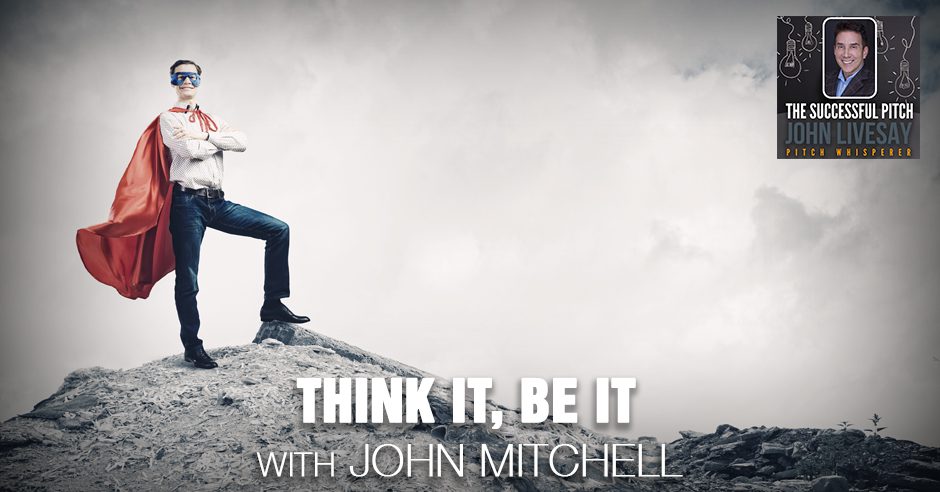
Think It, Be It with John Mitchell
Posted by John Livesay in podcast | 0 comments

Episode Summary:
Everybody wants to raise their income and have success in their careers. However, even with so many things written about achieving that, it is still pretty difficult to find one that you can follow. Taking the legendary book, Think and Grow Rich, entrepreneur and success mentor John Mitchell has created a technique that practically applies its ideas through his 12-minute-a-day Think It, Be It. Debunking the idea that hard work makes you successful, John talks about working smarter instead by influencing your everyday actions and thoughts. He gives out the four categories that will change your programming so that you can see your life in a way that allows you to pull in the people and success that you want.
—
Listen To The Episode Here
Think It, Be It with John Mitchell
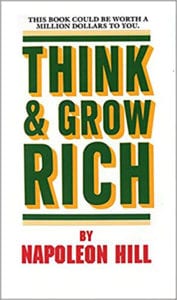
Think and Grow Rich
Our guest is John Mitchell. He has a 12-minute-a-day Think It, Be It technique that’s rated as the top practical application in the world of the legendary book Think and Grow Rich. When he applied his technique to his own life, he saw his income go up to over $5 million a year. Previously for twenty years as an entrepreneur, he earned low six figures and that twenty times difference happened because his daily technique significantly increased his control over himself by probably double. It made them laser-focused every day on the two or three things that move the needle in his business. It also allowed him to rapidly evolve his strategy for success. He was simply operating every day at a higher level than he ever had before and it showed up in his income.
The science behind his technique was profiled in a Time Magazine cover story. While John started out as a CPA, he became an entrepreneur at a very young age of 30. He’s owned companies in a wide variety of industries including real estate development, restaurants and publishing. Turning 50, he wasn’t as successful as he thought he should be. He found the top book of success written, Think and Grow Rich and he developed his own 12-minute-a-day technique. That what you envision in detail on a daily basis is what shows up in your life. John, welcome to the show.
Thank you. I’m glad to be here.
I always like to ask my guest to take that little intro that I gave and bring it to a life of your own story of origin, not so much about being a CPA. I want to hear the story of origin of turning 50 take us there and saying, “I thought I’d be more financially independent. I worked hard. I’ve been an entrepreneur and things aren’t what they need to be.” Tell us what the a-ha moment was for Think It, Be It book.
When I turned 50, I wondered if success looks what I thought I should be. I had a couple of goals in my life to make enough money, so I didn’t have to work and to find the woman of my dreams. As I assessed my life, I realized that I was falling short on both. As an entrepreneur, I’m always blessed to make well into six figures but never close to seven. On finding the girl at 50, I’d never been married. I can tell you, it was not from lack of interview. I did a lot of interviewing. The defining moment happened three days after I turned 50. I’m in my office, kick back and my feet are on the desk. I started thinking about my life and I do the math. I realized, “If I don’t make over $1 million a year, I’m never going to have that exceptional life that I’d always dreamed of.” The freedom, the lifestyle, the sense of accomplishment and that hit me like a ton of bricks. It was clear, I had to make things happen in my 50s. I made the decision that hard work doesn’t work.
While it works for making six figures a year but clearly it didn’t work for making seven. I knew there had to be something other than hard work. I made the decision to find out whatever that something else was. Three months after turning 50, as I’m puzzled about how to change this direction, a pearl of wisdom hits me. Why not find the top book in the world on success and achievement ever written and then apply it word for word to my life? The logic was so simple and compelling. After some research, I’ve found that there is one book that excels over all others and it’s Think and Grow Rich. Are you pretty familiar with Think and Grow Rich?
[bctt tweet=”‘Hard work doesn’t work for making seven figures.'” username=”John_Livesay”]
I am. It’s all about investing in real estate and letting that real estate grow for you.
It’s not quite, but I guess you’re in some of that.
That feels a little like Rich Dad, Poor Dad.
Here’s what’s significant about the book. First is the book has sold over 100 million copies whereas the next bestselling book on success and achievement has sold under ten million copies. Clearly, it’s a top book ever written on success by a factor of ten. The second thing is the book has created more millionaires and billionaires than any other book on the planet. It’s basically applying science to your life to up your success. I read the book and the central concept is what you envision in detail on a daily basis is what shows up in your life.
It’s very much along the lines of The Secret or Abraham Hicks, that whole mindset of The Science of Mind of Ernest Holmes or Your Thoughts Create Your Reality.

Think It, Be It: You got to work smarter by influencing the actual part of your brain that influences the thing that determines your success.
I read that and then I discovered there’s a problem that I and probably all of us have encountered 100 times. It’s a great idea but how to apply it in a practical way. I probably moped around for a couple of weeks not knowing how to apply it and then it hit me that maybe I had to come up with the practical application myself. I did and I applied it to a new business I was starting in the financial services industry. Over nine years, I continually tweak my 12-minute-a-day methodology. Over those nine years, my income went from low-six figures a year to $5 million a year. I felt so incredibly blessed. It’s quite a change from my twenty-year history. I could see why it was happening. By applying science to my life for the first time ever, I was influencing my daily actions and thoughts. Clearly, I was operating at a higher level than I ever could before. I could feel it. The best news was I also met the woman of my dream from applying this methodology.
It’s about pulling people in. Energetically, it’s almost like a metaphysical principle that the science is based on.
It really is. That sounds a little woo-woo, metaphysical.
Quantum physics does if you’re talking about energy for people who prefer that. Let’s go and dive right into this concept of a lot of people who go, “I don’t have time to meditate. I don’t have time to fill myself up with a bunch of positive thinking.” Give us an example of how the 12-minute-a-day methodology works.
This is essentially how it works. You’re going to feed yourself every day exactly the person you want to be, exactly what you want to accomplish and precisely how you’re going to achieve your clearly defined goals. When you feed that to yourself every day, after about 21 days, the science kicks in. That starts showing up in your thoughts and actions automatically without thinking. That’s the magic of it because when your thoughts and actions automatically start reflecting your programming, it immediately takes you to a higher level.
[bctt tweet=”Success is when your thoughts and actions match your programming.” username=”John_Livesay”]
What’s an example of somebody who did? Let’s focus on the career at the moment.
I’ll give you an example. Everybody wants to raise their income, their success and their career. To backtrack a little, the way this works is, you’ll take your life and compress it down to one sheet of paper, front and back. On the front is the ideal you and the five key areas of your life: yourself, your health, your romantic relationship, your spirituality and your career. That’s on the front. On the back are the improvements you want in each area of your life and your three goals for the quarter. That’s essentially it. One of the things in a career that we do is we articulate your succinct business plan, your strategy for success or the two or three things that move the needle. The linchpin issue that takes your business to the next level.
You feed that to yourself every day. I found that three things happen. First, your business plan is so easy to implement because it’s so top of mind. Secondly, you do become laser-focused on only what moves the needle. Everything else falls by the wayside. The third thing is that suddenly I had a way for evolving my strategy for success in the business plan in a way that moved it forward by like twenty times what I’d ever experienced before. That was happening because when you’re feeding your business plan or your strategies for success to your subconscious mind every day, it’s constantly challenging it and refining it. It had such an impact on me. I have that ability to continually refine my strategy and it made me more successful.
This is why I wanted to have you on the show, John, because I’m so fascinated by this premise. From my own speaking career, for example, when I had the courage to say out loud to people, “I want to give a TEDx Talk.” All your self-talk comes up, “Who am I to give a TEDx Talk? What a big goal? You’ll never achieve it. It’s never going to happen.” If you keep saying it to yourself and putting it out to people and let go of all the negative self-talk and worrying about whether the other people think you’re crazy to do it, then someone said, “I know someone who puts one on in San Diego. He might be able to help you figure out what you need to do to get a yes.”
The thought process of that laser-focused, keeping it top of mind, knowing that having a TEDx Talk would be one of those key drivers that you talked about moving the needle that gives you credibility as a keynote speaker. We got the laser-focused, then I get introduced to someone for saying it. It still took me a year and a half to get someone to say, “Yes.” It had nothing to do with my talk. It doesn’t fit our theme. You had to get used to those noes. This question that someone gave me that is what I hear you saying, which I want to tell everyone reading is if we plant in our seed this question of challenging that question, why is it that I’m a successful TEDx speaker? Why is it that my TEDx Talk has over a million views? That’s what I hear you saying is by having that laser-focus and then asking, “Why is it that I have my perfect soul mate in my life now?” Your brain starts matching that programming. Is that the gist of what you’re saying?

Think It, Be It: Just as you’re baking a cake where you can’t keep opening the oven, we have to give our goals and thoughts the full time to bake.
There are two parts to success. Using your example is probably a good idea. Your desire to do a TEDx Talk, that’s setting the goal. That’s being clear about what it is. Equally important, if not more important, are the action steps that you have to take to achieve that goal. You no doubt had a detailed vision of exactly what you needed to do to make that a reality. That’s the power of this 12-minute-a-day technique is that it takes those action steps that you’re going to need to take to achieve that goal. By feeding it to yourself every day that causes your thoughts and your actions to reflect your programming. That’s the game-changer. When people wonder about, “What makes me more successful or how do I become more successful?” Most people think, “I’ve got to work harder.” No, I don’t think so. You’ve got to work smarter. You work smarter by influencing the actual part of your brain that influences the thing that determines your success, which is your everyday actions and ongoing thoughts. Does that make sense?
It does. We talked about this a lot. I’ve interviewed investors to fund startups. They say, “Please tell your clients, don’t try to boil the ocean.” I tell people Amazon sold books first and have proof of concept that worked before they started selling everything. If you try to pitch Amazon now, it would be like, “That’s boiling the ocean.” I love this concept of laser-focus. People say, “I have top of mind what my goals are. I’ve figured out what I should be focusing on to take some action. Your secret sauce, from what I can gather, is this questioning your mind of visualizing it already happening where you’re saying, “Why is it that? This has already happened.” When you are fighting, in my case, when I finally did stand on that TEDx stage, on that red carpet, it seemed like, “I’m here,” or like you’re meeting the woman of your dreams for a date. It’s like, “She showed up.” It doesn’t seem like a surprise or magic. There’s the science of it because you’re doing this. The 12-minute-a-day, you mentioned the four categories: yourself, health, romance, spirituality and career. Do you spend a couple of minutes on each of these categories for the twelve minutes or do you spend twelve minutes on one?
No, it’s twelve minutes in total. Probably more of it is spent on your career because originally, I created this because I wanted to go to seven figures a year net. That was my big focus. It’s a little more towards the career, but it has all of those areas.
What is your life like? There are all these studies on happiness that we pass a certain Maslow’s Hierarchy of Needs, our basic needs are met in terms of food and shelter and what have you. In other words, the difference between making $100,000 and $1 million is not the same exponential increase in happiness as it is in money. Has that been the case for you?
When I was making six figures a year, in some ways, I was afraid to look at creating an exceptional life looked like because I wasn’t sure I’d ever get there. Once I got there and I started making $5 million a year, I was like, “This is way better than I thought it was.” Finally, I had enough money not to have to work. Because I was so fascinated by the stuff we’re talking about, I sold my company. I guess it was probably two or three months after I sold the company, I met the former chancellor and president at the University of Texas at Austin. I told him my story. He said, “You’ve got to teach this at the University of Texas and why don’t we teach it together?” I said, “That’s fine to teach at the high achievers.” My passion is to get those people that were like mad that struggle to go to that next level and teach it to them because I so relate to the pain that I had back then and so many people have.
[bctt tweet=”What you envision in detail on a daily basis is what shows up in your life.” username=”John_Livesay”]
You have empathy because you’ve been in their shoes is my big takeaway from what you said.
I had freedom was the feeling I’ve gotten as I crossed over and didn’t have to work. The best things were not material things. The lifestyle is great. That’s small potatoes compared to that sense of accomplishment, that pride of accomplishment, the level of control that this gave me over my life, that level of control was immensely great.
You’re the perfect person to ask this question to. In my observation of entrepreneurs and business people in general, a lot of people have the money thing down, but they don’t have the fitness thing down. They’re physically fit but not fiscal fit and then vice versa. There are a lot of fit people out there that have no money. You have both. You’re physically fit and you’ve got financial freedom. I tell people, “If you can get one area of your life, take the discipline you have, knowing how much your cashflow is, and what’s in your checking account and apply it to the calories and exercise you’re doing and vice versa.” Take the discipline from working out to your money. I don’t see many people talking about that. You seemed to be embracing all of this. Another reason why I wanted to have you on is you’re not talking about careers, you’re talking about all areas of our life. Can you speak to how this Think It, Be It applies? The concept of visualizing is discipline and focus from one area. Let’s say fitness can also be applied from your career.
I’m so glad you brought that up because here’s my definition of an exceptional life. You’re making seven figures a year. You’ve got a great romantic relationship and you’re fit and trim. To me, that’s the trifecta of an exceptional life. I see so often that to your point that people maybe are doing well financially. They got a lousy marriage or they’re overweight. They can’t control their weight. I particularly find this issue about having a great romantic relationship important. If you think about it, that relationship affects your happiness more than any other external factor there is. This affects all three areas at the same time. One of the things I think that you’d find interesting, this is something that we all have to overcome. We’re all using an antiquated operating system to run our lives. It’s like playing the game of life with one hand tied behind our back. The effect is that we’re all innately geared to daily survival. The effect of that is three things.
First of all, 90% of your thoughts are fear-based. Secondly, you have less than 20% control over yourself. Thirdly, you’re reactive rather than proactive on your report and agenda. All that is great if you’re running from a lion. It’s exactly the opposite of the way you need to be if you want to be productive, creative and happy. You have to overcome that. The part of your brain that controls your everyday actions and ongoing thoughts is your subconscious mind. That antiquated operating system is what’s running your subconscious mind. It’s gearing you exactly the opposite way you need to be. That’s what this 12-minute-a-day technique does. It overlays an operating system that gears you to productivity, creativity and happiness.
You have mentioned that there are two scientific discoveries that affect how much we achieve in life. Can you tell us what those are?
Over the last 30 years, there’s been a lot of scientific interest in what separates the mega achievers from the moderately successful. It comes down to two things: control of self and focus. Those are the two exact things that this affects. The principles that you’re referring to, it is that antiquated operating system. The other one is, you have a reticular activating system, which is a part of your brain that’s about the size of the tip of your little finger. It’s a filter for your brain. It determines what gets in and what doesn’t. It’s like the nightclub bouncer for your brain. When you’re feeding every day to yourself exactly the person you want to be, exactly what you want to accomplish and precisely how you’re going to achieve your clearly defined goals, then it knows what’s important to you. It brings in stuff that isn’t coming in. That’s what amazed me when I first started doing this, I saw my reticular activating system reacting to what I was doing for twelve minutes a day.
Is it the amount of time? Is there something special about twelve minutes versus ten versus fifteen?
The beauty of twelve is it’s doable. It’s not too much. I’ll give you an example of how it worked in my marriage. This illustrates how it works with everything. I didn’t get married until I was in my 50s. When I did, I discovered something that unfortunately my married friends had failed to share with me. Every once in a while, your spouse will say something irritating. I know that probably hadn’t have happened to you, has it?
It’s happened to everybody.
[bctt tweet=”Success is a necessity, not a preference.” username=”John_Livesay”]
When it happened to me, I didn’t like it. I didn’t like what would come out of my mouth. While it didn’t happen a lot, it did happen. I thought, “I’m going to put in my visualization that I’m going to be flexible, patient and thoughtful.” I’m reading that every day. Fifteen days in, I’m no more flexible, patient or thoughtful than I was at the start. About the 21st, the 22nd day, my precious wife, Ginger, said something irritating and in that moment, I was flexible, patient and thoughtful. I didn’t have to think about it. That’s who I had become.
It’s a tipping point. That 21-day thing of the brain getting reprogrammed.
I have done this with so many people. It is amazing about this 21-day mark. Some things the subconscious mind is going to accept at ten days in. I have consistently seen that around the 21st day, it then accepts everything.
I love stories. I always use the analogy of, if you’re planting a seed, you can’t keep digging it up going, “Is it growing?” If you’re baking a cake, you can’t keep opening the oven and be like, “Did it rise yet?” That’s what we tend to do with our goals and our thoughts. We don’t give it the full time to bake in this case, 21 days.
That brings up something else that’s interesting. This works on everyone, but it’s not for everyone. Maybe that’s even a negative about this. What I mean by that is it works on everyone because it’s pure science. It has to work. It cannot work. There’s one caveat to that. It’s not going to work if you don’t do it. It’s not going to work if you are trying not to do a habit or the other thing is if more success is just a preference, which is the case with most people as opposed to a necessity. It’s not going to work. More success has to be a necessity for you because if it’s not, you’re not going to spend twelve minutes a day.
Those twelve minutes a day, is it a journal that you’re writing in? Is it words you’re reading over and over? Is it making sure you’re top of mind on your action steps? What do the twelve minutes look like?
It’s pretty much all of the above. Keep in mind and picture this, you’ve compressed your life down to one sheet of paper, front and back. It’s sitting in a plastic stand that sits on your nightstand. The first thing in the morning before you get other things into your head, you spend twelve minutes a day to read it. You’re reading what’s moving the needle in your business. You’re reading the way you want to be with your spouse. You’re reading the things you want to make happen with your consistent exercise and how you eat. In the career, you’re feeding your succinct business plan, your strategy for success and your three things that move the needle. Also at the bottom of the visualization, you’re tracking every week on Sundays, the key behaviors associated with your goals. It’s that combination that has such a transformative effect on you.
The website is ThinkItBeIt.net. You have a five-day free email course that anybody who goes to the website can get. They can start to explore from that.
You can text me at 44222 and then the word, Genius, and that gets you the five-day email course.
John, I can’t thank you enough for sharing your success formula. You obviously are walking your own talk, which gives credibility. It’s been a pleasure having you on the show. Is there any last thought or quote or inspiration you want to leave us with?
I’ll share with you a story you might find interesting. When I created this a few years ago, I decided to go find the top expert in the world on success and achievement. I determined that the person is Darren Hardy. He is an amazing guy. I figured out a way to get to him. I’m able to sit down with him for three days and visit with him. Finally, we sat down and he looked at what I’ve created, this visualization. He studied it. He said, “This is good.” He looked a little closer and he said, “This is good. You’ve got a problem, though. Most people are not going to spend twelve minutes a day on anything to impact their success. That’s how it is.” I was like, “Darren, how can that be?” It’s twelve minutes a day. It’s based on the top book ever written on success and achievement. He goes, “I know, John. You’ll do it, I’ll do it. That’s a dirty little secret of the success in human achievement field is that most people won’t do anything to impact their success and achievement. The people that were a success is a necessity as opposed to a preference. They’re going to do this. It’s going to be their advantage in life for creating success.” I was like, “That’s what I experienced.” It was pretty gratifying to have him say that. Now, that we’ve done this with a lot of people and I get the inputs from how it’s changing their lives and how the template that we have makes it easy to do this, it’s gratifying.
Thanks again, John.
Links Mentioned:
- Think It, Be It
- Think and Grow Rich
- Rich Dad, Poor Dad
- The Secret
- The Science of Mind
- Your Thoughts Create Your Reality
- www.ThinkItBeIt.net
- Quantmre.com
Wanna Host Your Own Podcast?
Click here to see how my friends at Brandcasting You can help
Get your FREE Sneak Peek of John’s new book Better Selling Through Storytelling
John Livesay, The Pitch Whisperer
Share The Show
Did you enjoy the show? I’d love it if you subscribed today and left us a 5-star review!
-
- Click this link
- Click on the ‘Subscribe’ button below the artwork
- Go to the ‘Ratings and Reviews’ section
- Click on ‘Write a Review’
Happily Ever Always with Michael Rosenblum
Posted by John Livesay in podcast | 0 comments

 Episode Summary:
We often look for happiness in different places and people. But no matter how much we look, we can’t seem to find it. Michael Rosenblum believes we all deserve to live Happily Ever Always and for him, that is about looking within oneself. He is a self-made man and one of America’s most successful real estate brokers—deemed even as the broker’s broker. He talks about how much of his success comes from loving what he does and in serving other people. Shedding some life into real estate, he gives light and comforting advices on going to listings, selling, buying, and marketing. Ultimately, he believes that money can’t buy you happiness but happiness can make you rich.
—
Listen To The Episode Here
Happily Ever Always with Michael Rosenblum
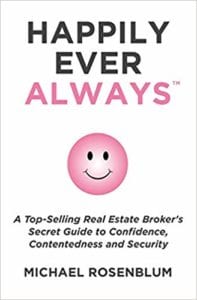
Happily Ever Always: A Top-Selling Real Estate Broker’s Secret Guide to Confidence, Contentedness and Security
My guest is Michael Rosenblum, who has written a wonderful book called Happily Ever Always. He reveals the winning philosophy by his amazing route to becoming one of America’s most successful real estate brokers. He has this amazing story where he takes you on a journey where you go through all these exercises to get in touch with what your thoughts are about happiness. He tells us that good business isn’t good enough. As someone who passionately believes his joy is measured in the equal proportion to the happiness of those around him, you could imagine that he makes everybody feel happier. He said, “We’re intentionally seeking this spiritual connection because it triggers greatness and we all want that. When you realize why you always deserve to live happily ever always, you have the secret to not only a happy life but a happy business life.” Michael, welcome to the show.
Thank you, John. I’m delighted to be here, certainly humbled, to say the least.
I always like to ask my guest to tell us your story of origin. You can go back as far as you want. You can be a little boy dreaming of being rich. You can be high school, college, wherever you want to start that had, “I want to be happier than the people I see around me.” Whatever you think would be relevant to give us a sense of how you all started on your journey.
I should probably begin by saying I was one of those children who never felt as if he fit in with other kids. I was a little different. In being different as we all maybe have experienced at one time or another in our life, you get bullied when you’re different by people who sometimes are not happy themselves. As I began to grow and learn to like myself, I decided through my trials and tribulations of life that I wanted to find out if there was some formula for being happy. As a young person, I thought happy was being rich, having a lot of money, all material possessions. I came to learn over time of a successful business that I wasn’t happy.
[bctt tweet=”Don’t wish your villains away” username=”John_Livesay”]
I remember having a job one time. I was paid so much money and it was blocks from my home here in Chicago. I would wake up every morning and I would cringe to go to the office because I wasn’t enjoying myself. I was able to go to dinners and buy different things and yet I wasn’t happy. I thought maybe happiness is when you meet the love of your life, when you meet that right person and you have that connection. I was blessed to have that experience and it didn’t work because you fall in and out of relationships.
That’s a lot of pressure to put on one person, “You have to be responsible for my happiness, now go.”
Together, being with someone, I was thinking that was the epitome of happiness and it wasn’t. In short, what I realized was that happiness came from within me. I had to figure out who I was and what was going to make me happy. What I found that was going to make me happy was having a sense of security of my own personal truth. Accepting me for who I am, growing with that and accepting the flaws, the favorable aspects and the gifts that are buried within me.
It’s an interesting way of looking at life because a lot of us, especially in the business world and sales, are looking for people to like us, accept us, typically in the form of hiring us. This whole podcast is about the successful pitch. If you’re constantly pitching to get hired or to sell a product or a service and your big concern is like Sally Field, “Do they like me?” You’re never going to ever feel completely happy because not everyone’s going to like you or what you’re selling.
That is the truth to heart. Furthermore, what’s interesting is that when you find that you like who you are, you have the ability to present yourself in an authentic way. You’re not concerned what other people think and you’re not concerned that the product you might be selling isn’t going to be favorable to somebody else. You can sell yourself best when you like yourself. When you find your own sense of happiness, then you have the world by the tail and you can do everything and anything that you ever wanted to.
You certainly have the world by the tail when it comes to business as one of the most successful brokers in Chicago. You’ve generated sales of over $400 million and then inducted into Berkshire Hathaway’s Hall of Fame. You’re constantly in the top 1% of 46,000 real estate brokers. There must be something to that success that has allowed you to stay consistently at the top. Yet if people think that that’s going to make them happy, they’re still not getting the message.
It falls back on the fact that you have to be happy with yourself. You have to like yourself. You also have to be authentic to who you are. By understanding who you are, then you present yourself in a real way. When you present yourself in that real, authentic way, you will find that people will gravitate towards you and you can do anything. My success in real estate is probably driven by the fact that I just want to do a great job for people because that’s what I would want to be done for me. I often call myself the broker’s broker. The reason why I call myself the broker’s broker is because I treat my clients in the same manner that I would expect my broker to treat me.
[bctt tweet=”Reincarnation: Do you want to come back as you?” username=”John_Livesay”]
It’s almost like a doctor saying, “I’m going to treat this patient like it’s a family member and not just another job.” I love this concept of when we are our authentic selves because in the marketing world if you try to be all things to everybody, you’re nothing to everybody. As opposed to picking a lane, picking a niche, who this is for and who this is not for. Therefore, when you go out to pitch to get someone to hire you, to give you a listing, what is it that you do or say that makes people want to work with you versus someone else? Separate from all the bells and whistles of, “This is our marketing strategy.” I want to hear, if I can, what’s the mindset you go in with? What’s the energy? What is it that somebody could say that would cause you to say, “This isn’t a fit?” Anything you can share in that arena?
I believe the driving force when I go into a listing appointment that separates me from other brokers is number one, my enthusiasm for the work that I do. Number two, being able to give a clear, concise presentation and of course not to forget the word compelling. We all suffer a little bit from not having the most robust attention spans because we’re busy. You need to have your presentation done in a succinct way where for me, one of the things that I do is I like to cover four points. I bring a wonderful presentation book of real estate comps and all the marketing we do. It’s a wonderfully thick book that we leave behind with our clients. What I do is number one, talk about who I am and a little bit about my background. Number two, I get into the comps. Number three, I talk about the marketing that we are going to implement in order to drive traffic to a particular property. Number four, we talk about how we’re going to service you, the client, so that we’re answering your questions before you ask them.
I would imagine that other brokers do a similar process in terms of the research and a little bit about their bio. What I’m looking for is your secret sauce. Do you paint a picture of what life is going to be like? Do you paint a picture of the process which can be stressful being less stressful because of your happiness focus?
It’s probably the oodles of enthusiasm that I seem to generate when speaking to somebody. I’m asking them questions about why they’re moving and why they’re contemplating this sale. If I’m working with a buyer, in going through an assessment program with the buyer, it’s trying to find out what’s the motivating force and then talk around that. I think it’s probably coming in and having an enormous amount of enthusiasm for what I’m doing. The other thing is just having the knowledge. You would be surprised at how many people don’t have a lot of knowledge about their industry. Fake it to make it.
What I hear then is if our audience wants to be more successful and happier, bring your enthusiasm, which has to be authentic. Ask questions that are specific to that particular person’s reason for making a change. Most importantly, prepare and don’t underestimate that can separate you from the competition. If someone is also saying, “I’d like to overcome some self-doubt. Maybe I don’t have the years of experience and this amazing track record that you have, Michael.” What would you recommend people do?
[bctt tweet=”When you find your own sense of happiness, then you have the world by the tail.” username=”John_Livesay”]
I believe everyone has certain gifts that are a little different than someone else’s. When you don’t have an experience in selling a lot of real estates, you might have a skill set that you can comport from a prior profession you were involved in. For instance, maybe somebody was in party planning. What they can talk about is the fact that when they get a listing, they build a marketing plan around that particular listing to figure out how to get the optimum amount of traffic. They’re taking their skill set from planning parties, which involves understanding menus and understanding possibly how to get press, depending upon the type of party it is. It’s taking a skillset from a prior profession, going ahead and comporting that to real estate and implementing it. Your enthusiasm can drive a contagious and infectious road path to get people to do exactly what you might like.
One of the things you talk about in the book, Happily Ever Always, is listen to your gut, not your wallet. That goes back to that earlier question I had about when do you say no to a potential client? Your gut’s saying, “I’d love the commission on this listing.” You’re listening to your gut and not your wallet. Do you have a story around that you can share?
First and foremost, you have to trust yourself. You have to believe that others are going to do the same. When you’re genuine, you win. If you have an agenda only for money, you won’t. Sometimes I’ll go into an appointment and I’ll sit down with a potential seller. They’re telling me that this is where their property should be priced and that they know exactly how it should be sold. It begins to make me feel as if, “What am I here for?” I should probably back up and say when I meet somebody who tells me that they’ve sold a lot of properties and this is where it should be priced despite the comps. I’ve cued them on different reasons as to why they believe that and I don’t feel that it is genuine or it makes sense. I step back and I’ll say, “I don’t think I can meet your expectations. I’m not the person for you.”
I realized that if someone’s telling me that they’ve sold six properties and I’ve sold over 1,000 properties, I have a better track record in deciding whether or not something’s going to go. Therefore, if I feel the person’s contentious, I realize it’s only going to be blood money. It’s not going to be harmonious. When you are in business with someone and when you’re selling something for someone, you’re married to them and you want to have that harmonious relationship. If it’s not there, then you’ve got to listen to your gut, not your wallet. You could end up spending a lot more in the long run.
[bctt tweet=”You get bullied when you’re different by people who sometimes are not happy themselves.” username=”John_Livesay”]
You also said you called it blood money, which leads me to my other question. You talk about, “Don’t wish your villains away.” Tell us what that means.
That’s an excerpt from my book and you should never want to wish your villains away. For lack of better word, I’ll use the word dreadful. Sometimes the dreadful people we think that come into our lives we wish weren’t there are the very people that can teach us lessons, not only about our self but also be a springboard to take us to a greater place. You might say, “Michael, why would you make that statement?” John, I would make that statement because sometimes mean people do things to us. It irritates us to the point where we say, “I’m not going to be your doormat. I’m not going to let you walk all over me. I am going to rise to the occasion and I’m going to be better.” That villain motivated you.
Even Cruella de Vil is someone that could motivate us if you look at it the right way is what you’re saying.
Another thing that I’d like to touch on is the point that is there anything bad in life? I guess we could say there are things that are bad in life, but sometimes from the tragedy comes the victory. We don’t see that necessarily when we’re settled in a situation that is terrible and that is painful. Sometimes if we step out of it, which takes a lot of courage and a lot of strength, we end up finding that we are strong and we can endure and we end up winning.
Is there a time in your business life when things fell apart and you still were able to find happiness?
There was a time in my twenties, I remember specifically where I wasn’t getting paid worth my salt. I felt in all the times that I kept asking my boss for a raise, which was over a two-year period that she wasn’t interested in doing that. I had looked for another job but hadn’t found one yet. I believed that until I took a hold of my life, believed in myself, quit my job and didn’t worry about the fact that I didn’t have another job. I knew that I would get a job or I could wait tables or do something rather than work for somebody and not get paid worth my salt, I went ahead and I quit.

Happily Ever Always: When you find that you like who you are, you have the ability to present yourself in an authentic way.
The next day in making phone calls, I had two job opportunities. What was interesting to me here was the fact that I probably needed to do what I did. I wasn’t going to find the security of getting one job and leaving another job. Perhaps I believe what the universe was saying, “Stand up for yourself. Don’t be a doormat. Believe in yourself. Believe you have great talent and things might not work in that alphabetical order that you want, but if you take the risk, you will find the reward.”
Is that what motivated you to want to write Happily Ever Always?
What motivated me to want to write Happily Ever Always was going through life’s trials and tribulations and realizing that we all deserve to be happy. Therefore, I found myself in my 30s and 40s starting to write different things. By the time I got to 52, I figured it’s a do or die situation. It’s time to write and put it together.
A lot of people have a dream of writing a book and they never make it happen. What was it that made you say, “I’m going to do this now,” besides time is running out?
I feel I am a fortunate person. I’m not the smartest person, I’m not the wealthiest person, I’m not the best-looking person, but I love being me. If I was asked to be anybody in this world, who would I want to be? I would want to be me. To be honest with you, it’s because I can say that with great conviction that I would not want to be anybody but me. I hope in my next life, if we believe in past lives, that I can come back as me. I felt that happiness needs to go in a book and needs to be shared with other people so that they can feel the same way. In writing the book, I felt rather than give my philosophies, pontificate and narrate, I needed to invite the reader to answer questions. As I narrate the story of my road to happiness, I prompt the reader to answer specific questions at the end of each chapter. That when they’re done with the 150-page read, they might have found their personal truth, which will always allow them to live happily ever.
[bctt tweet=”You can sell yourself best when you like yourself.” username=”John_Livesay”]
We’re not going to wish our villains away. We’re going to listen to our gut and not our wallet. We are going to keep our commitments no matter what. Those are the real things that you say will help us be happier in our personal and our business life and that they are in fact connected. Can you speak to the connection between personal and business?
The connection to personal and business is believing in yourself. When you believe in yourself, everyone else will too. In the business world, your colleagues will believe in you and they’ll trust you. In your personal, the people who love you and you love and the people who haven’t come into your life will also find that halo of happiness that seems to surround you as a person.
The book is Happily Ever Always. Congratulations on having a mission and a purpose to help other people get happier and want to be happy with whom they are that they wouldn’t want to be anybody else. The outcomes of that are all the trappings of success, but it’s coming from a completely different place from the inside out instead of from the outside in. If people want to follow you or certainly if people want to hire you to find them a place to live in Chicago or hire you to help sell their place in Chicago, how can they reach you?
They can reach me at HappilyEverAlways.com.
Thanks for being a guest on our show, Michael. It’s been a real pleasure and a happy experience for me and I’m sure the audience.
Thank you, John.
Links Mentioned:
Wanna Host Your Own Podcast?
Click here to see how my friends at Brandcasting You can help
Get your FREE copy of John’s latest eBook Getting To Yes now!
John Livesay, The Pitch Whisperer
Share The Show
Did you enjoy the show? I’d love it if you subscribed today and left us a 5-star review!
-
- Click this link
- Click on the ‘Subscribe’ button below the artwork
- Go to the ‘Ratings and Reviews’ section
- Click on ‘Write a Review’