

Raise Your Game With Alan Stein Jr.
Posted by John Livesay in podcast | 0 comments

The world tends only to see the wins and glorious moments in life. Many overlook the fact that behind all the success is the amount of work behind it, the blood, sweat, and tears shed leading towards that moment. In this episode, John Livesay is joined by the author of Raise Your Game, Alan Stein Jr. to share with us why we should not let outcomes determine our behavior and how the unseen hours we put in when no one’s looking determines our success. Having worked with amazing athletes, including Kobe Bryant, he then tells us some of the lessons he learned from the basketball court to the business world, such as preparing to do sales, focusing on being great where we are, and the difference between motivation and discipline. At the end of the day, success is not about the outcome but the preparation put into it. Join Alan in this conversation to find great nuggets of wisdom that will have you rethink the way you see success.
—
Listen to the podcast here
Raise Your Game With Alan Stein Jr.
Our guest is Alan Stein Jr., the author of Raise Your Game. He’s worked with amazing athletes, including Kobe Bryant. He shares the lessons he learned from the basketball court to the business world, including don’t let outcomes determine your behavior, how the unseen hours that you put in when no one’s looking determines your success. His big advice about being a star right where you are, and how that led him to incredible success. Enjoy the episode.
—
Our guest is Alan Stein Jr. He teaches proven strategies to improve organizational performance, create effective leadership, increased team cohesion and collaboration, and develop winning mindsets, rituals and routines. He’s a successful business owner and a veteran basketball performance coach. He spent fifteen years working with the highest performing athletes on the planet, including NBA superstars Kevin Durant, Stephen Curry and Kobe Bryant. In his corporate keynote talks and workshops, he reveals how to utilize the same approach in business that elite athletes use to perform at world-class level. He delivers practical lessons that can be implemented immediately. His clients have included everything from American Express, Pepsi, Starbucks, Penn State Football, and many more. The strategies from his book, Raise Your Game: High-Performance Secrets from the Best of the Best are implemented by corporate teams and sports teams around the world. Alan, welcome to the show.
I’m excited to be here. Thank you so much, John.
I’ve been a big fan of your work and your passion. I got to hear you speak at a virtual meeting. I thought I’m going to reach out because you and I love this passion for getting people to stretch themselves a little bit beyond who they are or what they think they can do. Let’s take it back a little bit to your own story of origin. You can go back to the first time you ever shot a basketball to wherever you want to start the story. Before you became such an expert in all of this and working with these athletes, what is your own little story?
[bctt tweet=”Don’t let outcomes determine your behavior.” username=”John_Livesay”]
The point of origin that is applicable is that basketball was my first love. It was my first identifiable passion. I fell in love with the game at 4 or 5 years old, several decades later, basketball is still a major pillar in my life. For that, I’m thankful that I’ve been able to build a life and make a living built around something that I enjoy and have a passion for. That stems from arguably the best piece of advice I ever received when I was young, which is find what you love, find what you’re good at, and then find where those two things intersect. For me, that’s always been around the game of basketball. Even now that I left the direct training space and do mostly corporate keynote speaking and workshops, it’s still centered on all of the themes, lessons, principles and strategies that I learned through the game. Most of the stories that I tell on stage or to a webcam are rooted in my basketball experience. Basketball is still a foundational pillar in my life.
For frame of reference, because everyone is always curious, how tall are you?
I’m 6’1”, which according to the average height of males in America puts me a little bit on the taller side, but it’s funny because I looked like an absolute shrimp in some of the pictures that I have because I’m usually standing next to someone that’s 6’8”, 6’9”, 7 feet tall. Even when I worked at the high school level, even though they were 15- and 16-year-old kids, many of them were 6’8”, 6’9”, 7 feet tall. When you see a team picture, it makes it look like I’m 5’4”.
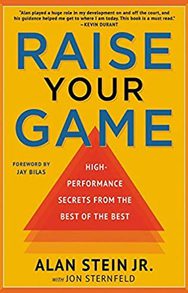
Raise Your Game: High-Performance Secrets from the Best of the Best
If you’re built a certain way in basketball heights, I remember in gym class in high school, the guy goes, “You got muscular legs.” I go, “I’m a competitive swimmer.” He goes, “You should be on the football team with those legs.” I had the opportunity to meet Michael Phelps and everyone was like, “He’s a successful swimmer because he’s got a big lung capacity.” There’s so much more to that success in any career, whether it’s an athlete or a salesperson or whatever you’re doing, than just your physicality. I wanted to start there. Did you have anybody encourage you or discouraging you like, “I don’t know if you’re tall enough?” What was it about basketball versus other sports that you go, “This is for me?”
I was always on the taller end of kids in my class. I’m not freakishly tall, 6’1” is a hair above average. It’s not like I’m 6’10”. My main attraction to basketball funny enough was, and this is a little-known fact that most people don’t know about me, is I’m heavily introverted. I love solitude. I love alone individual time. That’s how I recharge my battery. That was what unconsciously attracted me to the game of basketball because it’s one of the only team sports that you can practice by yourself and still improve the major skillsets. As long as you have a ball in a hoop, you can work on your ball handling, you can work on your shooting. Whereas when you think of soccer or baseball or football, you need someone else there with you to throw the ball and to catch or to tackle or to do whatever it is that you’re going to do. It’s harder to improve those sports in solitude. I love that I could take a few hours on a Saturday, go down to the park, work on my game by myself in complete silence.
Back in the ‘80s and ‘90s, we have a little boom box with some hip-hop music playing. I could go with my team and be around others and contribute to the greater good. That was one of the early attractions. I have seen in my time since the pressure that people put on young people when they’re tall at an early age. They make the assumption, “You should be playing basketball, or you should be playing volleyball because you’re tall.” They don’t quite get that. I understand that’s helpful, but they have to have a passion for it, for this to come to fruition.
[bctt tweet=”Emotions inform not direct your life.” username=”John_Livesay”]
I love that inside story of your introversion allows you to be by yourself to recharge and still be part of a team and toggle back and forth. That’s why basketball resonated with you. That’s nothing to do with your height, which is I happily found that insight for people. A lot of people think, “Why did you pick that or why does that resonate with you?” Let’s talk about your book, Raise Your Game. You’ve got some secrets in here. How did you come up with the title? That’s always a fascinating question for me, because as a fellow author, I know it’s not the first thing that comes to top of mind. There are many things that are considered.
Before we do that, I want to take one quick step back and say that my introversion is also what drew me to keynote speaking. I get to spend so much time by myself rehearsing, writing, and working on my craft. People often make the mistake of thinking if you’re introverted, you’re not social, that you don’t like people, that you don’t like large groups. Nothing could be further from the truth. I love being on stage and I love being around people, but that’s what drains my battery. It’s solitude that allows me to recharge. That’s the definition of introversion versus extroversion.
Extroverts get their energy from other human beings. Whereas for me, when I do a 60-minute keynote onstage and then mingle with some folks after, I can’t wait to get back to my hotel room and be in full solitude because I am emotionally exhausted at that point. I’ve been able to embrace my introversion and know that if I can put in the individual time to fill my bucket, then I can be of more value and of more service when I step on stage. I took that same mindset that drew me to basketball. That’s one of the key things that drew me to keynote speaking as well.

Raise Your Game: If you do have tendencies of being introverted, that in no way, shape or form should limit your potential as a sales professional.
That’s helpful because a lot of our readers are entrepreneurs. That’s a lonely job. I don’t think people, unless you’ve done it, realize that speaking can be a lonely job. The joke is we speak for free. They pay us to travel. If you’re a salesperson like I was, you’re on the road, you’re in a hotel room, people don’t realize it. If you are recharged by being around your friends and family, and you’re on the road in a strange hotel in a strange city, then that drains you. If you’re someone like you, it recharges you. The things that are hard for people who are extroverts, being on the road, alone in an airport, and all that isolation of not having one to talk to, it drains them. For you, it recharges you. It’s the same thing with sales. It’s like, “You got to be outgoing to be in sales.” Maybe or maybe not. It depends on how you can frame it.
If you are naturally extroverted, you will gravitate to something like sales because you make that connection of, “Nothing would make me happier than meeting with eight clients or prospects a day and talking.” While that may be true, that doesn’t mean that if you’re naturally introverted, that you should have an aversion to sales. You can still be an incredible sales professional if you’re introverted. You have to know your lane. You have to know that, “I’ve got a sales call today at 4:00, or I’ve got a presentation this evening.” I need to be in solitude to prepare for those two events so that I can bring my best and that I can show up as my best self. For the readers, if you do have tendencies of being introverted, that in no way, shape or form should limit your potential as a sales professional.
Also, as an entrepreneur. Bill Gates and Zuckerberg are quite introverted person. They’ve figured out ways to deal with that and make that work for them. You’ve said something that stands out to me, which is the need for preparation. We know athletes do it, Broadway performers do it, movie stars don’t get in front of the camera without rehearsing. Yet I see many sales professionals that are like, “I’m just going to wing it.” Whether they’re pitching for funding or pitching to win a new client, this resistance to practicing is the same personality that doesn’t like to stop and ask for directions before GPS. What is that do you think that causes people to realize, “All these people need to practice, but I don’t?”
[bctt tweet=”Don’t play the comparison game.” username=”John_Livesay”]
In any work that I’ve done with sales organizations, that’s one of the chief recommendations I make. You need to develop some type of system for practice. Whether you want to call it rehearsal, role-playing, whatever you need to do, you need to get into reps. It is interesting that we make that assumption with sports. We make an assumption when we’re watching a movie. None of us think that when we’re watching a movie that the first time Al Pacino or Meryl Streep is saying those lines is when the camera is on. Of course not. They said those things hundreds of times in preparation so that when the lights go on, they can nail it. Sales professionals should be doing something of the same effect.
One of the concepts in the book is we talk about the unseen hours. It’s the hours that you put in when no one is watching. A basketball player is made during the unseen hours. Us as novice fans, we get to enjoy their greatness when the lights come on, and the cheerleaders start dancing, but their game was built in an empty gym, working on their game by themselves. It’s the same thing with sales professionals. If you can start to look at that sales call you have or that presentation you have, if you can look at that as your game, or you can look at that as showtime on Broadway, then you’ll do what you need to do to prepare and to anticipate, “What am I going to need to be able to do during that sales call? What are some of the potential objections they may have or excuses they may make? What are the most insightful questions that I can ask them to get to know them, and qualify them as a legitimate prospect, and make sure that what I’m selling is the right fit for them.” That’s another important key.
A lot of sales professionals want to lead with their features and their benefits and what makes them unique. That stuff is important. However, it’s way more important to show the customer or the prospect or the client, how much you care about them and how invested you are in what will solve their problem. You’re not worried about selling them anything. You’re worried about making sure that you understand what it is that they need. If what they need is what you sell, then the sale will take care of itself. You don’t have to force it. You don’t have to manipulate. You certainly don’t have to convince anyone. You simply have to make sure that they can see the alignment between what they need and what you have. Once you get to that point, then you can share some features and some benefits and your unique selling proposition. It’s way more important to go into it with asking insightful questions and getting to know them.

Raise Your Game: With sales professionals, if you get too hung up on the outcome and the sale, it’s going to erode your preparation and your mindset.
This concept of the unseen hours, even as a speaker, sometimes people come up to you and go, “You’re a natural.” I smile like you did because nobody wants to hear about the work, unless they’re a speaker and then you’re having a conversation about the draft. People want to think that you can do that because you’re a “natural.” They don’t realize how much time you’ve spent crafting that TEDx Talk or whatever it is, let alone the keynote.
There’s no question that a certain level of charisma might be innate. You and I may have been born with certain personality traits that make it more conducive for us to be speakers and to be on. I say this respectfully and politely because people say the same thing. It’s almost insulting when someone says, “You’re a natural.” I do appreciate the intended compliment, but there’s a lot of work that goes into this. Ray Allen is one of the all-time best shooters in the history of the NBA. He’s still the leader in three pointers made.
He used to say the same thing because people would tell him, “You are such a natural shooter.” He said, “Natural shooter? Do you have any idea how many baskets I’ve made in the unseen hours in a dark gym by myself? This is not natural.” He would acknowledge. Maybe he was blessed with above average hand-eye coordination or spatial awareness. He was on the taller end. He was around 6’6”. He wasn’t discounting that he had some advantages, but at the end of the day, the reason he’s one of the best shooters ever to play the game is because he put in the work and he honored preparation.
[bctt tweet=”Find what you love, find what you’re good at, and then find where those two things intersect.” username=”John_Livesay”]
It’s the same thing for speakers. Could guys like us get away with not preparing? We might be able to do okay if we go up there and wing it, but we won’t come anywhere close to being as impactful and as influential as we’re capable of if we do prepare. This is why you can’t play the comparison game in speaking or in sales. If you’re comparing yourself to others and you’re using that as your yardstick, you’re going to fall short. My only comparison is, “Did I do as well as I’m capable of? Did I turn over every stone in preparation to make sure that I could deliver a customized message for this client? Did I bring my A-game and show up as my best self?”
If the answer to that at the end of the day is yes, then I know that I honored that client, respected that client, and did the best that I was capable of. The hardest part about that is learning to detach yourself from the feedback. There have been times where I felt like I killed it on stage and got good feedback, but they weren’t rave reviews. There have been other times where I got off stage and thought like, “Today wasn’t my best day. I was a little off my game.” I get some of the best feedback that I’ve ever gotten. It’s so important to keep all of these things in perspective and have some balance with them.
A lot of people secretly suffer and struggle with the imposter syndrome sometimes. A lot of that comes from comparing ourselves. We say, “Why am I not more successful by this age or by this stage of my career?” The first time I learned this was when I was in high school competitively swimming. They lined us up in heats. There’s always this guy that was faster than I was. They measure your time to the thousands of a second when you touched the wall. They said, “You won.” I said, “How did that happen?” They go, “He turned his head when he took a breath to see if he was ahead or not, and you stayed focused on the wall.” That was my first life lesson of, “When I focused on my own progress, I win.” When I was in the world of fashion, luxury entertainment magazines like, “Vanity Fair and Style are having an Oscar party. What should we do?” I was like, “Not that.” When you watch the Tiger Woods documentary, all that pressure and the crowd cheering, when you’re in basketball, you have that and so much at stake. It’s the same thing with salespeople when they’ve got the big sale coming up. I’m sure you’ve trained some of these athletes on how to be focused and turn off the noise.

Raise Your Game: Discipline is so much more important than motivation because discipline will get you through times when you’re not feeling motivated.
We can use swimming as a perfect example when we play the comparison game. If we compare you to me in swimming, you come out on top by a fast margin. I don’t even know anything about you, but I know I’m not a great swimmer. However, if we compare you to Michael Phelps, he’ll more than likely come out on top. It’s all a frame of reference. Yet, in both instances, you are the exact same swimmer. Nothing changed other than who we compared you to. It’s same thing with going out to eat. Some people will say that the Outback is expensive and other people say, “No, Ruth’s Chris is expensive.” It doesn’t change how much either one of them are charging, all it changes is what you decide to compare it to.
One of the hardest parts, especially in sales, because sales is numbers driven. Most sales professionals have sales goals and they have quotas. They’re earning a commission on sales, but when you can learn to detach from the outcome and learn to love the work, the process, and the preparation, that’s when you take that next step to being an incredible sales professional. If we use basketball as an example, there have been times I’ve been part of a team that did not play well and still won the game. There have been times where the team played the best they were capable of and they still lost the game. It’s the same thing with swimming. All you needed to worry about was, did you swim the best race you were capable of? It doesn’t matter whether the guy next to you beat you or you beat him, all that matters is that you did your best.
With sales professionals, if you get too hung up on the outcome and the sale, it’s going to erode your preparation and your mindset. You need to love the work because there will be times where you don’t get the sale, but you did everything right. You prepared. You were thorough. You brought your best self and they simply didn’t think it was a good fit. There will be other times where you nail it in, and somebody gives you the biggest check you’ve seen all year. You can’t let outcomes dictate your behavior. You need to be process focused, preparation focused, and aim to perform at your best. If you perform at your best consistently, I’m a believer that those things will take care of themselves.
I’m not saying that getting the sale isn’t an important because it is important, but that can’t be the focal point. It’s the same thing in basketball. Winning is important, but if you focus on winning every possession and you focus on taking great shots and playing great defense, the wins will take care of themselves. When you put your head down, your goggles in the water, and you swim your best race, chances are winning takes care of itself. It’s the same thing with sales, do all of the things that you’re supposed to do, and the sale will naturally be a by-product of that. We don’t focus on the sale. We focus on the preparation and the process. The end result more times than not will be the sale.
[bctt tweet=”Be a star where you are, no matter what level. Be great where you are, be great where your feet are planted.” username=”John_Livesay”]
I love what you said, “Don’t let outcomes determine your behavior.” I talk about it in terms of get off the self-esteem rollercoaster. You only feel good about yourself if your numbers are up and bad about yourself if your numbers are down. You can go up and down that multiple times in a day even. Our identity is bigger than anyone’s outcome. When we get that in not just an intellectual level, but a gut level, then we certainly don’t say, “I missed that shot. Therefore, I’m a bad basketball player.” Kobe doesn’t think like that.
Where this is so important is we don’t control outcomes, but we have much more control over the process, the preparation, our attitude, and our efforts. Most of this comes back to the happiness and fulfillment you’ll derive by taking control. I don’t want to give my power away. You said it so insightfully and perfectly. If my happiness and my self-worth is based upon the decision that someone else makes, that is a slippery slope. I don’t ever want to go down that path. I want to say that I prepared. I showed up as my best self. I did everything that I could, and then whatever happens happens. Either way, I’m going to feel good about the work that I put in. With that being said, I don’t want people to think that I’m a robot and that I’m completely stoic.
These are difficult principles to live by. It’s not easy when you think you’re going to get a speaking engagement and you find out they went with someone else. I’m not pretending that this is easy to do, but this is something we should all be striving for, which is detaching from outcomes and learning to love the work and love the process. Make that your enjoyment. When you can get as much satisfaction out of preparing for a sales call as you do from landing the sale, you own your happiness. No one else can control you. With that said, it reminds me of an important lesson I learned that our emotions are designed to inform us. They’re not designed to direct us. That’s so important when, as you said so perfectly, we can go on this roller coaster of highs and lows.
Some days we can sell anything and some days, we can’t sell anything, but that shouldn’t dictate the way we show up in our behavior. Hopefully, on the heels of a global pandemic where many sales professionals have been challenged, it’s okay if you’re feeling disappointed or pessimistic, or you’re in a low mood. There’s nothing wrong with having those feelings, but you can’t let those feelings dictate the way you behave, the way you prepare, and the way you show up. That’s what being a professional is all about. If you’re frustrated with a prospect, and then you act on that frustration, and you lash out at them, now you’ve got a problem. If you’re frustrated at that prospect, and you find a way to have the emotional regulation and control to still treat them with respect and civility, now you are a professional.
[bctt tweet=”Do the best job you’re capable of where you are. That will open doors and give you new opportunities.” username=”John_Livesay”]
Let’s loop back to how did you come up with the title, Raise Your Game, because we all are playing our own game whether we’re athlete or not. What was it that you said, “That’s the title for me, Raise Your Game?”
You hit it perfectly, almost as if you were reading my mind. I wanted to take something that I knew came from my sports background, which is playing games, but that would resonate with folks in other areas of life, business is a game. I want to raise their parenting game. I want them to raise their game as a spouse or leaders in their community. I wanted to find something that had a sports connotation, but was applicable and would resonate to anyone.
How did you get to, not only become a speaker, but get to work with the Kobe Bryant’s of the world? There are a lot of people who have your background maybe, but you’ve taken it to another level like the triangle on your book. You got one and then they send you referrals or what even made you want to do it or think that you could do it?
This is another lesson that applies directly to sales. I wasn’t always great at this when I was younger, but I’m getting better at it now. The answer to that is be a star where you are. Whatever level you are, even if you’re the lowest ranking sales professional, be great where you are, be great where your feet are planted. Do the best job you’re capable of where you are. That will open doors and give you new opportunities. The reason I say that is I worked at two different high schools here in the Washington DC area. Most of my work has been with high school age players, but I poured into them and did the best job I could as a high school strength coach. That opened the eyes of some people at Nike, the Jordan Brand, and USA Basketball. They gave me invites to come work at their events with Stephen Curry, LeBron James, Kyrie Irving, Steve Nash, and a whole host of players. That started, first and foremost, by focusing on, “Can I make the kids at my high school the best that they’re capable of, and then someone will take notice?”
[bctt tweet=”Folks are always focused on the next step that they don’t give the current step everything they’ve got.” username=”John_Livesay”]
A part of that, and this is an important part too, which also goes to sales, I’ve always been a relationship type guy. I’ve always valued relationships over about everything else. This wasn’t transactional of, “Can I make my high school players run faster and jump higher?” This is, “I truly care about them as human beings. I want to see them successful in life. I care about the coaches on the staff.” If you introduce me to somebody at Nike, I’m going to want to build a relationship with that person and find ways to add value to them, so the relationship, as well as the mindset of star where you are is what opened up the door.
That’s all any of us should be looking for, the opportunities and doors to open. Once you get in, clearly you need to be good at what you do, or they’re going to send you right back out that same door you walked in. Once I was able to work at Kobe Bryant Skills Academy, I’d like to believe I delivered at a high level, which is then what allowed me to work some other events, but that only came from focusing on and embracing the current role that I had instead of always having one foot out the door. I noticed that in a lot of professions, folks are always focused on the next step that they don’t give the current step everything they’ve got.
Whether you’re shooting a basketball or getting ready to do a race, and what I noticed with Michael Phelps, people forget he did not win gold, and yet he was able to let that go and get in the mindset of, “This is what I’m doing now.” Not let that loss of the gold, “I got a silver,” affect him for the next race. That’s what’s so challenging for many salespeople. “I lost a sale. Now I have to pretend like I’m in a good mood.” That resilience is what you’re showing and teaching people. I would be remiss if I let you go without asking the Kobe Bryant story. Talk about not comparing yourself to other people, but I have never had to swim against Michael Phelps or even being in the water with him, just at a party. You have a wonderful story of Kobe and even the timeframe that made me laugh of, “I’m going to get to work out with him.”
Kobe was an anomaly. The way he approached the game, and his now infamous mamba mindset is unlike anybody else that we’ve ever seen in sport. I would always have, and still to this day, have a lot of younger players that reach out to me and say, “I heard Kobe worked out three times a day for 2 or 3 hours at a clip. I want to be great. Should I do that also?” I say, “No, not necessarily.” Kobe had a work capacity and a mindset. I don’t know that we’ve ever seen anybody at that level. The goal is not to try to carbon copy what Kobe did. This would be something I’d tell young players, but it’s so applicable to sales professionals and to speakers. I’ve got a handful of speakers that do a remarkable job. They are some of the best people I’ve ever seen take the stage. I admire them and I respect them, but I’m not trying to copy them and I’m not trying to be them.
[bctt tweet=”Motivation is fleeting. Even the most motivated individuals don’t feel motivated all of the time.” username=”John_Livesay”]
They may have some traits that I’d like to emulate. I might be able to see you on stage, John, and go, “John has such a mastery of his content. He’s so captivating in his delivery that I would love to have a similar mastery of my content. I’d love to be able to deliver my stories with the same type of conviction.” That doesn’t mean that I’m trying to be you or that I’m trying to carbon copy you. It’s so important with anybody that we put up on a pedestal, that we look at some of their traits and try to emulate those traits, and figure out how we can take advantage of similar mindsets, but we don’t try to follow the script or the blueprint of somebody else.
We’ve heard some of these stories with Tom Brady. Tom Brady’s up at 5:00 in the morning watching 2 or 3 hours’ worth of film before the team comes in to practice. Once the team has done practicing, he stays after and watches more film. That doesn’t necessarily mean that if every quarterback did that, they would be as good as Tom Brady. Everybody’s got to find what makes them tick in their own recipe. That goes back to this comparison game. That’s why it’s such a slippery slope. If you think you have to do what everybody else is doing, that might not be what’s best for you.
There are many great takeaways, but the one that’s landing with me is be the star where you are and find your own rhythm, which allows you not to play the comparison game. That’s where the patience comes. Part of discipline is incredible patience of, “Why isn’t this happening faster? Why is it taking so long for my book to get published?” Whatever we can be impatient about. When we get in that zone of, “I’m at the right place at the right time doing the right thing. That’s all I can control. That’s all I have to worry or think about.” The anxiety and the stress level get so much lower and we do our best work. Is there any last thought you want to leave us with?
I’m so glad that you brought up discipline because motivation gets a tad bit overrated in this society. We’re all taught that we need to be these highly motivated people, and that everyone should be waking up at 4:00 in the morning, ready to hit the ground running. Motivation is fleeting. Even the most motivated of individuals don’t feel motivated all of the time. Discipline is so much more important than motivation because discipline will get you through times when you’re not feeling motivated. My goal is to perform at a high level consistently. My goal would be that you have no idea whether or not I was motivated to come on your show or not because it’s irrelevant.
Who cares whether or not I was motivated? All that matters is that I have the discipline and that I show up as my best self because I respect you, and because I respect your audience. I want to deliver as much value as I can. If you happened to schedule a show on a day where I wasn’t feeling motivated and I chose not to bring my best self, how is anyone going to attain any level of success or any type of reputation if that’s the case? Discipline is so important. I didn’t want you to think that I skirted your Kobe Bryant question. Arguably, the most important lesson that I got from watching Kobe workout at 4:00 in the morning during an off season, was that he has a strong appreciation for the fundamentals.
The line that he said to me, which changed my life forever was, “The reason I’m the best player in the world is because I never get bored with the basics.” I’m hoping that you and I collectively added tremendous value to your readers. If they can process that one nugget that “I’m going to focus on the basics and the fundamentals relentlessly during the unseen hours,” then you can become the best sales professional you’re capable of. Each reader needs to ask themselves, “What are my basics as a sales professional?” Preparation is a basic, active listening is a basic. Figure those things out and create a system to practice those things relentlessly, and you’ll become the Kobe Bryant of sales.
Your website is AlanSteinJr.com. The book is Raise Your Game in all areas of your life. Alan, thank you so much for hopping on, showing us how to be the best we can be. I loved all the secrets you shared. What a pleasure.
Thank you so much.
Important Links
Wanna Host Your Own Podcast?
Click here to see how my friends at Podetize can help
Purchase John’s new book
John Livesay, The Pitch Whisperer
Share The Show
Did you enjoy the show? I’d love it if you subscribed today and left us a 5-star review!
- Click this link
- Click on the ‘Subscribe’ button below the artwork
- Go to the ‘Ratings and Reviews’ section
- Click on ‘Write a Review’
Love the show? Subscribe, rate, review, and share!
Join The Successful Pitch community today:
- JohnLivesay.com
- John Livesay Facebook
- John Livesay Twitter
- John Livesay LinkedIn
- John Livesay YouTube
Backable With Suneel Gupta
Posted by John Livesay in podcast | 0 comments


Whenever you’re faced with what looks like a massive failure, you can either be an ostrich and bury your head in the sand or be a peacock and say, “I’m owning this.” That is what Suneel Gupta, the founder of RISE and author of Backable, learned from his experience. Imagine spending your whole career trying to paint a picture of success, only to become a poster child for failure. That is exactly what happened to Suneel as he tried and failed to pitch his idea of a one-on-one nutrition coaching platform to one naysaying investor after another. Put that on top of halted startups, canceled projects, missed promotions, and missed opportunities and you’ve got the perfect person for The New York Times to label as “The Face of Failure.” How does one get back up from that? You’ll be surprised how deceptively simple the answer is. Join in as he shares some of it with John Livesay.
—
Listen to the podcast here
Backable With Suneel Gupta
Our guest on the show is Suneel Gupta, the author of Backable. He says that when we focus on seven qualities, anybody can learn to be backable. We go over some of them so you can learn how to be backable. The concept of embracing something negative is an interesting way to look at something and your power to reframe something. Most importantly he said, “It’s not charisma that convinces people, it’s conviction.” Enjoy the episode.
—
Our guest is Suneel Gupta, who is the Founder of RISE, and is on faculty at Harvard University. Using the seven steps inside this book, Suneel went from being the face of failure for The New York Times to being the “New Face of Innovation” for the New York Stock Exchange. His ideas have been backed by firms like Greylock and Google Ventures. He has invested in startups including Airbnb, Calm and SpaceX. He also serves as an emissary for Gross National Happiness between the United States and the Kingdom of Bhutan. Welcome to the show, Suneel.
It’s nice to be here, John. Thanks for having me.
I’d love to hear a little bit more about your own story of origin. You could go back to childhood or school. It’s always interesting to see what got you to where you are now.
Why don’t we pick a moment that always stands out to me? It is the basis for this book that came out called Backable. The moment was in 2004. I am working as a junior-level speechwriter for the Democratic National Committee. I’m at the 2004 convention, which was being held in Boston that year. I’m backstage. The convention draws the who’s who crowd to be there and give speeches. Backstage, there are the Clintons, the Gores, the Liebermans, the standard faces of the Democratic Party. There was one face that I did not recognize and that was Barack Obama. I didn’t know who he was. A lot of people didn’t know who he was. While he gave his speech that night, that changed his career and I would argue changed the world. I got to watch that speech from backstage.
It was interesting because while it seemed like the world was watching Barack Obama, I got to watch the world. What I saw was this tidal wave of energy just ripped through the stadium. I became one of the millions of young people that night who became interested in his story. I started to dig deep into, “What is this guy all about?” What I realized surprised me. Four years earlier, he had run for Congress, not for Senate, not for president. He had run for Congress and he had lost. He had lost by a big margin. What surprised me more, John, was the way that he was received during that campaign. People described him as boring, stilted and professorial. There was a guy named Ted McClellan, who was a journalist who covered the campaign. He said, “Barack Obama is so dry that he sucks all the air out of the room.” Four years later, in 2004, he is this bastion of hope, inspiration and charisma.
The reason that story stands out for me, not only for my career in the way that I view the world but also this book that I wrote is because it turned me on to the power and possibility of human transformation. We can always change and reinvent ourselves. I have become obsessed and fascinated by how people do that. What happened in those four years between 2000 and 2004 for Barack Obama? What happens when we take the stories of all of the people that we admire who we now are looking at the chapters 14, 15, 16 in their story? If we go back to chapter one, what does that look like? Where did that begin? How do they evolve over time? That’s what makes me tick.
[bctt tweet=”Being #backable is not just for celebrities and CEOs. It’s something that all of us can learn.” username=”John_Livesay”]
In your own story, you were called out by The New York Times, “The Face of Failure.” You weren’t the only one. You and Barack share that similar history of being called something that’s not exactly positive and something that most people would say, “You’re never going to recover from that label.” The face of failure, in this case or in Barack’s case, sucking the air out of the room or the opposite of charisma. What’s the story? What happened? What did you do that caused The New York times to say that?
I was an entrepreneur at the time. I was pitching every investor I could find on this idea called RISE, which was one-on-one nutrition coaching right over your mobile phone. I was passionate about the idea and felt like it should exist. I could not get any investors to say yes. I also had a checkered past in terms of success and failure. I’d been part of a couple of startups that didn’t go anywhere. I’d been on the other side of canceled projects, missed promotions and missed opportunities. One day, I got a phone call from the organizer of a conference called FailCon, which stands for Failure Conference. She said to me, “You have been nominated twice to be a speaker at this conference.”
John, it’s a humbling experience when somebody calls and says, “I’m running a conference on failure. We would love for you to be the keynote speaker.” The reason I accepted that is because I thought, “Maybe there might be some investors in the audience, people who I can get on board with this new idea.” It turned out there wasn’t but there was a reporter in the audience from The New York Times. Fast forward to sitting in my apartment one day in San Francisco, my wife turned to the newspaper. There was a full-length feature story on failure with my story as the photo up top. That article went viral. It went viral to the point where for months you could have Googled just the word failure and you would have seen my face as one of your top search results.
That’s some SEO challenge in there.
I bet it’s still there. It’s still probably on page 1 or 2. When something like that happens, you have a couple of choices. One is you can pretend that it doesn’t exist and move in any direction. The other is you can embrace it. I had spent my whole career trying to paint this picture of success. Now, I’m the poster child of failure. I decided, “What would it look like to embrace that a little bit?” The way that I thought about there were all these people that I was trying to get coffee with and get advice from. I was cold calling them. I was reaching out to them the same way that anybody else would. “I’m living here in San Francisco trying to break through into tech and entrepreneurship. Would you grab a coffee with me?” Most people would say no or disregard the email. Now, I changed my approach. I sent them the article and I would say, “As you can see from this New York Times article, I have no idea what I’m doing. Would you be willing to spend a few minutes grabbing advice?” People loved it.
One bullet breaks through the clutter. It’s self-deprecating and clever. It’s the fact that The New York Times covered it, not just you saying it. It works on so many levels. You could be an ostrich and bury your head in the sand or you could be the peacock and say, “I’m owning this.” This story continues to get better. After all those noes and getting labeled that, you did get some funding. It was eventually acquired by One Medical. The full circle to your opening story about Barack is, in 2016, Michelle Obama partnered with RISE to bring this coaching to low-income communities. Nobody could have predicted the outcome of the story. I love that story. When a story has a twist like this, it is fascinating to hear. We all have the hero’s journey of like, “He’s down or she’s never going to recover from this.” Recovering might have been, “We finally got some funding.” It probably went beyond your wildest dreams when you started it, to get the first lady involved with it.
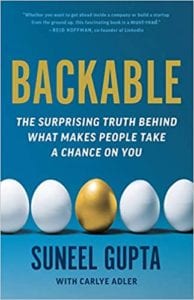
Backable: The Surprising Truth Behind What Makes People Take a Chance on You
John, you and I both love Joseph Campbell. We both love the hero’s journey. We know that one of the components of the hero’s journey is like, “Along the way, there’s an insight, learning, something that changes your worldview.” For me, through these conversations that I started to have, creativity and persuasion are two different things. Oftentimes, we think about them as one. We all know that you can have a great idea, be a great candidate for a job, have a beautiful product and still be dismissed. We see it happen all the time. That’s what I was feeling. Many of us have felt that way.
One of the stories that always pops for me especially is the story of Alexander Fleming, who came up with penicillin. Penicillin, to date, has saved nearly 200 million lives, yet it took him ten years to get people to buy into it. He got dismissed over and over again. Brilliant, game-changing ideas aren’t always met with a room of people who are going to support them. All of that got me interested in this idea of backable people. These are people who tend to be able to go into a room whether that be an interview, an audition or a pitch and they tend to shine. The trick of it is that, oftentimes, it’s when they aren’t the obvious choice. When they don’t have a fully baked product, we still feel like we want to take a chance on them. I wanted to understand like, “What is that quality? Can it be learned?”
Following up on this New York Times article, I started to have these conversations with people and said, “Let me have more and more.” Eventually, I found myself having hundreds of conversations with backable people from all walks of life including Oscar-winning filmmakers, Michelin Star chefs, military leaders, founders of iconic companies and fast-rising community initiatives. What I found was that being backable is not just for celebrities and CEOs, it’s for all of us. Being backable is not something that you’re born with but it very much is something that you can learn.
Let’s take a pause there. You’re being very humble. I’m going to shout-out. You have this book that has reviews from Reid Hoffman, the Cofounder of LinkedIn and Brian Grazer, one of my all-time favorite Oscar-winning producers of amazing movies. You’ve been able to not only have your own insights on what makes someone backable but figure out a way to grow your network and get out in front of people who are clearly backable and believe in what you’re doing. It’s a one-two punch there that gives it so much credibility much like The New York Times. One extreme to the other that social proof that gets transferred is what you’re demonstrating here in a big way that helps a lot of investors. You’ve invested in some successful companies yourself. I’m sure there are some things you look for in a founder that would be helpful to share that other people saw in you. The basic question is, as an investor, what makes a founder backable besides the idea?
The book outlines these seven qualities. We should talk about them. One of the things that I tried with this book, part of the reason that it’s doing well and a number-one new release is it talks about the stories and the substance but we get into the techniques. I personally love it when you can break it down for me and give me some specific techniques that I can use to bring it into my life immediately. Let’s start talking about some of these qualities. One of the first ones in the book came to me as a surprise. When I first started studying backable people, I thought that I was going to find a certain pattern of communication. I thought that backable people generally were going to end up being gifted speakers. They were going to make use of eye contact, hand gestures and pacing. I did not find that to be the case.
You certainly had backable people who are gifted speakers. It can be very Dale Carnegie-esque or Toastmasters-esque. There are plenty out there that are not. They’re shy, quiet and introverted. They’re not what we think of when we think of charisma. If you want an example of that, take a look at the most popular TED Talk of all time. What you’ll find is a brilliant talk being given by a guy named Sir Ken Robinson. It’s got over 65 million views. Amazing talk but not what you might expect. It’s a very un-TED-like talk. He’s got one hand in his pocket. He naturally walks with a bit of a slouch. He meanders on and off script, yet it was very well-received. What I found is that it’s not charisma that convinces people, it’s conviction.
[bctt tweet=”It’s not charisma that convinces people. It’s conviction.” username=”John_Livesay”]
There we go. There’s a tweet if I ever heard one. Plus, I love the fact that it’s got all those great alliterations. “It’s not charisma that convinces people, it’s conviction.” That’s a great line.
Backable people take the time to convince themselves first. They let that conviction shine through, whatever style it is that feels most natural to them.
Going back a little bit to your own story of origin, you have a relatively famous brother. I’m guessing that there’s a story there of what your parents taught you both. Why don’t you do the big reveal of who your brother is? It’s this concept of environment versus genetics. What causes certain families to produce such high achievers that are not just backable but impactful in the world? I wanted to ask, was there any sibling rivalry? Tell us a little bit about that experience with your brother and who he is.
It’s impossible for me to talk about my family without talking about my mom first. My mom was born and raised in a refugee camp on the border of Pakistan and India. She decided that somehow, she was going to become an engineer with Ford Motor Company. Her parents got behind the vision and dream. She got on a boat to the United States, ended up getting a scholarship at Oklahoma State University, drove to Detroit the day after graduation and went into the interview. When she got into the interview, the hiring manager said, “I’m sorry. We don’t have any female engineers here.” She, at that moment, was deflated. She picked up her resume and purse. She started to walk out of the room. In this last-ditch moment, she turned around and told this hiring manager her story of all the struggles that it had taken to get to this country, to get to Detroit, to get to this room. This guy was so moved by her story that he ended up taking a chance on her. She became Ford Motor Company’s first-ever female engineer. That was in 1967.
That’s the genesis story in a lot of ways for our family. I will talk about my brother here in a moment. We were raised with the refugee mentality even though we grew up in a very different environment than my mom. We had all the stuff that she didn’t have. We grew up in a safe, almost boring suburban Michigan. There’s still this refugee mindset of impermanence and possibility combined. It cuts both ways. With impermanence, you almost feel sometimes that things can be taken from you. You almost have an appreciation sometimes for what you have because you realize it could be gone. There’s the possibility. The possibility is there are no boundaries. Your past doesn’t necessarily determine your future. That’s what we learned simply from her story. She didn’t have to tell us that. It was who we were.
For my brother, he went to medical school and became a practicing surgeon in suburban Michigan. He realized he liked his job but he felt like there was more. He felt like he could be doing more of the type of work that he wanted to be doing. Naturally, he’s a gifted storyteller. He wanted to be telling the stories of patients. I remember I was in college at the time. I came home and he was home as well. We were with my parents. He was like, “I think I’d like to be on television. I’d like to start reporting on healthcare and patients’ stories.” I remember my mom was like, “Go do it. Figure out a way to make it happen. There’s no time like the present.”

Backable: When failure happens, you have two choices. The first one is to pretend that it doesn’t exist. The other one is to embrace it.
My brother, very similar to my mom’s improbable story, somehow gets himself in a room with the powers that be at CNN. This was in the year 2001. He has no Journalism and on-air experience but made himself backable in that moment. There are a lot of the techniques in the book that we talked about that he brought to that moment naturally. One of which is that he talked about his central character. He talked about the patient. Even though he didn’t have the on-air experience, his argument was, “I spend day in and day out with these patients. I understand them at a level that I may not be able to understand them if I wasn’t practicing day in and day out. These are the stories that I want to tell. These are the people I want to connect with.” It worked. They gave him a shot just like a hiring manager gave my mom a shot. That’s how Dr. Sanjay Gupta was at CNN.
One of the things that you talked about in the book, Backable, is this ability to put ourselves in a story that makes it memorable. You are singing from my song book. When people are pitching themselves to get a job, as your brother and mom did, pitching people to hire them, to buy their course and as speakers we have to pitch ourselves. If you can’t say something that makes you memorable during that interview and you’re just pushing out facts and figures or the details of your resume, “I’m a doctor. I went here,” and you don’t have a story to go, what I often do is I’ll tell a story of what happened at a recent speaking event and how that transformed the audience and made the people who hired me looked like heroes, all of those things and the feelings that get associated with it.
Stories are the emotional glue. We’re wired for stories. Few people understand that. You are supporting this so much that these personal anecdotes are what make us memorable. If you put yourself in the shoes of a hiring manager, an investor and the number of pitches that you hear in a year, there’s got to be somebody who says something to you that makes that memorable so that you can tell other people. That’s what people don’t realize. When someone like you, your brother or your mom tells a story or anybody who reads this book, Backable, learns is, “Once I have a story that makes me memorable, it’s not just that person who can remember it. They remember my story and tell other people.” That’s when it starts to grow viral or whatever else you might need it to do for those meetings when people are thinking, “Should we hire Suneel or someone else? Should we hire John or someone else? Did anybody tell us a story that we can tell other people of why we want to pick this person over another person?”
It’s such a good point, John. We’re not anymore pitching people. Hardly ever are we pitching the people who are going to be the only decision-makers. Typically, they’re going to have to sell their partners, other people, their boards, even their teams, on the decision they’re making. We’re not just looking for backers. We’re looking for advocates. Salman Rushdie has this great quote, “Most of what matters in our life takes place in our absence.” We don’t know what these conversations are like when we’re not there. We are trying to have people who are as passionate about what we’re trying to do with our own careers and ideas as we are. I do think stories are such a big part of that.
I remember pitching to Tim Ferriss on my company, RISE. I thought Tim was the perfect investor. When I was doing this one-on-one nutrition coaching right over your mobile phone, he had just written a book called The 4-Hour Body. He was starting to invest in companies. I thought it was the perfect fit. It turned out, he ended up passing on the idea. Along the way, he gave me some feedback that I will never forget. When I pitched to him, if you would have looked at that pitch, I spent the vast majority of my time talking about the market. I talked about the rising rates of diabetes, hypertension, obesity and how many people were out there spending money on trying to get into better physical health.
At the very end of the presentation, I told the story of my father. When he was in his 40s, he had an emergency triple bypass surgery. I still remember going to the hospital, I was about ten years old. I remember going to the hospital and felt like I had seen my father aged 25 years overnight. When we were leaving the hospital, they gave us a piece of paper. That piece of paper said things like, “Eat broccoli. Eat Brussels sprouts.” We were an Indian family. We didn’t eat broccoli and Brussels sprouts. There was nothing on that paper about chicken tikka masala. We struggled to make this diet that we were supposed to have now work. We struggled to make it fit for us. It wasn’t until insurance helped us pay for some time for a nutritionist that we were able to customize our lifestyle into something that worked. I believe that’s the reason that my father lived through that experience. He’s still alive now.
[bctt tweet=”The meaning of life is to find your gift. The purpose of life is to give it away.” username=”John_Livesay”]
I told Tim Ferriss that story. His feedback to me was like, “Why the hell are you leaving that story to the very end? Tell that story upfront.” My response to him was like, “It’s an Indian story. It’s an Indian thing.” He said, “No. It makes it even more important that you tell that story upfront even if the people who are sitting on the other side of the table from you look different than that. Even if they didn’t eat chicken tikka masala, it’s important. What you’re doing especially when you get into the details, is you’re helping them see themselves through the eyes of your central character, the one person that you’re trying to serve with this idea. If they can see themselves through the eyes of that central character, that’s when you hook them emotionally and then you talk about the numbers and the market. It’s the story that brings us in. It’s the substance that keeps us there.”
It brings us in and the substance keeps us paying attention but you can’t open with the substance. You did a beautiful job describing 5 of the 7 parts of what makes somebody backable. It’s drawing people into the story that makes them feel like insiders. I did this with Olympus Medical. I was saying to them, “What are you saying to doctors to get them to buy this equipment?” They said, “This equipment makes your surgeries go 30% faster. Do you want one?” I was like, “There’s no story there. That’s a left-brain analytical data like the market size.”
The story I helped them craft was, “Imagine how happy Dr. Higgins was six months ago using our equipment. He could go out to the patient’s family in the waiting room an hour earlier than expected. If you’ve ever waited for someone you love to come out of surgery, you know every minute feels like an hour. He came out, put them out of their waiting misery and said, ‘Good news. The scans showed they don’t have cancer. They’re going to be fine.’ He turned to the rep and says, ‘That’s why I became a doctor, for moments like this.’ That rep told that story to another doctor who sees themselves in the story and says, ‘That’s why I became a doctor too. I want your equipment.'”
That is your dad’s story with getting out of the hospital. By adding those little elements like, “If you’ve ever waited in the hospital for someone you love to come out of surgery, you know every minute,” that’s what pulls people in. Even if they haven’t had that experience, they probably know someone who has or they can certainly imagine how painful that would be. Those are the details that make me love your books so much. I have rarely seen anybody else talk about how to tell stories that are memorable. I say, “Tug at the heartstrings to get people to open the purse strings,” is what you’re showing us together.
I could talk to you forever. We’re only going to talk about a few things enough. Hopefully, it incentivizes people to run, not walk, to the nearest way to get a book. The last question I have for you is this beautiful cover, gold and blue, the gold egg. We all know there’s a story there about the goose that laid the golden eggs. I know, as an author, how much work goes into a book cover. What’s the story behind the book cover?
I’m glad you asked because I don’t get to talk about this enough. The book cover went through a few iterations. I worked with a great publisher. Little, Brown has been fantastic. I will say that when they sent me their first vision for the book cover, it was not something that I gravitated towards. It was the Facebook like thumbs. It was a cover full of thumbs where all of them were thumbs down but one of them was thumbs up. Same metaphor, it was like, “How do you get the thumbs up?” What I didn’t like about it was it felt overtly negative. It was almost littered with negativity.

Backable: Backable people take the time to convince themselves first. They let that conviction shine through, whatever style it is that feels most natural to them.
The other thing was it was very techy. I initially started writing this book because I felt like I was coming from the point of view of somebody who worked as an entrepreneur. I worked in tech. What I realized was like, “There’s not a single person out there who isn’t trying to make themselves backable in some way. You don’t have to be working as an entrepreneur. You don’t have to be working in tech.” It’s a human problem that we’re dealing with, which is unused creativity. We don’t sometimes know how to take these ideas that are inside us and get other people as excited about it as we are. That’s a human problem, not a tech problem. It’s not necessarily even an entrepreneurial problem.
I wanted to take this metaphor and do other iterations. It was interesting, John. I don’t know what your experience was like. With me, there was a push-pull that you have. We were very collaborative about it. I was super grateful to them for being that way. It reminded me a lot of one of the techniques that you talked about, which is flipping outsiders to insiders. One of my favorite stories from the book is it takes us back to the 1940s where Betty Crocker has introduced instant cake mix to the market. They were excited about this instant cake mix. All you have to do is pour water into a mix, pop it into an oven, and voila, you get this tasty treat. Who wouldn’t want that?
They were surprised when they find out that instant cake mix was not selling. Sales were terrible. They were trying to figure out why. They hired this psychologist named Ernest Dichter to go out into the field and start talking to homes across the country. What Dichter found when he came back with was fascinating. He said, “I think you’ve made the process of making a cake too easy and too simple. You removed the customer from the creative process so much so that when a cake comes out of the oven, they don’t feel any ownership of it.” His recommendation was, “Why don’t you remove one ingredient and see what happens?” They did. They removed the egg. Now, as a customer, you have to crack and mix in your own fresh egg. Sales skyrocketed. Now, when the cake comes out of the oven, customers felt like they were a part of it.
I think that comes back to this idea of we’ve been told that creativity and innovation is a two-step formula. You come up with a great idea and you execute on it well. I think there’s a hidden step in-between. That hidden step is where we flip outsiders into insiders so they feel like it’s their idea as well. In that way, when we show up to the execution, we show up together. These can be early employees, early investors, early colleagues who decided to take a leap of faith in your idea. You can trace every successful project, every successful organization, nonprofit company, political movement back to this hidden step.
There are many wonderful takeaways. Flipping outsiders into insiders. It’s not charisma that convinces, it’s conviction. This whole premise that the stories bring us in but it’s the substance that keeps us involved. The book is called Backable. The website to go read about the book and buy the book is Backable.com. Any last comments or ways that you want people to follow you and read about the book?
Go to Backable.com. I’ll leave you with one thought. I have two daughters, an 8-year-old and a 4-year-old. We do this little game every morning. I ask both of them, “What is the meaning of life?” They say, “To find your gift.” I said, “What is the purpose of life?” They say, “To give it away.” The meaning of life is to find your gift. The purpose of life is to give it away. I wrote this book, Backable, so that we can learn how to give our gift away. Thank you, John. I appreciate you having me on.
Thank you, Suneel. What a gift you are to the world. I’m sure you’re a great dad. I can’t wait for all kinds of people to benefit from learning these learnable insights on letting us all become a little bit more backable than we were before we got to read your wonderful book.
Thank you.
Important Links
- RISE
- Sir Ken Robinson
- The 4-Hour Body
- http://backable.com/
- Better Selling Through Storytelling Method Online Course
Wanna Host Your Own Podcast?
Click here to see how my friends at Podetize can help
Purchase John’s new book
John Livesay, The Pitch Whisperer
Share The Show
Did you enjoy the show? I’d love it if you subscribed today and left us a 5-star review!
- Click this link
- Click on the ‘Subscribe’ button below the artwork
- Go to the ‘Ratings and Reviews’ section
- Click on ‘Write a Review’
Love the show? Subscribe, rate, review, and share!
Join The Successful Pitch community today:
- JohnLivesay.com
- John Livesay Facebook
- John Livesay Twitter
- John Livesay LinkedIn
- John Livesay YouTube
The Five Questions With Dr. James Mellon
Posted by John Livesay in podcast | 0 comments

Life always has many questions in store for us, but a precious few of them are actually, in the long run, productive. Dr. James Mellon is the founding Spiritual Director of Global Truth Center Los Angeles and author of the new book, The Five Questions. James joins John Livesay to give you a little taste of the titular five questions that you should be asking yourself. There are certain questions—and answers—that move the needle in terms of the progress you want to see for yourself. But the journey to finding these questions and answers begins with believing in yourself and your own capabilities. After all, life’s too short to keep comparing yourself to other people.
—
Listen to the podcast here
The Five Questions With Dr. James Mellon
Dr. James Mellon is the Founding Spiritual Director of Global Truth Center, which has launched a new way to experience a body, mind, spirit connection in a program called Welcome Home. James’ philosophy of life is enlightenment through entertainment. He wears many hats in the entertainment world from being a Broadway actor, director, writer and producer. He’s a sought-after speaker in the field of personal growth. He is also the author of the book, Mental Muscle: Sixteen Weeks of Spiritual Bootcamp and has a new book, The Five Questions. James, welcome to this show.
It’s so great to be here, John.
You’ve been on the planet for a while and you’ve done a few things that have made a big impact. That’s a part of why I was so excited to be able to put a spotlight on you. I know you’ve helped so many people including myself, get clear on who they are and the impact that’s possible. A lot of the people who tune in to The Successful Pitch Podcast are entrepreneurs and they’re looking for a little bit of inspiration, motivation, and maybe some tips on when it’s time to pivot and make a change. I also want to talk to you about resilience because you’re the expert in that and that’s one of the keys to being an entrepreneur. One of the things I like to ask my guests is to tell us your own story of origin. You have so many stories and you can go back as far as you want. You can go back to being someone who wanted to be a priest in Philadelphia or you can jump right into your decision to get to Broadway. You start the story wherever you want.
Mine does start out as a kid in Philadelphia who could see the world outside of Philadelphia as something enticing and exciting. I always knew that I would be a Broadway, movie star or a television star. I had a sense that I was made for something bigger than Northeast Philadelphia. Even with all of the race consciousness and the familial encouragement or I should say lack of encouragement, making the world a big, bad place, a place that’s difficult to get into and succeed at. This is where it all began for me. I never listened to what other people had to say about what I wanted to do. I went and did it. I’ve always been that person to jump in before I knew what I would hit.

The Five Questions. Never listen to what other people say about what you want to do.
Automatically, I’m starting to think of Broadway musicals because that’s a part of who you are from Good Morning Baltimore to There’s Gotta Be Something Better Than This to Sweet Charity.
Even the one that I started on Broadway, which was West side story and that was against all odds because I didn’t have the dance training that Jerome Robbins was looking for. I didn’t have the singing training that Leonard Bernstein was looking for and I didn’t have the acting chops that any of them were looking for. Somehow when I stood on that stage and auditioned, it was like, “I’m here and I’m the right person for this. Give me a chance,” and they did. You’re right. When you decide to do something like Tony sings in West Side Story, “Something is coming.”
[bctt tweet=”Life is too short to compare yourself-tick frickin tock.” username=”John_Livesay”]
My whole life I have believed something’s coming. Even now, I still feel something’s coming. I don’t feel that I’m in the, as Jane Fonda likes to talk about, the third act of her life, I don’t feel that. I feel that there’s something new always coming. You used the word pivot. Pivot is so important to my life and I noticed yours too. If something doesn’t feel right, we need to pivot and not be afraid to pivot. Too much of the world is spent dealing with what they are accepting out of life as opposed to, “I don’t want to only accept this. I want to actually be passionate about something.” I pivot whenever I need to pivot and I don’t worry about what people will think about it.
This concept of jumping in without “having all the qualifications or the background that a lot of people think you need to do” is a helpful thing for us to double click on. How do you get the confidence or the mindset to do that?
How would you get the confidence to do something like that? It’s innate in all of us. It’s right there for us to tap into. The question is, “Do we tap into our natural authentic selves or do we tap into what the race consciousness around us is telling us?” For most people, unfortunately, we tap into what we’re being told as opposed to what we know and I mean in a deep sense not what I know because of what I’ve been told but what do I know in spite of what I’ve been told.
I want to get right to your book, The Five Questions, because I want to make sure we cover what those questions are. Think of it as a roadmap, readers, for your own entrepreneurial journey as well as your own personal growth journey. As you’re learning these questions, you can think about what your answers are for both personal and professional. Then I’ll ask you, James, how you’ve applied some of that on your own pivot. Tell us what those five questions are and we’ll go back to each one.
These questions came to me because I was caught off-guard. As you know, I’m a busy person and I tend to do a lot of things at once. I was at a retreat center and one of my partners came up to me and said, “I’m looking forward to your workshop.” I said, “When is my workshop?” They said, “It’s in an hour.” I hadn’t realized my workshop was that day. I went and sat under a tree and I said, “What do I need to know here?” All of a sudden these questions downloaded to me and they came in a specific order. It’s this, the first question was, “Why am I here?” Followed by, “What wants to know me?” Then came, “What wants me to release it?” “What is mine to do right now?” The last one was, “Do I know how great I am?” Those five questions came and I wrote them down. It was almost like a download. I wrote them down and thought, “I can work from these.”
[bctt tweet=”Money is a demonstration of integrity and passion on the right path.” username=”John_Livesay”]
I went into the conference hall and there were about 200 people there. They were all sitting and I asked them all to lay down on the ground and I said, “I’m going to go through some questions for us to start this off with.” When I started and I asked the first question, “Why am I here?” I was flooded with 100 other questions. The first question took about 30 minutes and people were crying, moving around and wriggling. I was like, “There’s something here.” When I got to, “What wants to know me?” I explained that we live in an energetic field of ideas and desires. Elizabeth Gilbert in her book, Big Magic, talks about how these ideas come up and you either take them or you don’t. If you don’t, someone else will because they’re all such viable living things and entities.
What wants to know me is, what am I allowing in my passion, intelligence and my wisdom? What am I allowing myself to absolutely engage in my own mind? It’s been a pretty amazing journey for me with these five questions and how they play out. That first question, “Why am I here?” I think of you and your amazing journey through your many careers and there are moments when something is ending like, let’s say your work at Condé Nast. When something ends, the question, “Why am I here?” can be answered on so many different levels. Why am I here at the end of this journey but why am I here at the beginning of this journey?
When entrepreneurs can ask themselves that question, why am I here? Why am I starting this company? What is my bigger purpose than just making money? They define a culture and attract the right people to their team, which attracts the ideal customers. People go, “I don’t need to figure out what my culture is in my company yet. It’s only me or me and a couple of people.” I tell people, “No. You need to know from the beginning why you’re doing this beyond profit.” That’s what people are responding to energetically.
This concept of what wants to know me, as an entrepreneur, a lot of people have a lot of ideas and in fact, so many of them that I help, say, “Don’t try to boil the ocean. Figure out one thing. Who you help and what problem you solve.” This concept of creating time through meditation or any other options. Google and big companies that now have nap rooms. A lot of people leading tech companies are saying, “One of the keys to my success is meditation and allowing other ideas to come in that are yours and not reacting to the world and emails all the time.” This question of “What wants to know me?” do you have any advice or suggestions for people of what they need to do to create that space to hear their own ideas?
It’s funny you should say that. One of my newest projects is a live space people will go to called Welcome Home. The whole purpose of creating Welcome Home is to give people an opportunity to go somewhere, into a room, into space which is our physical spaces, although they can also be entered virtually, to allow yourself to decompress. Get rid of the outside voices and world, to give yourself the opportunity to focus your mind on only you and allowing nature and nurture and all of the intentional energies out there to flow in and get into the fluidity of this thing called creative mind.
[bctt tweet=”EGO-Enter Greatness Only” username=”John_Livesay”]
You asked the question about, “Why I am here and what wants to know me about an entrepreneur?” One of the smartest things an entrepreneur can do or anyone with a new idea is to ask the question at the onset of something. “Why am I here?” If we find out that the only reason I’m here is that I feel I have to be here or it’s going to make me money, money cannot be the end goal. Money for me is always the demonstration of the integrity and passion that wants to be brought forth. Money is just a natural outcome of when someone is on the right path. Sometimes we hear, “Why am I here?” We may hear, “I’m here for all the wrong reasons.” It’s like you. I’m here for all the wrong reasons. I need to pivot. I need to ask myself, “What can I do to find what’s mine to do?”

The Five Questions. If something doesn’t feel right, you can’t be afraid to pivot.
This concept of, “What do I need to release?” Bob Iger was quoted in the New York Times launching Disney+ saying, “They realized they needed to release something true to only making money from the model of traditional television of owning ABC.” He started the streaming service and he said, “If you don’t innovate, you die.” Sometimes you’re even killing off your existing revenue source. In terms of spirituality and how people are doing things, what you’ve created with welcome home is the Disney+ of church.
Thank you.
You’re creating a place for people who want to watch ABC can still do that and go to church whether virtually or online or go to Global Truth Center or in going to hear you speak every Sunday. For others who are like, “That’s not me or I never did like that format,” you’re doing your own version of Disney +/Netflix for this place of Welcome Home. It’s important too because I’m so big on the story of every origin that Welcome Home is not a destination like, “I’m going home to see my family for the holidays.” It’s a welcome home to yourself going inside. Is that accurate?
That is absolutely right. Welcome Home, meaning that there is a place in you and a place in me that when we’re in that place, we’re in the same place. That’s what Namaste means, when you honor the sacredness and another person. John, you are so correct. I am a minister, a Reverend, I have my Doctorate in Consciousness Studies and yet I lean away from the religious side of even my own ministry. Everyone has a ministry in life. Even whoever’s the head of Sony has a ministry. It’s called Sony. I lean away from the religious side of it because, to be honest, that’s one of those dinosaurs and albatrosses that are dying out. You watch a lot of these religions and churches people aren’t supporting it anymore.
[bctt tweet=”You can’t really run very far if you are weighted down with all of the things that have no purpose in your life anymore.” username=”John_Livesay”]
There are still the holdovers, the ones that still want that type of experience but as the younger generation moves up and becomes the older generation, they want experiential. They want to feel what it feels like to be spiritual. They don’t want to be bored to death being told what it’s all about or asked to do some archaic exercises of prayers and whatever. What they want is to feel it. They want to be involved in it. That’s where we came up with the idea of Welcome Home. I still love Sunday services at Global Truth Center. I love being on stage, singing, band and fellowship. I love all of that but I recognize that there are many people who want something different so we came up with Welcome Home. It’s a series of 45-minute sessions where you go in and either have a sound bath, heart breath meditation or heart math. There are so many different modalities out there that can get us tapped into our inner self so you can finally say, “Why am I here? What wants to know me?”
What is the sound bath for those people who might not be aware of that?
A sound bath is a concert. I remember when we used to go to hear concerts and people still do. It’s a concert. It’s allowing your audible senses to be bathed in sound. Usually, those sounds are glass bowls, chimes, gongs, some rain. Also, those with big tusks that have all those pebbles in them and you turn them upside down and it sounds like a rain forest. It’s a beautiful place to go to. You usually lie on a mat with a beautiful pillow and a blanket and you’re surrounded in love and sound. People take about 45 minutes out of their day to go be immersed in this sound bath.
It gets you out of your head and all the frustrations of worrying about something. You’re fully present and you’re immersed in this experience that can reset your button. This concept that we recharge our phones and yet we somehow think we don’t ever need to recharge our bodies or our minds.
If you recharge your phone, why wouldn’t you be willing to recharge your body? You know what happens when you don’t recharge your phone.
That will be the visual image for Welcome Home. It will be a phone being charged in. It will be the future of us all becoming chips inside of us. The other question of what’s mine to do right now, everyone, whether they’re an entrepreneur or not struggles with time management. So much is coming at us with tweets and text messages and things that we weren’t expecting and our day gets away from us. How does that question allow us to make sure we are in fact doing the right thing at the right moment?
All of these questions take into consideration that you’ve given yourself space and time to let these questions answer you. It’s not about you answering them. If you allow that question to answer itself through you, sometimes we hear things that we may not want to hear like what’s mine to do right now? We may be shocked to find out that a lot of what we’re doing isn’t mine to do right now.

The Five Questions. If you recharge your phone, why wouldn’t you be willing to recharge your body?
The keyword there is mine versus delegating it to someone else.
Even the question, “What wants me to release it?” I have been on the other end of that question and found out that what wants me to release it is a relationship that no longer works for me. It could be a business partner, a friend or a family relation. It could be anything. You can’t run far if you are weighed down with all of these things that have no purpose in your life anymore. You’ve got to let it go and ask, “What’s mine to do right now?” Now you have the ability to go do whatever that is when you’ve let go of everything else. For the businessman and entrepreneur to say, “What’s mine to do right now?” If I were in the middle of it or at the beginning of a business project and I asked myself that question, “What’s mine to do right now?” I might give myself the opportunity to get out of thinking of the seven billion things that need to get done for this company to succeed and hear the first thing that I need to do.
It’s trusting your intuition to let it bubble up as opposed to, “Last night, I wrote down the number one thing is this.” Things might’ve changed and you’re still obsessed and attached to what you think has to get done first. It may not be the case. You said something about being burdened with so many things to do. A lot of this concept of what’s mine to release now might be being obsessed with what other people are doing aka what’s my competition doing and comparing ourselves to other people. That can be a burden. What advice do you have for people who want to release that trap?
It’s a big trap. You put your finger on it beautifully, it’s competition. Not to go all spiritual on you but for me, spiritually speaking, there is no competition. I understand that there is competition in the world. I am in the world. I succeed well in the world but for myself, I have to be clear that when it comes to truth, spirituality and energy of life, there is no competition. Energy is always expanding, creative, growing and moving. If I put my attention on what someone else is doing, not only am I not moving forward, I’ve stopped to pay attention. I’ve heard you talk about Michael Phelps. If you take a second to look at your competitor, you have lost because you’re not doing what’s yours to do.
[bctt tweet=”It is knowing who you are that allows you to step onto the largest stage possible.” username=”John_Livesay”]
There we go. It’s full circle because if you were to analyze what percentage of my day am I focused on what’s mine to do versus what’s everyone else is doing, how they’re ahead of me, how many more likes they have, how many more books they sold or widget, how much more money they’ve raised, or 101 things to be focused on besides what’s mine to do. You said, “I’m spending 30% or 40% of my time subconsciously thinking and focusing on that.” I’m reading the news and I’m thinking about, “Look at what that person did or got that I didn’t get.” What happened? Will you focus some of that energy on what I can do best?”
What would I do with all that time if I wasn’t doing that? I love Holland Taylor. I interviewed her for a show I’m doing called The Inner View and Holland was one of my guests. Someone in the audience, I forget who asked her, but it was a question about, “Do you ever worry about opportunities in what may go to other actresses?” She leaned forward and said, “I don’t have time for that stuff. My life is continuing to move forward, tick-freaking-tock.” I laughed because she put her finger on it. She said, “I’m living my life. Meryl Streep lives her life. Everybody else does what they do. I don’t need to be Meryl Streep. I personally don’t need to be Tony Robbins, Deepak Chopra or Marianne Williamson. I am who I am. They are who they are and we’re all doing what is best for us to do at any given moment.”
This final question of, “Do I know how great I am?” This is one that most people might struggle with. I’d love for you to talk about the difference between confidence and arrogance as you see it.
That’s a great way to put that. I always look at the ego. We think of ego sometimes as a bad thing when someone says, “That guy has such a big ego.” You better have a big ego. You better have a big understanding of who you are because it’s your belief in yourself. It’s your knowing who you are that allows you to step onto the largest stage possible. I don’t have a problem with ego whatsoever. Here’s the difference. You said confidence and arrogance. Confidence comes from an ego that knows who it is. It’s entertaining greatness only as opposed to people in spiritual terms, say edging God out, meaning edging the greatness out.
Confidence to me is someone who knows who they are. I tell this story a lot about Tom Cruise. Tom Cruise was my roommate back in the 1980s or early ‘80s. I was starring on Broadway and West Side Story and he was this teenager from New Jersey who wanted to be an actor. He would stay at my apartment because we had the same manager. Tom used to tell me all the time he was going to be a movie star and I used to laugh. I’d say, “Tom, you’re 5’7”. I didn’t see it but it didn’t matter that I didn’t see it. It didn’t matter who didn’t see it. It just mattered that he saw it because he had confidence and certainty about who he was that you could not fight him off of that. He’s also the nicest guy in the world. Arrogance is when you’re actually insecure about yourself. You don’t know who you are so you put up this pompous air of, “This is how great I am,” but you don’t believe it. Let me tell you as a director, when an actor walks into a room and they don’t believe in themselves, they barely have to speak and I already see it.
Listening to you describe these wonderful questions again and I can hear this over and over. It seems to me that there’s a circular connection to all this when I’m thinking visually. If we answer, do I know how great I am, ties into my belief in myself, which stems from answering the first question of, “Why am I here? What is my purpose?” Does the answer to why I’m here help the foundation to answer this is how I know how great I am because I know why I’m here? Is it all connected?
It’s totally all connected, John. Those five questions can be used in any situation. When you peel the onion back, every time you peel a layer back, start over, ask the questions again because if I know who I am and I know how great I am, when I say, why am I here? I’m going to get a different answer.
I promised at the beginning of this that I would ask you about resilience. You’ve had two major incidents in your life that most people would have a difficult time jumping back from. If we’re going to have things happen to us and it’s not a matter of if we get back up but I’m keen on how fast do we get back up. From being diagnosed with cancer to having your daughter tragically die at nineteen in a car accident, you’ve had more than your share of challenges in life. I don’t want people to go, “What an easy-breezy life this guy’s had from Broadway to this to that.” You’ve had all of that too. Somehow you model for yourself and other people this ability to be resilient. My big question to you is, what advice do you have for people on how they can be more resilient?
When you look at the word, resilience, resilience is the capacity to recover quickly, to recover quickly from some difficulty. When I was diagnosed with stage four cancer, to be perfectly honest, as devastating as it was to look at on the surface, I never ever felt that it would kill me even though they gave me a few months to live. They said in March I would be gone by August if they couldn’t find everything. They had no idea where it was. There was something in me that said, “You’re not going anywhere.” I had to go through five months of chemo, radiation, tearing things out of my neck. I went down to 130 pounds. For a six-foot male, that’s not a great weight. The whole time there was something behind me, which is my true self that said, “You’ll be fine. Keep going.” I’ve never had to get back on my feet through that. I don’t think I ever left my feet so I was pretty clear.
When my daughter died, which we’re about to reach the anniversary, if resilience is the capacity to recover quickly, perhaps I haven’t been resilient because I don’t think I will ever recover from that. However, what I did do quickly was to make sure everybody knew that just because the worst thing that I could have ever imagined happening to me happened, it did not change my faith. It didn’t change what I believed about God and about myself. It didn’t change how I would answer, do I know how great I am or that life may unfold perfectly no matter what.
It’s caused me to go deeper into what is life and what is death and try to have a better understanding of that. A day after my daughter passed, someone wrote on my Facebook page, and they didn’t mean it in a mean way. They wrote that they were sorry that it happened and perhaps I would reconsider the many things I’ve said as a minister and as a speaker. When I say, “Life unfolds perfectly and there’s always good in everything.” This person brought that forward and my reaction to it was so visceral that I went back onto the stage within three days of her passing and did not leave the stage. I stayed in my pulpit and my work. I have still stayed within my work this whole time. It was in reaction to that. I still do believe all this and no one is going to argue me down just because I have suffered something because my daughter’s fine. Wherever she is and whatever her next journey is, she’s fine. I miss her. I can’t even tell that I miss her every day. I miss her every moment of every day.
You always remember why you’re here. That’s the key to resilience that goes back to that answer to that first question.
“Why am I here?”
That purpose and reason for being allows you to be such a light and a gift to all of us. How can people find your book, The Five Questions, and find out about Welcome Home? What’s the best place for people to do all that?
If you go to JamesMellon.org, you will find me and my programs and you will find the book there. It’s simple. You’ll find me there. I don’t send people, I don’t even like using the word church anymore, to my center my spiritual center. If you’re interested in that, it’s called The Global Truth Center. You’ll find what goes on there. To me, it’s all one thing. Thank you for saying it at the top of the show, enlightenment through entertainment. I’m an entertainer. I will always be an entertainer, actor, singer, dancer, director, writer and minister. I get to take all that I do, wrap it up into one thing and focus my attention wherever that takes me.
James, I can’t thank you enough for reminding us that we get to remember who we are, figure out where we want to go, what wants to know us and all the other great questions that we can now ask ourselves in any situation.
Thank you, John. This has been a real treat.
Important Links
- Dr. James Mellon
- Global Truth Center
- Welcome Home
- Mental Muscle: Sixteen Weeks of Spiritual Bootcamp
- Big Magic
- The Inner View
- Better Selling Through Storytelling Method Online Course
Wanna Host Your Own Podcast?
Click here to see how my friends at Podetize can help
Purchase John’s new book
John Livesay, The Pitch Whisperer
Share The Show
Did you enjoy the show? I’d love it if you subscribed today and left us a 5-star review!
- Click this link
- Click on the ‘Subscribe’ button below the artwork
- Go to the ‘Ratings and Reviews’ section
- Click on ‘Write a Review’
Love the show? Subscribe, rate, review, and share!
Join The Successful Pitch community today:
- JohnLivesay.com
- John Livesay Facebook
- John Livesay Twitter
- John Livesay LinkedIn
- John Livesay YouTube