

The Future Of Work Is Now With Seth Mattison
Posted by John Livesay in podcast | 0 comments


Our marketplaces are shifting faster than ever, simultaneously with talent, expectations, wants, needs, and values. Today’s guest is Seth Mattison, the founder of FutureSight Labs, who shares how successful leaders become the beacon to top talent to navigate these shifts. To have an internal shift in 60 minutes can be challenging because it’s deep work to create a long-lasting transformation. Seth dives deeper into the conversation with his 90-day-rule. Find out what the 90-day-rule is as you discover how to face the changing faces of the future of work! Enjoy this episode.
—
Listen to the podcast here
The Future Of Work Is Now With Seth Mattison
Our guest is Seth Mattison, who is an expert on the future of work. He said, “Culture is not in the building but it is in the heart of the people who work there. You can’t be a successful leader unless you love people. Find out what he means. Enjoy the episode.
—
Our guest is Seth Mattison, who is an internationally recognized thought leader, author, advisor, and top-rated keynote speaker on change and transformation, leadership, and the future of work. His ideas have been featured in such publications as The Wall Street Journal, Forbes, and Entrepreneur. His diverse client portfolio spans industries ranging from Lockheed Martin and NASA to Microsoft and IBM.
In addition to leading his own research organization and future site labs, Seth is the Cofounder of ImpactEleven, a speaking training development and accelerator community that I am a member of, which supports both emerging and established thought leaders and bringing their message to the world. Seth, welcome to the show.
It’s great to be here. It’s great to get to spend a little bit of time with you. Thanks for the opportunity.
You have such a compelling story and a message. You are traveling around the world. It’s very fortuitous for all the readers to be able to get to know your story. Before we get into that, would you mind sharing your own story of origin? You can take us back to childhood, school or wherever you want to start. When you started thinking, “This whole concept of speaking and being in touch with what’s going on in the world is something that lights me up?”
[bctt tweet=”Culture is not in the building, but in the heart of the people who work there and that you can’t be a successful leader today unless you love people.” username=”John_Livesay”]
I think of my story as almost like a three-part saga. Part one is I grew up on a fourth-generation farm in Minnesota, father, grandfather, great grandfather, mother, grandmother, great grandmother but on my father’s side, I’m watching four generations of men approach work and life. The farm was a business. It was a remarkable way to get to grow up.
I was watching at a very young age this idea of how each generation has its own unique story and history. I was fascinated with that and had close exposure to it early, having lived through the Great Depression, the characteristics and behaviors that manifested out of that having come through the 1960s and ‘70s in Vietnam.
Without understanding or even knowing that generational theory was a thing, I was exposed to it naturally and learned how to connect across those generational divides. Coming out of University Act 2, I go into Management Consulting. I worked for a boutique firm in Minnesota, and the firm specialized in executive alignment and culture change work like the people part of the transformation. I came in as a very junior account executive. The role was more of sales and relationship development, calling in at a C-Suite level to $100 million to $1 billion businesses, mid-size or mid-cap.
At the time, I’m 24 or 25 years old. I’m calling on CEOs that if I could get through or I was chatting with people, these 25 or 30 years younger than they are. They are looking at me like, “What are you going to tell us about transformation and alignment?” They weren’t wrong. I tried to communicate. I’m not there to bring the solutions. I’m there to bring the right resources and play matchmaker with this incredible bench that we had.
To build a better connection, I started asking him a different set of questions. As an aspect of a lot of what you talk about like the power of asking great questions and what that opens up, I started asking them more specific questions about the younger workforce. It was unbelievable. This is in the mid-2000s. The conversation around Millennials and Gen Y at the time were new. We weren’t inundated with it like we are now with social media, articles, and all the coverage.
As I’m asking this question, I could see all of this pain and frustration come pouring out of these leaders who are like, “Tell me what it is that you all want?” To these kids, “What do you want? I don’t what to do. You are driving me nuts.” It is a little light bulb that went off in my head of like, “For the first time in this world, my age is a benefit. Instead of holding me back and being perceived as negative, this could be positive. I could be their inside guy to this world.”
I started studying and researching the topic, having my own point of view and perspective as a member of the generation but wanting to understand the theory. I naturally gravitated towards it because of my upbringing. I got lucky. I found the serendipity of life. I found that there were two best-selling authors who were also based in Minneapolis, Minnesota, where I was as well. It’s a niche. In all of the places in Minneapolis, there are these two HarperCollins-published best-selling authors. I knew that I wanted to speak to teach. I didn’t exactly know what or how but I felt that calling.
All of a sudden, I was like maybe this is a path. I used my network and my relationship building to find someone who knew someone who got me to David Stillman and Lynne Lancaster. I was able to convince David’s executive assistant to be on his calendar, which was not easy. I will never forget sitting down and having coffee with him. All that youthful enthusiasm and vibrance of like, “I’m the next generation. Lynne is a Baby Boomer. You are a Gen X-er. I’m a Millennial. We can do this together. Here’s what I think.” God bless him.
He let me talk and smiled. He’s like, “I love the enthusiasm. We are not looking to hire anyone now. If you want to speak, I will help you. I will give you some insight and show you the landscape.” He was the first one to encourage me to what I needed to put together to start reaching out. I’m talking about Chambers of Commerce, local rotaries, and the entry-level where you got to go because the barriers to entry are very low. They are always looking for people. There’s not a big budget. I started speaking for free wherever I could. I started introducing myself as a generation’s expert.
I read a couple of books. I met one actual expert and just claimed it. Sometimes, on our entrepreneurial journeys, even in the journey as a speaker, there comes a point when you have to claim that identity. Before anyone else is going to give it to you, you have to do it that become claim the identity before you feel you are it or before you feel ready. I started to do a study to get the reps. We stayed in touch, and it took about a year.
A year later, David reaches back out and he’s like, “We got the green light to write a book about your generation, the Millennials. We think it’s a perfect time for you to come onboard.” I did. I got to help them in the writing of their second book, which was called The M-Factor: How the Millennial Generation Is Rocking the Workplace in 2010. We had an unbelievable ride together, and it’s where I got my speaking chops. I started to speak with them. They were working with all the bureaus. It gave me an entry point. I was speaking on their IP and learned their content.
It taught me stagecraft, communication skills, and influence skills. They sell the platform and the brand. When they did, it gave me a beautiful opportunity to launch on my own. In 2013, I launched on my own and pivoted my research and focus from thinking exclusively about generations to thinking, researching, and talking about the future of work, which is Act 3 in this story.

The M-Factor: How the Millennial Generation Is Rocking the Workplace
I lunched on my own. I had just enough momentum and credibility in the marketplace with clients and more specifically, with speaking bureaus as I worked my way up that fee structure that when I launched on my own, they were like, “We’ll see what you got.” They were willing to take a shot at me. We were celebrating a decade in April of 2023, which is wild to think about.
We can talk about that journey and where the research landed. That’s a little bit of the background of the fourth-generation farm in Minnesota. I played college football, came up through the ranks and management consulting, stumbled into this cottage industry, this interesting profession, and got paid to speak for a living, and we are having a blast.
You co-authored another book, The Future of Leadership. I’m curious about that one because one of your key takeaways in that book is navigating disruption. Everyone’s experienced disruption. You wrote about navigating disruption before the pandemic. You have always had your zeitgeist.
We wrote it with my co-author in 2017, and then it came out in 2018. We took this fundamental shift happening in the world of work, this big trend, and we brought it to life through a parable. I had never written a business book like that before. It was a little bit of a leap of faith. I had so much fun. It was much joy to give myself permission to create characters and write fiction to bring these lessons through the feedback we’ve gotten from that has been remarkable over the years of a surprising way to bring these insights to life. That has been fun.
I can certainly relate to that journey with my book, Being A Parable Business Fable, a story about storytelling. You get into the descriptions of someone’s life. You want to paint that picture of that character in a situation. You’ve nailed it when someone says, “I thought so and so would get together at the end of the story.”
Their imagination is taking those characters and bringing out their storylines 1,000%.
What is the other thing that distinguishes you, in my opinion, is the research that you have. The thing that jumps out at me is going beyond this agreement of, “I’m going to be your leader. That’s the table stakes.” How do you work with C-level executives? This is applicable to whether you are Fortune 500 or running a small company of 50 people that they need regardless of their age from their leaders.
It’s an interesting and exciting yet challenging time for leaders. They’re more confronting, and external change and transformation on marketplaces are shifting faster than ever. At the same time, the people talent that we need to help us deliver value and create exceptional experiences for clients, and their expectations, wants, needs, and values are shifting at a speed we’ve never seen before. COVID fundamentally changed us. We all collectively went through a collective existential experience.
[bctt tweet=”Claim your identity before you are ready.” username=”John_Livesay”]
When we say collective existential experience, it means at some point over the last now almost three years, in a moment of pause, joy, and frustration in the silence when everything was closed and locked down, we all paused and asked ourselves the big questions, “Who am I? What do I want? How do I want to design my life? What are the experiences? Who do I want to be doing life with?” We all reevaluated.
When you talk about the research, whether we are conducting primary research or working hard to identify great secondary research, this theme of an existential experience showed up in the data. Oracle released interesting global data pointing to the fact that 88% of people said that they had evaluated their values over the past years. We are all looking at the 93% of people who said they had a new definition of what success was for them in their life. That is an unheard-of shift. For leaders, it’s like, “How do we work with them? What are we trying to do?”
It’s a good example. One of the things we are trying to do is to tease out the non-obvious counterintuitive data points of how the world and people are changing to create a-ha moments for them of like, “I hadn’t thought about that before. What are the implications if, across an organization of 10, 100 or 10,000 people, their values are shifting, and their definitions of success, all of our rewards, incentives, and things that we use as levers to get their juice, are being called into question? ‘Maybe they’re not going to work, and if those don’t work, what will work?’”
We saw that the traditional methodologies of trying to activate, engage, and drive performance no longer worked. We watched close to 50 million people voluntarily quit their jobs. It’s a mass exodus. Another thing I thought was interesting when we looked at the data of over 50 million people voluntarily leaving, 65% of those people left the industry with their field completely. The whole industries getting hollowed out. The other big ones like hospitality, you can’t go to a hotel and don’t have the staff, retail, healthcare, huge shortages, and nurses and nurse practitioners are exhausted from this.
A big part of the work that we are doing with leaders is helping them spot, “We got through all of that.” Whether it’s a recession or the next big internal, people are exhausted, and you have more open positions than ever before. You are trying to figure out how to create a compelling offer to bring people in to get them to want to join you.
How do you unlock high performance in and amongst the teams in your organization to create great experiences for clients? For me personally, number one, it’s an exciting and interesting time because there’s so much transformation that’s occurring in us as human beings, and then it’s ripe for reflection and perspective shifting with leaders as they try to get their arms around what’s happening.
What I’ve seen when I’m talking to architects or even law firms is this shortage of qualified top talent, a real estate also trying to get the top producers from one brokerage to come to their firm. It’s all the same. You bring your own business, “Why should I bring you versus somebody else?” Leaders have always needed to attract and keep top talent.
With this big shift in people’s values, you describe it as the need to be a beacon. I love that because that’s the lighthouse image of, “Here’s a safe place to land that’s going to see you as a human and not a cog in a wheel.” I can’t have you on my show without talking about your production skills, where you have a whole thing about stories changing the world.

The Future of Leadership: Elevate your influence. Navigate disruption. Bring out their best.
Speaking your language.
Tell us a little bit about how you’ve worked with some of these big companies on helping these leaders become authentic so that they can, in fact, become a beacon to top talent.
One of the challenges that we confront with speaking business is usually 30 or 90 minutes. Otto Scharmer from MIT quoted this saying, and this quote stuck with me. We also intuitively know this, “We cannot create an external shift in our organizations until an internal transformation happens within.” You can’t create an external shift until an internal transformation occurs within leadership.
Trying to help people drop into a deep self-reflective place and answering some of those big questions like, “Who am I? What are the beliefs and values that I hold? How am I showing up to get someone to be self-reflective?” To have an internal shift in 60 minutes is challenging because it’s deep work. To create real, lasting long-term transformation, that’s where your coaching comes, and you are working with someone.
What I’m hoping to do is to cut through the noise so that maybe they can hear it for the first time or more specifically, maybe it reminds them of who they are and that idea of being a beacon because a lot of times, the leaders we are working with are trying to lead a transformation journey internally. At the 2 or 3-day event that they are at, the leadership team has gathered. They are talking about strategy for the next year and how they are going to communicate that. Usually, they have to go back to their people and convince them to change their behavior and go in this new direction to get them to buy into the new strategy and the new vision.
I will have leaders say to me a lot of the times and stuff like, “How do you get them to believe in this thing?” I asked a mentor of mine once. The feedback I got, which has stuck with me ever since, is, “You can’t make anyone believe anything.” I can’t make you believe anything. The same goes for our audiences. I can’t make them believe it. All we can do is communicate what we believe with enough clarity and conviction that it creates space for someone to stand up and say, “I believe what you believe. I’m coming with you.” It’s like, “What does that mean?” Number one, you have to know what you believe.
It has to be very clear. It can’t be vague at all. It’s a Jerry Maguire thing as well. People know that reference of, “It’s coming with me.”
It seems simple but sometimes it shocked leaders and ended up like, “What do you believe?” Not just what you think. Especially for non-senior executive leaders, who are tasked with going back and communicating the vision and the strategies that their teams like, “If you don’t believe it and you are not bought in, no one is going to buy.”
[bctt tweet=”There is no external shift until there is an internal shift.” username=”John_Livesay”]
Certainly, not buyers if you are a seller. I see this across industries. That’s why I know you are in such demand as a speaker. Everything from real estate dramatically changes with interest rates going. It was very easy if you got a listing to get multiple offers at a low-interest rate, and now you have to change. The same thing. I’m working with a company that makes electric motors. They have been selling because there has been such a shortage of inventory. They happen to have it. They didn’t have to sell that hard. There’s only one place to get it. That’s not going to last forever, either.
The supply chain will eventually open up again. Everything keeps shifting. The future is different. You have to change and get the leaders to convince people that, “We can’t keep doing what we have been doing. It’s not going to keep working.” I saw it when print sales went away and it became digital. There are many examples of that.
You’ve got this incredible career and friendships with the cofounders of ImpactEleven. One of the things that you do so well is your authenticity comes through in your videos, in person or when you are on stage. You look at the world from a place of abundance and the people that you could be perceiving as your competitors. You make them your allies. You have this wonderful 90-Day Rule that I want you to share because I love it so much that you’ve got your core people. Tell us what you guys have agreed to do with each other and how ImpactEleven came about.
You are spot on about trying to operate in this state of abundance. It’s easy to talk about that and talk about when things are good and flowing. It’s another to be able to stay in that when you might be momentarily in a state of scarcity. My three Cofounders of ImpactEleven are Peter Sheahan, Josh Linkner, and Ryan Estis, did you have them all on the show? At least you had Josh.
I’ve had Josh, you are up, Ryan is following, and I still have yet to get Peter.
If you are only going to get Pete to be in the same state because he’s traveling all over the world. We will get him locked in. Technically from the outside, you could say that the four of us have been competitors for the better part of a decade. We have been in the same proposals up for the same opportunities forever. Ryan will go for one year. I will go next year. I beat Pete. Pete would beat me out but we were always very collegial.
Ryan and I were very dear friends. We live right next door to each other in Minneapolis. He was at my wedding. We had a strong anchor point. We had leaned on each other as we were building our businesses but you need somebody to run ideas through like, “How are you breaking in with this bureau?” We started to develop deeper relationships with Peter and Josh.
When we went through COVID, remember what I said when we’ve all gone through this collective existential experience. We did as well. Part of what came out of that was this idea of, “I don’t want to do this by myself anymore.” As entrepreneurs, depending upon the business that you are building, it can be a lonely road. Speaking in particular, you get to be in front of big audiences but you spend an enormous amount of time alone.

Future Of Work: It’s right for reflection and perspective shifting with leaders if they try to get their arms around what’s happening.
You are more often alone in hotels, airports, and traveling. You are sitting in front of your computer, cranking out content. That’s like, “I don’t want to do this by myself anymore.”It feels like there’s an opportunity to number 1) Do something together. Number 2) We all had people in our life that were there to help us break into this business each in our own way, I, David, and Lynne.
You’ve got all the raw materials and all the makings to be able to break in but it’s understanding of the formula. Maybe it was understanding how the bureau channel works. It’s getting a couple of your assets squared away so that it helps buyers as they are thinking through the buying decision. We could help the next “generation” of speakers, this whole tribe of speakers that are ascending in their own careers that you can see there add a great deal, a great volume but they a little tweak that takes them to the next level.
The idea was that there was more than enough for all of us to go around. There’s so much speaking opportunity out there, and then expanding that partner group out to a larger partner group. We can help other people do this well, and it’s not going to take anything away from us. I’m not trying to do 200 or 100 events a year. I want to do 60 to 65 events in my niche of future work.
I want to be focusing on building out this community. There are hundreds of thousands of speaking slots around the world for the opportunity. We came together and were like, “Let’s build this thing out.” You nailed it at the top of the show. Its development, training, live events, it is anybody who has a message on their heart that they want to bring to the world. Certainly, we have a number of phenomenal professionals like you that are in this community.
We also have people who have just sold their businesses they are writing a book. They’ve got to make the shift from, “I’m an executive,” into, “I’m going to take this to the street now.” It turned into this beautiful community that is expanding way beyond the four of us. We are seeing it happen in real time. Relationships are being developed, communications, and meet-ups which is what the hope always was. The community would be able to support one another in a way that the four of us long wouldn’t.
You have this 90-day agreement.
The 90-day agreement sparks specifically with Ryan. I moved to chase my wife out to California in 2011, from Minnesota. Ryan and I haven’t lived in the same city for over ten years. A part of what kept us close and committed because we get turned into adults, we have families, and we get busy. It’s about time. Time creeps in, and you lose touch. We’ve created this 90-day rule. Every 90 days, 1 of us gets on a plane or we are coordinating our travel schedules. We travel a lot and say, “Maybe it’s a layover. Maybe it’s a meeting at the airport. I will come up to Minnesota.”
We don’t go more than 90 days without seeing each other. It has sustained a beautiful friendship. There is some of that ethos that is carrying over into the ImpactEleven community. Now we have at least quarterly in-person experiences, and part of it is selfishly because we want to be together. Part of it is the learning magic and the deep bonds that are getting formed across the community by being able to spend time together in learning and leveling ourselves up and then doing a lot of fun stuff.
It has been one of the best experiences I have ever been a part of. A friend of mine who’s a mentor for me, Tim Sanders is one that told me about it years ago. He’s friends with Josh. It’s grown into all of this incredible skillset of understanding that it’s a business. It needs a structure, and your talk needs a structure. All of the different things of, “If you are not giving a talk that generates additional interest. There’s something wrong with your talk,” that a-ha moment for many people of, “I need to be constantly working on this craft like an actor or singer.”
You have all the nuances to do all that and see it in person. Also, this huge commitment to diversity of the kinds of people and mentors in the community. It’s a very special place. If anyone is interested in taking their speaking business to the next level and/or getting into the speaking business, I’m constantly telling people that this is the best investment you could ever make.
It was not lost on us. Four of us are sitting around a dinner table and it’s like, “We are four straight, cisgender White men. This is not reflective of the industry and our clients. At the same time, we can’t change who we are. What we can do is be intentional, bake it into our values, our behaviors, and who we encircle ourselves with to expand this reach.” It was important to us right away to build out what we called our extended partner group and bringing on people like Cassandra Worthy or Erica Dhawan.
[bctt tweet=”We can’t change who we are, but we can be very intentional and bake it into our values and behaviors and who we encircle ourselves with to expand this reach.” username=”John_Livesay”]
Alison Levine is one of my favorites.
Alison is a phenomenal veteran. She’s a great example of something that you said of, “Thinking about this like a business but this idea.” It’s applicable no matter what your profession is. If you are reading this and you are not a professional speaker, it still applies. In our business, this idea of going out and delivering with such excellence at such a high level that it transcends more than just a, “Thank you. That was a great job,” email.
That is nice, and it feels great but that has to be table stakes. What we are after is we need people coming out of our time with them, and they’ve got to tell people about what they experienced or are a part of an association they see John speak, and they were like, “I have to get John into my company.” They leave needing and feeling compelled to get you back or to tell someone about that experience. That is a very high bar for all of us that I’m constantly in pursuit of. It’s challenging because you can feel like, “That was pretty good.” People seemed happy they were nice afterward.
“Did I wow them?”
It’s true in every entrepreneur’s business, especially as you are growing it off like the satisfied customer versus a raving fan, that their business and life have been deeply moved by interacting with you. That’s what we are after.

Future Of Work: It’s easy to talk about abundance when things are good and flowing. It’s another to be able to stay in a state of scarcity when you might be momentarily in.
If they can quote something from your talk years later, I heard Alison speak in Los Angeles several years ago. I got her to be a guest on the show. We became friends from that. She has this wonderful line about, “Backing up is not backing down,” as she’s talking about climbing Mount Everest. I will always remember that. When you have that soundbite hook that people go, “That made me rethink things even if I’m not climbing Mount Everest,” then you see why she’s successful. Speaking of success, how can people reach out to you for speaking and find out more about ImpactEleven? Give us the websites if you would.
I’m easy to find. My website is SethMattison.com. There’s a big contact page there. When you reach out there, you will connect with our Head of Sales and Relationship Development, Jenny DeRosse, and across social channels. I’m probably most active on Instagram and LinkedIn. That’s @SethMattison. I’m pretty easy to find there too. Although I have friends who have told me that there’s a number of fake accounts, unfortunately, that using my name, so you have to give it double-check.
Any last thought or a quote you want to leave us with?
I will leave you with two. You teach us well by helping leaders try to navigate this environment that we are in now. Two big things that we have been trying to anchor into leaders’ minds as we have been doing this work, especially as organizations are trying to find their footing with, like, “What do we do with our physical real estate? Do we make this shift to remote? How do we do hybrid?” The number one reason why leaders tell me that they want their people back in the office is culture. It always comes back to this conversation, “I’m worried about a culture.” Culture is hugely important, and the physical environment can certainly facilitate that and holding that together.
What I try to remind them is that culture doesn’t live in the walls of your building. Culture lives in the heart of your people, and getting them to make this shift, doesn’t live in the building. It’s in your people. The walls can support it but that means in this new environment, your culture has to manifest and come to life across all digital channels. Your culture comes to life in the work itself in every text message, Slack, channel, and email. All become reflective. It’s not just the building. The building can help and support. That’s one.
Number two, you can’t be a leader in this coming decade unless you love people. Sometimes I have audiences that roll their eyes a little bit and are like, “I barely love my family. You are asking me to love my staff or my people?” The answer is yes. Love means wanting goodness for them in their life and calling them up to their place of high service. I always love to ask people to reflect and like, “If you have ever been lucky enough to work for a leader that you knew loved people, you were around them, almost every hand will go up in a room because someone can remember.
Think about how they showed up. They cared about you as a human being. They wanted good things. They had your back. They would tell you the truth. Loving might mean the leader that loved me let me go. He fired me, and it was an act of love. It doesn’t mean we lower our standards or don’t have high expectations, but you have to care deeply about people in this world and in this environment. Love your people.
What a great way to end. Thank you, Seth. You’ve inspired me every time. It’s great, and I’m sure you will have done the same for the readers.
Thanks, john. Take care.
Important Links
- ImpactEleven
- The M-Factor: How the Millennial Generation Is Rocking the Workplace
- The Future of Leadership
- MIT
- Josh Linkner – Past Episode
- Alison Levine– Past Episode
- SethMattison.com
- @SethMattison – LinkedIn
- Instagram – Seth Mattison
- Better Selling Through Storytelling Method Online Course
About Seth Mattison
 Seth Mattison is an internationally recognized thought leader, author, advisor, and top-rated keynote speaker on change and transformation, leadership, and the future of work.
Wanna Host Your Own Podcast?
Click here to see how my friends at Podetize can help
Purchase John’s new book
John Livesay, The Pitch Whisperer
Share The Show
Did you enjoy the show? I’d love it if you subscribed today and left us a 5-star review!
- Click this link
- Click on the ‘Subscribe’ button below the artwork
- Go to the ‘Ratings and Reviews’ section
- Click on ‘Write a Review’
Love the show? Subscribe, rate, review, and share!
Join The Successful Pitch community today:
- JohnLivesay.com
- John Livesay Facebook
- John Livesay Twitter
- John Livesay LinkedIn
- John Livesay YouTube
The Selling Well With Mark Cox
Posted by John Livesay in podcast | 0 comments

Sales is a critical part of any business. So, how do you ensure your sales team is supported so they can perform at their best? Here to share his insight is Mark Cox, the Chief Revenue Officer of In the Funnel Sales Coaching and podcast host of The Selling Well. Joining John Livesay, Mark highlights the impact of mindset on performance by looking into how the sales process is about working together with your team and a relentless focus on the client’s needs. Stay tuned as he shares advice for sales leaders on bringing important strategies to propel your team and your business forward.
—
Listen to the podcast here
The Selling Well With Mark Cox
Our guest is Mark Cox who’s the Founder of In The Funnel, which is all about helping sales teams become more productive. He said, “Don’t try to describe a color no one has ever seen before when you are painting a picture, and no one ever goes to a sales call and says, ‘Did I over prepare for that?’” Instead, he said, “You must have a relentless focus on what the client needs.” Enjoy the episode.
—
Our guest is Mark Cox, who has sold, structured, and negotiated some of the largest single-family transactions in North America, including a $1 billion transaction with the top US bank. After several years working for large corporations, he founded In The Funnel, ITF, sales coaching with the mission to dramatically improve the performance of business-to-business sales teams.
With a focus on strategy, process, tools, and discipline, he has helped hundreds of companies achieve predictable double-digit sales growth by implementing the ITF proprietary sales playbook. He’s been named one of the leading sales consultants of 2022 by Selling Power Magazine. He’s also been appointed to partner with the Canadian Professional Sales Association with all of his training content being officially accredited. While he’s not coaching clients to sell better, he can also be found goaltending in the local hockey rink, playing drums, or doing fitness training. When he’s not doing all of that, he hosts his own podcast. It’s called The Selling Well. Welcome to the show, Mr. Cox.
First of all, thank you so much for inviting me here. I have never been as excited about my past as much as when you described it. It sounds so much more exciting when it comes from you.
We try to bring a little passion and energy to everything we described, edify our guests, make them feel welcome, and let the audience know how much of a treat they are in for, which is certainly the case with you. Before you start playing hockey and winning all kinds of sales awards, can you tell us a little bit about how you got into sales in the first place?
This is our second conversation and I was so looking forward to it. I will be honest. I fell into sales. During college and university, I got the opportunity to run a small business, these student franchise companies for painting, and so forth. Way back in the day, years ago, I had that opportunity, maybe even more. It changed my life. It made me realize that my heart that I’m probably an entrepreneur and I loved every aspect of it. It was crazy hard. It was my first introduction to sales.
Even back then, this organization at the time was called AAA Student Painters, and now it’s called the Student Works. They were so good at teaching and coaching on sales, making sure the whole conversation was about the client and their better future after having worked with you. Looking back, I’m amazed at how good that sales training was.
I partied my way through university for a few years, and when I graduated and was looking for a job after starting that company in a couple of different areas in North America, I went full-time into this student franchising. I ended up deciding I had to get back into the corporate world, and the one skill that was easy to translate was sales. I have been an entrepreneur.
When you are applying for a job or talking to somebody in HR about running a business, they have no idea what you are talking about. You are describing a color they have never seen. When you are talking about your capabilities in sales, they could sense that. I started selling photocopiers as my entrance into the corporate world into professional selling with a great company Kodak in the early-90s.
What a phenomenon that company was. Who would have ever predicted they would get out of business? It’s like Google going out of business. That had been around for so long and did so many things right. Also, Xerox had great sales training, I imagine.
They did. They are a good example on the business side. They never wanted to cannibalize their cash cow. When you study them as a business case now, they had traditional film, insanely profitable, and digital film was coming on the table. They invented it, but they’d never invest enough in it because they are always worried about cannibalizing the cash cow.
[bctt tweet=”Have a relentless focus on the clients’ needs.” username=”John_Livesay”]
While they waited to decide what to do, other companies cannibalized their cash cow. Agfa, Sony, and all these guys got into it, but we got hired and we went down to Rochester, New York, and the sales training program was 90 days. Put up in a beautiful townhouse, and we went to a marketing education center, which was a sales university. Each week you had some tests, demos, and recorded sales calls that were being graded. You were rated against the other 80 people in the program every week. Every week, they tapped a couple of people on the shoulder, and unfortunately, they had to go home.
Hearing that is so valuable for people who are in sales to realize that it is a profession like being a lawyer, doctor, professional athlete, or actor that there’s a structure to it, and there are people who don’t always graduate, especially in law school. Also, it helps your mindset go, “My confidence is going to be so much stronger because I’m not just learning product detail. I’m role-playing. I remember when I went through sales training, we were timed.” How long did it take you to give the person your business card in case they forgot your name?
It’s little subtle details like that of trying to anticipate somebody being embarrassed to have you repeat your name again, and you hand the business card back when people did that in a way that the person didn’t have to read it upside down. Taking in a lot of details, especially in my case, I was selling multimillion-dollar mainframe computers and there were so many different decision makers, the financial people, software people, and analyzing.
What I admire about your work is the structure and making sure people don’t forget a step. It’s ironic because if you are baking a cake and you leave out a major ingredient or have it at the wrong temperature, that doesn’t turn out. The same thing is true in sales. I would love you to speak to that. How important is it to have a process and then follow it?
Which mainframe company were you with? Which computer company were you with?
A company called Amdahl that was owned by Fujitsu.
I remember Amdahl. That was a great time to be selling those mainframes. Those were early days for large computing technology. It’s competitive, but those were great days indeed. You described a complex sale. Those were the earliest days of the complex sale with multiple people influencing the decision to move forward.
One of the important things now is that there are steps in any process. Edwards Deming has that comment. I will get the quote wrong but, “It’s not enough to work hard. You have to know what to do and then work hard.” There is this way that you try and engage somebody and build trust and credibility, and then earn the right to proceed with a discussion or conversation about them and their business.

Sales: It’s not enough to work hard. You actually have to know what to do and then work hard.
You can collaborate to figure out how you can help them get to a better future. Whatever that means for their company, and for that particular individual in the company because everybody has these personal and emotional things. They have these things they are trying to accomplish for their client. Whatever role you play in professional sales, whether you are that sales leader, that process is a lot about working with your team and ensuring that, the Liz Wiseman, you are multiplying their capabilities instead of diminishing them when you are trying to coach them and develop them that you are coaching them.
From the salesperson’s perspective, there’s this constant and relentless focus on, “How do I help the other side of the table run a better business?” If they believe your intent is always to help them and that you’ve got some skills, experience, capabilities, and resources to help them do that, I don’t think they go quiet on you. With sales development, the more junior roles in professional sales, but hard now, I do think the checklist and the coaching are so important for them because those poor folks get hired on, get completely lost and overwhelmed, and turn at a shocking rate.
You have a statistic that about 1/3 of salespeople are churned every year. The Great Resignation, the lack of training, overwhelm, and all of those cost companies so much money, doesn’t it?
It sure does. It’s shocking. It’s the bigger cost. You were gracious enough to ask me about my start in professional sales. When I started selling back in the day and I’m selling photocopiers, it was a pretty big deal to get my first corporate job. For my generation, that first start was important and everybody knows you are in that job, and you’ve told your parents or a peer group.
I couldn’t believe how badly I felt for these people at Kodak who got tapped on the shoulder because it didn’t work out. There were tears. This was a major thing and the embarrassment and the impact on self-esteem for young people. That’s where I think about it a lot with the sales teams that we are coaching and developing. We have this responsibility to enable their success.
They have to put the work in. Don’t get me wrong and it’s 51% then, but there are too many environments that have this sink or swim and we’ll hire 30 and hope 15 works out. I don’t like the impact on somebody’s self-esteem or their future when they have got a mishit with the first job they get out of college or university.
When you talk about self-esteem, one of my big purposes and mission now is to help as many people, but specifically, salespeople get off that self-esteem rollercoaster because you get so attached to your results, determining whether you feel like you are a worthy person, let alone worthy salesperson. You are up and down all day long, vetting when you make a sale or not. Many salespeople only focus on the noes and not the yeses. They don’t celebrate the yeses. They move on. Maybe they had a boss that said, “You are only as good as your last sale.” What advice do you give people to make sure they don’t get on that self-esteem rollercoaster?
I’m a big believer in focusing on the positive. I’m no different. Nobody can see us now but I got a little journal beside me here. I do, particularly on a Sunday, sit down and jot down a few of the great things that happen during the week because you and I are entrepreneurs, and the professional salespeople out there are entrepreneurs as well. So much happens in a given week, and you are always on to the next thing. We rarely take a pause and go, “Let’s jot down or write down in a journal all the amazing things that happened this week.” That’s a big one. I like to do that. I find it changes my mindset setting. It gives me energy and enthusiasm for the week.
[bctt tweet=”What is your intent when you meet. ” username=”John_Livesay”]
The second thing is in sales we have got a tough job. We do things and we are trying to help people. At the end of the day, we introduce people to something they’d never thought of before, that can help their business in a way maybe they have never even considered before, and we invite them to spend money that they hadn’t budgeted to spend oftentimes. It’s a pretty tough thing to do.
I’d rather focus on the activities that I can control. If I try and do the right things, the outcomes will come. We have been through this for a long time. We have done things and great things have happened for us that maybe we didn’t deserve it. It just came our way. There were a lot of other times when we put enormous amounts of work, heartache, stress, and commitment into something and it didn’t go our way. I do find that everything reverts to the mean in terms of a large enough sample size. Over the course of a career, it’ll even out.
That’s great advice, especially for somebody starting out. I remember when I was interviewing for a job selling digital ads and I had never done digital, only print. I was giving it my all. I learned how to put a PowerPoint presentation together because I used to have an assistant that did that. I did all this research, mock-up, and preparation for this interview.
A friend of mine said, “You are certainly putting in a lot of effort for one interview. What if you don’t get it? Aren’t you going to feel bad?” I said, “I’d feel bad if I didn’t give it my all,” but a lot of people say, “I’m going to give a 50% effort. If I don’t get it, I will not feel bad.” What do you think about that mindset?
It’s so obvious what the right answer is. Have you ever left a sales call or left a client meeting and said, “I over-prepared for that, what a mistake?” I will be honest with everybody. Even at this stage with what I do, I remember a couple of years back, we had a great sales development team and someone said, “We have got this company and they want to talk to you and all of this.” I had a quick chat with the CEO and whether he was distracted, doing three things at the same time, or something didn’t go very well, and he said, “Come and see me.”
I had very little hope for this and the only way I agreed to see him was I was thinking to myself, “He’s in the same building as my gym. I will go in and go see him, and then right after that, I will do my workout and go home.” I remember showing up for that meeting. This was a few years ago. I hadn’t had time for the proper prep.
When I walked into his boardroom, he had our website up online. He’d been watching our digital video testimonials. He’d been contemplating getting us in for sales consulting. I knew the prep he did for the meeting immediately as I walked in. He was more prepared for that meeting than I was and the confidence came right out of my feet. You know that feeling. This was a few years ago, so I should have known better by this point in time.
I probably came out of an event where I was coaching people on now doing the same thing. I always liked that idea, whether it was playing a game of hockey or working out. I like to develop that DNA that says, “I will give it 100%. I’m going to do my best.” Sometimes things are going to go well, and sometimes they are not going to go well, but I will try and coach myself on the mindset that says, “If it doesn’t go well but I did my best, I’m going to sleep like a baby.”

Sales: Have you ever left a sales call or left a client meeting and said, “Boy, I over-prepared for that. What a mistake!”?
A skill is like a muscle. You get stronger and stronger at those presentation skills and interview skills and nobody bats 1,000 for every goal. That big picture zooming out is key. Since you are a Canadian and you play hockey, is it the Wayne Gretzky quote that says, “You anticipate where the puck is going?”
Thank you for making me comfortable by using a Wayne Gretzky quote. That’s the only language we speak as you well know. He said he’s not looking where the puck went. He’s looking at where the puck’s going. The other quote he’s well known for is, “You miss 100% of the shots you don’t take.” He was well-known that be shooting from behind the net and somehow would go in.
There’s a lot of positive there. One other note since you brought up our cultural hero, one of the things that he always said he learned when he was playing with a team called the Oilers and they were trying to win their first Stanley Cup. They were going against the team that had been on a roll, winning Stanley Cups, which was the New York Islanders in the US.
They, once again, lost to the Islanders in the final, and they were disappointed. As the Oilers left their dressing room, they had to walk by the Islander’s dressing room. They couldn’t believe what they saw. They saw the Islanders team walking around on crutches. Many of them had limbs in casts. What they realized was they were all warriors playing wounded, giving an enormous amount of commitment, and that woke up the Oilers. They didn’t walk away saying, “We are so talented. We’ll beat them next year.”
They started the next season saying, “We have learned something here about what commitment it takes to win.” They showed us. Thank you, Islanders. In the following year, they beat the Islanders in the final, and the commitment, and all those kinds of good things. I bring it up. When we were talking about self-esteem, sometimes when we have a failure in life, we see it as this scarlet letter.
I have had those failure failures as much as anybody else. When I was in my twenties, I started a business. It failed. It wasn’t like now. Now any startup that fails, it’s like a badge of honor. Back then, it was just a failure. That ever sit with me for a long time. It was because I had a bit of a mindset issue where instead of seeing it as an opportunity to learn, I used it as a judgment against myself and that stung. There’s this real opportunity for all of us to think about that, particularly in sales. If something goes bad, what can I learn from it to apply for the next time?
We talked about two companies we worked for before. In your case, it’s Kodak. In my case, it’s Amdahl. They are no longer here. What if those companies or us as entrepreneurs that are reading, start taking that Wayne Gretzky quote to heart and go, “Where’s the market going? Are print sales dying down? Maybe I need to learn digital. Are we ever going to be able to replace the number of digital sales with print sales? I don’t see a way path for that. What else can we do?”
That anticipation of what clients are needing before it becomes so obvious that the competition’s figured it out and you don’t have a product or whatever it is that’s causing you not to win is valuable. Doctors have meetings after they lose a patient to try and figure out what went wrong, learn from that every time, no finger-pointing. I don’t hear a lot of companies doing that in sales when they lose a sale. It’s a lot of finger-pointing. A lot of, “They beat us on price,” or whatever, and then move on. That’s not an in-depth analysis, is it?
[bctt tweet=”Being good at sales solves any other problem in a business for the most part because it’s going to bring revenue in the front door. It’s critically important. ” username=”John_Livesay”]
It’s not. Maybe it’s because some of those environments aren’t psychologically safe. I have no problem. Everybody jokes that I’m self-deprecating most of the time, but it’s also easy to be self-deprecating when you are running everything. Nobody’s judging me and I don’t feel it that way. I want to want to get better.
One of the things we have to think about is if we are going to do a loss review on an account or even do a strategy workshop, we have to go in and understand the rules of conduct. If we want to work on some collaboration or strategize on an account or a big deal we are working on, that meeting isn’t inspection and judgment about what the quarterback of the deal has or hasn’t done.
There might be a time for a little coaching there but put it into a different meeting. If you kick those things off and it’s not about an inspection or judgment, let’s assume you’ve got three other sharp people in a room here as your think tank to help. Maybe that’s a big topic in sales these days. Do we have environments where there’s psychological safety?
Let me ask a really basic question. Sometimes I have worked with sales teams. First of all, not everyone thinks of themselves as a sales team. I have worked with architects who don’t like to consider themselves sales and they have to go in and present. Some of them are so uncomfortable even standing up to speak. “Can’t I just stay seated and read my notes?” At a certain point, you go because I have told you all the reasons to stand up. Your energy changes. You come up in the room on and on. How do you work with people who don’t even want to stand up?
I will be honest with you. I may not be the biggest expert on that, but I do like to try and focus on the positives. I want to make sure that anyone we are working with knows our intent. A fellow by the name of Dr. Nick Morgan has got a couple of books out. His principle is he says, “When we meet someone, what we are always trying to assess is what’s their intent.” It goes back hundreds and hundreds of years that we shake hands. Remember when we shake hands? It’s to prove I don’t have a weapon where I’m going to club you.
To that extent, I’m always trying to make sure that folks understand the intent is only to help to make you better, but if that’s what you say, then you have to back it up. Am I saying that? I’m walking out of the meeting going, “Mark needs a little work here.” Am I being upfront and honest and practicing Kim Scott’s Radical Candor, but doing it so that you are not leaving a bruise? There’s a real art to that.
Feedback without leaving a bruise is one of my favorite things that you said. You also talk about virtual selling and certainly, with the pandemic, that was a big issue. One of my clients said, “Can you teach my sales team how to look and sound good on Zoom? They are uncomfortable presenting on camera,” especially if the client has their camera off.
It was interesting because I was talking to some of those people and they said, “What if a competitor is listening in?” They started making up all these worst-case scenarios. What if the doctor is not even listening? I’m like, “I don’t think virtual selling is going away. It’s going to be a hybrid like this return to the office.”

Sales: Sometimes things are going to go well and sometimes they’re not going to go well, but try and coach yourself in a mindset that says, “if it doesn’t go well, but I did my best, I’m going to sleep like a baby.”
They will be some people, all virtual, everybody, every day, 9:00 to 5:00, but this hybrid 3 days in 2 days off. We’ll continue the need to be good at virtual selling. That’s one of the things you’ve written about, and it’s one of the pieces of training you offer. Tease us a little bit with what you give people that help them in those situations.
Remember when we were kids and the first time you heard your own recorded voice? We can’t stand it and it’s, “I don’t sound that bad.” When I’m doing a face-to-face sales call, nobody’s recording it. I’m not watching myself in real time. You and I do these podcasts and I’m not sure how many of your podcasts you listen to after the podcast from start to finish, but it’s not that much fun.
We all have these kinds of barriers. None of us like seeing ourselves on camera or hearing our voices. A few of us who do become actors in Hollywood. Maybe you need that personality. A couple of thoughts for the meeting, there’s the Albert Mehrabian stuff that says, “A lot of communication is non-verbal.” With all of your training, you are much more of an expert in that area than me, but ridiculous percentages, well north of 80% of non-verbal communications. Where you are trying to make a connection, it’s important. A Zoom call or a video call sound, believe it or not, is more important than the visual.
It’s far more annoying if you can’t hear the person or there’s background noise and all of those kinds of good things. For all the salespeople out there, think of this. Where are you more compelling? If I’m trying to convince somebody and build a relationship and trust, is it best that I’m physically in their building, or do I want to pick up the phone? Easy answer. I have got to be in the building.
Virtual selling was a bit of a bridge between the phone and being in person. It’s the next best thing. If our intent is to make a connection, communicate clearly, demonstrate some energy and enthusiasm, and also play off some cues of other people, you’ve got to have the camera on. You got to be in the center of the screen. For some, they should be able to see your hands when you are on that call.
There are a bunch of subconscious ticks. Somebody else’s brain is going to be wondering about things, so you’ve got to be cognitive. Stress comes into play if you’ve got a complicated background. They can’t see your hands. You are not staring into the camera. You are not squaring the screen. For all of those reasons, remember that at the beginning of the pandemic, that’s why we are all so exhausted after five hours of meetings. Our brain was processing everything. When you are in a big group and you have the gallery view, so you can see twenty people at a time, it makes your brain tired subconsciously.
There are a lot of those things that come into play, and the only thing I can say to folks on the video side is that we have to get over it. None of us like ourselves on video. I’m not sure exactly why a lot of psychological stuff is in there, but it is critical for a connection. Try and stare into your camera, which is quite awkward because I can’t see you perfectly when I’m staring into my camera, but for you to feel a connection to me, you have to see my eyes and vice versa. Those are a couple of quick tips on the virtual side.
You’ve covered so many great tips. There’s no such thing as ever being over-prepared to relentlessly focus to my favorite, “Give feedback without leaving a bruise,” and now these great virtual tips. Do you have a last thought or quote you’d like to leave us with?

Sales: It’s a bit of a responsibility for all of us in sales today to make sure it moves forward as a profession and not a trade.
My first thought is to thank you, John. Your books are fantastic in terms of the importance of storytelling in sales. I love your focus on helping the self-esteem of salespeople. My last thought for everybody is that it’s a bit of responsibility for all of us in sales to make sure it moves forward as a profession and not a trade.
Applying that focus and some discipline, our relentless focus is on putting a client first or a prospect first and making it all about them. For the most part in most businesses now, the most important line item on a P&L is the revenue. Being good at sales solves any other problem in a business for the most part because it’s going to bring revenue in the front door. It’s critically important. It’s going to continue to be so, and it’s been a pleasure connecting with you again. I appreciate being a guest on your amazing show.
Thanks. If people want to reach out to you, they can find you at InTheFunnel.com where they can learn more about your sales workshops and your wonderful podcast, and explore learning how to be better at sales and drive that bottom line. Mark, thanks so much.
John, thank you. We’ll talk again for sure.
Important Links
- In The Funnel
- The Selling Well
- Radical Candor
- Better Selling Through Storytelling Method Online Course
Wanna Host Your Own Podcast?
Click here to see how my friends at Podetize can help
Purchase John’s new book
John Livesay, The Pitch Whisperer
Share The Show
Did you enjoy the show? I’d love it if you subscribed today and left us a 5-star review!
- Click this link
- Click on the ‘Subscribe’ button below the artwork
- Go to the ‘Ratings and Reviews’ section
- Click on ‘Write a Review’
Love the show? Subscribe, rate, review, and share!
Join The Successful Pitch community today:
- JohnLivesay.com
- John Livesay Facebook
- John Livesay Twitter
- John Livesay LinkedIn
- John Livesay YouTube
Sell Without Selling Out With Andy Paul
Posted by John Livesay in podcast | 0 comments


Sales isn’t a simple job; it takes a lot of skill to earn a buyer’s trust. So how do you sell without selling out? How do you earn that trust? John Livesay dives into sales with help from Andy Paul. With over three decades of experience under his belt, Andy gives us a glimpse at his sales insights. From building trust and communication to training and avoiding persuasion, this episode is one you can’t miss.
—
Listen to the podcast here
Sell Without Selling Out With Andy Paul
Our guest is Andy Paul, the author of Sell Without Selling Out. He talks about how influence rules and persuasion drools and that you are either a sales boss that is commanding people or a sales leader that inspires them. Find out how to be a learn-it-all instead of a know-it-all. Enjoy the episode.
—
Our guest on the show is Andy Paul, who is a leading global sales expert. He has over 180,000 people following his daily posts on LinkedIn. He is the host of the top-rated sales podcast Sales Enablement with Andy Paul, with more than over 1,000 episodes and millions of downloads. His podcast is a go-to resource for sales leaders and producers. He is the author of the Amazon best-selling book Sell Without Selling Out: A Guide to Success on Your Own Terms. He has also written other books and he is the Founder of Zero-Time Selling, which is an advisory firm. Prior to that, he had a successful sales career himself in tech startups, where he sold over $600 million of complex systems and services. Andy, welcome to the show.
John, thanks for having me.
Let’s go back in time to when you knew you wanted to get into sales. Maybe you had a paper out or you sold something and you went, “I am good at this. This might be my career.”
I did not know I wanted to be in sales after I had been in it for a couple of years. Up until that, I was not too sure that I wanted to be in sales. Like a lot of people, I fell into sales. I graduated from university and did not have any concrete plans about what I wanted to do. I worked at the college I graduated from during the summer. Fall came around and my parents were urging me to get more serious about things. I went to the career placement center around campus and the jobs that were available were all the major tech companies. They were trying to recruit people into what turned out to be sales. Interestingly, none of them called it sales positions. They are all marketing management training programs, but they were nothing about marketing. They are all about sales.
Marketing people do not have quotas. That is the big distinction I tell people.
It is this whole idea that sales is dirty and, “Who wants to be a salesperson?” It was evident even then. I fell into it and as I described in my book, I was not too comfortable with what I was being taught and how I was being taught how to sell. I reached the point about year two where it started making sense to me and I started to describe or define a way to sell that worked for me. I could start to see a future in it at that point.
[bctt tweet=”A sales boss commands, and a sales leader inspires. ” username=”John_Livesay”]
You and I both have a similar background in that we sold multimillion-dollar tech pieces of equipment. Tell us about that. What was that like in the ‘90s?
I started off selling roomfuls of computer equipment back in the day. They take a lot of space and a fraction of the computing power of our phones these days that major corporations are running their companies on. I swerved into the personal computer industry for a while and worked at Apple in the early days of Apple and a couple of others what we thought was going to be an interesting startup. I worked for a company that made the first battery-powered notebook computer. That was a glorious failure.
Somehow ended up, by default, I was looking for a job after the last company had been with that imploded. I saw a news article in Fortune Magazine about a company that was revolutionizing the satellite communications business with very small aperture satellite dishes for data communications. I cold-called them. That was a Friday. I called them on Monday. I did not have a job in sales. I was an account manager as a customer success person for about the first six months before I moved back over into sales. That was my introduction to the enterprise of selling large complex systems.
What would you say was your biggest challenge as a salesperson? Was it handling rejection, overcoming objections or getting the appointment? What was one challenge that you thought and you saw all the people struggling with?
I spent a big chunk of time in the satellite communications business and the wireless business and did not have a technical background. I was selling to very technical customers.
It was a different language, was it not?
For me, the challenge was internal sales. How did I rally people to support me and help make up for my deficits in a way that was still valuable for the buyer? I got pretty good at that after a while. It was matching the internal selling as well as the external selling. As in any startup, there are tons of competing priorities and people are ultra-busy doing multiple things and it is like, “How do I get this person to invest some of their time and attention in what is important to me?” That was the key for me to be able to rally support internally for big deals I was working on.
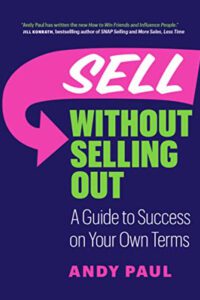
Sell Without Selling Out: A Guide to Success on Your Own Terms
How did you do that? Do you have any tips for someone who is thinking, “That sounds like my challenge, but I do not know where to start.”?
It is the same challenge you have with customers. I write about it in my book. You have to be able to connect with people on an authentic human level. You need to be able to use your curiosity and understand the most important things to them and how you can help them achieve that by working with you.
It is fascinating because you had said originally that people were like, “I am not so sure you will be good in sales because you are an introvert and an intellectual.” There are a lot of people who might identify as, “I am not extroverted. I cannot be the life of the party and entertain clients nonstop. I should not pursue this career.”
As I tell people that in the course of the first 24 years of my career when I was outselling the large 2/3 of billion dollars, I had dinner half a dozen times with clients. The opportunity presented itself. I was all over the world selling. For the most part, I had great relationships with my clients, but we did not feel like we had to have dinner with each other. It was not going to cement the relationship in a way that we were not doing in the office when we were talking with each other because their ability to trust me was based on what I was doing in the context of work more than anything else. Once I established that personal bond and rapport, I had to prove it every time I interacted with them.
How did you come up with the title of your book, Selling Without Selling Out? Do you feel like a lot of people feel like they do have to sell out in order to be successful?
They do. The simplest way to consider selling out is when you put your interests ahead of those of your customers. That is an external customer buying something from you or your internal customer. Whether you are working as part of a team or collaborating with people on things when you put yourself first, you start to sell out.
Do you have a story or example of that?
[bctt tweet=”Be a learn it all, not a know it all.” username=”John_Livesay”]
Think about it from a salesperson’s perspective. You go out at the start of the month or at some point when you start a relationship with a potential customer or client. You convince them through your actions that you are there to help them. They think you are there to help them, but then you get to that last week of the month and your boss says, “We need to bring this order in order to hit our month.” Early in my career, I was forced to go out and try to accelerate decisions that buyers were not prepared to make.
You start offering discounts and other inducements, delayed payment terms, or whatever the company does. In the mind of the buyer, suddenly, you went from being somebody that is there to help them to be purely transactional. It does not mean they will not buy from you, but they are under no illusion anymore that you are there to help them.
Once that trust is broken, it is almost impossible to get it back.
It is very difficult to get it back. They will stick with you as long as you are handy and convenient for them, but as soon as something better comes along, somebody they trust more or a product that is roughly equivalent to yours, odds are pretty high that you are going to be gone.
You talk about the difference between being a sales leader versus a sales boss. Can you give us that distinction?
A conversation that I had on my show with Stephen M.R. Covey, a great author who wrote the Speed of Trust. He has got a new book out called Trust and Inspire. It is about leadership modes. As he draws, the contrast is there are two dominant modes of leadership. There is the command and control, which we are all very familiar with because we have all been victims of it and then there is trust and inspire. That sums up the difference.
As a sales boss, it is all about command and control. Conformity and compliance are most important to me. Trust and inspire is, as a sales leader, you are going to sell to your person, “Here is your patch and territory. This could be your list of accounts of geographic territory.” I am going to support you the best way I can, but you decide the best way to get this business done in your territory. How can I help you achieve that? Trust people to continue to develop, expand, grow and learn with your support. The other is, “I know best. Do what I want you to do.”
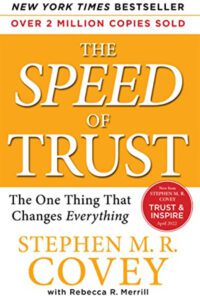
Speed of Trust: The One Thing That Changes Everything
One of the things both of you and I witnessed and experienced is a top producer is getting promoted into sales leadership without any real training and failing miserably as a leader versus a salesperson because they are different skills. Can you describe what someone should do to prepare to make that transition if they are not getting the training internally?
From my experience, I did a couple of things. I read what I could that was available about managing and leadership. I did not hesitate to ask people for guidance and mentors, internally, people that were more experienced in the role to give me some perspective on what they were doing. I asked the people that I was leading how I was doing.
It is part of your personality and it is not part of most people’s personality, the humbleness to ask for feedback, as opposed to, “I am going to pretend like I have it all together even though I had never done this before.” It is a completely different mindset to approach something with. In order to get feedback from people you are managing and/or your customers, you have to be willing to listen and not think you have all the answers all the time.
This is what I started pointing out in the book in terms of the contrast between a sales boss and a sales leader. One is a know-it-all versus one that is a learn-it-all. That is what you want to be. You want to be a learn-it-all. The humility you talk about is not just being modest and self-effacing, but it is about being intellectually humble. It is acknowledged that you do not know everything.
We put sales leaders, especially people who do not work in big companies that do not know very formal training programs and development programs, which the majority of companies out there put in tough positions. We promote them and then we do not enable them with the tools, the knowledge, and the training to have a better idea about what they are doing.
The thing that is ironic about that is that if you run polls, you look at the polls, surveys and research data, who is the single most influential in the life of an up-and-coming salesperson? It is their immediate manager. The people we should be investing in the most, we do not. According to LinkedIn, we spent roughly about $15 billion a year on sales training in the United States, of which 10% is spent on sales leaders and sales managers.
At least half of it should not be spent on sales managers. If they are the people having the most influence on the development of individual sellers, we cannot invest in them enough. Stop providing that training to sellers because they are going to get the guidance and knowledge they need from watching their sales managers.
[bctt tweet=”We are the sum of all the influences that are out there—our peers, our managers, the things we read, and the other information we absorb.” username=”John_Livesay”]
One of the things you talk about is people who say, “Let’s model what the top producer is doing. Let’s all march to that drum and say exactly what they are saying and try to be a clone.” You are saying, “That is the kiss of death. It is counterproductive.”
It is not like I was the best salesperson in the world, but no one sold like me because it was me. No one sells it like you. People did it better. That is great. I tried to learn from those people, but I had my own unique way of doing it. That has developed because we are the sum total of all the influences that are out there, our peers, our managers, the things we read, and the other information we absorb.
To force everybody into a single niche about how to sell is self-defeating. You have frameworks, you set up and you have expectations, “This is how we conduct business,” but within that framework, as a sales manager, I want to give you the freedom and the flexibility to go experiment and find out things that will work for you based on your unique strengths as a human being.
If you are going on a sales call with a boss and that boss is hyper-critical and expects you to be perfect, you do not have any room for failure trying something on your own, and then you are shutting down someone’s creativity and authenticity.
Selling is one of the most creative professions you can be in. To me, that was the one thing that has kept me in this, that in every situation, your approach is different. The way you present the solution and how you interact with the people will be necessarily different because they are also different if they are buying the same product. It is a fresh problem to solve, not solving the same problem over and over again.
I think of that as a doctor or a dentist. I thought, “How do they not get bored doing the same surgeries and over again?” I realized, much like a salesperson, in every patient and every situation, “We are putting a crown in your mouth,” or “We are removing your appendix.” Whatever it is, the outcome is the same, but there are so many unique things that require you to think, “I have never had to do it quite this way before.”
There are no small things to your customer. To your point, this is not to a patient. There are no small things when it comes to people’s health. As a seller, there are no small things in the buyer’s mind. If you try to serve to glom over those, assuming that they are like everybody else, you damage that relationship and the trust you have built.
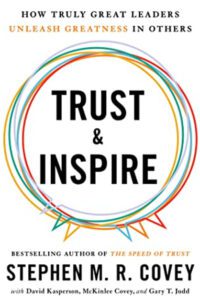
Trust and Inspire: How Truly Great Leaders Unleash Greatness in Others
One of the biggest reasons people are buying your book is that you have provided a guide on how to be successful on their own terms without having to fit into this mold of, “You have to be an extrovert. You have to do XYZ. You have to play golf.” All those stereotypical things of what salespeople used to have to do or would do and it is like, “I know what my terms are. This is how I entertain clients or not. This is how I sell. This is how I build rapport that might be different than you.”
It is becoming more essential because we are becoming more diverse in the people we are recruiting into sales. We are not doing enough. We could do more, but they all have different lived experiences. The perspectives people bring are what we need. We need more different perspectives. There is no one way.
You have so many great soundbites. One of my favorites is, “Influence rules, persuasion drools.” The visual on that is great. Tell us what you mean. A lot of people think, “I am going into sales. I am going to persuade you to buy this for this price.”
If you are persuasion-driven, you are putting your own interest ahead of those of the buyers. By definition, that is what you are trying to do. You are trying to persuade somebody to buy your product irrespective of their requirements, their needs and the things they want to achieve because you are in that mode where you are selling hammers and everybody is the nail. Even when you look at the definition of the word persuasion, it talks about prevailing or trying to prevail through force. In the wrong hands, persuasion is meant to be coercive and a little bit manipulative. Unfortunately, a lot of sellers are the wrong hands. That is not how buyers want to deal with the salesperson.
This is a big a-ha moment. I want to take a pause, circle it, underline it and highlight it. I am not in the persuasion business. Nothing against all the wonderful books about how to be persuasive, but let’s reshift this and start reframing how we think of ourselves.
Influence is all about having an effect on the thoughts and actions of others without the apparent use of force. That is what influence is and that is what position we are trying to get into. We are trying to build this connection with a buyer built on some level of trust that when the trust exists, they open up to us. When we bring our curiosity to bear, they will share information with us, perhaps at a deeper level than they would with someone where that trust and connection did not exist. Suddenly, we have more insight into the most important things to them in terms of the challenges they face and the outcomes they are trying to achieve by addressing those challenges.
When we have that understanding, we can work with the buyer to help shape this vision of success of what it will be like to get the value from the product or service you are selling. If you reach that point, that is something you do collaboratively with the buyer. It is not something you impose on them by trying to persuade them about it.
[bctt tweet=”Humility is not just being modest and self-effacing, but it is about being intellectually humble. It is acknowledging that you do not know everything.” username=”John_Livesay”]
I love that your definition of persuasion is, “I know better than you. I am right. You are wrong.” That is selling out. That is what this book is helping people not do. The opposite is the concept of selling which I have never heard of before. Therefore, there are no assumptions that you know more than they do or even vice versa. Think of it in terms of being a copilot with the buyer and this concept of, “Let’s make sure people feel heard and understood first before we jump into what we think they need.” It’s like when you go to a therapist, sometimes there is something called the presenting problem, which is a couple comes in and they say, “Our love life is not where we want it. That is why we are here.”
The therapist will go, “That is the presenting problem. I bet there are some reasons behind that.” As salespeople, we need to start thinking of ourselves as, “Whatever they tell you upfront, this is why we are changing, looking, upgrading or whatever the reason is for doing a proposal in the first place.” There might be other reasons they are unwilling to share yet, or maybe they do not even know yet. If you can help them discover that, then your trust factor has zoomed up.
Sometimes sellers are a little taken aback when I say this. I said, “You cannot take anything at face value that the buyer tells you.” They are not lying to you. They are not, not telling you the truth, but there is always more to it. If you accept what they tell you, you will hop down one path that is not the path the buyer wants to go down.
Building this level of trust so that they open up to you, as I write about in the book, then they give you permission to stick your nose into their business. What you are trying to get to is deeper level information that they do not readily share with everybody. I was in a conversation with someone on another podcast and they are talking about, “If you ask buyers scripted questions, you get scripted answers.”
If you are a robot, then they are going to give you robot answers.
You have trained them, not you, but sellers in general. Be the difference. This is the thing that I stress in the book. In the majority of instances, buyers oftentimes decide to buy from a seller despite the seller, not because of them.
If we flip that around and make it not in spite of but because we have a new tool in our box.

Sell Without Selling Out: In the majority of instances, buyers oftentimes decide to buy from a seller despite the seller, not because of them. In the majority of instances, buyers oftentimes decide to buy from a seller despite the seller, not because of them.
That is what you are trying to achieve. You become the reason they buy from your company. You, the individual. From supporting data from Gartner, Challenger and Forrester, we know that when customers make their decision, the majority of the criteria or factors in their minds are the experience with the salesperson.
That is everything from a home or the broker you pick to, if you are in Corporate America, deciding what vendor to make your equipment purchase from. People are buying your energy, your passion and your empathy.
How they experience you. Your understanding.
If people want to reach out to you and figure out how to get more coaching, more information and get on your email list, where should they go?
They can email me if they want to at [email protected]. They can connect with me on LinkedIn. Direct message me there. I would love to connect with people that are reading this.
Do you also have programs that you offer on your website?
If you go to AndyPaul.com and learn about the programs that I offer. You can download a free chapter of the book if you wish. We have an assessment that you can take there if you assume that selling out and selling in are polar opposite ends of a spectrum. You can start to determine where in that spectrum you sit. Are you leaning more towards selling out or selling in? It is not super scientific, but it is a fun quiz. Come buy the book on Amazon or wherever you purchase books.
[bctt tweet=”You cannot take anything at face value that the buyer tells you. They are not lying to you. They are not telling you the truth, but there is always more to it.” username=”John_Livesay”]
Thank you so much for sharing your insight. We are going to all become people who learn-it-all not a know-it-all. Any last thought or a quote you want to leave us with?
One of my favorite quotes is right at the beginning of the book from Ralph Waldo Emerson, “Insist on yourself. Never imitate.”
Most people think they have to become a clone in order to be successful. That is not the case at all. Thank you so much for getting us this new awareness and this new ability so that we can be ourselves and be successful at the same time. Who does not want that? Let’s go get the book, everybody. Thanks, Andy.
Thanks, John.
Important Links
- Andy Paul
- Sell Without Selling Out
- Sales Enablement with Andy Paul
- Stephen M.R. Covey – Sales Enablement with Andy Paul Episode
- Speed of Trust
- Trust and Inspire
- [email protected]
- LinkedIn – Andy Paul
- Better Selling Through Storytelling Method Online Course
Wanna Host Your Own Podcast?
Click here to see how my friends at Podetize can help
Purchase John’s new book
John Livesay, The Pitch Whisperer
Share The Show
Did you enjoy the show? I’d love it if you subscribed today and left us a 5-star review!
- Click this link
- Click on the ‘Subscribe’ button below the artwork
- Go to the ‘Ratings and Reviews’ section
- Click on ‘Write a Review’
Love the show? Subscribe, rate, review, and share!
Join The Successful Pitch community today:
- JohnLivesay.com
- John Livesay Facebook
- John Livesay Twitter
- John Livesay LinkedIn
- John Livesay YouTube