

Bend The Healthcare Trend With Mark Gaunya
Posted by John Livesay in podcast | 0 comments


No matter who you are or where you are in life, you should give kindness freely because leaders know how to adapt and blend with people. Learn and grow your business by being the right kind of leader. Join your host John Livesay as he talks with Mark Gaunya about the healthcare system, his passion for health and well-being, and its exponentially positive cultural and financial impact on businesses and organizations. Mark develops innovative solutions to complex challenges to save clients time and money. He is the Co-author of Bend the Healthcare Trend, a book written to demystify consumer-driven health and wellness plans with client case studies to share theory and show application. He discusses gratitude, learning, insurance and much more. As a leader, we need the inspiration to grow personally and professionally, and this episode boosts that and your leadership mindset.
—
Listen to the podcast here
Bend The Healthcare Trend With Mark Gaunya
Our guest is Mark Gaunya who is an entrepreneur on a lifelong mission to make healthcare easier and more affordable for everyone. He’s been recognized by the Benefits Pro as a Top 5 Broker of the Year finalist, and the Benefits Adviser as a Top 30 Thought Leader nationally. He develops innovative solutions to complex challenges to save clients time and money.
He’s passionate about consumerism, health and wellbeing, the exponentially positive cultural and financial impact on like-minded businesses. He’s the co-author of Bend the Healthcare Trend, which is a book that helps to demystify consumer-driven health and wellness plans. He is also the co-author of Inspire to Act and Inspire to Act For Kids, which are two books about living with an attitude of gratitude with 100 short stories about paying it forward. I can’t wait to know more about that. Mark, welcome to the show.
[bctt tweet=”Kindness has no age restriction. ” username=”John_Livesay”]
Thank you, John. I appreciate the opportunity to be with you.
Would you take us back to your own story of origin? You can go back to your days when you were at the University of Rhode Island or before that. How did you get interested in wanting to be involved in the healthcare world and insurance in particular?
My story of origin goes back all the way to my parents. My mom and dad were healthcare people. My mom was a nurse and my dad was a physical therapist by training. They were both very passionate about helping people and they are entrepreneurs. They built a company from the ground up. It was outpatient physical therapy. They had six facilities in three different states. After I graduated from the University of Rhode Island, I went to work with them for the first five years of my career. As a kid growing up, I learned all about the health care system, how it works, and how it was designed to help people. I learned how healthcare is delivered to people from the provider side of healthcare.
When I helped my parents sell their company and retire, I decided I wanted to learn how the insurance side of the business works. To be honest, the story was I want to go where the checks are written rather than where you wait to receive income. I went to go work for Blue Cross Blue Shield in Washington DC. That’s where I cut my teeth in the insurance business. I had a guy, my first mentor in the business, who put me into a leadership role with no sales management experience. He saw something in me and gave me an opportunity. Fortunately, I parlayed that into a career in insurance. I did a couple of what I call tours of duty in the insurance business.
I lived in Chicago for a period of time. I worked for Cigna Healthcare out there. I then left Cigna to be part of a startup health insurance company called Destiny Health, which is the expansion of an international organization firm that was based in Johannesburg, South Africa. They’re the ones who were pioneers in the whole notion of consumer-driven healthcare. It’s what we now know as health savings accounts. I moved away from Chicago back to the New England area where I’m originally from and met my now business partner, Jennifer. Through that journey, she and I became business partners in 2005. We run an employee benefits brokerage, consulting firm, and also a regional and national program called Captivated Health for a middle-market organization. The net of it is I’ve worked on the provider side, the consumer and the employer side. I have a 360-degree view of how healthcare works.

Bend The Healthcare Trend: How Consumer-Driven Health and Wellness Plans Lower Insurance Costs
That’s a fascinating perspective. As a child, you had a front-row seat as to how it all worked and what was wrong, and then you decided to get experience in every area of everyone who’s at the table. That’s the way I would describe that.
That’s an accurate way to state that. I’m not a clinician. I never have science in me. I appreciate it. I was not clinically gifted but I am business gifted. The business of health care and decided to learn the business of healthcare from every angle so that I could do something about it in my future years.
Don’t you think that gives you empathy and credibility? When you’ve been in someone’s shoes, it gives you both empathy and credibility. That’s the case for me when I get up in front of sales organizations and speak. I know what it feels like to have quotas, deadlines and to not take rejection personally, and all those things that everyone is struggling with on a day-to-day basis. Suddenly, I know you also speak to the industry. You have so much empathy and credibility because you’ve been there. Before we started the pre-chat, we talked about your friendship starting before your business relationship with Jennifer at Borislow Insurance. Can you tell us a little bit about how that evolved?
Jennifer was on the broker advisory council for an insurance carrier who was looking to do a joint venture with that company, Destiny Health. That council had to approve the transaction and I was the sales leader for that insurance company. The two of us hit it off instantly. The transaction went through and they asked me to head back to New England to head up the strategic partnership. My parents were retired and they were living in Cape Cod. This would give me a chance to be close to them which was a great decision because my mom passed away. I wouldn’t have had that time with her hadn’t I done that.
I met Jennifer and we became very good friends with each other. When I landed here in the Boston area, she was the person I would call and say, “What’s the market saying about my product and service?” She would tell me things that I didn’t necessarily want to hear but I needed to hear them. Truth be told, if I’m being honest about it, she and I are both passionate golfers. We spent a six-hour round in the golf course which is long, in the same cart together. That’s where our friendship was formed. She then tried to recruit me to go work for her. I didn’t have any desire to be employee number fourteen for her. At the time, it was a small benefit firm. We talked about becoming business partners and came together. As I always say to everybody, our business partnership was born out of friendship as opposed to the other way around, which makes it special.
You have a second edition. You told me that you were quite innovative and mailed that out. I’m going to ask you about that in a second. This concept of, “Why is health insurance expensive?” It’s basic because healthcare is expensive. There is a way to give people some power and knowledge. That seems to be the intent of the book. Who’s this book for?
[bctt tweet=”Empathy and credibility are a winning combination.” username=”John_Livesay”]
The book is for employers who are sponsoring health insurance and health benefits for their employees. It’s written for CEOs, CFOs and leaders of HR who are looking for a practical guide to transform their culture into one that educates people. If you look at the healthcare literacy rate in this country, according to the Kaiser Family Foundation, it’s 14%. That’s not okay that people are walking around not even understanding the language of healthcare. How are we going to expect them to be educated about making decisions if they can’t even understand the language?
We created this as a practical guide for employers to understand and demystify or debunk a lot of the myths that are promoted in the media or in the healthcare space by the players who designed the healthcare system. When you look at that, you say, “How do we navigate that?” What we did through this book is we created a practical guide that was ten chapters. It shared the theory in each chapter and then it would share a practical case story of a client who benefited and deployed that theory into practical application and what the impact was to their plan.
One of the things you have in your book that I love is this culture of health and wellness. Certain companies will give credit to help encourage people to join a gym and things like that. I’m guessing there are some other things that people can do when they have a company, big or small, to have a better culture for health and wellness.
We believe in the five-element construct of creating a culture of health and wellbeing. It even transcends wellness into overall health and wellbeing. Our five elements are physical, financial, workplace, community, mind and spirit. We look through those elements at any client we work with, and any business can do this and meet your people where they are. You can make progress in each one of those and we call that the whole person concept.
If we think about it, everybody wants to be physically and financially well. They want to understand the purpose of the work they’re doing and are tied to a bigger vision than that of themselves. They want to give back to the community and they need to spend some time taking a breath, meditating, doing yoga or whatever the case might be because life is still very busy. When you wrap all those five things together, you can transform the culture of any organization or elevate a company that’s already focused in those areas, but help their employees and family members ascend to an even higher level of wellbeing.
One of my favorite phrases is, “If it’s not measured, it doesn’t get done. If it’s not scheduled, it doesn’t get done.” We have something in chapter eleven called The Report Card. What is that about?

Healthcare Trend: A manager is somebody you have to follow, and a leader is somebody you choose to follow.
The report card essentially is our way of coming back to measuring the data, so taking a baseline assessment. When we work with a client, the first thing we’ll do is get any data analytics we can get our hands-on. It depends on the size of the employer, but demographic information, claims information, and we’ll do an environmental survey. We’ll go and look at the environment that the employers are working in. Especially with COVID, you see a lot of people are working at home. That environment has been somewhat challenged, but understanding the environment. The third is interests. What are the employees interested in? It’s those three data elements. Financial and data metrics, environment metrics and employee interests that you can then use as your raw material to measure, “What areas do we want to focus on and improve? What does the data tell us? What are the areas where we need to focus and improve?”
You and Jennifer went on to co-author Inspire to Act. You talk about how important a simple act of kindness is. When I speak to sales teams, the old way of selling is ABC, Always Be Closing and coffee is only for closers. I did that with ABK instead of ABC, which is Always Be Kind, starting with the way you talk to yourself. We can’t possibly be kind to our coworkers, let alone clients, if we’re not starting with some kind of internal thoughts ourselves. You collected this wonderful book of which all these stories of how positive connections with people have a direct impact on how we feel about ourselves. Is there a story in Inspired to Act that you want to share?
This idea or this book is born out of our culture of living an attitude of gratitude. We held a holiday party every year for our employees and we decided to shake things up a little bit. What we did was two weeks before our holiday party, we gave everybody $100 with a letter of instruction. At the time, we had twenty employees roughly. We had them go out into the community and do random act or acts of kindness. The only requirement was they had to come back to the holiday party and tell everybody what they did with the money.
The stories, many of them made you tear. One story, in particular, I can remember is one of our employees who went into the hospital emergency room. There was a family, they had a $100 copay at the emergency room and this person was fighting for his life. They didn’t have the money to pay the copay and the hospital was giving them a hard time. Our employee walked in and paid the $100 copay so that the family member could get the care. At that moment in time, he happened to be in the emergency room when something like that happened. It made a real big difference in that person’s life.
I always say when you tug at people’s heartstrings, they open the purse strings. That’s the power of storytelling. You start to imagine yourself in that story and what it would feel like that $100 could cause someone you love to not get the care they need to live. How would you feel if you were in that situation? On the flip side, how great would you feel if you had the money to help them? That’s a great example of that story. Many people say, “I don’t know if I’m a leader.” You have got this great quote in your book from John Quincy Adams, “If your actions inspire others to dream more, learn more, do more and become more, you’re a leader.” I love that so much because you and Jennifer didn’t have thousands of people working with you when you first started, but yet you were both leaders. Can you speak to aspiring people who want to become leaders?
First of all, Jennifer was one of the kindest people I know on the planet. She shared with me a quote that I’ll never forget when we first started working together, “No one cared about how much you know until they know how much you care.” When she shared that with me, I stopped and looked at her. I’m like, “What makes the two of us a great partner is that’s what we both not only believe but how we behave.” Leaders are somebody that people follow even when they don’t have to. A manager is not that. A manager is somebody you have to follow and listen to. A leader is who you choose to follow and listen to.
Jumping back to your other book, I want to close that open-loop I created. You sent copies at your own expense of that book to whom and to help them understand what they were dealing with because they weren’t healthcare experts. Can you tell that story?
[bctt tweet=”Creating a culture of health and well-being is a must. ” username=”John_Livesay”]
This was back in 2009. I co-authored the book and we were debating the Affordable Care Act, otherwise known as Obamacare at that point in time. I wanted our senators to stop, think and understand how the healthcare system works and from a prescriptive standpoint, how they could understand the principles that would set the foundation to change things for the better for people. I authored a letter and sent it out to all 100 US senators.
Sadly, I only received three thank you notes. Not even one from my home state of Massachusetts. That’s the sad part of the story. I did get three. One from Senator Collins up in Maine. She’s a wonderful human being. She’s become a friend of mine because I do a lot of work in the public policy area. I’m the Legislative Chair for the National Association of Health Underwriters. I get a chance to work with her and other people like that. I got a thank you note from Senator Hatch in Utah who was a very big believer in health savings accounts and consumerism. I also got a thank you note from Senator Inouye in Hawaii. A pretty good geographic dispersion but nobody from my own home state. I’m pretty sure most of them did not take a look at the book. Nonetheless, we made an effort to make a difference there.
We got to acknowledge the people who did send you a thank you, which is great. One of the reasons we’re aligned is the power of kindness and storytelling. I was working with an orthopedic surgeon who has created some new products for his industry and wanted some help on crafting stories to explain that to potential investors and other doctors. He said, “One of the benefits of learning how to become a better storyteller is with my child.” He has a seven-year-old daughter who used to say, “Daddy, tell me a story. Don’t just read me one.” He said, “Honestly, I was a deer in the headlights. I didn’t know how to tell a story until I started working with you. Now, I cannot just use storytelling from my career but with my child.” You and Jennifer took this Inspired to Act and have a new edition for children with the line, “Kindness has no age restriction,” which has got to be one of my all-time favorite quotes. How are people using this with children?
If you think about the whole notion of gratitude, it’s not something you’re born with. You have to be taught how to demonstrate gratitude. We believe that starts at a very young age. I have three children and I had them contribute stories to this but the idea would be, you don’t have to have $100. It doesn’t even have to be about money. How about you opened the door for somebody, or you say please and thank you when you want and get something, or you offer to be there for somebody as a shoulder to cry on when things are not going well? That book was written for kids 6 to 16 so that they can develop that habit of gratitude.
When you develop the habit of gratitude, it then becomes something ingrained in you. As an adult, I still write handwritten thank you notes and I do it every week. I do it because no one receives mail now. Most people don’t or a text. That’s a part of that person. In my case, it’s me. I’m putting a part of me on paper with my handwriting, telling you that you impacted my life in some magical way, or I’m amazed at how you conduct your life or whatever the case might be. That practice gets you out of yourself and focused on other things, which I think many of us get trapped in our heads. I know I do from time to time. That’s why the act of gratitude or meditation has been a huge gift.
That leads to helping children and what you’re doing as a Founding Principal and CEO of Captivated Health with helping schools. Can you tell us how you’re helping schools get control of their health care future?
We created Captivated Health in 2014. We do a lot of work with private schools where you might send your child to what you would be called a prep school. You pay for your child to attend the school. It could be a boarding or day school. We work with over 100 of them all across the country and growing in that space. We had three risk consortiums, three groups of schools that were buying together in their state but not buying together on a national basis. What we did is when Obamacare came into existence, it was going to make it very challenging for those schools to continue to purchase together.
Yours truly had to go and figure out, “How are we going to keep these guys together and help them overcome some of these challenges?” That’s how Captivated Health was born. Ten of our schools decided to be the founders of this program with us. We didn’t build this on our own. We collaborated with our school clients to create a community that was focused on four principles. Those four principles are members first, consumerism, health and wellbeing, and self-governance. If you look at those four principles, it’s table stakes.
The first principle of members first, I ask our team all the time, always ask yourself this question before you come in and advance an idea, “If you are a member of this health plan, would you want whatever it is you’re about to tell me?” If the answer is no, then please don’t bring it forward even if you know it will save us money. Principals and consumers, and everybody in the program, the employers offer a health savings account, which these plans have been beaten up by the media that they’re high deductible. Who wants to buy a high deductible plan? Nobody does. Who wants to buy a lower premium plan? Everyone will raise their hand. The idea of using words to help people understand healthcare.

Healthcare Trend: If we step back from the healthcare system and understand that it wasn’t a system built for the people, we could be aware that we can take control of our future by first acknowledging that.
As I mentioned to you, the literacy rate is 14%. Making sure people understand the language of healthcare is how you help liberate them to make better choices in the future because they understand the language. We use the slogan, “Knowledge is in power,” but if you look at the reflection, “Knowledge is me power.” The third element is creating a culture of health and wellbeing, which you and I already talked about in terms of the five elements. The fourth and final principle is self-governance. These groups and schools are taking the risk of what we call self-insuring the medical expenses of their people. They reinsurance to protect them from any person who might have a bad year or bad illness. They use other protection to give them a little bit of their financial liability but there’s risk involved based on how their plan performs from one year to the next.
What the self-governance principle does is created a set of bylaws. Those bylaws mirror our own US Senate, where it doesn’t matter the size of the school. They have one vote. Our Northern New England schools, their original ten pioneers, were very passionate about this because they said, “As this grows in scope and scale over time and larger schools come into the next, we don’t want our voices to be lost.” They created a structure with a chair and a vice-chair, and then they created four committees. Governance, membership, finance and engagement.
Those committees are staffed with HR and CFO executives who collaborate together in areas of concentration and represent their members. They have an annual meeting of the membership every year we hold in October, where they get together. They share stories of the programs that they’re running and the differences they’re making in the lives of their people. Is saving money and creating margin cuts for all non for profit important? Yes, but it’s not the driving force. The driving force is to make healthcare easier and more affordable for their people and schools.
At the end of the day, everybody wants to feel, be seen, heard and appreciated. Whether you’re managing people, your children or in this case, schools, everyone’s voice is equal regardless of the size. Mark, if people want to reach out to you in any of these areas, whether it’s learning more about gratitude, about how you can help them with their insurance or other schools, what’s the best way?
[bctt tweet=”No one cares about how much you know until they know how much you care.” username=”John_Livesay”]
My personal email address is [email protected], or they could go to our website, www.Borislow.com or in the example I shared with you about our program Captivated Health if they wanted to learn more about that. It’s spelled exactly as it sounds, www.CaptivatedHealth.com.
Any last thought or quote you want to leave us with?
If we step back from the healthcare system and understand that it wasn’t a system built for the people, understand that we can take control of our future by first, acknowledging that. Secondarily, understanding that the key to unlocking our future is to educate our people. We can find the interest of the people in the organization so everybody can get the same or higher quality healthcare at a fraction of the cost. They can reinvest those dollars in other areas to make whatever value proposition they’re providing their area a lot more powerful.
Thanks again, Mark.
Thank you, John.
Important Links
- Bend the Healthcare Trend
- Inspire to Act
- Inspire to Act For Kids
- Borislow Insurance
- Captivated Health
- [email protected]
- Better Selling Through Storytelling Method Online Course
Wanna Host Your Own Podcast?
Click here to see how my friends at Podetize can help
Purchase John’s new book
John Livesay, The Pitch Whisperer
Share The Show
Did you enjoy the show? I’d love it if you subscribed today and left us a 5-star review!
- Click this link
- Click on the ‘Subscribe’ button below the artwork
- Go to the ‘Ratings and Reviews’ section
- Click on ‘Write a Review’
Love the show? Subscribe, rate, review, and share!
Join The Successful Pitch community today:
- JohnLivesay.com
- John Livesay Facebook
- John Livesay Twitter
- John Livesay LinkedIn
- John Livesay YouTube
Discovering Your Inner Purpose With Dr. Benjamin Ritter
Posted by John Livesay in podcast | 0 comments

With so many things happening around us, we tend to lose focus on why we are doing something or what we can really gain out of it. But by understanding our inner purpose in life, we can get a better grasp of our reality. In this episode, John Livesay sits down with speaker, author, and the Founder of Live For Yourself Consulting, Dr. Benjamin Ritter, as he shares how he changed the course of his career from being a government employee to a full-time coaching professional by discovering what he really loves to do and where his strengths lie. Dr. Ben also delves into his Three C’s of Leadership and explains how every workplace should have the ability to redesign itself according to the tide of times – even a global pandemic.
—
Listen to the podcast here
Discovering Your Inner Purpose With Dr. Benjamin Ritter
Our guest on the show is Dr. Benjamin Ritter who runs a consulting business called Live For Yourself. He helps people who are unhappy in their careers get unstuck. We talk about that we don’t have to be attached to the path that we are on. Finally, we also talk about that you, as a leader, have to work on clarity, confidence and control. Enjoy the episode.
—
Our guest is Dr. Benjamin Ritter who is a leadership, career and empowerment coach. He is a national speaker, podcaster, author, mentor and he’s passionate about guiding others in finding and creating a sustaining career they love. With many years of experience coaching and a background in organizational leadership and adult learning theory, he understands how to navigate any career path you decide you want to travel. Since launching his coaching practice, he’s guided hundreds of professionals towards creating the career they love and impacted thousands through his events and media content.
From empowering young professionals to take accountability and feel empowered over their own job level with satisfaction to guiding senior leadership on how to stand out from the competition, develop executive and discover meaningful work. Ben is an expert in his field and guides people towards truly living for yourself at work and in life. I get to call you Ben because we’re friends as opposed to Dr. Benjamin. Welcome to the show.
Please call me Ben. You can call me Neb sometimes. For some reason, people want to turn my name around.
You and I are relatively new to living in Austin and that’s part of the joy is getting to meet people. We both are also from Chicago. It’s been fun to look at the similarities and our passion for helping people in different ways. Would you mind taking us back to your own story of origin? You can talk about childhood or school and where you got this premise of, “I’m going to live for myself.” I don’t think that’s normally a concept that we think about. I’m sure there’s a great story of origin there.
[bctt tweet=”Being clear with what we can and what we love to do is the first step in discovering our inner purpose.” username=”John_Livesay”]
I never thought I’d be a coach. I still don’t think I’ll be a coach, even though I’m a coach. At every single major turning point and milestone in my life, especially the ones where I felt lost, stuck, underutilized and questioning things, having those existential moments that we all tend to have, coaching popped up. The first time it ever happened, I was training to become a professional athlete in college and I didn’t make it. There were many things that happened to that.
I had my major canceled in college. I had hip surgery when I thought I was going to go abroad and play. I went abroad to play and got told that if I stay there, then I might have a chance, but I only had a semester left in school. There were many different rough points in that separate story. I lacked confidence there. When you set yourself up to achieve something outside of yourself, all you do is focus on achieving it. You hold yourself accountable to that and you define who you are by that, and then you don’t achieve it. Along the way too, you struggle to achieve it. You experienced some tough internal dialogues.
When I finally realized that I wasn’t going to make it, when I realized that I had to make the decision to make this my main priority or take away this priority for my life, I had to figure out how to redefine who I was. Luckily, we had the internet then. It wasn’t still that prominent, but I went online and searched something along the lines of, how to be confident, how to find yourself, what is the meaning of life? All of these keywords that you think you might type if you’re questioning life and searching for them on the internet, which is an interesting strategy, which I don’t think is as interesting nowadays.
What came up was this field of personal professional development. What came up were articles upon articles and books upon books on how to become more attractive, how to become more confident, how to become successful in business. It was never, “This is the meaning of life.” You’re probably more likely to find books like that nowadays than you were back in 2005. In my search engine results, that didn’t pop up. I spent the next 4 or 5 years studying that industry, studying all the material I could find, and not just studying it though, but going out and applying it.

Inner Purpose: Without clarity, you don’t have confidence, so you don’t know what the next step is.
As I mentioned, confidence was a big issue of mine. All of the material that you find on confidence as it relates to men is mainly focused on attraction, dating and being social. I would go out by myself to bars. I would walk up to strangers on the street. I would do things to make myself extremely uncomfortable to ensure that I never felt those things were uncomfortable. I probably lend a lot of those experiences to my stage presence, my ability to walk into a room, to my networking capabilities nowadays. That was the first little pinpoint in my life where coaching became influential and became something important to me.
If you fast forward a little bit, coaching came back when I got out of grad school. I couldn’t get a full-time job for about two and a half years because of the recession. I wanted to work in the federal government and public health policy at that time. I was doing some work for the Illinois Department of Public Health. I thought I was going to keep doing work for the Illinois Department of Public Health after grad school but the world had a different story. It had something else planned for me. I got a job offer from the Illinois Department of Public Health, from the CDC, and from two other health departments, but they were all canceled after I signed them.
It was almost like clockwork into the next day or within three days, they were pulled back due to funding. That was a two and half-year period of time where I was getting a job and then not getting a job. I made it work. I bartended and then interestingly enough, I was out by myself one day being social, because this is a habit that I kept. Someone approached me and said, I know what you’re doing. You need to meet my boss. The next day, I ended up getting hired to run a nationwide bootcamp program for men in relationship to interpersonal dynamics. For the next year, I was leading men on bootcamps in how to be more social, how to be more attractive, and how to have more confidence. At the same time, I ended up getting federal funding for six months of free life coaching for public health professionals. This is hilarious because there was no funding for a job. It was a grant that I applied for through networking, through going off on my own and meeting people.
Coaching again came up. I never thought about it as a full-time job. It was always a way for me to make some side money. It was a way to develop because after working for this guy, I ended up seeing an opportunity starting my own business. I started my own coaching practice but again, as a side hustle, there was demand to make some money. Fast forward another 6 or 7 years, I’m working in healthcare which I got that job because of the networking and meeting someone across the bar. I get selected to become an executive in my system. Because of that, I get the opportunity to receive sixteen months of leadership training from our Director of People who was a coach, who then becomes my coach. All of a sudden, I realized, “This could be a job. I could do this for a living.” I’m sitting here going into work on a daily basis feeling stuck, underutilized and feeling like, “This isn’t the place that I belong.”
[bctt tweet=”Are you truly living for yourself in a way that is positive and proactive towards what you care about and what puts you front and center?” username=”John_Livesay”]
Every job I’ve had up to that point was a reaction to the environment that something I needed to do because I needed to put money in the bank. I needed to create a career journey for myself. I finally felt empowered at that point in time to ask myself, “What is it that I want to do? What are my strengths?” I now have control. I have the ability to live for myself at this very instant. I don’t have to be held in handcuffs to the economy or to what people think I’m able to do or not able to do. I went and asked my coach, “How do I do what you do? How do I do this?” We came up with a little bit of a plan. I went back to my boss. I asked her to be involved in the talent development space. She said, “You can do this. Talk to the department. Get involved in projects.” I had a lot of energy for the first time in probably six years at this job. I felt like I was going to do something that I wanted to do, and then we got acquired. Everything I was going to do stopped.
I’m proactive and action-oriented, so plan B is I’m going to find a job in this field. All of them were about half my salary because I had no resume experience in this other than my side coaching business coaching men. That doesn’t make a resume seem lofty. I don’t have a lot of expertise in talent development and coaching individuals from my side business, at least not on my resume. I’ve been running this coaching practice for 5 or 6 years. I have experience doing this. I know I’m good at it because I got hired to do this in the past and I have a lot of media attention for it. I was writing for AskMen and Men’s Health at that time. I was getting interviewed on a live stream Facebook show with 100,000 or 200,000 people. I can prove it. I was in the Apollo Theater in Chicago as a panelist for The Great Love Debate.
There was stuff that was like, “You’re good at this,” but it wasn’t the industry I wanted to do it in. I’m like, “I’ll take all this knowledge and I’ll start my own business again. I know how to do this, but I’m going to do it in an industry that I’m passionate about, that I care about.” This is always a theme in my business development stages. How do I get seen as someone credible with no experience here? How do I sell myself to individuals? I’m like, “I know how to get media attention, but I’m still 30 and I want to work with executives. How does that work? I want to work with managers. I want to go into organizations. How are they going to believe me? I’m going to get my doctorate. I’m going to get the golden key to open up the door to at least get people to listen to me.” That led to me getting published in this field because I got to do some research in it and I got to speak on it. It did skyrocket my business. It probably sped up the timeline for more than a few years in terms of becoming successful. That’s what I’ve been doing for the past few years.
That’s not an easy feat getting your PhD, but that gives you the credibility. A lot of people write a book to try and get that credibility, but the PhD is at a whole other level of commitment and time. What I hear as a consistent theme is a lot of resilience going on. This awakening that you were stuck in something that you didn’t love and there are many people out there that feel that same way and because you’ve been in their shoes, you know what it feels like. The irony of you can change jobs, but you still have similar challenges if you’re not doing what you love. Would that be a fair assessment?

Inner Purpose: Your purpose isn’t bigger than you because you create your purpose.
Taking what was way too long of a story. I’m distilling it down and saying that I’ve been stuck. I’ve been underutilized. I’ve been overworked and I’ve made decisions for my career that weren’t based on what I wanted and mutually living for myself. They were based on what I thought I needed to do at that time. Instead, I hit a point in my life where I wanted to change that. I dove into what I cared about, what challenges I wanted to face. I plotted the course and I went to take action.
The good news is not everybody has to get a PhD like you did to have credibility and find their dream job or your consulting firm is Live for Yourself, LFY. You have something in there that I wanted to double click on which is The Three Cs of Leadership. This applies whether we’re leading other people or leading ourselves into a career we love. Can you talk a little bit about what those three Cs are?
It was working with clients and I had the Live Framework, which is a decision-making tool to live a much more aligned life for yourself. I was noticing that through working with clients, we were developing core traits within themselves like these pillars. I identify those pillars as the three Cs of self-leadership: clarity, confidence and control. If you have these, you’re able to lead yourself. You’re able to take action towards what you truly care about. Often, when I first start working with clients, they have this pain and they have this desire for change, but they don’t truly know what they stand for, what they care about, and how they’re going to get there. Because they don’t know that, they don’t have confidence in themselves. If you don’t have confidence in yourself, you’re never going to take action. If you get clarity and confidence, all of a sudden, you can prioritize that in your life. You can have control over your life.
I have not heard anybody phrase it like that. Without clarity, you don’t have confidence so you don’t know what the next step is. They build on each other. It’s not like you work on three things simultaneously necessarily. It seems to me like you do one, you get clear, which gives you the confidence to then have the ability to control. That concept of control from your perspective now, having felt like you’re not in control. All of us are experiencing what it’s like to not be in control when a pandemic comes. Let’s say we have some clarity, we worked on our confidence, and then all these other outside things, whether a funding going away or a pandemic. How do you advise people to get a sense of control when there are many things going on outside of their control?
[bctt tweet=”To gain full control of our lives, we first need to figure out why we are doing something and if we really love doing it.” username=”John_Livesay”]
First, if we start with clarity and confidence at least at any given point in time, we know what we stand for. We know what’s important to us. If we have that and outside of us, we’re not able to go along the path that we set ourselves to go on due to a global pandemic or shutdown, anything that can happen because we don’t have control over the external world, we then can reflect and say, “I still want to live these values. This plan doesn’t work anymore,” but those values are still the goal. The goal is not, “I want to achieve X, Y, Z.” The goal is, “I want to live a life that allows me to apply the values and strive towards what I care about in any fashion.” The first step to control is understanding that no matter what happens outside of yourself doesn’t change what you can feel about yourself.
As long as you keep applying your values throughout your life, you wake up and you know what you care about, you feel like you’re making an impact towards what you care about, and you can do that in any way possible. There’s an infinite number of ways for you to apply your values in the world. That’s what control is. It’s noticing what isn’t working anymore and a couple of different avenues that could work that could allow you to feel fulfilled on a daily basis. Just believing that you’re capable of that, that you have the choice and the ability to take action in a new way or a new path that’s still is important, and that your ego isn’t attached to whatever this other path was because the path itself isn’t important. It’s what you’re working towards and how you’re living on a daily basis. That in itself is inspiring and motivating that lends us to take greater control of our life and apply it to our life.
That’s going to be a great tweet, “Outside events don’t change what we feel about ourselves.” That’s a big a-ha. I know for myself, when I was laid off, it was like a kick in the gut, overwhelming and scary. You realized, “I haven’t lost my identity. My job is not my identity.” Getting re-centered around that was a big moment and realizing that if we don’t do what you’re saying, we’re going on l the self-esteem roller coaster. We only feel good if things are going well and bad if they’re not. To reframe that is wonderful. This premise of not getting attached to the path that we’re on, that’s a big one. We tend to like comfort zones and routine. We think, “If I’m doing this, then the outcome is that. I’m staying on this path. I can’t vary from that path.” In your own life, whether it was your athletic career getting derailed or a company getting defunded, you have to constantly be willing to not be attached because you said there’s something bigger than the path which is your purpose.
Your purpose isn’t bigger than you because you create your purpose. We lose sight of that often. There’s this interesting mindset of you need to think that the world is bigger than you because that keeps you motivated and that there’s more. I like to turn away from that and say, “You create all the things you care about.” You’re more than everything else around you. You come first or your health comes first. When you wake up and don’t feel good, it’s okay. Let’s figure out what’s going on in me, not what I have to do outside of myself.

Inner Purpose: An important component to motivate and engage your employees is to help them find their stories – why they’re doing what they’re doing and what matters about that work to them.
If we were able to have that focus and say, “My purpose is important because it’s a tool for me to find more happiness in my life.” All of a sudden the, “I need to do this because it’s my purpose,” changes from, “I enjoy doing this because it brings me happiness and it matters to me.” I give it energy, power and intention. I will define it as my purpose, but only to the point where it brings me a level of happiness. That doesn’t mean that struggle can’t create happiness. Waking up and building a business, figuring out solutions and the stress from that is something that I enjoy. That can be filtered through this lens of, “This is how I’m enjoying my life right now,” but the “This has to happen,” or “I’m not valuable,” that’s where I get lost.
I like to think that we’re the movie director of our own life. We can say cut, we can recast it and change locations as opposed to being at effect of everything that’s coming at us. We’re the thinker thinking the thoughts. That’s the whole concept of we created the purpose, therefore, the purpose isn’t bigger than we are.
I was listening to an interview and the guest said a few things that resonated with me. One of them was, “Are you the actor or the character?” I think in our life, we need to be the actor. The character is who we’re playing at the time, the things that happened to us, but it doesn’t define who the actor is. If we know who the actor is, it all allows us to play a variety of roles.
The other thing that you’re good at and when people hire you to come to speak is helping people find jobs satisfaction and get motivated even if it’s a job that they’re just doing for the money. It’s not necessarily something that they see as a career, but it’s what they need to do now. That could be working at a fast-food restaurant. Companies could bring you in to say, “How do we motivate somebody who is not making a lot of money and the job is fairly routine, yet we’re pressuring them to give amazing customer service?” When you have a client like that, how do you help them keep these people motivated and feel like what they’re doing is meaningful.
[bctt tweet=”Each and every single day, we don’t live in that broader world. We live in that right now.” username=”John_Livesay”]
I was running in Lady Bird Lake in Austin. We were running by this kayak shop and there were already people lined up getting their kayaks. I was like, “It’s a cool scene here.” As I was running, I saw the guy lifting the kayaks up and bringing them to the water, going back, talking to the customers and getting the oars. I had a thought that I have all the time. When I’m in Chicago, watching someone shovel the streets of snow, which I’m happy we don’t have here. I always think to myself, “What motivates them? What gets them going to do this job each and every single day?” It doesn’t connect with me. I don’t know if I would want to do that each and every single day, and doing what I enjoy doing.
You work on this. You find people stories. You help people figure out why they’re doing what they’re doing and what matters about that work to them. That is such an important component of figuring out how to motivate and engage your employees. It’s one of the pillars. It’s what motivates you, what drives you, what brings you to the office? It doesn’t have to be the paycheck. It could be, “My kids get to go to the school that’s a little bit safer. We get to have a special dinner once a week because now, we have a little bit more disposable income. My dad did this and we get to resonate and share stories about what it’s like to give people kayaks and then see the smiles on their faces,” or whatever it is. It’s their drive.
“I don’t have to worry about filing reports or sitting behind a cubicle.” I did that for five years. It could literally be anything that touches someone that sparks somebody. It’s very easy to forget these stories because these are the broader world. Each and every single day, we don’t live in that broader world. We live in that right now. A manager, a leader or a speaker can come in and remind them of those stories. It’s like what you do as well in terms of sales. You remind people of their stories to help them be more energized. You teach them strategies on how to remind themselves of their stories on a daily or weekly or monthly basis.
That’s probably the most important component of all the different things that I’d speak about in terms of job satisfaction. The other two are figuring out what work your employees love to do and what work they don’t love to do. Getting in there as a leader and crafting their work to be more fit to their strengths and likes, and helping minimize the work they don’t like to do, or knowing what work they don’t like to do, and then praising them for that work. It’s figuring out ways to make the work that they don’t like a little bit more enjoyable. It’s maybe giving them some more freedom to say, “You don’t like to do this work you do on Wednesdays, do it from home.”

Inner Purpose: You are literally the center of your own universe. To that point, you are the most important leader that you’re ever going to be.
You can come up with strategies to help someone to enjoy certain aspects of their job they don’t like. The other aspect is the social context of the way that we work. Where is the conflict in your department? Are there conflict between two specific members? Figuring out ways to mediate and solve that conflict, and then also to figure out who are friends at work and try to pair them up more and more together. At least build in time for them to talk not about work stuff, but venting about personal stuff, and being the conduit to positive relationships within work itself.
I think to allow that a lot of people are having to work from home versus being in the office so much, they don’t realize how much value there is in those water cooler moments, catching people in the hallway, “How was your weekend?” a little bit of a download or grabbing a coffee with somebody to vent. Without those release valves, the stress builds up and the sense of isolation that work is more than a paycheck. When someone like you with your expertise can come in and help people reframe that, sometimes those little moments of scheduling people to go on break together that like each other. That little detail showing that you care enough about them can make a huge difference. I love that specific example as well as the example of the person unpacking the kayaks.
There’s one more thing to add because I think it’s important in the remote world. It’s the resources. This goes along with the actual work that somebody is doing. What do they need to do their job? Many organizations sent everybody home and they’re like, “Go for it.” I don’t have a working webcam. Do I have to buy new headphones? Can I get a second screen? I don’t have pens. I don’t have printer paper. I don’t have a journal. I know these are extra expenses, but as a leader, have you ever sat down and spoken with your employees and say, “Think about your workflow. Where are the struggles? Is your computer slow? Is there a program that’s not working? Do you wish you had a different type of program? You have pens? Do you want me to send this stuff to you?”
You think about the level of productivity like, “I don’t have a stapler.” “I can go order one on Amazon,” but it’s like, “I could probably use a stapler.” That’s overlooked because organizations thought working from home was a day off. They thought it was like Fridays at least in Chicago. You work half day on Fridays or you don’t work. Nowadays, there has to be a very different mentality in terms of, do your employees have the tools and the resources they need? Are the same work boundaries also in place, which we didn’t even touch on? That’s just a side.
As you said, it’s the details, whether it’s a break time with someone you like and/or what do you need to do your job? Let’s not assume that you’re going to have it all figured out by yourself. Originally, they’re like, “This might be a month. We’re not going to worry about it.” Now, it’s much longer. The resources become much different. This is going to be a long-term thing versus a short-term thing. I’ve worked with people on basic sound and lighting. If you’re going to be presenting, especially if you’re in a sales role, people need to see your face. You’ve got to be properly lit so they can trust you. That’s a thought you’ve never take into consideration. When you’re seeing people in person, you don’t worry about the lighting in the conference room, but you need to worry about the lighting on a video call at home. Any last thought or a favorite quote you have that you want to leave us with?
If you haven’t noticed, I’m very big in personal empowerment and personal accountability. I think that’s also highlighted through my story, but personal accountability and responsibility that is healthy that is focused on you being at the center of everything. It’s not other things being at the center of everything. You are your own universe. Even in general, you’re preceding the world around you. You’re making that up. Everything you’re seeing is based on your brain and your eyes in how you see the world. You are literally the center of your own universe. To that point, you are the most important leader that you’re ever going to be. Are you truly living for yourself in a way that is positive and proactive towards what you care about and puts you front and center? If you do that, life gets a little bit more enjoyable.
It’s like the oxygen mask on the airplane. You’ve got to put it on yourself first before you could save a child, and a lot of us don’t do that. We put everything else ahead of that, including our career at the expense of our happiness and our health. You are definitely helping other people realize without that, inner happiness is not something sustainable because you burn out in one way or the other. If people want to find you, they can go to LiveForYourselfConsulting.com. Ben, I can’t thank you enough for sharing your own story, your insights that are certainly well-earned and much needed right now. I’m looking forward to hearing how you continue to make a difference in big and small companies.
Thank you.
Important Links
Wanna Host Your Own Podcast?
Click here to see how my friends at Podetize can help
Purchase John’s new book
John Livesay, The Pitch Whisperer
Share The Show
Did you enjoy the show? I’d love it if you subscribed today and left us a 5-star review!
- Click this link
- Click on the ‘Subscribe’ button below the artwork
- Go to the ‘Ratings and Reviews’ section
- Click on ‘Write a Review’
Love the show? Subscribe, rate, review, and share!
Join The Successful Pitch community today:
- JohnLivesay.com
- John Livesay Facebook
- John Livesay Twitter
- John Livesay LinkedIn
- John Livesay YouTube
The Talent War With Mike Sarraille
Posted by John Livesay in podcast | 0 comments

A business’ success lies upon the kind of people working behind it. Any business or organization that knows how to attract, develop, and retain great talent are well on their way to success, if not remaining as one. At the center of it all is a great leader who values the people they have. In this episode, John Livesay sits down with the co-founder, managing partner, and CEO of EF Overwatch, Mike Sarraille, to discuss how leadership skills are more important than a specific industry skill. He also talks about the importance of overcoming imposter syndrome and then dishes out on his book, The Talent War, which imparts some great wisdom from special operations around talent and how we are currently in a war to acquire the best talent. Join John and Mike in this conversation as they bring fresh insights around talent acquisition and leadership from the military perspective.
—
Listen to the podcast here
The Talent War With Mike Sarraille
Our guest is Mike Sarraille, the co-author of The Talent War. He’s an expert at helping companies find the right people and specializes in placing veterans in corporate jobs. Of course, he’s been a veteran himself among many things, being a Navy SEAL. We’ll talk about the importance of realizing how to overcome the impostor syndrome you might be facing, as well as how leadership skills are more important than a specific industry skill. He said, “Great leaders are always there for the people working for them.” Enjoy the episode.
—
Our guest is Mike Sarraille who is the Co-Founder, Managing Partner, and CEO of EF Overwatch. He’s a retired US Navy SEAL officer and he’s the Founder and Board of Director for the VETTED Foundation, which is an education platform. He’s also a graduate of the University of Texas Business School, and the leadership instructor and strategic advisor for Echelon Front, which is a management consulting firm. Mike served fifteen years as an officer in the SEAL teams and five years in the US Marine Corps as an enlisted Recon Marine and Scout-Sniper before receiving his commission in the Navy.
Mike served in the SEAL Team 3, Task Unit Bruiser alongside Extreme Ownership authors, Jocko Willink and Leif Babin, where he led major combat operations that played a pivotal role in the Battle of Ramadi in 2006. Mike was again deployed with Task Unit Bruiser in 2008 and led a historic combat operation in Sadr City during the Battle of Route Gold. Following his return, Mike assumed duties as the primary leadership instructor for all officers graduating from the SEAL training pipeline, taking over that role from Leif Babin.
Mike was then selected for assignment to the Joint Special Operations Command where he completed multiple combat deployments in support of the Global War on Terrorism. Mike is a recipient of the Silver Star, 6 Bronze Stars, 2 Defense Meritorious Service Medals, and a Purple Heart. Mike continues to participate as a Veteran Transition subject matter expert on panels around the world. Mike, thank you for your service and for being on this show.
John, thank you for having me. This is great.
I would be fascinated to know that’s such a huge, impressive list of things that we instantly know about you in terms of resilience, tenacity, and passion. I would love you to take us back a little bit into your own story of origin. You could go back to childhood or your early days. Did you always know you wanted to be in the Navy? Start wherever you think would be a fun place for people to get a sense of who you were before you accomplished all of that.
I will tell you no. I don’t come from a military lineage. Of course, my grandparents served in World War II. My dad was in the Army for a short while but service wasn’t the mainstay of our family. I was born and raised in the Bay Area. I loved California growing up and I loved Silicon Valley and getting to watch that become what it is now, but I was a little guy in high school. I played plenty of sports and my parents kept me active but I remember I wrestled during my freshman year at 119 pounds.
For a frame of reference, you look like you’re 190 of muscle or something.
[bctt tweet=”The definition of progress is inspiring the next generation behind you to be better than you were.” username=”John_Livesay”]
You cut me by about twenty pounds. I’m 210. That is twenty years in the military and working out nonstop in the gym. I had great trainers. The one thing my dad said later on, “I didn’t know what you were destined for but you had this disdain for bullies.” It’s a stupid story but in high school, there were classic bullies that were picking on little kids. I remember because my dad had to come to school and get me. I got a running start from about 75 meters away and hit the bully with my shoulder in his back. I put them down but ended up getting roughed up by his friends because they were picking on a kid. It was my high school. I didn’t like people picking on other people. Let’s be honest, it’s the best recruiting tool for the military. Do you want to talk about the best pitch?
Yes.
It’s Hollywood.
Top Gun or whatever, right?
Absolutely. What do those all have in common? There are bad guys out there doing bad things to innocent people, and then the heroes come in. You don’t understand the price or the cost of war when you’re watching those movies. You can’t recognize that but it drew me in. The greatest pitch since the title of the show is such that is I met a Force Recon Marine. Back in the ‘90s, Force Recon was the special operations community for the United States Marine Corps. I was eighteen and this man was physically built. He was handsome, articulate, humbly confident, and respectful to everyone.
There’s an eighteen-year-old that’s now weighing 130 pounds and you’re looking at this guy who’s 190 and everything you aspire to be. I’m like, “I need to be a part of that organization now.” You question yourself, “Do I have what it takes?” There’s only one way to find out. That individual helped me get enlisted in the Marine Corps and I eventually became a Recon Marine like him. Every leader I had in the military, from my drill instructors to the Recon Marines that I serve for, each made me aspire to be better. That is the legacy of leadership. If you can inspire the next generation behind you to be better than you were, that’s the definition of progress. Progressives don’t understand that. You’re leaving a better situation for those coming behind you and you’re training them to be better than you were.
I love that the legacy of leadership inspires the next generation. I’ve also never heard someone described as humbly confident because a lot of people think they’re mutually exclusive, and they’re not. What a great description of someone and something to aspire to as well. You went to Stanford and then you’ve got your MBA at the University of Texas here in Austin. Through that process, you were also in the service. It wasn’t like you went to school and then joined. It looks to me like it was all happening concurrently.
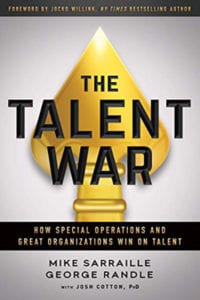
The Talent War: How Special Operations and Great Organizations Win on Talent
I enlisted in the Marine Corps, which means I did not have my college degree. America doesn’t know two things. One, we put a precedence on knowledge in the military. Unfortunately, Hollywood, the best recruiting tool, also paints us as if sometimes we’re people in the United States that have no option other than to enlist in the Marine Corps, so we pride knowledge. The Marine Corps looked at me after a few years and said, “Do you want to become a Marine officer and be in charge of young Marines?” This is pre-9/11 and the answer was, “Absolutely.” They said, “We’ll pay for you to go back to school,” and they did. I went to Texas A&M where I finished my degree.
John, this is interesting. I went to a Jesuit high school in Santa Fe called Bellarmine and I graduated with a 2.9 GPA in high school. I went back to college a few years later and I graduated with a 3.7 from Texas A&M. I didn’t get smarter during those few years. The Marine Corps taught me how to lead. They taught me commitment and discipline. It was a steadfast commitment in how to accomplish the mission. Before I went back into the Marine Corps as an officer, I’d served with some SEALs. It’s inspirational. I said, “I’ve got to see if I have what it takes.”
I went to the SEAL training. I made it through that and then towards the end of my career, that’s when I attended Stanford. It was a certificate program called the Stanford Ignite, a one-month program at GSB. I did that one month before I started my MBA at UT, which was humbling because I was 39, surrounded by a bunch of 27-year-olds that were smarter than me and I learned more from them as I did the professor’s because each of them was high-performing individuals. I don’t think without them helping me here and there that I would have graduated from that program.
For those who aren’t familiar, it’s difficult to get into the Marines more than let’s say the Army. That’s fair, isn’t it?
Yes.
The Navy SEAL is even more elite than the Marines itself, so it’s the elite of the elite.
That’s roughly accurate. Each is good at what they do. They have slightly different flavors.
[bctt tweet=”If you put a problem in front of a generalist versus a specialist, a generalist is more equipped to solve it.” username=”John_Livesay”]
Different skillsets and things like that. There are different tiers. Since you’re in the executive search world, you’re constantly looking at someone’s educational background. That’s why I thought it was interesting to start there. That full circle, now that you’re out of the service, you’re helping find people with military backgrounds and placing them in a business where they’re using that incredible leadership skill. There are different tiers of way to go to school. There’s the Ivy League. It’s not just a location at Harvard and Yale versus Stanford. There’s that league.
I happen to go to the University of Illinois in Urbana–Champaign, which is considered part of the Big Ten but it’s not an Ivy League school. I certainly feel like I got a great education and I’m proud of where I went to school but it’s not an Ivy League school. I would say the same thing with the Army. It’s needed, wonderful, and great like a Big Ten school and the Marines would be a little more Ivy League. Is that honoring everybody or not? Is that too controversial to say it like that?
I will set the facts right here. The Army is the oldest in the armed services. They’re 244 years old and the Army has produced more leaders for this nation than any other organization. I didn’t go to a service academy and I did not have what it takes. The Air Force Academy, Naval Academy, West Point known as the Military Academy, Coast Guard Academy, and Merchant Marine Academy are the equivalent of Ivy League schools. It is 24/7 for 40 years. Some of the smartest Americans and some of the best leaders come out of those institutions.
I don’t think the average person unless you’ve been in the service understands those distinctions. I’m thrilled you could clarify that. The Navy SEALs, that’s not an intellectual level as a whole, physically incredible like an Olympic athlete level of skills that are required. Yes?
It is. The military as a whole follows something called the whole person concept. We’re looking for people that are well-rounded mentally, physically, and emotionally. Someone who is balanced and proficient in all those areas to a greater degree with certain communities. SEAL training is some of the toughest training in the world. The attrition rate is high, anywhere upwards of 70% to 80%. The special operations communities that we’re not mentioning who I absolutely love is the Army Special Forces known as the Green Berets.
You have the MARSOC Raiders, which is an amazing group like the SEAL teams. The Air Force has something called Combat Controllers and also Pararescue. There are special operators that fly helicopters known as the 160th Special Operations Aviation Regiment. To have served with all of them and to watch them on the battlefield is humbling. You want to talk about not feeling like you belong, and that’s the description of my career. Watching these guys on the battlefield and what they did, it was almost like, “How did I fool them to let me even step onto the playing field with them?” I’m not joking here.
Let’s talk about that, Mike, because if you’re talking to CEOs or anybody with a C-level job, if they’re being honest with themselves, we all have a little bit of the impostor syndrome from time to time. When you’re trying to convince someone maybe to take a little bit of a leap in their career at EF Overwatch where you are finding people who have amazing skills from their military background. Maybe they aren’t as qualified on paper as somebody else without that background, but they have more experience. How do you help them overcome the impostor syndrome because you’ve had to overcome it yourself?

The Talent War: The military, as a whole, follows something called the whole person concept. We’re looking for people that are well-rounded mentally, physically, and emotionally.
It’s focused on what you know and what you know well. In EF Overwatch, it’s what we call a specialized executive search firm. We focus predominantly on small to midsize businesses, which can be as big as 1,000 employees up to $1 million revenue, massive companies. We do vet the candidates as much as we vet the clients and for the clients, I have to hear one foundational belief. We value leadership over industry experience. Trust me, there’s a lot of SEALs with twenty years in the SEAL teams that have a lot of industry experience for that domain and are not good. Industry experience does not equate to proficiency.
For the candidates, we do explain to them. One of the books we have for them to read is called Range by David Epstein. He makes an argument that generalists make the best leaders. The reason for that to summarize it is that they’ve dabbled in so much that they have such a broad range of experiences to draw from. If you put a problem in front of a generalist versus a specialist, a generalist is more equipped to solve it. For the CEOs and the C-Suite because I worked for Jocko Willink and Leif Babin’s company, Echelon Front, which we are going to make the world’s finest leadership consultancy. We work with companies nonstop on the leadership foundation side.
The common thread I found amongst C-Suite leaders is that they’ll admit they were not the best in their specific domain. “I was not the best salesperson. I was not the best engineer. I was not the best marketing director, but I knew how to form a team around me that was specialized and good, and direct them in a certain direction and say, ‘That’s what we wanted to achieve.’” They let them execute. Others knew they’re on top of their game and they knew they were the best salesperson, but they could not work with others. While they may drive the most sales, they’re ill-equipped to lead a team because they can’t let go of control. That’s what I have found.
This line that you gave about the industry experience does not equal proficiency, it’s the safe choice. “You’ve done this, so you can do it again here.” If you go back in history and look at Steve Jobs’ decision to bring in Sculley from Pepsi to Apple, he had no tech experience. You see a lot of people in the entertainment businesses that are running networks and studios saying, “We want someone with a completely different perspective to come in here and look at this from a different angle.” I see what you’re doing.
Let me give you one example. Guns aren’t exactly a mainstay in California. I never fired a pistol or a rifle growing up, and then all of a sudden, I ended up in the Marine Corps. I remember there are kids around me from Kentucky and Louisiana and they’re like, “I fire guns all the time because the instructors asked.” They know that a lot of those guys are being bad habits. For the guys that never touched a gun, the probability for you to score expert on the rifle range is higher because if you are trainable, they’ll teach you how to do it well.
There are no bad habits to break. There’s no hubris. “I know what I’m doing. Leave me alone.” It’s like, “Show me the right way to do it.” I totally get that. I’ve seen it multiple times. The wonderful new book you’ve co-authored called The Talent War: How Special Operations and Great Organizations Win on Talent is something I am fascinated about. Let’s start with the concept of where did the title come from because there’s always been a talent war going on. Like the real estate industry, there’s sometimes perceived as a buyer’s market or a seller’s market. What people don’t realize about the executive search industry is you can’t just find someone who agrees to take the job. That person has to stay in that job for a while for it to be considered a successful sale. It’s not just getting the yes. It’s a longer-term process.
It is. The Talent War is the realization that we are all, as organizations and leaders of organizations, in a war to acquire the best talent. The war for talent is a term coined by Steven Hankin of McKinsey back in ‘97. We’ve seen all the transformations of our economy. There was a study in 2019 of 600 CEOs and something like over 800 other C-Suite leaders, and they asked them what’s their number one challenge. Unanimously, it was attracting, hiring, and retaining the talent to win the new guys a victory like the book or movie, Moneyball. This is why colleges put money and effort into NCAA football trying to acquire the best talent.
[bctt tweet=”When a company has a talent mindset, the priority is the people.” username=”John_Livesay”]
Google is doing the same exact thing. The last I checked, Google spends 2 to 3 times more than their closest competitors on talent because they understand if they can get the best coders, they can get the best leaders and the rest takes care of itself. When you have the right people in the right positions with your organizations, they will solve the problems, seize opportunities, and drive the vision of the senior leaders to achieve it. That’s why I’m fascinated with this. The book uses a case study example and special operations are the heart of the case study. Special operations, Navy SEALs, Green Berets, and MARSOC Raiders, let’s be honest, the business world is fascinated with them.
They become one of the most recognizable, efficient, agile, and adaptive organizations in the world. They don’t hire for industry experience because it doesn’t exist. By nature, it became good at assessing people based on potential or what we say attribute-based hiring. It’s like, “Mike Sarraille has never been a Marine but does this kid have drive? Does he have effective intelligence? Is he emotionally stable? Is he resilient? Is he a team player?” If you can set up a process that identifies the behaviors that drive the values of your organization and people are trainable, you can build a team that will dominate its respective domain.
We can’t teach people to be resilient or passionate. You can teach them a skill, but they have to come with that. I have three questions from what you said there. I’ve heard about EQ, emotional intelligence, but you describe something as effective intelligence. Can you describe the definition of what that means to you?
Each of the special operations communities have a set of attributes they’re looking for. As one military psychologist said, “Navy SEALs, MARSOC Raiders, and Green Berets are all looking for ice cream just slightly different flavors.” We did research and interviews and we’d love to have the MARSOC community to describe this. Brian Decker, who was a Special Forces commander who led the assessment selection is the director of player development for the Indianapolis Colts described it like this. He said, “It doesn’t matter what your IQ is. What matters is what percentage of your intelligence you can use effectively to solve real-world problems for which no book solution exists.”
What they found was a baseline intelligence requirement. If you talk to any business leader, they’ll tell you that intellectual horsepower matters. What they found is that over a certain IQ score, it did not equate to increasing performance. When they look at intelligence, as long as somebody hits that baseline, that gate closes and that’s no longer an assessment or hiring criteria. Now they have to see how they utilize that intelligence to solve problems.
That reminds me of the research where after you make a certain amount of money, you don’t get happier. If you’re making $100,000 and you’re living in a place that you’re not stressed out with your overhead and this and that, and then suddenly, you have an offer to maybe move to let’s say New York or something and make $150,000 or $200,000. You think, “I’ll be twice as happy.” The research shows you’re not, and then other things come into criteria.
The other thing you talked about was Google’s realization of how important talent is. When I was speaking at the Coca-Cola Summit in Silicon Valley, they had a partnership with Google, and we went and toured that. They had someone come and talk to us about why they feed their employees, free food, and amazing food. In other countries and cities, it’s cultural cuisines even, and how much money they spend on that.

The Talent War: The Talent War is the realization that we are all, as organizations and leaders of organizations, in a war to acquire the best talent.
It all came down to this one sentence which is, “You feed the people you love.” I thought, “They value their employees to be able to show them and not just tell them, ‘You’re valued here.’” Now, it’s a whole another level of how do you do that when a lot of people aren’t working in offices at the moment, but that stuck with me. I was talking with the CMO of Domino’s Pizza and I asked him, “What’s your biggest marketing challenge?” I expected a marketing challenge as related to market share or messaging to consumers or whatever. He said, “Getting tech people to work here because we’re not in Silicon Valley.”
Mike, you could have pushed me over with a feather. I said, “I never thought of a marketing challenge that you’re responsible for recruitment.” He said, “We used to say we’re a pizza company that has tech.” They’re known for their app that tracks the pizza. “Now we say we’re an eCommerce company that happens to sell pizza.” I go, “That sounds like Amazon having to sell books at first.” He goes, “Exactly.” I thought you’d love that reframing of how this whole talent thing is related on many different departments.
It doesn’t matter what industry you’re in. We talk a lot about talent mindset where a company has a talent mindset the priority are people. When you prioritize your people, the mission naturally starts to come first and the mission is accomplished. I guarantee Google feeds their people because that keeps their employees engaged and appreciative of the company that they do that. These companies overlook this whole talent piece, from the talent acquisition to the talent management. The indirect costs of a bad talent program within the company is what drives them to failure. The last statistic on employee disengagement was that a company that has bad employee disengagement costs the company $3,400 out of every $10,000 of salary. If I’m feeding my people and that costs me maybe $1,000 an employee and their engagement is higher, that’s a higher ROI. That makes total sense to me.
I know in the talent where you talk about this amazing formula that is applicable from your background as a Navy SEAL, which is talent plus leadership is where victory happens. If I had to describe to somebody why they should want to buy and read The Talent War, that would certainly be one reason that stands out to me. If you’re not using this formula, aware of this formula, and need examples of this formula in action, then that book would certainly make you a better leader and recruiter. Is there anything else? Did I nail that close?
You did. Here’s the thing. Do you know the Dunning-Kruger effect?
Yes.
The Dunning-Kruger effect is when somebody does something for the first time, their confidence skyrockets but their knowledge is low and they end up on Mount Stupid. That’s the description of my life. Maybe I’ll reach enlightenment one day. Twenty years in the Marine Corps and fifteen years in the SEALs watching how they approach talent and how they lead their people, I’ve gained a lot of experience and with that experience, a lot of humility and battle scars.
[bctt tweet=”Great leaders always made time for their talent.” username=”John_Livesay”]
Here’s what I’ll say to business leaders. It’s not your fault. When somebody is the CEO of a company, what are they concerned with? They’re driving revenue. Maybe they’ve got a board of directors or maybe they’re a publicly held company. People are down their backs to hit quarterly numbers. You’re focused on sales or marketing that you tends to forget about people. What do all CEOs say? People matter, but their actions don’t necessarily reflect their words. It’s because there’s limited time.
Great leaders always made time for their talent. If you read this book, it’s not a prescriptive book that’s going to be like, “Do X, Y, and Z and you will succeed.” What it’s going to do is you’re going to read this book with your senior leaders and you’re going to have a discussion. How special operations approach their talent? Getting the right people in the door plus leadership which is the talent management piece. How do you develop and manage your talent? Leading them to victory is what matters.
The feedback we’ve gotten from some prominent business leaders that we gave in pre-releases have been, “This is simple. You wrote this in such a simple way that this is good.” First off, I’m praised because you begin to hate your own book. I wrote it for two years and I’m like, “I hate this thing. It’s not ready. We’re not going to put it out there.” Eventually, my other co-author, we did have an industrial-organizational psychologist who does assessments for a living. They’re like, “We’ve got to get this out there. It’s ready.” I hope, if anything, it provides an impact. I’m not worried about the number we sell. I’m worried about if it provides some impact on 1,000 companies. That’s a victory for me.
What a great catalyst for conversations. This is such a great way to end the episode. Great leaders always make time for their talent. Mike, I can’t thank you enough. The book again is called The Talent War. If people want to find you or follow you, where should they go?
LinkedIn, of course, Mike Sarraille. You can find the book anywhere books are sold. John, I want to say thank you for the opportunity to speak with you. I’ve had fun.
Important Links
- The Talent War
- EF Overwatch
- VETTED Foundation
- Echelon Front
- Extreme Ownership
- Range
- Moneyball
- Mike Sarraille – LinkedIn
- Better Selling Through Storytelling Method Online Course
Wanna Host Your Own Podcast?
Click here to see how my friends at Podetize can help
Purchase John’s new book
John Livesay, The Pitch Whisperer
Share The Show
Did you enjoy the show? I’d love it if you subscribed today and left us a 5-star review!
- Click this link
- Click on the ‘Subscribe’ button below the artwork
- Go to the ‘Ratings and Reviews’ section
- Click on ‘Write a Review’
Love the show? Subscribe, rate, review, and share!
Join The Successful Pitch community today:
- JohnLivesay.com
- John Livesay Facebook
- John Livesay Twitter
- John Livesay LinkedIn
- John Livesay YouTube