

Sharing Our Stories: Tales Of Resilience And Renewal With Rick Gilbert
Posted by John Livesay in podcast | 0 comments

Sharing our stories is one way that people communicate. Stories bind people to one another, and stories are a way to understand others. In this episode, John Livesay talks to storyteller extraordinaire, Rick Gilbert, on the art of telling your story. Rick shares how his business was born of the need to help and how he started on the path of the storyteller. Full of insight and learning, this is one episode you shouldn’t miss.
—
Listen to the podcast here
Sharing Our Stories: Tales Of Resilience And Renewal With Rick Gilbert
Our guest is Rick Gilbert from Let ‘er Rip Productions. He is the Retired Founder of PowerSpeaking Inc., one of Silicon Valley’s most successful communication and training companies. Prior to founding that in 1985, he was a psychologist and held management positions at Hewlett-Packard and Amdahl. Rick is an author of several books such as Speaking Up, which is a how-to book on speaking to senior leaders. He performs one-man shows. His latest book is an audiobook, Sharing Our Stories, featuring interviews with 65 people, including people like Gloria Steinem and Daniel Ellsberg. Welcome to the show, Rick.
John, thanks for having me. It is a pleasure to be here.
We’ve got a little inkling of what an impressive background you have. Would you mind taking us back to your own story of origin, childhood, college, wherever you want to start? How did you get involved with teaching people how to be better communicators?
I started out always liking to be on stage. I was always in the school plays. In college, I majored in Psychology. As I got into my first jobs, I began to realize how much trouble people speaking are. It was terrible. I thought, “This is easy for me. Why don’t I go into business and help people learn how to do this?” I was active in Toastmasters for a long time and the National Speakers Association. I saw how many people were calling Toastmasters wanting help with this. I thought, “Why don’t I start a company?” That was many years ago.
The company has grown from me in the bedroom to 35 trainers worldwide and doing hundreds and hundreds of programs every year. The one that might be most interesting for your readers is something called Speaking Up: Surviving Executive Presentations. We found out that whenever people went up to the C-level in their organizations to make a presentation, whatever they did with their own team did not work. The audience was so different.
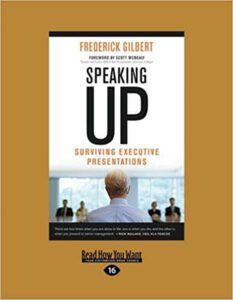
Speaking Up: Surviving Executive Presentations
What you said is so crucial. I have seen it time and again where somebody is a great salesperson and they get promoted to be a Sales Manager, Director, VP of Sales, not even at the C-level suite. They think, “Everyone has to sell the way I have sold.” Everyone has their own style. That alone is an example of just because you got a promotion does not mean the skills that got you there are not the skills that will keep you there.
Let’s take a composite person. A 45-year-old has 10 or 15 people on his team, making a lot of money and doing well at a certain level, whether VP or Executive Senior Manager. They get a chance to go to the C-level. Maybe they have to do it once a year to give a report. They use the exact same techniques they used with their own team. For some reason, they bomb and do not know why. It is because the audience is so different. It can be a tragedy for their career and team. Most of all, even for a product that needs to be funded, we had some people that we had been working with that did very poorly at the senior level.
I started interviewing CEOs to find out what was wrong with it. How come these guys are bombing? What we learned became that book, Speaking Up, and a program that we have been doing now for many years. It is very successful where thousands of people have taken this program. It shows middle managers, even though you are very successful, you are good, and you have an MBA, you’re great. The audience at the top level are different. We thought, “How are they different? What do they want?” We found out things that people can say that will make their career golden.
I will give you an example. The guy I was describing was 45 years old and a head of some big department. He goes into the CEO and the founders of the company. Here is what he or she can do to open up to be successful. The starting line is, “Good morning. I know how valuable your time is. We have 30 minutes on the agenda. I can get through it in 20 minutes.” You are giving me back some time. The second sentence out of that person’s mouth should be, “What I want from you today is a $10 million increase in our budget for marketing in Europe.” They know right up front what we call first line bottom line.
As a Sales Keynote Speaker myself, I know how important that first 90-second opening is. You’ve got to grab people’s attention. What I found works is a story that pulls people in right away, not this, “Thank you for the opportunity. I am excited to be here,” stuff. No one cares that you are excited. We go right into the story. It takes people a while, especially if they are not professional speakers, but just presenting.
[bctt tweet=”Stories energize all of us.” username=”John_Livesay”]
I worked with an architecture firm who was presenting against three other firms on who was going to get this billion-dollar project to renovate an airport. I said, “That opening line goes right into your story.” When I was 14 years old, I saw a drawing and I thought, “What is this?” That is what made me become an architecture buff. They are off and running as opposed to all the trite things, people, and the filler words.
This bottom line is a great soundbite. It is to let people know what you are asking for upfront. Otherwise, they are wondering, “What is to ask here? Where are we going?” I learned that when I gave my TEDx Talk, Be The Lifeguard of Your Own Life, the coach I had said, “What do you want the audience to feel, think and do?” Once we had the answers to that, the talk was built from the back end up in order to get those things. I am guessing you have found that similar type of strategy works.
I would make one suggestion to what you said. This is the thing about starting with a story. At the top level, you have the CEO, COO and CFO sitting around the table. They are making $13 million a year and their hourly rate is absolutely huge. This whole thing started when I was coaching this guy to start with a story and he did. They tore him to shreds and said, “Why are you taking up our time? What is your point? Get to the point.” We found that with the very top level, the stories are very difficult. The bottom line is they want data. If you are going to use a story, it should be extremely tightly focused on a customer experience. They are very numeric people.
A lot of the people I work with are in tech and healthcare. When I speak to that audience, they are convinced that people buy logically and back it up with emotion. I say, “Even the most sophisticated person is buying emotionally first and backing it up with logic.” Just pushing out facts and figures will not change anyone’s behavior. They are not going to remember it.
If I am speaking of an audience of CEOs, I always say, “XYZ CEO said to me or found that this was the number one thing that increased his bottom line. Here is the story to back it up.” Hence, if you have a story that can include a little ROI in it about someone that they relate to, they are a little more willing to go into the story.
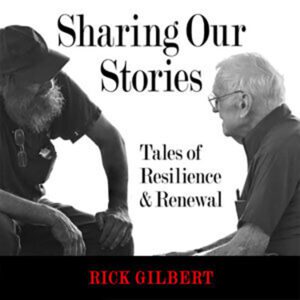
Sharing Our Stories: Tales of Resilience & Renewal
The guy that got criticized, our client, wandered the story, and took too long. They were so, “Let’s go. I have got another meeting.”
You can’t bore people. That is for sure. You have to be compelling. Stories need to tug at heartstrings to open purse strings. How did you come up with this audio book, Sharing Our Stories, about resilience and renewal?
I had retired years ago from the company that I founded, PowerSpeaking. I started a blog right away. Part of my blog was interviewing people. I love to do interviews, plus when I did the Speaking Up book, I had interviewed about 50 C-level executives in Silicon Valley. I had all of this choice of video and audio well-done and well-recorded. I thought, “Wouldn’t this be interesting to pull this together somehow?” A friend of mine said, “Why don’t you do an audiobook?” It popped for me.
I thought, “I love audiobooks. I have hundreds of them on my phone. It would be easy to do. I have all this stuff right here.” It was not easy. I worked on it for a year and a half. I am pulling it together and asking the data, “What does this mean? What is the data telling me?” Finally, it all came together and the title, Sharing Our Stories: Tales of Resilience and Renewal. I am a “spaghetti against the wall” guy. I said, “What is the pattern here?” That was the pattern that seemed to come out of all these interviews.
I ended up using 65 different people in this book. The purpose of it is to look over our lives from childhood, adulthood and elderhood. As a psychologist, there were 1 million different theories about development. I thought, “They are all too complicated. I like mine about childhood and elderhood. Elderhood is easy.” That was the format for it.
[bctt tweet=”At the very top level, stories are very difficult. Typically they want the bottom line. They want data, and if you’re going to use a story, it should be extremely tightly focused on a customer experience, or something like that.” username=”John_Livesay”]
The other thing that was critical about it was I wanted something to be entertaining. I wanted something that would be a page-turner, even though there were no pages. I would hope that people would sit in their cars and listen to this and be late for meetings because they want to find out how the story turned out. That is what I have produced here. It is an amazing contribution.
One of the things I learned from this that I did not know going into it was how powerful stories could be to change lives. It is not just telling our own story. We all like to tell our own stories, but how can I, as a person who cares about somebody else, encourage them to tell me their stories and give them the airtime and space to do it? Magic could happen. Magical things are incredible.
How did you get someone as famous as Gloria Steinem to agree to be interviewed?
I have a friend who runs a writers’ conference in San Miguel, Mexico. Gloria was coming down there to be the big keynote. It is a three-day conference. She was going to be the main event. My friend, Susan Page, told me about this and said, “You should come down and see if you can interview Gloria.” I wrote up a proposal that went to Gloria’s office. There were a lot of people in Mexico that wanted to interview her. I said, “I am interested, but I am not going to interview you about your career and the politics of what you have done. I want to know more about you as a person, what you have struggled with, and succeeded doing.”
They came back to Susan and said, “We want Gilbert to do this interview.” Nobody else got to talk to her. It was just me. You can see the entire interview on my webpage. Spending an hour with Gloria Steinem, she is like the Dalai Lama. I was in the same room with this woman. Here is the thing, John, you will love it if you watch the entire thing. I had watched some stuff of hers earlier that she had done. She had been a tap dancer in high school.

Sharing Our Stories: As a person who cares about somebody else, encourage them to tell their stories and give them the time and the space to do it.
At the end of our interview, I said, “We are wrapping up now. I am wondering whether you might be willing to do a little tap dance for us.” I put on my wide angle lens and pulled back. She said, “I do not know. I do not have any music.” I said, “I have music.” I sang, “You are my sunshine, my only sunshine.” She starts tap dancing in this hotel room. That was the end of my interview. It was more fun. She is a hoot.
There are a lot of takeaways there. One, you figured a unique angle that would appeal to her, so talk about knowing your audience. Two, that personal story of origin and the preparation, having a great closing is also equally important as a great opening and the playfulness of once a tap dancer, always a tap dancer.
I listened to that interview. One of the things that resonated with me was when she gets frustrated, aggravated, or a little down, she is able to remember a story of the impact she has had. She told this wonderful story of a woman who came to her book signing who had been in prison and changed her life. She became a lawyer. That arc of that person’s story energized her. I thought, “How great is that? Stories can energize all of us, even if they are not our story.”
When I asked her about moments that were extraordinary for her, she talked in general terms, like meeting people on the street. I said, “I want something more specific than that.” I burrowed in a little bit and said, “Can you give me a specific example of something that happened?” She told that story about the woman who went from prison to being an attorney and said to her, “I thought you would like to know.” Gloria says, “That keeps you going for months.”
There is a takeaway for the readers. Don’t take the first response someone gives you, whether you are interviewing them or if you are in sales and ask an open-ended question to try and find out what someone needs, and they give you the top line answer. You will understand this as a therapist. It is known when couples come to therapy and say, “Our sex life is in the toilet.”
[bctt tweet=”Active listening is the gold standard for interviewers.” username=”John_Livesay”]
That is the presenting problem. It is not the real issue. The same thing is true sometimes in sales. When you say to someone, “What is your biggest struggle? What is your biggest challenge?” They will give you a top line answer. You need to dig down a little bit like you did with Gloria. “What specifically does that look like or feel like?”
I learned that from Terry Gross on NPR. She is one of my favorite interviewers, and she always digs a little deeper. It has been very valuable for me as an interviewer when I am trying to get people to tell these stories.
Let’s face it. If you are in sales, and we all are selling ourselves all the time, you had to sell yourself to get Gloria to say yes. We need to ask deeper questions and build up some rapport that people are willing to answer those questions.
My background is in Psychology. Being a therapist, one of the takeaways from that part of my life was something called active listening. For an interviewer, that is the gold standard. Instead of trying to tell them your side of the story or direct them in some other way, you listen and say something like, “That must have been a real struggle for you at that point in your life,” and shut up.
I was fortunate enough to become friends with Elaine Gordon, who was married to Tom Gordon at the time, where they wrote Parent Effectiveness Training. That turned into Leader Effectiveness Training and that whole concept of not reacting to what someone says and reframing what you think you heard, so that you are listening to the right question.

Sharing Our Stories: One of the main things is going to be encouraging people to get the people in their lives to tell their stories.
I still use that technique when I coach people because sometimes, after they make a sales presentation, there is a Q&A. You can lose the sale in the Q&A if you are not listening to the question and you give them an answer that they did not ask because you are nervous or you did not hear it. They think they are talking to a politician and get frustrated.
It is like peeling an onion. You said it beautifully that people come for therapy. The sex issue is not the real problem. You start peeling away, but they will only tell you if you show empathy for what they are saying.
Tell us another favorite of the people that you interviewed on that book, another story from there of either how you got it or one of the things they said that surprised you.
One of the chapters is on risk-taking. I have interviewed some iron workers who talk about what it is like being 10 stories up on a 4-inch beam. One of the most interesting interviews I did was with a guy called Don Garlits. Don Garlits is the Founder of drag racing. He started racing after World War II on abandoned airstrips in Florida. I was doing a class at San Francisco State called the Psychology of Drag Racing. We went out to the drag races and interviewed these guys. Here was Don Garlits, the World Champion of this thing, and we got to interview him.
While I was interviewing, he said something had happened to him. Remember, this is danger and risk taking. He said, “I had a 2,000-horsepower dragster. I was coming off the line and two seconds into the thing, the car flew apart.” In those days, the driver sat behind the engine and transmission. When the car came apart, it also took off half of his right foot.
[bctt tweet=”Customize your presentation to your audience.” username=”John_Livesay”]
He ended up in the hospital for a long time recovering. In the hospital, he designed the rear engine dragster. At first, it was a real oddity and then it started winning races. Every time you see one of these dragsters that go 300 miles an hour in a quarter mile, the engine is behind the driver. I feel so proud of that fact that I got to hear that from the master, the guy that made that all happen, Don Garlits.
This concept of resilience and renewal, I have created something called the 555 Method. “Will this matter 5 minutes, 5 hours, or 5 days from now?” It is helping so many people to not stay in the loop where they keep replaying what somebody said that insulted them or hurt their feelings or in sales, you are getting a rejection. You have got to get back up fast.
Speaking of sales, there is a CEO I interviewed from Silicon Valley. His name is Steve Blank. He tells this story about what he learned and how he crashed and burned as a sales guy. He had a master sales guy come with him. When they went into this company, they were going to sell computers. Steve started out by telling them how stupid they were, how great his company was, and how wonderful their computers were. He said, “We were escorted out of the building.” This master sales guy said, “Let me do it this time.” In the next sales, the guy starts talking about the, “How are your kids? How about the high school football team? How are they doing?” Steve is sitting there, “When are we going to get to the sales part?”
Finally, the sales guy says, “I am embarrassed to be here because you guys are so smart. If your management had let you invest in the way that we have, you would have left us in the dust.” The customer says, “Now that you understand that, we are ready to hear what you have to offer.” It was a consultative sales masterpiece. Steve Blank tells this story so well of what he learned from a master sales guy who could understand from the client’s point of view.
I boil that down when I give my storytelling keynote speeches into, “The better you describe the problem, the better somebody thinks you have their solution.” We have time for one more, either story of someone you have interviewed or an overall reason why you would want someone to get the audio book.
[bctt tweet=”People will only tell you their issues if you show empathy for what they’re saying.” username=”John_Livesay”]
One of the main things is encouraging people to get the people in their lives to tell their stories. I am 82, so you can imagine a lot of my friends are getting up there in years. I have two friends who are going down very hard. One is in her early 90s. She is delusional. She has had a horrible life, round-the-clock care. Another guy is in his mid-80s. He can’t remember where he is. He gets lost in his own house, round-the-clock care.
The stories of these people are so sad. Both of them trust me though. I went with my iPhone recorder. It was very simple. I wanted an audio, and sat down with both of them separately. I got the woman who was delusional to talk about her career as a speech therapist in the school district. She spun out this wonderful story about a student that she helped. It was inspirational. Back in her mind is what she has done in life. It was so wonderful for me to be able to get her to tell that story.
It was the same with the guy who was so dimensional. He started talking about being on the swim team in high school. He starts telling these stories and it all comes back and is coherent. It makes them feel good about themselves. Their families love it because they are hearing it. “This is wonderful. This is the Jerry that I knew. This was the Tim that I knew growing up.” I want to encourage people to pull out that smartphone, sit down in a quiet place, use active listening, and listen. You will hear some magical things.
Rick, what is the best way for people to get to your audiobook?
Look for the audiobook, Sharing Our Stories: Tales of Resilience and Renewal. Thanks again, Rick, for sharing your story.
Thanks for having me. It has been fun.
Important Links
- PowerSpeaking Inc.
- Speaking Up
- Sharing Our Stories
- Toastmasters
- National Speakers Association
- Be The Lifeguard of Your Own Life – TEDx Talk
- Susan Page
- Gloria Steinem
- Terry Gross
- Parent Effectiveness Training
- Leader Effectiveness Training
- Don Garlits
- Steve Blank
- RickGilbert.net
- Better Selling Through Storytelling Method Online Course
Wanna Host Your Own Podcast?
Click here to see how my friends at Podetize can help
Purchase John’s new book
John Livesay, The Pitch Whisperer
Share The Show
Did you enjoy the show? I’d love it if you subscribed today and left us a 5-star review!
- Click this link
- Click on the ‘Subscribe’ button below the artwork
- Go to the ‘Ratings and Reviews’ section
- Click on ‘Write a Review’
Love the show? Subscribe, rate, review, and share!
Join The Successful Pitch community today:
- JohnLivesay.com
- John Livesay Facebook
- John Livesay Twitter
- John Livesay LinkedIn
- John Livesay YouTube
Punching Above Your Weight: Taking Client Engagement To The Next Level With Heath Barnes
Posted by John Livesay in podcast | 0 comments

One of the key ingredients to having a successful business is having the right clients. In this episode, Heath Barnes joins host John Livesay to share how he’s going above and beyond when it comes to treating his clients. Heath is the Branch Manager at Cardinal Financial and host of the Mortgages Reimagined podcast. Starting with being a heavy-weight boxing champion while attending Texas A&M, where he graduated with a BBA in Business and Marketing, Heath Barnes has always been punching above his weight. Listen to his interesting journey to entrepreneurship and get tips on treating and engaging your clients to maximize retention and increase referrals.
—
Listen to the podcast here
Punching Above Your Weight: Taking Client Engagement To The Next Level With Heath Barnes
Our guest is Heath Barnes, who shares with us his unique and creative ways to show client appreciation. You’ll want to read to find out some tips on not only how to have a client appreciation event but then how there are multi-levels to keep the fun going and keep you memorable. Enjoy the episode.
—
Our guest is Heath Barnes. He has an interesting story to share with all of you on his entrepreneurial journey. Many real estate agents are struggling to get their buyer’s offers accepted, and many home buyers are frustrated that the loan process is tedious and seemingly endless. I know I felt that way. Heath’s story starts with him being a heavyweight boxing champion while attending Texas A&M, where he graduated with a BBA in Business and Marketing. He has always been punching above his weight. The energy and passion that he exudes for the business he’s in, coupled with his competitive spirit, and are apparent even in his downtime. He has hiked to the summit of the Grand Tetons.
He’s a licensed pilot and a six-time Ironman. He’s a seasoned snowed skier, skydiver, fly-fisherman, sommelier, and even taught himself how to play the piano with a bunch of young kids. He was willing to take classes. Since 2002, he has been a consistent top producer as the Branch Manager for Cardinal Financial, closing over $15 million a year in loan volume.
He’s also the host of a successful podcast called Mortgage Lending Reimagine. Real estate agents love working with him because he works his magic to make their buyers’ offers irresistible. Homebuyers love working with him because the process he has is so streamlined and smooth, which allows them to close on time without the usual stress. Heath, welcome to the show.
Thanks, John. It’s a pleasure to be here.
Let’s go back to your own story of origin. I gave a little bit of the tip of the iceberg there. Maybe start with your days at Texas A&M and how you became such a passionate person about making life an adventure, and then we’ll get into how you got into the mortgage business.
It’s an honor to be here. Going back to A&M, I started at Sam Houston State. I went there because my brother was already there. I didn’t have to stay in the dorm. After two years at Sam Houston, my brother had graduated and I had a girlfriend at the time who had broken up with me and I dropped a lot of classes.
My mom came to visit me and said, “If you are going to make these kinds of grades, you need to do it at a real school.” She made me “move” to Texas A&M. In a way for me to fit in with the fraternity that I was transferring to, I decided to join the boxing team. It was in that endeavor that I found a new talent which was my long reach and dedication to be good at something and I ended up winning the heavyweight champ two years in a row.
That opened up a lot of doors for me. It opened up a door of self-confidence. It opened up a door to a new job at a local bar called The Tap, which is still there at Texas A&M. I became a bartender and my life began to flourish in college. It opened many doors of confidence and meeting other people being a bartender. I love talking about it.
[bctt tweet=”Host a client appreciation party.” username=”John_Livesay”]
My first question around that is how did you pick boxing? It’s not a common sport like baseball, football or basketball. Did you watch somebody on TV? Did somebody take you to a match? How did that get into your awareness?
Our fraternity happened to have a guy that had some experience in coaching boxers. I raised my hand trying to fit in and was dedicated to the workouts, practicing and getting better, which started early in childhood. I was a baseball player. I would spend the summers practicing. I always learned that if you are going to be good at anything, it takes a lot of practice. I knew if I was going to be any good at boxing and not get my face punched, then I would so. I didn’t even know my talent. In my first fight, I knocked the guy out in the first round. There were very few fights in which we got past the second round. Just about every one of my fights was a knockout.
That’s a great analogy there for what you are doing now with mortgages. Almost every one of your deals is a knockout. You also talked about the long reach of competitiveness. You are in a competitive field. I understand there’s a story of a very special relative that you saw in the mortgage business that made you want to mirror that. Sometimes we see a dad and go, “I want to follow my dad’s footprints. I don’t want to do that. My dad doesn’t look like he’s having a lot of fun.” Tell us a little bit about who influenced you to get into the mortgage biz? What did you see that he was doing that you wanted to do it?
It’s funny because it’s come full circle because I rehired my actual Uncle Larry, who got me in the business. In the beginning, in 1999, I was in the mobile home business. I remember going to a closing. In a mobile home business, you have two opportunities when you are getting financing. One is to finance the mobile home, which is called a chattel loan or a regular loan, which is not done by a mortgage company.
The second type of loan is what they call a land home package, where you are financing the home with the land. I was sitting at the closing table and I looked at the closing disclosure. I saw how much money the mortgage guy was making. I thought, “I might be in the wrong business.” I remember my grandmother telling me that my Uncle Larry was in the mortgage business. I called him. He flew down. We had a conversation and the next thing you know, I’m doing mortgages. I have never looked back.
If you had to give our audience a tip about breaking into a field that’s competitive and crowded. I talk about it in terms of a lot of people feeling like they are drowning in a sea of sameness. Everyone says, “Doesn’t everyone have access to the same loans? Isn’t the process the same?” What I found over the years of buying and selling homes, but mostly qualifying for the loan and the offers, there are a lot of nuance and differences in a strategy to put through to get your offer to stand out against all the other offers. I think a lot of real estate agents probably think of you as their secret weapon. Would that be fair to say?
For sure, as far as in this market, which if you are not familiar with, is a highly competitive market, especially if you are a buyer, and getting your offer accepted is not about necessarily having the highest price, but it’s having the right team, whether it’s our experienced real estate agent or a loan officer. Our strategy has been how we remove as many contingencies as possible to separate ourselves, so financing contingency.
The way we take the stress out of financing is by having a good interview with the clients and letting them know what’s going on in the market. The second step is getting them completely through the underwriting process because if you are completely through the underwriting process, the stress of getting the loan goes away. The stress of getting a loan is increased when you have something to lose.

Client Engagement: If you’re going to be good at anything, it takes a lot of practice.
If you are not out looking for a house, there’s no stress of losing something. There’s nothing to lose. There’s nothing to lose in the beginning when you don’t have a home. That’s the time you want to go through underwriting. The old way of doing things in the mortgage business has been you wait until they find a home because you want to make sure that your time is spent wisely that they are going to find a home. We said, “We are going to take it a step further. We are going to take the stress out by moving them completely through that process.” That way, when they go out into the market, there’s no fear about securing a mortgage, and you know exactly what they qualify for, and all the paperwork is done.
Reduce stress for your buyer, and that’s true in any business. If you can make the buying process, stress-free or less stress, then that’s going to make you stand out. We are going to reverse engineer this and then we’ll start at the beginning. You now have a very big group of people who’ve worked with you, trust and like you, and send you referrals. We are going to get to how you built that. What are you doing now to make those people feel seen, heard and appreciated? What did you do that was so timely that I thought was memorable and part of your personality? These are the things that make you stand out against your competitors.
I’m always thanking both the people that refer me business but also my clients. How can I provide an enormous amount of value where they would want to continue to do business with me? We do apply for appreciation parties a couple of times a year. We have made it a habit of renting out an entire movie theater and making it fun for previous clients.
We rented out a theater and we invited our top 100 clients or the first 100 that responded to the premiere of Top Gun. I took it a step further by borrowing my friend Jack Swanson’s flight suit and I bought some aviator glasses. I was fully dressed up for the experience. The look on people’s faces when they came into the theater thinking they were just going to see a movie about the sequel of Top Gun. That was my first experience with it.
Life is all about experience and how you make people feel, even in the stories that you tell. I’m trying to bring them into the experience so that when they leave, they are going to be thinking about me moving forward, especially if it’s going to be a memorable movie. What comes up for me now also is like in life, if you are an entrepreneur, it’s utilization. How do you use everything to your advantage, no matter what’s happening? What’s interesting about this experience was I had a dialogue with the movie theater and I said, “Before you start the movie, what I’d like you to do is stop it so that I can share a few announcements. I got a special treat for everyone.”
All the preparation of making sure there’s a mic and making sure we talk to everyone, and then the time comes. At the beginning of the movie, if you see it, Tom Cruise starts to talk and has a special message. They stopped it after that special message. I used that and I said, “Most of you all don’t know but I’m personal friends with Tom Cruise. That’s a personal message for you all. Thank you all for listening.”
The next thing that happened was I was in the middle of thanking all the people that had attended, the people that made this possible, and the mic went out. I thought, “How do I use this to my advantage?” I said, “I’m just going to continue.” I kept the mic in hand and ended up thanking everyone. I then turned around. I said, “One more thing,” and started out singing, “You never close your eyes.” It was a huge hit because I got out of my comfort zone. Everything inside of me was saying, “Don’t do this. Don’t embarrass yourself,” but I went through with it. My wife was like, “I was proud of you.” It made a big impression on everyone.
Let’s unpack that because it’s such a great strategy that you have a client appreciation party scheduled on a regular basis. What separates you from 90% of the people. What makes you in the 1% of that experience is you took the time to dress up. Automatically people go, “This is fun.” The fun starts before the movie starts.
[bctt tweet=”Reduce stress for your buyers.” username=”John_Livesay”]
You are exceeding the expectations, and then you surprise them by singing, which they didn’t expect. If you are willing to be vulnerable and out of your comfort zone, that’s endearing because that is an emotional bond with people. You feel safe enough with them, and you trust them to not make you feel stupid, and so you are building trust in a very subtle subconscious way.
You did one more thing that is brilliant because I have seen the video, which is you took it a step further for people who are fans and said, “I have got $50 gift certificates for the people who can shout out a quote from the first movie.” Now everyone is immersed in the experience. The audience involvement in a dark theater is tricky and you figured out a way to do it, and people are shouting out the quotes. I don’t know if you consciously did this or not, but what I love about the choice of this movie for you is you are the wingman for the agents and the home buyers.
That’s a perfect brand for you to be in the movie, for you to be identified, especially if you are dressed up in the costume or uniform of it. On some level, people are thinking, “Not only was that fun, but he is our wingman.” You can then email all of them and say, “What was your favorite quote from this new movie? I look forward to being your wingman on the next deal.” It allows you to have some momentum and a follow-up where you are not actually pitching.
I’m going to use that, “I’m your wingman,” and follow up with everyone. I’m going to use that moving forward. Thanks for bringing that to my attention.
It’s my pleasure. When you exhibit some creativity and start giving people an experience, they can then repeat that story. That’s the big takeaway for people, whether it’s a client appreciation story or a story of how you help somebody get a deal accepted in a way that is unique. That’s what generates referrals. For people that are looking for new ways to over-deliver service and things, do you have any structured way of either acknowledging and rewarding referrals or encouraging referrals beyond the, “I appreciate your referrals?”
I was taught several years ago by a coach of mine. I remember when I first got into the business, I didn’t want anyone telling me what to do. I spent the first nine years of my career wanting to do it on my own until I realized that there was no original idea per se. That’s when I started getting some coaching. One of the first habits that they pounded into our heads was to acknowledge people for the action, not the results. For the people that are reading, writing a note is a great way.
It will allow you to stand out like writing a handwritten note, not when the transaction is complete but when the action is given. You are rewarding the action. Anytime a person calls me and says, “I have a friend of mine who could use your help,” they give me a name and a phone number, my next action is writing a handwritten note and then dropping in a little $5 Starbucks, and sending that to them. I’m promoting the action, not the result.
That makes people much more likely to keep it coming because you are like, “If you only appreciate it if the person hires me or uses me for their loan, then the odds are much less.” Also, in a world of everything being digital with texts and emails, to go old school and take the time to send a handwritten note makes you stand out from the sea of sameness. Tell us about your podcast. Mortgage Lending Reimagine. How did you come up with the title?

Client Engagement: It’s not necessarily about having the highest price, but it’s having the right team.
The way I came up with the title is it’s for loan officers. It’s for entrepreneurs. It’s thinking of your business in a new way, rather than a new way of thinking about money or a new way of thinking about how you engage with your clients or a new way of thinking about how you engage with the world around you. For you to be relevant, you’ve always got to be shifting and changing into how you are going to provide value.
That’s the focus as a loan officer moving forward. The one thing that most people have a hard time with is changing. We get set in our ways. The one thing in life that is most predictable is that things are always going to change. They change every day. The more you look at that change and say, “This is happening for me,” and see it as a positive way to move your life forward rather than backward. You’ll be able to reimagine yourself and your life in a different way.
Can you tell us a story of a strategy you used where someone had the cash to make an all-cash offer? After the offer was accepted, you were able to say, “You may not want to have all your cash tied up like that. We can offer some financing. Your offer came through because it was cash only.” The seller is confident that you have all the money and there’s not going to be any contingencies, but maybe you want some of the deductions or there are a lot of other ways going on behind that. I don’t think a lot of people are aware of that strategy. How did you come up with doing that? Do you see a lot of people taking advantage of it?
The way I came up with this strategy, not everything, I came up with. I got it from someone else years ago. In these markets, you have to be more creative and have your offer accepted. Whenever I meet with the client looking at their financing, I’m always thinking, “How do I put them in the best position, not only to secure a mortgage but also to get their offer accepted?” If they have enough cash in the bank, the first thing I always mention to them is to look at submitting a cash offer. There’s a space in at least the Texas contracts that are called special provisions.
You submit a cash offer and this special provision is written in that the client has the ability to change their financing and put more or less money down, as long as it doesn’t delay the closing. By doing that, you are putting yourself at the front of the pack by having the opportunity to either pay cash, which is probably not a good idea in this environment to pay cash, and I will explain why in a minute. You can make sure that you are going to secure that offer. In this competitive environment, you need to be able to be at the front of the pack.
What is wrong with an all-cash offer?
The one thing to think about when it comes to financing your money is where inflation is. Right now, the government says it’s at 8.5%. I tend to think that’s probably the best number they can prove. It’s probably more like 15%. If inflation is 15% and interest rates are 5%, that’s 10% below inflation. That means you want to borrow more money because money’s going to be worth less in the future. You take that extra cash and move it into some type of commodities like another house, gold, silver or something that’s going to hold the value of your money. Inflation is the government stealing your money out of your pocket without you even knowing it.
I have never heard that before. I think that’s very memorable. There are three parts that most entrepreneurs forget in terms of growing their business. First of all, you are not restricted to just helping people in Texas. You can help anybody in the country, correct?
[bctt tweet=”Life is all about experience and how you make people feel, even in the stories that you tell.” username=”John_Livesay”]
Correct. All over the country.
A lot of people don’t realize that that’s even possible. They think, “We’ll have to work with somebody local.” That’s a big a-ha for people. The second part is you have to spend some time attracting clients. You have to spend some time converting them. The conversations you have for why someone should pick you versus another person who does what you do, and then finally, you have to deliver. That’s a lot of time and energy.
Most people get so caught up in the delivery aspect of their job, that they are putting out fires and dealing with details, and then they go, “I haven’t spent any time getting new leads or I’m not having that many sales conversations.” You’ve been doing this for a long time. You are at the top of your game. Do you still spend time cold calling or do you not do it?
Yes, totally.
That’s a big surprise. I know that about you and I was impressed that you do. I want to have you talk about why you still do that? Most people think, “I hate it and I will do it until I don’t have to do it anymore, and then I will live on referrals.” You are like, “I’m going to still keep reaching out.”
It still keeps me sharp in the game. It still keeps me in a creative mode. It still keeps the challenge there for me. I have on my calendar every day one hour of outbound prospecting, where I’m calling people that are already sending me business like real estate agents or calling my previous clients for one hour. I’m calling old leads, new leads or cold calling. It’s the same time every day, every week.
It’s that discipline from your sports background applied here, which is great. When you say calling, I want to clarify, you literally mean picking up the phone, not just sending an email. Those are a lot of things that most people don’t feel comfortable doing. They are like, “Nobody wants a phone call. Nobody answers their phone.” You are like, “No, I’m still leaving a message.”
I’m not leaving a message. If I’m cold calling, I’m calling and I’m saying, “Heath Barnes, Cardinal Financial, give me a call when you have a few minutes. I got a couple of questions for you.” They are calling me and it gives me the opportunity to engage in a conversation. The more conversations you have if you are an entrepreneur, the more likely you are to be successful.

Client Engagement: If you’re an entrepreneur, it’s utilization. How do you use everything to your advantage, no matter what’s happening?
How fascinating that they are like, “What in the world questions would he have for me?” You are asking questions about their needs and how things are going. If you find out something, you could help them with possibly, “Are you frustrated that your offers aren’t coming through all the time. Are your buyers complaining to you about how tedious the process is? I can fix that for you and make you look like a hero to your client.” Now you are having a conversation that people want to have. What’s one quote or a book you would recommend to our readers before we say goodbye that you think would help people in their mindset?
One of my favorite books is a book called Reinventing Yourself by Steve Chandler. I’m reading it for the second time, coaching a friend of mine. One of my coaches is Todd Musselman out of Colorado. He recommended it to me. What was evident in that book is we are always reinventing ourselves. There are so many great reminders about life and how we get to show up. It’s a great book. I love it.
If people want to find out more about you, get a quote from you or find out more about the show, what’s the best way that they could track you down?
They can go to my website HeathBarnes.com, or call me on my cell phone at (832) 771-8194.
Heath, thank you so much for telling us about your story of how you are not only not drowning in a sea of sameness but creating memorable experiences for those people who do have the pleasure of working with you.
Thank you, John. I enjoyed your book as well. Thanks for having me.
Important Links
- Heath Barnes
- Cardinal Financial
- Reinventing Yourself
- Better Selling Through Storytelling Method Online Course
Wanna Host Your Own Podcast?
Click here to see how my friends at Podetize can help
Purchase John’s new book
John Livesay, The Pitch Whisperer
Share The Show
Did you enjoy the show? I’d love it if you subscribed today and left us a 5-star review!
- Click this link
- Click on the ‘Subscribe’ button below the artwork
- Go to the ‘Ratings and Reviews’ section
- Click on ‘Write a Review’
Love the show? Subscribe, rate, review, and share!
Join The Successful Pitch community today:
- JohnLivesay.com
- John Livesay Facebook
- John Livesay Twitter
- John Livesay LinkedIn
- John Livesay YouTube
Be Unreasonable With Paul Lemberg
Posted by John Livesay in podcast | 0 comments

Have you ever tried being unreasonable when running your business? Most people would try to be reasonable and use everyone else’s strategies. By doing this, there’s not much you can do to differentiate yourself from the pack. Learn how to be unreasonable while still finding success in your business. Join John Livesay as he talks to Paul Lemberg about his coaching program that will grant you profitability. Paul is a business coach and author of Be Unreasonable: The Unconventional Way to Extraordinary Business Results. Paul’s goal is to help small business owners and CEOs double or even triple their income. Learn more about his Formula 5 Hyperdrive program. And discover how to trust and work with your intuition. Try being unreasonable today!
—
Listen to the podcast here
Be Unreasonable With Paul Lemberg
Our guest is Paul Lemberg, the author of Be Unreasonable and he has a Formula 5 Hyperdrive way to give you a system to get your business revenue soaring. He said, “Part of what we have to do is realize we need to generate a 2nd sale after we have made the 1st sale. Our intuition is a muscle we need to use and work out on a regular basis.” He helps entrepreneurs become wealthy.
He has consulted with Fortune 100 companies like Cisco, Adobe, IBM, Goldman Sachs, but his real passion is helping small business owners and CEOs double and even triple their profits sometimes growing companies more than 10X. Over the last few years, Paul’s one-on-one small business clients who range in size from brand new startups to companies with around $20 million in sales have profited by more than $450 million in bankable put-in-your-pocket cash, which is what everyone’s looking for.
He has been an entrepreneur most of his life. After a three-year stint as a software programmer in Corporate America, he launched his first company with $3,000 worth of credit card debt and sold it for $9 million in less than three years. He has published three books, including one published by McGraw Hill called Be Unreasonable. He is a speaker and a trainer.
—
Welcome to the show, Paul.
Thank you, John. It is great to be here.
Our mutual friend, who has been a guest on the show, Sam Morris, connected us and those warm introductions bypass so much of our brains that need to filter, question and make a decision, don’t they?
They do, especially as they are coming from you. Not me.
Let’s dive in a little bit to your own story of origin here. You can go back as far as childhood or school. You got into software but nobody probably grows up thinking, “I’m going to be an entrepreneur. I’m going to be an author.” How did that all come about?
I sure did not. My parents were working people, and between the two of them, have no entrepreneurial bone in their bodies. I was an art student. I went to art school mostly because I had ADD, and it was the only way I was going to get a college degree but I forgot. I thought I was supposed to be an artist. I came out of art school and I tried to be an artist, and all that stuff you hear about starving artists is all true. You have to make a decision about whether you are willing to starve for your work and I was not that good as an artist. I had forgotten about why I was at art school. I concluded that it was not going to be worth starving for me.
Somebody told me to become a computer programmer. It seems like I had the mind for it. I was amazingly lucky that I got myself a job at the time because they thought that artists and musicians made good programmers. I ended up with a job. I did that for about three years. I was great at it. I was like, “Programming was a natural gift,” if it could be that way.
[bctt tweet=”Our intuition is a muscle that needs to be exercised.” username=”John_Livesay”]
I did not want to stay in Corporate America. With a guy who is a client of mine, we started a software company that ended up writing software for gigantic worldwide banks. I did that. It was great but we ended up selling that company. It is not as exciting as it sounds. We were basically on the verge of bankruptcy and in the Federal Government about $1 million of somebody else’s money and all your taxes. Don’t ever do that. That’s a tip. Do not ever spend your employee’s taxes on your business.
Rather than going to jail, we ended up selling the company for a whole batch of money, which was a fantastic thing. I had not taken a couple of years off because I had a non-compete. I ended up starting another company doing the exact same thing. We sold that company to a big German bank and through a couple of career changes, I ended up one day, I woke up and the voice in my head said, “You are not doing your life’s work. You would better get busy.” I was like, “Who said that?” All I did was hear that same thing again. It is like, “There is something that I’m supposed to be doing,” and that was helping entrepreneurs.
In 1996, I hung out my shingles to coach. I made the biggest guarantee that anybody could possibly make. Coaches don’t do this, by the way. Coaches don’t guarantee results. I guarantee that you worked with me for a year and you will earn more money faster and with greater satisfaction than you ever thought possible or I will give you your money back. I still offer that guarantee. People said to me, “How can you do that? Nobody does that.” I took this straight out of Tony Robbins. I tapped myself on the chest and said, “I am that good.”
You have to own it, especially for charging something that has a premium price associated with it. We talked before the show about a way you have of bypassing the need to develop a rapport with somebody over weather where they live or whatever. Can you share with us what that is?
I absolutely can. Rapport is not about talking about the things that you have in common with somebody. There is about establishing a bond, which is based on commonality but those are not the same things. I’m a bit of a magician and I don’t mean stage magic. It is like manipulating energy and the world.
What I do is before I’m going to meet with somebody, whether I have met them before or not, I go into a little meditative state and I imagine our connection and our meeting, whether it is on the phone or in person, the warmth and the communication between us and everything are going well. As a sales trainer, when I train people, I say that the most important thing you do is to provide somebody with enough information to make a clear decision.
That does not mean it is going to be yes. It means that clear decision that’s with their best interests at heart. I imagine all of that in my mind happening and I found that when I meet people, I automatically have a rapport with them. This is not a strange thing. This is magic that we build rapport energetically, which is all you ever need to be able to communicate with somebody at that level of depth.

Be Unreasonable: Before going to a sales call, go into a little trance and imagine your connection with them. Provide them with enough information to make a clear decision with their best interests at heart.
I talk about that all the time that literally money is energy and action. People are buying your energy. I remember when I got hired as a keynote sales speaker, the bureau said, “Congratulations. They picked you over the other speakers they were interviewing. They liked your energy.” I thought, “There it is in writing. Rarely is that clear.” You think they liked your sizzle reel, your book and what you said, but they said later to me, “You made us feel good on the call. We figured you would do the same for the audience.”
Even if you are not selling yourself as a speaker, whether you are selling a very expensive tech product or anything, it is still selling yourself first, which is that energy of, “I care about you. I have got your back,” and things like that. You have something here that I’m fascinated about, Formula 5 Hyperdrive. I happen to live in Austin near Circuit of The Americas. That concept is very visual for me. How did you come up with that name and what system is this?
Formula 5 is a system that is guaranteed to allow you to double your business and then potentially double it again if you keep going. People say, “You can grow your business ten times.” I don’t know anybody who has a clue as to how to grow a business ten times, but I do know how to double it and double again, which is about as close to 10X as I want. It is actually 8X but it works like this.
I was trying to create a program that would give people the benefit of coaching without having a life coach and what that meant was that it would have strategies and tactics which produced results every single time that were simple to execute and that it would keep you motivated to keep executing. Those, to me, are the things that a coach should give.
I built a system that was based on five different principles and the strategy is that you make small changes in each one of them and that small changes pile up. If you can make a 5% change and another 5% change, it does not take too many of those to make a lot of money. I found that my biggest failures were my biggest ideas and the things where I was swinging for the fences. I lost $1 million here and I lost something else there.
When I do things, which are incremental, fair and easy to do, you get results if you keep doing them. The five things are simple and they are also obvious. The first one is lead generation. How do you get more leads? I give people simple strategies that are not based in whatever the current technology is, then how do you convert more? Which is not about becoming a great salesperson. It is about testing and figuring out what works and what does not work so we teach that and again, these are easy changes to make.
I like that because it takes away people’s fear of rejection if you are testing and you are not so attached to whether you get a yes.
[bctt tweet=”Ask for the second sale.” username=”John_Livesay”]
You are always testing and you are not committed to getting some BC. You are committed to their clarity and they are making decisions based on their best interests, then we teach them about margins and pricing. It’s shocking how many entrepreneurs go broke because they don’t understand what their margins are.
I teach them enough about margins and then show them how to double their business by making incremental price changes, which is astounding for people. You can teach them how to make the 2nd sale, 3rd sale, 4th sale and 5th sale. You spend all your energy getting a new customer. It is shocking how many people sell 1 person, 1 thing in 1 time. The ones who don’t have rehab programs, resell programs or don’t have second things to sell on. Don’t have upsells and all those things.
The last one is how do you use your assets and your resources more efficiently through things like systemization and prioritization. Every single thing in this program, I did not invent anything. What I invented is the way to put it together and execute it so that you can keep doing this and grow your business by shocking amounts by making small changes. That is Formula 5. It’s Formula 5 because it was a formula consisting of five things. I’m not a race car guy. I did not even consider that until it was pointed out to me. I use that metaphor a lot.
We talked about energetically connecting before we even talk to somebody or meet them. Is there some specific thing that you can help people tap more deeply into their intuition?
Wherever that stuff comes from, it responds well to usage. If you do ask your intuition for some help and your intuition serves up an idea to you. A lot of people ignore their intuition. They ignore it because they are not sure what it is or if they get an idea, they can’t approve it. They don’t act on it. There are two different things going on here.
One, they ignore it but even if they don’t ignore it, they tend not to act on it. I’m not sure where these things come from. I have my own beliefs that they come from way outside of yourself but even if it is your own other than conscious, that serves up an idea to you and you don’t do anything with it. What does that say?
It’s like, “I’m not respected. I don’t need to get this guy any more stuff because he’s not doing anything with it.” On the other hand, if you start paying attention to your intuition, that little tickle in your stomach that tells you not to do business with somebody and then you do and you kick yourself. I should have listened to my intuition. You start listening and you start implementing whether it’s do something, don’t do something or your idea stinks.

Be Unreasonable: The hardest thing for a CEO to do is to continuously re-enroll their team into the vision of the company. CEOs are the ones with the ideas. They’re the ones who provide that visionary energy to the company itself.
I’m working on a new product. I was thinking that product idea was wrong and it took somebody else to tell me, “Your product idea was wrong,” and I’m like, “I knew my intuition was saying this.” It’s like you get the acknowledgment. The more you use your intuition, the more intuitive ideas that you use you come up with.
That is a great tweet, “Our intuition is a muscle that needs to be used.”
It is a person whose advice you are asking for that you are not respecting by not doing anything with it. You can look at that on a very logical level or on a very outer rule level but it is true either way.
You talk about we all have some superpowers. If somebody does not know what their superpower is, is there something you can help them find out what it is that they could count on all the time?
I think it is easier than it sounds. It is like your intuition. There are things that people do and they do well and they keep doing them, but they don’t realize that it is a thing that they are doing. It is the easiest thing to do and the simplest thing to do is talk to your friends who get you and ask them, “What do you think my superpower is?” If you ask ten people that, they might give you five different answers but amongst those ten answers, five of them will start to coalesce and that is the thing that you start to investigate. If somebody says to me, “Your superpower is creating systems for other people.” That is one of my superpowers.
I knew I was good at this. I have been doing it for a long time but it took somebody to say it to me. What they said to me, all the tumblers dropped into place. Somebody said to me one day in full statement, “You get to be brilliant by creating systems and for other people to use profitably.” I was like, “I do that.”
Once you get an idea of what that superpower is, then you go back and look in your history and you will see how many times that is the thing that you have relied upon. For me, all the way back to my software days where I would talk to Wall Street traders to figure out what they did and then I would create these structures for them and I do it now as a coach. It’s a superpower.
[bctt tweet=”Do not ever spend your employee’s taxes on your business.” username=”John_Livesay”]
A lot of people think that being a CEO or running your own company is lonely. There are all kinds of quotes about entrepreneurship. It can be lonely. Even a big company is “lonely” at the top. Is there some role that you think a CEO should be doing that they find difficult to do?
In my experience with my clients, the hardest thing that CEO and owners have to do is continually re-enrolling their team whether it is their core management team or their entire company, into the vision of the company. In my opinion, what a CEO is more than anything else. The CEO as visionaries. They are the ones with the ideas. They are the ones who provide that visionary energy to the company itself. If I ask your typical small company owner, “When was the last time you rallied the troops and shared your vision with them?” It is like, “I don’t have to do that anymore. I did that years ago, we had a big meeting.”
Several years ago is probably not enough. You would probably want to do that at least once a quarter, if not once a month. They can’t understand it and the reason they can’t understand it is they are already enrolled. It’s their vision. They believe and they buy into it. They don’t do anything to make sure everyone else is already engaged. We talk about engagement all the time. Engagement is the thing.
I have an advertising background. If Coca-Cola did not have to keep running ads, they would not. Big brands constantly re-enroll people on their vision and their branding. You have not heard it before but if you don’t keep reinforcing, it goes away. I completely relate to that. Also, another big thing is a lot of people don’t do it as much as they used to, but when I was in Corporate America selling, it was always like interviews, “What is your 3-year goal and your 5-year goal?” All those things and you had to have some answer or they thought you were not serious or a deep thinker. Why do you think long-range planning is a bad idea?
I want to make two statements about this. Number one is I’m not crazy and it is a good idea to have a long-range point of view, which consists of where are you going and what do you want to achieve? Those are the objectives and the goals. The problem is not the long-range goals but the long-range plan itself.
There is a famous quote from a German General from 1800 named Von Moltke. He said, “No battle plan survives first contact with the enemy.” What he meant by that, which is pretty simple, was if you are about to go to war and you put your men, material, cannons, all that stuff and you placed them, that is the best you can do.”
The best you can do is figure out how to deploy your assets because as soon as they say go, the cannon starts firing, smoke is everywhere and they can’t see a damn thing. They have no control over what happens after that. It’s easy if you are an architect, the building does not fight back. You can plan out how to build the building because the building does not fight back.
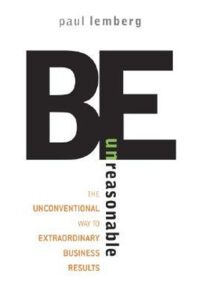
Be Unreasonable: The Unconventional Way To Extraordinary Business Results
On the other hand, if you are a marketer, the customers fight back. In other words, they do their own thing. Your competitors do their own thing. Maybe the regulators do their own thing. There are all these human beings who have free will and they do their own thing so your plans don’t survive first contact with the enemy because no matter what, whatever you think they are going to do, they will do something different.
I can relate to that as a storytelling keynote speaker. When the pandemic hit, that is not in my battle plan. I was like, “I never even had that as a contingency of, ‘What if there were no more live events?’ because it never had happened in anyone’s lifetime.” You think, “I have to reinvent myself and become a virtual keynote speaker, not one that can do live events if I’m to survive, and that is going to require a whole other set of skills.”
I ironically created a whole new set of needs, which was clients asking me, “Can you train our sales teams how to look and sound good on Zoom because they are very intimidated being on camera selling?” That never happened to be needed before. Zigging and zagging is key. A lot of people think that there are some obvious truths out in the world, like nice guys finish last. That’s when I don’t believe in obviously. The other one I think is that people buy biologically and then back it up with the emotion. I said, “It’s the other way around. People buy emotionally and then back it up with logic.” Do you have some truths that you think people believe are not true?
My last book is called Be Unreasonable. The core idea behind that book is being reasonable will get you dead fast. Being reasonable will keep your business in the back of it. All the things that you do to become comfortable are killing you. Another way of saying that is that the comfort zone is extremely uncomfortable because it can’t produce any good results from it. The idea of being unreasonable, every time I hear myself saying, “That is not reasonable.” I’m like, “The second tone is good. Let’s explore that.” Reasonable things are what everybody has done before. That is how they got to be reasonable.
It is fascinating because you will sometimes hear that as a negotiating tactic. Be reasonable, which you are asking for.
There is a thing that goes with that, which is the idea of best practices and people say, “The best practices.” I say, “Best practices are not and they got to be best practices because everybody is doing them. If everybody is doing them, you have no sources of leverage. Leverage comes from doing something which is different.”
If people want to reach out to you to explore getting coached for themselves and their business, what is the best place for them to go?
[bctt tweet=”Your biggest failures are usually your biggest ideas. So do small incremental things until you get results.” username=”John_Livesay”]
They can go to my website, which is PaulLemberg.com or they can reach me at my email address [email protected]. P was the shortest thing I could think of so it’s an easy one to remember. Those are the two best ways to reach me.
Any last thoughts or famous quotes you would like to share?
Not a famous quote but people ask me what my favorite business books are and I talked to them about philosophy, history, popular science, all sorts of woo and spiritual things. They are like, “I meant business books.” “I meant business books because reading business books is useful for gaining tactics, but business books are never going to give you the insight about life that you need to be truly successful.”
I would like to leave people with that which is that the greatest things that you can do in your business have very little to do with business. You learn those things way back in the beginning. The greatest things about business are how you deal with your people and how you provide opportunities for your people, and what you even think your people are doing, working for you. If you understand that, that’s the bones of a high-performance team.
Paul, thanks so much. You have inspired us to think of a Formula 5, as well as ways that we can all be a little more unreasonable in our limitations.
I am on the verge of releasing a new program, which is called Entrepreneur Alchemy, and it’s a program that merges some very hardcore, proven and easy to use business scaling strategies, and merges that with what I call magic. It is corralling and using the energy of the world to drive your efforts inside of all those activities and to give you extra leverage. If people are interested, they should go to my site and sign up for the waiting list. We are going to be launching this thing on the summer solstice. I figured it was a very magical plan. We are going to take the Earth’s energy and pour it into everybody’s business.
Thanks, Paul.
Thank you, John, for having me. It is a pleasure.
Important Links
- Paul Lemberg
- Be Unreasonable
- Formula 5 Hyperdrive
- Sam Morris – Past Episode
- [email protected]
- Better Selling Through Storytelling Method Online Course
Wanna Host Your Own Podcast?
Click here to see how my friends at Podetize can help
Purchase John’s new book
John Livesay, The Pitch Whisperer
Share The Show
Did you enjoy the show? I’d love it if you subscribed today and left us a 5-star review!
- Click this link
- Click on the ‘Subscribe’ button below the artwork
- Go to the ‘Ratings and Reviews’ section
- Click on ‘Write a Review’
Love the show? Subscribe, rate, review, and share!
Join The Successful Pitch community today:
- JohnLivesay.com
- John Livesay Facebook
- John Livesay Twitter
- John Livesay LinkedIn
- John Livesay YouTube