
Exactly What To Say For Influence And Impact with Phil M. Jones
Posted by John Livesay in podcast | 0 comments

 Episode Summary:
Lots of people have a great idea, but they fail to have any understanding of who they want to bring that idea to or exactly who that perfect person might be in the first place. They sit, wish, wait, hope and pray for success as opposed to point themselves in a targeted, directed fashion with the right message towards the right person at the right time. Professional sales trainer and coach, Phil M. Jones, teaches on exactly what to say for influence and impact to close a sale. Phil entered the world of business at the tender age of fourteen. With nothing more than a bucket and sponge, he went from washing cars at weekends to hiring a fleet of friends working on his behalf, resulting in him earning more than his teachers by the time he was fifteen. His career went from strength to strength, as he worked with a host of Premier League Football Clubs to help them agree sponsorship and licensing agreements, to then being a key part of growing a £240M property business. Phil is now on a mission to demystify the sales process and bring simplicity and integrity to an industry where the only thing that seem to matter are short-term results with no thought for the impact on everyone involved.
Listen To The Episode Here
Exactly What To Say For Influence And Impact with Phil M. Jones
Our guest is Phil M. Jones. He’s the bestselling author of Exactly What To Say, Exactly How To Sell and Exactly Where To Start. He had his first business at fourteen years of age. He’s the youngest recipient of the British Excellence in Sales and Marketing Award. Over two million people across 57 different countries have benefited from his lessons and they know exactly what to say and when to say it. Let’s start learning from Phil. Welcome to the show.
It’s good to be here, John. Thanks for inviting me on.
You’re quite prolific to have two separate books. I always like to ask my guest to take us back to their own story of origin and it seems that for you, that might be fourteen years of age.
I’ve been in this game for quite some time. My first business was when I was fourteen years of age. I was knocking on the doors of my neighbors, asking them quite politely whether they wanted their cars washed. Some said yes, some said no. Most asked me how much money I would charge, which I quickly realized meant they were interested providing my prices were fair. I did okay with that little business, so much so that by the age of fifteen I was not going to school quite as often as I should. I remember getting invited in by the said school teachers questioning my attendance saying, “Phil, why don’t you come to school?” My response was simple. It was a question. It was, “Sir, do you mind me asking you a question?” He said, “Yes, sure.” I said, “How much money are you making?” The school teacher refused to tell me at the time, but at fifteen years of age my little car cleaning business was delivering me around £2,500 a month at that time, around $4,000 at that moment.
The reason I didn’t go to school is I had customers that needed servicing, staff that needed direction. I’ve always had this entrepreneurial gene in my body. I built a number of businesses through my teens. At eighteen, I had a dilemma. An offer on the table from one of the most prestigious universities, but I wanted to get my education in the field. The next few years had me working through some nice corporate roles. I was the youngest Sales Manager for a business called Debenhams Department Store. Head of Sales Training and Store Manager for one of the largest furniture retail groups called DFS Furniture Group, a former Head of Retail and Commercial Director for two Premier League soccer clubs. I went from there to build a property business that turned over £240 million at its peak.
In 2008, as the world started to change with this wonderful economic crisis that was going on at the time, what I was seeing was lots of lots of businesses that either we’re doing something good or good at doing something and failing to get the results I knew they were capable of. Struggling in that recession time because of the fact they couldn’t sell anything. What I started doing was delivering small sales training programs to help out the local business community. Ten people in a workshop became twenty people in a workshop, became 50 people in the workshop became, “Can you come deliver this to our sales force?” became big companies coming on board, became first book. Ten years on from now, I’ve written six bestselling books, spoken all around the world and still wondering when I’m going to figure it out what want to do.
The thing that jumps out when I was hearing you talk about your background for me is the soccer aspect of it. I’m curious, if there are any life lessons, do you look at the sales playing field like a soccer field? Are there any lessons from soccer that you apply in your talks and your workshops?
None whatsoever. The only thing I think about, and this is probably relevant to a pitching point of view is when you study those that have been super successful in the world of any sport and then in particular soccer is those who have achieved the best of the best always have ratios attached to their numbers. An example of which is a guy called Alan Shearer, one of the greatest Premier League soccer players of all time. He’s won the Golden Boot, as in most goals scored in the season, more times than anybody else. In his best ever season, his shots to goals ratio was 10:1. Lots of people we meet in the world of sales or when they’re pitching things are saying things like, “I tried three times, it didn’t work out. I tried five times, it didn’t work out.”
[bctt tweet=”Enthusiasm is a catalyst toward decisions” username=”John_Livesay”]
The best of the best of the best have to try ten times to try to get one goal. Better than that also is what did Alan Shearer need to be able to do to score, what he needed to be to be able to take shots, he needed the ball. In the world of sales, our ball is our prospect list, and it’s who we are pitching towards. Lots of people have a great idea, but they fail to have any understanding of who they want to bring that idea to or exactly who that perfect person might be in the first place. They sit, wish, wait, hope and pray for success as opposed to point themselves in a targeted, directed fashion with the right message towards the right person at the right time.
I love that concept of measurement and it’s not just to have a goal, but it’s how many sales calls are you making? How many of these are your closing? Which helps get people’s mindset wrapped around not burning out? If you realize it’s going to take one out of ten shots in sports and it’s going to take one out of ten maybe in what you’re selling to get the yes, then it helps people realize, “I’m only an eight so I have to keep going.” That mindset of an athlete and the mindset of a sales athlete are important and you certainly have that down. Let’s jump in because you not only have one but two books out and another one on the way.
The new one is finished and it launches in October 2018. That one comes together and brings the trilogy to complete.
I’m going to ask you if someone is saying to themselves, “Do I want to start with What To Say or do I want to start with How To Sell? Where would you have them start first?
The third book is probably important to be able to bring into play here, which is called Exactly Where To Start. If you’re wondering where to start, that may well be the place. Let’s look at what all three of them are. Exactly Where To Start is a book to how to turn your big idea into reality. If you sat there thinking, “I’ve got this great product idea, this great service idea. I’ve got something I want to launch as a new arm to my business,” getting that blueprint for success right in the first place is more important than saying, “How do I drive it fast?” Take that race car analogy is, “Before you learn to drive the race car, you need to have a race car.” Building something that works on paper, getting an idea launched and out the ground is probably the place to start if you don’t have an existing business.
If you have an existing business in place, you can probably look at this either way around. For people finding my work the first time, the way in which they’re written is probably the best order. Read Exactly What To Say because it gives you some instant wins, some quick takeaways, but if you read it and you read it right, you’re going to be like, “That was super smart and it was crammed into a short read and it was something that was no fluff, but there was no backup to it.” There was nothing like, “Here are all the articles, all the investigations and all the experience as to why these things are true.” It’s jus, “This is true. Do this. This is how it works.”
For people that then want to back that up with some more sales psychology, they want to back it up with some more understanding of still straight talking principles, then read Exactly How To Sell. If you feel you know nothing about the sales process first time round, then flip those two around, start with Exactly How To Sell, understand the principles of sales and then Exactly What To Say becomes the sprinkling on the top of the cake that says, “How do I make the system run faster?”
Let’s start with Exactly What To Say and it’s the magic words for influence and impact. Who doesn’t want some magic words? One of the big things that a lot of people struggle with is realizing that there are two types of people that you talk about. You talk about this person that’s a professional mind maker upper and that some people as you talk about here leave their professional success in the hands of others. There are some people who judge something before they’ve even tried it. This constant awareness of who you’re talking to and should people adjust the words that they’re saying based on who they’re talking to is my question?
We should adjust the words that we’re saying depending upon the outcome that we want to achieve. When I talk in terms of the outcome that we want to achieve, it might not necessarily be the final outcome. This is a mistake that lots of people make when they’re trying to pitch something is they want to get from A to Z. In a conversation, even if it is a one-sided conversation in the form of a one-way communicative pitch, it still needs landing points and checkpoints to say, “What I want to do is I want to provide this piece of evidence and then this piece of evidence,” where the sum of all those pieces evidence mean, “Of course, they’re going to choose me. Of course, they’re going to do what I ask.” John, you know friends who have invited somebody to marry them? On a scale of one to ten, with ten being somewhere near certain and one being, “I don’t know whether she’s going to say yes,” where do you think most of those people are on that sliding scale of one to ten when they ask the question, “Will you marry me?”
I would say nine and a half. Everyone I know, male or female, depending on who’s doing the asking because we live in a whole different world now, that you’re 95% sure you’re going to get a yes when you went and ask the question, especially in front of a bunch of people.
Somewhere near certain, maybe a niggle of doubt in the back of your mind, but you’re somewhere near certain. What we should be looking to do is to find that same level of certainty before we invite somebody to invest in our idea, buy into our product or service, to be able to move forward with us in a long-term relationship. That same level of certainty should come before the big ask. That’s what we should be looking to be able to do with the evidence that we build through our pitches.
One of the phrases you have in Exactly What To Say is, “I bet you’re like me,” and that phrase allows people to get from being on opposite sides of the table to being on the same side of the table, if not physically at least psychologically because you’re building rapport with that phrase. Would you agree with that?

What To Say For Influence And Impact: Find a way to get anybody to agree with anything you say.
What you’re looking to be able to do is you’re looking to find a way to get anybody to agree with anything you say. Providing you’re reasonable, if you say, “I bet you’re a bit like me,” and then follow that up with a reasonable set of circumstances, you can gain a piece of evidence. “I bet you’re a bit like me, you like to work with a local organization and you far rather prefer to support local, homegrown talent than you would to work with somebody from the other side of the country or the other side of the world.” If what I’m going to do is to present the fact that we’re a local company, I’ve already got the evidence and the agreement, the fact that given the choice they would prefer to work with a local company.
One of the mistakes I see people making often when they give a pitch to get a new client or even get a pitch to get their startup fund it is not planning a good closing. You and I are both keynote speakers so we know how important a good opening and closing is. Most people think, “I’ll just end my presentation or my pitch with, ‘Do you have any questions?” I cringe every time I hear that. You at least have given them a new way to phrase, “If you’re going to ask for questions,” whenever. “What questions do you have for me?” which implies you’ve got to have something there.
It’s more than that as well. If I finish a presentation with the words, “Do you have any questions?” the undertone and psychology is I expected you to have questions. If I say to you, “Do you have any questions?” and you don’t have any questions, a little voice inside of the head says, “What did I miss? What have I not caught here?” It’s an activist, a catalyst, a breeding ground for objections like, “I need some time to think about it.” What you’ve done is you’ve suggested to them that they should have had questions to ask. You’ve told them you don’t believe you’ve given them enough information to make a decision, if you’re saying, “Do you have any questions?” Rephrase that to, “What questions have you got for me?” What you’ve got is you’ve created path of least resistance is for them to come back and say, “No questions.”
If they say, “No questions,” it means they’ve got enough information to make a decision, which means that you’re welcome to ask them for the decision. If you’re looking to be able to invite somebody to take the next step, then that’s all we need to do, is to invite them to take the next step. A close in a pitch environment isn’t this big, “Shall we go for it?” It’s inviting them to take an action that they could only take, had they decided they were going to go for it. It’s an invitation formula to take the next step.
Let’s jump into the other great book, Exactly How To Sell, which is a sales guide for non-sales professionals. If I may be so bold, everyone who is a sales professional should also read this because part of being a good salesperson is like an athlete or an actor is keeping up on your training and skill set. Even if you think you don’t need this, I would like to invite all the readers to reconsider that and say, “I think I might.” The thing that jumped out at me having had a sales career for many decades is where you talk about making the moments count. There’s a lot of great things out there about instead of eating a bagel or a muffin, eat this. Instead of eating pizza, eat this. You’ve done it in the way of talking about the problems. My whole philosophy is the better you can explain the problem to a client, the better they think you have the solution. You do a deep dive into four or five things that we should say instead of this. Instead of saying if, what should I say?
Instead of saying if, if you say the word when, then what you do is you create a vivid image. Think about the example. If I’m to say to you right now, “If you’re not careful, the cup of coffee in front of you is going to fall all over your keyboard.” Your little voice inside your head’s going to say, “It won’t fall. I’m careful.” If I say, “When you turn around too quickly, you’re going to knock that coffee cup, it’s going to ruin your keyboard.” You cannot help but see a visual image of your keyboard covered in coffee, which means that if I can say, “Here’s a mug with a lid on it,” that means that when you knock it over, it doesn’t spill on the keyboard, you’re more likely to be able to move forward with it.
[bctt tweet=”Show Me Your Know Me” username=”John_Livesay”]
The takeaway there is using the word when paints a picture. The word ‘but’ comes up a lot. “Can you do this for us?” “Yes, but,” and your whole philosophy is replacing the word but much like they do with improv with the word and.
What we do is we now create something where all things are true as opposed to negating the thing that was said prior to it. If I’m in a conversation with somebody and I say, “I hear what you’re saying. I agree with the points that you’re making but,” the second I’ve said the word but, what I’ve said is, “Everything you’ve just said is not true.” If you’re saying, “I hear what you’re saying, and I agree with the things that you’re pointing out to me and we’re both in agreement with this and the most important thing is,” then what I can do is shift the conversation and bring everybody with me.
Here’s a big one. It’s always shocking to me when the client will say, “How much does this cost?” We have the ability to reframe that with a different phrase, which you would say would be?
I would swap the word cost for investment. Let’s think about this with some pain, is four letter C words are typically not good to use. How do you feel about the cost in your life? A cost is a bad thing. If you understand what costs are, it’s money out and nothing back. A cost brings zero returns. If we were say in any other set of circumstances, “It costs me,” we would be describing a bad set of circumstances. It was something that left a pain on us. The thing that we’re looking to better provide to them, whether it is some form of involvement into funding a startup, whether it is them buying into a product or service. I’m guessing that thing is going to bring some returns. If that thing is going to bring some returns, it isn’t a cost, it’s an investment. We label it the right way around. The money is easier to spend. It’s easier to spend money on an investment than it is to spend money on a cost.
We’re having a collaborative conversation, they’re on the right track and they say, “When we are working together, X, Y and Z is going to happen,” and your suggestion is instead of saying the word we, we should say, you.
We should say you. We should swap everything that is we focused to you. Let me give you the biggest example of this in the world. In every proposal, every pitch document, every company website that I see, more often than not, what I see is, “We this, We that, We the other.” “We pride ourselves on our customer service. We founded in 2004. We have an experienced team of professionals,” you quite literally we all over your customers. Flip that thing around and what we should be saying is, “Choosing us means that You benefit from over 40 years of experience. What you find from being a customer of ours means that You get the benefit of being able to plug into this, this, and this.” Instead of it we, we, we, it’s choosing us so you. What we also do is we activate the sentence. We put them in possession of the service or the product that we have in their mind’s eye, which means that we move it from a future conditional tense and we bring it towards being an active and current tense.
Some people would be like, “Yes, we know we’re expensive but,” there are two noes there. Let’s say, “Yes, we know we’re expensive,” how would you suggest people reframe that?
Before I jump into the reframing, answer me this question. Do you like expensive things?
No.
I would also challenge that sometimes I believe that would be true.
I like them, I don’t know that I can afford them or want to spend. I’d like to have an expensive car.
Expensive restaurants, suits, shoes, watch, jewelry. In many sets of circumstances, the word expensive is something we’re remarkably proud of. Where it is in scenarios that we’re proud of is when we’re talking about a premium offering. If we swap the word expensive for premium, what we end up doing is we talked to the right side of the brain that considers expensive a good thing as opposed to expensive a bad thing. What is it that truly makes something expensive? The only thing that makes something expensive in my mind is what it’s being compared to. Is a Rolls Royce expensive? Not if you’re shopping for a Bugatti Veyron, it’s not. Until you can find a comparison, the label of expensive is only in relation to what it’s being compared to. If their first offering is the fact that this is an expensive product, we can reframe that it’s a premium offering. What we’ve done is we’ve then allowed them to be able to judge this as not do they or don’t they want the offering, it’s can they or can’t they afford it. That’s a different thing.

What To Say For Influence And Impact: It’s easier to spend money on an investment than it is to spend money on a cost.
When somebody sees something as expensive and the problem is that they cannot afford it, there’s not a great deal that we can do to change that. If you’re looking for $2 million worth of funding and somebody could only put $50,000 in and that’s all they have as disposable liquidity, I don’t care how good your pitch is. Somebody doesn’t have the means to be able to pay, then the game is unfortunately over and it may well be too expensive. However, what we’re looking to do is to build a premium offering, we’re building a premium company, we want to bring on board premium people. All of a sudden that requires a premium level of investment.
On the flip side of expensive is cheap. I don’t think anybody ever usually refers to their offering as cheap. However, the client might say, “We’re looking for the cheapest solution.”
Client says, “Have you got anything cheaper?” Sometimes though, even sales professionals in organizations say, “I have got something here for you. It’s a little cheaper.” The trouble is there would never be an ad agency that was putting a campaign together that used the word cheap in any of the slogans for a company. It’s not going to be the thing that reinforces a conversation the way that we would look for. People do talk about things like budget. Budget would be a way of being able to say it’s a budget offering, but I don’t like that on a personal level. What budget says when you think about the real meaning of the word is that’s the sum of money that’s been allocated towards spending on this. That isn’t what we’re looking to better create as a label on this. We could say that it’s a basic offering because what it is, is without all the bells, whistles and the frills or we could say it’s a value offering.
That gives you what you need, so you’re getting maximum value. If you don’t need all the bells and whistles, that’s just for you. A lot of people are always saying, “The problem we see out in the marketplace that we’d like to solve is this.” What’s your pain point? All those kinds of phrases, it’s too direct. It’s not conversational.
How could you ever answer that question? If somebody says, “What’s your pain point?” Put yourself on the receiving end of it or, “Talk to me about your problems. Why don’t we sit down and talk about your problems?” You’re like, “Screw you. I don’t want to talk about my problems.” In fact, if you ask somebody to describe your problems, you’re going to win about as many friends than saying that somebody has an ugly baby. It’s not going to play out well. What a problem is is a head to head conversation.
Think about the definition of a problem, is about you saying, “I can solve this. You’ve got this,” and then the other person has to wholeheartedly own up to the fact that this problem is all on them and that you are the Holy Grail and the Savior. That’s a big ask on both sides of that conversation. Flip the word problem for the word challenge, now it’s not head-to-head, it’s side–by-side. This becomes something that we can overcome in partnership, in collaboration together, which can have some long-term success where both parties can admit to indifference. Both parties can admit to the fact they’ve got imperfections and both parties can move forward, collaboratively together merely by swapping the word problem for challenge.
The final one is when you say to somebody, “When I sell you this car, when I sell you this product, when I sell you X, Y and Z, you’re going to be happy,” or whatever their promise is.
This is a general shift in everything. You’ll see undertones of this through all the examples that we’ve talked about. We should be shifting when I sell to when you want. When you create that same thing we talked about earlier where instead of creating a future conditional set of circumstances, we create an active, current set of circumstances. What we’re also doing is we’re removing all of the We, we’re shifting into the You. What we shouldn’t be saying is, “When I get your investment, what I’m going to do is this,” it’s, “When you choose to invest, what you’re going to find is it’s going to allow us to be able to do this, which means that what you’re going to then have is a closer step towards this, which then means that what we can do.”
We’re shifting the entire interest into talk about their interests and not yours. In every conversation that you’re looking to have, we’re going to create freedom. It’s not black and white. We’re looking to be able to enjoy the shade of gray in the middthe le. We’re looking to allow the other persons of color in between the lines, yet we formulate the lines. The feeling, the undertone in the other person throughout the entire conversation is, “Show me that you know me.”
[bctt tweet=”We vs You” username=”John_Livesay”]
The biggest challenge I see salespeople having is closing the sale. The reason they can’t close the sale, usually it’s because they can’t overcome the objections. You tackle this in your chapter about how to negotiate like a pro and overcome these objections. What I want to double click on, Phil, is dramatize your idea as a way to negotiate like a pro. Can you explain that for us?
People like big ideas. Enthusiasm itself is a catalyst towards decision. If you cannot bring the outcome that you were looking for somebody to move towards or away from, to a position that is larger than life, yet still unbelievably true, then the chances of you moving that person towards that thing remain into the realms of being rational and being made under the purpose of logic. We all know that the majority of decisions are made on emotion over logic. Emotion always comes first. Something has to feel right before it ever makes sense.
When it comes to whatever our idea is that we’re looking for somebody to be able to move towards, then what we need to do is we need to bring the noise to it. We need to make it into a full feature length production. The dramatization needs to be the very best version of reality. I’m not saying tell lies. I’m not saying to be able to bring in any mistruths. I’m saying what we should be able to do is to polish the truth in the finest possible ways so that the thing we’re asking somebody to move towards or away from is something they’re excited about. They feel enthused about. They feel like a catalyst that kicked off and it’s the thing they want to be a part of.
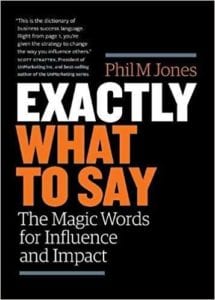
Exactly What to Say: The Magic Words for Influence and Impact
You talked about if you want different results and to be seen different from your competition, which is important that other not in this commodity space, that the real secret to all of it is we all have to start behaving differently. That is such a great way to end your philosophy and this episode. I’m going to ask you if people are like, “I get it, Phil. I need to behave differently,” is there one thing besides buying your books Exactly What To Say, Exactly How To Sell that they should be doing to behave differently?
They need to look at everything from the viewpoint of the consumer and say, “What am I doing to create an experience here that is demonstrably different?” If they want to take one point in time that they can do something that is demonstrably different, it’s the moment in time that is before the consumer gets to be the consumer. It’s the moment before the moment. If you are meeting somebody as a prospect for the very first time and you’re looking to be able to pitch to them, what can you make happen before you get into that first meeting? That would be the number one biggest takeaway that could influence your conversion rates in first meeting is to say, “What can I do to start the meeting before the first meeting happens to give me a fair advantage ahead of everybody else?” That means I shift the start line further forward by starting the relationship with the other person way before everybody else.
You’d go into all kinds of examples on how to do that, whether it’s reaching out on social media or something like that. If anybody wants to hire you, obviously, you’re hugely successful as a speaker. I definitely want to recommend that, but as far as following you on social media so we’d know when to buy your next book?
PhilMJones.com, from the site there you can splinter out to any one of the social channels. I’m pretty active across all of the major platforms. You can plug into the blog. There are loads of free content. You can stay up-to-date with some of my movements. I’d be delighted to hear from anybody that’s taken something from the interview, chose to put it into action and found a way of making it work for them.
Thanks so much for being on the show, Phil.
Thanks for inviting me. It’s great to be here.
Links Mentioned:
Wanna Host Your Own Podcast?
Click here to see how my friends at Brandcasting You can help
Get your FREE copy of John’s latest eBook Getting To Yes now!
John Livesay, The Pitch Whisperer
Share The Show
Did you enjoy the show? I’d love it if you subscribed today and left us a 5-star review!
-
- Click this link
- Click on the ‘Subscribe’ button below the artwork
- Go to the ‘Ratings and Reviews’ section
- Click on ‘Write a Review’
Pitch Secrets From Top Investor with Vic Pascucci
Posted by John Livesay in podcast | 0 comments

 Episode Summary:
—
Listen To The Episode Here
Pitch Secrets From Top Investor with Vic Pascucci
Our guest is Vic Pascucci, who is the Managing Partner at Lightbank in Chicago. He’s been a venture capitalist with over nineteen years of professional experience including Fintech investing and he has an amazing background with Fortune 130 companies and early-stage ventures. He’s really big in corporate strategy as general counsel. His specialties are Fintech and consumer. He’s got over $650 million in venture capital in M&A transactions. Welcome to the show, Vic.
It’s great to be here. I appreciate it.
I like to always ask my guests to take us on their own story of origin. Are you from Chicago? Did you dream of being a venture capitalist when you were in high school? How did this happen to you?
I think in high school, I dreamed of being in Chicago. Growing up as a kid in Cleveland, I became infatuated with the city like this although I didn’t get accepted to any colleges around here. Once I started working, I became infatuated with becoming a venture capitalist. Just like everything else, nineteen years later, you have an overnight success. When it comes to my career in venture, I like to tell people when they ask how did I get into venture, “I did it in a completely non-traditional way.” I fought, punched, kicked, kneed, elbowed and scrapped my way into it. I didn’t go to school in the right part of the country. I don’t have the right degree. I didn’t work for the major consulting companies. If you look at most venture capitalists, they have this punched pressed resume of Ivy League, consulting startup, went to the right country clubs, and worked their way up. I’m speaking broad-brush just to make it more exciting, but if you look at most people’s resume in venture, that’s what they look like.
[bctt tweet=”What is your unfair competitive advantage?” username=”John_Livesay”]
I started my career as an attorney, which a lot of venture people do. I started as a trial lawyer. I was trying cases right out of school. This is the early ‘90s to mid-‘90s and I was going to court every day and just was tearing things down. I was a trial lawyer. I would go and beat the hell out of everyone, witnesses, statements, and I’ll just destroy. I’ll put on a bunch of drama in front of a jury, go to win and move on. I noticed all these brilliant people around me that I meet, they were in technology. The way I look at it, they were building things every day. They are building technologies, building companies.
I had a midlife crisis in my mid-twenties, “How do I want to spend my life? Building or destroying?” The only way I knew how to get into venture from that standpoint was to teach myself how to do technology law, teach myself about corporate finance, and start my own law firm that did those types of things. From starting my own law firm with no clients, this is in the late ‘90s, beginning of 2000, so after the first technology crash. I was starting a firm with no clients, focused on technology companies. Building that from no clients, no business, to enough work to keep five lawyers busy. One of the guys I was working my ass off to get his business finally said, “I’m not going to give you my business, but I will give you a job as my first general counsel.”
Up into that point, I was doing a bunch of advising on venture and finance. I have always loved the venture side of things, representing some financiers, representing the State of Illinois for their seed stage investing. Before I knew it, I was out there raising money, managing teams. Once I got inside the “the belly of the beast” on the startup side, I loved it. From there, I progressed from one software company got bought by another. I ended up in Texas where I got a job. I sold the software company, then end up with a job with a Fortune 130 company which was the completely other end of the spectrum, working in this huge 25,000-person company. It was highly regulated with all these processes, completely conservative and conventional. I came in as the young guy that was supposed to represent their CTO, CIO, and CISO.
As their lawyer, what I’d see are deals that come across their desks. They would be an early adopter for desktop virtualization or security or some internet-based business. I just kept forcing them to say, “We should do deals with these companies.” They say, “We are.” I’m like, “No, you’re not. You’re just buying stuff. We need to invest. We’re going to rely on them. They’re going to rely on us. The best way to align is by investing.” They said, “No, we don’t do that here. Shut up. You’ll get fired.” After breaking that ice after a couple of years, I turned around and fast forward a couple of years, I’m managing a $330 million venture fund for them. It’s a top performing fund. We have a bunch of IPOs. We have a bunch of acquisition exits and a really active pipeline. That started it all officially. Throughout the course of those investments, I was able to meet my partners here, Brad Keywell, Eric Lefkofsky, this fund that they had started. They traded some deal flows, traded some pings and deals on sectors, and then a couple of years later when they were ready to bring in someone else to manage and run this fund, it’s how I got here.

Pitch Secrets: People just assume that all teams have great relationships, but that’s not the case.
That is quite a journey. I think that there must have been some skills around storytelling being convincing as a trial lawyer that has helped you on your career path because you obviously had to get other lawyers to join your team when you were starting your own firm and then getting people to engage with the vision of other startups.
Getting them to accept my bullshit, specious legal arguments in front of them, it helps to tell when people are telling a story with passion versus the people are just posing in bullshit. When it comes to entrepreneurs and pitching, there are the big picture things I am looking for and then the micro. The big picture, I’m looking for that compelling visionary that truly believes that they’re doing something bigger with this company. When I say something bigger, “I don’t want to sell more loans. What I’m trying to do is sell for the financial security for families everywhere because their incumbent banks won’t take care of them.” I need people to see something bigger and I need them to communicate it and tell that story in a compelling way.
That storytelling capability, I need to know that they’re exceptional at because they need to be able to inspire people to come work for them because I invest at the earliest stage of startups. I have the seed and Series A. These companies go through amazing ups and downs. They’ll face death and go out of business almost on a monthly basis. Unless you are that inspiring leader that can keep people going in the good times and bad, you’re not going to be able to do that. It starts with how well can you pitch. Not only do they need to be convincing me and their employees and their partners, but they’ve also got to convince the later stage investors. They’re going to be the type of person that can tell a compelling story to them. Get those people to part with their funds and invest in the companies, and give them the understanding that this is an incredibly competitive business on both sides. Both with VCs like myself trying to get deals, but also entrepreneurs pitching venture capitalists.
There are hundreds and thousands of deals we’re looking at. What is it that’s going to help them stand out and are they able to tell that story? Storytelling is a critical part of things. On the more tactical side, what I look for in every pitch and entrepreneurs are actually really good at doing this, they’re actually pretty blatant about it. I want to see an unfair competitive advantage. “Why are you going to win versus everybody else?” Tell me, “Why you? Why this company? Why this team? Why?” Unless they can articulate that, then I know they’re not really going to have what it takes to get through. There are so many deals, so many opportunities, so many people chasing financial services or banks or this and that and the other consumers.
Some of that unfair advantage could be a distribution channel. It could be a technology architecture. It could be the team itself in their relationships. It could be their approach. Something has to be there. I invested in Coinbase back in 2014. Those guys were really clear. Fred Ehrsam was like, “Here’s my competitive advantage. We have the best UI. We have more people. We are the biggest Bitcoin company in the world right now. We have the power law of scale on our side and then here’s our roadmap of how we’re going to take that and expand it.” It was clear. They did have an unfair competitive advantage at that point.
I love that you spelled out what the unfair competitive advantages are because so many people will think, “Is this one or is that not one?” It can be something as basic as a distribution channel. A lot of people have Uber on their phone, maybe they’ll do one other one like Lyft, but they’re probably not going to do a lot of other apps. That’s a distribution channel example. When you talk about the relationships that the team has, I think that’s a really interesting angle to take a look at. A lot of people just assume that all teams have great relationships and that’s not the case. Especially if you’ve got really great advisors who also have great relationships who was just part of your team to not overlook.

Pitch Secrets: I’m getting people to engage with the vision of other startups.
Through that storytelling, are they able to bring on great advisors? Through that storytelling, are they able to keep the relationships they have? We just invested in a company, it hasn’t been announced yet. It’s in the legal tax space, bringing automation to the legal field. This founder, this is the second time he’s doing something in that space. He’s got connections throughout the industry. It’s not exactly what he did before, but similar. His people on his team, they worked with him in the past. Then when we mapped the marketplace as to where his technology fits and where it’s going to go and what is his distribution channels, the people he’s going to rely on are the CMOs, the CTOs, the EVP of sales and distribution. All these were major channel partners that he’s going to rely on to go to market. You map it out, you see it and there’s the unfair competitive advantage.
I love that you paint the picture that once you explain what your unfair competitive advantage is, then here’s the roadmap of how we’re going to use that. It’s the next step of connecting the dots for people to really understand it. Sometimes an unfair competitive advantage can be traction that the competitors don’t have. It could be the technology, but also even if it’s just something that is so complex and needs a lot of SCC requirements around it and you figured out how to do that and that’s a barrier to entry to competitors, any of that is considered an unfair competition.
It can even be your subject matter expertise. There’s a company we invested in that I’m on the board of, Clearcover. It’s championing the concept of incidental insurance. I’ve been in insurance and Fintech for a while and everybody comes in to pitch with, “Incumbents are slow. They’re stupid. They don’t have the technology. It’s a huge market and I’m going to win.” Kyle Nakatsuji, on the other hand, has been in insurance for ten plus years. We walked through the entire regulatory roadmap of how he’s going to get his products approved in each of the 50 states. How he’s going to establish the laws of adjustment expense ratios. How is he going to run the rate combined? What is going to be his underwriting factors? His unfair advantage is one, he’s an awesome entrepreneur. Two, he goes deeper on this space than anybody else out there.
Here’s another important qualitative aspect because at the early stage, it’s truly a qualitative game. You’re betting on the non-tangibles because it’s early. We all think we know where these companies are going to go, but at the end of the day you don’t know how the market’s going to react, competitors, regulations, anything like that. For me, when I’m looking for an entrepreneur, you need to see that level of grit. There’s got to be that hustle, that grind and grit because despite what you read in WIRED and TechCrunch and everything else, startups are not fun and glamour. You’re in the trenches biting it. Are these the type of people that at the first sign of difficulty, are they going to turn? Are they going to give up?
[bctt tweet=”Can you tell a great story when you pitch?” username=”John_Livesay”]
I’m always looking for those people that are hustlers, they’re grinders. Are they going to grind it out no matter what? Are they going to see what’s going on in the market and see what’s going on, make the necessary pivots, and also hold their ground when it’s time to maintain those visions? The entrepreneurs, that it was too easy for them or they have layups or they were spoon fed a bunch of opportunities. They look great on paper but again and again, you can stand back and just watch flame out after flame out. We’ll always bet on those grinders and those hustlers that are able to articulate their unfair competitive advantage and can tell a great story.
Especially for you and your background, that makes a lot of sense. You had to be scrappy and not be spoon-fed to get to where you are so you can appreciate that in other people.
Generally, if something turns off an investor in someone’s background, those are usually the things that turn me on like, “What do you mean you’re waiting tables for three years in Brooklyn?” He was doing that to pay back student loans while he figures out this business plan. I’m like, “I’m good with that. That’s what I want to see.” “What do you mean you took two years off between high school and college?” He was selling Cutco Knives in order to pay the bills to help his mom. It doesn’t have to be about dire straits. We have people like, “Yes, I want to pursue my dream of becoming a musical theater actor in New York. I went after it and I realized after two years, I wasn’t that good at it. I went back, got a part-time job, got my MBA and dropped out of there because I thought this was wrong with financial services. I thought I’d go after this untapped market.”
Let’s change gears a little bit and talk about what’s happening in the blockchain since you said you were one of the early investors in Coinbase. I see a lot of investors who are Angel investors of the Seed round or a Series A saying, “ICOs and blockchain stuff are really not our business model, yet we want to get into it but we don’t know how to make it work.” I’m fascinated that you’ve figured out a methodology. Is it a different criterion? How does that all work for you? You’re typically not getting equity in ICOs, you’re getting tokens.
I watched the first craze and bust happened from 1999 to 2000. Then I watched it happen again in 2008 both as an investor as well as an operator. When I see technology that infatuates me at its most nascent stages, I still go back to the very fundamentals. Blockchain itself stepped away from the technology. Not only is it a new technology that enables both incredible things to happen across lots of different aspects of life, but if you’re going to sell through and around anyone, the regulated industries or to larger enterprises, it’s a completely different way for them to do business. When I’m looking at those teams that are getting into it, I keep going back to those fundamentals. Is this the team that has what it takes to change the way an entire industry operates?
If you think about the biggest enterprise sales that are out there, like when Oracle went after their competitors, when IBM tried to sell this, large enterprise sales are incredibly hard to do. That’s just when you’re changing and swapping out technologies. These companies and these product pioneers and their CTOs and the CIOs, they’re all doing business the same, just with different technologies and supposedly technology is supposed to get some lift efficiency. With blockchain technologies, you’re going to change the entire way they do things. You’re going to take out an entire floor of securities traders and replacing them with smart contracts. You better be the best salesperson, the storyteller in the world to get them to do that. Don’t give me like this bullshit of, “We’ll do a pilot. I’ve got a pilot with everybody and they all paid me fourteen cents for a pilot but I’m in everyone’s innovation lab.”
When are you going to see production? Are they even talking to the people that can put you in a production? My point is the people that are going to the blockchain, that we’re going to bet on, are the ones that understand their industry that they’re going into and have that ability to tell the story that can change the way the whole industry works. Those people are few and far in between. The men and women that are doing that, they’re going to be the next Steve Jobs, the next Bezos, the next Elon Musk, the next Eric Lefkofsky, the next Brad Keywell. They’re going to be those special entrepreneurs that can do the unthinkable. It’s just not going to be like, “I wrote a white paper and here’s my use case. Here are all my coins. I’m going to keep 20% for myself and I’m going to sell the rest out.”
[bctt tweet=”Sometimes, an unfair competitive advantage can be a traction that the competitors don’t have.” username=”John_Livesay”]
To me, that’s not going to do it. That’s not how I’m going to invest. I’m going to invest in the people and the companies. Yes, there could be some tokens but at the end of the day, it’s going to be the people and their businesses that I’m going to invest in. There are some interesting enablers going on out there for companies trying to do better trading of tokens and those types of new technologies. The true ones, they want to change how eCommerce works or change how consumer product goods or assets are tracked or securities are traded or insurance is put together. Those are the ones I’m looking for. What’s the next Coinbase going to be at the enterprise level? Coinbase has announced where they’re going with those types of things. It’s going to be those people like Fred Ehrsam that they knew that industry. That guy knew more about money transferring than anybody out there when talking to him. I was already in a financial services business with bankers and treasury offices that had been doing it for four decades. Fred knew it better than they did. It was awesome and so it was great.

Pitch Secrets: You had to be scrappy and not be spoon-fed to get to where you are.
The real takeaway I think is some people are really good at understanding their industry but they’re bad storytellers or vice versa. They might be a great storyteller but they don’t really have a competitive advantage and they don’t really have the expertise to make you feel like they could execute it. When you meet those teams, that’s why most deals are only funded 1%, you hear 2,500 pitches and fund 25. It’s because of that rare combination. It’s almost like a casting agent looking for the next big movie star. It’s like they’ve got to have that it factor, which is great storytelling and expertise combined. A lot of people who are technology-oriented are not really great storytellers. When you get those skills in one person, it is like this incredible hybrid that comes to life.
That’s a great point and that’s spot on. There are also teams that they know it like, “I’m the product person and this is my BD salesperson and we come together. I know the technology. She knows how to sell and build a team. Together, we’re an awesome combination.”
Which goes to the point of complementary skill sets, not the same skill set. It’s a big takeaway. Any last thoughts on recommendations for someone who is looking for Seed or Series A round in addition to all the great things you’ve said? Any last thoughts about being really be prepared for the Q&A in addition to the pitch or anything like that?
Just do your homework. To me, that speaks volume. If you’re talking to a Seed and Series A person, do they write Seed and Series A checks and what’s their definition of Seed and Series A? Is it the same as yours? Start at the most fundamental level. Are you talking to the right type of investor? Then from there, do they do the investments and the types of sectors or the sector of the industry that you’re in? Can you have the conversation with them? Look at the investments they’ve done. The reality is most investors are going to take pitches that come to them through warm introductions. Very rarely do you come in cold. Every now and then, some people do or even the ones that come through like a friend saying, “Will you please take this pitch?” “Fine. I’m happy to.”
[bctt tweet=”We know where these companies are going to go; but at the end of the day, you don’t know how the market’s going to react.” username=”John_Livesay”]
I do like to help people and talk with them and help even if I’m not going to invest. Those have been some of my best relationships. It’s like, “Do you understand what I’ve invested in? Please don’t come with the pitch on how you’re going to try to take out a company I’m on the board of that I lead umpteen millions of dollars in investments in.” Know that you shouldn’t be pitching me if that’s the story. Do your homework on the investor. Know what they invest in. Know how they invest. Know what their style is and know what their track record is so you can understand if you should be in front of them in the first place.
Since you brought it up, I’m sure that everyone is going, “Don’t let him go without answering this one question.” What do you define Seed Round from and where do you think Series A starts because it’s all blurred these days? Is Seed Round $1 million and under for you? What are your parameters?
At the Seed, I’m going to invest anywhere from $500,000 to $1.5 million and to me Seed Rounds are priced anywhere from a $4 million to maybe an $8 million to $10 million. If it’s going up near $8 million, that’s going to be a special type that has some unbelievable traction. It’s just that they took a while to take some outside capital. We still consider A as a traditional A. It’s $5 million to $12 million raise on an evaluation that somewhere around there, they’re going to give up 20% to 30% of the company.

Pitch Secrets: A lot of people who are technology-oriented are not really good storytellers. So when we get those skills in one person, it is like this incredible hybrid that comes to life.
We’re not the type of firm that’s going to take part in a $40 million Series A investment. It’s just doesn’t make sense. We’re fortunate enough that Lightbank is a top performing venture capital firm, one of the top twelve results. When you measure us against our top decile, it’s because we stayed disciplined in the evaluation and we stayed disciplined in our approach. At the Seed stage, I just want to see people that have done the work and have a model that makes sense. It’s mostly hypothetical and notional at that point because you’re maybe not a marketer who just got the supplications. Show me that you’ve done the work, that you’ve got a reasonable financing plan, a reasonable strategic go-to market, how are you going to get the product market fit, and then how you’re going to get to scale from there. We’re looking for a founder-product fit and then just try to get the product-market fit and then it’s scaling out from there.
Thanks so much for sharing your story, your insights, and most importantly the kinds of people that you’re looking for. Now, we have a roadmap. For our audience, it’s much better prepared on how to tell a story, have your competitive advantage and really know who you’re talking to and do your homework. Thanks again, Vic.
It’s my pleasure.
Links Mentioned:
Wanna Host Your Own Podcast?
Click here to see how my friends at Brandcasting You can help
Get your FREE copy of John’s latest eBook Getting To Yes now!
John Livesay, The Pitch Whisperer
Share The Show
Did you enjoy the show? I’d love it if you subscribed today and left us a 5-star review!
-
- Click this link
- Click on the ‘Subscribe’ button below the artwork
- Go to the ‘Ratings and Reviews’ section
- Click on ‘Write a Review’
Rob Nance on Local Investing, Venture Funds, Cryptocurrency, And NYCQ
Posted by John Livesay in podcast | 0 comments

 Episode Summary:
Managing partner of CityBlock Capital Rob Nance gets down into the business of local investing as he shares his new venture called NYCQ, a tokenized venture fund for investment into New York City startups. Starting with his origin story, he relays the milestones that led him to his successful career, from his interest of banking to taking on the opportunities to expand with venture fund. He covers topics about blockchain and cryptocurrency in relation to how his tokenized venture has revolutionized investments by digitizing. He also talks about the role of fundraising and the essence of communication.
—
Our guest on The Successful Pitch is Rob Nance, the Managing Director at CityBlock Capital. He loves to fundraise and he’s going to share with you his secrets on how he has reframed dealing with rejection, how he is willing to leave after five minutes if it’s not a fit in a polite way and really letting go of focusing on getting to a yes versus getting to know instead. It’s such a play on words by getting to know someone versus getting the no. What he’s doing in the blockchain at CityBlock is going to be really interesting for people who want to know how they can possibly invest in real estate in a way that’s never been available before specifically commercial buildings in New York to start with. He’s got an exciting pre-webinar coming up that you’re not going to want to miss. Enjoy the episode.
Listen To The Episode Here
Rob Nance on Local Investing, Venture Funds, Cryptocurrency, And NYCQ
Our guest is Rob Nance, who is the Managing Partner of CityBlock Capital, which launched the NYCQ, a tokenized venture fund for investment into New York City startups. CityBlock Capital sources capital globally and it allocates to proven local investors with track records of profitable exits. Rob is also the Managing Partner of Edgewater Equity, a fully invested early stage venture capital fund based in New York City. He manages a portfolio of early-stage companies around the globe. In addition to all this, he advises a diverse group of operating businesses, everything from restaurants to medical cannabis. Rob holds a Bachelor of Science in Finance from Winthrop University and a Master of Science of Law in International Taxation from Thomas Jefferson School of Law. Welcome to the show, Rob.
Thank you for having me, John.
I always ask my guests to take us back to your story of origin, when you were getting your Bachelor’s in Finance or maybe even before that. Did you always know you wanted to get into venture capital? Did you always know you wanted to start your own company? How did all that start to take place in your head?
I spent a lot of time in banking. It was an interesting place to be because I got to work with a lot of wealthy companies and individuals who had been very successful. While I was always interested in the venture, an opportunity presented itself when one of my clients came to me and said, “I want to start a venture fund. Do you want to come to start it with me?” I said, “That would be an amazing opportunity.” I left my career in banking and started Edgewater Equity, which is an early-stage venture fund. We had a bifurcated investment thesis. The first was invested in enterprise SaaS companies. The second was what we coined Consumer Product Technology. Consumer Product Technology is investing in companies that are bringing material science to industries that haven’t seen innovation in decades. A great example would be laundry detergent or the beverage category. I spent a lot of time doing that, primarily investing here in New York City at the Silvertech incubator. Silvertech is owned by the Silverstein family that owns the World Trade Center site. They have an incubator run by several experienced venture capitalists. I was investing heavily into that incubator.
I met Jon Avidor, who is a co-founder of CityBlock Capital. Jon and I were investing a lot of the same deals. We came up with the idea that it makes a lot of sense for us to co-invest and start a fund together for our fund too. It was his first fund as well. As is typical, when you get ready to start your second fund, you go back to your investors in your first fund. You say, “Give me more money,” for lack of a better term. As one of my investors eloquently put it, he said, “Rob, I like you but the average venture fund lasts twice as long as the average American marriage. I don’t want to marry you twice.” I laughed but actually, it’s a problem. It’s a problem because your money’s locked up for eight to ten years in a typical venture fund. Think about the individuals that invested in funds that invest in Uber. That company still hasn’t gone public and their money’s been locked up for eight years or more. The only liquidity that has come through that is when someone like SoftBank comes in and does a secondary offering at a discount. I started to think, “How can we solve this problem?”
What I saw in the market was a lot happening with blockchain, a lot happening with cryptocurrency, and a nascent market coming up within blockchain, which was the security token market. What’s interesting about this market is the idea is simple. You can take a real-world asset and you can take the interests that are held in this asset, which now are typically on paper and you can digitize them. You can issue a token that represents LP interest in a fund. One person has successfully done that and it was Blockchain Capital. I flew out to San Francisco and met with Bart Stephens of Blockchain Capital to learn how they had done this. He was extremely helpful. He’s a very nice guy. From there, I started to go down this road of, “Can I build my own tokenized venture fund?” I started working with Jon. He’s a lawyer. In our business relationship, I’m the optimist and he’s the guy that says no all the time. We worked through this and spent a couple of months developing the legal framework necessary to build this.

Local Investing: The opportunity that exists today did not exist before cryptocurrency was created.
Along the way, we met our other co-founder, Max Goldstein. We said, “Max, we’re going to tokenize our own venture fund. Maybe we’ll build something bigger in the future.” What Max saw was the opportunity here is not just to issue our own venture fund, but to build a platform that allows us to issue venture funds all over the globe. What I mean is the opportunity that exists now that didn’t exist before was created because of cryptocurrency. We all remember AngelList. Their goal was to democratize venture investing. The thinking was, “This would be an amazing opportunity that people all over the globe can invest into startup companies.” From the standpoint of democratizing venture, they weren’t as successful as they would have liked to then. A lot of their investors are family offices. What they didn’t have that we have now that’s interesting are these pipes that were created by bitcoin, ethereum and other cryptocurrencies.
When you look at what has happened, it was hard for someone in Ukraine or in South Africa to conceive that they could invest in startup companies in the United States. What bitcoin and ethereum have done is it’s broken down these digital walls that existed. For the first time, people can comprehend that they can send money anywhere, seamlessly and effortlessly, using cryptocurrency. We’ve seen these pipes that have been created. Going back to talking to my co-founder, Max, he said, “These walls have been broken down. There’s an opportunity to globally source capital from anywhere in the world and then put that in the hands of someone that is an expert investor where they live.” Most venture funds invest about 80% of their capital within about 100 miles of where they’re based. The opportunity here was, “Let’s find a local manager starting in New York City who understands this market and who understands how to invest in this market. Give them capital to deploy.” What we’ve done is we’ve created a model at CityBlock Capital where we work with what we call investment partners in different cities, starting with New York City, who deploy the capital on behalf of the fund into an investment thesis that we’ve established.
[bctt tweet=”Wall Street meets Blockchain = picks and shovels.” username=”John_Livesay”]
For our New York City fund, we’re deploying capital into the intersection of Wall Street and blockchain. You may hear it called picks and shovels. There is this interesting theme that’s developed, an interesting opportunity which is there are lots of assets that are currently built on paper. Whether that’s venture funds, whether that’s real estate and there’s an opportunity to make those offerings digital. The opportunity to make those digital is a huge market. Something like $700 trillion of paper assets exists. You think of all the privately held companies across the US and around the world. What we saw were the opportunities, “Let’s digitize this venture fund. Create tokens so people can buy and sell them.” That’s the market that we see that that’s important. Our fund is investing in that infrastructure that’s been built to support that. Those are the technology platforms that help issuers, like CityBlock Capital issue their tokens. There are the exchanges that will support this new digital infrastructure.
The thing that’s interesting is this concept of curation and having local people in local cities that they are experts in making those decisions as opposed to trying to find one fund or one group of people that know everything about everything. You’re not only digitizing assets, which are allowing people to own fractions of those buildings.
That’s one use case. A great use case is fractional ownership of buildings. In our case, we had these traditional structures. We’re taking those same structures and creating them in a form that is digital, which allows them to be bought and sold online instead of a cumbersome method of trying to do it through a paper format.
You’re making the user experience more seamless and less paper trail is also an outcome of what you’re doing. Is this a security token that you’re offering?
Yes. When we look at the blockchain ecosystem, I think of it as a three-legged stool. The first part of that would be payment tokens, bitcoin, ethereum. The second would be utility tokens, EOS or Filecoin. The last is security tokens. That’s the area that we fit into, which is taking real-world assets, building them on the blockchain, updating an antiquated ownership structure.
That encapsulates what it is you’re doing. Do people need to buy a utility token from you to get access to your platform or they can use any utility token?
You don’t have to buy any utility token to have access to invest in our first fund, which is called NYCQ. People can invest using Fiat currency, which is US dollar or they can invest using bitcoin or ethereum. There’s no special token to have access to our network. It’s just like you would invest in a regular venture fund, but what we allow is instead of having to wire money to us and has to fill out a paper subscription agreement, scan it and send it back. It’s all done through our website in a digital interface.
Are you the first to do this, Rob?
A couple of other people have done this. Blockchain Capital is one. Science, run by Peter Pham in LA, is another. Internationally, we’ve seen SPiCE VC do this. They’re out at Tel Aviv. A couple of people have done this. What no one’s done is looked at it like we do, which is a platform. We’re not trying to issue one fund. We’re saying, “How do we find people with local expertise in each market? Tap that local expertise and use that to deploy capital more efficiently.”
As you all know from reading this blog, and Rob certainly has heard this since he’s an expert at fundraising, one of the questions you always get asked is, “What’s your secret sauce? What’s your unfair competitive advantage?” From what you said, it seems to me that your secret sauce is these customized, city-specific experts making those decisions. Would that be accurate?
Yes. The example is we’re working with CoVenture here in New York City. What’s interesting about CoVenture the firm is that they have three different main areas of business. One is lending, one is venture capital and the other is cryptocurrency. Who better to deploy capital in New York City, which is the intersection of Wall Street and blockchain, somebody that has experience in the venture, and that has experience in cryptocurrency? We worked hard to curate the right managers for this city that understand that theme. A lot of those companies will be here in New York City because it is the financial capital of the world.
After New York City, I know you’re going to be looking at Los Angeles and San Francisco, correct?
That’s correct. To give you an example, when we think about LA, it’s a great tech city. A lot of venture capitalists and a lot of startups are going there. We think of eSports. We think an interesting area perhaps for our LAQ fund would be someone that has expertise in eSports. We would go find an investment manager that has experience, that understands what we’re doing, the likes of what we’re building at CityBlock, and get them to join us as the local investment partner for LA.
[bctt tweet=”Get To Know vs Get To Yes.” username=”John_Livesay”]
When someone buys your token, are they buying each individual city or one token that represents all of the cities?
They’re buying each individual city. We’re only raising our first token, which is NYCQ. We’ll open the other tokens subsequently as we grow. That token represents an LP ownership in the fund here, just like a regular LP would. We have a two and twenty model, which is the standard 2% management fee, 20% of profits after investors have all of their money returned. What’s great is we look at this, let’s say, in three to four years the fund goes 4X. There may still be more to go but in an early stage, if an investor says, “That’s good enough for me,” they have the opportunity to then go sell that to somebody else and deploy their capital elsewhere.
This is where your secret sauce is. I’ve been watching your Telegram channel, which has such great interaction going on and you’re very involved when you’re talking about locking up your money, whether you’re a venture capital fund, even if you’re an investor. I myself have invested as a tenant in common in a shopping center. I had to wait for that to be sold, even though it’s gone up in value. What I’m hearing you say is if that shopping center had been digitized with your token, I said, “It’s been five years. I got 4X. Even if you’re not selling the shopping center yet, I’m going to sell my part of that.” It was difficult to sell your tenant in common, but this will be much easier. Am I on the right track here?
That’s the idea. The idea is that there’s liquidity. Instead of just sell that interest, you have to find somebody. You have to find somebody that wants it. There would be nowhere to list it for sale on an exchange that exists. That goes back to the infrastructure we’re investing in. Think about the exchanges that will be built to sell those interests. If all the real estate comes online, a lot of real estate switches from this traditional paper ownership to digital ownership. It’s a huge opportunity for exchanges to list that and someone to be able to buy it from you.
You love fundraising. A few guests or founders feel that way. What is it about fundraising that you love so much?
When I set out for my first venture fund, what I was most excited about was investing. What I found quickly is that while I liked investing, what I loved was raising the fund. When I think about fundraising, a lot of people you’ll hear things like, “I hate going out and shaking my tin cup. I hate going out and begging for money.” I look at it from a different frame of reference, which is there are people in the world that understand what you do, like what you do and want to be a part of it, whether you’re raising money for real estate, a venture fund or whatever it may be. I’m super fascinated by human behavior. I’m super fascinated by how people make decisions. I’ve spent a lot of time studying decision making, communication and language processing to understand how to get to know as quickly as possible.
When I look at a situation, you hear a lot of these books that are called Getting To Yes. What I learned quickly is that’s a pretty terrible tactic to sell. A much better tactic is to get to know as quickly as possible. In a strictly business sense, no is the start of a negotiation, not the end of it. I work to get to know because it allows people to feel empowered. If they truly don’t want to work with you, it allows you to move on. I use the example sometimes of going to a bar. Let’s say that someone sees an individual cross the bar they want to talk to. They sit there the whole night looking at that individual going, “Should I go talk to him? I don’t know.” They go up after hour three and that individual is not interested in talking to them anymore and walks away.

Local Investing: In a strictly business sense, “no” is the start of a negotiation.
If they had done that in the first two minutes of being in the bar, there were 30 other people they could have gone and talked to. That’s exactly how fundraising is. If I go into a meeting and someone’s not interested, I’ll leave five minutes into the meeting, but not in a rude way, “This is not a fit for us. This doesn’t work.” What’s important is finding a fit, and people are afraid to get that rejection. I try to get the rejection as quickly as possible if it’s there. If it’s not, if they do like what you’re doing, then it’s a matter of finding a fit. What are the sticking points and how to work through that? Human behavior fascinates me, but also it is being comfortable enough to get rejected as quickly as possible when you realize that something’s not a fit.
Get comfortable with being rejected as soon as possible, as opposed to taking it personally. I talk a lot about this when I get my keynote talks on how to become a storyteller. How to pull people in with the vision you want to have. I’ve had Robert Cialdini who’s written a whole book on Influence and Pre-Suasion. He’s all talking about how do people communicate? My observation is that people have to trust you, they have to like you and then they can get to know you. It’s a gut, heart and head thing. A lot of people start off at the head level and start throwing up a bunch of numbers to someone and they’re like, “I don’t even trust you, let alone like you. Even if this is a great idea, I don’t know if I’d want to work with you.”
I totally agree. 70% of communication is nonverbal, 20% is your tone of voice and 10% is what you say. What you say matters very little. The other thing people don’t realize is the part of the brain that makes decisions has no capacity for language. Going back to what you said, you can throw figures up on the board all day long. When you do that, it doesn’t matter. If people don’t trust you, if they’re not comfortable with you, the best numbers in the world aren’t going to make a sale on the end. Part of sales to me is building a relationship. It’s not coming in and asking for the order the first minute you meet somebody. I like to build a relationship with individuals that are going to last decades. The car salesman example, the car salesman doesn’t sell one car. He sells eight cars over a lifetime. That’s how I think about business. That’s how I think about communication.
I’m fascinated that the part of the brain that you said makes decisions has no capacity to process language and no capacity to process numbers. It’s not just language. Numbers are in that same bucket. It becomes an emotional part of our gut. That’s why stories work well, and then it translates from there.
That’s where gut feeling comes from. You say, “I’ve got a gut feeling. I can’t describe it.” It’s because that part of your brain has no capacity for language. You get a gut feeling and you feel good about it or you’re excited about it, but you can’t quantify it. There’s a particular reason for that.
[bctt tweet=”Get the no as soon as possible.” username=”John_Livesay”]
That’s what they talk about with chemistry with people in a dating situation. Even in business, your co-founders, “Do we have chemistry? Do we like? Do we trust? Is there energy there?” People are investing in all of that chemistry, that’s why people go to the movies if they see the chemistry. There’s no language for it. It’s either there or it’s not. You have a webinar coming up on September 6 that’s free for people if they want to learn more about this new way of investing in commercial property. Tell us about that.
We have a webinar on September 6th. That includes CoVenture, our investment partners here in New York City and Morgan Creek Digital Assets, which is one of the biggest digital asset funds out there. What we’re really talking about is for digital assets and that is who’s working in the digital asset space? By digital asset, I mean security token. What does it mean for investors? Then talking a little bit about how our venture fund, NYCQ, falls into that space. We’re taking a deep dive with some of the best people in the industry, Anthony Pompliano and Mark Yusko, into digital assets. We will be talking about what is being built now and how we’re supporting that digital asset infrastructure that’s being built.
What time is this webinar airing on September 6th?
It will start at 10:30 AM Eastern Standard Time.
How do people find it?
The link will be on our website, in our Telegram group and we’ll have it posted on Twitter as well.
Do you have any last thoughts for our audience on how they can become better at pitching and understanding what people want to hear before they open their purse strings?
I would say the key first is listening and consuming as much information as possible. Lots of people have opinions on what works and what doesn’t work. What you have to find is what works for you. What works for you may be different than what works for someone else. There are lots of great people out there that have great content. I would consume as much as possible. I love consuming audio content, so whether that’s podcast or audiobooks, I do that on the subway. I do that between meetings and at the gym. I would find some people you like that have techniques that you think will be effective, consume that and then practice that.

Local Investing: It’s not enough to take in the information. You have to use them. Every meeting and every interaction is an opportunity to test.
It’s not enough to take in the information. You have to use it, which is a key factor.
It’s beta testing. Every meeting you go into is an opportunity to test it. Every interaction is an opportunity to test it. Whether you’re talking to someone in an elevator or you’re meeting with a potential client, it’s an opportunity to try something that you’ve learned and see what works for you and what doesn’t work.
That also takes some of the fear of rejection away if you’re constantly testing it. It’s feedback and not just something you’re taking personally.
It’s like cold calling. If you’ve ever had a cold calling job in sales, the more calls you make, the easier it gets. If you make 100 calls a day, it’s hard. You make 200 calls or 300 calls a day, it gets a lot easier because you’re used to it. You have to practice over and over again.
What you, Max and Jon are doing at CityBlock is going to be hugely successful. I’m happy to be at the forefront of bringing that out to the world with my podcast. Thanks for being a guest.
Thank you for having me.
Links Mentioned:
- CityBlock Capital
- NYCQ
- Edgewater Equity
- Silvertech
- Jon Avidor
- Blockchain Capital
- Max Goldstein
- AngelList
- Science
- SPiCE VC
- CoVenture
- Getting To Yes
- Robert Cialdini – previous episode
- Influence
- Pre-Suasion
- Anthony Pompliano
- Mark Yusko
- CityBlock Capital group on Telegram
- CityBlock Capital on Twitter
Wanna Host Your Own Podcast?
Click here to see how my friends at Brandcasting You can help
Get your FREE copy of John’s latest eBook Getting To Yes now!
John Livesay, The Pitch Whisperer
Share The Show
Did you enjoy the show? I’d love it if you subscribed today and left us a 5-star review!
-
- Click this link
- Click on the ‘Subscribe’ button below the artwork
- Go to the ‘Ratings and Reviews’ section
- Click on ‘Write a Review’