
Happiness From The Inside Out with Rob Mack
Posted by John Livesay in podcast | 0 comments

 Episode Summary:
Many people get stuck on thinking as soon as something happens then they’ll be happy. The fact of the matter is your circumstances only account for 10% of your overall happiness. People have to realize that the outside achievements are not the end all, be all to being happy and wanting to stay on the planet. Positive psychology expert Rob Mack you can achieve happiness from the inside out and the opportunity for happiness in this day and age is greater than it’s ever been in the history of time. Rob shares some insights into how to persuade and influence people easily and effortlessly, and how to have a sense of peace, confidence, and joy when you pitch anything so that you are happy regardless of the outcome.
—
Our guest is Rob Mack, the author of Happiness from the Inside Out. Rob talks about how many people get stuck on thinking, “As soon as something happens and then I’ll be happy,” when in fact, your circumstances only account for 10% of your overall happiness. He has some insights into how to persuade and influence people easily and effortlessly, and have a sense of peace, confidence, and joy when you pitch anything so that you are happy regardless of the outcome.
Listen To The Episode Here
Happiness From The Inside Out with Rob Mack
I’m honored to have my friend, Rob Mack. He is an Ivy League educated Positive Psychology Expert, a Celebrity Happiness Coach, an Executive Coach for those of us who are not celebrities, a published author, and a TV host and personality. He’s been endorsed by the likes of Oprah, Vanessa Williams, and many others. He is hosting and producing a show that I had been fortunate enough to be on called Good Morning LaLa Land, which is a daily live streaming morning show focused on positivity. He’s always being asked to come on camera and consult for shows on OWN.
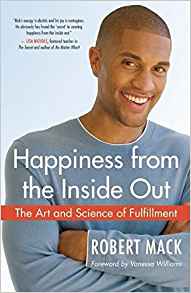
Happiness from the Inside Out: The Art and Science of Fulfillment
He was a Celebrity Love Coach for Famously Single on E! and he’s been on many different kinds of shows. His first book, Happiness from the Inside Out: The Art and Science of Fulfillment, is important to anyone who might be struggling with depression or anybody you know in your life. It is both an art and a science. He’s received his Bachelor’s Degree from Swarthmore College and he conducted his MBA coursework at University of Miami. He is an all-around nice guy that walks his talk. Rob, welcome to the show.
Thank you so much for having me, John.
I love to ask my guests to take us back to their own story of origin. You do that in your book, Happiness from the Inside Out, but I’m going to let you go back as far as you want. It could be college, high school, or younger than that. When did you start to get some insights into your own world of, “I maybe not as happy as I want to be and I’m going to figure out how to get there?”
I feel like at birth I was deeply in touch and in tune with my own stress and anxiety. I was aware of that from a young age. I felt uncomfortable, insecure and unsure about myself with respect to all people, all places and all things. At a young age as far as I can remember and as I grew up, that only increased. I became more of a ruminator. I think more about the stress, anxiety, and insecurity that I felt. As I moved into school and into sports, I found that on one hand I was able to do pretty well in sports with respect to academics in school. I didn’t feel any better for it, and I would keep upping the ante.
I’d get an A, and then the A wasn’t good enough. I would get a perfect score. I’d do well in cross country or in baseball. It was never enough. I could have hit two homeruns, but it should have been three. I could have gotten a perfect 4.0, but I should have gotten a 4.3 if I take that advanced class. That mentality, I continued to build on that unwittingly and unknowingly. It got to a place where I eventually was deeply, beyond dysphoric. I was deeply depressed and suicidal for many years.
What age did the suicide thoughts happen?
I would say probably about sixteen or seventeen, maybe a little younger. I remember reading a book, my first glimpse into the possibility that I could turn around my thinking, my confidence and my happiness. I probably read that book at around thirteen, it was Psycho-Cybernetics. It gave me a glimpse that something could be changed. I toyed with it but I didn’t find a whole lot of success because you’ve got to be persistent, you’ve got to put the time in and it doesn’t happen overnight all the time. I’d say thirteen, fourteen. When I think about it, that went at least through my mid to late twenties.
With some recent sad news about some relatively famous people like Kate Spade and Anthony committing suicide, it triggers a lot of issues in people. What I noticed is this mass consciousness illusion that if I had all those things, money and fame, I would then of course be happy. When you see someone having that at a high level, very few percentage of the population get that success or fame and they are not happy. It breaks the illusion a little bit that people think, “If I keep working hard enough and get more money, more fame or get famous, then I will be happy,” and then you’re like, “That’s not the answer?” When we talk about helping people with their pitch, whether it’s a pitch to get hired, a pitch to get their startup funded or even a pitch to get a new client if you’re in the business of anything, you always have to be selling to get new clients. Why now?
Why is now an important time for this product to come along? If you look back at Uber, without a majority of people in urban areas having smartphones, Uber wouldn’t have worked. The why now, Rob, is your mission. I’ve read your book, I’ve seen you on camera several times, I’ve heard your story and that’s why we’re so happy to get you on the podcast because your time is now more than ever. Your whole life, from my perspective, has led up to this very minute that you are being called to help people in the business world and other worlds, specifically in the business world. Realize that the outside achievements are not the end-all be-all to being happy and wanting to stay on the planet.
[bctt tweet=”Happiness is a science and an art. ” username=”John_Livesay”]
When you look at what’s going on, it’s like, “I went through all these struggles but for what? What’s my why? What’s my personal mission?” When someone else can hold a mirror up to you and go, “Here’s what I see. This is why you went through that,” and here’s why now is more important than ever to help all the people that might be reading this, going through whatever struggles, personal, business. The sense of wanting to give up, even if you’re not willing to give up in a dramatic way like checking out, but giving up on your dreams. How did you get from being this great athlete but still not feeling good enough to saying, “I’m going to get into being on camera,” whether it’s doing a movie with Vanessa Williams?
The one thing without question is that the opportunity for happiness in this day and age is greater than it’s ever been in the history of time. We’ve got more unhappy people on the planet now than ever, and we have those unhappy people on the planet despite the incredible technological advances that have been made in medicine, health and well-being. That has been made in the quality of our lives. This phenomenon of life getting objectively better, but people filling subjectively worse for it. Things on the outside getting better in general, on average, but people feeling worse on the inside is what we know is the progress paradox.
When I was going through this experience and contemplating suicide, I had stumbled upon this term and this idea that there was something happening in society that mirrored what was happening inside of me. That I was doing great athletically, I was doing great scholastically, but I was feeling worse for it, whatever reason. That began to allow me to begin to tease out what’s happening there and discern between true happiness and the happiness that was dependent on things outside of me. There was a difference between those two things.
As I began looking at this more closely, I found this program at Penn. The program at Penn is a Masters in Applied Positive Psychology. The study in science of what makes life worth living. It’s all this Ivy League science that’s accumulated over decades. They put it into one body of research and they call it Positive Psychology. As I began studying that more I thought, “I should probably do something here with this.” At the same time, in order to pay for that school because it’s a very expensive program, I moved on from my consulting career and I was trying to figure out what to do. At this time, I had moved to Miami. I was walking along the road. Some guy come up to me and said, “Have you ever thought about modeling?” I was the most insecure guy in the world. My high school class voted me Most Shy. I was the ugliest person on the planet. I had always felt that way, truly.
[bctt tweet=”The greatest challenge most people face is that they’re letting whoever they’re pitching to dictate what they’re thinking and feeling.” username=”John_Livesay”]
When he came up to me and said this to me, I thought, “I wonder what he wants. I certainly don’t have much money.” I didn’t take it all that seriously. He gave me a card. Another week later, another agent came up to me and said, “You should stop by the agency,” happened to be the same agency, different agent. I stopped by and I joined this modeling agency. I started doing modeling. I didn’t have any real future plans. I didn’t know what’s going to do with respect to my career at this point. The Positive Psychology ideas in my head weren’t all that clear. I hadn’t quite discovered the Positive Psychology world yet. I started the modeling thing. I was doing it basically to pay the bills while I figured out what I wanted to do with my life. Life is what happens when you’re busy planning for it.
Over a course of a couple of years I was doing this, enjoying my life, really focused on being happy. I’d given up this idea that success and money can make me happy. I was clear about that at that point in time. The more I read, the more I discovered how true that was. I’m doing the modeling. I had a female friend who was a model. She said, “Rob, are you go to this casting?” I’m at the pool, I’m going to relax. I’m not going to book whatever casting it is anyway. My hit rate with casting wasn’t great. I was sitting at the pool and she said, “Would you mind giving me a ride? You sure you don’t want to go?” I said, “I’ll come pick you up on the scooter. I’ll drop you to casting, I’ll wait for you and then we’ll go home.”
I get there, so I go and then the next thing you know, it was originally supposed to be a role for just a model, a model guy in a new show called South Beach that was airing on The CW. I was going to have no lines, walk the runway and whatnot. One of the producers comes over and says, “You three or four guys here, we’ve got this role. It’s for this guy named Paco. He’s an abusive model, boyfriend type of guy. Do you guys want to audition for that?” I was like, “No, I don’t think I could pull it off. I’m not an actor.” He ended up saying, “Give it a shot. Here are the lines.” Part of it was I was indifferent about whether or not I’ll book it or not. I had fun with it.

Happiness From The Inside Out: To find success, you’ve got to be persistent and you’ve got to put time in because it doesn’t happen overnight all the time.
The next thing you know I booked the role. It was opposite Vanessa Williams. That’s where my interest in the entertainment world began to take a look. I thought, “This is pretty interesting. I’m not even trying hard and things are happening in this direction, so I’ll trust that a little bit.” I was collecting notes on how to be happy for a long time and she encouraged me and said, “Rob, what are you going to do with those notes that you’re taking on being happy? You should share them with people. People always ask me about why you’re smiling and whatnot.” I thought, “Maybe I should,” so I eventually published it. It became Happiness from The Inside Out.
What a great story. The takeaway is when we’re not attached to the outcome of something and goes with the energy that’s flowing along and then people can feel that. You’re more relaxed during the audition process. Bringing it back to people who are in the mindset of pitching, if you are desperate to get an investor for your idea or if you’re desperate to get this client so you can sell a house, hit your quota the sales, get someone to join your startup or even get a job to get hired, people feel that. It’s a lot like dating. Since you were a Celebrity Love Coach, there’s some transference and some observations there that you might be able to share with us on what mistake or mistakes did you see people making when it comes to, “I’m attracted to this person. I don’t want to come across desperate, but I want to let him know I’m interested.” What’s the happy medium there?
For my executive coaching clients, we call it executive presence. It’s the ability to persuade and influence effortlessly, easily and enjoyably. I would say that at the root of it, the greatest challenge that most people face is that they’re letting the client, customer or whoever they’re pitching dictate what they’re thinking and feeling. This is a good thing. We want to calibrate and recalibrate based on our audience. That being said, you want to be able to do that in a way that your ability to regulate your emotions isn’t compromised. What do I mean by that? It’s an immovable, unshakable peace and confidence that I feel most people are challenged by.
The folks I see that are being at their most successful in terms of pitching anything, they have an immovable, unshakable sense of peace and confidence, and there I say joy. Regardless of the way in which the customer, client or the audience is showing up. They continue to persist and are consistent in this ability to regulate their emotions. When dating, what that means is that no matter whom I’m with or what I’m doing, my intention is always to have as much fun as humanly possible. To share as much love as humanly possible, and I don’t care whether I get it back or not. I don’t care if they’re having fun, that’s the challenge.
Normally what happens is, you’re not getting it back until you stop giving. You don’t have to continue to give to someone that’s being rude or disrespectful. We’re not talking about that. I find that same principle, this principle of deep, immovable, unshakable equanimity, confidence and joy that isn’t based on this quid pro quo idea that I’ve got to get it back. That isn’t even dependent on whether or not you sell anything.
[bctt tweet=”Have a sense of peace, confidence and joy when you pitch.” username=”John_Livesay”]
My brother and my sister are great. They’re both phenomenal sales folks. My brother does medical device sales. My sister does luxury homes. They weren’t always fantastic sales folks. The way they thought and felt was dependent on the responses they got from people that they weren’t very good. The second they detached those things that they detached the response they we’re getting from the way in which they were showing up. All of a sudden they would sell effortlessly, easily and they had a lot more fun. I would say that it’s a number of things. Mostly I’d say it’s being independent of the ways in which other people are showing up that you continue to show up in the same, positive, happy, confident, strong and you don’t make that dependent on anything or anybody.
Have a sense of peace, confidence and joy when you pitch. That’s my real takeaway there. It’s a constant, “Am I grounding myself? Am I centered?” One of the things I say to myself when I’m deciding, and it comes from branding. I do this with clients all the time, “What three words define you as a brand?” It empowers people, especially when they’re interviewing, to think of themselves as a brand going to work for another brand, and not some poor, desperate person. The three words are integrity, passion, and joy.
The people I might be working with are an integrity, I’m passionate about this and they are and it brings me or someone else joy. All three of those boxes get checked off then I do it, because that’s my moral compass and that’s my criteria. Having something behind that intention of always being peaceful, confident and joyful helps a lot. If you’re able to think on your feet, do you have three words that you would define the Rob Mack happiness within brand?
It’s going to sound cliché but it is. I would say that the very heart of it is peace, love and joy. The one thing I’m clear about as a Positive Psychology practitioner is that an emotion is more contagious than anything else on the planet. By far and large, that’s proven. My brand is being as deeply and independently peaceful, joyful, and loving as possible. My experience has been when I stay out of the results place, when I embody that fully and I’m deeply and truly present, that in and of itself is persuasive. I’m not trying to persuade you of anything. I’m not trying to influence you to anything. I find that all of a sudden you’re persuading, influencing directions that I love.
I would say it’s trying to embody that as fully and deeply as possible. It’s taking out all this reciprocity thing, it’s dangerous particularly when you’re pitching, particularly when you’re selling. I have to be intentional about that when I’m trying to pitch anything or I’m trying to sell anything, that I do it because I love it. I communicate that and stay out of reciprocity. It’s a little dangerous and people feel that. It’s hard to hide even if you don’t speak to it. People feel that you’re pitching, you’re selling something and attempting to get something from them and that’s not my approach. It hasn’t worked for me.
In the same way in the dating world and what you said really resonates with me about not all or nothing black and white thinking and that comes from your education. That’s one of the goals of therapy is to let go of having everything be all or nothing, black and white and there are shades of gray. If someone’s not returning the love and the joy in a dating situation back to me, it doesn’t mean I have to shut off being who I am. It’s just not right for them. The same thing when I’m offering someone an opportunity to buy something from me, it doesn’t mean they say no it’s no forever. Even if it is no forever, it doesn’t mean I suddenly dimmed my light because someone has said no.
It’s funny that you say that, by funny I mean interesting and profound. When I was modeling, I learned many things that I never expected to learn through modeling. I can be a little over analytical. I used to think of trying to get clear about what is it about the jobs I’m booking versus the jobs I’m not booking, and how is that related to my personality, my looks and all this stuff. It can drive you a little mad. I started discovering little things. I would always book the job that I had no interest in booking. The one that was I most indifferent about, I would book. The South Beach thing was a perfect illustration.
Happiness From The Inside Out: An emotion is more contagious than anything else on the planet.
I started asking friends, and I’d find another trend. One of the other trends was that some of the most successful models were trust fund kids at birth? They’d go into the casting or audition, and they did it because it was fun. They were having a good time, they’re totally relaxed, there’s no desperation when they hand you the comp card or they handed the book to the client. It was all coming through in every pore of their being that they didn’t need that job. They were there because it was fun. They enjoyed interacting with other people.
That being said, there are many shades of gray. It can become complex and every person’s a little bit different. Sometimes it’s good to be strong and even communicate it. You expect nothing in return if that’s the approach that works for you. I believe in what using what works, but in my experience, there’s no higher principle than been fully, truly, and deeply present and not thinking that anybody else is the source through which your abundance comes. That to me is deep.
In your book, Happiness, you say it’s both a science and an art. There are a lot of listeners that are structured, data oriented and measure things, but that’s not enough to being happy. It’s not like you lift many weights, so many times and increase the weight, do this kind of eating and then you’ll get this physique. There’s a little more to it when it comes to happiness that it’s not strictly a science like that. There’s an art to it. Can you explain how that’s worked in your life as an art form?
I believe in taking calculated risks. I want to take calculated, informed, and well-educated guesses when I can. Roll the dice if I can legally and ethically in the direction that is the best interest of everyone including myself. That means looking into the science and seeing what it says about happiness. What does lead to a happy life and what does not? We’ve got a lot of data there. You have to custom tailor and customize everything in your life, including the science. Science is changing all the time for one, for two, it doesn’t study Jesus or Buddha. It doesn’t study the Oprah’s of the world. It studies everyday people.
There’s a lot about science that isn’t necessarily included in every single study that you see, or even most studies. That means the truth of life, the truth of my life in particular is within me. I like to use my own experiences for the data that I want to learn from. It’s the data of my own life experiences that have been most valuable to me. That means a number of things. One, based on Positive Psychology research, after $70,000 additional dollars mean very little in terms of your happiness. Education doesn’t lead to happiness. Even great health doesn’t lead to happiness. Being married doesn’t lead to happiness. Having kids doesn’t lead to happiness. Nothing leads to happiness.
When you have a perfect life, that means when you have as much money as you could possibly imagine. When you’ve got the perfect partner or the perfect dating life, the perfect number of kids or none, depending on what your ideal life is. When your life is perfect circumstantially, all of that together only accounts for 10% of your happiness. That means 90% of your happiness are other things that are beyond the conditions and circumstances in your life. That’s where the art comes in. It’s trying to understand, based on science, what I personally need to do to make me happy. I found a number of things that worked for me. All that science says, “When you move to a sunny place, does it really change your level of happiness?” I found that it did for me. Little things like that.
[bctt tweet=”Happiness makes your life more successful and better.” username=”John_Livesay”]
The big awareness there is, “If I get all my ducks in a row, the life, the income, the house, the job, the car, the relationship, the money, the time to travel, I get all of that finally at the optimum level and then I’ll be happier.” That only contributes 10%. A lot of it has to do with your mindset and your genetics, because you can always find something to not be happy about is the bottom line to it all.
That’s the bottom line and you’re right. One thing I highlight real quickly, which is a great thing you’ve underscored here is that even with respect to genetics, they’re completely malleable. Meaning they’re changeable. Based on the thoughts you think, experience that you have and the feelings that you have, that DNA is malleable, it’s changeable. We often thought of our happiness as being something. It was at least partially hardwired. Not true at all.
It is the mindset as you nailed. It is also some of the behavioral things that we do. Do we exercise? Are we part of a spiritual community? Do we have social support? At the end of the day, remember that even within the context of all those additional things, there have been people in the world and there are people in the world. John, you’re a great example. Hopefully, I’m an example. There’s Jesus, Buddha, Lao Tzu and all these people are great examples that you can find and be happy, despite not having any of those things that most people think that you need to have in order to be happy. In fact, you can even be happier.
There’s a lot more to happiness and I would say success as well. The other interesting finding in this Positive Psychology body of research is that when you’re deeply, truly happy, you increase your odds of being successful in every single life domain. That means that the happier you are, the quicker, the earlier you get married, the longer you stay married. Even if you’re not married, the happier and healthier all your relationships are, the more money you make. You make $600,000 to $700,000 more than your less happy counterparts. Your health is objectively better, you live six to seven years longer. Even within those longer years, you’re healthier during that time. You experience less job burnouts. In every way, happiness makes your life more successful and better. That’s why it’s a huge key to being a pitch whisperer, if you will, like yourself.

Happiness From The Inside Out: When you’re deeply, truly happy, you increase your odds of being successful in every single life domain.
It’s the chicken and the egg, “As soon as I get all this success, then I’ll be happy.” What I hear you saying loud and clear is no. Choose to be happy now and then the other things will come or not come, but you won’t be attached to the outcome either way.
You’ve already got the ultimate success. That’s the greatest test in the world to be happy. The only reason we do, achieve, accomplish, acquire anything is because we think we’ll feel better. If you can feel better without doing all that stuff, you’re the smartest person in the planet.
The book is Happiness from The Inside Out. We can catch you Monday through Friday on Live Facebook, Good Morning LaLa Land. If someone wants to hire you for your executive coaching, how can they find you?
Everybody can find me at CoachRobMack.com.
Rob, I can’t thank you enough for being such an insightful and happy guest that allows us to feel happier.
John, I appreciate you so much. You have no idea. I mean that both as a professional but as a friend. You’re such a great guy with a huge heart. I learned so much from you. I want to thank you for your time and your energy.
My pleasure.
Links Mentioned:
- Happiness from the Inside Out: The Art and Science of Fulfillment
- Rob Mack
- Good Morning LaLa Land
- Psycho-Cybernetics
- Good Morning LaLa Land on Facebook
- CoachRobMack.com
- https://m.youtube.com/watch?v=FvYl-PqCcJE
- Quantmre.com
Wanna Host Your Own Podcast?
Click here to see how my friends at Brandcasting You can help
Get your FREE copy of John’s latest eBook Getting To Yes now!
John Livesay, The Pitch Whisperer
Share The Show
Did you enjoy the show? I’d love it if you subscribed today and left us a 5-star review!
-
- Click this link
- Click on the ‘Subscribe’ button below the artwork
- Go to the ‘Ratings and Reviews’ section
- Click on ‘Write a Review’
Talk Triggers: Word Of Mouth Marketing with Daniel Lemin
Posted by John Livesay in podcast | 0 comments

 Episode Summary:
—
Listen To The Episode Here
Talk Triggers: Word Of Mouth Marketing with Daniel Lemin
I am thrilled and honored to have Daniel Lemin. He is a startup co-founder, trusted advisor and the bestselling author on reputation management, digital marketing and social media customer service. He was an early member of Google’s global communications team. Daniel led the launch of products in North America and around the world. He is the CMO and Co-Founder of Selectivor, a food intelligence startup that helps people stay healthy through personalized eating. His book with co-author Jay Baer, Talk Triggers, is going to be a New York Times bestseller. It explores word of mouth marketing and lays out a framework so you can build that in your own organization. You want to have something that’s memorable and Talk Triggers gives you those ways to do it. He’s an expert commentary on television. He has got that anchorman smile. He’s smart and handsome. Daniel, welcome to the show.
Thanks for having me.
Take us back to when you were growing up in Ohio. You can go back to your childhood, high school, college, wherever you want, when you said, “I’m going to get into high tech.” Obviously, Google when you were younger that didn’t even exist. I’d love to hear what your background was of how you got into what you’re doing.
To some degree, I don’t know is the answer. That’s true for many people. You look back and think, “I’m not sure how I got into doing the things I’ve done, but I’m grateful I did.” Part of it though, I’ve always been a curious kid and also a kid that had a curious mind. I always wondered how things worked, why things worked and I tried tinkering with things to make them work better. I was always drawn to technology for that reason. I enjoy the challenges of it and also the gold rush. There’s always something new and bigger. There’s always a moon shot happening somewhere in the tech world, including several happening right now. There’s always been that curiosity for me. I always assumed that I would work in marketing as a kid. That was the only thing I was ever good at. I tried doing other endeavors, but none of them anywhere near with success.
[bctt tweet=”If you are assuming that your best chance to captivate a customer is to be the best in your category, then you’re going to struggle for a long time.” username=”John_Livesay”]
Tell us what it was like to be one of the early members of Google. What was that atmosphere like? What can you say looking back, how the culture has evolved?
I was employee number 400 at the company. I worked on this scrappy little marketing communications team. There were about eight of us in total at the time. The fun part about that was seeing the company explode around us in all different areas, from employee size to new markets, launching internationally new products, and new product space. They’ve launched so many innovations when I was there in the first couple of years.
[bctt tweet=”Nobody ever talks about average so you need to be remarkable.” username=”John_Livesay”]
It solidified for me, in my mind, the value of never resting on your laurels. You never assume that everything is done. The work is never done. You always continue to change things. You continue to think about ways you can do something better. That’s in part how I’ve approached my career after Google in marketing. It’s always looking for better ways to do things. It was a good training ground for me from that perspective. It was also an amazing place to work.
That has led you to your own startup, Selectivor. You’re applying AI intelligence to helping us all get healthier.
The broad mission is to help people stay healthy and well through whatever diets they may be following, both health and personal guidance. We’re building a whole host of AI tools to do that. We’ll help you find recipes that work for you. We’ll help you find restaurants and things that work for you. That’s the mission and the broad story behind that are personal struggles that both I and my co-founder had trying to stay on our diets. In the context of eating with other people, sometimes that conversation’s uncomfortable. You don’t want to tell them about your dietary needs. This has been the biggest buzzkill in the world, “I’d love to go on a date with you. I can’t eat this and I can’t eat that. I don’t eat this and I won’t eat that. Aren’t you looking forward to meeting me?” It’s extracting some of that social friction out of the equation in the process of doing that.
I’ve read some research that if you tend to have overweight friends, you are more likely to be overweight and vice versa. If you tend to have fit, healthy friends, you’re more likely to be fit. Since you’re an expert in data and software, does that ring true? Are you incorporating that into your company?
It completely rings true. There’s a famous landmark study from the ‘60s, the Framingham Heart Study. They wrote about it in that book, Connected. It’s a landmark study looking at how communities impact the health of its members. Obese communities tended to remain obese and lose weight together when they started. It is truly that connected. In fact, one of the things we’re building into our product is the ability to challenge yourself and others to do something, stay on a diet, drink more water, and eat more watermelon, whatever it might be. That notion of challenging each other is a much more playful way to do things together. It impacts how we think about the product.
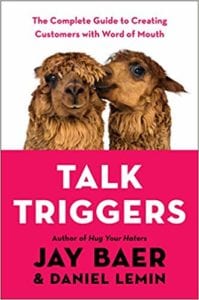
Talk Triggers: The Complete Guide to Creating Customers with Word of Mouth
Let’s dive into Talk Triggers: The Complete Guide to Creating Customers With Word Of Mouth. If there’s anything I’ve learned from my advertising background is word of mouth is much more powerful than any paid ad and commercial. Getting these brand ambassadors to talk about you and spread the word, the trust factor is huge. How did you and Jay Baer decide to work together?
I’ve known and worked with Jay for a decade, even more than that. I hired Jay at an agency I worked at in Downtown Los Angeles. I hired Jay there to help us on the agency side with innovation and bring some outside thinking. I liked working with him so much that I decided to leave that agency and work with him. I’ve worked with him on the consulting side since 2010.
This is a big collaboration with a lot of insights together. The cover of the book looks like two llamas nestling each other. What animals are those?
They’re alpacas nestling. They’re from Peru.
What is the significance of that picture?
It’s a simple story. The first version of the cover from our publisher was less than remarkable. It wasn’t terribly exciting. Widely panned might be a phrase I would use to describe that. We were looking for something that people would remember and talk about. Have you seen another business book with alpacas whispering to each other on the cover? It’s unique. It’s also hot pink. It’s connected to one of the case studies inside. That’s the story behind the cover. We’ve taken it to a ludicrous extreme. We’re all over now alpaca GIFs and memes. We’ve even been to an alpaca farm together, Baer and me.
The premise is you want to say something that triggers a conversation, which is what a good pitch does. The second part for me, from what I can tell that you’re offering people, does not only do it trigger a conversation but it triggers a memorable conversation. Can you give us an example?
The hero insight that led us to write this book was that the economic impact of word of mouth. The things we say amongst ourselves as buyers, investors and consumers of things, the economic impact of that is much more massive than we might assume. 20% of every purchase decision that’s made is directly driven by word of mouth discussion or recommendation. The challenge is few companies have an actual strategy to make word of mouth happen. They assume that it happens. You probably know from a gut feel as well as we did, that doesn’t happen. It’s a gamble you take that someone’s going to talk about your brand. We started looking at examples of companies that do something a little bit different in the delivery of their surface.
[bctt tweet=”Listen to customers to find the gap where a talk trigger can happen.” username=”John_Livesay”]
For example, the UberConference. What’s great about UberConference is if you’ve ever been on a conference call from UberConference, you may be familiar with their country, Twain-y hold music. It’s a hilarious song. It’s all about being on hold. You can go check it out, Google UberConference hold song. You’ll quickly find it. The impact of that when you’re on hold and then end up on the call nearly every single time someone says, “Did everybody else here that hold music? That was amazing.” In fact, if you go on Twitter, even on Google and search for UberConference hold music, people go crazy for that song. What they have done is nothing magical. They built in a slightly different way of filling a customer experience gap, in this case with hold music. That was the spark. That is an actual idea. That’s a Talk Trigger. It generates some material for a consumer to work with. It gives them a story to tell. That’s the hero insight behind it.
It’s an interesting thing that something could be so engaging that people would go listen to hold music while they’re not on hold.
UberConference hired Postmodern Jukebox to do a remix of it in multiple different genres.
You give keynote talks on this topic as well. Who is your ideal audience that needs to know how to have Talk Triggers?
The interesting thing is it spans all industries, even as individuals. We can all benefit from having a personal Talk Trigger. Jay Baer, if you’ve seen him speak, he wears crazy plaid suits. He’s always dressed impeccably. As individuals, we can benefit from it. I do a lot of work with associations, small business owners and corporate workshops to companies looking to try to figure out the best type of Talk Trigger basically to deploy. It’s a wide range but a lot of work with small business owners who frankly can probably benefit from it the most.
To me, it seems with the problem you’re solving here is many of the people that I work with, whether I’m giving a keynote talk on how to be a better storyteller and therefore increase sales is this concept of objection around price. You’re a commodity. We don’t see the value in paying your premium price. I don’t care if it’s food you’re selling or a design of an architecture firm. People have a lot of trouble justifying a premium price. How does your keynote and Talk Trigger help people with that particular challenge?

Word Of Mouth: The economic impact is more massive than how we assumed it to be in terms of the things we say amongst ourselves and buyers, investors, and consumers of our products.
Part of that is if you are assuming that your best chance to captivate a customer is to be the best in your category, you’re going to struggle for a long time. Even the best restaurants in the world, from a technical perspective, still struggle to get butts in seats. What is the reason for that? Is it the price? Maybe, but is lowering the price going to get them across that chasm? It might even hurt you in the end. Robert Cialdini always talks about this, the Pre-Suasion. If by the time someone calls you, comes into your restaurant or opens the door to your store, they’ve already decided they like you. They’ve already decided that they’re willing and able to do business with you. That is a massive benefit to the business.
The way to break in and get someone to see you, to get invited to the pitch, is to have some memorable Talk Trigger. You say there’s a 4-5-6 learning system in the book. Can you walk us through what that is and use the MailChimp example?
We put this learning system together. Many authors have written about word of mouth over the years. Certainly, it’s not a topic that’s new. We wanted to bring a little bit more structure to it to give business owners, companies and even individuals an actual framework for how you can make these Talk Triggers. Generally speaking, sometimes it just happened by accident in companies. We thought there’s got to be a better way for this, it’s so important. The 4-5-6 system wraps itself around a few elements. The 4 is the four mandates for a Talk Trigger, four things that must be true for something to be Talk Trigger worthy. There are five general types of Talk Triggers, which are not necessarily mutually exclusive. The 6 is the six-step system that you can use to build them, create them and deploy them.
[bctt tweet=”There’s always a moon shot happening somewhere in the tech world.” username=”John_Livesay”]
I’ll briefly go over the four. They’re a good place to start exploring Talk Triggers. The four mandates or musts for a Talk Trigger, number one, it must be remarkable by definition. It must be something worthy of talking about. No one talks about average. You don’t say, “Let me tell you about this perfectly adequate salad I had for lunch yesterday.” It’s not remarkable. It has to be a remarkable element in the customer experience or the sales experience. The second is it has to be relevant to the customer experience. Relevance is vital to the delivery and reception of the Talk Trigger by the consumer. If it’s out of left field, it feels almost like a gimmick or a stunt, and that’s not the best way to get people talking about us.
The third is it needs to be reasonable. By reasonable, we mean not over the top. If you go to any DoubleTree Hotel anywhere in the world and check-in, they give you a warm chocolate chip cookie that they baked in the hotel. 75,000 times every single day people get this cookie. It’s a reasonable gesture. People talk about that cookie. It’s a remarkable Talk Trigger for the simple thing that it is. It’s a cookie. It’s not a baby alpaca in your room that you can use while you’re at the hotel. It’s a cookie, but it’s relevant to the product experience. The fourth of the mandates is that it has to be repeatable. This is where we often get trapped. Sometimes we think about Talk Triggers being available to our VIP customers, our top customers and top 10%. If it’s something that isn’t available to every single customer every single time they interact with your product, it can cause dissonance. It can cause frustration and disappointment, which is the negative of word of mouth.
Imagine if I went to a DoubleTree and they’d run out of homemade warm chocolate chip cookies and I’ve been looking forward to that. I might be even angry as opposed to if I had no expectation of it, then that’s fine. If I’ve heard word of mouth and they’re out, it’s not good.
Just say, “I’m sorry, your room rate doesn’t include the cookie because it’s too cheap and you’re a bad person.” It creates this letdown, “Terms and conditions. While supplies last,” and all of that stuff is the enemy of word of mouth.
Don’t you see some of the airlines starting to do that? “That seat doesn’t let you have a free snack,” or whatever they’re doing now. Not only is it crowded but you do have to pay to put a bag in the overhead.
It’s almost like they’re paying someone to tell them how to make this experience worse. That’s what they’re hiring in consultants to do at this point, “Can you help us make this the worst experience for at least a small part of our customers?” We’ll talk briefly about MailChimp. I like this example because I’m a software guy myself. It’s often a little bit harder for us to imagine what you can do in a software environment that’s a Talk Trigger. If you’ve used MailChimp, you know their little chimp. It’s everywhere in the product. He is their mascot, he is their voice. He has a name. His name is Freddie, which a lot of people don’t know.
Freddie has a place in the product. When you submit an email to be sent through MailChimp, you get this big high five from Freddie. He says, “Good job.” He’s everywhere in the experience of the product. People talk about Freddie all the time. The reason it’s interesting is email software is the pits. It’s basically the airline of software. They’ve found a way with Freddie to make the experience better for you and because of that people talk about Freddie. I’m sure it has downstream benefits for them from a loyalty perspective and a lifetime value perspective, but most certainly from that Pre-Suasion perspective. If you’re looking for email software, HubSpot, Emma or MailChimp, some people may have an affinity right away for MailChimp.
[bctt tweet=”Never assume that everything is done. The work is never done.” username=”John_Livesay”]
We have an emotional connection almost like Colonel Sanders. There’s a person with the brand. Let’s go through those four Rs and how MailChimp is doing something remarkable. The fact that there’s a playful tone to the culture with this Freddie, you could say that makes them more remarkable than other email companies that don’t do it. Would that be fair?
That’s fair. SurveyMonkey also has a monkey as its mascot. It’s not used to the extent MailChimp uses Freddie. Freddie is in the product, as part of the product experience. From that perspective, it’s remarkable that they’ve done that.
It’s not a one-off, it’s integrated. It’s relevant because the concept of having a bunch of monkeys working for you in the background, it’s fun and it creates a visual image for me anyway.
Often, small business software is painful to use. Not only is it a relevant brand vision, but it’s also slightly better to use, which feels relevant to you at the moment.
It’s easy a monkey could do it maybe. It’s reasonable, it’s not over the top. It’s not this huge gorilla or something intimidating. Finally, it’s repeatable. That monkey’s there come rain or shine.
He gives you a little pellet award every single time you send an email.
That is remarkable to me because we know how our brains are wired. That’s why people keep playing Words With Friends or keep the addiction to the phone or gambling. It’s the, “I’ve got a little ding. I’ve got a little award.” To incorporate that into the software, to me, triggers the same addictive behavior in a good way.
On the Selectivor side, we are building a cute little dinosaur named Oliver. He’s going to have a lot of that same presence like Freddie does because it’s a little bit more fun to use.

Word Of Mouth: If it’s something that is not available to every single customer every single time they interact with your product, then it can cause dissonance, frustration, disappointment, and negative word of mouth.
Are there any tips besides buying the book that if someone’s saying, “I know I need a Talk Trigger and I understand the four steps of these Rs. What could I do? What’s my next step besides reading this book and seeing how other people are doing it?”
I may be biased but reading the book is helpful. Start looking for them in your everyday life. Think about your own experience in places and look for Talk Triggers because you start to see them in different ways and in different places. It’s fun to spot them that way. It’s educational for yourself because for the most part, almost all of them is in the category of, “Why didn’t I think of that first? That’s crazy. It’s so simple, it’s stupid.”
One of the things that you have in the book Talk Triggers is the six-step process for creating them. We’re not going to go into all six, but give us a little teaser. What’s the first step?
The first one is one almost no company does enough of, which is listening to your customers. We go into a meeting room, a conference room, we sit down and we say, “We need to build a viral campaign to launch our new water flavor.” What few people take time to do is to talk to customers, to get their opinion, to see how they use the product, and to talk to your customer service people about what are they hearing from customers. The first step in that six-step process is a listening tour. You go deep on the listening exercise. What you start to see are these little tiny gaps that you aren’t seeing in formal surveys, you’re not seeing in email feedback, but they are actual gaps where a Talk Trigger can fill.
[bctt tweet=”Word of mouth is much more powerful than any paid ad, commercial, and brand ambassadors. ” username=”John_Livesay”]
I tell people all the time, “If you listen to what your customers are saying and put it in your marketing messages, then your potential customers feel like you’re inside their head.” The example of that is I was working with an architecture firm. They were trying to decide whether they wanted to hire me to come and give a talk and a workshop to them. They said, “The problem is we’re tired of coming in second. We’re not winning enough pitches.” I said, “I can help you with that.” Now, part of my whole pitch is, “Are you tired of coming in second?” and then people go, “We are.” That’s a great example.
It totally changed the entire conversation. If you’ve given people a reason to trust you, like you and want to do business with you, I know they understand where I’m coming from and that makes me feel good.
How can people follow you on social media?
It’s Daniel Lemin there on social media and TalkTriggers.com is where all of the other stuff is. We have a special little bonus for our audience. If you go to TalkTriggers.com/SuccessfulPitch, we’ve got a little download there. You can get the six-step process for free.
Thank you so much for being on. It’s exciting to watch you and Jay launch this book. It’s got a great alliteration, a great cover and great colors. How can it not be a hit? It’s going to be fantastic and entertaining at the same time.
I appreciate it. Thanks for having me on.
Links Mentioned:
- Daniel Lemin
- Selectivor
- Connected
- Talk Triggers: The Complete Guide to Creating Customers With Word Of Mouth
- Jay Baer
- UberConference
- Postmodern Jukebox
- Daniel Lemin – Facebook
- TalkTriggers.com
- TalkTriggers.com/SuccessfulPitch
- Quantmre.com
Wanna Host Your Own Podcast?
Click here to see how my friends at Brandcasting You can help
Get your FREE copy of John’s latest eBook Getting To Yes now!
John Livesay, The Pitch Whisperer
Share The Show
Did you enjoy the show? I’d love it if you subscribed today and left us a 5-star review!
-
- Click this link
- Click on the ‘Subscribe’ button below the artwork
- Go to the ‘Ratings and Reviews’ section
- Click on ‘Write a Review’
From On Air Anchor To Blockchain with Elsa Ramon
Posted by John Livesay in podcast | 0 comments

 Episode Summary:
One of the keys to success is authenticity. You can’t fake that, and Elsa Ramon has it. She exudes authenticity and effervescent energy on camera. Until recently, Elsa was the weekend evening anchor for CBS in Los Angeles. She made the big decision to leave that industry and her successful career and go out and start getting involved in the world of blockchain and cryptocurrencies. From on air anchor to blockchain, Elsa shares how she made that big decision, what her future goals are, and how you can embrace new technology and still use your old skills in this new world that’s being disrupted every day. She also shares some secrets of what makes a good story.
Listen To The Episode Here
From On Air Anchor To Blockchain with Elsa Ramon
Our guest is Elsa Ramon. She was recently the weekend evening anchor for CBS in Los Angeles. She is a five-time Emmy Award nominee for her excellence in reporting and anchoring. She has worked as an anchor reporter in places like San Antonio, Phoenix, and Dallas in addition to LA. She got her first job on air in Palm Springs. She graduated from UC Irvine with a BA in English Literature. One of her other important accomplishment is she’s the mother of two children, Bella at fourteen and Zev who is five. Elsa, welcome to the show.
Thank you for having me. I love talking to you.
Your effervescent energy on camera, I’m fortunate enough to have had the chance to meet with you in person and it’s the same. One of the keys to your success is your authenticity. You can’t fake that. That is the key to one of your successes. The people that are reading to this are always interested in hearing people’s story of origin, their particular journey. You can jump in from when you were at UC Irvine or even go back further to when did you decide that you wanted to be on camera as an anchor?
It was when I was eleven years old. Before then, I thought I wanted to be a doctor. I thought that was a fascinating career. I was the person that naturally wanted to help people, so I thought being a doctor would be cool. We were living in Austin, Texas at the time. My dad is from Austin, my mom is from LA. We had moved back to Austin and been living there for a couple of years. The woman who lived out on the street, Martha Cerna, I did not know she was a producer for a kid’s television news show that aired on the NBC affiliate in Austin called Kids World. I always found excuses to try to ride my bike past his house, come over, or try to rally all the kids on the street to go play over at Jacob’s house because I had a crush on her son.
Apparently she saw something while we were always over there playing that made her ask my parents if I would be allowed to come down to the TV station and audition for the new season of Kids World. My parents thought about it because my dad didn’t want me to do it. He thought I would get tangled up in this world of on air, things that he hears through the tabloids and all that stuff. My dad’s a real pragmatic guy, Navy, old-school, old-fashioned. He didn’t like the idea of me being in that spotlight and that exposure. My mom was totally opposite and said, “You should let her do this.” Ultimately, my mom won out. I went down to the NBC affiliate in Austin, KXAN, and auditioned.
They had twelve spots open. They were going to get six kid anchors and six kid reporters. That audition day, there was a ton of kids in there. Long story short, I made the cut. I was at eleven years old, shooting stories with a producer and sitting in the editing process and voicing over the pieces that she wrote and going on air with it and fronting it as a reporter at eleven. That was it. I changed what I wanted to do from that point on.
[bctt tweet=”Secret to a great story is the people in it.” username=”John_Livesay”]
What a wonderful experience to find something you love and are good at, at such a young age, and then go from there. You’ve gone on to have such success, what do you think makes a good story? Whether you’re pitching to get a startup funded, pitching to get new clients to hire you or get customers for your business, storytelling is the key to that. Clearly to be a good reporter, and anchor, you know what a good story is. What do you look for when you’re deciding what stories to cover and how to make them memorable?
It comes down to the people who are in the story. You have a story. A lot of people might have the same story. It’s the people behind it that make all the difference. How have they learned from their story? How can we connect to them from what they’ve been through, what they experienced, and what they learned? How willing are they to let you in to learn? That’s the key. It’s vulnerability on both ends. It’s not just the person who is willing to sit down in front of the camera, take that leap and put their story out there. That takes a lot of courage, a lot of guts, and support. Whether it’s a good story, even a bad story, a story we learn from, they have to be vulnerable. They’re showing they are vulnerable by agreeing to be on camera with you and tell their story.
I never took that for granted because that takes a lot for people to make that decision. It takes vulnerability on my end too. I have to let the people know on the other end that they are being accepted and received and the trust that they’ve put in me, is not be taken for granted on my end either. I want them to know that I have the utmost respect and care for their feelings and their experiences because I’m human too. I have a story too, and there are a lot of things I can relate to as well. I want them to know that and feel that right away. It’s people. If you don’t have the people behind a pitch, a story, whatever it is to connect to and endear to, then I don’t think you have anything.
I love what you said. It could be the exact same story, but it’s the people that make it unique and compelling. I hear that from investors all the time that they’re investing in the team. Of course people, when they’re deciding who to buy or who to hire, they want to buy from people that they trust, like, and know. That’s what you’re gifted at, letting people get all that intimacy in a short amount of time in a segment. Would you share one of your favorite stories that you covered in your career? Whether it’s CBS or before?
I don’t know that this was my favorite. This was definitely not a favorite. It was a turning point, and extremely important in my career. I was at my first television job, my first on air job, I should say. It wasn’t my first TV job because before then I had spent about two years working as a production assistant and behind the scenes at KNBC in Los Angeles. I graduated from UC Irvine, I was an intern and I was lucky enough to be offered a position as a production assistant before I graduated from college. I had my foot in the door already. Production assistant ran scripts to the anchors and ran out and grabbed sound bites for the reporters. We were unpaid utility players. I was learning the ropes that way.
I did that behind the scenes before I got my first on-air job as an anchor reporter in Palm Springs in 1996. I had been at the job for a couple of months. Before then I was trying hard to learn the ropes. If you’re learning a sport, to play tennis or golf. When you’re first learning something, you’re concerned about the mechanics of it. Golf, head down, swing back, arms a certain way, stand a certain way and you’re so involved with the mechanics. That’s how I was at the beginning of my career on my first on-air job. I was concerned about the mechanics, the story, composition, beginning, middle, end, and best video first.

On Air Anchor To Blockchain: When you first are learning something, you’re concerned about the mechanics of it.
I was focused on that. I wasn’t seeing the bigger picture. I hadn’t learned yet that it was about the people, until there was this story of this woman who was coming into Palm Springs through the mountains on a motorcycle to come to a family reunion. She was a Harley rider and she was going to ride her motorcycle into Palm Springs to see the family. A lot of people cut through the mountain if they’re coming from Orange County, San Diego through to Palm Springs. She was on that mountainous trail and that mountainous road, she went off the side and was killed. She flew down about 500 feet or more. The family started to become concerned. They eventually found her, at first they became concerned. Where is she? She hasn’t shown up. She should be here by now. They couldn’t reach her.
We’d only had cell phones for a couple of years at that point and they couldn’t reach her on the cell phone. It started to become clear to them that something probably bad happened and they started retracing the steps, the path she would have taken. After calling the fire department, police, and everybody getting involved, they found her. They found the crash scene down 500 feet below. It was horrific. It was sad. It was a really hot summer day. The whole road was blocked off. Fire engines, paramedics, police officers, they were setting up a recovery effort to rappel down the mountain and recover her body. The whole family had come in from parts all over the country, they were all there on the side of the road.
The family reunion turned into this horrible tragedy and they were all there waiting for the fire department to bring up her body. They were all crying and bawling on the side of the road. It was terribly sad and so horrific and so heart-wrenching that I realized at that point that this is not about the mechanics of putting together a story. This is an entire family that’s been shattered by this tragedy. They were all in town for this wonderful time to reconnect with family members, to catch up with each other, take the pictures and talk about the time they had that great family reunion. Now, that was forever marked by her death.
The fact that they even talked to me while they were waiting on the side of the road through their tears, I was blown away that they gave me that trust and that honor in the middle of their tragedy. From that point on, I thought I will never take people’s pain or what they’d been through for granted. I hope to God people don’t have to go through something like this, but doing this for 21 years I’ve seen horrible things. I’ve also seen amazing things of the human spirit and how people come together and rally together when there’s been tragedy to help, to donate. We’ve seen it too as a country during 9/11. We’ve all seen it. During natural disasters and fires, we’ve all seen how people come together and donate money, time, food and clothes. That never ceases to amaze me every time there is something bad that happens. People come together, communities come together.
[bctt tweet=”Blockchain gives people freedom.” username=”John_Livesay”]
My big take away from that was when something is intense and emotional, the training wheels come off the bike riding of, “Am I doing this right? What’s the structure?” You’re in the moment and it’s a heartfelt connection because you trust that the skills are there. For the audience reading, when you’re giving a pitch or trying to get someone to hire you or trying to get a new customer, if you can get back to your purpose and your original reason for doing something, your authentic passion will come through. You can let go of wondering, “What am I supposed to say when this slide is up and did I say it perfectly or not?” and get in the zone. It sounds like that was a big turning point for you in your career. That’s a great example of that in action. More recently, you made the big decision to leave this incredibly successful career and become an entrepreneur in a whole new way. Tell us that story.
I never thought I would do that. This has been my life, my passion. I’ve enjoyed it. It’s been hard. It’s been rewarding. It’s been satisfying. It’s been gratifying. It’s like any job and career, it has its ups and downs, but it was my life. If somebody would have told me that someday, “You’ll leave it and branch out on your own,” there’s no way I would have ever believed that. I also don’t live with my head in the sand. I do realize that the business, after being in it for 21 years, is changing dramatically and I don’t necessarily think it’s for the better.
I also think our world is changing too and the way we operate, not just globally but in the United States. I recently had an opportunity to take a leap of faith and start working in the cryptocurrency, blockchain technology space. I can’t reveal yet exactly what I’m doing, but know that we are already working behind the scenes. This will be brought to light and to air eventually, and I’m excited about this progress and this project. It’s a breath of fresh air. I’ve got a shot of excitement, hope, and learning again. I feel like I did years ago where I’m a little scared, but I’m ready and I’m going to go forward with this.
It sounds that you’re definitely getting out of your comfort zone and getting into the learning zone.
When I say that the television and the news business is changing, I recently gave an interview and said it was a dying business. It’s dying in the sense in the form that we know it. The model that we know is dying with social media, the internet, and people are getting their news from many different outlets. It used to be my parents turned on the TV, they had several choices for their news, they picked one and that’s where they got their news, that or the newspaper or magazines. For immediate news, that was the model. That was it. That’s how it’s been done for decades, but it’s not that way anymore. I started seeing salaries getting cut back, the legacy anchors and journalists in markets like Los Angeles, all the big markets, we’re going backwards.
They’ve been asked over the last several contracts to not get raises but to get cut. I know personally of friends that I worked with who were asked to cut their salaries by up to 30% at their last contract negotiations. They’re in a position of, “I either take that or I don’t have a job at all.” It’s becoming leaner and less content. It’s less about content and quality in my opinion, and more about the shiny object over here. They’re doing what they can to try to hold on to their viewers, I get that. It’s a business. It is a business, butt’s such a struggle because many of us got into it to help people to make a difference, to change a few lives, and we can’t save the world alone.
We’re making a difference, one journalist at a time, I’d like to think. It was getting harder and harder to do that with more and more resources taken away, more and more people taken away. Money is becoming scarce and resources are becoming scarce, I knew that this is not right. It’s going backwards. I need to find something, another passion, because I felt like I was the last of the Mohicans. Even the generation before me might’ve been the last of the Mohicans, the legacy anchors that are there now. My fears were validated and confirmed when I was asked to re-sign my contract, which was great. It’s always nice to be renewed, but then they said, “No raise,“ flat.

On Air Anchor To Blockchain: We’re making a difference, one journalist at a time.
That was devastating to me because I had put in the first three years of that contract so much effort, so much time, so much passion, and so much commitment. I sacrificed a lot of time with my family and then to be told you’re not worth getting a raise and in fact, none of you are. That’s when I knew, “This is not a good situation. I’ve got to do something now.” I was lucky enough to meet some people who are deeply and heavily involved in the cryptocurrency and blockchain technology space and started learning, being enlightened, and here I am.
You are going to be able to take your passion for journalism, which is helping people. You are now figuring out ways that the blockchain stories that you might be exploring and covering could in fact help people, educate them and get them more comfortable with this new technology.
I will tell you the theme of the project we’re working on is freedom, and that is what cryptocurrency and blockchain technology will do. It’s going to give power back to the people, and I know that sounds cliché, but it’s going to be in a way that we have not experienced before here in the United States. We’ve all been lulled into this false sense of security with the way we live in our country. It’s about to be shaken up tremendously. Globally, this is already taking over. In small pockets it is taking over, cryptocurrency and blockchain technology, in the United States too. We’re a long ways away, but we’re going to come a very long way in a short amount of time. That’s what I’m going to do. I’m going to be helping people learn this new way of life, and this new way of operating in this new financial system, in the short amount of time.
[bctt tweet=”Cryptocurrency and blockchain technology is going to give power back to the people.” username=”John_Livesay”]
The concept of freedom is certainly something that everyone is connected to. As you said, if you were used to doing something, everything from buying a house requires that you have to go through Escrow and the title, and all of those things could be changed. How do we know that a particular food is really organic? If it’s on the blockchain, that might change how we get that verification.
You hit the nail on the head. Everything as we know it is going to change with blockchain technology. The agriculture industry, the healthcare industry, the real estate industry. How we notarize documents, how we buy real estate, how we bank, how we use our money, where we use our money, it’s going to change. People might be wondering, how does journalism and this world of technology, of cryptocurrency and blockchain technology, connect? I would say they’re a perfect match because as a journalist, our whole point was to right wrongs and to get some justice for people one story at a time if we can.
There’s nothing more satisfying than resolving something for people, getting them relief, or making them happy after a terrible situation that we could help fix. It’s the same with blockchain technology and cryptocurrency. This is going to right some wrongs. This is going to provide freedom to people who didn’t have it. This is going to provide identity to people who haven’t had one. It’s in line with what journalists want to do. This is exactly what blockchain technology and cryptocurrency is going to do.
You’re the perfect person to be the brand ambassador, to give everyday people the ability to understand what’s available, the inspiration to follow their dream, and shine a spotlight on this new technology in a way that’s accessible and not intimidating. It can embrace everyone and not just be for this select few who are tech experts.

On Air Anchor To Blockchain: There have been excellent articles written in the LA Times and other credible media about what the blockchain can and can’t do.
That’s another thing. We’re going to take away the fear that people might have and the mystery behind it is enough for people to say, “No, I don’t want to learn about it. I don’t care. This is what I know. I know fiat currency. I know money. I know dollars. This is how we live our lives. This is how our parents lived their lives. This is how our grandparents lived their lives.” At some point we all have to adapt and change, or it’s hard to get left behind. That’s with everything. We’ve seen that with cell phones, internet, and TVs. This is another adaptation that we’re going to have to accommodate. Eventually we’re all going to be on board with this. Right now is the time to learn. I feel the sooner everybody learns, the more freedom they’ll have.
Any last thought you want to leave us with either on your philosophy of life or your excitement about the blockchain?
I couldn’t be happier, feel more grateful, and lucky that I met the people that I have over the past year in this space to enlighten me and to encourage me to learn and grow. I feel like I’ve gone from zero to 60 in such a short amount of time. It’s just the beginning. It’s wonderful and I would encourage people to type in cryptocurrency in their search engines, type in blockchain technology, see what stories come up. There have been excellent articles written in the LA Times and other credible media about what the blockchain can and can’t do, the pros and cons of cryptocurrency, and the history of it. I would encourage people to do that, learn as much as they can and get involved now.
[bctt tweet=”Learn as much as they can and get involved now.” username=”John_Livesay”]
If people want to follow you on social media, your Twitter handle is @ElsaRamonOnAir, is that correct?
You will be able to find me on Twitter. Please stand by. I will be announcing on social media, Twitter too, when we are able to go public with what we’re doing. We are going to have an entire social media release and a space for people to go learn, engage, and reach out. I manage my accounts. I respond to everybody that I can. If I miss a few people, that is truly by accident. I really am that connected and I like to engage personally with people. Feel free to reach out to me. I’d love to hear from you.
What a gift you are to all of us. Thank you so much for being on the show, Elsa.
You are so welcome. Thank you for having me.
Links Mentioned:
- Elsa Ramon
- @ElsaRamonOnAir – Twitter Handle
Wanna Host Your Own Podcast?
Click here to see how my friends at Brandcasting You can help
Get your FREE copy of John’s latest eBook Getting To Yes now!
John Livesay, The Pitch Whisperer
Share The Show
Did you enjoy the show? I’d love it if you subscribed today and left us a 5-star review!
-
- Click this link
- Click on the ‘Subscribe’ button below the artwork
- Go to the ‘Ratings and Reviews’ section
- Click on ‘Write a Review’