
Invisible Solutions With Stephen Shapiro
Posted by John Livesay in podcast | 0 comments


Many people advise us to think about our destination, our end-goal, that sometimes, we miss out on the many opportunities that come our way. The author of Invisible Solutions, Stephen Shapiro, joins John Livesay in this episode to share with us the different lenses he’s created to allow us to see the solutions that are right in front of our face but are in fact invisible. One to emphasize how we should focus on the direction we’re going, he tells us some great insights, tips, and tricks towards becoming a lot more successful—from the importance of branding to learning how to ask the right questions. He also shares what a performance paradox is about and how we can use it to our best advantage.
—
Listen to the podcast here
Invisible Solutions With Stephen Shapiro
Our guest on the show is Stephen Shapiro, the author of Invisible Solutions. He shares with us all the different lenses he’s created to allow us to see those solutions that are right in front of our face but are in fact invisible. He said that if you focus on your direction you’re going and not necessarily just the destination, you’re going to be a lot more successful. He talks about what a performance paradox is and how we can use it to our best advantages. Sometimes having the answer is not the answer. Enjoy the episode.
—
Our guest is Stephen Shapiro. For many years, he’s presented his provocative strategies on innovation, culture and collaboration to audiences in 50 countries. During his fifteen-year tenure with the consulting firm, Accenture, he created and led a 20,000-person innovation practice. He’s the author of five books, including Invisible Solutions. His clients include Marriott, 3M, P&G, Microsoft, Nike, NASA and GE. In 2015, Stephen was inducted into the Speaker Hall of Fame. He’s also been a regular judge and mentor on the TV show, Girl Starter. We’re going to be talking about stories, how to become more inventive and what the heck is an invisible solution. Stephen, welcome to the show.
John, it’s great to be here. Thanks for having me.
I love to ask people like you to take us back to childhood or school when you started this curiosity factor that you seem to have in spades about, how does the world work and how can things be better? Start anywhere with whatever the story jumps out in your head.
I would say I’ve always been a bit of a tinkerer. I liked seeing how things work so I would take things apart and hopefully, try to put them back together. I did that sometimes successfully and sometimes not so successfully but that was something I always love to do as a kid. I also love magic because to me, magic is like, how do things happen? How do you do things that are impossible? I’ve always been fascinated with taking things that appear complex and trying to deconstruct them and understand them, then reconstruct them in a way that they’re not so complex.
Take us at the beginning of your college. How did you decide what to major in when you have that interest?
I had two paths that I was going to go down. One was going to music because I was a jazz sax player and good at it, and then the other one was an engineer. I got a lot of advice. In fact, one piece of advice I got from someone which goes counter to what a lot of people might say is they said, “If your passion is music, don’t major in it because once you start having to make a living off of it, it might crush your passion. Choose something that is going to make money and then do music as your true passion on the side.” I became an engineer because I’m a bit of a nerd.
[bctt tweet=”An ineffective question is one that doesn’t give you the results you want.” username=”John_Livesay”]
There’s a lot of similarities between music and math and all that, so that’s not a huge shock. I’ve heard Elizabeth Gilbert talk about creativity and in her case, it’s writing books like you. She’s like, “If you put too much pressure on your creative outlets to make you a living, it does take the joy away from it.” There’s something to be said there, where we don’t have any pressure on anything we love doing, and then if the money happens to come great. To make that jump in is I advise that a lot of young people are not getting because Robert’s “follow your bliss” situation is a big thing. Let’s jump into those fifteen years at Accenture. You’re based in London some of the time and you’re managing all these people. What kinds of problems were you solving?
The biggest problems that we were focused on were how do we take the mindset of 20,000 people who are much technology-led? A lot of Accenture was much on technology implementation. The group that I was working with was about, whether it’s SAP or some other enterprise management system or some other new technology, how do we get them to focus on value first? How do we get them to think innovatively and then look at the technology as solution? That was the problem we were trying to solve. We did that through a series of programs, books, materials and other things trying to create a greater awareness of how you can, without taking a lot of time, rethink the entire thought process for delivering a project.
You started your speaking career after that. Is that correct?
I had the first copies of my book on September 10th, 2001. It’s a bittersweet day because the next day, things were a little different. I plan to leave the company at that point and left Accenture when my first book came out. It’s been many years that I’ve been doing my own thing. I’ve been focusing on helping companies innovate, solve problems, collaborate and things of that nature.
In your book, Invisible Solutions, you’re wearing a purple shirt and the burqa is purple. There’s a lot of purple on your website as well. Let’s talk about the importance of branding, being known for colors, and certain things. What are your thoughts on that? How did you come up with purple?
I always loved purple. I have these big geodes that are deep purple and I always love those. Even as a kid, I have those. I’ve always loved purple for whatever reason. I hired branding companies that said, “You can’t do purple. Purple’s a bad color for a brand.” I moved away from purple. When the book came out, we decided to go with the purple cover. I went back to what I love. I love purple. To me, it’s a good royal color. I remember one of the first speeches that I gave after I left Accenture, I was in Singapore. I was told that purple is a color for innovation. I was like, “There you go. That worked out perfectly.”
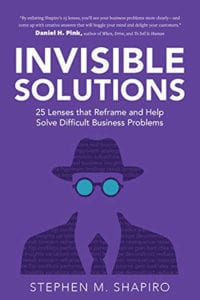
Invisible Solutions: 25 Lenses that Reframe and Help Solve Difficult Business Problems
That’s all meant to be. The cover of your book is fascinating. There’s a guy in a suit and these glow in the dark glasses. What’s the story there?
It’s the variation of the invisible man. The whole book is on 25 lenses, which are 25 different ways to reframe the problem. The fedora, glasses, tie, and jacket, if you look carefully, you’ll see subtly are all 25 lenses written. The whole outfit is made up of the words of the lenses.
It reminds me of Dolce & Gabbana, how they have words and their logos on dresses, purses and things and it becomes immersive like that. My first question is, how’d you come up with the title? Usually, people think, “If a solution is invisible, is that a solution?” We get down in the Alice in Wonderland rabbit hole a little bit.
I’ve been fortunate to have a buddy of mine, Adam Lefort, who’s brilliant at technology but he’s also great at coming up with big concepts. One of my books was called Best Practices are Stupid. Adam came up with that title. He came up with Invisible Solutions. The whole idea of the book is the best solutions are right in front of your nose. You just can’t see them because we’re not asking the right questions or we’re looking at the problem the wrong way. He said, “The solutions are there. They’re just invisible. They’re hidden.” That’s how we came up with the title which led to the invisible man, and then the cover was designed by my buddy, John Brunswick, who was at Salesforce. He came up with this concept one day and said, “How about the invisible man as a concept for the book cover?” I’m like, “Cool. Let’s go with it.”
Both in your keynote and in your book, you talk about how we are hardwired to ask ineffective questions. People would say, “We’re hardwired that way?” Let’s start with your definition of what is an ineffective question. I can guess but I’m sure you put a lot of thought into what an ineffective question is.
An ineffective question is one that doesn’t give you the results you want. The reason why we ask ineffective questions is because we probably don’t even ask questions. What we’re doing is we tend to make snap judgments or snap decisions, and then we start moving forward quickly. Part of this is because the brain’s primary function is survival. We need to innovate to survive and we need to adapt to survive, but we tend to innovate and adapt as a means of survival. The primary message of the brain says, “Whatever we did before we were together today, John, didn’t kill us so it’s probably safest for us to continue whatever we’ve done in the past.”
[bctt tweet=”Often, when we’re trying to solve a problem, we think of it too abstractly. We don’t take the time to frame it properly.” username=”John_Livesay”]
Anything new, different, and ambiguous might be risky, and therefore, we don’t want to do it. The brain doesn’t spend a lot of time processing the question. It is more reactionary in many respects. We need to put that conscious mechanism of putting the pause button on and say, “What is the real problem that I’m trying to solve? Where am I trying to go?” Sometimes, in organizations, business, and life, we’re under time pressures, so we think we need to go fast. The problem is if you go fast in the wrong direction, you’re just going further away from the ultimate result that you want to achieve. A little bit of time upfront can go a long way in repositioning you need to go in the right direction.
I’m fascinated by this whole fight or flight response concept. It’s something safe or not and yet, how do we build trust with clients, especially in the sales world? It’s little tricks and tips that we do as speakers, even though we’ve been on many stages. I’d be curious to see if you do this as well. If you have the opportunity the night before you give a talk in the morning, you go into the room, check it out, and maybe even walk up on the stage. You’re telling your body, “This is the safe space. This is not my first time on the stage. I know where the stairs are.” All those things that you don’t want to have to be thinking about survival like, “I don’t want to trip and look like a fool” is an example of that?
Absolutely. I will always go through a rigorous amount of practice the night before, whether it’s in the shower, thinking through certainly the first 3 to 5 minutes of the speech because I want to nail the beginning, and it’s always different. I know some speakers say, “I’ve got my first five-minute story.” I’ve tried that many times to have a starting story and it never seems to land. I don’t think it connects with the audience. I want to talk about, what’s the pain of the audience? What are they going through? I give a lot of thought to that so that when I’m ready to deliver the speech, even if it’s totally different, at least I feel comfortable that I’ve spent the time to think about it.
Yes, I love to practice. We’re on virtual stages so I’m in my office delivering speeches. I don’t know, John, if this is the same for you, but I still get nervous every speech. I don’t care what speech it is and I don’t care who it is. I sometimes do a little biofeedback. I’ll check my pulse in a live event. If I’m in the audience, I’ll be sitting there and I’ll put my fingers on my pulse. I’ll feel my pulse and I’ll control my breathing because I know that nervousness is going to help me explode on stage, but I don’t want to blow up and have my brains all over the place. I like to at least calm myself down a little bit.
I talk about this because a lot of salespeople struggle with nerves when they get up in front of big clients. I call it your Super Bowl of meetings or your Olympic moment. Everybody gets those butterflies in their stomach. My whole advice that I use myself is my whole goal is to get those butterflies in my stomach to fly in formation. I do that by saying, “It’s game time.” It’s my adrenaline kicking in and that fine line between being nervous and excited feels a lot the same, so we get to reframe it. I know what you mean. You’re sitting maybe off stage or standing off stage and they’re writing down the introduction to you and your heart starts beating a little bit faster because you know it’s showtime in a few seconds. You need to ground yourself and realize, “I’m excited. I’m not scared. I prepared for this.”
Let’s come to sales for a moment because one of the reasons why we might get nervous on a stage or in a sales pitch is because we are attached to the outcome. In many cases, we’re attached to the wrong outcome. If I’m trying to do a sales pitch, I might be attached to making the sale. That’s the outcome I want to get from it. If you can shift that outcome to, “I want to connect with the audience. I want to give them as much value as I possibly can, regardless of the sale,” now all of a sudden, that shifts your mindset and probably has. You’d be a better salesperson. When it comes to speaking, if I’m worried about, “Are they going to like me? Are they going to laugh? Am I going to get a standing ovation?” I’m going to fail. I try to remind myself, “I’m there to serve them the best I can. I’m going to give it my best shot. That’s all I can do.” If it’s all about me giving value, not me getting accolades, now I’ve shifted things and I find it helps a lot.

Invisible Solutions: The best solutions are right in front of your nose. You just can’t see them because we’re not asking the right questions or we’re looking at the problem the wrong way.
I went through this the first time I did a virtual talk and of course, everyone was on mute. When I know I get a giggle or a little bit of laugh, I can’t hear it. It took me off my game a tad. I was like, “Okay.” We depend so much on that feedback, energy, and facial reactions you can see people’s faces. I’m curious to know your experience of this, Stephen. Once the talk was over and people could post stuff in chat and take themselves off mute, the people are holier now than they were before the pandemic for connection, inspiration, and new tips. We’re saying how much they liked it. They got more feedback than the applause in a ballroom. I’m fascinated to know your thoughts on that.
People want connection. They don’t want to be in these endless Zoom calls, but they want to connect around something of meaning, purpose, and value. I know some of my speaker friends are 180 degrees from where I am but I love virtual. Partly because what you said that set you back a little bit was you didn’t get the audience reaction. My problem is in a live event, in-person event, I’m watching the audience and I’m thinking, “What are they thinking?” All these things start going through my head.
With the virtual audience, what’s awesome is I can be there. I do a lot of engagement with chat and other things but when I’m delivering the content, I’m just delivering the content. I’m looking at the camera. I’m giving it the best shot I possibly can. I find that the level of engagement and value and my energy goes up. I’m having a blast delivering virtual because it’s a different experience that can create a heck of a lot more value for the audience and for our clients.
I hear a lot of sales teams struggling with getting in what I call the virtual door. A lot of them, especially in healthcare, didn’t have to do it. They could stop by the doctor’s office and bring in some Starbucks or maybe catch the doctor at a hospital between surgeries. All those ways to connect and meet are gone. If they don’t have practice or training on what to say to even get the meeting before you tell a story, it’s a whole new world. I’m guessing you’ve got some ideas around that since you’re always about making sure you’re asking well-defined questions. Any thoughts and suggestions about what people who’ve never had to request meetings virtually before could be asking to show value at the meeting?
The keyword is value. A lot of times, we want a meeting because we have a hidden agenda. We need to move away from these hidden agendas to an explicit statement of value like, “Why would somebody even care to have a conversation with us? Why would somebody want to pay us to give a speech?” Whatever it is. A lot of times, it’s our get out and sell, but people don’t want to be sold. They want to be helped.
That’s what I try to do. I try to reach out to my best clients, my favorite clients, past clients, and people I’ve never done business with before and find something that I can connect to their pain. Unfortunately, I have a tool and a process and everything else that solves most people’s pains but putting that aside, everybody has a way of creating value. It’s not a Starbucks gift card. It’s not, “Let’s have a random conversation.” It has to be something that’s meaningful, timely and relevant for that individual.
[bctt tweet=”If you want to sell more, don’t focus on selling. Focus on serving.” username=”John_Livesay”]
That right now aspect of it. I first learned about this from a publicity standpoint. If you’ve got a book coming out and you’re a publicist and you are looking for what’s in the news and the headlines that are relevant to what I’m saying that pulls it in. When I’ve worked with people on their pitch to get a startup funded, it’s why now? If we think back in 2008, if the economy wasn’t in trouble, Airbnb might not have worked and people would have been open to new ways of having an income. That “why now?” question is valuable for all salespeople or anybody in marketing to put their filter through when they’re looking for the right questions to ask that bring this all up. I know you have 25 lenses that help us reframe things. We talked about reframing nervousness to excitement. What is one of your most popular tools of all these 25 lenses that somebody could possibly dabble with?
They’re all equally valuable. They’re all my children. I love them all equally. There are some that are more applicable. It depends on the type of problem. I’ll give a couple of them. A lot of times when we’re trying to solve a problem, we think of it too abstractly. We don’t take the time to frame it properly. Let’s say it’s a company that’s losing revenues. They might ask the question how do I grow revenues? How do I prevent eroding revenues? Whatever it might be.
The problem is when we ask these big, broad, abstract questions, it’s like trying to solve world hunger. We can get tens of thousands of ideas of which probably none of them have value. We need to, in those situations, break them down into something smaller. We need to reduce abstraction. There are five lenses for that. One which I always use is the leverage lens. It’s lens number one. It’s the most basic of lenses, but it says, “If you could only solve one aspect of this problem, what would it be? What’s going to give you the greatest return, the greatest bang for your buck?”
If you’re trying to increase revenues, you might ask, “First of all, is it revenues you want or is it profitability?” You could grow revenues but erode profitability. That’s a different lens. That’s a substitute lens. Is it revenues or profits? If it’s profits, then we can ask ourselves, “Who are the most profitable customers?” That’s a great start. What we might do is use the reduce lens, which is another lens to say, “Maybe instead of having more highly profitable customers, maybe we want to target fewer highly profitable customers.” Now you can see how we’ve gone from revenues to fewer highly profitable customers.
The last one I want to throw out is the variation lens. If we’re going to say we’re going to put most of our energy into our most highly profitable customers, we need to find a way of serving everyone else. The variation lens says, “We don’t necessarily want to. We probably do not want to use a one size fits all strategy.” How do we serve our most profitable customers one way, yet still offer something of value that might be completely different from our other customers?
For example, if you’re in financial services, maybe for your most highly profitable customers, you have a hands-on service where you provide them financial planning or whatever it might be. Whereas everyone else that’s purely digital, you can’t even walk into a bank. You can’t even do it with a teller or whatever it might be. Now you’ve got a highly efficient margin on one side where it can handle large volumes, and then the other one is high touch but high value. In the variation lens, think about how you would handle different segments, customers and people differently.
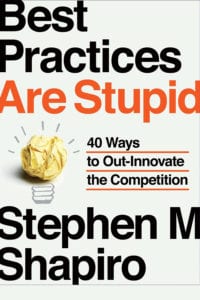
Best Practices Are Stupid: 40 Ways to Out-Innovate the Competition
I have an example of this from when I was selling advertising and one of my clients was Banana Republic. They had said, “We’re never going to be Neiman Marcus in terms of service and price points.” The question was, what could we do to target 20% of the clients that we have that are giving us 80% of the revenue? You triggered my memory when you’re talking about, “Let’s look at our most profitable customers.” They tended to be in San Francisco in the Union Square store and in New York City’s Rockefeller Center. They said, “Let’s try and anticipate, what is luxury?” That was the next question. That’s using your process without even knowing they’re using it. Now that I understand your process, it’s fascinating to see this in action. What is luxury besides price point? That’s the big shift. That’s the ineffective question. It’s the norm. Luxury is expensive. What else is luxury?
They came up with a definition that luxury is anticipating a need before you know you need it. From that lens, they said, “Why don’t we test putting in phone charge places in those two locations where the majority of our clients are giving us the majority of the revenue? We’re targeting this 20% of all the people that shop at Banana Republic or we’re going to get a good chunk of them in those two locations, those two big stores. It’ll be a nice way of upping the luxury experience without having to raise our prices or spend a ton of money, but giving them some other little perk.” The results blew them away because sales went up 20%. Not only did the people use it, but they also shopped longer waiting for their phone to fully charge, which they had not even thought of as an outcome. If I understand the takeaway from the book, which I love, Invisible Solutions, that would be it in action?
That’s absolutely it in action. That was a combination of the leverage lens, insights and observation lenses, which are all about, how do we understand what latent needs are? Needs that haven’t been explicitly expressed. That’s a whole bunch of different lenses there. I love that and then you can play with it like, “How do we get them to stay even longer?” Some stores have put in services in retail stores, whether it’s a desk where you could stay and work.
The theory is if you’re staying in the store, even if you’re not shopping, you’re still in the store, then you’d be like, “I see that over there. That’s cool. I want to go get that.” It could be even exclusively for certain clientele. “We got these red stanchions with velvet ropes for special people.” There are lots of different things you could do. The key is to test it out. You can sit around and come up with a lot of cool solutions, but we don’t know if any of them are going to work to do these small experiments.
What are the other things you have in your chapter about, switching elements is a performance paradox? Nobody loves an alliteration more than I do, Stephen. It sticks in my brain. Can you define what a performance paradox is?
The performance paradox is if you want to achieve a goal paradoxically, sometimes the best way to achieve it is to not focus on the goal. If you want to sell more, don’t focus on selling. Focus on serving. I had great pleasure when I was living in London working for a Formula One race car team. I asked them, “How do you get pit crews to go fast?” They said, “We tell them to go fast but what we found is that if we tell them not to focus on their speed, but focus on their style and their movements, they went faster and they thought they were going slower.”
[bctt tweet=”One of the big mistakes we make is we get myopically focused on the future that we forget that the future is not predictable.” username=”John_Livesay”]
There’s a lot of examples of this, whereby shifting from the outcome or the goal to a present moment activity can fundamentally shift your performance because you reduce stress. I’m not a great golfer, but I think about golfing as a great metaphor because when you’re golfing, which one does is look at the pin. You want to look at where you’re going but once you line up, if you lift your head up and look at the pin as you’re swinging, you’re going to slice the ball. You need to focus on the ball. Your eye has to stay on the ball 100% of the time knowing you’ve lined up and it’s going to go to the pin. That’s the way things work.
Don’t you find a lot of us struggle with worrying about the future too much? We’re not in the present moment, which is what a game like golf requires to be completely present. You can’t be thinking about anything, including what’s happening a few seconds after you swing. How does that help us in business when we do have to do projections and we have a big meeting, and yet we need to be completely present?
We cannot be thinking about, “I need this sale to make my quota.” “If I have to show this person another house. I’m going to lose my mind.” I work with people on replacing that negative self-talk or those future fear-based things with some simple mantras of peaceful and calm as you’re listening to someone give you an objection or interrupting them, worst case. “I have your answer. I’ve heard this objection 100 times. Let me cut to the chase. Talk about a way to kill a sale.” That’s one way to do it, right?
Yeah. We did a study once in a retail store many years back and we had two teams. One team, we told them, “We’re going to see who can sell the most.” We measured how much they sold. Another team, we told them they’re there to serve the customer. We’re going to see how well they serve the customer. That means if the customer should go somewhere else, they go somewhere else. Of course, the sales were measured for both teams and the team that was focused on serving the customer sold more than the team that was focused on making the sales. We can make these shifts.
You need to know where you’re going, at least directionally. I say you don’t want a specific destination. You want a sense of direction and then meander with purpose. That’s one of my favorite lines, which means, I don’t know. If you come up with a five-year plan, you’re smoking something because nobody has a clue of a one-year plan, so you need a sense of direction to make sure you’re moving forward with something but then you go each and every day and make these minor corrections in your course. What you’re going to find is you might move in a different direction, but it’s a better direction based on new information. That’s one of the big mistakes we make. We get myopically focused on the future that we forget that the future is not predictable.
I once heard someone describing this concept in terms of driving that when we’re driving on a freeway, we’re making these subtle corrections with a steering wheel to stay in our lane and not go over to the other oncoming traffic. It’s subconscious, we’re not even aware of it, error, correct. What you’re talking about is focusing on the direction we want to go. When I was a kid in family vacations, I’d be in the backseat torturing my parents. “Are we there yet?”

Invisible Solutions: The performance paradox is if you want to achieve a goal paradoxically, sometimes the best way to achieve it is to not focus on the goal.
That’s what salespeople management can do to each other. “Did you hit that number yet? Did you get that sale?” As opposed to, “Let’s keep focusing on customer service. What do they need? How can we solve that problem?” The other thing that you said I’m fascinated with is on both of those examples where there’s the car team changing the tires quickly or the other example of the contest is people perception. “Am I going slower or faster? Is this working or not?” It’s not always accurate. It’s almost like you’re trying to trust your eyesight and you know that sometimes what you see is not the reality.
When you’re working hard, you think you’re making progress. That’s not necessarily true. Some of the things that I’m talking about here go back many years to research that was done by two scientists, Yerkes-Dodson. If you look at the relationship in between, they use the word arousal, but I think of it as motivation. How do we motivate somebody? Their performance looks like an upside-down U for the most part. No motivation and no performance, then there’s that sweet spot where you hit that peak performance, but then if you over motivate somebody, their performance starts to drop.
Let’s say we were lucky enough to get our name picked out of a hat for a basketball game. If you shoot from the half court, you win money or better yet, let’s choose the county fair. Those little basketball games and you win a stuffed doll. A stuffed doll is not a big motivation but now all of a sudden, I give you $100, you’re going to try a little harder. $300, you’re going to try a little harder. There’s a point that will be different for each person but there’s a point where I’m going to give you so much money, you’re going to get a lot worse. If I said it’s going to be $10 million, I promise you, you will not sink the ball because your nerves are going to go out of control. That’s what we see happening is that upside-down U model.
That’s beginner’s luck because they’re unattached to the performance. “If I don’t do well, I’m not going to beat myself up. I’m not going to suddenly think I’m a bad person or not talented. I’m just trying this.” Once we started trying to beat our own records, when I used to swim competitively, that was always the thing. “Here’s your best time for the last three months. See if you can beat it this race.” Ironically, I find myself in a sales career, which is the same thing with quotas. “You hit this number last year, now we’ve raised it X percentage. I’ll try to beat that.”
It is interesting how we find ourselves. That’s why I always love hearing your own personal story of origins. You’re deconstructing things as a child and now you’re deconstructing myths like, “Working harder doesn’t necessarily mean progress,” or getting people to let go of the premise that, “I have to focus on my outcome and not the process.” All of those things that make us more innovative. There are solutions that are in front of us that we just have to get the right lens so that we can see them. Is that a fairly good, accurate summary of you and your book?
That’s spot on. I’m glad you pulled out the performance paradox because I also say there’s the solution paradox, which is the corollary to it. If you want a better solution, stop focusing on solutions. Having the answers is not the answer. We have to have better questions and we need to reframe the questions. The key to high performance is better questions that lead to faster implementation of more valuable solutions.
[bctt tweet=”The key to high performance is better questions that lead to faster implementation of more valuable solutions.” username=”John_Livesay”]
You need to have a certain emotional EQ to be comfortable that you don’t have all the answers, especially if you’re in a management or leadership position. The old way was if you got that job, you better have every answer or fake it. People can see through that as opposed to more collaborative conversations that I see happening. One last question for you because I see this as a big problem in a lot of different industries. I’m guessing you have a tool through your lenses. All the silos that exist in companies.
They’re constantly telling the silos of whether it’s a practice area and an architecture firm or law firms that have different practice areas or healthcare companies that have separate sales teams for each division of whatever the product is. Yet, they’re trying to get the end-user who’s using one division to use all of them and there’s no way for them to even start so they’re all focused on, “We need more new clients,” as opposed to, “Maybe if we weren’t siloed, we could grow some existing clients to use other divisions.” That to me seems like a huge problem that someone like you has to put a lot of thought into. Any thoughts around that before we say goodbye?
We could do a whole podcast on this one topic. It’s a fascinating one. I remember a company that we’re doing some work with, where their on-time product launch was 15% on-time product launch. The reason was because they thought product development, the R&D group was the product but it wasn’t because they would create a product, and then it would go to marketing. They say, “This is not the right product,” and then we go to sales, “It’s not the right product,” or manufacturing, “We can’t make this product.” They would go around in circles. They redefined product development as being six months after a successful product launch. Everyone, legal, sales, marketing, manufacturing, and R&D were all part of that and measured and incentivized on that. What they went for is from 15% to 70% on-time product launch in one year, simply by shifting people’s definition of what the launch of a product was.
Everybody has a vested interest in that.
Exactly.
The book, Invisible Solutions, you can get it on Amazon, and then Stephen’s website is StephenShapiro.com. Thanks for coming on and sharing your solutions whether they be visible or invisible.
It’s great to be here, John. Thanks.
Important Links
- Invisible Solutions
- Elizabeth Gilbert
- Best Practices are Stupid
- StephenShapiro.com
- Invisible Solutions – Amazon
- Better Selling Through Storytelling Method Online Course
Wanna Host Your Own Podcast?
Click here to see how my friends at Podetize can help
Purchase John’s new book
John Livesay, The Pitch Whisperer
Share The Show
Did you enjoy the show? I’d love it if you subscribed today and left us a 5-star review!
- Click this link
- Click on the ‘Subscribe’ button below the artwork
- Go to the ‘Ratings and Reviews’ section
- Click on ‘Write a Review’
Love the show? Subscribe, rate, review, and share!
Join The Successful Pitch community today:
- JohnLivesay.com
- John Livesay Facebook
- John Livesay Twitter
- John Livesay LinkedIn
- John Livesay YouTube
“Do You See What I See?”: Using Visualization to Close the Sale
Posted by John Livesay in blog | 0 comments
You know the holiday song “Do You Hear What I Hear?” There is a lyric that asks, “Do you see what I see?” which encourages people to use their imagination and look up into the sky.
What a great metaphor to remind us to look up from our daily tasks and imagine what is possible beyond our limited thinking.
When we start off conversations with “What If?”, we invite our potential business partners to imagine new possibilities. One of the best tools to do that is to ask a question that allows people to visualize a future where the two of you are working together and how much better their life will be by using your solution to their current problem.
Active listening has always been a key factor in being successful in sales. (And we all have to sell ourselves — whether we have a sales title or not). That is why it is crucial to reframe and restate what you think you heard someone say before you answer them.
When people feel seen and heard, they connect with you.
Eyes Wide Open
When I interviewed Issac Lidsky on my podcast The Successful Pitch, he told his journey of losing his sight at 25 years old. He went through many feelings of grief around losing his sight. Once he reframed how he saw his blindness, he went on to become the first blind person to serve as a law clerk for the U.S. Supreme Court.
Now, as an entrepreneur, he told me that when he runs meetings with his staff and asks them for their input, he sometimes hears silence. He reminds them, “I’m still blind. Are you all nodding again?” Then he has people go around the table and speak their thoughts. This gives him more information than if he had just relied on “seeing” people nod their heads.
He has written a wonderful book Eyes Wide Open and inspires all of us to see in new ways.
When you learn how to tell a new story to yourself about what you need to be happy and successful, you are back to being the director of your own life.
The Three Cameras
We always have three cameras at our disposal:
-
- How we see things. What lens are we using? Is it a wide-angle or close-up lens?
- The choice to see things from others’ perspectives and show empathy for what they see and feel
- The ability to zoom out and see the big picture. Will this be important or stressful 5 minutes from now? How about 5 days or 5 years from now?
If you want to learn how to see and hear things from a different angle so you can create meaningful connections, then my Better Selling Through Storytelling course and ongoing support could be the missing tool you have been looking for!
Let’s go on a journey together to get people to see and hear what you see by telling them stories that tug at their heartstrings so they want to open their purse strings.
The Influence Board With Jay Allen
Posted by John Livesay in podcast | 0 comments

Have you experienced being bombarded with cold calls and not knowing what to do with them? Especially when quarantine and social distancing have become the new normal, receiving these calls has probably been a lot more frequent that we just can’t find the time to answer them all. Introducing you to someone who has created a solution to that, John Livesay sits down with the founder of The Influence Board, Jay Allen. He shares with us the platform he has created that helped influential executives deal with cold calls and how he is letting people connect with the right decision-makers and make the world a better place.
—
Listen to the podcast here
The Influence Board With Jay Allen
Jay Allen is the Founder of the Influence Board. He noticed that a lot of influential executives were being bombarded with cold calls and they didn’t have time to do that. He created a solution for that. He helped build it with their input, which has allowed it to scale. Find out how he’s letting people get into the right decision-makers, while also making the world a better place.
—
Our guest is Jay Allen. He’s founded and managed six major networks of influential business leaders over the years with over 5,000 executive members from the major companies in the US and Europe. He has years of experience as an entrepreneur, strategic advisor, and executive leader. He is an influencer among private companies and large strategic corporations. He’s overseen strategic business development for a number of emerging technologies. He’s also the Founder of the Influence Board. Jay, welcome to the show.
Thank you. It’s great to be here, John.
Let’s go back to your own story of origin. You can go back to childhood or school. Tell us a little bit about how you got interested in business in general.
It all started with a passion for marketing. I went to college for international marketing and loved it. I grew up in the industry a little bit, but quickly discovered that the salespeople were making a lot more money than me. I transitioned at one point from marketing to sales. It was a tough transition. I’m a relationship person. The impact of rejection of cold calling was tough for me. I had a lot of anxiety about cold calling. I reached a point where I said, “Do I want to do this as a career?” I knew I needed to do something a little different. It was that inflection point in my life where I decided to take a slightly different trajectory. I ended up reaching out to ten executives I had never been able to get a meeting within two years of cold calling. I invited them to lunch to meet each other and I told them, “No vendors. You’re all going to pay for your own lunch.” I was shocked when all ten showed up.
I learned a valuable lesson that day that was a guide to everything I did after that. These influential people have a hard time growing their network of other valuable contacts. The networking events they get invited to aren’t high value because 80% of the people in the room want to sell them something or hand them a resume. The fact that I reached out and said, “These nine other executives want to have lunch with you. We’re going to get to know each other. No vendors. You’re buying your own lunch,” was a completely novel idea to them and something that was of high interest. Over the years, I went from a below-average salesperson that hated cold calling to one of the most connected people in Colorado by becoming a personal networking assistant to the most powerful and influential people in Colorado. That led me to do sales in a different way and continuing sales but not having to cold call the way I used to.
That is valuable for everyone reading. You’re solving a problem, which is what everybody has to put the lens on. The problem is that influential people have trouble growing their network without being inundated with a lot of other people pitching them things or wanting to hire them. They’re talking to their peers and learning from them without feeling like someone is trying to sell them something or get them to hire them. Smart executives realize the value of their network. You need it not when you have a job, but when you don’t have a job. They’re forward-thinking enough to realize, “This is a good use of my time. I might use something I could use in my job. Especially if it’s my peers, we probably have similar challenges.”
You and I were talking about some of the similar challenges that healthcare companies have with COVID. If a pharmaceutical company is talking to a manufacturing company and they’re both realizing, “We’re having trouble getting in the virtual door.” They might have some interesting conversations of sharing some things that are working. You were in that lunch even though they were all buying their lunch, but that’s not when you were pitching. I’m sure that’s the case. I want to reiterate for anyone who’s reading and going, “I’m going to try that.” It’s still not your chance to pitch. You’re just listening.
I coined a phrase, the law of two favors. My philosophy was if I have an ulterior motive or I’m trying to get in the door and close a deal with one of these executives and that’s why I reached out, I can’t tell them that until I’ve done them two meaningful favors. Once I’ve done them those two meaningful favors, I can bring that up and we can have a conversation. Selling to a friend is a much different experience than selling to a stranger. I wanted to establish that relationship of trust and friendship and cross the bridge of them knowing that regardless of the outcome of any transaction, we’re going to be friends. When I do the ask, they can say yes or no and have confidence that it’s going to have zero impact on our personal relationship.
Selling to a friend is different than selling to a stranger, that’s going to be one of our tweets from the episode. The problem I see with many salespeople is they’re short-term focused, “I’ve got my quota this month, this quarter. I don’t have time to make friends.” They’re not seeing the long picture. It’s like, “I’m moving on,” as opposed to maybe a no could be a yes down the road. That is not how you build a successful career, let alone a network. You have to invest. Those relationships are my big takeaway.
I’ll even give you an example. One of the executives in that first group of ten was the head of IT for a large technology company in Colorado. I had never been able to get past his admin. He had a brutal admin. He showed up at this lunch. One thing I discovered in the conversation over lunch is that he was engaged to be married. His fiancé was trying to land a job. I asked some more questions about what she was looking for. I made a few phone calls. I ended up landing her an interview. She ended up getting the job. The executive invited me to their wedding reception. We became fast friends.
I had an opportunity to sell into his company. When he changed jobs, I helped make some introductions for him to transition to a new job. I had some opportunities to sell into the organization that he went to at that time. He moved out of the country. When he moved back to the United States, years later, I was the first person he called and we reconnected and had an opportunity to sell to the new company that he moved into. It’s those long-term opportunities that made a difference in my career.
[bctt tweet=”Selling to a friend is a much different experience than selling to a stranger.” username=”John_Livesay”]
I remember when a client of mine in a healthcare company hired me to speak to their sales team. We had many conversations before and then we met face-to-face. He introduced me to his boss and all of that was the night before the event. He turned to me and he said, “I feel like I’ve made a friend.” I said, “You have.” That’s what you want to have. When you can make somebody look good to their boss or if I was calling on ad agencies and I make them look good to their clients, that’s when people know, “You don’t see me as just another job. You see me as a person.”
That premise of speaking and becoming friends with somebody at one company and they left and went to a competitor and they brought me with them. They’re like, “I want you to do what you did for me at the other company to this company.” Those warm introductions. When someone is hired, they obviously have a little honeymoon period going on. If they say, “I want to bring this speaker or trainer in,” it’s different. They go, “This is your first six months to show yourself and that’s why we brought you.” It’s a great example of all that.
I want to talk about your days at product development at American Express because I’m sure you learned some fascinating life lessons there working for such a big company versus working in other situations. When people get to work for a big brand like that, I know when I was at Condé Nast, you see things. Your resources, for one, are different from smaller situations. What was your big insight from being at American Express?
At American Express, like some of the other companies I was at, I was always part of a small entrepreneurial segment of the organization. Not all companies do that and do it well. American Express was one that did it well. They were interested in branching into a new space, which was the debit card or stored value card space for college campuses. The project I was on was, how do we develop both the platform and the marketing message to go to these college campuses, and provide them a stored value card that the parents could load up and would work at places that accepted American Express around campus? It was a great concept. The team there was entrepreneurial. You don’t often see that within a large company. It went well that that division ended up being acquired by Maritz, a performance improvement company out of St. Louis. I had the option of moving to St. Louis, which I didn’t take. I wanted to stay in the West.
What I find fascinating about you is you have your pulse on the zeitgeist. What I mean by that is like Wayne Gretzky’s quote, he aims his puck for where the puck is going and not where it is. You started the Influence Board years ago. Who could have predicted that the need to help people get appointments with key influencers would be at an all-time high during a pandemic when you can just drop it in office or see somebody between surgeries if you’re calling in the medical things? It’s almost like a relationship. You need to plant those seeds early on. You saw a need for this when you started it. Share with us how you came up with the idea and what it does.
What’s interesting is this concept has been attempted a couple of times in the past that I’ve seen and it has not succeeded. The reason it didn’t succeed is because it was being built from a salesperson’s perspective. I’m a salesperson. I want to access these influential hard to reach executives. I’m going to build a technology platform that allows me to donate to their charities. They build it and then they try and convince executives to come onto the platform. They’ve never been able to get traction. I had a completely different approach. I wanted the executives to build it. I wanted the executives to architect it and to solve the problems that they were having.
The problems they were having is they’re getting 30 calls and emails a day from vendors they’ve never heard, and trying to sell them stuff and get their time. They don’t have that much time. They can’t listen to all these people and figure out if there’s a fit. What they wanted was, “Can I forward all these emails into a system that can inform the vendor on my areas of interest and need? If they’re in the box, they can submit a meeting request. If they’re not, they know and they don’t have to waste their time.” That was part of it.
A lot of these executives are a little older and are at a point in their life where they want to make a difference in the world. They want to give back. They’re sitting on charitable boards. They want to make a difference. They wanted to weave in the ability to support charitable causes and make a difference in the world into the process that we’re building. It took us a long time. We’ve commercially launched just a few months but we have been working on this for years, testing different concepts. We tested an auction concept. We looked at different ways we could implement this and figured out what worked and what didn’t work.
We built it with all the tools the executives needed to meet compliance requirements and everything they wanted as far as the toolsets. When we rolled it out, we got immediate executive adoption because it was everything that they wanted with all the toolsets that they needed. We’ve been onboarding about 100 executives a month. We’re about 900 executives on the platform and that will accelerate. We’re going to see thousands of executives coming on board each month due to the interest level that’s been sparked.
My first big takeaway is when clients build something, they adapt to it quickly. As opposed to, the old way of doing things. An engineering standpoint is the engineers build this, and now marketing has to figure out how to sell it. We haven’t talked to a prospective customer. We don’t have any idea what they want or need or if they’re going to like this, let alone pay for it. You reverse engineered that mindset and that’s why it’s working and growing fast. I’m guessing there were some challenges in terms of the executives still having to answer to a board, even if you’re the CEO. The board is like, “Is this allowed?” It’s the compliance issues. Why is it your charity and not the company’s charity? Something along those lines. Can you get into any of the details of how you navigated that?
At the core of this platform is a means for an executive to offer an hour of their time for an exploratory meeting in return for a meaningful donation to a worthy cause of some kind. The money doesn’t go to the executive. It doesn’t accrue. It didn’t come to them. It’s not taxable to them. The vendor is paying the charity. We came up with a whole list of compliance capabilities and compliance guidance that we would give the executives as they came onto the platform. Things such as you’re not to use this platform for vendors involved in an active RFP. You wouldn’t use this platform for a meeting with a company that you’re already doing business with.

The Influence Board: At the core of The Influence Board’s platform is a means for an executive to offer an hour of their time for an exploratory meeting in return for a meaningful donation to a worthy cause of some kind.
We gave them tools. When they accept the meeting requests, they have the option of checking a box and waiving the donation if they want. If they feel there’s any conflict of interest, they could waive the donation. They can still take the meeting but there’s no donation involved. We recommend they commit 1 or 2 hours a month to this. It’s not a regular process. It’s 1 or 2 hours a month that they’re doing this. If they want, they can take their lunch hour to have the meeting so it’s not on company time.
You got that flexibility. You’ve thought this through.
I’ve been surprised. We got through compliance at Western Union and got greenlighted for their executives, a financial institution with a lot of controls around it. We’ve gotten a greenlight from compliance departments of municipalities, government organizations. We feel we’re on solid ground relative to giving the executives the tools they need to ensure they use the platform properly.
Now that you have some momentum, you’re in my sweet spot, which is turning these case studies into case stories. Also, being able to either post the case stories in written form or maybe even a video where someone’s saying, “I’m glad I took this meeting from the Influence Board. Now I have found a solution to a problem I couldn’t find without having to spend hours and hours of weeding through pitches and things.”
We’ve gotten some good stories from executives and vendors alike. I heard from a vendor that said that they landed a meeting with an executive they had been trying to reach for well over a year unsuccessfully. They were extremely happy. We’re seeing about a 20% to 33% median acceptance rate on the platform. If you submit ten meeting requests, you get 2 or 3 meetings. For this caliber of the executive to make ten cold calls once and get 2 to 3 meetings is unheard of. It’s delivering on the promise.
The other sweet spot for the Successful Pitch theme is on your platform, people have an opportunity to write into the reason for the meeting and upload some information for backup. The ability to pitch yourself and prove to the executive why your bid should be the one they pick, given everything is the same and that everyone’s giving the same amount of money to their charity of choice. To increase your odds, if you’re already getting 10% to 33% yeses, wouldn’t it be great if you knew how to be in that 30% or even make half your requests more irresistible? I thought it would be fascinating for us to brainstorm a little bit for anyone reading because it works for everything, but certainly for people on the Influence Board. What have you seen works and what hasn’t worked?
We standardized the format for submitting a meeting request on our platform. That was intentional. It came from the executives. We asked them, “What do you want the meeting requests to look like?” It came down to three things. Each one of the meeting requests has three parts. You get to make a 300-word bold claim. Tell me exactly how you’re going to solve my problem. Give me the metrics. What percentage improvement can I see? You don’t have to substantiate the numbers. Make the claims. Make a bold claim so that I know where you’re headed as far as solving my problems.
Part two is a video. What they want is a video of you talking to them. They get a sense of who you are as a person. People do business with people they know and like. This is an opportunity to make a human connection. The third part is the boring part, which is you can attach three documents that support the claims you made in your bold claim. Where we’ve seen the creativity is on the video. There was one person who shaved his COVID beard on the video saying, “This meeting is important to me. I’m cleaning up, finally.”
“I’m putting on long pants instead of shorts for this even though you’ll not see it on Zoom.”
There was another guy who knew that the executive played the guitar and was in a little band. He played the guitar on his video and he gave his pitch to music. We’ve seen some interesting creativity. We try and give guidance on best practices. John, you’re the expert at this. If any of your clients are doing it, I’m sure their bold claims are going to be fantastic.
Let’s talk about the two examples. Many of us have seen the Dollar Shave Club commercials. It’s a great use of humor. Humor works when it’s self-deprecating. Not humor at anybody else’s expense. It’s not about telling jokes. Be playful and get people a sense of who you are as a person by willing to be a little self-deprecating. One of my favorite quotes is from Arthur Ashe, the former tennis pro, “The key to success is confidence. The key to confidence is preparation.” The fact that somebody took the time to go find out what that person’s personal interests were and then customize the video through that music language is the extra effort that makes people stand out. Those techniques and then also the basics like have a good lighting and a good mic. Don’t film yourself on a video phone that isn’t professionally done because you still need to come across as professional. That’s the challenge of like, “I don’t need to spend a lot of money on it, but I need to spend some effort on it.” It’s this ability to speak in sound bites. One of my sound bites is when you target people’s heartstrings, they open their purse strings.
[bctt tweet=”Quite frankly, everybody hates cold calling.” username=”John_Livesay”]
One of the things that I would advise everyone who is creating a video for the Influence Board would be, do some research on the charity. Speak to how that charity resonates with you personally in your video, over and above the bold claim you’re making of why you should have the meeting. Those details are what’s going to make somebody trust and like you more and remember you more. Remember, you only have a few minutes. Some of them are probably not going to watch the whole video. You must have a strong opening. I know you and I are brainstorming on creating some basic, three mistakes to avoid. It’ll work for everybody, especially when the stakes are high. Do you ever get the objection from a vendor saying, “We don’t have budgeted money to donate to a client’s charity?” I’m guessing you’re saying, “You probably have a budget for travel and expenses that’s not being used at the moment.”
It’s interesting where people have found the money to do this, from a number of places. Their T and E budget has dropped dramatically. Instead of a $400 plane ticket, you can donate $400 to charity and get that meeting that you need to get. The other thing is a lot of them have stranded event sponsorship dollars because the events didn’t happen. They had budgeted for sponsorship and they see this as better use of funds. They were going to sponsor an event hoping that they would run into the right person at the event, and hoping they would have a conversation and it might turn into a meeting. For the same money, they could guarantee themselves a certain number of meetings on our platform.
At least your target is everything.
On our platform, you pay nothing unless someone says yes to the meeting. You’re only spending the money when you get the outcome that you want.
You’re making a donation to someone’s charity and you’re selling something of fairly high cost, the ROI is huge. Also, I want to take people behind the curtain a little bit of what I did there and what I want to encourage people to do on their videos when they’re creating them for the Influence Board. Anticipate an objection before the person voices it and answer it in your video. I haven’t been in Corporate America like you. We know the objections are we don’t have this budgeted. If you address that in your video, that’s not going to be the objection.
I gave an example of how you get clients. If you think someone has an objection like, “We’re happy with our vendor. You’re more expensive than what we’re spending now.” Address that in the video before you get to the meeting. It’ll make people think, “He’s in my head. He’s already anticipating what my concerns might be.” If you can address those concerns in the video, then they’ll think, “Maybe there is a reason to talk to you.”
That’s a great point.
Any last thoughts or advice you have for people who are struggling to get into the virtual room these days? How can the Influence Board help them?
We try to make it as easy as possible. It’s free to join the Influence Board and takes 30 seconds to create a profile. Once it’s created, you can download our entire database of executives into Excel. You can sort, slice, dice and figure out if there are some good targets for you in there. You could submit your meeting requests. It doesn’t cost anything to submit them. You only donate to charity when you win the meetings you want with the executives that are high priority for you. It’s a seamless process.
It’s fantastic. I’m sure you have wonderful case stories for both the vendors and the executives who are happy that they’re doing it.
We have some superuser executives that love the platform. It’s been fun to see them see this new way to manage the vendor cold calling dilemma. It’s turned into something that they hated. Quite frankly, everybody hates cold calling. The vendor hates making the cold calls. The executive hates getting them. This has turned the whole process into something fun and interesting and has renewed enthusiasm among the executives. When they get a meeting request, “Is the video going to be cool and inspiring?” It creates some intrigue and excitement that hasn’t been there in a while.

The Influence Board: People do business with people they know and like. This is an opportunity to make a human connection.
People like to be entertained, as well as informed and inspired. When we can encourage people to put their empathy hat on to what it’s like to be that executive, getting constant requests. The more you can put yourself in their shoes and think, “What a win this could be for them.” If I have something that can help make their job easier and better and they’re getting something for the charity, they’re going to be happy they took this meeting. If you can convey that emotion in your video, that’s what’s going to make people intrigued enough to want to hear more.
That’s great.
Thanks so much for joining us, Jay. If people want to find you and the Influence Board, where should they go?
InfluenceBoard.com and my info is there as well.
We’re going to look forward to continuing to watch this soar and scale much like you’re helping your clients who are on the Influence Board.
Thank you, John. It’s great to be here.
Important Links
Wanna Host Your Own Podcast?
Click here to see how my friends at Podetize can help
Purchase John’s new book
John Livesay, The Pitch Whisperer
Share The Show
Did you enjoy the show? I’d love it if you subscribed today and left us a 5-star review!
- Click this link
- Click on the ‘Subscribe’ button below the artwork
- Go to the ‘Ratings and Reviews’ section
- Click on ‘Write a Review’
Love the show? Subscribe, rate, review, and share!
Join The Successful Pitch community today:
- JohnLivesay.com
- John Livesay Facebook
- John Livesay Twitter
- John Livesay LinkedIn
- John Livesay YouTube