
Millionaire Secrets With Jeff Lerner
Posted by John Livesay in podcast | 0 comments
Getting to the top is not worth it if you are not doing what you love, or you still feel empty despite having everything. True professional success is all about indulging in your passion, keeping a healthy body, and having a deep connection with others. John Livesay is joined by the Cofounder and CEO of ENTRE Institute, Jeff Lerner, in discussing the secrets of attaining worthwhile business success, from taking care of your body to knowing the right way to eliminate money-related problems. Jeff looks back on his life that led him to become the entrepreneur he is today, starting from his piano performing days, getting divorced twice, and being a father figure of an integrated family.
—
Listen to the podcast here
Millionaire Secrets With Jeff Lerner
Our guest is Jeff Lerner who shares the 3P’s to success, physical excellence, personal excellence, and professional excellence. He does a deep dive on what the word professional means to him as well as what the word desire means. You’re going to want to listen to how he’s completely turned his life around and figured out how to be successful. More importantly, how you can too. Enjoy the episode.
—
Welcome to the show. Our guest is Jeff Lerner, who is the Cofounder and CEO of ENTRE Institute. He is a serial entrepreneur, speaker, author, and musician. He’s a native of Houston, Texas where he spent most of his twenties attending university by day while working nights at one of the top piano players, a gig, which found him playing in the homes of billionaires and business owners. This is what triggered his interest in entrepreneurship. In 2008, when he was only 29, after multiple failures, during a restaurant franchise that left him with over $400,000 in debt, he found his calling as a digital marketer and paid that debt off in eighteen months. Jeff, welcome to the show.
Grateful to be here, John. I appreciate you having me.
Let’s start with your own little story of origin. You can start by playing the piano. I love that story of seeing how successful people who are entrepreneurs got to live and being in the entertainment and saying to yourself, “What’s the secret sauce here?”
That was a powerful transformative experience for me. I’ll set it up by backing up a little bit. I’ve had one job in my life and it’s when I was sixteen years old. I worked for three weeks in the office supply room at a major law firm. That meant that I worked for legal secretaries. I don’t know what big five legal firm culture is now but I can tell you that in the mid-‘90s, legal secretaries were not the happiest bunch of people. As they say, they got what rolls downhill.

Professional Success: When you start screwing stuff up, and it involves kids, it’s a whole other level of carnage and negligence.
It rolled downhill from the attorneys to their secretaries. They paid it forward down to me in the lowly supply room and like, “I need a print cartridge. My boss has a deposition due at 2:00 and if he doesn’t have it, it’s going to be your ass.” I’m like, “I’ll bring you a print cartridge. Take a chill pill.” Three weeks was all the abuse I can handle. I managed to get myself fired. Apparently, I was disrespectful to a secretary. I’m sure she was being very respectful to me though. I was like, “I’m never doing that again. I better figure out something that I can do so I can make a living and make a life in this world without having to ever take that again.”
I became a musician. It was a very strategic decision. It wasn’t like I had some deep longing to express myself through the creative arts. It was more of like, “What do I know already that I’m good at it and I can develop into a tangible, monetized skill?” I went hardcore into piano. I didn’t start seriously playing piano until I was seventeen years old but I had played guitar previously. I knew I was a good musician, but the problem with guitar is if it’s acoustic, it’s not loud enough to play by yourself. If it’s electric, nobody’s going to hire you without a band for the most part.
Generally, you don’t get to keep all the money. A lot of times you get booked to show up, there’s already an instrument there and you get to keep all the money. Especially if you learn to sing, you can make decent money. Again, it was very pragmatic. I was like, “I’m going to learn the piano. I’m going to start learning to sing. I’m going to learn the Great American Songbook. I’m going to learn contemporary, radio hits, and I’m going to go get jobs.” It was a little harder than that. It took me three years to get good enough to play professionally.
I dropped out of high school at seventeen. I was like, “High school holds nothing for me. That’s going to graduate me to learn how to go get a job. I don’t want to do that so there’s no point. How to navigate that with my parents?” It was interesting. They knew me. They’re like, “If he decides he’s going to do something, there’s no stopping him. We can either make our home life miserable because he’s going to be pissed off all the time because we’re fighting him or crazy as it sounds, we can support him in becoming a professional piano player.”They bought me a piano. They said, “You better practice your ass off, son.” I did. It took three years. I practice 8 to 10 hours a day as much as I could. The only days I took off were because my hand was so stiff, I couldn’t move my fingers. In three years, I became good enough to get a scholarship at the collegiate level and start getting hired for gigs. It ended up taking me almost ten years to finish college but I did graduate with a degree in Jazz, Piano Performance, and Music Composition and a minor in Finance which is most notable because I had dropped out of high school.
[bctt tweet=”Physical, personal, and professional excellence are all needed for success. Stop trying to take shortcuts.” username=”John_Livesay”]
I still managed to get into college on a music scholarship. That was the musical part of the plotline but what was transformational for me were few things. One was, I did get to experience what it’s like to make a living doing something that you love. Once you’ve experienced that, it’s hard to ever imagine going away from it. I was hooked at that point that I had made the right decision even though life was hard and I did not make very much money. I tried to get married twice in my twenties and blew it both times. I was twice divorced by the end of my twenties. There are two classes of people that are hard to be married to.
One is startup entrepreneurs. The other is aspiring musicians. I was both. God bless my ex-wives. I don’t necessarily fault them for their second choice. The first choice to marry me, I questioned that but the one to divorce me, that makes some sense. The biggest thing in my twenties was as a gigging piano player, it’s not hard to get the elite gigs that pay the best. You have to get a suit that fits and not smoking. If you do smoke, do it in such a way that it doesn’t make you stink like cigarettes. You have to be on time and respectfully carry on a polite conversation but not over-talk because the clients don’t want you chatting up the guests. You have to know a lot of songs, and be a decent piano player. Since I was one such person, I got in with this good agency. They started booking me.
I played in the homes of Tilman Fertitta who owns the Houston Rockets, Jim Crane who owns the Houston Astros, Bob McNair who owned the Houston Texans. He passed away in 2017 but I played in his home, and Andy Fastow, the CFO of Enron. I played in some big billionaire mansions and I got a real taste of how much money there is out there. I was in a unique position because I would always get to the gigs early so I could warm-up, set up, play the piano, and feel the keys. Whenever I could, I would try to corner these guys for at least a minute or two of conversation.
Usually, I would frame it as like, “Do you have any favorite songs? How loud do you want me to play? What mood do you want me to set? By the way, you’re successful. Do you have any tips? You got a lot of zeros in your bank account. Anything you could share with a broke musician?” I started hacking my way into billionaire mentorship from some of these guys and got a real strong vision of what my life could look like. They frankly alienated me from my musician peers because they’re all about struggle and the art, and I was a jazz musician.

Professional Success: You can change who you are through cognitive restructuring, even though it can be brutally painful and exhausting.
There’s a real lore in jazz around the struggle. I was like, “Screw this. I want to be rich. I want to take care of people. I want to bless the world. Honestly, I want to be able to make music someday on my terms.” I heard a story about how Prince built this whole recording studio in his house. He started his own record label. He could release his albums and do all his recording. He answered to no one. I was like, “If I’m going to be a musician, I want to be a musician like that.” I realized I was never going to get there for me through playing piano so I tried to start businesses.
All through my twenties, I rattled off on the last interview I did, it was nine businesses that I failed at. Fast forward to 2008, the Great Recession destroyed the economy. In 2006, I had gone through the funding and application process for two franchise restaurants. I own these two sandwich shops. I thought I was going to be a traditional American franchise millionaire dude, instead it all went out of business with the Great Recession. In 2008, I was $495,000 in debt. I couldn’t afford my apartment. I ended up moving in with my estranged and soon to be ex-wife’s parents, living in their spare bedroom, dodging creditors who were calling their house so you can imagine how popular I was.
The hard thing about owing that much money on those types of loans is of the $495,000 in debt, $330,000 of it was to the US Treasury because these were SBA bank loans that are backed by the US government. It’s no different than owing $300,000 worth of taxes. You don’t disappear from that unless you die. I was hiding from the US government in my ex-wife’s parents’ house trying to figure out how the hell I was going to get my life back on track. That’s when I discovered in 2008, I remember it clear as day, it was Monday of Thanksgiving week, November 2008. Three days before Thanksgiving, for $395, I bought a course on affiliate marketing. It turned out that I was good at a keyboard whether it was a piano keyboard or a computer keyboard as it turned out. Mostly, I had the ethic to practice. I knew how to sit there and grind for 8, 10, 12 hours a day leaning in, deciphering complex musical passages.
You do the work and you give it time. As a musician, I know how long it takes to develop competence. It’s something that is sophisticated. Years, thousands of hours, and that’s how I approached internet marketing. Thankfully, I was a quick study. I had a great training course, a good mentor. In eighteen months, I paid off $495,000 in debt. I’ve been doing some form of new economy entrepreneurship ever since. I’ve done real estate, Shopify stores, affiliate marketing. I had a digital agency, I create my own courses online. You name it, I’ve done it.
[bctt tweet=”Always solve the money problem first to prove to yourself that money wasn’t the problem.” username=”John_Livesay”]
The thing that stands out for me, besides the wonderful metaphor of the keyboard from a piano to the keyboard of the computer, is the lessons you took from learning and becoming a professional musician, not from an artistic standpoint but driven money-making, “I don’t want to work for anybody else,” mission of discipline to practice, being on time. I can’t emphasize that enough to anyone. Since you make a virtual appointment, it doesn’t mean you get to be late, especially if you’re pitching to a client or an investor. How you do one thing is how you do everything. I’m wanting to tap into that, Jeff, because that’s one of the things that made me want to have you on the show. Finally, not talking too much. We both are comfortable in selling things and selling ourselves.
The biggest mistake I see a lot of people making is they talk too much about the features. They bore people. They’re not telling stories, and the worst mistake ever is after someone says bye, but they keep talking. When you brought that up, I thought, “I don’t hear a lot of guests talking about that being one of the keys to their success.” In this case, as a piano player. When you transfer that to an entrepreneur, a salesperson, and having a successful pitch, the exact same three things, discipline, be on time, don’t talk too much, that’s like table stakes. If you’re doing it and most people are only doing 2 of the 3 or only 1 of the 3, you’re already ahead of the game. In my mind, if you can tell better stories, which clearly you’re great at, because music is a story. Each piece of each song tells a story so you have the ability to transfer so many of those skills to that.
You’re doing at the ENTRE Institute these ways of excellence and you have three of them. There’s a personal one, a professional one, and a physical one. Many times, people sacrifice 1 of the 3. We see all these wealthy people that are one beat away from a heart attack. You’re like, “You’re walking commercial of what that looks like.” It’s because the physical is not a priority or the sleep deprivation is a badge of honor and all these crazy behaviors or the multiple divorces and miserable life. You had said you have some insights for people. I bet a lot of people are going to lean in now of you can show us how to be excellent in all three. Please start with the personal. What tips do you have for people on having an excellent personal life while being an entrepreneur?
What’s funny is this is the one that I thought I had figured out because I’ve always been a reasonably fast, smooth talker. I thought that meant I was good with people. I was a train wreck of a listener like, “I got to stop talking and let other people talk.” I was an only child. I thought I was the sun and everyone else was a planet. I thought that my personal skills were well-developed. It wasn’t until my mid-30s, I realized how truly terrible they were. I’m jumping ahead in the story but in my early 30s, I started making money but I’m still not happy even though I’m out of debt. I came off of another interview, but this was what we ended up talking. It’s important to solve the money problem so that you can prove to yourself that money wasn’t the problem. As long as you have a money problem, it’s easy to make that your problem.

Professional Success: Professionalism is an intentional profession of faith, belief, testimonial, and value.
I solved it in my early 30s and I was still miserable. I was a divorced bachelor living in New York City, trying to live a cool Manhattan bachelor life which was such a façade and a distraction. I met this wonderful woman who lived in St. George, Utah, a little town I’d never heard of. She was a widow. I met her at an event that her dad was hosting, and I was the guest because I’d been an affiliate for his company. We hit it off. She had three kids and her youngest was two at the time. I went and visited. It didn’t click with the concept of a dad. It wasn’t like, “You’re not my dad,” because she’d never had a dad. It was like, “Who’s this guy?” I came out a few more times. I was head over heels in love with this woman.
I was like, “This is the woman I want to like to hang out with. There’s no one like this in New York.” I’m flying out to Utah every weekend from New York. It’s 4, 5, 6 weeks into that process, then all of a sudden, she’s like, “Daddy.” Suddenly, my girlfriend and I are like, “What happened?” We didn’t plant or suggest that. In fact, we’ve been very careful. Here’s the thing, I pretended to be mortified. I was so happy. Something came over me and I was like, “This is it. This is what I want for the rest of my life.” Within a month after that, I had exited everything else I was doing in New York City. I had loaded up a U-Haul, I was driving out to Utah, and I’ve been here ever since. The reason I’m telling you this in terms of the personal excellence, personal relationships, communication, connection, all that good stuff.
Now I was the father figure in an integrated family. She had two boys and a girl and the stakes are high here. I’ve been through a divorce. It sucks when adults screw things up. When you start screwing stuff up and involves kids, it’s a whole other level of carnage and negligence. It was like, “Let’s go get therapy. Let’s go get help. Let’s do this right.” She’d been divorced. I’d been divorce. That’s what changed my life. Early mid-30s, I go get in with a good family counselor. I thought I was going for a couple months to follow instructions, put the Legos together, and it was all going to be grand. I spent 2,000 hours in therapeutic environments over the next five years.
It doesn’t surprise me because you’re focused on the number of hours you put into learning how to play the piano, you’ve taken that ability to focus and commit to making your personal life as good as it can be.
[bctt tweet=”Excellence must always center on how you connect with people and how you manage energy in conversations.” username=”John_Livesay”]
Here’s the thing, I love it. You talk about listening. It’s stop talking, responsive listening. I say those two words together or people are like, “I should listen and be more responsive.” There’s an art to responsive listening like empathy. I got tested in the early days of therapy. My empathy on a scale of 0 to 100 was a 4. I’m an only child. I don’t need to hear about other people’s problems. I don’t walk out on anybody’s shoes. Years later, I figured out what if I retook the test. It was up to an 80. You can change. Not what you think and what you do. You can change who you are.
It’s a process called cognitive restructuring. It is brutally painful and exhausting. To this day, my therapist says, “You two are some of the only people I’ve had that were willing to do the work.” In ENTRE, when I talk about personal excellence, I’m talking about how you relate, how you connect with people, how you manage and control the energy in conversations. I’m talking about power dynamics. We teach something called nonviolent communication. One of the most important skills in life is making it so that every time somebody finishes a conversation with you, they feel good.
Wouldn’t it stand to reason that would be a useful skill? There’s a way to do it. Study transactional analysis, non-violent communications, Adlerian psychology. There are actual ways that you can become excellent in relationships that not only make your personal life better, not only make your relationship with yourself better. Honestly, they’ll make you a crap load of money. We’re here to talk about pitching and selling. Let’s say I’ve made millions. These skills added a zero.
Let’s dive into that. Be professional excellence, especially around the world of affiliate partnerships. For those who may not know 100% what that is, it can be everything from someone selling a course or a training program and people promote it for you and they get a percentage of what your revenue is. What’s happening in my perspective, of course I want to hear yours, is transferring of trust. The skills that you learned, empathy and listening, are what allows people to want to partner with you and then have those people who are following them say, “If Jeff trusts John, then I can trust John.” That’s the foundation for then seeing of whatever John is offering wouldn’t even be something but at least the ears are open. “If Jeff has vetted him in this, then this is a safe email to open,” or whatever it is.

Professional Success: Money is the last indicator of health. It must always start in the body.
Affiliate marketing is technology applied to referrals. We’ve had referrals as old as time, “John, you’re in Austin. You got to check out that pizza place on MLK.” Imagine if I said, “Make sure when you go in there to give them my name so they know I sent you. They might even give you a discount but also they’re going to know I sent you so they’re going to send me $1 for the referral.” Affiliate marketing is that, only it’s all tracked through digital links. That is what I started with in 2008. I was a full-time dedicated affiliate marketer from 2008 to 2012. I did well with that and I paid off my debt.
At the end of the day, it’s all about communication. I have a very specific definition of the word professional. It’s the 3P’s, Physical, Personal, and Professional excellence. Admittedly, I like it because it starts with P. It fits the pattern. I could say financial excellence, business excellence, or value excellence. Professional is a very specific word, very intentional to profess something. A profession of faith, belief, testimonial, value, or whatever.
There’s so much more to change the way we view business as how we make money or change our career. The way we view our career is how we make money. What are you professing every day through the work that you do? It’s important to change the way we view the business that we do or the career that we have. It’s not how we make money. It’s what we stand for in the world. It’s the profession of our faith, our belief and our identity.
I love that because the basics of being a professional, one of the things is showing up on time which we talked about at the beginning. What’s more than that because it’s energy of your passion that you profess your company in such a way that is not something you’re doing. It’s something bigger and there’s a bigger purpose behind it. Therefore, you’re able to profess your belief in it and that’s what is attractive to people.
[bctt tweet=”Say yes to success by saying no to everything that isn’t success.” username=”John_Livesay”]
You could rate somebody’s career satisfaction by saying, “Is their profession consistent with their profession?”
Finally, the physical element of it. For those who aren’t able to see you in person, you obviously keep in great shape. Whether you’re an entrepreneur, a musician, or an athlete, there is something to be said that your health is your biggest asset. Without it, you’re tying one hand behind your back. Any thoughts you have about the importance of sleep and exercise and all that to be successful?
When I draw the physical, personal, and professional excellence model on a piece of paper or a whiteboard, I draw it as concentric circles and physical is at the center. By the way, I always say them in that order, physical, personal professional from first to last. Money is the last indicator of healthy, sustainable, non-destructive growth. I personally believe it starts with the body. The body is the fuel cell. You cannot power a life, an engine, or a machine if you do not have a charged fuel cell. The way I look at it is, your physical is your fuel cell. It’s the energy source.
When energy projects from your life, what’s the first thing it hits? It hits the people right around you. Your points of impact, those are your personal relationships. I would argue, if you’ve got an energy that positively suffuses the people around you, do you even deserve to have a lot of professional success? If you’re saying, “No, I want my energy to skip my family. I want it to land in the market so I can make a lot of money. I don’t even want to have to have good, healthy energy. I’m going to neglect my body and my family. Hopefully, there’s this peripheral ring of professional, whatever that sends me a bunch of money.” That’s irresponsible. That contravenes the universal law of effort and value.
Millionaire Secrets
We need to stop taking shortcuts or trying. The shortcuts don’t exist, but they’ll work for a while and then they’ll call our bluff. We need to stop trying. Take care of your body and the people around you. Again, use the word deserve. The place that you serve from. If you’re serving from the right place, you’re professing something that’s aligned with who you are, you believe in, and it gives value to the world then you deserve professional rewards. That’s how I look at the world. I’m a simple person from the standpoint of when the going gets tough. I can only remember one thing. It’s easy to sit here, you and I can have this coffee shop talk, be intellectual, cerebral, and have all these great ideas.
I’ve got a bookshelf right here. I can pull a book off and read. If I’m in a firefight or if I’m $495,000 in debt, my ex-wife is leaving me, I’m stuck living in her parents’ house, and I have a month to try to figure out how I’m going to generate $40,000 or $50,000 a month or else, I’m going to lose everything. I’m going to have to end up in debtor’s prison or whatever. In those circumstances, when the stress has ratcheted it up, I’m not smart enough to remember all the fancy stuff. I got to have so simple heuristics that I can glom to. The three PS is at the center of my mental universe because it’s always there for me, physical, personal professional. Jeff, where are you faltering? You don’t have the money you want.
Are you taking care of the people you love you? Are you taking care of your health? There’s the problem. It always proceeds in that sequence for me. As far as an execution, there’s only 24 hours in the day. How do I get to have it all? By the way, this is a podcast so people can’t see this, but I’ll show you and you can speak to it. This is my schedule. People will say, how do I do it? I get up at 3:30. I do my morning routine. I practice piano for an hour. I go to the gym for 90 minutes. I have an hour of family morning and breakfast and take my daughter to the bus. It’s 8:00 and I start work. There’s no way around it. Get your butt up, do the work, and be balanced. Here’s the key, you say yes to success by saying no to everything that isn’t success. I got time to do that because I make no time for anything else.
I believe that you might have a free gift for the readers.
I absolutely do. I have an eBook that I wrote. It’s called The Millionaire Shortcut. I am privy to all the studies on human attention spans and how much they like to read long books so I didn’t write one. I wrote a very short book, very big print. It’s even got some pictures, and it’s twenty pages long. You can read it in fifteen minutes. It’ll teach you the fastest way to become successful in the new digital economy. You can get that at MillionaireSecrets.com/JohnL. It’s a special landing page we set up for this episode. I invite you to read it. On that page, you can also subscribe to my YouTube and listen to my show if you’d like.
Jeff, thank you so much for sharing your passion about how we need to show up for ourselves so we can show up for the family and then make the impact in the world that we want with our finances. It’s been great. Thank you for sharing that great eBook. I’m sure lots of people are going to take you up on learning that. I love your story from the discipline of the piano keyboard to the keyboard of your life at this point.
Thanks, John, for having me.
Important Links
- ENTRE Institute
- MillionaireSecrets.com/JohnL
- YouTube – Jeff Lerner
- Better Selling Through Storytelling Method Online Course
Wanna Host Your Own Podcast?
Click here to see how my friends at Podetize can help
Purchase John’s new book
John Livesay, The Pitch Whisperer
Share The Show
Did you enjoy the show? I’d love it if you subscribed today and left us a 5-star review!
- Click this link
- Click on the ‘Subscribe’ button below the artwork
- Go to the ‘Ratings and Reviews’ section
- Click on ‘Write a Review’
Love the show? Subscribe, rate, review, and share!
Join The Successful Pitch community today:
- JohnLivesay.com
- John Livesay Facebook
- John Livesay Twitter
- John Livesay LinkedIn
- John Livesay YouTube
Road To Revenue And Happiness With David Meltzer
Posted by John Livesay in podcast | 0 comments

Pain is a turn signal, not a stop sign in your life. This is one mantra David Meltzer has always believed in his whole life. David is the Cofounder of Sports 1 Marketing and formerly served as CEO of the renowned Leigh Steinberg Sports & Entertainment Agency, which was the inspiration for the movie Jerry Maguire. Today on The Successful Pitch, he joins John Livesay to talk about his life mission to empower over one billion people to be happy. He also shares how you can be happy and successful without being pushy. Don’t miss this episode and be on the road to revenue and happiness.
—
Listen to the podcast here
Road To Revenue And Happiness With David Meltzer
Our guest on the show is David Meltzer, who has many great takeaways for you about how to be happy and successful. He said, “Pain is a turn signal, not a stop sign in your life.” Also, he said that the secret to a great pitch is credibility. Read the wonderful stories he tells about how you can be happy and successful without being pushy. Enjoy the episode.
—
Our guest is David Meltzer. He’s the Cofounder of Sports 1 Marketing, and formerly served as CEO of the renowned Leigh Steinberg Sports & Entertainment Agency, which was the inspiration for the movie Jerry Maguire. I’m happy to have David on board. His life mission is to empower over one billion people to be happy. This simple yet powerful message has led him on an incredible journey to provide one thing, value. In all his content and communication, that’s exactly what you’ll receive. As part of that mission for the past many years, he’s been providing free weekly training to empower others to be happy. David, welcome to the show.
Thank you. I’m excited to be on a pitch show. I’ve done so much to help people share a vision and they neglect the pitch so much. I’ve executive produced Elevator Pitch with Entrepreneur the TV show. My TV show is called 2 Minute Drill, which is a two-minute pitch show on Bloomberg and Amazon. I do a Perfect Pitch on my free Friday training as well. It’s nice to have someone that understands the value of whether it’s a 1, 2 or 10-minute pitch.
That right off the get-go is a big value. You need to have variations of your pitch. Most people only have a ten-minute version. They don’t have a 2 or 1-minute version and they get completely overwhelmed. If your ten-minute version, it’s not the first minute of your pitch, it still has a beginning, middle, and end. Before we get into all your expertise around this, let’s go back to your own story of origin. I’m always fascinated to hear if you can go back to childhood, school, college, what was it that made you start your whole journey into business? I want to hear how you came up with your own personal mission statement because I think that’s important for people to realize the why of what you’re doing besides making money is crucial. Take us back as far as you want.
[bctt tweet=”‘Pain is the turn signal, not the stop sign in my life.'” username=”John_Livesay”]
My journey started with money. I wanted to be rich at five years old. My dad had left. Six kids and a single mom, a terrific mom. She worked two jobs as a second-grade teacher, packed her dinner in a paper bag, put us in the station wagon, and filled up the turnstiles at convenience stores with greeting cards. I said to myself, “Someday I’m going to be rich. I’m going to buy my mom a house and a car,” and that was going to make me successful. I wanted to be rich because the only time I wasn’t happy in my childhood was when there was financial stress. I’d catch my mom crying because we didn’t have enough money for food or a summer camp or the car broke down. There’s always something and it always revolved around money and so I believed that money bought happiness and love.
One advantage of that journey is that I was always looking at opportunities to make more money. Unlike a lot of kids, including my siblings whose parents tell them to be a doctor, lawyer, or failure, and they stay limited in their scope of what they’re supposed to do in life, I was completely open-minded because I wanted the highest paying gig. I used to tell people I’d shovel crap with my hands six days a week, twelve hours a day to buy my mom a house and a car. I didn’t care. I wanted to be rich. My journey led me through wanting to be a professional football player. I played football in college but got ran over by Christian Okoye, better known as the Nigerian Nightmare, AFC Player of the Year. That’s when I realized lying on my back, “Doctor, lawyer, failure.”
I thought I’d be rich being a doctor. That’s when my oldest brother who was a doctor gave me the best advice of my life. I told him I hated hospitals. He said, “Dave, you’re eighteen years old. What do you mean you hate hospitals? You’re pre-med. What are you talking about?” I said, “I want to be a sports doctor. They’re not in hospitals are they?” He goes, “David, you need to be more interested than interesting.” That became truly a perspective of mine. I no longer was going to be an interesting person. I was going to learn what I call, “Find the light, the love, the lessons, and everything.” Ask as many questions as I could, which ended up being a great tool not just in pitching, but in selling in general. You are an expert at selling and you know how important it is to be more interested than interesting.

Being Happy: The lens of gratitude will give you the ability to find enjoyment and the lesson in what you’re doing.
I went to law school instead, but while I was in law school, I kept my options open. I ended up with two job offers. One to be an oil and gas litigator, which is one of the highest paying jobs out of law school. I also had found a sales job in this new thing in 1992 called the internet. This new thing piqued my interest and I told my mom, “I’m thinking about taking the sales job. I’m not going to be a litigator.” My mom almost died. She is like, “You’re going to ruin your life. The internet is a fad. Don’t do it.” That’s the next lesson that I like to teach people. Just because somebody loves you doesn’t mean you get good advice. That helped me throughout my whole career. Voting for what you want, not seeking other people’s approval, knowing your own values, these are all tools not only in selling but in pitching in general. To understand what the objectives are, what your aligned values are in seeking advice from people who sit in a situation you want to be in. I took the sales job nine months out of law school, millionaire, bought my mom a house and a car, had a little bit left over to pay my loans.
Here’s the interesting thing. I graduated law school at 24, 25 in 1993. Everything I did reinforced that money bought love and happiness. I became the favorite child of my mom in my mind. 1995 came, we sold the company I worked for $3.4 billion to Thompson Oils. I then went to Silicon Valley and raised hundreds of millions of dollars in the wireless proxy service space, the middleware space. I then became CEO of the world’s first smartphone. I worked with Microsoft. It was a Windows CE device. I worked with Samsung manufactured by them. I was a multimillionaire by 30. I married my dream girl from the fourth grade. Every single thing that I did reaffirmed that money buys love and happiness. That’s when the journey shifted because I then became the CEO of Leigh Steinberg Sports & Entertainment. You’ve interviewed Leigh, the most notable sports agent in the world.
I surrounded myself with celebrities, athletes, entertainers, and I truly started to realize one thing, that I had moved from a world of not enough, where I was a victim. I was always looking at, “Why me? Why does John have that and not me? I’m as good.” I was a victim. I then became a millionaire and it was everything enough for me. If I wasn’t happy, I’d buy things I didn’t need. If I wasn’t happy, I’d buy more things I didn’t need. If I wasn’t happy, I’d buy different things I didn’t need. If I still wasn’t happy, I’d buy things to impress people that I didn’t like. This was not the best world to live in. It wasn’t a world of abundance. I was barely philanthropic. I gave to receive. Everything I did was to help other people, but I wanted something back. I wanted acknowledgment, recognition. I wanted some quid pro quo or trade. I wasn’t living in the world of more than enough.
[bctt tweet=”Be interested, not interesting.” username=”John_Livesay”]
That’s where my journey took me is I learned to shift the paradigm of value to understand, to receive so I can give. I talk about a world through me to others. I’m always looking from, what am I going to receive? How’s it going to come through me for others? I’m inspired, not motivated, to receive as much as I can. That value paradigm, that value shift, that transformation has helped me. I am a natural salesperson. One who oversold, backend sold, lied, manipulated, and cheated like a lot of salespeople in the name of commissions, territories, and quotas to somebody who provides more value than I receive. I guarantee more value in everything. I carry an energy of providing more value than I receive. That’s the context and basis for why I wanted to come on your show to share these ideas of how we can and truly make a lot of money, help a lot of people, have a lot of fun, create abundance for everyone, and to empower others to be happy.
There’s much to unpack there. Let’s start with the myth that it can be fun to make money. I think a lot of people think, “It’s going to be hard work, grit, pushing, and frustrating.” I think you are showing that is not the case when we come from a place of, “Am I having fun?” That is not mutually exclusive. The concept when we were growing up was you have fun on the weekends and at night, but not at work. Now that the whole wall has come down in a big way and the more fun you are to be with, the more people want to buy with you and hang with you.
I came up with this definition that aligns specifically with what you’re talking about. Instead of attaching my emotions to an outcome to the weekends, to the nights, I have shifted my emotions to enjoying the consistent every day, persistent without quitting, pursuit of my own potential, my own objectives, my own what tied to my own why. By doing so, I don’t believe in the word we’re working more, talk about a shift in the paradigm and perspective that people have. I believe there’s an activity you get paid for, an activity you don’t get paid for, and you should enjoy them equally. You should try to maximize the activity you get paid for that you enjoy more than the activity you don’t.

Being Happy: When we can be accountable as salespeople, we become empowered and in control of everything.
One of the things that you offer are these wonderful quotes on your Instagram account, which is @DavidMeltzer. The one that stands out for me, David, is “Be kind, not right.” Let me tell you why that resonates with me on two levels. One, from being in the traditional sales training, it was ABC, Always Be Closing. I shifted that to ABK, Always Be Kind to the way you talked to yourself so you can be that way to other people. That in a nutshell is a huge paradigm shift. You’ve taken not just be kind, you’ve added this premise of not right. I remember years ago someone saying to me, “The question for you is do you want to be right or do you want to be happy?” Since happiness is part of your branding as well, I’m completely thrilled to be able to ask you about this whole concept of happiness and choosing kindness over being right, and how that all connects for you.
It connects by the fifth daily practice. The most important daily practice that I have learned over all these years and that’s practicing ending fear. What I realize is we have primary and secondary fears. These are the interferences, the corrosion between us, that unbelievable source of light, love, lessons, and happiness that we’re connected to at all times. It’s the thing that creates resistance, voice, and shortages to the sales that we’re making in our pipeline and energy sucks that exist out there. What I realized was why don’t I have a practice to end the need to be right? I guarantee you, if you take the need to be right or the need to be offended which is closely attached to the need to be right, the need to be separate, inferior, superior, anxious, frustrated, worried, and angry, any of these, if you took the time, emotion, and money that you wasted trying to do these things, it wouldn’t matter how good of a salesperson you were.
You’d be a millionaire, a billionaire if you could get all that time back and harness it towards what you want. I decided what was the higher frequency over being right, over being separate, inferior, superior, offended, resentful, guilty, and all these feelings. It was happiness and kindness. It was a truth that was so much easier to have gratitude in my life. The pain would present itself as it always does when you live in an expansive world and you’re trying hard with what I call the Law of GOYA, Get Off Your Ass, like you and I, people who know how to be productive. We don’t sit around dreaming about what we want. We dream, but we go ahead and we take action to go get it.
[bctt tweet=”Find the light, the love, and the lessons in everything.” username=”John_Livesay”]
When you look at the number, one, gratitude. The lens of gratitude will give you the ability to find enjoyment in what you’re doing. To find the lesson in what you’re doing. What it does is it says, “Pain, mental, physical, spiritual, emotional, financial pain, and pipeline pain which is no closing. You’re an indicator. You’re not a stop sign.” I’m not going to quit. You’re an indicator pushing me to something better. You’re teaching me a lesson. That pain is there to indicate I have a lesson to learn. It’s not a stop sign. It’s a turn signal that there’s a better way to go. A better situation to be in. Using gratitude, it allows pain to be a turn signal in my life. Leading then to forgiveness because if I have forgiveness, I can forgive others.
Most importantly in sales and pitching is accountability. Asking myself two questions, one, “What did I do to attract this to myself?” Two, “What am I supposed to learn from it?” I find the biggest detriment in salespeople’s careers is they lack accountability. They live in a world of blame, shame and justification. When we can be accountable as salespeople, we become empowered and in control of everything. The lessons keep on coming until we learn them, but they start coming bigger, better and faster. We become statistically more successful and productive as well as accessible to others. This is an extraordinary thing. The number one piece of advice is ignored by most people. People think that they have all these different things about a pitch that you should have.
The number one thing you can have in a pitch is credibility. If I was 100% credible, if I could attain 100% credibility, which I’ve never been able to do, maybe in my mom’s eyes. That’s because she thinks I’m better than I am, but 100% credibility, all I would have to do for a pitch is say, “John, wire me $1 million tomorrow and I will wire you back $2 million on Friday.” If I was 100% credible, you’d say, “Okay.” The difference is most people don’t realize when they’re pitching that the minute they diminish their credibility, dissolve their credibility, create overselling, backend selling, manipulating, lying, shortages, avoids obstacles, some sort of insecurity, of credibility, people start harnessing and focusing on that. You create many more obstacles for yourself because you exaggerated something.

Being Happy: Time, emotion, and value are the three reasons people change their minds.
I told you, I had the two TV shows, Elevator Pitch and 2 Minute Drill. This guy gets on, he’s pitching and goes, “Our revenue is up 300% this year.” In my mind, I’m like, “He’s an over-seller.” If his revenue was at all decent, he would have said, “We did $1 million last year. We’re at $3 million already this year, which is a 300% gain.” I’m thinking he did $1 last year. He’s tried to BS me and sell me on an accumulated number. All of a sudden, I wasn’t listening to him anymore. I was trying to pick holes in everything that he said. He had a credible company when I ended up vetting it after the pitch, but he would have lost me if it wasn’t a TV show. People do this all the time. If you’re going to have one takeaway on pitching from me, someone who’s done six episodes of Elevator Pitch, created Bloomberg TV’s new series, 2 Minute Drill. Be credible. Make sure to fine-tooth comb. Eliminate the negatives. Be honest. Don’t oversell, backend sell, manipulate, lie and cheat. You’re going to ruin your pitch no matter how long it is.
We’re certainly going to make that one of the tweets from the show. Credibility is the number one secret to a great pitch. The other tweet I love that you said is, “Pain is the turn signal in my life.” Let’s double-click on that and then we’ll get back to credibility. A big fear that causes the blame shame justification you were referring to that salespeople can fall into is the fear of rejection. I tell people, “You’ve got to stop rejecting yourself.” If someone says no to you, you go, “I must be bad or my product must be bad.”
You take it on personally as opposed to you saying, “That’s a signal, it’s not a stop sign.” That would be helpful for people whether you’re pitching to get a new job, get your startup funded, or get new clients, rejection is part of the journey. You’ve said, “I look at it as a turn signal even if that’s not working. Let me try something else.” As opposed to, “I’m going to give up.” What else do you think about rejection and how we can build up our tolerance especially as it relates to your sports experience? There’s a lot of pain involved in sports.
[bctt tweet=”Don’t sit around dreaming about what we want. Dream but take action to go get it.” username=”John_Livesay”]
I have two rules when it comes to no. Number one is a perspective rule. I always tell myself, “I’m 25 noes from getting what I want.” What it does immediately in that framework is when you tell me no, I’m like, “Good.” When I’m at ten noes, I’m like, “All right.” I’m the only one that gets super excited after 24 noes because I know it’s coming. The idea of it is, I’m only many noes from getting what I want because I take the turn steering wheel strategy. I know that pain is indicating I have a lesson to learn. Every time someone tells me no, I have a lesson to learn. I love to learn because I’m more interested than interesting. That great line my brother told me at eighteen has changed my life because it allows me to find the light, love, and lessons, and know because I have an opportunity to grow, accelerate and expand because someone’s telling me no.
The second no rule that I have is interesting because people are made by the people that say no to you if you understand how no works. In the context of someone being interested in the follow-up context, when people waste time and they wonder, “I’ve called him eighteen times.” I say, “There’s a three-time closing rule.” You’ve got through the process. You’re calling for either a meeting or an order, something that has been agreed upon. The person says, “Sorry, I had a flat tire.” That’s one no to me. I’m accountable and honest to people. Even I who’s a student, my calendar, every once in a while I’d miss a call. Usually, it’s an important call that I missed. I don’t know how that happened, but if I miss it, I still count that as a no.
The third no is I love to shift the energy of it. I’ll always tell someone, “This is the right time, emotion or value I’ve been able to convey to you. I have a lot of other people who want to do business and meet with me or close. I’ll tell you what, please give me a call if you’re still interested in moving forward. If not, thank you for your time and consideration.” Fifty percent of the time the guy will call back and close, meet me, or do whatever. The other 50% of the time, I never hear back. Do you know what I say to myself? Think about how much time, emotion, energy, and money I saved. I especially as a younger salesperson who is an aggressive, hyper and persistent person, I would hit my head against the wall 50 times thinking I was doing myself a great service because I wasn’t quitting, instead I went from quitting to allowing the deal to happen.

Being Happy: Don’t hug people and make them feel good. Give them a profit and they will love you.
It’s a turn signal. I allow the deal to happen. I don’t make it or force it to happen. When you’re in that close, three times is enough to get a meeting. When someone’s already agreed on it and gave you a yes, there’s something there. If you allow it to happen, note time, emotion, and value are the three reasons people change their minds. Timing has changed. Their emotions on it have changed, or the value has changed. When someone tells you no, it means they have something more valuable to either spend their money, time or emotion on. That’s all it is. Be honest with yourself. You’re not the priority.
In addition to being an author, which we’ll talk about, you’re also a coveted speaker to major companies and talk about the value changing. It’s a great example to those of us who speak for a living or that’s a big part of our living. We’ve had to go from live events to virtual events. I’ve had the experience where a client will say, “You need to resell me on the value of your fee for it to be virtual versus in person.” Whether you’re a speaker or not, this whole exercise is valuable for everyone reading. How do we reframe value when something’s changed like this?
I take quantitative reasons you want me to speak, the quantitative impact you’d like me to have, and the quantitative capabilities that you’d like me to enhance in the readers. Whether I’m on a stage, in person, on Zoom, or whatever other platform you want to use, it’s all about quantifying the value. I’ll usually break it down to per person. I’ll say, “If I was here on stage, value-wise if I increase production 10% of 1,000 people, what’s the value of that? If I help your closing ratio, one extra sale per guy, if I’m able to have people show up on time. What is the value of people who are happier?” Happier people are proven to produce 41% more in a day if you’re happy than an unhappy worker.
[bctt tweet=”The number one thing you can have in a pitch is credibility.” username=”John_Livesay”]
I utilize open and closed-ended questions to say, “What are you doing today? Where are the quantitative reasons, impacts and capabilities? What do you like about it? What don’t you like about it?” Take out the fact that I’m not there in person. The fact that I’m not there in person, it’s only going to save you money. That’s the only difference between me being a person and me being here and also the capabilities of replay, rewinding, and a variety of other extra values I can bring virtually. What I have found is I am getting paid equal or greater to march of what I used to get in person. People are getting acclimated because I’ve been able to completely quantify. There’s a problem with selling called subjective value. The stage and the virtual stage is a perfect place to talk about it.
People love to feature and benefit dump. They love to be that purple dinosaur that’s a cartoon. We know him as Barney. Everybody knows the big purple dinosaur. I get frustrated when I see Barney sellers. I see it in speaking and authors. People who are overselling, backend selling, feature and benefit. They haven’t gotten to the nuts and bolts of, “Can you see any reason why you want to have me speak to you? I am guaranteeing to be a profit center for you. You may pay $50,000 for me, but I’m guaranteeing you’re going to make $100,000. Can you see any reason you will want to move forward?” A Barney seller, what they do when they speak, write books, consult, or do the things that you and I do is they hug you and they say, “I love you. You love me. Nobody makes any money.” Everybody feels good after you’re done speaking because you’re a Barney seller, like the meeting, you’re a Barney seller. Everybody is feeling great when you leave the pitch because you’re a Barney seller. You walk away and it doesn’t wear well. You’re not selling through the client where they’re going, “That’s life-changing.”
I do it in my executive coaching. I had a client right before the interview, all I did was give him the belief, the shift in the mindset and heart set that he’s charging too little. I have him ten times, he closed two people. Let’s say he was making $1,000 a client. I told him to ask for $10,000. I told him why and how to be a profit center at $10,000 to guarantee that the minimum they’ll make is $20,000 if they pay him $10,000 a month. Two closes where he would have made $2,000 a month for the year, which would equate to $24,000 each. He had a total gross of $48,000 that became $480,000. I said to him, “Can you see a reason you don’t want to pay me $20,000 a month? He has no reason. You can do that virtually on stage. People don’t do the work. They’re Barney sellers. Don’t hug people and make them feel good. Give them a profit. They will love you. You’ll sell through them. They’ll brag to everyone how much money they made from you.
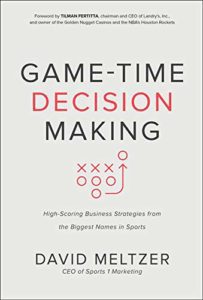
Game-Time Decision Making: High-Scoring Business Strategies from the Biggest Names in Sports
I want to support what you said because if someone’s reading and they’re like, “What does that mean that don’t just give motivation or good vibes?” You need to be tangible. In my situation, I tell people, “I’m going to show you how to tell a case story and whoever tells the best story gets the yes.” If you’re up against competitors, no one’s telling a story and you’re the only one telling a story, that’s going to mean more money, “What’s the average sale? Do you get that? Do you understand their business that well?” One more piece of jewelry. One more airport renovation. Whatever it is they’re doing, you help them win that, then the ROI is great on having you come to speak because it’s not, “Here’s something that would be nice to have.” It’s like, “We’re tired of coming in second place. If you can help us solve that problem, then that’s worth much more money.” That’s another example of what you said in action for people who are still thinking, “How does this relate to me?” I completely support what you’re doing.
You live by it, which is why I wanted to come on your show. What I enjoy about watching your stuff and reading your stuff is that you are the exact same type of salesperson that I am. You create productivity, accessibility and gratitude. You have quantitative value in what you do. You’re able to articulate it in the way that people want to communicate because it’s not what we say as salespeople. It’s what they hear. If you know your stuff well enough to articulate a story that comes to a logical conclusion of, “Can you see any reason you won’t want to do that?” You know how to pitch and you know how to sell like John does.
Thank you, David. You wrote this wonderful book called Game-Time Decision Making. That taps into not only why you, but the why now part of any decision. You talked about time, emotion and value. We’ve talked a little bit about creating value and storytelling creates the emotion. We’re going to end on the importance of timing, how that ties into your book and your upcoming workshops that you do every week on Fridays.
The manmade construct in this vibration is time. Everybody has 24 hours a day, but the productivity, the accessibility within that time of being able to number one, align your values. Your personal non-negotiable values, your experiential values. You’re giving and receiving values to the concept of time. Asking is related to time. If you understand time, you should understand the exponentiality of saying, “Do you know anyone that can help me? How can I be of service or value?” Understanding how time equates to that profit center and the exponentiality of growth, of growing exponentially by asking each person, “Do you know someone that can help me in person, on the phone, email, or media?” When we were young, most people had their card game, their golf group, and their church group. Nowadays on average, some guy you meet on the bus stop has 1,000 people in their network.
If you’re not asking, “Do you know what it can help me?” you’re cutting off your legs. Studying time is paying attention to and giving intention to the coincidence as you want with your time, the activity you get paid for the activity you don’t. Remember, that’s the mathematical equation of luck. Attention plus intention equals coincidence. Another thing about time is do it now. One hundred percent of the things you do now get done. The difference between successful people and others is successful people get stuff done. Ask yourself, “Could I do it now? If not, put it in your calendar to schedule for tomorrow and study that.” Finally, the practice of ending fear, utilizing your time, not to accelerate in the wrong direction, not to create resistance, avoid shortages and obstacles in your life, but to stop, drop and roll when you’re in an accelerated ego-based emotion, like the need to be right.
Kindness will take you back to the center and allow you to roll towards statistical success. More people in your pipeline. More people pitch correctly. More value is provided. More sales are made. More commissions are made to give to others so you can make more money, help more people and have more fun. Time is that manmade construct that you have to work within in order to effectuate that last world, to tie everything together. No more living in a world of, “To me, victimized and not enough.” No more living and buying things you don’t need to impress people you don’t like in the world of enough for me, but utilizing time, you can live as an instant between limitlessness and infinity in the world of more than enough. More than enough of everything for everyone.
When you’re selling and pitching from an abundant attitude that it’s not going to cost you anything, but we’re going to create value between the two of us that there’s more than enough of value for everyone. It’s because I take doesn’t mean you lose. It’s because you lose doesn’t mean I take. Everybody wins in the world of abundance. That’s where we need to pitch from with credibility and emotional judgment. Quantify the reasons, impacts, and capability from a world of more than enough. That’s what you do, John. We hit it off the first minute we ever spoke, we knew a lot of people in the same circles, but you started telling me what you do. I said, “This guy gets it. I’ve got to do more stuff with him.”
If you want more of David and let’s face it, why wouldn’t you want more? For the weekly training, you can go to his website at DMeltzer.com/training. Some of the episodes talk about creating a habit machine, learning to love what you do, and health, happiness and profitability. You walk your talk. The fact that you’re giving this training for free is such a gift to the whole community. I want to thank you on behalf of everyone reading for that. I want to encourage everyone to get this, because why would you not? David, any last thoughts or comments you want to leave us with?
Be kind to your future self and do good deeds. You can always email me at [email protected]. John, thank you for having me on.
Thanks for joining us.
Important Links
- David Meltzer
- Sports 1 Marketing
- Leigh Steinberg – Past episode
- @DavidMeltzer – Instagram
- Game-Time Decision Making
- https://DMeltzer.com/training/
- [email protected]
- Better Selling Through Storytelling Method Online Course
Wanna Host Your Own Podcast?
Click here to see how my friends at Podetize can help
Purchase John’s new book
John Livesay, The Pitch Whisperer
Share The Show
Did you enjoy the show? I’d love it if you subscribed today and left us a 5-star review!
- Click this link
- Click on the ‘Subscribe’ button below the artwork
- Go to the ‘Ratings and Reviews’ section
- Click on ‘Write a Review’
Love the show? Subscribe, rate, review, and share!
Join The Successful Pitch community today:
- JohnLivesay.com
- John Livesay Facebook
- John Livesay Twitter
- John Livesay LinkedIn
- John Livesay YouTube
Outbounding: Win New Customers With Skip Miller
Posted by John Livesay in podcast | 0 comments

Enticing people with your offers through cold calling, email marketing, and other business strategies will take more than just mere persuasion. Instead, much more in-depth and carefully thought outbounding techniques are needed. John Livesay sits down with Skip Miller, the President of M3 Learning, to talk about the ingredients that make up an effective outbounding process. Skip talks about connecting with your target audience through emotions, comparing outbounding to a first date, the power of references, and the importance of tapping above-the-line buyers. He also shares his mission to destroy the term decision-maker and how to let go of your fears.
—
Listen to the podcast here
Outbounding: Win New Customers With Skip Miller
Our guest on the show is Skip Miller, the author of Outbounding. He said, “The best sales call in the world is one where you don’t say much. The secret is to get people to be curious when you’re reaching out to them.” He’s on a mission to destroy the concept of there being decision-makers, find out what he means by that as well as a magical question to ask to determine whether someone’s going to take action right away or not. Enjoy the episode.
—
Our guest is Skip Miller, the President of M3 Learning, a pro-active sales management and training company based in the heart of Silicon Valley. He’s also the author of Outbounding. As the President of M3 Learning, Skip has provided training to hundreds of companies in over 35 countries. He created M3 Learning to make a salesperson better on each individual call. M3 Learning signature selling methodology ProActive Selling is unique in its high-definition focus on the tactics of selling and proactive sales controls. Skip, welcome to the show.
It’s a pleasure. Thank you for having me.
It’s my pleasure as well. We were having a wonderful chat pre the show talking about our passion for helping salespeople connect better. Before we get into your expertise and the team you’ve created, I love to ask guests their own story of origin. You can go back to childhood, school, wherever you were, along with this concept of, “I like connecting to people or I love sales,” or anything you want to share about your own particular background would be great.
I’ve got a big family, five brothers and sisters so you can’t avoid people in that situation. In college, I worked part-time at a small sporting goods store in Cleveland, Ohio. My job was to go to school in the mornings. In the afternoon, I’d try to go to high schools and bid on their football uniforms, cheerleading and basketball. We were a small little store about as big as an office. We were small. We were competing against big giant sporting goods stores.
[bctt tweet=”Make me curious.” username=”John_Livesay”]
I figured out that junior highs have as much money as high schools. I would go to these junior highs and pick up these orders because it was below the radar of the senior high schools. I had a good time building my little own business that way. When I left college, I became a salesperson and sales manager and stuff. For about twenty years, I was Sales VPs and stuff. The company I was with was a high-tech market research firm called Data Quest got bought by a company on the East Coast. I’m from Cleveland but I’ve been living in California for many years. I didn’t want to go back to the East Coast.
Not an offense to the East Coast people, but I like California. I said, “I might as well as to try to start my own business.” That was many years ago. The second or third month I started my business, I got a good-sized customer and I never looked back. It’s been a fun ride. To your point in the intro, I love walking away. A few years later, out of nowhere, I’ll get an email or a LinkedIn from somebody saying, “Skip, I took your course five years ago and I still use your tools. I want to drop you a note.” It’s hysterical. If you can make somebody a manager or a salesperson better at the point of attack, I feel great. That’s my reward so it’s been fine.
I’m guessing M3 Learning has a story of origin behind it. What does M3 stand for?
John, like you, you start your business and you’ve got to file a form to the states or whatever else saying the name of your business. I know I didn’t want to name it Skip Miller Consulting. It stands for Miller and his three kids. I’ve got three kids. In every one of my books, I call out my kids. When they were in school, they would take their friends to Barnes & Nobles or somebody and show that their name was in my book. They liked it.

Outbounding Techniques: A manager must know when and how to tweak strategies based on market demand, competition, and everything out there.
You’re a rockstar for that. One of the things that we were talking about is this need to feel seen, heard and appreciated. Kids say that all the time, “Watch me jump in the pool, dad or mom,” or whatever. That need to be seen, heard, acknowledged and appreciated does not go away when we go into our job. It may be subconscious. Let’s talk a little bit about that because that’s something that is unique. You and I both have a big passion for that. An awareness of it having both been in the salespeople’s shoes, in management and see those little acknowledgments as opposed to the once a year.
Let’s stand it on its head. People do need to be heard. They do need to be seen. The best sales call in the world is not where you hang up the phone or you get off the Zoom meeting going, “Nailed that puppy. That was a good call. I was on my game. That was good.” While you’re doing that, the customer is going, “What was that?” The best sales call in the world is where you hang up the phone or you get off the meeting and go, “I didn’t say anything. I didn’t even use a slide.” The customer is going, “They heard me. They feel great.”
As a next step, you can start doing your presentations but if you don’t get that attachment up front, they’ve taken your call, they’re going to take your meeting, they’re going to take your ten seconds of a cold call, whatever else but you want to make them feel like they’ve been heard. That’s a powerful draw. Everybody, managers don’t reward their salespeople enough. They always were telling them what they’re doing wrong and not right. Take what you said about being heard, felt and standing on its head and that’s a powerful drive for when salespeople need to outbound.
One of the things I love about your book, Outbounding, is how you talk about certain actions and certain ones are things that only inbound people are doing versus what outbound people are doing. There are a lot of crossovers but there’s a big difference. Would you speak to what the big difference is?
[bctt tweet=”Consistency wins.” username=”John_Livesay”]
It’s all about the buyer. We spend so much time thinking about ourselves, our approach, presentation, demo and our products. From a buyer standpoint, if you get an inbound lead, data shows they’re about 50%, 55% through their biocycle already. They’ve got an understanding that they got to make a change. They’ve somewhat monetized it. That’s why they’ve approved the budget. They’re about halfway through a sales cycle. They know they have a problem and they have to make a change.
Outbound, it’s like throwing darts. Did we get them at the right time? Is the buy window open? Most of the time an outbound, the buyer doesn’t know they don’t know. Once informed, they’re like, “I know I’ve always had a problem there. I live with it. I didn’t know there was a fix.” The approaches must be different. What we do is wrong. What we tell the outbound people is, “Those inbound templates we’re using are great. Why don’t you use some of those things?”
Let’s go to another three-day class where we could teach them more about our products, features, benefits and competitive advantages so you can use those in your outbounding. I don’t even know I have a problem yet. You’re telling me about your competitor doesn’t do this. Great. I didn’t know I had a problem. The messaging, I’m getting a lot of input regarding we can’t door knock anymore. We can’t walk halls. We can’t go to trade shows. You’re limited to social. You’re limited to email or you’re limited to the phone.
What can we do to get better attention? Change your message, change your cadence and your sequence. John, I went up to a salesperson at a meeting. I said, “You want to learn about outbounding? How has it been going for you?” He goes, “I outbound.” I said, “What have you been doing?” He goes, “I sent two people an email last week and I’m waiting to hear back.” I go, “That’s your outbounding. Good luck with that one.” That’s where we’re at with that. The whole point is inbound and outbound is different. We don’t treat it differently and we don’t have the correct management dashboards to reward the rep correctly. The processes are different.

Outbounding Techniques: The best way to get a hold of somebody is obviously referencing a person.
I hear a lot of people saying that are “inside salespeople” reaching out, trying to get business that they’re measured on how many calls they make as opposed to the quality of the calls or the outcome from the calls. I’m like, “What a bizarre thing to measure? If you don’t make X number of calls in X amount of time, you’re not working hard enough.” It goes back to that old stuff of throw a bunch of spaghetti up against the wall and see what sticks, which is not a strategic way to sell at all.
There are control knobs, John. Companies like Zoom with the pandemic, it’s a numbers game, dial, demands high, low-hanging fruit, whatever we want to call it. For that short timeframe, the pitch is good enough, make contact. In normal business times, you have to control outbound quality with competency. We call them frequencies and competencies. It’s doing a lot or a little bad, good stuff. If the market is in hot demand like when Tableau first came out, the whole market for visual analytics was hot. Dial, get an appointment, throw it over the wall and go and that’s not common. For most of your readers, they’re going to be sitting there going, “I can’t do 100 or 1,000 calls a day.”
Let’s work on quality. There’s a mixture of both in your cadence and sequences. We see people’s quality as poor. It’s all about us, what we do. That’s got to start being worked out but there are control knobs. We see people who do good emails but they’re doing five a week. Can you get it to ten? Can you get it to 100? There are control nubs and that’s a great management dashboard. It’s not about the hike. If I can get a meeting, throw it over the wall, that’s my job. It’s the same ISRs or the same SDRs. I want to get the meeting, talk to both the decision-makers and stuff and then throw it over the wall. It depends on where you’re at in the marketplace but there’s no doubt that quality and quantity are control knobs that managers got to tweak based upon market demand, competition and everything out there.
My background was in advertising sales and they were always talking about frequency and reach. The same concepts apply. Like a car company when I would call on them to advertise with me, they would say, “We never know when someone is in the market to buy a car. We have to advertise all year long. Hoping that our ad in a magazine or a commercial or on a website happens to catch somebody at that magical moment when they think, “I might go test drive this weekend.” If you have millions and millions of dollars to do that, you can do that. As a salesperson, that strategy is not efficient to say the least because you haven’t qualified someone or created some content that maybe somebody would even be intrigued enough to even start the journey. They don’t even know they have a problem until you point out there is a solution.
[bctt tweet=”The best sales call in the world is where you say very little.” username=”John_Livesay”]
John, consistency wins. One of the best people out there we’ve seen, they have a salesperson who does a regular sales job and takes a list of 25 people, puts them in a 12-touch 2-week cadence. At the end of the two weeks, they take that 25 out, take the ones out that didn’t respond or who do respond to write out and put that aside. You take a second 25 for a 2-week 12-touch cadence, take that out. They have three 25-touch cadences. I’m going to touch you for two weeks then I’m off for four and then I come back for two. They have a rotating carousel of three 25-touch cadences. It takes a good outbound salesperson who’s always busy an hour a day. If you get the system down and get your messaging down and stop outbounding like you want to get married, “I’m Skip Miller. We have the best product. I’m the representative for seven. You have to see ours. It’s our first day.” Treat it like the first day. Make me curious. Don’t tell me who you are.
I talk about that in terms of going from invisible to irresistible and if it rungs on a ladder like in dating. He’s where I see a lot of people get stuck and I would love to hear how you help them is in the middle of invisible to irresistible is the interesting. Wrong. In the dating world, maybe you say something to somebody and they like, “I’m interested to keep talking to you. I’m not agreeing to fly with you yet.” Salespeople get all excited and they tell their boss, “They were interested. They asked me to send them information,” and then it’s crickets. They’re stuck in the friend zone at work. They don’t know how to get out of it. I tell people storytelling is one way to get out of the interesting friend zone at work. I know from your book and your expertise, you’ve seen this happen all the time, yes?
Yeah, without a doubt. The best way to get ahold of somebody is to reference a person. You know somebody, I know somebody and that’s going to be instant rapport. That’s going to be hard to break. After that, it ties to your interesting comment. I come up with the big five. Here are the five things that you should look at if you’re going to outbound to try to get somebody’s attention. The top of the list, without a doubt, to you is curiosity. Make me curious about my title, about my industry, about things that my company’s doing.
“I’m going to do some homework on Debbie because I’m going to go after Debbie there and find out about Debbie.” That’s a rifle shot. Good luck with that. It can work but also Debbie’s curious about people at her level in other companies. Debbie is curious about other companies that are in her industry. Make me curious, give me a little dab. Don’t give me, “Here are five attachments.” Curiosity to your interesting level makes me go, “Let’s talk some more.” Same with that interesting wrong so make me curious, the great theme for those outbounding touches.

Outbounding Techniques: The passion must come from the salesperson, as well as their mission to tap into that energy for the prospect they’re talking to.
One of the things that you touched on is this concept of emotions at the start of the Inc. article. I am a big believer that people buy emotionally, even back it up with logic, even if it’s a big purchase or a corporate purchase. You talk about greed, fear and pride. A lot of people overlook the unspoken fear buyers have that if I make the wrong decision or pay too much, I’m going to get in trouble and I’m even fired. That concept of fear, uncertainty and doubt has been around since the ‘80s when IBM used it if you bought anything that wasn’t their product. It broke, they would point the finger at the other vendors that were dealing with that. I wanted to get your take on curiosity is certainly in that world of, “We’re out of people’s heads.” How important is emotion in getting people engaged?
Emotion is going to drive energy. I’m a huge energy person. I believe that a sale, it’s like a rollercoaster. You get to the top of the roller coaster and it’s losing energy and then the deal goes dark. It goes south. It goes quiet. It’s not getting energy at the top of the hill trying to push it over. You should have gotten energy earlier in the sales call. That earlier energy is emotion. It’s not so much what we call pleasure emotion. It’s more away from pain. We all want to look for pain points. A classic question is what’s the size of the problem? If you don’t understand a problem, they’re not going to have to change.
If it isn’t broke, I’m not fixing it. Something broke and what’s the size of the gap? Those are great mission statements to be on. I started writing the book and I was probably about 2, 3 weeks into it and I scrapped it and started over. Attitude is important as you outbound. It’s not, “I hope they take my call. I hope I can make my pitch.” A good outbounder believes, especially in a B2B world, they’re making their company money. They’re losing money daily by me not being able to talk to them about their issues and challenges. You’ve got to have that emotional passion to go out. You also got to try to find that emotional passion. It’s great when you get somebody on the phone or on Zoom or they go now that’s the problem.
That’s where you want to get to but if you don’t have that same emotion, that same energy, you’re not going to find it. Great outbounders are looking for emotion in themselves because they’re the top people. The ones who can speak the most or the biggest alpha dog, they’re on a mission to help the customers. My job is to have you listen to ten minutes of me and if it doesn’t fit any problems or challenges you have, no harm, no foul. The buy window is not open. I’ll call you in six months but you owe me ten minutes because I’ve done some homework on your company.
[bctt tweet=”To get the attention of many, changing your message, cadence, and sequence is important.” username=”John_Livesay”]
I was talking at a speech a couple of years ago to about 100 CEOs. I asked them why they would take a sales call and they said they wouldn’t. At the bar, I asked them, “Why would you take a sales call?” A bunch of them sat back and said, “The problem with salespeople calling us is they’re a solution hunting for a problem.” One of the first things they say is, “We can help.” You don’t even know what my problem is and you’re telling me you can help me.
You got to come up with a passion and my job is to listen to your story, to what you’re up to quickly. Maybe we can help or not but you can’t sit back and say, “I’m here to help. My mission is to help you,” but my first step has got to be, “I don’t know if I help or not.” I get a sales call and the guy calls in and says, “We want to train our salespeople. Can you help?” What’s your problem?” We can help in certain areas in certain areas we don’t. That mission has got to be emotional. The passion has got to be from the salesperson as well as their mission to go tap into that energy for the prospect they’re talking to.
There’s a myth that people think, “I lost the sale in the closing.” What I’m hearing you say is you probably lost it at the beginning because you didn’t bring enough energy and passion.
That’s one of the things we don’t teach is closing skills because the close started happening back at Stage 2. If you’re selling proposals, “John, we have a quick technology sales cycle, initial interest discovery, proposal harass,” that’s what we typically do here. It’s, “I want a presentation. Here’s the demo. Here’s the proposal. Buy now and I’ll give you ten points off if you’d make it by the end of the month.” It’s ridiculous. There’s no energy, no emotion, no anything. You’ve got to get over that.

Outbounding Techniques: A good way to handle objections is to agree with the demand direct where you want to take them.
You talk about that there are two decisions in a business-to-business sale, one above the line and one below the line. I like that formula. First teaching people to identify who’s who and there are meetings that happen after the meeting. This awareness that you’re creating and giving people some skills because they hear a bunch of proposals, a lot of presentations and then the decision-makers, “Now what do we all think?” Let’s talk about the ATL, the Above The Line, the Below The Line and what their needs are and how a rep can start to zoom in on that.
I was into buyer’s personas. You’ve got the user buyer, the fiscal buyer, the technical buyer, the executive buyer. There are too many buyers out there. One day I said, “There are three types of buyers, the user buyer, the fiscal buyer and the executive buyer. The user buyer is a feature function. The fiscal buyers create value for me, the executive buyers, market share, market size and still was messed up. I said, “Why don’t we name this?” We’ll call the user buyer Spaniards, the middle buyers Russians, the top people Greeks. You’ve got Spaniards, Russians and Greeks.
If you have a meeting with three Spaniards and a Russian, what language should you speak? The obvious answer is Russian because they’re the top person. That worked well. People were getting a little like, “Why are the Spaniards on the bottom?” We did some work for a company where the entire senior management team was from Russia. They want to know why the Greeks were ahead of them because they’re broken. It’s a metaphor.
Finally, our friends at Google said, “It’s not politically correct and stuff.” We came up with this above and below the line. John, I am on a mission to destroy the term decision-maker. There are two, the below the line buyer is one who says, “I’m responsible for making this work, the support. If we’re going to bring this on, I want these features. I want this security package. I want this. I want that. That’s their job.” The above the line buyer says, “As I look at 2021, our new product is probably got to generate $50 million. I probably got $20 million in the bank. I’m missing $30 million. If we could do something that can make a dent in that $30 million gap, what was the name of that again? Buy one of those things. I don’t care what features and benefits it has. As long as below the line buyer’s above the line buyers where you’re going to find energy. The above the line buyer is the one who says, “I got a gap. Bob, here’s the $50,000 budget. Go find something to make a dent in my $30 million problem.” I don’t care per se. The above the line buyer does care if they’ve been heard.
[bctt tweet=”Treat outbounding as a first date. Make the other person curious.” username=”John_Livesay”]
As you prospect and outbound of the buyer, the goal is not to give them your below-the-line pitch. They don’t speak Spanish. Go above the line and find out what are their initiatives for the next 3, 6, 9 months? What gaps do they have on those initiatives? We call them trains at the train station. Why is the train in the station? If you can make a dent in 2 or 3 of their trains, you don’t have to fix the whole train. Make a dent in 2 or 3, watch how much energy your deal has. Most salespeople go below the line. They want to talk about us. We want to talk about us. We all talk about us but when you go above the line, I’ll give you an executive overview of all the stuff we’ve been talking to below the line on.
It’s different. We’ve got to understand what an above the line buyer wants. What they want is to be able to mitigate risk. They want to be able to make a dent in their problems, on their initiatives or trains that they have in the train station. It’s two different ways of looking at a sale. Overall sales cycles usually are cut in half when this happens because the above the line buyer goes, “We’ve got to get this. We got it. Let’s go. We’ve got to do this now.” Rather than Bob has taken his time, he’s doing a two-month evaluation. Bob’s got the whole thing going. Sales cycles get shorter when you do it.
We’ve turned your book, Outbounding, into a course. I know one of the lesson sessions is about handling objections. I’d be remiss if I didn’t ask you to touch on how you’re helping people handle objections.
John, objections are always fun because what we hear as you all know, not all the time right now, “Now’s not a good time. We’re fine. We don’t need anything,” those typical objections. What happens is your body’s chemistry wants to go into defense mode, the fight or flight. You’re wrong and here’s why you’re wrong. We have a tool in there called Flow of the River. It’s a martial arts term. Martial arts teaches not to block energy but the flow of energy. When you hear an objection like, “Now’s not the right time,” agree with it, “John, you’re right.” A lot of companies we talked to say, “This is not the right time. However, if you give me ten minutes of your time, you may see where it could be a good time.” I’m asking for ten minutes, John. If you block me, you’re wrong. You’ve got my guard up. If you agree with me, I’m going to let my guard down.
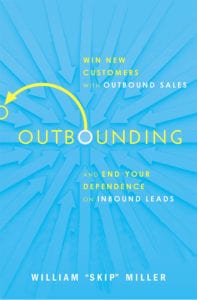
Outbounding: Win New Customers with Outbound Sales and End Your Dependence on Inbound Leads
Call Verizon and AT&T up, “I got a problem with my phone. I can see you’re right. It takes the winds out of your sales and now you’re ready for a conversation. I’m mad. My thing has been out for three hours. What’s your problem? You have a good right to be mad. Thank you.” It puts them defenseless. A good way to think of objection handling right up front is the bottom line is to make sure you think to agree with it and then direct where you want it to take it.
It reminds me of the old statement I heard years ago, “Do you want to be right? Do you want to be happy?”
Let’s put that stake in the ground. That’s not a good stake in the ground.
The book, Outbounding, can be found on Amazon. If people want to learn more about you, they can go to M3Learning.com. You do a lot of speaking to the clients.
We’ve got some training classes. John, I hate writing books. I don’t know about you, but I hate it. It’s 4:00 in the morning stuff for me. It’s Miller time at 5:00 PM. When I see a problem, in 2019, all the low-hanging fruit was going away. People had to start outbounding. You talk to salespeople, “I’d get to 80% of my number. I’m going to have to do a little outbounding.” They wait until November. By that time, it’s late. People were hurting because they’re so fearful of outbounding, fear of rejection, fear of the word no, I got to get six noes before I get a seventh yes. I hate getting noes. Who wants that rejection? I took it as a challenge to try to help the individual salespeople come up.
Don’t be fearful about this. It’s not a big fear thing. Do A, B and C, be on a mission to help your prospects, your customers and managers start measuring the right stuff. You’re measuring old-school stuff. If you want to measure good outbounding practices, given that we’ve got numerous channels, we have mail, social media, direct emails. There are numerous starts putting better dashboards together than the ones you like, “How many calls you make now?” which is hysterically archaic. It’s good but archaic. There are new ways. That’s why I wrote the book, help managers out, help salespeople out. If people want to read it, great. If they’re doing fine, if they don’t have a problem, there’s no reason.
Thanks, Skip, for sharing your knowledge and your insights. I love this concept of being on a mission to destroy decision-makers.
I’m on a mission to destroy the decision-maker because there are two. There’s not one.
That’s a great concept of how to look at all of that and how to reframe it. As you said, “Let go of the fear.” We will let everybody know how to become better at outbounding. Even if your job is not sales, we all have to sell ourselves all the time. There are some real tidbits in that book that will help everyone get over that fear of “the cold call.”
For me, I hate returning things. I go to Target or somewhere and I go, “Did you use this? I’m sorry.” I hate rejection as much as anybody. If I had to overcome it, people will read the book too.
Thanks, Skip.
John, thank you for your time.
Important Links
Wanna Host Your Own Podcast?
Click here to see how my friends at Podetize can help
Purchase John’s new book
John Livesay, The Pitch Whisperer
Share The Show
Did you enjoy the show? I’d love it if you subscribed today and left us a 5-star review!
- Click this link
- Click on the ‘Subscribe’ button below the artwork
- Go to the ‘Ratings and Reviews’ section
- Click on ‘Write a Review’
Love the show? Subscribe, rate, review, and share!
Join The Successful Pitch community today:
- JohnLivesay.com
- John Livesay Facebook
- John Livesay Twitter
- John Livesay LinkedIn
- John Livesay YouTube