

Fanocracy: How To Build Your Fandom With David Meerman Scott
Posted by John Livesay in podcast | 0 comments

When you’re a stage performer, there’s nothing like connecting with people who bring vibe and excitement to your show. Is it possible to build your fandom and create the same energizing feeling in your business? In this episode, John Livesay, aka The Pitch Whisperer, chats with marketing strategist, entrepreneur, advisor, and best-selling author David Meerman Scott about fanocracy, strategies that help you build fans for your business, and the usual marketing tactics that scare them off. David touches on his relationship with his daughter and how they teamed up to write their book, which is not just a prescription for a business to grow fans but also a formula to live a more passionate and fulfilled life for every one of us.
—
Listen to the podcast here
Fanocracy: How To Build Your Fandom With David Meerman Scott
Our guest is David Meerman Scott who is an internationally acclaimed business strategist, entrepreneur, advisor to emerging companies and a keynote public speaker. He’s The Wall Street Journal’s Bestselling Author of ten previous books, including The New Rules of Marketing & PR, Marketing Lessons from the Grateful Dead and The New Rules of Sales and Service. He’s got a new book called Fanocracy and in his spare time, he serves and travels around the world for great live music. David, welcome to the show.
Thank you, John. It’s great to be here. I love what you’re doing.
Thank you. I love your passion for music, but I always like to ask my guests to take us on their own story of origin. You can go back to childhood, high school or wherever you want to go and tell us where you had the idea that you wanted to become who you are now.
I started my professional career on a bond trading desk. I was absolutely terrible at bond trading and I hated it. I disliked the idea of being in a windowless room and screaming into telephones, but I loved the information behind bond trading, real-time data and real-time news. I moved into that world and for about a decade, I was in sales and marketing for companies like Dow Jones, Reuters and other organizations that are delivering real-time content around the world. The company I was working for at the time in 2002 was acquired by Thomson Reuters. I was in a jam because they let me go. They fired me and I was like, “What in the world am I going to do now?”

Fanocracy: When creating a new company, idea, book, or speech title, think of things like trademarks, unique names, and how people are going to search for you from the internet.
Fortunately, I had a head start on the web because I had been working in real-time information prior to the web. I came up with this new concept of what marketing on the web is that nobody else was talking about at the time back in the late ‘90s and early 2000. Marketing on the web, in my mind, wasn’t about advertising but instead was about content. I started to write and speak about that. The New Rules of Marketing & PR, the book I’m best known to hit the international bestseller list. It’s on a business week list for six months. It sold 400,000 copies in English. It’s now in the sixth edition and it’s in 29 languages. That got me on the rocket ship of speaking and I’ve been thinking about, “What’s next?” It seems to me that the pendulum has swung too far in the direction of superficial online communications when we’re all hungry for a true human connection. I’ve been trying to figure out what that is and it is the topic of my newest book.
Where did you come up with the name? One of the things you say is the need for fans is not just for actors and athletes anymore.
I’m a massive fan of live music. I’ve been to 790 live shows. I saw David Byrne three times, which is incredibly geeky. I’ve seen the offshoots of the Grateful Dead 75 times. I was thinking to myself, “I’m such a massive fan of live music.” I’m also a massive fan of the Apollo Lunar program. I wrote a book on the Apollo program. I was a producer on the PBS American experience mini-series called Chasing the Moon. I have probably one of the world’s best private collections of artifacts from the Apollo Lunar program. When I dig into something, I dig deep.
It’s not just a double click on the mouse.
I dig freaking deep. I was saying to my daughter, Reiko, “It is crazy that I’m geeky about live music and 75 Grateful Dead concerts.” She said, “Daddy, me too. I am such a Harry Potter nerd.” Not only has she read all the Harry Potter books multiple times, but seen the movies multiple times, been to the Wizarding World of Harry Potter at Universal Orlando Resorts in Florida. Also, she went to London to go to the Harry Potter Studios. She wrote a 90,000-word alternative ending to the Harry Potter story where Draco Malfoy is a spy for the Order of the Phoenix. She put it on our fanfiction site. It was downloaded thousands of times and had hundreds of comments. She’s like, “Daddy, I dig in deep, too.” We realized that there’s something there around fandom.
We’ve decided several years ago that we should collaborate on researching and potentially writing something about fandom. We didn’t have a title for a book and we didn’t even know it was a book yet. We dug in deep and she’s interesting. Not only is she a fan of different things, not only is she a different generation and different gender, but she’s mixed race and she graduated with a neuroscience degree from Columbia University. She is in her final year of medical school. She’s going to be an emergency room physician. We came at it from utterly different perspectives.
With different generations, too.
[bctt tweet=”Focus on community, generosity, and fun! What makes a superfan?” username=”John_Livesay”]
I’m a middle-aged white guy who loves the Grateful Dead and she’s the Millennial who’s digging into things like Harry Potter and Comic-Con. We wrote this thing together and we had to come up with a title. I’m a big fan of a lot of things, but I’m also a big fan of names that are memorable and names that you can own.
That is such valuable information because you want to get into people’s heads with something that takes up the rent. If you don’t have something memorable, compelling, easy to remember or combining phrases or words that people haven’t heard and put together, that’s what our brain craves something, “That’s clever. Democracy. Fanocracy. I get it.” For me, I came up with the pitch whisperer. People go, “I know what a horse whisper is. What’s a pitch whisperer?” It gets people intrigued enough to want to know more, which is the beginning of a conversation. It’s the whole premise of your book of this word of mouth.
It is. The other thing that’s important is that if you think of something in that way and come up with something new, the pitch whisperer and fanocracy, then you can also presumably own the URL and own the search results. A lot of people, when they’re creating a new company, a new idea, a new book or a new speech title, they think of things like trademarks. They think of things like, “Can we legally do this?” They forget that you need to think about, “What’s going to happen when people want to search on it.” When you introduced me, you said that my name is David Meerman Scott and some people think, “Why does he use his middle name? Is he pretentious?” I’m maybe a little pretentious, but the reason I use my middle name is that there’s a David Scott who walked on the moon. There’s a David Scott who’s a member of Congress from Georgia. There’s a David Scott who’s an IRONMAN triathlon champion.
I was never going to own the real estate for David Scott certified. If I went with my middle name, I’m unique on the web, David Meerman Scott. I pioneered something called newsjacking and I pushed that word out into the marketplace. This is an important aspect of this idea of creating something. I believe rather than trademark it, you should let it go and let other people use that. When I went out with newsjacking, I could have put a trademark against it and said, “This is my concept. You can’t use it,” but I didn’t. Instead, I put a Creative Commons license on it and let anyone use the term and my ideas who wanted to. It spread like crazy. I still own the search results because I own Fanocracy.com and I wrote the book.
There have been thousands of other people who have talked about newsjacking and the Oxford English Dictionary included newsjacking in the dictionary and they put my name against it. How crazy is that to invent something that’s in the dictionary? When I was talking with my daughter about the title for our book about the idea of fandom and growing fans, the word fan, fans and fandom were all great words, but all had been used many times. We came up with fanocracy and I don’t say we just came up with fanocracy like it took a minute or two. It took a year because we were playing around with many different names and then we realized that fanocracy was the way to go.
Let’s double click on the nine steps to building your fanocracy. We’re going to touch on each one to get people intrigued enough to want to go buy the book, hopefully. This concept of focusing on intangibles, you talk about community, generosity and fun as opposed to what a lot of companies are focusing on, which is all this internal data about how long we’ve been in business. That’s the first step of how am I going to get closer than normal to someone?
The fundamental principle of fandom is that it’s about a true human connection. I’m a huge live music fan, but what’s an important aspect of that is that I experience live music with my best friends. I have become close on a strong emotional level with other people who love to go to live music with me. It’s the same thing with my daughter. She gets dressed up to go to Comic-Con every year and she’s doing that with her best friend.
When you say dressed up, I’m assuming in costume as opposed to fancy.
Yes. It’s called cosplay, getting dressed up in costumes like the characters that they’re fans of the books.
We used to do that back in the day with The Rocky Horror Picture Show movie.

Fanocracy: If you’re trying to build a company and there’s transformative fandom going on, celebrate it.
It’s the same idea. The whole idea of The Rocky Horror Picture Show is a fabulous example of a fanocracy. The people who are there love the movie, but they love being with like-minded people who are also throwing the toast and doing the other things that you do at The Rocky Horror Picture Show film when you’re there together. You can watch it on your DVD or on Netflix, but going to the theater and being with like-minded people is what’s important. That’s a critical idea and we dug in deep on this particular one and there’s a big aspect of neuroscience involved because it turns out that our brains as humans are hardwired. The closer we get to someone, the more powerful the shared emotions are.
This is something that’s hardwired for our survival because we need to know when we encounter another human. Is that human a friend, foe or a potential mate? We have zones when people enter them of what our brain is unconsciously doing to make sure that we are prepared for what’s happening further than twenty feet away. We’re conscious of people, but we don’t get too concerned quite yet. Within twenty feet, it’s called social space. That’s when you walk into a room and you subconsciously scan the room to see, “Do I know anyone? Is there any threat here? Is our friend here?”
From 4 feet to about 20 feet is called social space and when we begin to track people within 1.5 feet to 4 feet is personal space. In the personal space, if we get that close to someone and we’re comfortable with people, like in a cocktail party situation, it’s a strong and positive human connection. If we get that close to someone and it’s a crowded elevator, a train or sitting next to someone you don’t know on an airplane, it can be a potentially negative emotional response. To develop fans, the more you can bring people in close proximity with like-minded people and with your employees or bringing your employees together with your customers and your partners or customers together with other customers, the more powerful the fandom grows. That was the first idea that we hit on and it comes from neuroscience and it’s a fascinating concept.
I can take it even farther, John, because there’s another aspect of neuroscience, which is called the concept of mirror neurons. We spoke to a bunch of neuroscientists about this. Mirror neurons are the part of the brain that fires when you see or hear somebody do something and it fires as if you are doing that action yourself. For example, if I take a bite of a lemon. That lemon is tart and it makes my eyes scrunch up. My mouth begins to water. I can’t help it but my cheeks pucker up a little bit and it’s a strong reaction. I would guess you might have had a little bit of saliva release now as well, just by me mentioning that. What this means interestingly for building fans is that you can virtually show people together, for example a selfie. A simple selfie is a powerful reaffirming tool that you have great relationships with like-minded people. The people who view that selfie together with another person are seeing that as if they’re in the photo with you.
I haven’t heard that before. I’m fascinated by that. Seeing a selfie is I’m imagining myself in that photo with you and those people are feeling comfortable enough for you to be in that personal space, then I could feel safe enough as well.
You nailed it and the same thing is through a video. Video is popular and people think, “You have videos that are popular,” but what’s popular is a video that’s framed as if you’re in the personal space with the viewer. That means looking at the camera directly, a head and shoulders shot. It’s one of the reasons why we think we personally know movie stars or television presenters because of those close-ups. It also means that in a scary movie, we get scared and when somebody’s sad, we get sad and happy and so on. There’s a lot of interesting ramifications when it comes to video down to the concept of proximity and mirror neurons.
I was watching A Star Is Born. They did such a great job with the camera angles that I felt like I was on stage and what it must feel like to be a rock star having all of that adoration come at you. This concept of, “Is it safe?” I talk about that a lot, too, that the handshake came about to show we didn’t have a weapon in our hands. Most people go, “That’s what’s going on at that fight or flight response.” The other thing I want to talk about what you mentioned in this concept is the shared emotions. That’s what I love about storytelling and that’s what you do and I do as speakers. We tell these stories that give people a sense of shared emotions. They go on a journey with us. When you can do that as a speaker with your audience, in your messaging or you’re talking to somebody one-on-one, that shared emotion is what makes someone become your fan and that’s valuable.
[bctt tweet=”We’re all hungry for a true human connection. ” username=”John_Livesay”]
That’s only one of these great nine things. Let’s move onto the second one, which is letting go of your creation. Many people talk about, “I’ve created this proposal. It’s my masterpiece. I’m not going to touch it. I’m done.” I remember talking to Françoise Gilot who is Paloma Picasso’s mother and she said that in the ‘40s, there was a shortage of canvases and they had to paint over them. The concept of having to paint over your masterpiece is valuable for people. Tell us what that means to you as far as how can we let go of our creations that you touched on about not letting anyone else use your URL, but I’m guessing there’s something more to it.
That’s a good manifestation of it around how I recommend that anybody build fans, which is don’t try to control that thing which you just created. For example, I mentioned that my daughter, Reiko, loves Harry Potter and she transforms Harry Potter into something else by writing alternative books for Harry Potter. Other people get dressed up as Harry Potter characters and still, other people draw fan art about Harry Potter. JK Rowling, the author has embraced this concept of fan-created Harry Potter works. There’s a website called MuggleNet that celebrates this. She has a good relationship with the person who created MuggleNet. That’s the idea of celebrating people who create something new.
To give the readers a contrast, Disney with somebody who does not like people doing anything with Mickey Mouse. I think that’s valuable to give them the contrast that not everyone embraces this concept. Those that do are a little more modern and newer.
We also looked at it from the perspective of, “Can we define and articulate that?” What we did was we came up with what we call curative fandom and transformative fandom. Curative fandom is the idea of the official fandom, the statistics, the official website, and the official social media. Disney has the official places that you can go to. Transformative fandom is the idea of transforming that into something else. I mentioned the idea with Harry Potter, but there are certain fandoms that have both. The best organizations at developing fans are those that understand that neither is right or wrong and that you should be celebrating both.
A perfect example is Major League Baseball. There are a lot of people who are under the curative fandom aspects of Major League Baseball. That would be curating the statistics, how many RBI is, how many home runs, which team is up and which team is down and all of the data that goes in with Major League Baseball. Whereas transformative fandom would be the people who do fantasy baseball. They’re transforming baseball into something completely different and they’re both fans of baseball but in different ways and Major League Baseball celebrates both of them.
I love the example of Hamilton. You’ve got the book Hamilton, which is the facts. “Here was Alexander Hamilton’s life,” and that’s curative fandom. You’ve got a transformative fandom of Hamilton, which is the play. A race bent retelling of Hamilton’s life in rap. It’s completely transformative. Neither one is better than another. They’re both great but they’re different. Celebrating both as ways of looking at Hamilton is great. There were some professors of history that said, “No, you can’t do the play. That’s wrong.” That’s not how you build fans. You should celebrate both of them.
I’m going to speak at the Coca-Cola CMO Summit and the whole theme is storytelling. They’re having one of the co-authors of Hamilton speak to the audience before we all go see the musical. Talk about an experience of that. What you’re talking about that’s valuable that I love is the transformative fandom of turning Hamilton the story into a rap musical. It is an entryway that causes a lot of students who aren’t into history to then want to know and go back to the curative fandom part of, “Let me read the book now and learn more about these characters through the entry of the transformative fandom.”
You can tune your brain to curative fandom versus transformative fandom. You think of different ways that perhaps if you’re trying to pitch something and if you’re trying to build a company, if there’s transformative fandom going on, celebrate it. One of my favorite examples is Roomba, the robot vacuum cleaner. If you take a look at YouTube and search for cats on Roomba or dogs on Roomba, there are all these wonderful videos of animals hitching rides on Roombas around the house. It’s unbelievable transformative fandom of what the Roomba is. It’s not a device for carrying your cat around the room, but that showcase fandom for a vacuum cleaner. Any time that there’s something like that going on, celebrate it. That is the coolest thing in the world to growing fans and smart investors, smart potential customers, partners and VC firms love that.

Fanocracy: Putting out white papers or eBooks requiring an email address to download it set up an adversarial relationship with a potential fan before you’ve even met them.
In marketing, there’s something called paid impressions and earned impressions. The paid impressions are how many people watch this TV show, see this ad and listen to this commercial. The earned impressions are when the fans start sharing it. Of course, that has more impact because word of mouth has more credibility than a paid ad. You’re right on the market money with the need in the marketplace for people to figure out, “How do I create fans?” One of the things you talk about is giving more than you have to. The concept of don’t have strings attached to your content. In other words, you can watch the first two minutes of this video and then you got to watch commercials. That’s strings attached and you say, “Don’t do that.”
There’s another one that always makes me wonder why people do it. I know why now having done the research, but that is people who put out white papers or eBooks and require an email address in order to download it. The problem with that is it sets up an adversarial relationship with a potential fan before you’ve even met them. If you dangle something in front of them and say, “Here’s my wonderful white paper. Download it.” They go to download it and you say, “I need to have something from you before I give you my stuff.” That’s an adversarial relationship. Better to make it completely and utterly free. I learned this from the Grateful Dead because they were the first band to allow fans to record their concerts and nobody else was doing that. If you went to The Rolling Stones or Pink Floyd, there are no photos and no recording devices allowed. Nothing is allowed. The Grateful Dead said, “Sure, why not?”
Many people started to record the shows that it became disruptive to the fans who weren’t recording. They created a taper section that was right behind the soundboard. You could buy a taper seat. It was this specific seat, which wasn’t a great place to watch the show, but it was a fabulous spot to record the show. In the early days, it was the cassette tape and it became MP3s, but the band allowed you to give away the cassette tapes or trade them. The only thing they asked is, “Please don’t sell them.” As long as you trade them or give them the way, you can record the shows.
That goes back to your first concept of it’s the fear of missing out. They weren’t at the concert, but they see the video of the concert. That’s like the selfie. They feel like they’re at the concert, makes them want to go to the concert and buy the music even more.
Even more so for Grateful Dead because they made the majority of their revenue from touring, people would say, “This is a great cassette. I’m playing it in my car and playing in my dorm room. I want to go to a live show, too.” You have people like me who have been to 75 Grateful Dead concerts. I wrote a book called Marketing Lessons from the Grateful Dead. The foreword was by Bill Walton who’s an NBA Basketball Hall of Famer. He’s been to 850 Grateful Dead shows. Imagine the revenue the band gets from people like us.
If someone can’t imagine going to something that often like, “I’m a fan, but I’m not a super fan.” Is it that you’re going with different people to these concerts? Would you go by yourself? What is it? They’re typically real professionals. You think, “That amazing,” and then you go the next time and they say exactly the same thing at the exact same time. Whether it’s a Broadway musical or a Grateful Dead concert, it’s precision. What is it about seeing something multiple times, the time when people’s attention span is short that makes you a super fan?
In the case of the Grateful Dead, it’s simply because they never repeated a show. The setlist was always different. At any one time, they had about 100 songs they could play at the drop of a hat and if they rehearsed a little bit, probably as many as 200 songs that they could play. The way they put the setlist together is that they try hard. If they do three shows in a night in the same city, they won’t repeat a song and they’ll try not to repeat a song from when they’re in the city last time.
That’s unusual. We have to say for people who are used to going to concerts. That is not the norm, correct?
It’s not the norm. Usually, if you go to a Rolling Stone show, let’s say, for example, most of the show will be the same, although they’ll do a few songs that are different, but the Dead, you never know what you’re going to get. They have good nights and they have bad nights. The solos are different and the way they play the songs is different. You never know where it’s going to go. For super fans like me and others, it’s about every time is different and you start to dig in, you become a bit of an expert in what’s going on. It’s like, “They haven’t played this song in four years. We’re lucky to be here when they’re playing this.”
[bctt tweet=”The more you bring people in close proximity with like-minded people, the more powerful your fandom grows. ” username=”John_Livesay”]
I’m hearing an element of surprise is what keeps you coming back. In addition to realizing that someone at their peak performances still has good days and bad days. You see this with athletes. Tiger Woods is great, but not every time. Baseball players, but not every time. As entrepreneurs and business people, and even as you and I are as keynote speakers, our goal is to nail it. We want that home run every time. Even the best performers aren’t nailing it. Their bad night to someone who’s never seen them before still might be great, but to a superfan, you’ve seen them better. Is there any life lessons takeaway that you can give your own self talk about when you aren’t at your best, but nobody else knows it?
It’s an astute observation that you delivered because the Grateful Dead concert is like a sporting event. Somebody can go to see the New York Yankees play twenty times in the season because they know that every game is going to be different. Grateful Dead is similar. At least in my own work, when I’m speaking from a stage, I always try to celebrate and use as much as I can the nuances of the room and the organization I’m speaking to. How can I draw them in somehow? Is it a company that’s hiring me? If so, what can I learn about the company that I can work into my talk? Is it an association? If so, what is the association? How can I work that into my talk?
I’m going to be speaking to a group of insurance company executives in the country of Colombia. I’m going to Cartagena, Colombia to give a talk and I’m excited to be able to have a couple of rifts and talk about the insurance business. Interestingly, there is a company called Hagerty Insurance that we uncovered. There is a story of it in our book Fanocracy and they have built a fanocracy. They have 650,000 fans and they’re an insurance company. It’s a product everybody hates. Nobody likes insurance. It’s crazy.
They think of it as a commodity. How in the world are they using some of the elements that we talked about?
They are, that’s why they ended up becoming a story in the book. They do classic car insurance. What they’ve done is they’ve dug in deep to provide as much information as possible for people who are fans of classic cars. They’ve become a part of their classic car fandoms. They go to the classic car events and they run seminars. I love this one. They’ll teach your kid how to drive a stick shift. Teaching your child how to drive a stick shift is stressful for both the parent and the kid.
A phone company could teach Millennials how to use a rotary phone because I’ve seen videos about that where they can’t figure out how it works.
They’ve got a YouTube channel and they have some valuation reports on their websites. They’ve done a fabulous job at building fans. The CEO is McKeel Hagerty. I interviewed him and he goes, “David, I’m in a commodity business and more than that, I’m in a business that everyone hates. Nobody likes insurance. Everyone hates writing a check to an insurance company. It’s terrible, but I’ve been able to develop fans. I have 650,000 people who are members of my driver’s club. I have tens of thousands of people who subscribed to my YouTube channel. I have fans in a product category that everybody hates.
Also, it seems to me that there’s a strategy life lesson for us to take away, which is if you’re in an industry that doesn’t necessarily seem like an obvious place for fans, figure out an adjacent fandom and be part of that. In their particular case, they said, “There’s a whole group of people that are fans of classic cars. We can piggyback on that passion with our fandom.” Is that what they did?
That’s exactly right. This is true throughout this idea of growing fans. Saying to someone, “I want you to be a fan of my company.” That is not going to work. Trying to make them a fan of your company is not going to work, but being a part of the fandom that already exists, that’s easier. That’s something that’s entirely possible and people see you as part of that fandom that already exists. For example, these classic car enthusiasts see Hagerty as an integral part of the fanocracy that they’re a part of, that rubs off. When they say, “I’ve got to insure my classic car. Who do I go with? The other guy or the people I know and the people who I interact with on a regular basis at car insurance?”

Fanocracy: Understanding your customer’s story and relating to it is a much more likely way to build fans than just talking about your product and service.
It creates a little bit of loyalty so they aren’t always going for the cheapest price. You said something that I want to underline because I’m constantly talking about this in terms of storytelling. When you describe a case study through a story and people see themselves in that story of you’re the Sherpa helping somebody up the mountain, they want to work with you. What you’re saying is when someone sees themselves in your fandom or the adjacent fandom, you have that rub off effect.
We aren’t going to have time to cover all nine but people need to get Fanocracy. The one I want to jump on is listening to rehumanize. I talk about the importance of listening before you start telling your story, that you have to realize that people have many unspoken thoughts going on there in their heads when you’re speaking. You have to come from a place of curiosity every time when you’re giving a keynote talk or whether you’re the Grateful Dead or whatever it is. Speak a little bit about how do we rehumanize people, so that we become better listeners?
I’m glad you picked up on this particular chapter. My daughter wrote this chapter. The way that we put the book together is that we thought about making it one voice and having it be a third party. We realized that we both have different viewpoints, voices and writing styles. We’ve swapped back and forth with chapters and Reiko, my daughter, wrote this particular chapter. She’s in her final year of medical school and she is a huge fan of something called narrative medicine. It was developed at Columbia University where she did her undergraduate degree. She took some courses in narrative medicine. It’s the basic idea that to be a truly good doctor, you have to understand the whole patient and not just the symptoms. It’s simple, but the idea of narrative comes in because when you interview a patient, you want to ask them about their life story. It’s exactly what you asked me at the top of the show. The first question you said, “Tell me your life journey,” and a good doctor does that.
My daughter got into this idea because she writes fiction. She wants to know, “Who is this person that I’m about to see?” They’re coming in because they have complaints where in one case, she tells the story. This made it into the book about a patient who has cancer. When trying to decide what treatment for this particular patient, it wasn’t just about the symptoms and the likely course the disease is going to take. What this particular patient said to her was, “I’m an artist and as long as I can do my art, I want to continue living. You need to figure out how you can help me to continue to do my art, not just how you can keep me alive.” That stuck with her because it was powerful. That’s an emotional hook on the story, but she recognizes that understanding that story is important. It became fascinating as we dug into this.
We’ve interviewed Siri Lindley. She was the number one world triathlon champion for several years and now she’s a coach. What she told us exactly on this theme around storytelling was when she coaches triathletes, it’s not about the power meter, the data, what the watch says and shaving a second off of the time. That’s what all the other coaches do. For her, it’s, “What is the story of the athlete. What is it that motivates this athlete? Why are they doing a triathlon?” She says when she’s able to enhance or in some cases, she has to rekindle love in triathlon among her elite athletes, they win. She has had a number of a champion triathletes that she’s coached, not because of the way everyone else coaches around data, but around their story.
This is why it’s such an important chapter in Fanocracy, we believe that understanding your customer’s story and relating it back, that is a more likely way to build fans than just talking about your product and service. We’re coming at something that you talk about a lot, but doing it in a way around the rubric of fandom. It’s a fascinating look at how you can become a better doctor, triathlon coach, entrepreneur and professional. You can live a better life, which is the ultimate aspect of this book that I found to be fun. It’s not just a prescription for a business to grow fans, it’s a prescription to live a more passionate and fulfilled life for every one of us.
[bctt tweet=”Over the last few years, the pendulum has swung too far into superficial communications, but what really feels good is being around people. ” username=”John_Livesay”]
The book again is Fanocracy. If anybody wants to hire you as a keynote speaker, you’ve spoken to big brands like Microsoft and spoken many times at the Tony Robbins’ Mastery Events. There are two websites, DavidMeermanScott.com, as well as Fanocracy.com. David, is there any last thought, word or phrase you want to leave us with?
What I recognized over the years is that the pendulum has swung too far into superficial communications. The digital has got some great stuff around it, but we live in a polarizing worldwide now. What makes us feel good is being around people we love and being around people who enjoy the same things that we do. You can tap that and you can use that to grow a business, to grow a career and live a better life. It’s incredibly reaffirming and I’ve been having fun with this concept of fanocracy and engaging people around it. I appreciate you having me on, so I could talk about it a little bit with you.
I’m thrilled to support your messaging and this wonderful new book. I want everyone to be encouraged to start thinking of themselves and make sure that you’re your own fan and then figuring out who you want to be a fan of after that.
What a lovely way to end. Thank you, John.
Important Links
- Fanocracy
- The New Rules of Marketing & PR
- Marketing Lessons from the Grateful Dead
- The New Rules of Sales and Service
- MuggleNet
- Hamilton
- YouTube channel – Hagerty Insurance
- Siri Lindley
- DavidMeermanScott.com
- Better Selling Through Storytelling Method Online Course
Wanna Host Your Own Podcast?
Click here to see how my friends at Podetize can help
Purchase John’s new book
John Livesay, The Pitch Whisperer
Share The Show
Did you enjoy the show? I’d love it if you subscribed today and left us a 5-star review!
- Click this link
- Click on the ‘Subscribe’ button below the artwork
- Go to the ‘Ratings and Reviews’ section
- Click on ‘Write a Review’
Love the show? Subscribe, rate, review, and share!
Join The Successful Pitch community today:
- JohnLivesay.com
- John Livesay Facebook
- John Livesay Twitter
- John Livesay LinkedIn
- John Livesay YouTube
Raise Your Standards With Mark Evans
Posted by John Livesay in podcast | 0 comments

There’s an old way, and there’s the new way of selling – which side are you on? It’s about time you raise your standards and get intentional with your sales. In today’s episode, host, John Livesay, is joined by Mark Evans, author and Standard Sales Company founder. Mark talks about the significance of building systems into your sales process and salespeople. He also deals with the subject of fear of rejection, the four types of people you interact with, and how to do follow-ups without being pesky. Discover how sales is not something you do to somebody and how to ask the right questions to start meaningful relationships that close the deal.
—
Listen to the podcast here
Raise Your Standards With Mark Evans
Our guest is Mark Evans, the author of Raise Your Standards: The Definitive Guide to Building Seven-Figure Sales. One of the things that Mark is known for is his energy. People call him one of the most enthusiastic people you’ll ever meet. His love of sales and the game of business is infectious. That’s one of the reasons I wanted to have him on the show. He believes that in its very core, sales doesn’t have to be manipulative or sleazy. He thinks it’s the greatest job in the world and he helps companies and individuals reach the seven-figure sales mark and beyond. Mark, welcome to the show.
John, thanks for having me. It’s a treat to be on here.
You are welcome. One of the questions I always love to ask my guests is to tell us your own story of origin. Were you born happy and enthusiastic? Did you love selling as a kid? Take us back as far as you want and tell us how you get to become you.
I come from a family of entrepreneurs. My parents are both entrepreneurs. My wife and her side of the family are all entrepreneurs. My story started back my parents, when I was a young boy probably 3 or 4. They had always been a part of other family businesses and that worked out okay, but they decided to risk it all and start their own business. They moved my entire family, my three sisters and I, about four hours away to a town they had never been in, to a city that they didn’t have any connections with to buy this business. From a young age, I was working with them and that’s where I got my first exposure to realize that sales is critical. It’s the lifeblood of all organizations, especially small and medium-sized businesses. At a young age, that was drilled down into me. It wasn’t just sales for corporate earnings or for a private jet. We weren’t close to that at all, but sales were what led to our family vacations and the tuition to my little parochial school in the town where we came from and basketball shoes. That’s where I got started and fell in love with sales as a young kid.
[bctt tweet=”Don’t just show up without preparation. Be like a chef. ” via=”no”]
I’m fascinated that you grew up with entrepreneurs and you married one. Sometimes for couples, it’s challenging if one is an entrepreneur and one is not or doesn’t have that background. They don’t understand the ups and downs, and the lack of a steady paycheck. It can be a big challenge for people to adjust to. What was your first sales job once you got out of school?
My family is in the printing industry and when I graduated, it was the week where the recession hit. I remember there was a Newsweek article or there was some news publication that probably isn’t even in business anymore that said, “Now is the worst time ever to get a job.” I remember thinking like, “This is something great to see after our graduation ceremony.”
To be clear, this is not the 1932 crash, correct?
Correct.
[bctt tweet=”Use video in your emails.” username=”John_Livesay”]
I’m guessing this was back 2008?
Yes. It’s the 2008 Great Recession. I may be balding but I’m not that old. I graduated and I went to work at a company. This is the start of my new book that’s coming out. I went to work for a commercial printing company and within three days of me being there, they laid off 40% of their workforce. In that same conversation said, “Don’t worry. Mark is here. He’s going to help us.” I said, “Is there someone else here besides me?” That’s where I started and that’s where I got the idea of two types of different companies. One that have and build systems into their sales process, where they’re systematic and intentional with their approach, both in their systems as well as with their salespeople. Those that are scattershot, are showing up and throwing up all over the place, whether it comes to their sales systems or their salespeople in general.
That concept, the old way of selling, “Let’s just throw a bunch of spaghetti up against the wall and see what sticks.” It doesn’t work well anymore. Let’s talk about the three things that you have of mindset, the preparation and the actual work of asking the right questions and getting the yes. Let’s start with the right mindset. Many people, especially if they’re professionals, architects or lawyers, you name it, they don’t like to think of themselves as salespeople. How do you help people who have that mindset?
There’s an old saying that I’m sure you’ve heard as well as the rest of the ones have heard, “If a tree falls in the forest and nobody’s around to hear it, does it fall?” The same thing can be said for companies. If you have a product, a widget or service and it can’t be sold, do you have a company or do you just have a hobby? That’s where I like to start the conversation off with people that say, “We’re not in sales.” You’re in business. I hate to break it to you, but sales are going to be the lifeblood of your organization. It’s going to be critical to everything you do. That’s where I start the conversation off. My book goes into four parts of what I consider the standard sales models. The first is mindset. You have to build your house on rock, not on sand. If you don’t have the proper mindset, whether it’s going to be in sales or whether you’re in any career, you’re not going to have a successful life and I truly believe that. The next part is prep work. John, are you familiar with a concept called Mise en place, a French cooking technique?
[bctt tweet=”Curiosity is a lost art.” username=”John_Livesay”]
I’m not since I don’t cook American, let alone French.
That’s okay. You’ve probably experienced it. Whether you’ve gone out to a great restaurant in LA or you’ve gone to waffle house, not that it’s not great, but let’s call them two different restaurants. Both of those restaurants are using a technique called Mise en place. If you have an 8:00 PM dinner reservation, the chef didn’t show up at 6:30 or 7:00. They’d been in the kitchen all day. They’d been there since 9:00 AM or 10:00 AM prepping, cutting vegetables, getting the meat ready, and getting the sauces right. When you come and experience the restaurant, you get this amazing experience where the dinner service flows and you have a great meal. Many salespeople and many sales-driven companies are showing up and throwing up. They’re showing up with no intention and with no schedule. If we can do this in a restaurant and if restauranteurs, chefs and servers can be intentional with their approach, then why can’t we do that in sales? The second principle that I talk about is all about making sure everything’s in its place before you start reaching out, start emailing, start cold calling or whatever you’re going to do to make that happen.
The tweet will be, “Don’t just show up without preparation. Be like a chef.” People will get that because everyone knows a chef, if you’ve hosted any dinner party, don’t show up when people are arriving to eat. That analogy is fantastic. Going back to the mindset, I want to get your thoughts, Mark, on rejection. People have such a fear of rejection. Since that falls under mindset, any tips that you have in your book or in life on that?
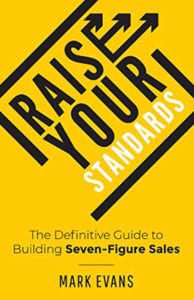
Raise Your Standards: The Definitive Guide to Building Seven-Figure Sales
I saw this study back a couple of years ago or so. I believe that about 90% of all the prospects that you meet, at any given time, aren’t ready to do business with you. Only 10% are ready to do business now. I was having this conversation with a client who was putting all of this weight into every single meeting. He was psyching himself out, to be honest with you. He’s trying to change almost his entire business model because 1 or 2 people have said no to him. We had this conversation, “Not everybody’s going to be ready that day to sign on the line that is dotted, especially the higher end and the higher level of service, widget or product that you provide.” You know this better than anyone, John, when selling luxury goods. Not everybody’s ready to drop six figures on something.
The next part of this is the actual selling and there are a lot of different steps to that. Do you reverse engineer it? Do you think to yourself before you even start building rapport, “How can I create a win-win?”
In creating a win-win and creating that type of scenario, you’ve got to have that in your mind. You’ve got to go in with some intention, but I caution salespeople to come in because I’ve been in situations where what the salesperson thinks I’m coming in for and the solution that I want are apart. We’re almost like train tracks where this person is going in one direction and I want to go somewhere else or we’re completely apart. I do a little reverse engineering, but honestly, I just want to be curious in sales conversations. That curiosity is a lost art and a lot of salespeople could benefit from being curious about the other person across the table, the company, the solution and where that company or person is trying to go.
I love a story, so I’m guessing you have a time where the buyer and the seller had a different track, then you had come in for something. Give people a story so that it locks in, whether you’re buying a car or matches.
I’ve made every mistake when it comes to sales, so I’ve got lots of horror stories if you will. I believe that there are about four types of people and I consider them to be either bowls. If you’re type A, you go get them and take no prisoners type of people. You’ve got your party people, that’s someone like me, energetic. We usually got cocktail parties. You’ve got your fact folks. Those are usually your CPAs and your engineers. The I’s are dotted, the T’s are crossed, and then they want to show you the math behind all of it. Your people pleasers are the type of individual that even if you eat their lunch right in front of them, they won’t say anything. They just want everybody to get along. How we interact with those types of people can be successful in a sales conversation.
[bctt tweet=”Sales is the lifeblood to all organizations, especially small and medium-sized businesses.” username=”John_Livesay”]
One story that comes to mind is I was trying to sell someone who is an electrical engineering manager. It’s almost the definitive individual when you think of fact folk. I saw his garage 1 year or 2 later and it was like you could eat off of it. It was impeccably clean. For the better part of a year as I tried to sell a high-end engineering solution to his company, I was constantly going up to this individual and there’s a way to build rapport and relationship. I was offering him tickets to a local sports team and front row seats. I offered him these great events where we’d have a table where he could network with fellow engineers and fellow people. I didn’t realize that and it didn’t dawn on me until a little bit later, that this person going out in public and trying to meet someone who is a complete stranger is a nightmare scenario for this guy and for this individual. He said, “Mark, I don’t want to be in a crowd. I don’t want to be around people socializing and networking. That’s a nightmare to me.” It was only when I said like, “Yeah.” Instead of trying to push these tickets on them, how about I just provide the facts and the figures that he’s asking for? As soon as I was able to do that, the business became a lot easier. We formed a great relationship.
You also talked about the fourth thing being follow-up and most people don’t do it. I know in my own career, it’s a big key to my success. How do you suggest people follow-up without being pesky?
A lot of people don’t want to be that “used car salesperson” where they feel like follow-up is something scary. They don’t want to be a pest. If you have a solution that’s providing value to someone, it’s in your best interest to follow-up with them. You can change their life if you follow-up and have a good consistent follow-up process. There’s a stat that I read that said something like 20% of salespeople are following up more than 3 or 4 times, whether by call or by email. That same study said that only 80% of all buyers will only respond to or buy something after the sixth or seventh connection attempt. We got this massive difference between salespeople that are stopping at three connects and people that are only buying at 5 or 6. John, for example, how many emails do you get in a general day?
I don’t even know anymore. It’s a lot. I can barely keep track.
[bctt tweet=”As a salesperson, your one voicemail or email is not going to make a difference. Don’t be afraid to follow up.” username=”John_Livesay”]
Probably north of 100, 150 or 200. The average executive gets over 250 emails a day. If you, as a salesperson, are out there thinking that your one voicemail or your one email is going to make a difference and reach out, that’s not going to happen. People are busy. They have lives, kids, spouses and parents that get sick or they get busy going on vacation. I always tell people like, “Don’t take it personally. It’s not up to you. It’s not about you, so don’t be afraid to follow up.”
You’re also a keynote speaker. Who’s your ideal audience?
I try to speak to companies that are looking to go to becoming sales-driven organizations. Maybe in the past, they’ve had a couple of salespeople or not professional sales organization and they want to be proactive when it comes to the sales process. That looks like a variety of different industries, whether it’s software as a service, professional services like CPAs, commercial real estate or realtors. It’s about those individuals and those entrepreneurs that want to grow their business, but they just don’t know how to get to that next level, especially when it comes to becoming sales-driven.
How did you come up with the title of your book, Raise Your Standards?
[bctt tweet=”If you have a solution that’s providing value to someone, it’s in your best interest to follow up with them.” username=”John_Livesay”]
I struggled with a title for a couple of weeks and nothing was coming up at all. I liked the Raise Your Standards part. I have a business coach. His name is Craig Ballantyne and he is out of Canada. He’s a New York Times bestselling author for 3 or 4 times and he’s a great guy. I was beating my head up against the wall for 3 or 4 weeks and within five minutes of one of our first conversations, he said, “It should be Raise Your Standards: The Definitive Guide to Building Seven-Figure Sales.” After explaining what I do and how I help a lot of sales companies, I loved it, but at the same time I was like, “Craig, how could you do this to me? You’ve figured this out right away.”
That’s what good people who have experienced do. I figured it out quickly, but it was 30 years of experience that allowed me to do that fast. We talked that your book can help people not feel pushy, sleazy or even difficult. Is there something in the book using these standards that takes it from feeling complicated or sleazy?
The core thesis of the book is that sales is changing. There’s the old way of selling and then there’s a new way of selling. John, I love your perspective on the new way of selling and you preach an intentional type of sales process. What I’m talking about is your personal interactions. Sales don’t have to be something that you have to do to somebody. You don’t have to use manipulation and kitschy techniques in order to close a sale. All you’ve got to do is ask some good questions, build some great rapport, and understand where that person is trying to go. If you have a solution, a product or a widget that can help them, then it’s your duty to make that pitch to make that ask of them. The sales approach and the sales genre that I’m trying to preach is that you don’t have to change and be the guru in front of a private jet or in front of a Lamborghini. You can work with someone else in order to get a win-win and to create a good long-lasting relationship.
Mark, what do you think makes a good question? We all know the difference between a close-ended question, yes or no or an open-ended question, but sometimes people feel awkward asking people a question. They don’t want to feel intrusive. How do you help people ask good questions?

New Sales Approach: Being in sales is like being a chef. You don’t just show up when people start coming in. There is an intentional approach and lots of preparation before you start reaching out to people.
When it comes to asking questions, that’s the core element of a good sales meeting and a good sales approach. The questions are where the magic happens. The level of depth, level of intention and level of thought that you put into your questions reflect on how you are approaching and how you are respecting your client or your prospective client. The framework that I like is thinking about what’s in it for the other person. Everybody’s tuned into the most, “What’s in it for me?” They’re trying to think of, “Where are they at currently? Where are they looking to go?” Those are the questions I tried because I firmly believed that if you can articulate the problem that your buyer or your prospect is having, better than even they can, they’re automatically going to think that you have some answer.
That’s the a-ha moment for many people. The better you can explain the problem, the better they think you have their solution, which in my mind requires some homework and some empathy. It’s not just, “It sounds like your problem is this,” but put some feeling behind it. “It must be frustrating to struggle with this particular problem and never figure out how to solve it or the same thing keeps happening and all that.” That is what makes people think, “You get me.” You have something where you say, “The first objection is not a real objection.” That intrigued me, Mark. Let’s say a couple goes into therapy and they said, “We’re here because we’re having trouble with our sex life.” The therapist is like, “That’s what you think is the problem, but there’s something underneath that.” How does that work in the sales world where you say, “Your first objection is not the real one.”
I had not heard that part but I liked that. That’s true and it’s an a-ha moment for me. John, if you’ve ever gone into a store even if you’re busy and even if you’re looking for someone and that helpful clerk comes scampering around and says, “Can I help you with anything?” Most people’s first answer is, “No, I’m just browsing. I’m just looking.” People naturally love to buy, but they don’t like being sold to. “I want to buy a new car. I love the thought and the thrill of driving off the lot, but I don’t like being sold at all.” That first objection often is real, whether it’s that therapy case. We put up these guards and barriers because we don’t want to let people in. We don’t want to be vulnerable and answer some questions. You’ve got to break through that.
Are you considered a Millennial or not?
I still fly into that, but I watch a lot of old movies and old books. I’m an old soul.
You’re what’s considered a digital native which is someone who grew up with computers as opposed to older people who had to learn it. You have whole expertise around how to stand out using video email. A lot of people don’t even know you can do it and they don’t even know what video to put in an email. Because this is your digital native, can you give us some tips on that?
One tactical that anybody who’s out there that is cold prospecting or trying to book appointments or book meetings with about anybody can benefit from is through video email. The average executive gets, let’s say 200 plus emails a day. Most of those are all text-based. One way I’ve found and my clients have found that’s effective in standing out in the inbox is a video email. The system that I use is called Vidyard. There’s a paid version and a free version. I use the free version, to be honest with you. I record a simple and easy video that can be converted into a GIF of me waving or me holding something up where I hold up my book and say, “John, it’s Mark. I’m the author of Raise Your Standards. I’d like to talk to you about X, Y, Z. We’d love to do this. I’d love to make an introduction.”
That little video stands out in people’s inboxes. Every time I send this or every time one of my clients starts using this practice, we see their conversion rates immediately jump. We see conversations come out of it. I use this to schedule a bunch of different appointments at a conference that I was attending, a big industry event. I was reaching out to different CEOs and executives and I became almost like this little mini-celebrity at these events. People are like, “I got your video. I loved it. It was amazing.” I’m still seeing the puddling effects or the ripple effects from that.
Give me the name of the service that you use.
There are two. The first is called Vidyard and the second one is a Wistia product called Soapbox.
Do people know that it’s a video in the email with the subject line somehow or you still got to get them to click to see the video?
They’ll see it when the actual video uploads. You can load it directly into your email, especially if you have Gmail or Outlook. In the email itself, there’s a little thumbnail like you would see any thumbnail. It almost looks like a YouTube box and you can turn that into a GIF. There’s motion like I’ll wave in it, I’ll move around or I’ll hold a sign up of that other person’s name. It will say like, “John, watch this video.” People naturally want to click. It’s clever. People can’t help but click on it.
What can sales teams learn from sports teams since you’ve written about this?
There are a ton that they can go with. Let’s start with the CEO, the entrepreneur who’s the head coach. I see a lot of CEOs who are the head coach and also trying to be the quarterback, the linemen, the person popping popcorn and the guy parking cars out in the parking lot. These small and medium-sized business owners are trying to be everything for everybody. The first thing is to start getting a team. Get your star performers and also start getting a good set of other coaches that can help you level up the entire team.
The book again is called Raise Your Standards. Any last thoughts or enthusiastic tidbits you want to leave us with?
In the end, sales are one of the greatest crews you possibly can be in. It doesn’t have to be something that’s manipulative. It can be a great career and at its core, it’s all about helping someone else.
Thanks for being with us, Mark.
John, thanks for having me. I appreciate it.
Important Links
- Raise Your Standards: The Definitive Guide to Building Seven-Figure Sales
- Vidyard
- Soapbox
- MarkPatrickEvans.com
- Vidyard.com
- Better Selling Through Storytelling Method Online Course
Wanna Host Your Own Podcast?
Click here to see how my friends at Podetize can help
Purchase John’s new book
John Livesay, The Pitch Whisperer
Share The Show
Did you enjoy the show? I’d love it if you subscribed today and left us a 5-star review!
- Click this link
- Click on the ‘Subscribe’ button below the artwork
- Go to the ‘Ratings and Reviews’ section
- Click on ‘Write a Review’
Love the show? Subscribe, rate, review, and share!
Join The Successful Pitch community today:
- JohnLivesay.com
- John Livesay Facebook
- John Livesay Twitter
- John Livesay LinkedIn
- John Livesay YouTube
The 10 Cent Decision With Laurie Guest
Posted by John Livesay in podcast | 0 comments
The core of every successful business starts from the small actions you do. By putting energy into the little things, you are actually creating a big impact on customer service. Entrepreneur, keynote speaker, and author of the great book called The 10¢ Decision, Laurie Guest, is the go-to resource for customer service excellence. In this episode, Laurie joins host John Livesay to talk about the power of not saying “no” and replacing that with the word “actually,” as well as the impact of doing small things and matching your energy zone with people to create loyal customers.
—
Listen to the podcast here
The 10 Cent Decision With Laurie Guest
Our guest is Laurie Guest, who is an entrepreneur, keynote speaker and author. She is a go-to resource for customer service excellence. For more than two decades, she has shared her practical point of view on customer service and staff development with audiences and companies across the country. Blending real-life examples and proven action steps for improvement. Her book, which I’ve read and loved, is The 10¢ Decision: How Small Change Pays Off Big. Laurie, welcome to the show.
Thanks for having me.
It’s so clever that you’re in the customer service world and your last name is Guest.
We should marry what we seek to be. If I wanted to be a guest speaker, I had to find a man named Tom Guest. I’ve often told people I should’ve been looking for Tom Skinny. That would have made all my problems go away.
That’s an illusion that we all have. People often ask me if I’ve changed my last name or was I born Livesay and became a speaker. I said, “That’s my name.”
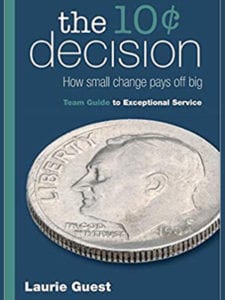
The 10¢ Decision: How Small Change Pays Off Big
You’re living up to it.
Let’s talk about your own story of origin before you were Laurie Guest and married to Tom. You can go back as far as childhood, high school or wherever you want to start. Tell us a little bit about your own experiences. Did you always know you wanted to be an entrepreneur? How did that come about?
I don’t think I’ve ever been asked that before and that’s interesting. I have been an entrepreneur since I was five. I was born wanting to invent businesses. I started out selling sweet corn on the corner in Somonauk, Illinois at a 1,300-person community, about 60 miles West of Chicago. My mom and dad were great with people. They taught me early on how you’re supposed to treat a customer. I sold more sweet corn than any other stand in town. That’s how I became an entrepreneur. Each idea I came up with was appropriate to my age level.
I kept doing stuff and building, selling and learning something and moving on one way or the other. Eventually, my trail took me as a young adult into healthcare. The core of my professional life prior to owning my own business was actually ophthalmology, the eye business. I was a trained technician and I would measure eyes for intraocular lens implants and schedule people for surgery. Our doctor was fabulous at customer service. Not only were they great surgeons but they knew how to train us to treat our patients.
That’s where all my wisdom came from early on. Other industries started calling and saying, “Could you come and share the secrets of your customer service and how you have such a thriving business?” My doctor looked around and he went, “Laurie, you like to talk. You go.” I jumped on that. I was born that way and I did that for quite a few years for him. One day, it dawned on me that there was actually a business I could have all on my own to be a customer service speaker and trainer. With his blessing, I left the firm and started out on my own. That was years ago. Here I am still owning my own business and I love it. Sales and entrepreneurship, we are the same kind of breed.
I want to double click on something that you intrigued us with. What was this doctor doing that maybe people can apply to their own business or life that made it so special and separated them from other people? Was it remembering birthdays?
We could talk all night long on what I learned there. Here are the big ones that came to mind. He had a mantra. He believed that a doctor should do only what a doctor must do. Examine, diagnose and treat and everybody else should do the rest of the stuff. What that means is you do what you do best. Whether there’s a guy reading this that owns a shoe store or a woman who owns a boutique, whatever it is, you should be doing only what you have to do. That means you have to hire great people, create a culture that they understand how you want your customers treated, empower them and the hard part is you’ve got to enforce these rules that you’ve made and the boundary that you’ve set. That’s where the problem comes. It’s easy to set the rules but it’s sure a lot harder to discipline and enforce them. It’s like parenting.
[bctt tweet=”Replace ‘No’ with ‘Actually.’ ” username=”John_Livesay”]
The more you reinforced those boundaries, the more people realize they’re real and you can’t negotiate your way around them. This concept of culture, even in a small company practice or business is so important that a lot of people don’t even take the time to define what the culture is. It influences everything. Not only who you hire and if it’s a fit culturally, regardless of their background and skill fit, but how you treat clients. I want to learn more about your thoughts on how defining culture impacts customer service?
It’s important that when people define a culture, they don’t confuse it with that special mission statement with all the perfect words and punctuation that has been matted, framed and hangs by the front door of your business. Most of your employees cannot recite that mission statement unless you force them to do it. I want to make sure that we define with people what we mean by culture. I’ll define it and you tell me if you agree. Culture is what we all agree to be true here. In this organization, we all agree that we’re going to and it’s X, Y, Z. It can be different for different places. In general, it’s going to be things like, “Treat the customer right and deliver the best product and service.” It becomes this bullet list that everybody has.
What differentiates our culture from your culture? It’s the delivery from the people who put it out there. Let’s say you and I both own a pizza place. You want a culture that you want good food served hot on time at a fair price. It sounds like my same list. Why would your pizza place be busting at the seams and people are waiting in line to get your pizza, assuming that mine is an equally good product, we’re not comparing pizzas here. We’re comparing service. Why do I have open tables and people are waiting to get in to see you. The only difference can be the delivery of the culture. The delivery of what we believe to be our values.
What’s so fascinating about that is, Domino’s has this mobile app that personalizes your whole experience. It’s like, “Billy placed your pizza in the oven and now Susie is wrapping it up. George is on his way and you can track it.”
It’s absolutely brilliant.
People are like, “I’m involved in the process and I never knew I needed to know the name of the person packing my pizza, but now I do.” It’s that level of extra care that comes along with it.

Creating Loyal Customers: You should be doing only what you have to do. That means you have to hire great people, create a culture that they understand how you want your customers treated, and empower them.
Before you go on, have you heard the new thing that Domino’s is doing about requesting?
No.
My college-aged daughter has left for college. She told me one summer she wanted pizza and she was insisting we order from Domino’s. We don’t normally use that vendor. I said, “Why?” She goes, “Go to the special request square, when you order it online, tell them that you want them to draw something inside of your pizza box and people do it.” I said, “You’re kidding me.” She types in something about, “Draw my dog named Lucky.” That’s all it says or something that. We don’t even have a dog named Lucky or something like that.
What happened was, when the doorbell rang with the pizza, she gets off the couch, came running like a 50-yard dash to the front door. She whipped open the door, she grabbed the pizza from the guy, I’m left to pay him. She runs into the kitchen, she opens the lid and sure enough, there’s a stick figure of a dog and he’s got a little collar on and it says Lucky. Somebody somewhere in my town drew what she asked for. That’s what I call a 10¢ decision. It cost them nothing to do that and she’s running to the door to get her pizza.
It’s customized and the fact that there’s a human being, especially with artificial intelligence taking over a lot of customer service. Press one, if you want this, and two, if you want that. This experience is the opposite of that. I have a King Charles dog and I get his food from this place called The Farmer’s Dog. They specialize in healthy food for your dog. I was emailing back and forth scheduling stuff with their customer service person. He ended the email with, “Give a belly rub to Pepe for me.” They knew the name of the dog from the order and he took the time to throw that in. That personalization of everyone who works there loves the dogs.
It’s where it’s at. Have you heard about Chewy that’s an online store?
[bctt tweet=”Match your energy zone to the moment.” username=”John_Livesay”]
Yes.
Here’s that culture. I love this. I have not experienced this but I’ve read about this. There was somebody that I know of that wanted to return two bags of dog food they had bought. They wrote and they said, “Our dog has passed away. We have these two bags of unopened dog food.” Chewy writes back to them with the condolences and said, “Please donate that food to your local shelter and you have our heartfelt sympathies.” It was something like that. It was genuine. A day later, fresh flowers arrived on the doorstep from Chewy at the house.
That unexpected extra that the person will never forget. That story gets passed on and on.
They’re going to have another pet. Most of us who own pets are not one and done. You’re always going to have another one and that’s where they’re going to be ordering their food, plus the story gets told.
That’s what I love and it’s unexpected. My favorite definition of luxury was doing something before somebody knows they need it. When I was working with Banana Republic, they wanted to up their game and they tested it in their flagship stores where you could charge your phone while you’re shopping. “It’s an unexpected luxury that I didn’t know I needed, but how great.” They were doing it to be unexpected. It turns out the sales went up because people kept waiting for the phone to fully charged and kept shopping. You hinted at what The 10¢ Decision is and I want to go back to that. It’s such a great title and easy to remember. The small changes that people can do, whether it’s writing something on a pizza box, sending flowers as condolence over, above and beyond and anticipating something like, “You might want to charge your phone when you’re shopping.” Things like that give us this little extra oomph. You have your own 10¢ story that you’ve talked about.
I do have my own 10¢ story. The way it came about is, as a speaker, I’m a frequent traveler and one time I checked into an expensive hotel. It must’ve been $350 or $400 a night. When I got to my room, as with all hotels, there were two bottles of room temperature water waiting for me with a tag on it that said $7. I thought, “I gave you $350 or whatever it was and now you want $7 more.” You and I both know why they’re doing that. It’s a brand standard. If I stay in that chain of hotel, it’s always going to be that water in that position. We also know that they could bring in a semi load of that water for about 10¢ a bottle if they wanted to, but they choose not to.

Creating Loyal Customers: It’s easy to set the rules but it’s sure a lot harder to discipline and enforce them.
They don’t make a 10¢ decision that makes a big impact. The next hotel that I went to, I get to my room, and this is a boutique hotel, it’s not a chain so they have the ability to make any decision they want. I get to my room and there’s a black mini-fridge. In the fridge, there are two ice-cold bottles of Ice Mountain, my third favorite water and sign on top of it that say, “Dear valued guest.” First of all, I love it when they take the time to put my last name on the sign. It said, “Dear valued guest, complimentary bottled water is found in the refrigerator. Please enjoy.” They spent almost nothing. It’s a 10¢ decision for my perceived value to be incredibly high. In the speech, I go on to explain the third stop which I won’t take the time to do in this interview, but at the third stop, there was a dramatic bottle of water waiting for me. It was a Bling bottle of water.
It was also free on a pedestal and an ice bucket. It had a brass plaque next to it that said, “Enjoy. Additional bottles may be purchased in the gift shop for $25.” Now, I have value. My point in this entire thing is we can either have a brand standard that says, “Not only are we going to take your $350 but we’re going to charge you $7 for a 10¢ bottle of water. We’re going to be the place that gives it to you for free or we’re going to be the place that goes, “We’ve got something spectacular for you and we’re going to make sure it has a value.”
The three levels is fantastic. You’ve got to pay, we’re going to give it to you for free and we’re going to give it a wow factor with the surprise. I’ve even had an experience where I’ve checked into a hotel and they offer me free water at the desk, “You must be thirsty after your trip.” I don’t even have to wait in my room to see if it’s free or I have to pay. I love that.
Here’s another interesting question. I rented a car from a well-known chain but I won’t name them. When I was waiting for my car, they handed me an ice-cold bottle of water. It was nice of them to do. When I got in the car for some reason, the only way you could charge your phone was with one of that cigarette lighter chargers of which there wasn’t one in the car. I didn’t have one with me and I usually use the USB port, but this car didn’t have it. It must have been older. I go back to the counter to get one of those cigarette lighter things for $16 and I’m thinking, “The 10¢ decision here is to have one of these in every car with their logo on it and with encouragement that you take it with you.” Every time I pulled that thing out of a cigarette lighter and it would have that brand caught on it and that would cost them probably about the same as the bottle of water if they wanted to make that choice. Isn’t that fascinating?
It is. For anyone stealing it or keeping it by mistake, we have to mark it up and all that stuff. Even when you go to Europe and they go, “If you want to have an adapter for to charge, you’ve got to pay us this.” The thing you talk about that I love in your 10¢ Decision book is matching the E-Zone of your buyer. The E-Zone is the energy that people bring to work every day. I could talk about energy all day long because when I initially got picked and it was between me and two other speakers, the speaking agent emailed me and said, “Congratulations. They picked you to be their next speaker at their annual meeting.”
We always go on three packs. You won the three-pack war.
[bctt tweet=”We should marry what we seek to be.” username=”John_Livesay”]
I did. We’re going to talk about that too. They said, “They liked your energy.”
You do have good energy.
Thanks but people realize, “They’re going to hire me or I’m going to sell this product or whatever it is I’m selling if I have the best price, information or whatever it is.” People don’t realize the value of your energy that people want to be around. Especially if you’re a speaker, you and I are. If you can make people feel good during the interview, they go, “I feel inspired after talking to him or to her. Maybe the audience will too.” Let’s talk about the E-Zone and how should I keep it up if you’re doing something that is your own customer service that might be a little rote or you’re having a bad day. You have this concept of the Big Seven of Service and my favorite one of there is where you talk about real greetings and not robotic acknowledgments.
Let’s move that all together. People are attracted to energy like a moth to the light. Let’s say you go to a cocktail party and you don’t know anybody. You’re scanning the room for who you might want to chat with. I don’t mean somebody that you’re romantically interested in. I mean a person to talk to. You’re going to scan the room and you’re going to spot the person that’s showing some energy. They’re making eye contact with you, they look they’d be friendly and could chat about anything. You and I would walk in a room as complete strangers and find each other because we each could talk all day long about absolutely anything.
If that’s what you seek, that’s what you’re going to find. We put that energy out there in our behaviors. When I talk about the E-Zone, I see it as a cardiac monitor and that there’s a heartbeat that goes inside this certain range. There are some people that come to work outside the range. On the top side, those are our Susie Sunshines. They’re coming to work going, “Good Morning,” and their pitch is high. I don’t believe them, I don’t believe you. You’re outside the zone. Underneath are the Boring Bobs. Those are the ones dragging themselves to work without any energy at all and complaining that it isn’t Friday yet. In between those two people is the zone, the place we want to be. That starts the moment you walk in the door. It’s a head game more than anything else.
When I was sixteen, I got a job at a grocery store and had to get up at 5:00 in the morning on the weekends and go make the donuts. You might remember a commercial years ago where the guy would get up and he’s like, “I’ve got to go and make the donuts.” That’s how my mom would wake me up in the morning, “It’s time for you to go make the donuts.” I’d show up to work. By the time the customers appeared at the grocery store, I had better be ready to sprinkle and deliver and keep on going. That’s the early age when I learned the energy thing.

Creating Loyal Customers: You have to believe in your own fees, even if you’re not the one who set them.
Inside the zone, we’ve got to match the moment and that’s where I bring the heart monitor part into it because people are disconnected. I’ll use healthcare as an example. If you’re sitting in front of me and I now need to give you a bad diagnosis or I need to perform a test on you that’s not going to be comfortable. It is a disconnect if I’m bringing my Susie Sunshine high-end like, “John, I’ve got you. This is only going to hurt a little,” and my pitch is high and I’m way off the energy zone. You’re uncomfortable with that. I need to bring the energy down and still stay in the zone but bring you that engagement that matches the severity of the situation.
Sometimes you do have to have tough decisions with people and not treat them children, which is what you’re talking about. Don’t be robotic. This needs to be authentic. That’s where empathy comes in big time. I’ve seen some people do this well in customer service when someone’s angry, they want to quit or return something. If the culture allows for that person to say, “I could see how that could make you mad. I would be mad if I was in your shoes.” That can diffuse the situation.
It can make a big difference. The whole idea of empowering people to be able to find those resolutions is an extremely big part of the culture we had. Our doctor felt that if the decision you made was the best thing for the patient and the practice, I back you on that decision rather than handcuffing us and not letting us do anything without permission. That becomes a culture choice.
We talked before about some of the clichés that people sometimes do only because they don’t know how else to ask the question. In a phone call situation versus an in-person one, they’re told, “Get the person’s name and try to use the three times within ten minutes.” They’re going, “To whom do I have the pleasure of speaking with now?” Nobody talks like that in person so why because when we’re on the phone, do we talk that to each other?
You get the idea that they’re reading a script to you. A script that doesn’t even match this conversation.
Talk about not matching the moment. I role-played with somebody and I said, “Let’s pretend I work here.” I said, “My name is John, I’m from XYZ company.” They say, “I want to do this or that.” I said, “Great, let me reintroduce myself to you because many times, people don’t hear it at the beginning. My name is John and you are?” That’s what I would to do in person. Do you have other ways?
[bctt tweet=”We put energy out there in our behaviors. What you seek is what you’re going to find. ” username=”John_Livesay”]
Sometimes it’s a simple question of, “May I ask your name?” How hard is that? That sounds so much better. There’s a well-known food chain that has taught its people to do this glorious greeting. They say, “It’s a great pleasure to serve you today.” When the greeting doesn’t match what we believe to be the reality, we have a disconnect. I do not believe you are that enthusiastic about giving me my chicken sandwich. We’ve got to figure out how do we give that energy and this service that you and I are both talking about in an authentic way? What’s weird about this is you would think it would be common sense, but it’s not. We have to train it. You have to teach what we want the words to be, but allow them to bring their own personality to the table.
The other thing in customer service/support sales is to build rapport and ask people questions. People don’t feel comfortable. I’ll go, “What questions are you asking them to say?” They’ll go, “We thought we’d start with, ‘How’s your day going?’” It seems it’s so off purpose for why the person called. They’re not calling to make a friend. Even if you are meeting somebody for the first time in a networking event, you probably think of something else to say besides that.
That would be a great title in the future book you’re going to write on sales. It’s like, “They’re not calling to make a friend.” Isn’t that the truth? They’re calling for results. They want a solution and an answer. I have this in the book. I am not a fan of the phrase, “How are you?” Unless you actually care and want to hear the answer. My replacement for that is, “It’s nice to see you.” I don’t say, “How are you?” I say, “It’s nice to see you.” It starts a conversation and you’ll be amazed how often do you first start using it. People respond, “I’m pretty good, thanks and you?” It’s so robotic. They’re so used to what the answer is supposed to be.
This concept of trying to be authentic and instead of saying, in this case in real estate, “How’s your day going?” I came up with another question that’s more pertinent, “How’s the house hunting experience going for you? Is it a nightmare?”
It’s so much better.
That’s a relevant question that I’m more than happy to answer and I feel that you might actually care about my experience from that question.

Creating Loyal Customers: Believe in your product and service enough that you feel the people will be lucky to have you.
As we used to say, “Get focused on the body part you care about,” so to speak, which is the same with the real estate. I worked in ophthalmology and if you’re coming to see us and I asked you, how are you feeling or how are you doing? What you’re going to do, especially as an older adult, is show me the scar from your most recent surgery. You’re going to tell me that you didn’t feel good last night. I at least got to get to the right body part. We were trained to say, “Tell me how your eyes are doing.” We’ve at least narrowed it down to what I can do something. That’s the same thing with real estate, “How’s your house-hunting going?” We’re not getting all this extra stuff. That’s a great one.
You talk about anticipating a customer’s needs and that small gestures can create loyal customers. Can you tell us what that means?
I do think that there are small things you can do to create loyal customers. The first one that comes to my mind is, a few years back, we did a remodeling at our home and we called four different contractors to come to the home to look at it and give us a bid. Two of them never showed up. One of them made the appointment and didn’t call back at all. The fourth one showed up when he said he would exactly on time every time he came. He explained things to us in a way that we would understand, not the internal lingo and if he used a lingo word, he would define it right behind it.
The biggest thing that I loved was when he explained that there are change orders, “After we go in with a quote, it’s locked in. This number will not change but if you decide you’re going to put in fancier windows, there will be a change quote and you’ll see the additional cost it’s going to be.” When the project was over, he came in at the penny of what he promised that it would. These are not dramatic things that he offered but I’ve been talking about him in the decades since we did this remodel because he was unique in his industry. You show up on time and do what you say you’re going to do.
Isn’t that amazing that that’s the new differentiator as opposed to the minimum acceptable behavior these days? That’s what it is. That’s how you can do this. You and I love words. You have a whole chapter devoted to choosing words wisely.
That’s my favorite chapter as a matter of fact.
[bctt tweet=”What differentiates a culture from another is the delivery from the people who put it out there.” username=”John_Livesay”]
You know that I love alliterations. The way you’ve structured your writing is Words Wisely. You talked about Careful Communication. It’s two Ws and two Cs. I want to get a hats off to that. That is important. Let’s do a couple of these great examples. You have version one which is going to cost you about $259 or the fee for that service is $259. That would sound fairly close to a lot of fees versus costs. What is that?
Fee versus cost and the other thing is your personal attitude towards the cause. One of my jobs was to help eye doctors who sell you glasses help them be successful. I would go in and therefore they would refer more people to us because we didn’t do eyeglasses in our firm. My point is when I would go and watch their teamwork, if the person checking you out from the eye care place thought that $259 was a lot of money to pay for a pair of glasses, they would say things like, “That’s going to cost you about $259.” The tone in my voice is, “You don’t want to pay this, do you?” We would have to train them to say, “The fee will be $259 and we take 50% now or I’ll need 50% now.” We would give them the words to say, you need to lean into this number because if you don’t believe they should pay it, they’re certainly not going to want to pay.
I use this all the time, “The investment to work with me is,” or “You’re getting a return on your investment when you hire me.”
We were at the dentist. We wanted to have some teeth whitening done for one of our children. It was going to be expensive under $500, but we would pay anything to help her smile. We want to do this. Multiple times, different people on the team kept going, “That’s going to be about $500. Why don’t you try the Crest white strips? Why don’t you try this?” They talked us out of it. We were begging. When I got in the car with my husband, I said, “We are begging for them to do this task. Why don’t we find another provider?” When we went to the other provider, they were all over it. They’re like, “Let us show you how we do this. It’s under $500.” It was the same fee. She called it under and had all this enthusiasm, that energy zone. We were like, “Sign us up.” The procedure has now come and gone and we’re thrilled with it. What bothers me about it is, don’t assume that I don’t want to pay the money. If I want that service or that product badly enough, I might’ve been willing to pay $1,000 for it. In fact, I was willing to.
It affects confidence and outlook. You think to yourself, “If I wanted that version of going and buying something from the drug store, I’m getting the results of that. If I want someone to take the time to match, what’s your skin tone? Your teeth should be this shade and not that shade. This is not a one size fits all. What you’re buying when you’re buying teeth whitening is how you’re going to feel. Does smiling more make you more confident? There’s research that says it elevates your mood. You know as well as I, that they tell people on the phone, “Smile,” because people can hear it your voice. If you don’t like your smile, you’re not going to smile all the time.
I want the salespeople who are reading, especially those who maybe are emerging salespeople that one of the most important things is you have got to believe in your own fees. Even if you’re not the one who said them, even if you have no control over the fees, you better believe in your product and service enough that you feel the people will be lucky to have you. It’s the same way in our business, John. We have to decide what our fee is for a certain job and if we act we’re not worth it or we’re not going to bring the value, then nobody’s going to pick you out of that three-pack. They’re going to go with somebody else. Sales to me are not about pushing you to buy something you don’t want. It’s educating you on why this is the right thing for you at the price I’ve set it at. There’s a big difference between those two.

Creating Loyal Customers: Sales is not about pushing people to buy something they don’t want. It’s educating them on why this is the right thing for them at the price you’ve set it at.
You’re singing my song because I talk about the old way of selling is to push out a lot of information and the new way is to tell a story that pulls people in.
The story is so critical because everybody wants to hear a story. Think about when you’ve been someplace, maybe it’s a church or something where someone’s talking a lot and you’re losing interest, and they click into a story and you’re back. That’s the same way with sales. It’s powerful that you teach that.
I want to leave the readers with one of my favorite parts of your book, which is, “Replace the word no with actually.” I’m going to be the person that the answer is negative. I’m going to say, “Can I expect to receive my lawn chairs tomorrow?”
The wrong way would be, “Nope. We don’t see those coming in until next Tuesday because of the holiday.” The right way to say it is, “Actually, that delivery is due on Tuesday.”
“Okay. Tuesday it is.” It’s so great. If you took nothing else from this book and believe me, that’s the tip of the iceberg of all the incredible value in The 10¢ Decision. I highly recommend people getting it. Laurie was generous enough to offer a little discount. Laurie, how can people get that discount and follow you on social media?
To get the discount, you can go to the book website, which is TenCentDecision.com. You can either do it as 10 or spell it out. Either way, it gets you there. When you go to buy the book, there’s a place where you can apply a coupon code. Anybody reading can use the word podcast, all one word. That tells us that you heard about it on this podcast. They can get 20% off for that. I’m on Facebook, Instagram and all the regular ones. I’m happy to connect with people there as well as LinkedIn. My regular website is LaurieGuest.com and we do reply to all messages on social media. Talk to us and we will talk back.
They’ll talk back in the right energy zone. That’s for sure. Thanks, Laurie, for being such a great guest, having such great energy and giving us such great tips. I’m never going to say the word no again. Even if somebody asked me out on a date, “Actually, I’m not available.”
Actually, you should be so lucky.
There we go. Thanks again.
You’re welcome.
Important Links
- The 10¢ Decision: How Small Change Pays Off Big
- The Farmer’s Dog
- Chewy
- Facebook – Laurie Guest
- Instagram – Laurie Guest
- LinkedIn – Laurie Guest
- LaurieGuest.com
- Better Selling Through Storytelling Method Online Course
Wanna Host Your Own Podcast?
Click here to see how my friends at Podetize can help
Purchase John’s new book
John Livesay, The Pitch Whisperer
Share The Show
Did you enjoy the show? I’d love it if you subscribed today and left us a 5-star review!
- Click this link
- Click on the ‘Subscribe’ button below the artwork
- Go to the ‘Ratings and Reviews’ section
- Click on ‘Write a Review’
Love the show? Subscribe, rate, review, and share!
Join The Successful Pitch community today:
- JohnLivesay.com
- John Livesay Facebook
- John Livesay Twitter
- John Livesay LinkedIn
- John Livesay YouTube