
Profit First For Fast Business Growth with Mike Michalowicz
Posted by John Livesay in podcast | 0 comments
Episode Summary
Having to restart a business from almost nothing and coming up on top is one proud experience Mike Michalowicz likes to share with business owners. But this is one life experience Mike doesn’t want to ever encounter again, because now he has learned that by letting go of his ego he rediscovered the meaning of entrepreneurship and felt that he wanted others to learn from his experiences of correcting himself. He is the author of four books including Profit First which Business Week calls “The Entrepreneur’s Cult Classic.” Learn how hiding money from himself made his business profitable because it forced him to find innovative ways to market for fast business growth.
—
Today’s guest on The Successful Pitch is Mike Michalowicz who is the author of Profit First. He has incredible insights on the importance of paying yourself first with your profit in order for you to become profitable. What that does for you is it identifies those services and products you might be offering that are not profitable. If you just see your business growing and being this cash-hungry machine and never making a profit, you don’t even have a clue what you should be cutting and what you should not be cutting. He said, “A lot of people come up with excuses about why they can’t do it. It’s too simple to work. I’m very unique, this would never work for me.” Believe me, he’s got case studies of himself, having it work as well as many other businesses. He said you really have to take a look at what would you do if you had all the money in the world? More importantly, what would you do if you had no money in the world and they both give you freedom? Finally, he said a lack of resources with no money is what triggers innovation. Enjoy the episode.
Listen To The Episode Here
Profit First For Fast Business Growth with Mike Michalowicz
Our guest is Mike Michalowicz who is an entrepreneur behind the three multimillion dollar companies. He’s the author of Profit First, The Pumpkin Plan and what Businessweek deemed the entrepreneur cult classic, The Toilet Paper Entrepreneur. Mike is a former small business columnist for the Wall Street Journal no less and the former business makeover specialist on MSNBC. Today, Mike travels the world as an entrepreneurial advocate speaking to groups and people just like us. He’s globally recognized as the guy who challenges outdated business beliefs and teaches us what to do about it. Mike, welcome to the show.
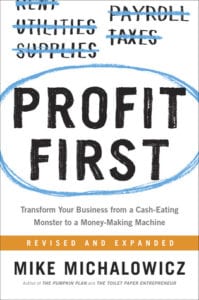
Profit First: Transform Your Business from a Cash-Eating Monster to a Money-Making Machine
John, it’s a pleasure to be here. Thank you.
I always like to hear people’s story of origin. Before you were a famous author and a famous columnist and doing all these business makeovers, did you know you wanted to do this from the get-go when you were in school or what happened? How did you get where you are?
I was a little bit of a stumbling-bumbling fool I would say, perhaps I still am. After college, I had no entrepreneurial aspirations whatsoever. In fact, my upbringing was get one job and live that job for your life and that’s what I aspired to do. I thought that was a perfect formula. I just couldn’t get a job out of college. Without a job, at least not an adequate career job, I decided perhaps I could start my own thing. Quite frankly, there were a few beers in me when these thoughts came through. Liquid courage did help. I quit my job that night with a little bit of a slur in my voice. The next morning started my first business but also was married and had a young son at that point. It was trial by fire. It was motivation out of fear and it took me quite a few years. I started to fall in love with the experience of being an entrepreneur. I grew that small business. It was a computer service company and sold it to a private equity group after eight years. I started another business in computer crime investigation, ended up in the right place and the right time. That one headed it. We helped facilitate some of the Enron trial and some other major cases where computer forensic evidence was involved and sold that to a Fortune 500.
Clearly, I know everything about entrepreneurship and you sensed the ego as I say that. My ego got hold of me and just became this ignorant, obnoxious person. I’m ashamed of how I behaved. I thought I knew all the answers. I thought I was better than other people and decided to become an Angel investor. That’s where I lost all my money. I started investing with my own funds from the selling of my companies. I started investing in all these different startups and I had no right to be in that space. I had no clue what I was doing. All these businesses collapsed. I lost literally all my money in spending good money after bad. That became the spawning moment for me, the day my accountant called me and said, “Mike, you should declare bankruptcy,” which I didn’t. I didn’t believe I even deserve to be forgiven for what I have done. I worked through it but also had to resort on life.
We, my family, my three children at that point, we lost all of our assets, we lost everything has to start anew. I also experienced depression there in that period. For all those dark times which I hated going through, I never want to experience that. I don’t wish that upon anybody. It was the greatest learning lesson for me. It triggered me to rediscover what true entrepreneurship is, to become a columnist, to start writing books and then fell in love with that phase and I’ve been doing that ever since.
[Tweet “Only sell what is profitable”]
There are so many things I want to unpack there. The first one I want to talk about because this is everyone’s goal at some point typically is, and you made it sound so easy and I can see why that would inflate your ego because it must have felt easy, you sold not one but two companies and made a lot of money. There’s got to be some lessons from that that you could explain. Did you identify who could potentially buy your company when you started your company and you always had that on mind? Did somebody stumbled upon you and found you? Tell us a little bit about that, Mike.
The things that worked was my first company. It was really driven out of fear. I had to make that business work. I started building a little reputation in a niche community. That’s one of the lessons. Once I started targeting a niche, the business grew quicker. The other companies that were in that niche, really scratching the surface of it caught notice of me too and that’s where this private equity group stepped in, so they approached me. The second company, same thing. I was approached in the same thing. I figured out a niche. This was computer crime investigation but specifically we did defense investigation. We actually facilitate part the defense side of Enron. People ask me by the way, “You do work with Enron, were they guilty?” The answer is yes. There was no evidence otherwise. Even though they were our clients, ultimately through their law firm, they’re guilty.
The element I didn’t realize is timing is a major component. I think we can do some things to manage timing. I was just by luck in the right place at the right time but I attributed it to my own intelligence, and that was a fatal flaw. I thought, “Cool, I started a forensics business and do a couple of moves. It’s going to take two and a half years before it’s acquired for millions.” Clearly, I know what I’m doing and now looking in retrospect, I didn’t make Enron happen. It happened. I just happened to be there. Yes, we can be opportunistic, we can position ourselves but luck does play a component and I think I disregard the significance of that. That’s very important. Luck may and will present itself, we seem to grasp it. Be very careful with thinking, “I’m super intelligent. I know everything.” I sure heck don’t.
The real takeaway for me from what you said is figuring out a niche, what problem are you solving and be in that specific niche and then the fact that Enron got all that publicity that attracted someone, “You’re involved with that? I want to buy you.” That’s the luck part, but you also had the foresight to realize that you were solving a big problem and in this case, it had to do with computer crime. That’s really valuable. The other thing you mentioned that everyone experiences and so few people are willing to talk about so I’m really grateful that you brought it up, is this trough of despair that you hear that most entrepreneurs go through. Sometimes it happens before you get your business sold and you wonder, “What am I doing? What am I thinking?”
In your particular case, your journey was a little more dramatic, which makes for a great story which I love. We’re going on the hero’s journey and the stakes are very high. Where you’re in such a high peak of huge success and then, “Everything I touch doesn’t turn to gold.” The truth is that’s true for everyone and we just don’t see the failures whether you’re Richard Branson or Oprah. Not everything they touch turns to gold. You think it does and then you go, “Wait a minute, there’s plenty of things that didn’t work out for them. We just don’t get a lot of publicity around it,” or you forget about a movie that Oprah made that didn’t work out or whatever it is. How did you get yourself out if this trough of despair/depression?
It was a two-year journey. I remember the one that kick off was someone in my family looked at me and said, “You have the mightiest touch, Mike. You’ve done this twice now.” I believed it. I really felt like mightiest, anything I do, I do right. Then the collapse happened. How it transpired for me is first, disbelief. I was in really disbelief in how my business were failing. I was putting good money after bad and they’re collapsing faster. I truly believe if I just put more money in it, that’s going to be the solution. That’s disbelief and really disregard for the reality.
Then I had to face my family. I told my wife and children sobbing, ashamed because we lost our assets that day as I was telling them. I had lied to them by omission. Then I went into depression. How it manifested for me? I’m not really a drinker. I like a beer or a margarita or both. I was firing down beer after beer. I’m insomniac, I wasn’t sleeping and wallowing in my own errors believing that I couldn’t get better. Suicidal thoughts, planning; actually, I know a great way to kill myself now. Those nasty thoughts of the world is better off with me not being here. I also realized that that was such an easy escape for me but I would be actually punishing others. I never really, really believed it but I was thinking it for sure.
The turning moment, which is the most bizarre thing, was just to start journaling. A friend of mine said, “Mike, just start journaling AKA a diary. Start a diary.” I thought what that meant, John, was to write down, “Things will be okay. I look forward to the future. Life is good.” He said, “No, what a journal is write down the thoughts that are in your mind at the moment. It doesn’t matter how disgusting or nasty or angry it is, just write it.” I wrote these ramblings but I started feeling relief. I was bizarre just by writing nastiness, I felt relieved. I became an avid journalist. Then the moment came I said, “What do I want to do in my life?” A lot of people say, “When you’ve all the money in the world, what would you do?” The better question is, “When you’ve no money left, what would you do?” It’s the same choice. There’s absolute freedom when there’s nothing and there’s absolute freedom perhaps when there’s everything.
I asked myself, “If I have nothing, what would I do? I could start over.” I looked at that journal and I said, “I actually like the writing component.” I could write about what I’ve learned in my journey. I could fix my own wrongs. I could start helping myself. That’s when I started writing books. Wall Street Journal then called me and said, “We’d like you to write for us.” MSNBC called and said, “We want you to be on television sharing your thoughts.” I didn’t realize this but honestly, everything I was doing was actually just trying to correct me. I’m trying to fix me and started to realize maybe other people could benefit from this too.
Again, so many wonderful insights there; I don’t know if you caught it or not or if it was an intentional play on words but you were journaling, writing in a journal and then you became a journalist. This concept of getting our negative critical thoughts out so they don’t stay in our head. Whatever the format is, talking to somebody, writing it down in a journal is so valuable because anybody can do that. That’s great stuff. That’s how you get out of that cycle of just perseverating over and over again in all the negative things of “I’m not good enough. What was I thinking? No one loves me. I’m not having a good idea. There’s scarcity in the world.” I really love what you said, Mike. I’ve never heard anybody say that instead of asking, “What if I had all the money in the world, what would I do? What would I do if I had no money in that world?” Both have the same answer. There’s a whole other book there, that whole concept of freedom.
You write about in Profit First that you came across this small, easily overlooked paragraph in The Toilet Paper Entrepreneur. I want to just go a little bit on the journey. You get out this depression and you write The Toilet Paper Entrepreneur. That’s a great title. Tell us how you came up with that title and what this overlooked easily paragraph is in there.
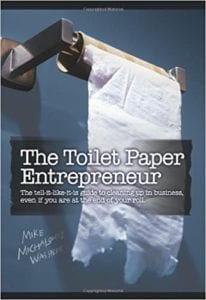
The Toilet Paper Entrepreneur
I wanted to find an analogy of something that we experience in life but don’t talk about it. A situation where there’s lack of resources and we don’t talk about. That is the definition to me of entrepreneurship. Entrepreneurship is a struggle yet we don’t talk about it. It’s vibrato and chest-pounding when really for the vast majority of us, we’re scant on money, we’re scant on resources, contacts, friends, experience. None of that stuff is available to us, yet we survive. I was like, “That’s the bathroom.” The moment we run out of toilet paper and there’s that three sheets. Of course, you don’t talk about it because that’s embarrassing and personal. The realty is we’ve all been there and we’ve all navigated it. I wanted to get this reality of the lack of resources actually triggers innovation. The Toilet Paper Entrepreneur is the lack of contacts, meaning you don’t have a network of people, requires you now to establish a network of contacts. It’s finding a new way to approach it. A lack of education or experience forces you to break the rules. It was a beautiful thing. That’s what that book was about.
I also put in there literally a three sentenced paragraph. I started talking about profit in there because I realized it’s a problem that I had. As much as my businesses grew in these companies I told you I sold, they were never profitable. They only made money for me when I excited, which is the big difference. I wrote and I found a little trick, hide money from yourself. That was basically it. When money comes into my business, I immediately take a portion and hide it away from myself and I won’t even miss it. By doing that one little mechanism, I started becoming profitable. I started getting a few calls, a few inquiries. People were saying, “I tried that ‘take your profit first’ technique and it’s working.” I said, “It works for me. I thought I was just alone. I thought I was the only weirdo that experience that.” It turned into a full system now. We estimated it recently, we think there’s 30,000 plus companies doing Profit First at the start of this year.
I love that line, “Lack of resources triggers innovation.” Because that’s not, “Poor me, I don’t have the huge staff or the huge funding I need or whatever it is to make my business a success,” and just go, “No, I’m going to figure out how to do it,” or “I didn’t go to an Ivy League school,” whatever. “I don’t have the right contacts.” This concept of hiding money from yourself to get profitable reminds me of what people do with automatic savings programs or the concept of your 401(k), just to have the money taken out of your paycheck. You never even notice it so you don’t spend it. Applying that to the business, is there an automatic way to hide money that you recommend?
[Tweet “Lack of resources triggers innovation”]
Yes, there are a couple of steps. You’re very astute because that’s exactly the system. It is the 401(k). It is the ‘pay yourself first’ system. I’m just a guy who says, “It works on our personal lives, we got to apply it to our business lives.” This is the process, when money comes into your business what I found most entrepreneurs run their business off their bank account. Maybe you were told read the P&L, the balance sheet. We don’t do that. Quite frankly, I have been in business for twenty plus years, I don’t know how to read a balance sheet adequately, but my accountant wants me to. What I do is I log in to my bank and see what balance is available and I make gut decisions based upon that.
What I found is the best systems are ones who don’t requires a change but the system actually works around our existing behavior and puts guard rails in place to make our existing behavior that gives bad results, now give good results. What we do is we set up another bank account and ultimately, multiple bank accounts. For now, start with one new bank account at your existing bank, call it profit. When money comes in to your main checking account, immediately transfer that percentage into the profit account. This is the envelope system. We’re dividing up money and we know what money is available for what purpose.
Step two is we got to hide the envelope because we’re going to dip in there when emergencies come about. What you do is you set up another bank but the goal here is not a convenient bank. No online banking, no starter checks, no ATM card. Now, we’ll transfer a link. When I transfer the money into my profit accounts, down the envelope, I know its purpose. I invoke a transfer, sometimes it takes a few days. It goes to that new bank and now it’s out of sight, out of mind and I have to draw my business off the remainder. That simple process, it allows us now to work with what’s left over. It’s human nature to very easily adapt to the circumstances around us. When we downgrade our house or where we live to a smaller space, initially it’s uncomfortable, we’re used to more space. Then we sell off some furniture, we do whatever and be like, “Here’s my new cozy space again.” We’re very adaptable. When there’s less money now available to run the business, at first it’s a little bit uncomfortable but it’s shocking how quickly we adjust and rarely is the business compromised. We just find more innovative ways to do things. We find more cost effective ways to do things and because we’ve taken our profit first, we have assured profitability.
It almost reminds me of the analogy of just eat 10% less per day. You will survive and you’ll probably lose some weight. I think that’s that same mindset. You talk about why Profit First works is because it doesn’t try to fix you. We don’t need to be fixed. You have this great analogy about flying and flapping your arms. Could you explain what that does? I think we’ll all relate to what that feels like.
I decide to open the book this way. If someone called you, “Do you want to fly? It’s really simple. Run off the nearest cliff, start flapping your arms as hard as possible and you’ll fly.” If we are crazy enough to try that out and we actually jump and we start falling, the guy yells from the top of the mountain, “Flap harder.” Of course, it doesn’t work except there is the exceptional few. There are some that just by the happenstance of nature, they bounce off a rock or two, they land in a certain way, that it doesn’t kill them. Then we have what’s called a confirmation bias. The world points to that person that landed and said, “See? He flapped his arms right. He flapped harder. That’s why he survived. That’s what you need to do.” We’re all like lemmings, we keep jumping off the cliff trying to flap wings and the few survivors become the confirmation bias. When it comes to profitability, that’s what’s happening. Most businesses are not profitable.
There was a study in part conducted by the SBA, there’s other sources too. It identified, at least that’s what I’ve heard, that 83% of small business survives check my check. They don’t have enough money to survive next week if they don’t get deposited. That’s flapping real hard. The few survivors, the few Facebook or whoever it is, we point to them and say, “See? It does work. We just need to flap harder. We just need to get investment from bankers and private equity and all these people that come in.” The answer is, “No, they are the exception. They are the ones who are truly lucky.” Don’t bank on luck, instead bank on your human nature and leverage it to your advantage. Taking your profit first and saying, “You’re sitting in an airplane and fly that way. That’s going to work a little bit better.” That’s what I’m trying to say here.
Don’t bank on luck, bank on how you naturally behave now, your existing human behavior. The goal is however you already behave, we just got to put parameters around that that natural behavior becomes our advantage.
[Tweet “Hide the profit from yourself in a separate account”]
Instead of flapping your wings, get in an airplane. I would say that means collaborate. Don’t try to go alone a little bit too.
Collaboration works in all aspects of business, but when it comes to Profit First, I was the first guinea pig ever to do Profit First. I started it almost ten years ago, when I wrote. What I noticed was I set money to a profit and then I stole from the money. I “need” the money. It was like a drug addiction. I got a partner, his name is Larry. Talk about the buddy system is real simple or collaborating. I got checks for my business with dual signature. Larry does not own my business. He’s not part of my business. He has his own company. I said, “Larry, for me to take profit form my business, I need you to sign on this check too.” I did the same for him. Larry is a stingy guy. Anytime I want to access the profit account, he’s like, “No, you can’t touch it.” Let me tell you why and I had to justify that the distribution profit was the true definition of it, which by the way is a celebratory account. When you take profit out, it is a reward for the equity owners. It is not to be invested back into the business, plowed back, pushed back, reinvest. None of that stuff. That simply means it’s a deferred expense. I had to prove to Larry, “I’ve saved enough profit. The business can run on its own. I’m going to go on a vacation with this.” In the beginning it was, “I’m going to go to Starbucks with this.” Then Larry would authorize the check. That’s how I collaborated.
Tell us one more story of how this has helped you. You have an example of somebody who owned a hot air balloon company.
His name is Keith Fear. What Keith does is he had a hot air balloon business that was not profitable. The irony was he grew it to $500,000 or $1 million in revenue which sounds like a pretty, healthy small business. He was still at a full-time job because every time the balloon took off, it was costing him money. He’s losing money. Even though people are buying tickets, it still cost the money. He said, “I go to get profitable.” He read Profit First and said, “It ain’t going to work. This is a stupid system. It’s too easy,” was his answer. Six months later, he read Profit First again because his business is not profitable. He said, “No, it can’t work. I’m too unique,” was his next defense. “I’m different than the ordinary business, the ordinary guy.” Third time he read it, he said, “Out of desperation, the business was going under. I had to do it.” Then fast forward a year after implementing Profit First, his business achieved profitability. What was surprising was his business started to grow explosively. Here’s one of the hidden benefits of Profit First. When you take Profit First, you have assured profitability. That’s the beautiful part. Also, it now forces you to identify the services you offer or the price you offer that are actually truly profitable because you want to enough money to sustain unprofitable stuff, that’s an expense. He had to reduce the things he was doing. He only did now certain length trips. He couldn’t do the short up in the sky and back down. That was a money loser. The long ones where it was a day trip and you go picnicking, it was just a couple on losing money. The one hour trips, that was the money-maker. He refined what he did.
The Pumpkin Plan: A Simple Strategy to Grow a Remarkable Business in Any Field
The second thing is then when you do less services, less products, it forces you to service a more narrow community. Some people don’t want your service. The people that were daring themselves to go up in hot air balloon, they were the up and downers for five minutes. They were no longer buying from him. The couples that want to have a romantic getaway, no longer buying. The people that were out for an adventure for an hour, now started buying. Those were the profitable folks. He narrowed down his offering, narrowed down the clients that he’s tracking, which means less marketing to a more focused community which meant the community is talking about him more but it cost him less because he’s more focused. His business actually grew two or three times faster than it ever grew before because he took his profit first.
Once we get over the excuses of, “This is too simple, I’m too unique,” and then we finally do it, the big a-ha here is stop doing what’s not profitable. If the whole thing is not profitable, you can’t figure out what that niche is, then it is profitable and do more of that. When you niche down to only doing things that are profitable, then that’s what people start referring you to and that’s what you’re known as, as opposed to trying to be all things to all people. That is just fantastic insights there, Mike. You talked about without Profit First, the business really is this cash eating monster. When you take control of it, then you become the boss of the monster as opposed to the other way around. If you have the time, I’d love to hear one more story because you have so many great ones. What was your initial instinct on the story?
The baseball team. It’s a funny story because it was so visual for me. I got a letter in the mail, this is about a year after Profit First was released. I opened the letter and inside is a baseball card. It’s a manager of a baseball team in this yellow tuxedo. I flipped the card over, on the back it said, “Jesse Cole, Manager of the Savannah Bananas.” Below it, it said, “We’ve started Profit First and it saved out team. Call me.” I called this guy. Savannah Banana is a Minor League baseball team in Savannah, Georgia, had a million dollars of debt. They were going under. They implemented Profit First in a year. Eradicated the million dollars of debt, have become profitable, are now in regards to attendance and profits and revenue, the best performing Minor League baseball team in the US, because in part of Profit First, and a big part because of how this guy embraced it. He did the system but he then embraced innovation. They do some of the most crazy, fun, engaging and profitable things I’ve ever heard of.
It’s just so exciting and exhilarating. I’m so glad you shared with us your journey because it would be very easy to just look at, “I started two companies, I sold them and now I’m this best-selling author and I’m a TEDx speaker and I write for the Wall Street Journal and I’m on TV. It was easy and breezy and you could do it too, maybe.” Then you’re like, “No, I had my own challenges to overcome.” That same discipline that you learned when things weren’t going well is the discipline you’ve applied to Profit First and I think that’s really the big insight there. Without that experience, you might not have had the discipline and focus to come up with and clearly, it’s working for you and many other people.
We have challenges still yet in front of us but I think the ultimate thing is to realize that going through a challenge for me, it’s nasty and dirty. I never look forward to a problem. I never lived through it in the moment saying, “This is great. I’ll learn from this. I hate it.” The discipline of looking back at our life’s journey, I think we can find a lot of answers for ourselves in that.
Mike, how can people find your book, follow you on Twitter, etc.?
Amazon is the mecca for books, so that’s the place to go. The cheapest price is there. If you prefer bookstores, it’s in Barnes & Noble, airports and in your local bookstore. All my books, I have free chapter downloads and I blog. I like to podcast too. It’s MikeMachalowicz.com. Here’s the deal, that’s the longest, most Polish name on the planet, I get it. No one will figure that out, here’s the way to get there. My nickname in high school is Mike Motorbike. If you go to MikeMotorbike.com, that will get you over there. I hope the resources are big value, but I promise you this, I expect it to be the most different website you’ve ever seen if you do spend a little time on the homepage.
Thank you so much for being on today.
It’s been a joy, John. Thanks for having me.
Links Mentioned
- Profit First
- The Pumpkin Plan
- The Toilet Paper Entrepreneur
- Savannah Banana
- Amazon
- MikeMachalowicz.com
- SBA
Wanna Host Your Own Podcast?
Click here to see how my friends at Brandcasting You can help
The Successful Pitch – Book Trailer
Share The Show
Did you enjoy the show? I’d love it if you subscribed today and left us a 5-star review!
-
- Click this link
- Click on the ‘Subscribe’ button below the artwork
- Go to the ‘Ratings and Reviews’ section
- Click on ‘Write a Review’
Max My Profit with Ben Fewtrell
Posted by John Livesay in podcast | 0 comments

 Episode Summary
In order to earn more, every business owner needs to learn more. Knowledge transforms into confidence that lets business owners try things and not be fearful of change. Even after operating 64 trucks in the transportation industry in Sydney at the age of 24, Ben Fewtrell felt that he was not getting anywhere in life. Now he helps business owners to grow their businesses using the five stages of the Business Exceleration Blueprint. If you are still asking, “How can I max my profit?”, the simple answer is by working on your business to give it value and making it a valuable solution to your prospects. Learn why making time, people and money as the foundation of your business can help it grow and make people invest in it.
—
Our guest is Ben Fewtrell who is an expert on helping businesses grow their business. He really shares with us a five-step process on how to get yourself from just struggling to soaring. It’s all about the foundation, the growth, how to optimize what you’re growing, the transitions so that you’re not the only person that can run the business, and finally how to diversify. He said you should really be budgeting for profit and that cashflow is like gas in your car. His real tip is on how to hire the right people and he has a really interesting insight into that. He says, “You don’t close a sale, you complete a sale.” Let’s learn the secrets to growing our business.
Listen To The Episode Here
Max My Profit with Ben Fewtrell
I have a guest all the way from Sydney, Australia. His name is Ben Fewtrell. He started his first business at the young age of eighteen in the transportation industry, and by 24 he had 64 trucks on the road, and by 28 he was done. He was working long hours and making hardly any money and he knew there was a better way. That’s when he then decided to pursue his passion for business and became a business coach. He spent thousands of hours training himself and others on just what they need. In the last ten years, he’s been featured in several publications. He’s an author. He hosts a podcast. He’s just an all-around great guy. His podcasts are called Business Brain Food and Daily Business Tips. He also gives keynote talks. If anybody who wants to book him from Australia into America, I would highly recommend that. Ben, welcome to the show.
John, thanks so much for having me.
I always like to ask my guests to take us back and flush out that little introduction. You’re 28 years old, you’re like, “I’m not going to kill myself. This is crazy. I’m going to help others figure out how to grow their business.” How did that all come about?
It was probably about six months before that moment in time that I had met somebody who called themselves a business coach. Back then, it was a relatively new thing. There weren’t a lot of people out there doing it. I went to one of those BNI breakfast meetings. I don’t know if you know those, John, where you get a breakfast and you get 60 seconds to do your elevator pitch.
I know it well because that’s what I train people on how to have a good one.
There was this one guy there and he would never use his 60 seconds. He would stand up and he’d say, “My name is Andrew and what I do is I help business owners work less hours and make more money.” Then he would sit down. I was in the situation where I was in the transport business and I had the disease that so many business owners have. That is that no one could do it as good as me at this or what I call the Superhero Syndrome where I was doing everything and it meant I was working crazy, crazy hours. I didn’t understand how to make money out of my business. We were turning over millions of dollars but I wasn’t making much, and I was making less than if I worked for somebody else and working a lot harder. This guy would stand up and do that every single week. When I go to this Breakfast Network, I don’t always get there but when I get there I said to myself, “I wonder what he actually does.”
One day I had lunch with him and he told me what he did. I ran back to my business. I was actually in partnership with my father-in-law. To give you an idea of what he was like, he would always find the twelve reasons why something wouldn’t work instead of the one why it would. When I told him about this coach, I said, “I found this guy that can help us,” I was struggling in a business and was not sure what to do, he just wouldn’t have a bar of it so it never happened. When I got to that point where I reached the end of the road and it was my relationship that was on the line, my marriage more than anything, that was the catalyst for me in making that change. My wife wasn’t happy and had given me a bit of an ultimatum. I had to make a decision. Do I sacrifice my marriage or my business partnership? Of course, my business partnership is what I sacrificed. I wasn’t happy there. Then I thought to myself, “What am I going to do?” As soon as I had sold my shares out of that business, I set in and said, “I wonder how many people are in the same predicament where they think they’re doing the right thing by working hard but they’re not getting anywhere.” That’s when the penny dropped for me. I went, “I want to do what that guy does that stood up every week and said he helps business owners make more money and work less hours.” I booked him in for lunch again and said, “How do I do what you’re doing?” Here I am today.
There’s a great example of having a compelling pitch that intrigues people enough to say, “That’s interesting, tell me more,” without having to get into all the details. That’s classic. Ben, I was watching one of your videos and you really are quite smart with this whole frame of reference. I’m someone who loves words, like within the word authority is the word author, so whatever you are the author of, you’re the authority of. Tell us about what you do when you talk about the word earn and how you add one letter to that that totally changes everything.
There are a lot of people out there that would like to be rich, let’s face it. If it was easy to get a couple of million dollars in your bank account right now, you’ll probably go, “Yes, Ben, show me how.” I can show you how. I think the great thing is that if you want to earn more, you do have to add one letter to the old L plate. You have to learn more. I always say to people the reason why there are people out there that are making $1 million a year or $2 million a year or $10 million a year, is they have learned how to. If you’re not earning that, you just haven’t learned how to. It’s possible. We know it’s possible. It was like the four-minute mile, people just have to learn how to run it. I believe the same in business is true. I think that you are a direct reflection of the knowledge you have, not because knowledge makes you money but knowledge gives you confidence to be able to try things that you may be fearful of trying otherwise.
You have a lot of different expertise. I’m going to dive in to the five-stage business acceleration blueprint, which totally ties into what you were just saying about the importance of learning to earn. Can you tell us what those five stages are?
Sure. I might just go back a bit because it’s important to understand that I think one of the challenges so many business owners were faced with is they didn’t have a road map. It’s like kids; businesses don’t come with an instruction manual. It would be nice if they did. It’s perfect for your listeners because if they’re pitching a business idea to an investor, if they’ve got a road map where they can say to an investor, “Here are the four stages I’m going to grow this business through. Here’s how I’m going to get the results.” That investor’s more likely to be intrigued and interested in investing in that idea. It’s great for any business, whether you’re looking for investors or if you just want to grow your business. What I worked out was there are five distinct stages a business goes through in its growth cycle. Myself and my business partner developed this thing called the Business Acceleration Blueprint. Now, when we work with a client, we take him through these five stages.
[Tweet “Budget for Profit”]
The first stage is foundation. This is a stage that so many people miss because it’s not sexy. It’s all the boring stuff like getting the basic fundamentals right in your business. The second stage is then the stage of growth. Growth is about being able to get your marketing and sales working in such a way that you have a predictable marketing machine. It’s important, if you’re going to grow a business that you know that when you spend $1, you’re going to get $10 back in. Whatever it might be, it’s got to be predictable. It’s no good waiting for the phone to ring. Having the best product doesn’t mean that you’re going to grow a great business. We’re seeing some great international organizations that make very average hamburgers yet they have over 30,000 stores. After you’ve got that marketing and sales working really well and got good cashflow then we go on to the third stage, which is to optimize. Optimization is all about systemizing repetitive tasks in the business with automation, in particular. In this day and age, it’s very easy to get into using software or a program of some sort that can systemize your business. It could be something simple, that doesn’t have to be automation. It can just be having a simple flowchart so people know what they’ve got to do. It just makes a business much more efficient, which of course includes profitability.
The fourth stage, the amount who go to business that has good foundation is growing nicely and predictably is optimized and runs efficiently, is now to transition how to working in to on. That’s a challenge so many business owners are faced with and being able to trust their team but also trust their systems that if they’re not there watching everything or macro-managing, that the business is still going to be successful. I’m sure as an investor they’d like to know that the business doesn’t rely on one individual because of course that’s dangerous. The transition stage is making sure the business can stand on its own two feet. The fifth stage, once you’ve got a business that runs without you having to be there, is then to be able to diversify. In the business sense that could be opening up of outlets, putting more vans on the road, it could be franchising or licensing or it could be totally something different. It could be buying other businesses or it could be investing in a property or a share. As an individual, it’s about diversifying and then capitalizing on the work you’ve done the previous few years to get to that stage.
Those are great stages: foundation, growth, optimization, transition and diversification. Let’s take a little bit of a deep dive into the one that’s so important. It’s like building a house, if you don’t have a solid foundation, the whole thing will crumble as you build up. What are some of the key mistakes people make in not having a good foundation?
If you look at why so many businesses fail, and that’s probably the point where I start with, is getting them to understand that businesses don’t fail because you want them to. Nobody starts a business with that as their goal. Everyone has this goal of building this great amazing business that’s profitable and fun to have, etc. The reality is most businesses fail, eight out of ten, they say statistically. I think it’s actually slightly higher in Australia. The reason for that is because they run out of money. When you look at the foundation side, the first thing is to do what I call financial foundation, which is having control of your money. It’s one of the resources that you need to manage. In your business, there are three resources that I believe you have in finances. One of them is time and people is the other one then money is the third one.
There are some key areas within finances that you need to master. One is reporting. You need to be able to look at a monthly profit and loss statement and understand what those numbers mean, look at the report and be able to make decisions based on what’s actually happening rather than on fictional. A lot of people say, “I go on gut feeling.” Gut feeling is not a great way to run a business. You want to run a business based on what’s actually happening and you want to be able to look at what are the most profitable products or services and then be able to capitalize on that by selling more of those. If something’s not making you money, you want to stop selling that. If expenses are getting out of hand, you want to know why. If you’re doing really well and you’re under budget, then you can also want to know why because you’d do more of that. The reporting is really important.

Max My Profit: Gut feeling is not a great way to run a business. You want to run a business based on what’s actually happening.
The second area then that it leads to is the ability then to be able to do budgeting. A lot of people think you budget for expenses or you budget for sales. I always say to businesses, “You’ve got to budget for profit because that’s why you’re in business. I know money is not everything but it’s somewhere very near to oxygen in my book. You want to be making sure you’re making money. Then the other real critical part of financial foundation is then cashflow forecasting. If you think about cashflow being like your fuel in your car, if you’re running out you’re going to stop. We want to make sure that there’s always fuel in the tank and that business continue to drive forward all the time. Those are the three key financial foundations but of course that leads to other parts of it. We don’t want to make business as accountants but we want to make them accountable.
You’ve got some really great sound bites, “Be accountable, and your foundation has to be both money, time, and people because it’s all about the team.” What do you look for when you hire people to work for you?
I think I made the mistake so many business owners make when they first start hiring, and that is to hire on skill. That can be important if you need somebody who’s got a qualification on something, then you’re going to have to hire that person. I really hire people on attitude because if someone’s got the right attitude and is a good fit with the team, then you can teach him anything. When I look for someone, that’s really the key thing; I look for what is their attitude and what are their personal attributes. Are they disciplined? You look at their lifestyle. Are they disciplined or are they lazy? They are a reflection of their life so that helps you then decide whether or not they’re going to be a good fit in your team. I always say to people, “Think of your business like a rowboat and you’ve got twelve people on the rowboat and you’ve got eleven people rowing, but you’ve got one person throwing the anchor at the back, it’s going to be a very difficult trip.”
The second part of this five-stage process, you talk about growth and the importance of sales and marketing. This is again really your sweet spot. What are some things business owners can do on LinkedIn to get more customers?
LinkedIn is a great platform. In fact, I always tell people LinkedIn is the most up to date business database in the world. We know that because you’re updating it. Everyone can jump on there. I think a lot of people are expecting with any social media platform that you can just put witty quote cards up or funny pictures up or a comment here and there, or maybe even pitch a product online and people are going to buy it. I think it’s still important to build a relationship. LinkedIn is probably more important than any other to have that ability where you can be very targeted but then start building a relationship with the people that you target. You do that by adding people to your network of course and you can look at second context through your current network and get introductions. I actually have a script that I wrote for people that are in the service-based industries to be able to contact somebody on LinkedIn. The good thing with something like LinkedIn is when you call somebody, if you just open with this online when you contact somebody at LinkedIn, you might Google them, get their phone number, ring them directly and say, “I’m giving you a quick call because I saw your profile on LinkedIn and I thought it was interesting.” Rarely will someone hang up on you.
Right, because you’re making it about them and not about you. You also have some really great skills and insights, and you give a whole keynote talk on this about how we can all simplify sales. I think one of the biggest challenges people get is, “I don’t know how to handle objection.” The biggest objection is, “Your price is too high.” Do you have any tips there, Ben?
[Tweet “Cash flow is like gas in a car.”]
This is a great distinction. If you’re getting that objection, you’re probably not articulating the value of what you offer. Objections are a good thing, by the way, so don’t be upset if you get an objection because it means that you’re getting closer to a decision. You’ve got to be comfortable with the fact that some people are going to say no and some people are going to say yes. We can use those objections as a tool to understand what is going on because communication is the response that we get. Whatever we’re getting back, we must have communicated something to get that response back. If someone says it’s too expensive or your process is too hard, what they’re actually saying to you is, “I don’t see the value in what you’re selling.” It’s totally different if someone says to you, “I can’t afford what you’ve got.” That means they see the value but they don’t have the money. I always say to people if you’re getting that objection that the price is too high, go back a few steps and go, “How can I make sure that my prospect sees the value in what I offer?” That’s going to come down to the questions that you ask. You want to be asking the right kind of questions to understand what it is they need? What are the challenges they have in their life that they need to overcome? Why aren’t they overcoming them? How does your product help them do that? I call that the POD formula: the Problem, Obstacle and the Desired Outcomes.
If you know what the problem is you solve. I always say to anybody, when they start writing up their sales process or thinking about objections, “Think about all the problems that you solved because the problem you solve could be different for every single person.” For example, if I own a hardware store that sells electric drills, for the person that wants to hang a picture, I’m solving that problem. For the person who wants to build a billy-cart, I’m solving that problem. For the person who just wants to drill holes in the floor to mount something, I’m solving that problem. For everyone, it’s different even though it’s the same product. I say to people, “Whether it’s the product or service, think about all the problems that you solved and then skip the O for a second and go straight to D,” which is the desired outcome and go, “What is the desired outcome for that problem that you’re solving?” For example, if the problem that you’re solving is overweight and the desired outcome is that, “I’m nice and fit and healthy and I can fit into the clothes I used to be able to fit into when I was eighteen,” then you can start thinking about what are the obstacles that person is faced with achieving that desired outcome? That’s where your marketing and your sales come in. That’s where you build the values. If my obstacle is that I don’t have time to exercise then if I want to help them reach their desired outcome, I could start pitching to them by saying something like, “Lose weight in ten minutes a day. Lose weight even if you don’t think you’ve got time to exercise.” All of a sudden, my sales have just become much more pertinent to what their desired outcomes are and their needs and it’s addressing their obstacle.
I love that so much because you’re getting inside the head of your potential customer and figuring out what their spoken or sometimes unspoken obstacle is to getting their goal, and then that’s what makes them go, “I want that outcome but I don’t have time.” If you don’t address the fact that you don’t have time in your pitch, then I just think, “I don’t have time to buy an exercise machine or whatever,” but you’d go, “In ten minutes, I could do that? Maybe I could buy a machine to workout ten minutes a day.” I love that you connected that problem, obstacle, desire. Half the people don’t even talk about what problem they’re solving, so just doing that is better than 50% of people out there. What gets you in the 1% then is you really take it to the next level of, “We’re not going to talk about your problem, we’re not going to talk about your outcome, but we’re going to talk about whatever your obstacle is to getting that outcome will be solved through this and therefore, you’ll pay anything to get that outcome because we’re overcoming your particular obstacle,” if I heard you right?
Absolutely. I always say to people, “Just imagine that you’re stuck in the middle of the desert and you’ve been walking through the desert for days and you’re just minutes away from death, from dehydration, and someone offers you a bottle of water for $10,000. You’ll find the money. You’ll buy it because the value is there.” The price is never too high. It’s that the value is not high enough.
The other thing is people say, ” I know I have to ask questions in order to get people to tell me what their problems are or their challenges.” What are the tough questions you find people afraid to ask?
One of the things is people dance around the fact that they are selling, and I think that’s dangerous because it puts everybody into a false sense of security. I’m pretty upfront with people. If I’m a salesman, I’ll say, “John, I don’t want to waste your time and I certainly don’t want to waste mine.” I’ll make sure you know my time is just as valuable as yours. That then allows me to ask the next questions where I would say, “John, is it okay if I ask you a few questions?” You’ll say, “Yes, sure.” Then I can start asking you because you’ve given me permission to some of the questions and I’ll make sure we’re not wasting each other’s time. I think things like saying, “Have you put aside a budget for this? Have you thought about how much you’re willing to invest to fix this problem?” Number one. I think too many people don’t do this, so they don’t qualify their leads.

Max My Profit: It is just about learning to ask good open-ended questions.
I think another thing that you’ve got to make sure you ask when you’re in any sales situation, whether you’re pitching for an investor or selling a product or a service is making sure that you have all the decision-makers at the table when you’re pitching whatever it is you pitch. Otherwise, you’ll get the one objection that’s very difficult to overcome and that is, “I’ve got to go and check with my partner,” whether it’s a business partner or a life partner. If you haven’t got all the decision-makers in the room then you’re in trouble. I think a lot of people struggle with asking that question. I think sometimes it is just about learning to ask good open-ended questions. What I mean by that are any questions that can’t be answered with a yes or no, but it typically start with a who, what, where, why, when and how. That enables you then to start gathering information so you can offer the right solution. You might love pitching what you pitch because you love it and you’re passionate about it but if it doesn’t resonate with your prospect, they’re not going to buy it.
In that spirit of open-ended questions, what do you find is some of the best closing questions that people can ask?
In my case, what I teach people is not to close and I teach people to complete because you’re starting a relationship. I think that the word closing has a negative connotation. What I like to do is I like to do a thing called temperature checking. The way that we do that is I use either/or questions, so alternates, rather than saying, “Will you buy from me?” The danger of saying “Will you buy from me?” or “Would you like to go ahead?” is you’re going to get a yes or a no. If you get a no, it’s all over. What I’d rather do is I usually say to somebody something like, “John, based on what you’ve told me, it sounds like it could be a good fit. Would it be okay if I offer you a couple of different options?” You’ll go, “Yes,” and I’ll say, “We’ve got it in green and we’ve got it in blue. Which color would you prefer?” Now instead of saying “Would you buy from me?” I’m now doing what’s called temperature checking. You might go, “I really like the blue.” I go, “Great. We could deliver that next week or the week after. Which week is going to be better for you?” One or two things are going to happen. You’ll say, “I’d like it next week,” or “Hang on a minute, I’m not ready to buy this.” I’ve got this opportunity now where I can go, “I’m sorry, what is it about the blue one that you weren’t happy with?” I can go back to my open-ended questions. Never am I getting a no to finish the conversation. I’m slowly easing us into doing what I call the completion process, which is of course in most cases paper work and payment.
It’s almost a little bit of the assumptive close in there until you’re told otherwise, right?
Absolutely. I always assume that because I say to people, “One of the key things is not what you do when you’re closing but what you do when you’re opening.” I do a thing called a positioning statement, which I know you’ll love because you’re all about positioning yourself. I would say, in my case for example, I walk into a meeting where we sell business services, I would sit down and say, “John, is it okay if I quickly outline how today’s meeting is going to go?” You’d never say no because we’d like to know what’s coming. It’s like sitting in a dentist chair and the dentist says, “You want me to just surprise you or would you like to know what I’m going to do?” I say to people have a positioning start where you say to somebody, “What’s going to happen in today’s meeting is I’m going to explain a little bit about my company, a little bit about myself, so you understand what gives me the right to be in front of you offering our services. Then I’m going to ask you a whole bunch of questions to find out exactly where you’re at, what problems you have, what’s stopping you from solving them, and see whether or not I can find a solution. If we both agree that what I can do will help you achieve those goals, then what we’ll do is we’ll have a look at the different options and if we’re all happy, we’ll get the paid work and the payment out of the way today and we’ll get you started. If not, no harm done. I’ll politely let you know if I don’t have a good fit and we’ll both be on our way. Is it okay if we go through today’s meeting that way, John?”
Just to jump back to one of the five steps here is this transition. I don’t think a lot of people even think about ever transitioning, as you said, from in to on. Getting somebody else to take over if you’re not there or you get sick or whatever it is that they are just so controlling that their identity is so tied up in it. How do you get someone to have the right mindset to even start thinking like that?
I think there are a couple of key factors. One is knowledge. If you put the oId plate on, you’ve got to learn. I think the knowledge needs to be, first of all, that you have the systems in place to be able to give you back the information you need to be comfortable that your business is working fine. Part of that process in foundation is setting up all the key performance indicators, the KPI, so you’ve got the reporting in place, and making sure that your business is structured for growth. What I mean by that is that you have distinct roles and responsibilities with KPIs attached to them. It is easy for you to monitor what’s going on, what’s working well, what’s not working well, so you can make more informed decisions. I think the reason a lot of people don’t make the transition is they’re uncomfortable because they’re not sure what’s going on is working. That’s the first step.
[Tweet “Hire people on attitude not just skills.”]
The second step, the other key fundamental is then the mindset. It’s your baby, you built it, you want to be a part of it, you feel proud of it, so you have this mindset that you need to be involved in it. The other dangerous mindset to have is that most people, and this is really a big problem for business owners all over the world, is that they value their money more than their time. What that leads to is that business owners will do a task that they’re not good at that they could pay someone a lot less to do than they’re paying themselves because they think they’re saving money. Huge danger. I always teach entrepreneurs that you’re making most money when you’re working on it, not in. When you work in your business, it feels good because you’re trading your time for money and you’re getting paid instantly. When you work on your business, you’re actually not trading your time for money. You’re actually trading your time to build leverage in your business that will pay you somewhere down the track, but it will always pay you more and it will pay you forever. It’s like you write a book. You don’t get paid now for that, you get paid later for that but you keep getting paid for it.
Ben, do you have a book that you would recommend either about business or life?
I’ve read so many books and I’m such a fan of telling people that can’t read books. The one that changed my life was Think and Grow Rich by Napoleon Hill. I gave that book to somebody one day and they said, “I don’t get it. What’s it all about?” I said, “Did you read the cover?” That’s about mindset. I believe that your business is a direct reflection of who you are. I can give you all the strategies, I can teach you, I can put your sales process together, I can put an amazing marketing plan together and get leads barreling into your business, but if you don’t have the right mindset then it’s not going to work long-term. It will only be a short Band-Aid fix. As an entrepreneur, if you can get your headspace in the right thinking where you are doing the things that are going to make the biggest impact. Most of us grew up working with somebody else in the beginning. We had to look busy to be valuable. When you’re a business owner, being busy is not valuable, being busy is inefficient. I always say to business owners, “You’ve got to be productive,” and to be productive you’ve got to make sure that your mindset is in the right space so you’re not doing the wrong things, because that’s where people get busy.
Any last thoughts or words of advice?
We talked about going to the dentist. I always say to people, “You wouldn’t give yourself a root canal. You’d go and see a professional.” If you’re going to grow a business, don’t try to do it on your own. There’s nothing wrong with hiring a professional to help you. You’re building a house, you hire a builder. You’re getting your kitchen built, you get someone to come in to do that. People pay people to wash their car. Why don’t you have somebody help you build your business? You might get there on your own but we’ll just get you there faster and quicker and a lot more cost-effective than if you try doing it on your own. I always say, whether it’s me or somebody else, go and find somebody to help you, to be by your side to walk you down that path and guide you and help you overcome the obstacle. You’re never going to get there in a straight line, that just doesn’t happen, but you’re going to get there in a straighter line.
Ben, how can somebody find out more information about you, engage with you? What’s your best website to go to?
The best website to hit isMaxMyProfit.com.au. That’s my main business website. There’s whole bunch of freebies on there. You can download my latest eBook, which is Planning Your Path For Business Success or you can download the Business Plan Template that we’ve used to grow thousands of businesses across the globe. That’s a very dynamic business plan template that we used to sell for a few thousand bucks, you can get it for free just by going to MaxMyProfit.com.au.
Ben, I can’t thank you enough for being on the show and sharing so much wisdom and insights. It’s been a pleasure.
My absolute pleasure. Thanks once again for having me on.
Links Mentioned
- Ben Fewtrell
- Business Brain Food
- Daily Business Tips
- Think and Grow Rich
- MaxMyProfit.com.au
- Planning Your Path For Business Success
- Business Plan Template
Wanna Host Your Own Podcast?
Click here to see how my friends at Brandcasting You can help
The Successful Pitch – Book Trailer
Share The Show
Did you enjoy the show? I’d love it if you subscribed today and left us a 5-star review!
-
- Click this link
- Click on the ‘Subscribe’ button below the artwork
- Go to the ‘Ratings and Reviews’ section
- Click on ‘Write a Review’
Gratefulness And Exponential Thinking: Success Secrets with Will Bunker
Posted by John Livesay in podcast | 0 comments

 Episode Summary
The idea that you have to uproot your life and live in Silicon Valley to make big money may have some truth in it. But this is not necessarily a requirement for Match.com Founder Will Bunker when he sold his company for $47.5 million. The success secrets he has held onto in order to invest in 170 start-ups are humility, gratefulness and exponential thinking. Don’t be just a clone of the other pitchers that came before you. Have a heart, choose kindness and think outside of the box.
Today’s guest on The Successful Pitch is Will Bunker who founded Match.com and was able to sell that for millions. He’s now invested in over 170 companies. He shares with us what he looks for when he hears a pitch and the importance of getting a customer versus just relying on funding to grow your company. He has some real core values at his company,GrowthX, about humility, gratefulness and exponential thinking where they’re really looking for the big idea. Really the big takeaway for me was if you’re not good at something, then figure out how to do it. If you’re not getting the results you want from pitching, then work with someone like me who can help you with the pitch. He’s working on improving his networking skills, so I introduced him to Judy Robinett. There’s always something you can offer someone no matter how successful they are, if you take the time to figure out what they’re working on now and how you can help. Enjoy the episode.
Listen To The Episode Here
Gratefulness And Exponential Thinking: Success Secrets with Will Bunker
Today’s guest is Will Bunker. Will knows two of my other guests, Andrew Goldner from GrowthX as well as Manny Fernandez. Obviously, I am excited to have Will on the show because we’re connected from multiple different ways. He’s an investor in more than 170 startups. He made it his life’s mission to help other entrepreneurs succeed in developing successful companies and achieving their goals. His skill and experience in connecting people have allowed him to build a global network of investors and entrepreneurs, which he then considers his extended family. Before he co-founded GrowthX, he raised and led the Silicon Valley Growth Syndicate, which is a seed-stage micro-VC. He was also a seller-founder of OneAndOnly.com, the largest internet dating site and one of the top 100 site of the 90s acquired by Ticketmaster for $47 million and rebranded as something we all know as Match.com. Will, welcome to the show.
Glad to be here.
Why don’t you start by telling us where you’re recording from because that’s interesting right off the get-go?
I’m at the Blockchain Conference, which is at Draper University being put on by DLJ and a couple of other folks. It’s an interesting group of people. There’s a lot of excited young people mixed in with conspiracy theory currency stuff, and so it’s just very interesting.
I know that your career began when you were working with N.B. Hunt who sent you on these adventures across Russia and Nicaragua, and you ended up carrying $250,000 worth of gold to Florida. Can we start there?
The plane left too early in the morning so I had to sleep with the gold under my bed because you couldn’t get it out to the bank that early. I would sleep with it under my bed, drive out to the airport, jump on a commercial plane, and drop it off to the Brink’s people in Miami every two weeks. Panic attack, it was tough.
[Tweet “Spend time learning skills you don’t have.”]
How long did you do that?
A year was all I could take. I would grab a book on Novell networking in the airport, come back to the jungle, study it, and when I passed all my tests, I quit and went to Dallas to get into the tech business.
If nothing else, it’s almost like building up your risk tolerance like taking a cold shower can do, right?
Starting an internet company seems a lot less risky than Nicaragua and Russia, that’s for sure.
I know everybody probably always ask you this and I would be remiss as a host if I didn’t, but would you mind sharing the story of how you came up with the concept for One And Only, and then how that became Match.com?
Dave Kennedy and I were really good friends in Dallas, Texas. We knew we wanted to do an internet business we believe strongly and that technology is the future. We kept researching ideas and then I ran across the fact that AOL generated half their revenue from chat because they were charging by the hour and everyone’s on the chat system. We went into the chat rooms and everyone was trying to get a date. We saw that half of the revenue of the largest company revolves around dating, whether they know it or not. We need to build that on the internet so that when everyone migrates off, we’ll be there. That was where the idea came from.
How long did it take to grow? Going back in my own memory bank, there was a stigma attached that only people who are really desperate would go on an online dating site. Now, that obviously is gone. Was that a big objection you got?
When I would tell people what I did in Dallas, they would physically back off or would cringe. It was seem pretty shady. As a matter of fact, there’s a really good movie about the guys who processed credit card payments for the pornography industry, and that was the only bank that would take us. I knew the guys in that movie. They were the only ones that would take credit cards from some crazy dating site. It was strange times.
Did you have to raise money before you were able to sell it to Ticketmaster?
I had no clue as to how to raise money in that time period. It was Dallas. It would have been very difficult even if I’d known how. We raised a total of $90,000 and that was all the money that went into the site. We grew it on cashflow for the next five years before we sold it.
After you have that kind of success, I recently read your article about what do I want to do next in my life, and you talked about do what makes you happy. I love that story. If you wouldn’t mind expanding on that about your own personal passion, you were happy with computers when you were a young lad, right?
My father was always buying us the latest technology, so we had a TI computer that I programmed. I really liked it as a kid. I was socially awkward. I just enjoyed it, I’d get lost in it. Then you get a little bit older and you realize, “I got to make a living.” I just couldn’t imagine getting paid to do something that much fun. I went into industrial engineering. I learned a lot and I’m very happy of the things I picked up in college, but I went to work at a factory during my junior year at the summer, and it’s just a miserable environment. You’re in there, it’s noisy, you’re inside, the machines are going, no one’s happy to be there. It’s worse than farming. I was just like, “I’ve got to get out of here. I’ve got to find something else to do with my life. Twenty years of this will not work for me.”
You know what I find interesting about your story, Will, is the risk. You could only do it for a year of taking that much gold from Nicaragua to Miami, and you said, “I can’t do that anymore, so internet doesn’t seem so bad. Now, compared to farming, being in a factory is even worse so I have to still find something else to do.” These dramatic comparisons are sometimes what propel us to take action into a new area of innovation.

Success Secrets: Pleasant doesn’t mean you agree with everything. It just means you’re not an asshole about stuff.
My father had the best way of motivating me. His thing to me was, “Son, go do anything you want. If it doesn’t work out, I’ve always got a tractor for you.”
That’s what you want to hear, isn’t it? Come on back to that life.
It’s like, “I’ve got to get out of here. I can’t do that.”
Since you’ve invested in so many startups, and this is The Successful Pitch, we would love to hear what makes a good pitch in your opinion?
It’s a combination of having a unique idea that’s not a clone of 60 other things you’ve heard that week. Today, I heard one at the Blockchain Conference. It was a person who is using Blockchain technology to allow anyone to rent storage space on their computer. Just connect it to the internet all the time. It’s like a distributed AWS, Amazon Web Services. I’ve never heard that idea before, that’s really interesting. It may or may not work, but at least it’s a unique perspective, and when you think about the future, you’d go, “Why wouldn’t you be able to do that?” Some of it is just being on trend, but they’re not being a clone of the seven other things that are trying to do it.
God knows there’s a lot of clones of Match.com, for example, now. I can’t imagine you’d have much luck trying to get money.
It’s very hard to raise money on dating because everyone’s heard of a dating idea and then seen it fail.
One of the things you wrote about that I really resonate with is when you generate trust, that’s what generates money, and that’s what caused you to want to get involve with GrowthX. Can you talk about that please?
I started investing seriously four years ago with my personal money. Quickly, I reached a point to where every time I want to invest with a company, I have to have this super painful conversation with my wife where she would beat me up and tell me what a terrible idea that startup was and we shouldn’t invest in it. I just reached the point where I was like, “Let me just put a fund together and write one check, invest of it out of the fund.” Plus if you look at the math, you need to make a lot of investments at this stage to get to one that really has the payoff that you want.
GrowthX came out of the fact that I was bringing some of my startups into Sean Sheppard who was teaching sales and Biz Dev at a boot camp. He started getting the students to work on it and they took one of my companies from $30,000 a month to $1 million in a month in less than a year. I just went, “What if that happened more often?” We put together this group, and if you raise money for people it is because they trust you. The people that gave me money initially, even for One and Only, it was the guy I worked for. Why did he give me money? Because he saw what a hard worker I was and he trusted me. In order for it to work, you have to build an ecosystem of trust around you because that’s who people do business with, that’s who people give money to. If you’re a first-time founder and you don’t have enough traction for an outsider to invest in you, the only resource you have is to go to the people you’ve built trust with and ask them. You’d be surprised at the numbers that will back you.

Success Secrets: You have to build an ecosystem of trust around you because that’s who people do business with, that’s who people give money to.
GrowthX has so many different arms and legs. Let’s let everybody know what all the different potential things are. Let’s start with the boot camp part of it.
We train people to do the non-technical roles that grow a company. That could be sales in Biz Dev, digital marketing and design. If you built a product and you have initial customers, you’re going to grow or die based on your growth talent. That doesn’t mean just touchless digital marketing. It could be any of the three. That’s our way of trying to create a talent pool that ten years from now we’ve got hundreds of people that we could pick up the phone and say, “We’ve got this great company that’s taken off. Are you interested? Can you help us support it?”
You also are really big on helping seed-stage capital find its product market fit. How does that work?
Before we had the school, we had an internal team. We want to make sure does this process work? We would take that team in about one out of three investments, deploy them into the company to do it with the company, and then to train and hand off those functions in the company once we’ve got the basic pattern figured out. That’s our market acceleration program. We’ve done it with twelve companies now. I’ve got two people full-time on the team and they’ve now taken twelve companies to market in the space of a year and a half. The amount of experience that they bring up there is really incredible.
Can you tell us the story about one of them, Will?
Max was a student of Sean’s. That company that I was saying that they grew, I was looking at investing, and Max called 400 new customers and of that, 35% wanted the product and 0% were able to use the product. It wasn’t time to put money in, but think about it, the other Angels that I hang out with were like, “No, why didn’t you put money in?” They know I invest anything. They really got worried. I said, “We called 400 customers and here’s what we found out.” They went, “Oh shit, we only called two.” You can generate a lot of information by trying to sell a product. It’s better than looking at the deck, that’s for sure.
You talked that success comes from customer revenue, not venture capital subsidy. I think that’s a big a-ha for a lot of people because they watch companies keep raising round after round that are not profitable and still maybe even pre-revenue, especially in the artificial intelligence arena when you’re competing against, let’s say, IBM, Watson, or something.
If something takes that much money to develop before you can get your revenue, it is exceptionally hard for the founder to end up with anything at the end of the journey. The original founder of Match.com raised $10 million ahead of us. He was fired, and when they sold the company from underneath everyone, he made $40,000. That is a very common story. The more you peel back that onion, the more you realize that raising money is not the outcome.

Success Secrets: The more you peel back that onion, the more you realize that raising money is not the outcome.
The other thing that I really love about what you and Andrew Goldner and the other people there are doing is this whole concept that you don’t have to uproot your life and your family and move to Silicon Valley in order to build a great company.
You don’t. All of us made our money out of the valley. Mine was in Dallas. Sean’s was in Phoenix. Andrew was in New York initially. It’s crazy that you have to move to be near some guy to write you a check. It’s logical for them because they can, but I think we’re rapidly reaching a world where that’s just not going to be true. If you focus on coming up with an idea and approach where you sell aggressively early, it removes that burden from you.
For someone who’s listening who is a startup founder, let’s say it’s their first startup, they don’t live in Silicon Valley, and they would love to raise the money and possibly work with GrowthX, what’s the first step they take?
Reach out either via someone you know that knows us or via the website. Some people will contact me on Twitter and send me their deck. It’s just any way to make that initial contact. I’m very diligent about at least looking at the deck and asking myself, “Am I interested?” It’s more interesting if someone I trust introduces you, but it doesn’t mean that a cold intro won’t work. One of our best investments stalked me at a conference in Redwood City, just came up out of the blue and just started talking to me. There was just something about this guy. He’s awfully strange but he’s a really good founder. You just don’t know. There’s a little bit of serendipity in this business.
Some investors like to really specialize, “I only invest in Fintech. I only invest in Mobile. I need to be early.” Do you have a criteria that you could share so people would know if they even have a shot at what you’re looking at?
I can’t really help you because I don’t know enough about your vertical to tell you what to do. Then, if you have a price point that allows you for having sales people involved, so it’s not just touchless digital marketing, then that fits our wheel house a lot better. It helps if you listen. If you’ve already got all the answers then we don’t really have much to add, please go execute. You don’t need me. Just go do it. I’m looking more and more just for people that are pleasant to work with. Pleasant doesn’t mean you agree with everything. It just means you’re not an asshole about stuff.
That whole thing about being coachable. Let me ask you to just recap so that everybody can really grasp. If someone’s pre-revenue, you’re still willing to potentially invest with them?
No. They must have a customer. Then we’ve got something to say about that, which is how do you get a million more just like him?
You have to have proof of concept before they should even approach you is what you’re saying?
Yes. We’ve had one company that was very science-oriented. They used magnetic waves to detect your heart rate without touching you. We, as part of our due diligence, got them their first customer. If you’re mature enough and interesting enough, we can always work together to get that customer, but we won’t invest until you have one.
You’re willing to possibly help somebody, get that first customer and then make the investment. How much revenue do they need to have? Do they need to have 400 customers for you to potentially call that money?
No, if it’s an interesting idea with some customer traction, just some. The more, the better, but any is fine.
Do you have any sweet spots of things or areas or you’re just open to new ideas that are unique?
As long as you’re selling to human beings, we find that interesting.
Of all the companies you’ve invested in, unless it always obviously is the person has unique idea, they’re coachable, you like working with them, do you fund past the seed round or do you put them in touch with VCs you know or do you do both?
We will follow on some capital. We consider the sales. Deploying that team is a form of human capital, so that’s our follow on. One in three companies we do that with. Then we have a real strong LT network that the reason they gave us money was to find good things for them to put money into.
The other thing that I really like about what you’re doing at GrowthX is your core values. Would you mind speaking to some of them? There are eight of them. The one that really resonates with me, of course, is gratefulness, but we can talk about any of them.
[Tweet “Core values of Humility and Gratitude are Key”]
For me, it’s people first. If you really treat everyone as a legitimate human being, then you’re forming the basis for a real relationship, a real way to work together. It’s easy to say that, “People first,” but from the people we picked to be our partners, that’s the key thing. If someone’s nice to me because they need something from me but the minute I’m not around, they tool on a startup because they can, I don’t want to work with them. You don’t know in this life who or what will become meaningful and important later. How many times have I needed people’s help? A lot. I just really believe in leading with that. I may not be able to give you money, I may not have any answers for you, but I can at least be kind and listen and be empathetic.
The other one that really jumps out for me is this concept of exponential thinking where you take some exponential steps. Can you explain that? I’ve never seen that before as a core value and that really interests me.
It’s the thought that we live in a world of unlimited abundance. We want to be working on things that have that explosive potential. If we don’t think our sales team can 10X your traction, we shouldn’t do it. We’re looking for those giant leaps forward. I took that $90,000 investment from that one investor and I returned him $15 million. That’s the kind of results we wanted, not only from the people we invested, from ourselves. We need to be looking at those things that are going to make a difference. I’m not doing this just to earn an extra $5. I want the world to be a better place. You do that by introducing new technologies, new businesses, new ways for human beings to get what they want.
Let’s talk a little bit about your advisory board because I was reading some of the descriptions of just basic things on how to come up with compelling ways for your messaging, which I’m all about story-telling and pitching. I was impressed by that.
Are you talking about the advisory board for the fund or for our mentors for GrowthX Academy?
I think the one I was reading was about the GrowthX Academy, but either one.
The academy there is creating a community of people that are successful and ready to give back. I go give talks all the time. I’m not doing it because I get paid anything, as a matter of fact. I do it because I want, in some way, to give back to the next generation of founders and entrepreneurs. The mentor group, at their core, that’s why they’re doing it. They’ve all reached a level of success where it’s no longer just about getting that next promotion or making that extra dollar. It’s, “What can I do to help people just like I was helped?”

Success Secrets: It’s no longer just about getting that next promotion or making that extra dollar. It’s, “What can I do to help people just like I was helped?”
Any final piece of advice about pitching or anything?
The biggest thing is to look at every one of these things like pitching, raising money, as a skill. By definition, if it’s a skill, you can learn to get better at it, but you have to train to get better at it. If you’re going around and you’re not having success raising money, how much time did you put this week into getting better at raising money, fundamentally? One of the things I’m working on now is I want to be better at maintaining my network. I’m putting a lot of time and energy. I’m spending probably five to seven hours a week learning about that because it’s a weakness that if I got better at it, I would be able to raise money faster and I’d be able to help more of my startups because my network would be better. It is a skill. Anything that you’re not having success at, if you put attention on getting better at it, you can.
What a great line and what a great way to end because if you’re not getting results from pitching, then you should engage someone who can help you with your pitch. If you want to improve your network, you should figure out who’s good at it and get their advice or read books on it. Even at your level and all the experience you have, you’re still willing to learn and I just think that’s so inspiring to all of us.
Will, I can’t thank you enough for joining us. On Twitter you’re @WBunker. Is there anything else you would like us to promote you or what you’re doing?
No, it sounds good. I enjoyed it. Thanks.
Thank you.
Links Mentioned
- Match.com
- GrowthX
- Judy Robinett
- Andrew Goldner
- Manny Fernandez
- OneAndOnly.com
- Ticketmaster
- @WBunker
- GrowthX Academy
Wanna Host Your Own Podcast?
Click here to see how my friends at Brandcasting You can help
The Successful Pitch – Book Trailer
Share The Show
Did you enjoy the show? I’d love it if you subscribed today and left us a 5-star review!
-
- Click this link
- Click on the ‘Subscribe’ button below the artwork
- Go to the ‘Ratings and Reviews’ section
- Click on ‘Write a Review’