

Friction: Passion Brands In The Age Of Disruption with Jeff Rosenblum
Posted by John Livesay in podcast | 0 comments

Episode Summary
Clients want content that inspire them to push themselves and do things that are irrational. This irrational behavior according to author of Friction: Passion Brands In The Age Of Disruption, Jeff Rosenblum, will create loyalty from your customers. If loyalty becomes the core of a big company where people trust each other, then disruption happens and an emotional connection between the customers take place. Jeff shares his stories of being a disruptor in the business world from the get go and his belief why brands are built and not bought.
—
Our guest is Jeff Rosenblum, the author of Friction: Passion Brands in the Age of Disruption. Jeff has such great insights as to what it is to help a brand get through all the static electricity that’s out there. He said, “Brands need tools that don’t create scars.” He’s got a great story around Patagonia that brings that to life. His whole point is that advertising should be emotional not transactional, and that sometimes we ask advertising to do too much. There are so many things that need to happen to get a new customer and to keep them. He said, “At the heart of every great brand is trust.” You’re going to really enjoy hearing the insights from Jeff’s book, Friction.
Listen To The Episode Here
Friction: Passion Brands In The Age Of Disruption with Jeff Rosenblum
I’m really excited and thrilled to have Jeff Rosenblum, the author of Friction: Passion Brands in the Age of Disruption as our guest. He has so many things that I want to talk to him about. Jeff is a documentary filmmaker, an industry disruptor in the advertising world and the founder of a marketing agency called Questus, which has counseled influential brands like American Express, Apple, Disney, Marriott, the NFL, it goes on and on. Jeff, welcome to the show.
Thank you so much for having me. I appreciate it a lot.
Jeff, I always like my guests to tell me their story of origin. That can be, “When I was a kid, when I was in college, I knew I wanted to go into advertising.” Take us to that place where you said, “This is the career for me.”
I can take this thing all the way back before I was born. I was speaking about this when I was drinking a bourbon and that whole cliché advertising experience. In a lot of ways, I was actually bred for this job. My father is a salesman. My mother is a shrink. My grandfather was a Rome-runner. When you think about those three pieces of genetic code, I was almost inevitably going to become an advertising man. I’m not saying I’m great at it but I think I was certainly bred for it.
Sales meet shrink. I had a big career in advertising selling advertising for Condé Nast. I was completely fascinated by psychology of what motivates people. How do you persuade people? Then if you take the showbiz factor of it with jingles and everything and catchy headlines that pull people in, I already knew I wanted to do it so I find that fascinating. Before you started your agency, what did you first start doing and what did you love about it?
The interesting part of that DNA is I’m not a creative guy. I have virtually no design skills. My background is more on the research side of things and hence, the power of that genetic code from a shrink. It’s all about listening to consumers and what they really want. It all had actually started in the early ‘90s. I was fresh out of school, I was working at a research company, and I had a motorcycle not because I was cool. I had it because I was really flat broke, it’s all that I can afford. When you put on a motorcycle helmet, it’s actually a lot like taking a hot shower. I’ve learned subsequently, what happens is you’re getting alpha waves in your brain. It’s your highest form of neurological creative thinking.
What I realized is everybody is soon going to be connected to the internet then all of the conversations that we’re having and all the data that we’re collecting is going to shift from the offline world to the online world. Lo and behold, it turns out I was correct. I’m still a 24-year old zit-faced kid. I barely graduated college. The next thing I know, I had Microsoft, Netscape, Sun Microsystems, Walt Disney, Discovery Channel, Levi Strauss all as my clients because I was one of the first guys in the country to figure it out. There are still a couple of other young kids on each coast, but this was the domain of young folks. It was really cool and really exciting gathering all that data for these huge companies. What always happens to me is I started getting bored. Once the adrenaline wore off, I realize that all I was doing was market research. I was moving around a lot of numbers, I was making a lot of PowerPoint, nobody really cared. They have wind up collecting a lot of dust.
I went down to the bottom of the Grand Canyon and I was having this incredibly psychedelic experience. I had this incredibly non-psychedelic thought which was, “Why not start an advertising agency?” It turns out that all these brands that had hired me wanted to understand not just how to collect data through the internet, but they wanted me to help them understand what should they do with the internet? How do you build a brand leveraging digital? I figured, “All the agencies out there don’t seem to get it, I’m going to start an agency.” I called my best friend from college. He was an incredible artist. He had private gallery openings, famous people like Johnny Depp were buying his paintings. I was like, “Let’s start an agency.” He was like, “Have you ever been in one?” I’m like, “No. Have you?” He said, “Absolutely not.” “Fuck it man, let’s do it.” We showed up. We had two desks, one chair, a stolen laptop and a pack of Marlboro cigarettes, and we had one client. It was three months’ worth of work and we realized that we had three months to go find another client. Fast forward about ten years later, we won Agency of the Year. Then the next year, we won it again. Then after that, we created the documentary and now we created the book. In a lot of ways, we’ve been disrupting things from the get-go.
What an impressive hero’s journey and a great story. I just love the visuals of one chair between the two of you. I doubt that you were so cutting edge that one of you were saying, “I’ll have a standing desk. I don’t need a chair.” The book Friction, I’ve read it. It’s not only got great insights, great visuals, but it really gives people a huge way of thinking about that advertising could eventually evolve to a place where it’s useful and not interrupting. Can you talk about that, Jeff?
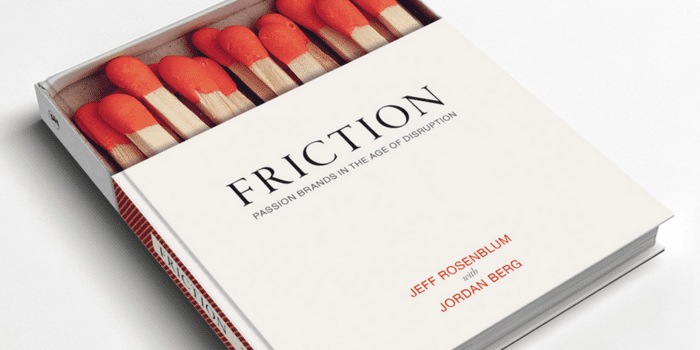
Friction: Passion Brands in the Age of Disruption
The name of the book is Friction. Friction is anything that gets in the way of people doing what they want to do in life. It’s anything that gets in the way of their hopes, their dreams, their aspirations and even their day-to-day goals. What it’s about is brand solving people’s problems. People don’t wake up in the morning wanting brands to interrupt them with clever advertising anymore. They want brands to do a lot more. They want brands to fight friction. They want brands to help improve their lives one small step at a time. What this means is creating content and experiences that empower people rather than just advertisements, which interrupt people.
Can you give us an example of one of your clients you’ve done that for?
We’ve done it with a lot of cool clients. Universal Orlando is a client where we follow the entire consumer journey. To be clear, a lot of what we do is we create ads and what we’d like to think are good ads. This really isn’t about the depth of advertising. That false eulogy has been written before. It’s about recognizing that we’re asking advertising to do too much. It’s just as important to have a great website, and more important than the website is the content that sits in the website, and to recognize that not everybody is the same. Very frequently a brand will have about six different personas and each persona has different needs. As they go through the sales funnel, they’re going to have different needs across those personas. Ultimately, you might be looking at a full content matrix as you go from aware to interested to converted to evangelist. It’s about having a video in the right place. It’s about having user-generated content in the right place. It’s about having an app in the right place. It’s about making sure that the app has the right features and that it’s technologically connected to the experience, geo-targeted in that example. With every client, it’s sometimes less about the activation and the big idea and it’s very frequently more about following the journey and putting the right information at the right place at the right time.
One of the things I don’t like to do is talk too much about my clients because it sounds like I’m tooting my horn. What I want to do is toot the horn of a brand I don’t actually work with, which is YETI Coolers. I just saw an article. The guys that invested in this company, they invested $57 million and it’s about to go IPO for $3.3 billion. It is not some fly-by-night crazy technology company. These guys make coolers. Literally, the same product that’s been around for over 100 years. Coolers would keep your beer cold, your soda cold, your bologna sandwiches cold. There’s nothing cool or exciting about this. They have turned YETI into a full-blown lifestyle brand. At the core of the friction that they fight is the product is fundamentally better than the competitions. It’s literally certified grizzly bear proof. Nobody needs a grizzly-proof cooler. When is that going to happen? It’s really nice to know that your product can go further than you could possibly go in your wildest adventure. What I really love about these guys is on their website, they’ve got commerce. You can buy these things like any other website, but they’ve got a full-blown storytelling platform. They’ve got a series of videos. Each of these videos are about eight minutes long. They have this protagonist like “The world’s most intense fly fisherman,” “The world’s greatest ski guide,” “The world’s greatest barbecue pit master,” and she happens to be this 89-year old woman; these crazy stories.
It’s funny that I misfocus. I could go and said, “These ads,” because they’re not ads. You literally never see the YETI brand except for maybe one second, the product will flash in the background. In one of these videos, you’ll see a competitor in this overnight kayaking race. This death-defying race that people are in. At one point, you see one of the competitors past out cold with a YETI hat on. The point is these videos are amazing. You watch these things and you’ll email me and be like, “These things are incredible.” They’re eight minutes long. I’ve watched dozens of them. I’ve shared them with my friends who have watched dozens of them. We post them to each other when we text. We put them on Facebook. We’re here talking about it in front of all your listeners. We can’t get enough of proselytizing for the YETI brand. The friction that they fight not only in the product is that people in that category who are going outdoors to go on their adventures, they want inspiration. They want to see content. It inspires them to push themselves further to do things that are more exciting. It’s not just the macro perspective of how much money they’re making, but it’s the fact that this brand has become a full-blown lifestyle brand. It’s no longer just coolers. Ad Age ran this article and it said, “If you can’t afford a YETI cooler, you’ll buy a YETI hat.” People always buy the t-shirts, the hats and they tell all their friends, “These coolers? They cost $700.” You can get a perfectly good one from Coleman for $150, the same size. That’s the power of fighting friction. That’s the power of telling a great story.
[Tweet “Are we asking too much of advertising?”]
The big takeaway for me from what you said, Jeff, is when you provide content that’s emotionally engaging without a lot of advertising in it and take people on a journey, a story, then they become your brand ambassadors and share it, and then that elevates your brand much like what I’ve seen Nike do and Harley-Davidson. That if you can afford the most expensive Nikes, you can buy a t-shirt and the same thing with the hat with the Harley’s. It’s really a great, great example and a story and a strategy on what we do. One of the things in your book that really stood out for me both from image standpoint and word standpoint is you talk about, “Brands need tools that don’t create scars.” We’ve talked about a great brand obviously not doing that. Let’s talk about brands that are creating scars and first start with, what’s an example of a brand creating a scar?
What we’ve referred to in that example is how to go in where we open the book and the founder of Patagonia, Yvon Chouinard, realizing that some of his products scarred the rocks that he loved to climb so much. That’s how he launched Patagonia. The point is that brands also need new tools the way that Patagonia did when they restarted their company and do scars or anything that hurt what people love the most in this world, which is their own brand reputation and their customers. Sometimes brands learn the hard way. United Airlines, that example is so profound because it doesn’t matter what United Airlines tells me. They could have the most charismatic person, a flight attendant on the phone, on the microphone at the flight, telling me to have a great flight. They can develop the most absolutely beautiful TV ad or print ad or banner ad or pre-roll. They could do the greatest thing ever done. There’s nothing they can say that’s going to get me to believe that they care about me, in any way, shape or form. I saw them standby while one of their passengers got dragged off the plane with blood coming out of his face. I saw it, you saw it, everybody saw it. The amazing thing is when you watch those videos, it’s not just what was going on. Here’s what I thought was really interesting is, how many cellphones are actually in the foreground of those videos? Type into Google, “United Airlines, passenger getting dragged out,” and it’s not just the fact that one person was filming. Everybody was filming, everybody has a super computer in their pocket. Everybody has an incredible video camera in their pocket. If you do terrible things like United Airlines, you’re going to scar your brand reputation and you’re going to scar your customers. It’s really hard to heal a scar.
That leads right into another thing that’s in Friction, which is talking about transactional versus emotional relationships. If you treat people like a commodity, like a transaction, there’s no culture that would stop that behavior because it’s just a transaction, “These are the rules.” If you come from a place that’s an emotional, “We care about our customers,” whether for me, Starbucks always pops up in my head. I am a big fan of Howard Schultz. I read his book, giving his employees or even part time health benefits when he didn’t have to. All that culture shows the employees that you care about them as people and then they in turn can care about their clients and customers, and then take that effort to remember your drink order. To me, that’s the difference. I’d love to have you explain what you see what brands can do or anyone who’s starting their own company, whether a big brand, existing or new to make people feel emotionally connected versus transactionally connected.
We can continue on that example, United Airlines makes a ton of money. In a lot of ways, I don’t know the numbers, but people might argue what’s the best airline company. At the end of the day though, it’s still a transactional company. I would never tell my friends that United Airlines is great. I will never spend $29 on a hat. I would never sit there and tell you that United Airlines is great, but they still get a ton of money from my travel expenses. There’s no shame in being a transactional brand. Transactional brands make sense. They have a good product. They’ve got good marketing and they charge a fair price. There’s no shame in that. It’s just not what my book is about. My book is about breaking through to what we call a passion brand. These are the brands that have an emotional connection. There’s nothing rational about buying a YETI cooler for $700 when you can get one from Coleman for $150. There’s nothing rational about buying a YETI hat and promoting that brand like a walking billboard. There’s nothing rational about telling all your friends on social media to watch these videos. What happens is when brands create that emotional connection, they elicit irrational behavior. It’s irrational in the most positive of ways. Ultimately, the best way to get irrational behavior out of your customers is to act irrationally yourself. That’s a crazy concept. Brands have to act irrational.
[Tweet “Advertising should be emotional, not transactional.”]
Irrational video for YETI is, “We’re Yeti and this is what makes our coolers so great. It’s grizzly-bear proof. It keeps your stuff cold.” You talk about features, you talk about the benefits, all that stuff. An irrational behavior is, “I’m going to create an eight-minute video. I’m going to invest in this video. I’m never going to put my logo in there. I’m never going to tell you anything about it and I’m never going to ask you to buy this product. I’m just going to do something to inspire you and entertain you.” That’s totally irrational. Going back to the Patagonia example, if you look at the homepage of their website, which probably has about six horizontal panels, the vast majority of them don’t talk about Patagonia products. They talk about all of their initiatives defending the environment. They literally had a panel on their homepage of their website that said, “Don’t buy this jacket,” with a picture of a jacket they sell. They were engaging people in a conversation about the damage that has done to the environment when you throw out your old jacket and when you buy a new jacket. They created a documentary called Worn Wear, which celebrates and extols the virtues of people who literally hold on to their Patagonia products for 50 years. That’s totally rational. They’re creating content, talking people out of buying their products. What did they get out of that? Unwavering loyalty and an absolute army of evangelists.
That’s the whole core. If you can get people to trust you as a person, as a brand, they stay loyal. The same thing is true in your company. If you can create a place where employees feel that you trust them and they trust you, that you’ve got each other’s back and you’re never going to do anything to hurt them, they will stay loyal because you’re not just in it for the money.

Passion Brands: Winners act like winners before they’re winners.
Before we wrote the book, we created this documentary called The Naked Brand. We sat down with Kevin Plank, the CEO of Under Armour, who in my opinion is literally one of the most impressive and successful executives on the planet. He started the company from his grandmother’s basement and he grew it into something that competes with Nike. He’s as nice a person as you’ll ever meet. He’s cool, he’s nice, he’s competitive, and he’s everything you could ever ask for. We’re filming and he says, “At the heart of every great brand is trust.” I remember watching this and I’m like, “You’ve got something more for me? That sounds a little thin and pedantic. I could use a little bit more depth.” Then what I realized over the coming days, weeks, months and years that I’ve thought about it, that’s what makes him so smart. He doesn’t cloud everything with a bunch of silly thoughts. He gets right to the heart of the matter, trust. At the heart of every great brand is trust. When you create content that inspires, educates, removes friction, it shows empathy and it creates trust.
As a Pitch Whisperer, I’m all about helping people be clear and concise and compelling. It’s not about trying to impress people with your vocabulary and how smart you are or telling them everything you do. It’s like, “Here’s the takeaway,” and that’s what helps you create good advertising. Back to what you were saying about this irrational behavior causes people to really engage with your brand, I think the Dollar Shave Club is another example of breaking through the clutter with that crazy comedies and going up against the big guys at Gillette that have been doing it for years. That really seems to me to be your sweet spot both in the book and what you do for your clients.
That’s hilarious that you bring up that example because my father sent me an email. Obviously, he’s a fan of the movie, fan of the book. He’s my dad, he’s very supportive and he loves to talk about these things. He’s talking about friction. He’s like, “I signed up for Dollar Shave Club. I felt this was a friction fighting brand, but I could not sign up. I couldn’t work my way through the sign up process.” It’s interesting because what we talk about is macro friction and micro friction. Macro friction is what we’ve been talking about. It’s these things that go on the entirety of a category. It’s YETI creating these great stories about the outdoors. It’s Patagonia defending the environment. The flipside of it is micro friction. These are the things that happen at that relationship level with prospects and with customers. It’s really as simple as help people make purchases easily, which seems really easy. How hard is it to take somebody’s credit card number? Every bit of technology that makes buying products easier, makes selling products harder. When we figured out desktops, mobile came along. When we figured out mobile, social came along. Then wearables came along and virtual realities coming along. Everybody I think should go buy an Alexa for $40 because it’s incredible for shadowing the fact that pretty soon, we’re not going to need screens at all. We’re just going to have little speaker phones following us wherever we go. This is a super computer that sits in your house and talks to you for $40. That makes it easier to purchase. “Alexa, go buy this new XYZ for me. Go buy Friction, the book.” It makes it harder and harder for brands to sell in particular if their products are not available on Amazon.
Amazon is the master at that user experience of one-click buy. In Friction, your book, you have chronological steps for removing friction and one of them is number seven, this user optimization. That’s exactly what we were talking about with Dollar Shave Club, right?
Yeah. It’s optimize, optimize, optimize. Consumers have no empathy for your brand anymore. They just have heightened expectations. One of the things we talked about is it doesn’t matter what category you’re in, Uber is your competition. In a world where you can just in three clicks, get a car, it shows up, it takes you wherever you want to go. One click, plays the music you want. You never have to breakout your wallet to pay for a five-star rating system. It keeps everybody civilized. There’s virtually no friction in the Uber product. There’s friction in the Uber brand, but let’s talk about the product. There’s no friction in it. It doesn’t matter if you’re going to buy a shaving equipment or any other product, people are used doing Uber world. They’re just not sympathetic or empathetic when it comes to friction in the relationship that people have with brands.
Amazon is taking it to the next level. You and I don’t have to wait a day. We’re going to have a drone deliver your package. Talk about instant gratification. The friction of going to a shopping mall and parking, no wonder malls are dying.
What I saw on the news is that they were talking about manufacturing is going to come back and it was going to fix retail. All I could think when watching this is like, “You’re out of touch. We all want manufacturing to come back in America. That would be awesome, but retail? Retail is screwed.” Unless you’ve got a very unique product, people are going to go to Amazon. I think they have bigger problem to that, and maybe we’re a little off topic with this. I think a lot of impulses that people have right now, a lot of that brain candy is just happening in their digital environment: the selfies, the Instagram, the Facebook, the Snapchat. People are entrenched in that behavior that I don’t think they wake up in the morning thinking, “I really need to touch that part of my brain by going shopping.” When was the last time you heard someone say, “What are you doing today?” “I’m going shopping.” You don’t hear that anymore. We used to hear that all the time. The economy is pretty strong right now for a lot of people. I don’t think it’s the economy that’s holding back retail. It’s the fact that our brains are physiologically changing.
Teenage girls just love to go and hang out at the mall. That became a social thing, not that they were necessarily buying a lot of things. Now, the retail therapy that so many women love to use is they get the same fix from online clicking and stuff shows up. They buy it in three different sizes and all that good stuff. You have this great quote in here about, “Winners act like winners before they are winners.” Can you talk about that?
The Score Takes Care of Itself: My Philosophy of Leadership
That’s not my quote. That’s Bill Walsh’s quote. The name of the book that Bill Walsh wrote is actually an autobiography. It was written after he passed away through some ghostwriter. It’s an autobiography. The name of the book is The Score Takes Care of Itself. “Winners act like winners before they’re winners.” The point is this, Bill Walsh walks in to the San Francisco 49ers headquarters in approximately 1979. He didn’t look like a football coach. He’s got the neatly combed hair. He’s got a sweater, he’s got khakis. He looked like a professor. The only thing that was missing was a Bent Billiard pipe. He didn’t yell. He didn’t scream. He didn’t give rah-rah speeches. He totally, completely and fundamentally revolutionized the way that football was played. He had this one simple idea, “Put the ball where the other team isn’t.” The Super Bowl trophy is called the Lombardi Trophy named after Vince Lombardi because he really created the strategic underpinnings of football before Bill Walsh. It was based upon strength and willpower. Big strong men blocking other big strong men, big strong linemen and running backs. Bill’s idea was make it look like that. At the last second before handing off to the big strong running back behind the big, strong alignment, pull it back out and throw it to an area of the field called the flats, which was about six yards from the line of scrimmage but really wide. Nobody was playing with a 53 yards of width, the whole football field.
This is what brands need to also do. Put the ball where the other team isn’t. You’re not going to win on strength and willpower by investing in huge advertising budgets, by trying to find a more creative agency than anybody possible. It’s undifferentiated. You have to find a place to put the ball where the other team isn’t. “The winners act like winners” quote, as if for me at least, that story was just perfect. He wrote this business book and I basically poached it and retold the story. The other thing that he really did is he focused in on culture and he was, “All winners have to act like winners before they’re winners.” He was focused on, “Receptionist, when you answer the phone, you’re going to answer it this way, with class, sophistication and intelligence.” He was going to take care of all these little things. He never had these goals like, “We’re going to win theSuper Bowl. We’re going to make the playoffs.” He literally had players that almost were revolting. When he told the owner on him, “This dude is not focused.” Meanwhile, he won five Super Bowls and almost every Super Bowl that has been won since has all been based upon Bill Walsh’s principles. The key is, “Put the ball where the other team isn’t,” and that includes culture and behavior before your bottom line goal.
We’re going to close with one of your quotes which is, “Great brands are built, not bought.” What does that mean from your lips? To me, that’s just as strong a quote and I want to hear what people should take away from that quote.
I’m glad you like it and I appreciate the compliment. It’s about creating experiences for people. It’s not about buying paid media interruptions. Paid media in advertising still works well, just asking it to do too much. Build you brand, don’t buy your brand. Build great content, build great experiences. Then you can spend money on paid advertising. “Great brands are built, not bought.”
[Tweet “At the heart of every great brand is trust”]
Jeff, I can’t thank you enough. The book is Friction: Passion Brands in the Age of Disruption. It’s a fantastic book. I highly recommend everyone get it. It’s one of my new favorite books. It’s a coffee table book. It’s just so clever, even the cover looks like matches that you can literally strike it on the side. People could follow you on social media, @JRQuestus. Thanks again, Jeff. This has been a big treat on how to eliminate friction and how to go from transactional to emotional connections to get brand ambassadors.
I love the podcast. Thank you so much for having me on.
Links Mentioned
- Jeff Rosenblum
- Questus
- Friction: Passion Brands in the Age of Disruption
- Ad Age
- Dollar Shave Club
- The Score Takes Care of Itself
- @JRQuestus
- Questus
Wanna Host Your Own Podcast?
Click here to see how my friends at Brandcasting You can help
The Successful Pitch – Book Trailer
Share The Show
Did you enjoy the show? I’d love it if you subscribed today and left us a 5-star review!
-
- Click this link
- Click on the ‘Subscribe’ button below the artwork
- Go to the ‘Ratings and Reviews’ section
- Click on ‘Write a Review’
Brandscaping – Unleashing The Power Of Partnerships with Andrew Davis
Posted by John Livesay in podcast | 0 comments
 Episode Summary
Clients will always say yes to pitchers who tell a great story, and a great story invites listeners to keep wondering what happens next. If your audience can predict the end of your story before you even get there, then their interest level goes down. Stories that chase answers pique the interest of clients, and to do this your pitch needs to be molded into a story where the ideas are simplified and the focus is not on you, your product or service, but on what you can do to help solve the problem of your potential investors. Author of Brandscaping Andrew Davis learned the secrets to telling a compelling story that was fueled by his dream of working in The Muppets Show. Learn more about the rules of Brandscaping and how partnering with like-minded people can get you your audience.
—
Our guest is Andrew Davis, who has some great takeaways on how to make your pitch and your story so compelling. He said, “Start with assuming that the audience already knows what you want them to know. Don’t teach people when you pitch.” He has a whole strategy on how to turn browsers into buyers. You’ll want to be sure and see how he does that. He tells us all about working with Charles Kuralt and how telling stories is really all about chasing answers. If you want to be a good storyteller, and I highly suggest you learn how to do it, raise the stakes and get the audience to say, “What’s going to happen next?” Because the more you can do that, the more compelling and concise your pitch will be. Enjoy the episode.
Listen To The Episode Here
Brandscaping – Unleashing The Power Of Partnerships with Andrew Davis
I have a guest named Andrew Davis who’s an author of two books and he is a keynote speaker. He tells me marketing has never been more complicated, and I couldn’t agree more. People are bombarded with over 500 branded messages every day. He helps people cut through the clutter and get people to take action, which is what we love to do here at The Successful Pitch. He really is an expert on how to rethink marketing for the digital age. He’s written for Charles Kuralt and produced for NBC. He worked for The Muppets and MTV. He co-founded, built and sold a successful marketing agency. If that’s not enough, he’s produced documentary films and campaigns for big brands as well as tiny startups. He has this great title of one of the most influential marketers in the world. He’s appeared in The Today Show and in The New York Times. I think this is going to be a lot of fun. Andrew, welcome to the show.
Thanks for having me. This is fun. This is a new show for me to talk about pitching. I enjoy it.
Your whole focus is getting business leaders how to grow their business and even impact their cities and leave a legacy. It’s a three-tiered step there, which I love. Let’s go back to your own little story of origin. You can choose how far back you want to go. You can take us to when you were ten. You can take us back to high school, college, whatever you want to do where you started to go, “I think I want to be an author or speaker or I want to work for MTV,” or saw The Muppets and said, “One day, I’m going to work there.”
If I go that far back, I wanted to be an actor. When I was a kid, my mom got me into some acting classes and I started out doing television commercials for Cadbury’s chocolate and Chevrolet and all sorts of other brands. In fact, I auditioned for ET, the movie. That’s how long ago we’re talking. I realized in high school that I wasn’t actually a really good actor but I really enjoyed the entertainment business and I wanted to be involved in television and film somehow. I went to college at Boston University. I studied television and film there. Right when I came out of college, I got my first job at a television station, producing two live shows. One was a call-in show. I was living in Boston at the time so it was a right wing Republican host in this Liberal state who would scream at the TV for an hour and try to get people to light up the phone lines. My job was basically to pick the least drunk person to put them on the air.
That sounds like a stand-up comedian.
It was awful. That was my foray into television. After that, I started working for The Today Show. I was a producer on Weekend Today and then The Today Show, The Daily Show version of it. I wrote for Charles Kuralt on his last television show. If you’re not old enough to know who Charles Kuralt is, you should look him up on YouTube. He’s an amazing storyteller. If you want to learn how to tell stories like a pro, just by watching him, you’ll learn a lot.
Let’s stop there then we can go back into your story of origin. Let’s double-click on Charles Kuralt and storytelling because that is what the whole concept of The Successful Pitch is. I’m always telling everybody whoever has the best story gets the sale. Whether you’re selling yourself to get hired, selling yourself to get your startup funded or selling to get new clients, run a pitch. What would you say are some of the secrets to Charles Kuralt being such a good storyteller? Tell us a story of working with him.

Brandscaping: Emotions are what lead to action while reason leads to conclusions.
I think the key for Charles Kuralt was always that it had to be a human story. I think that works everywhere. It doesn’t matter what you’re pitching or to whom you’re pitching. Understanding the human element, how the emotions actually play is what’s really important because emotions are what lead to action while reason leads to conclusions. What you’re really trying to do is inspire people to act. Charles Kuralt was an unbelievably powerful human interest storyteller. He wanted to ensure that you were telling a person’s story that was relatable on a broader scale. He wanted you to find the themes within the story no matter what story you were telling. He was relentless with this. Even when you were pitching Charles Kuralt a story, if you were in the pitch meeting, you essentially were tasked within just a few sentences, telling me something amazing about a person that inspired me to ask a few questions immediately. If you could do that and get Charles Kuralt interested in hearing more of the story, he would approve the story and say, “Go tell the story.”
The other key I think for him was telling stories was all about chasing answers. That’s what he used to believe. If you’re telling a story where the end is predictable or I know what you’re driving to and I’m getting there faster than you’re getting me there, that’s a pretty boring story. Charles Kuralt always ensured that if your story was two minutes long or twenty minutes long, it didn’t matter how long it was, as long as the viewer was constantly chasing an answer in the story like, “What happened to the person? Does he ever finish fixing the car?” They could be very basic questions but as long as you were chasing the answer, you could have people riveted and emotionally invested in the story.
[Tweet “Telling stories is all about chasing answers”]
Listeners, your takeaway here is when you’re telling a story, clip an open loop in the story. In other words, don’t give all the answers away in the first 90 seconds. Intrigue people to want to know more.
I think most people’s mistakes, especially telling a story or definitely in a pitch is believing that, “I’ve got to give all the information in containers that are clean and simple.” Stories don’t work that way. In fact, I think the best stories invite the viewer or the consumer or the listener to constantly wonder what’s next. Just like you did in this story, if you’re wondering about my origin story still, maybe you don’t even care about telling stories, you want to know what happened after that Charles Kuralt job I had. That’s leaving people hanging and wondering what’s next.
How did you get from Charles Kuralt to The Muppets and MTV?
This is really a quick story of persistence. My dream job after I left college was actually to work at The Muppets. That’s what I really wanted to do. Even as a child, I had a magic and marionette show. It was called M&M Puppet Theater. I used to tour around doing birthday parties for $50. I was a terrible magician and not a very good puppeteer, but it was the genesis of this idea.
From $50 a pop as a semi-good magician to now where you are as this high-paid, famous, in-demand keynote speaker. That’s quite the hero’s journey there.
The Muppets was a job I really wanted. I actually started writing one handwritten letter every single month to someone at The Jim Henson Company and I would have it FedExed. I realized it was the only way at the time to get through the assistants because the assistants open so much mail. They would find these letters from me and just throw them away or throw them on a stack of stuff that the executives wouldn’t read. If I FedExed it, they would read it. I wrote 36 letters, just over a three years’ worth of letters before I finally got a phone call from a guy named Peter van Roden who was the executive in charge of production for The Jim Henson Company. He essentially said, “Andrew, thanks so much for all these letters over the last few years. We don’t have an opening for you. I don’t want you to waste money on FedEx anymore. You’re in our system and we’ll call you.” I said, “Peter, I totally appreciate that. If you would just give me a half hour to meet with you, you will no longer get any more FedEx letters, I guarantee it from me.” He agreed surprisingly enough. He said, “Come down tomorrow. I’ll give you a half hour.” I sat down with him for a half hour which turned into about an hour. By the end of the hour, he offered me a job as the production manager for the workshop, which is where they made the puppets. That’s how I got my job there.
First of all, the big takeaway for me is you’re investing in your belief in yourself to stand out from the crowd. That’s always a big a-ha moment. I’m sure if you’re making $50 a pop, FedEx even back then was expensive. Clearly you believed in yourself enough to invest in yourself to stand out from the clutter. That’s the first takeaway of that story. The second takeaway for me is you got the first no but you didn’t let them off the hook. You still said, “If you want these packages to stop, you still have to see me.” A lot of people would have just said, “You don’t have an opening? Okay, thanks, bye.” There’s the difference. Persistence but in a creative way. Secondly, giving them one out.
I’ll even add one more because I think what was weird about that, and I didn’t realize it at the time, but when I was writing these letters, they weren’t just like, “Hire me.” What I was trying to do was research the industry as much as possible and even show them how thoughtful I was being about how they could maybe fix their business because this was actually in the 1990s. The Jim Henson Company was falling apart. Jim Henson had died in the early 1990s and they were really struggling to reinvent themselves. I had a format for each letter. It would start with a, “Congratulations,” or ”I heard,” and “What a big win.” Then it would say, “Have you thought about this?” Or, “I also saw this and maybe this would help build the business.” What I learned from actually writing the letters, even though I wasn’t getting a response, they became more and more a vehicle for me to learn about the industry. By the time he called, I didn’t really think I was going out on a limb and not taking no for an answer. I actually believed I could really help the company at that point.
I actually did this one more time. I wrote letters to Warren Buffett. In 2012, I sold a digital marketing agency that I had founded, called Tippingpoint Labs. I had founded it actually with a journalist friend of mine who I met at that first television station we talked about. When I sold the company, I was wondering what to do next, then I thought I would buy a newspaper. I don’t know if you’re aware, but Warren Buffett, one of the richest men in the world, owns 60 newspapers and I thought, “I’ll write letters every week.” I wrote him a handwritten note about how he could save the newspaper industry. It took me less than the three years. It ended up taking about a year and a half but I ended up having a meeting with him in New York as a result of the letters I had written. Again, it was the same outcome. I think I learned a ton about the business as a result of writing the letters to him. I also published them on Tumblr which actually generated a huge amount of interest from some of the world’s largest publishers.
Haven’t you turned some of that strategy that you learned owning this digital agency into part of your keynotes now?
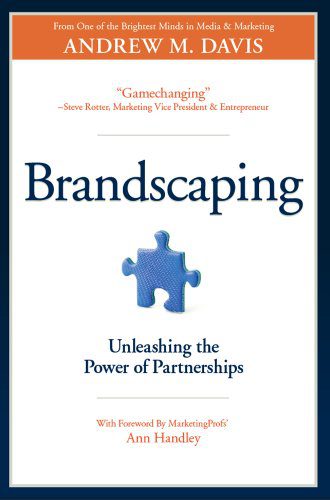
Brandscaping: Unleashing the Power of Partnerships
Yeah. The first book I wrote was called Brandscaping. After I worked at The Muppets, I worked at a couple of startups because everybody was leaving the television world in the late 1990s to work at the first dot-com boom. I got really into that as well, so I started working into marketing. I felt like I was working for really not smart marketers. My friend, Jim Cosco, and I founded Tippingpoint Labs in 2000 and we sold it in 2012. In 2012, I essentially said, “Let’s take all the knowledge that we learned at running an agency and turn it into a book.” I published the book when I left the agency in 2012. It’s a summation of what we learned, which is essentially partnering with other people to access your audience is a much better way to invest your money today than buying traditional media. That’s the short summary. A lot of that agency thinking has really propelled my speaking career but also helped me rethink marketing in general.
One of the things that we haven’t even touched on that is quite fascinating especially with what’s going on in the political landscape right now is you were a presidential advisor on the Russia relations from 2010 to 2012. Any insights on what that was like? There’s got to be a story there.
I can sum up that experience as a real clue into how the political system works but also how multinational negotiations work. I’ve been successful in the business world. I’ve been invited by the State Department and President Obama to be on a council. I do know a lot about the media. I had a lot of experience in the newspaper business as well and publishing. I was invited as well as six other people to be on this media relations and Russian relations team. I left really disillusioned not at any administration or people specifically, but on how slow and antiquated relationships work in the political sphere. It’s just not like I’m used to doing business, getting things done, and really having meaningful and substantive conversations with people. There was a lot of, “You just don’t do that. We don’t talk about the tougher issues early. We’ve got to build rapport and slowly bring in issues that they want to talk about.” Over two years, we did not get much done and that really disappointed me but it was a really interesting experience. There were people from the film industry. There were people from digital media. There were people from traditional newspapers, all six amazing people on the panel on the US side and on the Russian side. I learned a ton about the business in general.
Let’s jump ahead a little bit to what you’re talking about for 2018, which is your keynote about Raise the Stakes. Who’s that for and what are some of these simple secrets?
Chasing answers is one of the ways that storytellers help raise the stakes in telling a story. Raise the Stakes, the keynote that I’ve been giving since September is actually a fairly new one for me. It’s all about how people craft stories that actually get people to the end of the story, which in a digital age is very, very difficult. Especially if you’re thinking about watching on YouTube or even you’re listening to this podcast, there are lots of other opportunities for you to drop off and leave the consumption of the content. I spent about two years working through all the kinds of elements that I have even learned in television and in marketing that really do help tell a story that keeps people captivated and gets them all the way to the end, which is where you’re making your ask, where that call to action really is. Whether you’re pitching someone an idea or a business or just trying to make a sale or if you’re actually just trying to get across your core values for your company, all of these things are important. If they don’t make it to the end, you didn’t accomplish your goal of getting them to consume the entire length of the content. I didn’t tell you any of the secrets. I was getting you to chase the answer.
Tell us the story of a brand that uses the secret.
Let’s just use videos in general because they’re very easy for us to understand. How-to videos are really good example of videos that people get all the way through and that they cannot skip around. There’s a series of steps in a how-to video and you know you’ve got to get from point A to point B, so you’ve got to watch the whole thing if you want to get from point A to point B. Videos that are how-to videos keep people asking a question. The simple question there is, “What’s next?” If you’re giving a presentation or pitching something, if you keep them on the edge of their seats always asking, “What’s next?” that’s the most basic presentation or pitch or story you can tell. If you take it up a notch, raising the stakes is basically showing something that people really want, which could be your audience, it could be your customers, it could be the people that are sitting in the boardroom that you’re trying to pitch something to. Then threaten it as much as you can for as long as possible. That gets the tension really high and that’s when they’re interested in hearing how to solve this problem. The key to this is not solving the problem before you make the ask. At the height of their tension you’ve got to say, “Before I tell you how I solved all these problems or how these problems are going to be solved, I need $3 million from you. That is why I’m here.” Then you tell them how you’re going to solve the problem and then they’re interested in really answering that question because they were paying the most attention right before the release, the catharsis of that answer.
[Tweet “Raise the stakes by telling great stories”]
I’m always telling everybody that people buy emotionally and then back it up with logic. You’re talking about getting them at this emotional state where their brain is so alive and paying full attention that then you slip in what your ask is as opposed to them not associating that ask with any kind of emotional state.
You want them essentially at the height of their enthusiasm, anticipation, and interest for whatever is coming next. When it’s your ask, that’s the best time to get them to fully comprehend what you’re asking for and still want to know the answers to the question.
You also have this great thing called Momentum and how you turn people from browsers into buyers. Let me tell you, I talk about how to take people from invisible to irresistible, so nobody appreciates an alliteration as well as much as I do. The full alliteration is How Brilliant Businesses Turn Browsers into Buyers. That’s a brilliant piece of copy. Let’s double click on that and just open that up a little bit because everyone has that problem. Going from just browsing to your site and not clicking to buy, browsing from, “I’m looking at a bunch of resumes,” browsing from, “We’re looking at a lot of other speakers,” whatever it is.
I think the biggest issue actually is the approach in general. I think most of us, when we’re thinking about trying something new from a marketing or a sales perspective, we want to try the new stuff on a new prospect or customer immediately. I think that used to be the case. The smartest marketers and businesses today actually do the inverse. They experiment with their latest ideas, innovations, products, pitches, even marketing messages with their most loyal customers. I call them their loyalty loop. Instead of trying out your next big pitch on five investors in a big boardroom that you’ve never met before, the best thing to do is actually call someone you pitched two years ago that has heard you before and was maybe mildly interested and try the new pitch again. That way, you’re much more likely to get actual really good feedback.

Brandscaping: If you really want to build momentum, the first thing you should do is email it to your loyalty loop.
This applies even for email. A lot of people spend a lot of time writing great content to put on their blog and the first thing they do is tweet it out. I think if you really want to build momentum, the first thing you should do is email it to your loyalty loop. You should think about it in two phases. One is just a few people that are very close to you that you really do respect the opinion of and this content would be relevant to them. You want very specific feedback. Instead of going right then to tweeting it out, wait for that feedback. Wait for them to consume the content and return to you with some feedback. Then take it to your wider loyalty loop. That might be everybody in your company or it might be everybody that subscribed to your email newsletter. What you’re waiting for is actually the half-life of the consumption of your content, which means you’re actually waiting for the most people possible to consume it, then as it start to wane in interest, then you want to take it to the next level.
I broke out down-building Momentum into four phases. Start with your loyalty loop. Then it’s essentially move on to your social networks one by one. Instead of tweeting it out first on Twitter and then two seconds later putting it on Facebook and three seconds later doing a YouTube video on a SlideShare. You’re vomiting it on everybody. Stop vomiting your content on everybody. We don’t want your puked content. The more strategic about when you distribute your content instead of where you distribute it, the better off you’re going to be in building momentum for it.
The third phase is actually buy ads. I know this is counterintuitive in an age where everybody says just social media will do the trick. If your content has been successful in those first two phases, investing in a new audience, attracting new people to your content is really important to your stuff, to your pitch, to whatever it is you’re working on. The final thing is PR. Most people do the inverse. They start with a big product launch or a big announcement or hoping to get in The New York Times with their new big idea at the very beginning. Today, you’ve got to think of it in reverse. It ends up looking like building a mountain instead of building a series of spikes.
You’ve been on television multiple times. I’ve had the privilege of being on television and I know that when you’re pitching to get on television, the better your segment idea is structured in four minutes or less, that they can have a sound bite that grabs people and it’s backed up by the fact that you’ve already got some traction is what you’re saying with this.
You need to show them some social proof that it’s actually already got momentum. They need to think that they’re going to propel it to the next level.
You and I have talked briefly that you have some tips that you’ve learned from pitching from television that people can apply to their business. Let’s begin with that.
In the late 1990s, I was also pitching a lot of reality TV shows. When I first started our agency, Tippingpoint Labs with Jim Cosco, he and I were going out to LA from Boston almost every month, pitching shows to everyone from the networks to agents. We spent a ton of time out there. First of all, learning how to pitch TV shows but then second of all, failing a ton. We must have pitched 500 or 600 shows. We got a few option shows and we got one produced, which was actually a really bad show. It was called Knock First and it was on ABC Family for a season. It was a good idea executed poorly, I think. The art of pitching especially in television, what I learned very quickly was just simplifying the idea very, very quickly to the core of what you’re actually doing. I think too many people pitch very complicated ideas in very complicated ways. It doesn’t mean that your idea is simple. It means the art of the pitch is simplifying it so that it can be understood quickly, consumed quickly, and they can make a decision very quickly if they want to hear more. That’s really important. When I said we’re chasing answers, you want to simplify it so fast so that they can make a decision. When you pitch a TV show and I don’t know if you’ve ever done this, John. Have you?
[Tweet “How to turn browsers into buyers”]
I have pitched a couple of reality show ideas in front of the people that know what they’re doing. You have to go like, “It’s ‘Liar Liar meets Oh, God!’ or it’s ‘Big Brother meets the Survivor.’” They need points of references really fast.
It’s called an analogy line. When you go into a pitch, you pitch the idea and you would pitch it just like you just did. Or you might say, “Fear Factor is ordinary people facing their fears by competing against each other in outrageously devised stunts.” They make a split second decision. They say, “No, I don’t like it,” or they say, “Tell me a little more.” That’s exactly what you’re trying to do, get people to chase those answers. You’re trying to simplify the ideas you present. The other thing was I realized there was a giant difference between crafting a pitch and just creating a presentation. I think people in the last ten years or twenty years have essentially believed the two are the same. Creating a presentation is just putting a deck together and then going in and reading the deck or telling a bunch of stories that are on your presentation slides or just presenting ideas. Crafting a pitch is all about building that story in the right way where you’re really simplifying the idea and you’re focusing not on who you are or what you do because they don’t care at that point. You’re actually pitching the idea first and waiting for them to ask a question.
You said something that I really want to underline for everyone listening which is, just because you simplify your pitch doesn’t mean you’re simplifying your product, your concept, your idea, whatever the value is of what you’re doing. Most people go, “I don’t want to dumb down what I’m doing.” I’m like, “You need to make it so simple and intriguing that people want to know more and not tell everything at once.” In fact, one of my favorite quotes from an investor was, “Don’t boil the ocean.” That’s what you’re saying here is simplify the pitch so you’re not trying to explain everything.
There’s a real art to that. It’s actually really, really hard. The most successful pitching people in the world are really good at simplifying big ideas. At Tippingpoint, we actually had five really simple pitching rules. The first one was, “Assume your audience knows everything you wish they knew.” That was rule number one. I think we spend too much time just in general teaching people and thinking they don’t know what we need them to know. In fact, if you just make the assumption they know everything you wish they knew, they either will ask or they won’t ask. They’ll look it up and all of that stuff keeps them interested in whatever it is you’re doing. When you over-teach, you’ll lose the audience. That was number one.
Two, “The audience doesn’t care what we know.” That’s a really important one. A lot of people pitch and they try to sound smart and look smart, and most people don’t care what you know really. If they do, they’ll ask. The goal is to keep them asking questions when we’re pitching. Number three I think was, “Pitch with unbridled enthusiasm.” Number four I think was, “Make no excuses,” which is a very controversial one because we even get really upset if somebody was late for a meeting. If you show up late for a meeting, which does happen, but the first thing you do is walk in and say, “I’m so sorry I’m late. The traffic was really bad.” You’re already off to a really bad start. Making no excuses for a pitch is really important. It doesn’t mean you don’t apologize, but we prefer that you apologize at the end instead of starting off that way. Number five is my favorite, “Pitch and stop.”
That includes an elevator pitch. If someone says to you, “What do you do?” that’s not an invitation for a ten-minute monologue.
Pitch and stop was the key. Actually full disclosure, I am the worst rule infraction person for that rule. In fact, Jim Cosco, my business partner, was the opposite and he would kick me under the table. It was clear I just needed to shut up and let it go. I really do think there’s an art to pitching. The last one is, “Go big or go home.” I think there are too many people pitching great ideas but not pitching them as if this is their big pitch. This is something I learned in acting in the very early days.

Brandscaping: There are too many people pitching great ideas but not pitching them as if this is their big pitch.
Every audition is like the Super Bowl, right?
That’s right. A casting director told me once that I needed to ham it up, which is surprising for someone like me. If you’ve ever seen me speak, you’d be surprised. What her point was, she even said to me after I did the next take she said, “I need you to go even further.” She had to say this four or five times and I could still keep going further. I kept pushing it. She said, “I want you to go as outlandishly big and crazy as possible on this take.” I did and she was like, “That’s what I wanted.” When I asked why, she said, “Unless I know what you’re capable of, I don’t know how to pull you back. That’s a lot easier than pushing you forward.” I think that goes the same for a pitch. You’ve got to really bring all the enthusiasm and fun that you have. Bring it to the pitch, really deliver it in a way that really does excite the people that you’re presenting to in the manner you’re presenting. Forget about the idea. I’m talking about the way you actually pitch.
At the end of the day, people are going to hire people that they like being with. I was working with a big architectural firm, pitching to do a big airline renovation for five or six years. They were told, “We’re going to hire the people we like and not who has the best design because we’re going to work with you for five or six years.”
“It’s going to be a six-year endeavor. I don’t want to hire people I hate.”
That pitch, you better come across to someone that they want to work with, that’s fun, and all that stuff. People so often leave out that characteristic and they think, “I just have to show my stuff.” I loved everything, and especially with assuming that the audience already knows what you wish they knew so you’re not teaching them. That’s really great stuff.
I made all the mistakes that led to these rules.
That’s what audience relate to. When you’ve been in their shoes, that’s everything. You have a book called Brandscaping and another wonderful book called Town INC. Let us know the best way to follow you on social media because we know you’re not going to vomit on us. Give us your Twitter handle or your website, all that good stuff.
My Twitter handle is @DrewDavisHere. You can find me there. My website is AkaDrewDavis.com. It’s mostly speaking because that’s all I really do these days, which is lots and lots of fun. I’d love to hear from you. If you’re listening to the show and have pitching questions, pitching is something I’m passionate about but don’t talk about very often so this has been really fun, John. My email address is [email protected].
Andrew, thanks so much for being on the show. You’ve jazzed us up like you do your keynote audiences. I’m sure anyone who’s ever lucky to hear you speak out there, event planners that might be listening to this that you walk your talk. That’s for sure.
Thanks a lot, John. This has been awesome.
Links Mentioned
- Andrew Davis
- The Jim Henson Company
- Tippingpoint Labs
- Brandscaping
- Raise the Stakes
- Momentum
- Town INC.
- Andrew’s Twitter
- [email protected]
- Charles Kuralt
Wanna Host Your Own Podcast?
Click here to see how my friends at Brandcasting You can help
The Successful Pitch – Book Trailer
Share The Show
Did you enjoy the show? I’d love it if you subscribed today and left us a 5-star review!
-
- Click this link
- Click on the ‘Subscribe’ button below the artwork
- Go to the ‘Ratings and Reviews’ section
- Click on ‘Write a Review’
100 Things To Do Before You Die with Sebastian Terry
Posted by John Livesay in podcast | 0 comments
Episode Summary
Being tenacious, creative and authentic is what pulls clients in and say yes to your pitch. Sebastian Terry has been all three since he was 24 when he started listing 100 things he wanted to do to find himself. From invading a red carpet event to helping a complete stranger deliver her baby, Sebastian’s passion is inspiring other’s passion as well. Because he had a healthy internal conversation with himself, Sebastian saw what he stood for.
—
Our guest on The Successful Pitch is Sebastian Terry, the author of 100 Things: What’s On Your List? He has an incredible story of a life changing event that happened to him and realized he wasn’t happy and decided to do something about it. Created a list of things he wanted to do in order to be happy, and then figured out how to do them. Everything from getting on a red carpet to being there when the baby gets born. He has several obstacles that he overcame. The life lessons for you as an entrepreneur are just seeing what it takes to be authentic, find your passion and then whatever you have to do to make your dream come true. He is a living example of how he makes that happen. He has incredible insights as to what makes someone happy. If you’re not doing something that makes you happy, ultimately your business will not be successful. Enjoy the episode.
Listen To The Episode Here
100 Things To Do Before You Die with Sebastian Terry
I am thrilled to have Sebastian Terry who’s calling in all the way from Sydney, Down Under, Australia. I was lucky enough to hear him talk at an event called METal, and he blew everyone’s socks off. Literally, he himself likes to go barefoot so he already started off in a great way. He has this great line about, “In case of an emergency, oxygen mask will fall from the ceiling and you have to put yours on first before you can help others.” He really has learned to live that philosophy. He’s known worldwide for pursuing an incredible list of 100 things he wants to achieve before he dies. His story is not only about a bucket list. That’s what people think it is. It’s something far more reaching and is about connection and growth. What actually happened was he has always been curious, and a close friend of his passed away. That’s when he did this whole check in going, “Am I happy?” The answer was no. He wrote down 100 things he wanted to do. He followed his heart and this list, and he has just gone on all these amazing adventures.
Before he got to the 100 things, he realized that just ticking things off really wasn’t enough and now, he’s got this wonderful thing called 100 Things that acts as a conduit introducing people who need help to those who are willing to help. It just is something that I’m thrilled about. He’s turning it into a bestselling book, the Discovery Channel is doing a documentary on 100 Things To Do Before You Die. There’s just so much that he’s doing and one of those things includes marrying a stranger in Las Vegas. Welcome to the show, Sebastian.
Thanks very much. That’s a lot to live up to.
You have done it and are doing it. I just love the transition of, “Am I happy with my life? Life is too short, I just realized that. Then I’m going to do these things.” Then, yet again another pivot as they call it in the startup world, “I’m going to make this not just about me but other people.” Those are the elements of your story. Let’s start at the very beginning, your story of origin. Paint a picture for us before your friend died of what your life was, what you thought it was going to be, and what caused you to realize you weren’t happy.
[Tweet “100 Things To Do Before You Die”]
I guess I’ve never really thought about it. I was just following that conventional road that we tend to. I went to school, I finished school. I’ve taught at the university, so I did. I came out three and a half years later with a degree in something, but I felt very underwhelmed. I didn’t feel I knew who I was. In-depth to that point and in our searching for something of meaning, I ended up just backpacking overseas like many of us do until I was 24. Up until that point, I was just doing the things that I was told which is very common. We’re children at one point and we learn to do the things that we’re told. I was in Canada at 24 and that is when I received a phone call one night. It was from a good friend of mine back in Sydney. He delivered the tragic news that one of my closest mates growing up, a guy called Chris had passed away. It was a very sudden thing, an accidental moment and tragically, he lost his life. It rocked the community but for me in Canada, I guess I was left there by myself just pondering a lot of questions. “Why am I here? What am I doing?” All those questions that we tend to ask in those moments. The more I thought about it, the less clarity I had on anything. The one thing that stuck with me was just the notion of, “If Chris somehow knew that he only had 24 years on Earth, would he have changed the way he lived his life? If given another chance, would he live the same way or would he change? Ultimately, was he happy?”

Everyone’s 100 list is different.
I thought about it a lot and the more I thought about that. The conclusion I came to at least was that I don’t think he would actually change anything if he was given another chance. I think he lived a life that was very true to him. He loved the beaches. He loved his mates. He loved having a beer. All the things he did that were just very resonant with him. He knew his values, his principles, what he stood for. I thought, “A life far too short but one well lived.” I then turned that concept to myself at 24 in Canada. I just simply asked, “If today was my last day, looking back at my life, could I say that I wouldn’t change a thing? Am I happy ultimately?” It was almost instantly that I suddenly realized that I was actually really unhappy. I was just doing things that people had told me to do including even backpacking around the world. Everyone did it so I just copied. At 24 in Canada, I realized I didn’t know what I stood for. I didn’t know who I was and my values. That’s the moment that I picked up a piece of paper and a pen and I thought, “I’m going to write down a list of things that I think are going to make me happy and I think are going to help me uncover who I really am.” That was the beginning of my list of 100 things.
Was it hard coming up with 100 things or did you have more than 100?
I didn’t have more than 100. It took me a little while to get it all down on paper. I think we all have these ideas in the recesses of our mind. I actually hate the term bucket list. I think it’s very orientated around death. It’s a list of things that encompass my life and things I’d like to do. It very much is professional and it very much can be personal. Buying a house or starting a company or investing in this or that, it sits alongside proposing to someone or skydiving naked or marrying a stranger in Vegas, although I wouldn’t recommend that one. Actually I would if you’re up for a good time, you should do it. That’s the beauty of it. Everyone’s list is different. Even though it seems very quirky and outlandish, the list has certainly changed my life in the way I viewed it.
I’m now eight years down the track, having ticked off 72 things in this journey. I’m no longer in control of. It’s connected with a lot of different people around the world and it’s turned from this very self-indulgent journey where I make sure I do the things that I want to do. Now, it’s lending itself to a whole community of people who are being inspired to start their list. Now, what I do with probably 90% of my time is travel the world helping people with specific goals. True to the analogy you used at the beginning. I do think that life is very much like that emergency procedure they tell us on the plane. They do say, “In case of an emergency, put your oxygen mask on first before helping others.” If you think about that, that sounds quite selfish but I think in life, you have to have your oxygen mask on. You have to know who you are. You have to be feeding yourself so you can really understand who you are. At that point, the beautiful part of being selfish is you’ve been able to help others because you’re suddenly much more productive and you know who you are. That’s when you help others with their oxygen mask. It’s like this act that has happened very naturally over eight years. It wasn’t planned. I didn’t think anyone would ever hear about this. I never thought you’d be interviewing me when I started. I just wanted to smile more and it’s gone in a good direction.
[Tweet “Help others to make yourself happier”]
That’s a great line right there is that your initial intent instead of being famous or making a business out of something is to be happier, then you’re solving a problem for yourself. I find that time and again that any business that started with the intent to solve a problem that you personally are experiencing, that those tend to be the ones that have the most success and passion behind it whether they get funding or not. You’ve turned this into a business. It’s a book. If people go to 100Things.com.au, you can buy the t-shirts, you’ve turned it into a whole movement if you will. It’s really fantastic.
If people would go to my website, what I’d much prefer they do than buy a t-shirt is just start their list. I think it comes down to giving yourself permission to consider whatever it is that’s important to you, to consider your values and stuff. I’m not shy about this. It all happened very accidentally like from the show airing in America right now. It’s on go90. The Verizon product, it’s an app. To the books that you mentioned to list that and the others, I think you’re right. If you’re doing something authentically and genuinely for yourself because you actually think that it’s going to help you as a person, I’ve certainly found that it then has a potential to resonate with other people. Ultimately, passion inspires passion. If you can identify what it is you’re passionate about, I’ve certainly found myself that the world turns up to help you out. That’s why I’m here because people are good.
[Tweet “Passion inspires Passion”]
I found that to be true for myself and it’s amazing who shows up in your life to support you when you do show passion for something whether it’s getting a book done or there are connections to help you grow. Sebastian, one of the things on your list that you’ve checked off is crashing the red carpet. Since I’m in Los Angeles, that’s a dream I think of a lot of people. Would you mind sharing that story?
For me, I grow and I learn more about myself when I’m out of my comfort zone. A lot of my items are anchored to this me getting out of my comfort zone. I want to be on the red carpet mainly because it was a big challenge. I’m not wealthy, I’m not famous so I shouldn’t be there. The challenge was getting on there. I Googled red carpet events and the first one that popped up was the Cannes Film Festival at South of France. I researched that and I read that it was the more heavily attended event media-wise than the Oscars. I assume they’d have an amazing red carpet. I got my credit card out. I didn’t start with any money by the way. For anyone who thinks I’m just independently wealthy, I’m not.
I flew to the South of France. I basically tried everything to get on this red carpet. It was a couple of years ago now, but it was the first day. I got there and I tried to get media accreditation that failed. I tried to ask a few pretty ladies who were dressed up very elegantly for dates if I could be their plus one, and I was turned down. It’s a common theme in my life. I wore a sandwich board. I found a big bit of cardboard and I wrote, “Please give me a red carpet ticket.” As you would imagine, that didn’t work so I ended up hiring a tuxedo for I think it was about €80. I suddenly looked the part at least. I got right up to the corner or to the edge of the fence. There’s all these celebrities going past. I remember seeing Benicio del Toro, Jean-Claude Van Damme, Kate Beckinsale who’s one of the most beautiful women I’ve ever seen in my life. Then I saw Russell Crowe who is from this region of the world. He’s from New Zealand I think originally, although Australians try and claim him sometimes. He walked past me and I thought, “If I just make contact with him, he’ll help me.” I yelled out. I was like, “Russell, it’s me Sebastian.” He ignored me. He didn’t help at all.
My last resort was to quite simply crawl under the fence and walk across the road as if I belong there. Just to paint the picture, there were security guards along the perimeter of this fence every five to ten meters. There were hundreds of them. There were also the local gendarmerie which is the French police. They were just walking up and down looking after people. I just thought, “I’ve got no other option. I just have to try this now.” I waited for a moment when no one was looking at me and I ducked under the fence and I started strolling across the road. I put my hand up to my ear as if I had an earpiece in, I thought that would help. For some bizarre reason, nobody stopped me. My heart was pounding. I’m not confident doing these things. I’m just confident to attempt them, but I was in. My heart was pounding, I was sweating profusely. I somehow got across the road to the final security guard on the other side of the road. He was guarding a fence and if he had let me through, that would be me on the red carpet. He said a few words to me and I kept looking down at the ground. I didn’t make eye contact, I had my hand up to my ear. I just muttered something to him. I don’t know what I said because I was so scared. For whatever reason, he just let me passed. I went through the gate and suddenly, I was on the red carpet. I remember putting my right foot down and then my left foot and I ended up strolling on the carpet. I was euphoric. I don’t want to put too much of a point on it but I was elated. I felt like the most successful human that have ever faced our planet. John, we met and you know that’s not the case.

100 Things: It all goes down to that moment when you give yourself permission to consider your goals.
I think that’s the feeling everyone gets and everyone can get when you achieve a goal that’s meaningful to you. It reverts back to this question that I ask everyone, “What’s on your list? What are these things that are important to you?” It doesn’t have to be a red carpet. It could be something far more meaningful. It could be something far more meaningless. It doesn’t have to be hard or complicated. It could be very simple. I think it all goes down to that moment when you give yourself permission to consider your goals. It comes down to a choice. You just have to try and action. On this occasion, I got on the red carpet. I was there for half an hour by the way. I didn’t know what to do. I didn’t think I’d get that far. I ended up being the last person on the carpet. Almost everybody has left. Totally thousands of people were staring at me. The paparazzi all had their cameras on me. I ended up just walking back down to the fence line and not knowing what to do. I signed autographs for half an hour.
The elation you feel is pushing yourself past that comfort zone and then achieving something that seemed impossible. Once you’ve exercised that muscle whether it’s getting that dream employee or getting that dream client when you’ve had a successful pitch, now you have this amazing story to tell people and it just shows you have resilience and creativity and tenacity. That is how you pull people in to wanting to say yes to whatever else you want to do with your life. That’s a fantastic example. The other one that you told that really tugged at my heartstrings was one of the things on your list was delivering a baby. Can you tell us that story?
It’s a very abstract one but for me, I just wanted to see a human take its first breath on earth. That was just important to me. It was number 23 on my list. That is a long story but essentially I’ve got an email from a girl in Canada who had been following my journey online. She said, “I’m due with my second. If you come to Canada, you can help me deliver.” I simply said, “Yes.” I got my credit card out, I flew to her hometown in Canada which is actually named Regina, it’s the capital of Saskatchewan. I caught up with her for two and a half weeks. The baby was very late and then she ended up having an emergency delivery, and I missed the birth. The baby was very healthy which is great, but selfishly I thought, “I’m in this ugly named town and I’ve got no money. I don’t know anyone and I’ve got no baby to deliver.” What made matters worse was the fact that the Canadian media had started following my story. They asked me to do a morning breakfast TV interview the next morning live in the studio. I reluctantly said yes because I was really upset and I was embarrassed too because I hadn’t done what I wanted to do. I said yes and the next morning I was on the show. This has become a national story at this point somehow. I don’t know how but it had. This is beaming live to the country coast to coast.
The male anchor next to me, for whatever reason, just didn’t like me. He started off by saying, “Welcome, Sebastian. You must feel so silly.” I thought, “That’s more aggressive than I thought.” I laughed along with it but for five minutes he basically ridiculed me. At the end of it, he said, “Now you failed, what are you going to do?” I again thought, “That’s a bit harsh. Why are you being like that?” I said, “Actually I’d love to create an opportunity.” I’m basing this all on this idea that I’m doing something that’s authentically meaningful to me for whatever my reasons are. It just is. I think you become endlessly resourceful and creative in those moments. I looked down on the barrel of the camera and I just said, “If there’s anyone watching who’s five centimeters dilated or more, I’d love to hear from you.” The story goes from here. I was approached by ten people. I met one of them, her name was Carmen that very evening. She agreed to help me and I delivered a baby the next morning.
As a standalone experience, it was one of the most beautiful things I’ve ever been part of. It was incredible. It allowed me to see that people really are good. This couple were willing to do something so intimate, so personal, something that nobody would share with a stranger typically. Because they realized that I was doing my stuff for good reasons, I’m trying to find myself, they resonated with it. They resonated with someone who was passionate about what they did and for that reason, they really stepped up. The startup world isn’t really my thing although I’m edging closer into that at the moment. I am finding that doors are opening and people are bending over backwards to support, assist, work with me, collaborate with me because anything that I do is based from a very genuine place. That’s something that I think is very, very important for anyone.
What was the moment when you realized, “I don’t have to hit my own 100 to be happy. I’m going to try to inspire other people to come up with their list?”
It was a very natural progression in that sense. I remember there was a moment when I was in New York and I got put in touch with a guy who was very, very wealthy. His name is Tyson and we’re good mates. Basically, he heard of my story and he essentially offered me a blank check, knowing that I had next to zero dollars. He said, “I just want to help you with your journey. I really want to see you complete all 100 things.” What an amazing gesture and what an incredible human, very generous. That was the moment I started to think about things differently. I thought, “That would be great if I had the money. It would accelerate me ticking things off for sure, but would that be good for me?” For some reason, it didn’t sit well. I thought about a lot of it in the next few days and I actually started to think and realized that this journey wasn’t about 100 things. No one is defined by the things I do. I think you’re defined by just who you are. I realized then with more and more thought that my journey was really less about my 100 things. It was more about me just uncovering who I was via these things and learning to be me. I think probably my most profound moment is this idea that I just realized that my quest all along is just being about me trying to find out who I am. Now, the challenge is trying to be that person in every aspect, whether it’s an interview with yourself, John, or whether it’s something on a bigger platform or a smaller platform, any interaction. As long as we’re being ourselves, that’s the key to, far be it from me to say it, success whatever that is for. It would mean something different to everyone. That was a turning point for me.
100 Things: As long as we’re being ourselves, that’s the key to success.
You’ve hit on something that when you’re authentic then people see your passion. They know and understand why you’re doing something and that’s how you get people to say yes to whatever it is you’re pitching. In your case, you’re pitching people to come up with their own list but you’re also pitching something philanthropic. Tell us about what you’re doing with the camp.
There’s a charity aspect to what I do. The first charity I wanted to raise money for was Camp Quality, which is a kid’s cancer organization over here. I raised $100,000 for those guys, which was awesome. I did that so quickly that I thought I should just keep going. I then decided to raise $100,000 for Alzheimer’s Australia, which I did. I’m currently the Australian ambassador for the Make-A-Wish Foundation. I think that and a few other foundations, charities that I’ve raised money for. I’ve raised close to $350,000 somehow. There is that aspect of my list. I have to say though, that’s not why I’m doing the list. It was just as other things on my list fell into place. Number four was to raise money for charity based on the idea that I just never done it before. Embarrassingly, I’ve never done it. I’m very proud of all that for sure, but I think the way in which a journey has naturally lent itself for a bigger audience and it’s outgrown the story of just one man in this list. That’s the thing that I really, really believe. The idea that people started getting in touch with me and asking me for help with their list, I thought, “That’s so interesting, why are they asking me for help?” but I just said yes.
The first person I ever helped was Mark, a guy in a wheelchair. He wasn’t always there. He was able bodied but he got bitten by a tick in Greece and got Lyme disease. After three to four months tragically, he just became a quadriplegic. He can’t talk. He cannot move and he needs a ventilator to sleep at night. It’s really, really bad. He asked me to shave his head. I flew to Melbourne, I shaved Mark’s head, which is number one on his list because he’d created this list of 100 things. Once I got to know him, I thought I could do a lot more for him. I said, “What else can I do?” He said via his translator, “I want to complete a half marathon.” I said, “How can I help you?” He looked at me and it was the first thing I understood him say ever and he said, “Push me.” It was such a beautiful moment. The funny part is I said, “Why has no one offered to push you before?” He said, “It only came up in my list yesterday.” It immediately became the most important thing to me. I entered us into a half marathon and with no running ability, I pushed Mark for the race and we finished. It was the greatest single standalone thing I think I’ve ever done and it was just because I’ve helped someone else. That was probably the first time.
As the story goes, I’m now approached by people around the world who need help in various ways. People who are sick like Mark, but also people who are healthy. People who have no money and people who have plenty. People who are remote, people who are in the middle of cities. It doesn’t really matter. It’s why I spend my time doing this. The problem has become that I can’t help everyone, as much as I’d like to so I’ve got this growing community of people who now follow this journey of mine, 100 Things. They say, “Can you introduce me to someone because I want to help?” I’m playing this conduit role where I’m introducing those who need help to those who can help. My bigger purpose now, and I think it’s probably eclipsed, anything else that I’ve ever done is my next challenge which is to move to America, which I’m doing in very, very, very soon. I’m going to be building an app which is basically a marketplace for acts of good will, introducing people who need help to those who can help on a peer to peer level. That for me is my next big thing.
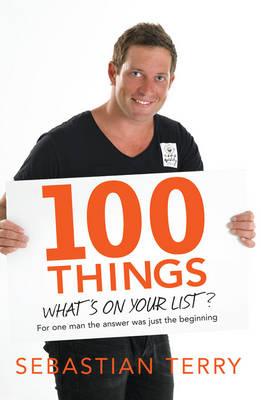
100 Things: What’s on Your List?
I’m sure that app is going to be just as successful as everything else you’ve done for us. Your Twitter handle is @Seb100Things and your book, 100 Things: What’s On Your List? is on Amazon. I can’t take you enough for sharing your journey. Is there any last bit of advice you want to have for people who are thinking about what to put on their list?
If people want to follow me on Instagram, it’s @Seb100Things. I’m on Facebook, Sebastian Terry or 100 Things, or my website, 100Things.com.au. I think a list is a really important thing and we all have them. It might sound like a quirky idea but we all have them. It’s a list of things in life. It encompasses everything. I really urge people to just take a moment. It might be 60 seconds to just stop whatever it is they’re doing at some point and simply ask themselves, “What’s on my list?” That thought, that permission, will allow a really healthy internal conversation. I also urge people to ask other people the same question, because I think the answer to that question when you give it proper thought, time, consideration, authenticity, etc. it has a potential to change lives. Not just your own but the lives of people around you. If you move forward in the startup world and in the business realm, knowing that you’re doing whatever it is that you’re doing for the right reasons because it resonates with you, it’s such a priceless invaluable tool or bullet in your gun. It all comes down to authenticity and I urge anyone to just ask themselves that one simple question.
Imagine what a more interesting world it would be instead of greeting people at a networking event saying, “What do you do?” You say, “What are one of the things on your 100 things to do before you die you want to do?” and then vice versa. That’s a much more interesting conversation, isn’t it?
100%. Thank you so much for having me. It’s so nice to connect with you again.
Likewise, thanks.
Links Mentioned
- Sebastian Terry
- 100 Things: What’s On Your List?
- METal
- go90
- Camp Quality
- Alzheimer’s Australia
- Make-A-Wish Foundation
- @Seb100Things Twitter
- @Seb100Things Instagram
- 100 Things Facebook
- Sebastian Terry Facebook
Wanna Host Your Own Podcast?
Click here to see how my friends at Brandcasting You can help
The Successful Pitch – Book Trailer
Share The Show
Did you enjoy the show? I’d love it if you subscribed today and left us a 5-star review!
-
- Click this link
- Click on the ‘Subscribe’ button below the artwork
- Go to the ‘Ratings and Reviews’ section
- Click on ‘Write a Review’