

Creative Storytelling Is Key To Growth with Anton Zietsman
Posted by John Livesay in podcast | 0 comments

 Episode Summary:
The easiest part of the business is having the idea. The more challenging part is bringing life to that idea and finding the right people to help you do it. Director of 3311 Ventures Anton Zietsman adds that a company needs the ability to transition from the founding members to the expansion team that will develop culture and that will promote high and hyper growth. However, before all of these, founders need to develop the ability of creative storytelling as well as developing deep working relationships. Learn how strategic partnerships can provide capital and future leverage.
—
Our guest is Anton Zietsman who works at 3311 Ventures as part of the core team finding entertainment startups to fund. One of those companies is Donut Media, which creates video content to entice millenials to be interested in the automotive industry since a lot of millenials are not keen on buying a car right away. He talks about what it takes to be successful both as an entrepreneur and as someone who’s pitching and has the ability to execute he said is much more important than whatever your idea is. You need to have great communication skills, be strong on juggling a lot of different things competing for your time and most importantly keep the quality up in everything you do. Enjoy the episode.
Listen To The Episode Here
Creative Storytelling Is Key To Growth with Anton Zietsman
Our guest is Anton Zietsman who is serving now as the Director of 3311 Ventures where he manages the day-to-day operations of that fund. That fund has some unique things that you’re going to want to hear about. Before joining 3311, Anton worked at Homejoy Inc. and Goldman Sachs. He has his degree from Stanford. Welcome to the show.
John, it’s good to be here.
You and I met when I was moderating a panel and you were so well-spoken and able to show a lot of empathy for founders seeking funding that I wanted to have you on the show to share your expertise and your insights. One of the things I love to do is ask my guest to take us back to their own personal story of origin. Someone like you graduating from Stanford has a lot of choices. Did you know right from the get go, “I’m going to go into this world of investments?”
I didn’t. Initially, what I wanted to do and what I was passionate about was politics. That’s why I studied political science and economics at Stanford. The goal was to get involved on the public side of things and ultimately pursue a career in politics, however loosely defined that was for me in the early days. What ultimately ended up happening is I joined a program called Stanford in Washington, which sends students to D.C. for about three months and places us in a government internship while we live and learn and involve in the city. I worked for the Treasury Department for about three months in the Department of International Affairs in the office for the Western Hemisphere. This was about 2010, which is right towards the latter half of the financial crisis where Dodd-Frank was being implemented and a lot of reforms were being pushed through when it comes to domestic finance side of things. I came away with two realizations from that internship. One was that government sector work was probably not for me, a little on the slow side. While there were great people at Treasury Department, I didn’t get that urgency and that piece of work that I was longing for. The second one was that domestic finance was where all the change and all the excitement was, at least at the time of the Treasury Department. That’s when I started to change my focus and started looking at internships on the private side and looking at finance work. That’s ultimately what led me to Goldman Sachs.

Creative Storytelling: Having the idea is almost the easy part of the job.
What was that like? Goldman Sachs is certainly well-known and prestigious and so is Stanford, but they don’t take anybody who wants to work there.
No. For me to go an opportunity to work with a group of likeminded and to work on a faster pace and on subject matters that I was passionate about at the time, which was global economies and the companies operating within them. That’s how I found my way to Goldman, which was an incredible experience from a skill set and personal development perspective. For me, it was a great couple of years learning the tools that I still use today and building a network of pretty impressive people.
What kind of tools did you learn that you still use today?
It’s mostly around the ability to be effective within a corporate or business setting. It sounds a little loosey goosey but what the biggest takeaways from Goldman is the company teaches you how to be effective, how to be a good communicator, how to manage competing workflows, how to manage tight deadlines, and do so while maintaining a high degree of rigor when it comes to the quality and the excellence of your work. In terms of transferability, that’s one of the greatest things that I took away from that experience. On top of that, there’s all the industry specific knowledge when it comes to how companies run and operate, how companies are capitalized, how they raise capital and evolve through their lifecycle. For me, all that was just a bonus.
What I find fascinating is that the ability to communicate well, the ability to deal with competing projects demanding your time and keeping the quality of everything up is exactly what it takes to be a successful entrepreneur as well as what it takes to be successful at a big corporation like Goldman Sachs. Are those the kinds of qualities you’re looking for and the founders that you and your team decide to fund when you hear a pitch?
That’s part of it. The DNA of a successful entrepreneur tends to be very different from the DNA of someone who is going to be a highly successful corporate student. There are certainly aspects of those qualities that are transferable, the ability to be tenacious, the ability to communicate effectively to really paint a vision, the ability to execute is incredibly important. Having the idea is almost the easy part of the job. What’s a lot harder is the ability to go out and bring it to life. What I see as being the main difference is that successful entrepreneurs and the ones that we look for have a big component of rule breaking, of being rebels on some level that you won’t necessarily find at a higher-level corporation. That’s something that’s important. It’s easy to say that the best startups have been the ones that came in and disrupted existing industries and have thought about industries in a new way or created new industries in of themselves. That’s the X factor that differs when it comes to entrepreneurs and something that we try and identify when identifying the companies to invest in.
[Tweet “The ability to execute is even more important than the idea.”]
People get so married to their idea and realize it’s probably going to pivot and it’s your ability to execute that is what the investors like you are looking for. Take us to what made you want to leave Goldman and go to Homejoy.
It was a combination of things. The most important one though is companies like Goldman are successful at what they do because they’ve built a structure in which they’re able to basically churn out junior employees on an annual or biannual basis and maintain their level of excellence. While that may be great for the firm and it may be great for the firm’s clients, what it means is an individual contributor within those companies is that you’re cog in a much larger wheel. Part of what I wanted to do was to be a lot closer to the underlying business. I wanted to be in an operational role in a smaller company in which I was able to come in and impact the underlying operations. That translated into a startup. I was intrigued in the world of high-growth companies, which at the time, a lot of which were in the on-demand space. That’s ultimately the experience that I was seeking. Through a connection at the right network, I was able to land at Homejoy.
What are some of the things that you learned at Homejoy that relates to operations that you think would be valuable for the audience to make sure they’re doing to make sure that their startup is operating at its peak level?
I spent a little under two years there and there are so many lessons learned, so many things that I picked up along the way that would be valuable. Ultimately, part of what was most striking to me is the importance of the team that you build and the culture that you develop over time, particularly when you’re dealing in a high growth or hyper growth situation like Homejoy. One of the challenges a lot of entrepreneurs’ face is how do you scale the team, how do you up level the team at the right time. One of the hardest things to do is moving forward or moving ahead from the founding team and bringing on more experienced executives and timing that in a way that makes sense for the business. That was one of the very interesting lessons and experiences that we had to go through and figure out when to reach out for the right kind of expertise and bring it on board. The second thing is just obsessing about the consumer and the consumer experience. It depends on the business not the industry. It’s understanding who the customer is, why they’re using you and being laser-focused on improving that experience. For us at Homejoy, that was both sides of the marketplace, both the client and the service provider, and understanding who the key constituencies are and keeping them conscious on top of mind throughout the development cycle of the company is critically important.
You’ve got so many other things trying to grab your attention, but if you focus on that, you’re most likely continue to keep them loyal and get new ones. This concept of the culture evolving from just a few people to now realizing, “Is it too soon or too late to hire somebody? Are they a good fit with our culture?” Sometimes the founders might be a little intimidated by people that are coming in with a skill set that they don’t have but need. Do you ever see that in the teams that you’re watching and funding?
[Tweet “Team and culture are the keys to growth.”]
It’s a problem that young companies face all the time. It’s important to get comfortable with that level of unease and on the contrary, seek out that unease and try and be honest about what the skill set of the founder is, what the skill set of the team is and understand what your blind spots are, what your goals are, and going out there and finding someone who is smarter than you when it comes to those things. Who’s going to be able to instantly or very quickly start pulling their weight and educate you and educate the rest of the company when it comes to that domain. It could be anything. It could be sales. It could be marketing. It could be branding. It could be operations. The best founders that we see have a high level of self-awareness when it comes to where they need help and are comfortable seeking out and convincing people to join them that can help them.
That brings us to 3311 Ventures. Do you know the story of origin, by chance, and why the company is called 3311?
3311 comes from the two numbers from our founders’ favorite baseball players. That’s where it comes from. 3311 Productions, which is our parent company, was founded in 2011 primarily as a film finance and production company. Over the years, it grew into a more diversified entertainment company that now does scripted TV and unscripted TV as well.
I’ve interviewed a lot of Angel investors, VCs, family offices, etc. A lot of people are not expertise in funding television, scripted or unscripted or films. That’s the kind of startup you’re looking for or a startup that has something that can help disrupt the entertainment business, is that right?
Our focus and the way we look at the landscape can be summarized this way. We look for companies in which we can not only come in and provide capital but also be strategic in terms of our partnership. When we think about that there are two things that we’re good at as an overall company. The first is storytelling, content creation, video production and distribution. The second is over the course of our existence of the company, we’ve developed deep relationships across the industry whether it’s with talent, agencies, networks, studios, distributors. We look for companies in which we can bring capital to the equation but also leverage one of these two core skill sets in a much more strategic way. In terms of what that translates to from a target company, we do see a lot of companies in the media and entertainment space, but we also see companies in the consumer tech, consumer econ space, in which we have the ability to get involved more in our marketing and branding perspective.
Can you give us a story or an example of someone that you said, “That was a great pitch, we want to go and do business with them?”
We currently have five companies in our portfolio and looking to add a couple more. There’s one example that I can give that will illustrate this well. We invest in a company called Donut Media, which is a millennial brand for car enthusiasts. Essentially, what they do is they create videos and distribute videos across their social platforms in a voice and tone and manner that is obviously compelling to their fans and allows them to grow their audience and establish and develop themselves as a brand and lifestyle brand. The reason why Donut was so compelling to us was through the founder and the founding team who had experience at AwesomenessTV in the capacity of creating, distributing content to this very specific audience and demographic. They also had the Premier Content creators in the car space who had made some of the more successful videos on YouTube what that featured car is. There was this genuine and incredibly authentic passion not only for the space but for their audience coupled with a long track record and expertise when it came to not only building teams and building content teams but also finding ways to distribute and grow that audience. For us, that’s the perfect mix of what we’re looking for and why we’re ultimately convinced to invest.

Creative Storytelling: We look for companies in which we can not only come in and provide capital but also be strategic in terms of our partnership.
The other thing I want to talk about is the importance of storytelling not only in the content you’re creating but also when you’re pitching. What are your tips on that?
Storytelling is not everything but it’s a big part of the process, particularly at this stage that we invest in, which is Series C to Series A. Very early stage companies. At that point, there are so few data points that we can go off and that we can use to do some of the more rigorous analysis that we would do with later stage companies. For example, when I was in Goldman, if we’re doing later stage growth or private equity, you’re ultimately betting on three things, which is the size of the market, the business plan and the team. The team plays a big role in that decision-making process, particularly their ability to paint a picture for what the company is going to look like not necessarily in the next six to twelve months but in the next six to twelve years. Investors can only spend so much time with each company and with each concept due to the volume of deal flow that we look at. The founder needs to do a lot of the legwork when it comes to painting the picture and connecting the dots for the investor and drawing them in to share their vision and see their vision and want to be a part of that process.
Your personal passion, your reason for why you love doing this, understanding who your customer is in the pitch, I have a big philosophy that the more you show an investor like you that you have empathy for the customer and you understand their problem better than anyone else, then someone like you would say, “You’re the right person to provide that solution. We’re going to get in business with you.”
That’s exactly right, especially in content companies and media companies. That has some crossover application as well in other businesses. There are a lot of people who are MBAs and make analytical judgments on opportunities that they think they can exploit. That’s certainly one way to build a business and it’s been successful in the past. When it comes to media companies and new media companies, something that we look for is authenticity and passion. Audiences have become much more sophisticated and much more intuitive when it comes to understanding if the company or the brand they’re interacting with is authentic. That’s a critical part of the equation for us is making sure that the DNA of the founders is in line with the business that they’re trying to create because it will also ensure that they’re in it for the long haul. They’re not just doing it for ulterior motives.
Let’s talk about what do you look for when you hear a pitch. Do you fund producers who want to pitch an idea for a reality TV show?
On the production side of the company, we’ll invest in feature films in the $5 to $25 million budget range. We’re very much film maker driven and chase storytellers. We have a unique voice and a unique perspective across genres. On the scripted and unscripted TV side, we do a lot more development. We’ll take stories. We’ll take ideas. We work with writers to develop a concept and we’ll go out and will pitch that to the universe of buyers whether it’s your traditional guys like HBO or Netflix or non-traditional guys like YouTube brand or some of the new entries in this space. On the venture side, we purely look for companies. We invest in companies that have an existing team and existing products. From that perspective, it’s much less funding productions and much more capitalizing companies to go out and build a media brand for example that itself then create productions to grow its audience.
What are your thoughts on virtual reality and augmented reality as it relates to being impacting in the way we experience entertainment?
[Tweet “Be obsessed and focused on the customer experience.”]
It’s top of mind topic for a lot of investors in this space and even investors outside of the space.You see a lot of the big players up in the Bay Area are starting to spend their time on virtual and augmented reality. My perspective is it’s too early to tell. It sounds like a cop out but the way I see it when it comes to virtual reality in the entertainment space, there’s still some very real concerns that I have when it comes to the sheer ability of the experience, the distribution of devices and headsets that allow people to consume the content around the cost of creating the content, which is incredibly high today. From an investment perspective, the consumer VR space is still earlier than we’d like it to be. That said, there’s no question in my mind that that is a huge growth portion of the industry. We’ve already started to see virtual reality content being created on the gaming side and adopted on the gaming side very successfully. There’s no doubt in my mind that that’s going to happen as well when it comes to other forms of entertainment. There are just a few more things that need to fall into place before we can get excited about it from an investment perspective.
Is there a book that you would recommend people to read when they’re trying to become good storytellers or get their startup funded?
I am a big fan of founder stories or founder autobiographies or memoirs. One of the best books that I read when it came to getting a business off the ground and having the tenacity and the determination to not let yourself fail was Howard Schultz’s autobiography. Howard Schultz, the founder and CEO of Starbucks. He paints a very detailed and colorful picture about what it took him to basically get the funding for his first Starbucks store and the amount of rejection and the amount of resilience that he needed because no one believed in his idea. That’s a great inspiration. It tactically gives you a pretty good idea, a pretty good understanding of how to go to market and how to sell your vision.

Onward: How Starbucks Fought for Its Life without Losing Its Soul
The book is Onward. Is that the one you’re referring to?
That’s right. He wrote two books. It’s either Onward or the one or the one before that.
Any last thoughts you want to leave us with, Anton?
When it comes to pitching, the only thing I would say is that everything matters. What I mean by that is every interaction you have with the potential investor is a data point. Whether it’s showing up to the meeting on time, responsiveness to emails, all of these interactions creates a data bank in the investor’s mind. There are so few data points to go off of in early stage companies that we use all of these inputs as a way to make a decision. Be conscientious about that and present yourself in the best possible way even when you think you’re not “pitching” because everything counts.
I’m a big believer of that. I am so glad to hear you say that because people think, “I can just phone it in. Nobody cares about this detail.” They really do. Thanks so much for being on. You’re a great guest and I am excited to watch you and your career and all the things that your company does.
I appreciate you having me.
Links Mentioned
- 3311 Ventures
- Donut Media
- Goldman Sachs
- Stanford in Washington
- Dodd-Frank
- 3311 Productions
- Donut Media
- AwesomenessTV
- Premier Content
- Onward
Wanna Host Your Own Podcast?
Click here to see how my friends at Brandcasting You can help
Get your FREE copy of John’s latest eBook Getting To Yes now!
John Livesay, The Pitch Whisperer
Share The Show
Did you enjoy the show? I’d love it if you subscribed today and left us a 5-star review!
-
- Click this link
- Click on the ‘Subscribe’ button below the artwork
- Go to the ‘Ratings and Reviews’ section
- Click on ‘Write a Review’
The Culture of Nice Makes Nice Guys Finish First with Doug Sandler
Posted by John Livesay in podcast | 0 comments

Episode Summary:
Gratitude trumps suspicion all the time. Instead of looking for the things that your people are doing wrong, intentionally look for the things that they are doing right and acknowledge it so that trust is built. This is the reason Doug Sandler believes that nice guys finish first. The people inside the organization are more important than the products and services its sells, because being high tech may get you to places but going high touch with the entire team makes everyone see your vision. Doug shares more tips on building trust through a culture of nice and the moments that formed his life.
—
Our guest is Doug Sandler, author of Nice Guys Finish First. He said in order to create a culture of nice, if you catch people doing something right and acknowledge it. He has something called a piggy bank moment. Find out what he means by that. Also, don’t compare your beginning to other people’s middle. You’ll never be happy. You need to celebrate your own progress. Another great tip is high-touch trumps high-tech every time, and he has a great story that shows what he means by that. His recipe for success or as he calls it new math, is that success is ability times effort, if either one is a zero, then your results are zero too. He also challenges us to not be normal and let go of worrying about making mistakes. Enjoy the episode.
Listen To The Episode Here
The Culture of Nice Makes Nice Guys Finish First with Doug Sandler
Doug, welcome to the show.
It’s great to be here, John. Thank you for returning the favor. Episode 125 was the episode that you were on my show. Thanks for hanging out with me and building that relationship throughout the entire year, John.
That’s really what it’s all about, it’s building relationships. That’s your whole focus when you give a keynote; building better relationships create better business. Tell me your story of origin. How did you come up with the branding of Mr. Nice Guy before you wrote the book? What was it like to be the son of Dave Sandler?
I am the son of Dave Sandler. What’s interesting about what you say, John, imagine walking out of your door when you’re six years old. You’ve got your mom and you’re there and you’re carrying your little woobie, my blanket at the time. I can just remember my mom saying to me so many times, “Dougie, be nice,” as I walked out the door over and over and over again. For me, being nice wasn’t a matter of practice, it was a matter of principle. My mom had said that to me so many times as I was growing up that I was destined to be a nice guy growing up. Later on when my dad, Dave Sandler from Sandler Sales, created that entire sales system, I can recall all of the business principles that he threw in my direction, just as a part of being around him and him growing the system and building the system. The combination of the sales system that my dad created and the principles that my mom had laid out of, “Dougie, be nice,” those two things collided. That’s how I’ve led my entire career. No matter what I’ve done in my life, whatever career path that I’ve chosen, those principles, whether that be the sales system that my dad created or the nice philosophy that my mom instilled in my head, those things have all followed me everywhere I’ve gone.
The whole goal of The Successful Pitch Podcast is to give people little nuggets of how to craft a story that pulls people in. You did a great example. I’m going to break down what you probably did naturally. If you noticed what Doug said there he said, “Imagine being six years old and holding your blanket, and your mom saying, ‘Dougie, be nice.’” Instantly, we’re taken back. That’s great exposition. We know exactly where we are, we can see it, we can feel it. When you talk about your father’s structure combined with your mother’s framework of being nice, they collided. Words like that are dramatic and memorable. I can see why you’re such a great keynote speaker. The challenge is when you’re giving your pitch to get someone to join your team, to get a new client, whatever it is, you need to paint a picture just like Doug did. Thank you for letting me break that down a little bit.
You can always say in emails to somebody, “What an awesome, what a great, what a wonderful.” Those words are so overused. If you say something like, “It was unexpected or what an amazing pleasure it was, and it was a pleasure because of,” and then you list a word, “It brings me back to this time when I was,” it puts you right in the position of having people follow you back in that story. That’s always what I love to do, either when I’m doing a keynote or when I’m just having a conversation with somebody. It’s so much more enjoyable to have a story as a part of your lesson that you’re teaching.
Nice Guys Finish First: Nice Guys Finish First
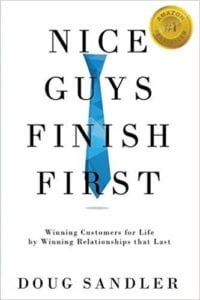
Storytelling and specifics show you care enough to do your due diligence, your preparation before you get in front of somebody. That has been my key to success and it seems to be yours as well. What would you say was the catalyst for coming up with the book Nice Guys Finish First? It’s obviously a play on our phrase of, “Nice guys finish last.” You’ve flipped that paradigm on its ear. How did you come up with that?
In March of 2013, I was in an appointment that my financial planner that we had set up. He had said, “Just be on the lookout for this next opportunity that may find you.” It wasn’t until about six months later in August of that same year that I met another keynote speaker. His name is Ryan Estis. He was delivering a speech at National Association for Catering and Events conference. Literally, I was that guy that was sitting in the back of the room as he was delivering this speech. When he was done he said, “If you have any information or anything that you want me to know or you want to find out more about me, just come on up to the front of the room.” It must have been the way that I was running from the back of the room to the front of the room with my card hanging out in my hand, flying down the aisles and finally reaching him at the front. He said, “You’re not coming to ask me about my message. You’re probably going to ask me about how to be a keynote speaker, right?” I guess that is a typical approach of someone that comes with as much enthusiasm from the back of the room to the front of the room.
He said the first thing you need to do is hire a speaking coach. When I sat down with Jane through Skype probably about six or seven weeks later, she explained to me that the purpose of being a speaker was to get your message out to the world. The best way to do that would be to have a book. You not only need to have a book, but you need to have a bestselling book. She taught me the principles that I needed to know in order to put together a book. I hired a speaking coach. To make a long story even longer, I hired somebody else in the process of writing my books. She was a speaking coach, not a writing coach. I hired a guy to help me write my book. He said, “You need to write 200 pages in twenty weeks. It’s ten pages a week for twenty weeks. Later, we did it 165 pages and when it came down to editing it, the title came as a part of me being this nice guy consistently. Somebody always says eventually along the process of me either putting this book together or anything that I do is, “How can you consistently be so nice when you do everything that you do in the course of your day?” labeling me as Mr. Nice Guy. I just thought about what would be a good play on words for the title. “Nice guys finish last,” is the saying but I said, “That doesn’t have to be the case in business because I seem to always fall on the right side of things when it comes to business negotiations or sales calls.” I figured, “Nice guys finish first,” would be a nice play on words and then it was adopted.
What I take away from that is you invested in yourself. You’re coachable. Someone said you need to write a book. You hired someone to help you do that. You hired somebody to teach you how to be a great speaker. That whole concept of, “I’m going to be successful without getting people to help me,” is a total myth in my experience. I’ve also done the same thing. I feel that people who are willing to invest in themselves and hire experts to help them become a better version of themselves are the ones that ultimately make it and are willing to do that. As opposed to, “I don’t know if I have the money to spend on myself and learn this skill,” and then you don’t believe in what you’re doing.
It’s also a matter of you’ve got to find where you’re happy is. You have to get down to what is it that drives you and what is it that will make you happy in life? After so many years of a very successful entertainment business, I’m at the tail end of that entertainment career. From an age perspective, I’m in a world as a deejay. As a 47-year-old deejay five years ago, I was in a field that was dominated by twenty-somethings. There’s only so long that a club owner is going to respect you. A 50-something or a 60-something walking into a club is not going to have the same effect. Before my market quit on me, I figured, “Even if they never do, I want to look for an opportunity, something else that I could do in my life.” That’s exactly what it was. I found my happy. Part of my podcast, Episode 362, Mo Gawdat talks about this idea of finding your happiness. It’s such a true statement. You have to find and gravitate towards your happy factor and that is it for me.

Nice Guys Finish First: You have to find and gravitate towards your happy factor.
Nothing is sadder than someone who’s staying on the stage too long whether it’s an actress trying to play an ingénue that’s outgrown the role. We all have to keep evolving and changing. You talk about the culture of nice. Explain to people what that means.
It’s not just a project of the week. Nice is not something that you can say, “This week we’re decided that we’re going to be nice so let’s turn the corner.” You need to tell everybody what does that mean. To different people, it might mean different things. For me, part of it is doing something such simple stuff like catching somebody in the act of doing something right. We’re so focused as managers, we constantly are finding people doing the wrong thing or changing people’s behaviors. How about if we try to go about it and try to find people in the act of doing something right? If you show gratitude, show empathy, be a good conversationalist, be there to support other people, catch them in the act of doing something right. It’s not an action step that a lot of companies have in place. To create this culture of nice does start with the things like gratitude, catching him in the act of doing something right, building trust, building relationships, understanding communication. Those are the things that so many companies focus little on and focus more on the bottom line. If you focus on the people in your organization and not just the products and the services that you provide, you’ll find that your business will be much more successful.
I remember that book, The One Minute Manager, it was the first time I was introduced to the concept of catching somebody doing something right and acknowledging it, as opposed to assuming that they’re just doing the job. That shifts everything. Let’s talk a little bit about your philosophy about the test of trust, since you brought that up in terms of what a culture of nice includes is empathy and trust. What is the test of trust?
It’s a part of one of the training programs that I have. I’m happy to provide this. All they have to do is email me. It’s a very simple 25-question test or quiz that you can give yourself to find out what level of trust do people have in you and what are you throwing out there to the universe. If you’re throwing out to the universe that you’re not a trustworthy person, take this test and you score a B or less, then maybe you do need to work on some of the things in order to be a little bit more trustworthy. It’s not rocket science. It’s things like, “Do you return your calls quickly? Do you show up on time every time? Do you provide more than the value of the sale that you have made to your client? Do you go above and beyond?” If you can genuinely say yes to those, then you are doing a great job of providing trust and being trustworthy of the people in your life.
I resonate with the one that talks about, “I listen to what others have to say.” Do I trust myself to do that?
So many people are so focused on the thing that they’re going to say next that they forget to listen to the thing that’s being said to them right now. Being present as a part of your conversations and a part of your relationships is such a critical part of being trustworthy. It has everything to do and nothing to do with trust at the same time. It has everything to do with relationships.

Nice Guys Finish First: Being present as a part of your conversations and a part of your relationships is such a critical part of being trustworthy.
You have something called the piggy bank moment. Please describe what that is.
I was given this inspiration from my wife as she was moving out of an apartment before we got married a couple of years ago. She’s sitting in her apartment and she has this piggy bank that she’s carried with her since childhood. In the piggy bank was literally, for her at the time, every cent that she had. You open up the piggy bank and you count the money that’s in the piggy bank and she had $129. Financially, she was probably going through a struggling point in her life at that time. She said, “This is that moment. I’ve got this $129. I’m about to move out with my apartment. I’m about to move in with this guy who I love. This is what it comes down to. This is what life is all about.” I always tell people as we have conversations about the things that you’re most passionate about in life, what is that piggy bank moment? What is that moment that you can go back to in your life that you can say, “Things are going to be changed and things are going to be different starting right now?” Take an assessment of your life. Look at where your life is and move beyond where you are right now.
Even if she had $129 and that was all that she had, it was what she had. She did an assessment of her life. She looked at her life going backward and she looked at her life where she’s going forward from there. Take a snapshot of your life. What is that piggy bank moment at that exact time? You’ll see how drastically we think that things move at a creepy crawly pace in life. I look back to my life five years ago. I had no podcast. I had no book. I had no keynote speech. All of the new things that are in my life that have become my career, they did not exist five or six years ago. It’s so great to know that I had my piggy bank moment back then as well. It’s different than my wife’s but look what has happened since then. That’s the wonderful part about it.
It’s all about celebrating our progress as opposed to only saying, “I still don’t have this.” It is valuable to take a minute and say, “What did I accomplish this day, this week, this month?” Our brain craves progress. If we don’t acknowledge it, then we can spiral downward. One of the keys to staying nice and positive and focused is celebrating your own progress and then you can look for it in another people.
[Tweet “Don’t compare your beginning to other people’s middle.”]
One of the issues that we have as people though is we tend to compare our beginning to other people’s middles. We say, “I’m not there yet.” You look on Facebook and everybody’s doing better than you. You look on LinkedIn and Twitter and everybody is at these great vacation spots and they’re doing wonderful things with their business and they close these deals. The things they’re not putting in there are all of those many failures that they’ve had, which we all have but we tend to focus. I have a book on Amazon, Nice Guys Finish First, and I have 105 or 110 five-star reviews. I had one one-star review. Which is the one that I focus on? I focused on that one-star review. I’m like, “What the heck did I do to deserve a one-star review?” Not, “What did I do to garner those or to deserve the 105 five-star reviews?” We tend to focus on the negative things in our life. If we just compare ourselves only to where we were five years ago, you’ll see that you have made huge end roads. If you haven’t, it’s not too late. You start right now and you have your piggy bank moment now and you move forward. You look at all of the wonderful things that you’ve accomplished in the upcoming years as well.
It’s another way of saying focus on your own progress and you succeed. It’s a great example of how to do that which is wonderful. You have a whole page devoted to your website of quotes. I’ve picked a few of them. “High- touch trumps high-tech every time.” How did you come up with that? Do you have a story around that?
I’ve led my entire life that way. In my entertainment business as a deejay, everybody tends to focus on the equipment and 25,000 songs that they bring to their event and the wonderful speakers and all that. I just say, “I only need 60 songs to get your event but I have a year and a half in which to get there, so can we spend a little bit of time talking about what do you think? What’s your vision? What’s important to you? What do you think would be valuable to have at your party? What are the things that you see happening at your party?” I challenge all of my guys that I train in my entertainment world to not focus on such high-tech gadgetry, to focus on the relationship. That’s why I say, “High-touch trumps high-tech every time.”
[Tweet “High-touch trumps high-tech every time.”]
It’s that whole thing that people buy emotionally and then back it up with logic, not the features and benefits, and it’s great. We’ve all heard this concept of new math, kids learning a whole new way of division and all that other stuff that’s different. You have a new math formula for success. Tell us what that is. It’s ability times effort. If either is zero, you get no results.
You have to have the ability and you have to put forth the effort. If you rely upon your ability, then you’re not going to get there. If you rely upon just your effort but you have no ability, you’re not going to get there either. You need to at least show up on both of those. We all think in our mind we have to be the best at everything we do. We have to be the best at social media. We have to be the best keynote speaker. We have to be the best at being a husband or whatever it is. If just show up and you play the game, you’re going to get better. Understand that you’re probably going to be horrible at first, but if you are a zero, if you don’t even show up, you’re not even going to post. That’s my new math.
Now you have this other quote, “Why be normal when you can be WOWmal?”
Since I came up with that quote, I’ve seen that in other places. I thought I was the guy that created that, but I’ve seen that on many different places on social media as well. Maybe they have stolen it from me and they’re welcome to have it or I stole it from them, and if that’s the case, I beg forgiveness. We all can be normal in the process of our day. We can do the things that everybody else does. Why do that? Rock the boat a little bit. Be a little bit wow. Be out there. Be engaging. Be exciting. Be controversial. Ruffle some feathers a little bit of the way as you go through this, as you go through life. It does not make sense to be that normal guy. It makes more sense to be that WOWmal guy.
[Tweet “Why be normal when you can be WOWmal?”]
It makes you stand out and it makes you memorable and that’s the way to break through the clutter. That’s my big takeaway. One of the things you talked about in your book, Nice Guys Finish First, is the mistakes that nice guys should avoid. That intrigued me. Please tell us what those mistakes are that we should avoid if we want to be a nice guy.
There are a bunch of them. I have a little hand out, The Five Biggest Mistakes Made in Business Today. Taking one of them, it’s a failure to care. There are so often times that we are going through life and just go through the motions. Remember effort and ability, if either one of those equal zero, if you don’t show effort, if you don’t show ability, you’re not going to become successful. The failure to care is probably the granddaddy of them all because if what you’re doing in life is not making you happy, if you don’t have any level of passion in the things that you do and you don’t approach life with a, “I can do this attitude,” you’re going to end up with results that are less than stellar. Why would you want to go through life not happy and not caring about the things that you’re doing?
If you’re not happy, you may not realize this, but everybody around you knows you’re not happy. That’s what you’re spelling with your face, that’s what you’re spelling with your attitude and that’s what you’re spelling through your effort. It makes sense to drop back a little bit, do an assessment of where you are, have that piggy bank moment in your life, and determine what is going to be the next step for you to either fix what ills you and fix what the problem is or get out of the situation that you’re in and move on to something else. It is that simple. Some people might say, “I have bills to pay and I got to do this.” It is that simple. You must find something that you feel passionate about, that you love doing or you’re not going to be successful. It’s very challenging to be successful at something you don’t enjoy doing.
It’s so true because your why has to keep you going through the tough times and the challenges to pick yourself back up. Dough, it’s been such a pleasure and an honor to have you on The Successful Pitch. Is there a final thought you’d like to leave people with?
This was a little bit of a lesson that my dad led to me. My dad used to be in the potato chip and snack food business before he started the successful sales franchise business called Sandler Systems. He would drive around the trucks and he would go from store to store. Oftentimes, he would make no sales in the course of his day. One of the lessons that he taught me, which I learned to embrace is it is okay to fail. It’s not okay to quit but it’s okay to fail. If you failed at something, get back up and go for it. Figure out what the next step is, brush yourself off. It sounds so cliché, but the reality of it is just don’t quit. If you continue down the path that you are passionate about, you will be successful. If there are any words that can be left in someone’s mind at the end of this episode, it would be it’s okay to fail.
DougSandler.com is full of great information. Your book is on Amazon. How else can people follow you on social media? Do you want to give out your email for people to email you to get these great mistakes to avoid?
If somebody wants either The Five Biggest Mistakes or any number of different programs that I have, or if you want a little one-sheet on some of the stuff that I do, [email protected]. If you want to go to my website, hit the contact page. If you sign up for any of the newsletters that are on there, those things automatically will be generated and be sent to you. That might be the best way to go.
Thanks, Doug.
My pleasure, John. Thanks for having me on the show.
Links Mentioned
- Nice Guys Finish First
- Doug Sandler
- Episode 125 with John Livesay
- Ryan Estis
- Episode 362 with Mo Gawdat
- The One Minute Manager
- Nice Guys Finish First on Amazon
- Quotes
- The Five Biggest Mistakes Made in Business Today
- Sandler Systems
- DougSandler.com
- [email protected]
- Contact page
Wanna Host Your Own Podcast?
Click here to see how my friends at Brandcasting You can help
Get your FREE copy of John’s latest eBook Getting To Yes now!
John Livesay, The Pitch Whisperer
Share The Show
Did you enjoy the show? I’d love it if you subscribed today and left us a 5-star review!
-
- Click this link
- Click on the ‘Subscribe’ button below the artwork
- Go to the ‘Ratings and Reviews’ section
- Click on ‘Write a Review’
16 Things High Performing Teams Do Differently
Posted by John Livesay in podcast | 0 comments

Episode Summary:
Successful people see themselves being successful.
There is a completely different motivation framework where business owners hate losing more than they love winning. Don Yaeger – the speaker of champions – believes that to avoid losing, every company needs to have a huddle where everyone is present and invested on the vision and the mission.
There are 16 things great teams do differently, and one of them is figuring out the next step when mistakes happen instead of blaming teammates.
Our guest is Don Yaeger, the author of Great Teams: 16 Things High Performing Organizations Do Differently.
Don is uniquely qualified to write that book because he worked at Sports Illustrated for a number of years and interviewed great athletes like Michael Jordan.
In this episode, he shares a story of how he went one-on-one with Michael Jordan.
Michael Jordan’s comment to him was, “Loss is not really a failure until you make an excuse.”
Don creates a whole culture of not allowing a “blaming environment” to exist.
He says, “Successful people expect success and therefore, they hate to lose more than they love to win.”
Find out what that means in the rest of this post. Enjoy the episode.
Listen To The Episode Here
16 Things Great Teams Do Differently with Don Yaeger
I’ve got Don Yaeger, the speaker of champions.
As an award-winning keynote speaker, business leadership coach, a nine-time New York Times Best-Selling author, and a long time associate editor for Sports Illustrated, Don has fashioned a career as one of America’s most provocative thought leaders.
As a speaker, he’s worked with audiences as diverse as the Fortune 500 companies to cancer survivor groups where he shares his personal story.
He’s even interviewed icons like Michael Jordan.
He’s primarily thought to discuss lessons on achieving greatness learned firsthand from his experience with some of those great sports legends.
He’s been retained by companies and organizations to coach their leaders, management teams, and employees on building a culture of greatness by looking at great teams in sports and discerning the business lessons we can learn from those.
Don, welcome to the show.
John, thank you so much for having me.
I always like to ask my guest to start at the story of origin. Can you take us back to your own personal passion for sports before you became involved with Sports Illustrated? Was that always a dream job?
Sports Illustrated certainly has been a dream job. As someone who just always participated in played and written about sports, the dream always was to try to find the best place you could execute on those talents and the greatest access point to high performers. For many years, Sports Illustrated has been that.
When I got the opportunity, they had such a small staff.
We started looking at the senior writers and associate editors.
Those who actually are generating the content at a big level in the company, there are only 30 of them in the whole world.
I could be one of those 30 or for the better part of twelve years maybe one the great gifts ever given to me.
It’s almost like making the Olympic team or something, isn’t it?
Yeah. I guess in my own small way, it allowed me to do that.
From there interviewing all these amazing athletes, you’ve really become the expert from all of your books, etc. on greatness. Let’s just dive in. Tell me the story of you going one-on-one with Michael Jordan. I think that’s a good place to start.
Jordan hosts an old men basketball camp every year.
It has been for many years which 100 old guys, doctors, lawyers, pretty amazing business executives would come to Las Vegas.
They would divide you into teams of ten and he brings in twenty great coaches, the best coaches in America. They coach us for four days as competitors against each other.
During one of those days, Jordan brings twenty of us out and gives us a chance to go one-on-one with him.
He makes a point right at beginning, say with 180 guys out there before that, the nine years he has previously done it, only five guys have ever scored on him.
He makes it clear that, “There will not be a sixth today.”
He’s not going to play easy. It’s not like you’re playing a game with your parents and they let you win, right?
Yeah, that is not who Michael Jordan is. The guys, two in front of me goes out to guard Jordan. It’s a game to one. It’s the first guy to score will win and Michael starts with the ball.
Most games end with one shot. You can’t stop and you can’t guard him.
Great players couldn’t stop or guard him.
Then he hits his one shot, whatever it is and then it’s over.
The guy in front of me was out to guard him. I just have to guard him closely.
I tried to throw an elbow at him, Jordan uses the ball to clear space, knocks the guy to the ground, Jordan dunks the ball, tosses it on him and says, “Now you know what it’s like to be spanked like a bad child.”
He’s just a great trash talker.
Then a few guys later, comes [my turn] and I decide not to guard him close. I decided to give him space to take an outside shot but I’m not going to let him dunk on me.
It’s actually a picture that I use in a speech when I tell the story.
He’s palming the ball in his right hand and his left hand was calling me out.
You can see his finger is there.
He’s basically saying and pulling out at you, “What are you doing there?”
He looks at me and he’s just like, “Are you really going to give me the shot?”
I look back at Michael Jordan and I said, “I don’t think you have it in you.”
100 guys started laughing and Jordan shakes his head, he goes up, takes a shot, and he missed it.
I get the rebound.
I stepped back outside the three-point line.
He’s coming out to guard me.
I look back and I said, “Aren’t you going to return the favor?”
That’s the favor by being a bad defender and he said, “I know you don’t have that shot in you.”
As he said it I stepped back and if you play six feet, threw the three-pointer that I became the sixth guy to score on Jordan.
First of all, how did that feel?
Incredible. I joked a lot with him and with other people that I probably made more money off scoring one basket on Michael Jordan.
What I see already is a through line, Don, of you being able to get on the Sports Illustrated team, a small team of 30 people. Five out of 180 old guys, you became the sixth person to get that shot off of Michal Jordan. What is it about you that allows you to achieve a level of excellence and greatness that other people are missing, that they could learn from?
[bctt tweet=”When you can offer humility even in excellence, people want you to win.” username=”John_Livesay”]
I think [there are] key things that have been really hallmarks or important in my career, one hopefully is humility of spirit.
There are just too many people that are high achievers or modern achievers who thinks so much of themselves.
People don’t feel comfortable giving them additional chances.
I think that when you can offer humility even in excellence, I think people want you to win. They want to help you. I think that’s the real key. I have been knocked down enough in my lifetime that humility has been forced upon me. That’s the truth and I think as it has developed, for me it has become more important.
What’s the second one?
The second one is that I am a sponge.
I love to try to find that question that has never been asked before.
Most of the people I talked to or have interviewed in my career have been interviewed thousands of times.
Some maybe more than that even.
Some private space or discussion points that they haven’t gotten into previously is really hard. I believe that through the power of preparation, you can even get to a place where you can ask people questions they hadn’t really thought about answering previously.
You’re singing my song, the power of preparation. That’s my number one technique to get people to be more confident when they pitch for anything.
The Arthur Ashe quote is one of my all time favorites that, “The key to success is confidence and the key to confidence is preparation.” It sounds like you’re in full agreement with that.
One of the things that you have here is that with Michael Jordan it’s personal, “They hate to lose more than they love to win.” Please explain that.
The genesis of that list that you’re referencing is when I was leaving college.
I was heading for my first job as newspaper reporter.
My father encouraged me to find somewhere in the course of many interviews I will do in my career to ask for something that will make me better.
He said, “You’re going to get access to some of the greatest winners in the history, some of the most powerful people of all time just because you’ve chosen to be a reporter. Do yourself a favor and always try to learn something that will make you better.”
The question I settled in on was essentially the version of what you asked.
“If there’s a habit or a characteristic that allowed you to do what others couldn’t, what would that be?”
I asked that question to about 2,500 winners over the course of time.
The number one answer that comes up is that they learn at some stage in their life to expect success.
Truly successful people expect to be successful.
It doesn’t give them the thrill it gives other people.
They win and they expected to win. It’s enjoyable but it’s not thrilling.
That’s not their standard anymore because they expected it. What their standard moves to is they hate to lose.
That’s a completely different motivation framework, isn’t it?
Right. If you’re just satisfied, “I won. That’s awesome, I won,” you could be good but you’ll never be great.
They believe greatness comes from passing into that next zone, which is when losing at anything; you blame no one, you make excuses to no one and you internalize. We got a whole generation of people out there who are learning and they even tell you it’s someone else’s fault.
Let’s take that into the business world now. How can a business owner, a salesperson, anybody who’s pitching to get a new client reframe their mindset when they pitch within this “I hate to lose” mindset that could help them?

Great Teams Do Differently: A loss is not a failure until you make an excuse.
Part of it is, losing is inevitable.
There will be losses.
Jordan actually said a sentence to me one time while we were talking about this in which he said, “A loss is not a failure until you make an excuse.”
For example, in my company we have a motto here where when we fail, when we lose, which happens, we don’t allow culturally a blaming environment to begin.
We don’t blame others. We don’t blame circumstances.
We internalize it and ask, “What could we have done?” which is better than saying, “I couldn’t have done anything because the referees were going to cheat us out all along. I couldn’t have done anything because the decision-maker was never going to like me anyway because I’m a woman or because I’m young or because I’m this.”
We don’t play that and that’s what I learned about the mindset of true great ones. You’ll never hear them truly get into the blame game.
They instead say, “It happened and it won’t happen again.”
I see that in the medical world.
If the patient dies, they’ll have a meeting to see what could have been done if anything to prevent loss without blame game happening.
In the business world, when you don’t win a pitch to get a new client, I’m a big proponent of having enough emotional IQ that you will ask that potential client that didn’t choose you to have a no blame meeting of total transparency and say, “What could we have done better?” What are your thoughts on that?
I totally believe it.
We have another phrase around my company, “Feedback is the breakfast of champions.”
You don’t get something that doesn’t come your way.
Ask for feedback.
I’m not trying to re-pitch you.
I’m not trying to have you change your position.
I just want to know, “Could you share what did they do better? What could I learn from the person you choose will help me grow?”
If you ask for feedback and you accept it and you make it a meal, which upon is that others will gladly give it to you.
[bctt tweet=”Feedback is the breakfast of champions.” username=”John_Livesay”]
Let’s talk about a post you made interviewing Matt Ryan. It’s one thing for you to build up own your internal confidence. I think everybody would love to learn your expertise on how do you build the confidence up with your team?
I think it’s important for me to try to build the confidence of your team. Before they’ll allow you to lead them, they have to know you are interested in leading you.
Before they’re interested in letting them lead you, they want you to show you’ve led yourself. Is that the gist of it?
Correct.
Give me a story or an example of that please.
I’ll use Matt Ryan. I think in the post you’re referencing, I was engaged to do some work with Matt Ryan when he was coming out of college.
He was heading to the NFL, and I was hired to come sit down with him about his skill set to be ready to be interviewed by NFL teams and to look at social media: “What five words you wanted to be known for before an interview was done? What are the words you hoped someone says about you after they listen to you or now? How do you weave those five words into the conversation you’re having?”
It’s a skill set the very best have.
It’s basic branding but it’s just done on a personal level by the best professionals out there.
The night before I was scheduled to meet with Matt at a facility in Phoenix, Arizona I got a phone call that my 8 AM with Matt Ryan, he wanted to move it to 7:00.
Would I be okay with that? I don’t care. I had an hour with him from 8:00 to 9:00.
I got there at 7:00 thinking he just wanted to go 7:00 to 8:00 and maybe he wanted to do a little bit of a workout and do something else.
What Matt Ryan wanted was 7:00 to 9:00. He didn’t want to move it back an hour, he wanted to add an hour.
It barely happens. What you saw in that was Matt Ryan said, “This is important. I will lead me better. I will lead them better. If you’re leading me better, how can I make myself better? This is one way.”
Just a small example.
That’s how when people go out and they are invested in and they’re working to try to make them better, we all know who those people who truly believe in development and don’t just talk about development but actually go invest in it.
I think the team respects that and says, “Yes. You’re in this position where you won’t lead me anymore. You lead me because I want you to lead you.”
The other thing that jumps out of me is you said, “What are the five words you want people to say about you when you leave the room?” Don, what are the five words you want people to say about you after you’ve given a keynote?
- Number one is humble.
- Number two is storyteller for me where people are hearing me tell stories. I believe that’s a skill set.
- Number three is accomplished. I think it’s important to be both humble and accomplished. It’s easy to be humble when you haven’t achieved anything.
- Number four would be respectful. I care enough about who I’m talking with to want to know what it is they need to hear and learn.
- Number five would be thought provoking. I want them to walk out not just having heard a story, but having provoked themselves to try to make themselves better.
Great Teams Do Differently: Great Teams: 16 Things High Performing Organizations Do Differently
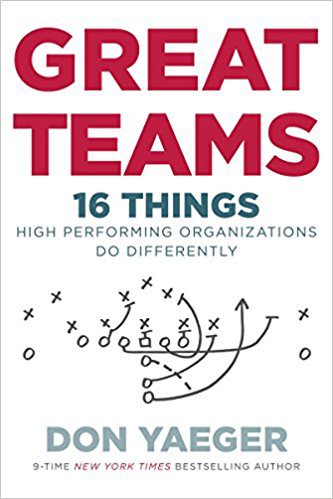
Your book Great Teams: 16 Things High Performing Organizations Do Differently, my first question is, did you have a lot more than sixteen and you had to edit it down?
Just like for whatever reason and the reason that this one ended up at sixteen, this is my first book.
In both cases, I had many more reasons but what you’ll find is there’s a cutoff point where you can say, “This is consumable.”
People can take this and do something with it.
If I had 118 things teams do differently, you would have never consider it because you’re like, “I can’t do 118 things.”
Sixteen seems reasonable enough. Stephen Covey had 7 Habits. John Maxwell has 21 Laws.
There has to be a consumable number and sixteen is my number.
Let me ask you about how great teams run successful huddles. I think that’s really valuable. A lot of people feel like their meetings aren’t productive and they just waste time. If you have insights on how to make huddles more effective, that’s really valuable.
That was one of my favorite discussion points because we all struggle with ineffective meetings and ended up it don’t seem as valuable as it should be.
I’ll give you two takeaways your listeners can do something with.
Huddles are the heartbeat of any organization.
Whether they’re meetings in their business or they’re huddle in sports, a gathering where information is shared and something needs to happen as a result, that’s the heartbeat of any organization.
Most of us have bad meetings. Most of us have bad huddles.
I went into the organizations that are known to have the best to ask them, “What do they do and how do they do it?”
Two takeaways that came up: Number one is every huddle has to start on time and it has to end on time.
[bctt tweet=”Every huddle has to start on time and it has to end on time. ” username=”John_Livesay”]
That just goes to your respect, respecting people’s time.
Let’s say you have a habit in your organization.
Everybody knows your meeting is going to start five minutes late.
What happened?
They’ll start showing up seven minutes late.
Everyone knows that a 3:00 meeting will start at 3:00.
Then what starts to happen is nobody wants to be able to be the one who’s there at 3:07.
If there’s flexibility, if 3:00 turns to 3:04 or 3:06 then there’s 3:07 and who knows? Also, it leads into the next meeting that they’ll do.
The best huddles are precisely run in a way that allows that to be done well.
What’s so interesting about that for me, Don, is think of all these sports that are so specific and exactly how long a quarter lasts. When the clocks running out on the basketball, that’s it, right?
Yeah. They don’t give you extra time because you need them done.
What’s the second takeaway on the good huddle meeting?
The second takeaway for me that I really love what I thought about was everyone in the huddle has to be fully present or fully absent.
We tell a pretty amazing story.
We’ll talk about a national championship basketball game in which an important huddle occurred, a back-up player on the huddle.
He knew he wasn’t going to be in the game at all. He’s outside the huddle. He’s actually waving at a girl in the crowd.
An important information about the idea that the team had no timeouts left was shared with the players.
This back-up player didn’t hear it because he wasn’t really listening because he wasn’t in the huddle.
A key moment came in the game and he yells, “Call timeout.”
When the player who’s on the court with the ball hears that, he does call timeout even though he was told there were no timeouts available.
What happened was that the team lost the national championship.
If you’re really getting to it and I got into it and every people studied it, the end result was the failure to be fully invested by everyone who was affected by the huddle and that includes your back-up players.
What does that mean for us in business?
That could mean you’ve got a bunch of people sitting in the room, and an important information is being relayed and they’re on their Twitter or they’re on their Instagram or they’re checking their email on their phone as opposed to being engaged in the conversation.
We have this rule in our building: If you’re not fully present in the meeting, be absent.
If you think what you have on Twitter or Instagram is more important that what’s happening here, then leave the meeting.
[bctt tweet=”If you’re not fully present in the meeting, be absent.” username=”John_Livesay”]
That reminds me exactly what happened at the Academy Awards. The guy who was responsible from the accounting firm of giving the envelope to read Best Picture was breaking the rules and taking a selfie with Emma Stone who just won Best Actress.
Then he ended up giving Warren Beatty and Faye Dunaway the wrong envelope to read Best Picture because he wasn’t fully present.
When you talk about great teams speaking a different language, I’m guessing part of that is no blame game. Is there something else in there you could give us?
A big piece of it is, “How do you handle it when mistakes happen?”
The bottom line is mistakes can happen.
That’s part of events.
How do you handle it when they do?
One of the things that I’ve watched among the greatest and the best teams is they know how to engage people in those moments.
Rather than saying, “What are you doing? How did you make that mistake? What were you thinking?”
Rather than being in the blame mode, they are in the mode of explaining, “Here’s how it’s done when we’re here. Do you remember that conversation we had yesterday in practice about this? We’re going to need you later to execute on this. Let’s remember the conversation.”
How often have we seen moments of crisis and the leader goes into, “Who’s fault is this that we’re in this crisis? Why did you do that?” as opposed to, “We have prepared ourselves for this. How are we going to move forward from it and what are we going to learn from it?”
This is a different language in how we collectively organizationally speak to each other.
Then the flip side of this, the final question is how do great teams avoid the pitfalls of success?
It’s really fascinating because we’re like, “We avoid the pitfalls of failure,” and most people don’t think about success having pitfalls.
You have experienced plenty of success in your career and in your life. We’ve seen you worked with other people who are great.
What are the pitfalls of success and how do we avoid them?
John Maxwell, who is a leadership mentor and speaker, one of my favorite people in the Collaboration, someone that I get a chance to work with every month on a project, has a great line.
He says, “One of the great predictors of failure is success.”
The truth is when we get successful, we get complacent.
We no longer do the things that got us to success because we think we don’t have to.
We think everybody is going to remember how successful we are. They’re going to quiver in their boots when we walk by.
We forget people aren’t as impressed with us as we were impressed with us sometimes.
The truly great ones, they understand success yesterday is exactly that. If we want to be successful tomorrow, it’s a new case. It’s a new day.
That place out there is just failure yesterday as exactly that.
Don, your website is DonYaeger.com.
It’s for people to learn more about your wonderful content, hiring you as a keynote speaker, buying your book and all that great stuff.
Anything else you want to leave us with?
When you’re pitching, it’s an art.
You’re clearly the artist.
I look forward to listening and learning.
I think the key to everything I have learned in life is the art of storytelling and I think that’s where great pitching happens.
It’s not just about what my product does, but what the product’s done for somebody like you that makes me go, “I want to get to know more about that.”
I think storytelling is a gift. It’s a skill set. As your listeners work on their development hopefully, in some way this all fits.
I want to give a special shout-out to our mutual friend, Stephen Woessner, the Founder of Predictive ROI, for connecting me to a great guest like you.
Thank you. I appreciate Stephen as well.
Did you enjoy this post about what great teams do differently? Be sure to visit these articles as well:
Exactly What To Say For Influence And Impact with Phil M. Jones
The Power of Positive Thinking & Being Present
Sales is a Team Sport
Links Mentioned
- Great Teams: 16 things High Performing Organizations Do Differently
- 7 Habits
- 21 Laws
- John Maxwell
- Don Yaeger
- Predictive ROI
- Sports Illustrated
Wanna Host Your Own Podcast?
Click here to see how my friends at Brandcasting You can help
Get your FREE copy of John’s latest eBook now!
Share The Show
Did you enjoy the show? I’d love it if you subscribed today and left us a 5-star review!
-
- Click this link
- Click on the ‘Subscribe’ button below the artwork
- Go to the ‘Ratings and Reviews’ section
- Click on ‘Write a Review’