

Signature Leadership With Jamie Mason Cohen
Posted by John Livesay in podcast | 0 comments


If you have a challenge, how do you deal with it? How creative do you get to become productive? In this episode, we will dive into how our guest applies the skills and lessons he learned being in Saturday Night Live. Jamie Mason Cohen, the Host of The Signature Leadership Show, shares how you can become productive through smart work, not hard work. He explains his focus on “What’s your 11:30” is the problem you want to focus on and turn it into a possibility. Being still during chaos is key in dealing with challenges to help focus on finding a creative solution. Learn more about Jamie Mason Cohen’s signature leadership.
—
Listen to the podcast here
Signature Leadership With Jamie Mason Cohen
Our guest is Jamie Mason Cohen who worked on Saturday Night Live. Find out what he means when he says, “What is your 11:30?” He said that when you’re laughing, you are learning and you can also hear a story of how to be still during the chaos. Enjoy the episode.
—
Our guest is Jamie Mason Cohen. He is a leadership development and resilience expert. He integrates his experiences working at Saturday Night Live as a Dale Carnegie Business Training Award Recipient and as a Certified Leadership Coach with The Leadership Circle to help organizations thrive in change. He’s a keynote speaker and facilitator who’s been hired to teach resilience, wellness, leadership and communication at organizations like SunLife, Meeting Planners International, Broadway Video Entertainment, the Canadian Society of Association Executives and many others.
He uses a toolkit of unconventional virtual approaches to cultivating resilience through unique performance assessment. He has something impressive and a little bit frightening, according to Forbes and the power of a superhero in his TEDx where each person learns how their strengths may serve that organization in 60 seconds. His new podcast is called The Signature Leadership Show. He’s a frequent commentator on CNN and The Morning Show. Jamie, welcome to the show.
John, I’m thrilled to be here with you.
I have been a big admirer of your work and follow you on all these social media platforms. I see how audiences light up. You have this amazing skill of not only all the lessons you learned while being at Saturday Night Live. We’re going to do a deep dive into that but you also have this skill as an artist. I’ve seen some of your paintings and you also can analyze people’s signatures.
You did mine, which was mind-boggling how fast the insights come across depending on the angle of how I cross a T. I want to ask you, before we get into all these incredible things that you do and have done, your little story of origin. You’re Canadian so take us back to school. Where did you first discover your love of creativity? I would think that’s the overriding umbrella over all of your skills.
I trace it back to my mother. One of the things you mentioned was my love of helping people discover their authentic selves through their handwriting. I remember my mother who was an educator. One day I was in drama class. I was standing on stage when I was about twelve years old in Toronto where I’m from. I froze because I stuttered whenever I got up in front of people.
I came home to my mother and I was devastated. I told her what happened and she said to me, “Let me see your handwriting in your daily notes from school,” when we were handwriting regularly. I showed it to her and she saw what you said. She saw the T-bar. The T-bar in handwriting tends to represent your goals amongst other things. She said, “You also have fluency of thought in the way you write.” It’s almost a figure eight for those who know anything about hockey, our Canadian pastime.
You had it in yours too, John. It planted a seed that I could change and grow and that I could in a sense build my growth mindset, which is a fundamental component of all creativity. I went on this journey from twelve years old onward to exploring how my brain works but also about how my creativity and my ability to make these connections in the world between disparate ideas could come to fruition. That’s a short version of how that one moment when my mother turned a crisis or a problem that I was facing into an opportunity.
Did she know how to analyze handwriting? Is that why she asked for yours and then she taught you? From that insight, were you able to overcome the stuttering because you realized the stuttering was not a physical ailment but more of a fear thing?
The stuttering was something that I ended up getting some help and support from experts in that field. It also drew a new level of self-awareness in that I could overcome challenges in my life. Part of it was my mother believed in me before I believed in myself. Something like stuttering was something that I thought was forever at that moment. Is this going to be my future in terms of how I communicate? Many years later, I became a professional speaker and what my mother said about me, “One day, you’re going to write and speak in front of people,” ended up coming true. It was a prophecy that my mother planted in me at that age.
There are so many takeaways here starting with you’re a dad yourself. Whether you’re a speaker, a teacher or someone that you’re working in a situation with other people, the influence we have to see the greatness in someone else at specific times and plant that seed or believe in somebody when they maybe have forgotten the truth of who they are is such a gift.
To be a parent that can do that to a child, I don’t think there’s a greater impact or legacy. As a speaker, there’s no greater impact that you do. Before we jump into your incredible keynotes, I want to hear about this and the audience does too. We teased it. How in the world did you find yourself involved with Saturday Night Live? What was that all about?
I called Lorne Michael’s office 25 times before his assistant said, “What would it take for you to stop calling?” I didn’t know better at that age. I just graduated from school. I said, “Thank you for asking. Can I send him a letter? When it arrives, can you put it on the pile of letters he probably gets every day?” She said, “Fine, go ahead.” I did and heard nothing.
I was working part-time on films in Toronto. I was a clerk at a school and I was living in my parents’ basement after graduating from Western, which is in Ontario where I’m from. I get a call and it sounds like Dr. Evil’s voice which is Mike Myers and Lorne Michaels. I hear, “Hi. Is James Cohen in there, please?” I thought it was one of my buddies, John, because I told all my friends, “I’m going to work in New York for Lorne Michaels in Saturday Night Live.”
Everyone said, “Stop talking crap. Come on.” It was him. I ended up asking him in a few sentences. I know you’re the master of the pitch. This was before I knew how to pitch. I pitched him and something clicked. I ended up going and I was backstage at Saturday Night Live waiting for my few minutes with Lorne Michaels.
I hear a voice coming behind me and it was someone I had heard before growing up but I didn’t want to turn around because I was so self-conscious and nervous. He’s high-fiving people, “How are you doing? How’s everyone doing?” I said to myself, with the introvert in me, “Please don’t sit beside me.” He sat down right beside me and it was no other than the late great Chris Farley a few months before he would pass.
He said, “Who are you?” I said, “I’m no one. I’m here to see Mr. Michaels. I got an interview with him.” For the next twenty minutes, Chris Farley ended up listening to me, actively listening, engaged, leaning in with his body language, completely mesmerized by the little stories I was telling him. It lowered my anxiety.
Lorne Michaels, the king, walks in. Everyone addresses him. He walks in with his Armani and tailored suit. I end up going into the interview with him. We talked about books where I’m from in Toronto because he’s from Toronto. At the end of the brief time together, he said, “Why don’t you come work for me?” That was my beginning at working for Lorne Michaels on Saturday Night Live.
You’ve written a book called Live from Your Class. It’s so clever as everything you’ve learned about teaching from working there. Did you start as his assistant or an intern? Where’s the humble beginning here?
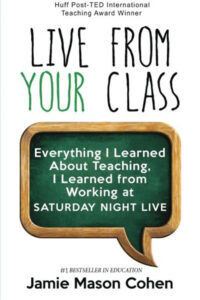
Live from Your Class: Everything I learned About Teaching, I Learned from Working at Saturday Night Live
I started as a little more than an intern. That is a broad company. That company produces TV shows, live shows and SBs. It goes on and on. I worked directly for Lorne Michaels in his orbit, Broadway Video Entertainment. This is his production wing. I worked for the show. I was young and I was more of a fly on the wall. I wasn’t an important player in that ecosystem but it allowed me as a young, ambitious and driven person to jump to different roles.
I learned things like how to pitch ideas because I was around people like Jim Sharp who ended up being one of the people who ran Comedy Central. I learned from several executives who pitched the TV, the film and as well as the show itself. I came out of there after a few years of having this behind-the-scenes but also this corporate understanding of how storytelling works and also where I might fit in the future.
How long were you there?
Four years.
There’s a great quote you have from Lorne Michaels that he would say that the show was not ready because it was finished. The show was ready because it was 11:30 on Saturday night and your whole focus is, “What’s your 11:30?” Can you explain to us how that relates to the audiences you speak to?
“What’s your 11:30,” is symbolic but in the context of Saturday Night Live, which is a metaphor that I use regularly in my talks, your 11:30 is that problem that you want to turn into a possibility or an opportunity. By the end of that week in Saturday Night Live, from Monday to Saturday, they have to have a show. There are people’s jobs on the line. Countless challenges come up. There are ratings they have to make sure they hit. Somehow this show has existed my entire life since 1975. This system works. Your 11:30 is, “How are you going to co-create a solution when you have a deadline in your timeframe that you need to make that happen?”
I’m sure there’s a story of, “We’re never going to make it,” or a celebrity going on after rehearsal. I’ve heard some stories. Whitney Houston was supposed to be in a skit and they didn’t think she was going to show and things like that. Do you have a story of the drama of last-minute people making a deadline or what you had to do when somebody didn’t show up?
I’ll pivot a little within that because what came to mind was someone who handled themselves so admirably and I learned so much from and how they dealt with that high-pressure situation when they had several challenges. That was Jackie Chan. I don’t know if he is the most famous or well-known movie star in the world.
Jackie Chan came on that show and I remember being backstage. That day, I brought my mom who came in from Toronto. She didn’t know who Jackie Chan was but when I pointed out who it was, she went, “He’s such a nice man. I can see he’s lighting up the room.” What Jackie Chan did so well was I watched him in the transitions between the commercial break and then coming out into the costume area where he had to change.
He never seemed to get perturbed or overly serious, which I do sometimes if I get stressed. My brow wrinkles and I look different. His energy with everyone was very balanced considering the situation. Jackie Chan also spoke English as a 2nd or 3rd language. I thought, “He’s going on live American TV in front of millions of people. There are no do-overs and yet, he’s running around backstage with a smile on his face, doesn’t look stressed even though 9 out of 10 even stars are stressed by that experience. He’s got this way of being still within the creative chaos.”
[bctt tweet=”Be still during the chaos.” via=”no”]
That was something where you asked almost the opposite. That was someone who walked into the fire and thrived. As a speaker, what can I take from that? That’s what you and I do. We spend a considerable part of our time standing in front of people, strangers and adults who might be judgmental based on where they came from. We have to somehow make them see something that can help them transform themselves. At that moment, Jackie Chan helped me see myself differently. If he can do that, maybe I can find that within me somewhere.
Isn’t that interesting that not even interacting but observing someone else staying calm and not panicking gave you hope that could happen for you?
It wasn’t his acrobatic brilliant stunts. The superpower he showed me at that moment was being quiet, staying calm, centered and present under pressure.
One of the things that intrigue me about your outcomes after people hear you speak is the difference between focusing on outcomes versus outputs. Can you give us a definition of what those two words mean to you and how that impacts productivity?
I heard this a lot before I started focusing on it. Companies would say, “We have a certain part of our workforce who works very hard and they want acknowledgment of how hard they work, not quite getting the outcomes that we need. How do we deal with that?” I look back on one of the themes in our conversation, Saturday Night Live or live TV as a metaphor for reaching outcomes on a deadline. You can’t hide. At the end of the week, there has to be that tangible show. The concrete sketch has to be turned into something real.
Nobody cares how many jokes were written if it’s not funny.
It’s how you show up. The way that I could simply define them and differentiate them is this. An output is a busy work. An output is an email. That’s important but is that getting you to whatever your ultimate outcome is to help your customers? Is that getting you toward the solution? It could be an email. It could be spending all day on ChatGPT, which I’ve loved doing. Just because I’m on ChatGPT, asking it to list five reasons for something, I’m impressed but it’s not necessarily helping me deliver my speech. It’s often busy work. It could be presentations.
Often, in companies, I found people think that a meeting is an outcome but a meeting virtually or in person, that’s an output unless it has a takeaway or something that’s going to directly move toward that solution. The outcome is the opposite of that. The outcome is solving a problem. The outcome is products. It is a service that helps someone solve their challenge or problem. You know if it’s an outcome because if you think of yourself or I think of myself, what value has the work led to that I am better off and my problem is solved? I have a solution that goes beyond the features.
It’s an actual solution that I’ve helped that person deliver. In some way or another, they are more evolved and less stressed. Whatever your promise is, that has led to that. That’s not to say we shouldn’t acknowledge the output. We need to acknowledge outputs in ourselves and others but we can’t stop there and say that’s enough. Smart work is ultimately more important than hard work.
I haven’t quite heard that before. I’ve heard, “Work smart, not hard,” but that smart work is more important than hard work is a great soundbite. There’s also a takeaway you have here about how to be creative on a deadline. Many people feel so stressed out when they’re given a deadline. Coming from the world of advertising, I was in advertising sales because I knew I was not the person that someone could come up to and say, “Give me twenty headlines by 5:00.” I would be deer in headlights.
I can come up with creative ideas when I’m not under deadlines typically or in the shower and middle of the night. A lot of people can relate to the challenge that my brain shuts down when I’m given a deadline to be creative. You saw that week after week for four years. Can you give us some a tip on what we can do if that’s our challenge?
Let’s go back to that Lorne Michaels quote and unpack that a little bit. Lorne Michaels said the show was not ready because it was finished. The show was ready because it was 11:30 on Saturday Night. What did he mean by that? What he meant by that is people will rise to the timeframe that you give them a task. If you and I said we have to produce this in the next 48 hours, we might not like it. We might kick and scream. We might resist it. Ultimately, if the stakes were high enough and it was urgent enough, we’ll finish in 48 hours.
Some of your readers might not like to read this but this is what the data shows us. There’s real data and organizational psychology that if you shrink your deadlines in half, your team will be more effective. You can take that as you want. People might disagree with that and that might not be popular to say. This is the outcome-based conversation that I like sometimes. If you are struggling with finishing something, give yourself a deadline where it’s cut in half.
[bctt tweet=”Shrink your deadlines by 50% and become more productive.” via=”no”]
Start anywhere. Start at the end if you have to. If you’re stuck at the beginning, find an accountability partner, which is the oldest thing in the book. As a matter of fact, I had someone on my podcast who is a three-time bestselling author and she’s the number one person in her field. She is ranked in several different studies I’ve seen. Yet she said that she is stuck and procrastinating on a passion project, something she wants to do. I told her on the podcast, “I will be your accountability partner. I am going to call you.” I’m going to remind her gently that it’s due. By the end of the day, she needs to take a step.

Signature Leadership: Find an accountability partner.
The other thing is to cut your deadlines in half because we rise to the timeframe. Find an accountability partner. This is not new and it sometimes almost becomes cliché because we hear it so often but what is your purpose? Why is it that you want to do this in the first place? If it’s not a priority, then the question I’d ask you is, “Is there a better project or goal to pursue now?”
I have two real-life examples of these deadline situations, having been in sales for most of my career and you schedule half an hour, maybe 45 minutes if you’re lucky to present. When I was speaking to a sales team in Canada, they said we’re given ten minutes. “The doctor will see you in ten minutes. You have ten minutes in between patients.” A lot of them are wasting those ten minutes by talking about facts and figures the doctor could look up for themselves.
It was my job to teach them how to tell a story or have something of value to intrigue them to want to keep talking. The same thing is true for a keynote speaker. I’m guessing this has happened to you because it seems to have happened to not only me but many of my friends who are in this keynote-speaking world. You’re booked for an hour.
Usually, if I’m the opening speaker, that usually works. Oftentimes, we’re the last speaker of the day. They’re running late and there’s a cocktail party that people want to get to, planes to catch or who knows what. They come up to you ten minutes before you go on stage and go, “Can you cut that down to 45 minutes?” There’s no time to edit the slides.
You talk about deadlines and creativity, first of all, your attitude and then your ability to not go through. Most people are like, “If I don’t have the time to rearrange my slides and cut slides, how in the world would I do that?” Anticipating those kinds of requests is the first step. I would love to hear your thoughts on this.
The question is what happens if this has happened to me as well? Even within that timeframe, you are asked to present. It could be as a professional speaker like we are or in a business meeting and your time is cut drastically at the last minute. What you said at the beginning is crucial. Your mindset going into it is, “I’m okay. I’m going to be okay.”
We’re coming full circle to Jackie Chan. I don’t know what to expect in terms of how they’re going to react to me. All I know is I can go out and deliver this presentation, talk or workshop because I prepared for it. I am ready because of what happened outside of myself that’s not in my control. The audience doesn’t know the difference. They’re not going to be upset.
They have somewhere to go after this. They probably can’t wait to go to lunch and it’s not personal. I am going to fit within the timeframe because my audience is also the event organizer and I want to build a relationship with them. You have two audiences. One is our event organizer. Like if you’re pitching, one is the executive and one is the customer and then there are the actual people in the audience.
Number one, if I make their life easy and I don’t pout and go or say, “Come on. I prepared for the last two months for this,” if I put all that aside and I have the Jackie Chan attitude, which is I’m going to smile, I’m going to go with it, I then will shift to, as a professional and say, “The number one goal here is to stay within my timeframe.” It depends on my structure.
I’ll give you one example. When I give my talk, it’s called Signature Leadership: Transform The Way You Lead. I look at the seven traits of renowned cultural icons and look at their handwriting. Get the audience to look at their handwriting. I then give strategies they can build into their work life to build more of these creative competencies or remove some of these barriers.
I won’t go through all seven. I will go through 4, not 7. I will make sure that my opening is not rushed. My opening is powerful. Like you’re the expert in, I’ll tell a story. At the end sometimes, I bring someone up on stage and I coach them or I do what I did with you. I’ll look at their handwriting and it will be the beginning or prompt for a short conversation about them.
If I have that opening and I have that end, do you think the audience is going to be asking, “Where are the other three traits? You only talked about four traits.” They don’t care. Yet I’m not rushed at the beginning. The beginning and the end are the most important parts of a talk. In the beginning, it’s like silly putty. I can move it or shake it and then we’re good.
That’s so helpful. Also in your book, Live from Your Class, you talk about the importance of laughter increases learning. Does that also apply outside of the classroom? Does it apply to corporate situations and corporate cultures? My question is, was there a lot of laughter in the process of creating Saturday Night Live or was everyone so stressed out? Did you see people who were nailing it, having fun during the week?
The theme of that book is when you’re laughing, you’re learning, which was by a public speaking coach and comedian in England named Jack Milner. When you’re laughing, you’re learning doesn’t mean you’re laughing all the time but there have been studies that show when you’re in a playful mood, you tend to be more creative, collaborative, easier to be around and a better leader.
[bctt tweet=”When you are laughing, you are learning.” via=”no”]
Laughing falls under the umbrella of play and joy. How do you feel when you’re laughing? You feel joyful and inspired. I don’t know about you. Even when I’m a participant on a Zoom call or Microsoft Teams or I’m speaking with groups of people, I’m not blaming them, I’m not judge judging, they’re looking down, they look sad and they’re not smiling. They are carrying a load of crap from the last meeting into this meeting. There’s heaviness.
People welcome appropriate humor, laughing and playing into situations. It’s surprising because it’s rare. I’m always looking for ways to help people within learning environments. I won this award, the TED Education, the TED Talk and International Award for Innovation. It was innovation around creating a curriculum for different levels of learning from kids up to adult education.
What I learned by applying what I had taken over twelve years of this study and application of building learning environments was if you can engage people on various levels on an emotional level, as you talk about, storytelling is part of it, on an analytical and appreciative level, you want to engage all aspects. Their brain and neural pathways are firing simultaneously. They will not only learn but they’ll have this emotional experience. The learning experience becomes an emotional unforgettable feeling that they take with them and they are more likely to apply it if they’re in that state.

Signature Leadership: If you can engage people on various levels, their brain and neural pathways are firing simultaneously. They will not only learn, but they’ll have this emotional experience.
Let’s go back full circle to the letter you wrote as a young man. Do you think there was some emotional state that you created when Lorne read that letter that made him decide to reach out, pick up the phone and call you or a lesson for someone who is trying to break through, whether it’s a prospect in sales or an event planner to get a relationship going for a speaking career?
We always are trying to grow our reach and network. When you look back at what you wrote to him, was it so heartfelt and authentic because you were that transparent and that he responded to it? Is there anything that you can see that you wrote that said, “I didn’t know I was doing it at the time but here’s what made him pick up the phone?”
Number one, it was short. I have found consistently that if you are at any age or level, if you’re attempting to reach out to people and cold calling especially but even if you have a distant thing, you’ve got to keep it short. Whenever I’ve gone against my instincts on that, I’ve been wrong. I have to explain my whole reason. Keep it short.
The next thing I did was I made sure that, without going over the top, there was a brief compliment specifically as to why I was reaching out. Not just why I’m reaching out but something about that person, even Lorne Michaels at his level, that inspired me. One thing I learned by being around some celebrities both then and in the years afterward was they do get bombarded with people who give them an almost superficial level of fandom.
There’s nothing wrong with that but, “I love you. I look up to you.” That doesn’t resonate as much as, “You did something years ago.” For him, I have to go back. I still have the letter in my journals that I’ve kept all these years. I talked about seeing him in the early days before he was on Saturday Night Live on a TV show on the CBC.
I saw reruns of that and I thought, “If Lorne Michaels started from where I grew up, maybe that’s something that I could aspire to on some level.” That’s not the usual introduction. It was authentic in how it was done and it was specific. Also, it’s getting to the point even in the form of a question to tell them what you want and if there’s a way that you can make it so that even if it’s 1%, it’s adding something of value to their life.
I’m improvising this because I didn’t know you were going to ask this question. It could be something like, “I noticed on your websites that you were looking to grow this area. You’re looking to hire someone who understands AI. I happen to be a graduate of Computer Science with a minor in AI. I have an idea that’s specific to solving that problem.” Most people don’t do that. Always end, if you can, with a quick question that’s confident. It’s not too aggressive but in some ways, you’re urging them a certain sense of urgency to want to get back to you. That’s hard but it’s doable.
Give them a compliment. Tell them why you’re reaching out to them in the form of, “I think I can help you with something,” not just, “I want coffee.” You and I, if I’m in LA or you’re in Toronto, if you’re around, I would expect you to say, “Do you want to have coffee,” because we have a relationship. If you don’t have a relationship with someone more successful than you, this is what a lot of people get wrong. I did the same thing.
Even successful people think, “I’m going to pick their brains.” Picking someone’s brain is coaching. It’s not fair to them to put them in a position where they have to ignore you, ghost you or say, “I don’t do that.” Most of them won’t say no. They just won’t respond. You want to flip that switch and offer them something specific to them.
It’s a two-way street. This has been so wonderful. I love that when we work smart, that is so much more important than hard work. It’s the distinction between outcomes and outputs, shrinking our deadlines by 50% and making us more effective, whether it’s in a team or individually. You gave us so many value wisdom bombs here. If people want to reach out to you to book you as a speaker by your book, where should they go?
My website. They could google me, JamieMasonCohen.com and I’d love to chat.
Thanks again for sharing your enthusiasm, your humor and most of all, your energy.
It’s my pleasure, John.
Important Links
Wanna Host Your Own Podcast?
Click here to see how my friends at Podetize can help
Purchase John’s new book
John Livesay, The Pitch Whisperer
Share The Show
Did you enjoy the show? I’d love it if you subscribed today and left us a 5-star review!
- Click this link
- Click on the ‘Subscribe’ button below the artwork
- Go to the ‘Ratings and Reviews’ section
- Click on ‘Write a Review’
Love the show? Subscribe, rate, review, and share!
Join The Successful Pitch community today:
- JohnLivesay.com
- John Livesay Facebook
- John Livesay Twitter
- John Livesay LinkedIn
- John Livesay YouTube
Becoming Kings With Johnny King
Posted by John Livesay in podcast | 0 comments

Our body is our kingdom. We keep the peace inside our kingdom. In this episode, Johnny King, the author of Becoming Kings, shares his insights on reaching our highest potential to become kings in our kingdom. Our inner kingdom encompasses our mental, emotional, and physical well-being; the outer is our purpose in the world, while the eternal kingdom is the things you take to go beyond our human experience. Once these three kingdoms are in alignment, that is how we reach our highest potential. Johnny also shares some tips on how we can become productive. Tune in to this insightful interview!
—
Listen to the podcast here
Becoming Kings With Johnny King
My guest is Johnny King who has some great insights and a description of how to work on your inner, your outer, and your external kingdoms. Enjoy the episode.
—
My guest on the show is Johnny King. Before Johnny became a transformational coach for men to help them reach their highest potential, he first had to discover his own. Amidst the recession of 2010, Johnny was broke. In fact, $35,000 in debt, jobless, and picking up the pieces of a failed marriage, he thought he was done. Little did he know it was the start of his journey.
He resolved never to experience hopelessness like that again. For more than a decade, he’s built and sold several successful businesses. He owns multiple short-term rental properties, travels the world, and operates a growing HVAC business. He sells his book Becoming Kings worldwide while producing a podcast that I’ve been fortunate enough to be on called Becoming Kings. Out of the pain of countless losses, he systematically designed his habits and routines to create a life he fell in love with. He’s now teaching others those tools so you can realize your own dreams and truly become the king or queen of your kingdoms. Welcome to the show.
Thank you. It’s a privilege to be on and to connect with you once again.
We were talking before the show about how we spontaneously ran into each other at a dinner in Austin, where I live and you live in Denver, so it was completely unexpected and a lot of fun.
I got you by surprise, for sure.
I don’t know about you, but I put people in categories like this person lives here and I only live here. I’m like a man at the airport and I run into somebody, I’m not as shocked, or at a sporting event or something. You’re like, “There’s a lot of people here.” That was an intimate 30-peer supper club event. What are the odds of that?
As you well know, the longer career we have, the more people we connect with, so the more likely you’re going to run into someone and it’s hard to always connect a name with a face. Along with anything else, that’s a challenge for sure.
For me, moving to Austin years ago at the peak of the pandemic, even though I’ve been here for years, doesn’t feel like that. I feel like I’ve started to find my tribe and my friends. I lived in LA for many years and I would run into people much more frequently there. Anytime anybody knows my name at a grocery store or anything in Austin, I’m always shocked. Tell us a little bit about your own story of origin. Can you go back to where you grew up, college, or school where you got onto this journey of having some success before 2010 came along?
Similar to you, I grew up in the Midwest, primarily in St. Louis. The short of the long ultimately is that I grew up in a relatively traditional blue-collar, white-collar, Midwestern family with four other siblings and was busy and always running from sporting events to choir concerts to everything else. The older I got, the more I realized that there were things going on between my parents and their relationship and how deeply that started to affect my own behavior in relationships, romantic relationships, and my relationships with my parents.
My father was a workaholic and primarily, he was around, but he wasn’t necessarily emotionally present. That’s such a gift to have that level of that connection and that presence. Ultimately, my mom got ill in 2006 and passed away. It was not easy, but the first record scratch in where I thought my life was going in my vision of it.
I had gotten married shortly thereafter. My father came out of the closet the year after that. The year after that, my ex left. Everything that I knew for what my life was going to be on the trajectory I thought it was on was blown up. That started the journey of, clearly, the man that I had become, and the life that I created was all facade, quite frankly.
It was legit, but I was trying to fake it until I make it because I was so insecure. I didn’t know what it meant to be a man. I started to heal myself and my relationship with my father. All those things brought me back to being where I am now, proud of who I am, happy with what I’m creating, and having my father be one of my best friends, which was great.
What a full circle that is.
[bctt tweet=”Productivity is achievable in small steps.” username=”John_Livesay”]
That’s a huge part of my journey, for sure. That’s the short of the long.
Lots of healing there. It’s funny, I watched the Garth Brooks documentary on his life and you look at that career and you’re like, “Wow.” You don’t realize that even someone at that success level struggled for a long time. They left Oklahoma, went to Nashville, and came back in 24 hours like, “This isn’t for me.” He has this amazing career after getting discovered, and then in the same year, much like you.
This is what I find so fascinating about stories. We don’t have to be a famous person to have these kinds of events, multiple events. A divorce, dad coming out, career, financial challenge, any one of those things by themselves knocks people down and keeps them down for a while. I call it the 1-2 jab. I’m not even fully standing back up from that.
Garth says, “I got divorced after many years. I have kids with this woman. I lost my mom, my closest supporter.” That was devastating. You went through that with your mom getting sick and then finally, he decided to retire from performing because he wanted to spend time with his kids. He goes all in the same year. Talking about losing your identity. That’s why I was like, “Look at you. You had that 1, 2, 3 like Garth did.” For seventeen years, he was not performing. He’s remarried and his new wife said, “I think you should go back on the road.” He said, “Is anybody going to remember me?”
That journey, whether you’re a man or not, of being disrupted and getting knocked down is huge. Your name is King and the title of your book is Becoming Kings. I love some of the takeaways in this book. The one I wanted to start with is how can we avoid this ordinary person mindset and not sabotage our life of abundance.
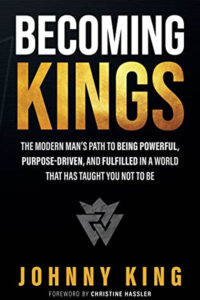
Becoming Kings: The Modern Man’s Path to Being Powerful, Purpose-Driven, and Fulfilled In A World That Has Taught You Not To Be
Abundance is not, for me, defined strictly by money, but it’s how many friends I have. Do I have an abundance of health? Do I have abundance and joy? I’m asking you to describe, first of all, what abundance is and then what we are doing in our minds to prevent us from feeling like we don’t deserve it, do you think?
Answering your first question, I feel like abundance ties into yes, my last name is King and yes, I’ve played my branding off of that, but I feel like it’s always been something that I’ve been connected with and driven towards. It is wanting to live a life where I have exceptional health physically, emotionally, relationally, and financially. Back in the old days, a king obviously reigns over the kingdom and has riches and everything. I wouldn’t say so much that my definition of being a king is that traditional, let’s say, but more focused on what we as men have control over in our lives.
You could have a lot of things. You could look like you’re a king and yet still be deeply insecure and hurting. You could be addicted to various substances, doing horrible things in the world. That’s certainly not what I feel is a king. That gets to answering the second question, which is what I feel prevents us oftentimes is our own insecurity. That has a lot to do with our upbringing and our lack of mentorship.
That ordinary mindset is, “Who am I to think that I’m going to be successful? Who am I?” It’s almost like impostor syndrome a little bit.
It’s 1 of 2 things. I do feel like there are a lot of people that are “hugely successful” and yet they are so driven by their insecurities. They’re like, “I’m going to prove the haters wrong,” and everything else. My father, too, was driven that way and I can relate to it as well. We have these deep underlying skeletons in our closet that we’re not enough and that we’re not lovable, so I must achieve X, Y, and Z.
I feel like that’s what guys oftentimes do. If I can get this thing, if I can get this person to hitch their wagon to mine, if I can have this many commas in the bank or live in this area of town, then I’ll be set. A lot of times, we get it and then it’s not there. We’re like, “Is this all?” Nothing changes. If anything, we’re more depressed and lonelier.
I remember a friend of mine in LA was an actress and very successful for a period of time, so much so that she could afford to rent a beach house in the Malibu colony. She was on this successful sitcom and she was never more depressed. Nobody wants to hear about it because you’re living the dream. You’re on a sitcom, you’re in the Malibu colony, and you wanted to throw a 4th of July party. What most people don’t realize about Malibu is it’s foggy in July. They call it the gloom June, which extends into the 4th of July holiday.
There you are and you can’t see the fireworks and so nobody wants to come and it’s cold. You think the show you’re on is stupid and it’s not why you became an actress. You’re, again, feeling so isolated that you can’t complain because you’ve got the money. It transcends gender. I used to do that. “As soon as I get out of college, I’ll be happy. As soon as I live in this neighborhood, I’ll be happy.” I remember talking to another friend of mine who lived in Bel Air and she said, “Everyone always says the grass is always greener. What I’ve come to learn is it’s all grass and it all needs to be mowed.”
We’re defining ourselves by our ZIP code and the prestige of our address or our car and all that stuff. That’s why it wears off after a while, doesn’t it? For me, the whole process of buying a house is so arduous, but by the time escrow closes, I’m like, “I don’t care anymore.” Even the new car is fun and then it’s been a couple of months and now, that’s my new norm. What is it that you help people become, as you say, mentally bulletproof so that we’re a little free of all that? That’s one of the things in the book that’s so powerful.
I’ve learned this by having these types of amazing conversations. These are not my original ideas. I have learned that for me, a lot of my healing has come through relationships with myself, with God, with my dad, making amends and various other things, and taking responsibility. A lot of my identity, the way that I viewed myself before, was in my relationships of how I attached to people or attached my value or my sense of self-esteem or self-worth to what they thought of me.
I was somewhat of a chameleon. I was inauthentic in my interactions with them. I was never taking ownership of my own fulfillment, my own sense of self-love, peace, and congruency. I feel for anyone to be ultimately bulletproof would be to get to the point where sticks and stones can break my bones, but words cannot hurt you. It’s because you’re very secure with who you are. That’s ultimately not what I feel like a king or a queen. Not to use those words obviously, but someone who knows themselves through and through has very few craps to give and they love what they do.
They love people, they’re present, and they’re great at what they do. They’re like your 2:00 AM friends who, if you had a busted down car and you needed to call someone, you could rely on them. We’re blessed if we have multiple of those people in our lives. I feel like a lot of guys who didn’t have very great role models in their lives learned to be very pleasing, yes men, if you will, which is inauthentic. We were too worried about getting our feelings hurt or hurting other people’s feelings. At some point, to be bulletproof, you got to know yourself, have done the work, and know that you’re not going to make everyone happy and that’s okay.
Even as a sales keynote speaker, I have to realize that not everyone’s going to resonate with my message or me and that’s okay. When you’re free of being at the effect of other people’s opinions of you, then you’re off that self-esteem rollercoaster. If you’re willing to put yourself out there as you do, where you have these programs for men and helping them become resilient, helping them get fit, and helping them with their mindset, there’s going to be people who critique that.
Whether it’s on a YouTube comment or as a speaker, they usually send out surveys. The odds of all 500 people or however many on the audience loving you, some people are going to go, “He’s okay,” or some people rave, but if you let yourself attach to, “That person liked me so I’m okay and this person didn’t, so I feel bad about myself,” it’s exhausting, isn’t it? I’ve been on it.
It’s relentless. You don’t sleep. You can’t concentrate. You can’t ultimately be present for other people.
You talk about there being three kingdoms that we should each build. Can you tell us what those are?
I talked about them a little bit already without saying the names, but it’s your inner kingdom, which is where you first start. It’s that relationship with yourself where most guys think that, as we were saying earlier, the solution to their problems is an outside-in job. They’re looking for something outside of themselves to solve or fill the big void that’s within. It’s an inside-out job. You’ve got to work on the inner kingdom, the mental, emotional, and physical health.
You have the outer kingdom, which is more about what’s your purpose in the world. What are you here to build and contribute? At the end of the day, the older we get, the more we realize how short life is. What are you here to do? What’s the impact? Your eternal kingdom focuses more on what things you get to take with you beyond this human experience. We don’t get to take our bodies. We don’t get to take any of the things that we acquire, but I believe that we get to take the love, the memories, and the relationships. The eternal, long-lasting, never-ending kingdom is where the juice is. It’s the interactions with people.
It’s a little bit of a legacy that you’re leaving behind. Children, you can still leave a legacy, relationships you’ve built, or something you wrote that inspired someone. I love that you’ve labeled those. You’ve taken that branding to a whole other level. Why I’m impressed by that, Johnny, is it’s memorable. I’m always striving for what I can create and say that is memorable and actionable. You have labeled those in such a way that if something’s not working, we now have a go-to checklist.
Is this an internal thing? Am I not exercising enough or am I so depressed, upset, grieving, or whatever it is that the inner work is not happening? I’m not meditating or doing whatever we need to do. Is it, “I don’t even know what my purpose is?” That’s why people hire you. They go, “I’ve lost my way. I didn’t grow up wanting to be an accountant. Do I have to do this the rest of my life because this is what I know how to do, golden handcuffs? Is there another purpose I could maybe figure out?
People retire and they don’t know what their purpose is if they don’t have that job and that title anymore. There are so many people who need what you do at different stages of their life. I’m pretty disciplined and I know my purpose is this. I went to a friend’s memorial and I realized I don’t have any legacy. I’m blowing all my relationships off the minute work makes one request that I’m so afraid of saying no to because I won’t get that promotion or whatever else. There’s no balance here. I’m painting a picture of all the different scenarios of why people would want to come work with you. Is that pretty close?
[bctt tweet=”Failure to commit is the high cost of low living.” username=”John_Livesay”]
That’s close because before I’d started working with men, I was working with women for eight years. I was doing a lot of health coaching, which was anything but health coaching. It was all psychiatry and everything else, being like a therapist. I’ve started to realize so many of these women had amazing relationships with their spouses. They were a great mother, and they loved what they did, but their relationship with their physical health and their inner kingdom was blowing up all of it.
It’s similar to my mom. She had so much that was going for it, but because she didn’t take care of her own health, she passed away at 61 years old. A lot of times, when we would get into it, sure enough, there was a rape or an abortion. There was something that was unresolved. That was why they were overeating. We all have our things. That’s a hard one to hide when you have excess weight on you. A lot of us who are, let’s say, healthier can still hide porn addictions, alcohol, sex addictions, or gambling addictions. It’s oftentimes the result of things that we’ve had that are unresolved.
You might have a great body and a great business, but you have no legacy or no one to share life with. You’re like, “What is this all about?” You could have someone who’s amazing in your life and you could have great health, but you have no real passion towards something that you’re building. You have to have all three. I see them as like circles that overlap each other and right in that sweet spot where they all overlap is that congruence. That’s where I feel like a king ultimately lives.
It’s like a three-legged stool. With a missing leg, it’s going to fall over. I see here you also can help people with productivity. You don’t have to have attention deficit disorder to have challenges with distractions. We’re constantly being bombarded with distractions and people go, “I didn’t get anything done. All I did was put off fires.” I hear that often. What is the one little tip that could intrigue people to want to engage you to learn how they could be a little more productive?
I struggle with it too. I’ve attempted to eliminate as many distractions, particularly off my phone. However, because our phones are literally on us pretty much 24/7 when they weren’t twenty years ago, it’s so crazy difficult given that we’re all pretty much connected to devices in general. One simple one that, to me, makes a massive difference because I know of so many people who scroll at night, the first thing they do in the morning is to scroll is putting their phone across the room.
It’s such a simple thing. I charge it across the room so when I put it down and then get into bed, I can’t grab it. That is a big part of allowing yourself to slow down and then be able to focus on what you are aiming towards. This is a lot bigger conversation to do a whole episode on but focuses more on your external outer kingdom. What are you committed to? What are you creating? What’s your impact on the world?
In what way are you going to bed knowing that when you wake up, you have a fire lit underneath you to get those things done? There are so many different hacks that I have in my programs that help you be productive because I’ve had to work for myself for many years. I got no one to whip me or any boss to tell me. I have to get stuff done. Otherwise, there’s no food on the table. There are a lot of things there that we could get into.
You have worked on your own story, your own three kingdoms, and it shows. When I ran into you in Austin, you were happy. Your face lights up and I don’t feel you can’t fake that. When you feel someone’s energy and you don’t know what’s off, you go, “I don’t know what’s on, but everything’s on with this guy. I feel it. It’s not like he’s faking it.”
You’re walking your talk and that’s why people want to work with you. They can start by listening to your podcast. They could buy your book Becoming Kings and then the weekly newsletter. There are lots of ways to work with you. Do we just send everybody to JohnnyKing.com? Is that the best place for everyone to get into your world?
There are so many people obviously that are out there that can support. One of those things that you have to look for is some type of resonance. Do you connect with someone? I work with Christine Hassler and Stefanos, who are down there in Austin as well. They work with Preston and Alexi. I’m always looking for that type of person to connect with. Similar to you, people can look at my website and see what I’m up to and if what I’m doing resonates with them. If not, like connect with me and I’ll put you in touch with some people who are also amazing coaches.
It’s because you come from a place of abundance. That’s what I like about you.
I’m here to serve and connect people with.
It shows. Any last thought or a quote you want to leave us with?

Becoming Kings: What prevents us from becoming kings and queens is our insecurity. That has a lot to do with our upbringing and lack of mentorship.
There are several quotes that are up in my room that I look at, but there’s one that says, “Failure to commit is the high cost of low living.” It’s the commitment to improve, the commitment to be, which is scary to get out of the rut of. I know on paper everything looks good, but there’s something missing. It’s scary to upset the apple cart. Start creating healthy boundaries and start doing the work to figure out who we are and who we might love ourselves as. The lack of commitment usually results in a lot of regrets, so I don’t want to live my life that way.
Thank you, Johnny, for being you, for writing your book, and for offering so many ways for people to get all three kingdoms at maximum. Your impact is huge and I’m happy to be someone in a small way to get that out into the world. Thanks for coming to the show.
Thank you. Likewise, your energy is palpable, but it’s contagious. I saw you and people want to be around you. It was fun to connect and so fun to have you on my show. It’s fun to be on yours. Thank you for having me on.
My pleasure. See you soon in Austin.
You bet.
Important Links
- Johnny King
- Becoming Kings Book
- Becoming Kings Podcast
- Better Selling Through Storytelling Method Online Course
Wanna Host Your Own Podcast?
Click here to see how my friends at Podetize can help
Purchase John’s new book
John Livesay, The Pitch Whisperer
Share The Show
Did you enjoy the show? I’d love it if you subscribed today and left us a 5-star review!
- Click this link
- Click on the ‘Subscribe’ button below the artwork
- Go to the ‘Ratings and Reviews’ section
- Click on ‘Write a Review’
Love the show? Subscribe, rate, review, and share!
Join The Successful Pitch community today:
- JohnLivesay.com
- John Livesay Facebook
- John Livesay Twitter
- John Livesay LinkedIn
- John Livesay YouTube
Mental Fitness With Rob Roell
Posted by John Livesay in podcast | 0 comments


Who says fitness is all about the physical? Rob Roell, Executive Coach at Equilibrium Coaching, believes we also need the mental stamina to unlock our true potential for professional success. In this episode, he joins John Livesay to talk about mental fitness, what it is, and why we need it. He dives deep into the imposter syndrome, the ways social media amplifies it, and how we can overcome that through mental fitness. Offering some great tools, Rob discusses the book Positive Intelligence, where he highlights how we can be more productive and fight off what is called mental saboteurs. Achieving success is not just about having the physical capacity to work towards our goals. It is also about having the mental part taken care of that helps us see through the challenges along the way, especially in this modern world. Join Rob in this conversation as he helps us become mentally fit.
—
Listen to the podcast here
Mental Fitness With Rob Roell
Our guest is Rob Roell, who is an Executive Coach that helps clients unlock their true potential for professional success so they can increase their performance without all the anxiety and stress. He has created a wonderful book called Positive Intelligence, PQ if you will. It’s a simple yet powerful operating system that allows you to become mentally fit like with physical fitness require some practice. This Positive Intelligence is developed with coaching in mind. He has been able to improve clients’ progress with their goals.
—
Rob, welcome to the show.
Thank you very much. I need to correct you. The book is not my book. The book was written by Shirzad Chamine, which is a great opportunity to give him credit for the foundation that I work from.
I have had some people do that with other people’s work. They give credit, whether it’s Simon Sinek’s Start With Why. It’s so wonderful when someone creates something so valuable that other people can be credited and make it a basis for a foundation and get the training directly from that.
This stuff is incredible work. It’s foundational for me. I use it as a foundation for all of my clients.
Tell us a little about your own story of origin. You can go back to childhood or school. How did you get involved or interested in coaching and helping people?
Years ago, I was at a Tony Robbins program. One of the trainers that I was working with saw something in me that can happen like a bubble went off in my head. This was something that I wanted to do. When it came together like one of those meant to be moments, I was talking to a friend of mine after the program. He’s like, “Rob, have you ever done this before?” Without even blinking or missing a note, I said off the top of my head, “It’s funny. I have been doing this all my life. I’ve never got paid for it.” It’s true. I have always been that person in every group of friends that people come, seek out advice, knowledge from and the shoulder to cry on like, “Rob, can you come over here? I need to talk to you about something.”
It fascinates me because of your background. You have a Master’s in Electrical Engineering. Nothing against engineers but as a species, you guys are exactly known for being right brain, warm and fuzzy. You toggle back and forth.
There is a reason that we use that term binary. Engineers tend to be left-brain cerebral thinkers. History-wise, my last run in the corporate world was what would be called a sales or a systems engineer, which is the person on the sales team that helps the customer to understand technology. That’s something you wouldn’t traditionally think of as an engineering role. It’s one of those places that I have always been in that unusual space between what traditionally I was trained for and what comes naturally to me.
[bctt tweet=”Celebrate your wins.” username=”John_Livesay”]
In a way, you are a translator of tech to something understandable. The same thing seems to be happening to me with this Equilibrium Coaching because a lot of people say, “I’m great at decision making. People like and respect me and yet in my personal life, I feel like I don’t have the same skills.” You can help them translate that.
I’m a little bit of that. What we tend to focus on are those things that aren’t working optimally in the business realm. The beauty is, call it stealth coaching, call it whatever you want, all of those things that they learn to use in the business world to make themselves feel more productive, happier, less stressed, translate over into the personal life, whether it’s a relationship with a partner, with kids or fitness. Whatever it is, it all translates.
Many people, no matter how successful they are, even celebrities, suffer from impostor syndrome. Let’s define what that is and what that looks like. I know I have certainly struggled with it when I was speaking at a Coca-Cola summit. I looked at all the other speakers who had MBAs from Harvard and New York Times bestsellers, I’m like, “That’s going to trigger any insecurities that would do it.” I’m a big proponent of not comparing myself to other people. I find we still all tend to do that sometimes, don’t we?
A lot of it is cultural. Nowadays, we like to bang on social media. Social media is the source of many issues. I’m a fan of the fact that social media is the accelerator. All of that stuff was there. Social media made it easier to put it all out into the public. Impostor syndrome, at the end of the day, it’s a part of what goes on with people. It’s that part of you that doubts, that judges yourself about, “Am I good enough? Have I done enough about this?” It’s that thing that keeps us up at night thinking, “Did I do everything? Did I check all the boxes to move me on powerfully?” Unfortunately, we are in a society that reinforces this idea, “You’ve got to get it done. You’ve got to get through. It’s going to be tough. It has to be tough to be worthwhile.” In some ways, that may be true. It doesn’t have to be tough on you emotionally, physically and mentally. It doesn’t have to be Pollyanna but you can do everything that you do from a positive perspective, rather than trying to attack it from the negative perspective. It’s going to get you there. It’s going to get you some success. Are you going to be happy? Are you going to be fulfilled? Likely, not.
I will never forget. I was friends with an actress when I was living in LA that had the Malibu summer house on the beach with all the other celebrities and was on a sitcom. She was miserable. She said, “No one wants to hear it,” because she’s living the dream of an actor. Getting on a show and having that lifestyle, then you are still miserable. She didn’t like the show, not well written and was embarrassed to do it. The stress of it is going to be canceled or not. Nobody wants to hear that. They want to hear you on Malibu and show. You must be happy. If you are not happy, don’t talk about it.
We could go down a deep rabbit hole about all of our societal issues with mental health. People don’t want to hear when their version of you, what they see of you is everything they think that they want.
You are busting the illusion. As soon as I had this concept, if I had that, I would be happy. I understand why I’m not happy. If you tell me that if I get that, I’m still not going to be happy, you are going to blow my circuits.
A Buddhist saying or wherever it comes from, you think about what comes first is, is success generates happiness or is it happiness that generates success?

Mental Fitness: People don’t want to hear when their version of you and what they see of you is everything they think they want.
We see all these famous people like Kate Spade or that amazing chef who committed suicide, Anthony Bourdain. I ask myself, “There it is again.” If you are not happy, all the money, fame and whatever in the world that you could want, what you are doing is crucially important. If we do this as soon as I get this, I will be a happy game. It’s a zero-some game. We have to be happy where we are, is what I’m hearing you say. Many of us are going to need some coaching to get there.
Honestly, I love it. There was some point in reading your book. There was this one saying that we are kindred spirits here. You talk about this internal voice that tries to protect us. I have the quote here, “The internal voice that tries to protect us by diminishing us and critiquing our performance.” The world I work from the positive intelligence mental fitness, we call those the saboteurs.
It’s valuable to label it. You are like, “Who’s speaking?” If I’m the thinker thinking these thoughts, “Who’s in my head telling me all these horrible mean things?” What I’m fascinated by with positive intelligence is that it’s so measurable. We know if we have worked out, we can measure our waist or our biceps. We go, “I’m getting results.” There are actual ways not to try to boost your mental fitness but measure it. Can you explain how that works?
The way that you can measure your mental fitness, Positive Intelligence gives us some great tools. If you already go to their website, they have several assessments. One is you can measure your PQ score like you can do an IQ test. Nowadays, emotional intelligence and EQ is a big thing, especially in the executive business world. You can also measure your PQ. It’s a ratio of how often you use positive reinforcement and positive perspectives to rule your life versus how much you use the negative. Where it becomes important is you get a score of 0 to 100. The target is you want to be above 75%. If you want, I can go into the science that goes behind it.
Let’s hear a little bit about Science. Here’s what a friend of mine who writes for Inc Magazine told me, anything that they write with a headline or an article about how our brain works get more clicks than anything else. Good to know. I get a chance to interview someone as knowledgeable as you that understands and can give us some valuable information on how our brain works or why something works for our brain. It seems to me that the data is there that people are interested in this. Let’s hear the highlights of it.
Look at that ratio. 75% to 25%, that’s a 3:1 ratio. The idea is that the saboteurs I mentioned live predominantly in that primitive part of your brain. The part that wants to see the leaves rustling out in the jungle just in case there’s a tiger there to come after you. It’s served a purpose at some point in our human development. Not so much now. Aside from Houston, there are not many suburban areas you are going to find a tiger rustling the tree. What that does is your brain is tuned on this 3:1 ratio to look more for something that’s going to go wrong than for something that’s going to go right. You want to be above a 3:1 ratio to be able to have an opportunity to override that tendency of your primitive brain.
It’s a survival mechanism. I heard something similar when I interviewed Steve Rohr, who wrote Scared Speechless talking about you and I are both speakers. Our brain is wired to never be separate from the tribe. When you are standing in front of people, your fight or flight response is kicked in and says, “What are you doing? The tribe is out there. You are all alone. You are going to get picked off.” I think there are some interesting things there. This concept that we are always looking for what’s wrong or could go wrong is part of the pre-wiring. He talks about when you are standing on stage in front of people, your brain is wired to say, “The tribe is out there. You are up here by yourself. You are in danger. You could get picked off by a predator.” We have to override that. That’s why people get so scared to speak. The same thing is true in our everyday life about what is going on that feels like we are not enough. We think hard to try to do this.
Going back to social media as an amplifier, you almost get this badge for being in that negative space. You post something negative on social media and everybody goes, “That’s so cool.” There are a lot of positive voices. It would be interesting to see. Is there a 3:1 ratio in that sense on social media?
[bctt tweet=”Treat mental fitness like it was physical fitness.” username=”John_Livesay”]
In journalism, if it bleeds, it leads. All of that click-through. I wrote something about this whole process of moving. I have done this a few times. Every time, I’m like, “By the time I move in, all the joy has been sucked out.” With the endless requests for the loan, problems with this, delays and you have your house inspected. Your whole focus is on everything that needs to be fixed.
It starts with that 3-inch stack of paperwork you have to sign to finalize the house.
You are thinking, “I am determined.” Ten things need to be fixed in the house, even a new house. That’s part of the process. We always have a choice toggling back and forth of, “Am I going to complain or am I going to be grateful? I have a roof over my head.” It is challenging when you keep getting knocked down or it’s one thing after another. The movers break something. There’s a leak in your roof. The laundry list is huge of what you can focus on to be upset about or you take a breath and go, “You broke something. Take a picture. I will claim, next.”
In the positive intelligence contacts, what you are talking about there is switching. We mentioned these saboteurs. Saboteurs are all within us. Let’s start there. To counter that is another part of us that’s also within us is the sage. It’s that part of us that wants to operate from the good. The sage starts with a sage perspective that everything in life that every challenge brings with it a gift and an opportunity. That resonates where you are now.
I always think this is going to make a great story, even it’s horrible. I can turn this into a story. I have heard people who write for movies go, “They are always looking for all. This is going to make a great script.” With that sage advice for me, I would love your opinion on this about zooming out. I do the 555 thing I made up, which is will this matter in 5 minutes, 5 days, 5 weeks, keep going. You realize, “Five days, zoom out. I’m so upset because this happened.” You are like, “This ability to have a sage perspective.” Ideally, the longer we live, the more of a sage we become. I have lived through this. That’s some good times and bump times. I have seen them all. I’m still here. That philosophy is sometimes difficult if you are younger. I see people get so obsessed with, “I thought I would be more successful by the time I hit this age. I probably making the 30 under 30 Forbes lists,” whatever their mindset is. How do you help people who, even if they are not “older,” are still so unhappy with where they are? You think, “As soon as I’ve got this, I would be happy.” You get that and you are not happy.
When we get there, we tend to focus on the thing we miss. In reality, we haven’t taken account of all the things that we gained along the way. There’s a famous speaker and one of his quotes is, “Shoot for the moon and the worst thing that happens is you land amongst the stars.”
That’s from an old Bette Davis movie.
Realistically, that’s true, especially when you talk about high-achiever mentality people. We look at the goal. If we don’t reach the goal, it’s a total failure. We don’t celebrate our wins along the way. Quite often, we don’t even define clearly what that goal is.

Positive Intelligence: Why Only 20% of Teams and Individuals Achieve Their True Potential and How You Can Achieve Yours
It’s always elusive. I remember when I was ten years old, I thought my dentist was so great. I thought maybe I will be a dentist. I was talking to him about it. He goes, “I settled on dentistry. I wanted to be a plastic surgeon.” I was like, “What? You settled on being a dentist.” Everyone has got this, “I’m still not happy. It’s not my dream.” From the outside looking in, you think it is. As you said, we have similar philosophies. This concept of perfectionism is a curse. I would say we need to reinvent and come up with a new word progressionist. You and I are progressionist to help other people to celebrate their progress.
The human brain and existence are geared around progress like a core coaching tenant are helping clients create progress. We also know it was one of the big personal development quotes. It’s like progress over perfection. You will hear me quote Tony a lot, I volunteer in his environment. I hear his stuff continually in my head. Tony says, “Perfection is the worst goal of attainment because it’s unattainable.”
It creates a barrier. If you come across perfect, no one can relate to you. There’s no connection. I know you pride yourself as a speaker on having this bond with the audience. Talk a little bit about how you do that.
I know you are a fan of the story. For me, my story was speaking. I was speaking in the corporate world. I was very powerful as a systems engineer or sales engineer however, I never felt like I was connected to my audience. I could spew the data, tell good stories and do well in that sales environment. When I first hired my speaking coach, that was the one thing I wanted to tackle more than anything. He’s like, “Rob, it’s very simple.” Throw away all that BS garbage that speaking coaches tell you about looking over everybody’s head. He’s like, “Find one person in the room and have a conversation with them and then find another person and have a conversation with them.” I know you have spoken from stage. Anybody that’s ever spoken from stage, you get the fact that when you speak to that one person, you get that radius effect. 10 to 20 feet out, everybody thinks you are speaking to them and then you feel connected. They feel that. It builds on itself.
Even if you go to a concert where you listen, sometimes the singer will say, “I want to tell you.” You feel like they are talking to you. There are thousands of people that are in the dark. That is fascinating, whether it’s 300 people in a ballroom or how many people Staples Center holds. That successful banter in between the songs creates that emotional connection. The other thing that I’m fascinated to ask you about. I have noticed that people who stay curious are the ones that seem to live long, healthy lives. People who are bored easily seem to be miserable all the time and tend to have unhealthy lives and not live so long. It’s the people who are like, “I decided I learned another language.” You are 80 years old. They are like, “I want to learn something new.” You are constantly up-to-date on what’s going on in the world and staying curious. What are your thoughts on being curious? I know it’s a big outcome of what mental fitness looks like. Are there things that people can do to increase their curiosity if they are not naturally curious?
One is bringing attention to it. Creating intent, when you create intent around wanting to be curious, part of it is like anything else. Creating that mental muscle to be curious takes practice. You have to remind yourself consciously from time to time, it’s being intentional about being curious. I mentioned the sage earlier. The sage has five powers. One of those sage powers is explored. The power game we play around sage explore is the fascinated explorer. Think of yourself as Indiana Jones. You notice how I’m leaning in. It’s having that posture of leaning in, listening closely and intently. Being curious has all of that around it. I get goosebumps talking about that.
The outcome besides being happier is this increase in productivity. Can you speak to how mental fitness helps us be more productive?
We were talking about these negative voices that go on inside of our heads. If you were to sit down and journal about how much of your time you are spending combating that. If you were to minimize those voices in your head, how much more productive would you be? At the end of the day, the studies show us that average people are over 30% more productive when they are coming from a positive mindset rather than a negative mindset in everything they do.
[bctt tweet=”Social media is the source of so many issues.” username=”John_Livesay”]
That’s huge. I didn’t know it would be that high. That’s a very surprising statistic. I would think maybe 10%, but 30%. Imagine, if you decided, “I can start work 30%.” I don’t have to work five days a week if I’m hitting my goals if I’m thinking more positively.
The high achievers out there going, “I still work five more days.”
I would keep Elon Musk. I would go to the moon. I would take us here.
The thing that’s nice about that extra productivity, you are not only more productive, but you are also happier while you are doing it. One of the metaphors that I love that Shirzad loves to talk about. He used to be an instructor at Stanford. He would talk about these concepts at Stanford. His students nicknamed this Jedi Mind training. I remember when I watch Return of the Jedi, Luke training with Yoda out on that planet Dagobah. It’s like, “I want to train with Yoda.” That’s what it was all about. How could Luke be calm, clear and focused in the middle of all the chaos of battle and everyday life?
That reminds me of what I watched in the documentary about Tiger Woods and how his father would constantly distract him while he’s practicing so that he had to get into the zone. When all the pressure was on, he could tune it all out. If athletes have to do that, when we are called on to perform as a speaker, in a business situation, you are pitching to win new business or whatever it is, if you are distracted by the hum or a look someone gave you, 101 things can distract us. Your phone going off and all that. Maybe you turn the distractions off that way. As you talk about laser focus, your ability is so important to mental fitness. That requires some work, doesn’t it? It’s got to get cleaning away some stuff.
Let’s put some foundation around this idea of mental fitness. To state the obvious, it’s based on the idea of physical fitness. When you are physically fit, you can climb a steep hill. You can jog down the street without losing your breath and without having physical stress. The same thing with mental fitness. When you are mentally fit, you can deal with life’s challenges without all the stress, anxiety, doubt and frustration that can come up all of the negative emotions from being in life. To be mentally fit, it’s not something that you can turn on just like that for the average person. To be physically fit, you have to train regularly to be there. Michael Phelps didn’t become a world-class swimmer by going to the pool once a week.
I have a story. When he was young, his coach said to him, “Michael, are you willing to work out on Sundays?” He said, “Yes.” He goes, “We’ve got 52 more workouts from the competition.” People go, “It’s not his physique. It’s not he got lucky genetically. In the end, he put in that extra work.” That’s important for people to realize you don’t suddenly get into shape overnight physically. Why would you think you could mentally with a few affirmations?
At the end of the day, mental fitness is a concept of being more positive than negative. It’s creating a practice around that. It’s something you do regularly. For me, knowing that I was nervous coming in here, I did somewhat we call them PQ reps, positive intelligence reps. There are about ten seconds a piece that help you to become more body-centric and centered. To put it, it helps the part that minimizes those saboteur voices in your head nice. When you are there, that gives you that opportunity to choose to take on the sage perspective.

Mental Fitness: When you are mentally fit, you can deal with life’s challenges without all the stress, anxiety, doubt, and frustration that can come up from all of the negative emotions in life.
I call it stacking your moments of certainty. 2 or 3 times, when you knew you had a good interview, you are like, “I know John likes me. He’s going to make me look good. Whatever saboteur voices I have in my head, this is not one of those gotcha interviews. This is going to be fun. I’m going to be of service. People are going to love what I say. There’s a technical glitch here and there. Who cares? We will figure it out. It’s not the end of the world.” We have the perspective so we can zoom out.
One of the other things I love about your work and what you do is, as you mentioned at the beginning, go from, “I’ve got to get this out and white knuckle it almost,” to the concept of, “I can take action. I move through life with grace and ease. Things always work out for me.” Many people are presenting the concept. I have watched people have visceral, angry reactions. “That’s not true. It’s not about working smarter. You’ve got to work hard. Everything has to be hard.” There’s no such thing about being in the flow. That’s why I love teaching people how to become storytellers. When you tell a story, you are in the flow. You are pulling people in. The action they want to take is like landing a plane. It’s not this surprise push at the end. Speak to how you help people get in the flow.
Let me back up again, add a little bit of science to this. Realistic as to where Shirzad came up with all of this in his studies, he’s worked with hundreds of CEOs around the world. We talked about the Stanford students that he’s worked with. He’s worked with world-class athletes. At this point, hundreds of thousands of people that are participated in his Positive Intelligence program. In working with them, what they did is they work from this idea of what’s called factor analysis, specifically root factor analysis where you are trying to find the root of why things are. What root factor analysis gives us is a radical simplification of why things are and why. That’s what resulted in the nine saboteurs. There are ten. There’s the judge saboteurs, the principal, and nine accomplices and the sage with the five sage powers.
To give you an idea of what root factor analysis is, we all know that of all of the thousands of colors that exist in our beautiful world, three colors exist at the root of all of that, red, green and blue. That’s when you look at a monitor. Those of us that are old enough to remember used to refer to monitors as RGB monitors. It’s a similar thing here with mental fitness. The root factor analysis with all of these people resulted in these ten saboteurs. Be very clear about the 1 sage and 5 sage powers. Also, what we learned from the root factor analysis, three main muscles create mental fitness. The saboteur interceptor muscle. It’s the idea of understanding when a saboteur is in your presence and acting on your mentality. To put it very simply, the saboteur interceptor muscle is a negative emotion. When you recognize your negative emotion, you equate that with the existence of a saboteur.
Labeling that helps take some of the chaos in our head and rip above it, doesn’t it?
It does. Having that interceptor muscle be strong, whether it’s personal development or coaching. The difference between having that a-ha moment and acting on that a-ha moment is like, “What are those things? What are the saboteurs that are keeping me acting powerfully on this?” That comes from, “I’m scared of this or I’m getting stressed. I’m getting anxious about it.” Noticing that you have the opportunity to do something about it. That brings up the second muscle. It’s the sage muscle. Knowing that the sage operates from everything as a gift and an opportunity, you have these five powers of the sage with the power games that go along with them. You can leverage those to help you make that shift as well.
The third muscle is where these PQ reps come from. The idea of the PQ reps is to exercise that third muscle so that you recognize you are in saboteur mode. You can do PQ reps to bring that voice down in your head. Now, you can powerfully bring the sage up. All of these things are all ready, just like your physical muscles are part of you. All of these three mental fitness muscles are already a part of you. You have to exercise them. You have to create a practice around it to strengthen them so that when the saboteurs come up, you can go, “That’s a saboteur.” If you want to identify this saboteur, “That’s the controller or stickler. The stickler wants to get everything right.” You could identify it to that level. The idea of knowing that saboteur is powerful in and of itself, and choosing the sage perspective and making the shift.
If someone wants to get ahold of you, what’s the best way to do that?
[bctt tweet=”Creating that mental muscle to be curious takes practice. You have to remind yourself consciously from time to time.” username=”John_Livesay”]
The best way to get ahold of me is very simply my name [email protected].
Rob, any last thought or quote you want to leave us with?
I would love to offer to anybody that’s reading, if they want to have a conversation with me, schedule 30 minutes with me. You can go to my website, EquilibriumCoach.us/contact. If you go there, it will give you a website/contact/connect. You get access to my calendar. You can schedule a 30-minute. We can sit down and talk about how mental fitness might work for you.
Thank you. It has been fun hearing about how we can all get a little more mentally fit from you, Rob. Thanks again.
Thank you, John. I appreciate you.
Important Links
- Equilibrium Coaching
- Positive Intelligence
- Start With Why
- Steve Rohr – Past Episode
- Scared Speechless
- [email protected]
- EquilibriumCoach.us/contact
- Better Selling Through Storytelling Method Online Course
Wanna Host Your Own Podcast?
Click here to see how my friends at Podetize can help
Purchase John’s new book
John Livesay, The Pitch Whisperer
Share The Show
Did you enjoy the show? I’d love it if you subscribed today and left us a 5-star review!
- Click this link
- Click on the ‘Subscribe’ button below the artwork
- Go to the ‘Ratings and Reviews’ section
- Click on ‘Write a Review’
Love the show? Subscribe, rate, review, and share!
Join The Successful Pitch community today:
- JohnLivesay.com
- John Livesay Facebook
- John Livesay Twitter
- John Livesay LinkedIn
- John Livesay YouTube