

How To Make Your Pitch STAND OUT – Interview with Dorie Clark
Posted by John Livesay in podcast | 0 comments
Listen To The Episode Here
Episode Summary
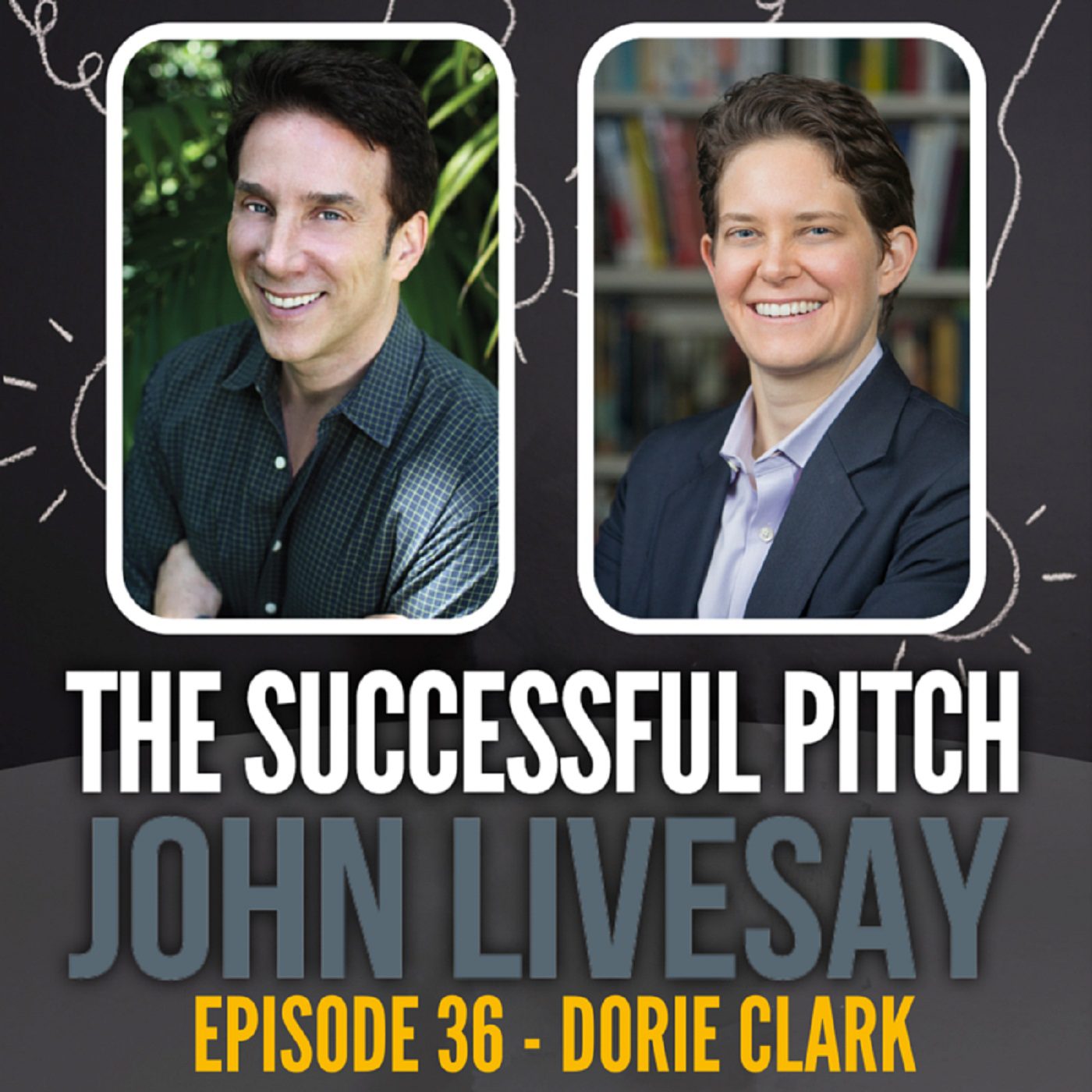
Dorie Clark is a strategy consultant and professional speaker who has worked with clients including Google, Microsoft, Morgan Stanley, DHL, Fidelity, Yale University, and the World Bank. She is also a regular contributor to Forbes and the Harvard Business Review, and the author of “Stand Out” and “Reinventing You”. Dorie talks on how startup founders can stand out and touches briefly on how they can let go of fear.
How To Make Your Pitch STAND OUT – Interview with Dorie Clark
Welcome to The Successful Pitch podcast. Today’s guest is Dorie Clark who is a branding expert, according to AP. She’s written not one, but two books. One is called Stand Out, the other one is called Reinventing You. She consults for companies like, oh, I don’t know, Google, Microsoft, Yale. She’s also a contributor for Forbes and Harvard Business Review. She teaches at Duke school and she’s a former presidential campaign spokesperson. My goodness, what an impressive background. Dorie, welcome to the show.
Thank you so much. It’s really fun to be talking with you.

Stand Out: How to Find Your Breakthrough Idea and Build a Following Around It
I always love to hear about the concept of branding. I was listening to one of your talks where you said that your personal brand is “your career insurance.” Which I think is such a great way to think about that. Before we dive into that, I want you to take our readers and listeners, if you will, back a little bit. Because sometimes people read the transcript and not listen to the podcast. How did you start out? What made you become interested in branding and how did you write your first book and all that good stuff?
I got interested in branding essentially because I needed career insurance. I came on board too late and so I started to learn about it and to try to help other people figure out how they could get a little bit ahead of the curve as compared to where I was. I started my career as a political journalist. I was about a year out of grad school.
I had been working as a reporter for a year and unfortunately, I had entered the profession at a pretty bad time. It was right around the tipping point where the internet started to just erode the newspaper’s profits, which had been very fat for a long time. Newspapers, we forget now, but it was a very, very lucrative business. All of a sudden, Craigslist was just going nuts, taking everybody’s business.
My newspaper laid me off. It was during a bad recession. It proved almost impossible to get another journalism job. I really had to reinvent myself and to try to figure out a new thing that I could do. I realized that it would be a heck of a lot easier for me or for anybody else if you have the kind of really strong brand that’s developed so that people are seeking you out specifically.
[Tweet “Branding is career insurance.”]
For me the true test, it’s not are you immune from vicissitudes or layoffs or whatever. You can’t control stuff. You can’t control what’s happening at a macroeconomic level. You can control necessarily what’s happening at your company. I mean, the poor people at Enron or Arthur Andersen or whatever. There’s lots of really good people that had no clue and no way of doing anything about it.
The real thing that you can protect against is, at an individual level, what is your reputation, what are you known for? If you lose your job or if you fall off the horse, how quickly can you then recover?

Reinventing You: Define Your Brand, Imagine Your Future
What motivated you to write Reinventing You? Was it this whole concept that you yourself had to reinvent yourself from a political journalist into a branding expert?
Yeah, pretty much it was. The genesis of Reinventing You was I started out with a blog post that I wrote for the Harvard Business Review. I didn’t really think of it as big official statement per say, but it was one blog post that I did based on my experiences. It was called How to Reinvent your Personal Brand. I thought, this will be interesting. I’ll share a few insights about the process
It turned out that it actually proved to be a very popular blog post. Popular enough that they asked me to turn it into a magazine piece. It went from about 700 words to about 2,500 words. It when it came out in The Harvard Business Review magazine, I got approached by several literary agents that said, “Hey, have you thought about turning this into a book?” At that point, I realized that it was an idea that had traction. I decided to go ahead and turn it into a book proposal and make that work.
Wow, what an amazing Cinderella story. So many people feel like they have a book inside them, but I don’t think I’ve ever heard anybody tell us the story of a blog to a magazine article to a book, that they are calling you to turn it into a book. Which really shows, if you put something out there, whether you’re a startup with an app, or in your case, somebody putting out really great content, and it clicks with people, it will be successful organically.
That’s a great way of reinventing yourself, so I would guess that if you’re going to get career insurance and being a branding expert, that you would recommend people make sure they start putting out good content is a great way to enhance your reputation and your brand, yes?
I’m a big fan of that. It absolutely worked for me. The asterisk on this, the proviso, is that what happens to me in terms of publishing something and then having the agents come to me, it’s of course relatively rare. But what I did to tee myself up for that possibility, this was not you try once and then, “Oh, you got so lucky.”
I had actually written three book proposals prior to Reinventing You. None of them got picked up. No one was interested. It was part of a continuing process where this one clicked, but I was trying to put myself into the path of opportunity beforehand.
Thank you for clarifying that. Because it is helpful to know that you’re not just an overnight success. That you learned so much, just like entrepreneurs do while they have their startup. When they pivot, “That proposal didn’t work, nobody bought that one, let me try something else.” Oftentimes, people really don’t get the successful exits until their third or fourth or fifth startup. In your case, it was three. Bam, after that, you got the book.
I’m extremely curious to know how you got and what it was like to be a presidential campaign spokesperson. Let’s talk about branding and every day dealing with poll numbers going up and down and one wrong word and your brand is damaged.

I served as Robert Reich’s press secretary. That was my initial experience working as a high level press person on a campaign.
Absolutely. The initial transition that I made, so I lost my job as a political reporter and I kept hoping that I could get another reporting job. It was just not happening. Finally, after about six months of freelancing and trying to cobble together a living, I got a phone call from a guy that I knew. He was a political consultant, and it turned out that Robert Reich, the former US Labor Secretary, was running for governor of Massachusetts.
He entered the race really late and he didn’t have any campaign infrastructure. They needed to hire people very quickly. My friend knew that I had been out of a job. He asked me if I was interested in it and I ended up taking the job. I served as Reich’s press secretary. That was my initial experience working as a high level press person on a campaign.
After that, I figured that I might be able to leverage that into a role on the subsequent presidential cycle, because the New Hampshire primary, of course, is really central to the elections. Most of New Hampshire’s medium market is the Boston medium market. There’s actually only one television station in New Hampshire. All the others are the local Boston channels. I had relationships with all of those reports. I thought that’s an asset I can leverage.
Again, it took a long time. It took about six months for me to be able to make the connections that I needed. Howard Dean was the candidate that I most want to work for. I had to really finagle my way in. I had a bunch of meetings that didn’t go anywhere, but eventually they did hire me.
That’s a great story of networking. A, you knew enough people that when an opportunity arose, somebody thought of you. You had brand awareness and then you delivered on your brand when the opportunity arrived.
So many of the founders are looking for how do I position my startup to investors in a way that it comes across as a brand with a culture that attracts the right team? Because that’s number one criteria for investor, is not the idea, but the team. The team is attracted to the leader, which creates a culture, which is what the brand is.
That’s why you’re such a great guest, because you’re a branding expert. Listeners need to know, how do I create a brand? When you’re talking to Microsoft and Google, what advice do you give big established brands like that?

When you have this behemoth like Microsoft that people already have fixed thoughts about, I think that the key thing there is you want to focus on segmentation.
It is an interesting challenge when you have this behemoth that people already have fixed thoughts about. I think that the key thing there is you want to focus on segmentation, because you’re never going to be able to succeed in changing everybody’s mind at the same time. People have different levels of awareness.
If you think about a tech company, as in your example, there’s going to be a different opinion in the general public of like, “Oh yeah, I’ve heard of them,” versus tech super users who have really particular opinions about, “Oh, they’re amazing,” or, “Oh, they suck.”
You really have to start with that and to figure out, who are the distinct constituencies and what is the message we want to drive with each of them and what are the proof points that we need? What do we actually have to do?
A crucial thing that people oftentimes fail to understand when it comes to marketing and messaging is they think it’s just about spewing messages at people. But actually it can’t be because no one will ever believe it, no one will ever take it seriously.
[Tweet “Marketing has to be integrated with product, with operations.”]
Marketing has to be integrated with product, with operations, etc. If people think your product sucks, you actually need to change the product in such a way that it doesn’t suck and then you have the ability, the flexibility, to change the messaging because it becomes about, “Hey, have you tried this? Have you looked at us lately?”
I think that some people just think it’s like this generic spin doctor kind of thing. Actually, it’s taking a holistic look at everything that the company is doing and then making sure that a light is shined properly on those initiatives.
What I find fascinating is you used the word constituency. It’s a political word. You have taken your political expertise of branding a politician and who their audience is, if you will, that can vote for them in their neighborhood or region or state, and applied it to branding for startups and huge successful tech companies figuring out, we’re going to break down which segment are we talking to, as you mentioned.
The really techies, are they gonna be the first adapters to try something new from Google or Microsoft? Or if you’re working for Apple, the new apple watch. You have to segment out who’s going to be the first to try and who are the brand ambassadors.
Can you share any differences between the brands of Google and Microsoft? I think everyone has their own personal opinions. I would just love to hear what Google and what Microsoft want people to think of them as brands. What’s their idea goal and see if it matches what we each think.
The first caveat with that is I wouldn’t want to say in any way that I speak for Google or Microsoft.
No, no, of course.

Just in July, I was at Google’s offices in Cambridge, Massachusetts. I gave a talk about Stand Out.
I’ll also say too, I have consulted for Google and worked for them as a consultant in the past. Lately, my most recent connection with both Microsoft and Google has been as a speaker. I’ve come in and spoken to their organization.
My new book, Stand Out, came out in April. For folks who are interested in watching online, I actually, just in July, was at Google’s offices in Cambridge, Massachusetts. I gave a talk about Stand Out to that, which is available on YouTube. When I was on book tour, I spoke at the Microsoft campus in Redmond as well about the book.
Let’s talk about that then, because that’s even more interesting than what my question was. Instead of what is Google’s brand that they want people to think of, I’d love to hear what was it in your message from your book, Stand Out, that Google felt compelled to listen to?
How much more does Google need to stand out? Are their employees trying to get their idea to stand out? Give us a little trailer, teaser, to get us to go to YouTube and watch your whole talk. What was it that made Google say, “This book and this topic is right on brand for us.”
One thing that I have learned a bit about Google. I’ve actually spoken at Google, at different offices, three times. For Reinventing You, my first book, I spoke at their Mountain View headquarters. That’s actually available on YouTube as well. I spoke about Reinventing You at their London office and then the Stand Out one in Cambridge.
[Tweet “Google has a culture where they’re interested in retaining their employees.”]
Something that I’ve learned that I think is actually quite interesting is that Google, I wish more companies would do this, they really seem to have a culture where they’re interested in retaining their employees.Even if the employee gets bored or for some reason doesn’t want to do the job that he or she has been doing, they don’t just say, “Fine, leave.” They really are invested in these people, they want to keep them.
There’s a lot of the culture, in fact, and encouragement within the culture, for people to switch jobs and functions within the company. It’s constantly revitalizing yourself creatively by having the opportunity within the confines of Google to do a lot of different things. That’s kind of exciting. I think that is relevant to the message of reinventing you, that you’re constantly sort of proactively deciding, “What do I want to learn? What do I want to be doing and how do I go about doing it?”
For Stand Out, I think the message that seems to resonate there is that if you’re doing something within a company or outside a company, if you want to have an impact, which I think that most of the people at Google and probably many people elsewhere want to have, it needs to get recognized.
[Tweet “If you’re doing something, if you want to have an impact, it needs to get recognized.”]
You don’t want it to be, you’re doing this amazing thing and a tree falls in the forest and nobody hears about it. You want the word to be able to get out so that people can, A) understand your contribution, but B) so that the idea can spread. In Stand Out, I have a latter section of the book talking about how to build a following around your ideas. If you have something you’re doing that you’re really passionate about, I think that people are excited to spread the word.
Do you have to get them to believe in your vision in order for them to spread your word? I would think that there’s got to be something in it for other people to get them on your team. I keep using the analogy of a founder getting really great talent to come join his startup when they have other choices and some of the other choices might even pay them more.
It goes to this whole culture of, if you get into Google and Google puts you through such a arduous process to get in, I can see why they don’t want to let you go. Because obviously they feel like they’ve picked the best of the best.
This whole concept of, so you’re a startup or you’re in a big company like Google, how do you get your idea to stand out? Or if you’re a startup working on your pitch, how do you make your pitch stand out? Do you have any tips that you could give our listeners about, if you’re pitching an idea, or in this case, asking for money, what are your tips for standing out on a pitch?
I think your question John, is really to the point. I lay out a framework in Stand Out that is a three step process. I interview about 50 top thought leaders and tried to reverse engineer what their process was for how they got known.
My tech listeners are going to love the fact that you reversed engineered that, by the way.
That’s right. When in doubt, reverse engineer. That’s definitely how to do it. What I learned was that almost everybody followed this formula for spreading their ideas. It’s a three step process. I’ll lay it out briefly and then explain a little bit more.
The short version. Step one is building your network. Step two, building your audience. Step three is building your community. What I mean by this, step one building your networking, this is of course really important because in the early days of any idea, there’s a few things that are happening.

You need to have a group of people around you who are both smart and talented, but also people that you really respect and respect you.
Number one, the idea’s probably not refined. It’s probably not that polished. It may actually not be that good. You need to have a group of people around you who are both smart and talented, but also people that you really respect and respect you. They have to have your best interest at heart so that you can receive honestly their feedback to make the idea better. They’re the people who are rooting for you. They want to help you. They’re going to open their Rolodex, they’re going to try to do what they can to advance you to the next level. That’s number one.
That’s great. I just want to recap, because it’s so helpful. In this case, it was an idea, but so many pitches are not refined. You can’t just pitch something without getting some feedback from your network is my big takeaway there. Thank you. So, step two is the audience, how does that help you stand out?
Step number two, about building your audience. This becomes the place where you start to share your idea with the outside world. Clearly, your idea is not going to do a very good job spreading if you are only talking to the inside circle or the people that you know personally in your network. You gotta start sharing it.
This is the place where, it’s the public phase. You are speaking about it, you’re writing blog posts about it, you’re sharing on social media, writing books. Basically, what you’re doing is you are making yourself findable by other like-minded people who would be interested in an idea of this sort. You start to do this to get the idea out into the ecosystem.
[Tweet “Make Yourself Findable.”]
Make yourself findable. I love it. And while you’re on the topic Dorie, if you don’t mind, I just want to take a little subset into this. So many people, and all of us experience it to one degree or another, have a little bit of fear of what other people are going to think and what if it gets rejected and all that stuff.
When you’re helping people stand out and say, “Now it’s time to put it out there,” there’s decision, analysis paralysis, it’s not perfect yet, especially with a new app or something. It’s like, ugh! Do you have any advice for people of how to let go of fear or how to not worry about what other people think?
It’s a real challenge, obviously. We’re held back by the concern about what other people might be thinking or saying or whatever. I would say this is yet another reason why it’s really important to have that internal network as your first step. Because even if you don’t trust yourself, and it’s easy, frankly, if you’re getting negative feedback, to doubt yourself.
If you have put around you a group of people whose opinion you really respect and they’ve said to you, “No. You have something here. This is good. I believe in this,” then in the moments when you’re doubting yourself, you can look to the people around you to get that kind of extra boost of confidence you need.
That’s fantastic information. It’s almost like a force field from your network before you go out into your audience. Love it. The final secret is how do we get a community around us so that we can stand out.
The final step here, so you’ve been building your audience, you’ve been sharing the idea, getting it out there. What happens next? Ideally what happens is that your community, your audience members who have been listening to you, start to form a community.
Basically what that means, what that looks like, is instead of just you talking to the audience as this one way megaphone, they start talking to each other. That is what enables virality to take hold. They become ambassadors, they become messengers, they’re spreading it. You’re able to achieve experiential growth for your idea.
[Tweet “If you want virality, make sure people see themselves in the idea.”]
The key, and this is something that you were alluding to earlier, is that this is never going to happen if your message is too self-centered or self-focused. They need to see themselves in the idea, they need to feel the idea is valuable to them. If they do, then they will be willing to spread it.
Got it. If you want virality, make sure people see themselves in the idea. That’s fantastic. That’s the whole shift from push messaging to pulling people in. It’s all about the secret of virality. It’s so great. First, come up with an idea, make sure your internal network agrees with you, gives you feedback, adjust it. Then put it out into the world. In other words, make yourself findable.
Finally, if it’s really clicking, like your first blog did, you will find people that will want to share that because they see themselves in how to reinvent themselves or the need to stand out and that this is something they want to share with their friends.
Because they think it’s got a lot of value and that they’re going to be perceived as someone who’s got good content. Their friends might even thank them for sharing something and therefore you become someone who stands out. How did I do? Did I get that right?
Yes. Rock and roll, you got it.
It’s just so great. I really want to do it justice and then just connect the dots for the listeners who are founders as it relates to how does that relate to my pitch. It’s the same three steps. Practice your pitch with your network, and then start talking to investors, and then believe me, if the investors like the pitch, it will get a community. All the investors know each other, and your pitch will become viral.
If you follow Dorie’s book, Stand Out, and these three steps, it will make your pitch hugely successful and you will get funded fast because of what Dorie had to say today. Can’t thank you enough. That’s absolutely amazing.
Before I end the podcast, because it goes so fast with somebody like you with such great content, can you talk to us about the Forbes inner critic article that you wrote that talks about taking a pause and having compassion and being curious?
[Tweet “How to silence the inner critic?”]
I think this is a really important topic obviously, because for so many of us, we’re not compassionate with ourselves. People are incredibly hard on themselves. They see someone else doing something and they say, “I get it, I understand.” We just hold ourselves to such a high level of perfectionism.
For Forbes, I actually co-authored a piece with a friend of mine named Susan Brady, who is high-level staffer at the consulting firm, Linkage. This is a topic that she’s written about pretty extensively, about how to quiet and silence the inner critic. I think that part of why we wanted to address it is that it’s almost impossible, frankly, to accomplish what you need to accomplish if you’re the one shutting yourself down.
You can’t move forward if you’re expecting perfection because no one is perfect out of the gate. That’s just the definition. It’s like somehow, we’ve seen these stories about a three-year-old that you sit him down at a piano and he can play Mozart. Everyone thinks, “I should be like that about pianos and about everything else.” Are you joking? No one is like that.
I think that we need to give ourselves a break. Of course, we need to do our best and try improve, but that’s a very different thing than saying, “If I’m not perfect then somehow I’m flawed.”
[Tweet “Can’t move forward if you expect perfection.”]
That’s great because so many founders are going to struggle and do struggle with the need to be perfect and that they think the pitch has to be perfect to get an investor to say yes. They think the app needs to be perfect to get a lot of users. You can’t move forward if you expect perfection.
I’m all about telling people to be progression-ist not perfectionists. Just focus on your progress. This whole concept of compassion as the way out of silencing the inner critic. If you’re criticizing yourself more than anybody else, you will not be successful. Thank you for that.
As we wrap up, besides the great books, Stand Out and Reinventing You, are there other books that have inspired you that you would think would be helpful for a founder who is looking to pitch investors to read?

Never Eat Alone: And Other Secrets to Success, One Relationship at a Time
There are so many really interesting, great books out there. Some ones that are favorites of mine to recommend, I always like Never Eat Alone by Keith Ferrazzi, great networking classic. One that I feel like is talked about less but I think is very valuable is called Power by Jeffrey Pfeffer. The subtitle, it goes, Power; Why Some People Have It And Others Don’t, which is always a very interesting thing to be aware of.
Especially in the political world.
I’ll just wrap up with Robert Cialdini who wrote a classic book Influence; The Psychology of Persuasion. He is so impressive. I actually interviewed him for both of my books. I have sections about him and his insights in both Reinventing You and Stand Out. He’s somebody that, with the book Influence, was very influential to me and to lots of other folks.

Power: Why Some People Have It and Others Don’t
We’ll be sure to put all three of those books plus yours, of course, in the show notes for people. Dorie, how can our listeners follow you? If someone wants to hire you as a speaker? Obviously people should go and buy your book. You have a website. Give us your Twitter handle or give us everything we can to know more about you and to track what you’re going to be doing.
John, thank you so much. I appreciate it. One thing that I’ll actually mention to your listeners, if they are interested in honing their skills for pitches and developing breakthrough ideas, is that I have a free 42 page workbook that I developed that folks can download off my website. It’s available right on the home page at DorieClark.com.
In addition to the free 42-page workbook, I have about 400 free articles that folks can access there. I’m on Twitter @DorieClark. I do a lot of speaking and consulting. Information about that is all on the website as well.
Great. Clearly, you walk your talk. You have put out amazing content and you’re generous with it. Obviously people see the value in that and you are someone who definitely stands out and makes a difference in the world. I can’t thank you enough for being on The Successful Pitch podcast today.
Thank you very much.
Links Mentioned
Dorie Clark: “Stand Out” | Talks at Google
Forbes Welcome
Never Eat Alone by Keith Ferrazzi
Power by Jeffery Pfeffer
Influence by Robert Cialdini
Dorie Clark Website
Reinventing You by Dorie Clark
Stand Out by Dorie Clark.
Crack The Funding Code!
Register now for the free webinar
Author John Livesay at NewsChannel 5
Share The Show
Did you enjoy the show? I’d love it if you subscribed today and left us a 5-star review!
-
- Click this link
- Click on the ‘Subscribe’ button below the artwork
- Go to the ‘Ratings and Reviews’ section
- Click on ‘Write a Review’
TSP035 | David Desharnais – How do you win Funding Deal Of The Year?
Posted by John Livesay in podcast | 0 comments
Listen To The Episode Here
Episode Summary
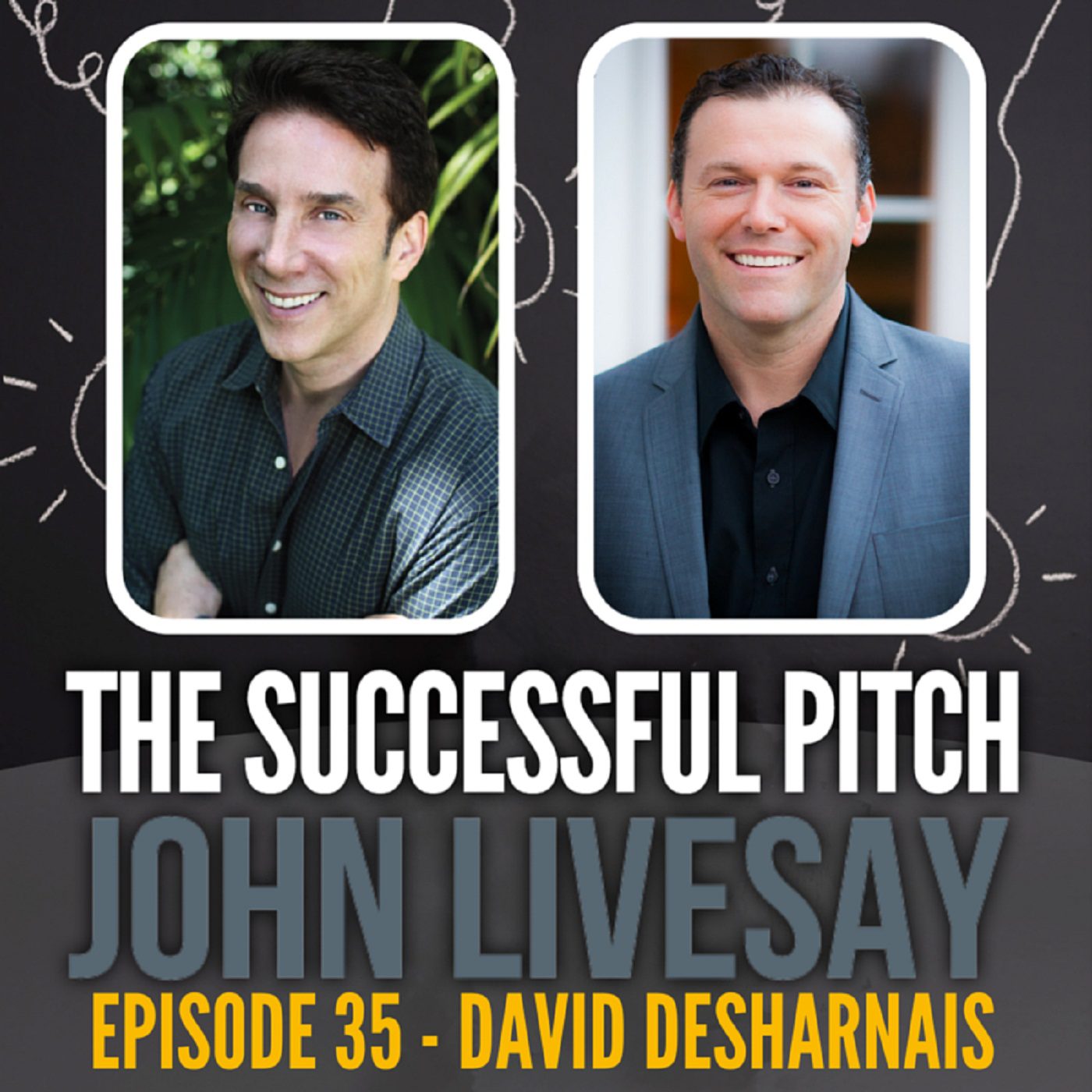
David Desharnais is the CMO and Senior VP at TraxPay and an advisor for several different investment companies. David has won a number of awards including the International Funding Deal of the Year Award and the Business Excellence Award. David explains how he and his team fixed a major problem in the finance industry and how he even turned his competitors into avid investors for the company.
Key Takeaways
- 00:01:50 – Why is David a ‘geek who can speak’?
- 00:03:45 – How did David go from being an engineer to an advisor?
- 00:09:10 – David talks about the team aspect in a company.
- 00:12:00 – How did David win the International Funding Deal of the Year award?
- 00:20:20 – TraxPay’s first round was $4m and on the second round raised $15m.
- 00:23:55 – David and his team got his competitors to be his investors.
- 00:25:00 – The difference between a first round pitch and a second round pitch?
- 00:27:15 – How did David win the Business Excellence Award?
- 00:29:45 – The same day David’s team announced TraxPay, Apple Pay was also announced.
- 00:31:25 – David highly recommends The Hard Thing About Hard Things book by Ben Horowitz.
- 00:33:20 – You can follow David on Twitter @DaveDesharnais.
Tweetables
[Tweet “Practice the pitch and Research your investors.”]
[Tweet “Co-branding is key to marketing success.”]
[Tweet “From near death to success.”]
[Tweet “A Geek Who Can Speak.”]
Links Mentioned
The Hard Thing About Hard Things by Ben Horowitz
Traxpay
David Desharnais LinkedIn
David Desharnais Twitter
Want the Transcription?
Share The Show
Did you enjoy the show? I’d love it if you subscribed today and left us a 5-star review!
-
- Click this link
- Click on the ‘Subscribe’ button below the artwork
- Go to the ‘Ratings and Reviews’ section
- Click on ‘Write a Review’
How To Win Shark Tank – Interview with Charles Michael Yim
Posted by John Livesay in podcast | 0 comments
Listen To The Episode Here
Episode Summary
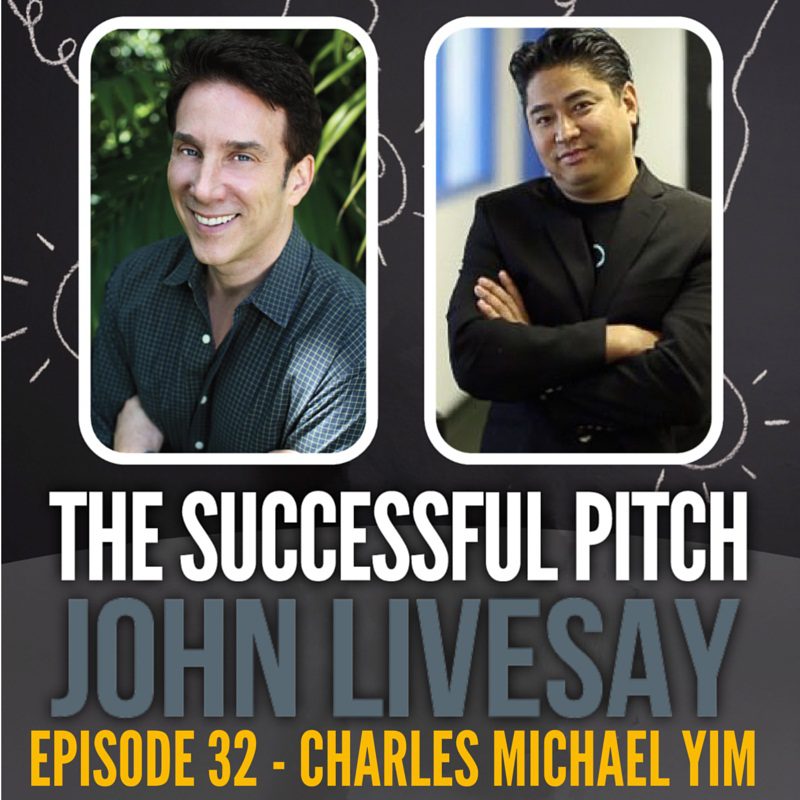
Charles Michael Yim is a successful serial entrepreneur and has appeared on Shark Tank and other news outlets. Charles was the first one in the history of the Shark Tank show to get funding from all of the sharks. Charles also came in first place out of 10.000 startups after competing for Sir Richard Branson’s startup contest. Charles talks on his success with Breathometer, the differences between Sir Richard Branson and Mark Cuban’s business style, and his upcoming book.
How To Win Shark Tank – Interview with Charles Michael Yim
Hi and welcome to The Successful Pitch podcast. Today’s guest is Charles Michael Yim who is the CEO of Breathometer. You might know Charles from seeing him win on Shark Tank. Charles, welcome to the show.
Hey, how’s it going? Glad to be a part of it.

Breathometer is the leader in breath analysis technology.
Thank you. We really appreciate you sharing your wisdom, your insights [on how to win Shark Tank]. One of the things that I really notice about someone like you is people see you on TV and they think, “Oh, overnight success,” and you’ve been doing this for quite a while and you had several successes before Breathometer. I think that’s really one of the keys that investors look for, is serial entrepreneurs, because you have a certain tenacity and you learned a lot and all that good stuff. Can you speak to your background a little bit? I know you were at some other companies and huge success there as well?
Sure. Like what you just said, you can’t just become an entrepreneur overnight. It’s more of a risk and reward scenario in that, it’s once you start, it’s really I’d like to think, is hacking away, you start hacking away at it. I think when you start, 50% is complete. But I think climbing up the mountain, addressing adversities, driving through a certain level of perseverance and tenacity and ambition. That’s what kind of gets you passed the line.
Breathometer, my current company, is technically my third founding company. I built and sold my last two and so I’ve had a couple of successful exits. I would say my first company is where I sharpened my teeth and that’s where I made several failures and many mistakes, but the important thing is that you get back up and you learn from them and you do better the next time. Ideally, you do it fast enough where you can still survive or your company can or your business can still survive.
What gave you the idea for Breathometer? Most entrepreneurs tell me, “We saw a problem and we wanted to solve it.” It was all about, at first, helping people not drink and drive, right? That was, before they get pulled over by the police they have to take a breath test.
In terms of inspiration, it really came from Jack Dorsey’s wear product. If you’re familiar with it, it’s a pin and processing product geared towards small to medium sized businesses. I saw a dongle and I kind of connected the dots. With the smartphone, I thought to myself, why couldn’t I just switch out the sensor inside for a bio-sensor instead and apply it towards essentially an alcohol breathalyzer kind of product, value proposition.
I used it back in college and I always erred on the side of safety. I put two and two together. Consulted with a few close, trusted friends. Next thing you know, I had a working, breathing prototype within about three months.
What I love about that story, Charles, is that you didn’t have to reinvent the wheel from scratch. You actually got inspired by someone else’s startup. What a great story that is, I love it, and say, how can I make this better? What’s also fascinating to me, please correct me if I’m wrong, but from what I understand is you’ve taken Breathometer to way more than just making sure of you’re alcohol level. It’s actually helping people make sure they don’t have bad breath. Who doesn’t need that, right?
Yeah, there’s quite a few applications that breath can apply to. I think about 6 months into it, I started collaborating and connecting and partnering up with Stanford university, my alma mater, as well Cleveland Clinic. Cleveland Clinic by far has basically the most advanced breath analysis lab that I would think, that I’ve seen at least. Breath analysis actually been a science for quite some time. A lot of consumers aren’t aware, but there’s breathalyzer-type machines in these Kaiser Permanentes in the world. They can cost as much as a quarter million up. You typically need a prescription and, I would say, extra added fees so you can have access to one.
It ranges in terms of applications. Everything from allergens, gastrointestinal issues, asthma. It really goes on and on. For us, we started with alcohol, but then we’re venturing into true medical or digital health applications like oral health, like health and fitness, being able to detect certain levels of fat burning through one’s body. But again, all through breath, because breath has roughly about 300 biomarkers whereby at least 25% are applicable towards human conditions.
All the people who are buying Fitbit and keeping track of their calories could also be buying your product to keep track of their fat burning through their breath analysis for ketosis and things?

Could you pair it with a Fitbit product or what have you or some type of step tracker? Sure.
Correct, and you don’t even have to worry about calorie counting anymore, or quite frankly, how many steps you are taking. Yeah, could you pair it with a Fitbit product or what have you or some type of step tracker? Sure, but if anyone really knows health and fitness, it really boils down to 80% of what you’re eating versus 20% in terms of your workout.
If you nailed down your diet and you’re not necessarily calorie counting but understanding how much fat you’re really burning and optimizing that, essentially that’s the holy grail. That’s how you really shedding pounds and staying at a certain optimal and healthy fitness range.
I think that’s what’s going to be partly responsible, if not a lot, of the incredible growth that you’ve already had. What I saw was that the growth for Breathometer was, 2014 you were at $4 million and then you project 2016 to be at $14 million, is that accurate?
Yeah. That’s right.
That’s phenomenal growth and obviously it’s not just from awareness from Shark Tank, although there’s a great story there. You were pre-revenue from the video I saw, right, before you went on Shark Tank?
Correct. We were pre-revenue. We’ve been revenue-generating for quite some time. Next year will be even a bigger year. Now we’re launching our third product and we’re already working on our forth and we already have our 5th in the R&D phase. All, again, geared towards different applications, not just alcohol.

Charles Michael Yim was the first person on Shark Tank to ever get all five sharks to invest with him.
What’s interesting about you on so many levels is you’ve broken history multiple times. You were the first person on Shark Tank to ever get all five sharks to invest with you. What’s interesting is they all said you checked off all the boxes.
You had a great product, you knew your numbers, you were a great business person, and you were doing something that was great for society, so everybody felt good about investing in that. Did you know before you went in [to win Shark Tank] there that you were checking off all those boxes or is that just who you are and the way you’ve done business in the past?
It’s the latter. I didn’t have necessarily a checklist going in there. I would say I definitely did my fair share of preparation. I definitely made sure I knew my numbers and I run a pretty tight ship so I knew my business inside out, so I was well prepared. I think as most people kind of define luck, there was a little part of luck in it where when the opportunity arises, you’re prepared and so you can take advantage of the opportunity. There was a lot of preparation that I think was key.
In terms of product, obviously there’s bias, but I definitely feel it’s compelling. Obviously, I have experienced and of course there’s a great cause behind it. I think, there’s a combination of factors, but a good portion of being prepared and the rest just being the right fit.
One of my favorite quotes is from Arthur Ashe, who said the key to success is confidence and the key to confidence is preparation. I’d love to have you share with our listeners what kind of preparation did you do before you went to pitch Shark Tank and what do you now before you pitch investors?
[Tweet “The key to success is confidence and the key to confidence is preparation.”]
I think with Shark Tank, which was very acute to Shark Tank, was I actually met with quite a few successful fellow Shark Tank entrepreneurs that have already been on the show and did well, started interviewing them. Understanding, are these investors are actually the real deal? Can they really add value to your business? Pro-tips, if you will, prior to being on the show.
In terms of just what I do in general, I’ve been in the board room several times. Again, it’s my third company. I’ve, overall, probably closed over $50-60 million dollars in funding, VC funding, single-handedly. I’ve been around the Valley. I think in terms of just being prepared being able to anticipate questions investors will ask, that’s extremely key [to win Shark Tank].
I have a pretty good head on my shoulders now and I think that just comes along with, as you say, preparation and that built confidence. In addition to that, just having the experience underneath your belt. When you’ve been around the block a few times, it gets easier. It gets easier, for sure.
[Tweet “When you’ve been around the block a few times, it gets easier.”]
Those questions include everything from what does it cost to acquire a customer to what’s your vision. There’s so many questions to be prepared for and anticipate. I want to brag about you. You closed $2 million in 2013 and now you’re going for $20 million. Is that accurate?
That’s right. Yeah, we already closed a good chunk of it already. More than 50-60% and we’re closing the rest of it now.
When you go from that kind of $2 million to $20 million, that’s such an incredible growth and obviously, based on huge success. Do you get different questions when you’re going for $20 million than you do when you’re going for $2 [million]?
Certainty, you do. Definitely, especially when you have a company that changes from, transitions from pre-revenue to revenue. Pre-revenue is more about product validation and ultimately product launch and assessing the risk points of the company in terms of being able to at least just ship the product.
When you’re in the second phase where we are, at series A, it’s user acquisition cost. How much does it cost to bring on a user? What’s the LTV, lifetime value of the customer? What’s the cohort analysis look like? How long are you retaining your customers and how long are they staying with you. Are they happy? Are they satisfied? If they’re not, you got to quickly address them.

There’s different certain level of expectations based on the growth stages that you’re in. There’s always good and bad with that.
Additionally [to help you win Shark Tank], what’s your roadmap and do you have the team that can support that? Do you have the engineering? Do you have the product? Do you have the financial assets or foundations to be able to support something like that? What are the markets you are targeting? Who is truly your demographic? Who is your customer at the end of the day?
You need to know quite a bit more about your product or products and your customers and then mechanics and foundation of your business, because at that point, you’re no longer an infant. You’re more like a toddler.
I would say we are in the transition and the interesting phase where we’re a toddler now, but we’re quickly transitioning to become a true teenager. There’s different certain level of expectations based on the growth stages that you’re in. There’s always good and bad with that. There’s going to be natural pain points, there’s going to be growing pains.
Scaling a business, hiring quick enough, but hiring quality individuals that can truly add value to the business, finding the right investors, support partners, and dealing with the distribution, international scaling, localization, regulatory. We’re a medical company at the end of the day, so we have to deal with the FDA. There’s complaint regulations we have to address, legalities.
There’s a ton of stipulations that we have to go through. It’s just a complete different set of questions from where we once were, first airing on Shark Tank. It’s a different ballgame. Just to mind you, we are truly a Silicon Valley company at heart.

I think Shark Tank, if at all, gave us a considerable boost.
When I say Silicon Valley, what I refer to and what that means to me is that we’re very much a technology company and we’re a culmination of both hardware and software. I think Shark Tank, if at all, gave us a considerable boost. We’re an atypical company in terms of how we’ve gotten to where we’ve gotten and the momentum we’ve built so far.
Can you speak a little bit about the team? I saw on your LinkedIn profile, you have some of the same people from your previous successful companies working with you again. Obviously there’s great synergy there when you have your team following you and you guys have a shortcut. They know what you expect from them and vice verse.
That’s so important for investors, is who is the team, and you mentioned it. Anything you can do about how you find your good team? How do you keep them from company to company?
That’s a great question. I think repetition is pretty key. You need to be able to treat your people and your team members well. I think if there’s a certain level of mutual respect there, I think naturally it’s going to lead to basically a, I would say, a clan, if you will. A group of you that go from one company to the other and creating success at one place and then hopefully repeating that, making that a recurring situation.
I think it’s a lot about that. It’s just great teamwork, team synergy and treating each other with an equal amount of respect. I think that naturally occurs. I there’s a second part of that, just team building. I think that’s probably one of the most important assets or talents that one founder can have when you’re building a company.
Because if you, for instance, don’t know a certain aspect or don’t have an in-house expertise on a particular topic for a business, maybe you don’t know, but you could hire someone that does. You can hire, believe it or not, a lot away out of your problems as a startup. If you don’t know it, bring someone in-house and they’ll figure it out for you.
[Tweet “Teamwork is respect and collaboration”]
I love that so much. The teamwork is built on respect and collaboration. Which is really what you’re saying is, collaborate with people who have skills that you maybe don’t have and then everything is stronger than it was before. It’s really fantastic insights. Do all five Sharks engage with you equally while you have that many investors?
No, I think it’s more on an as needed basis. When I first got funding and it was from all five at the very beginning, it was pretty much all five cylinders pumping at the same time. It’s pretty intense. Once you start scaling to a series A and when you establish a rapport and built up the relationship, it’s more on an as needed basis. We’re no longer that little tiny company that we once were. Now, it’s basically on demand basis more so than anything.
We have now institutional investors that are involved, that tends to be why we have a much larger round. In addition to that, we have a formal board now, which is very different. I’m not the only one just kind of calling the shots. I have a legitimate board that come from the institutional investor side that help mandate policy and make decisions with me.
We haven’t even gotten to your other big accomplishment, which is winning first place out of 10,000 other startups with Sir Richard Branson. Congratulations on that. You have Richard Branson and Mark Cuban backing you. I would think that’s quite a nice calling card for investors. Tell us a little bit about the Sir Richard Branson experience?

Charles Michael Yim won first place out of 10,000 other startups with Sir Richard Branson.
Richard Branson, it was more of his version of Shark Tank, if you will. It’s an opportunity for the community to basically, I would say, add fuel to the fire. If you already had something going, like Breathometer did at the very time we entered the competition, it basically acted as a catalyst and expedited our growth. We were exposed to a lot of investors. That’s what lead to our series A. and a lot of basically partnership opportunities as well. We had a lot of opportunity to interface with Richard Branson himself, his team, was able to go on his private island, Necker, so that was pretty cool. I’ve been twice since.
It’s just a phenomenal opportunity to meet great people, really expose the brand to a great community. There was just nothing but just give, give, give and take, take, take in terms of just a mutual exchange. Overall, it was a great experience and probably had equally as difficult, if not more difficult odds, in terms of coming through. But pleasantly surprised, we took first place. It was an amazing ride.
I bet. What advise did Mark Cuban and Sir Richard Branson give you? I would assume they have different points of view. Since you’re one of the few people who is fortunate enough to know them both, I would love to her your insights and how they compare.
I can tell you what I was able to take away from each so far. I think what I get from Mark Cuban, he’s a very much of an entrepreneur than an investor type that is all about building a business and doing the grind and just getting things done. I definitely got that from him. At the end of the day, he just wants to make sure that you’re doing your best and you’re building a real business.
[Tweet “Mark Cuban is all about getting it done.”]
I think what I get from Richard Branson is creating authentic genuine value. We have, for instance, a potential application for lung cancer. He was really just focused on that. He’s like, great, you can build businesses. A lot of people do build businesses, but if you really have a lung cancer application here, you talk about really saving lives.
[Tweet “Richard Branson wants authentic value.”]
I think what I got from him was just the bigger picture in that contributing back to the community, contributing back to the world. Doing something great while building something that you’re passionate about. That’s the winning formula there.
Building something great while making a difference in the world. That’s a great line. I love it. It’s really helpful. As if that’s not enough, you are also going to be an author. Tell us about your upcoming book.
[Tweet “Building something great while making a difference in the world.”]
I’m writing a book. It’s going to be three parts. My inspiration was from the show because after airing on the show, now I’ve been a part of five episodes and soon to be airing on the new spin-off show, Beyond The Tank, as well.
I’ve developed a public persona, if you will. I get approached quite a bit in public. I have parents coming up to me saying, “Hey, you inspired my kid to start his on business,” and blah, blah, blah or, “They want to learn from you.”
That got me thinking in that, maybe there’s something to here. That inspired me to write a book [about how to win Shark Tank]. The title may be something like Making of a Shark. Meaning that if you take some of the tips that I provide, perhaps you can build something of your own [and win Shark Tank too].

We had a lot of opportunity to interface with Richard Branson himself, his team, was able to go on his private island, Necker.
It’s three parts. It’s part one, my bio background. It’s a brief background of me and how I came to be as a lemonade stand kid to a full entrepreneur. Part two is my behind the scenes behind Shark Tank and then Richard Branson’s Xtreme Tech Challenge.
Part three, where I think the majority of value in the book is, my ten step guide, if you will, of how to come up with an idea, how to validate the idea, go to product discovery, whether it be product or service. Get investment for it, whether it be crowd funding or personal investors. Then taking it and releasing it to market, and then eventually scaling it. This is kind of a proven formula, if you will, that I’ve done personally with my last three companies, so I know it works.
I’ve broken it, I’ve distilled it down to very simple points where any average consumer, someone from middle America can pick it up and read it and go run with it. It’s my way to give back. I think it’s great if you’re successful, but if you can give back a little bit, that’s when the win is.
I’m being repped by one of the top agencies in Hollywood, they’re called APA. They’ve done Kim Kardashian, they’ve done Restaurant Impossible. They’ve done Gordon Ramsey and a bunch of stuff. They’re repping me at this point. I’ve already started writing the book, so we’ll probably launching in the next, I would say, 8-9-10 months.
How exciting. It sounds like a great content. It’s got enough celebrity hook of the behind the scenes with two major people, Mark Cuban and Sir Richard Branson, and then the actual meat and potatoes. One of the things that jumped out at me when you were describing the book, which I want to pre-order the minute it is available, is the idea.
So many people have so many ideas. How do you know or any tips you can give us in advance to your book, how do you know that this is the right idea to really pursue [so you can win Shark Tank]? Do you test it with crowd funding or do you test it with consumers or check out the competition? What’s your criteria for knowing that, in this case, Breathometer was going to be the right idea?
You hit a lot of the main points. Again, it’s essentially you need to one, validate the idea. That can be done through crowd funding. Secondarily, you need to do research. Figure out what the market size is like. Is there a predicate device, is there a market? The third part of it is, what truly is the potential penetration or traction of it? Those are kind of three of some of the primary characteristics or profile requirements. If you see and you recognize a potential, then at that point it’s a matter of execution.
[Tweet “If you see and you recognize a potential, then at that point it’s a matter of execution.”]
Great. I also know that you are involved with the Stanford StartX Accelerator program, which is another way of giving back, obviously. You must hear a lot of great pitches. Just to get into those accelerator programs is extremely competitive, almost like trying to get on Shark Tank. The number of people who apply and the number of people who get in.
I’ve recently been the pitch mentor at StartFast in New York, so I know that experience. I would love to hear your insights as what’s it like working with the Stanford Accelerator?
Like you said, it’s a tough accelerator. I entered, applied, being a Stanford alumni. That’s one of the main requirements. Aside from that, you need to have a legitimate idea or product or service. If you are selected, like you said, it’s tough, then you can go to the acceleration program. We did that and we did well. We gained a Chief Medical Officer. We got funding from Stanford University. That was nice. Now we’re working with them on the essentially respiratory side of things.
Moving forward, I now, like you said, give back. I’m actually now a mentor for the Stanford StartX Accelerator personally. I do get exposed to quite a few pitches. I think my two cents there is a lot of people get really caught in the, “Hey, I’ve got a cool idea and it sounds really cool, and what if it was this, what if it was that.”
I think my advice there is, and this is in my book again, that you should think about, when you create a company or product or service for that matter [to win Shark Tank or do something on your own], is always look through the lens of a problem-solution framework. What I mean by that is your target should be, are you solving a real problem? If you are and you have an innovative and a legitimate solution, you will have more than likely built a product or service that can provide real value.
[Tweet “See your idea thru the lens of what problem do you solve.”]
If you do, that’s when you have a basis for a company or a business. I find too often that, I would say, beginner entrepreneurs that just go out in the world wanting to create something but in actuality, they’re just creating something. That doesn’t mean that they’re generating or going to essentially create a business.
That’s incredibly valuable. Who do you help and what problem do you solve are two of the key questions that I think startups need to have in their head before they ever get to an accelerator, let alone an investor, and be able to say this isn’t just something that’s fun, it’s actually solving a problem. In addition to your upcoming book, are there any other books that you’d like to recommend to startups?

Art of The Start
That’s a good question. I am a big fan of Guy Kawasaki. That’s actually how I broke into the startup world. He has a book called Art of The Start. That’s pretty big for me. Let’s see. I think Eric Ries has a pretty good book. It’s called Lean Startup. You get an idea of how to run lean and mean and the fundamentals of running a startup and surviving. There’s also Tim Ferriss, 4 Hour Work Week.
I’m a big firm believer in working smart and obviously working hard, but working smart goes a lot further than working hard. Believe it or not, I run this company and probably in the middle of launching another company.
It’s just juggling the two acts where if you can get your current company or the company you’re working on to a stable state, a manageable state where you have senior management and at that point it’s self-sufficient and you are really delegating responsibilities, then potentially you’re at a point where you can actually start something else and make the best use of your time. Staying active, it’s all about a juggle act and it really comes down to how good you are at multitasking. I think that’s pretty key [to win Shark Tank].
I love it. How can our listeners follow you, be sure that they know when your book comes out, Twitter, LinkedIn? What’s the best way to keep track of, you have a blog or anything that you want people to read?
I’m pretty active on social media. I have a pretty significant following, especially after airing on Shark Tank and what have you. I am quite often pretty active on Facebook. You can find me under Charles Michael Yim. I technically go with my middle name as well. On Instagram, Twitter, I’m always under @CharlesMYim. You can follow me on there.
Otherwise, I’m always on the news or on TV with Squawk Box on CNBC and then potentially CNN soon and what have you. Shark Tank and now Beyond the Tank. You can follow me on TV as well. I’m constantly involved in blogs, whether it be TechCrunch or Mashable or Venture Beat.
Fantastic. Charles, I can’t thank you enough for being on the podcast today and sharing your wisdom [on how to win Shark Tank]. Congratulations on all your success. We’re looking forward to your new book and watching you on Beyond the Tank and other shows as well.
Cool, awesome.
Thanks again.
Thank you.
Links Mentioned
The Art of The Start by Guy Kawasaki.
The Four Hour Work Week by Tim Ferriss
The Lean Startup by Eric Ries
Charles Michael Yim Twitter
Crack The Funding Code!
Register now for the free webinar
The Successful Pitch – Book Trailer
Share The Show
Did you enjoy the show? I’d love it if you subscribed today and left us a 5-star review!
-
- Click this link
- Click on the ‘Subscribe’ button below the artwork
- Go to the ‘Ratings and Reviews’ section
- Click on ‘Write a Review’