

The Culture of Nice Makes Nice Guys Finish First with Doug Sandler
Posted by John Livesay in podcast | 0 comments
Episode Summary:
Gratitude trumps suspicion all the time. Instead of looking for the things that your people are doing wrong, intentionally look for the things that they are doing right and acknowledge it so that trust is built. This is the reason Doug Sandler believes that nice guys finish first. The people inside the organization are more important than the products and services its sells, because being high tech may get you to places but going high touch with the entire team makes everyone see your vision. Doug shares more tips on building trust through a culture of nice and the moments that formed his life.
—
Our guest is Doug Sandler, author of Nice Guys Finish First. He said in order to create a culture of nice, if you catch people doing something right and acknowledge it. He has something called a piggy bank moment. Find out what he means by that. Also, don’t compare your beginning to other people’s middle. You’ll never be happy. You need to celebrate your own progress. Another great tip is high-touch trumps high-tech every time, and he has a great story that shows what he means by that. His recipe for success or as he calls it new math, is that success is ability times effort, if either one is a zero, then your results are zero too. He also challenges us to not be normal and let go of worrying about making mistakes. Enjoy the episode.
Listen To The Episode Here
The Culture of Nice Makes Nice Guys Finish First with Doug Sandler
Doug, welcome to the show.
It’s great to be here, John. Thank you for returning the favor. Episode 125 was the episode that you were on my show. Thanks for hanging out with me and building that relationship throughout the entire year, John.
That’s really what it’s all about, it’s building relationships. That’s your whole focus when you give a keynote; building better relationships create better business. Tell me your story of origin. How did you come up with the branding of Mr. Nice Guy before you wrote the book? What was it like to be the son of Dave Sandler?
I am the son of Dave Sandler. What’s interesting about what you say, John, imagine walking out of your door when you’re six years old. You’ve got your mom and you’re there and you’re carrying your little woobie, my blanket at the time. I can just remember my mom saying to me so many times, “Dougie, be nice,” as I walked out the door over and over and over again. For me, being nice wasn’t a matter of practice, it was a matter of principle. My mom had said that to me so many times as I was growing up that I was destined to be a nice guy growing up. Later on when my dad, Dave Sandler from Sandler Sales, created that entire sales system, I can recall all of the business principles that he threw in my direction, just as a part of being around him and him growing the system and building the system. The combination of the sales system that my dad created and the principles that my mom had laid out of, “Dougie, be nice,” those two things collided. That’s how I’ve led my entire career. No matter what I’ve done in my life, whatever career path that I’ve chosen, those principles, whether that be the sales system that my dad created or the nice philosophy that my mom instilled in my head, those things have all followed me everywhere I’ve gone.
The whole goal of The Successful Pitch Podcast is to give people little nuggets of how to craft a story that pulls people in. You did a great example. I’m going to break down what you probably did naturally. If you noticed what Doug said there he said, “Imagine being six years old and holding your blanket, and your mom saying, ‘Dougie, be nice.’” Instantly, we’re taken back. That’s great exposition. We know exactly where we are, we can see it, we can feel it. When you talk about your father’s structure combined with your mother’s framework of being nice, they collided. Words like that are dramatic and memorable. I can see why you’re such a great keynote speaker. The challenge is when you’re giving your pitch to get someone to join your team, to get a new client, whatever it is, you need to paint a picture just like Doug did. Thank you for letting me break that down a little bit.
You can always say in emails to somebody, “What an awesome, what a great, what a wonderful.” Those words are so overused. If you say something like, “It was unexpected or what an amazing pleasure it was, and it was a pleasure because of,” and then you list a word, “It brings me back to this time when I was,” it puts you right in the position of having people follow you back in that story. That’s always what I love to do, either when I’m doing a keynote or when I’m just having a conversation with somebody. It’s so much more enjoyable to have a story as a part of your lesson that you’re teaching.
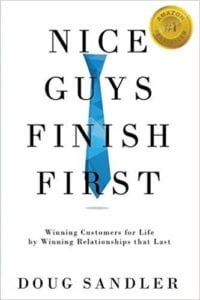
Nice Guys Finish First: Nice Guys Finish First
Storytelling and specifics show you care enough to do your due diligence, your preparation before you get in front of somebody. That has been my key to success and it seems to be yours as well. What would you say was the catalyst for coming up with the book Nice Guys Finish First? It’s obviously a play on our phrase of, “Nice guys finish last.” You’ve flipped that paradigm on its ear. How did you come up with that?
In March of 2013, I was in an appointment that my financial planner that we had set up. He had said, “Just be on the lookout for this next opportunity that may find you.” It wasn’t until about six months later in August of that same year that I met another keynote speaker. His name is Ryan Estis. He was delivering a speech at National Association for Catering and Events conference. Literally, I was that guy that was sitting in the back of the room as he was delivering this speech. When he was done he said, “If you have any information or anything that you want me to know or you want to find out more about me, just come on up to the front of the room.” It must have been the way that I was running from the back of the room to the front of the room with my card hanging out in my hand, flying down the aisles and finally reaching him at the front. He said, “You’re not coming to ask me about my message. You’re probably going to ask me about how to be a keynote speaker, right?” I guess that is a typical approach of someone that comes with as much enthusiasm from the back of the room to the front of the room.
He said the first thing you need to do is hire a speaking coach. When I sat down with Jane through Skype probably about six or seven weeks later, she explained to me that the purpose of being a speaker was to get your message out to the world. The best way to do that would be to have a book. You not only need to have a book, but you need to have a bestselling book. She taught me the principles that I needed to know in order to put together a book. I hired a speaking coach. To make a long story even longer, I hired somebody else in the process of writing my books. She was a speaking coach, not a writing coach. I hired a guy to help me write my book. He said, “You need to write 200 pages in twenty weeks. It’s ten pages a week for twenty weeks. Later, we did it 165 pages and when it came down to editing it, the title came as a part of me being this nice guy consistently. Somebody always says eventually along the process of me either putting this book together or anything that I do is, “How can you consistently be so nice when you do everything that you do in the course of your day?” labeling me as Mr. Nice Guy. I just thought about what would be a good play on words for the title. “Nice guys finish last,” is the saying but I said, “That doesn’t have to be the case in business because I seem to always fall on the right side of things when it comes to business negotiations or sales calls.” I figured, “Nice guys finish first,” would be a nice play on words and then it was adopted.
What I take away from that is you invested in yourself. You’re coachable. Someone said you need to write a book. You hired someone to help you do that. You hired somebody to teach you how to be a great speaker. That whole concept of, “I’m going to be successful without getting people to help me,” is a total myth in my experience. I’ve also done the same thing. I feel that people who are willing to invest in themselves and hire experts to help them become a better version of themselves are the ones that ultimately make it and are willing to do that. As opposed to, “I don’t know if I have the money to spend on myself and learn this skill,” and then you don’t believe in what you’re doing.
It’s also a matter of you’ve got to find where you’re happy is. You have to get down to what is it that drives you and what is it that will make you happy in life? After so many years of a very successful entertainment business, I’m at the tail end of that entertainment career. From an age perspective, I’m in a world as a deejay. As a 47-year-old deejay five years ago, I was in a field that was dominated by twenty-somethings. There’s only so long that a club owner is going to respect you. A 50-something or a 60-something walking into a club is not going to have the same effect. Before my market quit on me, I figured, “Even if they never do, I want to look for an opportunity, something else that I could do in my life.” That’s exactly what it was. I found my happy. Part of my podcast, Episode 362, Mo Gawdat talks about this idea of finding your happiness. It’s such a true statement. You have to find and gravitate towards your happy factor and that is it for me.

Nice Guys Finish First: You have to find and gravitate towards your happy factor.
Nothing is sadder than someone who’s staying on the stage too long whether it’s an actress trying to play an ingénue that’s outgrown the role. We all have to keep evolving and changing. You talk about the culture of nice. Explain to people what that means.
It’s not just a project of the week. Nice is not something that you can say, “This week we’re decided that we’re going to be nice so let’s turn the corner.” You need to tell everybody what does that mean. To different people, it might mean different things. For me, part of it is doing something such simple stuff like catching somebody in the act of doing something right. We’re so focused as managers, we constantly are finding people doing the wrong thing or changing people’s behaviors. How about if we try to go about it and try to find people in the act of doing something right? If you show gratitude, show empathy, be a good conversationalist, be there to support other people, catch them in the act of doing something right. It’s not an action step that a lot of companies have in place. To create this culture of nice does start with the things like gratitude, catching him in the act of doing something right, building trust, building relationships, understanding communication. Those are the things that so many companies focus little on and focus more on the bottom line. If you focus on the people in your organization and not just the products and the services that you provide, you’ll find that your business will be much more successful.
I remember that book, The One Minute Manager, it was the first time I was introduced to the concept of catching somebody doing something right and acknowledging it, as opposed to assuming that they’re just doing the job. That shifts everything. Let’s talk a little bit about your philosophy about the test of trust, since you brought that up in terms of what a culture of nice includes is empathy and trust. What is the test of trust?
It’s a part of one of the training programs that I have. I’m happy to provide this. All they have to do is email me. It’s a very simple 25-question test or quiz that you can give yourself to find out what level of trust do people have in you and what are you throwing out there to the universe. If you’re throwing out to the universe that you’re not a trustworthy person, take this test and you score a B or less, then maybe you do need to work on some of the things in order to be a little bit more trustworthy. It’s not rocket science. It’s things like, “Do you return your calls quickly? Do you show up on time every time? Do you provide more than the value of the sale that you have made to your client? Do you go above and beyond?” If you can genuinely say yes to those, then you are doing a great job of providing trust and being trustworthy of the people in your life.
I resonate with the one that talks about, “I listen to what others have to say.” Do I trust myself to do that?
So many people are so focused on the thing that they’re going to say next that they forget to listen to the thing that’s being said to them right now. Being present as a part of your conversations and a part of your relationships is such a critical part of being trustworthy. It has everything to do and nothing to do with trust at the same time. It has everything to do with relationships.

Nice Guys Finish First: Being present as a part of your conversations and a part of your relationships is such a critical part of being trustworthy.
You have something called the piggy bank moment. Please describe what that is.
I was given this inspiration from my wife as she was moving out of an apartment before we got married a couple of years ago. She’s sitting in her apartment and she has this piggy bank that she’s carried with her since childhood. In the piggy bank was literally, for her at the time, every cent that she had. You open up the piggy bank and you count the money that’s in the piggy bank and she had $129. Financially, she was probably going through a struggling point in her life at that time. She said, “This is that moment. I’ve got this $129. I’m about to move out with my apartment. I’m about to move in with this guy who I love. This is what it comes down to. This is what life is all about.” I always tell people as we have conversations about the things that you’re most passionate about in life, what is that piggy bank moment? What is that moment that you can go back to in your life that you can say, “Things are going to be changed and things are going to be different starting right now?” Take an assessment of your life. Look at where your life is and move beyond where you are right now.
Even if she had $129 and that was all that she had, it was what she had. She did an assessment of her life. She looked at her life going backward and she looked at her life where she’s going forward from there. Take a snapshot of your life. What is that piggy bank moment at that exact time? You’ll see how drastically we think that things move at a creepy crawly pace in life. I look back to my life five years ago. I had no podcast. I had no book. I had no keynote speech. All of the new things that are in my life that have become my career, they did not exist five or six years ago. It’s so great to know that I had my piggy bank moment back then as well. It’s different than my wife’s but look what has happened since then. That’s the wonderful part about it.
It’s all about celebrating our progress as opposed to only saying, “I still don’t have this.” It is valuable to take a minute and say, “What did I accomplish this day, this week, this month?” Our brain craves progress. If we don’t acknowledge it, then we can spiral downward. One of the keys to staying nice and positive and focused is celebrating your own progress and then you can look for it in another people.
[Tweet “Don’t compare your beginning to other people’s middle.”]
One of the issues that we have as people though is we tend to compare our beginning to other people’s middles. We say, “I’m not there yet.” You look on Facebook and everybody’s doing better than you. You look on LinkedIn and Twitter and everybody is at these great vacation spots and they’re doing wonderful things with their business and they close these deals. The things they’re not putting in there are all of those many failures that they’ve had, which we all have but we tend to focus. I have a book on Amazon, Nice Guys Finish First, and I have 105 or 110 five-star reviews. I had one one-star review. Which is the one that I focus on? I focused on that one-star review. I’m like, “What the heck did I do to deserve a one-star review?” Not, “What did I do to garner those or to deserve the 105 five-star reviews?” We tend to focus on the negative things in our life. If we just compare ourselves only to where we were five years ago, you’ll see that you have made huge end roads. If you haven’t, it’s not too late. You start right now and you have your piggy bank moment now and you move forward. You look at all of the wonderful things that you’ve accomplished in the upcoming years as well.
It’s another way of saying focus on your own progress and you succeed. It’s a great example of how to do that which is wonderful. You have a whole page devoted to your website of quotes. I’ve picked a few of them. “High- touch trumps high-tech every time.” How did you come up with that? Do you have a story around that?
I’ve led my entire life that way. In my entertainment business as a deejay, everybody tends to focus on the equipment and 25,000 songs that they bring to their event and the wonderful speakers and all that. I just say, “I only need 60 songs to get your event but I have a year and a half in which to get there, so can we spend a little bit of time talking about what do you think? What’s your vision? What’s important to you? What do you think would be valuable to have at your party? What are the things that you see happening at your party?” I challenge all of my guys that I train in my entertainment world to not focus on such high-tech gadgetry, to focus on the relationship. That’s why I say, “High-touch trumps high-tech every time.”
[Tweet “High-touch trumps high-tech every time.”]
It’s that whole thing that people buy emotionally and then back it up with logic, not the features and benefits, and it’s great. We’ve all heard this concept of new math, kids learning a whole new way of division and all that other stuff that’s different. You have a new math formula for success. Tell us what that is. It’s ability times effort. If either is zero, you get no results.
You have to have the ability and you have to put forth the effort. If you rely upon your ability, then you’re not going to get there. If you rely upon just your effort but you have no ability, you’re not going to get there either. You need to at least show up on both of those. We all think in our mind we have to be the best at everything we do. We have to be the best at social media. We have to be the best keynote speaker. We have to be the best at being a husband or whatever it is. If just show up and you play the game, you’re going to get better. Understand that you’re probably going to be horrible at first, but if you are a zero, if you don’t even show up, you’re not even going to post. That’s my new math.
Now you have this other quote, “Why be normal when you can be WOWmal?”
Since I came up with that quote, I’ve seen that in other places. I thought I was the guy that created that, but I’ve seen that on many different places on social media as well. Maybe they have stolen it from me and they’re welcome to have it or I stole it from them, and if that’s the case, I beg forgiveness. We all can be normal in the process of our day. We can do the things that everybody else does. Why do that? Rock the boat a little bit. Be a little bit wow. Be out there. Be engaging. Be exciting. Be controversial. Ruffle some feathers a little bit of the way as you go through this, as you go through life. It does not make sense to be that normal guy. It makes more sense to be that WOWmal guy.
[Tweet “Why be normal when you can be WOWmal?”]
It makes you stand out and it makes you memorable and that’s the way to break through the clutter. That’s my big takeaway. One of the things you talked about in your book, Nice Guys Finish First, is the mistakes that nice guys should avoid. That intrigued me. Please tell us what those mistakes are that we should avoid if we want to be a nice guy.
There are a bunch of them. I have a little hand out, The Five Biggest Mistakes Made in Business Today. Taking one of them, it’s a failure to care. There are so often times that we are going through life and just go through the motions. Remember effort and ability, if either one of those equal zero, if you don’t show effort, if you don’t show ability, you’re not going to become successful. The failure to care is probably the granddaddy of them all because if what you’re doing in life is not making you happy, if you don’t have any level of passion in the things that you do and you don’t approach life with a, “I can do this attitude,” you’re going to end up with results that are less than stellar. Why would you want to go through life not happy and not caring about the things that you’re doing?
If you’re not happy, you may not realize this, but everybody around you knows you’re not happy. That’s what you’re spelling with your face, that’s what you’re spelling with your attitude and that’s what you’re spelling through your effort. It makes sense to drop back a little bit, do an assessment of where you are, have that piggy bank moment in your life, and determine what is going to be the next step for you to either fix what ills you and fix what the problem is or get out of the situation that you’re in and move on to something else. It is that simple. Some people might say, “I have bills to pay and I got to do this.” It is that simple. You must find something that you feel passionate about, that you love doing or you’re not going to be successful. It’s very challenging to be successful at something you don’t enjoy doing.
It’s so true because your why has to keep you going through the tough times and the challenges to pick yourself back up. Dough, it’s been such a pleasure and an honor to have you on The Successful Pitch. Is there a final thought you’d like to leave people with?
This was a little bit of a lesson that my dad led to me. My dad used to be in the potato chip and snack food business before he started the successful sales franchise business called Sandler Systems. He would drive around the trucks and he would go from store to store. Oftentimes, he would make no sales in the course of his day. One of the lessons that he taught me, which I learned to embrace is it is okay to fail. It’s not okay to quit but it’s okay to fail. If you failed at something, get back up and go for it. Figure out what the next step is, brush yourself off. It sounds so cliché, but the reality of it is just don’t quit. If you continue down the path that you are passionate about, you will be successful. If there are any words that can be left in someone’s mind at the end of this episode, it would be it’s okay to fail.
DougSandler.com is full of great information. Your book is on Amazon. How else can people follow you on social media? Do you want to give out your email for people to email you to get these great mistakes to avoid?
If somebody wants either The Five Biggest Mistakes or any number of different programs that I have, or if you want a little one-sheet on some of the stuff that I do, [email protected]. If you want to go to my website, hit the contact page. If you sign up for any of the newsletters that are on there, those things automatically will be generated and be sent to you. That might be the best way to go.
Thanks, Doug.
My pleasure, John. Thanks for having me on the show.
Links Mentioned
- Nice Guys Finish First
- Doug Sandler
- Episode 125 with John Livesay
- Ryan Estis
- Episode 362 with Mo Gawdat
- The One Minute Manager
- Nice Guys Finish First on Amazon
- Quotes
- The Five Biggest Mistakes Made in Business Today
- Sandler Systems
- DougSandler.com
- [email protected]
- Contact page
Wanna Host Your Own Podcast?
Click here to see how my friends at Brandcasting You can help
Get your FREE copy of John’s latest eBook Getting To Yes now!
John Livesay, The Pitch Whisperer
Share The Show
Did you enjoy the show? I’d love it if you subscribed today and left us a 5-star review!
-
- Click this link
- Click on the ‘Subscribe’ button below the artwork
- Go to the ‘Ratings and Reviews’ section
- Click on ‘Write a Review’
16 Things High Performing Teams Do Differently
Posted by John Livesay in podcast | 0 comments
Episode Summary:
Successful people see themselves being successful.
There is a completely different motivation framework where business owners hate losing more than they love winning. Don Yaeger – the speaker of champions – believes that to avoid losing, every company needs to have a huddle where everyone is present and invested on the vision and the mission.
There are 16 things great teams do differently, and one of them is figuring out the next step when mistakes happen instead of blaming teammates.
Our guest is Don Yaeger, the author of Great Teams: 16 Things High Performing Organizations Do Differently.
Don is uniquely qualified to write that book because he worked at Sports Illustrated for a number of years and interviewed great athletes like Michael Jordan.
In this episode, he shares a story of how he went one-on-one with Michael Jordan.
Michael Jordan’s comment to him was, “Loss is not really a failure until you make an excuse.”
Don creates a whole culture of not allowing a “blaming environment” to exist.
He says, “Successful people expect success and therefore, they hate to lose more than they love to win.”
Find out what that means in the rest of this post. Enjoy the episode.
Listen To The Episode Here
16 Things Great Teams Do Differently with Don Yaeger
I’ve got Don Yaeger, the speaker of champions.
As an award-winning keynote speaker, business leadership coach, a nine-time New York Times Best-Selling author, and a long time associate editor for Sports Illustrated, Don has fashioned a career as one of America’s most provocative thought leaders.
As a speaker, he’s worked with audiences as diverse as the Fortune 500 companies to cancer survivor groups where he shares his personal story.
He’s even interviewed icons like Michael Jordan.
He’s primarily thought to discuss lessons on achieving greatness learned firsthand from his experience with some of those great sports legends.
He’s been retained by companies and organizations to coach their leaders, management teams, and employees on building a culture of greatness by looking at great teams in sports and discerning the business lessons we can learn from those.
Don, welcome to the show.
John, thank you so much for having me.
I always like to ask my guest to start at the story of origin. Can you take us back to your own personal passion for sports before you became involved with Sports Illustrated? Was that always a dream job?
Sports Illustrated certainly has been a dream job. As someone who just always participated in played and written about sports, the dream always was to try to find the best place you could execute on those talents and the greatest access point to high performers. For many years, Sports Illustrated has been that.
When I got the opportunity, they had such a small staff.
We started looking at the senior writers and associate editors.
Those who actually are generating the content at a big level in the company, there are only 30 of them in the whole world.
I could be one of those 30 or for the better part of twelve years maybe one the great gifts ever given to me.
It’s almost like making the Olympic team or something, isn’t it?
Yeah. I guess in my own small way, it allowed me to do that.
From there interviewing all these amazing athletes, you’ve really become the expert from all of your books, etc. on greatness. Let’s just dive in. Tell me the story of you going one-on-one with Michael Jordan. I think that’s a good place to start.
Jordan hosts an old men basketball camp every year.
It has been for many years which 100 old guys, doctors, lawyers, pretty amazing business executives would come to Las Vegas.
They would divide you into teams of ten and he brings in twenty great coaches, the best coaches in America. They coach us for four days as competitors against each other.
During one of those days, Jordan brings twenty of us out and gives us a chance to go one-on-one with him.
He makes a point right at beginning, say with 180 guys out there before that, the nine years he has previously done it, only five guys have ever scored on him.
He makes it clear that, “There will not be a sixth today.”
He’s not going to play easy. It’s not like you’re playing a game with your parents and they let you win, right?
Yeah, that is not who Michael Jordan is. The guys, two in front of me goes out to guard Jordan. It’s a game to one. It’s the first guy to score will win and Michael starts with the ball.
Most games end with one shot. You can’t stop and you can’t guard him.
Great players couldn’t stop or guard him.
Then he hits his one shot, whatever it is and then it’s over.
The guy in front of me was out to guard him. I just have to guard him closely.
I tried to throw an elbow at him, Jordan uses the ball to clear space, knocks the guy to the ground, Jordan dunks the ball, tosses it on him and says, “Now you know what it’s like to be spanked like a bad child.”
He’s just a great trash talker.
Then a few guys later, comes [my turn] and I decide not to guard him close. I decided to give him space to take an outside shot but I’m not going to let him dunk on me.
It’s actually a picture that I use in a speech when I tell the story.
He’s palming the ball in his right hand and his left hand was calling me out.
You can see his finger is there.
He’s basically saying and pulling out at you, “What are you doing there?”
He looks at me and he’s just like, “Are you really going to give me the shot?”
I look back at Michael Jordan and I said, “I don’t think you have it in you.”
100 guys started laughing and Jordan shakes his head, he goes up, takes a shot, and he missed it.
I get the rebound.
I stepped back outside the three-point line.
He’s coming out to guard me.
I look back and I said, “Aren’t you going to return the favor?”
That’s the favor by being a bad defender and he said, “I know you don’t have that shot in you.”
As he said it I stepped back and if you play six feet, threw the three-pointer that I became the sixth guy to score on Jordan.
First of all, how did that feel?
Incredible. I joked a lot with him and with other people that I probably made more money off scoring one basket on Michael Jordan.
What I see already is a through line, Don, of you being able to get on the Sports Illustrated team, a small team of 30 people. Five out of 180 old guys, you became the sixth person to get that shot off of Michal Jordan. What is it about you that allows you to achieve a level of excellence and greatness that other people are missing, that they could learn from?
[bctt tweet=”When you can offer humility even in excellence, people want you to win.” username=”John_Livesay”]
I think [there are] key things that have been really hallmarks or important in my career, one hopefully is humility of spirit.
There are just too many people that are high achievers or modern achievers who thinks so much of themselves.
People don’t feel comfortable giving them additional chances.
I think that when you can offer humility even in excellence, I think people want you to win. They want to help you. I think that’s the real key. I have been knocked down enough in my lifetime that humility has been forced upon me. That’s the truth and I think as it has developed, for me it has become more important.
What’s the second one?
The second one is that I am a sponge.
I love to try to find that question that has never been asked before.
Most of the people I talked to or have interviewed in my career have been interviewed thousands of times.
Some maybe more than that even.
Some private space or discussion points that they haven’t gotten into previously is really hard. I believe that through the power of preparation, you can even get to a place where you can ask people questions they hadn’t really thought about answering previously.
You’re singing my song, the power of preparation. That’s my number one technique to get people to be more confident when they pitch for anything.
The Arthur Ashe quote is one of my all time favorites that, “The key to success is confidence and the key to confidence is preparation.” It sounds like you’re in full agreement with that.
One of the things that you have here is that with Michael Jordan it’s personal, “They hate to lose more than they love to win.” Please explain that.
The genesis of that list that you’re referencing is when I was leaving college.
I was heading for my first job as newspaper reporter.
My father encouraged me to find somewhere in the course of many interviews I will do in my career to ask for something that will make me better.
He said, “You’re going to get access to some of the greatest winners in the history, some of the most powerful people of all time just because you’ve chosen to be a reporter. Do yourself a favor and always try to learn something that will make you better.”
The question I settled in on was essentially the version of what you asked.
“If there’s a habit or a characteristic that allowed you to do what others couldn’t, what would that be?”
I asked that question to about 2,500 winners over the course of time.
The number one answer that comes up is that they learn at some stage in their life to expect success.
Truly successful people expect to be successful.
It doesn’t give them the thrill it gives other people.
They win and they expected to win. It’s enjoyable but it’s not thrilling.
That’s not their standard anymore because they expected it. What their standard moves to is they hate to lose.
That’s a completely different motivation framework, isn’t it?
Right. If you’re just satisfied, “I won. That’s awesome, I won,” you could be good but you’ll never be great.
They believe greatness comes from passing into that next zone, which is when losing at anything; you blame no one, you make excuses to no one and you internalize. We got a whole generation of people out there who are learning and they even tell you it’s someone else’s fault.
Let’s take that into the business world now. How can a business owner, a salesperson, anybody who’s pitching to get a new client reframe their mindset when they pitch within this “I hate to lose” mindset that could help them?

Great Teams Do Differently: A loss is not a failure until you make an excuse.
Part of it is, losing is inevitable.
There will be losses.
Jordan actually said a sentence to me one time while we were talking about this in which he said, “A loss is not a failure until you make an excuse.”
For example, in my company we have a motto here where when we fail, when we lose, which happens, we don’t allow culturally a blaming environment to begin.
We don’t blame others. We don’t blame circumstances.
We internalize it and ask, “What could we have done?” which is better than saying, “I couldn’t have done anything because the referees were going to cheat us out all along. I couldn’t have done anything because the decision-maker was never going to like me anyway because I’m a woman or because I’m young or because I’m this.”
We don’t play that and that’s what I learned about the mindset of true great ones. You’ll never hear them truly get into the blame game.
They instead say, “It happened and it won’t happen again.”
I see that in the medical world.
If the patient dies, they’ll have a meeting to see what could have been done if anything to prevent loss without blame game happening.
In the business world, when you don’t win a pitch to get a new client, I’m a big proponent of having enough emotional IQ that you will ask that potential client that didn’t choose you to have a no blame meeting of total transparency and say, “What could we have done better?” What are your thoughts on that?
I totally believe it.
We have another phrase around my company, “Feedback is the breakfast of champions.”
You don’t get something that doesn’t come your way.
Ask for feedback.
I’m not trying to re-pitch you.
I’m not trying to have you change your position.
I just want to know, “Could you share what did they do better? What could I learn from the person you choose will help me grow?”
If you ask for feedback and you accept it and you make it a meal, which upon is that others will gladly give it to you.
[bctt tweet=”Feedback is the breakfast of champions.” username=”John_Livesay”]
Let’s talk about a post you made interviewing Matt Ryan. It’s one thing for you to build up own your internal confidence. I think everybody would love to learn your expertise on how do you build the confidence up with your team?
I think it’s important for me to try to build the confidence of your team. Before they’ll allow you to lead them, they have to know you are interested in leading you.
Before they’re interested in letting them lead you, they want you to show you’ve led yourself. Is that the gist of it?
Correct.
Give me a story or an example of that please.
I’ll use Matt Ryan. I think in the post you’re referencing, I was engaged to do some work with Matt Ryan when he was coming out of college.
He was heading to the NFL, and I was hired to come sit down with him about his skill set to be ready to be interviewed by NFL teams and to look at social media: “What five words you wanted to be known for before an interview was done? What are the words you hoped someone says about you after they listen to you or now? How do you weave those five words into the conversation you’re having?”
It’s a skill set the very best have.
It’s basic branding but it’s just done on a personal level by the best professionals out there.
The night before I was scheduled to meet with Matt at a facility in Phoenix, Arizona I got a phone call that my 8 AM with Matt Ryan, he wanted to move it to 7:00.
Would I be okay with that? I don’t care. I had an hour with him from 8:00 to 9:00.
I got there at 7:00 thinking he just wanted to go 7:00 to 8:00 and maybe he wanted to do a little bit of a workout and do something else.
What Matt Ryan wanted was 7:00 to 9:00. He didn’t want to move it back an hour, he wanted to add an hour.
It barely happens. What you saw in that was Matt Ryan said, “This is important. I will lead me better. I will lead them better. If you’re leading me better, how can I make myself better? This is one way.”
Just a small example.
That’s how when people go out and they are invested in and they’re working to try to make them better, we all know who those people who truly believe in development and don’t just talk about development but actually go invest in it.
I think the team respects that and says, “Yes. You’re in this position where you won’t lead me anymore. You lead me because I want you to lead you.”
The other thing that jumps out of me is you said, “What are the five words you want people to say about you when you leave the room?” Don, what are the five words you want people to say about you after you’ve given a keynote?
- Number one is humble.
- Number two is storyteller for me where people are hearing me tell stories. I believe that’s a skill set.
- Number three is accomplished. I think it’s important to be both humble and accomplished. It’s easy to be humble when you haven’t achieved anything.
- Number four would be respectful. I care enough about who I’m talking with to want to know what it is they need to hear and learn.
- Number five would be thought provoking. I want them to walk out not just having heard a story, but having provoked themselves to try to make themselves better.
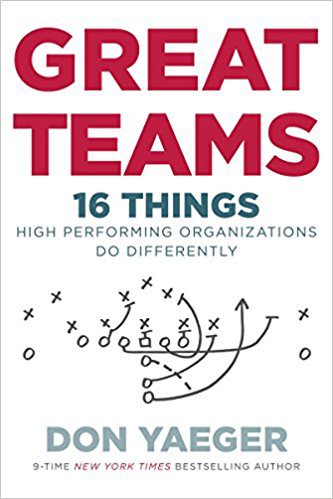
Great Teams Do Differently: Great Teams: 16 Things High Performing Organizations Do Differently
Your book Great Teams: 16 Things High Performing Organizations Do Differently, my first question is, did you have a lot more than sixteen and you had to edit it down?
Just like for whatever reason and the reason that this one ended up at sixteen, this is my first book.
In both cases, I had many more reasons but what you’ll find is there’s a cutoff point where you can say, “This is consumable.”
People can take this and do something with it.
If I had 118 things teams do differently, you would have never consider it because you’re like, “I can’t do 118 things.”
Sixteen seems reasonable enough. Stephen Covey had 7 Habits. John Maxwell has 21 Laws.
There has to be a consumable number and sixteen is my number.
Let me ask you about how great teams run successful huddles. I think that’s really valuable. A lot of people feel like their meetings aren’t productive and they just waste time. If you have insights on how to make huddles more effective, that’s really valuable.
That was one of my favorite discussion points because we all struggle with ineffective meetings and ended up it don’t seem as valuable as it should be.
I’ll give you two takeaways your listeners can do something with.
Huddles are the heartbeat of any organization.
Whether they’re meetings in their business or they’re huddle in sports, a gathering where information is shared and something needs to happen as a result, that’s the heartbeat of any organization.
Most of us have bad meetings. Most of us have bad huddles.
I went into the organizations that are known to have the best to ask them, “What do they do and how do they do it?”
Two takeaways that came up: Number one is every huddle has to start on time and it has to end on time.
[bctt tweet=”Every huddle has to start on time and it has to end on time. ” username=”John_Livesay”]
That just goes to your respect, respecting people’s time.
Let’s say you have a habit in your organization.
Everybody knows your meeting is going to start five minutes late.
What happened?
They’ll start showing up seven minutes late.
Everyone knows that a 3:00 meeting will start at 3:00.
Then what starts to happen is nobody wants to be able to be the one who’s there at 3:07.
If there’s flexibility, if 3:00 turns to 3:04 or 3:06 then there’s 3:07 and who knows? Also, it leads into the next meeting that they’ll do.
The best huddles are precisely run in a way that allows that to be done well.
What’s so interesting about that for me, Don, is think of all these sports that are so specific and exactly how long a quarter lasts. When the clocks running out on the basketball, that’s it, right?
Yeah. They don’t give you extra time because you need them done.
What’s the second takeaway on the good huddle meeting?
The second takeaway for me that I really love what I thought about was everyone in the huddle has to be fully present or fully absent.
We tell a pretty amazing story.
We’ll talk about a national championship basketball game in which an important huddle occurred, a back-up player on the huddle.
He knew he wasn’t going to be in the game at all. He’s outside the huddle. He’s actually waving at a girl in the crowd.
An important information about the idea that the team had no timeouts left was shared with the players.
This back-up player didn’t hear it because he wasn’t really listening because he wasn’t in the huddle.
A key moment came in the game and he yells, “Call timeout.”
When the player who’s on the court with the ball hears that, he does call timeout even though he was told there were no timeouts available.
What happened was that the team lost the national championship.
If you’re really getting to it and I got into it and every people studied it, the end result was the failure to be fully invested by everyone who was affected by the huddle and that includes your back-up players.
What does that mean for us in business?
That could mean you’ve got a bunch of people sitting in the room, and an important information is being relayed and they’re on their Twitter or they’re on their Instagram or they’re checking their email on their phone as opposed to being engaged in the conversation.
We have this rule in our building: If you’re not fully present in the meeting, be absent.
If you think what you have on Twitter or Instagram is more important that what’s happening here, then leave the meeting.
[bctt tweet=”If you’re not fully present in the meeting, be absent.” username=”John_Livesay”]
That reminds me exactly what happened at the Academy Awards. The guy who was responsible from the accounting firm of giving the envelope to read Best Picture was breaking the rules and taking a selfie with Emma Stone who just won Best Actress.
Then he ended up giving Warren Beatty and Faye Dunaway the wrong envelope to read Best Picture because he wasn’t fully present.
When you talk about great teams speaking a different language, I’m guessing part of that is no blame game. Is there something else in there you could give us?
A big piece of it is, “How do you handle it when mistakes happen?”
The bottom line is mistakes can happen.
That’s part of events.
How do you handle it when they do?
One of the things that I’ve watched among the greatest and the best teams is they know how to engage people in those moments.
Rather than saying, “What are you doing? How did you make that mistake? What were you thinking?”
Rather than being in the blame mode, they are in the mode of explaining, “Here’s how it’s done when we’re here. Do you remember that conversation we had yesterday in practice about this? We’re going to need you later to execute on this. Let’s remember the conversation.”
How often have we seen moments of crisis and the leader goes into, “Who’s fault is this that we’re in this crisis? Why did you do that?” as opposed to, “We have prepared ourselves for this. How are we going to move forward from it and what are we going to learn from it?”
This is a different language in how we collectively organizationally speak to each other.
Then the flip side of this, the final question is how do great teams avoid the pitfalls of success?
It’s really fascinating because we’re like, “We avoid the pitfalls of failure,” and most people don’t think about success having pitfalls.
You have experienced plenty of success in your career and in your life. We’ve seen you worked with other people who are great.
What are the pitfalls of success and how do we avoid them?
John Maxwell, who is a leadership mentor and speaker, one of my favorite people in the Collaboration, someone that I get a chance to work with every month on a project, has a great line.
He says, “One of the great predictors of failure is success.”
The truth is when we get successful, we get complacent.
We no longer do the things that got us to success because we think we don’t have to.
We think everybody is going to remember how successful we are. They’re going to quiver in their boots when we walk by.
We forget people aren’t as impressed with us as we were impressed with us sometimes.
The truly great ones, they understand success yesterday is exactly that. If we want to be successful tomorrow, it’s a new case. It’s a new day.
That place out there is just failure yesterday as exactly that.
Don, your website is DonYaeger.com.
It’s for people to learn more about your wonderful content, hiring you as a keynote speaker, buying your book and all that great stuff.
Anything else you want to leave us with?
When you’re pitching, it’s an art.
You’re clearly the artist.
I look forward to listening and learning.
I think the key to everything I have learned in life is the art of storytelling and I think that’s where great pitching happens.
It’s not just about what my product does, but what the product’s done for somebody like you that makes me go, “I want to get to know more about that.”
I think storytelling is a gift. It’s a skill set. As your listeners work on their development hopefully, in some way this all fits.
I want to give a special shout-out to our mutual friend, Stephen Woessner, the Founder of Predictive ROI, for connecting me to a great guest like you.
Thank you. I appreciate Stephen as well.
Did you enjoy this post about what great teams do differently? Be sure to visit these articles as well:
Exactly What To Say For Influence And Impact with Phil M. Jones
The Power of Positive Thinking & Being Present
Sales is a Team Sport
Links Mentioned
- Great Teams: 16 things High Performing Organizations Do Differently
- 7 Habits
- 21 Laws
- John Maxwell
- Don Yaeger
- Predictive ROI
- Sports Illustrated
Wanna Host Your Own Podcast?
Click here to see how my friends at Brandcasting You can help
Get your FREE copy of John’s latest eBook now!
Share The Show
Did you enjoy the show? I’d love it if you subscribed today and left us a 5-star review!
-
- Click this link
- Click on the ‘Subscribe’ button below the artwork
- Go to the ‘Ratings and Reviews’ section
- Click on ‘Write a Review’
A Real Estate Backed Cryptocurrency Token with Matthew Sullivan
Posted by John Livesay in podcast | 0 comments

 Episode Summary
Many people want to “get in” on the new cryptocurrency innovations, but are nervous about all the ups and downs as well as the fact that it is “not backed on anything but trust.”
Imagine if the real estate market got disrupted by a cryptocurrency token that would help people take equity out of their home without increasing their monthly mortgage. What if that new token also provided everyday people a way to get in to the cryptocurrency game, but do it with a token that was backed by assets in real estate?
Well you don’t have to imagine it because Quantm.one is launching to help people get cash in exchange for a small percent of equity in their home. The social impact of this is huge as people who need money out of their home to send their child to college can now do so without causing their mortgage payment to go up.
—
Our guest on The Successful Pitch is Matthew Sullivan who is the host of his own podcast called Hooked on Startups. He is the CEO and Founder of a new cryptocurrency token called Quantm.One and it’s going to allow people to get equity out of their house without having to take on more debt as well as help those people who don’t have the money for a deposit to buy a new home. He has a fascinating background working with Richard Branson on launching a lot of Virgin brand extensions. He flies a helicopter and he also has a story of how he met the Prince in the UK. Enjoy the episode.
Listen To The Episode Here
A Real Estate Backed Cryptocurrency Token with Matthew Sullivan
I have a friend and colleague as my guest, Matthew Sullivan. He is the Founder and Chief Executive Officer of Quantm.One. He is also the Co-founder of a $50 million Secured Real Estate Income Strategies fund, and the President and Co-Founder of Crowdventure, a real estate crowdfunding company. He hosts his own podcast called Hooked On Startups. He worked with Richard Branson’s Corporate Finance Team in the Virgin Group for six years and has quite a story about flying a helicopter. He is the Director and Trustee at the time of Virgin’s London’s Air Ambulance, which is what the helicopter is involved with. He went to school in London and studied law over there and now is here in Southern California. Matthew, welcome to my humble little podcast known as The Successful Pitch.
John, it’s my unending pleasure to be here.
I like to ask my guests to take us back to their story of origin. You can go back when you were a young lad as you call yourself in London or you can tell about working for Richard Branson, however far you want to go back and take us back on, “Here’s how I got to where I am.”
It’s really a story of the moment that I decided that I was systematically unemployable. I think all of us entrepreneurs have a moment where we go, “This job thing just isn’t going to work for me.” I remember I was a stockbroker at the time. It was a great time. I was a Far East stockbroker so I would go around the world to all of the Far East Tigers or the Asian Tigers as they were known then, which were Hong Kong, Singapore, Malaysia, Indonesia, Philippines and Thailand. Every year or twice a year, we would all go in this junket around those countries meeting companies and doing research and just generally having a bit of a wild time. There was a point when I think I was out in either Hong Kong or Thailand when I just thought, “This is great fun but I want to be the person making the decisions and I want to be the person defining the policy. I didn’t just want to sit back and be an agent of execution.” I think I was in my mid-twenties or early twenties at the time.
[Tweet “A real estate backed token”]
A couple of years after that, the guys that I was stockbroking with, Tim and Rory McCarthy, they set up their own company and I went along and joined them much more as a partner rather than as an employee as it were. Rory wrote a letter one day to Richard Branson because his office was just around the corner in Kensington and he said, “Dear Richard, we own Lindstrand Balloons and I’ve always wanted to go around the world in a hot air balloon, but I think you would be a much better pilot. How about it?” I remember seeing the letter when it came back because the letter said, “Dear Rory, Why not? Yours, Richard.” It was a very simple response and then at that point onwards, we then ended up building this incredibly complex hot air balloon to try and fly around the world and there began our journey with Richard Branson and Virgin. For the next five to six years, we ended up being best friends with him and working in all sorts of really interesting projects from Virgin Jeans, Virgin Cosmetic, Virgin Clothing, V2 Music, Virgin Executive Jets, Virgin Helicopters and Virgin Bride, the list is endless.
Tell us your James Bond story because I love that. I think that’s a great visual for everybody to get just how bon vivant you are.
I learned to fly a helicopter at one of the companies we set up, which became Virgin Helicopters. At the same time, Express Newspapers Group decided that they’d spent ten years sponsoring the London’s Air Ambulance but they’d come to the end of their run as it were. The sponsorship or the funding of the London’s Air Ambulance was up for grabs and there was this risk that it would have to close down. The person in charge of the Air Ambulance at the time came to see Richard and said, “I think Virgin would be a great idea,” so Richard said, “Yes.” He handed it over to us and we sorted it all out and we put the money together. I ended up being a trustee and one of the directors or the operations director in charge of the whole process.
One of the perks that I used to get every now and then was that I would drive my car in the morning to the place where they park the helicopter at night, and I would get out and go to the crew room with all the other pilots there. I’d put my bright orange pilot suit on and my flashy James Bond with a mirror glass and I’d get in the helicopter. Because I have a license, they let me fly the helicopter under pretty close supervision I can tell you. They let me fly the helicopter to the parking place on top of the Royal London Hospital. I would fly to work and I would land the helicopter and I’d get out and I’d unzip my flight suit. I’d pick up my bag and I’d have my business suit underneath and I just catch the elevator down, hail a taxi, and I go off to work. That was my James Bond and I would do that. I’d do that a few times a year actually. It was pretty cool just flying over London looking at all these people underneath thinking that at that moment, I was Mr. J. Bond.
On your LinkedIn profile, there’s a photo of you with some relatively famous people who happen to reside in I believe it’s Buckingham Palace. Can you tell us how that happened?
We were closing one of the other projects that I was involved with. It was a sustainability campaign so that was going back a few years, not too long ago though, I think post-2008. In Europe, we were quite ahead of the US in terms of sustainability in carbon footprinting and the importance for companies to be able to demonstrate environmental credentials. One of the companies I set up, which is still running today which is called Clearway, was a consultancy that worked with companies to help them reduce their carbon footprint and improve their sustainability. One of the projects that we work very closely with was The Prince’s Trust. The Prince’s Trust was really very much at the forefront of running programs and educating companies. The picture there was we’d put together a program for schools, which was called Eco-Schools. The particular program was designed to try and get kids at a very early age to understand the importance of energy usage and sustainability and how the world doesn’t have infinite resources. That was something that was very close to the Prince’s heart and his charity. The picture there was where we were working very closely with the The Prince’s Trust at that point trying to roll this out to as many schools in the UK as we could.
We fast forward to your latest venture and what’s interesting about that story you told, Matthew, in your youth saying, “I don’t want to just execute something. I want to create it.” You have the same mindset around cryptocurrency. You don’t want to just invest in one, you want to start your own token. Tell us how that came about?
It’s a case of faint signals from the future having seen what happened with the internet back in the late ‘90s. Once or twice, there’s normally once every ten years or so, if you’ve got your feelers up and you’re listening out for these things, then every now and then, you pick up these signals where, “These sounds and feels like the thing that we had ten or twenty years ago.” The internet at that stage had its fair share of naysayers and the people on the sidelines. The guys that got in the early stages and understood the potential with the guys that actually really benefited. Having followed Bitcoin not for too long, probably for less than a year, had people talking about blockchain and cryptocurrencies, it didn’t really resonate. There was a moment when I thought, “There’s something here.” Then you see the price of Bitcoin going through the roof and you think, “I don’t actually want to be involved as a secondary player here because I have no control over this. I’m purely a passenger and completely at the disposal and at the hands of the market.”
That ride is very choppy and very volatile and it’s not enjoyable at all. To all of you investors in Bitcoin and all of the other coins out there, I know what it’s like because every morning you probably wake up and the first thing you do is you look at the price of your Bitcoin or your Ethereum or Litecoin or whatever the coins are. If it’s gone up, you have a great day. If it’s gone down, you start your day with the equivalent of a cold cup of coffee.
It’s so funny you say that because I talk about helping people get off the self-esteem roller coaster really feeling good about themselves if their numbers and their sales are up, and bad about themselves if their numbers are down. We can do the same thing with our investments and you figured out a solution to that.
The real point is how do you build something where you’re in control of it? Where you are able to shape and define the policy rather than having to react to it. What I’ve figured out over the years is that always, the answer that you want is staring you in the face. You’re just trying to look beyond it. You’re trying to look outside of it. Actually, it’s there. It’s a combination of your experience and where you are right now. That’s what you should try and leverage. Having spent a bit of time trying to get out of my own way and figure out what was actually in front of me.

Cryptocurrency Tokens: It’s a combination of your experience and where you are right now. That’s what you should try and leverage.
If you look at the components of the businesses that I’m in, real estate crowdfunding and just real estate generally, technology and then you overlay that with this cryptocurrency idea where you’ve got bits and bytes flying around the world without the normal roadblocks that you have with normal money, the solution was really to say, “How do you solve one of the big problems?” On the basis that if you wake up in the morning thinking that your Bitcoin price could have gone through the floor but thank God it hasn’t, that means it’s an inherently volatile currency. Is there a place for something that combines the benefits of cryptocurrencies, which is all this flexibility and the ability to move money around the world in the blink of an eye and something solid like real estate, which is really the mainstay of any portfolio? Real estate is there. They’re not making it anymore. We all know that real estate is a great investment. Really the a-ha moment was how do we take something solid like real estate which is predictable, which always outperforms inflation? How do we make it accessible to people by bolting on this really cool cryptocurrency technology? First of all, we don’t want a cryptocurrency that’s bouncing up and down all over the place in terms of prices. We want something that’s predictable.
There are major problems within the US residential housing market that need fixing. They need fixing by people saying, “You shouldn’t be borrowing so much money. There should be other ways to help you fund your house.” At the moment, the only way you can buy a house is by borrowing a ton of money. You don’t actually buy a house, you finance your house. Is there a way where you can get other people to come in and maybe buy a little bit of your house with you so that your debt isn’t so massive? There are ways of doing that but the problem is, people don’t really want to invest in that because you’re locked in for a long period of time and it doesn’t throw off any cashflow. There’s all these problems floating around and if you wrap the umbrella of this cryptocurrency over the top of that, suddenly it starts solving these problems one by one.
From a volatility perspective, suddenly if you add real estate as your underlying asset, it smooths it all off because real estate doesn’t bounce up and down in price. It moves really slowly. If you can tie your currency to that and the currency comes down and doesn’t bounce all over the place and it becomes much more predictable. The thing about the currency is it creates liquidity. If you can buy and sell these tokens and if these tokens represent this big piece of real estate then theoretically, you can chop up a big piece of real estate into loads of tiny little pieces and you can sell those to people by way of tokens. The people that buy the tokens can then sell those tokens to somebody else. Those tokens move around like atoms. When they’ve got this big solid object underneath, it stays there. These tokens are whizzing around the top of it like atoms and that creates liquidity.
What we’re now in the position of doing is creating money that we can spend with people who can’t afford to buy a house and we can say, “I know you can’t afford to buy a house because you can’t afford the down payment, but how about we come in and split the down payment with you?” Or let’s say, “You’ve got a ton of equity that you’ve built up in your house and you need to release some of that because you can’t pay your mortgage, how about we buy a piece of that equity from you? You don’t have to pay us back. You just sold us a piece of your house and then we can give you some money so that you can pay your college fees or you can help get yourself back on track.” That’s a very long answer to a very simple question.
[Tweet “Helping people get equity out of their home with no debt”]
Let’s break it down a little bit. You decided that instead of just investing in cryptocurrency, you wanted to start your own token because it’s too volatile and you get on that self-esteem rollercoaster based on how something is performing and you have no say in it. That’s the first problem you’re solving is realizing there’s a lot of people that need to find a place to put their tokens. Then you have a social impact element to it, which is there’s a lot of people who have some equity in their house that they want to take out and the only way to do that now is by taking on a higher mortgage amount.
Yes, exactly. This is the design. The design is to say, “Here’s the token which is much more predictable where you haven’t got to worry, you’re not going to have those sleepless nights because it’s not going to bounce up and down anything like the other cryptocurrencies.” The second thing is really interesting because I think something like 70% of people who rent homes in the US would prefer to buy their house but they can’t because they can’t afford the down payment.
The 20%.
I think it’s less than that. 20% is the optimal but even if it’s 5% or 10%, because of all the issues we had back in ’07 and ‘08, the banks are now much more stringent about how much money they lend and who they lend it to. Add it to the fact that if you look at the amount of money that the average person has by way of savings in their bank account, I can’t remember what the exact statistics are, but it’s a few hundred dollars. If something goes wrong with your washing machine, basically you’re screwed because most people don’t have enough spare cash for something like that to happen. To actually find people who are trying to get their foot on the property ladder and to ask them to suddenly come up with this big down payment, they’ve got to go and max out their credit cards, phone up their friends and family and beg, scrape, and put together this deposit. That’s why most people are renting houses. That’s why the cost of rentals is going up disproportionately to inflation and to the all other indicates because there’s so much demand for rentals because people can’t afford to buy a house. We solve that problem by saying, “We will help you with the down payment.”

Cryptocurrency Tokens: Banks are now much more stringent about how much money they lend and who they lend it to.
The other problem is, “What about people that are sitting on houses that they’ve had for a long time that have gone up in value but they’ve fallen on hard times or their jobs aren’t paying as much as they used to and the price of living has gone up?” It’s crazy because they’re sitting on hundreds of thousands of dollars of value that they can’t get a hold of because the banks will turn them down if they try and get a home equity line of credit. They are stuck there with all this value, all this money that’s basically nailed behind the walls that they can’t get access to. What we say is, “We want a piece of your house because that’s really valuable to us a real estate asset. Sell us that piece of your house, just a percentage of your equity and we’ll have that and we’ll pay for that.” It creates this liquidity. It puts money back into people’s pockets that the banks are unable to do.
Still have some appreciation but you know it’s never going to go down to zero because it’s backed by some actual residential real estate. The other thing that’s interesting is there’s probably a lot of people sitting on the sidelines going, “I’d love to be part of this cryptocurrency world but it’s too scary for me because it’s so volatile. I could buy a token that’s backed by real estate. That makes sense. That will be a good entry for me,” yes?
You’re right. The other thing is I can buy one token or I can buy a half token. Let’s say for arguments sake the tokens start out at $10 each. I don’t have to buy a whole token. I could go on to an exchange and I can say, “I want to buy a $1 or $100 or $153.45 worth.” I’m not restricted by minimums. I can buy a little bit now, a little bit tomorrow, a little bit next month. I can sell a bit. The great thing about tokens because of the technology, you can actually chop these tokens up into tiny, tiny pieces. That makes it much more accessible for people that don’t want to have to spend $1,000. How much is a Google share or an Apple share these days? You’ve got to be pretty rich just to be able to buy one Bitcoin these days. People understand real estate so it’s the next step where we go, “I don’t really understand cryptocurrencies but I do understand real estate and I do understand that this token is backed by real estate so I’m a bit closer to understanding how this stuff works.”
Also, “I want to put some high investments in residential real estate without having to be a landlord. This gives me the benefits of owning a small percentage of a lot of people’s homes without having to deal with the upkeep because the owners keep the upkeep going.”
That’s a really critical point because the best people you want to look after a home are the owners. There’s a great expression, “If you’re renting properties, you’ve got tenants, toilets and trash.” Those are the three things that any landlord hates. Getting call at 3:00 on a Sunday morning saying that the toilet is blocked so you’ve got to do something about it. If you will own a piece of someone else’s house and you own it in true partnership with them so that if they make money, you make money. If they lose money, you lose money. If you are there as partners, they’re going to look after the house. They’re going to cut the grass. They’re going to paint the walls, they’re going to keep the place clean because they’re proud of the house and you’re a partner in that with them.
The great thing is that there are literally thousands of billions of dollars of people’s houses out there where they would be willing to share or to allow other people to be part owners in their house if they could keep their house or if they could stay as owners. It is a massively untapped asset class or a piece of a section in the real estate economy that people haven’t really been interested in because it doesn’t throw off any revenues. It’s not cashflowing. It doesn’t pay rent. If you buy a share in someone’s house, theoretically, you’ve got to wait until they sell the house before you make your money. That’s what put everyone off to date and that’s what changes with this whole concept of the token and putting the token on top of that.
The real reason to tokenize, if you will, the way people buy a home or get equity out of their home is fill in the blank. Right now, there are ways for people to get equity out of their house and there’s people sitting on the sidelines that can’t come up with a down payment. The real value of having a token do it would be, what would you say? It’s liquid?
What it does is it allows people on both sides of the fence to get involved. On one side of the fence, you’ve got the homeowner who wants to release some capital. Normally, that money would come from these big nasty hedge funds or banks or funds or pension funds and basically men in suits behind glass doors. There’s no opportunity for the man in the street to be able to participate. If I’ve got a bit of cash, I like the idea of investing in other people’s houses. I like the idea of being able to help them get on the housing ladder but that opportunity is not available to anybody right now because the money to do what equity sharing there is, is provided by banks and hedge funds. What the token does is it says, “We’re going to throw this whole thing out to the average investor.” We’re going to say, “Pretty much anybody now will be able to get on the housing ladder as long as they meet certain requirements.” Also, if you want to get involved in this and help people and potentially get a good return on your money, then what the token does is it democratizes that side of the equation as well.
[Tweet “Helping people with downpayment to buy a home”]
Also, isn’t it lowering transactional cost compared to traditional asset trading?
The great thing about the technology is that things happen in the blink of an eye now whereas beforehand, you have to go through brokers and dealers. There will be commissions here and commissions there and paperwork here and sign a form there. If we can do it through this technology lair, all those things happen instantly. The tracking and the securities that we’re putting in front of these properties create more security in these transactions. What we’re doing is we’re taking something that is not tradable, that is not liquid and then using technology, we are making it liquid. The result of that is the efficiency and the magic effectively that the technology brings. It unlocks that. Your question is about cost and efficiency. It will be fractions of a fraction in terms of the cost of doing that transaction compared to what it would be if we try to do it through the normal equity ways that we have today.
Matthew, I love what you are saying so much that I decided to join the team at this very moment. If anybody wants to track what’s going on with Quantm.One token, you can go to the website which is Quantm.One. Any other final thoughts on Quantm and the future of cryptocurrency in real estate?

Cryptocurrency Tokens: In the future, everything we do will have a value and we’ll be able to translate that value into something that we can spend.
As more and more people understand cryptocurrencies, the thing that we’re not really tapping into is just the amazing scale of things that cryptocurrencies can get involved with. My prediction for the near future is that everything we do will have a value and we’ll be able to translate that value into something that we can spend. Whether it’s intellectual property or whether it’s physical activity or skills or the ability to communicate, those skills of cryptocurrencies and tokens and technology, will be able to have a value around those things. That means that people that have these amazing skills that haven’t been able to turn this into capital because capital law, normal money is just a little bit old fashioned, that will be released. We’ll see whole new economies and whole new ways of doing things will also be springing out of this ability to tokenize activities and intellectual property and value.
It’s certainly an exciting time to be a part of all of this. Thank you for being a guest on the show.
John, it’s been my pleasure. Thank you.
Links Mentioned
- Hooked on Startups
- Quantm.One
- Virgin
- Crowdventure
- Richard Branson
- Virgin Helicopters
- Matthew’s LinkedIn profile
- Clearway
- The Prince’s Trust
Wanna Host Your Own Podcast?
Click here to see how my friends at Brandcasting You can help
Get your FREE copy of John’s latest eBook Getting To Yes now!
John Livesay, The Pitch Whisperer
Share The Show
Did you enjoy the show? I’d love it if you subscribed today and left us a 5-star review!
-
- Click this link
- Click on the ‘Subscribe’ button below the artwork
- Go to the ‘Ratings and Reviews’ section
- Click on ‘Write a Review’