

Turn Your Business Into A Brand and Define Your Business Brand with Greg Logan
Posted by John Livesay in podcast | 0 comments

Episode Summary
A product or a service becomes a powerful tool to a client when they can clearly see the good it can do for them and their business. Entrepreneurs tend to tell clients what they think and tell these clients what they want. Greg Logan turns this around and tells investors to be good listeners for their clients. To define your business brand helps once this is established because it will give the client a clear idea of the service and experience they can get. Learn more of Greg’s genius way of copywriting a business model and turning it into a valuable brand.
—
Our guest is Greg Logan, the Founder of TheDefinery.biz which is a consulting firm that helps businesses of any size become brands. He has an amazing ability to hone in on what your pitch should be, what your brand should be and he gives examples of what it looks like of what he does when you look at Apple. He even coaches me on how to hone in my own particular pitch. He has so much experience from working literally around the world as a creative director on big brands. He quotes Leo Burnett who he worked for, one of the big agencies, and he says, “Don’t tell me how good you make it. Tell me how good it makes me when I use it.” He said, “The key to winning pitches is to become a good listener.” Find out how he does that and more. Enjoy the episode.
Listen To The Episode Here
Turn Your Business Into A Brand and Define Your Business Brand with Greg Logan
Our guest is Greg Logan. Greg started as a copywriter at Leo Burnett at the age of nineteen. He worked for seventeen years for Leo Burnett from Sydney to Milan where he was a creative director at a young age of 25. Then he started and sold his own agency, McMann & Tate. That’s the one Darrin Stephens used to work for, for those of you who are big Bewitched fans like I am. He has literally created some of the most award-winning and popular advertising over the last twenty years, such as United Airlines, Qantas, Kellogg’s, Fiat, Procter & Gamble. It just goes on and on. He’s been the executive creative director of large branding agencies and he also writes reality TV shows. He would be one of the few people in the world to win these awards across advertising, film and TV. It’s like an actor winning the Emmy, the Oscar and the Tony Award. He’s an Australian. Now, he lives in LA. I’ve heard him speak. I couldn’t wait to get him on the show. He now has an agency consulting firm called The Definery which helps small and medium businesses become the all-important brands. Greg, welcome to the show.
Thank you, John.
It’s always so wonderful for me when I actually get to hear someone like you tell their story and then bring that incredible career and insights to The Successful Pitch. One of the stories I always love to ask people is, what’s your story of origin? I just started to give people the sense of it. At a very young age, you were working for one of the big ad agencies in the world. Paint us a picture of that. Were you inspired by Bewitched?
At the age of ten, I wanted to get into advertising because of Darrin Stephens. Up until the age of ten, I wanted to be an actor. My mom’s twin brother was an actor. I was pretty good at it. It was in my DNA. Every year at the school play, I was cast as the lead. Then when I was ten I said to mom, “Why does Uncle Peter give us really cheap Christmas presents?” She said, “Actors don’t make very much money.” I was like, “Are you serious?” That was the end of that career at the age of ten. I never thought about it again. I used to love Bewitched and I loved D’s office. I loved the briefs he got. I loved his sloppy desk where he had created the stuff. I loved how he presented and pitched. I said, “What does he do?” She said, “He’s a creative in advertising.” I said, “Does he make a lot of money?” She said, “Yes.” I said, “That is what I want to do.” I never changed from then all through high school. When people leave high school, they’re wondering, “What am I going to do with my life?” I already knew. I left school. The next year, I was working at Leo Burnett and I was working on huge jobs. It was so clear. Darrin Stephens plays a big role in my life. After seventeen years at Leo Burnett, I left and started my own agency. I said to myself, “If ever I have my own agency, I’m going to call it McMann & Tate.” I did.
Two questions that beg, the first one is, do you now give good Christmas presents to your relatives?
Yes, I do. Uncle Peter still gives us really cheap Christmas presents.
The second question is, having worked in advertising myself and selling advertising for Condé Nast for a number of years, I’m very well aware of Leo Burnett. I come from Chicago and that’s a big office for them. They have a reputation for having really fresh, shiny red apples in the lobby. That’s their branding. Tell us the story behind that.
It’s actually a really beautiful story and very few people know it, even people who work at Leo Burnett. Leo Burnett spends millions of dollars not only putting the apples in, but there are some countries that they don’t grow apples and they even import them from countries that do so that every office in the world has a bowl of fresh apples in reception. In the Sydney office, I know the couriers used to love coming here and they would always take an apple. The reason it exists is Leo Burnett started his advertising agency straight after The Depression and people said to him, “Are you crazy? No one wants advertising. No one has any money. Very soon, you’re going to be standing on this corner selling apples.” Leo put a bowl of apples in reception to remind him and also all his staff what they could be doing if they weren’t doing what they loved.

Define Your Business Brand: If you reach for the stars, you may not grab one but you won’t come up with a lump of mud either.
It was just one of those things that was a gentle reminder of, “We’ve got to work harder and we have to do the right thing.” If anyone just Googles Leo Burnett quotes, you’ll see he was quite a wise man and a good man. He was a bit of a grumpy old thing too. He was not dissimilar to Winston Churchill not only in his eloquence, in his quotes, but also in his look and manner as well. Outside my office was a quote that said, “If you reach for the stars, you may not grab one but you won’t come up with a lump of mud either.” It’s just such a simple thing. It’s not saying, “You may not grab one. We may not always get to where we want, but actually if you try and achieve it and you try and reach for it, you’re going to do a hell a lot better than if you don’t.” He had so many incredible quotes. Just that apples at the reception is a beautiful statement.
For me, it’s not only a gentle reminder to do what you love but also to be grateful that you get to do what you love. That’s my big takeaway. That’s what really resonates with me. One of the other quotes from Leo Burnett that you showed in your wonderful keynote was, “Don’t tell me how good you make it. Tell me how good it makes me when I use it.” Tell us how we can incorporate that mindset into our marketing messages when we’re trying to get people to join our team or get people to become clients.
I think it’s tapped into something I really, really believed in and something that he, from his grave, taught me. We have this desire as humans to tell people what we think and tell people what we want. In advertising is, “Isn’t my product great? Look what it does.” Actually, a person wants to feel better. A person wants to look sexier. They want to look trimmer. They want to have healthier hair. They want to be smarter. If you start feeding the audience with how good they could be with the product, it’s far more powerful. He also said another quote which was, “If you can’t turn yourself into a consumer, you probably shouldn’t be in this business.”
[Tweet “Don’t tell me how good you make it. Tell me how good it makes me when I use it.”]
That’s just one of my favorite things ever that I talk about all the time on The Successful Pitch, which is you must show empathy. Whether you’re giving a keynote talk, you have to show the audience that you have been in their shoes. Whether you’re getting someone to potentially hire you to be a client, you have to give them examples of you understand where they are and where they want to get to and possibly you’ve helped other people just like them. It all starts with the empathy factor that builds your likeability.
You have to put yourself in their shoes. It is something that people never, ever do and it’s so simple. Before anything, not just a pitch, anytime you send an email to someone, if you’re having a fight with your partner, if you’re having a disagreement with your neighbor or the work they’re doing in their yard, rather than just going out and blurting out what you want and what’s in your head, before you do you go, “What’s going on in their mind? I’m going to put myself in their shoes. What are they thinking?” Then you can tailor what you have to say that’s going to address what they want, what they want to hear. If you go back to that quote that Leo said, “If you can’t turn yourself into a consumer, you probably shouldn’t be in this business,” I take that a step further and also go, “If you can’t turn yourself into a client, you probably won’t be successful in this business.” I have a pretty good strike rate in pitches. People think, “It’s because you’re such a good presenter.” Those things help. It’s because I’m a good listener that is why I win pitches. It’s such a simple thing that people don’t do. When we’re asked to pitch that’s loaded with all this other stuff of, “I’m giving a presentation and someone wants to know what I have to offer and what I’m going to bring to the table.” People take that of, “How am I going to impress them? I’m going to create this and that.” Then you go off in tangents and go, “This is a really good idea. They’ll love this.” It’s actually you love that. You could be lucky and you blow them away, but it’s not probably what they’ve asked for.
[Tweet “Win More Pitches By Becoming A Great Listener”]
Your consulting agency is called Definery. One of my favorite things to do as part of the story of origin when I’m working with clients is how did you come up with that name? What does it mean? How does it define what you do?
I’m helping small to medium businesses become brands. That’s what I’m doing with The Definery. I’m taking everything that I’ve learnt from helping really big, rich companies get richer and I’m distilling it down to the most important stuff. I used to have big arguments not only with my advertising agency but after advertising, I worked for some huge branding agencies as well. I used to say, “We are spending all this time and effort on all this stuff.” Everyone out there would have heard about big hairy audacious goals and mission statements and purpose and goals and personality and values and SWOT analysis and this and that. What happens is you deliver this book of, “Here’s your brand,” and it’s so long and it’s so complicated that you hand it down to your agencies and people in your company and no one can actually use it because it’s just too much stuff. It becomes blah, blah, blah. I took everything that I knew and I just took the stuff that really made a difference. What The Definery does is it starts with your business definition.
What I do is I start with a business definition. Most agencies won’t do that. They’ll just hear what the business is and then tell them what the brand is off that. Whereas I’d rather start with, “Why are you in business that’s going to make money? What is the most potent thing about your business and why it’s going to succeed?” What I do is I’ll turn it into something in a way that the business has never heard about it before. I always use an example that I did for Apple. They didn’t pay me. This is me just in myself. If I look at Apple I go, “Their business idea is computers for people who don’t like computers.” You’ll never see that written anywhere of what Apple is. It will be a very rational statement about technology. You look at that and you go, “That’s going to make money. That’s why they’re successful.” Off that business definition you go, “What is the human benefit of that? What is the consumer going to experience?” For Apple, that would be revolution. Everything that they do and you feel is revolutionary from the advertising to the design of the products, to the store design and the experience. We define a brand idea then off that, everything a brand does, whether it’s the website or your logo or your name, comes from those two things.

Define Your Business Brand: Start with a business definition.
The other thing I’ve started to do is a verbal definition because more and more, people need to quickly define and tell people what their business or their idea or their startup or whatever it is, is. I said, “I listen very well.” The other difference with The Definery is instead of me going away and coming back a month later and saying, “This is what I think,” I create these things in the room with the people who run and own the business. All I do is I listen to them and I pull out and I basically copywrite what their business is, but in the best way they’ve ever heard it.
I love that Apple example because if you look back at the history of their advertising, it started off with a Super Bowl commercial about going up against IBM. Then it evolved into the Think Different campaign. It’s still about revolutionary, not going with the norm and there are other people who are iconic. If you see yourself as a Picasso kind of person, reinventing and disrupting things, then this is the computer brand for you. I think you’ve carried that through really well. I’ve never seen anybody else do it. I think for people listening, they really can have some great takeaways here going, “What is my business definition? How do I define my brand?” It’s so important to have a good brand because that defines your culture. Don’t you think, Greg?
Yeah. The brand ideas I come up with businesses, it’s amazing how many owners say, “I’m going to employ people based on that brand idea.” I want them to embody our brand. It’s because the brand idea isn’t something that I’ve just made up. It is the human benefit of what their business is all about. That’s what I do is I inextricably link the business and what’s great about the business to why consumers are going to fall in love with that business and come back again and again and again.
You’re someone who I know can think on their feet and be creative. I’ve seen you do it. Do you want to play a little bit and just give people an example of me using these three models and I’ll say something, then you can tweak it and say, “See how much better that is?” I think it’s one thing if you’re looking at Apple and you’re like, “I’m not Apple.” You really specialize in small and medium businesses even if it’s just a solopreneur or whatever it is. Business definition for me is, “I’m The Pitch Whisperer and I help people go from invisible to irresistible.” That brand definition for me is forget selling and tell stories instead. That separates you from everybody else out there trying to push their message in because when you become a storyteller, you pull them in as opposed to pushing. Then the brand expression of that is once you can tell great stories, Plato said, “Storytellers rule the world,” then that allows you to take that skill and apply it to everything else that you’re doing in your life to pitch to get people join your team and get new clients and anything else you want to do in your life.
Your line, “from invisible to irresistible” is really powerful. I think that’s your business idea. You’re a Pitch Whisperer, you would say, “My business is I turn the invisible into the irresistible. That’s what I do.” Then your brand idea is, what is the human benefit of being irresistible? That acquire confidence, its success, people trust you, it’s magnetic. I think your brand idea is magnetic because you are going to draw people to your clients. What you instill in them just makes them magnetic. Everything you then do with your brand would embody that magnetism. You’re a pretty easy one. You know this stuff better than most. As a brand the idea is, “I turn people from invisible to irresistible.” If someone sees that, it’s like, “That’s going to be successful. Give me some of that.” The only tweak I would make is just make your brand idea magnetic.
[Tweet “What is the human benefit of your brand’s promise?”]
That’s the perfect word and that’s the whole concept. A magnet pulls people in. That’s brilliant. Not everybody can do that. We hadn’t rehearsed this. That’s what I love is because now people can really see if you could do that for me and not just a theoretical Apple then the contrast is no matter where you are, and even with someone who’s got some thought put into it, you take something good and make it great, Greg. That’s what you do. That’s why I wanted to have you on the show to really show that skill off because that’s your genius. I don’t use that word lightly but it really is. It’s your gift. It’s your skill. It’s been honed over years and it’s just a huge gift to everyone that gets to work with you.
It has been fine-tuned over the years. When you work in advertising, your degree of difficulty is so high. In 30 seconds or a billboard, you have so many mandatories that the client wants you to do and sometimes they’re budgetary and sometimes it’s proof points of the product. You have to then make it sing and make people actually want it and get excited about it. You then have to also create this with all the other jobs you’re doing in a short time as well. Your brain gets problem-solving fit. The thing that has been the biggest factor in success in my career is I listen. The amount of pitches I’ve won and afterward it’s always great to ask, “Why did we win the business?” The thing I’ve heard again and again is, “You really listened to us.”
That’s the number one reason why clients lose clients too. I’ve worked with a lot of people helping them win back a client they lost. The number one reason isn’t the competition, it isn’t the pricing. It’s, “You weren’t listening to me. I told you I needed this, you gave me that. I told you I was worried about this deadline not being met. You said, “Don’t worry.” The deadline didn’t get met. Whatever it is, you didn’t listen.” Behind that is sometimes they won’t come out and say, “You’ve got the business because you listened.” They might say, “You’ve got the business because we felt like you’ve got us, you understand us,” which is just another way of saying, “You listened really well.” I just wanted to point that out to everybody is it may not come in that exact wording but it comes in other ways, so recognize it when you hear it in terms of, “You understood us or you get us.” This applies to dating too, “You get me.” That’s everything. You’ve worked on both United and Qantas. I’m fascinated by that because most agencies only have exclusivity within an industry like that. Tell us a little bit about the differences between those two brands when you were working on them.
Actually, that was just a couple I’ve put in my bio. I’ve actually worked on Cathay Pacific, United Airlines, Qantas and Virgin.
I’m a big airplane buff. I used to work for TWA when it was around. I’ve worked with Gensler on helping them with their pitches to build airports, so this is going to be really interesting to me and hopefully everyone else. You’re starting off with what can be perceived as a commodity. You buy your ticket. Is it only based on price? They each have different positions of, “Fly the friendly skies,” or whatever the tagline is. How do you help different airlines separate themselves in a sea of what could be perceived as, “I’m just going to buy the cheapest ticket?” Is there really a difference?

Define Your Business Brand: Tone of voice is the unique way a brand writes and speaks.
United was the trickiest to work for because they really see themselves as the big main brand and I don’t think they have a lot of personality. Inherently in their brand is very little personality. When trouble happens like we saw recently, consumers really give them backlash because all they have to talk about is a big company. I’m not even saying brand. It’s a big company that treats me like a commodity. Whereas with Qantas, I’ve worked very closely with Qantas on their brand and I created their tone of voice. For people who don’t know what that is, it’s the unique way a brand writes and speaks. The fact that Qantas is even interested in doing that says a lot about them. They want to talk to people from their own unique point of view. Just like I do with The Definery in defining what a business is about, I do the same thing with tone of voice. Instead of lots of rules and regulations in a big bible that no one does is I take the personality traits of a brand, in this case an airline, and I translate that into ways that people would speak. Then I go, “If someone spoke like this, this would be the essence of them.” For instance, for a big online betting company, it was cheeky and whatever. It was, “We speak with a wink.” You know exactly how that speaks. With Qantas it was, “When we speak, it feels like home.” For people who fly Qantas, Qantas is so inextricably linked to the Australian spirit and psyche. Wherever you are in the world, you step on that plane and there is an attitude that is so Australian and you get on and you go, “That feels like home.”
I would say even more so than British Airways does for London. I know I’m on a British flight but it doesn’t have the same for me. This is strictly my opinion.
They’ve become a bit United, whereas Qantas could easily do that. Qantas is the biggest Australian airline and they could very much go, “We’re number one.” British Airways has. In fact, you get on a Virgin and you feel more like Britain than on British Airways because they express their personality. I think with those airlines like Qantas and Virgin, they play a lot of importance on expressing their unique personality. It draws people in and makes people feel good about it, whereas United and BA do not.
It’s interesting you said you worked on Cathay Pacific and I imagine their competitors would be Japan Airlines and Singapore Airlines which, for me really you feel like you’re in the country already no matter where you get on the plane. Singapore in particular is really known for that incredible service. How does Cathay Pacific, since it’s not one specific country, how did you help them?
Cathay is interesting. If you’re a plane buff, you would know that airlines really embody the culture of the place they’re from. Cathay is from Hong Kong and Hong Kong is really confused about what it is because it’s Chinese, but they don’t want to be Chinese. They’re torn between being English and Chinese. I think with Cathay, there is that little confusion of, “Who we are.” That said, the combination of the British and the Chinese, you have a very efficient airline. It always runs on time. The planes are good. The entertainment is good. It’s always in the top ten airlines in the world. You just don’t understand their personality as well as Singapore, and that’s because I think the people themselves in Hong Kong are confused.
I knew this would be interesting because you really see each thing has its own brand and you’re the expert at helping people figure out the tone of voice and to get that emotional connection at the end of the day. That’s really what it’s about.
Consumers never see the stuff I’ve been talking to you about, but they feel it. That’s what a brand idea is all about.
Nobody does it better than you, Greg. I really mean that. I’ve been in advertising myself for over twenty years and seen a lot of people doing it. I think anybody who gets to work with you is really fortunate. Do you have a Twitter handle you want people to follow you on?
No. My life is too busy to get into that. My website is TheDefinery.biz or if you want to send me an email, [email protected]. I really love helping people. I loved all my time in advertising, working for huge brands but after a while, the satisfaction of just helping rich companies get richer gets a little shallow. When I’m working directly with people and even just how excited you got about magnetic, that happens every time when I tell someone what their business idea is. Some people cry. I had a guy here and I told him what his business was even though he’s been involved with it for many years. I said, “This is why your business is great.” I told him his business idea and he started crying because they inherently know that there’s something great about what they’re doing, but they’re unable to tell people in the most potent way. That’s what I’m able to do and I really love doing it.
Thank you so much for being a guest. I thoroughly enjoyed all of it from spontaneous branding to seeing what Apple is doing right so that we can incorporate those skills to your expertise in the differentiation. If you want to win more pitches no matter what it is you’re pitching, become a better listener and show some empathy. Thanks so much, Greg.
Pleasure, John. Thank you.
Links Mentioned
Wanna Host Your Own Podcast?
Click here to see how my friends at Brandcasting You can help
Get your FREE copy of John’s latest eBook Getting To Yes now!
John Livesay, The Pitch Whisperer
Share The Show
Did you enjoy the show? I’d love it if you subscribed today and left us a 5-star review!
-
- Click this link
- Click on the ‘Subscribe’ button below the artwork
- Go to the ‘Ratings and Reviews’ section
- Click on ‘Write a Review’
Get Your Sales To Soar By Accelerating The Buying Process with Dave Hubbard
Posted by John Livesay in podcast | 0 comments

Episode Summary
For every company to able to raise revenue, there is a need for the sales process and marketing methods to be aligned. Accelerating sales to 30% annually is an easing thing to do for Marketing Outfield CEO Dave Hubbard because he has an engineering background combined with a sales personality. This allows him to get into the gritty parts of sales and marketing. Instead of focusing on the sales process, what’s important is getting the customers into the buying process quickly. By aligning to what customers are trying to do, the sales process becomes dynamic, effective and gets on the same page with the marketing. Learn more on how to turn a suspect to a qualified lead, into a forecast, into and opportunity and then close deals.
—
Our guest on The Successful Pitch is Dave Hubbard who is the CEO and Founder of Marketing Outfield. Dave is both someone who’s an engineer as well as a sales expert, which is very rare to find one person being able to do both. He wrote an article called CEO Leadership Required to Accelerate Revenue Growth. Regardless if the company is a startup or a big company, there are five symptoms that help the CEO identify that their product team, their marketing team and sales team are not in-sync with the target customer. When the revenue generation team is not working well enough to work across different functions, then the CEO must get involved. They don’t have to be sales rock stars or even marketing gurus to make a massive impact. Enjoy the episode.
Listen To The Episode Here
Get Your Sales To Soar By Accelerating The Buying Process with Dave Hubbard
Our guest is David Hubbard who’s the CEO of Marketing Outfield which is a revenue acceleration expert. He has helped small and medium business sized companies accelerate their revenues by 25% to 50% annually. The way that Dave does this is by collaborating with business to business companies in the design and execution of their successful product launches. Also, he knows how to get you lead gens and how to execute on those leads. What I really love about Dave is his expertise in getting sales up and running. Dave, welcome to the show.
Thank you, John. Pleasure to be here.
Before we get into all your expertise, can you share with us how did you get all these expertise? Did you always know you’re going to be a CEO or a marketing sales guru when you were right out of school? What gave you the experience to get this expertise?
Actually, I became a professional engineer in computer design and systems. I was responsible for a number of computer systems for power utility. I decided I wanted to get in the general management, so I jumped into sales. I was very fortunate to jump into a $16 billion company. They gave me some training to actually sell. It enabled me to become one of their top sales reps in the corporation. A few years later, I decided to go into field marketing. They came along to train me with classical marketing: the product, price, place, promotion. That enabled me to create some and new significant businesses for the company. I went from there being at the field and I moved up to the chain from the field to country level to division, corporate. I did it in a very unique way. I went from sales to marketing all the way along. Sales and marketing field, sales and marketing division, sales marketing corporate and ultimately becoming chief marketing officer at some companies, chief sales officer at others and at a couple of cases, chief revenue officer responsible for all the sales, marketing and product management. I feel strongly that that uniquely qualifies me to help companies better align their sales, marketing and product management to the opportunity and actually accelerate sales.
I’ll say it’s very unique. Back in the day, I sold mainframe computers, Control Data, Amdahl which Fujitsu owned, competing with IBM. It’s a rare bird. It’s like a unicorn in the startup world that has an engineering background and a sales personality. Usually, they’re two very different skill sets and you’ve been able to combine them both. Is that an accurate description of what you do and who you are?
It is. If it wasn’t for the training and support I received early on, that transition wouldn’t happen. You’re right. An engineer that sells is a little bit unique but with all the training and skills, it becomes possible.
Also, sometimes engineers just don’t want to do it. It’s a left brain thing. They want to be in their left brain analyzing, solving problems with design or engineering, whatever it is. Sales people for the most part are not really interested in the tech stuff, “Just tell me enough that I can sell the product but I don’t really want to understand all the nitty-gritty stuff.” The fact that you can go into the nitty-gritty if need be, really gives you a stronger level of confidence and then you’re able to show other people how to get there. Let’s talk about one of the things that is really so important here which is the CEO Leadership Required to Accelerate Revenue Growth that you’ve written about. There are really five barriers to getting your sales up. What’s the first one?
The first barrier has to do with what’s called the sales process. A sales process is nothing more than the things that a salesperson must do to move a suspect into a qualified lead, from a qualified lead into a forecast opportunity, from an opportunity into an actual closed deal. The fortunate part is that a lot of companies don’t have a sales process. That is a big problem because a sales organization without a sales process is just a bunch of independent sellers. It’s not a sales force. They may have the sales process but then it’s rigid. In other words, a competitor does something with a compelling offer and it never gets in the sales process so the rest of the sales team doesn’t know about it. They all get surprised when it happens. The sales process has to be dynamic. If the sales process is not dynamic, it becomes outdated, ineffective and unused. Finally, the worst offender is the sales process should be about the salesperson trying to move the buyer through their purchasing process. It’s not about our sales process. It’s about the customer’s buying process. We want to move them through quickly and end up the winner. If we can do that correctly, and most companies do not, then having a right sales process can accelerate sales by 30% annually just that point alone.
[Tweet “How to go from suspect to customer?”]
The big takeaway here is, A) You need to have a sales process so the information gets shared across the entire team and not just scattered. B) Without this, then there’s no structure of moving someone on having a sense of what the next step is to move them as you called them suspects instead of prospects. I think that’s interesting all the way to them saying yes and really making sure that it’s on their timeframe and their criteria, not yours. Is that a pretty good summary?
Yes. It’s absolutely critical. Something like that wasn’t needed twenty years ago. Now that the buyers are self-educating online doing their own research, they’re making decisions without involving us. Therefore, we really have to make the extra effort to align to what they’re trying to do. If we do that, then we’ll become much more buyer-centric and miracles happen. We all of a sudden start talking about what the customer wants us to talk about. We, all of a sudden, start finding who is impacting that decision process and how we’re going to talk to him. We figure out how to get away from no decisions in half the sales because we’re gauged in the buyer’s process not, “An hour every day I did the sales presentation, I did the download, blah, blah, blah.”
It’s really finding out what’s important to them as opposed to just giving the standard presentation every time, right?

They don’t care about the product. They can find that online. What they want is a solution to their business problem.
Exactly. They will ignore us. They will avoid us. They will go through the whole process up to 70% all the way through their decision process without reaching out to us because we’re product pitching. They don’t care about the product. They can find that online. What they want is a solution to their business problem.
What’s the second barrier here as it relates to lead gens? I’m going to guess it has something to do with qualification and following up. Please tell us.
Lousy marketing leads. That’s always been the complaint between sales and marketing, “Lousy leads or they don’t follow up.” Now that you’ve got a self-educating buyer, the rules have changed. You’re going out looking for leads let’s say. 79% according to research of the leads that come from marketing will never buy. The 21% that will will do so eventually; maybe not this quarter, maybe not this week, eventually. The biggest problem is you can’t have a salesperson running around trying to qualify all these stuff instead of closing deals. When you look at the reasons for this, it’s not because marketing wants to do this. It’s because their strategy is outdated. Twenty years ago, in the old days, you didn’t have to worry about it. The customer would only find out what we told them. Now, they’re online. Marketing is still focused on just creating leads. They’re not focused on helping the sales organization convert and turn those suspects into customers. That’s what they have to do because the buyer is online all the time and they’re reading the competitor information, they’re making decisions so that both of them have to understand what’s going on. The key takeaway on that one is if you align the marketing and sales strategy so it’s throughout the entire buyer purchasing process, you’re going to deliver 38% more deals annually. It’s simple as that.
One of the things that I find really useful when we’re working with the marketing department or if you’re doing your own marketing is to really be clear on who you help and what problem you solve and in the marketing messaging and say, “Who this is for and here’s who this is not for,” so that that can really weed out some leads that aren’t qualified to buy or don’t need what you’re saying or don’t meet your minimum requirement. What are your thoughts on that?
That’s absolutely true. I’m going to talk about the impact of product to this whole process and the impact that marketing also has to be aligned to the entire buyer process to be educated to that. If they’re just doing leads, they have no visibility to what happens to the leads. It becomes magic. They have no possibility of knowing. I think that leads us straight into the third thing. It’s one of the reasons that marketing cannot demonstrate ROI. They cannot demonstrate the contribution to the business. The CEO is not interested in how many clicks and views and eyeballs they got. That didn’t wash it. Marketing can say what the cost to lead is but they can’t say what the cost of customer acquisition is. The reason for that is they can’t tell that a Twitter campaign drives more sales opportunities than an email campaign or a webinar or anything else. It comes back that they’re just doing branding lead generation. If they don’t engage with the whole buyer process, they can’t tell the impact of what they’re doing.
That’s so important what you just said there because if you’re pitching to an investor at any stage whether it’s the entry level or further down the road, one of the questions you’re going to get asked is, “What’s your projected cost to acquire a new customer?” If you’re further along and you’ve got revenue coming in, “What does it cost to acquire a customer and how can you reduce that?” Having that thought through in a way that makes a lot of sense because if they’re going to give you money to spend on marketing, they’re going to want to know how you do it. One of the mistakes people make when they pitch is saying, “If we only get 1% of all the people in China to buy this, we will be rich.”
They don’t go for that.
Do you have a story of how someone you’ve worked with has used your expertise to go from not really having an ROI to marketing to figuring out how to do it better?
I can give you the process. I can’t think of one right off the top of my head. Really it comes down to you have to take the marketing expense and tie it to not leads but how many sales opportunities did you increase? How many of those became sales forecast? How many of those became closed deals? How many of those became upsells? How many of those became cross-sells? How many customers do we retain? All of those points marketing can impact. They can impact with all the technology and approaches they have today. It’s all related to revenue. What’s exciting about that and where I have helped is sales and marketing are getting on the same page. You can get sales and marketing and say, “How do we move opportunities to forecast? Sales, what are you doing? Marketing, what are you doing? What can we do together?”
When the salespeople are talking to leads for marketing, do they ask them, “How did you hear about us? Where did you come from?” Sometimes the answers might be, “First, I saw a Twitter and then I opted in for something and then I got an email.” Then you start to realize, “It’s not just one thing that gets a good lead. It’s an accumulation of marketing efforts,” right?
It is. It’s technology that is available to marketers now that wasn’t twenty years ago. For what your example is called, it’s called attribution software. What it does is track a customer who could be anonymous when they go to the website. Track them and know exactly what they downloaded, what social campaigns they reacted to, what telephone campaigns. You can see the whole reaction. If you’re collaborating with sales, you share that. They’d say, “My customer has done A, B and C. I know they add up to a great qualified lead. I’m going to try to cold-call in there.” Let me give you some examples where this ROI comes in. The studies basically say if you go through this approach I’m talking about and execute it properly, you can deliver 27% faster profit growth. What caught my eye was this study. There was an interesting study of an industry. It showed that if you use the right mix of marketing programs, they increase revenue by 30% a year but get this, they decrease marketing expense by 50%. It comes back to marketing. If they don’t understand what’s working or why, they can’t fix it. Now, they have the technology to do that. They didn’t have before.
[Tweet “Getting the deal is never enough to keep a customer.”]
This whole concept of technology being used to retarget someone, they go to the website and they’re cookied and they’re tagged and they follow them when they go to other websites and they see an ad. That I know has shown great ROI for people who need some frequency. If you’re looking for a trip for example and you’re not ready to book yet but you keep seeing ads, so that when you are ready, you then book that hotel or what have you. Do you have any thoughts on the value marketing provides after someone is a customer? I think that other studies have shown that people tend to keep looking at ads of brands and products that they’re using to reinforce their buying decision so there’s no buyer’s remorse.
You’re absolutely in the right point. If you’re gauging online throughout the complete life cycle of the buyer, you know they’re going to go through that buyer remorse. You want to keep on feeding them messages whether it’s email, because you know who they are now, or online advertising to some degree. You want to actually be productive and try to upsell, cross-sell or get them into becoming an advocate for the company. In other words, it never stops. Just getting the deal is not enough. Sales can’t easily make that happen because sales is off to the next customer trying to bring him onboard. But marketing can because they have the technology. They just put it in there and keep the constant messaging going to those customers afterwards related to the product they bought. That’s powerful. It’s really important for startups particularly in the SaaS environment. Retention is critical. There’s so much more energy trying to get a new customer versus retaining what you have; so much better upselling a customer than trying to get a new one. Sales has not been equipped to do that very well because they’re always going after quota. Marketing can do a lot of fill in for that. All of the things that they used to get customers, all the technologies, all the campaigns are the same tools they can use to keep customers.

There’s so much more energy trying to get a new customer versus retaining what you have.
Barrier number four: Dealing with the product, go-to-market. Explain what that is please.
That one there is part of the biggest problem in companies and particularly in startups. If you have a product launch and sales don’t accelerate or every time you do new features and versions to release but you don’t see a balance in sales, it’s possibly and probably because they don’t have a good product market fit. They didn’t find out who the ideal customer profile is. That work is so critical when you develop a product to absolutely know who you’re targeting, who’s making the decision, what are their business issues and it goes on and on. If you do not do that work correctly, what happens is sales particularly in the startup, they’ll go out and they’ll find the early adopters. For them to accelerate sales, they’re going to find the sweet spot.
You can’t make all your predictions on the early adopters and think that there’s an unlimited number of them because there isn’t, right?
Right. If I was to talk to a CEO, I’d probably shake him and say, “You’ve got to get an experienced product manager involved earlier not later.” Doing this stuff, understanding product market fit, understanding the ICP, understanding product launch cross functionally, understanding go-to-market.
What’s ICP for those people who may not know?
That’s the Ideal Customer Profile. These things are not something you can think about in the weekend and go do. You’re betting the whole company as a startup that the product works. I’ll tell you from experience, it is much harder to find a market for an existing product than it is to design the product for the market correctly in the first place. I’ve seen companies go bust because they have this product but they don’t know where to sell anymore. The market they wanted to is not the right market.
Any example that comes to mind?
Not really except some of the startups I worked that was a problem. They had a product that worked well at the mid-sized side of companies, but it didn’t work well at the enterprise. The features were there. The problem is they didn’t have the robustness and reliability. At the enterprise level, for them that’s important. They don’t want to lose the job. For middle companies, they want to get the job done and they’re willing to take more risk. If you’re in the wrong market and you say, “I’m going to have a sales organization go after enterprise, and this is my product that was really made for the middle market,” you’re going to have a problem.
Keeping up with demand I think is also a big thing I see happening sometimes. If you don’t have the funding to make enough product or you don’t have the staffing to handle the results from a successful ad campaign, that can really be detrimental, right?
[Tweet “How to get you better leads?”]
It is. That comes back to really the four barriers we’ve talked about so far. If you look at moving the buyer through their process, that means you have a much more reliable forecast of what can happen. Marketing can tell you if they generate more leads from social how much revenue that could come out. They’ve tracked it by using attribution software and everything else. They know how many more opportunities could happen, with the right sales closes opportunities and actually have a reasonable forecast of what could happen. Right now, without that, you’re basically guessing.
That brings us to the fifth barrier, which is dealing with leveraging technology.
This one here, this is where the CEOs really got to jump up and get involved. Today, there is over 5,000 marketing technology vendors. That’s not counting the 600 or so advertising technology and the hundreds of sales technology. We have so much technology available to automate everything and anything. The investments on CRM, Customer Relationship Management, marketing automation, the C-level is not seeing the revenue they had hoped to see. There are two basic problems there. One is we’re still automating the outdated broken process that we used to use twenty years ago. That’s not a good thing because what you do is you just get lousy leads at scale because you’ve got outdated process. The second thing is these systems aren’t well-integrated. They suffer. When a salesperson goes to CRM, they see one thing. When the marketing person goes to their platform, they see something else. They’re not looking at the same thing. That makes it hard to align their efforts.
It’s like looking at the elephant, someone is looking at the tail and someone is looking at the trunk and saying, “We’re looking at completely different things.”
Aligning cross-functional processes is very difficult to do. It’s worth 13% faster growth. It’s a lot easier in a smaller company to fix all those stuff than a bigger company that’s got a lot of established bureaucracy per se. The CEO has to get on top of it. He cannot delegate technology, strategy. What he or she should be saying is, “I want a single revenue generation system. I want you to build me a single revenue system so that if we change strategies, I can see what the output is.” Sales looks at it and sees the same thing. Marketing looks at, sees the same thing as product management looks at and the same thing with the C-level.
If the staff doesn’t know how to do that, they can engage you to help them do that. Is that right?
Yeah. It really is straightforward. You really just have to make the commitment that says the CRM becomes a base unit. Everything revolves around it, every tool and you have one view. The marketing people look at the same window with the sales people. They may be looking at different things but they sustain information so that everybody is still on the same page. When it comes to trying to align sales and marketing and product management, it really comes down to give them the same page. Give them the same problem that everybody can work on. You’re looking to have collaboration. All of these people are smart. Sales understand sales they’ve been trained. Very few of them have ever been a marketing specialist especially in the data driven side. Marketers, very few have been in professional sales. They don’t understand. You get two of them in a room, you say, “Let’s communicate.” It’s like having two groups with different languages. They all agreed they want revenue. They all agreed they want customers. Now what?

If I get them focusing on a customer and moving the customer from where we found them to where we want to be, amazing things happen.
You really have to focus them on a common thing. What I found in my experience and in the last twenty years, if I get them focusing on a customer and moving the customer from where we found them to where we want to be, amazing things happen. They really do. You can get them to collaborate. It’s not marketing blaming sales or vice versa. They both have skill sets and they’re both trying to do the same job. I’ve seen it happen where sales and marketing just feel like one team. I see that as a future that has to be done. If we don’t get there, you can’t accelerate sales. You can’t accelerate revenue when you’ve got marketing going one direction, sales going in another. They’re doing their best but they’re not growing in the same direction.
What do you think is the most important thing a CEO can do to accelerate sales? Is it what you just described or is it something more with alignment?
It’s all about alignment. I don’t try to do alignment for enterprises. It’s just too difficult. Alignment is really taking departments, channels and trying to get them aligned. In an enterprise, there are hundreds of channels and departments to align. In a startup, you start out the right way. You get sales marketing and product management on the same page on the get-go. You give them your expectations of what you want to see. You allow them to take the tools and make it happen. The key thing for a CEO is make sure your revenue team is a team from the get-go. Don’t assume just because they get-together in a room, they’re on the same page. You have to make sure that every single person in the company, in the startup understands the buyer journey; what problems they have, how they make decisions, including customer service or customer success as it’s called these days, including financial. Everybody should understand how they’re interacting with a customer. Who else in the company may be interacting at the same point? It helps them understand better.
Dave, how can people work with you and your company Marketing Outfield to help them do all these things or even the services you offer include helping them as a chief financial or revenue officer? What’s the best way for people to decide whether they need you or not?
There are two primary ways. One way is if they’re not getting accelerated sales, I’ll come in and identify the two or three things that can make an impact over the next year that we should fix and collaborate with the existing organization, develop the right strategies and execute them. We take it from soup to nuts to make sure it works. That’s a typical consulting engagement. The one I prefer, the one I recommend and I’m moving more towards is what’s called a fractional chief revenue officer. In other words, you’re getting somebody with the experience that I have in sales, marketing, product management and you bring them in five or ten days a month, not for the full twenty days so you’re paying less, to guide the existing staff with the right strategies or right techniques to deliver acceleration. What it does is when I’d leave whether it’s a year or two years or six months, those people are better equipped and that leadership is better enabled to understand how the revenue engine is working.
You remind me of what a Sherpa does when people are climbing Mount Everest or any of the other big mountains. If you want to get up there faster, bring Dave in.
When I drive consultants in, when I was running companies and a CEO, etc. I wanted them to leave my staff smarter. I wanted them to leave me smarter. They’re bringing an outside perspective, something that when you’re trying to get your company going, you get blinders on unfortunately, and we all do. We’re just trying to execute the plan. Somebody coming in can add so much value. You really want them leaving the company better off, not like the traditional Big League management consultants who come in as a team and leave a PowerPoint behind and say, “Go ahead, do this and you’ll be fine.” It doesn’t execute in, the organization doesn’t get smarter. You’re not really doing the most value you can by getting involved.
I highly encourage people to follow you on Twitter. There are 30,000 people doing it already. You really are constantly giving great information and best practices for getting your sales to take off. It’s @MOutfield. Dave Hubbard on LinkedIn, you can follow him there. Go to the website, MarketingOutfield.com to see how to become more profitable and get those sales up. Dave, thank you so much for being on the show.
It was a pleasure. I hope those listening pick up just one idea that moves them forward in sales acceleration. I think we did a great job if they can just do that.
You did more than one. Thanks again, Dave.
Thank you, John.
Links Mentioned
- Marketing Outfield
- CEO Leadership Required to Accelerate Revenue Growth
- @MOutfield Twitter
- Dave Hubbard LinkedIn
Wanna Host Your Own Podcast?
Click here to see how my friends at Brandcasting You can help
The Successful Pitch – Book Trailer
Share The Show
Did you enjoy the show? I’d love it if you subscribed today and left us a 5-star review!
-
- Click this link
- Click on the ‘Subscribe’ button below the artwork
- Go to the ‘Ratings and Reviews’ section
- Click on ‘Write a Review’
Friction: Passion Brands In The Age Of Disruption with Jeff Rosenblum
Posted by John Livesay in podcast | 0 comments
Episode Summary
Clients want content that inspire them to push themselves and do things that are irrational. This irrational behavior according to author of Friction: Passion Brands In The Age Of Disruption, Jeff Rosenblum, will create loyalty from your customers. If loyalty becomes the core of a big company where people trust each other, then disruption happens and an emotional connection between the customers take place. Jeff shares his stories of being a disruptor in the business world from the get go and his belief why brands are built and not bought.
—
Our guest is Jeff Rosenblum, the author of Friction: Passion Brands in the Age of Disruption. Jeff has such great insights as to what it is to help a brand get through all the static electricity that’s out there. He said, “Brands need tools that don’t create scars.” He’s got a great story around Patagonia that brings that to life. His whole point is that advertising should be emotional not transactional, and that sometimes we ask advertising to do too much. There are so many things that need to happen to get a new customer and to keep them. He said, “At the heart of every great brand is trust.” You’re going to really enjoy hearing the insights from Jeff’s book, Friction.
Listen To The Episode Here
Friction: Passion Brands In The Age Of Disruption with Jeff Rosenblum
I’m really excited and thrilled to have Jeff Rosenblum, the author of Friction: Passion Brands in the Age of Disruption as our guest. He has so many things that I want to talk to him about. Jeff is a documentary filmmaker, an industry disruptor in the advertising world and the founder of a marketing agency called Questus, which has counseled influential brands like American Express, Apple, Disney, Marriott, the NFL, it goes on and on. Jeff, welcome to the show.
Thank you so much for having me. I appreciate it a lot.
Jeff, I always like my guests to tell me their story of origin. That can be, “When I was a kid, when I was in college, I knew I wanted to go into advertising.” Take us to that place where you said, “This is the career for me.”
I can take this thing all the way back before I was born. I was speaking about this when I was drinking a bourbon and that whole cliché advertising experience. In a lot of ways, I was actually bred for this job. My father is a salesman. My mother is a shrink. My grandfather was a Rome-runner. When you think about those three pieces of genetic code, I was almost inevitably going to become an advertising man. I’m not saying I’m great at it but I think I was certainly bred for it.
Sales meet shrink. I had a big career in advertising selling advertising for Condé Nast. I was completely fascinated by psychology of what motivates people. How do you persuade people? Then if you take the showbiz factor of it with jingles and everything and catchy headlines that pull people in, I already knew I wanted to do it so I find that fascinating. Before you started your agency, what did you first start doing and what did you love about it?
The interesting part of that DNA is I’m not a creative guy. I have virtually no design skills. My background is more on the research side of things and hence, the power of that genetic code from a shrink. It’s all about listening to consumers and what they really want. It all had actually started in the early ‘90s. I was fresh out of school, I was working at a research company, and I had a motorcycle not because I was cool. I had it because I was really flat broke, it’s all that I can afford. When you put on a motorcycle helmet, it’s actually a lot like taking a hot shower. I’ve learned subsequently, what happens is you’re getting alpha waves in your brain. It’s your highest form of neurological creative thinking.
What I realized is everybody is soon going to be connected to the internet then all of the conversations that we’re having and all the data that we’re collecting is going to shift from the offline world to the online world. Lo and behold, it turns out I was correct. I’m still a 24-year old zit-faced kid. I barely graduated college. The next thing I know, I had Microsoft, Netscape, Sun Microsystems, Walt Disney, Discovery Channel, Levi Strauss all as my clients because I was one of the first guys in the country to figure it out. There are still a couple of other young kids on each coast, but this was the domain of young folks. It was really cool and really exciting gathering all that data for these huge companies. What always happens to me is I started getting bored. Once the adrenaline wore off, I realize that all I was doing was market research. I was moving around a lot of numbers, I was making a lot of PowerPoint, nobody really cared. They have wind up collecting a lot of dust.
I went down to the bottom of the Grand Canyon and I was having this incredibly psychedelic experience. I had this incredibly non-psychedelic thought which was, “Why not start an advertising agency?” It turns out that all these brands that had hired me wanted to understand not just how to collect data through the internet, but they wanted me to help them understand what should they do with the internet? How do you build a brand leveraging digital? I figured, “All the agencies out there don’t seem to get it, I’m going to start an agency.” I called my best friend from college. He was an incredible artist. He had private gallery openings, famous people like Johnny Depp were buying his paintings. I was like, “Let’s start an agency.” He was like, “Have you ever been in one?” I’m like, “No. Have you?” He said, “Absolutely not.” “Fuck it man, let’s do it.” We showed up. We had two desks, one chair, a stolen laptop and a pack of Marlboro cigarettes, and we had one client. It was three months’ worth of work and we realized that we had three months to go find another client. Fast forward about ten years later, we won Agency of the Year. Then the next year, we won it again. Then after that, we created the documentary and now we created the book. In a lot of ways, we’ve been disrupting things from the get-go.
What an impressive hero’s journey and a great story. I just love the visuals of one chair between the two of you. I doubt that you were so cutting edge that one of you were saying, “I’ll have a standing desk. I don’t need a chair.” The book Friction, I’ve read it. It’s not only got great insights, great visuals, but it really gives people a huge way of thinking about that advertising could eventually evolve to a place where it’s useful and not interrupting. Can you talk about that, Jeff?
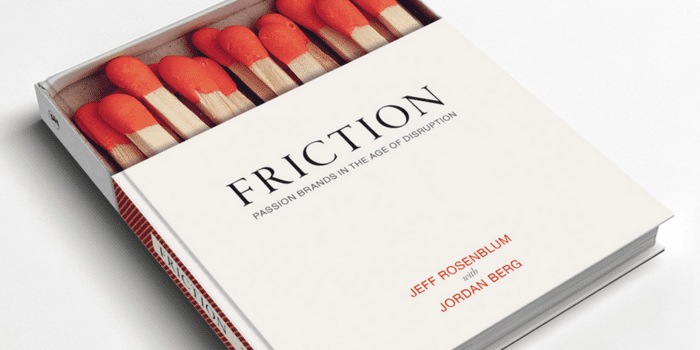
Friction: Passion Brands in the Age of Disruption
The name of the book is Friction. Friction is anything that gets in the way of people doing what they want to do in life. It’s anything that gets in the way of their hopes, their dreams, their aspirations and even their day-to-day goals. What it’s about is brand solving people’s problems. People don’t wake up in the morning wanting brands to interrupt them with clever advertising anymore. They want brands to do a lot more. They want brands to fight friction. They want brands to help improve their lives one small step at a time. What this means is creating content and experiences that empower people rather than just advertisements, which interrupt people.
Can you give us an example of one of your clients you’ve done that for?
We’ve done it with a lot of cool clients. Universal Orlando is a client where we follow the entire consumer journey. To be clear, a lot of what we do is we create ads and what we’d like to think are good ads. This really isn’t about the depth of advertising. That false eulogy has been written before. It’s about recognizing that we’re asking advertising to do too much. It’s just as important to have a great website, and more important than the website is the content that sits in the website, and to recognize that not everybody is the same. Very frequently a brand will have about six different personas and each persona has different needs. As they go through the sales funnel, they’re going to have different needs across those personas. Ultimately, you might be looking at a full content matrix as you go from aware to interested to converted to evangelist. It’s about having a video in the right place. It’s about having user-generated content in the right place. It’s about having an app in the right place. It’s about making sure that the app has the right features and that it’s technologically connected to the experience, geo-targeted in that example. With every client, it’s sometimes less about the activation and the big idea and it’s very frequently more about following the journey and putting the right information at the right place at the right time.
One of the things I don’t like to do is talk too much about my clients because it sounds like I’m tooting my horn. What I want to do is toot the horn of a brand I don’t actually work with, which is YETI Coolers. I just saw an article. The guys that invested in this company, they invested $57 million and it’s about to go IPO for $3.3 billion. It is not some fly-by-night crazy technology company. These guys make coolers. Literally, the same product that’s been around for over 100 years. Coolers would keep your beer cold, your soda cold, your bologna sandwiches cold. There’s nothing cool or exciting about this. They have turned YETI into a full-blown lifestyle brand. At the core of the friction that they fight is the product is fundamentally better than the competitions. It’s literally certified grizzly bear proof. Nobody needs a grizzly-proof cooler. When is that going to happen? It’s really nice to know that your product can go further than you could possibly go in your wildest adventure. What I really love about these guys is on their website, they’ve got commerce. You can buy these things like any other website, but they’ve got a full-blown storytelling platform. They’ve got a series of videos. Each of these videos are about eight minutes long. They have this protagonist like “The world’s most intense fly fisherman,” “The world’s greatest ski guide,” “The world’s greatest barbecue pit master,” and she happens to be this 89-year old woman; these crazy stories.
It’s funny that I misfocus. I could go and said, “These ads,” because they’re not ads. You literally never see the YETI brand except for maybe one second, the product will flash in the background. In one of these videos, you’ll see a competitor in this overnight kayaking race. This death-defying race that people are in. At one point, you see one of the competitors past out cold with a YETI hat on. The point is these videos are amazing. You watch these things and you’ll email me and be like, “These things are incredible.” They’re eight minutes long. I’ve watched dozens of them. I’ve shared them with my friends who have watched dozens of them. We post them to each other when we text. We put them on Facebook. We’re here talking about it in front of all your listeners. We can’t get enough of proselytizing for the YETI brand. The friction that they fight not only in the product is that people in that category who are going outdoors to go on their adventures, they want inspiration. They want to see content. It inspires them to push themselves further to do things that are more exciting. It’s not just the macro perspective of how much money they’re making, but it’s the fact that this brand has become a full-blown lifestyle brand. It’s no longer just coolers. Ad Age ran this article and it said, “If you can’t afford a YETI cooler, you’ll buy a YETI hat.” People always buy the t-shirts, the hats and they tell all their friends, “These coolers? They cost $700.” You can get a perfectly good one from Coleman for $150, the same size. That’s the power of fighting friction. That’s the power of telling a great story.
[Tweet “Are we asking too much of advertising?”]
The big takeaway for me from what you said, Jeff, is when you provide content that’s emotionally engaging without a lot of advertising in it and take people on a journey, a story, then they become your brand ambassadors and share it, and then that elevates your brand much like what I’ve seen Nike do and Harley-Davidson. That if you can afford the most expensive Nikes, you can buy a t-shirt and the same thing with the hat with the Harley’s. It’s really a great, great example and a story and a strategy on what we do. One of the things in your book that really stood out for me both from image standpoint and word standpoint is you talk about, “Brands need tools that don’t create scars.” We’ve talked about a great brand obviously not doing that. Let’s talk about brands that are creating scars and first start with, what’s an example of a brand creating a scar?
What we’ve referred to in that example is how to go in where we open the book and the founder of Patagonia, Yvon Chouinard, realizing that some of his products scarred the rocks that he loved to climb so much. That’s how he launched Patagonia. The point is that brands also need new tools the way that Patagonia did when they restarted their company and do scars or anything that hurt what people love the most in this world, which is their own brand reputation and their customers. Sometimes brands learn the hard way. United Airlines, that example is so profound because it doesn’t matter what United Airlines tells me. They could have the most charismatic person, a flight attendant on the phone, on the microphone at the flight, telling me to have a great flight. They can develop the most absolutely beautiful TV ad or print ad or banner ad or pre-roll. They could do the greatest thing ever done. There’s nothing they can say that’s going to get me to believe that they care about me, in any way, shape or form. I saw them standby while one of their passengers got dragged off the plane with blood coming out of his face. I saw it, you saw it, everybody saw it. The amazing thing is when you watch those videos, it’s not just what was going on. Here’s what I thought was really interesting is, how many cellphones are actually in the foreground of those videos? Type into Google, “United Airlines, passenger getting dragged out,” and it’s not just the fact that one person was filming. Everybody was filming, everybody has a super computer in their pocket. Everybody has an incredible video camera in their pocket. If you do terrible things like United Airlines, you’re going to scar your brand reputation and you’re going to scar your customers. It’s really hard to heal a scar.
That leads right into another thing that’s in Friction, which is talking about transactional versus emotional relationships. If you treat people like a commodity, like a transaction, there’s no culture that would stop that behavior because it’s just a transaction, “These are the rules.” If you come from a place that’s an emotional, “We care about our customers,” whether for me, Starbucks always pops up in my head. I am a big fan of Howard Schultz. I read his book, giving his employees or even part time health benefits when he didn’t have to. All that culture shows the employees that you care about them as people and then they in turn can care about their clients and customers, and then take that effort to remember your drink order. To me, that’s the difference. I’d love to have you explain what you see what brands can do or anyone who’s starting their own company, whether a big brand, existing or new to make people feel emotionally connected versus transactionally connected.
We can continue on that example, United Airlines makes a ton of money. In a lot of ways, I don’t know the numbers, but people might argue what’s the best airline company. At the end of the day though, it’s still a transactional company. I would never tell my friends that United Airlines is great. I will never spend $29 on a hat. I would never sit there and tell you that United Airlines is great, but they still get a ton of money from my travel expenses. There’s no shame in being a transactional brand. Transactional brands make sense. They have a good product. They’ve got good marketing and they charge a fair price. There’s no shame in that. It’s just not what my book is about. My book is about breaking through to what we call a passion brand. These are the brands that have an emotional connection. There’s nothing rational about buying a YETI cooler for $700 when you can get one from Coleman for $150. There’s nothing rational about buying a YETI hat and promoting that brand like a walking billboard. There’s nothing rational about telling all your friends on social media to watch these videos. What happens is when brands create that emotional connection, they elicit irrational behavior. It’s irrational in the most positive of ways. Ultimately, the best way to get irrational behavior out of your customers is to act irrationally yourself. That’s a crazy concept. Brands have to act irrational.
[Tweet “Advertising should be emotional, not transactional.”]
Irrational video for YETI is, “We’re Yeti and this is what makes our coolers so great. It’s grizzly-bear proof. It keeps your stuff cold.” You talk about features, you talk about the benefits, all that stuff. An irrational behavior is, “I’m going to create an eight-minute video. I’m going to invest in this video. I’m never going to put my logo in there. I’m never going to tell you anything about it and I’m never going to ask you to buy this product. I’m just going to do something to inspire you and entertain you.” That’s totally irrational. Going back to the Patagonia example, if you look at the homepage of their website, which probably has about six horizontal panels, the vast majority of them don’t talk about Patagonia products. They talk about all of their initiatives defending the environment. They literally had a panel on their homepage of their website that said, “Don’t buy this jacket,” with a picture of a jacket they sell. They were engaging people in a conversation about the damage that has done to the environment when you throw out your old jacket and when you buy a new jacket. They created a documentary called Worn Wear, which celebrates and extols the virtues of people who literally hold on to their Patagonia products for 50 years. That’s totally rational. They’re creating content, talking people out of buying their products. What did they get out of that? Unwavering loyalty and an absolute army of evangelists.
That’s the whole core. If you can get people to trust you as a person, as a brand, they stay loyal. The same thing is true in your company. If you can create a place where employees feel that you trust them and they trust you, that you’ve got each other’s back and you’re never going to do anything to hurt them, they will stay loyal because you’re not just in it for the money.

Passion Brands: Winners act like winners before they’re winners.
Before we wrote the book, we created this documentary called The Naked Brand. We sat down with Kevin Plank, the CEO of Under Armour, who in my opinion is literally one of the most impressive and successful executives on the planet. He started the company from his grandmother’s basement and he grew it into something that competes with Nike. He’s as nice a person as you’ll ever meet. He’s cool, he’s nice, he’s competitive, and he’s everything you could ever ask for. We’re filming and he says, “At the heart of every great brand is trust.” I remember watching this and I’m like, “You’ve got something more for me? That sounds a little thin and pedantic. I could use a little bit more depth.” Then what I realized over the coming days, weeks, months and years that I’ve thought about it, that’s what makes him so smart. He doesn’t cloud everything with a bunch of silly thoughts. He gets right to the heart of the matter, trust. At the heart of every great brand is trust. When you create content that inspires, educates, removes friction, it shows empathy and it creates trust.
As a Pitch Whisperer, I’m all about helping people be clear and concise and compelling. It’s not about trying to impress people with your vocabulary and how smart you are or telling them everything you do. It’s like, “Here’s the takeaway,” and that’s what helps you create good advertising. Back to what you were saying about this irrational behavior causes people to really engage with your brand, I think the Dollar Shave Club is another example of breaking through the clutter with that crazy comedies and going up against the big guys at Gillette that have been doing it for years. That really seems to me to be your sweet spot both in the book and what you do for your clients.
That’s hilarious that you bring up that example because my father sent me an email. Obviously, he’s a fan of the movie, fan of the book. He’s my dad, he’s very supportive and he loves to talk about these things. He’s talking about friction. He’s like, “I signed up for Dollar Shave Club. I felt this was a friction fighting brand, but I could not sign up. I couldn’t work my way through the sign up process.” It’s interesting because what we talk about is macro friction and micro friction. Macro friction is what we’ve been talking about. It’s these things that go on the entirety of a category. It’s YETI creating these great stories about the outdoors. It’s Patagonia defending the environment. The flipside of it is micro friction. These are the things that happen at that relationship level with prospects and with customers. It’s really as simple as help people make purchases easily, which seems really easy. How hard is it to take somebody’s credit card number? Every bit of technology that makes buying products easier, makes selling products harder. When we figured out desktops, mobile came along. When we figured out mobile, social came along. Then wearables came along and virtual realities coming along. Everybody I think should go buy an Alexa for $40 because it’s incredible for shadowing the fact that pretty soon, we’re not going to need screens at all. We’re just going to have little speaker phones following us wherever we go. This is a super computer that sits in your house and talks to you for $40. That makes it easier to purchase. “Alexa, go buy this new XYZ for me. Go buy Friction, the book.” It makes it harder and harder for brands to sell in particular if their products are not available on Amazon.
Amazon is the master at that user experience of one-click buy. In Friction, your book, you have chronological steps for removing friction and one of them is number seven, this user optimization. That’s exactly what we were talking about with Dollar Shave Club, right?
Yeah. It’s optimize, optimize, optimize. Consumers have no empathy for your brand anymore. They just have heightened expectations. One of the things we talked about is it doesn’t matter what category you’re in, Uber is your competition. In a world where you can just in three clicks, get a car, it shows up, it takes you wherever you want to go. One click, plays the music you want. You never have to breakout your wallet to pay for a five-star rating system. It keeps everybody civilized. There’s virtually no friction in the Uber product. There’s friction in the Uber brand, but let’s talk about the product. There’s no friction in it. It doesn’t matter if you’re going to buy a shaving equipment or any other product, people are used doing Uber world. They’re just not sympathetic or empathetic when it comes to friction in the relationship that people have with brands.
Amazon is taking it to the next level. You and I don’t have to wait a day. We’re going to have a drone deliver your package. Talk about instant gratification. The friction of going to a shopping mall and parking, no wonder malls are dying.
What I saw on the news is that they were talking about manufacturing is going to come back and it was going to fix retail. All I could think when watching this is like, “You’re out of touch. We all want manufacturing to come back in America. That would be awesome, but retail? Retail is screwed.” Unless you’ve got a very unique product, people are going to go to Amazon. I think they have bigger problem to that, and maybe we’re a little off topic with this. I think a lot of impulses that people have right now, a lot of that brain candy is just happening in their digital environment: the selfies, the Instagram, the Facebook, the Snapchat. People are entrenched in that behavior that I don’t think they wake up in the morning thinking, “I really need to touch that part of my brain by going shopping.” When was the last time you heard someone say, “What are you doing today?” “I’m going shopping.” You don’t hear that anymore. We used to hear that all the time. The economy is pretty strong right now for a lot of people. I don’t think it’s the economy that’s holding back retail. It’s the fact that our brains are physiologically changing.
Teenage girls just love to go and hang out at the mall. That became a social thing, not that they were necessarily buying a lot of things. Now, the retail therapy that so many women love to use is they get the same fix from online clicking and stuff shows up. They buy it in three different sizes and all that good stuff. You have this great quote in here about, “Winners act like winners before they are winners.” Can you talk about that?
The Score Takes Care of Itself: My Philosophy of Leadership
That’s not my quote. That’s Bill Walsh’s quote. The name of the book that Bill Walsh wrote is actually an autobiography. It was written after he passed away through some ghostwriter. It’s an autobiography. The name of the book is The Score Takes Care of Itself. “Winners act like winners before they’re winners.” The point is this, Bill Walsh walks in to the San Francisco 49ers headquarters in approximately 1979. He didn’t look like a football coach. He’s got the neatly combed hair. He’s got a sweater, he’s got khakis. He looked like a professor. The only thing that was missing was a Bent Billiard pipe. He didn’t yell. He didn’t scream. He didn’t give rah-rah speeches. He totally, completely and fundamentally revolutionized the way that football was played. He had this one simple idea, “Put the ball where the other team isn’t.” The Super Bowl trophy is called the Lombardi Trophy named after Vince Lombardi because he really created the strategic underpinnings of football before Bill Walsh. It was based upon strength and willpower. Big strong men blocking other big strong men, big strong linemen and running backs. Bill’s idea was make it look like that. At the last second before handing off to the big strong running back behind the big, strong alignment, pull it back out and throw it to an area of the field called the flats, which was about six yards from the line of scrimmage but really wide. Nobody was playing with a 53 yards of width, the whole football field.
This is what brands need to also do. Put the ball where the other team isn’t. You’re not going to win on strength and willpower by investing in huge advertising budgets, by trying to find a more creative agency than anybody possible. It’s undifferentiated. You have to find a place to put the ball where the other team isn’t. “The winners act like winners” quote, as if for me at least, that story was just perfect. He wrote this business book and I basically poached it and retold the story. The other thing that he really did is he focused in on culture and he was, “All winners have to act like winners before they’re winners.” He was focused on, “Receptionist, when you answer the phone, you’re going to answer it this way, with class, sophistication and intelligence.” He was going to take care of all these little things. He never had these goals like, “We’re going to win theSuper Bowl. We’re going to make the playoffs.” He literally had players that almost were revolting. When he told the owner on him, “This dude is not focused.” Meanwhile, he won five Super Bowls and almost every Super Bowl that has been won since has all been based upon Bill Walsh’s principles. The key is, “Put the ball where the other team isn’t,” and that includes culture and behavior before your bottom line goal.
We’re going to close with one of your quotes which is, “Great brands are built, not bought.” What does that mean from your lips? To me, that’s just as strong a quote and I want to hear what people should take away from that quote.
I’m glad you like it and I appreciate the compliment. It’s about creating experiences for people. It’s not about buying paid media interruptions. Paid media in advertising still works well, just asking it to do too much. Build you brand, don’t buy your brand. Build great content, build great experiences. Then you can spend money on paid advertising. “Great brands are built, not bought.”
[Tweet “At the heart of every great brand is trust”]
Jeff, I can’t thank you enough. The book is Friction: Passion Brands in the Age of Disruption. It’s a fantastic book. I highly recommend everyone get it. It’s one of my new favorite books. It’s a coffee table book. It’s just so clever, even the cover looks like matches that you can literally strike it on the side. People could follow you on social media, @JRQuestus. Thanks again, Jeff. This has been a big treat on how to eliminate friction and how to go from transactional to emotional connections to get brand ambassadors.
I love the podcast. Thank you so much for having me on.
Links Mentioned
- Jeff Rosenblum
- Questus
- Friction: Passion Brands in the Age of Disruption
- Ad Age
- Dollar Shave Club
- The Score Takes Care of Itself
- @JRQuestus
- Questus
Wanna Host Your Own Podcast?
Click here to see how my friends at Brandcasting You can help
The Successful Pitch – Book Trailer
Share The Show
Did you enjoy the show? I’d love it if you subscribed today and left us a 5-star review!
-
- Click this link
- Click on the ‘Subscribe’ button below the artwork
- Go to the ‘Ratings and Reviews’ section
- Click on ‘Write a Review’