

The 10 Cent Decision With Laurie Guest
Posted by John Livesay in podcast | 0 comments

The core of every successful business starts from the small actions you do. By putting energy into the little things, you are actually creating a big impact on customer service. Entrepreneur, keynote speaker, and author of the great book called The 10¢ Decision, Laurie Guest, is the go-to resource for customer service excellence. In this episode, Laurie joins host John Livesay to talk about the power of not saying “no” and replacing that with the word “actually,” as well as the impact of doing small things and matching your energy zone with people to create loyal customers.
—
Listen to the podcast here
The 10 Cent Decision With Laurie Guest
Our guest is Laurie Guest, who is an entrepreneur, keynote speaker and author. She is a go-to resource for customer service excellence. For more than two decades, she has shared her practical point of view on customer service and staff development with audiences and companies across the country. Blending real-life examples and proven action steps for improvement. Her book, which I’ve read and loved, is The 10¢ Decision: How Small Change Pays Off Big. Laurie, welcome to the show.
Thanks for having me.
It’s so clever that you’re in the customer service world and your last name is Guest.
We should marry what we seek to be. If I wanted to be a guest speaker, I had to find a man named Tom Guest. I’ve often told people I should’ve been looking for Tom Skinny. That would have made all my problems go away.
That’s an illusion that we all have. People often ask me if I’ve changed my last name or was I born Livesay and became a speaker. I said, “That’s my name.”
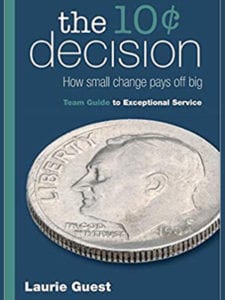
The 10¢ Decision: How Small Change Pays Off Big
You’re living up to it.
Let’s talk about your own story of origin before you were Laurie Guest and married to Tom. You can go back as far as childhood, high school or wherever you want to start. Tell us a little bit about your own experiences. Did you always know you wanted to be an entrepreneur? How did that come about?
I don’t think I’ve ever been asked that before and that’s interesting. I have been an entrepreneur since I was five. I was born wanting to invent businesses. I started out selling sweet corn on the corner in Somonauk, Illinois at a 1,300-person community, about 60 miles West of Chicago. My mom and dad were great with people. They taught me early on how you’re supposed to treat a customer. I sold more sweet corn than any other stand in town. That’s how I became an entrepreneur. Each idea I came up with was appropriate to my age level.
I kept doing stuff and building, selling and learning something and moving on one way or the other. Eventually, my trail took me as a young adult into healthcare. The core of my professional life prior to owning my own business was actually ophthalmology, the eye business. I was a trained technician and I would measure eyes for intraocular lens implants and schedule people for surgery. Our doctor was fabulous at customer service. Not only were they great surgeons but they knew how to train us to treat our patients.
That’s where all my wisdom came from early on. Other industries started calling and saying, “Could you come and share the secrets of your customer service and how you have such a thriving business?” My doctor looked around and he went, “Laurie, you like to talk. You go.” I jumped on that. I was born that way and I did that for quite a few years for him. One day, it dawned on me that there was actually a business I could have all on my own to be a customer service speaker and trainer. With his blessing, I left the firm and started out on my own. That was years ago. Here I am still owning my own business and I love it. Sales and entrepreneurship, we are the same kind of breed.
I want to double click on something that you intrigued us with. What was this doctor doing that maybe people can apply to their own business or life that made it so special and separated them from other people? Was it remembering birthdays?
We could talk all night long on what I learned there. Here are the big ones that came to mind. He had a mantra. He believed that a doctor should do only what a doctor must do. Examine, diagnose and treat and everybody else should do the rest of the stuff. What that means is you do what you do best. Whether there’s a guy reading this that owns a shoe store or a woman who owns a boutique, whatever it is, you should be doing only what you have to do. That means you have to hire great people, create a culture that they understand how you want your customers treated, empower them and the hard part is you’ve got to enforce these rules that you’ve made and the boundary that you’ve set. That’s where the problem comes. It’s easy to set the rules but it’s sure a lot harder to discipline and enforce them. It’s like parenting.
[bctt tweet=”Replace ‘No’ with ‘Actually.’ ” username=”John_Livesay”]
The more you reinforced those boundaries, the more people realize they’re real and you can’t negotiate your way around them. This concept of culture, even in a small company practice or business is so important that a lot of people don’t even take the time to define what the culture is. It influences everything. Not only who you hire and if it’s a fit culturally, regardless of their background and skill fit, but how you treat clients. I want to learn more about your thoughts on how defining culture impacts customer service?
It’s important that when people define a culture, they don’t confuse it with that special mission statement with all the perfect words and punctuation that has been matted, framed and hangs by the front door of your business. Most of your employees cannot recite that mission statement unless you force them to do it. I want to make sure that we define with people what we mean by culture. I’ll define it and you tell me if you agree. Culture is what we all agree to be true here. In this organization, we all agree that we’re going to and it’s X, Y, Z. It can be different for different places. In general, it’s going to be things like, “Treat the customer right and deliver the best product and service.” It becomes this bullet list that everybody has.
What differentiates our culture from your culture? It’s the delivery from the people who put it out there. Let’s say you and I both own a pizza place. You want a culture that you want good food served hot on time at a fair price. It sounds like my same list. Why would your pizza place be busting at the seams and people are waiting in line to get your pizza, assuming that mine is an equally good product, we’re not comparing pizzas here. We’re comparing service. Why do I have open tables and people are waiting to get in to see you. The only difference can be the delivery of the culture. The delivery of what we believe to be our values.
What’s so fascinating about that is, Domino’s has this mobile app that personalizes your whole experience. It’s like, “Billy placed your pizza in the oven and now Susie is wrapping it up. George is on his way and you can track it.”
It’s absolutely brilliant.
People are like, “I’m involved in the process and I never knew I needed to know the name of the person packing my pizza, but now I do.” It’s that level of extra care that comes along with it.

Creating Loyal Customers: You should be doing only what you have to do. That means you have to hire great people, create a culture that they understand how you want your customers treated, and empower them.
Before you go on, have you heard the new thing that Domino’s is doing about requesting?
No.
My college-aged daughter has left for college. She told me one summer she wanted pizza and she was insisting we order from Domino’s. We don’t normally use that vendor. I said, “Why?” She goes, “Go to the special request square, when you order it online, tell them that you want them to draw something inside of your pizza box and people do it.” I said, “You’re kidding me.” She types in something about, “Draw my dog named Lucky.” That’s all it says or something that. We don’t even have a dog named Lucky or something like that.
What happened was, when the doorbell rang with the pizza, she gets off the couch, came running like a 50-yard dash to the front door. She whipped open the door, she grabbed the pizza from the guy, I’m left to pay him. She runs into the kitchen, she opens the lid and sure enough, there’s a stick figure of a dog and he’s got a little collar on and it says Lucky. Somebody somewhere in my town drew what she asked for. That’s what I call a 10¢ decision. It cost them nothing to do that and she’s running to the door to get her pizza.
It’s customized and the fact that there’s a human being, especially with artificial intelligence taking over a lot of customer service. Press one, if you want this, and two, if you want that. This experience is the opposite of that. I have a King Charles dog and I get his food from this place called The Farmer’s Dog. They specialize in healthy food for your dog. I was emailing back and forth scheduling stuff with their customer service person. He ended the email with, “Give a belly rub to Pepe for me.” They knew the name of the dog from the order and he took the time to throw that in. That personalization of everyone who works there loves the dogs.
It’s where it’s at. Have you heard about Chewy that’s an online store?
[bctt tweet=”Match your energy zone to the moment.” username=”John_Livesay”]
Yes.
Here’s that culture. I love this. I have not experienced this but I’ve read about this. There was somebody that I know of that wanted to return two bags of dog food they had bought. They wrote and they said, “Our dog has passed away. We have these two bags of unopened dog food.” Chewy writes back to them with the condolences and said, “Please donate that food to your local shelter and you have our heartfelt sympathies.” It was something like that. It was genuine. A day later, fresh flowers arrived on the doorstep from Chewy at the house.
That unexpected extra that the person will never forget. That story gets passed on and on.
They’re going to have another pet. Most of us who own pets are not one and done. You’re always going to have another one and that’s where they’re going to be ordering their food, plus the story gets told.
That’s what I love and it’s unexpected. My favorite definition of luxury was doing something before somebody knows they need it. When I was working with Banana Republic, they wanted to up their game and they tested it in their flagship stores where you could charge your phone while you’re shopping. “It’s an unexpected luxury that I didn’t know I needed, but how great.” They were doing it to be unexpected. It turns out the sales went up because people kept waiting for the phone to fully charged and kept shopping. You hinted at what The 10¢ Decision is and I want to go back to that. It’s such a great title and easy to remember. The small changes that people can do, whether it’s writing something on a pizza box, sending flowers as condolence over, above and beyond and anticipating something like, “You might want to charge your phone when you’re shopping.” Things like that give us this little extra oomph. You have your own 10¢ story that you’ve talked about.
I do have my own 10¢ story. The way it came about is, as a speaker, I’m a frequent traveler and one time I checked into an expensive hotel. It must’ve been $350 or $400 a night. When I got to my room, as with all hotels, there were two bottles of room temperature water waiting for me with a tag on it that said $7. I thought, “I gave you $350 or whatever it was and now you want $7 more.” You and I both know why they’re doing that. It’s a brand standard. If I stay in that chain of hotel, it’s always going to be that water in that position. We also know that they could bring in a semi load of that water for about 10¢ a bottle if they wanted to, but they choose not to.

Creating Loyal Customers: It’s easy to set the rules but it’s sure a lot harder to discipline and enforce them.
They don’t make a 10¢ decision that makes a big impact. The next hotel that I went to, I get to my room, and this is a boutique hotel, it’s not a chain so they have the ability to make any decision they want. I get to my room and there’s a black mini-fridge. In the fridge, there are two ice-cold bottles of Ice Mountain, my third favorite water and sign on top of it that say, “Dear valued guest.” First of all, I love it when they take the time to put my last name on the sign. It said, “Dear valued guest, complimentary bottled water is found in the refrigerator. Please enjoy.” They spent almost nothing. It’s a 10¢ decision for my perceived value to be incredibly high. In the speech, I go on to explain the third stop which I won’t take the time to do in this interview, but at the third stop, there was a dramatic bottle of water waiting for me. It was a Bling bottle of water.
It was also free on a pedestal and an ice bucket. It had a brass plaque next to it that said, “Enjoy. Additional bottles may be purchased in the gift shop for $25.” Now, I have value. My point in this entire thing is we can either have a brand standard that says, “Not only are we going to take your $350 but we’re going to charge you $7 for a 10¢ bottle of water. We’re going to be the place that gives it to you for free or we’re going to be the place that goes, “We’ve got something spectacular for you and we’re going to make sure it has a value.”
The three levels is fantastic. You’ve got to pay, we’re going to give it to you for free and we’re going to give it a wow factor with the surprise. I’ve even had an experience where I’ve checked into a hotel and they offer me free water at the desk, “You must be thirsty after your trip.” I don’t even have to wait in my room to see if it’s free or I have to pay. I love that.
Here’s another interesting question. I rented a car from a well-known chain but I won’t name them. When I was waiting for my car, they handed me an ice-cold bottle of water. It was nice of them to do. When I got in the car for some reason, the only way you could charge your phone was with one of that cigarette lighter chargers of which there wasn’t one in the car. I didn’t have one with me and I usually use the USB port, but this car didn’t have it. It must have been older. I go back to the counter to get one of those cigarette lighter things for $16 and I’m thinking, “The 10¢ decision here is to have one of these in every car with their logo on it and with encouragement that you take it with you.” Every time I pulled that thing out of a cigarette lighter and it would have that brand caught on it and that would cost them probably about the same as the bottle of water if they wanted to make that choice. Isn’t that fascinating?
It is. For anyone stealing it or keeping it by mistake, we have to mark it up and all that stuff. Even when you go to Europe and they go, “If you want to have an adapter for to charge, you’ve got to pay us this.” The thing you talk about that I love in your 10¢ Decision book is matching the E-Zone of your buyer. The E-Zone is the energy that people bring to work every day. I could talk about energy all day long because when I initially got picked and it was between me and two other speakers, the speaking agent emailed me and said, “Congratulations. They picked you to be their next speaker at their annual meeting.”
We always go on three packs. You won the three-pack war.
[bctt tweet=”We should marry what we seek to be.” username=”John_Livesay”]
I did. We’re going to talk about that too. They said, “They liked your energy.”
You do have good energy.
Thanks but people realize, “They’re going to hire me or I’m going to sell this product or whatever it is I’m selling if I have the best price, information or whatever it is.” People don’t realize the value of your energy that people want to be around. Especially if you’re a speaker, you and I are. If you can make people feel good during the interview, they go, “I feel inspired after talking to him or to her. Maybe the audience will too.” Let’s talk about the E-Zone and how should I keep it up if you’re doing something that is your own customer service that might be a little rote or you’re having a bad day. You have this concept of the Big Seven of Service and my favorite one of there is where you talk about real greetings and not robotic acknowledgments.
Let’s move that all together. People are attracted to energy like a moth to the light. Let’s say you go to a cocktail party and you don’t know anybody. You’re scanning the room for who you might want to chat with. I don’t mean somebody that you’re romantically interested in. I mean a person to talk to. You’re going to scan the room and you’re going to spot the person that’s showing some energy. They’re making eye contact with you, they look they’d be friendly and could chat about anything. You and I would walk in a room as complete strangers and find each other because we each could talk all day long about absolutely anything.
If that’s what you seek, that’s what you’re going to find. We put that energy out there in our behaviors. When I talk about the E-Zone, I see it as a cardiac monitor and that there’s a heartbeat that goes inside this certain range. There are some people that come to work outside the range. On the top side, those are our Susie Sunshines. They’re coming to work going, “Good Morning,” and their pitch is high. I don’t believe them, I don’t believe you. You’re outside the zone. Underneath are the Boring Bobs. Those are the ones dragging themselves to work without any energy at all and complaining that it isn’t Friday yet. In between those two people is the zone, the place we want to be. That starts the moment you walk in the door. It’s a head game more than anything else.
When I was sixteen, I got a job at a grocery store and had to get up at 5:00 in the morning on the weekends and go make the donuts. You might remember a commercial years ago where the guy would get up and he’s like, “I’ve got to go and make the donuts.” That’s how my mom would wake me up in the morning, “It’s time for you to go make the donuts.” I’d show up to work. By the time the customers appeared at the grocery store, I had better be ready to sprinkle and deliver and keep on going. That’s the early age when I learned the energy thing.

Creating Loyal Customers: You have to believe in your own fees, even if you’re not the one who set them.
Inside the zone, we’ve got to match the moment and that’s where I bring the heart monitor part into it because people are disconnected. I’ll use healthcare as an example. If you’re sitting in front of me and I now need to give you a bad diagnosis or I need to perform a test on you that’s not going to be comfortable. It is a disconnect if I’m bringing my Susie Sunshine high-end like, “John, I’ve got you. This is only going to hurt a little,” and my pitch is high and I’m way off the energy zone. You’re uncomfortable with that. I need to bring the energy down and still stay in the zone but bring you that engagement that matches the severity of the situation.
Sometimes you do have to have tough decisions with people and not treat them children, which is what you’re talking about. Don’t be robotic. This needs to be authentic. That’s where empathy comes in big time. I’ve seen some people do this well in customer service when someone’s angry, they want to quit or return something. If the culture allows for that person to say, “I could see how that could make you mad. I would be mad if I was in your shoes.” That can diffuse the situation.
It can make a big difference. The whole idea of empowering people to be able to find those resolutions is an extremely big part of the culture we had. Our doctor felt that if the decision you made was the best thing for the patient and the practice, I back you on that decision rather than handcuffing us and not letting us do anything without permission. That becomes a culture choice.
We talked before about some of the clichés that people sometimes do only because they don’t know how else to ask the question. In a phone call situation versus an in-person one, they’re told, “Get the person’s name and try to use the three times within ten minutes.” They’re going, “To whom do I have the pleasure of speaking with now?” Nobody talks like that in person so why because when we’re on the phone, do we talk that to each other?
You get the idea that they’re reading a script to you. A script that doesn’t even match this conversation.
Talk about not matching the moment. I role-played with somebody and I said, “Let’s pretend I work here.” I said, “My name is John, I’m from XYZ company.” They say, “I want to do this or that.” I said, “Great, let me reintroduce myself to you because many times, people don’t hear it at the beginning. My name is John and you are?” That’s what I would to do in person. Do you have other ways?
[bctt tweet=”We put energy out there in our behaviors. What you seek is what you’re going to find. ” username=”John_Livesay”]
Sometimes it’s a simple question of, “May I ask your name?” How hard is that? That sounds so much better. There’s a well-known food chain that has taught its people to do this glorious greeting. They say, “It’s a great pleasure to serve you today.” When the greeting doesn’t match what we believe to be the reality, we have a disconnect. I do not believe you are that enthusiastic about giving me my chicken sandwich. We’ve got to figure out how do we give that energy and this service that you and I are both talking about in an authentic way? What’s weird about this is you would think it would be common sense, but it’s not. We have to train it. You have to teach what we want the words to be, but allow them to bring their own personality to the table.
The other thing in customer service/support sales is to build rapport and ask people questions. People don’t feel comfortable. I’ll go, “What questions are you asking them to say?” They’ll go, “We thought we’d start with, ‘How’s your day going?’” It seems it’s so off purpose for why the person called. They’re not calling to make a friend. Even if you are meeting somebody for the first time in a networking event, you probably think of something else to say besides that.
That would be a great title in the future book you’re going to write on sales. It’s like, “They’re not calling to make a friend.” Isn’t that the truth? They’re calling for results. They want a solution and an answer. I have this in the book. I am not a fan of the phrase, “How are you?” Unless you actually care and want to hear the answer. My replacement for that is, “It’s nice to see you.” I don’t say, “How are you?” I say, “It’s nice to see you.” It starts a conversation and you’ll be amazed how often do you first start using it. People respond, “I’m pretty good, thanks and you?” It’s so robotic. They’re so used to what the answer is supposed to be.
This concept of trying to be authentic and instead of saying, in this case in real estate, “How’s your day going?” I came up with another question that’s more pertinent, “How’s the house hunting experience going for you? Is it a nightmare?”
It’s so much better.
That’s a relevant question that I’m more than happy to answer and I feel that you might actually care about my experience from that question.

Creating Loyal Customers: Believe in your product and service enough that you feel the people will be lucky to have you.
As we used to say, “Get focused on the body part you care about,” so to speak, which is the same with the real estate. I worked in ophthalmology and if you’re coming to see us and I asked you, how are you feeling or how are you doing? What you’re going to do, especially as an older adult, is show me the scar from your most recent surgery. You’re going to tell me that you didn’t feel good last night. I at least got to get to the right body part. We were trained to say, “Tell me how your eyes are doing.” We’ve at least narrowed it down to what I can do something. That’s the same thing with real estate, “How’s your house-hunting going?” We’re not getting all this extra stuff. That’s a great one.
You talk about anticipating a customer’s needs and that small gestures can create loyal customers. Can you tell us what that means?
I do think that there are small things you can do to create loyal customers. The first one that comes to my mind is, a few years back, we did a remodeling at our home and we called four different contractors to come to the home to look at it and give us a bid. Two of them never showed up. One of them made the appointment and didn’t call back at all. The fourth one showed up when he said he would exactly on time every time he came. He explained things to us in a way that we would understand, not the internal lingo and if he used a lingo word, he would define it right behind it.
The biggest thing that I loved was when he explained that there are change orders, “After we go in with a quote, it’s locked in. This number will not change but if you decide you’re going to put in fancier windows, there will be a change quote and you’ll see the additional cost it’s going to be.” When the project was over, he came in at the penny of what he promised that it would. These are not dramatic things that he offered but I’ve been talking about him in the decades since we did this remodel because he was unique in his industry. You show up on time and do what you say you’re going to do.
Isn’t that amazing that that’s the new differentiator as opposed to the minimum acceptable behavior these days? That’s what it is. That’s how you can do this. You and I love words. You have a whole chapter devoted to choosing words wisely.
That’s my favorite chapter as a matter of fact.
[bctt tweet=”What differentiates a culture from another is the delivery from the people who put it out there.” username=”John_Livesay”]
You know that I love alliterations. The way you’ve structured your writing is Words Wisely. You talked about Careful Communication. It’s two Ws and two Cs. I want to get a hats off to that. That is important. Let’s do a couple of these great examples. You have version one which is going to cost you about $259 or the fee for that service is $259. That would sound fairly close to a lot of fees versus costs. What is that?
Fee versus cost and the other thing is your personal attitude towards the cause. One of my jobs was to help eye doctors who sell you glasses help them be successful. I would go in and therefore they would refer more people to us because we didn’t do eyeglasses in our firm. My point is when I would go and watch their teamwork, if the person checking you out from the eye care place thought that $259 was a lot of money to pay for a pair of glasses, they would say things like, “That’s going to cost you about $259.” The tone in my voice is, “You don’t want to pay this, do you?” We would have to train them to say, “The fee will be $259 and we take 50% now or I’ll need 50% now.” We would give them the words to say, you need to lean into this number because if you don’t believe they should pay it, they’re certainly not going to want to pay.
I use this all the time, “The investment to work with me is,” or “You’re getting a return on your investment when you hire me.”
We were at the dentist. We wanted to have some teeth whitening done for one of our children. It was going to be expensive under $500, but we would pay anything to help her smile. We want to do this. Multiple times, different people on the team kept going, “That’s going to be about $500. Why don’t you try the Crest white strips? Why don’t you try this?” They talked us out of it. We were begging. When I got in the car with my husband, I said, “We are begging for them to do this task. Why don’t we find another provider?” When we went to the other provider, they were all over it. They’re like, “Let us show you how we do this. It’s under $500.” It was the same fee. She called it under and had all this enthusiasm, that energy zone. We were like, “Sign us up.” The procedure has now come and gone and we’re thrilled with it. What bothers me about it is, don’t assume that I don’t want to pay the money. If I want that service or that product badly enough, I might’ve been willing to pay $1,000 for it. In fact, I was willing to.
It affects confidence and outlook. You think to yourself, “If I wanted that version of going and buying something from the drug store, I’m getting the results of that. If I want someone to take the time to match, what’s your skin tone? Your teeth should be this shade and not that shade. This is not a one size fits all. What you’re buying when you’re buying teeth whitening is how you’re going to feel. Does smiling more make you more confident? There’s research that says it elevates your mood. You know as well as I, that they tell people on the phone, “Smile,” because people can hear it your voice. If you don’t like your smile, you’re not going to smile all the time.
I want the salespeople who are reading, especially those who maybe are emerging salespeople that one of the most important things is you have got to believe in your own fees. Even if you’re not the one who said them, even if you have no control over the fees, you better believe in your product and service enough that you feel the people will be lucky to have you. It’s the same way in our business, John. We have to decide what our fee is for a certain job and if we act we’re not worth it or we’re not going to bring the value, then nobody’s going to pick you out of that three-pack. They’re going to go with somebody else. Sales to me are not about pushing you to buy something you don’t want. It’s educating you on why this is the right thing for you at the price I’ve set it at. There’s a big difference between those two.

Creating Loyal Customers: Sales is not about pushing people to buy something they don’t want. It’s educating them on why this is the right thing for them at the price you’ve set it at.
You’re singing my song because I talk about the old way of selling is to push out a lot of information and the new way is to tell a story that pulls people in.
The story is so critical because everybody wants to hear a story. Think about when you’ve been someplace, maybe it’s a church or something where someone’s talking a lot and you’re losing interest, and they click into a story and you’re back. That’s the same way with sales. It’s powerful that you teach that.
I want to leave the readers with one of my favorite parts of your book, which is, “Replace the word no with actually.” I’m going to be the person that the answer is negative. I’m going to say, “Can I expect to receive my lawn chairs tomorrow?”
The wrong way would be, “Nope. We don’t see those coming in until next Tuesday because of the holiday.” The right way to say it is, “Actually, that delivery is due on Tuesday.”
“Okay. Tuesday it is.” It’s so great. If you took nothing else from this book and believe me, that’s the tip of the iceberg of all the incredible value in The 10¢ Decision. I highly recommend people getting it. Laurie was generous enough to offer a little discount. Laurie, how can people get that discount and follow you on social media?
To get the discount, you can go to the book website, which is TenCentDecision.com. You can either do it as 10 or spell it out. Either way, it gets you there. When you go to buy the book, there’s a place where you can apply a coupon code. Anybody reading can use the word podcast, all one word. That tells us that you heard about it on this podcast. They can get 20% off for that. I’m on Facebook, Instagram and all the regular ones. I’m happy to connect with people there as well as LinkedIn. My regular website is LaurieGuest.com and we do reply to all messages on social media. Talk to us and we will talk back.
They’ll talk back in the right energy zone. That’s for sure. Thanks, Laurie, for being such a great guest, having such great energy and giving us such great tips. I’m never going to say the word no again. Even if somebody asked me out on a date, “Actually, I’m not available.”
Actually, you should be so lucky.
There we go. Thanks again.
You’re welcome.
Important Links
- The 10¢ Decision: How Small Change Pays Off Big
- The Farmer’s Dog
- Chewy
- Facebook – Laurie Guest
- Instagram – Laurie Guest
- LinkedIn – Laurie Guest
- LaurieGuest.com
- Better Selling Through Storytelling Method Online Course
Wanna Host Your Own Podcast?
Click here to see how my friends at Podetize can help
Purchase John’s new book
John Livesay, The Pitch Whisperer
Share The Show
Did you enjoy the show? I’d love it if you subscribed today and left us a 5-star review!
- Click this link
- Click on the ‘Subscribe’ button below the artwork
- Go to the ‘Ratings and Reviews’ section
- Click on ‘Write a Review’
Love the show? Subscribe, rate, review, and share!
Join The Successful Pitch community today:
- JohnLivesay.com
- John Livesay Facebook
- John Livesay Twitter
- John Livesay LinkedIn
- John Livesay YouTube
Pursuing A Life Of Significance With Aaron Walker
Posted by John Livesay in podcast | 0 comments


Having money, a big house, and a profitable business can lead to a fulfilling life – or so we all think. In this episode, discover what a life of significance truly means as you learn from life and business coach Aaron Walker. Successful in business, Aaron first experienced retirement at the early age of 27, but it did not scratch an itch he thought it would. Learn how pursuing a meaningful life led him to masterminds and a podcast, and his “why” in writing his book, View from the Top.
—
Listen to the podcast here
Pursuing A Life Of Significance With Aaron Walker
Our guest is Aaron Walker who is a life and business coach and runs masterminds for men. He’s a veteran businessman. He continues to inspire countless entrepreneurs with his leadership skills and his transparent and authentic life. His purpose in life is to mentor men to be better versions of themselves. Having more than 40 years’ experience and more than a dozen startups allow him to lead with confidence. He is the author of View From The Top, Living A Life of Success and Significance. He shares practical insights and wisdom on how you too can find hope and inspiration. He has an amazing real life-story that will challenge your thinking and motivate you to action. Aaron, welcome to our show.
John, thanks for having me.
Would you mind taking us back to your own story of origin? I would love to find out what made you who you are. You can go back to your childhood, high school, college or whatever grabs you.
I’m going to take you way back. I’m almost 60 years old now so I’ve got to go back to when I was thirteen years old. My dad woke me up on a summer morning and he said, “Get out of the bed. We’ve got some work to do. We’re going to go down and we’re going to remodel a pawnshop.” I said, “Can I make any money?” He said “Yes.” I said, “I’m all in.” I didn’t even know what a pawnshop was or know what that was, but I went down and helped him for the summer. When we got through doing that project, I went up to the owner at the time and he was 23 years old. This guy was opening a pawnshop in Nashville, Tennessee, where I’m a native. I said, “I don’t even know what a pawnshop is but I go to school across the street and I would love to work here after school and on the weekends.” He hired me on the spot. I worked every day and then on Saturdays and two years later when I was fifteen years old, I decided this is what I want to do for a living.
People asked me, “You’ve got to be kidding. What did you enjoy about it?” I said, “It’s the people. I love the different people that came in.” I went to summer school and night school for eighteen months. I had enough credits to graduate at the beginning of my junior year. I started working every day and I met a couple of guys with a lot of money because I didn’t have any. My parents were very poor and I didn’t have any money. I went to them one day and pitched us going into business together and they laughed at me. They own the 21st largest insurance agency in the country at the time. I said, “Why don’t we take my pawnshop experience and your money and open a store?”
They said, “Mr. Walker, how old are you?” I said, “I’m eighteen.” They started laughing again. They said, “We’ve never had anybody eighteen years old approach us.” I said, “That’s beside the point. Are you interested?” After two months of negotiation, they agreed to do it. I went and opened a pawnshop when I was eighteen years old. I wasn’t even married. I was still living at home. A year later, I get married to Robin and I said, “We can’t mess this up.” We agreed to pour every dollar back into the business. In 36 months, I paid off a ten-year loan. I was 21 years old. I had a paid-for-business and I said, “I can duplicate that.” I did and then I did it again and then I did it again.
When I was 27 years old, a Fortune 500 came and made an offer I couldn’t refuse and I retired. I was 27 years old and I thought this is the American dream. I go from broke and a convict to making enough money to retire by the time I’m 27. That lasted about eighteen months. I got fat and lazy, I was getting in the bed in the middle of the day and Robin goes, “This is not what I signed up for.” I went back and bought the company I worked for when I was a kid. We spent the next ten years quadrupling that business. As I shared with you a little bit earlier, I had a very serious accident in 2001 where I ran over and killed a pedestrian. It rocked my world when that happened. I sold the business. I took off for about five years and didn’t do anything. We traveled around the world. We built a new house and took a break.
My wife approached me again and said, “You’re getting fat and lazy again.” We go into the construction business. We build a very successful construction company. I turned 50 and I retired. Robin goes, “You’re going to drive me crazy if you don’t do something.” The mastermind members of mine, which is Dave Ramsey and Dan Miller and some of those guys said, “What are you going to do now?” I said, “Nothing. I’m going to retire. I’m going to call it good. I’ve been working since I was thirteen.” They said, “You’re too young.” I started coaching. That led to doing podcast interviews which led to mastermind groups. Now, we have fifteen mastermind groups, 150 men from nine different countries. I’m having the absolute time of my life helping people be successful and significant.
That is quite a lot to unpack. I love the story of the fantasy that, “I’m going to retire at 27. I’m going to retire at this age.” There’s something about not being relevant and not giving back that I think you are probably more equipped than almost anyone else because you’ve gone through this multiple times. It’s almost like in the Wizard of Oz when you go behind the curtain and you say, “That isn’t it. That’s the fantasy.” You work hard to get to this place where you don’t need to work and then you can find a life of significance. You’re saying it isn’t the answer.
It’s not the answer at all. I thought it was, and I want to warn people, if you’re working to stop, quit doing that because it doesn’t scratch the itch like you think it’s going to. I thought by being a poor kid that I was going to have enough money, this big fine house, a vacation home, nice cars, that I was going to feel meaningful and purposeful and I was going to live a life of leisure. Quickly, I discovered that it’s not what I thought it was going to be. Don’t hear me wrong, John, I want to make this clear. I hate when people with money go, “Money is not important.” I want to go, “You liar.” It is important but I don’t want you to make it your only focus. I don’t want you to make it your God. Focus on why and your purpose in life, then you have something that’s tangible that you can hang your head on.
[bctt tweet=”The Facebook persona, for the most part, is just a lie. People don’t really share the things that are going on in their families.” username=”John_Livesay”]
Aaron, what motivated you to write your book, The View From The Top? The thing that I love about this is not just success but success and significance.
To be totally honest with you, I didn’t want to write the book and let me tell you why I didn’t want to write the book. As I said, I’ve been in a mastermind with these guys that are here in Nashville. We all live in Nashville, Tennessee for decades now. Sitting on my left for ten or twelve years was Ken Abraham. Ken is probably the most noted ghost author on the planet. If you look him up, you can see he’s written over 95 books and some of the biggest name people on the planet. He’s written their books. He had sold millions and tens of millions of copies of books and sitting on my right was Dave Ramsey.
They’re all good friends of mine. Anyway, Dave has written a dozen books and sold millions of copies and Dan Miller sat across the table from me. He has 48 Days To The Work. He’s written seven or eight books. I said, “Who’s going to read my book?” I’m in this group, with all these people that are very successful, who’s going to read my book? Ken Davis did my mastermind group and Ken wrote a book called Fully Alive. He’s traveled all over the world. He’s a keynote speaker. He’s an amazing guy. He said, “Aaron, you’re writing the book for the wrong reason.” I said, “What do you mean?” He said, “When I wrote Fully Alive, the first year it came out, seventeen people wrote me an email and they said, “Mr. Davis, I didn’t commit suicide because I’ve read your book Fully Alive.” He looked at me and he said, “Aaron, if you can change one life with your book, will it not be worth it?” I said, “You’re right. It’ll be worth it.” I’m going to write that book because now the reason is different. Now, I write the book to help people uncover for themselves what’s important in life. I teach them how to be very successful financially, all the while being significant. That’s the piece that people are missing.
I have loved this concept. My own personal mission is to help as many people as possible get off this self-esteem rollercoaster where they only feel good about themselves if they’ve gotten a certain amount of success or book sales or whatever it is, likes some social media. What I hear you saying is when you let go of that attachment of how many books did I sell and that is it more than this person and comparing yourself to other people, you are free to create something with a very different purpose without the attachment to the outcome. Would that be an accurate summary?
100% and first of all, you’re never going to win in a comparison game because I even almost did it at the beginning myself when I looked at Ken Abraham and Dave Ramsey. I said, “How could I ever compare to this?” I couldn’t compare. After the book first came out, a guy that was in my mastermind group, his young son picked up my book and read it and there was a life transformational experience for him as a result of reading this book. He got onto a different path. He was on some substance abuse and he couldn’t get off of it. This book helped him reframe his life. I got a phone call from him and said, “Thank you for your book because it’s radically transformed my life.” I went in and told my wife, “If nothing else happens, if I don’t get any speaking engagements, if I don’t get anything, if nothing happens, it’s changed this one man’s life, his family tree.” It was worth the effort. It was worth the time.
You touched earlier on the pedestrian fatality that you didn’t intentionally cause, but it did happen. A lot of people would not be so transparent and authentic about that and yet you are. I want to bring that up for people to take a look at that blind that we’re only as sick as our secrets or people can always tell when you’re trying to hide something. People who haven’t experienced something like that, we all have something that we have trouble forgiving ourselves for, I would imagine. I know someone who that happened to him as well. He did it as a young boy. First of all, I have several questions about it clearly. I want to acknowledge and applaud you for your authenticity and transparency because when you are willing to do that, you inspire other people to do that. My first question around is what made you so confident to do it and tell that story?
First of all, by being around very successful people and coming to discover early on in my career that the Facebook persona, for the most part, is just a lie. We don’t share the things that are going on in our families. Everyone sees is the nice house, they see the nice car, they know you have this job and you’ve got 2.3 kids and you’ve got 3.7 cars and you’re living this thing. They’re not privy to the conversation that’s going on inside of the home. Inside of the home, one of the partners is working more than they should and they’re doing it at the expense of their family. They come home one day with a pocket full of money to a house full of strangers. What I’m teaching people to do is to prioritize your priorities and focus on what matters. The only way that you can do that is to be authentic and transparent and vulnerable with a few people.
I’m not saying go out and air your dirty laundry to the world but I am saying that you need a group of people around you such as a small group, an accountability group, a mastermind group or a connect group. You can call it whatever you want to call it, but you need an environment where you can go and go, “Things are not going so well right now. I’m struggling in my relationship. I’ve got a child that’s gone wayward. My job is on the bubble. I’m not even going to have an income a few years from now. I’m not making my mortgage payment. I’m wrestling with these trials and tribulations in my personal life and I don’t know where I stand as an individual and I don’t have this self-esteem or this hyper sense of awareness to myself and I’m getting myself in trouble.”
The reason that I am so authentic and transparent is that’s where strength begins. When we address who we are as an individual to a group of non-biased, trusted advisors, they then can help us. If they’re giving us advice on things that we’re telling them that’s not reality, how in the world could we ever get good advice to go forward and build on a solid foundation? I’ve had the privilege of experiencing that with a number of very successful people. That’s why I come forward with telling my story.
Authenticity and transparency are where strength begins. That’s such a powerful way of combining something that people think, “It doesn’t seem like you’re coming from a place of strength at all,” but in fact, it is. Was it hard to forgive yourself and any other insights from that experience?

A Life Of Significance: People struggle to have enough money and material things thinking that they’re going to feel meaningful and purposeful. Disappointingly, many discover that it’s not what they thought it would be.
It’s been eighteen years and the first five years were very difficult. I had to go to a lot of counseling and talking to a lot of trusted advisors to help work me through this. First and foremost, I do want to mention, it was not my fault. It wasn’t an error of judgment. He didn’t see me. He was 77 years old. He was crossing the street to catch a bus and we found out later he couldn’t see good and he run right out in front of me. It was a very horrific automobile accident. Still, he was somebody’s father, somebody’s husband, somebody’s brother and it took me years to work through that.
What I come to realize working through that is how fragile everyone’s life is and in the book, View From The Top, the chapter that I talk about this, I call it Blindsided. We all can be blindsided. There’s not a person listening to my voice right now that a phone call might not change your life. Something could happen that’s devastating to your life. You may get a message or a note or a phone call that you never saw it coming. What I discovered through this accident was that we had had tremendous success early on but it was all about me and my family. What I started thinking about was my legacy. I said, “What would my legacy have been?” My legacy would have been, “A poor kid from Nashville, Tennessee makes enough money to retire at age 27 and nobody cares.” I said, “That’s not what I want. What I want is I want John’s life to be better as a result of having known me.” That’s the reason I share this.
That leads right into the never-ending power of a mastermind. You were talking about how you started your own and now you teach other people how to create them. Tell us the journey of masterminds and how people can either possibly start their own or join yours to find out.
I appreciate that and I want to touch if I may on some of the reasons that I think being in community is so important. You call it accountability mastermind. You can call it whatever you want to call it. We weren’t designed to be in isolation. Isolation is the enemy of excellence. We’re designed to be in community and we need people around us at all times. First of all, for accountability purposes. If you think about it, we need people calling us out. We need a sense of encouragement today. We need people to come up to us and say, “John, I believe in you. I know you can do this.” We can find that in the community. We need relationships which I think is the most important asset that we could possibly have. We all have blind spots and a lot of people are unaware of those. We need people to call us out and say, “John, I’ve noticed that you’ve saved this. I noticed that this is going on frequently in your life. This is going to catch you if you’re not careful.” We have people pointing that out.
I also say that masterminds give us access. It allows us to be in other spheres of influence. We talk about the insight that it can give you. We talk about perspective. What it gives me more than anything is the ability to see things differently. There are so many things like that that we have insight, different things that we need in our life that we would never have in a million years. It’s the insight that it can give us. There’s spiritual health that we need. There’s vision, there’s mission, there are values, there’s so much that this community or mastermind can give us.
That’s the reason that I am on such a quest to be sure that everyone is involved in this. People call me regularly and they call me big A. They say, “Big A, how in the world have you scaled masterminds to the level that you have?” We developed a program called the Mastermind Blueprint. What this is, it’s teaching people if you’ve never even had a mastermind how to start it, how to grow it and how to run it. A lot of people want to scale it to the heights we have. Other people just want one or two groups. If you start thinking about your sphere of influence and the impact that you could have on other people’s lives, you could start a mastermind and impact and have life transformational experiences for the people you know.
Yours is called Iron Sharpens Iron. What a great visual that is. Describe how you came up with that as a name.
I’m a Christian by faith. A biblical proverb is Proverbs 27:17, “One man sharpens another just as iron sharpens iron.” I’ve had the privilege to be in these groups where they call you out. They call you out and say, “I’ve heard you say this or I’ll watch you do this or you don’t do this.” In order for you to get better, these are the things that you’re going to have to do. It’s not for the faint of heart. We need people in these groups that are willing to call one another out and we just decided that if we’re going to help other people accomplish their dreams and goals, there have to be some sparks flying. That’s why we call it Iron Sharpens Iron.
What a great analogy. You’re only focused on men. If there are women that are reading and say, “I would like to start a mastermind for women,” could your program work for them?
Let me explain that a little bit. Some women get offended by this and let me explain and hopefully you won’t be offended. Women have become our biggest advocates because they say, “Big A, you’ve done something with my man. What have you done? He is not the guy now that he was when he joined ISI.” There are women’s groups out there. Michele Williams has BVU, Better Version of Yourself, a mastermind for women and does the exact same thing. I can introduce you to Michele. I’m happy to do that but our course is gender-neutral. If it’s women, if it’s man, if it’s mixed, it doesn’t matter. We can walk you through the process. We give you two and a half years’ worth of content to teach you and to help you along the way. You don’t have to create anything. We give you the lead magnets. We walk with you for six months, twice a month. You have support from us that gets you up and going. We don’t leave you. Once you buy this, we walk with you through the whole process.
[bctt tweet=”Isolation is the enemy of excellence. We need others to help us break our upper limits because we all have blindsides we need help seeing.” username=”John_Livesay”]
For people who might not understand the distinction, can you compare this to mastermind versus a networking group?
For group coaching or things like that, this is a whole different level. This recaps what I’ve been talking about the whole interview. You can do group coaching, you can do networking but you just deal with the surface level when you’re talking about networking. I’m talking about something that’s life transformational, personally and professionally. I’m talking about people that walk with you on a weekly basis to help you accomplish your goals, your dreams and to hold you accountable, to connect to you and to give you the resources that you need in order to be successful. I could stand up here for an hour and give a dissertation or I can lead a group coaching but that is not going to have the same impact if you get in a group and you’re meeting with the same ten trusted advisors week in, week out, month after month, year after year our people have in our groups. We’ve had people to double, triple and quadruple their business. We’ve had people that have absolutely transformed their personal lives because they have this close-knit community, their board of directors that walk with them every single day.
You talk about that isolation is the enemy to excellence. Many people don’t realize the importance of having a tribe or not doing it alone all the time. Can you speak to why isolation is the enemy of excellence?
If I don’t fess up and I don’t tell you, then there’s no one checking in. If I don’t push the ball down the field, no one knows. Brian Moran wrote a great book called The 12-Week Year and we’ve implemented that into the very fabric of what we do. You focus each and every day on these lead indicators. You focus on the task. You have weekly accountability meetings related to the objective that you’re trying to accomplish. You repeat that every twelve weeks. Procrastination is the enemy also. We continue to procrastinate and this doesn’t allow you to do that. We have people around you and that surround you, make sure that you focus on the task at hand and then the goal takes care of itself.
The reason that the isolation is the enemy to excellence is if you don’t tell anybody, they don’t know. If you don’t share your troubles, you can’t get over your Achilles heel or your blind spots. When you have people surrounding you, they can encourage you, they can help push you through these upper limit challenges. We all have upper limits challenges. It doesn’t matter who you are. We all have a threshold that we bump up against the ceiling and these people can help take you to a different level. It opens doors and possibilities that you never dreamed possible. I would just suggest that if you want to excel, you have to get involved in some topic community so that you can be all that you were called to be.
We all have upper limit challenges and it’s from our childhood and our belief systems. If we’re not associating with other people who can hold us accountable, show us where we’re limiting ourselves, whether it’s a belief or a behavior that needs to be changed, then we will just stay at our own upper limits there. I imagine that part of this successful mastermind is the quality of the people that are in it. Can you speak to what criteria you use when you help people develop their own mastermind?
When we first started doing mastermind groups, if you had the fee you could get in and I quickly saw that wasn’t going to work well. We developed an application process that we go through and we do an interview. We vet every single person that comes in and we turn away a number of people because they’re takers, they’re not givers. What we are trying to do is to fill up a room full of givers because in the natural reciprocity, you’re going to get all you need. When somebody is interested in themselves, they only want to come in and get out of it, if it’s only beneficial to them, that’s not how you grow. That’s not how you build relationships.
We take a look at the motivation of why you want to be into groups. Once we establish that you are the giver, then we go through a series of questions. There are about 25 questions. How we can help you? More about your family. What you’re trying to accomplish? What your long-term goals and aspirations are? It’s a very lengthy process and then once we worked through each and every question, we determine whether you’re a good fit for this group or not. When you’re very careful vetting this many people, getting the right person in the right seat, as Jim Collins says, on the right bus, there’s the magic that happens when you have that level of synergy.
You certainly are walking your talk and hats off to you for that. Then taking it one step further and allowing people to not just hear about it but learn how they can start and run and scale their own mastermind. I haven’t seen or interviewed anyone else who’s doing that and you’re taking your own success and not just showing people, “Here’s some fish, learn these life lessons.” You’re teaching them how to fish, which is such a great gift because you’re scaling the scaling.
Someone asked me, “Why do you do this? Why don’t you just continue to add mastermind groups, other facilitators?” There are seven billion people on the planet. We have 150 people in our mastermind. I have an abundance mindset. If you have an abundance mindset, you’re willing to show your cards. I don’t hold them close to my vest, I’m like, “First of all, I live it and I do it and you teach it.” We’re at the stage in our career where now we’ve lived it, we’ve done it and now we’re teaching it.

A Life Of Significance: Masterminds give you access to be in other spheres of influence and the ability to see things differently.
How can people follow you? I know the website is ViewFromTheTop.com. If someone has been motivated and said, “I need to learn how to start my own mastermind,” what’s the next step?
The easiest way is to go to ViewFromTheTop.com and I make myself very accessible. My phone number is there. My email is [email protected]. Reach out and send me a note and I’ll personally give you a call and we’ll talk through it. I’d love to be able to share with you more as well.
I can’t thank you enough for sharing your time, your wisdom and your passion. You are someone who I’m glad to have in my world.
Thank you, John. I certainly enjoy being with you.
Important Links
- View From The Top
- 48 Days To The Work
- Fully Alive
- Mastermind Blueprint
- Iron Sharpens Iron
- Better Version of Yourself
- The 12-Week Year
- ViewFromTheTop.com
- [email protected]
- Better Selling Through Storytelling Method Online Course
Wanna Host Your Own Podcast?
Click here to see how my friends at Podetize can help
Purchase John’s new book
John Livesay, The Pitch Whisperer
Share The Show
Did you enjoy the show? I’d love it if you subscribed today and left us a 5-star review!
- Click this link
- Click on the ‘Subscribe’ button below the artwork
- Go to the ‘Ratings and Reviews’ section
- Click on ‘Write a Review’
Love the show? Subscribe, rate, review, and share!
Join The Successful Pitch community today:
- JohnLivesay.com
- John Livesay Facebook
- John Livesay Twitter
- John Livesay LinkedIn
- John Livesay YouTube
Financial Peace Of Mind with Michael Nathanson
Posted by John Livesay in podcast | 0 comments

Episode Summary:
While being a lawyer and financial planner, Michael Nathanson was diagnosed with a brain tumor that completely changed his life. Realizing how we need a specialist in the medical field, he believes that the same should be true with our financial health. Now, Michael is the Chairman and Chief Officer of The Colony Group. He shares the reasons why going to someone who knows what they are doing is key to achieving financial peace of mind. Discover the five pillars for getting financial peace of mind and financial independence and learn some tips on finding the right advisor for you.
—
Listen To The Episode Here
Financial Peace Of Mind with Michael Nathanson
Our guest is Michael Nathanson, who is the Chairman and Chief Executive Officer of The Colony Group. He’s been recognized ten times by Barron’s Magazine as one of the top 100 independent financial advisors in the nation and has been selected six times as a super lawyer as published in the Massachusetts Super Lawyers. He’s been included in Worth Magazine’s list of the countries top 250 wealth advisors. He’s published articles on a wide variety of financial, tax and legal topics and has a book out that we’re going to be talking about. That book is called Personal Financial Planning for Executives and Entrepreneurs, which is a path to financial peace of mind. Michael, welcome to the show.
Thank you for having me, John.
I always like to ask my guest to take us back to their own story of origin. You can go back as far as childhood, college or wherever you want. You are a lawyer and a financial planner. I’d want to get a sense of when did it all start and what came first. Is it the interest in legal stuff or financial stuff?
I grew up in the days of a show called LA Law.
[bctt tweet=”Riches are in the niches.” username=”John_Livesay”]
I remember that show. Harry Hamlin, Susan Dey and the whole gang.
It was a great show. You mentioned the Harry Hamlin character whose name was Michael Kuzak. I loved that character and that’s what I wanted to be. My father is a lawyer as well. He always has been an inspiration for me. I always wanted to be a lawyer. I got into a great law school. It turns out that when I got to law school and looked around, there was a guy named Barack Obama. In all my first-year classes, we were in the same section. Neil Gorsuch was in our class, who is now in the Supreme Court. We had quite the group of very inspirational group of people to be around. You can imagine the dynamic when I went to school having a class comprised of such people. I thought I would always practice law and I wanted to be a litigator. I went to a great law firm and got interested in investment management companies. I started doing legal work for some of these companies. I practiced tax law primarily but became a business lawyer as well. Over time, I found this company, The Colony Group. It became one of my clients. At the time, it was a small company and I liked the group of people there. They recruited me to leave my law firm, which was a very hard decision. That’s how I got myself into financial services. As a tax lawyer, it was a natural transition for me.
I have interested myself in becoming an executive and in becoming an entrepreneur. I had been a great practitioner and had a great career for thirteen years and was looking to do something different. While all this was happening, I received one of those diagnoses that can change your life. In the year 2000, I was diagnosed with a brain tumor. Fortunately, it was not cancer but unfortunately, it was not something that can be operated on. That event changes your perspective on things. My story is one where I was on a clear path and I thought for sure I’d practice law my whole life, my whole career. I never imagined that I would be someone talking about having a brain tumor, but things happen. I had this great client, The Colony Group, that I wanted to go and join. I had this life-altering experience. The way stories go, sometimes you know the ending and sometimes you have no idea. I found myself where I am right now and I’m very happy to be where I am right now.
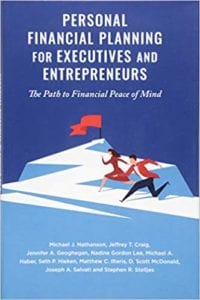
Personal Financial Planning for Executives and Entrepreneurs: The Path to Financial Peace of Mind
I must ask the question that I’m sure all the readers are asking themselves. You still have a brain tumor that’s still inoperable, but it’s not cancer so you’re still alive. Is that what you’re saying?
I do. I have a three-centimeter brain tumor. I used to not talk about it because it was something that I was afraid would diminish me and something that people would say, “That guy has got a brain tumor. He’s not long for the world. He’s got some diminished capacity.” I got into physical fitness and I met someone at the gym. This is the way stories transpire. You never know what’s going to happen. I met someone whose daughter happened to have a brain tumor. He was raising money for the National Brain Tumor Society, which is the largest nonprofit brain tumor organization in the country. Long story short, he recruited me to get involved in the organization. I became a board member in 2011 and in 2013, I became chairman of the board. I served as chairman from 2013 until the end of 2018.
When you have a position like that and you have a leadership role in a community in need, you’ll learn to talk about it. You’ll learn to own it and have pride in who you are and what you have. I’m very fortunate. My tumor should not end my life. It’s something that is treatable with medication. It’s inoperable because of its location, but it is treatable with medication that keeps it from growing. It doesn’t make it go away. I’m very fortunate. I must go get an MRI every year to make sure that I’m stable. I’ve been stable now for just about twenty years. I’m in good shape and I’m very grateful for the experience because while I would never have wished to get a brain tumor, I’m very happy to be part of this community. It’s a great community. It’s a community in need and one where I feel that I’ve made a difference in life.
You also talk about the similarities between medical and financial. You compare financial planning advice to medical advice. Can you expand on that?
I drive from my experience in the brain tumor community. I’m not a doctor or a researcher, but I’ve learned a lot about medical research. It occurred to me that as we make greater and greater advances in the medical space, there’s this thing called precision medicine. Precision medicine is the concept that some of the best and most effective treatments are treatments that are designed specifically for an individual. It’s not necessarily the same treatment that your neighbor would have. It’s designed for the specific DNA, the specific circumstances of a particular individual. Some of the most effective treatments are precise in nature. I also think from the medical space that there’s this concept generally in specialization.
[bctt tweet=”Financial peace of mind starts with a plan.” username=”John_Livesay”]
As you think about specialization, if you have a neurological issue, you tend not to go see a cardiologist. You might go see a general practitioner, but you want to see someone who’s a specialist that deals with your needs. As I got more and more into the world of financial planning and financial services, what I realized was that there were too many people trying to be everything to everybody. What we need to be thinking about is to provide the most effective type of financial planning service. It has to be targeted, it has to be precise in nature and it has to be delivered by specialists who understand the specific needs of the recipient.
I love that because I’m always saying the riches are in the niches.
For example, you mentioned our book. It’s about corporate executives and entrepreneurs. Corporate executives and entrepreneurs are very different from the professionals, from a lawyer, from an accountant, from a professional athlete. These are people who have very specific needs. They have very specific DNA. I believe that the right kind of service requires specialization and a precise approach.
There is such a difference because entrepreneurs do not have a lot of money to invest because we’re putting it all into the company. Who is your ideal client? How do you work with entrepreneurs? Are they people who’ve already raised series A and B versus starting out?

Financial Peace Of Mind: The decisions we make at the beginning of getting into a business starts with what choice you want to make in terms of what kind of entity to operate out of.
Certainly both because some of the best entrepreneurs are those that are just starting out. Often, you get someone who’s an entrepreneur that’s already done something before and now they’re on to another project. Let me just talk a little bit about the subject. The executive is a broad term that can include entrepreneurs. Many entrepreneurs are themselves, executives. It’s quite common to create a company and to have a product and to go get some financing. That person may have a title like a chief executive officer, chief financial officer, chief operating officer and yet that person is also an entrepreneur, which is why we wanted to write about both.
What we did was we wrote about the example of two people, and we tell a story around this where one person is a startup entrepreneur and one person pursues a more traditional executive at a large company type of opportunity. Their needs are related but different. The entrepreneur, especially in startup mode, should be thinking about foundational decisions such as choice of an entity that needs to be made at the very beginning in order to achieve the best financial results. Whereas the executive at the more mature company is going to have another series of needs and those needs will include the need to be thinking about employment agreements and equity compensation.
It sounds like you have a lot of advantages of being both a financial planner and a lawyer. It’s not like you have to go back and forth and say, “You need a contract. You need to put your LLC together here in Delaware,” or whatever the needs are that fit into the overall picture of financial planning. Would that be accurate?
That would most certainly be accurate. Our philosophy at The Colony Group is that we believe that effective financial planning advice should be delivered by a team that includes lawyers. In fact, we have around twenty lawyers that work for us because lawyers provide their own perspective. That is not just in the area being able to think about things like choice of the entity or thinking about provisions in a will or trust. Lawyers also have the ability and are trained to understand risk and to measure risk and to manage risk. I think that’s an important part of providing advice.
[bctt tweet=”Some of the best entrepreneurs are those that are just starting out.” username=”John_Livesay”]
Can you expand for people who may not know what choice of entity is since you’ve mentioned it a couple of times?
Choice of entity is when you begin in a business, that starts without an entity like a corporation or a partnership or a limited liability company around the business. It may start as a sole proprietorship, but the decisions that we make at the beginning of getting into a business start with what choice you want to make in terms of what kind of entity to operate out of. Do you want to be a corporation, an LLC, a partnership? It’s a complex set of choices. About what the right choices are, it depends on the facts. It also depends on the state of the law. The law has changed with the Tax Cuts and Jobs Act of 2017. There are lots of nuances that go into that decision.
You also talk about the five pillars of financial peace of mind, not just peace of mind. Let’s give the audience a quick little description. The first one is maximizing the rewards of working as an executive. What do you mean by that?
In order to answer that question, we have to understand why corporate executives are different. Executives are different for a variety of reasons. One of the reasons is that they often are employed under formal agreements. Many people are what we call employees at will, but executives tend to have some formal agreement in place. What we mean by maximizing the rewards of being an executive, first and foremost, is looking at your agreement. It’s negotiating appropriately and respectfully a good agreement. It’s understanding what’s in your agreement so you can harvest the benefits of your employment agreement. Maximizing the rewards of being an executive also includes understanding corporate benefit plans. It also incorporates understanding of equity incentives and other incentives that are put in place. Sometimes they’re cash related such as long-term and short-term incentive plans and making sure that the executive is well positioned to maximize the benefits of those programs while also observing the other four pillars.

Financial Peace Of Mind: The greatest strength of an entrepreneur is their passion. They have this courage where they don’t fear the risk.
The next one is achieving financial independence. What does that mean for you? Does that mean I never have to work again if I choose? How much money does someone need to have financial independence these days?
I want to be clear what that concept is. The concept of financial independence is a personal determination. It’s different for different people. This is not about, “If I have this much retirement and I take out 4% a year, I can be in retirement for this many years before I pass away.” This is beyond thinking about retirement. This is the concept of understanding what the person’s goals are and what their needs are going to be. Do they want to own two homes? Do they have kids that they want to educate? Do they want to leave money to their children in the future? When they do retire, what will their needs be from a lifestyle perspective? Understand all of that and come up with a plan to get to the point at which work is no longer necessary. That does not mean that you will retire at that point. It simply means at that point, you have the ability to do whatever you want. That’s what financial independence is. It’s understanding where you need to be. It’s getting to that place and then deciding at that point whether that may mean retirement or maybe it doesn’t mean retirement.
Planning and minimizing taxes is more important than ever now with the new laws. Certain states are not letting you deduct as much as they used to in terms of state taxes.
That’s right. Putting a cap on state and local taxes was a huge bite, especially in high tax states including some of the states on the East and West Coast. The third pillar is minimizing taxes. This is where many people go wrong, especially among executives and entrepreneurs. There are so many opportunities to minimize taxes. Whether that’s in the area of simply maximizing opportunities to defer taxable income, to maximizing use of deductions, to understanding the benefits of having capital gain versus ordinary income, to understanding how we’re using equity incentives by using a good tax approach that allows you to minimize taxes over the years. That in itself can generate a return that can sometimes exceed the great investment returns that we’ve been able to see over the last several years. People need to focus on a regular basis on the need to minimize taxes.
[bctt tweet=”Financial independence means understanding where you need to be.” username=”John_Livesay”]
Finally, planning for others. I don’t think most people think about that. Tell us a little bit about that one.
Planning for others, the fourth pillar, is the act of thinking about those that we love but also the causes that we care about. Planning for others is thinking about our dependence, thinking about people that we want to take care of while we’re here and while we’re not here after we pass away. That includes some traditional estate planning and thinking about dependent care planning, but it also goes beyond that. It’s also thinking about what are the causes that are important to an executive or entrepreneur. We find that most of our clients do have a passion for helping others and from making a difference in the world for what I called legacy planning. Think about what your legacy is going to be when you’re no longer on this earth. A big part of the planning exercise is identifying those causes and then figuring out the best ways to help those causes, not just economically but also in terms of providing your own services or just being part of the organization in some way. It’s complex. Choosing the right organization, understanding which organizations to get involved with and how to support them is itself a very complex undertaking.
Managing risk is so interesting to me because when you’re pitching to get your startup funded, you must minimize the risk for the investors by showing them that you’ve got proof of concept and who’s on the team and all those things. Even selling yourself in any situation to get people to change their behavior or the way they’re doing something with your product or service is also part of managing the risk that’s involved. How do you approach this for your clients?
Managing risk is something that we think about in many different perspectives. We must think about it in some of the most obvious perspectives, which would include from an investment perspective and talking about stories. One of the inspirations for writing this book is thinking about companies like Enron, WorldCom, Global Crossing, Bear Stearns or Lehman Brothers. I could go on. Years ago, these were companies that executives were just thrilled to be at. These were companies that the whole world admired. Those that had too much risk in those companies and those that had too much invested in those companies paid a very heavy price when each one of those companies suffered a very uncomfortable demise.
We think about investment risk. Investment risk can simply be asset allocation. It’s thinking about asset allocation strategy, thinking about the concentration of wealth issues, thinking about what your goals are and only taking the amount of risk necessary and no more to achieve those goals. That’s the more obvious way of thinking about it. A slightly less obvious way of thinking about it is thinking about the use of insurance. That insurance is life insurance. It’s casualty insurance. It’s directors and officer’s insurance. It’s thinking about all the ways that we’re exposed to risk and utilizing insurance to hedge that risk. Then we get to the broader and more nebulous areas of risk, which are the ones you were touching on.
Think about your business and think about all the risks that you take in your business. Most people don’t even have a clue as to how bad that risk can be. You get people who are so passionate about what they’re doing. That’s the greatest strength of an entrepreneur. The greatest strength of an entrepreneur is their passion. It’s their vision. Some people don’t have that kind of vision. That’s what makes the entrepreneurs the best. They had this courage. They don’t fear the risk. Fears are the instinct that we don’t always have. Fear is designed to make you exercise caution. As we operate our businesses, you should take as much risk as you need to take and hopefully know more than that. It is part of the business plan as well thinking about how much risk you’re taking to achieve your objectives.
You’re also talk about the criteria that people should use to decide what financial planner they should do. Should everyone have one? How do I find a good one?
There are studies that talk about executives. One of the studies that we talk about in our book indicates that executives worry more than other wealthier people about financial planning in every single category of financial consideration. They’re worried a lot. You might think that, therefore they’re also all going to be likely to go and hire someone to help them. That is true, but to some extent, it’s not true. We find that executives are prone to want to work with a planner, but only when they can partner with that planner. They don’t want to just completely delegate. They want to partner with an advisor that they can work with on a regular basis to achieve the best results. It may be a little bit of a surprise or an irony and that you think of an executive as someone who delegates. In fact, the larger group is the group of executives that want to partner with an advisor. There is a number that also wants to do it on their own, but they do understand that this is very important. What we found was that about two-thirds acknowledged the need for some third-party expertise.
[bctt tweet=”Fear is designed to make you exercise caution.” username=”John_Livesay”]
Whether that’s a formal financial advisor or whether they’re trying to do it themselves and work with a series of people like a lawyer, an insurance professional, an accountant, about two-thirds of executives want to work with someone. What are the choices? The choices generally relate to a couple of different service models. Most people are unaware of these models. One is what I’m going to call the suitability model. There is a legal standard called the suitability standard, and this is what is generally applicable to what we call wirehouses, the big brokerages. The standard at these brokerages is that the advisors there are bound by a standard that requires them to make sure that anything they do for a client is suitable in nature. They’re taking into account their personal circumstances, but they’re allowed to have conflicts of interest and operate in a way that may benefit them at the expense of the client provided what they’re doing for the client is suitable in nature.
That may sound like a negative way of saying it. That is the standard. I do want to be clear that there are many excellent people at these organizations who do great work for their clients. It’s about getting the right person. The other standard is the standard to which we adhere and are required by law to adhere is called the fiduciary standard. That is the standard by which an advisor must always put the client’s interest first. There will still be conflicts of interest. There are always going to be conflicts of interest, but they must be mitigated. You’ve got to mitigate your conflicts of interest and put your client’s interests first. That’s the preferred standard. You can get great advisors on both sides. It’s about getting the right person. It’s important to think about what the right standard is. Someone who goes to a fiduciary-based advisor is more likely to be able to get peace of mind that they know that their interests are being put first.
Michael, I can’t thank you enough for sharing your wisdom and your personal story. You inspire us all to not give up, have a plan and get some financial peace of mind.
It’s my pleasure, John. Thank you for having me.
Links Mentioned:
- Personal Financial Planning for Executives and Entrepreneurs: The Path to Financial Peace of Mind
- The Colony Group
- Quantmre.com
Wanna Host Your Own Podcast?
Click here to see how my friends at Brandcasting You can help
Get your FREE Sneak Peek of John’s new book Better Selling Through Storytelling
John Livesay, The Pitch Whisperer
Share The Show
Did you enjoy the show? I’d love it if you subscribed today and left us a 5-star review!
-
- Click this link
- Click on the ‘Subscribe’ button below the artwork
- Go to the ‘Ratings and Reviews’ section
- Click on ‘Write a Review’