

What Is Your What? with Steve Olsher
Posted by John Livesay in podcast | 0 comments

Episode Summary:
—
Listen To The Episode Here
What Is Your What? with Steve Olsher
Our guest is Steve Olsher who’s known as the world’s foremost reinvention expert. He’s famous for helping individuals and corporations become exceptionally clear on their what. That is the one thing they were created to do. His practical no-holds-barred approach to life and business compels his clients towards achieving massive profitability while cultivating a life of purpose, conviction and contribution. He’s a 25-year plus entrepreneur. He is the Chairman and Founder of Liquor.com, which is an online pioneer that launched on CompuServe’s Electronic Mall in 1993. He is the New York Times bestselling author of What Is Your WHAT: Discover The One Amazing Thing You Were Born To Do and also the author of Business Technology Book of The Year, Internet Prophets: The World’s Leading Experts Reveal How to Profit Online. Steve, welcome to the show.
I appreciate you having me.
I’m always interested to hear my guest’s story of origin. You can take us back as far in childhood, high school or college or wherever you want. Did you always know you wanted to be an entrepreneur? How did you come up with these concepts for figuring out our purpose? What was it that got you where you are now?
Here’s what I believe, and I believe that entrepreneurs are not made. I do believe that they are born. I think it’s either on your DNA or it’s not. For me, I’ve always been wired as an entrepreneur pretty much from the time I was old enough to pick up a rake to move leaves around or grab a shovel and shoveling sidewalks and driveways. It’s always going back to some of my rap roots trying to rub a couple of dimes together to make a quarter, trying to make $1 out of $0.15. I’ve always been naturally wired in that way of trying to figure out where the opportunity is and can I create a product, program or service to solve that problem. I ended up opening my own nightclub when I was nineteen. That was my first real entrepreneur endeavor. I’ve been DJ-ing in clubs for a number of years and built a decent following so I thought maybe there’s an opportunity here for me to have my own club but I was young. I couldn’t even legally drink.
It was interesting because I think that’s where my true entrepreneurial roots were born because I saw the opportunity. You create a club that would be a non-alcoholic club which would be in the middle of all these alcohol lane environments, in that same central district. Because we wouldn’t serve alcohol, we would be able to care for the teenagers, those eighteen and under for a number of hours. We could close down, clean up, reopen and then cater to those eighteen and over and stay open as long as we wanted because we weren’t serving booze. We won’t subject to those liquor laws. When you’re young, the bar closes at 1:30, it’s a little early. There are some folks who still want to stay and do their thing. That was the basic idea and I thought there was a good opportunity there to create a non-alcoholic club. That’s what I ended up doing. I ended up writing a plan, raising some money and open up the club when I was nineteen. That was my first real entrepreneurial endeavor. Right off, there were some of the other things since. I think it’s in the blood. We’re naturally-wired to excel in specific ways and it’s up to us to figure out what that is.
[bctt tweet=”Entrepreneurs are born not made. ” username=”John_Livesay”]
The irony to me is you’re young and starting a nightclub not serving liquor and then you somehow from that get to launch to be the Founder of Liquor.com. What was that journey?
My family has actually been in the liquor business for a couple of generations. My grandfather started Foremost Liquor Stores out at Chicago back in 1939. My mom went to work for him, my grandfather, in 1977. It was a family business. After the club thing ran its course, I was sitting there trying to figure out what to do and mom said, “Maybe you want to come and join the family business and see if there’s a way that you can help here.” I didn’t want to be involved with stores necessarily. I don’t want to be in the retail environment. This wasn’t my bag, but then this very small piece of the company which was called Foremost Liquor by Wire, which basically did the same for wine, champagne and spirits as FTD did for flowers. If you’re in LA and you want to send a bottle of wine to your friend in New York, you call our 1-800 what’s line way back in the day and we would take care of that delivery through a local retailer. I saw that piece was interesting. They were maybe doing a couple of thousand dollars a month so it was a very small piece.
I thought there was an interesting opportunity there so I said, “Let me dig in here to this,” and ended up launching a catalog in ‘91. In ‘93, when AOL, CompuServe, Prodigy and some of those hit the map, it’s like, “Let me see what we can do here in this online space. I think this is going to be pretty big.” We launched one of the first stores on CompuServe’s Electronic Mall in ‘93. All the while, we were called Liquor by Wire. In ‘95, we launched one of the internet’s first fully-functional eCommerce sites. In ‘98, we had an opportunity to pick up the domain Liquor.com. It was a monetary stretch. It was certainly a financial stretch to do it, but I thought I could really change the phase of the business and so we made that leap.
Have you ever had to raise money for this company?
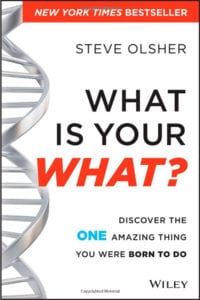
What Is Your WHAT?: Discover The One Amazing Thing You Were Born To Do
Several times.
Talk about that first because everyone’s always interested in what you learned pitching-wise.
We actually have a couple of iterations on it. In ‘98, after we got the domain, that’s when things started to pick up on the online space in a pretty big way that was internet 1.0 if you will. It was crazy. If you remember ‘99, those years, nearly ideas on the napkin were being funded. It didn’t matter. If you had a decent idea, you wrote it down, you had somebody like, “Let me give you a check.” We were an anomaly in the space because we were profitable. We were doing millions of dollars in revenue at the time we started heading down that path of fundraising. We were already doing about $3.5 million in sales which in nowadays’ dollars, that’s in $28 billion or something like that. Using the terms of the day, all the heavy lifting was done. We just needed money for marketing. We really just needed money to let people know that we existed.
Any infrastructure was in place, we can handle the load that was a niche. ‘99 we went out and brought in someone to help us get to the Promise Land, raise initial friends and family around. Call it maybe a series A, but just a very low-price round to give us additional capital to be able to hire an official investment bank to take us public. That was the ultimate goal. Part of that capital that we raised, I think we raised about $500,000 in the first round and ended up raising about another $4 million in total before the S1 was filed and we were ready to go public. That was the roadshow, the whole nine with the S1, and trying to get investors to sign on once obviously to commit to participating in the IPO. Did the roadshow and we were slated to go public in March of 2000. That’s when everything imploded.
Did your investors still get a good ROI?
They got zero. They got nothing. Everything imploded. As a matter of fact, part of the money that we brought in, we brought in because Wall Street wanted to see more of these lettered saviors. The CEOs, the CMOs, the CTOs, the CFOs, the WTFs, all these people that you don’t really need. We bought into it hook, line and sinker so much that I actually signed away my management rights to the company. We were completely blinded by the dot com light. We found ourselves in March of 2000 being unable to go public and by August of 2000 I had walked away from everything. I had built the company for nine-plus years. I literally walked away from everything. My mom walked away in December. Grandpa had passed many years before that. She walked away in December and I put it out of sight, out of mind for years. Mind you, I had never signed away my rights to the domain, just to the company. I washed my hands off it and I was like, “I’m out of here. I didn’t get along with the CEO.” That story is for another day.
[bctt tweet=”You are the solution to someone else’s problem.” username=”John_Livesay”]
In 2006, I won’t go into too much detail here because I know we’ve got other ground to cover, but I was finally able to reclaim the domain and subsequently put it up for sale. I had a couple of very interesting offers. The highest offer was $4.25 million just for the domain. Needless to say, I accepted. The guy made the first few payments and then bailed on the rest. I kept the money and I kept the domain. In 2009, I ended up teaming up with some folks out of San Francisco who now run the business. I’m the chairman but they actually run it on the day-to-day. I’ve got no day-to-day with it at all and we’ve raised about $12 million to date or so in this current iteration.
What a fascinating story of it go away. It comes back because you had one piece that could allow you to rebirth it, which is one of the big storytelling genres I’m always talking about. It’s also the not giving up and now the people who have invested in this iteration must be happy.
Not yet. It’s interesting. It’s like, “Screw me once, fool me twice.” You would think I would win but no. When I brought in this team out of San Francisco, the deal was I would contribute the domain and they would build the business. Once again, I signed away my management rights to it because I just didn’t have an interest in building the business at that point. In hindsight it was dumb, but it is what it is. I love those guys to death. They’ve done great on a lot of different levels. We’ve got millions of people who subscribed to the newsletter. We’re number one or number two in any SEO search you can think of. We work with all the biggest brands in the world but revenue has been limited to ads and those brand-related relationships. Revenue has been suffering. They’ve been operating in the red for God knows how long. We ended up striking a deal with a pretty big conglomerate to put a big chunk of change in and it’s needed at this point because the thing is bleeding. We’ll see what happens. That will be an eCommerce initiative and we’ll see how things go.
Amazon lost money for quite a while too. It shows the importance in investors going, “I still see the big picture.” The fact that you have relationships, revenue, the search, something that all that equity is worth a lot. You now seem to be the kind of entrepreneur, Steve, that has the ability, some people call it their gut, some people have described it as having their pulse on the Zeitgeist. It’s a little bit ahead of everyone else of, “I see this could be an opportunity,” which you did with this. It starts off as a little thing. You have a gut instinct. You look at something and you go, “This is something that’s a seed of an idea.” You have a seed of an idea that you feel now is going to be your next big thing. Can you share with us a little bit about what that concept is and what you’re doing?
I take that as a compliment because what you’re saying is that I’m able to see to Wayne Gretzky saying, “I see where the puck is going.” That hasn’t worked to my benefit, to be honest, because I’ve actually been too early in most cases. If you look at Liquor.com as a whole, it’s a perfect example of just being too early. There are other things that I’ve done where it’s been too early. In this case, I hope the timing is spot on. I think the timing is spot on but long story short is the endeavor that I’m undertaking is called Latatud. For those of you who are familiar with Software as a Service, you pay a monthly fee, you get access to a particular software, membership-driven recurring revenue, etc. This is built around the same general principles except that it is housing as a service.

What Is Your What: No guy ever wants to hear anything that he’s associated with being associated with the little thing.
It’s a membership opportunity for people who live the laptop lifestyle or as they’re commonly known as digital nomads to be able to pay a set membership fee and have access to housing that we own. That’s the biggest difference between Airbnb and us or any of those types of people. Our company owns that housing and it gives these digital nomads the flexibility to move from location-to-location as often as every 30 days and they have the ability to have privacy. It’s not like one of those co-living type environments that you see for so many of those types of folks. One of the more unique elements of what we’re doing here is they build equity as if they’re a homeowner without the headaches of homeownership. It combines flexibility, equity and privacy in ways that frankly isn’t being done right now. We would actually own the real estate which gives us the opportunity to provide equity for not obviously dollar-for-dollar but it’s certainly a lot better than renting. That’s what it is.
There are two things I want the readers to take away here. One of the things investors look for is why you and then why now. In Steve’s case, he’s got this experience of launching a company with huge revenue and brand. He knows what to do. They’re putting their money on the jockey and if you’ve already been through some of the pain points, that lets them feel like you’re not going to give up and you’re going to figure out how to make something work. The second part is why now. In other words, if Uber tried to launch or even Airbnb which is a more relevant example, Uber without people having smartphones in urban areas, that wouldn’t work. Airbnb, if 2008 hadn’t happened with people being open to new ways of making money, the concept was so revolutionary. This is yet another example of why now. The growth of all the digital nomads is one thing and the only options they have now is we work, we sharing, co-living or Airbnb and there’s some downside.
If you can boil down to your pitch like you just did to three keywords: privacy, flexibility and equity, then that lets people lock in three key things that you’re offering, the solutions to the problems you’re solving. That is what allows people to go, “I get it. I can explain it. I don’t have to work so hard in 30 seconds to understand digital nomads are going to get a place to live that gives them privacy, flexibility and equity.” That’s your one-sentence pitch right there and so that is the secret sauce to then having people double click on each of those different topics and how it’s different than what’s out there. It’s great stuff.
I appreciate that and the piece that we didn’t talk about and the reason why I think this combines so much of my particular skill sets is that I actually have done real estate development for the better part of several years.
The why you is very strong there.
[bctt tweet=”We’re just naturally wired to excel in specific ways. It’s up to us to figure out what that is.” username=”John_Livesay”]
There have been big huge hits and there have been big huge misses and the learning experiences with both I think does make me uniquely qualified to be able to lead this charge. I often say that this is a real estate play disguised as a tech play. The reality is that real estate and tech is where I’ve cut my teeth for the better part of many years.
I want to get to your book, What Is Your WHAT? because my first question to you is there are a lot of people reading that have a dream of a book or have a book but you were able to get yours to be a New York Times bestseller. Can you tell us that story?
2013 is when What Is Your WHAT?: Discover The One Amazing Thing You Were Born To Do was released. I knew that it not only had the ability to help people in ways that Myers-Briggs and What Color Is Your Parachute? and StrengthsFinder and some of those types of modalities couldn’t. I also knew that from a personal branding standpoint, if I wanted to build this career and the expert space, which I started pursuing in 2010 when I had this wake-up moment. I realized that my life was focused on the money and it was great for me and those closest to me but really no one else, which of course was short-sighted because money is awesome and that is a whole discussion for another day. There’s that, we come to that come-to-Jesus moment and that’s what it was for me in 2010. All these real estate developments all we were good but it’s just money. What am I going to do to serve humanity? That’s when expert-type space came about. I knew that if I wanted to build a personal brand, that more of the Steve Olsher brand, there were some things that you need to be able to check some boxes on. Having major media, having a book hit the list, have a live event, all these things that go hand-in-hand with being seen as one of those top folks. It was always the plan.
What Is Your WHAT? was my third book but it was always my plan to put that one on one of the lists, ideally the New York Times list. Back in 2012, 2013, even a few years after, there was a company called ResultSource. ResultSource’s claim to fame was if you can put enough pre-orders together for your book, we will then place orders throughout the country so that it shows up on BookScan or whatever it’s called nowadays. It looks like all of these people are buying all of these books across the entire country at the same time. If you have a certain number of books that are sold in a finite period of time, that then gets you on the radar of the list. Back in those days, if you’ve got to 10,000 books, the odds were good that you would hit the New York Times list. It was 10,000 books in a week.
You get to 20,000, you probably hit the top five and if you could get to 30,000 or so, you’d probably be top one or top two. The plan was that I’m going to work with ResultSource. We’re going to blow this thing out of the water. We’re going to focus really hard on providing incentives for people to buy the book, to buy more than one book. You buy ten books, you get this. You buy twenty books, you get this. You buy 50 books, you get that. Let’s shoot for 13,000 as our goal because that’s the number that we had said, “If we can get to 13,000, we should have a pretty good shot at hitting the list.” When all was said and done, we ended up right around 13,800 in terms of the number of copies that were pre-sold. On release date, they were then distributed out through all these various points of entry to the book system there across the country and that’s how we ended up hitting the list.

What Is Your What: You can achieve your desired results if you focus on what it is that you’re doing.
It reminds me of the way movies are launched. A lot of money spent on marketing to get watching trailers so that opening weekend is a killer because if it’s not, then the movie will not be a hit. All the buzz that has to go on is very similar. That skill set alone is completely transferable to so many other things and I know you’re doing a lot of other kinds of launches as well. There’s a chapter in your book, What Is Your WHAT? that I want to get you to talk about, which is The Vortex of Invincibility. You certainly have that. What is it that we can all learn from your book and you to become more invincible when things knock us down?
The Vortex of Invincibility is built around the framework of the conscious competence learning stages model. Basically, we have these four stages of the conscious competence learning stages model. We have what’s known as unconscious incompetence where you literally don’t know what’s going on, you don’t know what you don’t know. We have the stage of what’s known as conscious incompetence where you become familiar with what it is, where you’re weak or where you need improvement, etc. Those two are obviously very important as you move through this process of getting to a state of invincibility because if you don’t know what you don’t know, you don’t know it. If you’re out of luck, you’ve got to figure it out. Getting to step two of turning the light switch on is huge in terms of your own personal growth, your business growth, whatever it is.
Step three is then all about achieving what they call conscious competence which means that you can achieve your desired results but you’ve got to focus on what it is that you’re doing. Maybe you’re learning a new language. You’re sitting there, you’re reading a book and it’s in Spanish. You have the ability to read Spanish but you have to think about what that sentence meant, every word, etc. Ultimately, the last stage of the conscious competence learning stages model is unconscious competence and an unconscious competence basically things come naturally to you as breathing. You don’t have to think about your process.
To get to that point of invincibility, even if you can just master one area of life or business, the world stands up and generously applauds and compensates those who have achieved unconscious competence in any area of life or business. It’s so hard to do. Few people will ever achieve that state of invincibility outside of things that come naturally to them like breathing, walking or talking. I’m not talking about 10,000 hours or anything of that nature. I’m talking about truly becoming a master of whatever that craft is that the world handsomely rewards those people for whatever that one thing is. The tag on the book, Discover The One Amazing Thing You Were Born To Do, that’s the interesting part about all of this is it doesn’t take more than one thing to have a monumental impact. Not only of course on your life and on the lives of those closest to you, but on the world at large.
I remember this process learning how to drive stick shift and it’s like, “I don’t know anything about this.” I didn’t have any energy on it like, “I don’t know how this works,” but once I started the stop, the jolting part of it, it’s such a great metaphor I think if you’ve ever tried to learn stick shift on the hills of San Francisco. Now I’m aware of how incompetent I am at this and sweat’s pouring down my face as I’m almost going back down the hill because I can’t get the car in gear.
[bctt tweet=”A single thing can have a monumental impact not only on your life and on the lives of those closest to you but on the world at large.” username=”John_Livesay”]
The first stage honestly is you didn’t even know there was a stick shift.
When I don’t know it, I don’t have any judgment on myself yet. I just go.
You just get a car, put it in drive and go.
Someone’s going to teach me how to drive stick. I haven’t a clue what it does or how it works or clutch or any of that. For me, the challenge that I’ve seen myself face and I think other people do too is when you get to this conscious incompetence stage, the negative self-talk really amps up. “You’re never going to learn this. You were stupid even to try to learn this.” That’s where the invincibility is probably at its most fragile. Once we get to the place where it’s like, “I have to concentrate. I can’t be listening to the radio or talking to anybody when I’m driving stick.” That’s fine and we know we’ve got it at least. We’re not going to crash or go down the hill. This part, you can use this for everything in your life, anything you’re trying something new, in your business, to getting a new client, whatever it is. This conscious incompetence stage, do you have any insights that you personally have said to yourself or any tips for people who don’t realize that you will get it but it might take a little longer than you think? Try to talk down or turn down the volume on all that negative self-talk?
Yeah and I’m not going to sit here and say that negative self-talk isn’t helpful. There are things that you are not meant to do. I could sit here and I’m 5’8” on a good day and the reality is there used to be a time where I could touch the rim in basketball. If I can slap at the net, I’m doing pretty good. The bottom line being I never could dunk. I’m not going to dunk. For me to continually sit here and try to get to the stage of unconscious competence, dunking isn’t going to happen. It is a fine line of recognizing where reality intersects with dreams, hopes, wishes and what actually is possible. What I know to be true is that for me, if I’m banging my head up against the wall on a consistent basis, let’s use the analogy of trying to jam a square peg into a round hole.

What Is Your What: Once you understand what your core gift is, the question is then what is the primary vehicle that you’re going to use to share that gift?
There are times where you can continually do that and you will whittle that thing down and break it away and eventually you can jam it in, most of the time it just results in pain. When you find yourself in that state of conscious incompetence and you’re continually trying to jam that square peg into the round hole, it may be time to go outside of yourself and ask someone for feedback. That’s the beauty of having a mentor, coach, guidance or accountability partner. Go outside of your own head to say, “Am I an idiot here? Is this something that I should continue to press through?” I’ve been doing Brazilian jiu-jitsu for the better part of many years. For me, it’s still conscious incompetence. I have some conscious competence but I have yet to reach the stage of unconscious competence. I’m still in phase two and I’ve been doing the thing for many years.
You obviously like it so you keep doing it.
I do like it but I also know that with enough time, with enough practice and with enough consistency, I can achieve that level of unconscious competence with one move at a time. It won’t necessarily be the entire sport because it’s endless and there are a number of things that you can do and the number of things that happen. There are so many variables in it. You’ll never get to that stage. Even the grandmasters find themselves like, “I didn’t even know this was possible,” because the sport is always evolving but you can certainly move beyond that stage of conscious incompetence to at least achieve some conscious competence with it. It’s an interesting discussion because at some point though, you do have to cut the rope and say, “This is not something that I can do or I no longer want to do it.”
At the end of your book, let’s say you found your one thing, your what. Now what? Obviously, the one thing you talk about is helping people in corporations figure out what their one thing is that they were created to do. Once people have identified that, what do you recommend they do with it in the book and in life?
It probably requires to talk just briefly about the What is Your WHAT? framework so that people understand what we’re saying here. What I’m talking about what your what is, in author land they say that you write the book that you most need. For me, this has always been a struggle trying to figure out as a grown man what it is that I’m good at and should be doing with my life. I did the Myers-Briggs, What Color is Your Parachute? and all those. They all left with more questions than answers. There’s got to be a better way. There’s got to be an easier way to get to an answer in terms of how I can hit the ground running to make a meaningful impact on the world. What I realized in having taught a class called The Reinvention Workshop, this is something that I had started doing back in 2009 where I was helping people to reinvent their lives and just try to move powerfully forward. I started doing workshops that I call The Reinvention Workshop and kept teaching The Reinvention Workshop, I became clear that there are three important pieces of the puzzle. If you can solve these three pieces, everything else falls into place.
[bctt tweet=”Bend your time or invest your time to start pursuing your what.” username=”John_Livesay”]
It all begins with understanding what your core gift is. Your gift could be something like teaching, healing, communicating, enrolling, protecting or entertaining, something like that. We all have a core gift. John, your core gift is probably either communicating or teaching, I would think something like that, maybe but we could get into. Once you have an understanding of what your core gift is and if you look at the cover of What is Your WHAT? you’ll see that the only graphic element on there is the DNA strand. What I honestly believe is that what really has chosen you is not that what you chose is truly a part of who you are. You can spend a lifetime in denial about what it is but ultimately, it’s a part of who you are. Your gift I believe is in your DNA. It’s there. It’s static throughout your entire life.
The other two pieces are more organic. They can evolve over time based on new experiences or based on things that come out of you. Either things come into your life and it opens your mind to something new or something new comes out of you. The second piece is the vehicle. Once you understand what your core gift is, the question is then what the primary vehicle that you’re going to use to share that gift is? For example, your core gift could be let’s say healing. The primary vehicle that you use might be a massage or might be acupuncture or something of that nature. Core gift, primary vehicle.
The third piece of the puzzle and this is the What is Your WHAT? framework. When I talk about your what, it’s the combination of these three elements. The third element is the people and understanding the people that you are most compelled to serve. Let’s say hypothetically you’ve got a tripod and you’ve got all three pieces here. You’ve got your gift, your vehicle and your people. You’re going to have a stable place to sit, it’s going to work, whatever. If you take away any one piece, if you’re clear on the people that you’re most compelled to serve but you’re not clear on the vehicle that you’re going to use to serve them, obviously that doesn’t work. If you’re clear on what your gift is and you’re clear on what your vehicle is but you’re unclear on who the people are that you’re most compelled to serve, you’re just going to end up serving anyone. That’s going to be a tough thing to take to six, seven or eight figures depending on how far you want to go with it. You can run it six ways from Sunday and you’ll see how that all comes together.
I love this so much because figuring out what you’re good at or gifted at, figuring out how you’re going to deliver it and then this is the biggest mistake I see people make so many times is trying to be all things to all people. Who do you help? What problem do you solve? Why are you uniquely qualified to execute it? It’s all answered in these three structured. It’s great.
The question that I asked people then is, “Who are you most compelled to serve?” The God-honest truth is you found your what, now what? That can evolve over time but then you found your what, now what? The first thing you do is you get started and you don’t quit your day job. If you’ve got a day job that’s paying you money, don’t quit that day job. Think about it like a recipe mixture. I know what my what is but right now 100% of my income is derived from my what isn’t. 0% is derived from what I think it is. Use those hours in the day. You can either spend your time or you can invest your time. That’s all you can do. Use those off-hours meaning before work, after work, the weekends to start pursuing your what.
As soon as those dollars start coming in, then that recipe mixture starts to shift. 100% of your income becomes 99% of your income and now 1% is derived from your what. It starts to shift 70/30, 60/40, 50/50 whatever and it’s the point you’ll understand when it’s time to cut the rope. You’ll also understand once you get in motion, what are the things that you need to be doing to make this work for you in a way that not only reflects something that you love doing but it also reflects something that you’re really good at. It reflects something that people will pay you handsomely for.
I can apply this personally to my own speaking career. I discovered I loved speaking and was good at it but I realized I needed to have some training to make it even better. The vehicle of communicating, in my case helping salespeople who struggle, but pushing out a bunch of information learn to become storytellers. I was very clear in who I helped and then specific industries, not just all salespeople but tech people, executive recruiters, healthcare people, design people. I knew exactly who I could help in that niche and the vehicle was being hired as a keynote speaker but then I was like, “I need to get more talks to be from 10% of my income to 50% to 80%. How do I grow that and all the steps to do that?” I think that example for people who go, “You don’t start out being Brené Brown with the Netflix Special. First, she did a TEDx Talk. She was a researcher but she found that she was gifted at taking information and turning it into stories. Anyone can take a real look at that. Are there any last thoughts or pieces of advice you want to leave our audience with?
As you relay the What Is Your WHAT? conversation which we’re having here now is the end, I have to simply say that the bottom line is that you are the solution to someone else’s problem. There are people who are literally praying for you to show up in their life. The God-honest truth is I believe that you do not have to succumb to life as a starving artist simply because you are compelled to draw. Why shouldn’t you be paid extraordinarily well for what it is that comes naturally to you as what comes as naturally to those who make millions of dollars a year doing what comes naturally to them? For me, I’m wholeheartedly on the mindset that once you show up in these people’s lives, those people who are praying for you to show up. They can get up off of their knees and stop praying because they have now found you and found your solutions, that they should start paying. We embrace the notion that you are the solution to someone else’s problem and that people should pay you for your talents and pay you handsomely for any gifts that you bring to the table.
Steve, thanks so much for sharing your story, your incredible journey. This new Latatud is going to be a huge hit, I’m sure. Of course, all the insights on what makes this book a New York Times Bestseller.
You’re welcome.
Links Mentioned:
- Liquor.com
- What Is Your WHAT: Discover The One Amazing Thing You Were Born To Do
- Internet Prophets: The World’s Leading Experts Reveal How to Profit Online
- What Color Is Your Parachute?
- The Reinvention Workshop
- https://SteveOlsher.com/
- WhatIsYourWhat.com
Wanna Host Your Own Podcast?
Click here to see how my friends at Brandcasting You can help
Get your FREE Sneak Peek of John’s new book Better Selling Through Storytelling
John Livesay, The Pitch Whisperer
Share The Show
Did you enjoy the show? I’d love it if you subscribed today and left us a 5-star review!
-
- Click this link
- Click on the ‘Subscribe’ button below the artwork
- Go to the ‘Ratings and Reviews’ section
- Click on ‘Write a Review’
Unleash Your Inner Company with John Chisholm
Posted by John Livesay in podcast | 0 comments

Episode Summary
 Today’s guest on The Successful Pitch is John Chisholm, the author of Unleash Your Inner Company. He has such an impressive background from MIT and Harvard and has coached thousands of entrepreneurs on how to be successful. He shares those secrets with us today. In fact, he said, “Passion is an attitude but perseverance is a behavior.” He does a deep dive into the psychology of growing your mind from the inside out. He really shares what he looks for when he hears a pitch as an investor. I think you’re going to get a lot of value into learning what it takes to reduce the risk by hitting certain milestones and showing an upside potential so that your pitch becomes irresistible. Enjoy the episode.
Listen To The Episode Here
Unleash Your Inner Company with John Chisholm
I am thrilled to have John Chisholm today as my special guest. John has an amazing background. He went to MIT. In fact, he’s now president of the MIT Alumni Association. From there, he went to Harvard. He was one of the early employees at Hewlett-Packard and Silicon Valley. He has an amazing book called Unleash Your Inner Company. He has also founded two companies. He co-founded a third. He sold a fourth company. He’s advised literally thousands of entrepreneurs across five continents. John, welcome to the show.
John, thanks so much for having me.
I have so much respect and insight for what you’re doing. You have such an amazing career and journey. Let’s start with this whole concept of you’ve been both an entrepreneur and an angel investor. Let’s just dive right in. What do you listen for when you hear a pitch?

Unleash Your Inner Company: Use Passion and Perseverance to Build Your Ideal Business
I think it’s helpful to have been an entrepreneur, when you’re both evaluating pitches and trying to be helpful to entrepreneurs, I listen very closely for a real unsatisfied customer need. Until I hear one, it’s hard for me to get very excited or to be very focused on the opportunity. So many entrepreneurs focus on their really cool technology rather than a real customer need. I like to say, I started my first company with a really cool technology for which there was no customer need. It took me six to nine months to let go of that cool technology and swap it in favor of something for which there was a real customer need, namely doing surveys on the internet.
My first company which I founded in 1992 was Decisive Technology which published the first software for automated surveys via email and later via the internet. Start with a real customer need, that way you know that your business will be addressing a real customer need. It’s okay to use your resources, including your technologies if you have some, to suggest real customer needs, but make certain that you’re satisfying one. In the book, I talk about ways to come up with a potentially infinite number of unsatisfied customer needs even just in the areas you’re passionate about and to test them and to confirm that they’re real.
How do you suggest somebody test that the problem is real? Do you have any ideas on that?
Yes. First of all, let me talk about how you come up with unsatisfied customer needs. Start with any product or service in an area that you’re passionate about. For example, you’re passionate about running. One of the products and services we runners use are running shoes. Then ask yourself, what are the limitations of that product or service? I can think of three for my running shoes. Number one, they start to smell after I’ve worn them too many times. Two, if I want to change the shoelaces to match the color of my outfit, it’s a hassle to thread and re-thread them every time, two laces of different colors. Three, the shoes don’t tell me how far I’ve run or how fast I’ve run and they should know that, shouldn’t they? Those are three possible customer needs.
I have to confirm that they’re real and unsatisfied. Real means that other people besides just me have the need that means talking to people, going online seeing if other people seem to have the need, doing interviews. Also, I have to confirm that they’re unsatisfied, which means that another product or service isn’t already satisfying them. That means seeing what products and services are currently available, going to shoe stores. If I can satisfy myself that they are real and unsatisfied, great. That’s an opportunity for me to come up with a possible solution to that need. Let’s say, I can’t find anyone who addresses the problem of changing shoelaces easily to match the color of my outfit. That’s an opportunity to be creative and maybe I can think of a way to let a set of shoelaces to snap on or off. For the other needs, the shoes that smell and the shoes that don’t tell me how far or fast I’ve run, there are obviously solutions for those footpads and sprays and so forth.
Then ask yourself, what are the limitations of those solutions? Sprays have to be done every day. Footpads have to be changed frequently. What if there were a way to go for weeks or months without having to use the spray or change the footpads? That would have some advantages over the current product. Now, I have a new potential customer need that is the leftover need from the original need that’s not fully satisfied by the product or service currently available. Similarly, for the shoes that don’t tell me how far or fast I’ve run, there are solutions to those. There are Fitbits, there are odometers and so forth that you can wear while you’re running, but those I have to put on and take off. What if there was a way to have it built into the shoes so that I didn’t have to worry about putting it on or taking it off? Then that’s another potential need.
You can see I started out with a single product or service in an area that I’m passionate about. It blossoms into a tree of potential unsatisfied customer needs that I can consider evaluating. That’s how you can get a potentially infinite number of unsatisfied customer needs from even just one product or service in an area that you’re passionate about.

Unleash Your Inner Company: Come up with unsatisfied customer needs.
That’s so helpful. I’m always telling everybody: when you pitch, paint a picture. You just did that for us, John. You talked about it blossoming into a tree and you showed us how each branch leads to another branch by this logical way of exploring what the problem is. You’re really getting into the head of a potential customer’s problem that they may not have even thought about. “Yeah, my shoes smell.” They accept it. If you can really figure out a way to prevent that, they would love it. That’s really helpful.
John, sometimes I hear from budding entrepreneurs, “What if my areas that I’m passionate about aren’t very business oriented?” Let’s say I’m passionate about long hot baths, kittens and comic books. None of these sound very businesslike, do they? But even in these areas, there are potentially an infinite number of unsatisfied customer needs.
Warm hot baths. People like to read, listen to music, talk on the phone when they’re in the tub. How about a floating waterproof case for my iPad or iPhone that lets me do those things when I’m in the tub? Kittens. They lose a lot of their cuddliness when they grow up to be cats, don’t they? What about a diet or genetic therapy that allowed a kitten to stay a kitten its entire life? There would be a lot of demand for that, wouldn’t there? Comic books. The hugely successful and popular tradeshow Comic Con in San Diego attracts about 150,000 people. Hugely profitable, people sign up, attend dressed up as their favorite comic book character. No matter what your passion is, even if they don’t seem very businesslike, like those three, there will be unsatisfied customer needs in those areas. You just need to find them.
I love that. I’ve actually been to Comic Con. Talk about finding people who are passionate. This enthusiasm, whether it’s somebody who rides a Harley and they get that tattooed or the Nike people that get the swish tattooed. If you’re that passionate and there’s a whole other group of people that are equally passionate about what you’re doing, that’s great advice, is to focus on solving that problem and you’ll solve other people’s problems. In your book John, you talk about using passion and perseverance as a positive feedback loop, which is just the very beginning of Unleash Your Inner Company. I would love to have you talk about, how we can get a positive feedback loop going in our own head?
What do we mean by positive feedback loop? I mean people or things that reinforce each other. Passion is an attitude, perseverance is a behavior. In many aspects of our lives, our attitudes and behaviors reinforce each other. If I deeply love an activity, you know how the hours can go by like minutes when I’m engaged in that activity. It’s easy to persevere in those circumstances. That’s an example of passion driving perseverance. Similarly, if I just stick with an activity long enough so I start to get good at it and then get better at it and then start to like it and then start to love it, that’s an example of perseverance driving passion.
If you can think of any aspect of your life where you’ve experienced this positive feedback between passion and perseverance, that’s probably a really good area to consider starting a new business. It could be in any realm of life. It could be in family, sports, some area of scholarship, travel. You name it.
[Tweet “Unleash Your Inner Company: Passion is an attitude, perseverance is a behavior.”]
You talk about the psychology of entrepreneurship, and certainly passion and perseverance is a big part of that. Is there anything else that you want to share with us about the importance of the psychology of entrepreneurship?
I have an entire chapter in the book called Growing Your Mind from the Inside Out. It’s really hard to start a business. You’ll run up against lots of obstacles. I talk about many of the obstacles I’ve run up against in the last 25 years starting businesses. I’ve had to lay off people, cut back salaries, factor receivables so I had enough cash to make payroll. At one point I reduced my salary to minimum wage. We had to move to smaller more modest offices. All of these are hard and humbling steps to take. You have to be very deliberate about building your own self confidence to be successful as an entrepreneur in my experience, or at least it’s helpful to do so.
In this chapter, Growing Your Mind from the Inside Out, I offer a number of techniques. One of the techniques I offer is this: If there is some aspect of yourself that you genuinely can’t change, find a way to view it as an asset. I use myself as an example. When I was in my early 30’s, I accepted the fact that I’m gay. Most people wouldn’t view that as an asset, at least from a business standpoint. I disagree. For me, it’s been an asset for at least five different reasons.
[Tweet “Unleash Your Inner Company: Growing Your Mind from the Inside Out”]
One, when you are growing up gay, you know unambiguously with absolute certainty that at least some of the world’s routine assumptions aren’t wrong. People routinely assume that guys are attracted to girls and vice versa. You know that it’s not universally correct. I think growing up gay has helped me not necessarily accept the status quo, think outside the box. That’s made me a better entrepreneur and executive. Two, it wasn’t socially acceptable to be openly gay when I was growing up and so at least some of the energy I might’ve put into dating, I put into sports, studying and career instead. 30 years later, I’m hugely enjoying the benefit of that early investment. Maybe I wouldn’t have gone to MIT if I hadn’t been gay.
Three, I’m not a minority in any sense that I can think of other than being gay, so it has sensitized me to what it’s like to be a minority. Four, when people see that I’m not trying to hide my sexual orientation, they can see I’m being honest with them and that helps build trust between us. Five, I think it further conveys that I have strength and reserve if I can be open about the fact that I’m gay.
Similarly, if there’s some aspect of yourself that you genuinely can’t change, find a way to view it as an asset. Set the bar very high. Don’t use this as an excuse to accept some aspect of yourself that you can change and would like to change. If you genuinely can’t change it, if you can find a way to view it as an asset, it’ll be hugely empowering for you as it was for me. That aspect of yourself will become one of your strengths.
A few years ago, I was telling this exact same story to a group of undergraduates in Guatemala in an auditorium. About half way back in the auditorium, a young man was sitting. As I spoke, he slowly made a fist and gently moved it up to his chest and pressed it against his chest. At first I thought it was a small gesture of agreement or support for what I was saying. Then, when I looked again, I could see he wasn’t making a fist at all. His hand had no fingers on it. I imagine he was saying, “This I cannot change. This is my strength.”
[Tweet “Unleash Your Inner Company: Turn your challenges into an asset.”]
How moving. I love what you said so much. I personally relate to it as I’m also gay. I know that before I was comfortable talking about that, it was always a secret that you’re keeping. In order for anybody to trust you, I’m a big believer that before anybody wants to work with you, hire you, invest in you, they have to trust you. The best way to be trustworthy is to be authentically who you are, because otherwise people feel like you’re hiding something and they can’t put their finger on it. If you’re comfortable with who you are, more times out of not then other people are too. They pick up your energy, whether you like yourself or not. Thank you for sharing that so much. It’s so great.
One of the questions I always get asked by people I’m helping with their pitch is, “Is this the right time for me to be looking for money? Do I have to have a lot of traction or can I get funded with just an idea and a minimum viable product?” What are your thoughts on that?

Unleash Your Inner Company: I definitely think there are right times in a startup’s life to raise money.
I definitely think there are right times in a startup’s life to raise money. They’re not when you’re running out of cash. Then you have no credibility or negotiating leverage at all. They’re not even when you’re about to run out of money. I would say that the right times are when you either, A) significantly in reduced risk or B) significantly increase your upside potential as perceived by the investor. Let me say a word or two about both of those.
First of all, significantly reduced risk as perceived by the investor. What do I mean by that? Each time your company reaches a milestone, such as a positive cash flow of revenue, your first customer, your first working prototype, each time you reach one of those milestones, you have eliminated a risk in the business. If you have positive cash flow, you’ve eliminated the risk that you can get revenue. If you have revenue, you’ve eliminated the risk that you can get customers. If you have customers, you’ve eliminated the risk that the market will accept your product. If your market is accepting the product, that eliminates the risk that your prototype works, and so forth. Each time you can reach one of those milestones you have significantly eliminated or reduced a risk to the investor.
If you’re about to achieve one of those milestones, that’s a particularly good time to raise money, both before and after. Let’s say you’re very confident that you’ll achieve one those milestones in the next 60 to 90 days, schedule a time to visit the investor. Layout your value-add, the customer need that you satisfy, your solution, your team, your track record and so forth. Say to them that in the next 60 to 90 days, you will achieve this milestone. Then, ask if you can come back 60 to 90 days later after you’ve done so. Then go ahead, achieve that milestone, go back and talk to the investor again. That starts building your credibility with the investor even before they become an investor.
I love that. You said two things that I really want people to have as a big take away. One, don’t wait until you’re running out of money to seek money because you’re desperate. Just like in dating, nobody wants to date someone who’s “desperate.” What you just said here is just so important. Investors invest in who you are, your integrity and how you think. John just laid out for you step by step what to do, to prove that you have integrity, that you do what you say you’re going to do because you have thought through something. That your word means something because then they know if they invest in you going forward and you say you’re going to deliver a milestone, odds are you will because you’ve already proven it to them.
Beautiful, John. Thank you so much. They may or may not invest in that round but they’ll remember, “Those were the guys who said that they were going to do X and who did X.” You’ve made a positive impression, they could well be investors on the subsequent round. That’s one set of times when it is a good time to raise money, in my experience. A second set of times are the converse of reducing risk, which is right after you increase upside potential.
One of the things I talk about in the book, Unleash Your Inner Company, is the bowling pin model. Think of the growth of your business over the next three to five years as a series of bowling pins. You knock down the first bowling pin, that bowling pin helps you knock down the next bowling pin, the next, and next and so forth. Each of the bowling pins is a customer or market opportunity. It could be a city. It could be a vertical market.
Let’s say you’re located in San Francisco. Your first bowling pin might be the region of San Francisco, where you live. Your next bowling pin might be the city of San Francisco. Then the next bowling pin might be Oakland, which is a nearby city, then Sacramento, then San Jose, then Los Angeles. Establishing a market presence and awareness and customer base in each of those cities will help you further penetrate the next city. These bowling pins could be vertical markets instead. If you’re in IT, maybe it’s accounting as an application for your software. Maybe it’s supply chain management, maybe it’s customer relationship management and so forth. You could grow that way.

Unleash Your Inner Company: What builds confidence in the investor’s mind that your company has upside potential is when it’s really credible.
What builds confidence in the investor’s mind that your company has upside potential is when it’s really credible, that by knocking down one bowling pin, it will indeed help you knock down the next bowling pin, the next and so forth. One way that you can help build that credibility is by showing that you’ve knocked down one bowling pin and it is helping you already start to knock down the next bowling pin. I’ve got a set of customers in one vertical market, maybe the markets are like retail, maybe they’re B2B customers in retail financial services, telecom and so forth. Maybe your initial set of customers is in financial services and you are expanding from that base into retail or into telecom or vice versa. The first few customers that you get in the telecom space or whatever the next bowling pin is, that builds the credibility that it really is true that by knocking down one bowling pin you can knock down many bowling pins.
Again, another really good time to raise money right before and after, when you’re very confident that the first customer or cluster of customers in the adjacent vertical market or whatever the market is will be knocked down. Let your potential investors know that you’ll be achieving that within 60 to 90 days. Go out and do it, then come back to them 60 to 90 days later and show them that you’ve done it. This technique is like a two-edge sword. If you succeed in doing what you set out to do and said you’re going to do, it is a huge win. If you fall significantly short of doing what you said you were going to do, that’s a big negative. You want to be very confident that you are going to achieve whatever it is you’re going to achieve in the next 60 to 90 days. If you need to wait a little bit longer to make absolutely certain that you’re going to do it, that is something you might well consider. All of this raises the question, how would I fund my business in the interim until I’m at a point to raise money?
In the book, I laid out three different ways to fund your business in the interim until you’re at a point where you can attract outside investment. They are, number one, living frugally yourself. In the book, I offered the example of my friend, Nick Winter, a successful entrepreneur here in San Francisco, who has reduced his physical possessions to exactly 99 things. He has one laptop, one cellphone, two pairs of jeans, one wedding ring and so forth. My list on 99 things is in the book. This is an extreme case of minimalist living, which seems to me is an emerging trend.
I know that I have experienced downsizing from a big spacious three-story town house in Menlo Park to a compact town house in the town of San Francisco seven years ago. When I did, I had a whole new sense of freedom from having to take care of day to day maintenance on my house. When I clean out a closet or my kitchen and free up space in the closets, I have a new set of freedom and spaciousness. I haven’t gone to the extreme that Nick has but I can certainly empathize with how simplifying your life and minimalist living frees up mindshare and money to invest in your business. In the book, I talk about how skipping Starbucks can save you $1,250 a year, which is enough to buy a very nice coffee machine with gourmet coffee for several employees for the first few months that you’re in business. Living frugally is one technique, and freeing up mind share, resources and cash to invest in your business.
Two is providing services. If there is some skill that you are uniquely skilled at and expert at, then potentially you can offer those services as a way to generate revenue to fund your business. For my second company, which was in enterprise feedback management, which means automating the customer feedback and surveys for corporations, we had learned about that field from my first company, Decisive. The second company was called CustomerSat, the website is still CustomerSat.com. We had early experience in doing surveys. For my second company, we used the product of my first company to do large scale surveys for corporations and used the earnings that we made from those services to fund the development of our platform for the second company.

Unleash Your Inner Company: Use whatever skills you have to generate cash to fund the development of your new technology.
You can do the same. Use whatever skills you have to generate cash to fund the development of your new technology. If the skills that you’re providing or the services you’re providing relate to the new business, so much the better. In fact, that’s the ideal case because there you’re not only generating funds, but you’re building customer relationships, you’re learning about customer requirements and all of that. You can fold it into the new company that you’re starting.
The third way is friends and family. If your friends and family see that you’re living frugally, see that you’re serious enough about your venture to provide services to fund it, then that will show them how serious you are about that new venture and make them receptive to consider investing in your new venture or lending to you for your new venture. Those are three techniques that you could use before you reach the point where you’re ready to either get crowd funding, angel investing or approach a venture capital firm.
That’s so helpful. Live frugally so that investors feel like you’re going to be good stewards of their money. Provide a service as a way to generate additional revenue for yourself in the interim. Especially if, let’s say, you’re really great at tech and that’s what you’re bringing to your start up, then you could probably get hired as a tech consultant. Those people that are hiring you could even become customers. I always like to say, if you really hit the jackpot, you come up with a startup idea that a customer becomes an investor because they love what you’re doing so much. Have you ever seen that or experienced that yourself, John?
Absolutely. The company I co-founded two and a half years ago, Pyze.com, their largest investor came to them directly through one of their customers. Incidentally,if any of your listeners are developing mobile apps, they should check out Pyze.com because the applet gives their mobile app a ton of customer intelligence, free of charge in the basic version of the product.
That’s great. Unleash Your Inner Company has received over 85 five star reviews on Amazon, soon to be 86 when I get on there. How did you come up with the name of your book? I’m always interested in that story of origin.
The catalyst for writing the book was a TED Talk. After I sold my last company in 2009, I was invited to talk to young entrepreneurs in Silicon Valley. I started out with a 30-minute talk and then a 90-minute talk, then a half-day workshop, and a full-day workshop. Then I was invited to give a TEDx Talk, which meant cutting it back to eighteen minutes. I had a full day of material. I had to figure out what was the most important for the eighteen minutes. That process of deciding what was most important and distilling the most important parts to eighteen minutes was so clarifying. I realized for the first time after I’ve done that I could turn this into a book. That TED Talk is a TEDxUFM, University of San Francisco Marroquin in Guatemala.
That was 2011, I already had a great deal of material to work with. Originally, the name of the talk was Release Your Inner Company but then I changed it to Unleash Your Inner Company because that seemed more powerful. I spent about a day a week in 2011, two days a week 2012. It was a full time activity by 2014. I finally submitted the book to my publisher in 2015. It was five years in the making. A labor of love. Probably on average about a half time activity over that five years. The book came out in October 2015. It’s now been out for almost a year and a half.
What’s the best way for people to follow you? Obviously, we’re going to put the link to buy Unleash Your Inner Company on Amazon. You have a wonderful website called JohnChisholmVentures.com. Your Twitter handle is just your name?
It’s @johndchisholm. The website for the book is www.UnleashYourInnerCompany.com. The website for my consultancy in angel investing practice is www.JohnChisholmVentures.com.
John, I can’t thank you enough for sharing your wisdom, your insight, your passion and your expertise on how we can all learn to unleash our inner company and make it happen with the passion and perseverance that you’ve clearly shown and continue to show in the way that you live your life.
John, it’s been a pleasure. Thanks so much for having me.
My pleasure.
Links Mentioned
- J Robinett Enterprises
- John Livesay Funding Strategist
- Unleash Your Inner Company – book
- CustomerSat.com
- Pyze.com
- Unleash Your Inner Company – book on Amazon
- JohnChisholmVentures.com
- John Chisholm TEDxUFM
Crack The Funding Code!
Register now for the free webinar
The Successful Pitch – Book Trailer
Share The Show
Did you enjoy the show? I’d love it if you subscribed today and left us a 5-star review!
-
- Click this link
- Click on the ‘Subscribe’ button below the artwork
- Go to the ‘Ratings and Reviews’ section
- Click on ‘Write a Review’
Apple v Samsung – Tom and Tracy Hazzard
Posted by John Livesay in podcast | 0 comments

Episode Summary
Tom and Tracy Hazzard are product designers and design experts of Hazz Design. They’ve collectively designed and developed over 250 products, which has generated over $1 billion in revenue for their retail clients, and counting. Their entrepreneur experiences are taught in a Harvard Business review course in 26 universities around the world. Tom and Tracy are the hosts of the 3D printing podcast, WTFFF?! They are the experts in talking about everything to do with innovation and design. In this episode, they talk about the latest ruling by the Supreme Court in Samsung V Apple and how that impacts people who have a design patent and their valuation.
Listen To The Episode Here
Apple v Samsung – Tom and Tracy Hazzard
Today, The Successful Pitch, I have a bonus episode of two really smart and really nice people named Tom and Tracy Hazzard. They’re based in Orange County, California, just down the road from me in LA. They’re product designers and design experts of Hazz Design. They’ve collectively designed and developed over 250 products, which has generated over $1 billion in revenue for their retail clients, and counting. They hold over 37 utility and design patents with an unprecedented 86% commercialization rate, which is double the national average.
Their entrepreneur experiences are taught in a Harvard Business review course in 26 universities around the world. Both Tom and Tracy have their products in all the major retailers, wholesale clubs, electronic boutiques and office super stores. Their bestselling mesh office chair has been in Costco for over four years straight.
Tom and Tracy are the hosts of the 3D printing podcast, WTFFF?!, which you have to know 3D podcasting to understand what that is, which is ranked number one in iTunes with over 45,000 listeners monthly. Besides being featured on numerous podcasts and publications like Entrepreneur, Forbes, Wired, Fortune, Small Business and CNN Money, Tracy pends a regular featured Inc column on innovation and I’ve been fortunate enough to be in one of her columns.
They are the experts in talking about everything to do with innovation and design. I asked them to record a special episode with just the two of them talking, as if you’re eavesdropping in on their personal conversation like you would on their 3D podcast. In this case, they’re talking about the latest ruling by the Supreme Court in Apple v Samsung and how that impacts people who have a design patent and their valuation. I think you’re really going to love this episode. Enjoy.
It occurred to me the other day that listeners of The Successful Pitch podcast, especially the founders that listen to the podcast all the time might be very concerned about the Supreme Court ruling, Apple v Samsung, about design patents and its affect on their valuations and their pitches.
I think it’s a valid thing to be concerned about, especially because there is, as of now, no real official test yet as to how liable Samsung is for their infringement of Apple’s patent.
Or how much less Apple gets in the process.

Apple v Samsung: This has been a patent battle playing out in the system for several years now.
Let’s go over it a little bit. This has been a patent battle playing out in the system for several years now. Most recently, I think in the summer of 2016, Samsung was held liable for patent infringement of the iPhone with their Samsung phones. This is over a design patent, which really dictated the outside ornamental look of the Apple iPhone. Samsung was found to have infringed on that patent with the outside ornamental design of one of their Samsung phones.
Then Apple was awarded a huge sum of money. We’re talking very, very large. In Apple v Samsung, Apple was awarded a huge sum of money originally, a staggering $548 million. Samsung was hoping to get $400 million of that back. They’ve appealed it to the Supreme Court saying, “Just because the outside design is the same, we shouldn’t have to be liable for all the profits of our Samsung phone because there’s so much more in it in terms of electronics and software and other things that really represent a lot more of the profits that they make on their phone.”
The idea is that something that’s an ingredient in the sales process and one of many reasons why somebody would buy an Apple phone and then Samsung happened to copy, in this particular case, isn’t a reason to get 100% of the profits of the sales of those items during that time period. That’s what they’re talking about, whether or not they should sub cut up the profit, divvy it up based on the percentage that that might have an impact on.
Honestly, that seems reasonable to me as someone who has a lot of patents and understands what goes into a patent and how big a role it plays in a product. It seems to me logical that just because Samsung copied, intentionally or not, the look of the iPhone, doesn’t mean that that look was completely responsible for all the profits they got. They have their software, their technology, their user interface, operating system, etc.
Exactly. There’s lots more reasons why you buy an iPhone versus a Samsung phone. The thing is though is that right now, while this was actually a very, very quick ruling by the Supreme Court and the decision was very clear. The process by which it’s going to be determined and used as a rule of thumb as to how to divvy up the profits and how to decide what that percentage is that’s liable is now been dropped down to the lower court that made the original ruling, which is leaving a lot of uncertainty. That’s maybe why there’s a little bit of concern, anxiety in the founder community, especially those that are depending their valuations on these patents. Because the decision here changes the valuation that your design patent, if you have one, might be valued at in that process.
The Supreme Court, I guess, declined to issue a ruling on a test or a measurement. How do you decide how much of the profits should be owed to an infringer who infringes on a design patent that represents a portion of the value of the profits of the product? The lower courts are going to have to resolve that test. That’s going to take sometime. Eventually, they will come out with a test. I’m hoping that will be a very good thing because then we’ll all know what the potential liability is in this kind of a situation.

Apple v Samsung: We’ve always treated design patents as more of maybe an offensive strategy or even a defensive strategy in certain cases.
It’d be great if it’s extremely clear. That’s hopeful thinking though. I really want to step back and start talking about this from our perspective. We have 37 patents pending and issued in the mix and probably I think close to 25 of them are utility and ten or twelve of them are design.
We don’t really rely heavily on design patents. They’re there, they’re in the mix. In practice, we’ve never treated them with a high valuation before. We’ve always treated design patents as more of maybe an offensive strategy or even a defensive strategy in certain cases where we’re plugging some holes and surrounding the utility patent with good other patents. We call it a patent fortress strategy.
That’s where we’re really building a large base of intellectual property around a certain product. Sometimes there’s a utility patent involved and other times we want to add design patents to that to make it a stronger defense against a potential infringer. Other times, there are appropriate situations where you may just want a design patent on your product. They are limited in what they can protect, but if the ornamental look of your product is really critical to the identity of your product and the success of your product, then a design patent maybe very useful for you.
We use that patent portfolio or fortress strategy that we use, we use that because it builds a higher valuation across many things. It’s like a risk assessment on a portfolio. When you have one single patent, then there’s this higher risk factor that gets mixed in by whoever is doing the valuation or the investment valuation and considering it and looking at that. When you have a mix of things that are in various states of issue, some of them might be provisional, some of them might be filed, some of them might be issued, when you have a mix of those things, it makes it harder for them to assess you at that high risk state. Some of it is more balanced here, some will likely issue, some will likely be defensible. It gives you more options and it gives you a better valuation overall and that’s what we found.

This Apple v Samsung lawsuit does show us that design patents can be very valuable.
Still, what this Apple v Samsung lawsuit does show us is that design patents can be very valuable. Even if the courts end up saying, “Apple, you have to give back some of that $548 million to Samsung because you don’t deserve all the profits they got from their phone,” certainly, Apple is going to get to keep a lot of the money that they got. At least $100 million probably or more. It was certainly a worthwhile endeavor to those who …
Worthwhile patent to have filed.
To have filed and then also to litigate. Samsung, let’s face it, the major competitor to Apple, probably did want to make their phone look as much as an iPhone as they could because they didn’t want the look of their phone to be something that would keep people from buying a Samsung phone.
In this case, once you’ve defended this once, it’s also a deterrent to future infringers and more knockoffs get settled quicker than go to court. That’s really the other important part of what they’ve done here. I want to go back to as a founder or a patent holder standpoint, really what you can do to help yourself and protect yourself and address some of these valuation issues that you’ll have as you go into that.
Really the thing that we found over time is that when you go to file a design patent and when you include a design patent in your patent portfolio is to dial it in and make it very specific on one element. You might file, and this is exactly the case of what Apple did, is they filed one on the shape of the overall phone, they filed another one on the shape of the icons. They had a different design patent for the shape of the icons that were on the home screen of the phone. By divvying up all of those design patents and not doing all in one is an extremely important strategy. We learned this the hard way on office chairs.
We have.
Or our clients have, I should say.
Us and our clients have both learned, for sure. We have experienced a client that had a design patent on the entire ornamental design of an office chair. Mostly, especially on the upholstery stitching of that because that was a unique look that they wanted to protect. They filed it, the design patent got issued and then a competitor knocked off that chair completely with one slight detail difference.
Which what constituted about a ten percent or less change. It wasn’t really major.
I would say less, quite honestly. From my perspective at the time, I thought this is really enough of a knockoff that this company will surely be found to have infringed by the courts. This case actually did go all the way to court, to trial, the whole thing because both sides, I guess they wanted to fight about it and they couldn’t agree. There was just one difference in stitching on the back side of the chair, because this design patent included not only the appearance of the upholstery from the front but also the back. There were many, many drawings covering all the elements of this design. The competitor added one stitch seam on the back side of the chair to the knockoff that did not exist in the original. Very surprising to me, the jury came back and said that the competitor did not infringe on the design patent because of that one additional stitch change, that it was not considered the same design. Personally, I didn’t agree with that. That’s what the court found.

Apple v Samsung: All the elements are broken up into multiple design patents.
Since then, the strategy has always been, in this particular case with office chairs, is we file one patent for the chair back, another one for the chair seat if necessary, the arm pad design if it’s different, the base of the chair. All the elements are broken up into multiple design patents. Now, it’s more costly to file, but in this particular case, you would have, now, with this new ruling, you would have more of an opportunity to stop someone from infringement based on just an element.
Or certainly a better ability to recover damages from a company that clearly did copy your design. By breaking it down to the upholstery on the upright back cushion of the chair, and you can even break it down into the front side, the front face of that cushion design if it’s really unique, and then the back side separately or don’t even file a patent for the back side if you don’t want to, that if somebody then incorporates that design into their design, the rest of the chair could be different and they could still infringe. We had made a recommendation to another client of ours at a later time to do the same thing. We came up with a unique design for an upholstered pattern. It was the hallmark element or signature design element of this chair design that ended up being a very successful design in Staple stores across the country. We then recommended to our client they file a design patent for that.
They refused because they thought design patents weren’t that valid, weren’t that valued. They refused on it. A year later, Staples decided to buy direct and cut our client out of the loop. They lost $4 million of value for that one single chair because they didn’t file a design patent and couldn’t stop Staples from making it. What would’ve been a few thousand dollars, under five probably for filing a design patent, they lost $4 million a year.
It was really a short sighted decision. Our client learned the hard way unfortunately. Going forward then, they were all the wiser. If they think they have a product that is going to succeed well and it has a unique element, then they could protect it. Because it’s true, we have witnessed a company like Staples. In fact, actually Staples, even though they wanted to go around the supplier and direct source of product, if there was a patent involved, they stayed away from it and they didn’t do it. In this case, they probably would have kept buying the chair from our client had there been a design patent.
It just would’ve been too risky to go at it.
Very unfortunate.
That’s where we talk about offensive and defensive strategies to using patents. In this case, I think that this ruling actually only reinforces it. Even though it’s not known what the test will be by that lower court yet, we think this is really critically important for those of you out there pitching and worried about valuations, which are so fuzzy anyway at the early stages of business when you’re really in your early seed stages or just beyond your market proof stages. These kinds of things create the company value that someone’s buying into.
They’re buying in more to the idea, they’re also buying into something that’s an asset of the company. Having these patents and having multiples of them, including design patents, make or break that valuation for you and that investment for you. We really want to encourage you to continue to do those. Don’t be discouraged by the design patents, that they have lower value and they’re not worth doing. There are so many reasons that they are worth doing and you should continue and move forward with that plan.

Apple v Samsung: Intellectual property portfolios, patents in particular, add tremendous amount of values to a corporation.
Absolutely, I agree with that, Tracy. There’s just all kinds of evidence, certainly in our experience and in other business experience that you can read out there in the media, that intellectual property portfolios, patents in particular, add tremendous amount of values to a corporation, especially when they’re seeking to be acquired. We encourage really an offensive and in some cases a defensive patent strategy. I agree with you. This case just shows that there is a value for the patents, that the courts do recognize them. They’re just talking about where does it begin and end.
Semantics of dollars.
Having that defined at some point hopefully will be a very good thing and it won’t be so ambiguous. Unfortunately, if any of you end up in a patent litigation at some point, it won’t be as much of a unknown. “If we get down this and get a ruling in our favor, is there really going to be any money there?” I think there can be and there will be proper tests for determining what that value is.
Clarity of standards can always help settlements happen quicker so that there’s less likely to be litigation involved in the process because it’s been ruled all the way up at the top, at the high courts. We want to encourage you to do that. We really hope that you have a successful pitch and that patents become a strong part of that asset that creates that success level that you have. We thank John for inviting us on the show and we really appreciate it. If you need to contact us in any way or ask us questions about that, please reach out to John directly and we’d be happy to answer them for you.
Thanks for listening everybody. Hope you enjoyed this. This has been Tom and Tracy on The Successful Pitch podcast.
Links Mentioned
J Robinett Enterprises
John Livesay Funding Strategist
Crack The Funding Code!
Register now for the free webinar
Fox 11 News Los Angeles John Livesay The Successful Pitch book
Share The Show
Did you enjoy the show? I’d love it if you subscribed today and left us a 5-star review!
-
- Click this link
- Click on the ‘Subscribe’ button below the artwork
- Go to the ‘Ratings and Reviews’ section
- Click on ‘Write a Review’