

The Accidental Entrepreneur With Alec Melman
Posted by John Livesay in podcast | 0 comments


The road to entrepreneurship isn’t always a one-way path. For example, today’s guest considers himself an accidental entrepreneur. Alec Melman is the CEO and co-founder of Gotham Artists. In this episode, he chats with host John Livesay about how he went from journalism to law school and now manages his own business using all his accumulated skills. Plus, Alec discusses what makes Gotham Artists stand out from other speaker agencies and why forging relationships is valuable. Stay tuned for a fun conversation on entrepreneurship and how it’s not too late for you to make it too!
—
Listen to the podcast here
The Accidental Entrepreneur With Alec Melman
Our guest for this episode is Alec Melman, who’s the CEO and Cofounder of Gotham Artists. He tells a great story of how he got from law school into being a cofounder of a talent agency that represents speakers and entertainers. He talks about himself as an accidental entrepreneur who takes risks. His one big secret is creating a seamless experience for buyers. Enjoy the episode.
—
Our guest is Alec Melman, who was raised in Brooklyn, New York, long before he became cool. He is a graduate of the University of Maryland and New York Law School. He’s also a member of the New York State Bar and Notary. For some reason, we’ll find out why. He is an East Coast guy. He is also someone that is involved in the world of entertainment and speakers. He founded Gotham, which is something that is a unique hybrid, from what I can see, of not just entertainers and comedians but also speakers. Alec, welcome to the show.
Thanks for having me, John.
Let’s go back and hear your own little story of origin. I don’t get many speaking bureau founders or talent agency founders who also have a Law degree. I’m sure that came in handy but you can go back to childhood. Did you have a passion for certain comics or something? How did this all evolve from that to law school to where you are?
I grew up in Brooklyn. I thought I was going to be in entertainment, an entertainer, writer, performer or something like that. I went to Stuyvesant High School, which is my greatest academic achievement.
Tell us why that’s impressive for those of us who don’t know.

The Accidental Entrepreneur: We’re always going to send that extra email to check on something.
It has a harder rate of acceptance than Harvard does, for example, based on the number of students in New York City who apply for the specialized high schools. I got in by the skin of my teeth, a couple of points and it changed the direction and course of my life. I met some of my high school friends in various ways. They’ve come back to help me. To that end, my friend from high school and I wanted to be writers. I went to Maryland. I studied Journalism there and didn’t know what to do next.
The job market wasn’t great. I said, “Here’s a great idea. Let’s go to law school.” The thinking was, “If the writing career or acting career doesn’t take off, let me focus on entertainment law in law school. I could at least be a resource to my talent and friends and help them navigate that world.” I focused on copyright law, intellectual property and things like that. As everything is in this world, it’s not what you know. It’s who you know.
One of the benefits of growing up in a big city like New York City is you know a lot of people by virtue of you are around a lot of people. I needed part-time work to help pay the bills. My Aunt knew a woman who works for a solo practitioner, Larry Fabian. He was into entertainment law. I said, “Let’s try this.” I worked for him for a year or so. He had a client named Greater Talent Network, which was a big speakers agency. It was acquired by United Talent Agency.
It was around for years and I met the folks there. That’s was my first job right out of law school. I went from law school, took the bar exam, passed the bar exam and then jumped right into working there. I worked there for about three years. I knew immediately I didn’t want to be a lawyer. On the second day of law school, I was like, “This was a mistake.”
I should have sat in on a class at least one time. If I can give any advice to anyone thinking about going to law school, it’s, “Go sit on one class,” which I’d never done. I was like, “This is what it is.” All things happened for a reason. I wouldn’t change anything. With law school, I went to work for that attorney. With that attorney, I met the folks at Greater Talent Network and because of that, I met my former business partner and cofounder, Daniel Ymar. In 2009, he convinced me to go out on our own and we’ve been at it ever since. In 2021, I took on the CEO role and more of the head of the company.
What I hear often from founders of startups, and you would consider your company a startup years ago, when people are in partnership, what seems to work well is skills that are complementary as opposed to the same. If you’re both great at marketing but nobody has any tech skills, let’s say if it’s a tech startup, that’s not great if you’re both great at tech and no one knows how to market. Would you say that the two of you brought different skills that were complimentary to making Gotham Artists successful?
[bctt tweet=”Entrepreneurs are not afraid to take risks. ” username=”John_Livesay”]
What Daniel brought was the spark. He had the vision. Every time I had an objection, “How are we going to do this,” he had a reason why we could. It was his motivation that got me thinking about it. I remember I was going in for an annual review. I was doing pretty well at the other company. This is 2009. I said, “I want to work from home 1 day in 1 month. I want a higher commission, the basic stuff.” I was rebuffed and I went to Daniel. I was like, “What was that conversation we were talking about?”
That’s so timely with the Great Resignation going on. The fact that you were so cutting edge going, “One day a month.” People are like, “How about 3 days in 1 week?” That’s fascinating.
He gave me the courage to try. It was your classic startup story. I got a $15,000 loan from my sister. He got one from his brother, a family affair from jump street. We worked out of my girlfriend, now wife and mother of my two children’s apartment on the Westside. She would go off to work as a teacher, and her roommates would go off to work. Little did they know that Daniel and I were going to the apartment working all day from there and hustling. Daniel was about to be the father of twins, his first children. We quit a month before his kids were born. I don’t know what he was thinking but I was not married, had no kids, no mortgage and not a lot to lose. It was good timing for me.
You’re growing the business. Did you start representing speakers first or performers first? How did it all begin?
The name ‘Gotham Artists’ is chosen on purpose. It doesn’t say speakers in the title. We were a little bit fortunate that the URL, New York Speaker Bureau, was already taken because we had considered that, but Gotham Artist was available. My mom is the one who came up with the name. We wanted it to be broad enough that we could have flexibility.
One of our angles was we wanted to be the buyer’s advocate. That was the difference in how we were going to approach it. Whereas the bigger speaker agencies with the exclusive clients and big talent agencies represent the talent and artist but who’s looking out for the buyer? In that case, nobody. Our pitch was, “We have access to all the same people. We’re going to be your advocate in the negotiating process and help you get it at the best price of the most seamless experience.” We built up the buyer side.

The Accidental Entrepreneur: Our default is “no harm in asking.”
The other benefit we had was there are a lot of speakers in the market who aren’t exclusive. Bob Woodward is an example we always love to go to. He’s one of our favorite speakers of all time and a delight to work with. He was the same price whether you booked it through Gotham or 1 of 10 other agencies. We had a parody with our much bigger competitors on pricing. They couldn’t beat us on pricing on those non-exclusive so we focused on the non-exclusives and building up buyer relationships.
What happened over time is we got so many great buyer relationships. One of my favorite data points of the company is how much business we retain. We have repeat customers that opened us up to opportunities with speakers because buyers would ask us to go find someone who would open up a relationship with that person. The next thing you know, we started booking with that person. Over the years, while we’re still buyer focus, we’ve taken on a couple of exclusive clients and looked to grow that piece of it but always the person writing the checks is who comes first. That is the client, the buyer and then the talent.
You gave us a great soundbite, a tweet, if you will. “Create a seamless experience for buyers.” That is the essence of what you’re saying here. I know myself as a sales keynote speaker, oftentimes, clients say, “You were so easy to work with and responsive.” That is as important to us as the content and the outcome that we’re seeking, that you’re easy to work with. Can you talk a little bit about what a seamless experience looks like for the buyer?
I can’t tell you how much business we’ve gotten and how many conversations we’ve started with. I worked with so and so in 2021, and it was less than ideal. It’s the polite way to put it. We’re always going to send that extra email to check on something. We’re not afraid to ask. We’re the default. While a lot of companies say, “No. He or she won’t do that,” our default is, “No harm in asking. Let’s check.”
We’ve seen this experience over and over again, especially high-profile talent or A-List talent. They get on-site and the meeting planner finally meets them. They say, “It’s too bad. You couldn’t do that meet and greet.” They say, “I would’ve been happy to do a meet and greet.” Their big talent agencies should look out for their client and their talent’s interests.
It’s almost to a fault where they’re not going to bother them for things that are like, “We’re going to go the extra mile and look for speakers that go the extra mile.” We tend to recommend people that we know are going to do all the extras, customize the content, get on another phone call with them and make the buyer feel like the most important person in their lives for that period. It does not stress on their back to do so.
[bctt tweet=”Relationships are forged in a time of crisis. ” username=”John_Livesay”]
Sometimes it’s the little things, Alec. For myself, if I’m hired to go to a live event, I will text or email the event planner letting them know I’ve arrived on time. That’s one less thing for them to worry about, especially with the weather, canceled flights and who knows what else. You as Gotham Artists, one of the things I’m sure that you’re caring about is if God forbid, something happened that a speaker couldn’t get to an event, you have a whole well of talent of people who are quick to respond, can hop on a plane, do whatever they need, get in a car, whatever they need to do to get to something so that the event planner is not left with this big gaping hole to open their event.
Some of the best relationships we have with buyers are forged in times of crisis. It’s easy to look good when everything goes right but when something hits the fan, that’s when we have our chance to shine. We’ve pulled rabbits out of hats with 24-hour cancellations, getting people on private planes and doing whatever it takes. That is what I’ve seen. When there’s a cancellation or a problem, usually it’s how we act in those situations that will lead to long, strong relationships with people. It’s not that I’m looking for crises to solve.
It’s the same thing when you’re on an airplane. You want that pilot if, God forbid, has to land in the Hudson, he can do it. He’s got the training and all that stuff. This concept that relationships are forged in times of crisis reminds me of what I do as a storytelling keynote speaker that describes those stories that have some drama in them. The stakes are high. That’s why you care about what happens.
In this case, the buyer is the hero and you are the mentor, the Sherpa, if you will, or Yoda, making sure that that event planner doesn’t have an egg on their face. Behind the scenes, things that the audience will probably never know happened. That is the key. When someone like a buyer or client feels like you have their back, then the relationship is solid. Show it, instead of saying it like a story. A good story is you’re showing something instead of telling it. It’s the same thing. It becomes an amazing story for you to share with potential new clients who are trying to decide if Gotham Artists is the right place for them or not.
I’d be remiss if I didn’t say it was because of the team. Samantha Conine, who’s our COO, is on top of it. This is a relationship and person-to-person business. It’s the fact that people know that they can reach her, me or anyone on the Gotham team if there’s a problem. We can fight for the answers. You’re going to be blamed for something that isn’t your fault but 9 times out of 10, our buyers recognized that if something’s going wrong, it’s not our fault. We are all working very hard in unison to solve it. That’s what I mean by forging it in times of crisis. They can see that our hearts are on our sleeves with that.
When you and Daniel started Gotham Artists, did you have in mind what the culture was going to be and the types of clients you wanted or has that evolved? You did say that the culture’s fairly relaxed.

The Accidental Entrepreneur: It’s easy to look good when everything goes right, but when something hits the fan, that’s when we have our chance to shine.
It’s evolved. We’re much like any living thing, which Gotham is. It’s matured over time. We’ve exited our childhood and we’re in young adulthood as a company. When we started, we didn’t have a lot of long-term visioning. Remember, it was my first job out of law school. The thinking was along the lines of we want to do it our way. We want a place where we can drink, smoke, mess around and get the job done but do it in a more relaxed environment, our way, as Daniel would say. That was it.
The company has grown and we have fifteen people. I have a responsibility to them and I take my leadership role seriously. It can’t be all messing around anymore, unfortunately, but we always try and save time to have a little fun. We want that work hard, play hard balance to always be in place but working hard is the first part and play hard is the second.
I want to give a shout-out to Paul Epstein, who introduced us because you talk about living in a big city or being out in the world allows you to meet people and that ability to get those warm introductions make such a difference in terms of are you willing to have a conversation? I always say, “It allows you to realize there’s some trust that’s being transferred when you have a warm introduction.”
It’s going to sound corny but it’s Dale Carnegie, How to Win Friends & Influence People, of which every business book since I feel is in some way a child or an offspring of that seminal text. I go back and read it at least once a year, and make everyone who joins the company read it. We printed the principles and they hung them in the office. It’s something we turn to often.
I bring it up because people would argue that some people have a natural inclination towards it. I happen to be an extrovert and that’s a good quality to have if you’re going to be selling. I like being the center of attention in certain circumstances or lighting up a room with a joke. I feel like most of the agents at this company fit that mold as well.
We were going down that line of warm introductions, trust being transferred and the importance of relationships so that if you’re getting an introduction to a potential new client and it came from a warm introduction versus you getting a cold email. It’s a night and day thing. You have to build trust with one person for them to feel they want to make those introductions.
[bctt tweet=”We never want to make promises that we can’t keep.” username=”John_Livesay”]
It’s a blessing and a curse. It’s the New Yorker in me. I’m a straight talker, straight shooter and blunt. Curt might be another word for it. Sometimes it bites me when I’m too honest but by and large, when people are interacting with me, they would say that I mean what I say and I say what I mean. That comes through pretty quickly.
That’s my definition of integrity. A lot of the readers are always curious about any agency, whether it’s a talent agency or an agency like yours that represents talent and speakers. What are the criteria to decide whether you take on a speaker or not? Do they have to be as famous as Bob Woodward? What is the decision on a process for that?
As we’ve grown as a company, the metrics and benchmarks have changed. I’ll be very candid. We’re looking for speakers that are already doing about $300,000 or 400,000 a year in top-line sales. That’s the ideal. We want to grow them from that to $900,000, which would be exponential growth. What I’ve said for a long time is we’re not great at getting a stopped train moving but we’re good at getting a moving train up to a very high rate of speed. We can add fuel to the fire.
With that being said, there are still passion projects where it’s like, “I love this person and I want to work with them.” I’m going to reach out to them. We have two levels that we’ve developed. We have exclusive, The Gotham Collective, and then one level below that, which is called Preferred Bureau Relationship. We list this on your website and start recommending you but the expectations are a lot lower too because we never want to make promises that we can’t keep.
If that person in the preferred relationship starts to take off, 10 to 15 events, then we elevate. We have a conversation about becoming fully exclusive. That’s what we’re looking for. I reached out to someone who has done zero speaking engagements but I saw an amazing article about them in the New York Times where I was like, “This is a great story. I’m going to take some time out of my day. I’ll get this guy some speaking gigs because I believe in it.” There’s always one of those.
If you have an exclusive speaker, that means any inquiries they get from other bureaus have to be booked through you but other bureaus can still recommend them and get them jobs.

The Accidental Entrepreneur: You put in the work, and good things will come out of it.
We have Kate DesRosier in our office who’s amazing at the bureau relationships. She’s making sure that they know to recommend our people and we give them a healthy commission. Everyone is incentivized by that and is happy. We’re trying to build that piece more.
The other thing that intrigued me about Gotham Artists is this creative section and that great quote from Dorothy Parker, “Creativity is a wild mind and a disciplined eye.” That fits your brand a lot. You’re doing a lot of amazing things from an inventive culinary setting to performing arts. Do you have a story of a client that you said, “We’ll get you a speaker?”
That’s my colleague Laurie Barnett, who is up in a godsend. She has come in. She used to work for Anthony Bourdain. She’s had such a storied career before she even came to Gotham. She brought the culinary piece to us. To be honest, it was what saved us, not just financially but mentally, during the pandemic. The culinary events and cooking demos that we did, where we would send packages of food and have a celebrity chef cook along, were the most fun events that we did and the ones that felt almost we were making a community. She led the charge on that with the culinary.
We do music as well. My colleague Ben handles the Music Department. Back to why we have such a vague name like Gotham Artists was we wanted to be broad enough to do all that. The newest person we brought on is Magdalena. She’s an influencer marketing expert. That’s brand ambassadorships, things like social media influencing and those paid types of deals, which are in a parallel but completely different lane than booking a speaker. There are enough similarities that we think we can expand to that. We’re trying to make our company more recession-proof, COVID-19 proof, live events and disaster-proof. That’s part of the strategy of becoming more well-rounded as a company.
Is there any last thought, word of advice or a quote you want to give to the readers before we sign off?
I Am An Accidental Entrepreneur is the title of my forthcoming book. I’m working on it. I’ve copyrighted it. It’s been a blessing. Take risks when you’re young. Be honest with yourself and with others. I’m a firm believer that if you put in the work, good things will come out of it. I was lucky and blessed. My sister helped. I had family and support. I had a law degree, which became very useful later in my career. When you want to start your own company, you need to figure out all these documents. I can’t believe my advice is almost going to be to go to law school. Do anything but don’t go to law school is my advice.
If people want to reach out, find out more about you and Gotham Artists, it’s GothamArtists.com. You have an impressive LinkedIn profile that you post things on that people can comment, like and stay in touch with what you’re doing. Do you have any other final words or ways for people to reach out?
We show up on Google. Shout-out to Gail Davis and Shawn Hanks. They inspired me to participate because you made them look so good.
That’s so kind. I’m sure they’ll be thrilled to hear that. Thanks so much for sharing your story. It was fascinating, fun and inspiring. Who could ask for more from a guest? Thanks, Alec.
Thanks, John.
Important Links
- Gotham Artists
- New York State Bar
- Notary
- United Talent Agency
- Daniel Ymar
- Bob Woodward
- Samantha Conine
- How to Win Friends & Influence People
- The Gotham Collective
- Kate DesRosier
- Laurie Barnett
- Ben Anshutz
- Magdalena Boujenah
- LinkedIn – Alec Melman
- Better Selling Through Storytelling Method Online Course
Wanna Host Your Own Podcast?
Click here to see how my friends at Podetize can help
Purchase John’s new book
John Livesay, The Pitch Whisperer
Share The Show
Did you enjoy the show? I’d love it if you subscribed today and left us a 5-star review!
- Click this link
- Click on the ‘Subscribe’ button below the artwork
- Go to the ‘Ratings and Reviews’ section
- Click on ‘Write a Review’
Love the show? Subscribe, rate, review, and share!
Join The Successful Pitch community today:
- JohnLivesay.com
- John Livesay Facebook
- John Livesay Twitter
- John Livesay LinkedIn
- John Livesay YouTube
LinkedIn Wealth And Impact With Marcus Bell
Posted by John Livesay in podcast | 0 comments


If there is one platform that has proven to be helpful for businesses and individuals to connect at a professional level, it would be LinkedIn. But how do you really get started on it? Marcus Bell—an American music producer, songwriter, multi-instrumentalist, singer, social media influencer, activist and entrepreneur—joins John Livesay in this episode to share with us what they are working together geared towards helping entrepreneurs create a more positive impact as they build wealth: LinkedIn Wealth and Impact Bootcamp. They give us a peek into the tools they can offer at your disposal that will help not only yourself but also others to live their dream of doing something that is impacting the world. Follow along to this conversation and discover the possibilities for wealth and impact, all within LinkedIn.
—
Listen to the podcast here
LinkedIn Wealth And Impact With Marcus Bell
Our guest on the show is Marcus Bell, who was a child prodigy in music and has worked with every imaginable star, including Beyonce. Find out how he has taken his skills in music to conduct and create an entrepreneurial journey that allows people to monetize their LinkedIn profile even if they’re not looking for a job. When you figure out how to create content that is as meaningful as a hit song, you become irresistible. Enjoy the episode.
—
Our guest is Marcus “Bellringer” Bell, who is an American music producer, songwriter, multi-instrumentalist, singer, social media influencer, activist and entrepreneur. He’s marketed, promoted, produced, remixed, written for, mentored and developed some of the world’s superstars and brands. His list of credits include Nicki Minaj, Snoop Dogg and Beyonce, as well as Discovery Network, Amazon and Warner Bros., just to name a few.
He published on Amazon a number one bestselling book titled Bellringer Branding Bible: The 5 Musician Branding Principles for Singers, Rappers, DJs, Music Producers, Composers, Writers, and Recording Artists and all kinds of people, not just those in the world of music. He has an amazing background being the son of a National Tennis Champion. His father was an entrepreneur so we’re going to ask him to take us on that little journey. He, along with Daniel Burrus created the show called LinkedIn Wealth and Impact Bootcamp, which I’m very excited for you to know about what we’re all doing to help other people. Welcome to the show.
John, thanks for having me on. It’s so good to be here with you, being able to share stories with you and share some value for your audience.
One of the things that you say when people ask you, “Tell me about yourself,” has to do with dignity and compassion. Let’s start there. How did that come about for you as your stake in the ground of who you are?
The thing that is so important to me is my activity of life coming from a foundation of what I truly value for myself and others. I stand for dignity and compassion for myself, others, the planet and all of humanity. There are these isms that create tension in the world. I’m up to transforming those conversations around ageism, sexism, racism and all of that because if one holds dignity and compassion for another, then the isms start to disappear. That’s important to me.
I wake up every day with that on my mind. How can I be more compassionate towards the people I care about, love and don’t know that aren’t like me? People that have a different worldview and different frame that they’re living their lives from? How can I hold compassion for who they are as human beings? Not so much necessarily all the things that they do but who they are as beings.
That goes back to your youth and your parents. I want to hear the story of how you were in high school and led a demonstration to prevent the demolition of your high school.
[bctt tweet=”LinkedIn secrets revealed.” username=”John_Livesay”]
I had an unusual high school experience. I went to three high schools at the same time. The first high school was called Churchland High School in Portsmouth, Virginia. That high school had advanced placement courses. I would go in the morning to that high school to get those advanced placement courses for college and then I would leave that high school. Someone would transport me before I could drive and then when I could drive, I would drive myself to the predominantly African-American high school which Missy Elliott, people like Ruth Brown and other well-known people in the world went to because it was the only African-American high school that was pretty much there and the only option in that area.
When I was a sophomore, I became the youngest student government president of the school. On my watch, the city decided that they were going to close the school down. That school is I.C. Norcom High School in Portsmouth. The alumni association, my mother and my uncle went to that high school. They were tennis champions at the high school. A lot of historic greatness came from that high school. We held press conferences and pulled the community together to support saving the school and its history. Sometimes decisions get made inside of city governments that don’t necessarily take into account the history and the stories that exist that somehow has to be preserved.
Fortunate for us, the city decided to do the opposite of closing it down and investing and building a new building. They spent over $2 million on maintaining I.C. Norcom High School. Every time I’m in Virginia and I drive by that school, I feel overwhelmed with gratitude that we were able to pull together enough support. If I think about the work that you do, John, in crafting story, we had to sell the story of the school and why it was important, meaningful and necessary to keep it in existence. There are many different places that we can apply storytelling.
A good song is a story that touches your heart. A good song like a good story is memorable. There are lots of overlapping here of your passion and the kinds of people that you have gotten to work with and produced. We know you have had this amazing career in the music business but I want to jump ahead to 2012 when President Barack Obama was running for reelection and you get this call to do a song for flash mobs. What was that like? How did that happen?
Someone from his campaign reached out to me and said, “We’re planning to do all of these different culturally relevant actions to get people involved in the campaign and make it exciting.” That’s the thing about Obama’s campaign. They were using a lot of innovations in terms of how they were reaching the public, galvanizing and organizing. I played a small role in coming up with a song that was used for flash mobs across the country. It took on a life of its own.
I would imagine there may be some people that have not heard of flash mobs but behind the scenes, there’s a video put together to music with the choreography and then different people, whether it’s the general public, learn the routine and organize in a public place. They may rehearse somewhere else, go to that public place and pretend as though nothing is going on. They’re acting businesses as usual and then all of a sudden, music happens out of nowhere and then people start dancing doing the routine. In this case, people will come up with the Vote for Obama signs at the end of it.
Everyone whips out their cellphone who’s not involved because they’re so shocked, feeling like they’re part of something that looks spontaneous but lots of hours in rehearsal went into it. We jumped from one interesting part of your story to another, which is if I’m doing the chronological order, wasn’t it around 2018 when Beyonce was doing the On the Run II Tour and she ended up performing one of your songs that you produced. How did that happen?

LinkedIn Wealth: If one holds dignity and compassion for another, then the ism starts to disappear.
I have to take it back years before. I’ve been in the music industry my entire life. I started playing piano when I was two years old. When I was nine, I produced my first song for money. It was $120. I’ll never forget. Someone gave me $120 for replaying a Whitney Houston song that they couldn’t find a karaoke for. In that moment, I said, “I can make money.” $120 was a big deal for a nine-year-old, even now, that is the case. They can buy a lot of toys and so forth. For me, I was more about buying instruments than anything else.
In terms of my music journey, I’ve been producing and started a record label when I was twelve years old. When I started that record label, I started hiring my teachers to be my backup musicians. I had a bit of a child prodigy upbringing. I ended up going to Berkeley College of Music in Boston. Around early 2000, I got a call from Jam Master Jay from Run-DMC. They said, “Is this Bellringer?” That’s my artist-producer name. I said, “Yes.” He’s like, “This is Jam Master Jay.” I was like, “What?” He’s like, “I’m here to listen to your music. Did you produce all of this? Did you write these songs? I want to bring you out to New York to work with me.”
I fly to New York and start doing work with Jam Master Jay. This was around the time that I was working with him. He had done a label deal with Virgin Records. I was in a studio with him frequently. He wanted to throw me on everything that he was working on just because I’m a multi-instrumentalist. I can work in a lot of different genres. I can vocally produce and engineer. Someone can come to me and get everything done. I work very quickly because I’ve been doing it for so long. In four hours, we can go from nothing to the radio and that’s happened.
One day, I decided to go and visit my family in Virginia. When I was on that trip back home, I get a call saying, “Marcus, where are you at? Jay just got murdered.” At that moment, I decided, “I think I’m cool on hip-hop for a second. I’m going to take a pause in the hip-hop community.” I started doing country music and went down to Nashville. I started doing some gospel things and a lot of international work.
Inside of the international work, I went to India and I spent six months there with an artist named Shakti. When I was in India, I was working with a lot of Bhangra music and Carnatic music. We were using all these different instruments. It was the world of that. I immersed myself into the culture as well as did a lot of collaborations.
One day, I get a call from someone saying, “I’m in the Beyonce concert and I’m hearing your music inside of the performance.” They had combined Baby Boy with this Indian song I had done back in the early 2000s. That’s how that came about. They found a way to integrate some music I had done and some world music that I was involved in. It was a hip-hop Bhangra music and that ended up on that tour. That’s the origin of that one.
You’ve taken all this incredible experience and impact into being an entrepreneur with a lot of success in your businesses, as well as a huge social media influencer, which has led to you creating an experience for certain kinds of entrepreneurs that want to learn how to have wealth and impact in their careers, especially that you partnered with Dan and invited me to be part of this concept where LinkedIn becomes the core platform as a launching pad. Can you describe what gave you and how you reached out to Dan? Tell us a little bit about who it’s for and how it all started.
[bctt tweet=”How to reach for something bigger.” username=”John_Livesay”]
I’ve been an entrepreneur since I was nine. I’ve gone through the entrepreneurial journey on the music side. I have a company that supports 450 writers, producers and artists, getting music placed in TV and film as a sync licensing company. I’ve been in the entrepreneurial spirit. For many years, I’ve been supporting as a mentor, advisor, coach, celebrities, music celebrities, as well as politicians and CEOs of companies. I decided some years back to start doing a group of people because I wanted to be able to impact more people at once. I started the Wealth and Impact Bootcamp for that purpose to take some of the distinctions that I’ve learned around building wealth, entrepreneurship and make an impact with your message and the thing that you care most about.
The way the LinkedIn Wealth and Impact Bootcamp came about was I was in a conversation with Daniel Burrus, who is a New York Times bestseller and amazing entrepreneur as well. He said, “We’re six successful businesses and exits.” He consults the LinkedIn C-Suite as well as the Microsoft C-Suite. He and I have been buddies for several years. We were thinking about how we could create an offer of value that was unlike anything in the marketplace. The low-hanging fruit, which people don’t understand how important and the opportunity that exists for is on the LinkedIn platform.
We both have large social media followings but Dan amassed over 1.2 million followers on LinkedIn. Not only that, he has been doing upper six figures on LinkedIn since week two that he was on the platform. When we were in conversation around that, I said, “Let’s help people with that and have an offer of value that is helpful for a group of people that are about uplifting the planet. Let’s train them in how to use the LinkedIn platform to better communicate and articulate the offers of value in the marketplace, monetize their missions and make the impact and difference that they want to make.” That’s how the LinkedIn Wealth and Impact Bootcamp idea got cited.
Who is it designed for? Is it designed for people in the music business, someone who is a coach or a financial advisor? Do you have a particular ideal person that this works best for?
Coaches, entrepreneurs, wealth financial advisors, people that have companies, offer book, authors, speakers and not just music artists. There is a way for everyone, no matter what their offer is, to find their ideal customer on LinkedIn.
Normally, you either have to pay advertising on Facebook or you wait for referrals but you’ve created a way for people to create content that’s engaging. Certainly, with your music experience and background in producing, that’s part of the secret sauce. It’s creating relevant content that other people want to share.
There’s a secret sauce inside of our LinkedIn Wealth and Impact Bootcamp system. You’re a part of the secret sauce, John. The other way that’s a unique way we’ve designed this is we’ve reached out to people that we love, care about and have a relationship with like you, who have specialized knowledge in areas that are important for the success of the participants. You are the master storyteller.

LinkedIn Wealth: The key to success is confidence. The key to confidence is preparation.
As we know and as you say, “The sale is in the tale.” That’s a piece of the secret sauce. If the secret sauce was a mixture, it will be a mixture of your distinctions, my distinctions, Dan’s distinctions and other collaborators’ distinctions. We’ve also invited some guest appearances and superstar guests like you to come in, contribute and bring their specialized knowledge, whether it’s understanding the algorithm, sales strategy or video content creation. All of these things coming together create the opportunity for someone to create wealth and impact using LinkedIn specifically.
A lot of people say, “If I need help in this area, my branding, I’ll go to this person. If I need help with my storytelling skills, maybe I’ll work with John.” What I see here, which is so fascinating, is that your success as a producer for so many years requires a lot of skills and a lot of talent being pulled. You need the best person on drums and horns. You need the best process for people to go through and they’ll show up on time, the promotion of the music and the packaging of it all. You have created a one-stop-shop for people who’ve already created something that knows people are willing to pay for and they need. They’re just missing this secret process because no one else has done it the way you’ve done it.
They’re like, “If I need help in this, I have to go keep finding all these individual people who have expertise in something but then I’m still stuck on my branding.” You have assembled much like a music producer. This world-class group of talent that allows people to be shepherded through first, will fix this and then once you’re there, it will smoothly go into the next level. That’s the whole experience of getting someone to become aware and engage with you. If you’re helping people with their brand so that they stand out and then create the content, which then would ideally generate people wanting to have a conversation with them, that’s where I would enter in and say, “Let’s make sure you’re telling the best possible story that makes people want to buy or hire you.”
You’ve anticipated every single problem that people have or maybe don’t even have an offer yet but they want to do something entrepreneurial. You even can help them with that. It is comprehensive. That’s why I was so impressed with the thought and the strategy that went into it to help people go, “I can take a breath. I’m in good hands.”
I’m ringing the bell on you because that is the best articulation of how I think about things. There’s an orchestra. You have an aim and this song that you want to create is called wealth and impact in your life and in the world. Each section has a melody and it connects harmonically with all of the other sections. What happens is people want to create this great piece of music but they’re missing the drums, the timpani or the xylophone or they have the drums, xylophone, tuba section and French horns but they’re missing the strings. The strings are what pulls at the heartstrings.
When you learn how to tell a story that tugs at people’s heartstrings, they open the purse strings. There’s another analogy to the music part.
The way I view the LinkedIn Wealth and Impact Bootcamp, everything that I’ve put together in terms of courses and things like that, I look at it from that lens like, “What is this piece? What is needed for this piece to be a harmonious, beautiful piece of music for someone’s life?”
[bctt tweet=”The sale is in the tale.” username=”John_Livesay”]
Let’s paint the picture for people who say, “This all sounds really interesting.” Is there a little story of how this has worked for someone? What is their life like that they have all this tuned up, that everything’s in sync, on the right song page and working together? What happens for people when they’ve got the right song, brand and message at the right time but they’re not spending a lot of time wondering why the ads aren’t working or they’re struggling to get people to understand what value they have when all that gets fixed?
The name of it is LinkedIn Wealth. Obviously there’s money, but I want to also hear about the impact part. It’s not just you’re making a lot of money for yourself but you get to help people live their dream of doing something that’s making an impact in the world. That’s what differentiates what you’re doing and who you are as a man as well. It’s all so heart-centered and therefore, this is for heart-centered people.
There’s a participant and her name is Sharon. Her cause is around diabetes and educating people around that. She’s taking some of the principles that I’ve shared with her that’s a little piece of what’s in the LinkedIn Wealth and Impact Bootcamp program. She’s creating these events and being called on to platforms to talk about Type 2 Diabetes. She’s sharing her specialized knowledge as a nurse that supports people in that area.
There’s Brazos, who’s one of the participants in LinkedIn Wealth and Impact Bootcamp. From a wealth standpoint, he’s inside of my programs, done over $500,000 increase in his net worth but he also has a movement around longevity and living to be 120 years old. His mission is to help bring forth that narrative that it is possible for you to live longer in a healthier lifestyle. He’s bringing that forth into the world. As he does that, he’s making a tremendous impact because he’s been able to attract more people into what he’s discovered.
What you’re also helping people become are thought leaders. If they’re already a thought leader, you take them up another level where the authority is there. Let’s say if you’re a speaker and you’ve got X number of followers but after this whole experience, people are going to find you and hunt you down, instead of you having to pitch yourself to get hired as a speaker. With the content you’re creating and the impact it’s having, they’re going to want to say, “That’s the kind of speaker we want to have come and speak here.” All of that is full circle and dovetails together again much like a great song that people go, “I can’t wait to share this song with my friend.” It helps things get shared. When that happens, then you’ve got more money and the offers coming in than you could’ve ever imagined.
Across the board, I see people getting requests for speaking engagements, being part of book projects, hired for their services and asked to come on television. I’ve seen all kinds of things and movements start to get created for each person. Every business different and everyone’s aim is different. What I see is people being able to use the tools. The tools are values neutral. Any tool can be used for good or for other purposes. What we do is provide a way to use the tools that are available that a lot of people don’t know about that exist on LinkedIn.
I’ve seen you and Dan share some of these tools and you’re like, “How did I not know this was possible?” If you want to be perceived as a thought leader, you have to be at the forefront of using new tools. You want to have that wow factor. As a virtual speaker, I use ECAM and special effects. It gives people a little bit of a wow factor. Arthur Ashe, who I know is near and dear to you with your mom’s connection as a professional tennis player, is always talking about the key to success is confidence and the key to confidence is preparation. What you’re doing in this bootcamp is the preparation that an athlete does to be successful.

LinkedIn Wealth: Help people be successful, but also have significance.
Maslow, who’s the famous therapist that came up with the hierarchy of needs, has this great quote, “If the only tool in your toolbox is a hammer, you tend to go around looking for nails to hit,” which from a selling standpoint, if you only have a hammer and you’re trying to get people to buy from you, then you’re hammering away. “Do you want to buy?” When you have all these other tools at your disposal, such as storytelling and the quality of the content that’s engaging people to come to you that are already pre-sold, that’s where it all comes together in this beautiful song.
I want to underscore something that you mentioned and that is thought leadership. There are a lot of people that have thoughts but don’t necessarily embody leadership. There are a lot of people that are successful but what we’re aiming to do is help people be successful but also have significance. Inside of that significance, there’s a bigger context. The words that Dan Burrus likes to say is, “Talk about the bigger big.” There’s something bigger for your life. The thing that you think is big is not your bigger big. There’s something bigger. We’re operating the LinkedIn Wealth and Impact Bootcamp program on the bigger big level. What is it that you can create that does way more than what you’ve been doing?
If people want to find out more about you and this LinkedIn Wealth and Impact Bootcamp, where should they go?
They go to Wealth and Impact Academy. That’s the best place to go for the LinkedIn Wealth and Impact Bootcamp.
Marcus, thank you so much for bringing all of your talent, kindness and compassion to the world and to this episode. It’s been a pleasure.
John, thanks so much for having me. It’s been a pleasure interacting and sharing some value with you. I’m excited about you being a part of this LinkedIn Wealth and Impact Bootcamp.
Here we go. Success and significance, everybody.
Important Links
- Marcus Bell
- Bellringer Branding Bible: The 5 Musician Branding Principles for Singers, Rappers, DJs, Music Producers, Composers, Writers, and Recording Artists
- Daniel Burrus
- LinkedIn Wealth and Impact Bootcamp
- Wealth and Impact Academy
- http://www.WealthAndImpactBootcamp.com
- Better Selling Through Storytelling Method Online Course
Wanna Host Your Own Podcast?
Click here to see how my friends at Podetize can help
Purchase John’s new book
John Livesay, The Pitch Whisperer
Share The Show
Did you enjoy the show? I’d love it if you subscribed today and left us a 5-star review!
- Click this link
- Click on the ‘Subscribe’ button below the artwork
- Go to the ‘Ratings and Reviews’ section
- Click on ‘Write a Review’
Love the show? Subscribe, rate, review, and share!
Join The Successful Pitch community today:
- JohnLivesay.com
- John Livesay Facebook
- John Livesay Twitter
- John Livesay LinkedIn
- John Livesay YouTube
The Titanic Effect: Helping Startups Navigate Through Icebergs with Drs. Todd Saxton and Kim Saxton
Posted by John Livesay in podcast | 0 comments

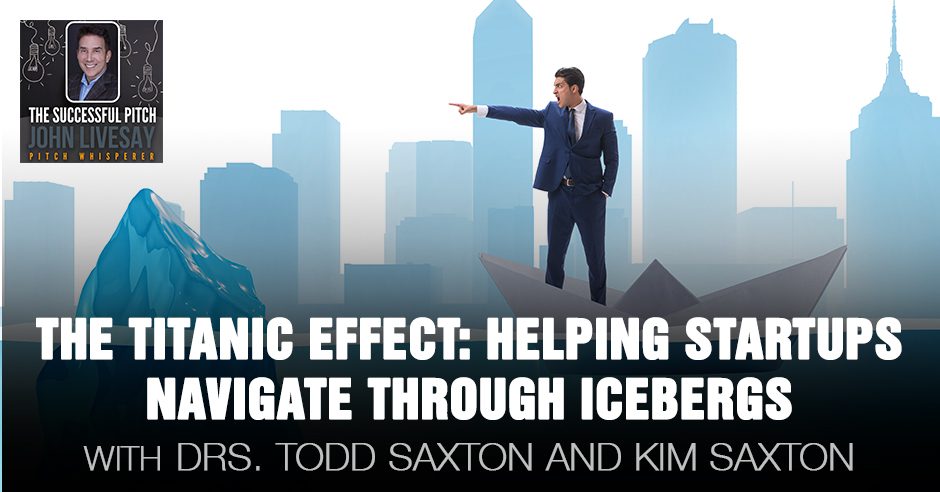
Hitting icebergs is just part of the business, especially when you are in the startup stage. Nevertheless, it does not mean that you can’t steer away from them because the fact remains that these mistakes can be costly. We double up the insight in this episode as host John Livesay interviews business professors Drs. Todd Saxton and Kim Saxton. Giving us a preview of their book, The Titanic Effect, they help startup founders navigate the icebergs that so often sink startups in the ideation and early stage of development. As they touch on the four oceans that startups have to get across and how they can do that, they also offer great advice on practicing your pitch.
—
Listen to the podcast here
The Titanic Effect: Helping Startups Navigate Through Icebergs with Drs. Todd Saxton and Kim Saxton
Our guests are Drs. Todd and Kim Saxton. They’re award-winning professors at Indiana University’s Kelley School of Business as well as co-authors of The Titanic Effect. The book is a practical guide to help startup founders, as well as their investors and supporters, successfully navigate the icebergs that often pop up that sink startups in these early stages. They’re going to share their decades of academic and professional experience, business strategy, marketing, venture-funded startups to help you navigate these deck burgs that often sink early startups. Drs. Todd and Kim, welcome to the show.
I’m fine. Kim is fine. Thank you so much for having us. It’s a pleasure.
I’m excited to be here and chatting with you.
Let me ask you to each tell me your own little story of origin before you became professors, married and all of that stuff. I love to hear one of you start and say, “When I was growing up,” you can go back as far as you want, “my dream was,” and give us a sense of how you became a professor. We’ll get into the story of how you started working together and got married.
Here I thought you were going to do the origin story of how we got together, which was already dialing back many years.
I’m always fascinated, especially people who dedicate their lives to teaching the university level. Did you know in college this is what you wanted to do or did you as a young girl know, “Someday I’m going to be a professor?”
If I say what my real childhood dreams were, honestly, my first dream was to be the president of the United States. I went to MIT because at some point in high school I discovered I was good at math and computers. I worked in a debit processing center at the local junior college and got to play with some of the first personal computers that were coming out. By the time I got to MIT I had realized, that whole be the first American female president was going to be a tough way to go and would be fraught with a lot of icebergs even though I didn’t know that term. I thought, “I’m going to go make money instead. That’ll be a lot more fun.” We both got into consulting directly out of college, helping companies identify what they’re going forward, strategies ought to be as what I did. Todd did something some related. Todd started to want to go back and get a PhD and follow in his dad’s footsteps of being a professor. I pulled out my SAT scores and I discovered that what I told the SAT when I took that exam to get into college was that I wanted to be a professor as well.
[bctt tweet=” Practice your pitch on your least likely prospect first. ” username=”John_Livesay”]
I can’t wait to hear. Your dad was modeling for you, Todd, what a professor’s life was like?
The academic connections, it’s funny because Kim and I have both been out six years from college and working in business consulting on the East Coast. Circle back a little bit, I’m a Jersey boy. I grew up selling newspapers on the Jersey shore. My mom bought the lawnmower in exchange for me mowing our own lawn for free, which meant I could use the lawnmower to mow our neighbors’ lawns. That’s my connection back to your network.
I can relate to you both well of Kim talking about early computers. I was at the University of Illinois in Urbana-Champaign and we had Plato where you can touch the screen back then. That was totally cutting edge. I don’t know if you’ve ever remembered or heard of those. I also had a paper route, Todd. I would do the entrepreneur thing, knock on the doors, “Do you want to subscribe?” You sell it, you deliver it and you’ve got to go collect it at the end of the month.
If you’re good, you make your money in tips.
Don’t throw it in the bushes.
There are things you throw in the bushes in New Jersey, but it’s not your customer’s newspapers.
Ironically I skipped over that. My early pitching was as a Girl Scout, I went door-to-door. Those times you had to haul the boxes with you. After a little while, you only had one type of cookie left.
You had pushed those. The mints are gone. Now we’re pushing peanut butter or something. I can relate.
You learn how to message pretty quickly so that you don’t have to haul those cookies back to the house.
The Titanic Effect
Let’s hear those story of the origin of how you too wonderful people connected. You can make it as romantic as you want or as academic as you want. The choice is yours.
I’ll share the non-romantic part. Our first jobs out of school were at the same consulting firm in the DC area. Kim was the sixth and I was the seventh person hired. This was a relatively small entrepreneurial consulting firm. For the first few months, we struggled to work together. We did not get along. Kim may ask me to cut this out, for now, just between us, when we started dating and it got serious enough. We were like, “One of us probably has to leave.” Kim went to talk to the founder to say, “I’m moving onto something else. Part of the reason is I’m dating someone here.” He went through every member of the company, including some that were married, the other women, the janitor, the company dog and the only entity left was me. It was like, “It can’t be Todd.”
We got to keep that in. That’s at least likely to be dating. Kim, what’s your version of that story?
It’s pretty much like that. In fact, at that time, I was conservative and he was clearly liberal. There were so many different ways that we should not get along at all. As we tried to work together, that same founder one time said to me, “Would you stop yanking his chain already?” I didn’t realize I was. What ended up happening is that over a weekend thing, we realized that there was some attraction. We thought, “You can’t ignore chemistry so what we ought to do is probably date and get this over with so we can move on to the real love of our lives.”
It’s fascinating because I talk about going from invisible to irresistible in a business sense but also in a dating sense. If you have so much pressure that this has to be the investor that funds my startup or this has to be the customer that hires me or this has to be the love of my life. It’s too much pressure. If you think instead of, “Let’s get through this and we know we’re not going to be a fit, there’s no pressure.” The irony of that, if people could take that away from this show, I’d be thrilled that if you start to hold things a little lighter in your hands, how much that shifts things.
That’s interesting as a way to think about it. I never connected these two before. I counsel entrepreneurs when they go to their first pitch, whether it’s for money or a customer, go to the one you think is going to be most challenging and least likely first because you’re going to screw something up. You’re going to mess up the value proposition or the connection or frame of reference, whatever that might be. You’re going to hit icebergs. Get an iceberg that isn’t your biggest opportunity, whether it came from funding or a customer perspective because you’re going to get beaten up. You’re going to learn something from that and get better. As you get better, you got closer to home and the bigger and better opportunities because you fit some of those icebergs but survived.
He gave me that advice. He’s had to do some cold calling and I said, “Here are my best prospects.” He said, “Don’t call them. You’re not great prospects. Get them out, burn through five or ten of them. By then you’ll be ready for the good ones.”
Practice your pitch on your least likely prospects first, that’s unique advice because you’re not attached to the outcome.
[bctt tweet=”Be accountable as you scale.” username=”John_Livesay”]
Maybe it’s a phone instead of practice. There is a chance to compare it. We’re still married for many years.
Honing and practicing for me. We are rewriting everything already. I know in your book The Titanic Effect, originally, this metaphor was a sideline. It became something that anchored the whole concept. Let’s hear the story of origin for how did you come up with the idea for the book?
It started with the term technical debt, which you’re familiar with and some of your audience, for those that are not when particularly software. Any physical product that you’re trying to build it, you can’t invest enough time, resources, energy to build it all the way into the robust version that you might envision eventually. You have to cut some corners. You’ve got to build your software on some code that might be a little bit flimsy to go out there and get that minimally viable product or that early testable model to get feedback. The challenges, as you start to scale, as you move from that one pilot customer to five customers to hopefully ten, twenty plus, if you’re building on this weak foundation, it’s going to collapse upon itself. That’s from a technical standpoint, from a product standpoint, and that’s the term of technical debt. There are equivalents in our metaphor, these other oceans.
You have the people that you work with, who you surround yourself with, how you allocate equity. You get advice from who helps guide you, who you hire as your early employees. In the human ocean, all of those are important decisions, but also have associated debt with them. As we thought about it was all of these decisions look obvious and easy when you are resource-strapped, and that’s the part above the water. There’s all of this mass below the water that you can’t see or anticipate because you’re making decisions under conditions of uncertainty. That connoted the image of the iceberg, and at least many of us, when we think about iceberg and failure, we associate that with the Titanic. I’m like the superficial naming guy was like, “We’ll call our presentation The Titanic Effect, then something after to make it a little more specific.” They were like, my co-authors, Michael and Kim, “It’s a good idea. It’s catchy. We should probably make sure there is some substance.” I was like, “Substance, that’s your bailiwick. I’m out of here.”
You have images of all the different icebergs and things. I’m a big Titanic fanatic. I’ve been to the museum, the menus, touched the cold ice and watched all the documentaries. You’ve got me in a minute. The research that you showed people that it’s not what icebergs are not all the same, Kim?
We started with that idea originally of marketing debt and human debt. We started thinking, “Let’s name the debts and all that.” We got onto the iceberg. We started doing iceberg research. It turns out that icebergs are super cool. They have such a variety of size from little bergy bits. Imagine a berg all broken up to iceberg islands. It’s huge masses. They have different shapes. Some are downed, tabular and all this stuff. We started getting into it. It was easy to envision these debts as different icebergs. Even since I focus in the marketing area, I have a visual image of each one of the ones as something a little different. In the book, they all look the same. There was too much granularity to try and talk about size, shape and all that. It was pretty exciting. I’m the researchy person to do that background work. I said, “If my very creative co-author and partner here is going to come up with a fancy title, I need to figure out if it has any legs. I started researching it and it turns out that there’s a lot that’s been written about the Titanic.
There are many resources too. We’ve read books, documentaries, online research. The museum has a lot of information too. We started finding thing after thing that matched up. Todd usually tells the story of a change of investors bringing on a new investor caused them to change the shipyard that they use. You can imagine what the ramifications of that are going to be. They have three different segments, this luxurious class and the steerage as we know about. The groups of people are trying to do different things. What was cool is that the first-class luxury passengers were Americans and the third-class steerage was from Eastern Europe. Can you imagine trying to have a successful marketing program that bought those two different groups of people into the same boat?

The Titanic Effect: If you don’t have alternative opinions, you’re not going to be able to aim your product into the market and understand the variety of needs that are out there.
Never were they supposed to interact. The romance went out as it did with your relationship. Did you dance to Celine Dion’s song at your wedding?
Can you imagine doing that in 1912 like share difficulty of that is mind-boggling?
I hadn’t thought about it like that. The buzz of getting the wealthy people, you’re like, “I’m sure everybody wanted the glamor of all that.” The masses, what would make them want to get on that versus all the other ways to get across? One of the things I want to talk about what you have in The Titanic Effect is the four oceans, the human ocean, the marketing ocean, the technical ocean and the strategy ocean. I know you have a whole chapter devoted to each one of those things. It’s such a great incentive for people to start thinking of this metaphor in a way that, “I want to buy this book now because we started dabbling in the marketing ocean there a little bit.” You can each talk about each one or you can split it up however you want to do it. Let’s dive in on what’s the human ocean? What’s the biggest mistake people make when they’re putting their team together?
The human ocean has these different seas within it. I know geographically that doesn’t quite work, but in the metaphor, please forgive us and allow us there that you have your co-founders. The biggest mistake that I see early-stage and first-time entrepreneurs make, and frankly even seasoned entrepreneurs, are allocating all the equity early and equally across co-founders. Your three people go out for coffee or a beer and they sketch out this idea on the napkin. They get all excited. They’re going to start this company. We’ll split everything three ways equally. A few months later, how many times that everyone is completely pulling their waiter or even able to fully contribute? The co-founders, how you allocate equity, whether you have the appropriate mix of people. Those are some of the debt bergs on the human side within co-founders.
The next sea that we talk about are the investors and advisors. Those are the people that you enlist their help, ideally some money as well. You need that feedback, encouragement, support, connections and how you go about doing that. Who you choose, how many you choose and how you interact with them are some also important sources of either resource or in some cases step bergs as well that can limit your success moving forward. Finally, within the human ocean are the employees and who are those early employees that you hire? Do you go after the cheap but enthusiastic interns who may be graduated or aren’t even through college and bright, but don’t know a lot and maybe can’t help the venture as much and spend a lot of time training, etc.? The other end of the spectrum, the giant whale hunter who has had the huge success and demands $250,000 salary and a lot of equity. It turns out they’re a one-hit-wonder and don’t know what they’re talking about. That can also be a huge source of a debt berg. Who those early employees are, how you leverage outside resources, that’s one of the other major elements we talk about in the human ocean.
In the employee sea, Todd, I wanted to add, the iceberg that’s named our debt berg has named the dearth of diversity is one that deserves more attention. We have been working with some incubators and looking at some of their companies. I was struck that out of all of the companies and all of the founding teams, there were four people who did not look like everybody else. Academic research is interesting when you have people who are much like you, more homogeneous, you get along better. Startups are a hard path to go. Getting along better is probably good. On the other hand, if you don’t have those alternative opinions, you’re not as well going to be able to aim your product into the market and understand the variety of needs that are out there.
Let me ask you about advisors within the human ocean. How important are they, is the first question, which they’re very important. What’re the criteria of what makes a good advisor? How often should you expect them to talk with you? What equity do you have to give them over time? I have so many questions about advisors alone. It’s one little grand of sand in the ocean there of human odds. It’s something that you are expertly qualified to answer. I haven’t heard many people talking about that granular level if you don’t mind.
[bctt tweet=”Get an iceberg that isn’t your biggest opportunity because you’re going to get beaten up. ” username=”John_Livesay”]
I can’t pretend to have all the answers on that as you suggest. It’s a complex and nuanced question. At some point, it boils down to rapport. The fact that you like working together. It’s going to be a slog when you’re involved in any new activity, innovative activity, new project, and especially a new venture. It’s a long journey and they’re going to be hard moments. You want to be with people that you genuinely like, respect, appreciate and have fun with. That’s an important underlying element. The more objective criteria, I wouldn’t dare call it a rule. I’ll have somebody who documents and shows me, it only took X, but it’s a 50 and five rule that it will probably take you meeting with 50 people having a cup of coffee, a beer, whatever, lunch to share your idea. To get five that you feel are truly in that inner circle that is our trusted advisors that you have a good rapport with that get back to you.
One of the mistakes I see some entrepreneurs make is they try and maintain connections with 50 people and you simply can’t do that. The goal isn’t to make your network as big as possible. You want to be more engaged and activated, but also it takes a lot of networking and searches to find those five, settle with the first five you get. Within those five, you want some people who are not exactly always devil’s advocates in your face, but at least aren’t yes people that do challenge you. That you’re willing to have that and that gets back to that alternative perspective that Kim talked about and having a diversity of perspective is important.
Following that, it is having some diversity in terms of their backgrounds that you have one or two advisors that are more industry experts. You have one or two that perhaps have started a company, have grown one or two that are more on the investor perspective, that’s financial savvy and hopefully, connections that when it comes time to raise money. I think of it as this critical mix of elements that are all part of the stew that or ocean that helped you be a successful startup, but also help you identify different types of debt bergs in different oceans. You want advocates and advisers who can help you navigate that journey.
I wanted to have Kim speak to this one particular thing you said, which is that you’re not hiring a bunch of advisors who agree with everything you say and being comfortable enough to be coachable, to hear other people’s perspectives or maybe even criticism like you’re going down the wrong path or whatever it might be?
Nobody likes to have Negative Nancy around all the time. You have to be tough with yourself and say, “Who is going to be the person who’s going to see all the bumps in the road?” Who’s going to be able to point out those hazards to me and it’s going to tell me 1,000 ways that this isn’t going to work. For some of us and me, if you tell me all the challenges that I’m going to try to cross them, surround them. It’s good from that perspective, but also you want somebody who maybe can see things that you can’t see. There’s this hard thing about being the founder of a startup or the founding team is that you have to be enthusiastic. You have to be persistent. Sometimes you need to go a different path and to be doggedly persistent and not to be able to hear or listen is tough.
The ultimate pivot that everyone ultimately ends up doing. That’s why people invest in the team more than the idea and that awareness is something that a lot of people don’t register with or they feel embarrassed sometimes that they have to. I’ve seen it time and again where you have to be willing to let that go a little bit. We obviously don’t have time to go into all the oceans. I did want to have maybe you talk one little bit about the strategy ocean because some people think, “Why does strategy have its own ocean or its own chapter?”
But before we go on, I’d like to close on one more thought on that advisor side because we frequently get asked to be advisors. In fact, some years we’ve done hundreds of lunches and coffees and things like that. As advisors, we have a talk and a coachability metric that we use. We’ll take the first coffee with anyone and we’ll have lunch sometimes. You go away and if you ask a second time, we’re very likely to take the second one as well if we’ve already given the first one. If you come back in the second one and you have tested nothing that we said in the first one and/or you are doggedly holding to ideas that we suggested negative things about the first time, we recognize you as not being coachable.

The Titanic Effect: One of the mistakes entrepreneurs make is they try and maintain connections with 50 people.
That’s great criteria or excuses of why you haven’t done something yet.
Moving into the strategy ocean, we recognize that we don’t have all the oceans in the book. We pick solutions that were in our sweet spot, our comfort zones. There are regulatory issues and legal issues and all that. The challenge that we see with some startups and probably most startups at different points in time are that because you have these different arenas that you’re moving forward. You’re moving forward the human stuff. You’re moving forward the funding. You’re moving forward what your customer relationship is going to look like. You’re moving forward the product. The whole thing gets unwieldy.
You get something that’s very in-depth on the product side. There’s no understanding or recognition of how this could be marketed or what’s valuable to customers or you get something at the sales and marketing side starts promising something that employees can’t do. That’s why we call it out the strategy ocean because that’s the place to bring the other three oceans together. To remind people that you have to be coordinated, you have to move one piece forward a little bit. The next piece forward a little bit.
That lack of coordination, one department sales promising something that engineering can’t deliver or is a nightmare even at a small scale.
Measurement, what happens, we’ve seen a lot of startups is they get so busy doing and they’re shorthanded, that they don’t even have metrics in place. They know the metrics that they’re going to need to see if they’re going to go do an angel pitch or a VC pitch. They’re not effectively running the business with metrics. We advocate different metrics at different points in time, but identifying what those metrics are and having somebody look at them. The third sea in the strategy ocean is about accountability, which is, we all think we’re heading in a certain direction, but until you put a name to it, it doesn’t happen.
Always be the founder or even the founding team as you grow up a little bit, as you start to scale, that accountability has to start to transfer to others within the organization.
What you’re saying is sometimes accountability is delegating stuff too. It’s not doing it all yourself. It’s been a fascinating look at the Titanic as a metaphor and the oceans that we all swim in, whether we’re starting a business or working in a business and all the challenges that we face. The book is called The Titanic Effect. Is there any last thought or piece of advice you each want to leave us with?
I’ll cut in on one and it comes back to very much the theme of a lot of what you talk about and making sure in your picture, in your story, you know what you’re trying to get out of it and that it is both stage-appropriate and context-appropriate in a very personal sense. We’ve talked about our own interactions with each other. When we’re looking for feedback, I’m going to characterize two different types and try and make this brief. We do a lot of writing. If I have a deadline that I’ve got to get it out by midnight and into a journal for review or whatever, I have to signal to Kim, “I’ve got a tight deadline. I need these superficial and it’s okay if you say, “That’s great, Hon.”
[bctt tweet=”If you’re good, you make your money in tips. ” username=”John_Livesay”]
At the early stages of this project, however, when we were trying to flesh out this metaphor and extend it, we needed to be ruthless with between all three of us. What may have created some challenging discussions, but that early stage, that’s the time to be open to much more discursive conversations about what’s going to work, what isn’t, what is clear and what is not? Understanding where you are in the journey and what you were looking for in your pitch, whatever that might look like is an important part of the process. As you very well know when articulate in many ways, a pitch is not this model with the constructed. A pitch varies a lot by what you’re trying to accomplish, who your audience is, etc. That’s certainly very true as you’re navigating from an early stage of launch and ideation through the later stages of growing a venture.
Keep on sailing, that’s the goal.
If people want to follow you on social media and track the book, what’s the best way for them to do that?
They can check out the website at www.TitanicEffect.com. We have a weekly blog and we email out little tips once a week so we don’t clog your inbox, but it’s fun when people email or text us and say, “I love that.”
Thank you both for sharing your expertise, navigating the waters that we all face.
Thank you so much. It’s been a lot of fun and good luck with your endeavors. To the audience, good luck with your pitch, whatever that might look like.
Thank you.
Important Links
- The Titanic Effect
- https://www.TitanicEffect.com/successfulpitch
- Better Selling Through Storytelling Method Online Course
Wanna Host Your Own Podcast?
Click here to see how my friends at Podetize can help
Purchase John’s new book
John Livesay, The Pitch Whisperer
Share The Show
Did you enjoy the show? I’d love it if you subscribed today and left us a 5-star review!
- Click this link
- Click on the ‘Subscribe’ button below the artwork
- Go to the ‘Ratings and Reviews’ section
- Click on ‘Write a Review’
Love the show? Subscribe, rate, review, and share!
Join The Successful Pitch community today:
- JohnLivesay.com
- John Livesay Facebook
- John Livesay Twitter
- John Livesay LinkedIn
- John Livesay YouTube