

Talk Triggers: Word Of Mouth Marketing with Daniel Lemin
Posted by John Livesay in podcast | 0 comments

 Episode Summary:
—
Listen To The Episode Here
Talk Triggers: Word Of Mouth Marketing with Daniel Lemin
I am thrilled and honored to have Daniel Lemin. He is a startup co-founder, trusted advisor and the bestselling author on reputation management, digital marketing and social media customer service. He was an early member of Google’s global communications team. Daniel led the launch of products in North America and around the world. He is the CMO and Co-Founder of Selectivor, a food intelligence startup that helps people stay healthy through personalized eating. His book with co-author Jay Baer, Talk Triggers, is going to be a New York Times bestseller. It explores word of mouth marketing and lays out a framework so you can build that in your own organization. You want to have something that’s memorable and Talk Triggers gives you those ways to do it. He’s an expert commentary on television. He has got that anchorman smile. He’s smart and handsome. Daniel, welcome to the show.
Thanks for having me.
Take us back to when you were growing up in Ohio. You can go back to your childhood, high school, college, wherever you want, when you said, “I’m going to get into high tech.” Obviously, Google when you were younger that didn’t even exist. I’d love to hear what your background was of how you got into what you’re doing.
To some degree, I don’t know is the answer. That’s true for many people. You look back and think, “I’m not sure how I got into doing the things I’ve done, but I’m grateful I did.” Part of it though, I’ve always been a curious kid and also a kid that had a curious mind. I always wondered how things worked, why things worked and I tried tinkering with things to make them work better. I was always drawn to technology for that reason. I enjoy the challenges of it and also the gold rush. There’s always something new and bigger. There’s always a moon shot happening somewhere in the tech world, including several happening right now. There’s always been that curiosity for me. I always assumed that I would work in marketing as a kid. That was the only thing I was ever good at. I tried doing other endeavors, but none of them anywhere near with success.
[bctt tweet=”If you are assuming that your best chance to captivate a customer is to be the best in your category, then you’re going to struggle for a long time.” username=”John_Livesay”]
Tell us what it was like to be one of the early members of Google. What was that atmosphere like? What can you say looking back, how the culture has evolved?
I was employee number 400 at the company. I worked on this scrappy little marketing communications team. There were about eight of us in total at the time. The fun part about that was seeing the company explode around us in all different areas, from employee size to new markets, launching internationally new products, and new product space. They’ve launched so many innovations when I was there in the first couple of years.
[bctt tweet=”Nobody ever talks about average so you need to be remarkable.” username=”John_Livesay”]
It solidified for me, in my mind, the value of never resting on your laurels. You never assume that everything is done. The work is never done. You always continue to change things. You continue to think about ways you can do something better. That’s in part how I’ve approached my career after Google in marketing. It’s always looking for better ways to do things. It was a good training ground for me from that perspective. It was also an amazing place to work.
That has led you to your own startup, Selectivor. You’re applying AI intelligence to helping us all get healthier.
The broad mission is to help people stay healthy and well through whatever diets they may be following, both health and personal guidance. We’re building a whole host of AI tools to do that. We’ll help you find recipes that work for you. We’ll help you find restaurants and things that work for you. That’s the mission and the broad story behind that are personal struggles that both I and my co-founder had trying to stay on our diets. In the context of eating with other people, sometimes that conversation’s uncomfortable. You don’t want to tell them about your dietary needs. This has been the biggest buzzkill in the world, “I’d love to go on a date with you. I can’t eat this and I can’t eat that. I don’t eat this and I won’t eat that. Aren’t you looking forward to meeting me?” It’s extracting some of that social friction out of the equation in the process of doing that.
I’ve read some research that if you tend to have overweight friends, you are more likely to be overweight and vice versa. If you tend to have fit, healthy friends, you’re more likely to be fit. Since you’re an expert in data and software, does that ring true? Are you incorporating that into your company?
It completely rings true. There’s a famous landmark study from the ‘60s, the Framingham Heart Study. They wrote about it in that book, Connected. It’s a landmark study looking at how communities impact the health of its members. Obese communities tended to remain obese and lose weight together when they started. It is truly that connected. In fact, one of the things we’re building into our product is the ability to challenge yourself and others to do something, stay on a diet, drink more water, and eat more watermelon, whatever it might be. That notion of challenging each other is a much more playful way to do things together. It impacts how we think about the product.
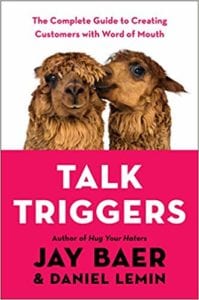
Talk Triggers: The Complete Guide to Creating Customers with Word of Mouth
Let’s dive into Talk Triggers: The Complete Guide to Creating Customers With Word Of Mouth. If there’s anything I’ve learned from my advertising background is word of mouth is much more powerful than any paid ad and commercial. Getting these brand ambassadors to talk about you and spread the word, the trust factor is huge. How did you and Jay Baer decide to work together?
I’ve known and worked with Jay for a decade, even more than that. I hired Jay at an agency I worked at in Downtown Los Angeles. I hired Jay there to help us on the agency side with innovation and bring some outside thinking. I liked working with him so much that I decided to leave that agency and work with him. I’ve worked with him on the consulting side since 2010.
This is a big collaboration with a lot of insights together. The cover of the book looks like two llamas nestling each other. What animals are those?
They’re alpacas nestling. They’re from Peru.
What is the significance of that picture?
It’s a simple story. The first version of the cover from our publisher was less than remarkable. It wasn’t terribly exciting. Widely panned might be a phrase I would use to describe that. We were looking for something that people would remember and talk about. Have you seen another business book with alpacas whispering to each other on the cover? It’s unique. It’s also hot pink. It’s connected to one of the case studies inside. That’s the story behind the cover. We’ve taken it to a ludicrous extreme. We’re all over now alpaca GIFs and memes. We’ve even been to an alpaca farm together, Baer and me.
The premise is you want to say something that triggers a conversation, which is what a good pitch does. The second part for me, from what I can tell that you’re offering people, does not only do it trigger a conversation but it triggers a memorable conversation. Can you give us an example?
The hero insight that led us to write this book was that the economic impact of word of mouth. The things we say amongst ourselves as buyers, investors and consumers of things, the economic impact of that is much more massive than we might assume. 20% of every purchase decision that’s made is directly driven by word of mouth discussion or recommendation. The challenge is few companies have an actual strategy to make word of mouth happen. They assume that it happens. You probably know from a gut feel as well as we did, that doesn’t happen. It’s a gamble you take that someone’s going to talk about your brand. We started looking at examples of companies that do something a little bit different in the delivery of their surface.
[bctt tweet=”Listen to customers to find the gap where a talk trigger can happen.” username=”John_Livesay”]
For example, the UberConference. What’s great about UberConference is if you’ve ever been on a conference call from UberConference, you may be familiar with their country, Twain-y hold music. It’s a hilarious song. It’s all about being on hold. You can go check it out, Google UberConference hold song. You’ll quickly find it. The impact of that when you’re on hold and then end up on the call nearly every single time someone says, “Did everybody else here that hold music? That was amazing.” In fact, if you go on Twitter, even on Google and search for UberConference hold music, people go crazy for that song. What they have done is nothing magical. They built in a slightly different way of filling a customer experience gap, in this case with hold music. That was the spark. That is an actual idea. That’s a Talk Trigger. It generates some material for a consumer to work with. It gives them a story to tell. That’s the hero insight behind it.
It’s an interesting thing that something could be so engaging that people would go listen to hold music while they’re not on hold.
UberConference hired Postmodern Jukebox to do a remix of it in multiple different genres.
You give keynote talks on this topic as well. Who is your ideal audience that needs to know how to have Talk Triggers?
The interesting thing is it spans all industries, even as individuals. We can all benefit from having a personal Talk Trigger. Jay Baer, if you’ve seen him speak, he wears crazy plaid suits. He’s always dressed impeccably. As individuals, we can benefit from it. I do a lot of work with associations, small business owners and corporate workshops to companies looking to try to figure out the best type of Talk Trigger basically to deploy. It’s a wide range but a lot of work with small business owners who frankly can probably benefit from it the most.
To me, it seems with the problem you’re solving here is many of the people that I work with, whether I’m giving a keynote talk on how to be a better storyteller and therefore increase sales is this concept of objection around price. You’re a commodity. We don’t see the value in paying your premium price. I don’t care if it’s food you’re selling or a design of an architecture firm. People have a lot of trouble justifying a premium price. How does your keynote and Talk Trigger help people with that particular challenge?

Word Of Mouth: The economic impact is more massive than how we assumed it to be in terms of the things we say amongst ourselves and buyers, investors, and consumers of our products.
Part of that is if you are assuming that your best chance to captivate a customer is to be the best in your category, you’re going to struggle for a long time. Even the best restaurants in the world, from a technical perspective, still struggle to get butts in seats. What is the reason for that? Is it the price? Maybe, but is lowering the price going to get them across that chasm? It might even hurt you in the end. Robert Cialdini always talks about this, the Pre-Suasion. If by the time someone calls you, comes into your restaurant or opens the door to your store, they’ve already decided they like you. They’ve already decided that they’re willing and able to do business with you. That is a massive benefit to the business.
The way to break in and get someone to see you, to get invited to the pitch, is to have some memorable Talk Trigger. You say there’s a 4-5-6 learning system in the book. Can you walk us through what that is and use the MailChimp example?
We put this learning system together. Many authors have written about word of mouth over the years. Certainly, it’s not a topic that’s new. We wanted to bring a little bit more structure to it to give business owners, companies and even individuals an actual framework for how you can make these Talk Triggers. Generally speaking, sometimes it just happened by accident in companies. We thought there’s got to be a better way for this, it’s so important. The 4-5-6 system wraps itself around a few elements. The 4 is the four mandates for a Talk Trigger, four things that must be true for something to be Talk Trigger worthy. There are five general types of Talk Triggers, which are not necessarily mutually exclusive. The 6 is the six-step system that you can use to build them, create them and deploy them.
[bctt tweet=”There’s always a moon shot happening somewhere in the tech world.” username=”John_Livesay”]
I’ll briefly go over the four. They’re a good place to start exploring Talk Triggers. The four mandates or musts for a Talk Trigger, number one, it must be remarkable by definition. It must be something worthy of talking about. No one talks about average. You don’t say, “Let me tell you about this perfectly adequate salad I had for lunch yesterday.” It’s not remarkable. It has to be a remarkable element in the customer experience or the sales experience. The second is it has to be relevant to the customer experience. Relevance is vital to the delivery and reception of the Talk Trigger by the consumer. If it’s out of left field, it feels almost like a gimmick or a stunt, and that’s not the best way to get people talking about us.
The third is it needs to be reasonable. By reasonable, we mean not over the top. If you go to any DoubleTree Hotel anywhere in the world and check-in, they give you a warm chocolate chip cookie that they baked in the hotel. 75,000 times every single day people get this cookie. It’s a reasonable gesture. People talk about that cookie. It’s a remarkable Talk Trigger for the simple thing that it is. It’s a cookie. It’s not a baby alpaca in your room that you can use while you’re at the hotel. It’s a cookie, but it’s relevant to the product experience. The fourth of the mandates is that it has to be repeatable. This is where we often get trapped. Sometimes we think about Talk Triggers being available to our VIP customers, our top customers and top 10%. If it’s something that isn’t available to every single customer every single time they interact with your product, it can cause dissonance. It can cause frustration and disappointment, which is the negative of word of mouth.
Imagine if I went to a DoubleTree and they’d run out of homemade warm chocolate chip cookies and I’ve been looking forward to that. I might be even angry as opposed to if I had no expectation of it, then that’s fine. If I’ve heard word of mouth and they’re out, it’s not good.
Just say, “I’m sorry, your room rate doesn’t include the cookie because it’s too cheap and you’re a bad person.” It creates this letdown, “Terms and conditions. While supplies last,” and all of that stuff is the enemy of word of mouth.
Don’t you see some of the airlines starting to do that? “That seat doesn’t let you have a free snack,” or whatever they’re doing now. Not only is it crowded but you do have to pay to put a bag in the overhead.
It’s almost like they’re paying someone to tell them how to make this experience worse. That’s what they’re hiring in consultants to do at this point, “Can you help us make this the worst experience for at least a small part of our customers?” We’ll talk briefly about MailChimp. I like this example because I’m a software guy myself. It’s often a little bit harder for us to imagine what you can do in a software environment that’s a Talk Trigger. If you’ve used MailChimp, you know their little chimp. It’s everywhere in the product. He is their mascot, he is their voice. He has a name. His name is Freddie, which a lot of people don’t know.
Freddie has a place in the product. When you submit an email to be sent through MailChimp, you get this big high five from Freddie. He says, “Good job.” He’s everywhere in the experience of the product. People talk about Freddie all the time. The reason it’s interesting is email software is the pits. It’s basically the airline of software. They’ve found a way with Freddie to make the experience better for you and because of that people talk about Freddie. I’m sure it has downstream benefits for them from a loyalty perspective and a lifetime value perspective, but most certainly from that Pre-Suasion perspective. If you’re looking for email software, HubSpot, Emma or MailChimp, some people may have an affinity right away for MailChimp.
[bctt tweet=”Never assume that everything is done. The work is never done.” username=”John_Livesay”]
We have an emotional connection almost like Colonel Sanders. There’s a person with the brand. Let’s go through those four Rs and how MailChimp is doing something remarkable. The fact that there’s a playful tone to the culture with this Freddie, you could say that makes them more remarkable than other email companies that don’t do it. Would that be fair?
That’s fair. SurveyMonkey also has a monkey as its mascot. It’s not used to the extent MailChimp uses Freddie. Freddie is in the product, as part of the product experience. From that perspective, it’s remarkable that they’ve done that.
It’s not a one-off, it’s integrated. It’s relevant because the concept of having a bunch of monkeys working for you in the background, it’s fun and it creates a visual image for me anyway.
Often, small business software is painful to use. Not only is it a relevant brand vision, but it’s also slightly better to use, which feels relevant to you at the moment.
It’s easy a monkey could do it maybe. It’s reasonable, it’s not over the top. It’s not this huge gorilla or something intimidating. Finally, it’s repeatable. That monkey’s there come rain or shine.
He gives you a little pellet award every single time you send an email.
That is remarkable to me because we know how our brains are wired. That’s why people keep playing Words With Friends or keep the addiction to the phone or gambling. It’s the, “I’ve got a little ding. I’ve got a little award.” To incorporate that into the software, to me, triggers the same addictive behavior in a good way.
On the Selectivor side, we are building a cute little dinosaur named Oliver. He’s going to have a lot of that same presence like Freddie does because it’s a little bit more fun to use.

Word Of Mouth: If it’s something that is not available to every single customer every single time they interact with your product, then it can cause dissonance, frustration, disappointment, and negative word of mouth.
Are there any tips besides buying the book that if someone’s saying, “I know I need a Talk Trigger and I understand the four steps of these Rs. What could I do? What’s my next step besides reading this book and seeing how other people are doing it?”
I may be biased but reading the book is helpful. Start looking for them in your everyday life. Think about your own experience in places and look for Talk Triggers because you start to see them in different ways and in different places. It’s fun to spot them that way. It’s educational for yourself because for the most part, almost all of them is in the category of, “Why didn’t I think of that first? That’s crazy. It’s so simple, it’s stupid.”
One of the things that you have in the book Talk Triggers is the six-step process for creating them. We’re not going to go into all six, but give us a little teaser. What’s the first step?
The first one is one almost no company does enough of, which is listening to your customers. We go into a meeting room, a conference room, we sit down and we say, “We need to build a viral campaign to launch our new water flavor.” What few people take time to do is to talk to customers, to get their opinion, to see how they use the product, and to talk to your customer service people about what are they hearing from customers. The first step in that six-step process is a listening tour. You go deep on the listening exercise. What you start to see are these little tiny gaps that you aren’t seeing in formal surveys, you’re not seeing in email feedback, but they are actual gaps where a Talk Trigger can fill.
[bctt tweet=”Word of mouth is much more powerful than any paid ad, commercial, and brand ambassadors. ” username=”John_Livesay”]
I tell people all the time, “If you listen to what your customers are saying and put it in your marketing messages, then your potential customers feel like you’re inside their head.” The example of that is I was working with an architecture firm. They were trying to decide whether they wanted to hire me to come and give a talk and a workshop to them. They said, “The problem is we’re tired of coming in second. We’re not winning enough pitches.” I said, “I can help you with that.” Now, part of my whole pitch is, “Are you tired of coming in second?” and then people go, “We are.” That’s a great example.
It totally changed the entire conversation. If you’ve given people a reason to trust you, like you and want to do business with you, I know they understand where I’m coming from and that makes me feel good.
How can people follow you on social media?
It’s Daniel Lemin there on social media and TalkTriggers.com is where all of the other stuff is. We have a special little bonus for our audience. If you go to TalkTriggers.com/SuccessfulPitch, we’ve got a little download there. You can get the six-step process for free.
Thank you so much for being on. It’s exciting to watch you and Jay launch this book. It’s got a great alliteration, a great cover and great colors. How can it not be a hit? It’s going to be fantastic and entertaining at the same time.
I appreciate it. Thanks for having me on.
Links Mentioned:
- Daniel Lemin
- Selectivor
- Connected
- Talk Triggers: The Complete Guide to Creating Customers With Word Of Mouth
- Jay Baer
- UberConference
- Postmodern Jukebox
- Daniel Lemin – Facebook
- TalkTriggers.com
- TalkTriggers.com/SuccessfulPitch
- Quantmre.com
Wanna Host Your Own Podcast?
Click here to see how my friends at Brandcasting You can help
Get your FREE copy of John’s latest eBook Getting To Yes now!
John Livesay, The Pitch Whisperer
Share The Show
Did you enjoy the show? I’d love it if you subscribed today and left us a 5-star review!
-
- Click this link
- Click on the ‘Subscribe’ button below the artwork
- Go to the ‘Ratings and Reviews’ section
- Click on ‘Write a Review’
Rob Nance on Local Investing, Venture Funds, Cryptocurrency, And NYCQ
Posted by John Livesay in podcast | 0 comments

 Episode Summary:
Managing partner of CityBlock Capital Rob Nance gets down into the business of local investing as he shares his new venture called NYCQ, a tokenized venture fund for investment into New York City startups. Starting with his origin story, he relays the milestones that led him to his successful career, from his interest of banking to taking on the opportunities to expand with venture fund. He covers topics about blockchain and cryptocurrency in relation to how his tokenized venture has revolutionized investments by digitizing. He also talks about the role of fundraising and the essence of communication.
—
Our guest on The Successful Pitch is Rob Nance, the Managing Director at CityBlock Capital. He loves to fundraise and he’s going to share with you his secrets on how he has reframed dealing with rejection, how he is willing to leave after five minutes if it’s not a fit in a polite way and really letting go of focusing on getting to a yes versus getting to know instead. It’s such a play on words by getting to know someone versus getting the no. What he’s doing in the blockchain at CityBlock is going to be really interesting for people who want to know how they can possibly invest in real estate in a way that’s never been available before specifically commercial buildings in New York to start with. He’s got an exciting pre-webinar coming up that you’re not going to want to miss. Enjoy the episode.
Listen To The Episode Here
Rob Nance on Local Investing, Venture Funds, Cryptocurrency, And NYCQ
Our guest is Rob Nance, who is the Managing Partner of CityBlock Capital, which launched the NYCQ, a tokenized venture fund for investment into New York City startups. CityBlock Capital sources capital globally and it allocates to proven local investors with track records of profitable exits. Rob is also the Managing Partner of Edgewater Equity, a fully invested early stage venture capital fund based in New York City. He manages a portfolio of early-stage companies around the globe. In addition to all this, he advises a diverse group of operating businesses, everything from restaurants to medical cannabis. Rob holds a Bachelor of Science in Finance from Winthrop University and a Master of Science of Law in International Taxation from Thomas Jefferson School of Law. Welcome to the show, Rob.
Thank you for having me, John.
I always ask my guests to take us back to your story of origin, when you were getting your Bachelor’s in Finance or maybe even before that. Did you always know you wanted to get into venture capital? Did you always know you wanted to start your own company? How did all that start to take place in your head?
I spent a lot of time in banking. It was an interesting place to be because I got to work with a lot of wealthy companies and individuals who had been very successful. While I was always interested in the venture, an opportunity presented itself when one of my clients came to me and said, “I want to start a venture fund. Do you want to come to start it with me?” I said, “That would be an amazing opportunity.” I left my career in banking and started Edgewater Equity, which is an early-stage venture fund. We had a bifurcated investment thesis. The first was invested in enterprise SaaS companies. The second was what we coined Consumer Product Technology. Consumer Product Technology is investing in companies that are bringing material science to industries that haven’t seen innovation in decades. A great example would be laundry detergent or the beverage category. I spent a lot of time doing that, primarily investing here in New York City at the Silvertech incubator. Silvertech is owned by the Silverstein family that owns the World Trade Center site. They have an incubator run by several experienced venture capitalists. I was investing heavily into that incubator.
I met Jon Avidor, who is a co-founder of CityBlock Capital. Jon and I were investing a lot of the same deals. We came up with the idea that it makes a lot of sense for us to co-invest and start a fund together for our fund too. It was his first fund as well. As is typical, when you get ready to start your second fund, you go back to your investors in your first fund. You say, “Give me more money,” for lack of a better term. As one of my investors eloquently put it, he said, “Rob, I like you but the average venture fund lasts twice as long as the average American marriage. I don’t want to marry you twice.” I laughed but actually, it’s a problem. It’s a problem because your money’s locked up for eight to ten years in a typical venture fund. Think about the individuals that invested in funds that invest in Uber. That company still hasn’t gone public and their money’s been locked up for eight years or more. The only liquidity that has come through that is when someone like SoftBank comes in and does a secondary offering at a discount. I started to think, “How can we solve this problem?”
What I saw in the market was a lot happening with blockchain, a lot happening with cryptocurrency, and a nascent market coming up within blockchain, which was the security token market. What’s interesting about this market is the idea is simple. You can take a real-world asset and you can take the interests that are held in this asset, which now are typically on paper and you can digitize them. You can issue a token that represents LP interest in a fund. One person has successfully done that and it was Blockchain Capital. I flew out to San Francisco and met with Bart Stephens of Blockchain Capital to learn how they had done this. He was extremely helpful. He’s a very nice guy. From there, I started to go down this road of, “Can I build my own tokenized venture fund?” I started working with Jon. He’s a lawyer. In our business relationship, I’m the optimist and he’s the guy that says no all the time. We worked through this and spent a couple of months developing the legal framework necessary to build this.
Local Investing: The opportunity that exists today did not exist before cryptocurrency was created.
Along the way, we met our other co-founder, Max Goldstein. We said, “Max, we’re going to tokenize our own venture fund. Maybe we’ll build something bigger in the future.” What Max saw was the opportunity here is not just to issue our own venture fund, but to build a platform that allows us to issue venture funds all over the globe. What I mean is the opportunity that exists now that didn’t exist before was created because of cryptocurrency. We all remember AngelList. Their goal was to democratize venture investing. The thinking was, “This would be an amazing opportunity that people all over the globe can invest into startup companies.” From the standpoint of democratizing venture, they weren’t as successful as they would have liked to then. A lot of their investors are family offices. What they didn’t have that we have now that’s interesting are these pipes that were created by bitcoin, ethereum and other cryptocurrencies.
When you look at what has happened, it was hard for someone in Ukraine or in South Africa to conceive that they could invest in startup companies in the United States. What bitcoin and ethereum have done is it’s broken down these digital walls that existed. For the first time, people can comprehend that they can send money anywhere, seamlessly and effortlessly, using cryptocurrency. We’ve seen these pipes that have been created. Going back to talking to my co-founder, Max, he said, “These walls have been broken down. There’s an opportunity to globally source capital from anywhere in the world and then put that in the hands of someone that is an expert investor where they live.” Most venture funds invest about 80% of their capital within about 100 miles of where they’re based. The opportunity here was, “Let’s find a local manager starting in New York City who understands this market and who understands how to invest in this market. Give them capital to deploy.” What we’ve done is we’ve created a model at CityBlock Capital where we work with what we call investment partners in different cities, starting with New York City, who deploy the capital on behalf of the fund into an investment thesis that we’ve established.
[bctt tweet=”Wall Street meets Blockchain = picks and shovels.” username=”John_Livesay”]
For our New York City fund, we’re deploying capital into the intersection of Wall Street and blockchain. You may hear it called picks and shovels. There is this interesting theme that’s developed, an interesting opportunity which is there are lots of assets that are currently built on paper. Whether that’s venture funds, whether that’s real estate and there’s an opportunity to make those offerings digital. The opportunity to make those digital is a huge market. Something like $700 trillion of paper assets exists. You think of all the privately held companies across the US and around the world. What we saw were the opportunities, “Let’s digitize this venture fund. Create tokens so people can buy and sell them.” That’s the market that we see that that’s important. Our fund is investing in that infrastructure that’s been built to support that. Those are the technology platforms that help issuers, like CityBlock Capital issue their tokens. There are the exchanges that will support this new digital infrastructure.
The thing that’s interesting is this concept of curation and having local people in local cities that they are experts in making those decisions as opposed to trying to find one fund or one group of people that know everything about everything. You’re not only digitizing assets, which are allowing people to own fractions of those buildings.
That’s one use case. A great use case is fractional ownership of buildings. In our case, we had these traditional structures. We’re taking those same structures and creating them in a form that is digital, which allows them to be bought and sold online instead of a cumbersome method of trying to do it through a paper format.
You’re making the user experience more seamless and less paper trail is also an outcome of what you’re doing. Is this a security token that you’re offering?
Yes. When we look at the blockchain ecosystem, I think of it as a three-legged stool. The first part of that would be payment tokens, bitcoin, ethereum. The second would be utility tokens, EOS or Filecoin. The last is security tokens. That’s the area that we fit into, which is taking real-world assets, building them on the blockchain, updating an antiquated ownership structure.
That encapsulates what it is you’re doing. Do people need to buy a utility token from you to get access to your platform or they can use any utility token?
You don’t have to buy any utility token to have access to invest in our first fund, which is called NYCQ. People can invest using Fiat currency, which is US dollar or they can invest using bitcoin or ethereum. There’s no special token to have access to our network. It’s just like you would invest in a regular venture fund, but what we allow is instead of having to wire money to us and has to fill out a paper subscription agreement, scan it and send it back. It’s all done through our website in a digital interface.
Are you the first to do this, Rob?
A couple of other people have done this. Blockchain Capital is one. Science, run by Peter Pham in LA, is another. Internationally, we’ve seen SPiCE VC do this. They’re out at Tel Aviv. A couple of people have done this. What no one’s done is looked at it like we do, which is a platform. We’re not trying to issue one fund. We’re saying, “How do we find people with local expertise in each market? Tap that local expertise and use that to deploy capital more efficiently.”
As you all know from reading this blog, and Rob certainly has heard this since he’s an expert at fundraising, one of the questions you always get asked is, “What’s your secret sauce? What’s your unfair competitive advantage?” From what you said, it seems to me that your secret sauce is these customized, city-specific experts making those decisions. Would that be accurate?
Yes. The example is we’re working with CoVenture here in New York City. What’s interesting about CoVenture the firm is that they have three different main areas of business. One is lending, one is venture capital and the other is cryptocurrency. Who better to deploy capital in New York City, which is the intersection of Wall Street and blockchain, somebody that has experience in the venture, and that has experience in cryptocurrency? We worked hard to curate the right managers for this city that understand that theme. A lot of those companies will be here in New York City because it is the financial capital of the world.
After New York City, I know you’re going to be looking at Los Angeles and San Francisco, correct?
That’s correct. To give you an example, when we think about LA, it’s a great tech city. A lot of venture capitalists and a lot of startups are going there. We think of eSports. We think an interesting area perhaps for our LAQ fund would be someone that has expertise in eSports. We would go find an investment manager that has experience, that understands what we’re doing, the likes of what we’re building at CityBlock, and get them to join us as the local investment partner for LA.
[bctt tweet=”Get To Know vs Get To Yes.” username=”John_Livesay”]
When someone buys your token, are they buying each individual city or one token that represents all of the cities?
They’re buying each individual city. We’re only raising our first token, which is NYCQ. We’ll open the other tokens subsequently as we grow. That token represents an LP ownership in the fund here, just like a regular LP would. We have a two and twenty model, which is the standard 2% management fee, 20% of profits after investors have all of their money returned. What’s great is we look at this, let’s say, in three to four years the fund goes 4X. There may still be more to go but in an early stage, if an investor says, “That’s good enough for me,” they have the opportunity to then go sell that to somebody else and deploy their capital elsewhere.
This is where your secret sauce is. I’ve been watching your Telegram channel, which has such great interaction going on and you’re very involved when you’re talking about locking up your money, whether you’re a venture capital fund, even if you’re an investor. I myself have invested as a tenant in common in a shopping center. I had to wait for that to be sold, even though it’s gone up in value. What I’m hearing you say is if that shopping center had been digitized with your token, I said, “It’s been five years. I got 4X. Even if you’re not selling the shopping center yet, I’m going to sell my part of that.” It was difficult to sell your tenant in common, but this will be much easier. Am I on the right track here?
That’s the idea. The idea is that there’s liquidity. Instead of just sell that interest, you have to find somebody. You have to find somebody that wants it. There would be nowhere to list it for sale on an exchange that exists. That goes back to the infrastructure we’re investing in. Think about the exchanges that will be built to sell those interests. If all the real estate comes online, a lot of real estate switches from this traditional paper ownership to digital ownership. It’s a huge opportunity for exchanges to list that and someone to be able to buy it from you.
You love fundraising. A few guests or founders feel that way. What is it about fundraising that you love so much?
When I set out for my first venture fund, what I was most excited about was investing. What I found quickly is that while I liked investing, what I loved was raising the fund. When I think about fundraising, a lot of people you’ll hear things like, “I hate going out and shaking my tin cup. I hate going out and begging for money.” I look at it from a different frame of reference, which is there are people in the world that understand what you do, like what you do and want to be a part of it, whether you’re raising money for real estate, a venture fund or whatever it may be. I’m super fascinated by human behavior. I’m super fascinated by how people make decisions. I’ve spent a lot of time studying decision making, communication and language processing to understand how to get to know as quickly as possible.
When I look at a situation, you hear a lot of these books that are called Getting To Yes. What I learned quickly is that’s a pretty terrible tactic to sell. A much better tactic is to get to know as quickly as possible. In a strictly business sense, no is the start of a negotiation, not the end of it. I work to get to know because it allows people to feel empowered. If they truly don’t want to work with you, it allows you to move on. I use the example sometimes of going to a bar. Let’s say that someone sees an individual cross the bar they want to talk to. They sit there the whole night looking at that individual going, “Should I go talk to him? I don’t know.” They go up after hour three and that individual is not interested in talking to them anymore and walks away.

Local Investing: In a strictly business sense, “no” is the start of a negotiation.
If they had done that in the first two minutes of being in the bar, there were 30 other people they could have gone and talked to. That’s exactly how fundraising is. If I go into a meeting and someone’s not interested, I’ll leave five minutes into the meeting, but not in a rude way, “This is not a fit for us. This doesn’t work.” What’s important is finding a fit, and people are afraid to get that rejection. I try to get the rejection as quickly as possible if it’s there. If it’s not, if they do like what you’re doing, then it’s a matter of finding a fit. What are the sticking points and how to work through that? Human behavior fascinates me, but also it is being comfortable enough to get rejected as quickly as possible when you realize that something’s not a fit.
Get comfortable with being rejected as soon as possible, as opposed to taking it personally. I talk a lot about this when I get my keynote talks on how to become a storyteller. How to pull people in with the vision you want to have. I’ve had Robert Cialdini who’s written a whole book on Influence and Pre-Suasion. He’s all talking about how do people communicate? My observation is that people have to trust you, they have to like you and then they can get to know you. It’s a gut, heart and head thing. A lot of people start off at the head level and start throwing up a bunch of numbers to someone and they’re like, “I don’t even trust you, let alone like you. Even if this is a great idea, I don’t know if I’d want to work with you.”
I totally agree. 70% of communication is nonverbal, 20% is your tone of voice and 10% is what you say. What you say matters very little. The other thing people don’t realize is the part of the brain that makes decisions has no capacity for language. Going back to what you said, you can throw figures up on the board all day long. When you do that, it doesn’t matter. If people don’t trust you, if they’re not comfortable with you, the best numbers in the world aren’t going to make a sale on the end. Part of sales to me is building a relationship. It’s not coming in and asking for the order the first minute you meet somebody. I like to build a relationship with individuals that are going to last decades. The car salesman example, the car salesman doesn’t sell one car. He sells eight cars over a lifetime. That’s how I think about business. That’s how I think about communication.
I’m fascinated that the part of the brain that you said makes decisions has no capacity to process language and no capacity to process numbers. It’s not just language. Numbers are in that same bucket. It becomes an emotional part of our gut. That’s why stories work well, and then it translates from there.
That’s where gut feeling comes from. You say, “I’ve got a gut feeling. I can’t describe it.” It’s because that part of your brain has no capacity for language. You get a gut feeling and you feel good about it or you’re excited about it, but you can’t quantify it. There’s a particular reason for that.
[bctt tweet=”Get the no as soon as possible.” username=”John_Livesay”]
That’s what they talk about with chemistry with people in a dating situation. Even in business, your co-founders, “Do we have chemistry? Do we like? Do we trust? Is there energy there?” People are investing in all of that chemistry, that’s why people go to the movies if they see the chemistry. There’s no language for it. It’s either there or it’s not. You have a webinar coming up on September 6 that’s free for people if they want to learn more about this new way of investing in commercial property. Tell us about that.
We have a webinar on September 6th. That includes CoVenture, our investment partners here in New York City and Morgan Creek Digital Assets, which is one of the biggest digital asset funds out there. What we’re really talking about is for digital assets and that is who’s working in the digital asset space? By digital asset, I mean security token. What does it mean for investors? Then talking a little bit about how our venture fund, NYCQ, falls into that space. We’re taking a deep dive with some of the best people in the industry, Anthony Pompliano and Mark Yusko, into digital assets. We will be talking about what is being built now and how we’re supporting that digital asset infrastructure that’s being built.
What time is this webinar airing on September 6th?
It will start at 10:30 AM Eastern Standard Time.
How do people find it?
The link will be on our website, in our Telegram group and we’ll have it posted on Twitter as well.
Do you have any last thoughts for our audience on how they can become better at pitching and understanding what people want to hear before they open their purse strings?
I would say the key first is listening and consuming as much information as possible. Lots of people have opinions on what works and what doesn’t work. What you have to find is what works for you. What works for you may be different than what works for someone else. There are lots of great people out there that have great content. I would consume as much as possible. I love consuming audio content, so whether that’s podcast or audiobooks, I do that on the subway. I do that between meetings and at the gym. I would find some people you like that have techniques that you think will be effective, consume that and then practice that.

Local Investing: It’s not enough to take in the information. You have to use them. Every meeting and every interaction is an opportunity to test.
It’s not enough to take in the information. You have to use it, which is a key factor.
It’s beta testing. Every meeting you go into is an opportunity to test it. Every interaction is an opportunity to test it. Whether you’re talking to someone in an elevator or you’re meeting with a potential client, it’s an opportunity to try something that you’ve learned and see what works for you and what doesn’t work.
That also takes some of the fear of rejection away if you’re constantly testing it. It’s feedback and not just something you’re taking personally.
It’s like cold calling. If you’ve ever had a cold calling job in sales, the more calls you make, the easier it gets. If you make 100 calls a day, it’s hard. You make 200 calls or 300 calls a day, it gets a lot easier because you’re used to it. You have to practice over and over again.
What you, Max and Jon are doing at CityBlock is going to be hugely successful. I’m happy to be at the forefront of bringing that out to the world with my podcast. Thanks for being a guest.
Thank you for having me.
Links Mentioned:
- CityBlock Capital
- NYCQ
- Edgewater Equity
- Silvertech
- Jon Avidor
- Blockchain Capital
- Max Goldstein
- AngelList
- Science
- SPiCE VC
- CoVenture
- Getting To Yes
- Robert Cialdini – previous episode
- Influence
- Pre-Suasion
- Anthony Pompliano
- Mark Yusko
- CityBlock Capital group on Telegram
- CityBlock Capital on Twitter
Wanna Host Your Own Podcast?
Click here to see how my friends at Brandcasting You can help
Get your FREE copy of John’s latest eBook Getting To Yes now!
John Livesay, The Pitch Whisperer
Share The Show
Did you enjoy the show? I’d love it if you subscribed today and left us a 5-star review!
-
- Click this link
- Click on the ‘Subscribe’ button below the artwork
- Go to the ‘Ratings and Reviews’ section
- Click on ‘Write a Review’
Apple v Samsung – Tom and Tracy Hazzard
Posted by John Livesay in podcast | 0 comments

Episode Summary
Tom and Tracy Hazzard are product designers and design experts of Hazz Design. They’ve collectively designed and developed over 250 products, which has generated over $1 billion in revenue for their retail clients, and counting. Their entrepreneur experiences are taught in a Harvard Business review course in 26 universities around the world. Tom and Tracy are the hosts of the 3D printing podcast, WTFFF?! They are the experts in talking about everything to do with innovation and design. In this episode, they talk about the latest ruling by the Supreme Court in Samsung V Apple and how that impacts people who have a design patent and their valuation.
Listen To The Episode Here
Apple v Samsung – Tom and Tracy Hazzard
Today, The Successful Pitch, I have a bonus episode of two really smart and really nice people named Tom and Tracy Hazzard. They’re based in Orange County, California, just down the road from me in LA. They’re product designers and design experts of Hazz Design. They’ve collectively designed and developed over 250 products, which has generated over $1 billion in revenue for their retail clients, and counting. They hold over 37 utility and design patents with an unprecedented 86% commercialization rate, which is double the national average.
Their entrepreneur experiences are taught in a Harvard Business review course in 26 universities around the world. Both Tom and Tracy have their products in all the major retailers, wholesale clubs, electronic boutiques and office super stores. Their bestselling mesh office chair has been in Costco for over four years straight.
Tom and Tracy are the hosts of the 3D printing podcast, WTFFF?!, which you have to know 3D podcasting to understand what that is, which is ranked number one in iTunes with over 45,000 listeners monthly. Besides being featured on numerous podcasts and publications like Entrepreneur, Forbes, Wired, Fortune, Small Business and CNN Money, Tracy pends a regular featured Inc column on innovation and I’ve been fortunate enough to be in one of her columns.
They are the experts in talking about everything to do with innovation and design. I asked them to record a special episode with just the two of them talking, as if you’re eavesdropping in on their personal conversation like you would on their 3D podcast. In this case, they’re talking about the latest ruling by the Supreme Court in Apple v Samsung and how that impacts people who have a design patent and their valuation. I think you’re really going to love this episode. Enjoy.
It occurred to me the other day that listeners of The Successful Pitch podcast, especially the founders that listen to the podcast all the time might be very concerned about the Supreme Court ruling, Apple v Samsung, about design patents and its affect on their valuations and their pitches.
I think it’s a valid thing to be concerned about, especially because there is, as of now, no real official test yet as to how liable Samsung is for their infringement of Apple’s patent.
Or how much less Apple gets in the process.

Apple v Samsung: This has been a patent battle playing out in the system for several years now.
Let’s go over it a little bit. This has been a patent battle playing out in the system for several years now. Most recently, I think in the summer of 2016, Samsung was held liable for patent infringement of the iPhone with their Samsung phones. This is over a design patent, which really dictated the outside ornamental look of the Apple iPhone. Samsung was found to have infringed on that patent with the outside ornamental design of one of their Samsung phones.
Then Apple was awarded a huge sum of money. We’re talking very, very large. In Apple v Samsung, Apple was awarded a huge sum of money originally, a staggering $548 million. Samsung was hoping to get $400 million of that back. They’ve appealed it to the Supreme Court saying, “Just because the outside design is the same, we shouldn’t have to be liable for all the profits of our Samsung phone because there’s so much more in it in terms of electronics and software and other things that really represent a lot more of the profits that they make on their phone.”
The idea is that something that’s an ingredient in the sales process and one of many reasons why somebody would buy an Apple phone and then Samsung happened to copy, in this particular case, isn’t a reason to get 100% of the profits of the sales of those items during that time period. That’s what they’re talking about, whether or not they should sub cut up the profit, divvy it up based on the percentage that that might have an impact on.
Honestly, that seems reasonable to me as someone who has a lot of patents and understands what goes into a patent and how big a role it plays in a product. It seems to me logical that just because Samsung copied, intentionally or not, the look of the iPhone, doesn’t mean that that look was completely responsible for all the profits they got. They have their software, their technology, their user interface, operating system, etc.
Exactly. There’s lots more reasons why you buy an iPhone versus a Samsung phone. The thing is though is that right now, while this was actually a very, very quick ruling by the Supreme Court and the decision was very clear. The process by which it’s going to be determined and used as a rule of thumb as to how to divvy up the profits and how to decide what that percentage is that’s liable is now been dropped down to the lower court that made the original ruling, which is leaving a lot of uncertainty. That’s maybe why there’s a little bit of concern, anxiety in the founder community, especially those that are depending their valuations on these patents. Because the decision here changes the valuation that your design patent, if you have one, might be valued at in that process.
The Supreme Court, I guess, declined to issue a ruling on a test or a measurement. How do you decide how much of the profits should be owed to an infringer who infringes on a design patent that represents a portion of the value of the profits of the product? The lower courts are going to have to resolve that test. That’s going to take sometime. Eventually, they will come out with a test. I’m hoping that will be a very good thing because then we’ll all know what the potential liability is in this kind of a situation.

Apple v Samsung: We’ve always treated design patents as more of maybe an offensive strategy or even a defensive strategy in certain cases.
It’d be great if it’s extremely clear. That’s hopeful thinking though. I really want to step back and start talking about this from our perspective. We have 37 patents pending and issued in the mix and probably I think close to 25 of them are utility and ten or twelve of them are design.
We don’t really rely heavily on design patents. They’re there, they’re in the mix. In practice, we’ve never treated them with a high valuation before. We’ve always treated design patents as more of maybe an offensive strategy or even a defensive strategy in certain cases where we’re plugging some holes and surrounding the utility patent with good other patents. We call it a patent fortress strategy.
That’s where we’re really building a large base of intellectual property around a certain product. Sometimes there’s a utility patent involved and other times we want to add design patents to that to make it a stronger defense against a potential infringer. Other times, there are appropriate situations where you may just want a design patent on your product. They are limited in what they can protect, but if the ornamental look of your product is really critical to the identity of your product and the success of your product, then a design patent maybe very useful for you.
We use that patent portfolio or fortress strategy that we use, we use that because it builds a higher valuation across many things. It’s like a risk assessment on a portfolio. When you have one single patent, then there’s this higher risk factor that gets mixed in by whoever is doing the valuation or the investment valuation and considering it and looking at that. When you have a mix of things that are in various states of issue, some of them might be provisional, some of them might be filed, some of them might be issued, when you have a mix of those things, it makes it harder for them to assess you at that high risk state. Some of it is more balanced here, some will likely issue, some will likely be defensible. It gives you more options and it gives you a better valuation overall and that’s what we found.

This Apple v Samsung lawsuit does show us that design patents can be very valuable.
Still, what this Apple v Samsung lawsuit does show us is that design patents can be very valuable. Even if the courts end up saying, “Apple, you have to give back some of that $548 million to Samsung because you don’t deserve all the profits they got from their phone,” certainly, Apple is going to get to keep a lot of the money that they got. At least $100 million probably or more. It was certainly a worthwhile endeavor to those who …
Worthwhile patent to have filed.
To have filed and then also to litigate. Samsung, let’s face it, the major competitor to Apple, probably did want to make their phone look as much as an iPhone as they could because they didn’t want the look of their phone to be something that would keep people from buying a Samsung phone.
In this case, once you’ve defended this once, it’s also a deterrent to future infringers and more knockoffs get settled quicker than go to court. That’s really the other important part of what they’ve done here. I want to go back to as a founder or a patent holder standpoint, really what you can do to help yourself and protect yourself and address some of these valuation issues that you’ll have as you go into that.
Really the thing that we found over time is that when you go to file a design patent and when you include a design patent in your patent portfolio is to dial it in and make it very specific on one element. You might file, and this is exactly the case of what Apple did, is they filed one on the shape of the overall phone, they filed another one on the shape of the icons. They had a different design patent for the shape of the icons that were on the home screen of the phone. By divvying up all of those design patents and not doing all in one is an extremely important strategy. We learned this the hard way on office chairs.
We have.
Or our clients have, I should say.
Us and our clients have both learned, for sure. We have experienced a client that had a design patent on the entire ornamental design of an office chair. Mostly, especially on the upholstery stitching of that because that was a unique look that they wanted to protect. They filed it, the design patent got issued and then a competitor knocked off that chair completely with one slight detail difference.
Which what constituted about a ten percent or less change. It wasn’t really major.
I would say less, quite honestly. From my perspective at the time, I thought this is really enough of a knockoff that this company will surely be found to have infringed by the courts. This case actually did go all the way to court, to trial, the whole thing because both sides, I guess they wanted to fight about it and they couldn’t agree. There was just one difference in stitching on the back side of the chair, because this design patent included not only the appearance of the upholstery from the front but also the back. There were many, many drawings covering all the elements of this design. The competitor added one stitch seam on the back side of the chair to the knockoff that did not exist in the original. Very surprising to me, the jury came back and said that the competitor did not infringe on the design patent because of that one additional stitch change, that it was not considered the same design. Personally, I didn’t agree with that. That’s what the court found.

Apple v Samsung: All the elements are broken up into multiple design patents.
Since then, the strategy has always been, in this particular case with office chairs, is we file one patent for the chair back, another one for the chair seat if necessary, the arm pad design if it’s different, the base of the chair. All the elements are broken up into multiple design patents. Now, it’s more costly to file, but in this particular case, you would have, now, with this new ruling, you would have more of an opportunity to stop someone from infringement based on just an element.
Or certainly a better ability to recover damages from a company that clearly did copy your design. By breaking it down to the upholstery on the upright back cushion of the chair, and you can even break it down into the front side, the front face of that cushion design if it’s really unique, and then the back side separately or don’t even file a patent for the back side if you don’t want to, that if somebody then incorporates that design into their design, the rest of the chair could be different and they could still infringe. We had made a recommendation to another client of ours at a later time to do the same thing. We came up with a unique design for an upholstered pattern. It was the hallmark element or signature design element of this chair design that ended up being a very successful design in Staple stores across the country. We then recommended to our client they file a design patent for that.
They refused because they thought design patents weren’t that valid, weren’t that valued. They refused on it. A year later, Staples decided to buy direct and cut our client out of the loop. They lost $4 million of value for that one single chair because they didn’t file a design patent and couldn’t stop Staples from making it. What would’ve been a few thousand dollars, under five probably for filing a design patent, they lost $4 million a year.
It was really a short sighted decision. Our client learned the hard way unfortunately. Going forward then, they were all the wiser. If they think they have a product that is going to succeed well and it has a unique element, then they could protect it. Because it’s true, we have witnessed a company like Staples. In fact, actually Staples, even though they wanted to go around the supplier and direct source of product, if there was a patent involved, they stayed away from it and they didn’t do it. In this case, they probably would have kept buying the chair from our client had there been a design patent.
It just would’ve been too risky to go at it.
Very unfortunate.
That’s where we talk about offensive and defensive strategies to using patents. In this case, I think that this ruling actually only reinforces it. Even though it’s not known what the test will be by that lower court yet, we think this is really critically important for those of you out there pitching and worried about valuations, which are so fuzzy anyway at the early stages of business when you’re really in your early seed stages or just beyond your market proof stages. These kinds of things create the company value that someone’s buying into.
They’re buying in more to the idea, they’re also buying into something that’s an asset of the company. Having these patents and having multiples of them, including design patents, make or break that valuation for you and that investment for you. We really want to encourage you to continue to do those. Don’t be discouraged by the design patents, that they have lower value and they’re not worth doing. There are so many reasons that they are worth doing and you should continue and move forward with that plan.

Apple v Samsung: Intellectual property portfolios, patents in particular, add tremendous amount of values to a corporation.
Absolutely, I agree with that, Tracy. There’s just all kinds of evidence, certainly in our experience and in other business experience that you can read out there in the media, that intellectual property portfolios, patents in particular, add tremendous amount of values to a corporation, especially when they’re seeking to be acquired. We encourage really an offensive and in some cases a defensive patent strategy. I agree with you. This case just shows that there is a value for the patents, that the courts do recognize them. They’re just talking about where does it begin and end.
Semantics of dollars.
Having that defined at some point hopefully will be a very good thing and it won’t be so ambiguous. Unfortunately, if any of you end up in a patent litigation at some point, it won’t be as much of a unknown. “If we get down this and get a ruling in our favor, is there really going to be any money there?” I think there can be and there will be proper tests for determining what that value is.
Clarity of standards can always help settlements happen quicker so that there’s less likely to be litigation involved in the process because it’s been ruled all the way up at the top, at the high courts. We want to encourage you to do that. We really hope that you have a successful pitch and that patents become a strong part of that asset that creates that success level that you have. We thank John for inviting us on the show and we really appreciate it. If you need to contact us in any way or ask us questions about that, please reach out to John directly and we’d be happy to answer them for you.
Thanks for listening everybody. Hope you enjoyed this. This has been Tom and Tracy on The Successful Pitch podcast.
Links Mentioned
J Robinett Enterprises
John Livesay Funding Strategist
Crack The Funding Code!
Register now for the free webinar
Fox 11 News Los Angeles John Livesay The Successful Pitch book
Share The Show
Did you enjoy the show? I’d love it if you subscribed today and left us a 5-star review!
-
- Click this link
- Click on the ‘Subscribe’ button below the artwork
- Go to the ‘Ratings and Reviews’ section
- Click on ‘Write a Review’