

Can You Sell? with Alex Rubalcava
Posted by John Livesay in podcast | 0 comments


Episode Summary
All startup companies want to develop their businesses effectively. However, funding can be a hindrance for some who want to scale. Alex Rubalcava, General Partner and co-Founder of Stage Venture Partners, gives more information about their company and shares their passion for investing in a startup, particularly in enterprise software. Alex shares why and how they filter companies that approach them for potential funding with their three “why” criteria and three “can” questions. Find out what those questions and how you can stand out from the crowd of startups out there.
—
Listen To The Episode Here
Can You Sell? with Alex Rubalcava
Our guest is Alex Rubalcava, who is a General Partner and Cofounder of Stage Venture Partners. With experience in both public equity and venture capital investing, Alex has been a professional investor since 2002. He started his career as an analyst at Anthem Venture Partners, which is a leading venture capital firm in Santa Monica. While Alex worked at Anthem, the firm backed startups such as TrueCar, Myspace and Android. After Anthem, Alex launched a long/short equity fund where he ran for nearly ten years. In addition to his investing work, Alex was an active board member at several nonprofit organizations in Los Angeles. He was appointed by Mayor James Hahn to the LA Animal Services Commission. Later, he served on the board of KIPP LA Schools and South Central Scholars. He serves on the board of stage portfolio companies Sightline Maps, Balto Software and WhiteFox Defense Technologies. He graduated from Harvard in 2002. Alex, welcome to the show.
John, it’s great to be here.
What I love to do is to ask you to take us as far back as you want. It could be childhood, high school, college, whatever it was that led you into this passion for investing in startups.
I did not know what a VC was or what startups were when I was growing up. All I knew was that I didn’t want to be a doctor or a lawyer. Those were two things that did not appeal to me. I tried a lot of things while I was in high school and college. I worked selling t-shirts by the side of a road in a motorcycle rally. I busted tables, worked at an advertising agency, in a real estate development firm and a couple of startups. This is all before I was 21. I discovered investing around that time when I got an internship at a venture capital firm. Ever since then, I’ve worked in finance. I think that the idea of helping to finance growth companies is tremendously exciting and I’ve been doing that for my career ever since.
When you were at Harvard, your focus was on government, was it not?
I did study government to college. It was a major that was somewhat relevant but not terribly so. I took a lot of classes in the History of Science, which was a unique major at Harvard that had I known about it when I started as a freshman, I probably should have majored in that.
You have three criteria that you ask someone who comes in to pitch you for potential funding. Would you walk us through those three why questions?
To give a little context, I’ll tell you a little bit about what we do at our firm. We are a seed venture capital firm investing in enterprise software startups. What that means is that we’re investing in companies that are very young, usually one to two years old. Often, they have fewer than ten employees. Sometimes they have a product in the market, sometimes they don’t have yet. Almost always, they are approaching us looking to raise their first institutional funding. They may have had funding from friends, family and Angel investors prior to approaching us but they have almost always raised less than a million dollars. They’re now looking to raise that first $1 million to $3 million of institutional capital.
That’s who they are when they get to us. When they do, we have to filter through the vast set of companies that are pitching on us. To give you a little bit of an idea of the volume, we had about 1,300 new companies approach us, we approached or that somehow got into our database. We met with 500 of them. We did serious work on about 75 and we wrote checks to seven companies in 2018. 1,300 down to seven. These questions that we’re going to go through are how we filter from 1,300 down to seven. The three whys: why you, why now and why us. Why you is a question about the founder. Why are you uniquely capable of building the company that you are building? Why are you uniquely credible? We use the word like credible or capable deliberately because those words are open-ended. You can earn credibility from prior work experience. Maybe you founded a startup before, maybe you are a senior executive at a high growth startup or maybe you earn that because you’re one of the best technologists in the world.
There’s evidence of the fact that you know more about a particular area than other people do. Maybe you have vertical expertise. Maybe you know more about drone defense than anybody else in the world. We try not to be prescriptive when it comes to the type of expertise that we are seeking out. Rather, we try to be open-minded and to recognize that world-class credibility comes in different forms but somebody on the founding team has to be world-class at something. We will then hire around that person’s skills. We don’t look for well-rounded individuals. We look for pointy individuals and we built a well-rounded team around them. We look for pointy people. People who if you graphed their capabilities, they would be no better than anybody else at large numbers of things but at something important for growing their company, they’re one of the best people in the world.
[bctt tweet=”Why you, why now, and why us? Can you hire, ship, and sell?” username=”John_Livesay”]
In terms of why now, we believe that time matters a tremendous amount when it comes to starting and growing in a company. If somebody comes to us and pitches a company, a product or an idea and it could have been built using the techniques and the tools that were available years ago, our interest fades very rapidly. It’s the kind of thing where our belief is there’s so much capital out there, there’s so much entrepreneurial energy that if something was possible years ago, it was tried years ago. Something meaningful has to have changed in order for it to be worth trying again. The why now question is all about where’s the world now? What are our customer’s demands and expectations? Where is the technology in the world now? Is there something recent and important that has changed that will enable customers’ expectations and the capability to build something to be met in the middle?
The example I always use is Airbnb. If the economy hadn’t been bad back in 2008, people wouldn’t have been opened to renting out a room or their entire home to strangers. There was a time that people were so hungry for a solution, if they were losing their jobs or fear of that. They were open to that idea. Had that happen before, the technology wouldn’t have been available anyway for people to be looking like that. The timing was key to their success. You’ve done over 23 of these investments and to go back to that math, I’m fascinated by that. The strategy is the investors invest in 1% of the pitches they hear. That resilience and tenacity that it takes to be a founder seeking funding.
I don’t think people understand the numbers. It’s not to dissuade anybody but if you want to be an actor, you can’t let those numbers dissuade you either. You talk to 1,300 companies, meet with 500, do due diligence in 75 and write checks for seven. That’s even less than 1%. These questions that you’re sharing are helping people, not just getting the 1% club but even the smaller club. If you wouldn’t mind, pick one of your favorites. If it’s possible, companies that are on your website. I’m particularly fascinated by the WhiteFox Drone Defense but anyone you want that you can give an example of the why now.
In the case of WhiteFox, no one needed drone defense years ago because there was not a large consumer market of drones. Nobody was flying around $800 unmanned aerial vehicles. You can go on Amazon and buy any number of consumer drones for $800, some of which can lift a fair amount of payload, fly over any fence and any wall in the world. For owners of sensitive property, whether that is a nuclear power plant, a military base, a stadium, an oil pipeline or anything like that, it used to be sufficient to put up a twenty-foot wall. Maybe put a few cameras along the wall to monitor your wall and your perimeter. If your perimeter extends from that twenty-foot wall up to 20,000 feet into the air and you now have to protect the air column above you, as much as you protected the ground access to your facility before.
A customer need was created there by the availability of these new drone technologies and the need for a solution was recognized immediately by a number of operators. We met with people who have guns that will shoot RF radiation at a drone to try to jam it. We met with people who will send other drones to intercept a hostile drone and throw nets at it. We’ve met with people who are training hawks and falcons to go intercept the drones. For a variety of reasons, we didn’t think any of those solutions were truly robust. When we met WhiteFox, which was founded by a 21-year old college dropout named Luke Fox, we found a company that had what we believe is the only truly scalable solution in the market.

Investing In Startup: Somebody’s always trying to do it cheaper and give somebody an alternative.
That also speaks to one of the key things I want to get your opinion on is what’s your secret sauce? Without competition, in my opinion, and what I’ve heard from other investors like you, it means there’s no market. Clearly, there are a lot of other alternatives out there but they have the best. Would you agree that that’s important that there has to be some competition for the market to be something that the why now could kick us in?
Some of our companies don’t have meaningful competition. We have a company called SPIDR Tech that developed software to help police departments communicate more effectively with their citizens. Imagine if you had vandalism at your home, the police department sent you a text message and an email immediately upon logging your case and said, “Here’s your case number.” Forty-eight hours later, they sent you another one with the contact info and the bio of the detective who was assigned to your case. A week or two later when a suspect had been identified, you got a notification and when that suspect was arrested, you got a further notification.
That chain of communication is almost identical to the chain of communications that you get when you order something from Amazon or a pizza. If you were not a cop yourself, you might not have seen that market opportunity. More importantly, you might not have the credibility to be able to go to a police chief and sell this product to them. The company that we invested in SPIDR Tech is founded by two former cops Elon Kaiserman and Rahul Sidhu. They recognized an opportunity that no one else had. We added their seed around 2017 alongside other investors, including Google and we have yet to encounter a competitor.
That’s very unique because usually if someone is the first to market and they’re growing, that spurs competition. Somebody’s always trying to do it cheaper and give somebody an alternative. That’s fascinating that it hasn’t spurred any competition. I’m sure they’re making the most of it because that’s pretty rare. The third question which goes to the due diligence on the part of the founder that’s coming to pitch you. A lot of people somehow don’t take the time to do this and it’s obviously a problem, especially when they’re going to get asked a certain question.
Why us and that’s one reason why our ratio of deals that we do to ones that we don’t is deceptively stringent. In the sense that we pass on a lot of investments that we’re pretty sure are going to get funded by other good investors, but we would not offer anything to the company besides capital. We also get a lot of proposals and requests for capital that are not well targeted for us. If you look on our website, you will see that we invest exclusively in enterprise software companies. It shouldn’t be a surprise that the number one category of new deals that approach us are enterprise software companies.
[bctt tweet=”Try to be open-minded and recognize that world-class credibility comes in different forms.” username=”John_Livesay”]
To me, it is still surprising that the number two category is companies doing all manner of things with cannabis. We have never funded a cannabis-related company. We are not going to. We are not the smart money there. There are plenty of other people who are the smart money there and yet for some reason, a lot of people doing cannabis deals reach out to us. If any of you are doing cannabis deals, please do not reach out to us. I know nothing about your market. I’m the wrong guy for you but there are plenty of people out there who are the right investor for you.
Let’s say somebody in emerging software technology specifically for B2B, not B2C, you’re very targeted. You have a portfolio that gives very specific examples. You’ve mentioned a few of them and they get to this level of the 75 where you’re doing the due diligence on. You also shared with me there’s another level within the why you that said, if you almost will, I call it double clicking on that with some more dropdown questions. Let’s talk about what those are.
When it comes to investing in a startup, the most important consideration for us at all times is our assessment of the quality of the founder and his or her team. In particular, there is an enormous number of things that can go wrong with the startup, almost all related to the founder. Those questions are often related to speed and execution. The way that we assess the founders when it comes to speed and execution is a set of three questions. Can you ship? Can you sell? Can you hire? Can you ship is about can you deliver a 1.0 product in a workable condition that is valuable to a customer? Ideally, a third party customer who is not your mother or a mother-in-law that’s willing to pay real money for. Can you do that earlier rather than later?
A lot of people come to us asking for money to build out their 1.0 product. Maybe they have no progress on that and assume that we are interested in funding companies that don’t even have a line of code written. Plenty of people get to us were for $50,000 or $100,000 worth of angel capital invested in the company. They’ve developed a product that beats all their competitors and has already been adopted by major companies. Obviously, it gets our attention when someone comes to us having already accomplished that.
It’s way beyond the minimal viable product if you’ve got someone paying you.
I’ll call the first few customers evidence of a minimal viable product but not much more than that. That’s all that’s needed at the stage at which we invest. When we see a company that has been able to ship a product on very little capital that gives us a degree of confidence that when we increase the amount of capital that the company has to work with, that product development will continue to happen on time, on budget. They’ll continue to innovate in an efficient and timely manner. The money will not be spent in endless revisions and refactoring of code bases. When it comes to the second question, can you sell? We are often investing in companies that are selling high ticket software. We tend to have two buckets of companies.
We have companies that are selling software over the phone and email, which means inside sales or something between $10,000 and $40,000 a year. We then have a group of companies that are selling software at much higher prices, around $100,000 a year and up where you have to put somebody on a plane to go sell that software. Regardless of which type of software you’re selling, there needs to be some evidence that the founders and/or some early members of the team are capable of selling the product and they have some idea about where customer leads come from. They have some idea as to what their conversion rates and their sales cycles look like and they have some idea as to what the payback period looks like on that customer acquisition. Not all of that needs to be figured out, when you’re a seed investor you are not necessarily a metrics-based investor in the way that a Series B investors would do, but we are looking for evidence that people are on the way to figuring that stuff out.
This is my world that I love talking about, which is selling and it all starts with a good elevator pitch to even get on the radar. You have to be able to sell yourself and your vision to potential clients but also to potential investors so that they can easily understand who you help and what problems you solve. That’s the first big hurdle that a lot of technical people in particular struggle with. They get into the technology and not the basics of who they help and what problem they solve. Do you ever look for the team to have some marketing plan in place of what their strategy is to generate the leads and all that?
If you don’t know where to acquire your customers, you’re going to play all around and spend money without discipline trying to figure that out.
If you’re selling expensive $40,000, $100,000 software, what kind of training is there going on for the salespeople? How you are teaching them to sell it in a way that they can handle objections that they’re going to get because every sale has an objection.
[bctt tweet=”Something meaningful has to have changed for it to be worth trying again.” username=”John_Livesay”]
One example that we see a lot of startups have an idea that they will be able to sell through a channel because they have seen large companies sell through a channel. If you’re IBM and you have documentation, products that are twenty years old, channels of value-added resellers and the like give me a good way of getting the product to the market. That does not work for a new product. That does not work for a new company.
They want proof of concept. I’m a Cofounder at QuantmRE. We’ve raised some money. We built some products and we are helping homeowners get cash for the equity in their home. We’ve had some initial conversations with, for example, Home Depot who we could send them clients to use that money to remodel but before they become a partner, they want to see thousands and thousands of people using this that they can interview before they would want to do anything big. If you’re only starting in one state, like Uber did before you grow and they’re national. You need to figure out how you’re going to do it without channel partners is what I took away from what you said.
The early good market is entirely the responsibility of the startup. Maybe when you’re at $10 million or $100 million in annual revenue, you can start to think about what a channel strategy would look like, what a platform would look like or any other ways of going to market.
It helps you scale but you need to know where that first hundred thousand customers are going to come from without it.
You need to know where those leads are coming from, how you identify them, how you qualify them, how you moved them through the process. Software for the most part, especially expensive software is sold, not bought. Low-cost software is often purchased and is adopted in a viral way. Things like Zoom is a great example of a company like that but higher ticket software is much more of a consultative sale.

Investing In Startup: If you don’t know where to acquire your customers, you’re going to play all around and spend money without discipline trying to figure that out.
You’ve asked the founder, the why you has been answered as well as the why now and why us but you’re into the weeds with them saying, “Can you ship? Can you sell?” The final question, which I think is key.
Can you hire? The hardest thing for any company is to assemble a great team. You have to convince people who are rock stars at their job, who are probably earning a lot of money, with highly secure jobs, are on track for promotions and are working for companies that their friends from college and their in-laws recognize prestigious jobs, to then come and join you at a startup that nobody has ever heard of. Working out of a random garage or a co-working space with no perks, with no prestige that typically comes from a career and to be in the weeds with you on a tough journey. That is not an easy sale, it’s not easy to convince people to do, especially in a market like California, where there are tons of great startups hiring. You have to stand out from the crowd of all the other startups out there. It is not an insignificant challenge.
Do you have a story of someone that your company has invested in that did make a great hire that made you feel, “They really have this down?”
There are so many to choose from. I don’t even know where I would start but of all the companies in our portfolio, WhiteFox Technologies, our drone defense company, has shown the most interesting ability to hire. They have multiple people who have been presidents and CEOs of companies before working on the team. Luke and his team have been able to recruit all of those people because everybody sees the size of the market, the urgency of the problem and the quality of WhiteFox’s solution.
It has to do with the vision being explained in such a way that people can see it, understand it and want to be a part of it. It’s an emotional decision as well as a logical one in my experience. You’ve certainly given us a lot of valuable content. The why you, why now, why us and if you’re in that next category, how do you get into that less than 1% club? You better have some good answers on can you ship, can you sell and can you hire? Are there any last thoughts you want to leave us with, Alex?
[bctt tweet=”The hardest thing for any company is to assemble a great team.” username=”John_Livesay”]
If any of you are pursuing highly technical enterprise software product and are looking for a seed investor to please reach out. We’re pretty easy to find. My email is [email protected] and we’d be happy to hear from people.
I can’t thank you enough for sharing your criteria and your wisdom. Congratulations on all your success.
Thanks, John. It’s great to be here with you.
Links Mentioned:
- Alex Rubalcava
- Stage Venture Partners
- Anthem Venture Partners
- Sightline Maps
- Balto Software
- WhiteFox Defense Technologies
- SPIDR Tech
- QuantmRE
- [email protected]
- http://www.StageVP.com/
Wanna Host Your Own Podcast?
Click here to see how my friends at Brandcasting You can help
Get your FREE Sneak Peek of John’s new book Better Selling Through Storytelling
John Livesay, The Pitch Whisperer
Share The Show
Did you enjoy the show? I’d love it if you subscribed today and left us a 5-star review!
-
- Click this link
- Click on the ‘Subscribe’ button below the artwork
- Go to the ‘Ratings and Reviews’ section
- Click on ‘Write a Review’


Build Your Tribe with Philip Folsom
Posted by John Livesay in podcast | 0 comments
Episode Summary:
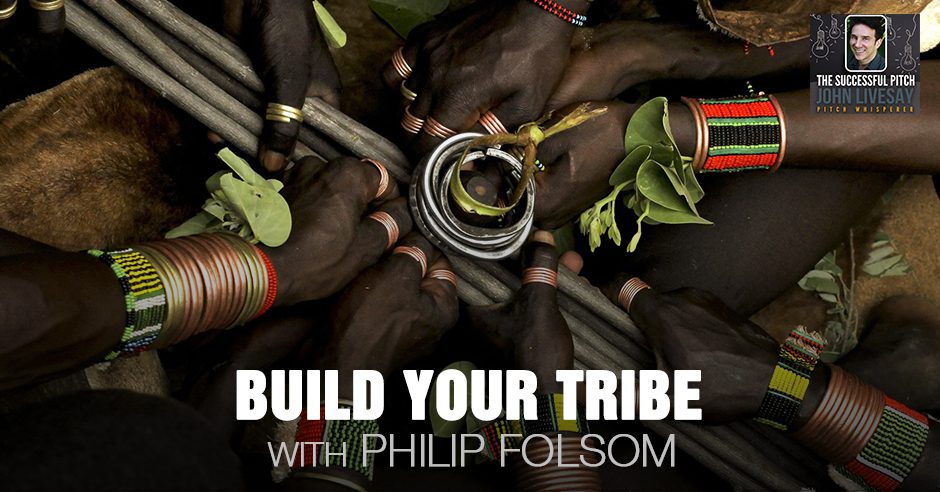
It is not anymore about the team, it is now about the tribe. Industry leader in team building and leadership Philip Folsom shares how to build your tribe in business and in life. Moving away from the concept of a team, a tribe has become the people who are beyond acquaintances or transactional business partners. Philip talks about how to build a legitimate relationship-based collaborative connection. He gives great insights into creating an environment where people feel safe and healthy, which ultimately increases productivity and loyalty. Making a play on words, he also puts forward the notion that to decide is connected to suicide and homicide where you are literally killing off other ideas. Philip goes deep into all of this as he lays down in metaphors on why we need better relationships in our businesses.
—
Listen To The Episode Here
Build Your Tribe with Philip Folsom
My guest is Philip Folsom. He’s gone into the dark woods. What he learned there is that individuals and organizations can do and be anything if two things are in place. One, a model of success and two, the tools to reach it. He’s got game-changing tools that have improved over 500,000 people’s lives in the last many years through his work. He’s acknowledged he’s an industry leader in team building and leadership, especially the Los Angeles High Ropes Challenge courses where he has a Professional Development Adventure Program. He came from Washington State. He has a great story he’s going to share about being raised by a single mom and joining the Army at seventeen. His own hero’s journey of hitting rock bottom and coming back up and helping everyone who works with him and encounters him heal. Philip, welcome to the show.
Thank you, John. It’s a pleasure and an honor being here.
I like to ask my guests to take us back as far as they want to the story of origin. Did you always know you loved animals? Tell us about your journey. You can you can start when you joined the Army or you can start earlier than that. I want to give people a timeline of what happened to you that caused you to become an expert in this.
Part of the theme when we talk about the hero’s journey or any type of narrative related to that is that it’s only by going into the shadow that we are able to excavate our gold. That’s a vital component of my story and all of ours. I grew up in classic pre-trauma environments of some neglect and some poverty. It was pretty abject challenges when I was growing up. My dad left early. I went into the Army at seventeen. Like a lot of us, I didn’t go in out of patriotism. I went in there as a means of escaping the situation I was in. In the Army, I had some acute trauma piled on top of chronic trauma. When I got out it was brought to my attention that I had some challenges that I had to deal with. I dropped out of grad school and went on to as a contemporary Vision Quest experience where I studied meditation. I studied equestrian therapy and Outward Bound adventure programming and archery.
What I discovered about myself was that there was healing to be done. It was a choice that became available to me. One of the big themes is the choices of the function of awareness. A lot of people simply aren’t realizing that they have the opportunity to heal and expand and grow and connect and claim the title of hero of their own story. I was always a minor character. In fact, inside of me, there still is a little kid who is marginalized, unsuccessful and terrified of being revealed. I have to acknowledge him. I keep him right next to me. I don’t let him get behind me. I don’t let him blindside me and undermine me. I want to have that little rat sitting right next to me so I can keep an eye on him. I can choose to have him sit down. I get to be the full king of my kingdom now instead of the minor Prince character.
[bctt tweet=”Going beyond team building is tribe building. ” username=”John_Livesay”]
Let’s talk a little bit about the equestrian therapy and how that tie into also what you’re doing with the SPARTA Project?
Equestrian therapy is incredibly powerful. My horse guru is Cheyenne Price. She’s an amazing six-foot blonde horse guru. She has the ability to utilize her animals and tap directly into whatever secret stuff is going on. Horses are prey, which is different than us. We are predators. We have eyes in the front and we are designed for acquisition. One of the secrets of success is to be able to turn whatever it is that we want to have a shift in our life into an acquisition story instead of an avoidant story. Predators don’t like to lose anything including weight. Instead of losing weight, I want to gain fitness. All of a sudden, this reticulate activating system gets triggered and we look for opportunities to gain fitness. The horses are the opposite. They are prey animals, so they move away from energy. It’s a different dynamic. If you can learn how that communication system works, all of a sudden it allows us this tremendous desktop experience of being able to manage our emotions and connect with those things. They see right through you.
The moment you walk into the round pen, here’s a big naked 2,000-pound animal that knows exactly what’s going on with us energetically. We’ve stuffed down our animal nature to the point where we are in our head a lot of the time. Horses can’t afford to do that and they don’t have that available. They know if you’re a bully. They know if you’re an impostor. When I trump in with all of my masculinity and my boots and whatnot, they call me immediately on it like, “You’re not all that.” Come down to your real level and then we can engage with a conversation and a relationship that’s healthy. Once you’ve earned that respect and trust, now we can engage with some different forms of more robust conflict. The horses are one of the animals I use. The other one are wolves. That’s probably not been my favorite thing over the last couple of years.
In fact, your tagline is, “The time of the lone wolf is over.” If you wouldn’t mind sharing why does a lone wolf cry? How does that relate to wolves never biting each other as dogs do? That’s a fascinating insight you have.
We have to start with the reality that we are pack animals. In addition to being predators, we’re pack animal. We have things called mirror neurons, which is this synaptic, legitimate neuron-type that we have that gets triggered when we are connected with another member of our tribe. It releases serotonin. It also is the source of empathy and compassion. We need each other. We need it at a cellular level if we’re going to feel good about ourselves. Wolves are the same. Wolves are also a pack animal. They’re predators. They have mirror neurons and so do horses. What’s happened in our society is that instead of being in our kinship-based tribal systems, we have gotten successful that we’re living in these giant mega tribes. We have moved out of that sweet spot of about 50 to 75 people that we can maintain deep relationships with. We’ve shifted from being personal, connected and collaborative, vision, mission, value-sharing partners to these impersonal relationships we move around with and it’s anxiety-producing for us.

Build Your Tribe: One of the secrets of success is to be able to turn whatever it is that we want to have a shift in our life into an acquisition story instead of an avoidant story.
What happens is when we’re looking at the big drivers of wellness, health and success, it comes down to relationships. This has been studied scientifically from not only longevity but in your specific field of sales and business success. It’s all about relationships and getting those skills. The wolves, why I use them are that they are designed to hunt big game. We are also designed to hunt big game. Except for our big game now and we start looking at our lives is the game of doing something that provides meaning, purpose, service and something bigger than us. If we are going to be able to move towards those big goals in our life, we need other people. We need them beyond an acquaintance or a transactional business partner, but a legitimate relationship-based collaborative connection.
It always comes down to the team and over and over. No matter how big or small the company is, it’s how well does that team get along and respect each other.
Beyond team is a tribe. The tribe is people who are not only connected at a mission or accomplishment level and a visual level which is here’s our job. Beyond the job is what’s the why? What’s the meaning? Why does this exist? Why am I being willing to share and donate eight hours of my day to this cause? It needs to be that important. That’s a tribe.
Part of the way the wolves operate as a pack in their particular tribe is they may fight, but they don’t ever bite each other. Can you explain the difference of how dogs fight versus wolves and how that impacts us in our business life?
When we need somebody, if you have a partner that you need to be able to show up and deliver for you to sell a house or in the case of SpaceX to be able to get to Mars. You’re talking big game stuff. You need those people to do their job. You can’t afford to have them be compromised in any way, which means instead of vague, undermining, politicking gossip, competing with those people. You want to now be reciprocal and be the best cheerleader those people you can because they are an extension of yourself. When we’re talking about tribal or partnership relationships, you want that partner to be absolutely at their sharpest, their most powerful and they’re most resilient. You can’t afford to undermine them. In the case of wolves, they can’t afford to bite each other. It takes ten wolves to pull down an elk.
[bctt tweet=”Choice is a function of awareness.” username=”John_Livesay”]
If they compromise the strength of the pack by infighting, they all starve. This is a hard-wired behavior amongst the wolves because they have that taboo against biting each other. It’s a survival mechanism. All of a sudden, they have the opportunity to express and discharge conflict almost nonstop. They squabble. They talk. They snarl. They posture. They also play because once they have discharged any of that immediate conflict that they’re having, then they get to be completely clean with each other. They run off and play and engage with whatever they’re doing without having that weird, toxic, stuffed down experience that we have when we can’t express our feelings. Sigmund Freud calls that the Theory of Hydraulics, “Whatever we shove down, it’s coming out somewhere else.”
I’ve heard the term that it’s leaking out the anxiety or the stress. What you’re doing with the SPARTA Project, it’s a non-profit for veterans and emergency first responders who are dealing with post-traumatic stress. How does your work with the wolves if at all impact that? What are you doing to help people overcome that?
We are running a cohort. It’s a five-day residential free program for veterans and first responders. This is an all-female cohort starting. We’re proud to be running this program. We run off donations. If you or somebody else you know is interested in giving back to a lean, non-profit, TheSPARTAProject.org is the name of that. We use what’s called a parallel process, which means we are going through this journey along with the veterans because all the good facilitators, all the good storytellers, yourself included. You’ve come from a place where you had to go on that journey. You had to go into the woods and you discovered that the only way out is through. We have to get all the way through the story. We have to resolve.
It’s different than the medical model where there’s a smart person telling you how you should live your life or how you should refill your strategic objectives at work. Good people are co-creators. You mentioned that even when you’re talking about engaging with your clients in a co-creation process. It’s the difference between a doctor and a midwife. The doctor gets to deliver the baby. The mothers who are reading this blog, you know the doctor didn’t deliver the baby. You delivered the baby. The truth is that we’re here to facilitate the creation of whatever that project or healing is for our clients and where they are to be. Sometimes a cheerleader, sometimes its support, sometimes it’s an accountability partner.
That’s what we’re doing with the veterans and first responders are we’re going through this journey with them because we’ve been through the dark woods. We know what’s in there. We know the road that will get us out. The wolves heal each other. Here’s another shout out to a great lean nonprofit, ApexProtectionProject.org. They rescue and rehabilitate wolves and wolf dogs that have been abused, mistreated and neglected. They bring them out to their sanctuary. They slowly integrate them into their healthy pack and the pack heals the wolves. This is how we as humans are going to heal each other are that we need to build the relationships. We need to be able to discharge our shame. We need to be able to go through and feel the pain and get honest with each other. This is true at a relationship level and also at an organizational level. When you’re looking at all the big societal challenges that are happening in our industries, at some point we’re going to have to go all the way through this piece and get the healing done.

Build Your Tribe: In our own journeys, we had to go into the woods and discover that the only way out is through.
The other thing that is surprising about you because you present an extremely alpha male. The way you dress and the fact that you’re outdoors with animals and wolves and horses. You’ve got the hat. You’ve got the whole Indiana Jones vibe going on. Yet you also spent several years as a professional ballet dancer. I’m fascinated to hear that story. How did you go from being in the Army and hitting rock bottom? Ballet is traditionally something that people start very young or something that typically only wealthy people are involved with. It’s a cultural artsy niche. How did that come about?
If I have received any divine blessings, one of them is the ability to go on weird journeys that for some reason people are not allowed to do. I can thank my strange parents for that. I grew up on a commune. I grew up pretty alternative and maybe that little chunk of experience allowed me to go on some weird journeys that are different than other people. Thanks, mom, thanks dad for that. One of them was I got out of the military and I had to take a PE class in community college. I was going through all of my challenges and trying to reintegrate. I was trying to do things as far off of the military as I could. I was looking for balance. The military is highly structured. It’s hyper-masculine. Here was an opportunity to get a PE credit and do something that was much more expressive and much softer. I took a ballet class in a community college. I enjoyed it. It was fun. The teacher said, “I’d be willing to give you some free classes if you come down and do some of the partnering work.”
I was out of the Army. I was twenty years old and strong. It sounded like fun to me. I was taking classes one evening and a bunch of strangers showed up in the class that I hadn’t seen before. I was taking classes with kids. It turned out it was an audition class for the Spokane Ballet Company. There weren’t any tall guys and the prima ballerina of the Spokane Ballet at the time was Rachel Ferrelli, a big six-foot Italian lady. The ballet director said, “Have you ever wanted to be a dancer?” I said, “What does that mean?” “I’m looking for a partner for Rachel Ferrelli and all you got to do is learn how to partner well and look good in tights.” I said, “Let’s do that.” It led me down to Los Angeles. I danced at the Los Angeles Ballet and I danced with a bunch of companies down here. I was never a good dancer. I had done enough martial arts and I looked good in tights.
I know a lot of professional athletes, football players, in particular, do a lot of ballet work to be agile and things. It all fits into your work because you’re working with companies like Sony, DreamWorks and Apple helping them as a high-performance tribe culture coach. Can you tell us what that looks like? Who would hire you? What problem are you solving typically? Give us an example or story of an outcome of someone after working with you.
Stepping back from that, I spent many years doing team building at a local company in Los Angeles. What I was noticing is that it wasn’t changing anybody. I was seeing the same clients that would show up year after year. They were having the same challenges. I realized something that our industry is doing is not creating sustainable results. I’m in my 50s right now. We start looking at legacy. You start thinking about the purpose. What impact did I leave with this? Did I move the conversation forward? I would define that as the transition from passion, which is kindling, it burned hot, fast and easy. It’s me-centric and then transitioning from that passion into purpose, which is like a big log. It’s something that carries a tremendous amount of energy, but it’s hard to get it lit. We get to into this point in our career where we’ve got a lot of skills and we’ve done our 10,000 hours to achieve mastery. We start looking at those bigger purpose conversations of, “What I want to do in the world?” Usually, it’s not about us anymore. It’s about what’s the service component. I eventually started realizing that I had to do a couple of things in my career if I was going to achieve organizational transformation with my clients.
[bctt tweet=”It’s only by going into the shadow that we are able to excavate our gold.” username=”John_Livesay”]
I needed to start understanding strategy. I also needed to start understanding the culture of the organization because it’s easy to change people short-term. If we go out and do something together, there’s going to be an immediate boost in morale, trust and some other fast-burn drivers of energy. We immediately are going to revert back to our baseline of behavior and that baseline is culture. We need to be able to go into a culture and we need to fix that. What is culture? What are the components of it? That was when I got to start growing in my true passion, which beyond healing people is understanding humanity. I studied Paleoanthropology at UCLA. How does our species work? It turns out that journey is a perfect dovetail to upgrading the culture of organizations because the reality is we’re no longer kinship-based animals. We are career-based. Our work teams are the new tribes. That is the anthropological reality.
I’ve studied with the Maasai in Africa and all over the world. When we go in to study these people, there are certain formats about looking at how a culture works. That’s the same thing that business consultants are doing. They’re going in and going, “How was your alignment with vision? Does everybody understand exactly what the mission parameters are? Your strategy? Your tactics? How is morale? How are your values operating?” This is straight anthropology work, but it also allows people to co-create and participate in their culture. This is that time where we get to now have access to all of this tremendous information of humanity and be able to create the cultures that we want to have at work, which is hopefully they’re going to be healthy. More importantly, they’re going to be high-performing. That means we’re going to be able to be competitive, innovative, resilient and have high retention. These are all things that from a business standpoint are the primary profit drivers of the business. Culture does that for them. I work at SpaceX. I do a lot of work with Red Bull. I work at Universal and other industries.
What you’re helping them do is create a safe environment where people can express concerns or confusion or even new ideas without being heavily ridiculed or criticized. That healthy feedback loop from working with you on adjusting their culture allows companies to attract and retain top employees and to even be more productive with those that are there.
One of the unique things that myself and some other people are doing is that you cannot decrease safety. It doesn’t work. Creating safe spaces at universities where there’s no hate talking, it’s not ever going to work. At some point, you have to shape an environment where people are either resilient enough to handle pushback or they’re treating each other as extensions of themselves. At which point they can give feedback, but they’re not biting each other. You cannot write trust and safety up on the break room wall and go, “Now we have a safe environment.” It doesn’t change anything. You have to shape the environment so that it’s changing behavior.
You do that by taking people out into nature and doing all these group activities together that build trust and bonds as opposed to being an intellectual concept.

Build Your Tribe: When we make a decision, we’re killing other ideas.
Those big challenging activities, which are my adventure Vision Quest stuff. I do ropes courses and other big epic things. Those are not creating character, they are only revealing it. The creation process happens during reflection and process. This is one of the things that we don’t do well and most organizations don’t because we are over-programmed and we don’t have time to reflect. A lot of the time we are simply jumping right into, “What’s happening in Q2? We need to get those numbers.” There needs to be that moment of breath where we go, “Are we in alignment? Are we creating the outcomes and the experience that we want to have?” This is something that is on a micro level with us and also on the macro level with big industries is there should be at least some breath in between Q1 and Q2 where you go, “Are we in alignment with our vision and values? Are those things correct?”
When we make a decision, we’re killing other ideas. In the business world, if you’re in sales, in particular, you’re asking people to buy what you’re offering. Therefore, you have to have some empathy that if they buy what you’re selling, they’re going to be making some changes and other options or ideas are therefore being killed off. Can you elaborate on that? It also helps people with addictions, which was mind-boggling to me with food. Anything you can talk about around that would be interesting?
When we look at the word decide, it contains the same entomological root as a homicide, suicide. It means in Latin to cut or kill. When I decide something, I’m killing off my other options. In economics, that will be your opportunity cost. If I want to find out how I’m making decisions, I need to pop the hood and take a look at what are my priorities. Even the word ‘priorities’ is a new term. Usually, that’s only a priority. It’s singular. What is the one priority of all those hundreds of things that I want to experience more of in my life? What’s the one that bubbled to the top and I made that decision and killed off all the rest of those things? That one top priority would be my highest operating value. When we’re looking at either individual or organizational decision making, change management. If we want to ever get in the driver’s seat of being able to make intentional directional courses as we move through our world, I need to at some point take a look at what are my values? Those values are driving the decisions of the things that I’m killing off. Organizational values are not simply a fun thing to put on your website in the break room. If they’re correctly implemented, then they are guiding the navigation of your organization.
Philip, you’ve been a great guest. Your website is PhilipFolsom.com. They can sign up for a newsletter. What’s the best place to follow you on social media might be?
I’m Philip Folsom at LinkedIn, Instagram and Facebook. That’s my website as well. Please jump on my newsletter because there is more of this strange esoteric but hopefully relevant and powerful information coming. In addition, there’s a monthly open program for people who want to spend a day with the wolves and me. There are cool change agents and seekers. I encourage you to stay involved. Keep changing the world and that starts with ourselves. It’s been an absolute honor, John.
[bctt tweet=”People don’t realize that they have the opportunity to heal, expand, grow, connect, and claim the title of the hero of their own story.” username=”John_Livesay”]
Thanks, Philip. It’s been insightful, entertaining and inspiring. I can’t wait to keep up with new ways you are impacting the world with animals and tribes.
Links Mentioned:
- Philip Folsom
- Outward Bound
- SPARTA Project
- SpaceXApexProtectionProject.org
- LinkedIn – Philip Folsom
- Instagram – Philip Folsom
- Facebook – Philip Folsom
- www.wolftribe.life
Wanna Host Your Own Podcast?
Click here to see how my friends at Brandcasting You can help
Get your FREE Sneak Peek of John’s new book Better Selling Through Storytelling
John Livesay, The Pitch Whisperer
Share The Show
Did you enjoy the show? I’d love it if you subscribed today and left us a 5-star review!
-
- Click this link
- Click on the ‘Subscribe’ button below the artwork
- Go to the ‘Ratings and Reviews’ section
- Click on ‘Write a Review’