

Gratitude As A Sales Tool With David Reed
Posted by John Livesay in podcast | 0 comments

Whenever we are faced with rejection, the automatic reaction is sometimes to give up. In this episode, David Reed shares his origin story and the roadblocks he needed to overcome. David has a passion for entrepreneurship and wanting to control the outcomes in small businesses. After getting his MBA from UCLA, he ended up working for Pierre Landscape. Together with the owner, Harold Young, they grew the four-employee company to an $8 million-dollar enterprise. Interestingly enough, the company grew to $33 million after he left the management position to go back to being an employee. David talks about the importance of gratitude as a sales tool and celebrating wins with the entire team, not just a select group of people.
—
Listen to the podcast here
Gratitude As A Sales Tool With David Reed
Our guest is David Reed, who’s known as a pre-construction guru. David has quite an impressive background starting from his education days. He went to the University of California in Berkeley and went on to get his UCLA Master’s MBA Program. He has been in the field of construction and working for Pierre Landscape for many years. He’s going to tell us that story of origin what it’s like to grow a company and his own personal passion for what he’s doing and also how he overcomes roadblocks. David, welcome to the show.
Thank you, John. I’m super happy to be here.
I wanted to ask most of my guests is the story of origin. Let’s talk about your days in college. Did you know when you were back getting your MBA and all that landscaping was for you?
Everything has been serendipitous to that degree. At UCLA, when I got my Master’s in Business, there were a number of people that went to interviews for accounting and consulting and finance projects. I felt at the time that small business and entrepreneurship was something that was going to be what I have more of a passion for. It came down to wanting to control the outcomes of things. Prior to going to UCLA, I’d work for manufacturers Hannibal Trust Company in their Latin America division. International banking was a great way to start my career. It felt like it’s a big organization. I wanted to feel like I could have an impact. Small business and entrepreneurship were what I was drawn to at UCLA. Landscaping was something I’ve been doing since I’ve been thirteen. Serendipitously, I ended up after business school doing a home remodel in the Palisades with a friend of mine. Harold Young, who’s the owner Pierre Landscape came in to put a bid on the sprinklers. That’s how he and I met in 1990. The company had four employees and after the house was built, we started Pierre Landscape. From 1990 to 2004, over those fourteen years we grew from four employees to an $8 million company.
[bctt tweet=”Being busy is a sales killer. ” username=”John_Livesay”]
What are some of those growing pains to go from small to $8 million?
It was certainly bootstrapping. We didn’t have any credit lines. It was all internally funded. It was getting new clients, getting new landscape architects and general contractors that would partner with us. I remember getting on the phone and going through the phone book and reaching out to landscape architects and introducing ourselves. Starting out in that way and spent a lot of time sort of driving through our core markets which were in Brentwood and Pacific Palisades and Santa Monica and Hancock Park. Stopping off on job sites and literally walking into the job trailer and introducing Pierre landscape to see what we could do.
It was feet on the ground kind of marketing where you would cold call in person as opposed to an email or phone call.
It was. You’ve talked about areas of genius, things that are walking on the job site with something that I do and did. It’s only in retrospect that I realized that a lot of people don’t have would never do that.
It’s the willingness to be rejected. An in-person person sometimes that fear of rejection is even stronger. Did you have any insights now that you’re looking back or any thoughts to yourself? For every person you would sort of drop in on and say, “Would you like to work with us?” How many of you have to talk to before one would say, “Yes?” One out of ten, one out of 100?
I wish it was as easy as yes or no. It ended up most of the time it was, “We’re in framing,” or, “We’re coming out of the ground,” or, “We’re about to stucco.” Landscaping is the last trade, it was a lot of, “Happy to talk with you but before we’re going to make a decision, it’s going to be something that’s going to be two, three, four or five months down the road.” Persistence was another one of those skills that honed that good follow-up. Having a sense of decadence in the sales process when it was time to follow-up. Making sure that we were there at the right time when they were ready to finally give us a set of drawings to get a proposal or proposals. I’ve been sitting out there and force the cadence of the process to when they’re going to make a decision. Not being afraid to walk on the job sites was definitely one of the big drivers. It is having the team organized and being persistent in following these projects. The sales cycle wasn’t a short one. In some cases, it would be a year or longer when it was finally time.

Gratitude As Sales Tool: Who we are is bigger than our professions. Sometimes it gets mixed together in a beautiful way that we don’t necessarily realize that.
That’s where a lot of people give up. They’re like, “I don’t have the patience to wait a year. I’ve got cash flow problems now.” They don’t have a system in place to follow up on those leads. I know from my own sales career that organized follow-up at the right time. Doing what you say you’re going to do, “I’ll call you in a month,” and you do. That automatically builds some trust which is so important. They think to themselves, “If this guy, David says he’s going to call me a month and he does. When he tells me he’s going to have this landscaping done in three months, if we give him the bid, he probably will keep that word as well.” That’s how it sounds to me. You were building trust. My question for you is, were there any tools you used or recommended using to have this cadence you refer to so that things don’t fall between the cracks?
There are lots of great CRM programs out there. Over the years we’ve used Excel, we used Outlook. We’re settled in on Salesforce. There are other CRM tools out there. Having something that allows me to organize myself and to look at which opportunities are in need to be nudged along. That’s one of the strengths of the top performer in sales is being organized. There are the art and science of selling. The artful part is knowing when to push a deal along and reach out to somebody. As you were commenting on how to make and keep commitments on a small level, over time builds up to a sense of somebody having the confidence that you’re going to be able to perform at the end of the day. A lot of our clients now with Pierre landscape use it, these are people who have been with us for many years. These are people that we’ve got long relationships with. That’s different than working with somebody new. Especially when we started, we didn’t have that kind of history. Those are some thoughts. Having a good CRM and being organized is key to be successful as a relationship.
One of the keys to being successful when you’re launching any business is no matter what its size or growing it. You not only have to be organized to how often you’re reaching out to new clients, existing clients, keeping your word. How do you organize your own day, your own week and month? Especially as a startup, you’re wearing a lot of different hats. You’re selling it. You’re implementing it. You got to attract clients. You’ve got to work on the bids, the invoicing and then deliver it. How did you figure out, “From this hour to this hour I’m dropping in update these people. I’m following up on these people. I’m putting stuff into the CRM?” Did you have a cadence in your head of how you scheduled your day? Did you sort of find yourself reacting and saying, “I have to respond to this proposal and forget cold calling right now. I don’t have time?” How does that all work for you?
My planning process is to plan the week in its entirety either on a Saturday or Sunday before the week starts. Lockout the major things that need to get done and don’t get distracted by things that might come flying at the last minute. There’s always a little bit of margin that I try to leave for work. Great clients have urgent needs for them. For the most part, I feel best about my week in and week out when I got my priority goals the things that are going to move the needle that the things that are going to make my number. If I’m checking those boxes, that’s a good week.
If it doesn’t get scheduled, it doesn’t get done.
We were we’re talking a little bit about the busyness of life and being busy in some ways is a sales killer. Busy means running around. I’m focused and methodical. I’m not a person that likes a lot of drama. Being focused and methodical has generated stronger results than then being reactive.
[bctt tweet=”Don’t be distracted by last minute requests. ” username=”John_Livesay”]
Let’s talk about your own story during this 28, 29-year journey. You, at one point, can tell us when that happened, you decide you’re going to sell your interest back to your partner. Tell us what motivated that? How did it go? What does that look like now?
I’ve been with Pierre Landscape for many years. When I go back to my business school reunions, I talked with my friends who may have had five, six or seven different companies that they’ve worked for since business school. I think to myself, “Are you the smartest guy in the world or the dumbest guy in the world?” I’m one of the two. Part of what your readers might find interesting about my journey is getting to a point in 2004. This is several years after the start of the company, after I partnered up with Harold. We went from four employees to about $8 million in sales. I sold my interest in the company back to Harold to become an employee. For several years, I’ve been an employee of PR Landscape. The company’s gone from $8 million to $33 million. There’s been a huge transformation over that time. Over that several years, I’ve been a salaried employee working as a business developer and pre-construction.
What I found out about myself over those first several years as the company went from four employees to $8 was that running and managing a business and the passion that it takes to run and manage a business. This sense of being consumed in a beautiful way of running and building the business wasn’t something that I had. I could do it but putting on a suit of clothes and arms were too short. If I pulled my arms up the sleeves would get down and sort of fit but at the end of the day, it wasn’t something that was making me happy. We have been working with a business consultant for many years. We had our consultant with us at the time as we were discussing what it would look like for Harold to buy me out. When our consultant first suggested, “Maybe this is the solution that you guys might want to think about.” We both shook our heads and said, “That isn’t that.” A few months later, a year later, we worked through the process of getting to a place where I could become an employee. The management side and the goal setting and vision setting and then driving to the vision, those weren’t my areas of genius. I’m a relationship builder, a business developer. I’m a technical reconstruction person, but vision and driving a vision are different.
Was there already difficulty in letting go of being involved with all the decision making? Did they have trouble stopping asking you to work all these incredible hours?
On one level it was hard, on another level it was easy. One level for me, it was a burden that wasn’t serving me to put that aside was refreshing. On the other side, not being looked to for leadership and guidance because I said, “You know what? That’s not what I want to be bringing to the table.” There’s a sense that there, “I’m not an owner anymore.”
It’s a separation of who I am is bigger than what I do for a living. Letting go of outside labels defining our self-worth. That’s my big takeaway from your story.

Gratitude As Sales Tool: The sales team is the tip of the iceberg, and everybody else is doing the heavy lifting.
It’s accurate and you talked about it in your book. When you lost your job at Condé Nast and then got it back and won the salesman of the year. You’re sitting up there and you’re like, “I’m the same guy.” There is a sense of who we are is bigger than our professions. Sometimes it gets mixed together in a beautiful way that we don’t necessarily realize that. As I look back, I don’t know if it was me being the smartest guy in the room or the dumbest guy in the room. That was what we decided to do the best for both of us.
David, what do you do to keep your team morale up? How do you celebrate wins?
One of the things that I’ve taken on consciously is being a cheerleader inside PR Landscaping, how a good, “Atta boy,” goes such a long way. I think of it as internal salesmanship. I’ve got an internal client and an external client. Typically when I’m listening to a sales podcast or reading a book on sales, it tends to be about the external client who was selling too. Selling internally and making sure that the people on my team from estimating to our production people to our maintenance team. I make it a point of being the person that says, “Thank you,” more than anybody else to my team internally. The internal salesmanship in my mind is key to building a wonderful team and it’s key to being able to bring the best of what our company can offer to the client. When I say, “Thank you,” it makes me feel good too. I walk into somebody’s office and say, “You know what? The way that you handled that maintenance issue with them or the way you handled that warranty issue. Thank you, means a lot to me.”
Do you double back when you win a bid? Do you go back to the people who put the estimate together to let them know that in fact, it came into fruition and to thank them for their part?
We do. It’s always an email to the estimator, the chief estimator, the sales manager and the president. It’s like the chief cheerleader for Pierre Landscape. In those moments, bringing a sense of celebration to a sales big or small is important.
Let everybody feel part of the wind as opposed to the sales team getting all the credit.
[bctt tweet=”There’s an art and science in selling. The artful part is knowing when to push a deal along and reach out to somebody. ” username=”John_Livesay”]
It’s hardly about the sales team. It’s about our estimating team to put together a good estimate. It’s about our production team that does a good job in the field so that we’re able to go out and get repeat business from people. In a lot of ways as we celebrate, it’s the sales team is the tip of the iceberg and everybody else is doing the heavy lifting.
What do you do to keep morale up when you don’t win a sale?
I was going to comment that we’re happy if we’re closing 20% of what we put out. For every ten bids, eight bids we are not going to get. People are going to either go with another company or maybe the job won’t go at all. As an internal salesperson, I try and be super candid with everybody on what I see with certain deals, if they’re going well if they aren’t going well. I’ll be candid about things that are positive about a certain opportunity.
It sounds like you keep people informed so they’re not shocked when it doesn’t happen.
The Reed family gave out Christmas cards to our friends and family. I brought Christmas cards into the estimating team. I wrote down on for each estimator that deals that I wanted to close in 2019. What’s been fantastic is that the Christmas card has been up on their bulletin board.
They have a shared goal and vision.
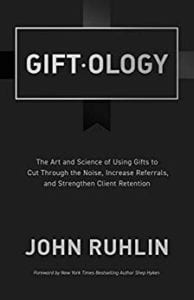
Giftology: The Art and Science of Using Gifts to Cut Through the Noise, Increase Referrals, and Strengthen Client Retention
We go through it and we’ll highlight the ones we got and go, “We didn’t get that one. We didn’t get that one.” The communication piece is, “Good, bad, beautiful or ugly.” That’s been a good recipe for building trust. I’m going to be honest. I’m not going to tell somebody that this deal is for sure win. I’ve got some signs that know it’s heading the wrong way.
I had John Ruhlin who’s the author of Giftology on the show and he’s an expert at coming up with unique thoughtful gifts both for big clients and internally. Is there anything that you do internally or to your big clients to celebrate or thank them for their business? That’s a little out of the norm.
I am not a creative gift giver. My wife Susan Reed has that beautiful creative side to her. I have started deals over $1 million. I have started bringing in either a bottle of whiskey or a bottle of tequila when we do our turnover meeting making a big deal of presenting it to our estimator. At one point we went out and did a craft brew we called it the Pierre Pale Ale.
You’re onto something there because that’s what I learned from John Ruhlin. When you customize a gift and give people an experience. As well as something that they can remember that experience by. You have the wow factor because for people reading, “If my goals are to close 20% of the bids I put out. What else can I do to increase that?” In my experience, it’s creative gift-giving to grow current business. The second part is, what are we doing in our proposals or in the conversations that we could improve to get to 22% or 25%? I’m a big proponent of telling the story. I have had conversations about what’s the story of your personal passion. What’s the story of Pierre Landscaping? How did it start? What’s the culture that it stands for? If gratitude and appreciation are part of your culture that might attract some people. If you’re not telling that story out externally then people don’t know it. If you can find other companies that have that same value suddenly people have a connection to you. If it’s between you and someone else and everything else is fairly even, then they might go that way.
You’ve prompted me to remember something that I use in most of my conversations with my clients. It’s thanking them in some way the phrase that I use is, “Thank you so much for all the heavy lifting. All the heavy lifting that you’re doing out there as general contractors to get these projects to a place where Pierre Landscape is one of your subcontractors.
It’s a little more customized, “Thank you.” That has a little tongue in cheek there. David, is there something you want to leave the audience with? Maybe a book you like, a quote, a philosophy, advice, anything you want to leave people with?
[bctt tweet=”Bringing a sense of celebration to a sale, big or small, is important. ” username=”John_Livesay”]
The main thing is how powerful it is to say, “Thank you,” for things that others might take for granted. Be a big cheerleader out there. This abundance mentality is something that has served me well when I’m thanking people. There’s a sense of coming in at this whole thing from a better place. Sales is a game. Sales has its ups and downs. Some days are wonderful. When it is wonderful to be sure to celebrate and not on your own. Be sure to celebrate with the team. A team win is more gratifying than an individual win.
If people want to reach out to you? How else can people follow you or reach out to you?
Through LinkedIn. I’m happy to share any insights. I’ve been taken with better selling through storytelling and you are using good open-ended questions and storytelling to engage with my clients. In that way, I’ve connected a lot more people and that’s been a joy to connect with clients in a deeper way over the course of a sales process.
Thanks for sharing your wisdom and your fascinating story of making sure that you’re happy. In turn how that allows you to come from a place of happiness and gratitude and how that continues to create a place of abundance for your company and your life.
Thanks.
Important Links
- Salesforce
- John Ruhlin – Past episode
- Giftology
- LinkedIn – David Reed
- http://www.PierreLandscape.com/
- Better Selling Through Storytelling Method Online Course
Wanna Host Your Own Podcast?
Click here to see how my friends at Podetize can help
Purchase John’s new book
John Livesay, The Pitch Whisperer
Share The Show
Did you enjoy the show? I’d love it if you subscribed today and left us a 5-star review!
- Click this link
- Click on the ‘Subscribe’ button below the artwork
- Go to the ‘Ratings and Reviews’ section
- Click on ‘Write a Review’
Love the show? Subscribe, rate, review, and share!
Join The Successful Pitch community today:
- JohnLivesay.com
- John Livesay Facebook
- John Livesay Twitter
- John Livesay LinkedIn
- John Livesay YouTube
The SLAM – Startup Launch Assistance Map With Jon Warner
Posted by John Livesay in podcast | 0 comments

Everyone dreams big, no matter how simple it is. When building a startup business, you already have success in mind. The question is do you know how to bring that success from your head into reality? Jon Warner, the CEO of Silver Moonshots and author of more than 40 books, talks about how to increase the chances of launching a successful startup business. He shares in detail the steps in how to build a strong foundation in the early stages of your business as mentioned in his book SLAM. He conveys the importance of narrowing your niche and understanding the needs of your target audience as one of the first steps you should be doing.
—
Listen to the podcast here
The SLAM – Startup Launch Assistance Map With Jon Warner
Our guest is a five-time company CEO, Jon Warner. He’s a widely respected entrepreneur, expert, and mentor. He’s founded and led three startups, one was a failure, one that did not trouble the score, and one successful exit. He’s got the gamut of experiences. Jon’s career started in the corporate world with air products, working in the US and across Europe before joining ExxonMobil. At Exxon, Jon worked in the UK, Australia, Nigeria, and he ended his career there as a deputy CEO.
Following his several years in the corporate world, Jon founded and grew a management consulting business called the Worldwide Center for Organizational Development, which has had over twenty people carrying out a wide range of strategy assignments for all kinds of companies. He was also a founder and CEO of two other startups, a digital publishing company and a bill pay and payments software platform that operated globally. Since his exit from the latter, he’s been working California-based to mentor and invest in disruptive startup companies, especially in the area of technology, deployment, healthcare and aging tech in particular.
He’s now the CEO of Silver Moonshots, a research organization and virtual incubator for startups focused on a 50-plus population which is growing. Jon is a noted speaker around the world. He lectures on entrepreneurship. He’s a prolific author. He has a book called SLAM. There are also a lot of things about GRAND SLAM in there with all kinds of fun, clever things. He’s a graduate of the UK’s top Warwick University. Jon, welcome to the show.
Thank you, John. It’s good to be here.
Let’s start at your own personal story of origin. You can go back as far as you want to university or even as a kid. Did you always know you wanted to be an entrepreneur?
I did. I quickly got into doing anything I could to get out of the house and then earn an extra buck. Early on, that was delivering the newspapers in the days when that was possible to wash other people’s cars and various other things. I liked earning money that I’d generated through my effort. It got a little light switched on pretty early for me.
[bctt tweet=”Do you have a side hustle? Who should be on your team? What is the unmet need you solve?” username=”John_Livesay”]
We have this image of going to school. You have a PhD in Psychology of Neuroscience. Were any of the people walking around in the capes as we see on Harry Potter?
Not quite. That might get a bit of fictionalizing going on there.
You’ve written this great book called SLAM. Who do you think is going to benefit from reading this?
There are a number of people. The broad category is entrepreneurship. It’s anyone who’s interested in becoming an entrepreneur, is an entrepreneur. That’s the broad category. The reason I wrote it however is there’s a subcategory within it I particularly liked. That is people who’ve got side hustles, people who aren’t necessarily working full-time on entrepreneurship or their idea but would like to go and get that bigger, faster, stronger if they could, and maybe they didn’t have the roadmap for that to happen. That was who was in my mind when I was putting that book together.
Everyone’s clear that the word SLAM is a fun acronym. Do you want to tell everybody what that stands for?
The whole process which the book revolves around is the Startup Launch Assistance Map and that spells the word SLAM. What it is there to do is to support that whole process of exploration as you try and validate your startup idea. It encompasses a second acronym in terms of the way the process works, and you have to do them sequentially. Once you’ve gone through the validation phases, there are eight steps in there, you flip it over and you start thinking about execution. It’s an acronym called GRAND. On that basis, you are going to another eight steps to make sure that you get to where you need to go, which is growth and traction fundamentally.

Launching Successful Startups: It’s important to create the right team, the people that do the bits of the work and make you stand out and shine.
The interesting thing about the concept of a GRAND SLAM is you say start with SLAM and then go to GRAND. I thought that was a clever positioning there. Let’s apply some of these steps from SLAM since we start with SLAM into a side hustle of so many people want to be a speaker. I know a lot of people that have their own consulting agency or they’re running a digital marketing company, or they’ve had experiences as entrepreneurs and founders of themselves, or they’re maybe professors. There are lots of different people who have expertise. They have a main job, but they also want to be a speaker and maybe become a full-time speaker. In order to do that, you have to have speaking as a side hustle.
I know when I was working full-time at Condé Nast, I’ve started my speaking career several years ago where I would speak to some of the advertisers that I was responsible for getting as an added value perk. I would speak to their sales teams, whether it was a car company or a fashion or jewelry company that was advertising with my brand. I would say, “I’m going to train your salespeople on how to be better salespeople. There was run the ad to get the traffic and the dealership and then let me come speak to your salespeople about how to close more sales.” That’s how I started it as a side hustle. I love to use that lens. The first thing you talk about in SLAM and this is important for anybody who wants to be a speaker as well is, “What’s the unmet need? What’s my unique message that somebody would even want to have me come speak about?” Can you address that, Jon, on your experience of how important that is?
It’s crucial and it’s probably the most important step to get right and take your time doing so. Step one, any entrepreneurship venture would be to go and uncover that unmet need with the target audience that you’re aiming at. What I see a lot of entrepreneurs do is thinking, “I’m going to be selling ultimately to the whole world, so who cares? I’m going to be like Facebook. This is going to be huge. Everyone’s going to be the path to my door.” That’s not how it happens.
Even Facebook started in one university with first years in that university. You need to establish a beachhead of customers who have a need that you can solve for. In the speaking realm, that’s about thinking about what people want to hear about, what do they hear from me about, my topic, and how much it’s going to resonate with that beachhead market is something you want to dig into. The best way to go and do that is going and talk to a few people and find out who is likely to be that audience who’s got their hair on fire about an issue and expertise on.
I always like to remind everybody that Amazon just sold books first before selling everything under the planet and got a good concept there. If you personally had experienced the problem, whether you’re a speaker or not and you have this is the problem I know, I always like to say, “The better you understand the problem, the better you have the solution both for your customers and investors.” As a speaker, if you’ve been in the shoes of your audience, not only does that establish credibility and rapport, but it goes to this first point of SLAM which is the unmet need. One of the things that might be helpful for the readers is an example of that. I’ll give people mine and then I’d love for you to contribute one that you might have thought of that’s not necessarily in the speaker world but something you’ve dealt with your broad base of experience. The way I position what I talk about is that the old way doesn’t work anymore of selling and the new way is this. That framework can work for almost anything and it pulls people in.
I say, “The old way of selling of just pushing out a bunch of information or throwing up a bunch of stuff against the wall and hoping something sticks isn’t going to be successful anymore. The new way is instead of pushing, you become a storyteller who pulls people in and makes you become magnetic.” People instantly go, “This is something I might want to know about and have a speaker come to talk about, because it’s so clear of what the problem is.” I love your feedback on when you paint that picture if the old way doesn’t work anymore, as you said hair on fire, so what are you going to do?
[bctt tweet=”Anyone who’s interested in becoming an entrepreneur is an entrepreneur.” username=”John_Livesay”]
What I’d like to do, John, is unpack that because you, as The Pitch Whisperer, are doing something even cleverer than the way you’ve described it. Let me tell you how clever you were. What you did is you recognize that the entire market of getting out there and speaking was enormous. You immediately narrowed it down and said, “People need to pitch the things. They need to pitch for something. It might be pitching for a promotion. It might be pitching for a pay rise.” In your case, you went fairly all-in on pitching for investments and saying, “In that room, there are people who need to get money and it’s a special relationship.” You need to tell the story to investors as a beachhead market so that they will listen and the product that you are supplying is going to be exciting to the people listening to that pitch.
What you’re doing is daring them to make that presentation in a story-oriented way. What you did was gone cleverly in my opinion into the unmet need by slicing the marketplace into a specific audience. A customer persona people could imagine and say, “I’m going to go out and talk in that area, write books in that area, talk about it on my podcast.” In so doing, you allowed yourself to dominate that segment. That’s the key. What you’ve then described is the way you now delivered on the product side of that, which is step three, because you are now adding unique value in terms of giving people a way of making that happen so you’ve become top of line as a guy who can help you while I’m pitching for investment.
What’s interesting referencing the Amazon example again is once I had that beachhead of investors and founders that I’ve helped get funding, I’ve now broadened it to companies like Honeywell or Coca-Cola. Even Redfin, which is a tech company disrupting real estate bringing me in as the sales keynote speaker to show them a new way of selling, because of my experience selling media for Condé Nast. I’ve been in their shoes. I know what it’s like to have a quota. I know what it’s like to be seen as a commodity. I know what it’s like to feel burnt out. Here’s the solution that works for me and it can work for you if you become a storyteller, X, Y and Z.
Those double-click of unmet needs for one market and then expanding it beyond others. What’s interesting for people to hear because whether you’re reading this and you’re a startup pitching an investor to get your startup funded or are equally important if not more so. As you know, Jon, startups love to see customers paying for something you’ve created to make sure there’s some proof of concept that you talk about, is one of the key value propositions in SLAM. You need to be able not just to sell your product to investors but sell it to a customer who’s going to pay for it.
When I was being interviewed and this will happen to everybody, it’s typically between you and in my case, two other speakers or if you’re the founder pitching an investor, it’s between you and all the other investors or the other founders pitching that one investor. They said, “I was up to speak to an executive search firm.” They said, “Have you spoken to other people in our industry before?” That’s a lot of people, especially if you’re trying to grow your business, so that objection comes up a lot. There’s some real value here of how to handle that that you talked about in SLAM.
The way I handled it was I said, “I haven’t spoken exactly to the executive search firm industry which has to pitch themselves to get new clients to find their next CEO.” I have spoken to another industry that has a similar business model to what you have which in my case was Gensler, an architecture firm and they have people who specialize in practice areas like you do. They have to go up against two other firms for an hour and pitch. They weren’t telling stories. They were presenting the designs and you are going in there. When you double-click, I said, “What’s the biggest challenge you have when you have that one-hour pitch?” This is so important to take away from what you said on this unmet need. Sometimes, people don’t even know what it is, but if you can identify it for them and then show your solution, Jon, that’s when your magic kicks in.

Launching Successful Startups: Once you’ve determined your value proposition is unique and different, you need to corroborate all of that.
One of the other things to add John to that is that the secret here is and it’s counterintuitive by having at least initially a narrow beachhead so you go out and maybe you help people to go and pitch to seed investors for example. That’s an incredibly narrow niche. You credential yourself as being able to deliver your value proposition so your ability to go and tell a story, to go and get people to cross the river as you often like to say, get to the other side. When you do that, people recognize you can jump to other segments because you’ve already proven you can dominate that one segment. They then buy it. You can add segment after segment and before you know it, you are the person who does pitching well in whatever circumstance. That’s what’s happened to you for several years.
We had an example of talking to the CEO of DHR International, this executive search firm. He said, “When it’s between two other firms and us, we always ask if we can be the last.” Research has shown that whoever goes last typically is more memorable. However, here’s the unmet need that you talked about, Jon. You can’t control that. It’s up to them what order you go in. When I identified that as an unmet need, we might ask to go last. We can’t control it. We hope we do so it increases our chances of being memorable. The real problem is you need to be memorable and you can’t depend on what order you go in. What you can control is telling a story that makes you memorable and when you do that, no matter what you’re pitching, you could be first and you set the bar. That’s why they ended up hiring me when he understood how I was solving that for his audience. The book SLAM says, “That’s your core foundation to getting a yes, whether it’s funding clients or pulling in people on your team,” which is the second part of SLAM.
Let’s talk about the importance of team and if you don’t mind, I’d also like to add in the importance of culture that goes with it which I know is a little bit of what you talked about in the second part of the GRAND elements. I want your opinion here, Jon, on how important is it for you to create a team even at the very early stages that understand the culture you’re creating so that they know if it’s a fit for them or not.
The keyword here for me is the right team. Once you’ve uncovered the unmet need and the beachhead market that’s got their hair on fire about that need, your job is to think who it that consoled for those problems is. Clearly, the founder is the main person if you’re a speaker. If it’s a one-person band, it’s you, but you’ve got to think about what else that sector needs for me by way of expertise, by way of production values, by way of the way communications occur, distribution of information before and afterward. Even a speaker will have a fractional team around them, an army of people that might do bits of the work. They make you stand out and shine. In a company, you’re going to be recruiting people progressively and what you want to do early on is shape that team so that its culture is completely consistent with what you’re trying to deliver by way of value.
The team is the old adage that a lot of people on the investment side invest in the jockey and not the horse. The jockey is always the team and the quality of that team and it’s not a single founder or the person who had the idea. It’s the people they surround themselves with, both advisory and direct, fractional, full-time, part-time, and all the rest of it. That’s why it’s step two on the SLAM map. It is almost as important as covering that unmet need.
Even as a speaker, I’ve had to find people that I feel are the best team to be my speaking agents or to create the website and the design of what my brand is, even down to the color choices. If I don’t have a clear sense of who I am, what I stand for, what I want my brand to stand for, how can I possibly explain it to the people on my team? That’s what its visionary skills, painting that picture keeps going back to SLAM number one. Here’s who I helped, here’s the problem myself, and because of this, here’s the feeling I want when people go to my website or when you’re looking for an agent.
[bctt tweet=”Entrepreneurship is a venture where you uncover the unmet needs of your target audience.” username=”John_Livesay”]
What’s your beachhead as you say, Jon? I get very specific with them. I’m like, “Here are my five specialties, technology, healthcare, real estate, automotive, and design.” Anything as a sales team in those areas that’s who you pitch me to. Think how much easier I made it for the speaking agent to know exactly what to put me up against, and who to recommend. Otherwise, it’s like you’re a sales keynote speaker. Do you know how many there are? What’s your hook? What’s your niche? All those things are blurry until you can define it that short and crisp. That’s what SLAM helps people do.
What you’re wrapping around that is having a clear vision in terms of what you’re doing, in terms of meeting that unmet need with the product you want to supply. I like Peter Thiel’s statement in his book Zero to One because you also want to get people who can take a step to change the difference in terms of that beachhead market issue. They do get a result. If you’re pitching for investment, what’s a great result? I got investment or at least I shortened the time it took me to get the investment I needed. If you’re delivering that, people beat a path to your door so your cost of acquisition of new clients goes down as a result of that.
For example, to have those stories ready to go at a moment’s notice, whether it’s your elevator pitch or you’re in the call and it’s between you and two other speakers or you and some other investors, or you and two other clients that you’re pitching. I will say, “That’s the value of storytelling. Would you like to hear the story of how I helped this architecture firm win a billion-dollar airport renovation?” That’s the value proposition. You already know the outcome. Here’s the story that you can then use to win your next big pitch for the business. We’ve got the unmet needs, the team, and now the value prop then we want to test this out and the social proof is great for that.
What you’ve got in steps one, two, and three which is on the diagram of the SLAM map and the book elucidates is the rock on which you’re going to go and build your speaker career or your startup or whatever it might be, a side hustle. Your value proposition is unique and different, but you do want to corroborate all of that. Step four is the corroboration step and it’s a pivot point. It’s almost a fulcrum around which the rest of the map operates. You’re constantly testing with your audience whoever they may be that the assumptions and the beliefs that you have about what can be successful are true in their words and their eyes, not you guessing. It’s corroborated by the target customer you’re aiming at, that they are doing the corroboration. The more you do that, the more you do risk your startup and the more attractive you become to new customers and indeed investors you want to come and invest in you.
Here’s an example of that. The irony of me having to sell myself to get hired, to be the speaker, to DHR International, the executive search firm, was that after I was giving my keynote, I also did a workshop for them. They would say, “There are competitors, other search firms that have placed more executives in our particular niche.” How do we handle that objection? I tell them the exact same story of how I connected the dots from an architecture firm using the same business model to their business model and what other companies have you worked with that you could do that front to answer that objection. They went, “Oh.” The test was that’s how I’m in front of you. I know this works and you can use this too so that’s where it becomes great.
The next part of what you talked about in SLAM is the market size. I’m always talking to people about putting their own roadmap together in terms of invisible to irresistible and all the steps along that ladder. You can’t keep working with your core clients because things happen. People leave. Businesses get disruptive like Disney buying Fox. Suddenly, Fox is not hiring a lot of people and if you’re in charge of finding executives for Fox and you haven’t been growing your market in other areas, you’re in trouble. Speak a little bit about what somebody should be looking at in terms of market size. What can I do to see how big this could get or how do I scale something?

Launching Successful Startups: Podcast is an excellent example of content strategy where you can leave a legacy and people can access it through time.
It’s all about scale trajectory and velocity in this section. What you’re doing is saying, “How big is the pond I’m fishing in and is it going to be big enough to give me the velocity, the growth, or the traction that I need?” Your beachhead market might take you quite a long way, but it might not stay the same. Things change in the world of log so what’s going to be your approach and how big is that market? In some cases, the pond is not going to be big enough and it’s not going to grow fast enough.
You might have to look beyond this, and your job is to measure this. Your ambition might be different. You might want to say, “I’m in a lifestyle business. I’m a lifestyle speaker. I’m more than happy doing twenty gigs around the country may be and that’s enough for me.” If you want to go and be Anthony Robbins and you want to go and do a multimillion-dollar business out of all of this in books and promos and everything else, you’re going to have to think about the market in a different way. The key is to have metrics around that that are rigorous so you know where you’re heading, and you can do risk at that side of it as well in terms of that whole analogy of fishing in the pond.
You talk about in SLAM the next thing is how to reach these people. Are you going to use Instagram or Facebook or something else completely different? One of the things is this concept of lateral thinking and not doing what everybody else is doing to reach your target.
You can perhaps get the clue that even in the price that you’ve taken, you should have started forming a view of where beachhead mark you’re aiming at, at least initially, hang out. What do they pay attention to? Are they reading blogs? Are they reading emails? Can you reach them by email? Is it social media or which platform within it? Do they hang out at trade shows? There are a number of channels. You can’t be in all of them. You don’t have the bandwidth in time and you don’t have the money usually on the tip to do all of them. You’ve got to be careful about the channels and make sure they’re consistent with where people pay attention and then you want to go and put your budget together so that you can test those channels on an agile basis. Go to market is a practical way of saying, “How am I going to get the message to the particular audience that I found in the unmet need section right back at step one?”
One of the things I’ve done that I want to give as an example for people to start putting their thinking caps on is using a podcast as a marketing tool. One of the things I’ve done is there are quite a few speaking bureaus out there. Some you have to be exclusive with but a lot of them you do not. In other words, as a speaker you can be represented by multiple bureaus and they each have the different clients that they pitch different speakers to. However, you can imagine how many speakers are pitching them to represent them all the time.
I was fortunate enough to get a gentleman named Bernie Swain who wrote a book on entrepreneurship and started the Washington Speakers Bureau which represents almost all the former presidents including going back as far as Reagan. He reached out to me because I had created a podcast that had value and he wanted to be on it. He didn’t even know I was interested in the speaking business. I did him a favor by having him promote his book on the show which then gave me that first leverage so I could go to other speaking bureaus, many of whom based their business model on his and say, “Would you like to be on my podcast to tell your story of how you started your entrepreneurial bureau? By the way, one of the leaders in your field, Bernie Swain, has been on my show.”
[bctt tweet=”Always think of how to add value to your customer because their pain is costing them.” username=”John_Livesay”]
That was relatively easy. Suddenly I have something of value to offer them. During that interview, they get to like and know me and then many of them, almost all of them I believe have said, “We want to represent you now.” If I call them cold and said, “Let me tell you about me,” without giving anything, it’s not the easiest thing to do like an actor getting represented by an agent. I wanted to throw that out there as an example of lateral thinking of what is that I can do that I don’t see other speakers doing well. Many speakers that have a podcast, some do like Tim Ferriss, but are they using it to get bureau agents to represent them? He doesn’t need to but somebody at my level, like looking at the landscapers you talk about in SLAM and figuring out what is it I could do with the resources I have and the way that no one else is doing and then that comes to life.
It’s an excellent example. In fact, it’s an example of a content strategy but not traditionally most people would think about blogging or going out on social media platforms but a podcast is a wonderful way of leaving legacy content that people can access throughout time and you can put these things up on other platforms as well at the same time so that people can listen to, other than credential you as someone that can help them. It’s a very good example.
One bureau was celebrating its 20th anniversary so they use being on my show as part of the promotion for that. It all worked out and then the final element of SLAM is the actual business model. How am I going to make money?
This is crucial and it’s the step before the last because you do want to enter the ecosystem in step eight on the SLAM map, but it’s probably the one that matters the most from an investor perspective because if you can’t make money in terms of what you’re doing, you’re going to be in trouble. There are many ways to do this and it’s not about pricing. It’s not about slapping a price and saying, “I’m going to charge something similar,” or any startup that thinks that way. The key here is thinking about how do I add value to that beachhead customer and their needs because their pain is costing them something emotionally or actual money or resources or sheer frustration and friction.
What you’re doing is come along and say, “I’ll take that pain away. What’s that worth to you?” If you can do that, you are demonstrating value-added and sometimes it’s like 2x, 3x, 5x. If you’re doing that, you have a monetization model that’s working and again, you become investable because people can see that the face for those of you that are high so it needs a lot of care and attention to craft the business model well whatever it may be.
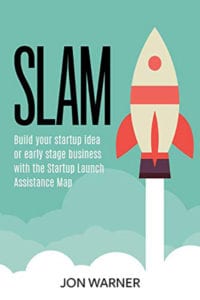
SLAM: Build your startup idea or early stager business with the Startup Launch Assistance Map
What you’ve created here, Jon, I believe is almost like a Sherpa helping someone climb Mt. Everest. Without a map, without someone like you with all your expertise and guidance saying, “Do this then do this. Don’t do this out of order.” It’s like you’re trying to help somebody bake the cake who’s never baked a cake before. They forget to preheat the oven or they don’t put all the ingredients in them or whatever it is and then they wonder why it doesn’t rise. You have given a proven step-by-step process that’s so valuable. I’m sure there are many people who wish they’ve had this earlier in their career, but the good news is it’s available now. You’re sharing your wisdom, your expertise. The book is called SLAM. Tell us how else people can work with you?
I spend my time mentoring startup organizations of all types. My passion space is healthcare and within that, I particularly like the 50-plus population and companies that are solving for all the unmet needs for people who are 50 and more. They tend to get marginalized by society. There are many needs and not in healthcare. It’s in many other realms at the same time. Anybody who’s got a side hustle ideating around this or a small company that’s thinking about the older adult community I’m particularly interested in working with. I run a virtual incubator every quarter. Eight companies come into that virtual environment. We make a six-week sprint to go and go through the SLAM process.
That’s something they can look upon the SilverMoonshots.org website. It’s listed right there. I’m happy to engage. I’m happy to explain the SLAM process. Some of the resources, the actual map itself, both front and back, are on the website at SlamProcess.com. Those are free resources for people to download all of the questions and all of the eight steps on the SLAM slide are there. You can turn it over when you’ve got product-market fit and validation and go to the execution side, the GRAND side, and hopefully get a GRAND SLAM over time.
It does become your Bible what you’ve created for people because it’s done with so much thought and visual. It is so well done and so well executed. Congratulations on that. There’s a whole video that goes with it, a map. You’re like the GPS for businesses.
I hope it’s a good tool to help people explore. I hope people don’t think of it as a cage. It’s an enabling tool I hope to explore your idea.
Thanks for being with us, Jon.
I appreciate it.
Important Links
- SLAM
- Jon Warner
- Silver Moonshots
- Zero to One
- Bernie Swain – Past episode
- SlamProcess.com
- Better Selling Through Storytelling Method Online Course
Wanna Host Your Own Podcast?
Click here to see how my friends at Podetize can help
Purchase John’s new book
John Livesay, The Pitch Whisperer
Share The Show
Did you enjoy the show? I’d love it if you subscribed today and left us a 5-star review!
- Click this link
- Click on the ‘Subscribe’ button below the artwork
- Go to the ‘Ratings and Reviews’ section
- Click on ‘Write a Review’
Love the show? Subscribe, rate, review, and share!
Join The Successful Pitch community today:
- JohnLivesay.com
- John Livesay Facebook
- John Livesay Twitter
- John Livesay LinkedIn
- John Livesay YouTube
Pursuing A Life Of Significance With Aaron Walker
Posted by John Livesay in podcast | 0 comments


Having money, a big house, and a profitable business can lead to a fulfilling life – or so we all think. In this episode, discover what a life of significance truly means as you learn from life and business coach Aaron Walker. Successful in business, Aaron first experienced retirement at the early age of 27, but it did not scratch an itch he thought it would. Learn how pursuing a meaningful life led him to masterminds and a podcast, and his “why” in writing his book, View from the Top.
—
Listen to the podcast here
Pursuing A Life Of Significance With Aaron Walker
Our guest is Aaron Walker who is a life and business coach and runs masterminds for men. He’s a veteran businessman. He continues to inspire countless entrepreneurs with his leadership skills and his transparent and authentic life. His purpose in life is to mentor men to be better versions of themselves. Having more than 40 years’ experience and more than a dozen startups allow him to lead with confidence. He is the author of View From The Top, Living A Life of Success and Significance. He shares practical insights and wisdom on how you too can find hope and inspiration. He has an amazing real life-story that will challenge your thinking and motivate you to action. Aaron, welcome to our show.
John, thanks for having me.
Would you mind taking us back to your own story of origin? I would love to find out what made you who you are. You can go back to your childhood, high school, college or whatever grabs you.
I’m going to take you way back. I’m almost 60 years old now so I’ve got to go back to when I was thirteen years old. My dad woke me up on a summer morning and he said, “Get out of the bed. We’ve got some work to do. We’re going to go down and we’re going to remodel a pawnshop.” I said, “Can I make any money?” He said “Yes.” I said, “I’m all in.” I didn’t even know what a pawnshop was or know what that was, but I went down and helped him for the summer. When we got through doing that project, I went up to the owner at the time and he was 23 years old. This guy was opening a pawnshop in Nashville, Tennessee, where I’m a native. I said, “I don’t even know what a pawnshop is but I go to school across the street and I would love to work here after school and on the weekends.” He hired me on the spot. I worked every day and then on Saturdays and two years later when I was fifteen years old, I decided this is what I want to do for a living.
People asked me, “You’ve got to be kidding. What did you enjoy about it?” I said, “It’s the people. I love the different people that came in.” I went to summer school and night school for eighteen months. I had enough credits to graduate at the beginning of my junior year. I started working every day and I met a couple of guys with a lot of money because I didn’t have any. My parents were very poor and I didn’t have any money. I went to them one day and pitched us going into business together and they laughed at me. They own the 21st largest insurance agency in the country at the time. I said, “Why don’t we take my pawnshop experience and your money and open a store?”
They said, “Mr. Walker, how old are you?” I said, “I’m eighteen.” They started laughing again. They said, “We’ve never had anybody eighteen years old approach us.” I said, “That’s beside the point. Are you interested?” After two months of negotiation, they agreed to do it. I went and opened a pawnshop when I was eighteen years old. I wasn’t even married. I was still living at home. A year later, I get married to Robin and I said, “We can’t mess this up.” We agreed to pour every dollar back into the business. In 36 months, I paid off a ten-year loan. I was 21 years old. I had a paid-for-business and I said, “I can duplicate that.” I did and then I did it again and then I did it again.
When I was 27 years old, a Fortune 500 came and made an offer I couldn’t refuse and I retired. I was 27 years old and I thought this is the American dream. I go from broke and a convict to making enough money to retire by the time I’m 27. That lasted about eighteen months. I got fat and lazy, I was getting in the bed in the middle of the day and Robin goes, “This is not what I signed up for.” I went back and bought the company I worked for when I was a kid. We spent the next ten years quadrupling that business. As I shared with you a little bit earlier, I had a very serious accident in 2001 where I ran over and killed a pedestrian. It rocked my world when that happened. I sold the business. I took off for about five years and didn’t do anything. We traveled around the world. We built a new house and took a break.
My wife approached me again and said, “You’re getting fat and lazy again.” We go into the construction business. We build a very successful construction company. I turned 50 and I retired. Robin goes, “You’re going to drive me crazy if you don’t do something.” The mastermind members of mine, which is Dave Ramsey and Dan Miller and some of those guys said, “What are you going to do now?” I said, “Nothing. I’m going to retire. I’m going to call it good. I’ve been working since I was thirteen.” They said, “You’re too young.” I started coaching. That led to doing podcast interviews which led to mastermind groups. Now, we have fifteen mastermind groups, 150 men from nine different countries. I’m having the absolute time of my life helping people be successful and significant.
That is quite a lot to unpack. I love the story of the fantasy that, “I’m going to retire at 27. I’m going to retire at this age.” There’s something about not being relevant and not giving back that I think you are probably more equipped than almost anyone else because you’ve gone through this multiple times. It’s almost like in the Wizard of Oz when you go behind the curtain and you say, “That isn’t it. That’s the fantasy.” You work hard to get to this place where you don’t need to work and then you can find a life of significance. You’re saying it isn’t the answer.
It’s not the answer at all. I thought it was, and I want to warn people, if you’re working to stop, quit doing that because it doesn’t scratch the itch like you think it’s going to. I thought by being a poor kid that I was going to have enough money, this big fine house, a vacation home, nice cars, that I was going to feel meaningful and purposeful and I was going to live a life of leisure. Quickly, I discovered that it’s not what I thought it was going to be. Don’t hear me wrong, John, I want to make this clear. I hate when people with money go, “Money is not important.” I want to go, “You liar.” It is important but I don’t want you to make it your only focus. I don’t want you to make it your God. Focus on why and your purpose in life, then you have something that’s tangible that you can hang your head on.
[bctt tweet=”The Facebook persona, for the most part, is just a lie. People don’t really share the things that are going on in their families.” username=”John_Livesay”]
Aaron, what motivated you to write your book, The View From The Top? The thing that I love about this is not just success but success and significance.
To be totally honest with you, I didn’t want to write the book and let me tell you why I didn’t want to write the book. As I said, I’ve been in a mastermind with these guys that are here in Nashville. We all live in Nashville, Tennessee for decades now. Sitting on my left for ten or twelve years was Ken Abraham. Ken is probably the most noted ghost author on the planet. If you look him up, you can see he’s written over 95 books and some of the biggest name people on the planet. He’s written their books. He had sold millions and tens of millions of copies of books and sitting on my right was Dave Ramsey.
They’re all good friends of mine. Anyway, Dave has written a dozen books and sold millions of copies and Dan Miller sat across the table from me. He has 48 Days To The Work. He’s written seven or eight books. I said, “Who’s going to read my book?” I’m in this group, with all these people that are very successful, who’s going to read my book? Ken Davis did my mastermind group and Ken wrote a book called Fully Alive. He’s traveled all over the world. He’s a keynote speaker. He’s an amazing guy. He said, “Aaron, you’re writing the book for the wrong reason.” I said, “What do you mean?” He said, “When I wrote Fully Alive, the first year it came out, seventeen people wrote me an email and they said, “Mr. Davis, I didn’t commit suicide because I’ve read your book Fully Alive.” He looked at me and he said, “Aaron, if you can change one life with your book, will it not be worth it?” I said, “You’re right. It’ll be worth it.” I’m going to write that book because now the reason is different. Now, I write the book to help people uncover for themselves what’s important in life. I teach them how to be very successful financially, all the while being significant. That’s the piece that people are missing.
I have loved this concept. My own personal mission is to help as many people as possible get off this self-esteem rollercoaster where they only feel good about themselves if they’ve gotten a certain amount of success or book sales or whatever it is, likes some social media. What I hear you saying is when you let go of that attachment of how many books did I sell and that is it more than this person and comparing yourself to other people, you are free to create something with a very different purpose without the attachment to the outcome. Would that be an accurate summary?
100% and first of all, you’re never going to win in a comparison game because I even almost did it at the beginning myself when I looked at Ken Abraham and Dave Ramsey. I said, “How could I ever compare to this?” I couldn’t compare. After the book first came out, a guy that was in my mastermind group, his young son picked up my book and read it and there was a life transformational experience for him as a result of reading this book. He got onto a different path. He was on some substance abuse and he couldn’t get off of it. This book helped him reframe his life. I got a phone call from him and said, “Thank you for your book because it’s radically transformed my life.” I went in and told my wife, “If nothing else happens, if I don’t get any speaking engagements, if I don’t get anything, if nothing happens, it’s changed this one man’s life, his family tree.” It was worth the effort. It was worth the time.
You touched earlier on the pedestrian fatality that you didn’t intentionally cause, but it did happen. A lot of people would not be so transparent and authentic about that and yet you are. I want to bring that up for people to take a look at that blind that we’re only as sick as our secrets or people can always tell when you’re trying to hide something. People who haven’t experienced something like that, we all have something that we have trouble forgiving ourselves for, I would imagine. I know someone who that happened to him as well. He did it as a young boy. First of all, I have several questions about it clearly. I want to acknowledge and applaud you for your authenticity and transparency because when you are willing to do that, you inspire other people to do that. My first question around is what made you so confident to do it and tell that story?
First of all, by being around very successful people and coming to discover early on in my career that the Facebook persona, for the most part, is just a lie. We don’t share the things that are going on in our families. Everyone sees is the nice house, they see the nice car, they know you have this job and you’ve got 2.3 kids and you’ve got 3.7 cars and you’re living this thing. They’re not privy to the conversation that’s going on inside of the home. Inside of the home, one of the partners is working more than they should and they’re doing it at the expense of their family. They come home one day with a pocket full of money to a house full of strangers. What I’m teaching people to do is to prioritize your priorities and focus on what matters. The only way that you can do that is to be authentic and transparent and vulnerable with a few people.
I’m not saying go out and air your dirty laundry to the world but I am saying that you need a group of people around you such as a small group, an accountability group, a mastermind group or a connect group. You can call it whatever you want to call it, but you need an environment where you can go and go, “Things are not going so well right now. I’m struggling in my relationship. I’ve got a child that’s gone wayward. My job is on the bubble. I’m not even going to have an income a few years from now. I’m not making my mortgage payment. I’m wrestling with these trials and tribulations in my personal life and I don’t know where I stand as an individual and I don’t have this self-esteem or this hyper sense of awareness to myself and I’m getting myself in trouble.”
The reason that I am so authentic and transparent is that’s where strength begins. When we address who we are as an individual to a group of non-biased, trusted advisors, they then can help us. If they’re giving us advice on things that we’re telling them that’s not reality, how in the world could we ever get good advice to go forward and build on a solid foundation? I’ve had the privilege of experiencing that with a number of very successful people. That’s why I come forward with telling my story.
Authenticity and transparency are where strength begins. That’s such a powerful way of combining something that people think, “It doesn’t seem like you’re coming from a place of strength at all,” but in fact, it is. Was it hard to forgive yourself and any other insights from that experience?

A Life Of Significance: People struggle to have enough money and material things thinking that they’re going to feel meaningful and purposeful. Disappointingly, many discover that it’s not what they thought it would be.
It’s been eighteen years and the first five years were very difficult. I had to go to a lot of counseling and talking to a lot of trusted advisors to help work me through this. First and foremost, I do want to mention, it was not my fault. It wasn’t an error of judgment. He didn’t see me. He was 77 years old. He was crossing the street to catch a bus and we found out later he couldn’t see good and he run right out in front of me. It was a very horrific automobile accident. Still, he was somebody’s father, somebody’s husband, somebody’s brother and it took me years to work through that.
What I come to realize working through that is how fragile everyone’s life is and in the book, View From The Top, the chapter that I talk about this, I call it Blindsided. We all can be blindsided. There’s not a person listening to my voice right now that a phone call might not change your life. Something could happen that’s devastating to your life. You may get a message or a note or a phone call that you never saw it coming. What I discovered through this accident was that we had had tremendous success early on but it was all about me and my family. What I started thinking about was my legacy. I said, “What would my legacy have been?” My legacy would have been, “A poor kid from Nashville, Tennessee makes enough money to retire at age 27 and nobody cares.” I said, “That’s not what I want. What I want is I want John’s life to be better as a result of having known me.” That’s the reason I share this.
That leads right into the never-ending power of a mastermind. You were talking about how you started your own and now you teach other people how to create them. Tell us the journey of masterminds and how people can either possibly start their own or join yours to find out.
I appreciate that and I want to touch if I may on some of the reasons that I think being in community is so important. You call it accountability mastermind. You can call it whatever you want to call it. We weren’t designed to be in isolation. Isolation is the enemy of excellence. We’re designed to be in community and we need people around us at all times. First of all, for accountability purposes. If you think about it, we need people calling us out. We need a sense of encouragement today. We need people to come up to us and say, “John, I believe in you. I know you can do this.” We can find that in the community. We need relationships which I think is the most important asset that we could possibly have. We all have blind spots and a lot of people are unaware of those. We need people to call us out and say, “John, I’ve noticed that you’ve saved this. I noticed that this is going on frequently in your life. This is going to catch you if you’re not careful.” We have people pointing that out.
I also say that masterminds give us access. It allows us to be in other spheres of influence. We talk about the insight that it can give you. We talk about perspective. What it gives me more than anything is the ability to see things differently. There are so many things like that that we have insight, different things that we need in our life that we would never have in a million years. It’s the insight that it can give us. There’s spiritual health that we need. There’s vision, there’s mission, there are values, there’s so much that this community or mastermind can give us.
That’s the reason that I am on such a quest to be sure that everyone is involved in this. People call me regularly and they call me big A. They say, “Big A, how in the world have you scaled masterminds to the level that you have?” We developed a program called the Mastermind Blueprint. What this is, it’s teaching people if you’ve never even had a mastermind how to start it, how to grow it and how to run it. A lot of people want to scale it to the heights we have. Other people just want one or two groups. If you start thinking about your sphere of influence and the impact that you could have on other people’s lives, you could start a mastermind and impact and have life transformational experiences for the people you know.
Yours is called Iron Sharpens Iron. What a great visual that is. Describe how you came up with that as a name.
I’m a Christian by faith. A biblical proverb is Proverbs 27:17, “One man sharpens another just as iron sharpens iron.” I’ve had the privilege to be in these groups where they call you out. They call you out and say, “I’ve heard you say this or I’ll watch you do this or you don’t do this.” In order for you to get better, these are the things that you’re going to have to do. It’s not for the faint of heart. We need people in these groups that are willing to call one another out and we just decided that if we’re going to help other people accomplish their dreams and goals, there have to be some sparks flying. That’s why we call it Iron Sharpens Iron.
What a great analogy. You’re only focused on men. If there are women that are reading and say, “I would like to start a mastermind for women,” could your program work for them?
Let me explain that a little bit. Some women get offended by this and let me explain and hopefully you won’t be offended. Women have become our biggest advocates because they say, “Big A, you’ve done something with my man. What have you done? He is not the guy now that he was when he joined ISI.” There are women’s groups out there. Michele Williams has BVU, Better Version of Yourself, a mastermind for women and does the exact same thing. I can introduce you to Michele. I’m happy to do that but our course is gender-neutral. If it’s women, if it’s man, if it’s mixed, it doesn’t matter. We can walk you through the process. We give you two and a half years’ worth of content to teach you and to help you along the way. You don’t have to create anything. We give you the lead magnets. We walk with you for six months, twice a month. You have support from us that gets you up and going. We don’t leave you. Once you buy this, we walk with you through the whole process.
[bctt tweet=”Isolation is the enemy of excellence. We need others to help us break our upper limits because we all have blindsides we need help seeing.” username=”John_Livesay”]
For people who might not understand the distinction, can you compare this to mastermind versus a networking group?
For group coaching or things like that, this is a whole different level. This recaps what I’ve been talking about the whole interview. You can do group coaching, you can do networking but you just deal with the surface level when you’re talking about networking. I’m talking about something that’s life transformational, personally and professionally. I’m talking about people that walk with you on a weekly basis to help you accomplish your goals, your dreams and to hold you accountable, to connect to you and to give you the resources that you need in order to be successful. I could stand up here for an hour and give a dissertation or I can lead a group coaching but that is not going to have the same impact if you get in a group and you’re meeting with the same ten trusted advisors week in, week out, month after month, year after year our people have in our groups. We’ve had people to double, triple and quadruple their business. We’ve had people that have absolutely transformed their personal lives because they have this close-knit community, their board of directors that walk with them every single day.
You talk about that isolation is the enemy to excellence. Many people don’t realize the importance of having a tribe or not doing it alone all the time. Can you speak to why isolation is the enemy of excellence?
If I don’t fess up and I don’t tell you, then there’s no one checking in. If I don’t push the ball down the field, no one knows. Brian Moran wrote a great book called The 12-Week Year and we’ve implemented that into the very fabric of what we do. You focus each and every day on these lead indicators. You focus on the task. You have weekly accountability meetings related to the objective that you’re trying to accomplish. You repeat that every twelve weeks. Procrastination is the enemy also. We continue to procrastinate and this doesn’t allow you to do that. We have people around you and that surround you, make sure that you focus on the task at hand and then the goal takes care of itself.
The reason that the isolation is the enemy to excellence is if you don’t tell anybody, they don’t know. If you don’t share your troubles, you can’t get over your Achilles heel or your blind spots. When you have people surrounding you, they can encourage you, they can help push you through these upper limit challenges. We all have upper limits challenges. It doesn’t matter who you are. We all have a threshold that we bump up against the ceiling and these people can help take you to a different level. It opens doors and possibilities that you never dreamed possible. I would just suggest that if you want to excel, you have to get involved in some topic community so that you can be all that you were called to be.
We all have upper limit challenges and it’s from our childhood and our belief systems. If we’re not associating with other people who can hold us accountable, show us where we’re limiting ourselves, whether it’s a belief or a behavior that needs to be changed, then we will just stay at our own upper limits there. I imagine that part of this successful mastermind is the quality of the people that are in it. Can you speak to what criteria you use when you help people develop their own mastermind?
When we first started doing mastermind groups, if you had the fee you could get in and I quickly saw that wasn’t going to work well. We developed an application process that we go through and we do an interview. We vet every single person that comes in and we turn away a number of people because they’re takers, they’re not givers. What we are trying to do is to fill up a room full of givers because in the natural reciprocity, you’re going to get all you need. When somebody is interested in themselves, they only want to come in and get out of it, if it’s only beneficial to them, that’s not how you grow. That’s not how you build relationships.
We take a look at the motivation of why you want to be into groups. Once we establish that you are the giver, then we go through a series of questions. There are about 25 questions. How we can help you? More about your family. What you’re trying to accomplish? What your long-term goals and aspirations are? It’s a very lengthy process and then once we worked through each and every question, we determine whether you’re a good fit for this group or not. When you’re very careful vetting this many people, getting the right person in the right seat, as Jim Collins says, on the right bus, there’s the magic that happens when you have that level of synergy.
You certainly are walking your talk and hats off to you for that. Then taking it one step further and allowing people to not just hear about it but learn how they can start and run and scale their own mastermind. I haven’t seen or interviewed anyone else who’s doing that and you’re taking your own success and not just showing people, “Here’s some fish, learn these life lessons.” You’re teaching them how to fish, which is such a great gift because you’re scaling the scaling.
Someone asked me, “Why do you do this? Why don’t you just continue to add mastermind groups, other facilitators?” There are seven billion people on the planet. We have 150 people in our mastermind. I have an abundance mindset. If you have an abundance mindset, you’re willing to show your cards. I don’t hold them close to my vest, I’m like, “First of all, I live it and I do it and you teach it.” We’re at the stage in our career where now we’ve lived it, we’ve done it and now we’re teaching it.

A Life Of Significance: Masterminds give you access to be in other spheres of influence and the ability to see things differently.
How can people follow you? I know the website is ViewFromTheTop.com. If someone has been motivated and said, “I need to learn how to start my own mastermind,” what’s the next step?
The easiest way is to go to ViewFromTheTop.com and I make myself very accessible. My phone number is there. My email is [email protected]. Reach out and send me a note and I’ll personally give you a call and we’ll talk through it. I’d love to be able to share with you more as well.
I can’t thank you enough for sharing your time, your wisdom and your passion. You are someone who I’m glad to have in my world.
Thank you, John. I certainly enjoy being with you.
Important Links
- View From The Top
- 48 Days To The Work
- Fully Alive
- Mastermind Blueprint
- Iron Sharpens Iron
- Better Version of Yourself
- The 12-Week Year
- ViewFromTheTop.com
- [email protected]
- Better Selling Through Storytelling Method Online Course
Wanna Host Your Own Podcast?
Click here to see how my friends at Podetize can help
Purchase John’s new book
John Livesay, The Pitch Whisperer
Share The Show
Did you enjoy the show? I’d love it if you subscribed today and left us a 5-star review!
- Click this link
- Click on the ‘Subscribe’ button below the artwork
- Go to the ‘Ratings and Reviews’ section
- Click on ‘Write a Review’
Love the show? Subscribe, rate, review, and share!
Join The Successful Pitch community today:
- JohnLivesay.com
- John Livesay Facebook
- John Livesay Twitter
- John Livesay LinkedIn
- John Livesay YouTube