

The Right Hustle With Rajesh Setty
Posted by John Livesay in podcast | 0 comments


Many people say you won’t get far without hustle. In truth, it’s not just hustle that will take you far; it has to be the right hustle. John Livesay is joined by author and entrepreneur, Rajesh Setty as they discuss what the right hustle means and how you can achieve it. Rajesh talks about his early forays into writing and the rejections, and ultimately, the first book he sold. He also discusses connecting with people, generosity, and the art of learning.
—
Listen to the podcast here
The Right Hustle With Rajesh Setty
Our guest is Rajesh Setty who talks about his course, The Right Hustle. The big question is, do I care about what you care about? It is the genesis of every relationship he has. Finally, he says, “What is your GQ?” Find out what GQ stands for. Enjoy the episode.
—
Our guest is Rajesh Setty who is Silicon Valley’s secret spark plug from startups to scaleups. He loves to bring meaningful ideas to life via startups like Audvisor.com and MentorCloud.com. His books include Six Foot World and Smart, but Stuck. He also has a course called The Right Hustle. Welcome to the show.
I’m super excited. Thank you for having me.
You’re one of those people that pulls people in. Your magnetism, kindness and creativity are all so inspiring, and people want to be around your energy. I’m curious to know a little bit about your own story of origin. You can take us back to childhood or when you were in school. How did you discover this passion for bringing ideas to life, not just generically but doing it with love?
It was not by design, for sure. By the time I was four, I had started reading all sorts of books. Anything that went past me, I would read it in multiple languages. In India, many people grew up with many languages. I love reading. By the time I was about nine, I had read about 700 books. Most of them were useless books, according to my mom, because they were thrillers, fantasy, adventure, spy thrillers and murder mysteries. You name it, I would read it.

The Right Hustle: Everybody talks about hustle and get things done. Whenever the word is used, the connotation is you have to network to get something. That’s the wrong hustle.
When I read that many books, most of them were fiction, I used to think, “I know what happens in this book.” I know this is what will happen, but most of the time, something else would happen, and I would get frustrated with myself, not with the author, saying, “How can I not guess what it is?” After some time, I thought, “My forecasting powers were good. Authors were making a mistake, and they should have done it this way.” I then got frustrated with them. I said, “The only solution is I should write my book because I can make the characters do whatever I want and the story to develop however I want it to develop.”
I went on a journey for over eight months. I never wrote a poem. I never wrote a short story. I wrote a novel, which was more than 200 pages. My parents thought something was wrong with me. My parents thought I copied it from somewhere else. For me, I thought, “How many people would write a book when somebody is nine years old? I’ll send it to a publisher. I’ll get a red carpet welcome and my books will be in the bookstores, and I will be a celebrity.” That was what I was thinking. Nothing remotely close happened.
The moment I picked up the phone and called the publisher in my baby voice, the first thing is they click the phone back thinking somebody is doing a prank or somebody is playing games. I would call them back again. At that time, there was no internet and in our home, there was no phone. I had to go to a grocery store nearby where there’s a public payphone booth that I had to put money in, and then I had to dial. I keep dialing again and I said, “Please don’t hang up. I’m an author.” Until I say, “Never call me again or I’ll call the police,” or something, I’d keep trying. Long story short, I was rejected 160 times over 3.5 years.
That’s a lot of rejection. Why did you not take it personally?
[bctt tweet=”What is your GQ – Generosity Quotient?” username=”John_Livesay”]
Earlier, I would think they’re making a mistake. They’re wrong. I would think that I’m not getting the right person. I was experimenting with myself. After some time, I realized something is not right. I reframed it thinking, “Everybody gets rejected maybe 200 to 300 times. I’m still not there. Let me finish my rejection quota so that I will get to the right one quickly.” I used to keep on reframing to my convenience. That’s what I used to do.
Whatever story we tell ourselves that keeps us going is the key. Whether it’s overcoming a physical challenge in sports or an illness, our dream is going to happen sooner than later.
I still remember the time when I got a book deal. I was physically meeting a publisher and I gave them the manuscript. By that time, I had built a network of my own because when I get rejected, I reach out to other people, “How do you do it?” You build relationships and I got a referral to this publisher. I went and they said, “This is interesting. Let me take a look.” He turned on the side and then he started reading it. I was a thirteen-year-old kid so I don’t know whether to stay or to leave because he didn’t ask me to leave. I was standing there for about two hours. He forgot that I was there. He finished reading the book, he turned around and said, “You’re still here.” I said, “Yes, I’m here because you didn’t tell me to leave.” He said, “I’m sorry. I’m going to take this. It’s a good book. How much do you want?” That is one question I was not prepared for. I had no idea what to say. With great thought and a lot of stupidity, I said, “I need ₹100.” ₹100 is $1.50, so you can imagine what I asked for. He said, “Are you sure?” I said, “Yes. That is what I want for this book.” He picked up the money, gave it to me and said, “We have a deal.” That was a game-changing moment for me.
That’s a great story and an example of hustle. That leads to my next question, which is you have a course called The Right Hustle, which is this fine art of moving the needle and that it is an art form. It’s not just push, push, push. I love that you talk about choreographing actions, which to me implies that there’s some preparation and thought that goes in before you jump in.

The Right Hustle: We have more tools than ever before on this planet that will make you get closer in the spirit and in the mind.
My thinking is that everybody talks about hustle and get things done. Whenever the word is used, the connotation is you have to network to get something. I think that’s the wrong hustle. The right hustle is to network to give something. You don’t have to get all the time because there’s a universal accounting system that will take care of the checks and balances and all the accounting system. Your goal is to give something meaningful. When you reach out to someone, and you connect with someone, make sure that you give a gift rather than trying to get something from them. How do you do it? That’s the whole thing about the right hustle. What will give you the platform, power, strength, skills and abilities so that you are always giving?
One of your many books is called Six Foot World. How did you come up with the title?
This is probably the first book that got published about the pandemic. As soon as the pandemic was onset, within three months, I wrote and published the book about what might happen. I’m usually often wrong but never in doubt kind of person. I said, “I might be wrong but there is something wrong that is happening here.” People will be caught off guard. I had a friend who is a publisher who took a chance on me. The reason I wrote Six Foot World is when the pandemic was onset, people say, “You need to maintain a 6-foot distance.” I said, “This thing will continue for a very long time.” Several of my friends said, “This is nonsense because it will end in three months, and then this book will be irrelevant quickly.” I said, “I don’t think so.” They said, “Why do you think this is?” I said, “I’m not a doctor and I’m not a futurist, but I studied linguistic philosophy for 7.5 years. When the phenomenon experience is described wrong, everything about it will be wrong or the assessments will be wrong.”
Why do I say it? If you think about it, every big disaster that we have had, the society came back as if nothing happened after a few years post the disaster. That happens on 9/11. Post 9/11, things didn’t come back to normalcy. They underwent a permanent change. The security systems got bolstered, pilots would lock themselves up in the cabin. There is red, blue and all of those kinds of signals. Everything changed. Why? It’s because there is a switch in the internal world that said, “Who knows? One among us may be a terrorist.” Once that switch is internal, the change externally will be semi-permanent.
[bctt tweet=”Be timeless, relevant, actionable, curated and knowledgeable.” username=”John_Livesay”]
Even the concept of social distancing as opposed to physical distancing, I thought once you start flipping that switch that people should be afraid to be connected or be near each other socially as opposed to just stay 6 feet apart. If we’re socially distancing, then it becomes a whole other level of psychological distress. My favorite analogy is one of the worst things they can do to prisoners is put them in solitary confinement.
The post-traumatic stress that people have been experiencing by social distancing, in other words, feeling so isolated from friends and family and meeting new people, once that is switched, it’s going to take a while to heal and recover from that. In this 6-foot world that we’re living in, even after everything might go back to some fewer restrictions in terms of distancing, mask and big events, what do you think is one of the biggest things that people can do? I love the image you have of the kitten is unprepared and the lion is prepared.
If you think about it, we have never met. We both are talking but we never felt that we’ve never met, isn’t it?
Right.

The Right Hustle: The easiest thing to do, whether you’re connected physically or not, is to ask only one question. Do I genuinely care about what they care about?
I’m sure we have many friends like that that you never met, but you always feel connected to them. I always think like this. We have to learn to live in a world however physically disconnected we are, but in the spirit and the mind, we should be fully connected. I’ve worked with several people in my life. One of them is my illustrator, Ming, in Malaysia. I’ve been working with him for around twenty years, but I met him only after sixteen years of working with him. I never felt that I was disconnected because it has to be in the spirit. The easiest thing to do, whether you’re connected physically or not, is to ask only one question. Do I genuinely care about what they care about?
Are the values aligned?
Once you do that, then the physical distance is distilled because we have tools like Zoom and all those things. We have more tools than ever before on this planet that will make you get closer in the spirit and in the mind.
Since you’re all about promoting new ideas, it creates new needs for new projects. For example, when I was speaking to the Olympus Medical sales team, I went from a live event to a virtual event, they said, “Can you also add in some training on how to look and sound good on Zoom calls?” That was never a need before. How do we sell on-camera versus being in person? All those little tips suddenly create another need. If one goes away, another one comes up.
[bctt tweet=”When you reach out to someone, make sure that you give a gift rather than trying to get something from them.” username=”John_Livesay”]
If we think about it, there are only two things. People have concerns or when they are taking care of their concerns, they have breakdowns along the way. That’s what my philosophy teacher taught me. The concerns and the breakdowns while they’re taking care of those concerns are never going to go away as a concept. As soon as you make a change, then the concerns are not going to go away. New concerns will get formed.
Speaking of new concepts, let’s talk about Audvisor, brilliant in three minutes. How did you come to get involved with this startup?
Let’s look at the trend. The trend is people are going to think that they have less and less time. They don’t have less time. I can guarantee you that. They will think they have less and less time. Why? It’s because they’re always connected with people who will want to sell them advertisement or sell them stuff and all those things, but they don’t know that. They always think they’re always connected and it’s a privilege, but it’s a privilege for people who will sell them something. In the process, their time is getting lost and then it becomes this, “I don’t have much time to study. I don’t have much time to grow. I’m always doing something.”
Globalization is not helping, which is you can follow the sun. This means when you sleep, somebody else is working. When they are asleep, you are working and you can do the handoff. In reality, both of them are awake all the time, saying they’re in coordination and all those things. My thinking is with these many changes, the need to learn and grow has never been less. It has to be more and more, but if they have less time, how do they get to learn from some of the world-class experts or top experts? If the only method is to digest your entire book, it’s not possible because you don’t have the time. What if I get the world’s best experts, more than 100 of them, and give their best advice in three minutes or less with zero fluff?

Six Foot World: How to Reimagine the Future in Disruptive Times
It’s laser-focused. Let’s give an example. I recognize so many of these experts who have been guests on my show, everyone from Sam Horn, Dorie Clark to David Meerman Scott, a lot of many smart speakers, thought leaders and authors that people can say, “I don’t have time to read their whole book but I would love to get the essence of it.” It is so powerful. This concept of TRACK is a wonderful acronym. Can you walk us through what that stands for?
It stands for Timely, Relevant, Actionable, Curated Knowledge. It has to be timely and relevant, which means if it has to be relevant for a long time, then the experts or authors that we work with should give timeless advice. That means it should stand the test of time. It has to be actionable and it has to be curated knowledge. Our goal is to deliver the highest wisdom per minute. People say that we want you to spend a lot of time with our app. I said, “No. Don’t spend a lot of time with our app. You can spend 15 minutes per week or even a month. It’s good enough for you.” Why? It’s because we have abstracted the best wisdom in the least possible time, deliver it on the audio, which means that you’ll be eyes-free and hands-free. Just press the button and you can listen to it. There is no excuse for not doing it. What will you say? “I don’t have fifteen minutes a week?” No. You just start to have the discipline.
One of the things I love about Audvisor is that you say, “We perfectly curated a playlist just for you.” I talk to people all the time about the need to think of their brains as a playlist with stories. You don’t have 1 or 2 stories that you tell over and over again. You have multiple stories like a playlist, but in this case, instead of a song, it’s a story that’s relevant to the person you’re speaking to. That requires a lot of practice, curation and being able to have access at a very fast amount of time, “I need to tell this person this story at this moment for them to see themselves in it.” The same thing is true if you start training your brain to absorb a short amount of information, then you can give a quote from someone or something you learned that’s keeping your own knowledge relevant, timely and actionable. People think, “How do you have time to read all these books?” It’s almost the old premise that leaders are readers or readers are leaders, however you like to say that. Now, this is a way to stay cutting edge without exhausting your energy and time.
If you think about it, what is the biggest blind spot that everybody knows but it’s very difficult to do anything about it? It is what you don’t know that you don’t know? You don’t know what to do about it because you don’t know that you don’t know.
[bctt tweet=”Everything that’s there is red, blue, and all of the signals. Everything changed.” username=”John_Livesay”]
You’re in the dark. It’s like when I needed to learn how to make special effects on my virtual presentations. Before that, I didn’t even know that Ecamm existed so I didn’t know what I didn’t know. How am I going to make a Zoom call to 300 or more people engaging, and I didn’t know what I didn’t know? Once I became aware that that was a potential tool, then I had to make the decision, “Am I willing to invest the time and money in it because of my own passion for doing something cutting edge and giving my audiences the best possible experience to keep them engaged?” There’s a whole premise of getting people up from unconscious and competent to “I’m aware that this exists,” to “When do I take action on this? Do I wait until everyone’s using it? Is this a requirement? Do I want to be the kind of person that gives something to people while it’s still new because the wow factor is incredible, and then that’s what makes people remember you and refer you?”
It was one more step deeper. If you think about it, if somebody watches you in action, unless they talk to you in person or in a coaching conversation or sometimes read your book. Let’s say they’re brought you in to help with a big sale. They say to you, “Whatever you want to take inside. We have a $2 million deal. Can you come and help us?” You took that assignment, and then you deliver the best possible pitch. If they don’t know that the underlying theme was how to construct a story with exposition, conflict resolution route. If they don’t know this, they will just conclude, “John is so awesome and he tells amazing stories.” If they say, “Now that you saw him in action, can you please repeat it?” They can’t because they don’t know the ingredients that pertain to what made you awesome. Unless they work with you, read your book or something, it’s not automatically by watching. Nothing happens because that’s only the tip of the iceberg.
I’ve helped an architecture firm, Gensler, win a billion-dollar airport renovation in Pittsburgh. The criteria there was, “We’re going to hire the firm we like the most because you’re all qualified to do the work.” They were like a deer in headlights because they’re used to pitching their designs and hoping that’s enough to win the business, “Likability? Where do we even start?” In addition to helping them tell case stories instead of just presenting before and after pictures of other airports, I worked with them on the team slide to craft a story of origin from each person that made them likable, memorable and gave a sense of their own. It’s one thing to say, “I’m somebody who doesn’t give up.” It’s another to show it a story.
All of those little techniques are something that people can learn and work on. If we start at, “We don’t even know we need to tell stories,” to “Now we know the basics of a story but we still need to be at the blackbelt level of it.” If we’re the only ones telling a story and our competition isn’t, odds are we’re going to win. In this case, they did. If other people start telling stories, then you’re like, “That’s the table stakes. That’s the minimum. Now I have to be a master storyteller to tug at heartstrings.” It’s an ongoing process and your solution Audvisor is certainly another way for people to stay one step ahead of what other people are thinking and doing.

Smart, But Stuck
This is the art of learning as well as a discovery platform. A discovery of what you think you should know, but you didn’t know that you should. For example, if you talk to somebody, let’s say the person on the Wolf of Wallstreet, Jordan Belfort. He will talk about straight-line selling. Maybe that’s useful but if you didn’t even know that such a thing existed that you could use that tool somewhere, you’d have no idea. Maybe it’s about frame control. How do you control the frame? If you didn’t know there was a concept of something called a frame, how will you do it? I created a term called hunger engineering, which means way before you sell something, you have to create the hunger for them to want it. If you never think of it, then you have no clue. They are not tools. First of all, you should know the concept exists, which means somebody has to describe it and put words to it.
I want to talk about your talk, Know Your GQ. I was like, “IQ, EQ and GQ is a fashion magazine.” You have a new definition here of what GQ is. Give us a little hint of what that means so we incentivize to go watch your talk on that.
I gave this talk years ago called Practical Generosity Quotient. I always talk about generosity because that’s a complete advantage that anybody can have with simple changes to their mindset, skillset and the way they do their relationship building. The practical generosity quotient is very simple. It’s the ratio of the capacity you added to the capacity that was needed by someone to make a meaningful thing gets done. For example, somebody wants to write a book. We know the capacity that is needed was 100. Somebody comes to return sixteen books and said, “Can you help me here?” I said, “No problem.” When you want to write a book, you pick a topic, go to Amazon and search on the topic. See the books that come out and look at the top three ones. Read them and you’ll get inspired.”
Be as advised. The capacity you added was 1 out of the 100 that was needed. I can do this very same thing differently. Somebody comes to me. I know what is required for a publisher. It’s like a proposal. I have the best proposal template that anybody can have. I select it and do the proposal. I’ve given talks about writing a book. I’ve written a book about how to write a book fast. I have a video course material and a book called Writing Zero. I give them all of those and say, “Why don’t you take a month or something, read it and then we’ll have a discussion over breakfast or Zoom. I’ll help you come through the content. I’ll create a mind map for you.” Now the capacity I added was way more than 50 out of 100. Imagine if everybody did this to the other person by the PGQ. How much capacity are they’re adding to the capacity that was needed to get a meaningful project or meaningful action done? It will be a different way we look at the world.
It is indeed a wonderful new way to look at the world. Your startup or many that you’re involved with Audvisor, one of your many books, the Six Foot World, one of your many courses, The Right Hustle, and now the generosity quotient. Thank you so much for sharing all of this wisdom with us. If people want to follow you on social media or find out more about the book and the course, where should we go?
My website, RajeshSetty.com.
Thank you so much. It’s been a thrill and an honor to get to spend time with you.
Thank you so much, John.
Important Links
- Rajesh Setty
- The Right Hustle
- Audvisor.com
- MentorCloud.com
- Six Foot World
- Smart, but Stuck
- Sam Horn – Previous Episode
- Dorie Clark – Previous Episode
- David Meerman Scott – Previous Episode
- Know Your GQ
- Practical Generosity Quotient
- Writing Zero
- Better Selling Through Storytelling Method Online Course
Wanna Host Your Own Podcast?
Click here to see how my friends at Podetize can help
Purchase John’s new book
John Livesay, The Pitch Whisperer
Share The Show
Did you enjoy the show? I’d love it if you subscribed today and left us a 5-star review!
- Click this link
- Click on the ‘Subscribe’ button below the artwork
- Go to the ‘Ratings and Reviews’ section
- Click on ‘Write a Review’
Love the show? Subscribe, rate, review, and share!
Join The Successful Pitch community today:
- JohnLivesay.com
- John Livesay Facebook
- John Livesay Twitter
- John Livesay LinkedIn
- John Livesay YouTube
Wisdom At Work With Chip Conley
Posted by John Livesay in podcast | 0 comments

When you were young, you had kindergarten. When you were a teenager, you had high school. When you were a young adult, you had college. What happens when you reach midlife? Research says that midlife starts at 35 and ends at 75. Does learning stop at 35? Is that why people call it a midlife crisis? Join your host, John Livesay, and his guest, Chip Conley, in this discussion about why being middle-aged is just bad branding. Chip is the Founder of Modern Elder Academy and is the best-selling author of Wisdom at Work. Learn all about the Modern Elder Academy and why Chip created it to fight off the negative stigma of midlife. Also, learn the difference between retirement and regeneration, diversity, and so much more.
—
Listen to the podcast here
Wisdom At Work With Chip Conley
Chip Conley, the Bestselling Author of Wisdom at Work and the Founder of the Modern Elder Academy. He said middle age has bad branding. It’s not just a crisis. We talked about the difference between retirement and regeneration. When you are as curious as you are wise, you are a modern elder. Enjoy the episode. On this episode’s guest is Chip Conley who is a Rebel Hospitality Entrepreneur and New York Times Bestselling Author. He disrupted his favorite industry twice. At 26 years old, he founded Joie de Vivre Hospitality, which transformed an inner-city motel into the second largest boutique hotel brand in America. He sold that after running it as CEO for 24 years.
The young founders of Airbnb asked him to help transform their promising startup into the world’s leading hospitality brand. He served as Airbnb’s head of global hospitality and strategy for four years and now acts as the company’s strategic advisor for hospitality and leadership. His five books have made him a leading authority at the intersection of psychology and business. He was awarded the Most Innovative CEO by the San Francisco Business Times and is the recipient of the hospitalities highest honor, the Pioneer Award. He holds an MBA from Stanford and is also, where we are going to get into, the Founder of something that I’m extremely impressed with called MEA, the Modern Elder Academy.
—
Chip, welcome to the show.
John, it’s great to be with you. Thank you.
You have so many words of wisdom. My favorite book of yours, Wisdom at Work is just something I have read multiple times. I usually don’t have the time to read a book more than once but it’s become a resource for me. Before we get into how you’ve got to be so dang smart and wise, let’s go back to your own story of origin. Tell us, childhood or your days at Stanford, wherever you want to start.
I grew up in Southern California in Long Beach. I wanted to be a writer and an entrepreneur and my dad said, “Entrepreneur, yes. Writer, no. Writers are poor and psychotic.” Ultimately, I became an entrepreneur and a writer. I was a rebel, of course, but I went to the College of Stanford. I went to business school at Stanford. I’ve got an MBA. About 2.5 years, out of Stanford Business School at age 26. I decided to call my new boutique hotel company Joie de Vivre. It is not easy to say, spell or even know what it means in America. French for Joie de Vivre. That was our mission. Our mission was to create joy. I figured, “Why not have the name of the company and the mission of the company being the same.”
I started with a broken-down motel in the Tenderloin in San Francisco and grew that into 52 boutique hotels around the State of California over the next 24 years as the Founder and CEO. It became the second-largest boutique hotel here in the US. I loved it until I hated it. There was nothing in between for 22 years. What happened was, I was starting to love the writing more. The third book I wrote was called PEAK: How Great Companies Get Their Mojo from Maslow. It became a bestseller. I started giving speeches on it, and then the Great Recession came along in 2008. I didn’t want to do this anymore. I didn’t want to be founder and CEO anymore but I didn’t set up the company to have a succession plan.
The Great Recession started to wipe us out and I had a bunch of other stuff going on. I had a difficult couple of years around 47, 48, 49 years old. Finally, I’ve got to the places that I’ve got to sell this company. I did it during the recession. What’s fascinating is it allowed me to say, “I now am without a resume, without a job and identity.” It was weird. I felt naked. That’s the time that the three founders of Airbnb came along. A couple of years ago, I joined them and it was a small tech company. Nobody in the company had a hospitality or travel background.
[bctt tweet=”DQ, Digital Intelligence, also requires EQ.” username=”John_Livesay”]
That was a fascinating journey, helping them guide the rocket ship in a 70-hour week. I only did it for four years. While I was there that I came to realize, they were calling me the modern elder behind my back. I wasn’t sure if I liked that. It sounds like modern elder lee. I was mentoring Brian, the CEO and Joe is the Cofounder. He said, “Modern elder’s as curious as they are wise.” That’s what led me to where I am now. When I left my full-time role and became a strategic advisor of the company, it gave me the space to write Wisdom at Work: The Making of a Modern Elder. While I was writing that down here in Baja, where I had a home on the beach, I had a Baja a-ha and epiphany. That’s when I decided, “We’ve got to create MEA.” That’s a quick summation.
There are a couple of things that stood out for me. “I loved it until I hated it.” Twenty-two years, it was joyful. I can’t help but think about personal relationships, marriages, partnerships, or any relationship with something. Not everything has to last forever for it to be a success. We could be in those relationships with ourselves and go, “It’s time for something new.” It doesn’t mean that it wasn’t great or that I’m a failure at this just because I don’t want to do it anymore.
We all evolved and there are things in life that we think will be permanent but nothing is permanent, including ourselves. We die at some point. Your reputation could live on. There’s a famous Developmental Psychologist named Erikson. He says, “I am what survives me.” I like that. It speaks to legacy. Your legacy and your reputation can live on. There are things in life that have to have an end. I didn’t think I would have an end with the company I started but I had a flatline experience. I died multiple times after having an allergic reaction to an antibiotic that I was on. I died on stage, even worse, it was right after giving a speech in St Louis. It was that moment at age 47, almost 48, where I just said, “Something is not working here.” There were a lot of things that are not working. It allowed me to step back and say, “This is the wake-up call for this hotelier.”
I have a phrase that I would love your opinion on, which is, “If not now, when?”
What that phrase does is it says stop procrastinating and stop optimizing for some perfect time because often, the perfect time is now.
The concept of a Modern Elder is as curious as they are wise, I have found that people I know who are fully alive in their ’80s, friend of mine turned 90, she has always been someone extremely curious. That doesn’t stop just because we get older. That need to keep learning and stay on top of what’s going on and have an opinion about something makes me want to dive into what you are doing at the Modern Elder Academy, which is creating, first of all, a safe space for people to be vulnerable. Would you say that’s accurate?

Wisdom At Work: Your legacy and your reputation can live on, but there are things in life that have to have an end.
That is very accurate. This is particularly important for men. Let me give you the background on what it is the Modern Elder Academy and then we can dive into what we do there. While I had this big Baja a-ha reading on the beach, what came to me was the following, why do we not have any schools or tools, rites of passage or rituals for people in midlife? Midlife has a bad brand because we slapped on midlife crisis. That’s the term that everybody associates with midlife.
Sociologists say midlife now extends from 35 to 75. It’s starting earlier than in the past. The past was 45 to 65. Why is it 35 to 75? Why is it a marathon? It’s partly because in certain industries if you are a software engineer, an advertising executive, a model, a professional athlete, there are a lot of industries where people feel over the hill at age 35. Similarly, there are a lot of people who are not going to retire at 65. They are going to live longer. They are going to work longer. If midlife is 40 years long, what do we have to help people through that period? That’s why we created the world’s first midlife wisdom school, the Modern Elder Academy down here in Baja.
Our program is dedicated to what we call long-life learning. We like lifelong learning but long-life learning is a different thing than lifelong. Lifelong learning, says, “At age 30 or 60, you are learning something new.” It doesn’t suggest that maybe what you want to learn and how you learn it is different at age 60 than at age 30. Long-life learning is based on the premise that as we are living longer, we want to live a life that’s as deep and meaningful as it is long. It’s not just about filling your head with knowledge. It’s having the curiosity to figure out what is valuable to you and how can you be a value in the world. How do you cultivate and harvest your wisdom and repurpose it in new ways?
We like to call this same seed, different soil. You have a seed inside of you but the question is, “How do you go out?” Let’s use examples rather than being abstract. My seed was my company. I became one of the better-known hospitality executives in the US as a boutique hotelier. I sold that company. I still had that seed. I thought my seed was exclusively knowing the hospitality business and travel. What I didn’t realize is that seed was wisdom around leadership and entrepreneurship. When I was asked to go to Airbnb, they thought they wanted me for my hospitality knowledge but Brian Chesky has said to me many times, “What we’ve got was not just my hospitality knowledge, we’ve got your leadership and entrepreneurship wisdom.” That’s the same seed, different soil. How do we help people at 45, 55, 65, maybe even 75 take that wisdom, that seed and make it relevant to other people out there in the world?
What you are offering and the success stories that I have seen from being on your email list and watching you on social media is using one of the genres of storytelling that I love, which is this rebirth. It’s a Wonderful Life is an example of a movie that rebirth. Even Prudential at one point had a campaign about your retirement is not a continuation of middle age, it’s your third act. It’s time for a rebirth. That concept, as you said, there’s no transition. Otherwise, it feels like, “I’m in middle age, going to feel and do the same things I have been doing since I’m 40 now that I’m 62.”
That is so helpful to give people, as you said, these same seeds, different soil. For myself, I have looked at it from a standpoint of I have a sales career. I was successful at Condé Nast and other companies. You are like, “What else?” I have given a TEDx Talk. Larry King interviewed me. Now, I have different things to help people with, not just help them win new business. A lot of people have a dream of giving a TEDx Talk.
[bctt tweet=”Midlife has a branding problem.” username=”John_Livesay”]
A lot of people would love to be interviewed by the press. A brand is all storytelling. What story do you tell the press? What story do you tell in a TEDx Talk? It’s a very different story than you speak to an audience of salespeople. Uncovering different parts of our skillsets, in your case, you are like, “I know hospitality.” No, you also know leadership and entrepreneurship. These are things that, especially young people, need and value. You have completely given people a reframing instead of feeling awkward or embarrassed that they are older. You should want this.
There are a couple of thoughts here. Do you know that 40% of Americans have a boss that’s younger than them? If you are 55 years old, 70% of 55 years old have a boss younger than them. By the year 2025, the US Department of Labor predicts that the majority of Americans will have a younger boss. What does that mean? We have never had this. This is a new phenomenon. We never had it before. It’s partly because people are living longer. Sometimes when they get older, they say, “I want to work part-time.” They can’t be the boss anymore. It’s also because of digital intelligence, DQ is more important.
Brian Chesky, CEO of Airbnb and I had a trade relationship. I offered him EQ. He offered me DQ. I was able to offer him some emotional intelligence. When I joined Airbnb, I was 52. Brian was 31. He was my boss. I was his mentor. That’s an unusual situation. What’s beautiful about it is that we had something to teach each other. Here’s your mentorship. Here we have these young digital leaders creating companies that are becoming billion-dollar companies almost overnight and yet they need to microwave their emotional intelligence and leadership skills because they have never been in this situation.
How do we create an alliance between younger and older? These are leaders such that we can be there to support them and help them be better leaders. I’m proud of Brian. I have been working with him for many years. He’s now a public company CEO, Airbnb. Airbnb’s value is worth more than Marriott, Hilton, Hyatt Intercontinental and Wyndham combined, whether it should be worth that to be determined, the fact is what it’s worth. This is a company that has grown to that point. Here’s a guy who went to design school at the Rhode Island School of Design, had no business background at all, and is now leading that company as a public company. Good for him. I’m proud. He’s like my son.
What you are describing, in my opinion, is the EQ that you brought to the table gave him a frame of reference that he didn’t have because he was either too young or it wasn’t part of his skillset yet. Without that frame of reference, you are almost, as a mentor, a Sherpa. “I would climb this mountain before. This is the path we want to avoid. You will get frustrated spinning your wheels here. You need to have this philosophy about hiring and firing people because you will hold on to somebody too long.” It’s not producing whatever the skills that you have been through. You could go, “I don’t have to reinvent every wheel myself. You have been up this mountain before. You can save me so much time.” I love that.
The other thing that I find so fascinating about you is, we both have been interviewed by Ageist Magazine, which you have to be over a certain age and be comfortable with what your age. We are also both openly gay men. I find that everyone has a journey. I think to myself on that journey, two years apart in age, me being 62, the premise of coming out, whenever you do that is one thing. You go, “I’m so much freer than I have this ‘secret.’” Back in the early ’80s, that was not as comfortable to be in the Corporate America world as it is now.

Wisdom At Work: Whenever anyone has to water down or dilute who they are to accommodate the majority, especially the dominant power, they risk losing some diversity and even creativity.
Now, a lot of people feel like they have to keep their age a secret. I thought to myself, “No, you need to come out about your age as well and own that.” Otherwise, you are walking around with another secret. There are few people that I can have this conversation with. Even if you don’t happen to have the coming out of sexuality issue. Many people will be reading this and they are going to be talking about it in terms of whatever age. I feel old over the 35 already. I wanted to bring that up as a topic for you. Even myself, I had to go, “If someone doesn’t want to hire me as a speaker because I’m this age and I’m openly gay, then that’s fine but I’m not going to pretend to be somebody I’m not to get a job.”
I want you to write a wisdom or blog post from a guest post for me on that subject. It’s a great idea. Let’s start by saying, “Whenever anyone has to water down or dilute who they are to accommodate the majority, especially the dominant power or forces, we have a risk of losing some diversity and even some creativity.” This is what I said to the world. We need to have an annual Be the Other Day, BTO because everybody needs to learn what is it like to be in a non-dominant power. It helps people to understand, “I can walk a mile in your shoes.”
I understand if you are a woman in a male-dominant place, an LGBTQ person in a place that’s predominantly heterosexual, a person of color in a place that’s predominantly white, as you said, a person who’s older in a predominantly younger workplace or vice versa. The younger person who feels like they have to almost act like they are five years older than they are, the thing that we need to help people with is the idea that having those diverse voices, there’s so much evidence that diversity on teams on average is better as opposed to worse.
If you are a diverse person on the team but you feel like you have to act like a man, it’s because you are a woman, a white person because you are a black person, a straight person because you are gay, a young person talking as if you rap, that’s 62 years old. That process, if it’s not genuine, if it’s coming from a place of muting who you are, it’s not good for the organization and certainly not good for yourself. I love the idea of coming out with one’s age. It is a very much topic we converse about here at the Modern Elder Academy and especially in our MEA Online class, which is on the website. We definitely go into that topic a lot.
There are six different kinds of ways to engage with the community. One, you mentioned, you don’t even have to go down to Baja. You can connect with the community online. You have these wonderful two weeks or longer sabbaticals. Let’s hear what that’s like.
Sabbatical Sessions was a pandemic project because we had to close down on March 15, 2020, pandemic came along. Six and a half months later, we reopened with what we called Sabbatical Sessions. It’s people coming for extended stays. We have had people come for as long as three months. At a minimum of two weeks, the intent is to give people the space to reflect. The programming we have is much less intense. It’s a little bit each day and it’s all optional. It’s three spectaculars, healthy and delicious meals a day. We are on the beach. We used our campus for a different use, instead of our very intensive, emotionally, physically, intimate workshops, which didn’t feel quite right during COVID. It’s been really popular. There are a lot of people who come for two weeks and say, “I’m staying for 4, 6, 8, then 10.” They keep extending. I hope they don’t have a pet dog at home.
[bctt tweet=”Regeneration, not retirement.” username=”John_Livesay”]
You mentioned that the workshops can be somewhat intense. Who are the workshops for and how would somebody know if that’s something they need?
What we often say is that our purpose as an organization is to help people to navigate midlife transitions. Let’s face it. There are all kinds of transitions that happen in their life. They were not careered once. You have a career or a job transition. You can lose your parents. If you have kids, you can become an empty nester. You could be in the sandwich generation, taking care of your parents and your kids at the same time. You could go through menopause or men go through something called andropause. You could have a divorce or the end of a long-term relationship. There are a lot of things that happen in this period.
A person who is well suited to come to MEA or do the MEA Online course is probably somebody who’s in the midst of transition. A lot of people, with the pandemic, are in the midst of transition. Our workshops here in Baja are based upon the premise that, “You come for a week. There’s a core curriculum that’s 75% of the program of the week. You are in a group of 18 to 20 people. The other 25% is whatever the theme of the week is with the guest faculty member.” The theme could be money, dating and relationships, purpose and legacy, and mindfulness. There are a lot of different kinds of workshops we have, average ages 54. A large percentage of our people here in our Baja campus are on some form of scholarship we give them, which is great. We have a diverse collection of people. Over 60% are women. We want more men. Men have a hard time being vulnerable. A lot of men, not everybody, that’s the program. Now we have bought a ranch, 2,600 acres just outside of Santa Fe. We are working on that campus. Hopefully, we will have a campus in Santa Fe as well.
I know for myself when my dad died years ago and I was still in the throes of working in Corporate America, how intense that was. You had your own health challenges. A lot of us haven’t had that health challenge but when a parent dies, that is a huge wake-up call. I would think a lot of people could use some transition of a wake-up call for your mortality when a parent dies.
Death is one of the things we don’t talk a lot about in our culture and yet it is so inevitable, just like taxes. Helping people to make sense of it, we even have a workshop with Michael Hebb. We started an organization called Death Over Dinner, which is how to have dinner conversations around the subject of aging and death. This guy is in his mid-40s. We are in our late 40s. It’s about around 45 or 50 where people start to think about a little bit more for themselves because of their parents, partly because their own body starts to run down in certain ways. It’s a very important subject. It’s also something you don’t want to be paralleled in Harold and Maude who gets a little obsessed about it. Death is a beautiful organizing principle for life. It helps you to understand how you want to live your own life but it is not the purpose of life. The purpose in life is not dying like the purpose of running a marathon. It isn’t necessarily hitting the finish line. It is having the sense of accomplishment of running 26.2 miles, the enjoyment, and hopefully, the endorphin high along the way.
When I interviewed Alison Levine, the first woman to ever climb Mount Everest, she said, “It’s just ice and rocks gang at the top. That’s not what it’s about.” You think you are going to get there to have some amazing epiphany. The other thing that I’m so impressed with is when someone goes to the Modern Elder Academy, they have the opportunity to be part of this alumni membership. Even if they were not there when some other people who had been there before them might have some wisdom to share, you suddenly are tapping into not just the people you are interacting with when you are there but the entire legacy of all that collective wisdom. It must be an amazing value for people.
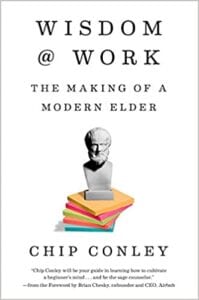
Wisdom at Work: The Making of a Modern Elder
When we were doing the beta program three years ago in the first half of 2018 here in Baja, we are trying out MEA to see if people like the idea of the one-week workshops. We used that two-week workshop then. We found that one week was better. The number one thing we heard from our beta participants was, “Where’s your alumni program?” That was a good sign. If the number one question is the alumni program that says, “Whatever we were doing, was working.”
We now have 1,250 alumni from 25 countries who are part of the alumni program. We have twenty regional chapters around the world. The most active one is in Australia and New Zealand. It’s a great collection of people. There are three ways you become an alumnus. You come down to do a workshop here in Baja. We are reopening for workshops until Thanksgiving, do Sabbatical Sessions in the meantime or you do MEA Online, which is the easiest way to become an alum because you do it from home. It’s the most affordable. It’s an eight-week course. That is easy to accomplish and very connected. Most online learning courses are boring and nobody finishes it. We call it digital intimacy. How do we help? You are in a cohort of six people and you feel a sense of digital intimacy by feeling the sense of connection with your small group and your cohort.
You just dropped a really another great value bomb there. I want to underline it for readers, which is when your customers, clients, whatever you want to call them, tell you what they are looking for, that’s your social proof that you should create something. Listen to what people are saying they want or need and would be willing to see value in or pay for. I wanted to underline that. The last thing I want to ask you about is this wonderful pillar of regeneration. You hinted at it in terms of form, soil, seed and putting the same seed in different soil. For their soil, there’s a soul, community and locale. Would you mind touching briefly on that? How can people get a sense of how that would be another compelling reason to integrate that? If one of those is missing, it’s like a stool without enough legs, I’m guessing.
Here’s the idea. In some ways, we are disrupting two industries. Having been a disrupter twice before, I can promise, you become an entrepreneur to be a disruptor. You create something that starts to disrupt. There are two things we are disrupting with MEA. One is higher education. Why are we disrupting or what? How are we disrupting higher education? Clay Christensen, the famous thinker who was unfortunately passed away, said years ago, “Half of the American colleges and universities will go out of business in the next years.”
That was even pre-COVID. COVID has made it even harder more than go out of business. We are disrupting higher education by bringing college professors and academics to the area of long-life learning and midlife learning. What if some of these college campuses that are going to go out of business became a midlife wisdom school? What if alumni can no longer give enough money for a particular campus? It’s gorgeous. It has been around for 120 years. What if that university says, “We are changing our model.”
Instead of dealing with people 25 and younger, we are now in midlife wisdom school. You can get a one-year certificate and you do a gap year. That’s one thing. Secondly, the other thing we have noticed and listened to, is people said, “I love coming to MEA. I want to live this lifestyle year-round, not just one week a year when I come to visit you.” That’s when we started to think, “Let’s create a residential community.” Instead of it being a residential community, we decided for it to be a Regenerative Community, not a retirement community.
[bctt tweet=”Stop procrastinating and stop optimizing for some perfect time because often, the perfect time is now.” username=”John_Livesay”]
What is the Regenerative Community? It has a regenerative farm. It’s better than a sustainable organic farm because it enriches the soil. It does what’s called carbon sequestration, which is good for the climate and has better crops. It’s not monocropping. Instead of a fairway in the center, like in a retirement community, there’s a farm in the center. We have an academy. People come here to learn. If you are in this community and you are buying a home around the farm, you also have a school there. While you may not go to workshops every week, of course, you are not going to do that, there are some collateral benefits to being where the school is.
There’s a famous speaker, Brené Brown is coming to town. She’s going to be giving a workshop for a week, David Brooks, or Paul Hauck. You can sit in on a public lecture that this person is going to do. Plus, other programs as well. Soil is the farm, the soul is the sense of regeneration people have. Community is our broader MEA community, living in an intentional community with a bunch of homes and people who all have similar interests. Locale is wherever we go to do this, we want to be a net positive benefit to the community.
A lot of times, if you think about retirement communities now, they have walled off their gated communities. Everybody there is 65 plus, and often 80 plus. There’s no sense of connection. This is not true of all of them but it’s true for most of them. They are not very connected to the community other than occasionally getting people on a bus and taking them to the shopping mall so they can go shop. Why aren’t there mentorship programs? Why isn’t there a co-working space intergenerationally in the retirement community so that old entrepreneurs and young entrepreneurs can be side by side and learn from each other? Aren’t other volunteers providing service from that retirement community in the broader community? In essence, we are creating a regenerative community. We will be disrupting the retirement community and senior living space. We are disrupting two things at once. Both of them, which is quite frankly ready to be disrupted.
As you are building this regenerative garden, that is a metaphor for people doing the same thing for their body and their mind. Also, the awareness of nature has cycles and seasons, not to resist one coming in the next. There are a lot there I’m sure quite wonderful. Any last thought or a quote from your book that you want to leave us with?
Here are a couple of thoughts. Let me define the word elder. In Modern Elder, they are curious as they are wise. An elder is different from than elderly. Elderly is the last 5 or 10 years of your life. Elder is a relative term. It speaks to who you are surrounded by. If you are an advertising agency and you are 42, you might be an elder. Similarly, if you are a software engineer and you are 40, you might be an elder around a bunch of people who have just joined MIT and know a whole new tech language.
The elder of the past, they were respected because they were perceived as being reverent. There was a revering the elders. You revered your elders. Now is not about reverence, it’s about relevance. The modern elder is not about being reverent to the modern elder, it’s about the modern elder being relevant. That’s why the curiosity piece is so essential. If you are not long-life learning, if you are not constantly learning something new, it’s hard to know how to take that wisdom you have and put it in the context of a bunch of people who don’t understand what you are saying because you don’t understand the tech business as I did. I joined a tech company at age 52, had never been in a tech company. That’s why my curiosity around tech was essential. Otherwise, I would be just passing out wisdom. I was talking about how many rooms a maid cleans in eight hours? That’s relevant to the hospitality industry of hotels but not Airbnb.
If people want to explore being part of that wonderful community, follow you, you have your own website, which is your name, ChipConley.com. Wisdom at Work is the book. Any other ways that you want people to follow you on social media or join your email list?
WisdomWell is one of the better ways. It’s a daily subscriber opportunity that is free. My LinkedIn profile is where we post almost all of those articles so you can stay at it. Keep an eye on it there too.
Chip, thanks for sharing your wisdom, not just at work but in your own life. It has been a joy to interview you.
Thank you, John. I appreciate it. I appreciate what you are doing in the world. You’ve got a great message.
Thanks.
Important Links
- Modern Elder Academy
- WisdomWell
- LinkedIn – Chip Conley
- Wisdom at Work
- Chip Conley
- PEAK: How Great Companies Get their Mojo from Maslow
- Alison Levine – Past episode
- Airbnb
- MEA Online
- Sabbatical Sessions
- Death Over Dinner
- Regenerative Community
- https://www.linkedin.com/pulse/im-coming-out-john-livesay/
- Better Selling Through Storytelling Method Online Course
Wanna Host Your Own Podcast?
Click here to see how my friends at Podetize can help
Purchase John’s new book
John Livesay, The Pitch Whisperer
Share The Show
Did you enjoy the show? I’d love it if you subscribed today and left us a 5-star review!
- Click this link
- Click on the ‘Subscribe’ button below the artwork
- Go to the ‘Ratings and Reviews’ section
- Click on ‘Write a Review’
Love the show? Subscribe, rate, review, and share!
Join The Successful Pitch community today:
- JohnLivesay.com
- John Livesay Facebook
- John Livesay Twitter
- John Livesay LinkedIn
- John Livesay YouTube
Business Mastery With Bill Prater
Posted by John Livesay in podcast | 0 comments


If you want to excel in business, don’t think like the players in your niche. Instead, figure out what the elite players do and emulate them. Joining John Livesay in today’s episode is Bill Prater, a business owner, entrepreneur, publisher, author, speaker, consultant, and coach. Bill is best known for his long-term success in enabling business owners and leaders to quickly eliminate personal barriers, rapidly reach their current dreams, and embark on a journey of business mastery. Today, Bill shares some insights on how you can think like an elite performer and dominate your market. Enjoy the episode.
—
Listen to the podcast here
Business Mastery With Bill Prater
Our guest on the show is Bill Prater, who’s an expert at Business Mastery. He tells people not to use the same approach for all problems. He’s got some insights on how to dominate your market and how to think like an elite performer. Finally, he says, “Always be ignorant. Don’t be afraid to ask questions and stay curious.” Enjoy the episode.
—
Welcome to the show. Our guest is Bill Prater, who’s a business owner, an entrepreneur, a publisher, author, speaker, consultant, and coach. He’s best known for his long-term success in enabling business owners and leaders to quickly eliminate personal barriers so they can rapidly reach their dreams and embark on this journey of Business Mastery. His own story was that he was excelling in sales, sales training, and sales management at IBM in the computer division as a national sales manager and a partner in the country’s largest oil and gas securities firm. He raised more than $750 million of equity capital in eight years. He recruited, trained, and led more than 100 sales professionals and achieving average revenue growth of 100% annually. I know how hard that is. Bill, welcome to the show.
It’s great to be here, John. Let’s make this happen.
One of the things I want to ask about having sold multimillion-dollar mainframe computers myself earlier in my career is your own story about that. We can start the story before IBM. If you’d like, you can start with school, college, or wherever you got this passion for connecting and sales.
The connecting and sales lineage started back with me being a full-ride football guy at a university. I got a scholarship. I got hurt before the season started. After the first year was over, I had to figure out how to go to school on my own. I ended up working in the land surveying civil engineering field and made pretty good money that I thought, “Why bother going to school?” That’s my first relationship with the value of money. I ended up flunking out of school. I went back and saw the Dean of Men at the University of Washington. I said, “I like to come back into school because I’m a good guy,” and I went through my whole spiel. He said, “No. Why would I let a flunk out in the school when I have these eager young freshmen that want to come into school?”

Business Mastery: If you think you know the answer to something, go ahead and ask anyway. You never really know what you don’t know until you ask.
That was an excellent point. He vented. What he said is, “I’ll let you into night school if you get straight A’s, then I’ll let you go into the day school.” I said, “How do I get straight A’s?” He says, “I don’t know. Ask the professors.” He needs to know I’m dead serious. “Think this through. What kind of students asked the professor how to get an A?” I said, “Probably A-students.” He said, “You got it.” That was my first major learning about effectively, the art of asking questions or, better yet, asking for help. You and I have a sales background, sales management background. You’re stuck with it. I’m still in it, even though I don’t claim I’m a sales guy.
A big major lesson that I got early on is always to be ignorant. By that, I mean, even if you think you might know the answer to something, then go ahead and ask anyway. You’ll never know what you don’t know until you ask. Fast forward, I did ask the professors how to get A’s. I ended up getting straight A’s for the rest of my college career and graduating on the Dean’s List. It’s all because of that simple question, which I asked over and over again. It was amazing the kinds of things these people would do to help me get an A.
They know you’re that committed. What I love about what you said, “Always be ignorant. Ask anyway,” as opposed to assuming you know what the answers are going to be. I’ve helped some people when they’re interviewing for a job ask a question. At the end of every interview, people say, “Do you have any questions for us?” Unfortunately, a lot of the younger people might say, “When’s my vacation start?” I tell them to ask this question, “What would it look like if I were to exceed your expectations in this job?” It is another way of saying, “What do I need to do to get straight A’s?” Most people never ask a future employer that question, nor do they ask a professor that question.
When people are reading this, they can start to think, “What question am I not asking that I could ask that my competition is probably not asking? What set me apart?” Once you have that momentum going in any conversation, whether it’s a sales conversation or trying to get your team motivated to grow and scale, which is your expertise, it completely shifts in the box traditional way of solving things. Also, what I love about that story is your resilience. A lot of people would have given up. “You got a good point. Why should you give it to me when you got all these hungry freshmen? That’s too high a bar. Straight A’s? Forget it.”
[bctt tweet=”Allow yourself to be ignorant and ask questions anyway.” via=”no”]
There are lots of things that come out of that story that starts to give me a little more color and texture, almost like a painting coming to life. I know how hard it was to get a job at IBM. They would test everybody. If you think getting into college was tough, getting a job at IBM was tough. It was the best of the best. You just didn’t get a job. You thrive there. I’m sure there’s a little more context. I specifically want to know when you were at IBM, this premise of scaling 100% out of 100%, there are two things that come up all the time when I’m talking to people who are entrepreneurs, salespeople, or both. One is fear of rejection. The other one is, “I had my best year ever. How am I going to top myself?” That’s where the superstars like you shine, is the consistent growth, not just, “I have a great year. Don’t ask me about next year.” How do you start to help people with that mindset and strategy?
That’s exactly what it is. It’s the mindset. What it is that all of us were programmed as young people to act in a certain way. A lot of that becomes part of our subconscious. Since it’s in our subconscious, we’re able to deal with a bunch of stuff. We don’t have to think, “What color is that light? What color is red?” You know red means stop the car. You don’t process that through. A couple of points about mindset is that it had happened at IBM that I realized what my programming was.
When I was young, I remember vividly that when something would happen in the house where my grandmother lived with us, she’d say, “Billy, do something about that.” I didn’t have any idea what it was all about. I jumped up and took action. I didn’t think. I just responded. That’s lesson number one. I realized that in a company like IBM, there’s a lot of telling you what to do going on all the time. I decided, “No. I’m going to think this through, not be reactive and figure out how can I reduce the amount of time it takes to get something done?” If you remember IBM, they used to be greedy good at giving you performance appraisals.
I was a systems engineer to start with. I get in performance appraisal. My boss, his name is Dave, said to me, “Your score is outstanding.” I said, “That’s great. I’m outstanding. Now what?” He said, “What do you mean now what?” I said, “If I’m already at the top, what’s next to your point?” He flounders around a little bit, frankly. I got him in a box because I was outstanding. I said to him, “If I’m your number one systems engineer, am I the highest-paid systems engineer?” They don’t like to answer that question, but he did, unfortunately, and said, “No.” I said, “I don’t understand how I could be rated number one and not being the number one paid?”

Business Mastery: Most of us were programmed as young people to act in a certain way. A lot of that becomes part of our subconscious.
He went through. He got the old chart out. You’ve seen the charts of how many years and what your score is. The maximum raise you can get. It’s all a Mathematical model. He said, “The only way to get paid what you’re worth in IBM is to be a sales guy.” I said, “Okay, sold.” He said, “No, not so fast. You’re my number one systems engineer. I don’t want to let you go.” I said, “Dave, that is not a good answer. You’ve got it.” He says, “I’ll let you go to sales school if you finish in the top three.” I go, “Okay.”
I got the challenge of finishing the top three. I ended up finishing at the top one. I was number one in sales school. I came back, and I walked into his office. The school ends on a Friday, and I’m back at work on Monday. He doesn’t know anything about what happened. He said, “How did it go?” I said, “It went pretty well. When’s my sales job?” He said, “What do you mean?” I pull out my gold cross pen that has IBM on it and I hand it to Dave, and he uttered a nasty word. I said, “It’s time for sales.” He said, “You don’t want to go now. This is September. You’d have to have a whole half year’s quota.” I said, “Fine.” He says, “You don’t know what you’re saying. You got three months to do a full half-year.” I said, “I want to go now. You’re barking was if I did this, I get there.”
I ended up doing pretty well. I bought myself a Porsche in the whole deal because I completely shut it out. I shut the lights out. You and I talked before we got into our interview about cold calling. I figured I might as well go cold calling people. I don’t know anything else about what to do. I go. One of the very first people I banged on the door of, I walked in, and the receptionist said, “You’re with who?” I said, “IBM.” She said, “I’m sure that David wants to see you. We’re looking for a computer.” That was it.
Once you got into sales management, how did you keep the momentum going when your team would have a good year and the quotas would go up accordingly? This is why I was excited to have you on the show is we can go into this subconscious mindset. I feel from my observations that a lot of salespeople think when they’ve had a great year, it’s a fluke. Therefore, when you were asked to repeat it or exceed it, it’s the same thing for the business leaders you deal with, a new council. They don’t have a plan or a roadmap in place.
[bctt tweet=”Be curious to get insights.” via=”no”]
They say, “Everything started lined up as a perfect storm.” They had a big knee. They had a budget that they’ll never have again. “I can’t possibly find another client like that. With these numbers, I’ll never make it.” You take the mindset and the strategy. It’s not just one or alone. I wanted to get a sense from you when you work with companies. Companies hire you to pick this expertise and give them the scalability issue that you’re great at. Not just growth but dynamic growth. What is it that you do that helps people overcome their initial negative self-talk that they can’t possibly exceed the best year they’ve ever had in terms of mindset? What are they missing strategy-wise?
I’m going to finish up with mindset and then we’ll jump into strategy or positioning. A lot of what you asked me and a lot of the answers I deal with is the notion that we’re originally programmed or taught that we need to deal with the environment we’re put in or the hand that you’re dealt. You’re given a certain quota, a crappy sales territory, a sales team, but half of them are rookies. We can continue to list all of that. All of that, in general for all of us, you and I and the people that are reading, if you think about a bell curve, most salespeople, sales managers, business owners think of themselves as in the middle. In the middle is what’s called the standards or the averages. That’s the way you measure the middle of any industry.
The people that end up looking at the environment through the prism of being in the middle of the bell curve are going to stay in the middle of the bell curve. What you need to do mindset-wise, I found is you’ve got to figure out what the elite players in your niche. If you’re 1 of 140 salespeople, they’re not all performing equally. You don’t think the revenue of the company, divide by 140, and everybody does that Math thing. Instead, there are some super laggards. There’s the mass unwashed middle, and then there are the superstars. What are the superstars doing? One, they’re not waiting until they get their quota in the middle of January. They’re starting day one, minute one. Second, you remember this with IBM, every year, they had a different sales plan. The sales plan was designed to benefit the company called IBM.
They wanted you to sell certain things. They wanted you to add certain kinds of software and a variety of it. They put all that stuff in the sales plan. Step one, minute one, don’t deal with all that stuff, go figure out what the fastest path to the cash is, and go do that. It’s usually a machine they want you to sell etc. Number one is don’t think like the rest of the players in your niche, instead figure out what the elite players do and emulate them. Their mindset is one of mastery, dominance, excellence or extraordinary. Emulate that. Strategy is an entirely different thing than tactics, but a lot of people get that stuff mixed up. For example, a tactical thing to do is to make cold calls on the phone or send out cold emails.

Business Mastery: Once you’ve got the goal and assembled your resources, the next step is to execute.
The question is, why are you doing that? What’s the strategy? What’s the higher-order bid? What’s the reason that you have to go down the road you’re going down? Once you’ve figured out your reason or your strategy, then you can start doing tactics. Maybe cold calling is a perfect fit, but maybe it isn’t. Maybe, instead, what you want to do is go and interview your last year’s customers and have them tell you, for example, here’s the question, “Sir, I enjoyed working with you last year. How could I have served you better?” That’s the question I taught my people to ask. We went and interviewed all of our customers the previous year, ask them how we could do better, how we could serve them better. We got this huge list. We got our whole tactical plan from asking people, “How do I get an A?”
Were there many surprises? Were those things you knew you could do better and didn’t have the resources to do, or was it, “I had no idea that was something people wanted, so we weren’t doing it?”
Mostly surprises. Companies like IBM or Transamerica are large organizations. The senior executives don’t have a clue what’s happening on the street. The people that know what’s happening on the streets are the people that are on the street. Just because the sales plan or the missive from on high says, “X, Y, Z,” that doesn’t mean that something like, “P, R, Q,” is what you should be doing. The only way you can find that out is to ask people that are your customers. Prospects are going to give you the answers too, but they don’t have much context because they haven’t seen what you’ve done in the past.
This Business Mastery system that you’ve been doing for many years, helping companies, small and large, figure out a killer strategy, makes a lot of sense in that context. One of the things you have on here is this wonderful blog about What’s Stopping You From Getting Better Results Every Single Time?, as opposed to, “I’m going to try, be like a baseball player, and hit a certain percentage.” You’ve got four beautiful colored circles, things. Would you walk us through what those are? We’ve touched on them. I want to intrigue them to read this blog. If you described what the four things are and how they all keep going round and round to keep growing, it might be a light bulb moment for some people saying, “No wonder I’m missing this key part while I’m doing 3 of the 4.”
[bctt tweet=”Don’t think like the rest of the players in your niche. Instead, figure out what the elite players do and emulate them.” via=”no”]
Even using baseball or softball, either one analogy is a good place to start. Nobody told you that you had to have a good batting average. Your coach didn’t say that. Nobody said that. That’s not baseball. That’s not what it is. If you’re up for batting, what is the first thing you’re supposed to do? It’s not hit the ball. The first thing to do is get on base. How can you get on base? The ball can hit you then you go on base. You can hit the ball and have nobody catch it or throw you out at first. You’re then good on base, or you can walk. There are at least three different ways.
The point of it is to figure out how to get on base. That’s back to that comment about a tactic versus the strategy. The individual player, the job of the batter, is to get on first. They do have a term in baseball and softball called on-base percentage. That’s much more important than a batting average. It’s the same thing as though in business. What I discovered of a variety of things and I won’t go in order because frankly, John’s describing, it is a cycle, number one, and it fits for any size company in any niche privately held and republic he held but even more magically if it’s in every department in every company. Even more magically, it fits in every team in every department, in every company. It makes my life easier.
Those of us that are in sales is a practical matter. We’re a business owner. We have a geographical territory, some product niche, or specialty. All of that is an entrepreneur’s or business owner’s jive. We already talked about this concept of the environment. The environment is where all your resources are. That’s where you have your tools and potentially some team members. Most people operate their business, territory, job from the standpoint of whatever they have from a resource standpoint. For example, if you’re physically in San Francisco and an opportunity comes for you to service somebody in, let’s say, Baltimore, and you say in your mind, “I’m in San Francisco.” That would be resource restrictive that you’ve allowed yourself to be contained by your environment.
Instead, what you wanted to say in your mind is, “How can I service somebody in Baltimore at a high-quality level?” That’s one of these four phases, which is effective alignment, but most people put that a front of planning. It should be behind plan. Your plan should be the pick of the year. “I’m going to be 300% of quota this year. I’m going to grow my business by 300%. I get 300% more new customers.” That would be effectively an annual goal. Once you’ve got that, it’s time to look at what resources you do need. Not the other way around, make your decision about what you want to do first, then find the resources. For example, we could cold call. We could figure out a way to get a bunch of referrals. We could survey all of our existing customers and all of those.

Business Mastery: Dominate Your Market: How to Quadruple Revenue in Four Steps (Business Mastery Series Book 1)
The temptation a lot of people might have is they’ll hear an idea like that, and they’ll put it in action. It may or may not be a good idea. The way to do it is to do it after you’ve figured out what your goal, objective, or strategy is for the year. Once you’ve got the goal, and you’ve assembled your resources, next is to execute or go get into action and do stuff. Instead of being like, “I did with my grandma jumping up immediately when she told me to.” Think, gather your resources, then execute. The fourth phase is to figure out what in the world happened.
The answers are either red and you fell on your face. Green, you exceeded whatever heck you’re after doing. The third is some Amber or a yellow, meaning you’re just about okay. The cycle is to analyze your situation, figure out a new plan, gather the resources you need, execute. After you execute, analyze the result, adjust your plan, find new resources if you need to, then execute. It’s a cycle. All businesses, departments, projects, individuals with a sales territory, all people with some project that they’re managing, you should run them through that four-phase cycle I gave you.
When we clarify something, we’re not limiting ourselves to one answer, and you zero in on what do we want to focus on first. The thing that I love about this Business Mastery system you’ve created is the alignment. Not just executing without other people’s agreement, understanding. That’s crucial to what you’re doing that makes this fly so much. I did also want to touch on this wonderful quote of yours, which is, “Don’t use the same approach for all problems.” If you go to sales training like, “You get this objection, here’s the answer regardless of who’s saying it or what the situation is.” I don’t think that’s the case anymore. I tell people, “You’ve got to think of your brain like a jukebox with multiple stories ready to go depending on what the problem or the challenge is.” The fact that you talked about this is another wonderful blog about how you bring results to people. Give us a little taste of what this means in terms of some things that require more finesse etc.
Objections are problems. However, most of them are disguised. What I mean by that is most people that you’re having a sales conversation with are not very skilled at giving you quality objections. They may say something, but they’re hoping you’re going to go away. They’ll make a comment to see what you’re going to do. If you say, “I’d give up,” then mission accomplished. What teed up in my mind is whatever you hear from anybody is likely not a well-thought-out response. Sometimes it could be, but you simply need to practice this art of ignorance and say, “Could you elaborate more on what you mean by that? Would you flash that out more?”
[bctt tweet=”What’s stopping us from getting better results is almost always not asking questions or for help. ” via=”no”]
I don’t believe in a Rolodex type of thing where you get a certain question. You need to find that answer and deliver it. That’s what you get when you have a chatbot or something like that running on a robot. All you have to do is be genuinely curious. “I’m surprised you said that. Where did that come from? What’s the backstory of that?” That’s the key. The key is to be ignorant, don’t act like you’ve heard that before because maybe it isn’t quite the same and ask, “Tell me more. May I ask for more? Can you help me out here? I don’t quite get it,” things like that.
Are there any last thoughts? You have this wonderful book that people can get. It’s called Dynamic Growth.
In GetBillsNewBook.com, and you’ll get a chance to get the pre-publication version. It will give you a book form. It will encapsulate a lot of what we’ve been talking about here.
It’s called Dynamic Growth: How to position your business as a 24/7 cash-producing ATM. Who doesn’t want that? Bill, thank you so much for sharing your gifts, including this wonderful book, and more importantly, this awareness that when we’re curious and when we’re not pretending we know something, no matter how much experience we have, get our mindset and our strategy in place, there’s nothing that we can’t do together. Thanks again for being on the show. I’m looking forward to having all kinds of feedback on how many people are going to be giving me insight going, “That was a great episode. Thanks so much for having Bill on.” Nothing makes me happier than to have guests like you that have so much wisdom and a heartfelt passion for what you do.
Thanks, John. I appreciate it very much.
Important Links
- Bill Prater
- What’s Stopping You From Getting Better Results Every Single Time?
- GetBillsNewBook.com
- Better Selling Through Storytelling Method Online Course
Wanna Host Your Own Podcast?
Click here to see how my friends at Podetize can help
Purchase John’s new book
John Livesay, The Pitch Whisperer
Share The Show
Did you enjoy the show? I’d love it if you subscribed today and left us a 5-star review!
- Click this link
- Click on the ‘Subscribe’ button below the artwork
- Go to the ‘Ratings and Reviews’ section
- Click on ‘Write a Review’
Love the show? Subscribe, rate, review, and share!
Join The Successful Pitch community today:
- JohnLivesay.com
- John Livesay Facebook
- John Livesay Twitter
- John Livesay LinkedIn
- John Livesay YouTube