
The Blind Spots Between Us With Dr. Gleb Tsipursky
Posted by John Livesay in podcast | 0 comments


We like to think of ourselves as intelligent beings. After all, are we not the most evolved organisms on the planet? Sophisticated as our brains may be, they are specifically wired to be prone to a large number of cognitive biases that affect how we communicate and build relationships with other people. Whether you’re talking about business or personal relationships, falling prey to our cognitive bias leads to bad decisions and, ultimately, disaster. We have over 100 cognitive biases. Cognitive neuroscientist and Disaster Avoidance Experts CEO, Dr. Gleb Tsipursky, takes the 30 most dangerous ones for relationship building and effective communication and discusses them in his new book, The Blindspots Between Us. In this interview with John Livesay, he goes in-depth into the two most common and insidious forms of cognitive biases that we are constantly subscribing to, to the detriment of our business and relationships.
—
Listen to the podcast here
The Blind Spots Between Us With Dr. Gleb Tsipursky
Our guest is Dr. Gleb Tsipursky, who is the author of The Blindspots Between Us. He talks about the importance of emotions being like underwear, and that you don’t want to go commando into your next sales call. I love that. That was very playful and clever. He’s quite intelligent and talks about cognitive bias, which is when we think something is true, when in fact it’s false. For example, people buy illogically and then you throw out a bunch of information. He and I are definitely on the same page that people buy emotionally and that they need stories to pull them in. Find out what the other cognitive biases are that you might be doing and making mistakes that you can learn to avoid. Enjoy the episode.
—
Our guest is Dr. Gleb Tsipursky, who defends people from relationship disasters caused by dangerous judgment errors, known as a cognitive bias. He does this with consulting, speaking and training as the CEO of Disaster Avoidance Experts. He’s a Cognitive Neuroscientist and Behavioral Economist. He has over 550 articles, everything ranging from Fast Company to being in Psychology Today. He is a bestselling author known for Never Go With Your Gut. He is writing a book about resilience, which we all need about adapting to COVID. We’re going to be talking about his latest book, which is The Blindspots Between Us: How to Overcome Unconscious Cognitive Bias and Build Better Relationships. Gleb, welcome to the show.
Thank you so much for inviting me, John. It’s a pleasure.
Our mutual friend, Dr. Mark Goulston, lots of doctors, you’re a doctor, he’s a doctor, referred me and he always has amazing relationships and contacts. You and I had a chat previous to the show, and you have a very unique set of insights to share with us. Before we get to that, Gleb, I like to ask my guests to take our readers on their own little story of origin. How did you become you? Were you a little boy saying, “Someday, I’m going to become a doctor and figure out how to help people avoid disasters?” You can take us back to childhood, college, wherever you want.
I will take it back to childhood and it wasn’t quite about disasters. It was about decisions. That’s what my fundamental area of expertise. How do we make decisions go well? How do we make decisions badly? How do we avoid the bad decisions? When you look at disasters, disasters come from bad decisions. That’s where disasters come from. There are two types of decisions that lead to disasters. Either we actively make a bad decision, so our initiative causes a bad decision or a series of bad decisions that lead to a disaster, or we fail to foresee a disaster. We fail to foresee and take action, make the decision that would result in avoiding disaster. Those are the kinds of things that result in disasters. My interest in decision-making stems from my childhood, when I saw my parents making some pretty bad decisions in their personal lives. For example, my mom, she liked to buy nice clothing. She’d go out, she’d buy a $100 sweater. My dad was a cheapskate, so she’d come home and he’d yell at her, “No sweater should be worth over $20.” She’d bring up how he always leaves the toilet seat up.
Where did you grow up? Where is this happening?
This was happening already in the former Soviet territory of a country called Moldova, which was liberated from Soviet domination, Russian domination in 1991. That’s when my parents immigrated to the United States and that happened in the United States. I was ten when they immigrated. It happened definitely before that and afterwards.
It’s important to get that context. It’s fascinating for them to realize why your dad might be perceived as a cheapskate based on his background there, and now they’re in the States and still bringing some of those choices, beliefs and decisions. Even though you changed locations, your mindset sometimes comes with you.
[bctt tweet=”Disasters come from bad decisions.” username=”John_Livesay”]
That does not change. That basic dynamic between them did not change. I kept doing that and the thing is all throughout my childhood, both back in Moldova and in the United States, nothing changed. They kept doing the same things and they kept not changing their behavior. My mom kept buying nice clothing and my dad kept yelling at her. I grew up frustrated. It impacted me as a kid to see my parents fight over something so stupid. As a kid, I was seeing this stupid thing to fight over. Even more stupidly, there was no change. They kept hurting each other, dealing with each other to these emotional blows all the time, but their behavior didn’t change. My mom kept buying the clothing. My dad kept yelling at her and they kept having these conflicts.
I kept hoping that somebody would sit me down and say, “Here’s how I make good research decisions about communicating about your relationships with others,” but nobody did. In other life areas, there was nobody who taught me how to make good decisions. That didn’t happen in school. Not in elementary school, not in middle school, not in high school. Nobody taught me to make good decisions in college and that’s not taught in business school either. I became interested in how do you make good decisions? How do you avoid the bad relationship patterns and communication patterns that my parents fell into? I didn’t want that for my relationships. I didn’t want that for my professional life. I am the CEO of Disaster Avoidance Experts. As the CEO of a consulting, coaching and training company, I’m obviously in sales.
Dr. Gleb, can you define for us what a disaster is in business?
A disaster in business is anything that significantly impacts your bottom line in a negative way. Anything like that is a disaster and that’s what I wanted to help people avoid. Right now, as the CEO of Disaster Avoidance Experts, I’m obviously in sales. I know that there are many things, many of these dangerous judgment errors that harm the fundamental relationships that you have to build in sales and the effective communication that you have to have in sales. That’s something I learned as I went into the job of consulting, coaching, and training. Initially, I didn’t know anything about sales. I was fascinated with decisions and decision-making. As I learned about this topic, people started asking me about it and that’s how I began to be consulting, coaching and training on this topic. I’ve been doing that for over twenty years. I learned that there’s very little quality information available out there in the popular literature and the popular media on making good decisions. It boils down to go with your gut, trust your intuitions, follow your heart. The Tony Robbins, be primal, be savage, that’s unfortunately incredibly damaging and causes people to lose sales all the time and make very bad decisions about everything from selling to storytelling to all other areas of business.
What’s the biggest mistake people are making when they’re trying to sell someone?
The biggest mistake people are making when they’re trying to sell someone is going for their mind as opposed to going for their hearts. There’s a cognitive bias, a specific, dangerous judgment error that we make as human beings because of how our brain is wired. That’s called the empathy gap. The empathy gap is when they underestimate the extent to which emotions move other people or influence other people. When you look at the research, I mentioned there was very little quality literature out there making good decisions. It’s popular literature. I had to go into academia and become a cognitive neuroscientist, which is the study of how our brain works and how it impacts the way that we function, and the behavioral economist, which is how human beings behave in economic situations. I’ve been doing that for many years.
In order to get somebody to take an action and buy something, or even hire you or enroll in graduate school, you have to look at their thought process as well as their pocketbook. People look at something and they go, “I want that or I need that,” like in your mom buying the dresses. There’s some behavior bias on why she needed to buy a certain price point to feel good about herself or proud about what she was wearing. If we define cognitive biases, so a bias is when we tend to have a prejudice one way or the other based on our thoughts. Is that what cognitive bias is?

Cognitive Bias: There are so many dangerous judgment errors that harm the fundamental relationships that you have to build in sales.
Cognitive bias is a mistake we make in our thinking when we think one thing is true, but it’s actually not true.
Do we have an example of that?
I mentioned the empathy gap. When people think that other people are moved by reason by logic.
It’s a cognitive bias mistake to think that people buy logically when they in fact buy emotionally. That’s an example of a cognitive bias.
That is one out of over 100 cognitive biases. That is a fundamental mistake because what the research in cognitive neuroscience shows us is that our motivation, about 80% to 90% of what motivates us comes from our emotions. It comes from what we feel, not what we think.
I had a conversation with the dean at a prestigious university who’s in charge of marketing. He was saying, “You’re always telling, ‘People tug on the heartstrings and people open their purse strings.’ I’m not sure that I agree with that for all products.” His premise was that telling something that’s tugging at heartstrings, it’s emotional might be good to get people intrigued to get into the sales funnel. Maybe you want to close your request to get students to enroll in a graduate program with an emotional play. He says, “Everything in between there is a logical decision. It’s not impulsive. They want a return on investment.” I get at the end the emotional tug would be your life will be better or this will be a new chapter you’re investing in yourself.
That’s his thought process. My whole premise, which I would love your expert opinion on, is that you need the emotional storytelling throughout the entire funnel. It’s not that the opening and closing. I actually work with people in turning these boring case studies, whether it’s a technical situation, or in this case, trying to get someone to enroll in an expensive graduate program. You still should be using case stories to emotionally pull people in so that they see themselves in that person’s life that went through the program and want to go on that journey versus only using emotions at the beginning. My first question to you is, do you think that’s true that we should have emotional storytelling throughout the entire funnel, or only as he’s suggesting at the beginning of the end?
[bctt tweet=”People absolutely buy emotionally for everything. They just don’t realize it.” username=”John_Livesay”]
We must have emotional storytelling throughout the entire funnel. His perspective is silly. He’s not realizing what’s happening. This is fundamentally a mistake where he is thinking people are logical. I was a professor for over fifteen years. I understand how professors relate to each other and they relate to each other mainly through logic and reason. They perceive that other people are logical and reasonable. What’s important fundamentally underneath that is a combination of fear, anxiety, status-seeking, respect seeking, intellectual one-upmanship, competition. Those are all things that are fundamentally emotional. That dean does not realize that.
What we do is complicated. I hear a lot of people tell me, “In technology, people don’t make an emotional decision to do that. We need to show how smart we are and that this is an engineering choice.” My second question based on his comment was do you think that people buy emotionally for everything, not just certain products?
They absolutely buy emotionally for everything, but they don’t realize it. When there’s an engineer, let’s say a software engineer describing a product, there’s a demonstration of status of smartness. That makes people feel more confident, more trusting in what’s going on. Confidence and trust are the emotions that are appealing to. Of course, if the engineer doesn’t realize that what’s going on is that she or he is appealing to confidence and to trust, they’re not going to be doing that in the most effective manner. Emotions are like underwear. You don’t show that you know what’s going on. They’re the framework, but you need to not go commando to a sales pitch because that will not be good for you. That will not be good for your sale. You want to understand the emotions that the other person is experiencing. If you haven’t taken the time to create an emotional profile of the person that you are going to sell on and you haven’t taken the time to think of the stories, you want an emotional profile, and that is fundamental. You want to see what the person will resonate with. You want to think about how stories will impact the emotional profile at various elements. The stories are going to be the tools, the tactics that you use to appeal to the person. Those are the tools that you should work with when you’re pitching people.
Gleb, what made you write The Blindspots Between Us? How did you come up with that title and what made you want to write this book?
What made me want to write this book is seeing all the problems in communication. I’ve been doing consulting, coaching and training for over twenty years. I’ve been in academia for over fifteen years and there’s no book out there on the cognitive biases in communication and in relationships. This was sad to me to see that people are making so many mistakes. My fundamental value set is as utilitarian. I want the most good for the most number. Seeing people suffer unnecessarily, make terrible mistakes, everything from losing sales to going for divorces because of bad communication and not realizing what the basis for the relationships is. The basis for relationships is fundamentally emotional. There are so many mistakes that we make when we try to approach other people on the logical basis. What the research on this topic shows us is that we as human beings, we are fundamentally pattern-making and storytelling machines.
When you look at the evolutionary basis of what our gut reactions are, what our emotions are, we look for patterns, and that is a fundamental aspect of who we are. Those patterns are most effectively conveyed through patterns and stories. Those are all very effectively appealing to emotions. You want to understand the patterns that people will see. How will you tie your pitch to their needs? There needs to be a pattern that they resonate with. The story is a way of creating that pattern, that effective pattern, that narrative that appeals to their underlying emotions.
Let’s pivot a little bit on a personal level because this book appeals to both personal relationships and business relationships. Let’s say I have a friend and he keeps tending to date the same person. He tends to find himself not purposely or consciously going out. “I met this woman and it turns out she’s a nurse and I like nurses. They’re compassionate, they’re caring, they’re this or that. I dated her and then it was a horrible breakup.” Two years later, he dates some other people and now, “I’m getting married to a nurse.” That lasted for a number of years and then they got divorced. Now he’s saying, “John, do you think I should stop dating nurses?” Is that a pattern? I’m fascinated to hear what your thoughts are on that? Is that something that’s a coincidence? You’ve heard it many times like, “I married my parents or I keep attracting people that don’t treat me well,” or whatever the issue is. Let’s go as basic as this, “I’ve had two bad experiences with nurses in my dating life. Therefore, I should make her an absolute rule for myself going forward I’m never going to date another nurse.” What do you think about that?
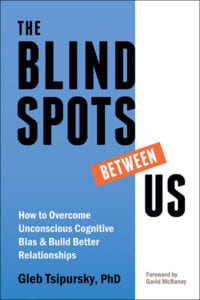
The Blindspots Between Us: How to Overcome Unconscious Cognitive Bias and Build Better Relationships
What you want to look at is what’s under the quality of the nurse. If you’re looking for people who are compassionate, let’s say. If that’s the reason you’re looking for nurses, there are lots of caretaker people who will be compassionate. They don’t have to be nurses. If you have breakups with nurses and in general, with compassionate people, that might indicate that you’re looking too much for compassion, those people are already giving of themselves in the world. You might be looking for love in the wrong place in that sense.
You mentioned that there are over 100 cognitive biases besides making the mistake that what you think is true is not true. You could make a joke about the majority of people believe that the world is in fact round and not flat, but some people maybe have that cognitive bias that they think it’s flat. They don’t trust science. Is there another big cognitive bias where people think something is true and they behave accordingly that you say, “That’s such a problem in business?”
One of the other biggest ones I want to highlight is called the illusion of transparency. The illusion of transparency is the idea that when you say or convey something, the other person understands 100% of what you mean perfectly well. That is the biggest cause of miscommunication that I see. The empathy gap is the biggest cause of problems and challenges through relationships, but in the direct communication, the illusion of transparency is the biggest one.
For example, if I say dog, I assume I mean my adorable King Charles, and you might be thinking Great Dane, right?
Exactly. It’s semantics and so much more, and the dog is one thing. When you say dog and to somebody who is from a culture where people eat dogs, you’re thinking pet and that person might be thinking food. That is another fundamental misunderstanding because when you say something, we don’t realize the mental associations we have with certain terms and certain concepts. We assume the other person has the same mental associations with these concepts or the same stories. We’re talking about stories, we understand our life, our surroundings through stories. When we say dog, you have a certain story of a dog in your head. The other person has a very different story. Most likely they have a dog in their head unless you know very well that they have the same story.
If you and your wife have the same dog and have the same pet, you probably have a similar story, but otherwise, you most likely don’t. When you’re doing a sales pitch, let’s say when you’re conveying certain information, you have a lot of knowledge about the product or the service that you’re trying to sell. That’s why salespeople often try to sell the grass seed instead of the lawn. They talk about the product. They don’t talk about the other person’s needs. They don’t talk about what the other person needs. They focus on conveying information. They assume. They feel. That gut reaction is to feel like the other person would automatically understand the outcome because they describe the qualities. That is fundamentally flawed. That is not how the other person thinks. They don’t have the same stories. They don’t have the same associations that you do with what you’re describing. With the content, with the idea, or with the message that you’re trying to convey. What you need to do is discover their stories. What they are thinking about the topic that you’re going to be talking about? Not what you’re thinking, but what they are thinking. Target your messaging toward their thought patterns. That’s the first step. You want to check for understanding. You want to ask people to convey to you that they’re getting what you’re trying to get them to get.
Constantly be checking in. It’s like, “Does this make sense? Are you following this?” I always say the confused mind says no. Most people won’t tell you they’re confused. It’s an ego thing.
[bctt tweet=”Know the other person’s story first. Don’t assume they think about things in the same way that you do.” username=”John_Livesay”]
It feels bad and that’s emotions. It feels bad to say you’re confused. Even framing it, “Have I conveyed this clearly? Would you like me to rephrase something?” Putting it on yourself.
Would you say, “I’m not clear, I’m holding responsibility for this not coming across clearly. Let me restate it?” Would you say it’s fair then to say close the empathy gap through storytelling?
Absolutely, yes.
That will be one of the tweets we’ll have for this episode for a sound bite for people to remember what you’re saying because I’d like to try to sum it up. That’s why I’m known as The Pitch Whisperer and a short little sound bite that makes it easy for people to reference this. My big belief is that one of people’s cognitive biases, I’ve never called it that before, but for years we’ve heard the term, “You’ve got to get people to know, like and trust you,” in that order. You’ve heard that, yes?
I did.
My premise is if people think that’s the order in order to get someone to buy from you, that’s what triggers the mistake of saying, “You’ve got to get to know me. Let me vomit a bunch of information about my product.” I think the order is all wrong. I tell people, “You need to get people to trust you first,” and then it goes to the heart, which is, “Do I like you?” Finally, it’s a knowledge thing. It’s not even still do I understand the product perfectly, but the question is completely different, which is, “Will this work for me or not?” Therefore, do I see myself in the story? I think that’s why Dr. Mark wanted us to meet because we have similar philosophies of looking at things going, “This isn’t true. You’re behaving your assumption that this is true. People have to know you first before they like and trust you causes you to do the wrong behavior. When you flip it and start building trust and likability first, then you can get into people knowing you and your product. It’s not about knowing it. The head question is, will it work for me?”
What they need to do is trust you first, not trust the product. That’s the fundamental mistake.

Cognitive Bias: The empathy gap is the biggest cause of problems in relationships, but in direct communication, the illusion of transparency is the biggest one.
You sell yourself first.
That’s the fundamental mistake so many people make. They logically sell the product whereas what they should be doing is building a personal relationship and cultivating that first. How will the person trust you and trust that the product will work for you? They have no idea what the product is compared to you, but they have to buy it and then figure it out. They have to trust you first. They need to trust you. They need to trust that you have their best interests at heart before they go forward to with the product.
Any last thoughts or a phrase or something that’s in the book, The Blindspots Between Us, that you want to leave us with to incentivize us to take the leap and get the book?
I want to remind you about the illusion of transparency. Know the other person’s story first. That can be another tweet to share about this. These are only two of the cognitive biases. If you want to know what are the others, there are over 100, I talk about the 30 most dangerous ones for successful relationship building and effective communication in The Blindspots Between Us: How to Overcome Unconscious Cognitive Bias and Build Better Relationships. If you want to know the other 28 and make sure that you don’t fall into those problems, get the book.
The book again is called The Blindspots Between Us. Dr. Gleb, thank you so much for sharing your story, your wisdom and the results from all your research so that we can avoid making these mistakes over and over again and have better relationships in our career and in our personal life.
Thank you so much, John. It’s been a pleasure.
Important Links
- Never Go With Your Gut
- Disaster Avoidance Experts
- The Blindspots Between Us: How to Overcome Unconscious Cognitive Bias and Build Better Relationships
- Amazon – The Blindspots Between Us: How to Overcome Unconscious Cognitive Bias and Build Better Relationships
- Better Selling Through Storytelling Method Online Course
Wanna Host Your Own Podcast?
Click here to see how my friends at Podetize can help
Purchase John’s new book
John Livesay, The Pitch Whisperer
Share The Show
Did you enjoy the show? I’d love it if you subscribed today and left us a 5-star review!
- Click this link
- Click on the ‘Subscribe’ button below the artwork
- Go to the ‘Ratings and Reviews’ section
- Click on ‘Write a Review’
Love the show? Subscribe, rate, review, and share!
Join The Successful Pitch community today:
- JohnLivesay.com
- John Livesay Facebook
- John Livesay Twitter
- John Livesay LinkedIn
- John Livesay YouTube
Avoid Making This Pitching Mistake With Glenn Hemanes
Posted by John Livesay in podcast | 0 comments

The wow factor is what you want to have not only from what you’re saying but from the images you are showing. But what does it take to wow your audience? In this episode, John Livesay is joined by Glenn Hemanes, the Creative Director and Founder of Glenn’s Designs, who shares some tips and secrets that can create that wow factor without overwhelming, emphasizing a usual pitching mistake that you should try to avoid. They also tackle why consistency is essential and how it should be across all of your platforms, as well as how you can get that perfect angle and the best mindset for your Zoom calls and deliver your successful pitch.
—
Listen to the podcast here
Avoid Making This Pitching Mistake With Glenn Hemanes
Our guest is Glenn Hemanes, who is one of the best graphic designers I’ve ever worked with in my career. He has this ability to take your concepts and turn it into visual images that give you that wow factor. He did my slides for my TEDx Talk and designed the visuals for my website. We talked here about what it takes to get people to say, “Wow,” when they listen to you present anything. He shares his secrets and insights so that you can start to imagine yourself giving a presentation where people are wowed by the visuals, but not overwhelmed by them.
Glenn has an amazing career from his days at Apple computer working with big brands like Coca-Cola and creating not just visual images, but visual images that give our clients the wow factor. The wow factor is what you want to have not only from what you’re saying, but what images you are showing. Much like in the fashion industry, which is where I had come from, you would see sometimes celebrities on the red carpet and somebody would say, “Jennifer Aniston, looks great in that dress.” Sometimes you’d see a comment like, “I think the dress is wearing the celebrity.”
That similar analogy in how your visual images, your slides that you’re using when you present anything, they either complement what you’re saying and enhanced it, if you’re using Glen or they take away from you. People are so into your slides, that they’re distracted by what you say. One of the biggest mistakes we’re going to cover that you see time and again is too many words on a slide and the real kiss of death is reading the words on your slide. We all know how to read, but the last thing we want is someone reading to us when we’re giving a presentation. If you’ve made these mistakes or are currently making these mistakes, please stop. There’s no need to do that anymore.
In the first five minutes, look at all the value you have gotten. A free sneak peek of my book and two of the big mistakes that people are making, too many words on the slide and reading. Let’s get right through it as far as what other things we’re going to share and show you. If you want a free sneak at Better Selling Through Storytelling, text this number, 66866 to the word Pitch and you’ll get that. You can see right off the bat a visual image. It’s the book cover like the slides that Glenn creates all take in a lot of different visual images. A book cover has to pull people in and you’ll notice how the ladder looks three-dimensional based on the shadowing. Also, colors are a big part of your brand. Glenn, I would love you to comment on what goes into creating a logo, creating colors for someone’s brand. What mistakes you might see that people don’t think about?
First of all, for the introductions and for the opportunity. I’m looking forward to having this conversation with you of something that we talk about all the time. It’s nice to have a little bit of an audience. There are many facets to having a brand and then communicating that brand in various different ways like book covers or slides. There are things that take into consideration. You have your color palette and you have three colors that are the primary colors of this. By having a limited color palette, you create a theme. Your theme are the gray, black, green, and blue green.
Having a book cover that has dimension to it is one of those elements that keep people engaged. When I talk about doing presentation decks and crafting it, it’s all about keeping people engaged on several different levels. As far as incorporating the branding with your book cover, having a visual image that keeps people engaged, color and font style are the three primary things that are going to be reflected in your book. It is also reflected in any other marketing material that people are going to see.
If anybody goes to my website, which is my name, JohnLivesay.com, you will see the design that Glenn created that completely ties in with the colors and the fonts that match the book. That’s an important thing to take away. Your brand must be consistent across all platforms, whether it’s a book, a website, LinkedIn profile, anything you put out into the world. People instantly recognize the Coca-Cola brand for reasons. We know that font and color red, all of that continues.
Let’s talk about another thing that you helped me with, which is my TEDx Talk. I have a story that I opened my TEDx talk with as well as my book, where I talk about being eighteen years old and being a lifeguard. That photo did not exist of me, that I could find. My mom was able to tell us whether this is what I look like when I was eighteen. I thought it sure came close. I literally describe in my talk a picture that I’m eighteen years old and sitting on my lifeguard perch. I’ve got mirror sunglasses on my face, the zinc oxide on my nose, and a whistle in my mouth. You can see how Glenn created this image of someone who had a face structure similar to mine. Tell us the secret of what you did for the zinc oxide.
I looked up several images to try to find as close as possible to the way you described yourself. He didn’t have any sunscreen on his nose. I use a lot of Photoshop. It was a matter of applying it. I don’t know if I’d put it on my own nose. I wanted to make sure it looked like it was applied and not just like a white watch. There was some translucency and it may or may not be able to see it here, but when it’s blown up on stage, those details are important to make sure that it comes across that sale. It sells and doesn’t distract.
The other element is when you’re giving a talk, especially if it’s virtual, you need to have some animation going on so that the people’s eyes keep looking at it and they’re not going to get distracted. During this particular story, I talk about a girl jumping off the high dive, which I think was her first time doing it. She suddenly goes under water and I start counting 5, 6 seconds and that’s two seconds too long. The fact that you were able to have this pop up, it enhances the drama of the story because we see how fast a second goes. This animation is something I don’t see any other speaker is using. It’s a big part of why Coca-Cola, who has all the access to all the resources possible decided to hire you for this expertise because they had seen this in action. They said, “That’s great. That enhances your story. Who did that for you?” Tell us where you learn how to do this.
That was quite an opportunity. That was fantastic. Without tracking too far back, as an artist and as a designer, I’ve always tried to make the world make sense to myself. I’m in a process of always translating things for myself. What I discovered is that as I make things make sense to myself, it helps other people understand. I use my imagination. When you’re telling a story, my head gets filled with images. I think like this is something that I’m thinking of and the hopes that other people are thinking of the same thing. Having something that immediately goes right to somebody’s imagination is the key. The shorter that distance, the better between them thinking of it and scan it.
[bctt tweet=”Animation and timing can give your presentations the WOW factor.” username=”John_Livesay”]
I engaged to your work again because I had a virtual keynote coming up from $1 billion high-tech healthcare company. I wanted something customized that would relate to everybody feeling like they were in quarantine. I picked the clip from Tom Hanks’ Cast Away movie. I was able to open my talk after my initial story saying, “How many of you feel like this. You’re on this isolated island and you’re trying to get your technology or something else to work. God forbid, your Apple computer goes down. The Apple stores are closed. We get frustrated like Tom Hanks. We just want to throw it all away.” Sometimes out of this disruption, innovation happens. This is where your real magic comes in. We all can relate to what it feels like to be that frustrated. You have the Wilson ball animate onto the movie clip. People were blown away. That’s unexpected and it pulls them in even more. Speak to how you came up with that.
It’s interesting you touched on the unexpected part. That’s the other part that’s fun to play with. I try to make every slide not like the last. I like to mix it up. There is a balance between having continuity to make sure that it looks like it’s following the same brand, thought, theme, but also I try to mix in as much unexpected things. Having the ball come in at the end was a fun like I thought of it and the challenge is whether or not I can pull it off. Ninety percent of the time, the graphics and the effects that I create, I try to keep them within a keynote to PowerPoint. It was a PowerPoint effect. I was able to use this animation in putting the ball and having it roll in. It’s a matter of timing in trying to figure all that out.
The timing is everything because we saw him put the bloody hand on the ball. I as the speaker have the control of when as I’m speaking that disruption becomes innovation. That’s not just a movie clip. That brings it to life. The other thing I talk about and that people remember from my talk are this concept of we have a choice. Do we want to be an ostrich and bury our head in the sand? Try to forget what’s going on and let me know when it’s all over. You can see in the animation how that ostrich was actually moving or do we want to be like the peacock? The peacock makes itself bigger when a predator comes and steps up to the plate. This choice of do I want to be an ostrich or a peacock? It’s not just a photo of the peacock fully open. We’re watching it open as I speak to that combination and I speak to the timing of the animation. That’s what makes it all work. What are your thoughts when you hear my thought process around how I time my speaking to your animation?
I love that you did that because I didn’t see out after we’ve gone back and forth and putting it together that you’re delivering a part of it. It was an unexpected thing that the ostrich was one. It’s a still graphic, but it moved its head out of the way. It was fun how you incorporated that. To go a little backstory, I started when slides were like this. I’m dating myself, but there was a revolution that happened when the digital projector came in and when people were able to show things directly from the computer instead of having it be a static slide. I try to take advantage of the opportunity that we’re working with multimedia platforms. We’re working with something that has motion, animation, music and sound effects at our disposal. The art is in how it’s used and helps enhance the story and the message.
We talked about some of the big mistakes people make when they present too many words on a slide and reading from the slide. The big problem that I’m solving for people who have to sell themselves or sell a product or service is this old way of thinking about yourself. This concept of when people get to know, like, and trust you, then they want to work with you and hire you. When Glenn and I were discussing this concept and the problem, I said, “Glenn, I’ve come up with this premise that the order is completely wrong.”
I watch what Glenn did. It’s not about getting people to know, like, and trust you because what that does is if people think, “You have to know me first, then let me vomit a bunch of information on you and dump a bunch of stats. You know me and my company.” That’s not at all how people want to relate to you or buy from you. I said, “The order is wrong. We need to flip it.” He literally flipped it for me. I said, “We start at the gut level.” The trust factor that the handshake came about to show we didn’t have a weapon in our hands. We need to build trust through social proof, eye contact, all that good stuff and then it goes to the heart, “Do I like you?” That’s where empathy comes in. Finally, it goes to the head where people are thinking, “Will this work for me?”
If you’re going to tell a story, which is my whole premise. The better you tell stories, the better success you have in your career. The people need to see themselves in your story. That’s the question they’re asking themselves, “Will this work for me?” If you’ve described a story of someone you’ve helped through your product, your service, then they see themselves in the story and they have that answered. Glenn, speak to us about how you came up with these icons and the colors as you can see, because you never heard me give the talk using your graphics. I described what I was going to say and then you created this. You can see what a collaborative process it is to create visuals that match your speaking, topic and message.
I love the way your mind works. You’re always thinking of these things and how to read message and explain things. That’s why I love working with you. This particular side was one that I pulled from the investor decks that I create. A lot of investor decks need to be short and to the point. People need to see things and use a lot of iconography. Some people get it and understand it right away. That was the inspiration for this slide. I came up with icons that I felt will match and were appropriate for the particular words that we were using to describe this process.
Obviously, red for the heart. It’s all subliminal but it all works and registers. This particular visual is something that I talk about and you’ll see it in the sneak PDF. Where do people see you on this ladder? A lot of salespeople are always worried about, “This person is 90% likely to buy from me, maybe 50% or 20%,” but nobody thinks of themselves as a percentage. Flipping the script, we need to start showing empathy. Where do people see us on this ladder? Are we invisible? They’ve never heard of us? Are we insignificant, which is even worse? Are we stuck at this interesting rung of the ladder? How many of you had conversations with clients?
They go, “I’m interested, send me the information.” You then have this endless loop of people saying they’re interested and they never take any action. I describe this as being stuck at the friend zone at work with people. People are interested and yet that’s only halfway up the ladder. We need to say or do something that intrigues them enough to want to know more, even in a good elevator pitch. Finally, when you’re at the top of this, this is where you become irresistible and these are your best clients. They share information. They talk about you to people. Here’s the secret, the better you tell a story, the better other people will share your story and that’s where you have them at your irresistible rung of the ladder.
The next up is this concept of what happens when you bore people? You have no emotional connection and I tell people they need to stack their moments of certainty. The best way to do that is through a story. If you think of Lady Gaga, she certainly resonates confidence. Here’s an exercise for everybody to do. Write down two times in your life when you knew you nailed something. You got a job offer, a sale, or you got somebody to go out with you a second time. Those are the moments you want to stack in your head before you get nerves up. The goal is not to get rid of those butterflies in your stomach, but to get the butterflies to fly information. The best way to do that is to stack your moments of certainty. You’re in control of what you’re putting in your head, not the fear thoughts of it. Do you have any comments on that, Glenn, about confidence and things I’ve worked with you on?

Pitching Mistake: Having something that immediately goes right to somebody’s imagination is the key, and the shorter that distance, the better between them thinking of it and actually scanning it.
You want to know about hand gestures.
Especially if you’re on a camera. Make your hand gesture is here and not down here.
Is it a sign of confidence when you’re using hand gestures?
Yes. It gets the nervous energy out of your stomach and into the room. Make gestures that make sense, that tell a story, not just gesturing for gesturing purposes, where you want to emphasize something. You have to have the right mindset before you tell a story. You want to stack your moments of confidence and make sure that you remember another time you told a story where it landed and people remember it, especially when you’re trying out a new story. Everyone does have a story. The problem is a lot of people panic and think they don’t.
I encourage people to think about this, what happened to you in your life where you learned a lesson? What’s a big mistake you made and you learned a lesson? That’s two huge sources of telling your story. This is one of Glenn’s masterpieces in my humble opinion. This concept of a case study has been around for decades where salespeople will go in and present, “Here’s another client we helped and here’s the facts and the figures.” I again tell people, “That’s not enough anymore. You need to turn a boring case study full of facts and figures into a compelling case story.”
When I’m giving a presentation and the visuals do that, what do you think happens to people’s mind? They go, “Wizard of Oz.” I don’t want to be the black and white Kansas speaker or salesperson. I want to be all that excitement of something new. We’re on this yellow brick road journey together of telling you an amazing case story. Glenn, share with us what inspired you to do this? I said, “Give me some visuals on turning a case study into a case story,” and look what he created.
There was a reference that you had to the Wizard of Oz earlier in the presentation. I took a segment out. It was the resolution part of telling a story. Dorothy was back home and telling everybody else, “You were here,” and. “You were there.” That was the inspiration I thought. That’s a story. It starts out with black and white. You mentioned about the importance of lots of the things that we both do. It is subliminal. People aren’t necessarily aware of it. Even things turning from color to black and white, you have an emotional reaction to that, even if you may not be conscious of it.
Moments of certainty, marquee. You write down 2 or 3 times when you knew you nailed it. Hopefully, I gave you enough examples of what those moments of certainty are. You put that in your head before you go present. That’s what you want to be stacking. Your moments of certainty. It’s almost like an air traffic controller when all the planes are flying, has to stack airplanes. You’re stacking your moments of certainty with a feeling, “I felt confident, inspired, exhilarated.” Put all those feelings together. The next time you have to do something outside of your comfort zone.
Sony, wants to know when you hear stories, how can we make our stories more trustworthy? First of all, make them authentic. I tell the story of meeting Michael Phelps. I’m happy to share that story as an example. When I tell that story, I show a picture of me with Michael Phelps. I don’t make people want to go, “You didn’t really meet him.” There’s a picture of it. The story about Michael Phelps is I was selling advertising for a high fashion magazine and Speedo was in my territory. They were coming out with a line of sportswear. I said to them, “Would you consider advertising?” They go, “No, we’re going to run in a fitness magazine.” I said, “What if?” It taps people into their right brain where the imagination lives.
I said, “What if we treated your sportswear like it was high fashion? We could have a fashion show around a hotel pool. You could invite Michael Phelps because he’s on your payroll as a spokesperson. We get all the press for it.” They go, “We liked that idea.” They were intrigued enough to do it. I got to meet Michael Phelps and as a former lifeguard, you can imagine what a thrill that was. I went up to him and I said, “Michael, everyone says, you’re such a successful swimmer because you’ve got these big feet, fins and your lung capacity. I’m guessing, is there something else?”
He said, “Yes, John, my coach said to me, when I was young, ‘Michael, are you willing to work out on Sundays?’ ‘Yes, coach,’ ‘We just got 52 more workouts a year than the competition.’” What’s the takeaway for you? What are you willing to do to be an Olympic level expert in your business that your competition is not willing to do? That’s a story, hopefully that resonates with you. That’s an example of a good story that has some value and keeps it going.
[bctt tweet=”Stand up and dress up when on a Zoom call to pitch.” username=”John_Livesay”]
I’d like to add on the what if part. That is critical when it comes to the creative process. That’s a lot of what I do is in that area, I would say, “What if?” The next half of that is, “Can I produce it and make it?”
What’s interesting about all of the quarantine situation is there’s a lot of impact that is not positive, but if you constantly look for opportunities, even when something seems negative, you can find them. My client said to me, “In addition to your talk on helping us become better storyteller so we win more new business because we’re of coming in second place. We’d love it if you could train our people who only make sales calls in person how to be more effective on a Zoom call.”
Once again, I called up Glenn, I need some new content. You’re the person to help me create the visuals to go with it. I thought I would give not only an example of Glenn’s work, but also some amazing takeaways for your Zoom video calls or whatever platform you’re using. Anytime you tell the story, paint the picture, who what, where, when. Get us in the story in this particular case. For years, this has been the traditional way we make sales presentations and have meetings with people. You’re calling on the doctor, you’re with the vendor, but now that’s reduced to being on a screen. It’s going to pause there and have Glenn describe how he made that so transitional.
I had to find an image that had the people separated enough and ideally look like they could still be on screen and in person. This was one of those times where I thought, “What if?” I tried to figure out, “Can I do this?” It’s fairly straight forward. There’s a single transition and there are two layers. This image is an overlay that has the screen cutout. I was able to transition from one slide to the next, with one of the images the same and without getting too granular. It worse an existing image into the shape of the following image. This one shrunk down a little bit and there was an overlay of the screen on top of it.
As a speaker, these visuals helped me be more effective and look how the details. There’s an iPhone and a coffee cup next to it that matches the whole color scheme of the black and white. Everything is well designed, which then rubs off on my brand as a speaker. The visuals must support you as a professional and not something you just try to throw together.
I’m not used to doing this. I don’t think about all those things, but that’s a good point. I have to be conscious of all the elements that I bring into an image.
This is the sound bite that they loved. For casual conversations, you don’t have to do this, but if you’re presenting to someone to hire you in any capacity or to buy from you, stand up and dress up. I put on a button shirt and I’m standing up because it changes my energy. This was the huge a-ha for this company that said, “Not one of us, including the management, is standing up when we have calls with clients about hiring us or buying our product. We do it when we meet them. They sit around a conference table. We get up and we present and yet we aren’t doing it on these calls.”
Stand up and dress up. That’s another example of something memorable with a sound bite. That’s what you want to do. Framing yourself. Everybody can do this exercise. Put three fingers on the top your head and you can see that’s the right distance from the top of your head to the top of the frame. Then you literally want to hold your arms up like this and say, “That’s the right frame.” Cross your arms underneath your chest and that’s how you know the camera’s at the right spot. Not below it, not above it, because here’s what happens when you don’t frame yourself.
You have these images of people looking down at you and you want to be eye level. If you have to put books on your computer or you have a standup desk, whatever you need to do to be eye level with the camera. Glenn, let’s go back on those last two images. Frame yourself. We looked at all kinds of different frames. I want everybody to get a sense of the thought, the effort and the creativity that goes into. What’s the best way to tell that story with a visual?
Showing people is challenging because I try to be sensitive and not focus on any one particular person or body type, and be sensitive to that, but also to illustrate the point. I tried to find images that were probably more exaggerated than others, but it gets the point across. Even the frame image they had before was we probably had 3 or 4 different frames. I believe you told me that one of the frames I had was too fancy so I had to pick out a few different ones. This seemed to be the right one and the right tone without it being too distracting.
I took a screenshot of somebody doing the wrong thing. You then found out other people are doing it. It’s sad to see what a common problem it is. The next problem is lighting. Do not sit in front of a window, you’ll be in the dark, don’t sit like you’re in the witness protection program. We are in the shadows. We can see you. I have a sidelight here next to me and I believe Glenn does as well.

Pitching Mistake: A lot of people see presentation slides as something unnecessary, but they’re there to enhance the speaker and the message.
I use ring lights and I’m always experimenting, but I have one right in front of it or right behind the camera. I’ve got a couple over here using some for shading. It adds depth. This is all real when I’m standing.
You can’t make gestures if you’re in front of the fake backgrounds without your hands disappearing. It’s important to make sure you have that. What about the body language? Body language in person is important, but even more so in a Zoom call because our eyes want to see something moving. If it’s not that stopwatch that Glenn did at the beginning, then it has to be your hands making a gesture to get people to be pulled in. Ironically, this whole concept of getting in this Zen moment and being 100% present. If you’re not 100% present, there’s no way the clients are going to be. Write down one thing you’ve gotten from this so far that you might have question of or that we can talk about. Imagine if, what if or imagine. I also start sentences with, “Picture this.” It taps into the right side of our brain. Without saying, “I’m going to tell you a story,” say, “Picture this” or, “Imagine,” or, “What if.” Camera on eye-level and standing. Stacking your moments of certainty. Continuing the visual and the verbal story that there’s some continuity that they’re working together and enhancing each other, and it’s a consistent with your brand and your story.
It’s true to have that the continuity and the slides aren’t a crutch and they shouldn’t be read. A lot of people see presentation slides as being something that is unnecessary to read. They’re there to enhance the speaker and your message.
I’ve been following both of your work for a long time. I’ve seen you speak and I’ve had the pleasure of working with both of you professionally. You guys always deliver such gold in terms of the information. Once people work with you on a specific message and it’s customized, that’s when you see all this come together. That’s an important point to make. You can watch all the books and read all the material and do this, but once you have your message and your own story to deliver, that’s where everything you’re teaching is important. That’s what I mean by making sure that the verbal and physical presentation like the TED Talks and the visuals that you do, Glenn, getting all of that into your brand is extremely valuable. Thank you both for what you’re doing.
Somebody wrote that people need to see themselves in your story is a big takeaway. Neil went on to say that that’s what he does in his own webinars. When you are a great storyteller, people see themselves in that story, they want to go on the journey with you. You then have a new tool in your toolbox. You’re not trying to hammer and force people to buy. You simply say, “Does that sound like the journey you’d like to go on?” It’s customized to all of that.
I want to transition into some of the problems that get solved by telling a good story. I’ve come up with this method from speaking to thousands of salespeople at different companies about, there’s got to be a way to get off this self-esteem rollercoaster. We only feel good about ourselves if our numbers are up and feel bad about ourselves if our numbers are down. How can we improve our closing ratio and not get burnt out? This has worked for me and it’s worked for many other people. We all have to sell ourselves in one capacity or another. When you learn this storytelling method, you’re going to stop coming in second place. I had an architecture firm say to me, “We get in the final three and we are tired of coming in second place. Can you help us?” I said, “What are you doing in your chance to present? Are you telling stories?” “No, we’re giving out information and hoping that’s what causes us to win.”
Once they started this one step of turning these boring case studies, as we saw the visual black and white, into a compelling case story where people saw themselves in that story, they said, “I want to go on that journey with you.” I’m going to tell you the story now that caused Gensler, the world’s largest architecture firm to win $1 billion project. The biggest amount I’ve ever worked on an event to renovate the Pittsburgh Airport. It was between Gensler and two other firms.
The client said, “We’re going to hire the people we liked the most because we’re going to work with you for six years.” They said, “Get John in here. We don’t know how do we make ourselves likable? We showed designs and hope that does it.” They had some great pictures for the case study of what they’d done for another airport, but there was no story and certainly no emotional connection. Here’s the story. Imagine I’m Gensler telling the story to the Pittsburgh Airport people. Two years ago, JetBlue brought us in to renovate the terminal at JFK. During that three-year process, one of the challenges we had was we had to rip off all the floors in the middle of the night from 9:00 PM until 9:00 AM so that we would not disturb the retail revenue.
We had all our vendors on call all night because we knew all the things that could go wrong in previous projects and we were ready for them. Sure enough, at 2:00 AM, a fuse blew. We got a vendor we had on call got there in twenty minutes and we fixed the problem. At 8:59 AM, the last tile went down and all the stores opened on time. A year later, sales are up 15% because we’ve designed a place that attracts people and keeps them shopping longer. The people at Pittsburgh said, “That’s exactly what we want. We want to have that kind of an outcome.” The elements to that story of exposition as I described them in the picture, it’s JFK, JetBlue, and the problem.
Gensler got up there and said, “We use critical thinking to anticipate problems.” They didn’t have to say that, they showed they did it by having the vendors on call. Your point earlier about gestures, hopefully, you saw this. I said, “At 8:59 AM, the last tile went down.” See how the gesture contributes to the story? The gesture is here, not blocking my face. All those are subtle things to being a good storyteller. The resolution to that story is that sales are up 15% a year later because of the design. A lot of people don’t connect those dots, that design, whether it’s Glenn’s expertise on the slide or the design of a space impacts storytelling, which impacts revenue and impacts people’s experience.
I’ve created this online course to help people learn how to be a master storyteller who can’t hear me speak in front of the big crowd or want to do this at their own pace. The other big problem is people say, “Can you come in and teach our people how to be persuasive, not pushy because nobody wants to be pushy?” That’s the joy of what storytelling does. It allows you to tell stories that make you magnetic and pull you in instead of pushing out a bunch of information. I was fortunate enough through some mutual friend, Mark Wilson, who introduced me to Cal Fussman and Larry King. I was on Larry King’s Show with them talking about storytelling. You can be sure I did my homework and found out what Larry’s King story of origin is. He got his big break meeting Frank Sinatra. On the car ride from breakfast to the studio, I said to him, “I love that story of how you get to interview Frank Sinatra and you weren’t famous yet and that was your big break.” He was like, “That was a good night.”
[bctt tweet=”No matter what visuals you do, if the message isn’t there to begin with, it’s not going to be as effective.” username=”John_Livesay”]
I knew it was safe to bring that up on air. When he said, “John, what makes a good story?” He’s holding my book. I said, “Larry, would you mind sharing your story of how you got your big break with Frank Sinatra and then we can break it down?” Looking back on that it was unplanned. I don’t know where I got the guts to answer Larry King’s question with a question and ask him to tell the story, except I knew he liked telling that story. He said, “Down in Florida, I have a radio show. I was friends with Jackie Gleason and he asked me this question, ‘What’s impossible in your business?’” I think about that many years ago. What a great question for all of us to ask ourselves, what’s impossible in our business?
Larry King said, “Interviewing Frank Sinatra. His son just got kidnapped and he’s not doing any interviews. He’s mad at the media for insinuating that it was because of mob connections. Jackie Gleason said, ‘I filled into him one time. I’m doing my comedy act when he had laryngitis. He owes me a favor. ‘I’ll ask him to do this for you.’” Sure enough he did and they hit it off. During the interview, Frank Sinatra invited Larry King that night to bring a date, come and sing at the Copacabana for free at the dinner table right by the stage. Larry was like, “Whatever woman I bring, she’s going to be so impressed.” Sure enough, it was a wonderful evening.
This is before people had no credit cards or ATM. He didn’t have a lot of money. He came across like a big shot that night because everything was comped. They’re driving back to her place and she’s like, “Stop at this place and pick up some coffee for tomorrow morning.” He was embarrassed. He didn’t have any cash. He didn’t want to ruin the whole mood of the evening. He walks into the store, comes back out and she’s like, “They’re out of coffee?” “There is but they couldn’t break $100.”
What a great resolution to that story. We went through the exposition. We know what’s happening and the problem. He’s out of money and we know the solution. The resolution is what makes that successful. Gensler calls me their interview guru when they have to go in interview for new projects. It’s all because of the storytelling. This food company called Sugar Mountain. Once they started telling their story of origin and how much love and thought goes into creating their products, then it’s no longer pushing to get it on the shelf. This is the big problem. I was working with an executive search firm and they said, “When we go and present against our competitors, we walk out of the room and they forget what we said. It all sounds the same. We hope we can go last.”
That’s not a strategy. You can control the order you present. Whoever tells the best stories is going to be memorable. They’re like, “Light bulb moment. You’re hired. Teach us how to tell case stories so we don’t have to worry about what order we’re in.” Especially in healthcare, the salespeople are trying to talk to the doctors in between surgeries and they go, “I feel like an annoying pest.” I said, “Would you like to learn how to feel like a welcome guest?” “Yes, please. What do I do?” I said, “Bob was always trying to pitch something to the doctor between the surgeries and the doctor’s like, ‘Stop pestering me.’”
Meanwhile Sue said, “Doc, I’ve got this amazing story of another doctor I helped into their hospital. How he was able to keep his energy up between surgeries. Would you like to hear that story?” “Yes.” It turns out people always have time for a good story. This concept of, “I feel invisible to people and how do I develop rapport fast?” It’s a common problem. I work with Redfin, the tech real estate company. I’m helping those people figure out how to turn somebody who’s angry into somebody who feels heard through the empathy skills that you learn in this course. This whole concept of getting out of the friend zone at work as what this Phoenix Controls were doing.
This course has all these wonderful modules that are about 10 to 15 minutes each. It’s like watching a Netflix movie. The visuals and the cinematography that I have put into this makes it enjoyable. Rob Angel, the creator of Pictionary, he took the course to learn how to tell better stories for his talk and his interviews. Hasim who’s on this call has taken the course and I worked with him. If you want to share with people your experience of it, it would be great.
My experience on it is it changed my whole perspective on how you enter a meeting and how I talk, and even how I write down my business plan. I redid my whole business planning because of this. It should be done soon. I have some friends to help me with certain parts too.
If I can jump in, John. I have to make sure I say this because this is super important. You and I we’re working together. I am grateful you’re offering this because as part of our process of what we do for designing presentations, we have three specific areas that we focus on. The first one is messaging, which is the storytelling, which is absolutely making sure that that is clear, concise, and compelling, which are the things that I’ve learned from you as my mentor. When I have a new client and they haven’t quite got that part, worked out, it’s almost required that they contact you and connect with you. The projects that we work on have a time set aside for them to meet with you. The fact that you’re offering the course is going to help enhance that so more people can have access to this because you are the master storyteller. It has absolutely been a huge bonus to our process and making what I do that much more effective. Without the story, without getting the messaging and all of that first phase of the project together, no matter what visuals I do, if the message isn’t there, to begin with, it’s not going to be as effective. Thank you.
I’ve created these bonuses where I have a private Facebook group for anybody who gets the course. You’ll be able to practice your stories, practice your pitches. We get real time feedback. In between the one-hour group call, you can post questions that I’ll answer. I’ll send you a signed copy of my book. We’re going to have a virtual contest to see who promotes the course the most we’ll be able to get on my show. I’ve created a guarantee. I so much believe in this. I’m going to take all the risk away from you. We would look at how many sales you’re currently closing. If you don’t close 10% more after 60 days, I’m willing to give you your money back. If you go to the course. I will work with you one-on-one for a whole hour, and you’ll still get access for ten weeks in the private Facebook group. Are there any other questions?
I have a question but I don’t know if it’s related. It’s about storytelling. I’m about to do a live on an EMF because I’ve been in the EMF space, electromagnetic radiation inspired by a post in our WhatsApp group on 5G. I shared on Facebook something in support of something that Trump did. I didn’t said, “I love Trump.” I said I’ve been supportive of something he’s done. It’s amazing how many people have come back and personally attack me. Being the storyteller, how would you discern between being in alignment with an action someone’s taken and not attaching that to a character?
Pitching Mistake: When storytelling, make sure that it’s clear, concise, and compelling.
I would use the example that in any good book or movie or TV show, the character always has some positive attributes and some negative attributes. Nobody’s perfect and nobody’s all evil for the most part. Any of those extreme examples are not terribly interesting. It’s just the cliché of don’t shoot the messenger and also the premise is it’s not all or nothing. It’s not black and white and get comfortable with shades of gray. I’ve talked about in the course to let go of needing to be a perfectionist. What that does is it puts so much pressure on us to be perfect all the time.
When we relax into being a progression is where we celebrate our progress. For example, the last story I’m going to leave you with. You’re climbing Mount Everest. You’re halfway up. You have a choice. You can look back down and go, “Look how much progress we’ve made. We were halfway up,” or you can look up and go, “Look how much further I have to go.” It’s your choice. If it’s not perfect, one little thing goes wrong in the presentation. You focus on that, as opposed to all the things that you did. You’re helping people with their nutrition, their eating and their mindset. It’s about progression. Be a progressionist and let go of being a perfectionist. Hopefully, that helps you.
As a speaker, you must relate to the idea of being in flow when you’re on stage.
Luckily, the flow still happens virtually.
If it’s preplanned too much, it can even come across as preplanned rather than maybe having a little outline in the head, but allowing it to come through.
Let me give you a tip on that. I’ve worked with a lot of people who are afraid of coming across robotic, which is what I heard you saying. If I preplan, every word I’m going to say is going to be too memorized. The key here is make sure you have a great opening, a great closing and three points you want to cover and trust that those three points you’ve practiced enough, that you can have a little bit of spontaneity in it. Make sure your opening and your closing are nailed. That’s the thing we’ll be working on in the private Facebook group for the people who enroll in the course. Tell us what your three things are. It’s a big part of design. If you want a free PDF, text the word “Pitch” to 66866. If you know anybody else that might benefit from this course and want to have a fifteen-minute chat with me, please reach out to me as well. Thank you.
Important Links
- Glenn Hemanes
- TEDx Talk – Be The Lifeguard of Your Own Life!
- Better Selling Through Storytelling
- JohnLivesay.com
- Better Selling Through Storytelling Method Online Course
Wanna Host Your Own Podcast?
Click here to see how my friends at Podetize can help
Purchase John’s new book
John Livesay, The Pitch Whisperer
Share The Show
Did you enjoy the show? I’d love it if you subscribed today and left us a 5-star review!
- Click this link
- Click on the ‘Subscribe’ button below the artwork
- Go to the ‘Ratings and Reviews’ section
- Click on ‘Write a Review’
Love the show? Subscribe, rate, review, and share!
Join The Successful Pitch community today:
- JohnLivesay.com
- John Livesay Facebook
- John Livesay Twitter
- John Livesay LinkedIn
- John Livesay YouTube
How To Be A Story Leader With Ben Zoldan
Posted by John Livesay in podcast | 0 comments

Listening to others and what they have to say fosters a sense of community, kinship, and empathy, and these are things we all could afford to get better at. In a time of divisiveness, listening to others might just get us to a place of, at the very least, mutual understanding, in order to foster peace. Ben Zoldan is the co-founder of Storyleaders. He sits down with John Livesay to talk about why listening to others is such an important skill that we need to hone. Listening is the gift that makes others feel seen, so let’s get to a place where we’re all giving each other that precious gift.
—
Listen to the podcast here
How To Be A Story Leader With Ben Zoldan
This episode’s guest is Ben Zoldan who is the co-author of What Great Salespeople Do. He is the Cofounder of Storyleaders. He said if he had to retitle the book, it would be What Great People Do, not just storytellers or salespeople. He also said, “When you listen into people’s eyes, you transcend basic empathy, and that listening is the gift you give others and you make them feel seen, and that totally transforms the relationship.”
—
This episode’s guest is my friend Ben Zoldan who is the Cofounder of Storyleaders and author of What Great Salespeople Do. I read it myself and loved it. It turns out that he started Storyleaders back in 2008 as an accidental research project. Before that, he was always into efficiencies and things related to results. That turned into him now talking about stories as a way to measure things in a whole new way. Welcome to the show, Ben.
John, thanks for inviting me into your world. That bio, I wasn’t expecting it. That was my narrative coming from efficiencies, compliance, and process. That gave way for some other things in my life and things that you’re into.
This concept of someone’s story of origin is something near and dear to both of our hearts. I would love it if you can take us back to Ben as a little boy growing up, wherever that would be, or college days. Wherever you want to start your story as to how you got to where you are now.
Let me start with something controversial that happened to me. I started my day off at around 6:30 going through my feed and trying to pick a video or something to watch and I found this company. I went to the bios of their leadership team. There were twenty leaders, and it was middle-aged white dudes. It looked like the United States Senate. Something appalled me. I was like, “Why is it so homogenized?” I’ve always had a disdain for the system, the way things work.
My journey started off with teenage parents who are at UC Santa Cruz and had two kids by the time they were twenty. They were hippies before it was cool to be hippies. Vegan before it’s cool to be vegans. What I did get was a lot of these alternative influences and all this cool stuff that was on the sidelines and I was always in trouble. My parents were so young that they didn’t monitor us so we would just run wild. I was always getting in trouble by the combination of having parents that gave me these cool influences, things that were on the sideline like counterculture before there was such a thing, and then having a lot of autonomy when I was younger, so I was always getting in trouble.
Now when I look at things in the world that are injustices, and I’ve had my own. Being on my own, abuse was part of my upbringing. Stuff that I always had a hard time talking about. I speak of it as a 49-year-old guy, but even as a 35-year-old, I probably couldn’t talk about and share my true authentic experiences. I was guarded. What I always do was when I saw injustice or something wrong, I fought it. I didn’t know how to fight it before. It was yelling by yelling, and I would rather yell without yelling now.
What I hear going on is, there was a secret, and we’re only as sick as our secrets is the phrase that takes on a whole new meaning because as long as we’re holding on to a secret, whether it’s, “I got abused,” or “I’m gay.” Whatever the issue is that someone can then possibly blackmail you with, make you feel bad, or expose it because you haven’t owned it, and you have all this charge on it, then we get triggered if anything reminds us of our secret. Even if it’s not happening to us, because it’s like a walking wound almost. That would make sense to me that if there’s not a lot of structure in the youth, and some bad things happen along the way, then we would be following, in your case, the hero’s journey into this thing of, “How can I get control of my life?” “I know. I will get good at measuring results, numbers, structure, looking at logic, and putting some process into things so things do seem like they’re a little bit more in control.” Is any of that resonating?
It was my drug. It was my dopamine hits at every turn and it was a safer place to be. I can run away from this stuff and look for external things to govern the world and put controls in the world and safety of process and measurement. For me, it showed up more in this incredible search for belonging and feeling so isolated. When you talked about wounds, running away from the wounds, and thinking that there was a way to belong in the world, that was to sign up for all the things that we’re supposed to sign up for, a career, scoreboard, stack rankings, and so-called success. Making a certain amount of money and then you make this much money and then a little bit more, then a nicer house and a nicer car. It’s all this endless, hollow, shallow race. For me, it was signing up for all these playbooks. The playbooks are always the same thing. These playbooks were built around, “How do we get more, do more, and sign up for this endless vicious cycle?” For me, it collapsed.
[bctt tweet=”Listen into people’s eyes.” username=”John_Livesay”]
Eventually, it does. Even for people who reach the pinnacle of whatever they’re doing. Like when Michael Phelps had to stop swimming, it collapsed for him. It’s like, “Who am I if I’m not this Olympic swimmer? I’ve done it so many times. I’ve hit that bell, got those medals, but I still have to figure out who I am.” As a swimmer competitively myself in junior high and high school, my parents used to put a big chart on the wall of all my times for all the different events. I was constantly trying to beat my own time. Fast forward to my career in sales, I’ve basically recreated that whole experience with a quota of, can you beat last month or last year’s number? Over and over again. It was so familiar to me from competitive swimming that you do tend to burn out from all of that.
You and your co-author did so much research for your book with salespeople who sometimes feel like they’re so pushy, and that’s what causes them to be universally disliked. Can you speak to some of that? If you don’t like yourself and then you take on a career that is not liked and salespeople aren’t alone. Lawyers or dentists sometimes fit into that category. If you have a job that most people dread going to or dealing with you on top of you not liking yourself, how do we deal with that? How do we change that story?
First of all, I hate the title of my book. I can’t believe you picked it up and read it. It was never about that. I’ll tell you the story behind that. It was past the deadline a few months with McGraw Hill, our publisher, and Danya, who happened to be my personal publisher, was like, “Get the manuscript in.” We finally did and we didn’t have a title. We were going back and forth one day, and nothing was coming up for us. I barked at her. I said, “Danya, stop it. This is a book about what great salespeople do.” She goes, “Hold on. Let me get back to you.” I guess she went and checked if it was available.
She comes back ten minutes later. She calls me up and says, “Ben, I think we have a title.” I’m like, “What is it?” She was like, “What Great Salespeople Do.” It checks off all the boxes. It has the word sales in it, so we put it on the sales shelf. I didn’t think much of it. I’m not this marketer. It stuck, but here’s the thing. It wasn’t real. When I was doing the project, which was a personal research project, it was fundamentally about people that I had admired. People that I had emulated. If you close your eyes right now and I know some of the people in your circle, and you think of somebody who makes a difference in your life. Can you think of a person that comes to mind who has that knack or that gift? Did someone come up for you?
Sure, our mutual friend that introduced us, Mark Goulston.
Dr. Mark Goulston, a beautiful man. Would you describe him as any of the attributes of a salesperson?
No. Just the opposite. In fact, his whole thing is about helping people get out of this mindset of transactional relationships and then to transformational ones.
Now here’s a guy who is incredibly wholehearted, combined with incredibly sciencey. This lethal combination of knowledge and a whole heart that comes at you with such empathy and compassion and yet, he’s probably the antithesis of any of the behaviors of a salesperson. He’s not this hard-charging agenda, interrogator, or ROI negotiator, but he gets there in such a beautiful way. He’s helped me open up doors in my life. When I thought about people that I emulated a dozen years ago, I was like, “I want to deconstruct those people.” People like Mark. It was people that had this grace and benevolence. The way they could just sprinkle fairy dust.
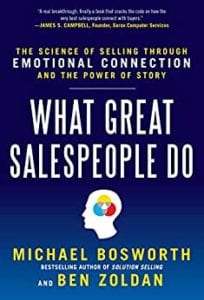
What Great Salespeople Do: The Science of Selling Through Emotional Connection and the Power of Story
I had that interaction with you when we first met. We went from not knowing each other to an hour later, I was like, “I know this guy. I would take the shirt off my back for you.” Sometimes we can’t label why we feel that way around people. For me, this was a research project. The book was about people that were affecting the world in such a way that was not figured out. We never figured it out. What a lot of things came up for me was how people can open up and share their stories. How they could be so in tune, self-reflective, and fiercely passionate about something but not in this dogmatic way.
I bring that back now to why I brought that up. To me, it was a book and I’m not a moral authority. I don’t know if I’m qualified to say it, but it’s what I fantasize about. I have to go back to my publisher and change the title of the book to What Great People Do. If we all think about our careers that way, it will change our behaviors. For example, lawyers. If lawyers stop lawyering, salespeople stop selling, or teachers stop teaching and start being more human. I have two teenage daughters and now with the storm that’s going on in the world, they’re doing remote learning. These teachers are just giving information, trying to teach and hammer information. What if we could create a culture of humans out of any of the things we do?
Let’s do a little bit of an insight into the magic that you’re doing for big corporations like Salesforce. A lot of big companies that people would think, “They’re going to be resistant to this.” Yet, the testimonials say the opposite. You’ve got these workshops that are not just another training where people are learning how to be not storytellers but authentic storytellers. You’ve got some listening involved there and I love that part. I tell people all the time, especially if they’re salespeople, “Until people feel like you’ve listened to them, they’re not willing to listen to you even if you’re telling a story instead of a bunch of facts.” Also, this other piece of the pie or third leg on the stool, if you will, is neuroscience. I want to make sure that we touch on at least one little nugget from each of those three circles because that’s why you’re sought out as a speaker. That’s why companies bring you in to help make all of this come together. Let’s start with authentic storytelling. First of all, what makes something authentic versus just a story?
Early on for me, it was scary because as I was looking at people that I admired, the theme was these people are just storytellers. I had this mentor of mine, his name was John Scanlon, and it didn’t matter if we were with a customer, if it was a team meeting. I rode with him once from downtown Chicago to O’Hare and in that one-hour ride to the airport, I got out of the car and I’m like, “Here’s the CEO of this thriving company, and I know everything about his life.” I didn’t know it at the time, but he was just letting me in. No veneer, no pretense, no points he was trying to make but if something came up, he would share like he had no guard. I was like, “What if I want to be like that?” That means I’d have to share.
You wouldn’t have those secrets walking around.
I’m pretty good at the walls, the secrets, the mask, and the veneer of superficiality. We could talk about the Lakers and we could talk about the weather. If you want to know about me and show you who I am, I always thought, and this took me a while so I love your take. I don’t think I came from storytelling. I don’t think it’s a framework as much as it is, this self-discovery work and I resist. In sales, we always talk about a story about a customer but that’s the price of admission. No good stuff is the good stuff. It was a battle I resisted. I could talk about everything but myself.
Part of it has to do with the mistake that people make in thinking, “I’m one person at home and I’m another person at work.” Now that many of us are having to work from home during the quarantine, people see where you live. All those masks are coming down in a whole new way. When your dog, kid, or whatever else is interacting with your life, it’s not so siloed. “I’m one person in my life in Connecticut,” if you’re that person, “and then I go into the city and I’m the business person. That business person doesn’t let people in.” The irony is that the more you show your imperfections and vulnerability or that you don’t have all the answers all the time, the more people respect you and trust you.
I grew up in the suburbs of Chicago so I know that ride so well from downtown to O’Hare. The Midwest, in particular, at least my experience in the suburbs was, that’s what everybody talks about all the time. It’s the weather or sports. I go, “Is there anything else to talk about?” That was the opening line for small talk all the time. I thought to myself, that’s how people relate to each other. “We have this in common,” or “How about those Cubs? Are they ever going to win?” and all these kinds of conversations left me empty as a kid and I didn’t know why. I didn’t have any other skills to bring up but I was like, “This is not interesting to me, constantly talking about those two topics.” Maybe we get into cars a little bit, “How’s your car running?” I don’t care but it was another topic that didn’t deal with any authenticity or vulnerability about how you are feeling.
[bctt tweet=”Listening is the gift to make others feel seen.” username=”John_Livesay”]
I remember being with my dad. One of his dreams was to go up in a helicopter but he’d never done it. I was able to do that with him and his sister and my sister. I had a picture of it. I said, “Dad, look how happy you are in this picture.” My dad was not somebody who was comfortable with expressing feelings. He never learned. His response was, “Who wouldn’t be?” I thought, “I asked you to express a feeling that’s not in your toolbox. I get it. Of course, it’s logical that you would be happy at that moment.”
Once I let go of being so frustrated that he couldn’t express his feelings, someone said, “Do you know how to fly a helicopter?” I said no. They said, “What if it’s an emergency, you still can’t do it. It’s the same thing with feelings. It’s another skillset.” Storytelling, it’s not something you’re brought up with. You might think, “Everyone else is a natural storyteller. I go on and on. My stories don’t have any point.” The good news is that people who go through Storyleaders learn how to become storytellers, correct?
Yes. It’s like with your story. It almost sounded like if I’m getting you that there was a level of fatigue with this and the way the interactions were. Was it, for you, like, “I’ve had enough of this. Let’s get real?” In my old days, I would have thought, “Here’s a guy, John, who can get on stage in front of hundreds of people and inspire them.” The myth is that this guy is a natural-born storyteller, leader, or whatever. That’s not the case for you.
Not at all. I had lots of training, lots of focus on it, getting inspired by other people and thinking, “I want to feel something.” I want to make other people feel something, as well as teach them something when I speak. It was a journey to make a difference. I didn’t know how I was going to do it. There’s no such thing as professional swimming so I knew I couldn’t stay in that sport to make a difference. That’s what led me on that path. I thought of little moments where people will say something and you’re like, “Huh.” I remember at the end of Oprah’s talk show after all those years. She said, “Everyone should think of their life as a talk show.” I love that framework. Whether I’m talking to one person or hundreds of people when I’m on stage, it doesn’t matter. I’m still having some impact. That’s where that goes. Let’s go into the real listening part, not just listening. What is a nugget that you can share with us about how we can be better listeners?
We have mentioned that Mark Goulston has been a mentor in both of our lives. He’s the Professor of Psychiatry at UCLA and a former hostage negotiation trainer. He takes everything we do and distills it down to what it would be like to listen. He and I were having a conversation once. He was talking about what it would be like to listen into people’s eyes. At that moment, I was shaken because I was thinking about all the times I don’t listen into people’s eyes. That would require such a level of commitment, being all in, and vulnerability. I was thinking about this experience I had talking to a friend the day before I was talking to Mark. We were talking about something going on with how we’re taking in information around this pandemic. Should the government do this or the government not do that? The minute I heard her position, which was 180 degrees from mine, I went, “Stop. Timeout.” I made some stupid remark like, “Don’t ever say that around my family.” She goes, “See? You always do this.” I’m like, “I always do this,” and I start defending myself. She lets me spin out because she knows. Here I am, a guy who preaches about listening and I cut her off myself. After my tornado winds down, she goes, “You never listen.” That hits me.
For someone who thinks of themselves as a listener, that’s the ultimate insult.
I’m a fraud. I don’t practice what I preach. I remember those words that Mark has shared with us about what it’s like to listen into someone’s eyes. I feel like what that requires for me is such vulnerability because I have to commit to somebody else’s place, feelings, and position. It’s so hard to do. What I found easier for me to do is to look away. If I look away, I could be like, “No, I’m right. You’re wrong. You’re Republican, I’m a Democrat. We’re Israel, Palestine and we’re divisive like the news channels.” There isn’t any antidote to that division. It’s like the vaccine we’re looking for. If we actually listened into people’s eyes, we would feel what they feel. It would be the purest form of empathy.
This may be controversial. Everybody talks about empathy. It’s become so over, you don’t even know what the word means anymore. Empathy sucks. It sucks because empathy is hard. We have to say, “I’m going to feel what you feel.” I have one tattoo of my daughters’ names on one arm. On the other arm, I want to put “listening to their eyes.” If we look into others’ eyes, we cannot help but feel. I’m looking at your sincerity. My heart rate slows down. My defensiveness and my own walls go down. I go, “That person’s another human being.”

Listening To Others: Leadership teams in many organizations tend to look very homogenized.
They always say that the eyes are the windows to the soul. If you look at someone and don’t look away, it requires incredible tolerance of anxiety to stay completely present. That’s why the phones are such a challenge. It defeats listening because I’m going to look down at my phone if it dings or I’m bored with what you’re saying or whatever. To hold someone’s interest and to be riveting to someone goes back to the emotion. Take me on a story. You told me a story that’s got some emotional ups and downs. Now, I’m listening with my eyes because all my emotions are engaged. I know how much you pride yourself on being a good dad. Make that eye contact with your daughter and teach her how to do that to other people. You’re modeling for her, “If people aren’t doing this to you, that is not okay, no matter what their gender is.”
The same thing is true in a sales situation. If you’re not paying attention and listening to somebody tell their story, what their challenges are, why they’re tired, or whatever the issue is, it doesn’t resonate when you tell your story. We were talking about table stakes, the basics are telling a story of another client you helped. What I love doing that makes me so excited is to get to know you and bring you into the people that love storytelling as much as I do for our clients.
Once we get someone to be comfortable with their own story and then we get them to the place where they’re telling a story of a client they helped, when you put it together and say, “We’re going to tell a story within a story,” that’s a whole other skillset. I was working with this guy, Adam. Before we started talking, he said, “I’ve got three daughters,” and this and that. He told me their ages and I filed it away. I said, “Okay.” He’s telling the story of a client. I said, “What’s her name?” “Sandy.” “What was Sandy’s situation?” “She had to be in charge of going to the hospital from two operating rooms to four.” “What was Sandy feeling?” You’ve got to pull that out of people.
If you’re not in touch with your own feelings, you’re certainly not listening to what other people are feeling. “Sandy was overwhelmed by having to go from 2 to 4.” I said, “Let’s go back to you having three daughters. I imagine that when your third daughter was born, your wife turned to you and said, ‘Honey, we’re outnumbered. I feel overwhelmed.’” He was like, “We did say that.” Put that into this story so that you’re showing empathy for Sandy but through your lens of what it feels like to be overwhelmed, not in the same situation. That’s what I think you’re saying here. It’s not just empathy, it’s my experience of that emotion. You were talking about secrets and I share that I know what it’s like to have a secret. We all have something. That’s where I think real connection comes from.
As you’re sharing about that, speaking about daughters, and talking about listening reminds me of a profound experience I had with my youngest daughter. One evening, we took a walk in the neighborhood. We walked to the little center where there are restaurants and stores. It’s late in the afternoon and the sun is going down. It was a nice time she and I were having together. We walked by this man who’s asking for money. He’s having a difficult time. By appearance, he looked homeless. Since we were just going on a walk, I didn’t bring my wallet. My daughter was probably in her early teens at the time. I said, “Abby, have you got any cash on you?” She said, “No, dad.” I was stuck. I couldn’t walk by this man who needed help. I go, “Abby, stay here. I’m going to bolt home. I’ll be right back.” We both wanted to help this guy out. I ran and got back in two minutes. I have a $20 bill and I hand it to this man. Abby was hanging out over here for a few minutes until I got back.
My youngest daughter goes, “Are you from here?” The man takes a $20 bill and puts it on the side next to him. I’ll never forget this, John. I want you to visualize it for a second. He’s sitting on this bench, takes a $20 bill, and almost sets it on the bench next to him. It could have flown away. The minute Abby asked him, he first introduced himself. He says, “My name is Albert. I’m not from here. I’m from Mississippi.” I’m like, “How long have you been here?” He said, “Twenty years.” He tells us the most incredible story of coming here from Mississippi. His parents moved out here and they had passed away. He had brothers, they’re not here. They’re back in the South. We were engaged with Albert for 15 or 20 minutes. I don’t know if it was five minutes. He let us into everything about who he is. His story was beautiful. It had traumas in it. It was unfiltered and it was raw. My daughter was there with her jaw open, listening to this man.
It’s different from her life or her friend’s life.
Fifteen minutes went by and that $20 bill was still on the side of him. He never went to the $20 bill. We wrapped up, “It’s great to meet you. I’ll see you around.” We walked away and it was beautiful. It was magical, if I can say that. He leaned over and nonchalantly grabbed the $20 bill. The $20 bill was incidental. Abby said the most profound thing to me as we’re walking away. She said, “Dad, the $20 wasn’t nearly as important to Albert as him sharing his story with us.”
[bctt tweet=”If empathy’s the thing that’s going to get us out of this mess, we have to get better at it.” username=”John_Livesay”]
That was his priority.
It was as if him being able to share his story was the magical gift. I feel like it was more important than the $20. There’s so much wisdom in what Abby taught me. When you talk about listening, maybe as we listen, we’re giving people this platform to show up, be heard, be seen, and to not be invisible. Listening can be a more powerful thing than sharing our stories. When we talk about connection, it’s a swapping of stories. When we share stories, that’s part of it. When we give other people the ability to share theirs, that’s a gift.
That’s a great tweet. Listening is the gift to make others feel seen. People want two things in life. They want to be seen and they want to be acknowledged, and ultimately loved. When you’re accepted for who you are, then everything else comes. The money starts flowing in from that. The final thing is the neuroscience that you have combined to storytelling and listening. What is it about neuroscience is a trigger or a different part of our brain where stories seep in a way that information doesn’t?
When I started the research, I don’t think I could tell a story for the life of me. Someone said, “Tell me a story,” I couldn’t. Somebody said something to me once. He said something like, “Go around and ask people, ‘Can I tell you a quick story?’ They’ll never say no.” Why don’t people say no to that? It has to be because of how we’re hardwired? Our evolution is wired into our DNA of who we are as a species, what separates us from every other species.
It might be entertaining too.
Why do our heart rates slow down when we hear the words once upon a time? A relevant thing that I learned and I’m no scientist but I admire people who do real research. In our generation, the neuroscience, how we’re wired, how we make decisions, how we respond to stimuli is understood in a way in the last 15 to 20 years that has undermined everything before. It’s like our good friend that shared with us who is a neuroscientist, we’re at the age of anxiety. Everybody’s scared, we’re fearful. We’re constricted, we’re sheltering.
Stress is at an all-time high and the stress hormone is cortisol. That makes it hard for us to think straight. When we have high cortisol levels, the stress hormone, the blood that goes from the top of our brain goes to our fight or flight. People aren’t thinking straight. The question becomes what’s the antidote to cortisol, to stress? I’m a stress case. I’m neurotic, I have to get the plugin. I’m a Jew from LA so I’m neurotic and paranoid. I have a lot of anxiety. The hormone that will reduce the cortisol levels is the oxytocin, which is the bonding agent, the love drug. That’s the neurochemical that is disproportionate in levels where we have bonding, love, lovemaking. Our loved ones holding, hugging, and touching.
Even pets, anything counts. The impact that you have with clients who hire you. Some of these results of if you get someone to go to where they learn how to tell authentic stories, become good listeners, and figure out how to reduce their own anxiety by making real connections with people. You then bridge this huge gap between low and high performers that aren’t making their goals. It has nothing to do with their knowledge or their commitment to their job, and yet they’re not making their numbers. After working with you through Storyleaders, they suddenly no longer have the stress of being fired because they’re not making their numbers. What a gift to the world you have here, Ben.

Listening To Others: Everybody talks about “empathy” so much that they don’t even know what that word means anymore.
You’ve given me this and I think about this in a nerdy way sometimes because I have to oversimplify. If we’re all at anxiety levels, cortisol levels, as we go through the world, drive down the street, meet with salespeople, meet with prospects, meet with bosses, we’re at high cortisol levels and the antidote is oxytocin. You then got to say, “What triggers oxytocin?” We know this. What triggers that is empathy. The ability to feel what other people feel. What I’m trying to understand is we don’t tell stories, we don’t listen, we don’t do these things to sell stuff. Maybe we have it backward. Maybe we sell, we do the things we do in order. It’s like listening to each other’s stories. If we start there, if someone doesn’t get how that has everything to do with leadership, selling, parenting, friending, spousing, or sonning. It’s my mom’s birthday, I want to be a good son tonight. If empathy is the thing that’s going to get us out of this mess, yes. We need to get better at that.
What a great note to end on. How can people find you? I know there’s Storyleaders.com to read more about all the different ways you impact the world through storytelling. Any other way that you want people to track what you’re doing?
I appreciate you. By the way, let me say this first. You are one of the most gracious people I know. You support others, give other people a platform, but you do it through your community building and put other people first. You shine a light on others which is such a great form of leadership into itself. You allow others to lead and you shine a light on others. If you’re a musician, you allow others to have their solos. It’s Storyleaders.com. My email is [email protected] and I respond to everybody. I appreciate everything you do, John.
Likewise, Ben. I’m excited to see how we can continue to collaborate and get as many other people to learn how to listen into other people’s eyes. That alone could make a huge shift in how we all deal with the stresses that we’re under. Thanks again for being on the show.
You got it. Thank you.
Important Links
- What Great Salespeople Do
- Salesforce
- Storyleaders.com
- [email protected]
- Better Selling Through Storytelling Method Online Course
Wanna Host Your Own Podcast?
Click here to see how my friends at Podetize can help
Purchase John’s new book
John Livesay, The Pitch Whisperer
Share The Show
Did you enjoy the show? I’d love it if you subscribed today and left us a 5-star review!
- Click this link
- Click on the ‘Subscribe’ button below the artwork
- Go to the ‘Ratings and Reviews’ section
- Click on ‘Write a Review’
Love the show? Subscribe, rate, review, and share!
Join The Successful Pitch community today:
- JohnLivesay.com
- John Livesay Facebook
- John Livesay Twitter
- John Livesay LinkedIn
- John Livesay YouTube