
How Women Lead With Julie Castro Abrams
Posted by John Livesay in podcast | 0 comments


How do women lead? In this episode, Julie Castro Abrams, Founder and CEO of How Women Lead, joins John Livesay as they talk about propelling women’s leadership forward and shifting the world’s frame. Julie shares her journey through the years from social worker to spearheading a network of women leaders and general partners in a business firm, she has done them all. Julie and John discuss the significance of having a network as they dig deeper into how Julie helps women and entrepreneurs, in general, to be resilient and find their true identity. Tune in and learn the importance of having grit and how you can get your shot to success.
—
Listen to the podcast here
How Women Lead With Julie Castro Abrams
Our guest on the show is Julie Castro Abrams. She has a huge background in everything from being a social worker to creating her own investment firm. She gives advice on the importance of grit and you need to show grit in order to be successful as an entrepreneur. She talks about you’re not going to win everything you pitch or try to do so you must learn to be resilient. Finally, she talks about this concept of replacing your identity by telling yourself a different story. Enjoy the episode.
—
Our guest is Julie Castro Abrams who’s the Founder and CEO of How Women Lead. She is an expert in board governance and building diverse boards that are a strategic advantage. She is an experienced nonprofit CEO and entrepreneur. Through her consulting practice, she supports leaders to build high-performance boards, breakthrough performance for the leaders and high performing multicultural teams. She’s the Chair and CEO, as I mentioned of How Women Lead, which is a network of over 10,000 women dedicated to promoting diverse women’s voices and propelling women’s leadership forward as well as the Managing Partner of BoardLeaders, where she places leaders on corporate boards and supports them to build inclusive and high-performance boards. She’s an active investor and advisor to startups and sits on the advisory boards of FinTech startups like LENDonate and The New Search Collaborative. She’s the recipient of many awards, including the More Jobs Genius Award, the Morgan Stanley Innovation Award and has been featured in four books including Scrappy Women in Business. Julie, welcome to the show.
Thank you. I’m glad to be here.
You have such a diverse impact on the world in many ways that you inform and start things. If you don’t mind, let’s go back to your own story of origin. You can go back to childhood and school. Where did you decide that you wanted to have an impact in the world and saw some injustice happening that you wanted to be part of solving?
When I was growing up, Title IX was just passing, that was the law that said you have to spend as much money on girls sports as boys sports. I was an athlete in which the data is pretty clear that the majority of CEOs and leaders in this country, women leaders in particular have been serious athletes at some point in their lives. That was formative for me, but it was paired with some interesting things that were happening. My mom had some family money, her dad died and left her some money. She had to get my dad’s permission to spend her own money. I was around at this moment of big change. I remember when I was going to college, it was this moment when all of these guys left their wives for the 24-year-old secretary and these women were destitute. This was before there was the requirement that there would be a 50/50 split. It’s this moment in time right before an important justice was happening. I thought economic stability, women having economic power is essential to them being able to have a voice in their own families and their own communities. Those were the big influences for me that kicked me off.
I went to Northwestern University. I get into racial and gender justice in a much deeper way. I was challenged for my white privilege and all kinds of other things that were super formative for me. I spent my life designing and defining frames around how I want change to work. Early in my career, I defined this frame of a strength-based approach to poverty alleviation. When you have somebody, a woman in particular, I spent most of my life working with women, but I also worked at a music conservatory for low-income kids for seven years. It’s one of my first big job as the deputy director there. What we knew is if kids were coming from public housing, for example, in this environment, they were the violinist. They weren’t the kid from public housing. They reshaped their self-definition and it changes everything.
[bctt tweet=”You’re not going to win every time, so pick yourself up and try again.” username=”John_Livesay”]
I ran a microenterprise and microfinance program for low-income women. I helped over 6,000 women start their own companies. If somebody is a domestic violence survivor, it’s wonderful and essential that we have emergency services that we have places for them to be in therapy, etc. If you came to my organization, you were the CEO of your own company. You were no longer defined in that space, in that moment as the domestic violence survivor. To me, that’s an essential way of thinking about how do you shift our world’s frame. As we’re dealing with all of these racial upset in this country, we need to shift the frame of who’s a philanthropist, who’s an investor and what does leadership looks like. That’s what I’m up to. We launched a venture fund. As we looked at who our investors were, the majorities were women of color. It’s first in the country. We’re all about doing campaign is like, “This is what an investor looks like. She’s brown. She’s black.” These are women who are highly educated, extremely successful and have made some wealth. They want to play a role in defining the future of our companies and what leadership looks like.
Let’s start with the impact that sports give people as a learning tool. If you’re in a sport, you learn team building. As an investor in startups, everyone who I’ve ever interviewed has always said, “We invest in the jockey, not the horse and the jockey is the team.” If you don’t have any framework of being a team player and cheering for the team even if you’re not on the field or whatever it is, you don’t have a concept of that. Let’s talk a little bit about what lessons you think people can take from sports into being a good team player whether they’re the CEO or not in a startup.
One of the other important things is you’re not going to win every time. How do you pick yourself up and try again and keep having incremental goals? That is essential as we think about, how are we incentivizing and supporting people to innovate, to take risks and move things forward.
We’re going to make that a great tweet. You’re not going to win every time so get some resilience. That’s one of the characteristics that investors like you look for in people. Tell me a story of a time you got knocked down and had to pick yourself back up and how fast did you get knocked down.
Grit is the number one thing that results in entrepreneurial success. Where do you learn grit? I learn it when I was a swimmer. I learned it in the swimming pool. It’s like you work all season. They do something called tapering where you rest for two weeks. If you’re more mature as an athlete, you finally get your best times. What if you have the flu and one day when after the whole season you finally are ready to perform and you can’t because you’re sick. What life lessons do you get with that kind of moment? It’s critical.

How Women Lead: Women having economic power is essential to being a level voice in their own families and communities.
I’m a former competitive swimmer myself. I was a lifeguard in the suburbs of Chicago. You train and train in case you ever need to save somebody. Most of the time, you’re blowing the whistle, telling kids not to run on wet cement. When you see somebody drowning, you can’t start going, “What am I supposed to do, reach, throw, row, tow or go?” You’ve got to know it. That’s the same thing as a startup. When you’re getting up in front of an investor to pitch, you’ve got to know your story, your numbers. You can’t be grasping at straws. You need that preparation that is required to be an athlete. It serves entrepreneurs well.
Taking off on that comment, the theory in venture is you see 100 deals and you will fund 3%, 97% of the people get told no. If you’re a woman or a person of color, you get no far more than that. It is unfair, unacceptable and I’m out to change it. In the meantime, pick yourself back up, get out there and do what you’ve got to do.
There’s a documentary out on HBO called The Weight of Gold, which shows Michael Phelps holding all the gold medals on him and all these other Olympic athletes. Who am I if I’m not an Olympic athlete anymore? They lost their identity. As you said, what if on the day I’ve been training for four years and I hurt myself or I get sick and all that perception? When I gave my TEDx Talk called Be the Lifeguard of Your Own Life!, which is all about resilience, I was fortunate enough to have the woman speak before me. Her name is Bonnie St. John. She’s a woman of color. Do you know Bonnie or know who she is? Have you heard her story of when she was in the Paralympics? She had to have surgery when she was a young girl. They removed the lower half of her left leg. She went on in her twenties to do downhill skiing with a prosthetic leg in the Paralympics. She talks about going down in two mountains. The first one, she was in first place. Everybody had to go down a second mountain. They’re going to take the average of you two times. This mountain was much icier and everybody was falling. She also fell. They averaged the times and said “You only came in second place. Why? You’re the fastest going down. In the first hill, you weren’t the fastest person to get back up.”
What a great little micro lesson of how fast we get back up. We’re all going to get knocked down again. How fast do we get back up? Anytime I get to share her story and you’re the perfect person to share it with, I love promoting her story of resilience. She’s had a lot of challenges and it keeps going. The other thing that jumped out at me was your background in music. There’s a whole connection between music and math. Sometimes women listen to music when they’re pregnant. The way music is structured fits into the way things are coded in math. I want to also say this concept of reshaping our identity, “I’m no longer my past or my color, my race or my sexual preference. I am the French horn player or the violinist or whatever it is.” At that moment, I don’t carry all the other baggage with me. How can people start to learn how to reshape their identity if they’re not in sports or not playing music? What other tips do you have for them?
It can be in anything. All of us have stories that we need to unlearn, stop listening to. Someone told you something at eight years old and for some reason, you’re still hanging on to that dumb story and it’s not relevant anymore. You need to let it go. What are you going to replace it with? We all have a choice every single day. What is your new story? You’re going to believe about yourself and you’re going to get reinforced. It’s easier said than done, but it takes focus and discipline. The sky is the limit. There is nothing we can’t do. I’m a social worker. Nobody has given me permission to become a venture capitalist, but I raised a bunch of money. I set up a structure. I’ve got an amazing team of people around me. I am the general partner of a venture fund and one of the most innovative and unique funds around now. You get to do that too. You can say who you are, where you stand on the world and whatever definitions you have that you still might want to carry with you or you might want to let go. We get to choose.
[bctt tweet=”Grit is the number one thing that results in entrepreneurial success.” username=”John_Livesay”]
What is the name of this unique fund? I’m sure people do want to know.
It’s How Women Invest.
You’ve said so much that’s so rich here. The focus and discipline that you get from being an athlete or a musician requires rehearsal, practice and workouts. The same thing is true for people who need to pitch to get their startup funded. If you know the odds are against you, be prepared. Practice your pitch. Don’t go in there and wing it. You need to know what they’re going to ask you about. The biggest mistake I see people make is they’re pitching it like they’re trying to get you to use their app or be a customer. You as an investor have so many other concerns beyond, “Do I want to use this app? Isn’t this cool how this works?” That’s not what you’re looking at all. Besides having a good team, would you share a couple of things that trigger you to be intrigued to go into due diligence? Remember the whole goal of a good pitch is to get the next date where you go into due diligence. What is it besides a good team that you look for that makes you intrigued to get into that, 3 out of 100 that you might want to fund?
The team is critical. The CEO is even more important. Believing that the founder has the discipline, integrity, and the gravitas that you believe. A lot of companies, you invest in them and then they pivot, and they’re a new company by the time you end up having an exit. Do you believe that this leader has the mental flexibility to be able to pivot? There are other things that you look at. I look at, is there an exit strategy that I can see? Can I see a 10x return? Some people will have a nice business that shows every year, moderate growth. If it’s moderate growth, you’re not a venture capital candidate necessarily. We’re looking for someone who could scale up quickly and then has a very large market, we call it a TAM.
Can I identify at least $500 million in the market for you? We all think we are and have the most unique thing ever. Being honest about what is in your competitive landscape, we need more than one of everything. You don’t have to be the only one. Be honest about it and be clear about how you’re differentiating it. If you can’t be honest with yourself and with us about those kinds of things, we’d see through it, and we don’t necessarily trust you. How are you going to exhibit both, all the technical stuff, have a great pitch deck but also show us that you are both responsive, honest with yourself and with us about what’s the real deal? Some people are so fake and you’re like, “I can see through that a mile away. I wasn’t born yesterday.”

How Women Lead: Venture capital is important and a good resource for lots of people, but it doesn’t have to be the right thing for everybody.
When you lose trust, you lose everything. That’s why the due diligence is key that you haven’t said anything that they’re going to find out about in due diligence, where they go, “The deal is off because you lied to us about something.”
That has happened to me before. I ended up contacting a company that someone said was their beta test and they were going to have a big contract. When I contacted someone I knew in the company, they’re like, “No, we told this person to take us off their pitch deck and off their website. We’re not going to work with them again.” It was like it will never touch her with a 10-foot pole now. It was too bad.
I’ve heard investors say, “If you don’t have competition, you don’t have a market.”
Maybe. There’s something called a Blue Ocean Strategy like Airbnb didn’t have real competition. It was hotels, but by the end of the day, Airbnb markets are so much bigger than the hotel. It created a whole new marketplace. That doesn’t happen very often.
During a pandemic, they’ve closed down all the public pools and even the condo pool I live at. There’s a company called Swimply, have you heard of this?
[bctt tweet=”Everyone has stories that you need to unlearn.” username=”John_Livesay”]
No. I’m a swimmer. I need to find this.
It’s the Airbnb for swimming pools. People who own their homes and have a private pool, you go on the website, you look at all the pools in your neighborhood and you say, “Click. I want to book from 10:00 to 11:00 and swim for an hour.” You send them the $45 or $60 or whatever it is, depending on how fancy the pool is and you never even see the person. They unlock the gate. You bring your own towel or you can have a little swim party for up to ten people. This is a genius of an example of taking a concept and having it work. Even if you don’t have “a lot of competition,” you’re that cutting edge, I do think you need to be able to express your secret sauce. That is where a lot of people don’t realize how important that is. It can’t be duplicated by a bigger company with more money and the ability to do that. Do you have a story of a favorite startup that you’ve funded that had a great secret sauce that made you go “That’s going to be something?”
This is something that’s very near and dear to my heart and just happened. I ran this microfinance organization and helped thousands of women start their own companies. One of them was a woman who is a domestic violence survivor from Malaysia. She grew up in a family of street vendors, which is the lowest of the low in the societal structures in Malaysia. She came to the US and escaped the abusive marriage and started cooking Malaysian food. We helped her turn it into a formal business. The Obama’s had dinner. We had her cater something. They ate her food. They came back two additional times during the time that they were the presidential family. I had a birthday and my daughter said, “I’m going to bring you dinner.” She brought me Azalina’s, this Malaysian food, which is so fresh and so good. You can’t find it anywhere.
I said, “How do you even know about her?” My daughter works at Uber. She’s the chief staff of the design team. She said, “Mommy, we partner with her for Uber Eats. We have a video of her all over our company all the time. I buy from her all the time. It’s my favorite place to go. She’s been in the Twitter building on the bottom floor.” It was one of those things where it’s like, this was a fifteen-year journey. I haven’t talked to Azalina for a couple of years and here my daughter brings it to me for dinner. She’s got a cool product. She’s doing great. She’s scaled and ramped in. A lot of people know about her. To me, that was one of those things where I was like, “I knew her at the beginning of this journey and how beautiful is that?” It’s a very big company now.
It’s a play on words. It’s the secret sauce of what’s in the food and then the secret sauce of what makes your business so successful.
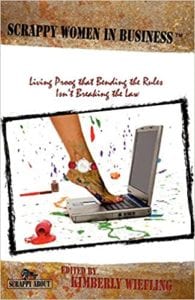
Scrappy Women in Business: Living Proof that Bending the Rules Isn’t Breaking the Law (Scrappy Guides)
I have dozens of stories like that. There’s this woman from Australia. She came to the United States. She didn’t have a community. She was trying to figure out how to make a living. She started baking scones. She took me to the farmer’s market. She happened to come in the wettest winter that we had. Scones and water aren’t such great bedfellows in the farmer’s market. She was outside. She came to us. We helped her figure out how to put a business plan together, ultimately open up a location. She had this shtick she decided to do to get people to recognize her. She calls herself Bakesale Betty. Her real name is Alison, but hundreds of thousands of people know her as Bakesale Betty. She puts on a blue wig and wears this ‘50s outfit.
Her tables in her restaurant are old fashioned ironing boards. She’s created this whole shtick and she doesn’t do any marketing. It doesn’t even have signage. She puts butcher paper every morning that says Bakesale Betty’s on the window. The way you know about her is through word of mouth, or you see the line around the block. Every minute they are open, there’s a line around the block. They got one of the handfuls of contracts at the Chase Stadium that opened up. It is a great example of someone who is like dying in the vine there because financially in a million ways. She became very famous.
What you just said is something I love. It’s called the rags to riches story. That’s a storytelling genre that I teach people in my course when they want to learn how to sell better, whether it’s to get a startup funded or get new clients or customers. We have the image of her in the water, the rain, the scones and the farmer’s market. I spoke at the Coca-Cola CMO Summit. One of the people in the audience was the marketing person for Auntie Anne’s Pretzels. They’re sold in malls and airports. I said, “How did this company start?” He said, “She sold pretzels at the farmer’s market.” Now, look how successful it is. It’s that same journey.
For everyone reading, think about what your story of origin is and what genre of the storytelling it is. When you have that going for you, you can pull people in. Everyone’s going to remember that story. What’s fascinating about that story is you don’t have to have a multimillion-dollar budget like Apple to have people stand in line to get your products. People think Apple is doing something right. They’ve created an emotional hook. What your friend, Bakesale Betty is doing, is creating ironing boards as tables. We crave new things and that’s why stories and visuals make something memorable and pull people in. This has been so much fun and interesting. Do you have a last thought, quote or book you want to recommend to anybody as we say goodbye?
If you’re thinking about starting a company or you have a company, and you’re thinking about getting venture funding. I like people to first read the book, The Founder’s Dilemmas. Be careful what you wish for because as a venture capitalist, we get to own part of your company. We get a seat on your board. It has happened with some frequency that people get fired from their own company that they founded for bad reasons and good reasons. It might have been appropriate that Travis Kalanick at Uber was asked to leave because there was some bad stuff going on there. It often happens that you don’t manage the dilution well. You can end up not making any money. The company can make huge money for its investors. Be careful before you start giving away your baby. There are lots of loan products and lots of other ways to grow and being disciplined about what you spend. Venture capital is important and as a good resource for lots of people, but it doesn’t have to be the right thing for everybody.
If people want to follow you, read more about you, what websites should we send them to?
HowWomenLead.com is our big network for 10,000 women leaders and HowWomenInvest.com is our venture fund. You can find them both on each other’s websites.
Julie, thanks again for sharing your passion, your wonderful stories, not only your own stories but about other women you’ve helped. We’re all inspired now. We have some great tips on how to tell better stories.
It’s my pleasure. Thanks for having me. Thanks for all you’re doing.
Thanks.
Important Links
- Julie Castro Abrams
- Scrappy Women in Business
- BoardLeaders
- LENDonate
- The New Search Collaborative
- Be The Lifeguard of Your Own Life! – John Livesay’s TED Talk
- How Women Invest
- Swimply
- The Founder’s Dilemmas
- Better Selling Through Storytelling Method Online Course
Wanna Host Your Own Podcast?
Click here to see how my friends at Podetize can help
Purchase John’s new book
John Livesay, The Pitch Whisperer
Share The Show
Did you enjoy the show? I’d love it if you subscribed today and left us a 5-star review!
- Click this link
- Click on the ‘Subscribe’ button below the artwork
- Go to the ‘Ratings and Reviews’ section
- Click on ‘Write a Review’
Love the show? Subscribe, rate, review, and share!
Join The Successful Pitch community today:
- JohnLivesay.com
- John Livesay Facebook
- John Livesay Twitter
- John Livesay LinkedIn
- John Livesay YouTube
How to Fight Your Flight Response
Posted by John Livesay in blog | 0 comments
We’ve all heard the term “use it or lose it.”
The Secret To Making Your LinkedIn Post Go Viral With AJ Wilcox
Posted by John Livesay in podcast | 0 comments
Have you ever wondered if you should be running ads on LinkedIn versus another platform? In this episode, AJ Wilcox, LinkedIn ads professional and Founder B2Linked, joins John Livesay as they reveal the secret to making your LinkedIn post go viral. John and AJ talk about targeting people on LinkedIn and the strategies you can implement on LinkedIn for people to buy from you. Get to know AJ and his company a bit more as he shares his story of origin and his journey through the years. Tune in and learn the secrets to how you can leverage LinkedIn and increase professional traffic in your business.
—
Listen to the podcast here
The Secret To Making Your LinkedIn Post Go Viral With AJ Wilcox
Have you ever wondered if you should be running ads on LinkedIn versus another platform? If so, this is the episode for you. I have AJ Wilcox as my guest who is the Founder of B2Linked.com, which is the only agency that specializes in LinkedIn advertising. We’ll go into the secret of how to make your LinkedIn post go viral, as well as how to target people on LinkedIn so you’ll get a relationship going to get them to want to buy from you. Enjoy the episode.
—
Our guest is AJ Wilcox, who is a LinkedIn ads professional. He Founded B2Linked.com, which is a LinkedIn ad specific agency back in 2014. He’s an official LinkedIn partner, host of the LinkedIn Ads Show podcast, and has managed among the world’s largest LinkedIn ads accounts worldwide. Did you notice the theme there? Yes, it’s all about LinkedIn. I love that focus. He also happens to be a ginger and a triathlete. He and his wife live in Utah with their four children. His company car is a wicked fast go-kart, how cool is that? AJ, welcome to the show.
John, I’m excited to be here. Thanks for the invite.
We met when I heard you speak. I instantly loved your energy and your vibe, as well as your expertise. There are a lot of entrepreneurs out there that are wondering, “Which platform should I use? Is it content or do I need to run an ad?” There are many questions people have that you have the answers to. Before we get into your expertise, this is about successful pitch and stories. Take us back as far as you want, your childhood. You and I have talked about how the LinkedIn thing all happened, which is a great story. You can start there or you can go even further back, wherever you want to start.
Starting from my family life, my parents and family are all fiscally conservative. My dad was a VP at a bank for his entire career. He retired. We don’t have an entrepreneurial bone in our entire family tree body. My thoughts in growing up were, “I’m going to go and work in a job and become a manager and then a director and then a VP and then, hopefully, a CMO or CEO someday.” That was my career trajectory. That’s what I thought I was going to do. I’ve always been highly technical. In fact, in college, I had a job troubleshooting network connections and internet servers. I enjoyed the technical. At the same time, I was studying marketing. The fears of a college student brain, it was like, “If all I know is tech, who’s ever going to hire me in marketing when I graduated?” Marketing is tech-heavy so I laugh at that but back then maybe that was a legitimate concern.
One of my professors brought in a guest speaker who spoke about search engine optimization. As he was talking, the light bulb went off for me and it was like, “This is what I want to do for the rest of my life. This is tech plus marketing all in one.” I went up after class and I begged this poor man for an internship and he took me on. This was back in ‘07. He and his team taught me search engine optimization and how to build websites and Google Ads. Fast forward a bunch of years, a couple of agencies later, a couple of in-house gigs later, I got brought into a company that’s publicly traded that was a business-to-business SaaS software company. On my first day, talking to the CMO, she asked me about my marketing strategy and I tell her what I want to do and she goes, “All that sounds great. Go ahead and execute it. Just so you know, we started a pilot using LinkedIn ads so see what you can do with it.”
I didn’t want to look like an idiot to my new boss. I jumped in and started trying to figure things out. Within about two weeks, one of our sales reps came up to introduce himself and he said, “By the way, we are fighting over your leads. Whatever you’re doing, keep it up.” I was like, “What are you talking about?” I logged into our CRM to go and investigate what are these leads. Without fail, everyone he was talking about was sourced from LinkedIn ads and that was not the only channel we were running.
Long story short, I kept investing until I took that to become LinkedIn’s largest spending account worldwide. After running that for about 2.5 years, I ended up getting laid off from that company. It was at that point where I went, “I have skills on this platform called LinkedIn ads that I don’t hear anyone else talking about. Maybe I could do something with that.” Years ago, I launched B2Linked and we’re an ad agency that only focuses on LinkedIn ads. Back then, who knows if this can even support our family. We’ve got a little bit of a runway, let’s see. I’m sure the majority of the readers have at least heard about LinkedIn. It worked out nicely.
It’s fascinating because a lot of people go, “Facebook, they got all this advertising. You can create lookalike audiences. I don’t know that LinkedIn can do any of that.” Let’s start with that because I’m trying to anticipate what my readers are thinking and ask those questions beyond my own personal questions. The first one is if someone is trying to decide between a Facebook ad versus the LinkedIn ad, are there certain advantages that one platform has over the other or are they pretty much even as far as the ability to laser in like that?
There are definitely many similarities and many stark differences. What you need to understand about LinkedIn is all of the targeting is around who you are as a professional. We can laser-target people by job title, seniority, company size, and industry, even specific company names. We’ve got 27 different ways of targeting someone. It’s insane for business-to-business or if you need to target people by who they are professional. We pay for that level of specificity in our targeting. The average cost per click on LinkedIn is somewhere between about $8 to $11. On Facebook, I’m assuming the majority of your readers are probably paying between about $1 to $3 per click. If you start comparing, you’re like, “Is a highly qualified lead worth 3 to 5 times more to me than I’m paying for it on Facebook?” LinkedIn ads is pretty much a no-brainer. If it’s not, maybe LinkedIn priced themselves out of the market for you.
[bctt tweet=”What you need to understand about LinkedIn is all of the targeting is around who you are as a professional. ” username=”John_Livesay”]
Let’s say you have your ideal client and that client has hired you for quite a bit of money to buy your course or hire speaker, all these other things, and you’re thinking, “They have not signed an exclusive with me. Would it make sense to try and target their competitors because I have experience in that industry? I could use the similar titles of the people that ended up hiring me to do that.” Do you ever see that happening?
I’m sure it happens. As an agency, we don’t do that. I feel a high degree of loyalty towards our larger clients. They took a chance on us earlier so I like to give back. Quite a few of our clients will start to specialize in an industry. You can target specific roles at specific companies, they could go out and say, “We slayed it at insurance.” Look at what we’ve already done with Geico, “Allstate, check this out.” That can be highly successful.
There seems to be a specific niche of people who are the best type of clients to do this. You’ve been successful with B2B products or services that have a lifetime value of something over $15,000. Without giving a name out of a client, can you give us an example of what a product or service would be like that?
We do a lot with SaaS software. Let’s say your license is $1,250 a month and people are going to stick around for 2 or 3 years, that would be much a no brainer. Targeting the people who need your software, they feel that pain. People with coaching mastermind groups where there are $15,000, $20,000 a year sign up products like people in the medical industry who are selling multimillion-dollar MRI machines, that thing, those are the types of things that do work well. We find that the average customer client to close usually takes about $1,000 to $4,000 in advertising. If you imagine you’re going to pay $1,000 to $4,000 and then you’re going to make at least $15,000 from it that leaves plenty of slush there to pay an agency to manage it for you and compensate your sales reps with commissions.
A big medical company, for example, they got a marketing budget and they’re hiring you to get their sales teams good leads. What’s fascinating about that is I’ve worked with some companies and they’re all struggling with the pandemic because the salespeople are not able to go to the doctor’s offices or go to the hospitals and catch them between surgeries like they used to. They’re struggling even to get the appointment for a Zoom call. I would imagine that running a campaign to grab those people’s attention, if you can’t get past the receptionist or whoever’s managing their calendar, would be a solution here.
I’ll add into this. There’s a social network that is reserved for doctors and surgeons called Doximity. I have been dying to try this ad platform out because you need a minimum of $100,000 buy in to get in. The ads aren’t expensive once you’re in. It takes this massive commitment. Once you’re in, you can target doctors by specific specialties. It’s a network they spend time on and trust. If I had a highly medical audience, I would try to scrape together $100,000. If you’re going to do this, please contact me because I would love to be involved in a Doximity campaign.
What’s also interesting is it looks like you’re also helping people who are targeting MBA candidates, the private Pepperdine’s of the world and all the other business schools that are out there that spend a lot of money on marketing to try and get people to use their MBA program versus another. That’s even more challenging because a lot of people recruit people from overseas to come here in the States and maybe they have issues with travel or things that are more difficult. If you’re going to be taking an MBA class remotely versus on campus, they have to justify that price still being the same. There are a lot of challenges there that I’m imagining you might be able to contribute to how to do that.
I can surely help with the targeting. That whole industry is seriously being disrupted. I wish I had the answers and knew what was going on. From a targeting perspective, if you know who it is who would make a great MBA candidate, whether it’s home or abroad, LinkedIn’s got good targeting for it. If you have a bachelor’s but don’t yet have any advanced degree, if you studied something like English or journalism or arts that doesn’t turn into money, you want to advertise those people and say, “Come bring your skills into something where you have a career.” Those are the types of things that LinkedIn allows you to do. What you do with that strategy after in such a changing environment is up to you. I’m along for the ride.
Do executive search firms ever hire you to target certain people? That’s a fascinating niche because I assumed that the executive search people would email or call the person directly. What makes them need an ad to help them is it if they’re not getting their emails returned?

Viral LinkedIn Post: Marketing is tech-heavy.
No. Here’s what’s amazing about headhunters, about recruiting in general. If you are reaching out to people, that’s a manual thing that takes a lot of time. Time is expensive, as you know. They are usually augmenting this with things like job boards. They put a job posting out there, they hit the job boards and what they find universally with that is the candidates who apply are job searchers. They are active searching candidates and they tend to not be nearly as high quality as those who are passive. As soon as you start turning on ads to your exact audience who already has the skills and title, you’re looking to hire for in that area has the right experience. If you’re showing an ad that says, “You look experienced here. Would you be interested in applying for our position?”
What it invariably does is it starts bringing in these passive candidates that recruiters love. This is the first time they’ve considered searching for a job. When you give them an offer, you’re not competing with eight other companies and have to get into a bidding war. They’re usually gainfully employed at that point and they tend to be a better candidate. It works well hand in hand with the other efforts that they do. Most of the time, we find we can beat the other methods.
From an entrepreneur standpoint, tell us a little bit about what lessons you’ve learned growing your company, payroll, taxes, recruiting clients, how much time are you spending, and how do you get clients. All of that would be interesting to the readers.
It’s sure as heck interesting to me when I was going through it. I started this company because I was insanely good at advertising on LinkedIn and not because I was good at operations, finance, sales, or any of the other things that you have to take on when you’re running a company. The biggest lesson I learned is, immediately, I was faced with this dilemma of, “I can run an ad account, but how do I go and find clients?” First of all, I’m averse to sales. I hate being sold to, like everyone else. One of the reasons I went into marketing is because I wanted to learn the ways that people were marketing to me and selling to me and trying to manipulate me. I could know their tricks and be immune to it.
I remember I walked into an appointment and usually lead with like, “Let me tell you about this platform.” This lady looks across the table, we have a common friend, and she goes, “Pitch me.” I was like, “No one has ever told me that before. That sounds gross.” I utterly failed. I was not proud of that. I figured out quickly, “AJ, you are not a sales guy. Don’t try to pitch, instead, do what you do best as a marketer, which is you go and provide value. You go and teach, train, share everything you know, and eventually, you’ll get the inbound leads coming to you of people who trust you.” We’re years in and that’s the tactic I use. I still don’t do any outbound sales. We don’t do any advertising ourselves. Everything is word of mouth, it’s people who’ve heard me on a podcast or seen a webinar or seen my content on LinkedIn and heard my podcast who come to us to work with us. I’m a lot more comfortable with that than I was trying to be the used car sales guy.
You don’t do any advertising, which is ironic since you’re the big one to advertise. I love that. I wanted to get that clarification. Now that you are friends with me, you’re going to completely shift your feelings around selling if you’d ever want to scale more and figure out how to tell stories in a way that pulls people in so you’re not pushing out the information. Hopefully, we’ve given people a little example for some of those stories and that journey.
We are also a speaker. I think to myself, “How does he have time to do all this?” You get hired to come in and speak and one of your takeaways is which ad formats work best and which one people should avoid? That’s a fascinating topic because, first of all, most people think, “Is there more than one ad format on LinkedIn?” Let alone which ones to avoid. Without giving away all the secrets in your talk that people pay for it, do you want to give a little hint of what that means?
I don’t hold anything back. I’m an open book. There are four different ad formats that you can use on LinkedIn. Chances are, you’ve seen all of them but you haven’t realized because they’re not as in your face as something like a Facebook Ad. There’s a newsfeed ad and that’s where I recommend everyone start. Start with a single image, they call it sponsored content. It’s a great middle of the road ad format. It’ll fit whatever call to action you have. It’s versatile. There are ads over in the right rail, which tends to be cheaper. They’re over in the right rail, they’re only available when you’re on a desktop computer, which most are on mobile. They don’t get clicked on a whole lot so it can be hard to drive enough traffic to make it worth your while.
You have one that is the new sexiness of LinkedIn where you pay to send a message into someone’s messaging box, their InMail, and that’s called sponsored message ads. They seem sexy because you’re only paying $0.20 to $0.65 per person you send it to. When you do the math, only about 50% of people will open them and then only about 3% of people who open will end up clicking on what you’re asking them to. You end up with an astronomical $20 to $40 cost per click. I recommend test into those later because they are higher risk but start with the lowest risk in the newsfeed ones first.
[bctt tweet=”You need to go for something in between where you are providing enough value to make people want to click but you’re also asking for them to fill out a form.” username=”John_Livesay”]
Is that your fourth one, the newsfeed, the rail, and the email that you were paying for?
The right rail and there is one called text ads, that’s the cheapest. There’s one called dynamic ads, that’s a little bit bigger. It’s $6 to $8 a click. You can pay all the way down to $2 per click on the text ads. You’ll pay $6 to $8 for the dynamic. It’s two separate ad formats there. Start with sponsored content and then try text ads because it’s also a low risk.
It means I’m getting a text on my phone with an ad?
It’s an ad. It’ll have a little teeny image. If you’re on desktop, on LinkedIn, you’ll see a little 50×50 pixel images with a 25-character headline and a 75-character description and you’re stacked in there with usually 1 or 2 other advertisers.
I’ve never even noticed it.
Now you will.
This is where my niche is. What are you saying in those ads? What are you saying in those sponsored emails that grab people’s attention? There’s a lot of expertise you have here about which offers convert and which ones are a waste of time. Do we want people to set up a call with us? Is that the good outcome of an ad versus trying to get them to go from an ad and clicking to buy something? What is the normal offer that makes sense here?
From a business perspective, every client we talked to says, “I want people who are ready to buy, ready to hop on the phone with sales.” We realized that if we show that to a cold audience, these are qualified people but it doesn’t mean that they know who you are or that they’re ready for what you do yet. If you put an ad that says, “Click here to talk to my sales rep,” no one will click that ad and you won’t get any leads, which is unfortunate because that would be amazing leads if you could. You don’t want to go to the opposite extreme, which is like, “I’m going to pay $8 to $11 per click to send you to my blog posts and hope that you fall in love with our content and are dying to work with us.”
You need to go for something in between, that would be where you are providing enough value to make people want to click but you’re also asking for them to fill out a form. They’re identifying themselves and raising their hand. The types of content that tend to work best here, as long as it solves a pain point or satisfies a curiosity, no matter which of these you choose, it’s going to work. It’s like, “Join our free webinar. Download our free guide, our eBook. Download this free checklist or cheat sheet. Come attend our free in-person event.” Those are the types of offers that will convert and you’ll be able to get your cost per conversion way down. A good sales team is usually going to get 10% to 20% of those people on calls for demo requests. That’s a much stronger approach on LinkedIn.

Viral LinkedIn Post: Once you have someone in your funnel, all of your channels can give them that warm digital hug and keep nurturing them down.
That’s the importance of that lead magnet. What’s interesting is you would assume, “You’re clicking on an ad from LinkedIn. I know who you are. Do I need your email?” You do, so you can continue to nurture that past paying for those emails for that specific things we’re trying to do here to be in the weeds a little bit. Why would I need them to give me their email? You’re not paying to reach out to them again. The expectation is huge, correct?
Yeah. When you own their email address, sure, you could always retarget them on LinkedIn. As soon as you get their email address, you can upload that email address into Google, Facebook, Twitter, and Quora. You can put them in your marketing automation. You can reach out directly. It gives you many different ways of enveloping that prospect in a warm digital hug, which is much better than waiting a week and a half for them to happen to log into LinkedIn and see you again.
What a great soundbite, “Give your prospects a warm digital hug.” I love that. That’s great. Any advice for people who are trying to decide how much money to spend? You’ve got all kinds of retargeting things. When is the right time to say, “This person opted in and signed up for my webinar or got my PDF,” do I need to keep retargeting them or I’m still going to retarget people who haven’t opted in?
It’s all worth testing. LinkedIn Ads is insanely good. I call it, getting the horse to water and getting them to take the first drink. It’s getting them into the top of your funnel, opting into some that is of value. Once you have someone in your funnel, all of your channels can give them that warm digital hug and keep nurturing them down. A lot of the testing I would do is start out by saying, “Download my eBook.” Anyone who’s downloaded the eBook, “Let me see if I can get you right onto a call now.” Did I earn enough of your trust that I can get a high conversion rate to a sales call?
If I’ve driven fifteen, twenty conversions by that point and I go, “My conversion rates still don’t look great. Let’s try inserting another offer in there.” Maybe it’s eBook and then webinar and then let’s try on a demo call. If you can find the right combination, the right sequence of offers to get someone to know, like, and trust you, then that’s gold. You can then take that to every other marketing channel and build around it.
That’s a useful marketing strategy for those of you who haven’t thought of that. Most people think in terms of all or nothing. The analogy I use is, would you ask someone to marry you on a coffee date? Probably not. Yet, we think this ad should go from a coffee date to down the aisle. Sometimes people need to be rude more than once, and hence the retargeting comes in. I think you like that analogy.
Yes. I use it all the time right from a cold ad saying, “Jump right onto a call with sales or buy something.” It’s like you met someone for the first time on the street and you’re screaming, “Marry me.” You might be a great marriage candidate but they will never know. They’ll think you’re crazy.
Do you ever encourage your clients to create content that maybe isn’t paid for in addition to the advertising so that there might be some synergy going on there?
I’ll go into a little bit of a hack. Readers might not perceive this as a hack but I’ll explain why it is. When you are sharing stuff on LinkedIn, it’s easy to go viral. It’s the easiest network in the world to go viral on. When you provide value to people, you’ll get a lot of interest. You’ll reach people outside of your own network. The challenge that you face if you’re doing organic is the leads that you get are the people who are connected to you and connected to the people connected to you and you don’t get to be specific about who these people are. Whereas with advertising, we can make sure you have this role and this level of seniority at this size of company, we know you can afford what we do. When you combine them together, it’s great. You’re getting a good combination of things. Sales teams like variety. They don’t like hitting the same thing over and over.
[bctt tweet=”The types of content that tend to work best are those that solves a pain point or satisfies a curiosity.” username=”John_Livesay”]
One trick that we’ve used is when you post something organically, let’s say you came out with this new guide, maybe you’re advertising it. When you share it organically, you don’t say, “Go to my same landing page here.” What you do is you say, “I created this new guide. I’m proud of it. If you want it, say something in the comments and let me know. I’ll follow up with you.” There’s a reason why this is a hack. When LinkedIn sees people commenting, it perceives that there are valuable conversations going on and it’s virality fuel. LinkedIn is going to say, “This is amazing. Let’s show this to as many people as possible.” Every person who comments is saying, “I want it. Send it to me.” You’re going to have to take some time and go and follow up with all these people or your VA. What ends up happening is that post ends up reaching way outside your network and tens of thousands or even hundreds of thousands of people will see it, and it was all free. It’s your time in following up.
How important do the comments come within the first hour of the post?
It certainly helps. There’s this concept that you have heard, I don’t know if your readers have. Pods on LinkedIn or in other social networks where you let people know this is a group of trusted people, you say, “I posted this, go like and comment if you can.” What happens is, in the first few minutes, you can determine the fate of this post if this is going to go crazy or if it’s going to get buried. The first hour is helpful. LinkedIn is going to try to show it to enough people to feel. If you can spur the algorithm on by reaching out to friends and saying, “Can you help me out here?” You’ll give yourself a better shot.
Obviously, on certain days on LinkedIn, a lot of people aren’t going on weekends. I’m guessing you’re not posting things or advertising on weekends, or do you?
This is all over the board. The majority of our customers only want to advertise during business hours, during the week, because that’s when they got sales staff on board ready to nurture people and ready to have conversations if they opt-in. We have quite a few clients who end up getting higher conversion rates and more leads on the weekend than they do on the weekdays.
Even less, probably.
I’m imagining people waking up on a Saturday morning, sitting on the toilet, deciding to pop in and see what’s going on LinkedIn and they’re converting somehow. That depends on industry.
They’re like, “Why would I go to a business web’s platform on my weekends?” Yet if you’re getting comments from maybe another post or somebody is messaging you, suddenly you’re there and then you’re looking around maybe. The last question I know people always ask is, how important is video content on LinkedIn?
LinkedIn was late to the game with video. They approached it in their bidding algorithm not in a great way. When we take a video and a static image and we test them against each other, usually what we find is the cost per click from the static image is lower than video. I tell people it’s less risky and less expensive because video cost money to produce, to try an image ad and see what happens and then test into video later. The reason for it being slightly more expensive is when you have a video ad and you have a call to action, there are implicitly two calls to action. There’s, “Watch my video,” and then take the action I want you to take. As we know, the more things we ask someone to do, the less likely they’re going to go all the way.

Viral LinkedIn Post: When you provide value to people, you’ll probably get a lot of interest.
Unlike Instagram where you’re scrolling in the videos playing automatically, that’s not the case in LinkedIn. You got to hit the button to watch that video.
It does autoplay. It works the same as Facebook and Instagram, where it starts auto-playing but plays muted. It’s important to have action going on in the first few seconds so you can get someone to stop scrolling and it’s important to have subtitles as well.
AJ, there are many value bombs. Any final thoughts or quotes? Anything you want to share as a parting gift?
Most people go to an ad platform because they want to generate leads, that’s why we go. LinkedIn’s targeting is good, in the last little while, I’ve been thinking heavily about using it for market research as well. I’m targeting marketing decision-makers. I’m going to put together a campaign that’s like, “If you’re in marketing and your seniority is manager and above, I want to target you.” Instead, what we do is we create four separate audiences. One that’s marketing managers, one directors, one VPs, and one CMOs. When we show them exactly the same two ads, the same AV test, what we start to learn is it’s like a silent focus group of what level of seniority you are and what you like and don’t like. We can find when our content resonates with the C-suite or it resonates with the individual contributor or anything in between. You’re going to generate the same leads but you’re also learning about your audience in a way that you couldn’t on any other network.
That is fascinating. The CMO is the only one that can make the decisions, but maybe somebody below them will want to impress their boss and take it to them. You’ll never know who’s going to be your advocate or brand ambassador. Thank you, AJ. If people want to follow you on LinkedIn or in any other way, what’s the best way to find you?
If you search for me on LinkedIn, I’m easy to find, it’s AJ Wilcox. Look for the smiling ginger. That’s simple to find. Do make sure that you customize your connection request to me and say, “I heard you on John’s podcast.” That way I know to accept the connection request. There are plenty of spam out there and I don’t accept the request that I can’t tell why they want to connect.
Good advice. Thanks for being on the show.
John, thanks for having me.
Important Links
- B2Linked.com
- LinkedIn Ads Show
- Doximity
- AJ Wilcox – LinkedIn
- Better Selling Through Storytelling Method Online Course
Wanna Host Your Own Podcast?
Click here to see how my friends at Podetize can help
Purchase John’s new book
John Livesay, The Pitch Whisperer
Share The Show
Did you enjoy the show? I’d love it if you subscribed today and left us a 5-star review!
- Click this link
- Click on the ‘Subscribe’ button below the artwork
- Go to the ‘Ratings and Reviews’ section
- Click on ‘Write a Review’
Love the show? Subscribe, rate, review, and share!
Join The Successful Pitch community today:
- JohnLivesay.com
- John Livesay Facebook
- John Livesay Twitter
- John Livesay LinkedIn
- John Livesay YouTube