
Selling From The Heart With Larry Levine
Posted by John Livesay in podcast | 0 comments

Salespeople usually focus just on the product or service that they’re selling. But really they should try selling from the heart. As a salesperson, people skills is a very important trait to learn. You need to know how to sell your memories and experiences with your customer. Join John Livesay as he talks to Larry Levine on how to sell properly through relationships. Larry is the bestselling author of Selling From The Heart: How Your Authentic Self Sells You! He is also the co-host of the Selling from the Heart Podcast. Join in the conversation to learn how to grow your business by knowing more about your client.
—
Listen to the podcast here
Selling From The Heart With Larry Levine
If you’re looking for new ways to be authentic when you sell something and make authenticity a lifestyle and not a light switch you turn on or off, then this episode Selling From The Heart is for you.
—
Our episode’s guest is Larry Levine, who is the best-selling author of Selling From The Heart and the cohost of the Selling From The Heart Podcast. With decades of in-the-field sales experience within the B2B technology space, he knows what it takes to be a successful sales professional. In a post-trust sales world, Larry Levine helps sales teams leverage the power of authenticity to grow revenue, grow themselves and enhance the lives of their clients. He’s coached sales professionals across the world from tenured reps to new Millennials entering the salesforce. They all appreciate the practical, real, raw, relevant, relatable, and street-savvy nature of his coaching. He is not shy when it comes to delivering his message. Welcome to the show, Larry.
John, what’s going on? I can already tell we’re going to have a blast.
Tell me about your story of origin. You can go back to childhood or college, wherever you want to start where you got your first inkling of either being an entrepreneur or the concept of being a heart-centered person.
I hated everything about school. To me, high school was a blur. I didn’t like anything about school. I went to college to appease my parents and I double majored in college. My cumulative GPA by the time I graduated was 2.1 out of a 4.0 scale. The school wasn’t the gig for me but I went because I wanted to make my parents happy.
That’s the thing, growing up with a father who was a rocket scientist. That’s what I did. I’m a big believer in this. You don’t wake up one day and say, “I think I’m going to be a salesperson.” You fall into sales somehow. Here I am with a degree in Marketing and Health Science going, “Now what?” I was getting married. No pressure and no job. I had this little voice inside my head saying, “You got to pull your head out of you-know-what pretty quick because life has been thrust upon you.”
It’s going back to the late ‘80s. I opened up the yellow pages and saw the largest ad in the office technology space because my father had said, “If you could last one-year selling copiers, you’re worth your weight in gold in the sales world.” I took it for what it’s worth. I picked up the yellow pages, the largest ad, called up, asked for the owner of the company and got a job.

Selling From The Heart: You don’t wake up one day and say, I think I’m going to be a sales person. Sales doesn’t work like that, you fall into it. You fall into sales somehow.
A week later, I find myself in a room watching a bunch of videotapes and getting trained and so forth. I’m sharing all this with you because the backstory behind all of this translates into my entire career selling copiers. My first year was 1988. It was the worst year and the best year of my life. I made $18,000 selling copiers in my 1st year.
Was that commission only, I’m guessing?
It was a draw against the salary and it was tough. I had to do 50 cold calls a day. I couldn’t come back until I had 50 cards. Once I came back, I had to start knocking down phone calls. I share all this with everybody because I believed what I learned in my first year carried me my entire career in the office technology space. I’m a big believer in this. We all have five senses and we all know what those are but I have no scientific proof behind the sixth sense, though we all have a sixth sense. My sixth sense when I was 24 years old was I have a keen awareness of bull crap.
It’s the BS meter if somebody’s wasting your time or not when you’re prospecting them.
[bctt tweet=”If you can last one year selling copiers, you’re worth your weight in gold in the sales world.” username=”John_Livesay”]
It’s not only that. I say this for a reason. I had this sixth sense of being keenly aware of what was going on in my surroundings, how salespeople are treating customers and what they were doing. I was going on sales ride-outs and so forth. I saw that the customer and commission were the centers of everything. It took me a while to figure this out because I was mirroring and mimicking everybody in my surroundings. It started to mess with me and I knew that wasn’t me. I remember I made my very first sale. I asked him, “Why did you buy from me? Besides, you felt sorry for me because it was my first sale.”
They said something to me that got me to start thinking, “You did something that completely was the polar opposite of what everybody else did. You made it about me, my company and how you can help. You didn’t make it about your products, your company and yourself.” I still remember that. I went on a very inquisitive rampage throughout my entire career. That curiosity led me to always ask questions. The more questions I asked about what was going on inside their heads, their perception of salespeople and experience, I took all of that and that’s how I marketed myself. For many years, I spent my entire career in one sales channel that was selling copiers.

Selling From The Heart: The best way to define authenticity in the sales world is congruency. Does your walk match your talk?
You talk about in your book, Selling From The Heart, the importance of authenticity and getting trust when trust is low. A lot of people are aware that they have to be curious and ask some questions as opposed to just talking. What I want to have the readers learn from you is how do you earn the right to even ask the questions? The fact that you’re curious, if someone doesn’t trust you or think you have their best interests at heart, they’re like, “Tell me what you’re here for and I’ll make a decision. I don’t need to talk to you or for you to quiz me.”
Doctors can ask patients questions because assumed expertise and trust are going on there. Let’s dig a little deeper because you have so much experience. That’s the table stakes. Don’t be somebody who just talks. Ask questions. Let’s assume that more than half the people reading know that but are looking for another way to earn that trust, to be authentic so that potential buyers are even willing to answer the questions.
I’m going to dance on authenticity for a moment and the equal business stature. There are a couple of key things there. I believe we’re all authentic human beings. First and foremost, John, I’m going to get that out on the table. To me, authenticity is a lifestyle. It’s not a light switch. We’re all authentic human beings. I have no PhD or Doctoral in any of this, neither Master’s in Psychology and so forth. This is street smarts through decades of getting the you-know-what beat out of me, what works and what doesn’t work.
I bring up authenticity for a reason. The best way to define authenticity in the sales world is congruency. Does the walk match the talk? We can say the BS meters are at an all-time high with people. How you build trust and credibility happens in the first five minutes of a conversation with somebody. This is what I know is going on in their head. John is saying to himself, “Does Larry have the goods? Is this somebody that I can trust, open up and share my business secrets with the things that are going on in my office? Can I trust him? Is he credible? Can I believe what he says?”
I bring this up for a reason because that’s what I was keenly aware of. There are two words that I held myself accountable for my entire career. It’s how can I connect and relate to somebody? The faster you can do this and the faster you can make somebody feel comfortable with you, the faster they will become comfortable enough to share uncomfortable things going on in their office. It’s those uncomfortable things that are gold. Those are the things that you will need to help them solve their issues, challenges, goals, initiatives, dreams and aspirations.
[bctt tweet=”Sell memories and experiences.” username=”John_Livesay”]
I play so much emphasis on how I opened up meetings because I knew if I opened these up correctly and I shared a bit of me, John would share a bit of him. The missing link is we don’t spend enough time on the first five minutes. The first 5 to 10 minutes in most sales situations are product-centric dumps, company-centric dumps, the buyer knows it and the insert name of decision-maker knows it. They know what’s happening and they‘re prepared for it.
I was talking to an optometrist. Salespeople are calling him all day long and he said, “It’s gone from they could bring lunch into we could have a conversation. With the pandemic, you can only talk to me for ten minutes between patients.” What are people doing? He said, “They all say the same thing. ‘Our product is the best. Let us give you all the data and scientific facts to back it up.’” Something he could read on his own.
They’re not saying one thing about themselves or anything that they might have as an idea to help his practice. It’s like, “I only have ten minutes then I got to talk about all this stuff.” There’s no “time” to build rapport or ask a question. He said, “The opposite is true. When you have less time, relationships are even more important to build. Not less.”

Selling From The Heart: Know how you can connect with somebody? And how you can relate to somebody? The faster that you can do this, the faster they will be more comfortable to share things with you.
I’m a big believer that we all can achieve equal business stature. Let’s say I’m talking to a chief financial officer, chief information officer or human resources. It doesn’t matter. I don’t have to be as highly educated as them but I need to understand the language they speak and bring it to the table in a very quick amount of time that I understand their world.
In other words, in the very beginning, if you want somebody to feel comfortable with you, start speaking their language and sharing like, “John, these past days, I’ve worked with four chief financial officers just like you. These are the three issues that we’ve been working on deeply to help them solve, issues 1, 2 and 3. I’m curious, do any of these hit home with you?” You can roll that out but what it shows somebody is you’re working with people and using verbiage like them. You’re living in their world. Talk about making somebody feel comfortable, they’re going to go, “What just happened?”
Back to the optometrist because I love stories and I’m always trying to take your words of wisdom and make them relevant through a story, the optometrist said he likes this company that he works with because of their innovation. The problems people have with their eyes in that are not what they’re having. With the pandemic, everyone’s coming in complaining about their eyes being dry, wearing contacts more than six hours because they’re looking at Zoom calls and phones way more than they used to.
Enter a product that makes your contacts less dry after 6 hours and can go for 8 or 10 hours. That ability to stay current and make the doctor look like the hero by having the product that solves the problem is what a lot of companies didn’t use to do. I remember computer companies. They’re like, “We’re going to make something and then it’s up to marketing and sales to get people to want it as opposed to asking, ‘What are your problems? Let’s make a product to solve it.’”
Here’s my challenge to the sales world. We think we sell products. Ask any salesperson, company, sales leader or most people on what they sell. They go right to their products, solutions, service, all company-centric stuff. When I learned this decades ago, it was a monumental shift in everything. I learned to sell memories and experiences. You use storytelling. This is where all of this ties together.
[bctt tweet=”Authenticity is a lifestyle, not a light switch.” username=”John_Livesay”]
In sales, we all live in a commoditized world. I’m here to throw this out there. I came out of the copier channel. There wasn’t much difference between one copier and another. Highly commoditized sales channel. The difference was my ability to articulate how I was able to help them do better business and the experience they would get with me, not my company. The big key is the competitive differences in the company. The competitive difference is you. When I learned how to capture stories and how to repurpose stories, I’m the biggest believer that the best storytellers are story collectors.
I’ve worked with companies who realize that if the rep’s repertoire or tools are only the sales they’ve made and they don’t know anybody else’s success stories to share, they’re walking around with one hand tied behind their back. If somebody else has multiple stories like a playlist or a jukebox ready to go, even if they’re not their personnel, they can say, “So-and-so in another office had somebody in a similar situation to you.”
They tell that story. If that’s the one that resonates the most, then that’s what’s important, even if it’s not necessarily your story. As long as it’s a true story that somebody else in the company did, that’s how you start breaking down silos and growing existing clients. The secret there is not just telling stories but figuring out a way to share the stories across the department.

Selling From The Heart: Ask any salesperson what they sell. They’ll go right to their products, services, and other company-centric things. Instead of doing that, learn how to sell memories and experiences.
This is game changer stuff for those that are in sales. Let’s think about this collectively for a moment. Salespeople have golden opportunities to capture all of this. You’re having conversations with your customers daily. You’re in sales situations daily. You have opportune and monumental times to capture these stories. This is why amusement parks such as Disneyland, Magic Mountain or the sports entertainment world do a massively good job at capturing memories and experiences. There are no price negotiations.
It keeps going up every year. You don’t go to Disneyland and say, “I’ll have four tickets,” and the person at the window says, “That will be $1,500.” The next word out of your mouth goes, “I’ll tell you what. I’ll give you $1,250 for it.” It doesn’t happen so why do we allow this to happen for those that are in sales? The reason why I believe it happens is that people have lack confidence.
They may not believe in themselves or their messaging. They have low self-worth. When all of this happens, it’s hard to capture these memories and experiences. To be able to have a heartfelt human conversation with somebody with clarity, they get somebody to go, “I get it.” The faster you can tug on somebody’s heartstrings, the faster they will open up.
They open up the purse strings, not just their needs because we buy emotionally and back it up with logic. In your book, Selling From The Heart, you’ve got a whole wonderful visual of someone who is authentic and that there are three parts to around the heart. There’s selling, client management and prospecting, all done through the lens of authenticity. Let’s start with how does somebody prospects authentically? What does it look like when someone isn’t being authentic in their prospecting?
I have a different viewpoint on this because you started with prospecting. It triggers them. Most companies start their training with prospecting and building the pipeline. I’m all for it. I write about it in Selling From The Heart. If you want to have an ever-flowing sales funnel, you must build an ever-flowing relationship funnel. Here’s where I believe companies missed the mark. They start with prospecting first. I start with client management first.
I see monumental growth with this and it ties into authentic prospecting. When sales leaders and sales professionals understand what it’s like and they can comprehend how to build authentic relationships and bring meaningful value to their current client base, this fuels them and will propel them to authentically prospect for new opportunities. I’m all for new business growth and prospecting. It’s 100% non-negotiable.
[bctt tweet=”If you want to have an ever flowing sales funnel, you must build an ever flowing relationship funnel.” username=”John_Livesay”]
It’s a fascinating way of looking at it because I’ve come at it from a different perspective but the outcome is the same. When I was training speaking to a sales team of luxury car salespeople, Jaguars and Range Rover, I said, “You’re going to get noes.” People think, “If you’re selling a luxury car, you don’t get rejected.” Yes, you do. There’s a competitive set for every price point. I said, “What you need to do after the no calls someone you recently sold a car to. Not to try and sell them anything else but to remember what a happy client sounds like.”
When the next person walks into the dealership or rings on the phone, you have that in your head and not the no. It’s like a sorbet in between courses. I hear you saying before you start prospecting, get in the mindset of the current clients and why they’re happy so that you’re authentically sharing that message.
I fought with sales managers inside the world that I grew up in, which is the copier channel. We were always benchmarked on outdated KPIs, Key Performance Indicators. “How many calls you made now? How many appointments did you go on?” Things that are still alive and well drive me bonkers. I would get into severe arguments then they would say something like this, “Larry, you’re spending way too much time with the current customers. You got to go out and grab some new business.” However, I drove more new business sales in a company year over year than any other salesperson but yet spent the most amount of time with my current customers.

Selling From The Heart: If you want to grow your business, know that the more you know about your clients, the more you’ll grow with your clients. And, the more you learn about your clients, the more you’ll earn from your clients.
Were you getting referrals?
It was referrals but here’s where I learned this. I self-taught myself to power the networks. I knew that when I went high, wide, deep and built authentic relationships inside my customer base, I was one degree of separation from all of their peers, friends and people like them in other businesses with the same titles. I will be the first one to throw up both hands high in the air and say, “I hated cold calling.” I would rather find any other excuse out there than to cold call.
What I did enjoy was prospecting through my current customers. If leaders and salespeople can latch onto this, they will monumentally grow their business. It was simple as this. It’s a silly rhyme but I’ve made this up a long time ago. I stuck to it forever. “The more you know about your clients, the more you’ll grow with your clients. The more you learn about your clients, the more you’ll earn from your clients.” I held myself to these non-negotiable standards that every single day, I was going to generate new conversations, new connections and build new relationships inside my customer base.
I was going to intentionally pour myself into my customers. In turn, they would pour themselves into me. In doing so, I would ask for people like them that I can go out and talk to. Pretty soon they were repurposing stories and sharing experiences. I was driving more new business inside my company than anybody else. That’s why I’m a big believer that we have to flip prospecting on its head. I’m all for a new business but not at sacrificing the relationships with your current customers.
You have taken all this expertise and turned it into a book and a podcast. You also are available for personalized coaching for teams or individuals. You have some sales training available.
This is where this forced entrepreneurship came in because at 50 years old, I was fired. That was my exit out of the copier channel. I had to decide real quickly what to do. I can go back to what I knew or I could try something different. I doubled down on myself. I put 100-pound weights on my ankles into the entrepreneurship world. What I’m bringing is what I believe is sorely lacking. There are great sales skills training and product training out there.
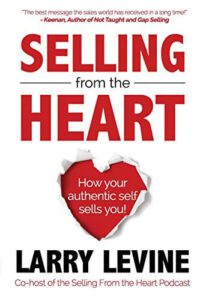
Selling From The Heart: How Your Authentic Self Sells You! By Larry Levine
What’s not enough of is people skills and relational skill-building. To me, that’s the missing link in sales. Some might call it soft skills. I say soft skills, yield hard dollars. People skills are human nature. It’s how we connect, relate and create these personal relationships. Everything that we do on our side of life, I believe transfers to the professional side of life. That’s what I coach sales leaders and sales teams to do. They might be going, “Where’s my ROI on this?”
Do you have a particular niche that you’d like to talk to? Is it people who are selling equipment?
What’s been interesting is to see where Selling From The Heart has taken me. It’s taken me into tons of vertical markets and industries. Industries are where relationships matter. You might be saying, “Larry, that’s about every place.” The whole message in the book and the movement around Selling From the Heart attracts like-minded and like-hearted leaders.
It eliminates the dirtbags that are out there that are transactional-oriented salespeople and sales leaders. Nothing wrong with that, you can grow your business that way. If you want to continue year over year to grow your people, you have to transform yourself, your sales team, the conversations and the relationships you have with your customers.
It all comes from developing people skills and relationship skills with your team. I’m a big believer in this and this is why we’re seeing such growth with this. Leaders who lead with their heart and lean into their sales team will soon develop a team that goes out there and leans into their customers and sells from the heart. That’s what we’re all about.
There’s a great way to end the episode. If people want to find out more about you, the book or the podcast, they can go to SellingFromTheHeart.net. Any last thought or quote you want to leave us with, Larry?
Your clients and your future clients would rather do business and connect with a sales professional who sells from the heart as opposed to a sales rep who is an empty suit.
Thanks for being someone who sells from the heart and shows us all how to do it in that wonderful way as well. Thanks, Larry.
Important Links
- Selling From The Heart
- Selling From The Heart
- Selling From The Heart Podcast
- Better Selling Through Storytelling Method Online Course
Wanna Host Your Own Podcast?
Click here to see how my friends at Podetize can help
Purchase John’s new book
John Livesay, The Pitch Whisperer
Share The Show
Did you enjoy the show? I’d love it if you subscribed today and left us a 5-star review!
- Click this link
- Click on the ‘Subscribe’ button below the artwork
- Go to the ‘Ratings and Reviews’ section
- Click on ‘Write a Review’
Love the show? Subscribe, rate, review, and share!
Join The Successful Pitch community today:
- JohnLivesay.com
- John Livesay Facebook
- John Livesay Twitter
- John Livesay LinkedIn
- John Livesay YouTube
How Hard Can It Be? With Arnaud Henneville-Wedholm
Posted by John Livesay in podcast | 0 comments

How hard can it be to monetize your startup business? John Livesay sits with Arnaud Henneville-Wedholm, an entrepreneur, optimist, and author of How Hard Can It Be? The journey is full of peaks and valleys. It’s never just a straight line towards success. The key is to start small. Validate your assumptions by throwing your ideas into the market. Don’t forget to get honest feedback. The most important thing? Believe that you can. Need more tips on how to make your startup business a success? Tune in!
—
Listen to the podcast here
How Hard Can It Be? With Arnaud Henneville-Wedholm
Our guest is Arnaud Henneville-Wedholm, who is an optimist, entrepreneur, and author of How Hard Can It Be. He leads sales and business development at GLOBHE, which is a health platform for drone data on demand. He mentors startups at the Nordic Startup School and Leaders on TaskHuman.com. He is the Founder of multiple startups, including internalDesk, a SaaS platform for enterprise collaboration, where he served as the Chief Operating Officer. It was recognized as one of the Top 10 Tech Rising Stars in the Nordics in 2014 and was acquired in 2019. His interests include entrepreneurship, neuroscience, and everything related to mindset and wellbeing. He lives in Stockholm. He’s also a fan of storytelling. Welcome to the show.
Thank you so much, John.
It’s great to be with you. We have some mutual friends. I would love you to take us back to your own story of origin. You can go back to school or even childhood of how you get interested in being in the world of entrepreneurs. A lot of people are not even exposed to the concept. You either go to school and become a doctor or lawyer, or you have your own business as an electrician or something. How did you get into this world of entrepreneurship?
The quick answer is I feel that I’ve always been an entrepreneur. It’s a weird one. I’ve never fitted in. I’ve done the classic curriculum in a way, although it wasn’t a straight line. I went to school, dropped out, started to work, and went back again. I didn’t follow the classic schooling in France initially. I worked a bit and eventually realized that I felt behind academically. I needed to have this bigger degree. I went on and pursued an MBA.
After that, I work in management consulting. I didn’t align with my expectation of what it meant to be in business. I did try a couple of things along the way, naturally. That’s why I’m saying I’ve always felt like being an entrepreneur throughout. After years in management consultancy, I went all in and dedicated my life to entrepreneurship. It’s been joyful and exciting.
Your book, How Hard Can It Be, is a chronological watch of your startup journey. At the beginning of our entrepreneurial journey, most of us are seeing big winners like Jeff Bezos. You said it’s like comparing a late-stage Picasso to someone who’s starting. It’s not fair to yourself to do that.
We were exposed to the big successes, the Kardashians and the Elons. When you start with that picture in mind, you can quickly, rapidly, or totally be sent off guard and end up being depressed, perhaps even.
[bctt tweet=”The journey is full of peaks and valleys; it’s never just a straight line towards success. ” username=”John_Livesay”]
The worst thing we can do in any career is to compare ourselves to other people because that is the gateway to Imposter syndrome and self-doubt. It never benefits us.
I did my journey, and my startup lasted for a few years. We did the classic entrepreneurial startup journey. We had the idea, blended some angel money, driving a tech startup, and we’re incubated. We got VC funding and did the whole trip. We landed very nice customers, Fortune 50 companies, and did some nice rollouts. It was a nice and enriching experience.
When you look at the data points, at that time, we were all looking beautiful. It’s all aligned. The journey itself is filled with peaks and valleys. It’s never a straight line towards success. We go up and down. Eventually, after a few years, we never got to scale the way we wanted to. We had to hang up the gloves and let them go.
The reflection of that post-journey, even though it didn’t necessarily end up in a failure, but at least a personal failure, not meeting my own expectations. I realized that most of us, 9 out of 10, will end up like that. As you look around and from where we started, it all looks everyone is an Elon, but that’s not the case.
There are a lot of takeaways there. A lot of people think it’s all or nothing. Either you’re this huge success, or you’re this huge failure. What I’m hearing is while you didn’t scale the business, you were still able to sell it. I’m wondering if the investors got some, if not all, of their money back, or maybe even a little profit. Tell us how that turned out.
It didn’t turn out the way they had expected. We did sell the technical platform, but it’s not that we ended up on the beach with piña coladas, nothing like that.
The fact you’re able to sell something is a huge accomplishment. A lot of people have to realize things are not all or nothing in life. Your book takes us on this journey, much like my fable, The Sale is in the Tale, where you pull people in with this story with great exposition about. We know it’s Stockholm, know what year it is, your laptop’s open, waiting to go live, yet there’s some conflict because there’s a big delay. That creates some tension. It’s important for people to realize that any good story, whether a movie or a book, sets something up and then instantly creates some conflict because there is no story without conflict.
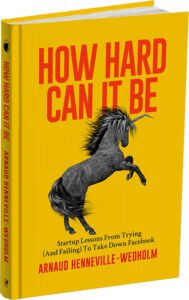
How Hard Can It Be: Startup Lessons From Trying (And Failing) To Take Down Facebook
I did an MBA. I was a management consultant. I read most of the books that are concerned with strategy and entrepreneurship. Most of them are either highly academic, which serve their purpose but are not so inspiring as a story would be. Otherwise, they are a list of the hacks to make it work. Someone has figured it out.
If you buy the book, you’ll manage yourself. It’s not black or white. It’s a very gray zone in here. My intent was to put the wannabe entrepreneur or the entrepreneur who is running his or her startup into what it’s like to drive a startup from everything, the actual emotional rollercoaster because there’s a lot to it. It’s not success after success. There are a lot of valleys and difficult situations to rise from and decisions to make.
We’ve heard about the hero’s journey and the trough of despair. What you’re saying is that your emotional skills are as important as your tech skills.
It’s all about what’s in between your ears. That’s where everything happens. There is this thing that either you believe you can, or you believe you can’t. In both cases, you are right. That’s true.
The subtitle of your book is Startup Lessons From Trying (And Failing) To Take Down Facebook. That’s a huge goal. Ironically, we are doing this interview close to the plummet in Facebook’s stock. A lot of it has been blamed on somebody taking it down, whether it’s Apple changing the ruling about tracking things, TikTok getting a little more popular, or Google doing some things. It seems like a multifaceted series of challenges that they’re facing. Give us some perspective on that. You spent a lot of time trying to figure out how to take them down back in 2013 and 2014. Years later, it looks like it might be happening. Timing is a big factor in everything.
Sadly, it wasn’t me this time. At that time, Facebook was the social platform of choice. What we were frustrated with as management consultants was the focus on behaviors. My thing was helping large organizations to cascade strategic initiatives. That implies typically either upscaling the employees themselves to help them roll out the strategy of the moment inside the company or upscaling of behavior like mindset change.
What does it take to roll out a sales initiative or whatever important strategic initiative that needs to be rolled out in large corporates? As we were looking at Facebook, all of our friends and the whole world were wondering what’s in it for people to press that button from there so fast and call that engagement? Why should you do that? Why should you like the content of the plate of your neighbors and be satisfied with that?
We thought there was more to life than being content with that action. We would challenge them with a social network that would be more engaging, and the mechanism we had found to do that was to create challenges. Anyone could challenge anyone. You could challenge your friends or yourself to something that you want to achieve in the real world.
It could be anything like becoming a storyteller, learning Chinese, or starting running in preparation for a marathon. Whatever you would set yourself to, you would have to do on the platform and provide evidence of your accomplishment. We thought that as we would do that, we would help people become better versions of themselves.
[bctt tweet=”Help people become better versions of themselves. ” username=”John_Livesay”]
It was all back to self-development in a way, self-actualization, and helping people to move from their current state to their better self. When you look at it from all theories you have out there, from Maslow to anything you can come across, it’s all agreed upon. We all want more, but there’s a gap when it comes to doing it.
You had mentioned that one of your challenges was scaling your business. What advice would you have from going through this experience for people of either a mistake to avoid or something they need to make sure they are doing to scale a business?
I’ve got plenty of advice, having gone through years of it. One of them would be to start small and not think about this one thing we believe is the best thing since sliced bread. We are going to scale it, all is going to be nice, and we’re going to end up as an Elon. No. Start small, validate your assumptions by throwing your ideas into the market, getting real feedback, and not overdeveloping things. That’s the beginning.
For example, when you launch a product, the MVP thing, you don’t want to be overdeveloping only to realize that you’ve developed out of your own imagination. It doesn’t resonate with the market whatsoever. I’ve learned to get out there, get real feedback from the market, and follow the lead of your target audience.
One of the things you say in the book is scalability is a scale in itself. You give an example of a telemedicine application on the phone being more likely to scale because you can increase the number of virtual consultants exponentially with only a small increase in the actual costs of IT. What you’re talking about is figuring out something that can scale fast without a lot of expense.
Yes. Also, your product can be scalable. Ours was. We had developed a platform that could host a lot of videos and content. The platform was scalable, but the business model was not. There was a conflict here. I have to take you a few steps back. As we tried to get people to become other versions of themselves, we failed at that because that’s a mindset element. That’s the thing we can talk about.
Everyone has their own comfort zone of how you only let yourself get so fit or whatever the issues before self-sabotage kicks in.

Startup Business: Business strategy books are highly academic but not as inspiring as a story.
It’s very hard to naturally do things that you have not done before and throw yourself into new things. People get comfortable and function 95% out of a routine they’ve established or have not established for themselves based on the mental models they’ve been given or downloaded throughout their younger age and believe what they perceive as being the world is what it is but it’s not. You can shuffle it all up and come up with anything you want. You just have to decide what it is you want.
As a storytelling keynote speaker, I’m always explaining to audiences the importance of showing something and not telling them. You did a great job of that with the story of how you met your wife, Claire, and all of the obstacles. I thought Romeo and Juliet had a tough go. You guys were in different countries and time zones. It would be so easy to have given up on that relationship.
You think, “I got this job opportunity to be close to her.” The next thing was she has moved and got her own thing even further away. That little love story within the business story shows your tenacity and flexibility. That’s what investors are looking for, being able to tell me a story either in your personal life or career where you show those things as opposed to saying you are someone like that.
When you have a story like that to back it up, then it’s memorable. People feel it’s so wonderful because you’re married, have children, and happy. Children love to hear how their parents meet. It’s such a great legacy as well. The same thing is true when you’re telling not only your personal story but your company stories.
Let’s jump ahead a little bit to what you see happening now. For Facebook to double down and even change their name to Meta, you’re asking people to make big changes and no longer “live in the real world” as much they may currently be doing and want to be immersed in this world with avatars and things. It’s a big escape beyond video games.
What is your take since you’ve been so immersed in this world and seen some resistance? Is it going to be an age thing? Young people are going to go, “This is for me. I am a digital native,” and people over a certain age will be like, “Maybe I’ll spend an hour in there, but not my whole life. I still want to talk to people in person.” What do you see happening in the future?
That’s a very multifaceted discussion, the metaverse, blockchain, NFTs, and all of that.
Let’s keep it to the metaverse because it ties so well to what your book is about, which is, “Just because the platform exists doesn’t mean the business is scalable.” Do you think it’s going to be age-specific, or is everyone going to want this new metaverse world?
[bctt tweet=”Your online digital brand image is crucial. ” via=”no”]
To some extent, we are already doing it. Interestingly, we spend a lot of time online. We all do it first for work. Every document is in the Cloud. You are already spending a large portion of your time online. You’re already in the metaverse. Another thing that struck me is that we’re not conscious of it, but we tend to create our own branding.
Our branding online has become more important than our branding offline. You can go and buy milk in your not-so-classy trousers. In your neighborhood, you may know just a few people. However, when you go online, you have potential access to millions of people, and you want to show right. That means that your actual avatar or your real or personal branding has a higher value for you online than it has offline. To some extent, we are already there.
There are all kinds of people who will spend money buying costumes and jackets for their avatars. The movie that was done several years ago about everybody going into this machine and becoming a 3D avatar is certainly an interesting thing. Do you think it’s going to appeal to a wide range of people and not just young people?
Yes. There’s the next level with the whole brain that is connected to the net, and we live mostly in the metaverse. First, we’ll go there as digital avatars, and then eventually, perhaps with Elon again, we might end up being thrown into the digital world itself.
I went to New York and saw my friends and their son, Max. During the pandemic, I wasn’t able to see him. From 6:00 to 8:00, I only have a relationship with someone via FaceTime and Zoom. In real life lunch, he said to his mom, “Uncle John is more fun in person than he is even on Zoom or FaceTime videos.” I thought, “Thank goodness.” He seems surprised that he would have more fun in person than he would on a call. What a fascinating perspective for someone who has been so isolated at that age range because that was not my childhood to have that comparison. What’s next for you?
Two things, I’m working with the book. I want to help as many entrepreneurs as possible to get a feel of what the journey is. If they are not yet in it but are considering the move, they’ll get a head start if they read the book. That’s one. Another thing I’m doing connected to the book is Keynote and things like that. With organizations, we talk a lot about failing as a capability that needs to be built into the organization for resilience.
Naturally, as a leader, you should understand what that means and how you get feedback from your people and build a culture where failure is not the thing that you don’t accept. It’s even going beyond embracing failure. It’s about seeking failure so as to dare new things and extend the box in which you are, and hopefully, find next-generation products and services.

Startup Business: Start small and validate your assumptions by throwing your ideas into the market.
In the startup world, there’s all this culture of fail fast and learn from it, and reiterate. In the world of Corporate America, people are afraid to fail. They think they’re going to get fired. To become more agile and nimble, they need to embrace failure as something that people are not afraid of doing or, worse, hiding it, and because we don’t take risks, we’re so afraid of failing that we can’t experiment. We keep doing the same thing.
I talk about Blockbuster with all the video stores that kept doing the same thing. By the time they tried something new, it was too late. Netflix did not go down that path. There are many examples of companies failing to the point where they go out of business, like Kodak, because they are not willing to try something to fail. If people want to reach you, you’ve got this wonderful website, which is the title of the book, HowHardCanItBeTheBook.com. Any last thought or quote you want to leave us with?
Dare and seek failure as opposed to being afraid of it because it’s an illusion. It doesn’t exist. You’re making it up. The moment you try something that you have not tried before, you realize that finally, it wasn’t that hard. It’s a mental block. The more you dare try things, the more you rewire your view of the world, and the easier it becomes to try different things.
[bctt tweet=”Failure builds resiliency.” username=”John_Livesay”]
I tend to look at this as when you run. If you stay stagnant on one thing you’ve always done, like running around the block while you’re not going to run 10K or further, the moment you start pushing it a bit, you realize that, “I can do that. Maybe next time I run a little further and a little further.” Eventually, you end up doing a marathon, and it wasn’t that scary after all.
It’s about expanding yourself by putting yourself into situations that at first may seem difficult, but the reason they are difficult, or at least in your head, is because you haven’t done them before. They are in your reach. Anyone can do anything. It’s a matter of mindset and daring to get out there and do the thing that you want to do.
Your children are lucky to have you as a parent that’s inspiring them with those messages. We’re all lucky to have your book inspiring all of us. Thank you so much for being on the show.
Thank you, John.
Important Links
- How Hard Can It Be
- GLOBHE
- TaskHuman.com
- The Sale is in the Tale
- HowHardCanItBeTheBook.com
- Better Selling Through Storytelling Method Online Course
Wanna Host Your Own Podcast?
Click here to see how my friends at Podetize can help
Purchase John’s new book
John Livesay, The Pitch Whisperer
Share The Show
Did you enjoy the show? I’d love it if you subscribed today and left us a 5-star review!
- Click this link
- Click on the ‘Subscribe’ button below the artwork
- Go to the ‘Ratings and Reviews’ section
- Click on ‘Write a Review’
Love the show? Subscribe, rate, review, and share!
Join The Successful Pitch community today:
- JohnLivesay.com
- John Livesay Facebook
- John Livesay Twitter
- John Livesay LinkedIn
- John Livesay YouTube
Winning Is Better With Bob Wiesner
Posted by John Livesay in podcast | 0 comments

“Winning is better” has got to be the slogan of many companies and businesses. The question is, how do you start winning? We tackle this question and more as John Livesay and Bob Wiesner of The Artemis Partnership grapple with the mechanics of persuasion. We take a deep dive into Bob’s book, Winning Is Better, to look at building trust, leveraging the non-technical aspects, and positioning yourself for success. Tune in to learn more from the masters in pitching.
—
Listen to the podcast here
Winning Is Better With Bob Wiesner
In this episode, Bob Wiesner talks about his new book, Winning is Better, and how to stop coming in second place. We talk about how important it is to build trust and how to do it fast. Finally, he talks about making a win room instead of a war room. Find out what he means. Enjoy the episode.
—
Our guest is Bob Wiesner, who has always been fascinated with how people make decisions. Even as a kid and a huge baseball fan, he was more interested in the operations of the front office than in action on the field. He studied Psychology as an undergrad and graduate student and went into advertising, where his focus on decision making shifted to the advertiser.
After several years where some of the biggest ad agencies like BBDO and McCann Erickson, he shifted focus again from the mass persuasion of advertisers to the individual persuasion of a seller relative to a buyer. He is all about this practice. People know him as the Pitch Doctor. As the Pitch Whisperer, I would like to welcome the Pitch Doctor to the show.
Thank you, and thank you for not whispering as well. We can talk out loud. I appreciate it, John. I’m glad to be here.
This premise of a whisper of anything, we horse whispers, dog whispers, we also go to the doctor for them. We trust them and ask a bunch of questions to figure out what is going on specifically. Before we get into how you came up with being known as the Pitch Doctor, take us back to what inspired you to be interested in how people get persuaded, I know for myself. I watched a TV show called Bewitched, where there was a character that worked for an ad agency. I thought, “That looks like a cool job.” What was the initial thing that pulled you into? I want to learn how people get motivated to change their minds.
It was not a lot unlike yours, John. I stumbled my way into advertising by accident. I graduated college, and before I decided to go to grad school, I was looking for a job, and I did not know what to do. I had a buddy who worked for a large ad agency. I asked him, “What did you do? It sounded interesting. Do you need special training or education for that?” He said, “Anybody could do it.” I said, “Sign me up.” I did find a job in agency life and enjoyed it.
What I liked about it was a combination of a couple of things. First of all, it was about persuasion. I found that getting an undergraduate degree in Psychology, there is nothing remarkable about that but the whole idea about how people think about things and how they perceive things, they perceived the impact of those things on themselves was something that I had studied, and it was interesting. I loved the creative aspect of it.
[bctt tweet=”Show you have a deeper understanding to build trust.” username=”John_Livesay”]
Here we were creating things for a reason. We were creating them to be different yet to be purposeful, to have an objective at the end of the day, which was to sell and soak. That was something I wanted to know more about. I stayed in the agency business in total for eighteen years with some graduate school mixed in there and focused entirely on mass persuasion, how advertisers who spend tens of millions of dollars persuaded millions of people. Later, I realized, I wanted to get a little bit more personal about it and turn my attention to how individuals are persuaded by other individuals.
What were you doing at the agency? Were you media account services selling the agency to win new business, or were you the creative team?
Yes and no. I started in media planning and buying. I moved over into account management. I spent some time in a new business. I forget what the 4th one was but not creative but I touched on all different facets of the agency. To this day, I feel like I do understand how agencies do their thing and how they persuade people.
You now are morphing into instead of trying to convince the masses to prefer one brand over another. Let’s get into helping one person persuade another person to pick a client, to hire them, whether it is a speaker or an architecture firm, you have several clients in several different industries. I love what you say in your book, Winning is Better: The Journey to New Business Success. Can people look at the roster of clients that you are now working with and say, “That does not seem to have a lot in common?” Yet, at the end of the day, there is one thing that is in common with all of them, and you say, “We are all people, and people are wired pretty much the same.”
Before I started Artemis, which is only two years old in 2022, I was doing this for other firms and doing this on my own since the mid-’90s. What fascinated me was that a decision-maker is a person. They are not a role or a job description. They are human beings. As human beings, while there are obvious differences from person to person, they are also predictable aspects about how they think. It does not matter whether they are thinking about advertising, accounting or management strategy. They are still a human, and they still have needs, desires, and mechanisms for processing information.
I don’t think that as a rule, a lot of professional services firms like advertising, architecture, and accounting understand that aspect of the person that they are pitching to. My goal since I’ve got into this part of the business is to help my clients get a deeper understanding about how decision-makers perceive their offers and use that understanding to differentiate their offers from their competitors.
One of the things you talk about in the book that is counterintuitive for many people is, “Don’t pitch everything.” Especially for me, coming from a sales background, we were told the old way of selling is to throw as much as you can up on the wall and hope some of it sticks, which is a nightmare. It is not targeted and strategic. You have a much more strategic approach to let’s define who your ideal client is and the work you love to do. In the book Winning is Better, you talk about how sometimes you can take a bid to get something, and you even win it. If it is not something you love, the win is a chore. It is not a joyful experience. I thought, “What a great distinction.”
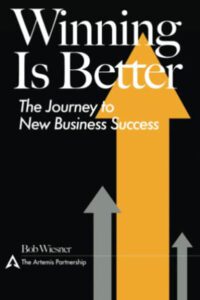
Winning is Better: The Journey to New Business Success
That is something that is easily overlooked by sales organizations and by business development professionals. It is the price of winning or the cost of winning. It is one thing to rack up numbers to get your percentages up. It is one thing even to get your revenue up but what is the impact of that win on my organization both short-term and long-term?
We define a chore as something that we are capable of doing that people will pay us to do but that nobody gets any leisure from doing. We are competent at it but that is far as it goes. You start layering a lot of that stuff into an organization, and people start turning off to it. Your workers start to shrug their shoulders and say, “Not again. Do I have to do another bathroom design? Do I have to design another landing page on a website? I would like to do something more exciting, interesting, meaningful, purposeful.”
John, everyone now knows about the Great Resignation. Is that even contributing to the Great Resignation? The fact that you are. “We are a successful company. We are growing and winning new business left and right,” your people have to do stuff they do not enjoy doing. Now, maybe they do not even want to stick around to do it.
Without people sticking around, the cost of turnover, and consistency, you are selling the team’s ability to work well together. If all that goes out the window, you are a commodity.
You have got this short-term impact of, do people want to be doing this work, and you get the long-term impact, which is if it is the work I do not love to do if people are not sticking around to do it, and if it is a commodity exactly as you say it, where is the growth opportunity going to come later on? How is this client going to turn into a bigger client down the road if the initial work that I won is one where I’m churning out a product without any passion, excitement or cultural lift from it?
Let’s double click on that word, that phrase without any excitement. I have a belief that people buy your energy. I know for myself, as a sales keynote speaker, I often have to compete. I get interviewed like big companies when they are in the final 2 or 3. I remember getting an email from the speaking bureau saying, “Congrats, they picked you. They liked your energy.” Rarely, it’s that specifically called out. I then talked to the person and they said, “You made us feel good. We figured you could make the whole ballroom full of people feel the same way.”
That energy you bring to the 45-hour however over your timeframe is presentation or interview, whatever you want to call it is important that people are going, “How do we feel? Can we see ourselves enjoying this journey if we are going to hire you to work with us?” In the case of an architect, sometimes 4 to 6 years on renovating an airport or something. People forget that that is a key part of you can’t give away anything you do not have. If you are burnt out from doing all these bathroom jobs of designing bathrooms, and you want to be designing a whole airport, you are not bringing your best energy to the room.
[bctt tweet=”Listening and empathy create chemistry.” username=”John_Livesay”]
What people lose sight of is not only that, and I’m not diminishing the importance of it but from a decision-maker standpoint, that is our thing. It is about the buyer. They are comparing you as the potential speaker to seven other people they are interviewing to be potential speaker. It is not your energy level in the absolute sense that they are looking at. It is you relative to everybody else.
How do you differentiate yourself from other people? Your content may be awesome but their content may be pretty good too. They might not be able to tell the difference between the topic you are going to speak about and the topic someone else is going to speak about. If it comes to your energy, passion, commitment, drive or what you might more broadly call the cultural fit, that could be the differentiator that wins you the business way more important than any topic or content that you might be proposing to them. That is what competing firms lose sight of is the importance of the non-technical aspects of their pursuit.
We talk about the importance of trust, and most people will go, “Yes, I know trust is important.” You have a formula for how people can be better at building trust that you reference here. I thought it was clever that trust is not just, “You are safe to be within the room. You’ve got a good referral. That is maybe 1/3 of it.” Can you walk us through what companies can do if they are walking into a room cold and have to present to build some trust?
The trust will worthiness equation was first identified by David Maister, Charles Green, and Robert Galford in a book called The Trusted Advisor, which alongside Winning is Better: The journey to New Business Success should be on everybody’s bookshelf. What they articulated was that trust has four components. It has credibility, reliability, transparency, and self-orientation.
One area that every sales organization blows consistently when it comes to building trust is this area of self-orientation. In other words, they always seem to be selling something. They seem as if the relationship that they are attempting to build with the buyer, again, buyer perception maybe not be a reality but it seems like all they want to do is talk about themselves, products, and price and try to extract money from the buyer.
All that torpedoes trust faster than anything you can possibly do. You layer onto that, whether they are credible in the space, deliver on their promises or are open and honest. All those factors together influence whether you are viewed as being tried trustworthy. Our point of view is that when initiating a conversation with a prospect, regardless of what stage you are in the sales journey, think about how are they perceiving your trustworthiness and what are you doing to build it up or diminish it?
Sometimes, part of it is being a little bit vulnerable and not pretending that you have all the answers all the time.

Winning Is Better: When initiating a conversation with a prospect, regardless of what stage you are in the sales journey, you have to think about how they perceive your trustworthiness and what you are doing to either build it up or diminish it.
That is what Maister, Green, and Galford called intimacy, which I don’t think is a 2022 word. I prefer the word transparency but being honest with people about, “Here is what I’m capable of doing. I’m good at it, and here is what I’m not so capable of doing. I’m not going to take on the project if it is not directly in my area of expertise and brilliance.” A lot of buyers appreciate that.
Let’s close that open-loop I did at the opening. How did you become known as the Pitch Doctor?
In the firm that I was working for at that time, the part of our practice that focused on helping our clients as you are doing now, John, is helping them be more effective with pitching. Not everybody in my firm back then liked doing that work. It was high-pressure work. Unlike the usual training and development stuff that the firm was doing back in the ‘90s and early 2000s, this one had results attached to it, either you win the pitch or you do not.
I loved that. That fits my personality and my motivation for working perfectly, so I raised my hand. I said, “I want to learn more about how to do this. I want to take our principles that we were training and apply them in real-time to actual new business pitches.” I did that. I worked on dozens of them for ad agencies, IPOs, and management consulting firms for an Olympic bid. I became the go-to person within the US operation when there was a client who wanted help on a specific pitch, so I became known as the Pitch Doctor.
When I talk to people who say, “We are so tired of coming in second place.” I know on The Artemis Partnership, that is one of the things that you are solving because, unlike in the Olympics, there is no medal for second place that will say, “Did you ask why you came in second place?” Oftentimes, they will say, “We were too salesy.” It goes back to what you were saying earlier, “You are too self-absorbed about bragging about how big your company is, and it has nothing to do with them.” Those kinds of things. Are you seeing a current consistent reason why people do come in second place that you are able to fix?
If someone tells you that you came in second because you are too salesy, that is great feedback, and it is better feedback than most organizations are either seeking or able to get. There are a couple of factors here. First of all, a lot of companies do not get accurate feedback at all, which makes it difficult for them to understand why they come in second.
That is a whole separate chapter of the book because it is important to get that good feedback. We hear this more from the buyers than we do from the sellers. Buyers will tell us that they did not select a firm because they did not trust them, did not connect with them, and did not provide any additional reason for why they should be hired. They followed the RFP. They met the minimum standards.
[bctt tweet=”What competing firms lose sight of is the importance of the non-technical aspects of their pursuit. ” username=”John_Livesay”]
The firms that win always have gone beyond what was initially accepted. Now the beyond could be defined emotionally. I knew you used the word energy before. We hear the word passion a lot, commitment, drive, and dedication. We also hear buyers say, “I selected that firm because they showed a deeper understanding of what I was looking for. They answered the questions in the RFP but they went beyond that to show that they understood what we looked for and they cared about it.” What is interesting is that a lot of losing firms wind up losing because they did what was asked of them but whereas the winning firms did what was asked of them and did more.
This is so insightful and valuable. For everyone reading, take that in, that it is not enough to answer the questions. You need to show the person making the decision that this is not another client or checklist for us to do. I have a philosophy. It sounds like you agree with this. The better you can describe someone’s problem and put it into words that they have not even used before, they think, “You get us that feeling of you understand us, the fact that you can express our challenges and what keeps us up in the middle of the night. Therefore, I trust you to have our solution because you understand our problem well, even if it is beyond what we described in a proposal.”
We see that manifested in a few different ways but the firm that stands out from others is a firm that shows a better understanding of the challenges of the problem. It could be the upside, a better articulation of the opportunity. That absolutely matters. That takes us back because everything is connected to a point you made earlier in our conversation, John, which is about the importance of pitching less or chasing fewer opportunities.
I cannot get the depth and the information that will help me win if I’m chasing everything. I do not have the time, bandwidth or energy for it. Whereas if I’m more selective about what I chase, I can get more depth and more understanding. I can have that diagnostic that you mentioned that deeper understanding of the problem because I took more time to do it. Everything goes hand in hand. The buyer gets that right away. They can distinguish the 6, 10 or 16 firms they are talking to. They can tell the 1 or 2 of them that took the time to get to know them from the other fourteen that did an autopilot and submitted a proforma response even if it answered all the questions.
You and I, as authors and being on a show, it is evidently clear within the first five minutes if the host has read your book or not, versus reading through some provided questions from the publicist. Going back to this concept that if you can go beyond the expectations and show a deeper caring than the come-up competition. I want to give people an example of what that looks and sounds like.
When I was working with an architecture firm on the presentation, we were having dinner the night before the practice. One of the guys said, “As an architect working in airports, I travel over the world and gets to move wherever the job is but this is my hometown. If we win this, this is a hometown game for me. The whole point of this airport is to reflect the new version of this city.” I go, “That is what we are going to be saying on the team slide. This isn’t another job for you.” That personal connection to the city for the people making the decision of what firm is going to redesign the city’s airport came through time and again. That is what you were talking about as an example.
I want to get into your wonderful pie chart on the truth about decision-makers here. You are helping people have empathy for what they are thinking about. The first part of this is people go, “You win or lose business based on what your solution is, and you say no.” That is only 28% of the decision. Let’s talk about what the other three quadrants are.

Winning Is Better: If you’re going to be a politically unsafe choice, compensate for that by pumping up some of the other parts of your sales initiative recommendation. But if you are going to be politically sound or even advisable, then leverage the heck out of it.
The next one up, which ranks higher than the solution, is the understanding me. We have touched on that. I want to get people the full fork pieces of the pie. If you have your solution, we can see that it would work. Now 31% of my decision is going to be based on how well you show me you understand me. That goes above and beyond my problems.
I’m glad that you emphasized the word me because decisions are made by individual people. They are not made by anonymous groups using groupthink. Each decision-maker is going to judge the options in front of them based on, “Did this team or organization understands what I personally was looking for, what my concerns were, what my fears were, what my hopes and dreams were, and what my own personal decision criteria are,” which might be completely different than anything published in an RFQ or RFP.
Each decision-maker, person, and influencer needs to know that the pitching team was addressing their individual needs. Sometimes, you have to be nuanced or careful about how you articulate them but you still have to make it clear that you heard them and that you’ve got it. Now that is distinguished from understanding my company or the project, which is important. They are both necessary but they are not sufficient to win. You have to go deeper, get to know the people, and show you understand the individuals.
The other part of it is chemistry. We know chemistry is with dating, and we know whether we have chemistry when we watch a movie. Although, those actors did not have the chemistry that does not work. The script is great. The chemistry in the business scenario is, “Do I want to work with you? Is this somebody I want to go have a drink with after work? Is this somebody who would have my back or would they throw me under the bus?” All those things come into play.
It is all of those but it does not necessarily have to go that deep. It depends, frankly, on whether or not I have spent enough time with you to even know that you have my back. In the first meeting that you will have with people, long before they reach the conclusions that you accurately pointed out, they are going to be able to perceive, “Do we communicate on the same wavelength? Do we use the same language? Do we waste each other’s time with irrelevant facts? Do we cut to the chase? Do we seem to care about each other as people? Are we listening well? Are we showing empathy?”
These are all factors that go into this idea of chemistry. They are easily represented even in a Zoom meeting, and they set you up for then getting to know the person even better. By the end of the process, I will believe that you and I are simpatico, we will look out for each other, I will enjoy having you around my job site for the next five years or having you auditing my books for the next three months. I would not say I would enjoy having you auditing my books but I will enjoy having you around my office. Those things will look eventually get there. I want people to understand that the chemistry is evident from the first conversation that you have with people, and it carries on from there.
Finally, chemistry is 25%. That leads a remaining 16% to the category of politics, which most people feel uncomfortable and hazy about, “Do I want to get involved with the company’s politics? Is it being aware that there is politics involved? If 16% of the decisions are based on politics, help me, Bob, how do I navigate that?”
[bctt tweet=”Competing firms lose sight of the importance of the non-technical aspects of their pursuit. ” username=”John_Livesay”]
You may not be able to but you at least have to be aware of what it is now. Internal politics are about, “What do decision-makers care about internally? Who evaluates them? Who needs to approve their decision? How will they look to these other stakeholders, that could be their bosses or colleagues? If you are selling into a marketing department, how will the marketing people feel when they go to the sales department and say to the sales guys, ‘We hired this firm to do our social media?’ Are they going to like it, or are they going to hate it?”
If you are a large organization, maybe you are publicly traded. You’ve got to worry about the shareholders. How will they feel about things? This information is not easily discovered but it is findoutable. If you can at least know what it is, you can anticipate how important it is. If you are going to be a politically unsafe choice, you can compensate for that by pumping up some of the other parts of your sales initiative. If you are going to be politically sound or even advisable, leverage the heck out of it.
If you say we have picked this social media company or we picked John as a speaker, we are going to have the Pitch Whisperer come to speak to us, give them some ammo to present why you are the good choice to get somebody excited with, especially if they are not involved in the choice. If you are an architecture firm pitching to redo an airport renovation, realize all the taxpayers and city officials that are involved in giving opinions on this as it goes along that is way more than the eight people in the room listening to the presentation. Before I let you go, I want to talk about your wonderful book at the end here, the pursuit field manual, where you have a win room. You are all about winning is better, focused on the winning more than the selling. What is a win room and how can people start to create their own?
Many people in sales and business development are familiar with the term war room. We prefer to call it a win room because we want to be more optimistic about what the purpose of the room is. The typical war room that I have seen, and John, you have probably seen it as well, is oftentimes constructed around what our offering is going to be. It is like, “What is our strategy? What is our weaponry out? How flank the other guy is? Where are we going to put our battalions? What about us?”
The win room is about the buyers. Not surprisingly, as we have been talking about. The win room is built around how much information you have about decision-makers and influencers. You probably do not have enough. How do you get more? It becomes a formula for how do I convert these inputs, which is the information you have about decision-makers and influencers, and convert that into outputs, which is your messaging.
Messaging that differentiates you from your competition persuades the buyer that you are not just viable but you are an optimal choice for them and seals the deal in your final proposals and your pitches. The win room differs from the war room, not in name or attitude but while war rooms are much more product and firm centric, the win room is entirely prospected centric and builds all of its efforts around that.
Before the show started, you and I had a little chat, and we talked about how you need to keep your flexibility at the moment. If you get feedback right before you are about to go present that a client checked your references, find out what the reference was asked, and possibly use that as part of their criteria that might not have been in the proposal to open up your messaging, you are playing at optimizing things in the win room.
[bctt tweet=”Pitching and winning isn’t about having the best product and solution, but how you position and offer it up.” username=”John_Livesay”]
One of the interesting things about the win room is that you never close your win room. It has never been done. You continually input right up until the last minute because every little nugget of information you get could make the difference.
The book again is called Winning is Better. You can get it on Amazon. People can also find you at TheArtemisPartnership.com.
Connect with me directly on LinkedIn. They are both effective.
Any last thought or quote, you want to leave us with Bob?
This has been a great conversation. I loved it. We are like-minded because we both believe that pitching and winning are not about having the best product and solution. It is about how you position it and how you offer it up. Your readers will do well to follow your advice on selling and storytelling. They would also want to read some that we have to say about the overall strategic approach to pitching, and you put these combinations together. You will be a powerful force in the market, and your competitors will be trying to figure out what the heck you are doing. That is driving them crazy.
Thanks again, Bob.
John, it was a pleasure. Thank you.
Important Links
- Bob Wiesner
- Winning is Better
- BBDO
- McCann Erickson
- The Trusted Advisor
- LinkedIn – Bob Wiesner
- Better Selling Through Storytelling Method Online Course
Wanna Host Your Own Podcast?
Click here to see how my friends at Podetize can help
Purchase John’s new book
John Livesay, The Pitch Whisperer
Share The Show
Did you enjoy the show? I’d love it if you subscribed today and left us a 5-star review!
- Click this link
- Click on the ‘Subscribe’ button below the artwork
- Go to the ‘Ratings and Reviews’ section
- Click on ‘Write a Review’
Love the show? Subscribe, rate, review, and share!
Join The Successful Pitch community today:
- JohnLivesay.com
- John Livesay Facebook
- John Livesay Twitter
- John Livesay LinkedIn
- John Livesay YouTube