

The Empowerment Paradox With Ben Woodward
Posted by John Livesay in podcast | 0 comments

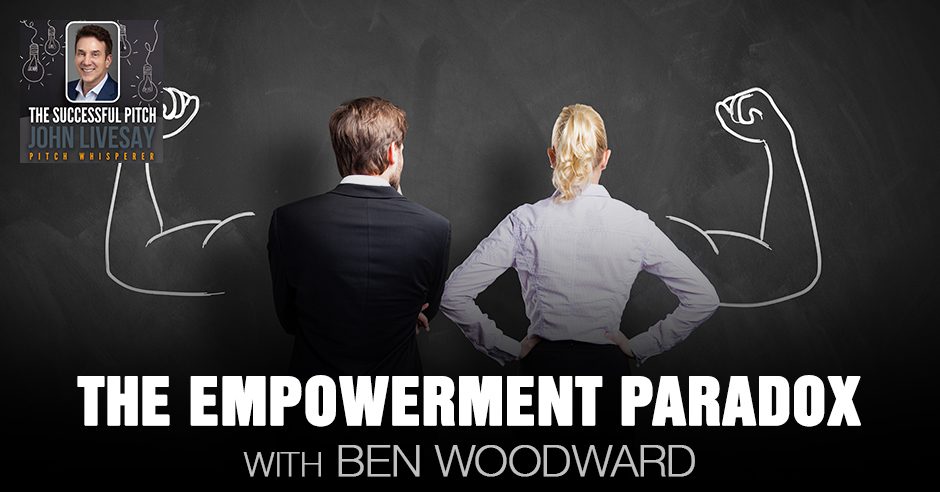
Life is not without its own set of challenges and struggles for us to go through. Understandably, these are the very things no one asks for. However, the paradox in all of these lies in the way it reveals our strengths that we often don’t know we have. In this empowering episode, John Livesay interviews Ben Woodward, the author of The Empowerment Paradox: Seven Vital Virtues to Turn Struggle Into Strength. Here, Ben gives us a peek into his book and talks about the philosophy behind his words. “Surrender does not mean that you give in or give up.” “Imagination can help you increase your patience and strength.” “We’re always going in and out of a crisis in business and our personal lives.” At the heart of these, Ben shows us that while challenges are a part of life, they nevertheless help us to emotionally and mentally overcome whatever may come our way. Join him and John in this conversation where they discuss how to handle disruption and more.
—
Listen to the podcast here
The Empowerment Paradox With Ben Woodward
Our guest on the show is Ben Woodward, the author of The Empowerment Paradox: Seven Vital Virtues to Turn Struggle Into Strength. Ben talks about the philosophy, “Surrender does not mean that you give in or give up.” Find out what he means by that. Also, “Imagination can help you increase your patience and strength.” Finally he said, “We’re always going in and out of a crisis in business and our personal lives.” How do you embrace that? Find out more, including how to handle disruption, whether it’s sickness, death of a loved one or even aging. Enjoy the episode.
—
Our guest on the show is Ben Woodward, who is the bestselling author of The Empowerment Paradox: Seven Vital Virtues to Turn Struggle Into Strength. His unique experience as a senior executive and multibillion-dollar companies has seen him flourish as a businessman and thrive as a successful entrepreneur. His intimate experience with personal suffering, having to send his own father to prison has taught him how to make tough choices, live outside his comfort zone, and turn adversity into an incredible opportunity for personal transformation. He’s a dual citizen of New Zealand and the UK. He lives in Southern California with his wife and seven children. Ben, welcome to the show.
Thank you, John. It’s an absolute pleasure to be here.
You have quite the story and the readers love a good story. I’m going to let you decide where you start your story of origin. You can take us back to New Zealand or the UK childhood since your dad’s involved in your story, whatever you think is relevant that allowed you to learn these seven vital virtues.
The story probably began a long time ago. It is often the way. When I was 22 years old, I was living in New Zealand and I made a wonderfully impulsive decision to jump on a plane, fly to the UK and see my father who I hadn’t seen since I was fourteen. It has been a long time and I had enough money for a one-way ticket. I jumped on that plane. I remember panicking as I was halfway across from New Zealand to England going, “What have I done? I’ve got £50 in my pocket.” That was it. I landed in the UK. I moved in with my father and with £50 to my name. I certainly didn’t have any means of doing much else other than relying on that relationship, which I anticipated would be great as a platform for me to get going and have my overseas experience as a young twenty-something and then work my way back to New Zealand. That was the original goal. It didn’t work out that way. Shortly after moving in with my dad, I learned he’d done some terrible things. What do I do about it? It was obvious that a prison sentence was looming over his head. If I was to act on the knowledge that I had come across, what do I do with that? It impacts me as well. I’m living with him. It’s me and him. What do I do now?
[bctt tweet=”You are always going in and out of crisis…how do you handle it?” username=”John_Livesay”]
There are many issues there: loyalty, survival, betrayal and morality. What’s the right thing to do on a bigger level? I can’t even imagine at such a young age when we’re still developing our emotional intelligence, how you coped with that. Please, tell us.
I moved out of his place and I had an older brother that was living there. Long story short, I initiated a criminal investigation into my father. It resulted in his arrest. The day that happened, I can’t even begin to express the ache in my heart knowing that he was sat in a police department somewhere being interrogated for hours on end, what that would be doing to him? These things aren’t quick processes either. You don’t get investigated, arrested. This stretches out for months and years. It led to his arrest. The arrest led to a trial at court. On the day of the court case, I’m sat there with my brother. We’ve been given a tour of the environment that we’re in, “This is where you’re going to sit when they call your name. Your father will be sat over there. This is where the jury is going to be placed. If people are in,” it was a public courthouse, “This is where they’re going to sit if they want to sit and listen.”
We sat there, my brother and I, with this horrible ache in our chest, going through this ordeal. The court official comes up and says, “The court case has been postponed. It’s not going ahead.” “What’s happened?” “Mr. Woodward has had a heart attack. He’s in hospital.” The stress of the event of everything that was going on gave him a life-threatening heart attack. He’s in hospital. Fast forward, it comes out again. He’s back in the courtroom. He gets sent to prison and he’s there for about 4.5 years. He misses my wedding. He misses the birth of my first child, maybe even the second. How was that at the start of my story? That sounds like a terrible experience. It forced me to confront difficult questions. By nature, I’m not a confrontative person.
Some people like to embrace confrontation and conflict and others don’t.
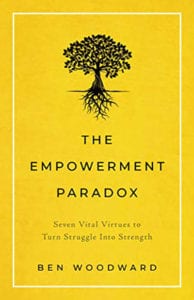
The Empowerment Paradox: Seven Vital Virtues to Turn Struggle Into Strength
That’s not me but this certainly demanded it of me. You used that word morality. What is the morally correct thing to do? Don’t focus on who is right or what is comfortable for you. What is right? What is the right thing to do? Even for my dad, I don’t think anyone wants to go to prison, but if you want to turn your life around and get rid of the demons in your life, you’ve got to confront the tough stuff. Sometimes you need someone to help you out. This wasn’t done as a punitive measure from my part. It was done as a helping hand to say, “You’re not going to have the guts to do this by yourself to put it right. I’m going to help you.”
You’re not going to turn yourself in. As we transition that into your career in business and managing salespeople and consulting, there are some life lessons that get translated because sometimes you have to fire people who aren’t performing or tell them the truth. It’s awkward. If that’s not in your wheelhouse, it doesn’t impede your leadership skills.
A friend of mine who was the CEO of a billion-dollar business once said, “In business, you’re always going into or coming out of a crisis.”
I saw that in your book. He said, “If you’ve got a smile on your face, I know what’s around the corner.” What a great line.
[bctt tweet=”Surrender does not mean give in or give up.” username=”John_Livesay”]
Of necessity, if we want to be real leaders, we need to understand how to deal with a crisis, with the unexpected, to respond to things that are uncomfortable and are unpleasant, to do it with honor, morality and to do it because that is what is right versus having our own private agenda of comfort, ease or personal benefit front and center. That personal benefit can be things like, “I don’t want to confront this issue with this person because I like them. We’ve become mates.” You’ve got to be willing to do what’s right. That’s what leadership’s all about. Another friend of mine that I worked with, I was the president of the company at the time and he was a CEO. We would often spar off each other and work together and strategizing and planning. We were dealing with a particular crisis and he said, “Many people aspire to have our jobs. They love the title of CEO and president but I don’t know if too many people that would enjoy doing what we’re having to work through and would have the guts to make these decisions.”
The glamour goes out the door when a crisis comes in the door. You’ve got a quote in your book that I love which is, “In business, you’re always going into or coming out of a crisis.” I don’t think people think of it in terms of that. They think, “We’ll fix this problem and then we’ll never have another problem again. Things will always go smoothly. Our growth will be linear year-after-year.” All of us experiencing a pandemic know that whether we like it or not, this is a crisis that those skillsets come from. For me, I learned how to not panic and stay calm in a crisis when I was a lifeguard and someone was drowning and my training kicked in.
Instead of panicking, I stayed calm and that’s helped me in my career when I got laid off after being at Condé Nast for fifteen years in 2008 when the mortgage crisis hit. That training you have from dealing with the crisis in your father of confronting hard times and dealing with doing the right thing and all those things, my lessons from a lifeguard of not panicking and staying calm, the same thing when I got laid off, I didn’t panic and stayed calm. There’s a through-line there for everyone reading going, “There are some stories here of things we learned about childhood tough decisions we had to make.” You talk about in The Empowerment Paradox, this concept of it’s about perspective. Can you expand a little bit upon that, Ben?
This is the critical thing and it’s the reason why I started perhaps with an unusual story at the frontend of, “Where does my story begin?” It revolves around my dad going to prison and the pain around that, what relevance does that have in my career? How do we view ourselves? What perspective do we give to our own life experience that can add value, diversity, insight, and clarity to a commercial environment, that they are all interconnected? If I was to look at myself for example, I come from a divorce, broken home. My father went to prison. What was me? I color myself in that light then, what strength do I give myself internally to rise up to claim my own ambitions and dreams, and chase them? Do I say, “I navigated that with a strength that taught me some lessons. I’ve got some wisdom here and some insights that can be a value I can make a difference in the world. I’m going to do something?” Do I see myself as someone with strength or someone that grew up on the wrong side of the tracks and got lucky?

The Empowerment Paradox: If we want to be real leaders, we need to understand how to deal with a crisis, with the unexpected, to respond to things that are uncomfortable and are unpleasant and do it with honor and morality.
It’s easy. I’ve heard this many times in many different frameworks that we’re only as sick as our secrets and whether that’s an addiction, secret or being ashamed of something you did or someone in your family did whether it’s sickness, death or getting older or all the other things that you talk about in the book, those are all forms of disruption. I’m fascinated to hear your tips helping people embrace the disruption of getting older because even if you’re still young and you’re reading this, you have people in your life who are getting older whether it’s your parents or grandparents.
Sometimes depression comes for a lot of people that they’ve lost their purpose, “Why am I still here? I’m not working anymore. Are the best days behind me?” There are a lot of perspective thoughts that come up and I’ve been through some of those questions myself. That’s why I’m glad that you agreed to be on the show because you’re someone who walks your talk. Now you’re raising your own children and you’re clearly a different father. What tips do you have for us on dealing with the disruption of growing older or someone in our life growing older?
There’s a whole chapter that I dedicate to this principle in the book, which is around surrender. The word surrender doesn’t mean give up. We’re not talking about giving up or giving in to getting older and throwing our hands up in despair. That’s not what it means. What we mean here is that we surrender or let go of the illusions that we’re holding onto in our lives that hold us back from moving forward. As long as I’m holding onto that illusion, that illusion being, “I refuse to grow old,” like Peter Pan. There’s a perfect example. If I’ve got something that’s holding me back, as you said, it’s a secret within me that I’m keeping to myself and I’m not confronting it. If I’m not looking directly at it, I’ve started to build illusions in my life that allow me to exist and move forward. Pretending that reality is not what it is. If I can’t let go of that, there are a number of problems that come in. First, I devote a lot of mind space to that illusion and that mind space is wasted time. I could be devoting it to a real solution, but I’m not going to be able to get to a real solution if I’m holding on to illusions.
This concept of where are we on this journey of surrender and the illusion that something is happening, I tell people all the time, “Don’t play a horror movie in your head that’s not even happening.” What if this happens? What if the economy gets bad? What if this goes on? You cannot solve problems when you’re playing horror and I think of ourselves as the director of our own movie, and we can yell, “Cut,” any time and stop where the thinker thinking the thoughts, not the thoughts thinking us. I love the way you described that. Especially in business, in crisis situations, this premise of the illusion of, “I’m never going to grow up and I’m holding onto that. I’m going to fight it tooth and nail because I have a belief system behind it that I will no longer be valuable.”
[bctt tweet=”If you want to turn your life around and get rid of the demons, you’ve got to confront the tough stuff.” username=”John_Livesay”]
Here’s a story. A friend of mine has a son that’s a teenager. He found a picture of his dad in his twenties and he brought the picture out to his dad. He said, “What happened to you?” His dad calmly went and got a baby picture of him at 4 or 5 and said, “What happened to you? Where’s my little boy? We all change.” When you’re in your teen years, you don’t think you’ll ever get old. You think you’re immortal. This concept of growing old doesn’t happen at a certain age. It’s a whole awareness that life’s always changing and then you can embrace it or fight it. Let’s go through some of the seven vital virtues that are part of this Empowerment Paradox. Before we go into that, did you entitle it? What made you want to say paradox? Is there something that’s a surprise that you think it’s one thing the paradox is something else? What makes it an empowerment paradox?
There are two layers to this paradox and multiple paradoxes within it. The first one is the necessity of the coexistence of joy and suffering in life. They’re two sides of a single reality and they both exist. There’s this wonderful saying we’re familiar with, “Time heals all wounds.” What a wonderfully reassuring message but time also seems to wound all heels if you can get your head around that. It’s heels the heel of the foot. Each of us gets hurt along this journey of life. I’ve been in a number of events where the self-help and personal development and a lot of people go. If you could imagine the ideal life for yourself, 5 to 10 years, let’s craft this, let’s build it out, what does it look like? Everyone builds this emotional homeostasis where everything is perfect, my health is in tiptop shape. My finances are fantastic. My relationships are good. My work-life balance is right and there’s no pain or suffering. I’m not suggesting we seek it or that we build it into our future. It will find its own way in but what we’ve got to recognize is that joy and suffering exist in our lives. It’s not one or the other. There’s the paradox.
It is a paradox. It reminds me of when people come to me and they said, “I get nervous when I have to pitch or speak. I get butterflies in my stomach.” I said, “The goal isn’t to get rid of the butterflies in your stomach, it’s to get them to fly in formation.” Part of that is when we’re excited or scared, our body feels similar. When you were writing about the perspective of it, “Either I get to do this or I have to do this. Either I’m excited to give a talk, a presentation or I’m scared to do it.” Our adrenaline has kicked in and we get to decide how we label that. That goes to what you’re talking about this paradox, “Something’s going, it’s out of my norm, butterflies and my stomach. Am I excited? Am I scared? If I’m scared, can I reframe it to be pretending like I’m excited?” One of the things you talk about is well-practiced patience. That’s my favorite of the seven vital virtues. Tell us a little bit about that and then hopefully that will entice people to go by The Empowerment Paradox.
My wife and I have the saying that we’ve got up in our bedroom up on the bookshelf, “No one knows how strong they are until being strong is the only choice they have.” That’s true. The reason I wanted to feature patience, I’ve even toyed with writing a whole book on that one virtue.

The Empowerment Paradox: Our capacity to become more, achieve more, be more is in our humble acceptance of the reality of joy and suffering.
I’m telling you it could be the next power of now and the fact that it’s well-practiced not just patience. What you’re saying then is we need to practice being patient. Isn’t it something we automatically either have or don’t?
There’s a lot in this virtue. First of all, there’s an old proverb that says, “In patience possess ye your souls.” This means if you take the antithesis of that in patience, we run the risk of losing them. How many bad choices are made as a result of impatience?
“Should I have that second piece of cake?”
Especially if we are going to experience adversity, there is a necessity in understanding the role of patience in that journey so that we can get through it to the point where the wisdom and the lessons can emerge. There is a journey when we are hit with adversity, suffering, trials or whatever it may be, it’s not an event, it’s a process. It’s something where we need to first embrace it, and then strive to understand it and then get to a point where we can be transformed by it. That requires patience.
[bctt tweet=”You’ve got to be willing to do what’s right. That’s what leadership’s all about.” username=”John_Livesay”]
Let’s talk about being stuck in traffic. That’s usually a big trigger for people who get impatient or waiting in a line. If you go, “I can embrace this or be mad.” Maybe listen to a podcast while in traffic or something or waiting in line. The DMV is a big test of everyone’s patience.
Yes, it is. It looks like chaos there all the time.
You know you’re going to be in line even if you have an appointment. It’s going to happen in our personal and business life and how we reframe that will allow us to embrace the empowerment paradox. The outcome of that is ironically we’re not at battle with everything that we don’t like happening. We are embracing it is my summation of what I got out of the book.
I like this principle going along with patience that often we interpret it as, “In order to have it, we need willpower alone to see us through.” There are research and evidence that demonstrates that if we can have a greater sense of imagination, then the role of imagination in dealing with our adversity and struggles increases our capacity to respond with strength. If I can have in my mind’s eye a clearer picture of where I can go and what I can get out of this that will empower me more to exercise my patience and to allow time to pass through me well, versus having it come through me tooth and nail with resistance.
[bctt tweet=”Let go of the illusions you’re holding onto in life that hold us back from moving forward.” username=”John_Livesay”]
What a great note to end on. Ben, is there any last quote or thought that you want to leave us with?
“Our capacity to become more, achieve more, be more is in our humble acceptance of the reality of joy and suffering.” When we can accept it and embrace it, surrender our illusions, we can become the best version of ourselves.
That’s ultimately the journey we’re all on. Thank you so much, Ben.
Thank you, John.
Important Links
- The Empowerment Paradox: Seven Vital Virtues to Turn Struggle Into Strength
- Ben Woodward
- Better Selling Through Storytelling Method Online Course
Wanna Host Your Own Podcast?
Click here to see how my friends at Podetize can help
Purchase John’s new book
John Livesay, The Pitch Whisperer
Share The Show
Did you enjoy the show? I’d love it if you subscribed today and left us a 5-star review!
- Click this link
- Click on the ‘Subscribe’ button below the artwork
- Go to the ‘Ratings and Reviews’ section
- Click on ‘Write a Review’
Love the show? Subscribe, rate, review, and share!
Join The Successful Pitch community today:
- JohnLivesay.com
- John Livesay Facebook
- John Livesay Twitter
- John Livesay LinkedIn
- John Livesay YouTube
Social Impact Investing With Neil St. Clair
Posted by John Livesay in podcast | 0 comments

Doing good and doing well is a philosophy that all entrepreneurs with a philanthropic side want to do, but there are so many ways to approach it. Neil St. Clair does his share by removing fear from everyday life through social impact investing. Neil is a serial media entrepreneur, senior marketing and startup advisor and creator of the “Intrigue Marketing” philosophy. He is currently leading the launch of a global media network focused on “investing with impact.” As a former journalist, Neil knows the value of telling a good story and he uses this ability to pitch venture deals and get high-net worth people and organizations to get into social impact investing. Listen as he joins John Livesay to share his story.
—
Listen to the podcast here
Social Impact Investing With Neil St. Clair
Our guest is Neil St. Clair. He has a lot of great philosophy here about doing well and doing good. Social impact investing has always been at the core of who he is. He has a great suggestion, which is that we write our obituary and create goals, so we meet how we want to be remembered. He tells us about verbal judo, leaving a little surprise to create that wow factor when you give a pitch. You’re going to want to be sure to find out what that is. Enjoy the episode.
—
Neil St. Clair is the President and Founder of NES Impact, which is a management consultancy firm and they work with single-family offices to help them develop social impact goals. They’re not only investing the money but money having a social impact. We’re certainly going to ask him about that. He also serves as the President of Child Safety Pledge, a nonprofit combating child sexual abuse through storytelling and impact investing. Before that, he was the President of Karma Impact. It’s a media platform for the next generation of private impact investors.
He’s hosted several shows for the network, including Timeless Media. He was the first-ever Chief Growth Officer for a venture-backed AR marketing platform and served as the first-ever Director of Marketing for over $11 billion. Earlier in his career, he was an on-camera news journalist. You can tell by his handsome face that that is the case. He’s also been at the forefront of a lot of award-winning media outlets. He’s a speaker that presented at UPenn’s Wharton School and Bloomberg News to name a few. Neil, thanks so much for coming on the show.
It is my extreme pleasure, John. I got out of TV because I had a face for radio and now this is a podcast.
You graduated from Boston University as magna cum laude. You went on to go to Yale. You clearly have a competitive edge as a marathoner and choosing to live in Manhattan. It’s the make it there, make it anywhere. Would you share with us a little bit of your own story of origin? You can start in college. You can go all the way back. Where did you get this drive to make a social impact?
I’m a Jersey boy for better or worse. A lot of us that come out of the garden state have a little chip on our shoulder as we stared across the river at Manhattan and wondered, “What if?” A lot of it is instilled values from my parents. Some of that is also natural. I spent a lot of time thinking about the science and art of ambition. What drives somebody to pick themselves up out of their circumstance? Why sometimes people that are born into great circumstances don’t have that natural ambition? A few years ago, I did two exercises. I would recommend this to any of your readers. The first one’s a little bit maudlin but well worth it, which is to write your obituary.
[bctt tweet=”Do well and do good.” username=”John_Livesay”]
Imagine your death at 100 years and work your way backward from that. What are all the things that you would like someone to say about you as your final act? Take that literal lifetime goal and break it down into yearly, monthly, and the actual week by week, day by day, and sometimes even hour by hour execution items. You’ll find that there are many little things that you can do to start to agglomerate and lead a great life. It also helps us offset procrastination. There is a lot of science around that setting moderate goals that have an almost cocaine effect. It releases dopamine when you achieve those goals but if you’ve set something that’s massively large for yourself, you’re less likely to ever even get started.
That’s one little ordering principle. Beyond that, what started me down the path of social impact was about a few years ago I said to myself, “I do believe that doing good and doing well is an equation that rings true, but there are many directions that I could take with this. How can I put an ordering principle into a place that’s going to be my philosophy of life?” I looked at a variety of things and finally came to a simple conclusion, which is that everything that I do philanthropically, investment-wise from a career perspective must be one simple thing. I must remove fear from everyday life.
That ordering principle has given me so much opportunity, but also so much direction. It’s flexible. It allows me to sometimes make my own definition and say, “Is this fear from physical harm?” I do a lot of work in the child sexual abuse prevention space. Is this removal of fear, say economic fear? There’s a great index at the Chapman University in California that puts out the top fears for Americans. You find political corruption, environmental change, and fear of not having the money for the future tend to be the variations of a theme of the top five going back twenty-some odd years. That plus an action-oriented way of thinking about my life has given me a social impact undercurrent but real ways and means to achieve that.
I’d be doing a disservice if I didn’t say that part of what woke me up to this was working with multibillion-dollar families like The Hinduja Family. The founding family, at least one member of the AllianceBernstein, the investment bank, working with them and seeing how they wanted to put their efforts into action. They didn’t want to sit on their money but wanted to go out and prove that equation of doing well and doing good. I’ve subsequently become involved with several networks like Nexus and Concordia that have similar outlooks. It’s been phenomenal to get involved and see that. Maybe this Gen Z/Millennial generation is going to put this into practice and help change the world.
I love what you are encouraging us all to do by writing our obituary so we can create goals to get there. It’s reverse engineering, which a lot of startups do. They like to reverse. What do we want this product to do? When I gave my TEDx Talk, I remember the coach said, “Reverse engineer your talk. What do you want the audience to think, feel, and do at the end of your talk?” You’re saying it in a bigger picture. What do we want people to think, feel, and do about us at the end of our life? I thought that was a unique way to do that. You have this quote on your LinkedIn profile from Churchill, “It’s better to be making the news than taking it, to be an actor rather than a critic.” Tell us what does that quote mean to you and what made you pick it?

Social Impact Investing: When you work backwards from what you want your life to be at the end, you’ll find that there are so many little things that you can do to lead a great life.
It means a lot. I came across it while doing some work for my undergraduate thesis many years ago and I let it rattle around in my brain. It was written by Churchill in a book that he wrote when he was a young man called The Story of the Malakand Field Force. He was coming back as a young lieutenant or colonel from the Boer War and was just getting into the political realm. This was his clarion call to himself into his generation to get involved and not to be swept up into action by others. He actualized on that in a big way. That quote, as it bounced around in my head has led to two momentous shifts in my life.
I like to think that post-college had three acts in my life. The first was as a journalist storyteller. The second was as an entrepreneur. I’m now in the third act as the gray haired disseminating my knowledge. I’ve got to figure out what I want to do with the rest of my life. All that aside, I was starting my life as a TV journalist. I was with YNN in upstate New York and Binghamton. I was promoted and worked in New York 1. At a certain point, there are a couple of other factors in this. Let’s not kid ourselves. Being a TV journalist until you make it big time is not the most lucrative way to build one’s life. Beyond that, we become increasingly frustrated by telling other people’s stories and not writing one of my own.
This quote started to bind around in my head, to be an actor and not a critic, to start making the news, and to not simply take it. It was at that point that I decided to take a break. That’s when I went into graduate school at Yale and that’s why I said, “I’m going to start my own company.” I did that first one almost the same day that I made that momentous decision. We were incubated at Yale and spent about two years on it. I was a peer-to-peer marketplace for buying and reselling hotel rooms. It was a wonderful abject failure. I’m happy to have at least one of those under my belt. You learn infinitely more from failure than from success.
I’m in the process of writing a book about the science of failure. There’s this interesting psychologist, to give you a quick example, the smartest people in the room, let’s call them venture capitalists in this scenario, or let’s call them the heads of major movie and TV studios. They get it right 1 out of 10 times. That’s success. Yet all we try to do in almost all aspects of our lives is model success, but success is the random factor. Failure is more mathematically predictable and there are ways to minimize failure than maximize success. We’ve been getting it wrong for a long time and the way that we’ve been thinking about how to go about our lives. There are more to come on that at some point. I’m in the process of collecting stories and architecting that a little bit more.
That quote drove me out of journalism and into the do part of my life as an entrepreneur. I went on to have a couple more successful companies. It also spoke to me again later in life when I was working with the Hinduja Family on Karma Impact as part of Timeless Media and Timeless Capital. I love the work we were doing. It’s meaningful but we were telling stories of social impact and social investing. I said, “I want to do social impact and social investing.” I had the capability to do that. I left there and went to go work with the daughter of the Founder of AllianceBernstein on child sexual abuse prevention.
[bctt tweet=”Write your own obit and set goals to meet it.” username=”John_Livesay”]
We created the first-ever matrix to allow people to invest in both private and public capital markets in child sexual abuse prevention. We did some other cool things while we were there. It was that quote that started creeping up again, saying, “You’ve got to do. Don’t just tell the stories.” That’s not a knock on journalists. I have an extremely soft spot on journalists and they’re getting a bad rap now. Storytelling is immensely important and can be completely impactful, but once you’ve done that for a while, it behooves yourself to circle back into the active part of life and have other people look at you and say, “Can I tell your story?” That’s a yardstick for me.
I wanted you on my show so you could tell your story. You’re not reporting on someone else’s story. I’m fascinated by yours. Now that you have seen both sides of storytelling, people present ideas and startup ideas because you’re always looking for things to possibly invest in, whether it’s your own money or the family-offices that you represent. What do you think makes a good pitch?
A couple of things and this took a lot of years of trial and error of having been an operator and subsequently having been an NLP in various venture funds or looking at it from an investor’s perspective. It gave me both sides of the equation to finally understand what I was sometimes getting wrong. I was pitching for money. The first thing, and a lot of us are guilty of this, is being short and sweet, especially when you’re dealing with investors, whether they’re venture capitalists, family offices, direct investors, it doesn’t matter. Whether they’re right or wrong, they think they’re the smartest person in the room. When you have that syndrome, listening to someone drawn on and on with rare exceptions, all you’re doing and I’m sure we’ve all sat on the chair at this point, where all you want to do is jump in and state your opinion or, “Have you thought about this?” They’re patient and respectful. What’s the TED rule? Is it twelve minutes on stage, no more or something along those lines?
My TEDx Talk came in under twelve minutes.
That’s a well-honed, true, tried, and tested rule. Twelve to fifteen minutes max is the true attention span. The shorter, the better. It’s one of the most amazing things you can do. Think of it almost as a verbal judo. Twelve to fifteen minutes, knowing that you’re leaving a couple of key points out because they assume that you’re on a pitch with a Q&A session. You won’t be comprehensive if you don’t have that Q&A, but draw someone in. Leave one slide in the appendix that you know is a killer slide. When that person or investor said, “Have you thought about this?”

Social Impact Investing: Outside of the United States or the developed world, there is no such thing as access to credit. Either you have the cash or you do not.
You say, “In fact, we have.” You pull up that slide and knock them down. I will tell you that having been that investor, I love that because that shows that you anticipated my question. To be drawn in and have that question answered in such a prepared way and not someone that’s clearly bluffing. It’s clearly thought out, gave me a short enough presentation that I got it already, and knocked me over the head, I’m like, “I’ve got to learn more about you.” That is one of the things that investors are often looking to challenge you on. They like to play these games.
I love that so much because I’m constantly teaching people when I tell specifically sales teams that you’re selling yourself when you pitch to get funded, you’re selling yourself to get hired or get a new client. You must tell stories to become magnetic. Showing someone that you have thought out a potential question and have a slide ready to go as the answer is much more powerful than telling someone, “I am someone who uses critical thinking.” When you show it in, as you said, verbal judo almost, the energy is going back and forth. To me, a great story, a great pitch is all about having a collaborative conversation. The potential buyer or investor leans in and goes, “I want to know more about you.” You’ve intrigued them enough to pull them in. That’s what great storytelling does. I love this analogy that you use of saving a little something for the wow factor. It’s almost like dating. You don’t want to tell everybody everything about yourself. Intrigue us a little bit more that there’s something else. It’s this and more.
You’ve used my favorite word. If you go to NeilStClair.com, which frankly needs to be updated, I came up with an idea of something called Intrigue Marketing many years ago, which leads to this. It is to leave a little something out. Human beings are social animals and I have seen that concretely now in the time of COVID how social we are. We want good stories. We want to be surprised. Why do we go to the movies and see a horror movie where someone’s going to jump out of the darkness? Why do you think Steve Jobs or that television detective from back in the ‘70s would always say, “But wait, there’s one more thing.” That was always the thing. Psychologically, when you write an email to somebody, the one thing that almost everybody remembers is the PS. Always write a PS. Always make that the most important point.
There are many of these little psychological games that at the end of the day, the way to tell that effective story is to employ some of those techniques. There are some great books that were written amongst others, but the bottom line is if you can get someone to lean in and do that verbal judo, you’re already 80% of the battle there. If you’ve been short and sweet enough that you’ve been able to get those 3 or 4 mission-critical points across, the reality is human beings can’t store that much information in their head. You’re going to have such a higher chance of success than if you try to talk for 45 minutes. There are still questions at the end and now you’re trying to riff and come up with answers.
At the end of the day, don’t make the perfect the enemy of the good and allow that person to lean in effectively. Intrigue is one of my favorite words. I run a private membership organization that relays and proved out over the years this concept. I essentially sometimes will rarely send it to someone I know but oftentimes cold emails to prominent figures. The number one word I get back in the invitation I send is, “This is so intriguing.” It’s my absolute favorite word. Human beings love to have that interest piqued. Do that as much as you can. There are a lot of techniques within all things that you do that can lead to some material positive results.
[bctt tweet=”If you start off with massive goal for yourself, you’re less likely to ever even get started.” username=”John_Livesay”]
I’ve created this whole ladder. That’s why I was resonating with who you are and what you do about going from invisible, to insignificant, to interesting, to intriguing, and at the top becoming irresistible. That whole “Where you are on that ladder,” whether people see you, is the whole key to pulling people in.
You’ve leveled one of the things that I wanted to speak on for a moment, which is talking about analogizing it to dating. Let me be somewhat crass. Human beings are driven. The things that cause joy and fear are universally the same. It doesn’t matter whether you’re marketing on Twitter, Facebook or you’re writing in Sanskrit 10,000 years ago. The idea of stories and the way we communicate and the things that cause us joy are universally similar. What is one of the things that truly drive our lives? Where do you got it a lot wrong but you got one thing right? I hate to say it but sex and relationships drive us at a material level.
As you’re thinking through business, use the relationship analogy in all aspects of your business to understand how do you make yourself irresistible to somebody. Begging usually doesn’t work. Talking one-sidedly usually doesn’t work. How can you get that person to lean in and say, “I absolutely must learn more about this person?” Sometimes a little air of mystery and sometimes going 80% of the way to the kiss, and letting them come in the other 20% that works. The psychology of successful relationships cross-applies in business.
It’s so true that magnetic field of energy. When you think of energy in terms of what energy am I putting out? What is that attracting? Who is this for? Who is this not for? The clearer you get both in your dating life and in your business life, I feel is what makes people attract the right one. What kinds of projects in social impact are you looking to be part of? I know you have an AI background. Are you looking for something that has AI with social impact? Is there any magic formula or you know when you hear it?
Talking about a relationship analogy, one of my biggest turn-offs is when someone walks in and says, “We’ve got AI, insert whatever platform here.” The same way that a lot of people on dating websites or whatever oversell themselves. The picture doesn’t match up with the reality in life. If you come to pitch me as an investor and say, “Artificial intelligence,” the conversation is usually over before it started. Unless you’re coming from MIT or the Jet Propulsion Lab or something, no one has true AI. It’s a branding term. Having worked in that world, primarily what we have now is machine learning. I won’t go off on a long tangent about this, but when it comes to investors, if they’re smart investors and there is stupid money out there, let’s not kid ourselves.

Social Impact Investing: Storytelling is immensely important and it can be completely impactful.
If you’re talking to a savvy investor, don’t give me crappy, schlocky, corporate terms that you think are buzzwords that get my eyes lit up. The reality is what’s called General Artificial Intelligence does not exist. While I’m looking for things that have automation and machine learning that take a complicated or manual repeatable process, that’s great but the reality is that’s most things. That’s most technology now. That’s table stakes. You’re taking a repeatable process that was done manually and techifying it to some extent. I’m probably, by my admission, not smart enough to understand things that are true deep high tech. There’s a whole class of people out there in the life sciences that are looking at things in true deeper robotics and true neural networks. I love that. I love nerding out about that, but I’m not smart enough to be a proper investor in that.
I’m an investor typically working with families or myself in things like media. Sometimes it’s one of the most exciting and entertaining ways to lose $1 but I’m a glutton for punishment. FinTech and financial services, because I can understand that I still think there’s a lot of nuts to crack there. I also had an insurance technology company in the past. I love taking boring industries and making them sexy wherever possible. I’ll give you a couple of examples of things I’ve invested in. The undercurrent on most of those things is they have to have some degree of social impact.
For example, I’m interested in for-profit universal basic income platforms. There are a few things out there looking at that. It’s fascinating to use financial engineering to provide people with what I call a springing UBI. It’s not a government grant but it’s something that we can do to solve some real societal ills. I’m invested in the company now they specifically does merchant side financing for third world countries. Most people you probably don’t realize, outside of the United States or the developed world, there is no such thing as access to credit. Either you have the cash or you do not.
If you’re a lower-middle-class family in South Africa, Kenya, Peru or Mexico, and you want to buy a stove to heat your house and help feed your family, if you want to have whatever unit of a denomination is an XYZ dollars, you cannot get it. What they do is provide a firm style financing for something like that. You can’t go and buy a TV with this merchant style financing. It has to be things that drive you forward socially. I’m passionate about those folks. Similarly speaking, I’m involved with a company called ScholarMe, which came out of Y Combinator. It’s run by a young kid. It’s a great story. I met him at a venture pitch competition that I was judging. He hacked his way out of Baltimore by going to cafes, hacking into Verizon and getting access to their Wi-Fi. It’s a great story at the outset and you tell this kid has it. He’s a total tech nerd.
He probably shouldn’t be the CEO but definitely, he is someone that knows how to techify a company in the right way. The bottom line is what they do is they’ve created a common application for scholarships using natural language processing and some other deep tech stuff. You can write one application that now goes out and pre-fills 3,000 scholarship applications in a matter of an hour. Whereas before, you probably spend 3,000 hours filling out 3,000 applications with still uncertain results. The way they make money is by doing some interesting plays with student loan companies. I’m interested about what they do in helping people get a low cost or gratis education. Those are the things that I look for which is a true provable business model. Yes, good technology. Yes, good team, but something on the back end, going back to my philosophy, removes fear.
[bctt tweet=”Humans can’t store too much information in their heads, but they sure love a great story.” username=”John_Livesay”]
In the first example, the company doing merchant side financing is removing that fear of being able to frankly live in those instances and be able to see past 30 or 40. In the instance of ScholarMe, it’s removing that fear of, “How am I going to pay for college? How am I going to be able to afford these things? Can I go to Yale? Do I have to go to a community college or a local state school?” I’m not saying they’re bad schools, but by comparison, Yale gives you a natural leg up in life. Being able to even that playing field through inclusion, equality, and equity is important to me. That’s what I’m looking for and all the typical VC things. It’s a great founding team, know your stuff, know your numbers, you got the right kind of gray hair sitting behind you.
When I first heard the concept that we feel excited or we feel scared, the sensations in our body are similar, which is joy and fear. It’s up to us to reframe fear, “I’m excited now. I’m not scared.” Whether you’re getting out there to give a TEDx Talk or whatever you’re trying something new, that framework is helpful through the lens of, “I’m looking for things that remove fear from everyday life.” What a great tweet that’s going to be.
The joy and fear or whatever you want to slot in there, there’s a lot of interesting studies on the science of emotion. They’re not only are physiologically closely linked, they’re also neurologically closely linked. There are actual tricks in the way that you can combine those feelings and emotions either to replace them or to say, “Put fear or anxiety with a feeling of joy.” All of a sudden, you create an entirely hybrid emotion that can stimulate you to act in many ways. There’s a lot of neurological backing that once you become aware of it, you can also start to retrain yourself, your body, your mind, and the way that you process things.
The way that you put it, reimagining fear is something that gives us excitement and something that I look for in an entrepreneur. Someone that’s taking a kernel of fear and has overcome their own lack of privilege or personal shortcomings and has turned that into a hugely motivating factor. That’s the person that’s going to be your next Elon Musk, Steve Jobs, or someone that never stops. There’s a relentlessness to them sometimes to the detriment of their personal life. It’s a great way to think about it. Emotions play a lot in outcomes and success.
When I teach salespeople that storytelling is a skill as a speaker or through my online course, I tell them, “You must create a story that people see themselves in that story. When they see themselves in the story and they know you have empathy and understanding of the problem that you’re solving, then they want to go on that journey with you.”

Social Impact Investing: The things that cause joy and fear are almost universally the same, whether you’re marketing on Twitter or Facebook or you’re writing in Sanskrit 10,000 years ago.
That’s right. You have to match those communication styles. If they are an entertainer and want to tell the story of their life, you match it right back and become a great active listener and provide a little bit of a reflection of that storytelling. I’ve gone through and done a lot of sales training myself in the past. Doing that almost Socratic method, I tend to find that often when you ask someone to do something, they’ll give you the opposite answer. If I sat down and started to say to you, “Tell me what you like about your current software platform.” You’re not going to tell me what you think about your software platform. You’re going to go on a tangent on all the things you don’t like about it.
Heuristically, from a sales perspective, I believe that we define our lives by the negatives. I want to go back to my relationship analogy here. If I said, “Describe your perfect mate,” most people would give something like, tall, dark and handsome for a guy or whatever it is. The reality is that’s not who you’re with right now. When I asked you, “Don’t tell me what you think you want. Tell me what you don’t want based on past experience,” you get a much more specific granular laundry list of things that didn’t work. By definition, the opposite is probably true. People oftentimes fool themselves into this vague sense of what the future might hold when the reality is they already hold the keys to those answers by doing that definition by the negatives.
Neil, how can people follow you and find out more about you, whether it’s some of the charities you’re involved with? What’s the best way? Is it on your website or LinkedIn? Where should they go?
You’re welcome to go to my website, NeilStClair.com but it’s probably not the best repository for information. I love being contacted directly. I’m open to being an advisor or considering an investment or helping you as I can. As my old boss would say, “Sharing my confusion where appropriate.” Please feel free to reach out directly. My best email is [email protected]. I’m perfectly accessible through that. In terms of social media platforms, please feel free to reach out to me on LinkedIn. I love connecting with people there. I’m not particularly active on other social media platforms. Although if you want to follow my daughter, she has 1,000 followers on Instagram @EllaBearStClair. I tweet to both her and her brother. They appear on a regular basis. They get political sometimes, but it’s a lot of fun. I figured one day, I was like, “Where am I going to have a catalog of their life?” I go out and take a fifteen-minute coffee break every day. I might as well do something that gives my kids a legacy of their life. Feel free to follow them as well.
What a wonderful and upbeat note to end on. Thanks again for being with us, Neil, and sharing your wisdom of when we do well, we can also do good.
Thank you so much, John. It’s my pleasure.
Important Links
- Child Safety Pledge
- Timeless Media
- The Hinduja Family
- AllianceBernstein
- TEDx Talk – John Livesay
- LinkedIn – Neil St. Clair
- ScholarMe
- Y Combinator
- [email protected]
- @EllaBearStClair – Instagram
- NeilStClair.com
- Better Selling Through Storytelling Method Online Course
Wanna Host Your Own Podcast?
Click here to see how my friends at Podetize can help
Purchase John’s new book
John Livesay, The Pitch Whisperer
Share The Show
Did you enjoy the show? I’d love it if you subscribed today and left us a 5-star review!
- Click this link
- Click on the ‘Subscribe’ button below the artwork
- Go to the ‘Ratings and Reviews’ section
- Click on ‘Write a Review’
Love the show? Subscribe, rate, review, and share!
Join The Successful Pitch community today:
- JohnLivesay.com
- John Livesay Facebook
- John Livesay Twitter
- John Livesay LinkedIn
- John Livesay YouTube
The Blind Spots Between Us With Dr. Gleb Tsipursky
Posted by John Livesay in podcast | 0 comments

We like to think of ourselves as intelligent beings. After all, are we not the most evolved organisms on the planet? Sophisticated as our brains may be, they are specifically wired to be prone to a large number of cognitive biases that affect how we communicate and build relationships with other people. Whether you’re talking about business or personal relationships, falling prey to our cognitive bias leads to bad decisions and, ultimately, disaster. We have over 100 cognitive biases. Cognitive neuroscientist and Disaster Avoidance Experts CEO, Dr. Gleb Tsipursky, takes the 30 most dangerous ones for relationship building and effective communication and discusses them in his new book, The Blindspots Between Us. In this interview with John Livesay, he goes in-depth into the two most common and insidious forms of cognitive biases that we are constantly subscribing to, to the detriment of our business and relationships.
—
Listen to the podcast here
The Blind Spots Between Us With Dr. Gleb Tsipursky
Our guest is Dr. Gleb Tsipursky, who is the author of The Blindspots Between Us. He talks about the importance of emotions being like underwear, and that you don’t want to go commando into your next sales call. I love that. That was very playful and clever. He’s quite intelligent and talks about cognitive bias, which is when we think something is true, when in fact it’s false. For example, people buy illogically and then you throw out a bunch of information. He and I are definitely on the same page that people buy emotionally and that they need stories to pull them in. Find out what the other cognitive biases are that you might be doing and making mistakes that you can learn to avoid. Enjoy the episode.
—
Our guest is Dr. Gleb Tsipursky, who defends people from relationship disasters caused by dangerous judgment errors, known as a cognitive bias. He does this with consulting, speaking and training as the CEO of Disaster Avoidance Experts. He’s a Cognitive Neuroscientist and Behavioral Economist. He has over 550 articles, everything ranging from Fast Company to being in Psychology Today. He is a bestselling author known for Never Go With Your Gut. He is writing a book about resilience, which we all need about adapting to COVID. We’re going to be talking about his latest book, which is The Blindspots Between Us: How to Overcome Unconscious Cognitive Bias and Build Better Relationships. Gleb, welcome to the show.
Thank you so much for inviting me, John. It’s a pleasure.
Our mutual friend, Dr. Mark Goulston, lots of doctors, you’re a doctor, he’s a doctor, referred me and he always has amazing relationships and contacts. You and I had a chat previous to the show, and you have a very unique set of insights to share with us. Before we get to that, Gleb, I like to ask my guests to take our readers on their own little story of origin. How did you become you? Were you a little boy saying, “Someday, I’m going to become a doctor and figure out how to help people avoid disasters?” You can take us back to childhood, college, wherever you want.
I will take it back to childhood and it wasn’t quite about disasters. It was about decisions. That’s what my fundamental area of expertise. How do we make decisions go well? How do we make decisions badly? How do we avoid the bad decisions? When you look at disasters, disasters come from bad decisions. That’s where disasters come from. There are two types of decisions that lead to disasters. Either we actively make a bad decision, so our initiative causes a bad decision or a series of bad decisions that lead to a disaster, or we fail to foresee a disaster. We fail to foresee and take action, make the decision that would result in avoiding disaster. Those are the kinds of things that result in disasters. My interest in decision-making stems from my childhood, when I saw my parents making some pretty bad decisions in their personal lives. For example, my mom, she liked to buy nice clothing. She’d go out, she’d buy a $100 sweater. My dad was a cheapskate, so she’d come home and he’d yell at her, “No sweater should be worth over $20.” She’d bring up how he always leaves the toilet seat up.
Where did you grow up? Where is this happening?
This was happening already in the former Soviet territory of a country called Moldova, which was liberated from Soviet domination, Russian domination in 1991. That’s when my parents immigrated to the United States and that happened in the United States. I was ten when they immigrated. It happened definitely before that and afterwards.
It’s important to get that context. It’s fascinating for them to realize why your dad might be perceived as a cheapskate based on his background there, and now they’re in the States and still bringing some of those choices, beliefs and decisions. Even though you changed locations, your mindset sometimes comes with you.
[bctt tweet=”Disasters come from bad decisions.” username=”John_Livesay”]
That does not change. That basic dynamic between them did not change. I kept doing that and the thing is all throughout my childhood, both back in Moldova and in the United States, nothing changed. They kept doing the same things and they kept not changing their behavior. My mom kept buying nice clothing and my dad kept yelling at her. I grew up frustrated. It impacted me as a kid to see my parents fight over something so stupid. As a kid, I was seeing this stupid thing to fight over. Even more stupidly, there was no change. They kept hurting each other, dealing with each other to these emotional blows all the time, but their behavior didn’t change. My mom kept buying the clothing. My dad kept yelling at her and they kept having these conflicts.
I kept hoping that somebody would sit me down and say, “Here’s how I make good research decisions about communicating about your relationships with others,” but nobody did. In other life areas, there was nobody who taught me how to make good decisions. That didn’t happen in school. Not in elementary school, not in middle school, not in high school. Nobody taught me to make good decisions in college and that’s not taught in business school either. I became interested in how do you make good decisions? How do you avoid the bad relationship patterns and communication patterns that my parents fell into? I didn’t want that for my relationships. I didn’t want that for my professional life. I am the CEO of Disaster Avoidance Experts. As the CEO of a consulting, coaching and training company, I’m obviously in sales.
Dr. Gleb, can you define for us what a disaster is in business?
A disaster in business is anything that significantly impacts your bottom line in a negative way. Anything like that is a disaster and that’s what I wanted to help people avoid. Right now, as the CEO of Disaster Avoidance Experts, I’m obviously in sales. I know that there are many things, many of these dangerous judgment errors that harm the fundamental relationships that you have to build in sales and the effective communication that you have to have in sales. That’s something I learned as I went into the job of consulting, coaching, and training. Initially, I didn’t know anything about sales. I was fascinated with decisions and decision-making. As I learned about this topic, people started asking me about it and that’s how I began to be consulting, coaching and training on this topic. I’ve been doing that for over twenty years. I learned that there’s very little quality information available out there in the popular literature and the popular media on making good decisions. It boils down to go with your gut, trust your intuitions, follow your heart. The Tony Robbins, be primal, be savage, that’s unfortunately incredibly damaging and causes people to lose sales all the time and make very bad decisions about everything from selling to storytelling to all other areas of business.
What’s the biggest mistake people are making when they’re trying to sell someone?
The biggest mistake people are making when they’re trying to sell someone is going for their mind as opposed to going for their hearts. There’s a cognitive bias, a specific, dangerous judgment error that we make as human beings because of how our brain is wired. That’s called the empathy gap. The empathy gap is when they underestimate the extent to which emotions move other people or influence other people. When you look at the research, I mentioned there was very little quality literature out there making good decisions. It’s popular literature. I had to go into academia and become a cognitive neuroscientist, which is the study of how our brain works and how it impacts the way that we function, and the behavioral economist, which is how human beings behave in economic situations. I’ve been doing that for many years.
In order to get somebody to take an action and buy something, or even hire you or enroll in graduate school, you have to look at their thought process as well as their pocketbook. People look at something and they go, “I want that or I need that,” like in your mom buying the dresses. There’s some behavior bias on why she needed to buy a certain price point to feel good about herself or proud about what she was wearing. If we define cognitive biases, so a bias is when we tend to have a prejudice one way or the other based on our thoughts. Is that what cognitive bias is?

Cognitive Bias: There are so many dangerous judgment errors that harm the fundamental relationships that you have to build in sales.
Cognitive bias is a mistake we make in our thinking when we think one thing is true, but it’s actually not true.
Do we have an example of that?
I mentioned the empathy gap. When people think that other people are moved by reason by logic.
It’s a cognitive bias mistake to think that people buy logically when they in fact buy emotionally. That’s an example of a cognitive bias.
That is one out of over 100 cognitive biases. That is a fundamental mistake because what the research in cognitive neuroscience shows us is that our motivation, about 80% to 90% of what motivates us comes from our emotions. It comes from what we feel, not what we think.
I had a conversation with the dean at a prestigious university who’s in charge of marketing. He was saying, “You’re always telling, ‘People tug on the heartstrings and people open their purse strings.’ I’m not sure that I agree with that for all products.” His premise was that telling something that’s tugging at heartstrings, it’s emotional might be good to get people intrigued to get into the sales funnel. Maybe you want to close your request to get students to enroll in a graduate program with an emotional play. He says, “Everything in between there is a logical decision. It’s not impulsive. They want a return on investment.” I get at the end the emotional tug would be your life will be better or this will be a new chapter you’re investing in yourself.
That’s his thought process. My whole premise, which I would love your expert opinion on, is that you need the emotional storytelling throughout the entire funnel. It’s not that the opening and closing. I actually work with people in turning these boring case studies, whether it’s a technical situation, or in this case, trying to get someone to enroll in an expensive graduate program. You still should be using case stories to emotionally pull people in so that they see themselves in that person’s life that went through the program and want to go on that journey versus only using emotions at the beginning. My first question to you is, do you think that’s true that we should have emotional storytelling throughout the entire funnel, or only as he’s suggesting at the beginning of the end?
[bctt tweet=”People absolutely buy emotionally for everything. They just don’t realize it.” username=”John_Livesay”]
We must have emotional storytelling throughout the entire funnel. His perspective is silly. He’s not realizing what’s happening. This is fundamentally a mistake where he is thinking people are logical. I was a professor for over fifteen years. I understand how professors relate to each other and they relate to each other mainly through logic and reason. They perceive that other people are logical and reasonable. What’s important fundamentally underneath that is a combination of fear, anxiety, status-seeking, respect seeking, intellectual one-upmanship, competition. Those are all things that are fundamentally emotional. That dean does not realize that.
What we do is complicated. I hear a lot of people tell me, “In technology, people don’t make an emotional decision to do that. We need to show how smart we are and that this is an engineering choice.” My second question based on his comment was do you think that people buy emotionally for everything, not just certain products?
They absolutely buy emotionally for everything, but they don’t realize it. When there’s an engineer, let’s say a software engineer describing a product, there’s a demonstration of status of smartness. That makes people feel more confident, more trusting in what’s going on. Confidence and trust are the emotions that are appealing to. Of course, if the engineer doesn’t realize that what’s going on is that she or he is appealing to confidence and to trust, they’re not going to be doing that in the most effective manner. Emotions are like underwear. You don’t show that you know what’s going on. They’re the framework, but you need to not go commando to a sales pitch because that will not be good for you. That will not be good for your sale. You want to understand the emotions that the other person is experiencing. If you haven’t taken the time to create an emotional profile of the person that you are going to sell on and you haven’t taken the time to think of the stories, you want an emotional profile, and that is fundamental. You want to see what the person will resonate with. You want to think about how stories will impact the emotional profile at various elements. The stories are going to be the tools, the tactics that you use to appeal to the person. Those are the tools that you should work with when you’re pitching people.
Gleb, what made you write The Blindspots Between Us? How did you come up with that title and what made you want to write this book?
What made me want to write this book is seeing all the problems in communication. I’ve been doing consulting, coaching and training for over twenty years. I’ve been in academia for over fifteen years and there’s no book out there on the cognitive biases in communication and in relationships. This was sad to me to see that people are making so many mistakes. My fundamental value set is as utilitarian. I want the most good for the most number. Seeing people suffer unnecessarily, make terrible mistakes, everything from losing sales to going for divorces because of bad communication and not realizing what the basis for the relationships is. The basis for relationships is fundamentally emotional. There are so many mistakes that we make when we try to approach other people on the logical basis. What the research on this topic shows us is that we as human beings, we are fundamentally pattern-making and storytelling machines.
When you look at the evolutionary basis of what our gut reactions are, what our emotions are, we look for patterns, and that is a fundamental aspect of who we are. Those patterns are most effectively conveyed through patterns and stories. Those are all very effectively appealing to emotions. You want to understand the patterns that people will see. How will you tie your pitch to their needs? There needs to be a pattern that they resonate with. The story is a way of creating that pattern, that effective pattern, that narrative that appeals to their underlying emotions.
Let’s pivot a little bit on a personal level because this book appeals to both personal relationships and business relationships. Let’s say I have a friend and he keeps tending to date the same person. He tends to find himself not purposely or consciously going out. “I met this woman and it turns out she’s a nurse and I like nurses. They’re compassionate, they’re caring, they’re this or that. I dated her and then it was a horrible breakup.” Two years later, he dates some other people and now, “I’m getting married to a nurse.” That lasted for a number of years and then they got divorced. Now he’s saying, “John, do you think I should stop dating nurses?” Is that a pattern? I’m fascinated to hear what your thoughts are on that? Is that something that’s a coincidence? You’ve heard it many times like, “I married my parents or I keep attracting people that don’t treat me well,” or whatever the issue is. Let’s go as basic as this, “I’ve had two bad experiences with nurses in my dating life. Therefore, I should make her an absolute rule for myself going forward I’m never going to date another nurse.” What do you think about that?
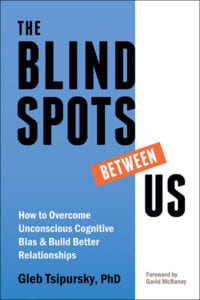
The Blindspots Between Us: How to Overcome Unconscious Cognitive Bias and Build Better Relationships
What you want to look at is what’s under the quality of the nurse. If you’re looking for people who are compassionate, let’s say. If that’s the reason you’re looking for nurses, there are lots of caretaker people who will be compassionate. They don’t have to be nurses. If you have breakups with nurses and in general, with compassionate people, that might indicate that you’re looking too much for compassion, those people are already giving of themselves in the world. You might be looking for love in the wrong place in that sense.
You mentioned that there are over 100 cognitive biases besides making the mistake that what you think is true is not true. You could make a joke about the majority of people believe that the world is in fact round and not flat, but some people maybe have that cognitive bias that they think it’s flat. They don’t trust science. Is there another big cognitive bias where people think something is true and they behave accordingly that you say, “That’s such a problem in business?”
One of the other biggest ones I want to highlight is called the illusion of transparency. The illusion of transparency is the idea that when you say or convey something, the other person understands 100% of what you mean perfectly well. That is the biggest cause of miscommunication that I see. The empathy gap is the biggest cause of problems and challenges through relationships, but in the direct communication, the illusion of transparency is the biggest one.
For example, if I say dog, I assume I mean my adorable King Charles, and you might be thinking Great Dane, right?
Exactly. It’s semantics and so much more, and the dog is one thing. When you say dog and to somebody who is from a culture where people eat dogs, you’re thinking pet and that person might be thinking food. That is another fundamental misunderstanding because when you say something, we don’t realize the mental associations we have with certain terms and certain concepts. We assume the other person has the same mental associations with these concepts or the same stories. We’re talking about stories, we understand our life, our surroundings through stories. When we say dog, you have a certain story of a dog in your head. The other person has a very different story. Most likely they have a dog in their head unless you know very well that they have the same story.
If you and your wife have the same dog and have the same pet, you probably have a similar story, but otherwise, you most likely don’t. When you’re doing a sales pitch, let’s say when you’re conveying certain information, you have a lot of knowledge about the product or the service that you’re trying to sell. That’s why salespeople often try to sell the grass seed instead of the lawn. They talk about the product. They don’t talk about the other person’s needs. They don’t talk about what the other person needs. They focus on conveying information. They assume. They feel. That gut reaction is to feel like the other person would automatically understand the outcome because they describe the qualities. That is fundamentally flawed. That is not how the other person thinks. They don’t have the same stories. They don’t have the same associations that you do with what you’re describing. With the content, with the idea, or with the message that you’re trying to convey. What you need to do is discover their stories. What they are thinking about the topic that you’re going to be talking about? Not what you’re thinking, but what they are thinking. Target your messaging toward their thought patterns. That’s the first step. You want to check for understanding. You want to ask people to convey to you that they’re getting what you’re trying to get them to get.
Constantly be checking in. It’s like, “Does this make sense? Are you following this?” I always say the confused mind says no. Most people won’t tell you they’re confused. It’s an ego thing.
[bctt tweet=”Know the other person’s story first. Don’t assume they think about things in the same way that you do.” username=”John_Livesay”]
It feels bad and that’s emotions. It feels bad to say you’re confused. Even framing it, “Have I conveyed this clearly? Would you like me to rephrase something?” Putting it on yourself.
Would you say, “I’m not clear, I’m holding responsibility for this not coming across clearly. Let me restate it?” Would you say it’s fair then to say close the empathy gap through storytelling?
Absolutely, yes.
That will be one of the tweets we’ll have for this episode for a sound bite for people to remember what you’re saying because I’d like to try to sum it up. That’s why I’m known as The Pitch Whisperer and a short little sound bite that makes it easy for people to reference this. My big belief is that one of people’s cognitive biases, I’ve never called it that before, but for years we’ve heard the term, “You’ve got to get people to know, like and trust you,” in that order. You’ve heard that, yes?
I did.
My premise is if people think that’s the order in order to get someone to buy from you, that’s what triggers the mistake of saying, “You’ve got to get to know me. Let me vomit a bunch of information about my product.” I think the order is all wrong. I tell people, “You need to get people to trust you first,” and then it goes to the heart, which is, “Do I like you?” Finally, it’s a knowledge thing. It’s not even still do I understand the product perfectly, but the question is completely different, which is, “Will this work for me or not?” Therefore, do I see myself in the story? I think that’s why Dr. Mark wanted us to meet because we have similar philosophies of looking at things going, “This isn’t true. You’re behaving your assumption that this is true. People have to know you first before they like and trust you causes you to do the wrong behavior. When you flip it and start building trust and likability first, then you can get into people knowing you and your product. It’s not about knowing it. The head question is, will it work for me?”
What they need to do is trust you first, not trust the product. That’s the fundamental mistake.

Cognitive Bias: The empathy gap is the biggest cause of problems in relationships, but in direct communication, the illusion of transparency is the biggest one.
You sell yourself first.
That’s the fundamental mistake so many people make. They logically sell the product whereas what they should be doing is building a personal relationship and cultivating that first. How will the person trust you and trust that the product will work for you? They have no idea what the product is compared to you, but they have to buy it and then figure it out. They have to trust you first. They need to trust you. They need to trust that you have their best interests at heart before they go forward to with the product.
Any last thoughts or a phrase or something that’s in the book, The Blindspots Between Us, that you want to leave us with to incentivize us to take the leap and get the book?
I want to remind you about the illusion of transparency. Know the other person’s story first. That can be another tweet to share about this. These are only two of the cognitive biases. If you want to know what are the others, there are over 100, I talk about the 30 most dangerous ones for successful relationship building and effective communication in The Blindspots Between Us: How to Overcome Unconscious Cognitive Bias and Build Better Relationships. If you want to know the other 28 and make sure that you don’t fall into those problems, get the book.
The book again is called The Blindspots Between Us. Dr. Gleb, thank you so much for sharing your story, your wisdom and the results from all your research so that we can avoid making these mistakes over and over again and have better relationships in our career and in our personal life.
Thank you so much, John. It’s been a pleasure.
Important Links
- Never Go With Your Gut
- Disaster Avoidance Experts
- The Blindspots Between Us: How to Overcome Unconscious Cognitive Bias and Build Better Relationships
- Amazon – The Blindspots Between Us: How to Overcome Unconscious Cognitive Bias and Build Better Relationships
- Better Selling Through Storytelling Method Online Course
Wanna Host Your Own Podcast?
Click here to see how my friends at Podetize can help
Purchase John’s new book
John Livesay, The Pitch Whisperer
Share The Show
Did you enjoy the show? I’d love it if you subscribed today and left us a 5-star review!
- Click this link
- Click on the ‘Subscribe’ button below the artwork
- Go to the ‘Ratings and Reviews’ section
- Click on ‘Write a Review’
Love the show? Subscribe, rate, review, and share!
Join The Successful Pitch community today:
- JohnLivesay.com
- John Livesay Facebook
- John Livesay Twitter
- John Livesay LinkedIn
- John Livesay YouTube