

The Holistic Revenue Strategy With Mary Grothe
Posted by John Livesay in podcast | 0 comments


With every business opportunity, maximizing your yield is a no-brainer and that’s where the holistic revenue strategy comes into play. Mary Grothe, the CEO of Sales BQ joins this episode to dive into the details of how this strategy works. Recognizing that in the world of business nobody is safe from rejection, she gives some important tips and pointers on how to recover and cope. Mary also stresses on the role your mental mindset plays in this and how your actions are connected with your emotional state. Listen in as she talks about what it entails when you become a leader especially during this challenging time and what you can do to bring out the best in the people that follow you.
—
Listen to the podcast here
The Holistic Revenue Strategy With Mary Grothe
Do you realize that the skills that maybe got your company to $5 million are not the same skills that are going to get it to scale to $50 million? Mary Grothe knows this. She is the Founder and CEO of a company called Sales BQ, which stands for Behavioral Quotient. She and her team just don’t come in and analyze what’s wrong, they also stay with you and fix what’s wrong so you can scale. Enjoy the episode.
—
Our guest is Mary Grothe. She is a former number one mid-market B2B sales representative who after selling millions in revenue and breaking multiple records had formed Sales BQ. It’s a Denver-based firm of fractional revenue leaders who serve companies nationwide by profitably rebuilding their marketing, sales and customer success departments. They do this by getting to the root of revenue problems, rebuilding infrastructure, developing talent, and holistically growing their revenue at sometimes rapid paces. Mary, welcome to the show. Let’s go into your story of origin, which is always fascinating. You can take us back to childhood, college or wherever you got the concept that, “I’m good at selling or I’m good at figuring out problems.”
I became an expert problem solver in my childhood. I didn’t have the glamorous childhood that some people have. I grew up in the performing arts, which was one cool aspect of how I was raised. My dad was an actor and an opera singer. My mom was a classical pianist and choral director. I grew up in Northwest Indiana. I was on the stage every year in productions and musical theater. I chained triple threat, acting, singing and dancing. There were some neat components in my childhood. There were also some negative points. I had an alcoholic mother and there was a lot of abuse in my family growing up, and it shaped me. I learned how to be a complex problem solver. I have a high EQ, emotional intelligence, and I learned how to navigate through tough situations at a young age. The combination of having to fight for survival many times and figure out how to get myself out of situations. Couple that with the creative childhood that I had being on the stage and wanting to be performing in the lights. It was a unique combination to shape me into the number one salesperson. Who would have guessed?
It was a fourteen-year journey in Indiana and then my parents lost the performing arts school. They ended up filing bankruptcy, running away from a lot of problems. They threw us all in a moving van with little notice and moved us out to Colorado. We started our lives over, but they couldn’t afford to pay for my brother and me. I started working at a young age as a bagger at a grocery store out here called King Soopers. I started my first job on the day that I turned fifteen, which is a couple of months after we moved out to Colorado. By the time I turned sixteen, I was fully supporting myself. I look back at that time, and it was challenging and hard, but let’s talk about the good here.
I have time management skills and I’m fully financially independent. I had a work ethic like nobody’s business. I focused on my academics and ended up with a 4.2 GPA in high school. I continued dancing. Of the three talents, dancing was my strongest. Life has a funny way of happening. I did have a scholarship to CU Boulder to be in their dance program. I got a minor in dance and a major in molecular, cellular and developmental biology. It’s a good thing I ended up not doing that because I can’t even pronounce it, but I went for one semester. I got in a car accident in my senior year of high school. My poor body was damaged and broken from the car accident. I was broken on the inside. Because dance had been my identity, it was a safe place for me and I had great aspirations of being a professional dancer. It was gone and I had to reinvent myself. It’s hard to do that when you’re eighteen and you don’t have a strong family foundation. I was completely on my own at that point and it was scary.

Holistic Revenue Strategy: Whether you think you can or you can’t, you’re right.
I’m thankful because the world has a crazy way of raising you if you let it. I fell into some dark times and things that weren’t that great that we can fast forward through. When I was 22, I was welcomed into Corporate America. I had come off a few years of interesting part-time jobs. I was able to secure a position as a District Sales Assistant for a mid-market sales team of eight people covering three states. It was for a payroll company called Paychex, which is a big Fortune 1000 company. I went in as the DSA, District Sales Assistant in the Denver office. I happened to be reporting to the number one sales manager in the country and working with the number one sales team. I got put on the fast track for over two years. I had no college degree and no professional experience. I just went all in. I said, “I want to be on the sales team.” They thought I was crazy and they’re like, “Okay, sure.” I fought and fought. I learned the profession. I went out in the field and started taking on responsibility for the salespeople. I had all the hunger and desire to make it happen. I got put on the mid-market team two years in and I became the number one rep in 30 days, and I maintained that.
My first year’s quota was $150,000. I sold $758,000, more than numbers 2 and 3 combined. In the second year, they cut my territory in half. They doubled my quota and asked me to train reps and managers across the country. I sold $850,000 in my second year. At that point, I said, “I like sales a lot.” I went and took a VP of Sales and Marketing position with one of my clients. It’s a small company at about $125,000 in annual revenue. It’s still in the startup phase. I went on and took their products and services, repackaged them, and put them in a way that the target audience could understand. I took it to the market and the sales and marketing team quadrupled the company’s revenue in seven months.
I set them up and positioned them for investment. I got the heck out of there and said, “I want to do this for a living.” I started my first consulting firm for three years with 36 business owners. It grew all their companies. I wrote a book and that’s funny now that I look back at it because I was 27 and I knew everything. It’s super weird. I wrote this cute little book, Extreme Business Building: From Concept to Profit in 60 Days. I became a starving entrepreneur and I made a lot of rookie mistakes. I didn’t know how to charge for my services, how to delegate, and how to say no. I said yes to everything. I was working with startups and entrepreneurs that wanted to pay me in hope like gift cards, Chipotle or whatever.
Equity is my favorite offer.
[bctt tweet=”You have to get to the root cause of what the insecurity is, or what the fear is behind rejection. It’s different for everybody.” username=”John_Livesay”]
I was lucky to get the gift card. They all had the hope of a dream of equity and I fell for it a few times. I met my now-husband in 2013 and I was like, “I’m going to go back and be a top producer again. I’ll make a lot of money, buy a house, get married, have a baby, and then I’ll go be an entrepreneur.” That’s what I did. Three more years at the payroll company, I crushed it and sold millions. In my last year, I finished number seven in the country that I worked nine months out of the year. I had a baby and sold one of the top 10 largest deals in history. I sold it at a full price, no discount and I loved it. I love selling. I love paychecks. I’m thankful for the opportunity I had with them. The training there is tremendous. I turned out to be an amazing salesperson. Now as Sales BQ CEO, we’ve helped over 100 companies reshape their path to revenue. It’s the most beautiful journey I’ve had an opportunity to be on. Thank you for having me here. I know we’ll probably unpack and dig into a lot of that, but I want to tell you the story.
The first point I want to dig into is that your childhood taught you resilience and not being afraid of rejection, which are two of the biggest challenges young people have. We can probably spend the whole show talking about them but we won’t. I know this concept of fear of rejection because you and I have won awards for the best salesperson of the year. Condé Nast for me and you with your success in crushing those quotas. I’d be remiss if I didn’t mention that you have your own podcast called that. This concept of not taking rejection personally because we have to somehow frame that, what I have said is I don’t take it personally from the standpoint of, “I don’t reject myself nor do I reject what I’m selling if somebody says no to me.” My old way was like, “Maybe somebody else could have gotten them to say yes,” or “Maybe they’re right. Maybe this other product or service is better than what I have.” I realized that I’m not a bad salesperson and what I’m selling is not bad. It’s just not a fit for them. How did you handle the fear of rejection? How do you coach people to not be afraid of rejection?
You have to get to the root cause of the insecurity or the fear behind it because it’s different for everybody. When I started in sales, I had that momentous build-up of two years. I got the role and I went to two weeks of corporate training. I’m top of the class and had everything memorized. I could demo the product and have the script memorized. I was a bright young student back then. I get back to my desk and the reality hit. I’m staring at the phone like, “I have to do this thing called sales. I made it to this point. What do you mean I don’t just get the salary and the title? I have to earn it.”
I’m staring at the phone and sweating bullets like, “What do I do?” I was mortified. It wasn’t to make the call. It was, “What do I do if they pick up? What do I say to them?” I went into my manager’s office and had a funny moment. I’m like, “This is the day that I’ve been fighting for and I’m done.” I can’t move and I’m paralyzed like, “What do I do?” He’s like, “Go call ten of our existing clients with no sales agenda. Just ask them these three questions. Why did you choose the product and service? Number two, what’s the biggest gain since you’ve been here? Give me an ROI statement on what we’ve done for you. How is your life better because we’re in it? Three, why do you remain a client even when the competition is beating down your door? What’s the staying factor for you?” I didn’t get through all ten calls. I just got through a handful and it was everything that I needed. I realized that my fear was letting them down.

Holistic Revenue Strategy: Attitudes are contagious. Make sure yours is worth catching.
Stemming from the way that I was raised as a byproduct of my family situation, I believe in performance-based love. “If I do this well, I can get attention, and then maybe I will feel that glimmer of love that I was looking for in my whole upbringing.” The only way I could get attention in a busy family of four was I had to do something remarkable. I had to outperform everyone else and I was competitive. I was the youngest of four so I had to do something. I had an age disadvantage too and I had to do it better than everybody else. I always wanted to make people’s lives better because I was in it. Oftentimes, I did not earn that. When I did, the addiction to that was amazing. The opposite of that is I had a fear of disappointing people, being a nuisance to them, letting them down, and having them view me as anything other than a value add in their life.
The fear came from, “I’m scared to death that they answer the phone and I can’t deliver a talk track that’s something of value where they would say, ‘I’m glad you called me.’” I backed into it and listened to those Voice of the Customer interviews that I did to hear how our product and service brought value to that type of customer. I simply transitioned my thinking into, “We do great things here. People love us and we made their life better. Who doesn’t want to have that conversation?” My confidence changed and my whole outlook changed. My mental mindset shifted to trigger a positive emotional state and have excitement. I started making these calls and I’m like, “I hope they answer because I can’t wait to learn about these people. I don’t know if they’re fit for us or not but if they are, how much better could their life be?”
It was a complete shift for me. It’s not that telemarketing is my favorite thing to do ever but I removed the fear of it. If they declined my lovely invitation to have a meeting or conversation, I didn’t take it personally. I saw it as an opportunity to say, “When is the right time? When do you normally evaluate this? I’m fine and understanding if you’re set and you’re happy, and that’s great. I’m calling you and you’re not calling me. I would anticipate if it was good, it would have been an inbound email in my inbox, but you’re not. That’s fine and it’s okay today, but when is a more appropriate time for us to be having this conversation?” I’m inviting myself into their world but then connecting with them, learning about them, and genuinely getting to know my prospects and my clients. That’s how I’m getting over the fear of rejection, which is getting to the root cause of what was causing the fear of picking up the phone.
What you’re saying is what I teach when I give talks to sales teams which is, “No now doesn’t mean no forever.” That’s the concise way to say that. That’s a nice takeaway for everybody. How about resilience? Let’s talk about that. This ability to pick ourselves back up. I have studied this when I gave my TEDx Talk, Be The Lifeguard of Your Own Life! When you get laid off, how do you reinvent yourself and get rehired? We’re all dealing with the need for resilience during the disruption of this pandemic. Part of the research I found, and I’d be fascinated to know if this matches your experiences in working with many different companies, is it’s not about, will you get back up? It’s how fast you get back up. There’s been all this research even with real estate agents who lose a big deal, for example. The top performers are the ones that shake it off and go forward. The other people who are struggling to make their numbers keep talking about it for sometimes, months afterwards. They’re not even aware they’re doing it. I wanted to get your insights and tips on how do you help people become more resilient.
[bctt tweet=”There are going to be some circumstances that are going to hurt worse than others, but it’s meeting that problem head-on and identifying it.” username=”John_Livesay”]
I’m on both sides of this because I’ve had a couple of deals and situations that have knocked me back bad and is not typical for Mary Grothe. Those have knocked me out of the game for a little period of time more so than usual. I have a good bounce-back factor. I’m human and I’m real. Everybody reading this, there are going to be some circumstances that are going to hurt worse than others, but it’s meeting that problem head-on and identifying it. Let me explain this to salespeople specifically. An abundance mentality will help. If you are in desperation and justification mode, you’re holding on to a deal that you don’t even have anyway. You’re holding on to it and you’re looking at your pipeline. All of your eggs are in this basket and you’re saying, “I’m connected to the outcome of this.” It’s the wrong way to go about a sale. As a high performing salesperson, you should have many qualified deals in your pipeline and this abundance mindset that, “Even if I lose this one, I’m going to get more. There’s more coming to me.”
There’s a whole way of approaching a glass half full and a glass half empty. It’s your perspective. Resilience comes from your mindset. An abundance mindset helps us not get emotionally triggered in a negative state that will hurt our actions. I’m going to jump in here. BQ is Behavioral Quotient. If you imagine a wheel right now, at the top is the mental mindset. Your mental mindset triggers your emotional state, and your actions stem from how you are, emotionally. If you’re down because you lost a deal and you’re discouraged, upset, and you’re in this funk, what actions come out of that? Not good ones. You’re not in a mentality or in an optimistic and encouraging state that good things come out of that. You’re manifesting worse because you’re in a funk. When you’re in the mental mindset stage, you have a piece of information that enters your mind. When that happens, we tell ourselves a story. We’re human. We put out our frame of reference and we interpret the information that went into our mind. We start telling ourselves a story and that’s going to trigger an emotion. It could be positive and it could be negative.
Based on that is where the action stemmed from, and actions yield your performance. Your resilience and being able to bounce back from something is one, you have to separate stories from the facts. Yes, you lost a deal. The story may all of a sudden be, “I needed this deal. I’m already behind you. I don’t know how I’m going to get back after this. This is awful.” You start blaming other people. “If only so and so had done that. That guy screwed over my demo. I can’t believe that they brought in the IT guy into the meeting. You’re so negative. You discredited everything and threw me off.” You start making excuses and you go down a path. It is very woe is me.
It’s all about everybody else that’s out to get you and you get in this funk. You can’t create good from that. You have to go back to the top, change the mental mindset, change the attitude, and rework the emotional state to have strong resilience or bounce back factor. Going back to my comment about having an abundance mindset and a lot of deals in your pipeline. That will help you at the top because if a piece of information comes into your head that, “I lost the deal,” immediately, your frame of reference and story behind it can be, “I’ve got eight other deals that are slated to close this month.” You avoid everything that you went through. It’s a big cycle. It’s a big wheel. You just have to start at the top. It’s the quote, “Whether you think you can or you can’t, you’re right.”

Holistic Revenue Strategy: If you expect excellence, be excellence. If you expect kindness and grace, be those things.
One of the tweets we’re going to make is, “Abundance mindset allows you to be resilient.” Behind the mindset is not being attached to anyone outcome. It gives you such a sense of freedom. The other one I like is, “Don’t play the blame game,” which we’re going to make another tweet from what you said. There’s a lot of value here and this concept of calling clients up like, “Why’d you hire us? What do you like? Why do you stay?” When I was giving a talk to Jaguar Land Rover salespeople, you think, “They’re selling luxury cars. How hard could that be?” They still deal with rejection or another dealership is stealing their deal or whatever it is.
I said, “You’ve got to cleanse your palate like in a meal base sometimes between courses. The way to best cleanse your palate so the next phone call or the next person that walks in, you’re not negative, is to call up an existing person that bought a car from you and say, “How’s it going? What do you like most about the car?” Remember that feeling and be in that mindset. You’re not trying to sell them anything. Sometimes, they might even give a referral. Who knows? At least you’re resetting your own mindset that way. You and I are so much in sync on this. It’s fantastic. Let’s talk about your big clients. You work with companies that have grown from maybe getting to $5 million. The skills that got them there are not the skills that will keep them there. That’s another great quote. Enter Sales BQ. Tell us what is it you’re able to do for these companies who are stuck and probably coming from a place of fear that if they don’t figure this out, the board of directors might replace them.
There are a lot of different areas that they could be fearful of. It’s a fun conversation for us to have with the CEOs right out of the gate. When I first meet a CEO, there are two parts of the conversation. One is I’m doing my due diligence and asking myself, “Is this somebody we can work with, will enjoy working with and can drive great results?” On the other side, I’m listening to what they’re telling me but I’m trying to read between the lines to identify the root cause of the problem. One thing that we are experts in is identifying the root cause of the revenue problems and not trying to solve surface-level problems.
For example, I’m a huge fan of sales training. We do some sales training at Sales BQ. I got hired for great sales training engagements and I have great respect for sales trainers. Sales training is one component of the revenue ecosystem. You can train a rep and teach them something fantastic, but you put them back into their old environment where the marketing department sends over terrible leads. They’re on an old outdated CRM, don’t have any automation, they have to manually send emails, and the company doesn’t invest in a prospect database. Why are we training up a sales team? We have to solve the ecosystem problems first, then you train the salespeople to be these sales ninjas. You put them back in a high-performing environment, then you watch what they can do.
[bctt tweet=”Your mental mindset triggers your emotional state and your actions stem from how you are emotionally.” username=”John_Livesay”]
I listen to what they’re thinking the problem is, and then we have to dig into that so far to figure it out. For us, our process is we have a 30-day build phase. The first week is our kickoff and our observing shadow week, which could be anywhere between 20 to 40 hours worth of meetings. We are deep diving and learning the company’s product and service, their competition, and also who they sell to their ICP, Ideal Client Profile. We’re trying to understand the construct of the revenue flow through the organization based on the buyer and customer journey, and then we see how revenue is aligned with sales and into customer success. The underlying technology layer, which we call RevOps, Revenue Operations, is a combination of marketing ops, sales ops and customer ops.
We look at the whole flow through. We try not to silo separate like, “Let’s solve your marketing problem. That’s great. We inject a whole bunch of leads, and then the salespeople can’t convert them. That’s bad or we’ll change the salespeople first, but we didn’t fix the other problems.” You get the point. We go in with a holistic approach. We identify from all attraction methods for marketing through how we’re servicing a customer, seeking to grow our retention, have revenue expansion opportunities, upsell, renewal, etc., and everything in between. We identify all the core problems of why they’re not growing, and then we come back with this gap analysis. It’s a three-hour presentation. It makes people’s heads spin, but we do come through and say, “Here are the 27 different areas. Not the one you thought it was,” and then we have a plan of action that we deliver two weeks later.
The cool part about our team is we’re not consultants. We build a plan. We’re like, “Good luck. Make it happen.” If they were able to make it happen, they would have done it by now on their own. These teams are busy. They’re reactive to the needs of the business. They’re in the wits. They are present in the day-to-day, but they can’t pull themselves out of that to do things like build infrastructure to implement new technologies, build a training curriculum, and do talent development strategies. Also, to re-innovate how they’re doing marketing and go from an outbound funnel to a targeted inbound marketing methodology. They love those things like, “We were talking about that two years ago.” I’m like, “Did you do it?” “No, we don’t have anyone to help us with that.” Our team does the work and we become an extension of their team members and work side by side for five months after that delivery.
It sounds like your unique selling proposition is you don’t just point out what the problems are and leave. You point out what the problems are and stay to fix them.
Extreme Business Building: From Concept to Profit in 60 Days
We only exist to grow their revenue and that’s it. We don’t expect them to be revenue ninjas. We want to come in here, fix it and do right by them.
Any last thoughts or quotes you want to leave us with?
I do have a couple of favorite quotes. One stems from, “Attitudes are contagious. Is yours worth catching?” We’re in a challenging time and you look at what you’re bringing into the workplace because the tone that you set is the tone that will be followed. I’m noticing that with a lot of executives, no matter what size your company is, you’re the leader and they look up to you. Granted this works better in theory if you have more than yourself working for the company. Even though this could be stressful, or you’re looking at how to get to the next level, or you’re recovering from shut down that’s happened with the pandemic, or trying to reinvent yourself, or whatever it is, how you show up is the way that people will create perception around you and that becomes their own BQ.
The way you articulate, present yourself and set the tone becomes a piece of information that goes into their head that then they tell a story about, that triggers their emotional state, that dictates their actions and yields performance, so it does start at the top. If you’re looking at building that high performing team, it’s how you show up and how you are with your people. Don’t expect them to do anything other than what is a reflection of what you’re putting out there. If you and I want to have an excellent team, you have to put out excellence and be able to model that for them, be an incredible communicator, and lead with love, grace, kindness, support, autonomy, and empowerment of your people in doing a great job. I love that quote, “Attitudes are contagious. Is yours worth catching?” Remember that how you’re showing up is what is going to be caught by other people. If you expect excellence, be excellent. If you expect kindness and grace, be those things. They’ll see that as a reflection of you. From one leader to another, that’s the greatest recommendation I can make.
What a great way to end. Thanks for being on the show, Mary.
Thank you.
Important Links
- Sales BQ
- Paychex
- Extreme Business Building: From Concept to Profit in 60 Days
- Podcast – Quota Crusher
- Be The Lifeguard of Your Own Life! – John Livesay’s TEDx Talk
- Better Selling Through Storytelling Method Online Course
Wanna Host Your Own Podcast?
Click here to see how my friends at Podetize can help
Purchase John’s new book
John Livesay, The Pitch Whisperer
Share The Show
Did you enjoy the show? I’d love it if you subscribed today and left us a 5-star review!
- Click this link
- Click on the ‘Subscribe’ button below the artwork
- Go to the ‘Ratings and Reviews’ section
- Click on ‘Write a Review’
Love the show? Subscribe, rate, review, and share!
Join The Successful Pitch community today:
- JohnLivesay.com
- John Livesay Facebook
- John Livesay Twitter
- John Livesay LinkedIn
- John Livesay YouTube
The Talent War With Mike Sarraille
Posted by John Livesay in podcast | 0 comments

A business’ success lies upon the kind of people working behind it. Any business or organization that knows how to attract, develop, and retain great talent are well on their way to success, if not remaining as one. At the center of it all is a great leader who values the people they have. In this episode, John Livesay sits down with the co-founder, managing partner, and CEO of EF Overwatch, Mike Sarraille, to discuss how leadership skills are more important than a specific industry skill. He also talks about the importance of overcoming imposter syndrome and then dishes out on his book, The Talent War, which imparts some great wisdom from special operations around talent and how we are currently in a war to acquire the best talent. Join John and Mike in this conversation as they bring fresh insights around talent acquisition and leadership from the military perspective.
—
Listen to the podcast here
The Talent War With Mike Sarraille
Our guest is Mike Sarraille, the co-author of The Talent War. He’s an expert at helping companies find the right people and specializes in placing veterans in corporate jobs. Of course, he’s been a veteran himself among many things, being a Navy SEAL. We’ll talk about the importance of realizing how to overcome the impostor syndrome you might be facing, as well as how leadership skills are more important than a specific industry skill. He said, “Great leaders are always there for the people working for them.” Enjoy the episode.
—
Our guest is Mike Sarraille who is the Co-Founder, Managing Partner, and CEO of EF Overwatch. He’s a retired US Navy SEAL officer and he’s the Founder and Board of Director for the VETTED Foundation, which is an education platform. He’s also a graduate of the University of Texas Business School, and the leadership instructor and strategic advisor for Echelon Front, which is a management consulting firm. Mike served fifteen years as an officer in the SEAL teams and five years in the US Marine Corps as an enlisted Recon Marine and Scout-Sniper before receiving his commission in the Navy.
Mike served in the SEAL Team 3, Task Unit Bruiser alongside Extreme Ownership authors, Jocko Willink and Leif Babin, where he led major combat operations that played a pivotal role in the Battle of Ramadi in 2006. Mike was again deployed with Task Unit Bruiser in 2008 and led a historic combat operation in Sadr City during the Battle of Route Gold. Following his return, Mike assumed duties as the primary leadership instructor for all officers graduating from the SEAL training pipeline, taking over that role from Leif Babin.
Mike was then selected for assignment to the Joint Special Operations Command where he completed multiple combat deployments in support of the Global War on Terrorism. Mike is a recipient of the Silver Star, 6 Bronze Stars, 2 Defense Meritorious Service Medals, and a Purple Heart. Mike continues to participate as a Veteran Transition subject matter expert on panels around the world. Mike, thank you for your service and for being on this show.
John, thank you for having me. This is great.
I would be fascinated to know that’s such a huge, impressive list of things that we instantly know about you in terms of resilience, tenacity, and passion. I would love you to take us back a little bit into your own story of origin. You could go back to childhood or your early days. Did you always know you wanted to be in the Navy? Start wherever you think would be a fun place for people to get a sense of who you were before you accomplished all of that.
I will tell you no. I don’t come from a military lineage. Of course, my grandparents served in World War II. My dad was in the Army for a short while but service wasn’t the mainstay of our family. I was born and raised in the Bay Area. I loved California growing up and I loved Silicon Valley and getting to watch that become what it is now, but I was a little guy in high school. I played plenty of sports and my parents kept me active but I remember I wrestled during my freshman year at 119 pounds.
For a frame of reference, you look like you’re 190 of muscle or something.
[bctt tweet=”The definition of progress is inspiring the next generation behind you to be better than you were.” username=”John_Livesay”]
You cut me by about twenty pounds. I’m 210. That is twenty years in the military and working out nonstop in the gym. I had great trainers. The one thing my dad said later on, “I didn’t know what you were destined for but you had this disdain for bullies.” It’s a stupid story but in high school, there were classic bullies that were picking on little kids. I remember because my dad had to come to school and get me. I got a running start from about 75 meters away and hit the bully with my shoulder in his back. I put them down but ended up getting roughed up by his friends because they were picking on a kid. It was my high school. I didn’t like people picking on other people. Let’s be honest, it’s the best recruiting tool for the military. Do you want to talk about the best pitch?
Yes.
It’s Hollywood.
Top Gun or whatever, right?
Absolutely. What do those all have in common? There are bad guys out there doing bad things to innocent people, and then the heroes come in. You don’t understand the price or the cost of war when you’re watching those movies. You can’t recognize that but it drew me in. The greatest pitch since the title of the show is such that is I met a Force Recon Marine. Back in the ‘90s, Force Recon was the special operations community for the United States Marine Corps. I was eighteen and this man was physically built. He was handsome, articulate, humbly confident, and respectful to everyone.
There’s an eighteen-year-old that’s now weighing 130 pounds and you’re looking at this guy who’s 190 and everything you aspire to be. I’m like, “I need to be a part of that organization now.” You question yourself, “Do I have what it takes?” There’s only one way to find out. That individual helped me get enlisted in the Marine Corps and I eventually became a Recon Marine like him. Every leader I had in the military, from my drill instructors to the Recon Marines that I serve for, each made me aspire to be better. That is the legacy of leadership. If you can inspire the next generation behind you to be better than you were, that’s the definition of progress. Progressives don’t understand that. You’re leaving a better situation for those coming behind you and you’re training them to be better than you were.
I love that the legacy of leadership inspires the next generation. I’ve also never heard someone described as humbly confident because a lot of people think they’re mutually exclusive, and they’re not. What a great description of someone and something to aspire to as well. You went to Stanford and then you’ve got your MBA at the University of Texas here in Austin. Through that process, you were also in the service. It wasn’t like you went to school and then joined. It looks to me like it was all happening concurrently.
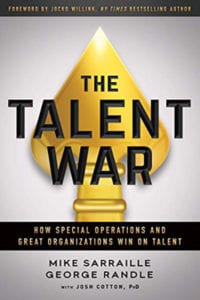
The Talent War: How Special Operations and Great Organizations Win on Talent
I enlisted in the Marine Corps, which means I did not have my college degree. America doesn’t know two things. One, we put a precedence on knowledge in the military. Unfortunately, Hollywood, the best recruiting tool, also paints us as if sometimes we’re people in the United States that have no option other than to enlist in the Marine Corps, so we pride knowledge. The Marine Corps looked at me after a few years and said, “Do you want to become a Marine officer and be in charge of young Marines?” This is pre-9/11 and the answer was, “Absolutely.” They said, “We’ll pay for you to go back to school,” and they did. I went to Texas A&M where I finished my degree.
John, this is interesting. I went to a Jesuit high school in Santa Fe called Bellarmine and I graduated with a 2.9 GPA in high school. I went back to college a few years later and I graduated with a 3.7 from Texas A&M. I didn’t get smarter during those few years. The Marine Corps taught me how to lead. They taught me commitment and discipline. It was a steadfast commitment in how to accomplish the mission. Before I went back into the Marine Corps as an officer, I’d served with some SEALs. It’s inspirational. I said, “I’ve got to see if I have what it takes.”
I went to the SEAL training. I made it through that and then towards the end of my career, that’s when I attended Stanford. It was a certificate program called the Stanford Ignite, a one-month program at GSB. I did that one month before I started my MBA at UT, which was humbling because I was 39, surrounded by a bunch of 27-year-olds that were smarter than me and I learned more from them as I did the professor’s because each of them was high-performing individuals. I don’t think without them helping me here and there that I would have graduated from that program.
For those who aren’t familiar, it’s difficult to get into the Marines more than let’s say the Army. That’s fair, isn’t it?
Yes.
The Navy SEAL is even more elite than the Marines itself, so it’s the elite of the elite.
That’s roughly accurate. Each is good at what they do. They have slightly different flavors.
[bctt tweet=”If you put a problem in front of a generalist versus a specialist, a generalist is more equipped to solve it.” username=”John_Livesay”]
Different skillsets and things like that. There are different tiers. Since you’re in the executive search world, you’re constantly looking at someone’s educational background. That’s why I thought it was interesting to start there. That full circle, now that you’re out of the service, you’re helping find people with military backgrounds and placing them in a business where they’re using that incredible leadership skill. There are different tiers of way to go to school. There’s the Ivy League. It’s not just a location at Harvard and Yale versus Stanford. There’s that league.
I happen to go to the University of Illinois in Urbana–Champaign, which is considered part of the Big Ten but it’s not an Ivy League school. I certainly feel like I got a great education and I’m proud of where I went to school but it’s not an Ivy League school. I would say the same thing with the Army. It’s needed, wonderful, and great like a Big Ten school and the Marines would be a little more Ivy League. Is that honoring everybody or not? Is that too controversial to say it like that?
I will set the facts right here. The Army is the oldest in the armed services. They’re 244 years old and the Army has produced more leaders for this nation than any other organization. I didn’t go to a service academy and I did not have what it takes. The Air Force Academy, Naval Academy, West Point known as the Military Academy, Coast Guard Academy, and Merchant Marine Academy are the equivalent of Ivy League schools. It is 24/7 for 40 years. Some of the smartest Americans and some of the best leaders come out of those institutions.
I don’t think the average person unless you’ve been in the service understands those distinctions. I’m thrilled you could clarify that. The Navy SEALs, that’s not an intellectual level as a whole, physically incredible like an Olympic athlete level of skills that are required. Yes?
It is. The military as a whole follows something called the whole person concept. We’re looking for people that are well-rounded mentally, physically, and emotionally. Someone who is balanced and proficient in all those areas to a greater degree with certain communities. SEAL training is some of the toughest training in the world. The attrition rate is high, anywhere upwards of 70% to 80%. The special operations communities that we’re not mentioning who I absolutely love is the Army Special Forces known as the Green Berets.
You have the MARSOC Raiders, which is an amazing group like the SEAL teams. The Air Force has something called Combat Controllers and also Pararescue. There are special operators that fly helicopters known as the 160th Special Operations Aviation Regiment. To have served with all of them and to watch them on the battlefield is humbling. You want to talk about not feeling like you belong, and that’s the description of my career. Watching these guys on the battlefield and what they did, it was almost like, “How did I fool them to let me even step onto the playing field with them?” I’m not joking here.
Let’s talk about that, Mike, because if you’re talking to CEOs or anybody with a C-level job, if they’re being honest with themselves, we all have a little bit of the impostor syndrome from time to time. When you’re trying to convince someone maybe to take a little bit of a leap in their career at EF Overwatch where you are finding people who have amazing skills from their military background. Maybe they aren’t as qualified on paper as somebody else without that background, but they have more experience. How do you help them overcome the impostor syndrome because you’ve had to overcome it yourself?

The Talent War: The military, as a whole, follows something called the whole person concept. We’re looking for people that are well-rounded mentally, physically, and emotionally.
It’s focused on what you know and what you know well. In EF Overwatch, it’s what we call a specialized executive search firm. We focus predominantly on small to midsize businesses, which can be as big as 1,000 employees up to $1 million revenue, massive companies. We do vet the candidates as much as we vet the clients and for the clients, I have to hear one foundational belief. We value leadership over industry experience. Trust me, there’s a lot of SEALs with twenty years in the SEAL teams that have a lot of industry experience for that domain and are not good. Industry experience does not equate to proficiency.
For the candidates, we do explain to them. One of the books we have for them to read is called Range by David Epstein. He makes an argument that generalists make the best leaders. The reason for that to summarize it is that they’ve dabbled in so much that they have such a broad range of experiences to draw from. If you put a problem in front of a generalist versus a specialist, a generalist is more equipped to solve it. For the CEOs and the C-Suite because I worked for Jocko Willink and Leif Babin’s company, Echelon Front, which we are going to make the world’s finest leadership consultancy. We work with companies nonstop on the leadership foundation side.
The common thread I found amongst C-Suite leaders is that they’ll admit they were not the best in their specific domain. “I was not the best salesperson. I was not the best engineer. I was not the best marketing director, but I knew how to form a team around me that was specialized and good, and direct them in a certain direction and say, ‘That’s what we wanted to achieve.’” They let them execute. Others knew they’re on top of their game and they knew they were the best salesperson, but they could not work with others. While they may drive the most sales, they’re ill-equipped to lead a team because they can’t let go of control. That’s what I have found.
This line that you gave about the industry experience does not equal proficiency, it’s the safe choice. “You’ve done this, so you can do it again here.” If you go back in history and look at Steve Jobs’ decision to bring in Sculley from Pepsi to Apple, he had no tech experience. You see a lot of people in the entertainment businesses that are running networks and studios saying, “We want someone with a completely different perspective to come in here and look at this from a different angle.” I see what you’re doing.
Let me give you one example. Guns aren’t exactly a mainstay in California. I never fired a pistol or a rifle growing up, and then all of a sudden, I ended up in the Marine Corps. I remember there are kids around me from Kentucky and Louisiana and they’re like, “I fire guns all the time because the instructors asked.” They know that a lot of those guys are being bad habits. For the guys that never touched a gun, the probability for you to score expert on the rifle range is higher because if you are trainable, they’ll teach you how to do it well.
There are no bad habits to break. There’s no hubris. “I know what I’m doing. Leave me alone.” It’s like, “Show me the right way to do it.” I totally get that. I’ve seen it multiple times. The wonderful new book you’ve co-authored called The Talent War: How Special Operations and Great Organizations Win on Talent is something I am fascinated about. Let’s start with the concept of where did the title come from because there’s always been a talent war going on. Like the real estate industry, there’s sometimes perceived as a buyer’s market or a seller’s market. What people don’t realize about the executive search industry is you can’t just find someone who agrees to take the job. That person has to stay in that job for a while for it to be considered a successful sale. It’s not just getting the yes. It’s a longer-term process.
It is. The Talent War is the realization that we are all, as organizations and leaders of organizations, in a war to acquire the best talent. The war for talent is a term coined by Steven Hankin of McKinsey back in ‘97. We’ve seen all the transformations of our economy. There was a study in 2019 of 600 CEOs and something like over 800 other C-Suite leaders, and they asked them what’s their number one challenge. Unanimously, it was attracting, hiring, and retaining the talent to win the new guys a victory like the book or movie, Moneyball. This is why colleges put money and effort into NCAA football trying to acquire the best talent.
[bctt tweet=”When a company has a talent mindset, the priority is the people.” username=”John_Livesay”]
Google is doing the same exact thing. The last I checked, Google spends 2 to 3 times more than their closest competitors on talent because they understand if they can get the best coders, they can get the best leaders and the rest takes care of itself. When you have the right people in the right positions with your organizations, they will solve the problems, seize opportunities, and drive the vision of the senior leaders to achieve it. That’s why I’m fascinated with this. The book uses a case study example and special operations are the heart of the case study. Special operations, Navy SEALs, Green Berets, and MARSOC Raiders, let’s be honest, the business world is fascinated with them.
They become one of the most recognizable, efficient, agile, and adaptive organizations in the world. They don’t hire for industry experience because it doesn’t exist. By nature, it became good at assessing people based on potential or what we say attribute-based hiring. It’s like, “Mike Sarraille has never been a Marine but does this kid have drive? Does he have effective intelligence? Is he emotionally stable? Is he resilient? Is he a team player?” If you can set up a process that identifies the behaviors that drive the values of your organization and people are trainable, you can build a team that will dominate its respective domain.
We can’t teach people to be resilient or passionate. You can teach them a skill, but they have to come with that. I have three questions from what you said there. I’ve heard about EQ, emotional intelligence, but you describe something as effective intelligence. Can you describe the definition of what that means to you?
Each of the special operations communities have a set of attributes they’re looking for. As one military psychologist said, “Navy SEALs, MARSOC Raiders, and Green Berets are all looking for ice cream just slightly different flavors.” We did research and interviews and we’d love to have the MARSOC community to describe this. Brian Decker, who was a Special Forces commander who led the assessment selection is the director of player development for the Indianapolis Colts described it like this. He said, “It doesn’t matter what your IQ is. What matters is what percentage of your intelligence you can use effectively to solve real-world problems for which no book solution exists.”
What they found was a baseline intelligence requirement. If you talk to any business leader, they’ll tell you that intellectual horsepower matters. What they found is that over a certain IQ score, it did not equate to increasing performance. When they look at intelligence, as long as somebody hits that baseline, that gate closes and that’s no longer an assessment or hiring criteria. Now they have to see how they utilize that intelligence to solve problems.
That reminds me of the research where after you make a certain amount of money, you don’t get happier. If you’re making $100,000 and you’re living in a place that you’re not stressed out with your overhead and this and that, and then suddenly, you have an offer to maybe move to let’s say New York or something and make $150,000 or $200,000. You think, “I’ll be twice as happy.” The research shows you’re not, and then other things come into criteria.
The other thing you talked about was Google’s realization of how important talent is. When I was speaking at the Coca-Cola Summit in Silicon Valley, they had a partnership with Google, and we went and toured that. They had someone come and talk to us about why they feed their employees, free food, and amazing food. In other countries and cities, it’s cultural cuisines even, and how much money they spend on that.

The Talent War: The Talent War is the realization that we are all, as organizations and leaders of organizations, in a war to acquire the best talent.
It all came down to this one sentence which is, “You feed the people you love.” I thought, “They value their employees to be able to show them and not just tell them, ‘You’re valued here.’” Now, it’s a whole another level of how do you do that when a lot of people aren’t working in offices at the moment, but that stuck with me. I was talking with the CMO of Domino’s Pizza and I asked him, “What’s your biggest marketing challenge?” I expected a marketing challenge as related to market share or messaging to consumers or whatever. He said, “Getting tech people to work here because we’re not in Silicon Valley.”
Mike, you could have pushed me over with a feather. I said, “I never thought of a marketing challenge that you’re responsible for recruitment.” He said, “We used to say we’re a pizza company that has tech.” They’re known for their app that tracks the pizza. “Now we say we’re an eCommerce company that happens to sell pizza.” I go, “That sounds like Amazon having to sell books at first.” He goes, “Exactly.” I thought you’d love that reframing of how this whole talent thing is related on many different departments.
It doesn’t matter what industry you’re in. We talk a lot about talent mindset where a company has a talent mindset the priority are people. When you prioritize your people, the mission naturally starts to come first and the mission is accomplished. I guarantee Google feeds their people because that keeps their employees engaged and appreciative of the company that they do that. These companies overlook this whole talent piece, from the talent acquisition to the talent management. The indirect costs of a bad talent program within the company is what drives them to failure. The last statistic on employee disengagement was that a company that has bad employee disengagement costs the company $3,400 out of every $10,000 of salary. If I’m feeding my people and that costs me maybe $1,000 an employee and their engagement is higher, that’s a higher ROI. That makes total sense to me.
I know in the talent where you talk about this amazing formula that is applicable from your background as a Navy SEAL, which is talent plus leadership is where victory happens. If I had to describe to somebody why they should want to buy and read The Talent War, that would certainly be one reason that stands out to me. If you’re not using this formula, aware of this formula, and need examples of this formula in action, then that book would certainly make you a better leader and recruiter. Is there anything else? Did I nail that close?
You did. Here’s the thing. Do you know the Dunning-Kruger effect?
Yes.
The Dunning-Kruger effect is when somebody does something for the first time, their confidence skyrockets but their knowledge is low and they end up on Mount Stupid. That’s the description of my life. Maybe I’ll reach enlightenment one day. Twenty years in the Marine Corps and fifteen years in the SEALs watching how they approach talent and how they lead their people, I’ve gained a lot of experience and with that experience, a lot of humility and battle scars.
[bctt tweet=”Great leaders always made time for their talent.” username=”John_Livesay”]
Here’s what I’ll say to business leaders. It’s not your fault. When somebody is the CEO of a company, what are they concerned with? They’re driving revenue. Maybe they’ve got a board of directors or maybe they’re a publicly held company. People are down their backs to hit quarterly numbers. You’re focused on sales or marketing that you tends to forget about people. What do all CEOs say? People matter, but their actions don’t necessarily reflect their words. It’s because there’s limited time.
Great leaders always made time for their talent. If you read this book, it’s not a prescriptive book that’s going to be like, “Do X, Y, and Z and you will succeed.” What it’s going to do is you’re going to read this book with your senior leaders and you’re going to have a discussion. How special operations approach their talent? Getting the right people in the door plus leadership which is the talent management piece. How do you develop and manage your talent? Leading them to victory is what matters.
The feedback we’ve gotten from some prominent business leaders that we gave in pre-releases have been, “This is simple. You wrote this in such a simple way that this is good.” First off, I’m praised because you begin to hate your own book. I wrote it for two years and I’m like, “I hate this thing. It’s not ready. We’re not going to put it out there.” Eventually, my other co-author, we did have an industrial-organizational psychologist who does assessments for a living. They’re like, “We’ve got to get this out there. It’s ready.” I hope, if anything, it provides an impact. I’m not worried about the number we sell. I’m worried about if it provides some impact on 1,000 companies. That’s a victory for me.
What a great catalyst for conversations. This is such a great way to end the episode. Great leaders always make time for their talent. Mike, I can’t thank you enough. The book again is called The Talent War. If people want to find you or follow you, where should they go?
LinkedIn, of course, Mike Sarraille. You can find the book anywhere books are sold. John, I want to say thank you for the opportunity to speak with you. I’ve had fun.
Important Links
- The Talent War
- EF Overwatch
- VETTED Foundation
- Echelon Front
- Extreme Ownership
- Range
- Moneyball
- Mike Sarraille – LinkedIn
- Better Selling Through Storytelling Method Online Course
Wanna Host Your Own Podcast?
Click here to see how my friends at Podetize can help
Purchase John’s new book
John Livesay, The Pitch Whisperer
Share The Show
Did you enjoy the show? I’d love it if you subscribed today and left us a 5-star review!
- Click this link
- Click on the ‘Subscribe’ button below the artwork
- Go to the ‘Ratings and Reviews’ section
- Click on ‘Write a Review’
Love the show? Subscribe, rate, review, and share!
Join The Successful Pitch community today:
- JohnLivesay.com
- John Livesay Facebook
- John Livesay Twitter
- John Livesay LinkedIn
- John Livesay YouTube
How Women Lead With Julie Castro Abrams
Posted by John Livesay in podcast | 0 comments


How do women lead? In this episode, Julie Castro Abrams, Founder and CEO of How Women Lead, joins John Livesay as they talk about propelling women’s leadership forward and shifting the world’s frame. Julie shares her journey through the years from social worker to spearheading a network of women leaders and general partners in a business firm, she has done them all. Julie and John discuss the significance of having a network as they dig deeper into how Julie helps women and entrepreneurs, in general, to be resilient and find their true identity. Tune in and learn the importance of having grit and how you can get your shot to success.
—
Listen to the podcast here
How Women Lead With Julie Castro Abrams
Our guest on the show is Julie Castro Abrams. She has a huge background in everything from being a social worker to creating her own investment firm. She gives advice on the importance of grit and you need to show grit in order to be successful as an entrepreneur. She talks about you’re not going to win everything you pitch or try to do so you must learn to be resilient. Finally, she talks about this concept of replacing your identity by telling yourself a different story. Enjoy the episode.
—
Our guest is Julie Castro Abrams who’s the Founder and CEO of How Women Lead. She is an expert in board governance and building diverse boards that are a strategic advantage. She is an experienced nonprofit CEO and entrepreneur. Through her consulting practice, she supports leaders to build high-performance boards, breakthrough performance for the leaders and high performing multicultural teams. She’s the Chair and CEO, as I mentioned of How Women Lead, which is a network of over 10,000 women dedicated to promoting diverse women’s voices and propelling women’s leadership forward as well as the Managing Partner of BoardLeaders, where she places leaders on corporate boards and supports them to build inclusive and high-performance boards. She’s an active investor and advisor to startups and sits on the advisory boards of FinTech startups like LENDonate and The New Search Collaborative. She’s the recipient of many awards, including the More Jobs Genius Award, the Morgan Stanley Innovation Award and has been featured in four books including Scrappy Women in Business. Julie, welcome to the show.
Thank you. I’m glad to be here.
You have such a diverse impact on the world in many ways that you inform and start things. If you don’t mind, let’s go back to your own story of origin. You can go back to childhood and school. Where did you decide that you wanted to have an impact in the world and saw some injustice happening that you wanted to be part of solving?
When I was growing up, Title IX was just passing, that was the law that said you have to spend as much money on girls sports as boys sports. I was an athlete in which the data is pretty clear that the majority of CEOs and leaders in this country, women leaders in particular have been serious athletes at some point in their lives. That was formative for me, but it was paired with some interesting things that were happening. My mom had some family money, her dad died and left her some money. She had to get my dad’s permission to spend her own money. I was around at this moment of big change. I remember when I was going to college, it was this moment when all of these guys left their wives for the 24-year-old secretary and these women were destitute. This was before there was the requirement that there would be a 50/50 split. It’s this moment in time right before an important justice was happening. I thought economic stability, women having economic power is essential to them being able to have a voice in their own families and their own communities. Those were the big influences for me that kicked me off.
I went to Northwestern University. I get into racial and gender justice in a much deeper way. I was challenged for my white privilege and all kinds of other things that were super formative for me. I spent my life designing and defining frames around how I want change to work. Early in my career, I defined this frame of a strength-based approach to poverty alleviation. When you have somebody, a woman in particular, I spent most of my life working with women, but I also worked at a music conservatory for low-income kids for seven years. It’s one of my first big job as the deputy director there. What we knew is if kids were coming from public housing, for example, in this environment, they were the violinist. They weren’t the kid from public housing. They reshaped their self-definition and it changes everything.
[bctt tweet=”You’re not going to win every time, so pick yourself up and try again.” username=”John_Livesay”]
I ran a microenterprise and microfinance program for low-income women. I helped over 6,000 women start their own companies. If somebody is a domestic violence survivor, it’s wonderful and essential that we have emergency services that we have places for them to be in therapy, etc. If you came to my organization, you were the CEO of your own company. You were no longer defined in that space, in that moment as the domestic violence survivor. To me, that’s an essential way of thinking about how do you shift our world’s frame. As we’re dealing with all of these racial upset in this country, we need to shift the frame of who’s a philanthropist, who’s an investor and what does leadership looks like. That’s what I’m up to. We launched a venture fund. As we looked at who our investors were, the majorities were women of color. It’s first in the country. We’re all about doing campaign is like, “This is what an investor looks like. She’s brown. She’s black.” These are women who are highly educated, extremely successful and have made some wealth. They want to play a role in defining the future of our companies and what leadership looks like.
Let’s start with the impact that sports give people as a learning tool. If you’re in a sport, you learn team building. As an investor in startups, everyone who I’ve ever interviewed has always said, “We invest in the jockey, not the horse and the jockey is the team.” If you don’t have any framework of being a team player and cheering for the team even if you’re not on the field or whatever it is, you don’t have a concept of that. Let’s talk a little bit about what lessons you think people can take from sports into being a good team player whether they’re the CEO or not in a startup.
One of the other important things is you’re not going to win every time. How do you pick yourself up and try again and keep having incremental goals? That is essential as we think about, how are we incentivizing and supporting people to innovate, to take risks and move things forward.
We’re going to make that a great tweet. You’re not going to win every time so get some resilience. That’s one of the characteristics that investors like you look for in people. Tell me a story of a time you got knocked down and had to pick yourself back up and how fast did you get knocked down.
Grit is the number one thing that results in entrepreneurial success. Where do you learn grit? I learn it when I was a swimmer. I learned it in the swimming pool. It’s like you work all season. They do something called tapering where you rest for two weeks. If you’re more mature as an athlete, you finally get your best times. What if you have the flu and one day when after the whole season you finally are ready to perform and you can’t because you’re sick. What life lessons do you get with that kind of moment? It’s critical.

How Women Lead: Women having economic power is essential to being a level voice in their own families and communities.
I’m a former competitive swimmer myself. I was a lifeguard in the suburbs of Chicago. You train and train in case you ever need to save somebody. Most of the time, you’re blowing the whistle, telling kids not to run on wet cement. When you see somebody drowning, you can’t start going, “What am I supposed to do, reach, throw, row, tow or go?” You’ve got to know it. That’s the same thing as a startup. When you’re getting up in front of an investor to pitch, you’ve got to know your story, your numbers. You can’t be grasping at straws. You need that preparation that is required to be an athlete. It serves entrepreneurs well.
Taking off on that comment, the theory in venture is you see 100 deals and you will fund 3%, 97% of the people get told no. If you’re a woman or a person of color, you get no far more than that. It is unfair, unacceptable and I’m out to change it. In the meantime, pick yourself back up, get out there and do what you’ve got to do.
There’s a documentary out on HBO called The Weight of Gold, which shows Michael Phelps holding all the gold medals on him and all these other Olympic athletes. Who am I if I’m not an Olympic athlete anymore? They lost their identity. As you said, what if on the day I’ve been training for four years and I hurt myself or I get sick and all that perception? When I gave my TEDx Talk called Be the Lifeguard of Your Own Life!, which is all about resilience, I was fortunate enough to have the woman speak before me. Her name is Bonnie St. John. She’s a woman of color. Do you know Bonnie or know who she is? Have you heard her story of when she was in the Paralympics? She had to have surgery when she was a young girl. They removed the lower half of her left leg. She went on in her twenties to do downhill skiing with a prosthetic leg in the Paralympics. She talks about going down in two mountains. The first one, she was in first place. Everybody had to go down a second mountain. They’re going to take the average of you two times. This mountain was much icier and everybody was falling. She also fell. They averaged the times and said “You only came in second place. Why? You’re the fastest going down. In the first hill, you weren’t the fastest person to get back up.”
What a great little micro lesson of how fast we get back up. We’re all going to get knocked down again. How fast do we get back up? Anytime I get to share her story and you’re the perfect person to share it with, I love promoting her story of resilience. She’s had a lot of challenges and it keeps going. The other thing that jumped out at me was your background in music. There’s a whole connection between music and math. Sometimes women listen to music when they’re pregnant. The way music is structured fits into the way things are coded in math. I want to also say this concept of reshaping our identity, “I’m no longer my past or my color, my race or my sexual preference. I am the French horn player or the violinist or whatever it is.” At that moment, I don’t carry all the other baggage with me. How can people start to learn how to reshape their identity if they’re not in sports or not playing music? What other tips do you have for them?
It can be in anything. All of us have stories that we need to unlearn, stop listening to. Someone told you something at eight years old and for some reason, you’re still hanging on to that dumb story and it’s not relevant anymore. You need to let it go. What are you going to replace it with? We all have a choice every single day. What is your new story? You’re going to believe about yourself and you’re going to get reinforced. It’s easier said than done, but it takes focus and discipline. The sky is the limit. There is nothing we can’t do. I’m a social worker. Nobody has given me permission to become a venture capitalist, but I raised a bunch of money. I set up a structure. I’ve got an amazing team of people around me. I am the general partner of a venture fund and one of the most innovative and unique funds around now. You get to do that too. You can say who you are, where you stand on the world and whatever definitions you have that you still might want to carry with you or you might want to let go. We get to choose.
[bctt tweet=”Grit is the number one thing that results in entrepreneurial success.” username=”John_Livesay”]
What is the name of this unique fund? I’m sure people do want to know.
It’s How Women Invest.
You’ve said so much that’s so rich here. The focus and discipline that you get from being an athlete or a musician requires rehearsal, practice and workouts. The same thing is true for people who need to pitch to get their startup funded. If you know the odds are against you, be prepared. Practice your pitch. Don’t go in there and wing it. You need to know what they’re going to ask you about. The biggest mistake I see people make is they’re pitching it like they’re trying to get you to use their app or be a customer. You as an investor have so many other concerns beyond, “Do I want to use this app? Isn’t this cool how this works?” That’s not what you’re looking at all. Besides having a good team, would you share a couple of things that trigger you to be intrigued to go into due diligence? Remember the whole goal of a good pitch is to get the next date where you go into due diligence. What is it besides a good team that you look for that makes you intrigued to get into that, 3 out of 100 that you might want to fund?
The team is critical. The CEO is even more important. Believing that the founder has the discipline, integrity, and the gravitas that you believe. A lot of companies, you invest in them and then they pivot, and they’re a new company by the time you end up having an exit. Do you believe that this leader has the mental flexibility to be able to pivot? There are other things that you look at. I look at, is there an exit strategy that I can see? Can I see a 10x return? Some people will have a nice business that shows every year, moderate growth. If it’s moderate growth, you’re not a venture capital candidate necessarily. We’re looking for someone who could scale up quickly and then has a very large market, we call it a TAM.
Can I identify at least $500 million in the market for you? We all think we are and have the most unique thing ever. Being honest about what is in your competitive landscape, we need more than one of everything. You don’t have to be the only one. Be honest about it and be clear about how you’re differentiating it. If you can’t be honest with yourself and with us about those kinds of things, we’d see through it, and we don’t necessarily trust you. How are you going to exhibit both, all the technical stuff, have a great pitch deck but also show us that you are both responsive, honest with yourself and with us about what’s the real deal? Some people are so fake and you’re like, “I can see through that a mile away. I wasn’t born yesterday.”

How Women Lead: Venture capital is important and a good resource for lots of people, but it doesn’t have to be the right thing for everybody.
When you lose trust, you lose everything. That’s why the due diligence is key that you haven’t said anything that they’re going to find out about in due diligence, where they go, “The deal is off because you lied to us about something.”
That has happened to me before. I ended up contacting a company that someone said was their beta test and they were going to have a big contract. When I contacted someone I knew in the company, they’re like, “No, we told this person to take us off their pitch deck and off their website. We’re not going to work with them again.” It was like it will never touch her with a 10-foot pole now. It was too bad.
I’ve heard investors say, “If you don’t have competition, you don’t have a market.”
Maybe. There’s something called a Blue Ocean Strategy like Airbnb didn’t have real competition. It was hotels, but by the end of the day, Airbnb markets are so much bigger than the hotel. It created a whole new marketplace. That doesn’t happen very often.
During a pandemic, they’ve closed down all the public pools and even the condo pool I live at. There’s a company called Swimply, have you heard of this?
[bctt tweet=”Everyone has stories that you need to unlearn.” username=”John_Livesay”]
No. I’m a swimmer. I need to find this.
It’s the Airbnb for swimming pools. People who own their homes and have a private pool, you go on the website, you look at all the pools in your neighborhood and you say, “Click. I want to book from 10:00 to 11:00 and swim for an hour.” You send them the $45 or $60 or whatever it is, depending on how fancy the pool is and you never even see the person. They unlock the gate. You bring your own towel or you can have a little swim party for up to ten people. This is a genius of an example of taking a concept and having it work. Even if you don’t have “a lot of competition,” you’re that cutting edge, I do think you need to be able to express your secret sauce. That is where a lot of people don’t realize how important that is. It can’t be duplicated by a bigger company with more money and the ability to do that. Do you have a story of a favorite startup that you’ve funded that had a great secret sauce that made you go “That’s going to be something?”
This is something that’s very near and dear to my heart and just happened. I ran this microfinance organization and helped thousands of women start their own companies. One of them was a woman who is a domestic violence survivor from Malaysia. She grew up in a family of street vendors, which is the lowest of the low in the societal structures in Malaysia. She came to the US and escaped the abusive marriage and started cooking Malaysian food. We helped her turn it into a formal business. The Obama’s had dinner. We had her cater something. They ate her food. They came back two additional times during the time that they were the presidential family. I had a birthday and my daughter said, “I’m going to bring you dinner.” She brought me Azalina’s, this Malaysian food, which is so fresh and so good. You can’t find it anywhere.
I said, “How do you even know about her?” My daughter works at Uber. She’s the chief staff of the design team. She said, “Mommy, we partner with her for Uber Eats. We have a video of her all over our company all the time. I buy from her all the time. It’s my favorite place to go. She’s been in the Twitter building on the bottom floor.” It was one of those things where it’s like, this was a fifteen-year journey. I haven’t talked to Azalina for a couple of years and here my daughter brings it to me for dinner. She’s got a cool product. She’s doing great. She’s scaled and ramped in. A lot of people know about her. To me, that was one of those things where I was like, “I knew her at the beginning of this journey and how beautiful is that?” It’s a very big company now.
It’s a play on words. It’s the secret sauce of what’s in the food and then the secret sauce of what makes your business so successful.

Scrappy Women in Business: Living Proof that Bending the Rules Isn’t Breaking the Law (Scrappy Guides)
I have dozens of stories like that. There’s this woman from Australia. She came to the United States. She didn’t have a community. She was trying to figure out how to make a living. She started baking scones. She took me to the farmer’s market. She happened to come in the wettest winter that we had. Scones and water aren’t such great bedfellows in the farmer’s market. She was outside. She came to us. We helped her figure out how to put a business plan together, ultimately open up a location. She had this shtick she decided to do to get people to recognize her. She calls herself Bakesale Betty. Her real name is Alison, but hundreds of thousands of people know her as Bakesale Betty. She puts on a blue wig and wears this ‘50s outfit.
Her tables in her restaurant are old fashioned ironing boards. She’s created this whole shtick and she doesn’t do any marketing. It doesn’t even have signage. She puts butcher paper every morning that says Bakesale Betty’s on the window. The way you know about her is through word of mouth, or you see the line around the block. Every minute they are open, there’s a line around the block. They got one of the handfuls of contracts at the Chase Stadium that opened up. It is a great example of someone who is like dying in the vine there because financially in a million ways. She became very famous.
What you just said is something I love. It’s called the rags to riches story. That’s a storytelling genre that I teach people in my course when they want to learn how to sell better, whether it’s to get a startup funded or get new clients or customers. We have the image of her in the water, the rain, the scones and the farmer’s market. I spoke at the Coca-Cola CMO Summit. One of the people in the audience was the marketing person for Auntie Anne’s Pretzels. They’re sold in malls and airports. I said, “How did this company start?” He said, “She sold pretzels at the farmer’s market.” Now, look how successful it is. It’s that same journey.
For everyone reading, think about what your story of origin is and what genre of the storytelling it is. When you have that going for you, you can pull people in. Everyone’s going to remember that story. What’s fascinating about that story is you don’t have to have a multimillion-dollar budget like Apple to have people stand in line to get your products. People think Apple is doing something right. They’ve created an emotional hook. What your friend, Bakesale Betty is doing, is creating ironing boards as tables. We crave new things and that’s why stories and visuals make something memorable and pull people in. This has been so much fun and interesting. Do you have a last thought, quote or book you want to recommend to anybody as we say goodbye?
If you’re thinking about starting a company or you have a company, and you’re thinking about getting venture funding. I like people to first read the book, The Founder’s Dilemmas. Be careful what you wish for because as a venture capitalist, we get to own part of your company. We get a seat on your board. It has happened with some frequency that people get fired from their own company that they founded for bad reasons and good reasons. It might have been appropriate that Travis Kalanick at Uber was asked to leave because there was some bad stuff going on there. It often happens that you don’t manage the dilution well. You can end up not making any money. The company can make huge money for its investors. Be careful before you start giving away your baby. There are lots of loan products and lots of other ways to grow and being disciplined about what you spend. Venture capital is important and as a good resource for lots of people, but it doesn’t have to be the right thing for everybody.
If people want to follow you, read more about you, what websites should we send them to?
HowWomenLead.com is our big network for 10,000 women leaders and HowWomenInvest.com is our venture fund. You can find them both on each other’s websites.
Julie, thanks again for sharing your passion, your wonderful stories, not only your own stories but about other women you’ve helped. We’re all inspired now. We have some great tips on how to tell better stories.
It’s my pleasure. Thanks for having me. Thanks for all you’re doing.
Thanks.
Important Links
- Julie Castro Abrams
- Scrappy Women in Business
- BoardLeaders
- LENDonate
- The New Search Collaborative
- Be The Lifeguard of Your Own Life! – John Livesay’s TED Talk
- How Women Invest
- Swimply
- The Founder’s Dilemmas
- Better Selling Through Storytelling Method Online Course
Wanna Host Your Own Podcast?
Click here to see how my friends at Podetize can help
Purchase John’s new book
John Livesay, The Pitch Whisperer
Share The Show
Did you enjoy the show? I’d love it if you subscribed today and left us a 5-star review!
- Click this link
- Click on the ‘Subscribe’ button below the artwork
- Go to the ‘Ratings and Reviews’ section
- Click on ‘Write a Review’
Love the show? Subscribe, rate, review, and share!
Join The Successful Pitch community today:
- JohnLivesay.com
- John Livesay Facebook
- John Livesay Twitter
- John Livesay LinkedIn
- John Livesay YouTube