

Dig Deep To Fly High With Karl Staib
Posted by John Livesay in podcast | 0 comments


The real key to success lies deep within ourselves, embedded in our goals, emotions, and desires. Aiming to help entrepreneurs achieve a boundless mindset and use their struggles as stepping stones is Karl Staib and his Dig To Fly technique. He shares how a simple concept born out of grief from his father’s death led to a life of gratitude, which Karl wants to impart to every business out there. To explore it even further, John Livesay turns the table and lets Karl interview him according to the Dig To Fly technique. They go deep into John’s desire to gain more momentum in his speaking stints, where he wants to grow, and how meditation can help achieve his goals.
—
Listen to the podcast here
Dig Deep To Fly High With Karl Staib
What I like to think of it is we have these diamonds inside of ourselves and they’re rough. They’re caked with dirt. You don’t realize that they have energy trapped inside of them. When we dig down and we start to uncover them, we start to see the energy come out because we bring them to light, and we see the shine and the sparkle.
—
My guest is Karl Staib, the Creator of the Dig to Fly Method. In this episode, he literally walks me through a particular challenge I’m having and uses his method to uncover new ways to look at it. When we change our mindset and come up with actionable ways to move the needle away from anxiety and into some sense of focus and comfort, it’s quite something. You’re going to enjoy this. You can start to see yourself in this episode where you can say, “I’d like to be a little more patient. I’d like to stop comparing myself to other people. I’d like to become a little more comfortable with the unknown.” If any of that resonates for you, this episode is for you.
—
My guest is Karl Staib, who is the Founder of the Dig to Fly Method. He trains people to use this method to find opportunities in their struggles. He’s been featured by Forbes and National Public Radio and has worked with great companies like Phillips Global and Southwest Research Institute. He has speaking chops. He’s spoken to Fortune 500 companies about using their struggles and turning them into stepping stones. He has a passion for improving the mindset that has no bounds. His real expertise is helping small business owners get a new mindset. When that happens, their business starts to take off. Welcome to the show, Karl.
Thank you. I’m excited to be here.
I always love to ask my guests to tell their own story of origin and you can certainly take us back to childhood or school or when you had your own struggles with health issues or your father passing, wherever you want to start the story.
There are many different spots because a lot of it stems from childhood. How we connected was because my father was passing and you connect with that story because your father passed a few years ago as well. It’s important when we go through a struggle, like a passing of a loved one, dying of a business that we dig into these thoughts and emotions. My son watched a little video that my older son created. It was these animated little characters. You do still frame. One came into the frame and made fun of the other, then the other’s shoulder slumped and he sulked out of the room.
My youngest started crying. A lot of empathy. I was like, “That’s great.” After crying, he’s like, “Can I watch something?” It was a way to soothe himself because he didn’t want to feel these feelings. I was like, “It’s okay to be sad. It’s all right.” When I was growing up in the late ‘70s, ‘80s, the boys were like, “No. Dust yourself off, get back out there. Don’t feel these things.” Our world is changing a lot. When we do feel these things and when my father was passing, we can either ignore it or we can soothe ourselves with alcohol, video games, TV, sex, whatever but we’re not paying attention, and not tuning in. When my father passed, it was this fork in the road of like, “What am I going to do here?” I knew a gratitude journal is one of the best ways to help process things. That’s what I did. That started me on the whole Dig to Fly journey. I went all in and now I have this method that I help small business owners with.
You have a book called Bring Gratitude: Feel Joyful Again With Bite-Sized Mindset Practices. I know we’ve heard the importance of gratitude, but I’ve never heard anybody use it as a way to deal with grief in particular. That fascinated me because I thought, “How wonderful to have another tool in our toolbox.” Gratitude does many things and your process certainly does that. Let’s talk about what your issues are about? How does someone find gratitude when they’re going through a crisis, whether it’s a business or a personal crisis?
When I first started on this journey back in 2016 when my father went into the hospital, I’ve done research in the work happiness space. Back in 2008, I started a website called Work Happy Now. I spoke and I trained people around work happiness. It was hard. People didn’t get the concept and in 2020, things are shifting. In 2021, we are becoming more empathetic and we are becoming a more compassionate culture. That’s amazing because back in 2008, I would reach out to companies and my employees are lucky to have a job. What are you talking about? Now years later, it’s a big shift. What’s amazing about this opportunity is we have these tools like gratitude but we then can say, how do we apply it?
[bctt tweet=”When you dig deep, you remove the dirt off the diamond that is you. Ask yourself the questions you don’t know the answers to and watch your business take off.” username=”John_Livesay”]
That’s when I came up with the Dig to Fly Method, because I realized it wasn’t just gratitude that I was using. I was digging in underneath these thoughts. I had testicular cancer and one of the things that you have to do with testicular cancer, or if you’ve ever had skin cancer or know somebody that has, you can’t take that piece of cancer. You have to go around it because it will metastasize. There are these little hairs that keep going. You have to go even further around it. That’s when I was like, “I need to not be just grateful for things. I got to understand where these feelings are coming from that I’ve been so afraid to think about and process.” I noticed when I started doing that, I reduced my procrastination. I was happier. I was taking on bigger challenges because I wasn’t as afraid. That’s when I was like, “This is something powerful.” Would you like to try the Dig to Fly Method?
I’d love to. Let’s jump in and show people what it is.
Do you have a current struggle that you’re dealing with right now?
I would think the big struggle I have sometimes is a lack of patience. I expect things to happen faster than they sometimes do. Whether it’s, “I thought I’d be booking more speaking engagements than I am now. Why is this taking so long? It seems like everybody else is able to speak more frequently than I am. What’s the missing ingredient?” That’s all tied together. The biggest struggle is getting comfortable with the unknown of when the next gig is coming.
I love it because a lot of people struggle with this. On a scale of 0 to 10, zero being, “This isn’t a struggle at all,” and ten being, “This is overwhelmingly the biggest struggle I’ve ever dealt with in my life.”
Seven.
Why is this a struggle?
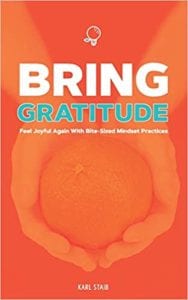
Bring Gratitude: Feel Joyful Again With Bite-Sized Mindset Practices
Because I love doing it. I have gotten such great feedback that I have a wonderful impact on helping people become storytellers, and how it enhances their career in their life. It feels like this is what I’m supposed to be doing. When it’s not happening as frequently as I would like it to, it is a struggle because I get frustrated thinking, “Am I not doing something right?” I’ve gotten past the not feeling good enough, which used to be part of the struggle. Now the struggle is, how do I create momentum?
Why do you want to create momentum?
I know there’s a great book about the tipping point. I remember somebody saying, “The more you speak, the more you speak.” I thought, “What does that mean?” Now I have had an experience of it where someone will be in the audience that will hear me speak. They’re like, “My wife works at XYZ Company. I’m going to tell her they should talk to you.” That is what I mean by momentum happening. Your confidence level continues to go up the more you speak. Your skills are finely tuned and you have stories ready to go about how you gave a great talk and how it gave everybody a great impact. That’s why momentum is powerful. It helps our energy and our confidence.
You said the word impact. Another reason why you want to make an impact on these people, could that be another reason too?
Yes, because the more momentum I have, the more people I’m reaching, the more impact I have. Ultimately, that’s what we’re trying to always do, create some legacy.
What are your expectations? Where do you expect to be at this point?
I stopped setting goals for myself around this because I was always under pressure for many decades in Corporate America with sales goals. You have to sell this month this X number, in this quarter, in this year to hit these goals. My intent is to align my intentions and allow the right people to find me without having to beat myself up if I’m not hitting certain numbers. As with any business, you have to invest quite a bit of time and money. As a speaker, you invest time in your website, your video, getting that edited, all that. In my case, I also have a course that goes with the talk. Your expectations are mine anyway of this is an investment in me. I know my work ethic and my skillset. I’m willing to put this money in.
[bctt tweet=”When we go through a struggle, like the passing of a loved one, we must dig into our thoughts and emotions.” username=”John_Livesay”]
As with anything, there’s no promise that it’s going to take off. At one point, you break even, and then when does it become profitable, and then when does it become something more than, “I love doing this. No, this is an actual career that you’re getting to do.” The big shift for me leaving Corporate America was realizing, “If I make $100,000 as an entrepreneur versus $100,000 as an employee, they’re very different.” I hadn’t realized that. First of all, it’s probably not going to come in a steady two-week paycheck, ups and downs. Also, there will be expenses that you have to pay, your insurance, websites and things like that. $100,000 as an entrepreneur is not necessarily the same lifestyle as an employee.
You want this to grow quicker because you’re like, “I have certain expectations money-wise, expectations of how I want to affect people and impact them,” and your legacy. This is where we need to start making some shifts here, some mental 180s. What are you grateful for about this situation?
I’m grateful that I have a wonderful speaking agent named Shawn Ellis. I don’t take that for granted ever. I’m grateful that I have had the opportunity to speak and get selected. I am grateful for the response. I gave a talk to Anthem Insurance and someone came up to me afterward and said, “How long have you worked in healthcare?” I’m like, “I haven’t. I took the time to customize my talk to your industry.” When you get a standing ovation and you see tears in people’s eyes, and you realize that you’ve touched their heart, and/or the feedback of, “That was beyond our expectations.” Those are all the things I’m grateful for.
The last part of this is, where are the opportunities that are within this struggle that you can dive into?
I’ve started the concept of focusing on healthcare and tech companies because I love that industry and I have several experiences with it. One of the things I’m looking at is I updated my LinkedIn profile, narrowing in on that particular industry. Sometimes people think, “That’s limiting yourself.” The irony is I’m still getting offers to speak at other industries because they want to hear about what’s going on in healthcare and tech, and how it could apply to them. It may seem like you’re cutting yourself off if you just niche. It has turned out to be the opposite experience.
What other opportunities have you noticed?
Sometimes speakers refer me when they can’t do a gig or other speaking bureaus, I’ve gotten on their radar enough to get referrals that way. Sometimes people find me by Googling storytelling and sales. I’ve spent some time and money on my search engine optimization. That’s always exciting when that works. That was unexpected. I had the belief that I was going to have to convince companies of the value of storytelling to grow their business. Many companies now have after the book Better Selling Through Storytelling came out.
The Tipping Point: How Little Things Can Make a Big Difference
It wasn’t the book but I wrote the book without having that expectation. When it first came out, I was definitely having to convince people of how it makes you memorable and magnetic, people buy emotionally and not logically. Now the last few inquiries had been, “We want someone to teach our sales team how to be a storyteller.” It’s specific to what I do that’s an unexpected opportunity to have. Other people speak about storytelling and do it in different ways, which is fine. I don’t need to be the only expert on storytelling. That’s been fun to say, “Let’s keep making sure the SEO stuff works.”
Also, with external opportunities, there are also internal opportunities. What internally have you noticed going on that you could shed some light on?
I noticed that the more I speak, the more confident I am every time I have to go up and be interviewed for the next talk. I’m still on a high from the feedback from the recent one. Also internally, I remember I was up against 1 or 2 other speakers and the agent called and said, “They picked you. They liked your energy.” I thought, “How great?” The person said, “I felt inspired and motivated by your passion and energy, I assumed you’d make my team feel the same way.” Sometimes I can get stuck in my head internally going, “I need to explain to them all the details of how this is going to work.” At the end of the day, money and what you take away from a speaker is all energy. People are buying my energy as much as they are my expertise
What opportunities are out there that maybe you haven’t worked on to reach more people to make this bigger impact?
That I’m not sure I have an answer for because I’ve been digging as deep as I know how anyway. I’m exploring all the different channels, whether it’s how people can find me agents, referral, search engine, Google search. There is that tipping point that I’m doing press. You get some momentum that way of people started hearing about you. Posting on social media is another big way not to be attached to someone having to respond from one particular post. I did get somebody that reached out to me blindly on LinkedIn who goes, “I like your videos. I’m interested in talking to you about a talk that we have coming up in six months.” I thought, “Which videos? I need to know which ones are resonating.” I thought it doesn’t matter. It’s the consistency of it.
I’m going to read these back to you. I’m going to play it back to you in story form. I want you to listen, and then what we can do over the next 30 days to help you reduce this struggle and get more of these opportunities. The big struggle is a lack of patience. You want things to happen faster, more speaking opportunities. You see other people getting these opportunities and you wonder why you haven’t. The big part is the unknown. As you build this, you’re not sure what is going to happen next. I asked you to rate the struggle and you said it was a 7 out of 10. That’s manageable. If people say a ten, I’m like, “You’re not quite ready for this yet,” but it’s a seven, so you know there’s wiggle room there. There are things that you can improve. You have the motivation. If it’s a 1 or 2, there’s no motivation there to make any change.
Why is this a struggle? You love speaking. You love how it makes you feel but you’re not doing as much as you’d like, and you’re wondering, “Am I missing something?” You want to reach this tipping point and you want to make a big impact in the world. The expectations you have is you want to be able to reach more people. You expect more people to realize that you are good at this and that you can help them. One of the things you realize is you stopped setting goals. When you stopped setting goals, maybe there are some opportunities there of like, “Is there a hybrid model?” Maybe not the goals that Corporate America was setting but something that you can set that makes you feel more comfortable.
[bctt tweet=”Anxiousness is just a form of being stuck.” username=”John_Livesay”]
You realize too with your expectation of, “I’m going to start this business. When I earn $100,000, it’s not the same as earning $100,000 working for a corporate job.” We started that shift of gratitude. I could see it in your face. You started talking about the wonderful speaking events that you speak at healthcare. You have a wonderful agent, Shawn Ellis, which is amazing and you’re lucky to have him. The responses that you get, you’re blown away by how people feel, and how you can emotionally affect them through your words. You’re amazed that as you’ve been able to do more of this work, you don’t need to convince them that they need a storyteller. This didn’t happen ten years ago. This wasn’t a thing.
Opportunities, you want to focus on healthcare and tech. This is something that you realize like, “Yes, I’m niching myself, but I realized I’m also still getting jobs in other industries.” There are opportunities for more speaking referrals. Confidence, as you do this and people you’ve realized is they love your energy. Maybe how can we play off that? If there are these videos out there that they are attracted to, how can you showcase more of these? Where can you do this? I noticed social media seems like a good opportunity for you. I want to do internal and external goals. What actions can you do to reach out to others and then internally, help you process this. Let’s start with the external. What could you do over the next 30 days once a day or maybe Monday through Friday but every single day for 15, 20 minutes?
I could probably reach out to the people that I’ve spoken to in the past and check in on how they’re doing and the impact that it’s having. That might lead to a referral.
Can you do that every single day? Can you add some other people that might have been in the crowd that you’ve talked with? Maybe 1 or 2 people a day, when can you do that? What time of day? How can you add that to your routine?
I probably like to do it after lunch like 2:00.
Can you put that on your calendar?
Yes.
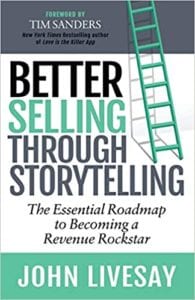
Better Selling Through Storytelling: The Essential Roadmap to Becoming a Revenue Rockstar
Keep it short, like 10 to 15-minute block you, and then once you have that email, you can copy and paste portions of it like your talk. It’s the core there. I love that. Now, internal.
I know that when I definitely booked time to meditate, I’m much happier.
Why is that? How does that help?
I’m not as reactive. I don’t get as stressed out and frustrated as easily.
When can you do that for once a day over the next 30 days? When’s best for you?
8:00 AM.
How long are you going to do it for?
I had this guided five-minute meditation.
[bctt tweet=”We need to be our own greatest advocate.” username=”John_Livesay”]
I love it short because whenever you’re like, “I’m going to do it for 30 minutes,” no. I know me. I do fifteen minutes max, and then I want to do something now. I heard what you’re going to do at 2:00 PM. You’re going to reach out to people, past clients, people you’ve spoken with. You’re going to get to understand a little bit deeper of how they liked it, get some feedback. Can you get maybe even quotes or testimonials while you’re doing It?
That’s a great idea.
You have a guided meditation that you can use and help you become less reactive. That’s why it is so important. The key thing and what I like about that is you’re already starting to think of how you’re going to be grateful for these things. You’re less reactive and you know you’re going to be calmer. How do you feel now on a scale of 0 to 10?
It’s like a three. It’s amazing putting a plan in action and not feeling overwhelmed. Part of it is this Dig to Fly Method is giving me a sense of control about something that’s felt out of control.
An important part of this is the sequence. You create some emotional space when you start putting a number on it, and then you’re already like, “That’s not terrible.” You start working your way through it. You dig down and then you start to do that 180. You can start getting out of that hole and start flying. I love it. Seven to three, that’s fantastic. Good job.
How great is that, you were able to show and not just tell what the method is. When you said, “Think of it like a story,” that’s the way I’m wired. Suddenly, I’m not listening to just my own stuff. I’m literally seeing a character in a story. Our protagonist is struggling with patience and comparing himself to other people and getting comfortable with the unknown. I’m like, “That’s a story I want to see how it turns out.” That part of it was interesting. Also, the willingness to ask questions that I’ve never asked myself. I could see how this would help small business owners in particular, but anybody, gets unstuck or get less anxious. Anxiousness is a form of being stuck. Maybe you’re still taking action but you’re anxious about it. That’s not the energy you want to put out into the world either.
What I like to think of it is we have these diamonds inside of ourselves. They’re rough and they’re caked with dirt. You don’t realize that they have energy trapped inside of them. When we dig down and we start to uncover them, we start to see the energy come out because we bring them to light, and we see the shine and the sparkle. We start to take away the dirt and the grime, and we start to chisel it away. We see how beautiful it is when we take the time to dig into this stuff and surface it because then it’s like, “Yes, I see what’s holding me back,” and then you can move forward. That’s the thing. It’s this murky darkness. You’re like, “I don’t know which way to go,” and then you slow down and go through the process.

Dig To Fly: Dig out of your hole, start to feel better and grateful, and then realize the opportunities that you have.
Everybody in the audience, after this is done, I have a one-sheet and they can print it out. They can do it themselves. That’s what I try to train people to do. Therapists are great counselors but we need to be our own greatest advocate. I want people to do this because I do this if my son’s acting like a little jerk or whatever and he’s in a cranky mood. I’ll be like, “How bad is his struggle?” I’m like, “Where did that question come from?” Subconsciously, now it starts popping out and I’ll do this method in 30 seconds. I’m like, “Where are the opportunities for?” Talking about my son crying, probably the older me from five years ago would have been like, “Come on. It’s just a little movie.” Now I’ll sit down and I’ll walk him through it because I want him to have this inner voice to be positive and talk him through things instead of being like, “Shove it aside, buddy. You’re fine.” It’s so interesting.
If people want to get your free steps and questions, they go to DigToFly.com.
Right there on that homepage is a little email sign up and they’ll get the Dig to Fly worksheet. I also have a recording of another Dig to Fly session so they can listen to somebody else. She was struggling with a friend. She has a reaction on there. She’s like, “Oh my God.” It’s funny. It hit her like a ton of bricks. It’s cool to hear.
I felt like you were running the interview instead of me hosting. I’m a big believer of show, not just tell something. We certainly showed how it can work in real-time and hopefully, people can imagine themselves going through it like I did. Any last thoughts you want to leave us with, Karl?
If people don’t even do this Dig to Fly Method, it’s important for them to pause, take a breath and say, “What is bothering me and why is it bothering me?” That why is so important because once you understand why, then you can start to come dig out of that hole. That’s when you can start to feel better and grateful, and realize the opportunities that you have.
Ask yourself, “Why am I so upset? Why is this bothering?” Nine times out of ten, we’re taking something personally. At least that’s my experience or we’re coming from a place of fear. One of those two whys can help us dig out and become the diamonds we were meant to be and be dirt free. It’s Dig to Fly Method. Thanks again, Karl, for sharing your expertise with us and inspiring us all to remember that we have the resilience inside if we ask these questions.
Thank you. I had a blast. Great job.
Important Links
- Karl Staib
- Bring Gratitude: Feel Joyful Again With Bite-Sized Mindset Practices
- LinkedIn – John Livesay
- Better Selling Through Storytelling
- https://www.Amazon.com/dp/B07DBT1L76/ref=rdr_kindle_ext_tmb
- Better Selling Through Storytelling Method Online Course
Wanna Host Your Own Podcast?
Click here to see how my friends at Podetize can help
Purchase John’s new book
John Livesay, The Pitch Whisperer
Share The Show
Did you enjoy the show? I’d love it if you subscribed today and left us a 5-star review!
- Click this link
- Click on the ‘Subscribe’ button below the artwork
- Go to the ‘Ratings and Reviews’ section
- Click on ‘Write a Review’
Love the show? Subscribe, rate, review, and share!
Join The Successful Pitch community today:
- JohnLivesay.com
- John Livesay Facebook
- John Livesay Twitter
- John Livesay LinkedIn
- John Livesay YouTube
Soft Skills Make You Stronger
Posted by John Livesay in blog | 0 comments
“Soft skills,” which include empathy, listening, and storytelling, are known to not be as important as hard skills. If you’re an architect, your hard skills are what you learned in school—i.e., how to design a building. If you’re a lawyer, your hard skills are what you learned in law school and passing the bar. If you’re a keynote speaker, your hard skills are knowing how to put together a talk that has a beginning, middle, and end—i.e. the craft of speaking.

No matter what your profession, mastering the soft skills is what makes you stronger than your competition. Recently, a top architecture firm had me speak to their team about how to build better client relationships. Their old way of winning new business was to show their design and hope that would be enough to get a new client. When a client told them they were going to hire the firm they liked the best, because the project would last 5 years, they panicked. “How do we become more likable?” they asked me.
Enter: soft skills! I told them that one of the best ways to increase your likeability is to show empathy. The more people think you understand the stress they are under and how you can help them, the more they like and want to work with you. Telling stories is a great way to build rapport, especially when you tell a story of origin around what inspired you to do what you do. People love working with people who are passionate because they usually means the process will be fun. When I showed them how to turn their case study into a case STORY, about when they helped a client meet a deadline, the prospect new client knew they have found the right firm for them.
The best storyteller wins!
Lawyers have “contests,” where they have to pitch against other firms to get hired. If everyone just talks about where they went to law school and the stats about how many cases they won, there is no emotional connection. Instead, when a law firm shows how they connect to a jury using the soft skills of storytelling and really listening to a witness, they win more cases and new clients.
When an event planner is interviewing a speaker and all the speaker talks about is how great they are and not how they are going to customize their talk to meet the event planner’s goals, the speaker doesn’t stand out from other speakers. The speaker who tells a story about how they love to have dinner the night before their keynote and meet and talk with as many people as possible to really have an in-depth feeling of what their challenges are is the one who gets booked and gets the highest ratings.
When you create content that shows you have empathy, people get to trust, like and know you. Putting myself in an event planners shoe’s, I created a blog for them on 4 questions to ask speakers to help them make a decision. What kind of content can you create to show your soft skills of empathy and storytelling?
Three Tips
Here are three things you can do to make your soft skills even stronger:
1) Make soft skills just as important as hard skills in your culture. When you invest in training that helps your team practice listening and empathy, it will become stronger—just like your physical workouts.
2) Practice telling your case stories and stories of origin with your co-workers. That way, when you have a request to pitch for new business, you are ready to go!
3) When you don’t win a new client, sit with your team and ask for the real reason they went with another person. Rarely is price the reason people don’t buy from you. If you dig deep, you may discover ways to show more empathy and understanding of the problem for the next pitch. When you do all these things, your soft skills will be stronger and stand out against competitors.
Lighten Your Day With Professor Pete Alexander
Posted by John Livesay in podcast | 0 comments


No amount of career success is ever really worth killing yourself for. We need to take stress management seriously if we want to be our best selves and be truly of value to the people who matter in our lives. This message resonates clearly in Lighten Your Day, a book written by the inspirational Professor Pete Alexander. Joining John Livesay for this interview, he shares his own story of how he almost lost everything by being stressed out. He also shares some cool tips on how to deal with pandemic stress and introduces us to the ancient Hawaiian art of Hakalau. Feeling a bit stressed lately? This episode has everything you need to get out of that situation. Listen in and start lightening you day!
—
Listen to the podcast here
Lighten Your Day With Professor Pete Alexander
Professor Pete Alexander is an expert in helping people reduce their stress. His book is Lighten Your Day. He talks about his own story of how he almost lost everything by being stressed out. He said, “When you trade in your health for focusing on your business over your health, that’s always a bad trade.” He has some tips on how to deal with pandemic stress. Don’t try to control what you can’t control.
—
Our guest is Professor Pete Alexander, who’s a recovering hard drive leader with years of sales, marketing, educational and entrepreneurial experience. He successfully battled the negative effects of stress head-on and developed the LIGHTEN Stress Model. He also has a book called Lighten Your Day. He helps people get motivated to take action in a few minutes a day where they learn stress management techniques, which allows them to become better leaders. Professor Pete, welcome to the show.
John, thank you for having me on.
Let me ask you to take us back and hear your own story of origin. You weren’t always a professor. At one time, you were a young lad in school. You can take us back to your MBA days or even before that where you started to experience the stress or were aware that there’s another way to live.
The stress goes way back to when I was a kid because I grew up in a dysfunctional family. I had to deal with a lot of alcoholism, suicide attempts and a suicide that was successful in our family. For me, it was a challenging experience because as a young kid, I had to be the adult in the family. In a lot of cases, it was stressful because I wanted to stay straight. That was my way of figuring that I would be able to get out of this crazy situation. From there, I was grateful in my mid-twenties to come across a twelve-step program. It’s Adult Children of Alcoholics and Dysfunctional Families. When I started that program, it taught me not only to like myself, but to also love myself. My whole life changed after that. It was an amazing experience to be able to realize that there are other people that could understand what was going on with me as a kid.
Career-wise, from a stress standpoint, it continued to be high. I always was putting my career as either one A or one B in terms of my priority list. Doing my sales, doing marketing for different companies, I was always the one driven to be the number one employee. It’s a good work ethic I have. The problem is that when you don’t listen to your body about what stress is doing to it. I didn’t do that in 2008 because not only did I have a business I had to run, my dad was dying and needed to have his affairs taken care of. My mom had major surgery and didn’t have the insurance to have physical therapy afterward. She had to be cared for. I had two small kids at the time. By the way, I had a marriage that was heading for divorce.
[bctt tweet=”There is only one person that you need to compare yourself to and that’s yourself.” username=”John_Livesay”]
All of a sudden, I lost 30 pounds in 30 days. That was in my mid-40s, John. At first, it was like, “Fantastic.” I wasn’t doing any special dieting. I wasn’t doing anything unique in my exercise regimen, but it started coming off. I hadn’t lost weight in twenty years. I thought, “This is fantastic,” until that 30th pound came off. I thought, “I better get it checked out.” Sure enough, it was stress-induced diabetes. I listened to my body about what stress is doing to it. For another ten years, I ended up burning the candle at both ends until I ended up in the emergency room with a severe case of diabetic ketoacidosis. For your readers who don’t know what that is, my body was eating itself alive because of my stress.
Here’s the crazy thing. I got transferred from the emergency room to my first ever and hopefully, last time, stay at the ICU. It was on my second day in ICU when my blood sugar, which was high when I was admitted to the hospital, they were 8 to 10 times higher than they were supposed to be. The doctor said I was an hour from being comatose. It was skyrocketing. My boss knew that I was in the hospital. On the second day, around 6:00 in the morning, they were checking my blood sugar every half hour. I get this text from my boss and he says, “You have a webinar you need to run at 8:00. What are you going to do about it?” I went into fix-it mode. I got to make sure everything is taken care of.
My blood sugar, which had come down into closer to normal range, all of a sudden, 90-degree angle, skyrocketed up. The nurse that was working with me at that time, she happens to say, “You realize this is what put you in this hospital bed in the first place.” That was my epiphany moment. I needed to have a complete stranger tell me that I was killing myself. When you trade your health for your career or other responsibilities, that is one bad trade.
That’s a great line, “When you trade your health for your business, career or responsibilities, that is one bad trade.” It’s such a great analogy when it comes to trading stocks and stuff.
The way to think about it is whenever you are sick, let’s say with the flu or something like that, did you feel like doing anything other than lying in bed?

Stress Management: Most stress is self-inflicted.
No.
If you just want to lie in bed and you don’t have any energy for anything, you’re no good to your business. You’re no good to your spouse. You’re no good to your kids. You’re no good to anybody. Take care of your health.
You were a professor at Berkeley, hence, Professor Pete. What lessons did you learn there? What stresses did you see your students going through those years?
It was a wonderful experience to get the honor to teach students. When I went through college, I’m probably ahead. Ninety percent of my professors and instructors were sadly, forgettable because they would either teach right from the book and teach in a boring way. I always said that if I had the opportunity to teach, I would teach in a much more interactive way, the way that I would like to be taught. When I started teaching back in 1999, the opportunity I had was to experiment with different gaming-like activities. Engage the students and get them to learn what was most important by applying what they were learning.
For me, my stress was always experimenting with different techniques to see if they worked or if they would flop. It’s like a great presenter going out there. As much preparation as you possibly can have, there’s no guarantee that something is going to be delivered the way that you intended to the audience. Every now and then I get some sort of a flop. It was like, “Let me try something different.” For the students, it was almost always about the grade. Sadly, that’s something that we have in life. We’re comparing ourselves to others.
[bctt tweet=”Fear is a four-letter acronym: Fictional Evidence Appearing Real.” username=”John_Livesay”]
The grading system, A through F, if you don’t get an A or B, whatever you expect, you feel like a lesser person. For me, what was awesome about my class and why the students connected is not only because they applied what they learned. If they did the work, they get As or high Bs. They just had to show up and participate and they would learn. It wasn’t about memorization. Let’s apply what you’re learning to a real-life situation because my promise that I would always have to my students was that no matter what career you’re getting into, you’re always going to have to do some marketing. Think of every career.
It even comes to the point where when somebody says, “I’m an accountant,” whatever it happens to be where you don’t think you’re doing any marketing. That’s not true. There’s personal marketing. You have to sell yourself to others, sell yourself to get a job, sell yourself to a client, etc. There’s always marketing. If you learn a couple of techniques that’ll help you improve your career, that’s what I would promise in my classes. I never had a single student say that they didn’t get something that helped them in their career.
There are many things you said there, Professor Pete, that I want to double click on. One is I always tell people, “You’re always selling yourself all the time.” That’s why I’m such a big proponent of whoever tells the best story is the one that gets hired or gets promoted or gets a new client. We’re not taught storytelling techniques in school. Many people think, “Am I ever going to need this algebra?” Nobody is ever going to question you, as a professor, about, “Am I ever going to need to know how to market myself or sell myself or tell my story?” I’m completely in sync with you on that.
The other topic is this concept of comparing ourselves. I tell people all the time, “Let’s not get on that self-esteem rollercoaster where we only feel good about ourselves.” In my case, in sales, making my numbers or not good about myself if I’m not or my dramatic situation of being laid off after fifteen years and then winning an award. If you let yourself go on this self-esteem rollercoaster, comparing, and only looking outside of yourself for how your self-esteem is, it’s exhausting. It’s not consistent. What I love about what you’re doing is you’re teaching people easy real-life skills in both your book and your workshops on how they can get off that rollercoaster because it’s stressful. The other thing you’re tapping into here is the imposter syndrome, comparing ourselves to other people. How do you avoid the imposture syndrome for yourself? Let’s start there.
One thing is you have to get away from comparing yourself to other people because there’s only one person that you need to compare yourself to and that’s yourself. Think about that. You need to prove to yourself and nobody else. I always remind people that the key thing to remember is that most stress is self-induced. We do it to ourselves. When we’re comparing ourselves to others, we’re doing it to ourselves. Let’s say the next-door neighbor, who’s driving the fancy car and has this big house or something like that, you think, “They must be doing well.” Maybe they are. Maybe they’re leveraged to the hilt. If they were to get laid off, the house and car goes and they’re back to square one. You’ll never know.
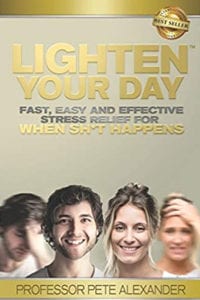
Lighten Your Day: Fast, Easy and Effective Stress Relief for When Sh*t Happens
The only thing you can control is yourself. Comparing yourself to somebody else doesn’t do you any good. It’s going to add stress. The great thing that I like to mention to or have them think about when we get into this imposter syndrome is it’s all fear-based. We’re thinking, “We’re not good enough.” First of all, I like to remind people that fear is a four-letter acronym, Fictional Evidence Appearing Real. We’re doing it to ourselves. We’re assuming something is bad when it isn’t the case. When somebody is thinking, “I want to go for this promotion.” “I want to go for this big fish client.” “I have this important presentation.” That fear of, “Am I good enough?” The question that I always suggest to people is, ask yourself, “What would you do if you knew you couldn’t fail?” What that does, John, when you hear that question, it opens up the world of possibilities.
It turns off our fear mode. We’re always in fight or flight. When you have that question posed to you, you get out of your fear or fight mode in your brain and say, “Let me go to my imagination where storytelling lives and see what all that’s going to be.”
You can be storytelling to yourself, “What would you do if you knew you couldn’t fail?” I asked this of my eighteen-year-old. First of all, trying to connect with a teenager as a parent is a challenge in itself for anyone. However, he was struggling with what he wanted to do for a career. I asked him that and I said, “Think about that but don’t tell me right now. Think about it and let’s talk tomorrow.” The first thing he says to me says, “Dad, that was an interesting question.” First of all, I’m like, “I got through to him.” He came up with three different possibilities, things that were way out there. Instead of being stuck, he was thinking about one of those things and he’s pursuing one of those.
You have something specific for people who might get nervous before they have to pitch or have a big interview and it’s called Hakalau.
It’s a light meditation that comes from the Hawaiian culture. What it’s designed to do is exactly what you said. If any of your readers are about ready to go on stage or go into a conference room, let’s say a Zoom conference where you have to give a good presentation, there’s pressure there and you’re thinking, “What’s going to happen?” A great way to ground yourself is to use Hakalau. This is a minute or two beforehand. What you do is you pick a spot on the wall, a stationary spot anywhere. If your readers want to practice this, I’ll walk you through it.
[bctt tweet=”Gratitude is the best stress reliever.” username=”John_Livesay”]
As you stare at this spot, which is preferably above eye level, if you’re either sitting or standing, you let your mind go loose and you focus all of your attention on that spot. If you notice, within a matter of moments, your vision starts to spread out and you see more of the peripheral than you see in the central part of your vision. As you start to see the peripheral, pay more attention to the peripheral than the center of your vision and you stay in this state for as long as it feels comfortable. Notice how that feels. You do that for 30 seconds or a minute maybe. You open and close your eyes, come back into the room and you’ll notice that you’re calmer, more aware of your surrounding and ready to take on that perceived stressful event.
In a way, it sounds like a little bit of self-hypnosis.
It can be.
Your book, Lighten Your Day: Fast, Easy and Effective Stress Relief tips and you have this whole LIGHTEN Model that you’ve created. Who do you work with for this? Is it individuals? Is it companies? Is it both?
It’s both. Usually, it starts off like a Zoom workshop for an hour. I have a team of people. I walk them through certain activities. Hakalau is one of them that I walk them through. If any particular individual might be struggling and needs a more in-depth stress relief, I’ll work one-on-one with somebody.

Stress Management: Don’t try to control the uncontrollable.
We’re in a pandemic, which a lot of people are experiencing a whole another level of stress from the isolation part of it. Do you have any tips for people on that?
The most important one there is don’t try and control the uncontrollable. This whole COVID thing and having to be stuck at home in many cases. We as humans, our human nature when we’re faced with a stressful situation is that we stress about all aspects of that situation. Inevitably, only some of it is within our control and some of it is outside of our control. We can mentally think about creating two lists, our controllable list and our uncontrollable list.
Let’s take COVID for example. Thinking about that, what can’t we control? We can’t control the government response to it. Let’s say if you have small kids and whether or not they’re going to school physically or online, we have no control over that. You don’t even have control or we don’t even have any control over the person next to us wearing a mask. We don’t have control over that. You list out whatever things you don’t have control over.
On your controllable list, you list things like, “I can wear a mask. I can wash my hands frequently. I can make sure to keep six feet distance from the next person. I can focus on my own mindset to make sure that I’m not worried about or try not to stress about all aspects of this situation.” If you separate those two and you say, “The uncontrollable stuff, I’m going to do my best to forget about that. I can’t do anything about that.” You focus as much of your mindshare on the controllable. What happens is, when we feel like we’re in control, when we can affect change, our stress goes way down.
If somebody wants to reach out to you, your website is PeteAlexander.com. Any last thoughts or a piece of advice you have for people on stress or a quote you like?
People ask me, what’s my favorite stress relief tool? I tell everyone, consistently, “It’s gratitude.” Have gratitude for what you have. What happens is a lot of people think, “That means I have to have gratitude for the big things. I’ve got a great paying job. I have a big house. I have a fancy car,” whatever it happens to be. Gratitude is for the little things in life. My wife and I, every night, we have a gratitude exercise where we ask each other, “What are you grateful for today?” I always start with, “I’m grateful for my health.” All else is secondary. Both of us will bring up things like, “I’m grateful that I got home from work safely. I’m grateful that I got a chance to go out for a walk because the weather was nice. I’m grateful that I had a chance to talk with one of my kids on the phone.”
When we lose track of the small things and think, “I have to win $1 million to be grateful.” We’re not giving ourselves a recipe for success. When we focus on what our own progress is, as opposed to comparing ourselves to other people, that seems to be the big takeaways that you’ve given us. What a great reminder of only compare yourself to your own self. I say, “Focus on your own progress and you win.” That’s the race you have to compete in. Thanks for being who you are in the world and helping us all realize that stress is something that we’re choosing to respond to, as opposed to being victims of any one event.
John, thank you so much for having me on the show. It’s been an absolute pleasure. I appreciate the time of your readers. I hope they got something out of this.
I’m sure they did. Thanks again, Professor Pete.
Important Links
- Lighten Your Day
- LIGHTEN Stress Model
- Adult Children of Alcoholics and Dysfunctional Families
- PeteAlexander.com
- Better Selling Through Storytelling Method Online Course
Wanna Host Your Own Podcast?
Click here to see how my friends at Podetize can help
Purchase John’s new book
John Livesay, The Pitch Whisperer
Share The Show
Did you enjoy the show? I’d love it if you subscribed today and left us a 5-star review!
- Click this link
- Click on the ‘Subscribe’ button below the artwork
- Go to the ‘Ratings and Reviews’ section
- Click on ‘Write a Review’
Love the show? Subscribe, rate, review, and share!
Join The Successful Pitch community today:
- JohnLivesay.com
- John Livesay Facebook
- John Livesay Twitter
- John Livesay LinkedIn
- John Livesay YouTube