

Future Proofing You With Jay Samit
Posted by John Livesay in podcast | 0 comments

If your old business ways are not working anymore, it doesn’t mean you need to do a full reset just to try once more. Sometimes, all you need is to start reinventing strategies. When you give a chance to the things you don’t give a lot of love into, interesting outcomes may surprise you. John Livesay sits down with Jay Samit once again, this time to talk about his book Future Proofing You. Together, they talk about how your fears can be leveraged to discover neglected opportunities and how tried and tested tools can be rehashed to achieve refreshing and far better results.
—
Listen to the podcast here
Future Proofing You With Jay Samit
Our guest on The Successful Pitch is Future Proofing You author Jay Samit. Jay has been on the show before. He talks about the Twelve Truths he’s written about in his book and how he busts through a lot of myths. One is that the world operates as a zero-sum game that if I win, you lose. He said, “That’s not the truth. What is true is that you’re only one click away from having incredible success.” He defines success as going way beyond making money but realizing what your purpose is. When you’re willing to work harder than most people, he says, you have a life that’s better than most people. We talk about the different kinds of fear. The fear of humiliation, failure, rejection, and how to overcome those fears. Enjoy the episode.
—
Jay, welcome back to the show.
Thanks for having me.
Why don’t you fill us in on what you saw and the success of Disrupt You! Let’s take a minute and brag about that huge success. How many languages has it been translated to and the impact that you saw?
I highly recommend it to anybody who feels that they have a book in them to write it. You’ve learned this as well because I’ve run companies with 300,000 employees and offices all over the world. When you’re at the top of a big company, all that you get is problems, fires, and hate mail. When you write a book that changes people’s lives, you get literally love letters from around the world. People who’ve turned their lives around or people that have stopped a suicide people. It’s an amazing transformation. The response was beyond anything I ever imagined. I’ve heard from readers in 140 countries. With COVID disrupting the world, it’s become a hit again and it’s coming out in languages like Icelandic, Urdu, Italian, Polish, and on and on.
Each time when it launches in the country, I suddenly hear from people whose lives are transformed. That being said, it turns out I have thin skin. Once in a while, I get an email from somebody, usually a millennial that said, “This is all motivational, but I could never do this.” That drove me nuts because my whole reason for writing a book isn’t to make any money, I don’t need it. The purpose is to take what I’ve learned and what I feel you’re not learning in school, and you’re not learning in an MBA program of how to get success and it’s easy.
I grew up in a regular middle-class, working-class family and dozens of friends become billionaires and change the world. We’re not smarter, we’re not better looking, we didn’t have connections, we didn’t have capital, but we saw the world differently and that can be taught. I decided to put my reputation on the line and I took a young man who was an immigrant, grew up on welfare, had no connections, no capital, and no entrepreneurs in their family. I decided to take the knowledge that I have and synthesize it down to twelve truths that if you embrace these, you will be successful.
His name is Vin Clancy and I mentored him one day a week for a year. I gave him no money. I introduced him to no one and I didn’t tell him what business to start. By the end of the first month, he made $70,000 and he could have flown to Europe without a plane. He didn’t believe it was possible. I didn’t know if he could keep up that level of commitment. No one says it’s easy but if you’re willing to work one year of your life harder than most people will, you can live the rest of your life better than most people will. He made that sacrifice and spoiler alert for the book, he hit it in less than a year, which was amazing to me. People wanted it to step by step. I went with Wiley as a publisher this time because they’re known more for technical types of books but it’s not a technical book. It’s some basic tricks. I’ll give you an obvious one and you know them. You solved it.
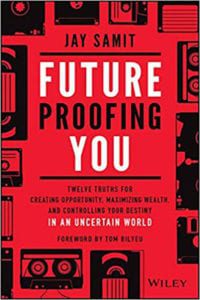
Future Proofing You: Twelve Truths for Creating Opportunity, Maximizing Wealth, and Controlling your Destiny in an Uncertain World
I’ve seen them in action before the transformation. I’ve heard his own personal story. You certainly picked a rags to riches storytelling genre there to come to life.
I’m also a fan of My Fair Lady and the Cockney accent from England so he’s my Pygmalion. Let’s start with a basic premise that people are taught in school that’s wrong. In school, you’re taught to buy an apple for $1 and you sell it for $2. You make $1 but the world is a zero-sum game. The only way for me to make money is to take it from you. When in fact, most of the millionaires and many of the billionaires never made a profit. They didn’t take money. If I start a new company, and I sell you 10% for $1,000, we now have a $10,000 company. I made $9,000 out of thin air. Jeff Bezos lost money for a decade and became the wealthiest man on the planet.
Every 48 hours, there’s the self-made billionaire. What are these people doing differently? Why is it easy when we’re all one click away? I have to be right for a nanosecond. To make money or to change the world and success isn’t about making money. I believe that the purpose of life is to live a life of purpose. What is your purpose and what do you want to achieve? One of the things that I’ve definitely seen since traveling the world for the past few years on endless book tours is that capitalism has to change and is changing to sustainable capitalism. Things that are both good for the bottom line and good for the planet.
This isn’t some hippie-dippy left-wing philosophy. Walmart, one of the biggest retailers in the world realized that their second biggest cost after employees was electricity so now they’re the biggest solar user. Why? It’s because it’s good for the bottom line and it’s good for the planet. There are many opportunities now to leverage the networks and the technology to do things in ways that don’t end life on this planet but help us sustain life. If you look at all these changes, and you realize with each of these changes, what they are new opportunities. There are many new ways to make money that didn’t exist.
That’s what I love about this book, Future Proofing You. It’s almost a continuation of Disrupt You! which you did brilliantly in laying out the premise that you need to disrupt yourself before it happens to you. Many people are afraid of being disrupted in terms of their job ending or getting fired and now the concept of the pandemic, having many people and industries even going away. The need to future proof ourselves is even more valuable than ever so we’re not living in fear. This concept of, “I’m doing my job. It’s a means to an end. I’m not happy, and it could go away at any moment.” That’s not a definition of anybody’s success, is it?
Yeah. To work at a job that you hate, wake up one day and you didn’t trade a day or a week or a year, you traded the only life you’ll ever have. This makes no sense to me. I was a vice-chairman of a company with 300,000 employees and partners retiring at 60. It’s a consulting firm. Since they run their own retirement plans and all that, they know the life expectancy. Here are the wealthiest and most successful leaders in the world. Their average life ends at 66.
Isn’t that shocking?
[bctt tweet=”The purpose of life is to live a life of purpose.” username=”John_Livesay”]
Your average NFL players’ life ends at 55. We’re not making choices that make sense and for those that didn’t believe the disruption would happen to them, 2020 proved my premise. Whether by choice or circumstance, you will be disrupted. That’s one of the things when we’re talking about sustainable capitalism. Whether you believe it or not, governments are going to start coming up with regulations that are going to force the industry to do things for survival.
Do you wait until your business gets told to do something and you’re out of business or do you get ahead of the curve? Do you look at the opportunities that are happening with this change? You mentioned this as a second course. In Future Proofing You, I talked about if this was a college course, the prerequisite would have been to take Disrupt You! 101. This is a continuation. This fills in, for me, the gaps of what people said that I didn’t cover and they didn’t understand how capital is created. Fear is one of the truths that we talked about.
Let’s talk a little about that.
Fear is the greatest thing.
You have a quote that I have given you credit for multiple times over the years, which is, “Fear is feedback. We keep going until we get a zombie idea so great that it won’t die.” Every time I say it and say you said it, everyone laughs and they have this insight of, “It’s true.” If you have anything else to say around fear, I’m all ears and I know that our readers are too.
We have to remember that we’re evolved lizards. We still have our lizard reflexes, fight or flight. Those basic reflexes allow our body to do stuff with us not even thinking about it. We have hundreds of thousands of years since we’ve been mammals dealing with this stuff. Why I say that is, we’re not quite suddenly changing, because we have a phone and a computer. Fear is why you’re here. If your great-great-great-grandfather in the cave wasn’t afraid of the saber-toothed tiger, you wouldn’t be here. Fear kept people alive.
What you’re afraid of is what you have to focus on. People are afraid of failing. People have a fear of being made fun of, fear of rejection, and all these things. Those are legitimate fears. I’m not going to mock you but isn’t the greater fear of wasting your life? Isn’t the greater fear of never having happiness? If you go to any of your grandparents, if you go to a senior citizen, go to an old age home, and ask people their regrets, it’s not something that they tried and failed, it’s something that they failed to try. That’s the first half. That’s your fear.
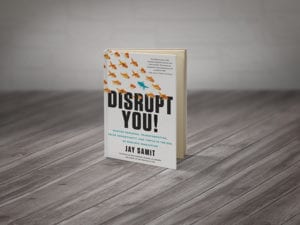
Disrupt You!: Master Personal Transformation, Seize Opportunity, and Thrive in the Era of Endless Innovation
If you change what you’re afraid of, you can overcome these insignificant fears. I learned this in college, if I asked that girl out, and she turned me down, I’m being rejected, and that’s horrible. If I ask out 100 girls, someone’s going to say yes. I’m in better shape than that I’ve been afraid to ask at any. Businesses are the same way. Here’s the part about fear that nobody else writes or talks about. That person across the desk across the table that you’re trying to sell, you’re trying to get to hire you and you’re trying to impress, they have fears too. If you can understand what fear motivates them, you can better attune what you’re saying. I’ll give a great example because we came off of the election.
It’s a strange scene two elections ago, not a single presidential candidate was spending any money on social media. I wrote this white paper saying social media will pick the next president of the United States and this is in 2010. It was a little early but I looked at the campaign. This was when Obama, McCain, Mitt Romney, and everybody was running. They’re going to spend $2 billion and I happen to have a digital ad agency at the time that I was building up and we took it from nothing to selling it for $100 million in eighteen months.
The way that I worked fear was I looked at these campaign managers and they weren’t spending any money on social. They were older and they didn’t understand it. They weren’t on Facebook. These were the days so I went and let them know that I could only meet with them on certain days because I was going to the other cities with the other campaign managers. I explained why this works, or whatever and they didn’t believe me.
They didn’t understand it but what they did know is if another candidate was using social media and they won, they would never get hired to be campaign manager again. Their career would be over. By the time I did, my circle of the four presidential candidates all four became clients and all four said, “If I hire, you can’t work for anybody else.” I said, “You don’t do that with ABC, NBC, or anywhere else that you advertise.” That’s how we got presidential elections to buy digital ads. Fear.
The fear of missing out.
Fear of getting fired. If you’re dealing with a big corporation, there’s only one thing and I’ve been CEO of NASDAQ companies. I’ve been through the whole thing. There’s only one thing that anybody thinks about and it isn’t shareholders and it isn’t profits. It’s keeping their job. They fought tooth and nail to get to that C-Suite. The life expectancy of a CMO or CEO is about the same as cheese. I’m not talking about some rare Swiss cheese. I’m talking about the kind that stinks after a couple of days. On average, a CEO lasts less than four years in this country. Self-preservation. How is your pitch of you coming in trying to sell them into business? What impact does that have on their self-preservation? Frame it in that and you’ve won.
What’s in it for them?
[bctt tweet=”If you’re not changing your skillset, you’re becoming obsolete.” username=”John_Livesay”]
I know that you pontificate and I mean that in a positive sense, about having to make that emotional connection in that story from the range of emotions that you can play with. Machiavelli taught us 300 years ago that it’s great to be loved but you can’t force somebody to love you, you can make somebody fear you. I don’t mean the fear in the mafia, “If you don’t buy this from me, I’m going to burn down your thing.” It’s the fear of what if your competition uses us and your boss finds out that you turned down this opportunity?
I talked about that. I said, “The new way of doing sales is whoever tells the best story is the one that gets the yes. If your competitors are telling a better story and you don’t even tell a story, you can imagine why you’re going to be losing market share, which goes into and that’s what they’re evaluated on.”
In Future Proofing, I broke down the three fears that drive people in business and how to leverage those for success. The next thing that was new that was an oversight in Disrupt You! that’s in Future Proofing You is there is a myth of the self-made man or woman that somehow you did it on your own. I was part of this myth when I ran music labels with our rock star on the stage alone with that guitar. What you don’t see are the makeup artists, the hairdresser, the production manager, the nine producers on the record, the promotion, the tour roadies, and everybody. It takes a ton of people. It’s the same way, you’re not going to make it to the top on your own.
Don’t fly solo and for each stage of your career, you need different mentors but no one ever taught you how to get those mentors. How do you get millionaires and billionaires to help you and work for you for free? None of us would get here without standing on the shoulders of others. Much of what I did, I did being naive and it worked and now I understand why it works so I teach it. When I was nobody sitting alone in my little five-man company, I wrote to the richest man in the world, Bill Gates. Would he introduce me to the biggest guy in the music industry because I had an idea that would make people playing video games on computers more fun and I have the technology of how to do it?
When the richest man in the world contacts a billionaire, they take the meeting. It goes back to asking girls out. If Bill Gates had not responded, I wouldn’t have been devastated. The fact that Bill Gates did that for me and I’d never met him at that time. Talk about being elated. When you reach for the stars, you may not make it to Jupiter, but you can make it to the moon. You’ll make it much farther than you ever imagined and this is what I did with Vin.
I’m seeing that it’s the same feeling you had from Bill Gates. You gave him when he made his first $70,000 in the first month. It’s a fantastic legacy.
I showed him to reach beyond what he could understand. He thought he knew all about social media and he was trying to do online marketing for people. He was going after people who couldn’t pay him anything because that’s all he knew was his craft and everybody else was doing the same thing. I go, “How do you differentiate? How do you show that you were the best in the world at one thing? If you’re not the best in the world at something, no one needs to hire you.” It turns out, I hate competition because I know there’s always somebody better, brighter, nicer looking, better financed, and knows more people. If you go into an area that nobody else has gone, if you’re the first one doing it, if you’re the only one doing something, by definition, you’re the best in the world. How do you differentiate what you’re doing? If you can’t articulate that differentiation, how do you expect somebody else to recommend you, want you, or use you?

Reinventing Strategies: Work at a job that you hate and you traded the only life you’ll ever have.
Hence the need to have a great elevator pitch so people can understand what you do in a way that allows them to share that story.
I’ve gone into more fields before anybody knew what you were talking about. I’ll give you a great example. Zoom is now worth more than Exxon. Years ago, I was President of a company called ooVoo. It’s the technology as Zoom. They’re the first ones to do multi people used by tons of people but at that stage, the only people who got to use it were teenagers. It had 100 million teenagers using it around the world. It was the number one app with teens prior to Facebook and yet businesses couldn’t understand it and didn’t see a need for it.
Doctors wanted you to come into their office even if it was for something that didn’t involve touching your body. What the pandemic did, it wasn’t changing behavior. It accelerated trends that were already happening. Having a remote workforce is one of those trends that I talked about in Future Proofing You. Since the beginning of time, if you open a business 100 years ago, you don’t get to hire the best people. You get to hire the best people within 5 miles, the best people in your culture, or the best people in your nation and now you can hire the best people in the world. It turns out people who work from home are more productive than people that go to an office.
It’s counter-intuitive than what management thinks.
They’re happier, they stay longer and there’s less turnover. All this had been in studies for years but it wasn’t until the pandemic forced people to change. That’s why I talk about disrupting yourself. If you wait until you’re forced to do something, everybody else is doing it then. To watch a surfer, they don’t wait for the wave to break. They paddle out to where there are no waves so they’re in the perfect position for that one opportunity.
When I was working with Redfin, they were having their customer service onboarding people work part-time from home and part-time in the office. When the pandemic hit and the whole thing about, how do we set people up to work from home for most companies who would never let them do it, they were a little bit ahead of their competitors because those people already had a home office setup.
They put the tools in place and they’re ready.
[bctt tweet=”When you reach for the stars, you may not make it to Jupiter, but you can make it to the moon.” username=”John_Livesay”]
You talk about being early sometimes doesn’t mean you get to be the market leader when the change does come. At that moment in time, you don’t have competition. If we look back at Beta to VHS. Beta was considered a superior quality and yet VHS back in the days when people were recording stuff took off. I’ve read something that I wanted to ask you about with Skype. At one point, Skype had a big hole in the business world. Suddenly, no one was using Skype for video calls. It was all Zoom. What do you think Zoom did right or Skype did wrong that caused that to happen?
When we went after Skype, long before Zoom, we realized that there were more forms of communication than one-to-one. Skype was revolutionary. Turns out, one-to-one communication, ICQ existed back in the AOL days. Nobody had the bandwidth to do video, but the process was the same. Looking at those unmet needs and unmet audiences of where it makes sense. My favorite example was texting. It’s going to sound weird to people that didn’t grow up pre this era that were never used on phones. You could have always done it. Phones were for talking. What happened was your talking minutes were more expensive, your texting was cheaper, and people still didn’t switch. In the hip hop club culture, you couldn’t hear so people were texting each other.
What a great story of origin.
From that approach, I was involved with Nokia back when they were 45% of the global market share of phones. They were one of the first to have a camera on a phone. They thought it was a killer feature. Nobody would use them. Nobody understood. Why would I need a camera on a phone? Nokia hired good-looking models pretending to be a couple in high tourist areas like Times Square, New York, whatever to walk up to a stranger and go, “Would you take a picture of us,” and hand them a phone. It never occurred to people. What I’m getting to is we all calcify. We can make ten million decisions a day so we develop habits.
When I was taking my youngest son to his first apartment, we’re driving around, “There’s a perfect one. There’s a sign. Write down that number.” He takes his phone and takes a picture. That would have never occurred to me. I have a different habit. How can you use the tools that other people have existed to solve a problem with data and focus on? The biggest fortunes aren’t made by the inventors of something new, they are made by those that solve a problem. All success is solving problems.
What you’re saying here is look for ways to use existing tools in a new way.
A new market. New use and you own that market. That’s exactly what Vin did that I talked about in the book. There was nothing that he wasn’t doing before. He was charging $100 for and now he could get a client paying him $35,000 a month to do the same thing that you used to for $100. In the book, I talk about my favorite example, and I’ll bore everybody who doesn’t care about magic. Harry Houdini, the name synonymous with magic, one of the most famous magicians of all time used to work in these little things called dine shows, where you come in and see a bunch of shows. He’d do ten shows a day and he was starving to death. He was making pennies. A guy saw him and thought he had a great talent. He took him out, repackaged that same act, and took it to Europe where he made some money. When he came back to the US, it was like, “Here was the star of Europe who would perform before all the kings and queens in Europe. I want to see that.”

Reinventing Strategies: There is a myth of the self-made man or woman that somehow you did it on your own.
It’s easy to make these changes. There’s nothing in either of my books that you’re going to go, “That’s rocket science. I need a calculator.” You’re going to say, “That’s common sense. Why didn’t I ever do it? Why didn’t I think of that?” One of my favorite stories was about a young man who watched Mad Men on TV and wanted to work in advertising. He got a job at one of the big agencies in New York and used to work in New York. That’s an amazing accomplishment until you show up and you’re an acute doing mindless moving of numbers and charts for execs and there’s nothing creative about it probably for fifteen years.
He was googling around and he realized that the big creative directors of the big Omnicom of the world, the WPBs, none of them want their names as keywords. It was obvious to him that every famous person has to google themselves to say something untrue, bad, or whatever. For $9, the cost of that Frappuccino somebody slurping on reading this, he bought the names of the top five creative directors in the world and said, “I’d like to work for you. Click here to see my portfolio.” Three of them offered him jobs and accelerated his career by hundreds of thousands of dollars a year in fifteen years of time for $9.
What a great story. Before I let you go, I was intrigued and I love an open-loop more than anybody else, when I’m reading about your takeaways from Future Proofing You, you talk about ways to get a piece of the trillion-dollar opportunity that’s bigger than mobile. Can you give us a hint of what that might be to entice people to want to get the book?
That’s one of the truths in this book that I hit on hard. It is hard for people to imagine a world without cell phones. We’re all addicted to them. We look at them hundreds of times a day and we spend hours a day with them. In the next few years, that phone will no longer be coming out of your pocket. You’ll be wearing a heads-up display. Augmented Reality is a fact. My consulting clients are Facebook, Microsoft, and Google, I know what’s coming. The best way to predict the future is by hanging out with people that are coding it. I know I’m right, not because I have a crystal ball I’ve seen and I know their schedules when they’re coming out. Here’s the proof for people that don’t believe or like, “I’m never going to wear crazy glasses.”
In 2020, in the United States, 50 million pairs of glasses were sold that cost more than $150 a pair that came with one app, Hocus. Another 30 million were sold that came with a different app called SAN. If you need to read or you don’t want to be blinded out in the sun, we buy glasses. When the phone came out, when the iPhone came out, what were the top ten bestselling apps the first year? I’ll tell you two of them. The Fart app that makes sounds up farts and a game with cats. There was no OpenTable, there was no go through your ten most useful apps, but each of those became billion-dollar businesses.
Somebody did the hard part and the glasses are all coming out. He saw things that you couldn’t do with the phone. What is that killer app? Here are the obvious ones and the thing that’s hard for people to understand. Google has the greatest business model and makes them a boatload of money. I don’t need to convince anybody that but if you’re no longer looking at your phone or your desktop computer for searching for stuff, they go out of business if they don’t own this.
Apple no longer caring about showing people the new iPhone doesn’t come out of your pocket. Apple goes out of business if they don’t sell this. Facebook, if you’re not using your phone or computer to get the message, this is an existential threat. This is a trillion-dollar opportunity. The big guys, with the deepest pockets, are solely focused on that piece of hardware and the OS around it. They’re not thinking of the millions of millions of apps. They want to get market share that they will use OPM, my favorite money, Other People’s Money, to make your app successful or advertise it because it makes people use their device.
[bctt tweet=”All success is solving problems.” username=”John_Livesay”]
One proof. I’m the old guy on the wrong side of 50 with a gray beard. There was a time when no one ever swiped, now, I can’t imagine. No one knew how to swipe. We know how to use a mouse. We didn’t know how to swipe. Apple, knowing that they were coming out with a tablet, the iPad, wanted to find a game that uses swiping. There weren’t any. They went to any little company that wasn’t successful because the big guys were busy making hit games. Make a game that swipes and we’ll put it in our TV commercial.
There was a company that had 30 failed games and they were on their next one in Northern Europe in Scandinavia that no one had ever heard of. They made a little game of the pandemic of that year. The pandemic that year was because there was swine flu. All of Asia had to kill every single bird because they were catching it. Remember this? H1N1. The birds were angry about the pigs causing them to die. The most bizarre game you could ever say would be it.
Apple spent $100 million in TV commercials for the iPad and everybody saw Angry Birds in that commercial. When you flew business class or coach, it didn’t matter what for the next three years, all you saw anybody doing was playing Angry Birds and buying Angry Birds lunch boxes, birthday toys, blankets, sheets, and $12 billion worth of merchandise. All because somebody else advertised a solution to a problem they had. How much of that ownership did Apple take? It’s zero. There are people that will give you millions. I have had companies give me tens of millions of dollars.
I remember Sony.
Coke or McDonald’s. They’re the biggest brands in the world. They didn’t want any equity. They don’t want to get paid back. They didn’t tell me how to do it because I could solve a problem that they had. Whatever business you’re trying to launch, there’s somebody else that wants to reach that same audience that isn’t a competitor. You can make that person that doesn’t have an idea look smart.
Jay, I can’t thank you enough for coming back on and sharing your wisdom. Thank you for writing Future Proofing You. I’ve got my copy. I can’t wait to share it with other people because not only are you helping us, but it makes an ideal gift. If you know people that are struggling and wondering why can’t I figure out how to get my life going, this is the roadmap.
This is why I write. Nobody’s writing a book to make money. This isn’t Harry Potter. This is taking years of my knowledge and the knowledge of everybody that was kind enough to help me along the way and synthesizing it in a way that is actionable. That’s the keyword. Everybody needs to commit to lifelong learning. The world is changing. If you’re not changing your skillset, you’re becoming obsolete. You’re going to be roadkill in the future.

Reinventing Strategies: If you’re the first and only one doing it, by definition, you’re the best in the world.
We know that we’re not going to get back to a world that doesn’t change or suddenly has all this certainty and stability. It’s up to us to control our own destiny by realizing these twelve truths you’ve written about.
The world is changing faster than ever before. That’s what’s causing so much angst in people. That’s why there’s a generation that is not going to live older than their parents. I love democracy. Democracy only exists with the middle class and the middle class only exists with entrepreneurs creating jobs. Governments don’t create jobs. I don’t care what party you are in. When you solve a new problem, if you’re reading my words now and you have problems in your life, congratulations, you’re halfway there. That’s all that you’re doing and I’ll leave you with one acronym that’s in the book, MOVE. It starts with a Mindset, an Obstacle, finding a Void in the market, and Executing. All you have to do is move.
I love it. It’s a great metaphor on so many levels because we know without action, nothing happens. We need to keep moving our bodies. Why in the world do we think we need to not keep moving our brains to keep learning? Jay, thank you so much. The book again is Future Proofing You. I can’t thank you enough for inspiring all of us to future proof ourselves.
Thank you so much for the time.
Important Links
- Future Proofing You
- Jay Samit – Previous episode
- Disrupt You!
- Vin Clancy
- ooVoo
- Redfin
- SAN
- OpenTable
- Better Selling Through Storytelling Method Online Course
Wanna Host Your Own Podcast?
Click here to see how my friends at Podetize can help
Purchase John’s new book
John Livesay, The Pitch Whisperer
Share The Show
Did you enjoy the show? I’d love it if you subscribed today and left us a 5-star review!
- Click this link
- Click on the ‘Subscribe’ button below the artwork
- Go to the ‘Ratings and Reviews’ section
- Click on ‘Write a Review’
Love the show? Subscribe, rate, review, and share!
Join The Successful Pitch community today:
- JohnLivesay.com
- John Livesay Facebook
- John Livesay Twitter
- John Livesay LinkedIn
- John Livesay YouTube
Be Concise And Precise With Tim Pollard
Posted by John Livesay in podcast | 0 comments


The key to effective communication lies in the human brain. The brain wants and needs to consume information in a certain way. When you align with the way the brain works, you can be incredibly successful. Tim Pollard, the Founder and CEO of Oratium and the author of The Compelling Communicator: Mastering the Art and Science of Exceptional Presentation Design, joins John Livesay on the show today to explain how one can be concise and precise to become an exceptional communicator. Tim is a regular contributor to the Forbes Coaches Council and a leading thinker in advanced communication skills. He shares some insights from his experiences and journey in understanding the “science” of excellent communication and developing a holistic model for effective sales and marketing conversation. Enjoy the show and unlock the keys to get your message across to your listeners effectively.
—
Listen to the podcast here
Be Concise And Precise With Tim Pollard
Tim Pollard is the Founder and CEO of Oratium, a leading messaging consulting firm. He’s a sought after speaker and author of the acclaimed books The Compelling Communicator: Mastering the Art and Science of Exceptional Presentation Design and Mastering the Moment: Perfecting the Skills and Processes of Exceptional Presentation Delivery. Tim also draws insights from a long career in sales, marketing and communications for companies such as Unilever, Barclays Bank, and The Corporate Executive Board. I got the pleasure of seeing Tim in action. We’re in for a big treat. Tim, welcome to the show.
John, it’s a pleasure to be here. Thank you.
I know you’ve had this amazing experience and stories to share with us. Would you mind taking us back to your own story of origin? You can go back as far as you want, college, high school. When did you start to realize that you had a love of presentation, communication, and more importantly, connection?
I think I’ve had a fascination with communication almost my entire life. In the last 10 to 20 years, I’ve been particularly obsessed with understanding why does communication fail so often? When it works, why does it work? When it doesn’t work, why doesn’t it work? That led me through a very interesting journey of pursuit. It turns out that fundamentally the key to communication is one simple thought, which is it’s all about the human brain. The brain wants and needs to consume information in a certain way. When you align with the way the brain works, you can be incredibly successful, but when you misalign with the way the brain works, you’ll be incredibly unsuccessful. In nowadays world, most communication, which is dense, convoluted, complex, and PowerPoint-driven isn’t annoying, but it almost perfectly misaligns with the way the brain works. That’s one of the reasons why so much communication is ineffective.
[bctt tweet=”The left brain is about what is, and the right brain is about what things mean.” username=”John_Livesay”]
Across about the last 10 to 15 years, I invested a lot of time developing a model that would allow you to design and deliver communications to be exceptionally successful in terms of getting the outcomes you want from your audience. That draws from all kinds of weird and interesting places. There are lessons from Shakespeare. There are a lot of lessons from neuroscience and functional mapping in the brain. There are even lessons from standup comedy. All of these come together. What we did is put them all together into one holistic model that allows you to build a conversation, particularly a sales conversation and have it be much more effective. That’s how we got to where we are now.
Let’s touch on a little bit of each of those things. You got your MBA at Warwick, which is in the UK.
That’s right, close to where Shakespeare was born.
Since you mentioned Shakespeare, that was worth bringing up. You were telling me that Oratium comes from the Latin word oratur. I always like to hear the story of the origin of a company name because that’s equally important so the people have an emotional connection to it. You could have named your company anything. Ten years ago or so, you decided, “This captures what we’re going to be helping people with.”

Effective Communication: One of many new things you have to master if you’re going to sell in a virtual world is the ability to be crisply articulate, which probably was not as important in a live meeting.
Oratium is a little bit of an unusual word. It’s Latin for an oral argument. In some colleges in Europe, if you’ve done a big piece of work like a dissertation, you would do an oratium, which is your oral defense of the piece. It’s the same root word you find in orator and oratory. Our particular emphasis has always been on how do you make an oral argument? The principles of communication apply equally to written communication, letters, emails, proposals, even web design. A lot of our clients use our principles for those other nonverbal settings. A lot of what we focus on is equipping people particularly now in a virtual setting for that live sales conversations.
The other thing you said that I’m fascinated with is how you also study standup comics. Since you and I are both sales keynote speakers, we love to see what is it that makes an audience laugh. More importantly, when I’m watching Ellen DeGeneres, Jerry Seinfeld or any of them, I noticed that when they tell a story, oftentimes it’s in present tense dialogue. I wanted to get your thoughts on that.
I haven’t given a tremendous amount of thought to the tense of a story. I don’t know if it is necessarily funnier to tell it in the present tense or the past tense? Stories are better to tell it in the first person rather than the third person. People tend to engage more if they think this was an experience I had rather than something that happened to my buddy. The main lesson we’ve drawn from comedy is linguistic precision. In any presentation setting, there is an absolute premium on linguistic precision or saying something in exactly the right way, not fumbling your words, not taking 30 words to say something that could be said in ten words. Not saying something three times before you finally say it the right way. That has always been an important attribute that salespeople should cultivate, linguistic precision. That becomes geometrically more important in the virtual environment. The virtual selling environment that we’ve all found ourselves in, and that we’ve been forced into in 2020 is a much more socially-constrained environment.
Customers are more distracted. They have less bandwidth. Their actual intellectual capacity physically measurably drops. You have to get your message arrow through a narrow window. One of the ways you have to do that is with precision and economy in language. I simply don’t have the time or space to fumble around for poor, imprecise, bland language. I have to go for absolute precision. What that raises is one of many new things you have to master if you’re going to sell in a virtual world. One of them is the ability to be crisply articulate, which probably was not as important in a live meeting. I’ll give you an example. We’ve been doing some research. The average live sales meeting, you fly somewhere. You’re going to get 2.5 hours, 3 hours almost unfailingly often where lunch before or drinks afterwards.
[bctt tweet=”Create viewer anticipation when you present.” username=”John_Livesay”]
That’s very common. I was talking to IBM, Cisco, Rockwell about this. All of them are reporting meetings coming down now between 30 minutes and 45 minutes, no lunch. You’ve got a much narrower window and it’s changing the standard of precision because you don’t get to do the things you used to do in a three-hour meeting. You’ve got to be much more precise. Funnily enough, standup comedy is perhaps the nonsales discipline in society that might have best practiced that level of linguistic precision. You’ve got these interesting hyperlinks between selling and other forms of communication.
I love this concept of linguistic precision. The tweet for this episode could be, “Be concise and precise,” because that’s what you’re in essence saying.
In a virtual world, you couldn’t go too far wrong with those two premises.
One of the things you said that I was interested in at the beginning was communications is all about how our brain works. What’s the biggest mistake that you see people are making that causes them to push people away or repel them even because that’s not how our brain works, and that’s how they’re communicating?

Effective Communication: Too much sales messaging is thoroughly confusing that the value is unclear.
It’s almost hard to pick the single worst brain violation. I would say there are three. The first one is we tend to pack too much information into our messaging frequently. I look at a large technology company, the very dense, bloated, PowerPoint decks they produce. This creates complete cognitive overload. What we know from science and psychology is that once somebody feels overloaded, they ignore everything. We’re working with a large pharmaceutical company. An interesting story. The average sales meeting has got longer for pharmaceuticals, which is unusual. The reason is doctors, rather than seeing reps briefly between patients, they’re having one long sales meeting in the end. What pharmaceutical reps are doing is packing so much into that 30 minutes because they think they’re taking advantage of more time. They’re completely destroying themselves. Violating bandwidth is the most egregious problem. Death by PowerPoint and too many slides.
The second biggest brain violation is that too much sales messaging is thoroughly confusing. What I mean by confusing is the value is unclear. We do not do a good job in particular and I’ll write here the word flow, develop a good narrative story arc. We present slides with topics. The human brain does terribly badly with random information. It’s why you can’t remember a 7, 8, 9-digit phone number. I think about some of the messaging we built like with Cisco Systems, our goal here and our entire purpose is to create messaging with a logical narrative story arc. If we think about it, any great sales message is a three-part symphony. The problem you have is a customer solution, why our solution solves that problem better, and then action, how we move forward together. That macro narrative flow is a critical solution to the lack of narrative.
It’s so powerful what you said. I want to double click on that before we go to the third mistake, this confusing part. Many people love to use acronyms to try and prove how smart they are. They assume everyone else knows. What I’ve seen and I want your opinion on it is that the confused mind always says no, and the client will never let you know they’re confused. It’s up to us to read the room.
There are a lot of different places you could go with that. Any use of insider language, acronyms terminology that we understand that the customer doesn’t is an immediate fracture. We use a similar phrase. People do not buy what they don’t understand. It is hard for most people and particularly most sellers to understand what that buyer does and doesn’t know truly. For example, it’s tempting to think that if I’m selling technology and you’re buying technology, we all understand the same technological terms. That’s nonsense. If you’re a CIO of a large bank, you live in the world of banking. If I’m a seller for a technology company, I live in my world. Those two worlds are not the same. The moment you create that fracture, people are going to tune out.
[bctt tweet=”In any presentation setting, there is an absolute premium on linguistic precision, saying something in exactly the right way.” username=”John_Livesay”]
You hinted at something that is important. In a live sales meeting, you generally get to read the room. At least if you commit that mistake, you might get to correct it. In the virtual world where you have taken a thoroughly social process which is selling, and you’ve moved it now into an asocial environment. The asocial environment has three different characteristics that a seller has to understand. The customer is more distracted. The customer has less mental bandwidth. You also experience a loss of social cues. This is the one you’re talking about. When you lose social cues, you may never see that the customer was confused. Virtual selling now exists at the confluence of these three different social dynamics. If you’ve lost them for any reason, too much information, confusing, no narrative flow. There’s another piece of this that we discussed, which is your material is too technical. In the virtual environment, you may never find that out. What we know is the virtual selling environment has an amplifying effect on traditional messaging mistakes.
Three big mistakes people make because our brain is wired to learn, accept and retain information in certain ways. Without it is a disaster versus pushing out too much information, secondly is confusing them, and then the third mistake you see people making is too sender-oriented.
This is interesting because you used a particular term, which is the most extreme idea. It’s you haven’t failed to engage but you have actively got them to disengage and push you away. This is the problem of sender orientation. I got in with a story about me and I could pick up any one of these traditional slide decks. This is a 100-slide deck from a large industrial company. There is within it no single reference to a customer, a business problem, a business goal or an objective. The assumption we make often as sellers is that the customer will infer why this solution is good for them. That is entirely not good enough. At extreme, you literally have pictures of buildings, ponds and how many cool people we have and how many offices. Too much information and confusing messaging will tick people off and it’ll irritate them, but sender orientation will drive them away from you.
I could come in and talk about my great solution and they’re going to say, “Good for you. Why should I care? Why would I even be interested in this?” In a world where people are overloaded with information, the default goal is always to leave that sales conversation and do nothing. If you don’t come in with a reason why you should consider my solution, they are immediately going to default to, “Great, this meeting ended and I do not have anything on my to-do list.” Sender orientation, I’m not going to say it’s the most toxic of the three. Any one of those three will devastate a sales pursuit. These are in combination. What you see is almost all sales messages conform to these three toxic hallmarks.

Effective Communication: In a world where people are overloaded with information, the default goal is always to leave that sales conversation and do nothing.
Tim has been doing something quite unique and it’s an ability to break through the bandwidth because our brain craves new things. It’s a fight or flight response like, “Do I need to pay attention to this?” If it’s a shiny new object, we get distracted sometimes, but it also is a technique to pull people in. I’ve never seen somebody writing on a screen. How is he doing that? Your brain starts to go, “Is he writing backwards? How’s that even possible?” Please share what it is you’re doing. For those who are not able to watch, you might want to hop over to my YouTube channel and see it in action, and how this is something that you’re working with a lot of companies to help them get into this sweet spot that you were drawing those three circles of intersection.
Backing up to where you were, the brain likes variety. That’s why in any message, you need to have some degree of multimedia. I don’t mean gratuitous for the sake of it, show a video. The brain always likes you to punctuate a slide run with some white-boarding, maybe with a short video, or with some conversation. The brain craves variety. The second point is there is a particular value that has been known for a long time in sales for white-boarding or build as you go content. The reason is there are two different psychological forces that are the same thing. One is called the Gap Theory of Curiosity and one is called the Viewer Anticipation Effect. If I start drawing randomly, you suddenly want to know, “What is this? Where is he going with this?” Your brain wants to know how it ends. If I draw this three-circle model, you want to know what’s in the three.
All good communicators and particularly sales communicators should figure out where a load-bearing white-boarding moment is. The key here is not to be gratuitous. You don’t write random things. This would not be what you do. You want to make sure you’re developing load-bearing ideas and hyperlinking between them. As far as the actual technology in a live meeting, I do a lot of white-boarding but in the virtual meeting, I can do this, which is a light board. We do make and sell these because they’ve become an important communication technology. I cannot write backwards and I am not a witch. This is a pane of optical standard glass, which is weird. It’s lit from the inside, which is what’s key. As I write on it, inner lighting illuminate pigments in these special pens. The computer then flips the image. However, if that’s true, how am I able to hold something up? Post-pilot analysis, this is an interesting sales message from one of our clients. How can I hold that up and have you read that? I will let your audience figure that out for themselves.
Let’s talk about this Gap Theory a little bit and the concept of closure. I know when taking a journalism class, they were talking about how you frame yourself on camera and how you frame a story. You don’t want your head to be too high or too low from the top of the frame. Yet sometimes when people take a picture or an artist creates a painting, they won’t show the whole head because our brain completes that circle for us. I think that concept of filling in the gap, that there are a lot of ways our brain is wired to complete a circle. It pulls us in a little bit more as opposed to it being, “I’ve seen that kind of picture or painting. That’s somebody’s head.”
[bctt tweet=”The brain likes variety. That’s why in any message, you need to have some degree of multimedia.” username=”John_Livesay”]
If it’s cut up in a unique way, we don’t want to do that on virtual calls. If it is a piece of art, it’s done because our brain is craving some completion, interaction, and anticipation of imagining what is there. Let’s go into a passion of both of ours, which is storytelling and framing a story in such a way that people see themselves in your story, which in my opinion solves this big problem that I completely agree with you on which is sender orientation. That somebody is, “Here’s all about us and how long we’ve been in business,” and then you’re the person’s waiting and waiting for something relevant to them. When you craft a story of maybe another client you’ve helped or what have you, then that framework completely changes from “here’s how great we are” to a story that someone ideally can see themselves in. How do you help your client with that?
There are different themes interweaving here. Let’s break it down. As we all know and as science now knows, you have a left brain and a right brain and joined by a little bit of tissue called the corpus callosum. It’s widely misunderstood how they work. It’s not as simple as some things happen in the left and some things happen in the right. The basic understanding of the way the brain works is the left brain is good at and all about fact, detail and analysis. If you imagine a bird trying to feed, it’s looking for seeds in gravel. That would be a highly-engaged left brain. However, simultaneously the bird has to keep an eye out for predators and what it needs to do is look for patterns.
If the bird heard a squawk, saw a shadow, saw some other birds flush, the right brain puts all that together and says, “Hang on. That could be a predator.” The left brain is horrible at this. The left brain cannot do that. The right brain looks at patterns and interprets meaning. A nice phrase is the left brain looks at what something is but the right brain looks at what something means. If the left brain does the analysis, the right brain does synthesis. It’s analysis, analyzes, breaking things apart. Our right brain synthesis, putting things together. Why does this matter? All human decision-making resides in the right brain. The right brain also is the center of emotion, which is a very important part because all human decision-making is emotional by nature, not rational. It’s clearly proven by functional MRI. There’s the science background.
What all this means is when you present using a traditional sales model, we tend to present using a very left-brain, Western rationalist argument, all facts and data. Engaging the left brain, the right brain can reach over to the left brain and source left brain information for decision-making. If you want to engage a customer’s decision-making and emotional centers more directly, then you can reach into the right brain using imagery and storytelling particularly. A lot of people understand they should use story but they don’t understand why. The reason why is that you want to engage the customer’s decision-making centers, which are thoroughly right brain.

Effective Communication: The virtual selling environment is governed by an entirely different set of social rules. If you don’t understand those, they’ll destroy you.
A good way of doing that is to imagine the customer has a problem, and converting their problem into a story. Imagine you’re a doctor and you’re really tired. You’ve come off the night shift. You go and lie in the break room. You’re trying to clear your head, so you’re binge-watching Netflix on your iPad. Meanwhile, that sucking of bandwidth is preventing some key patient monitors sending signals to the nursing station and lives are being put in danger. What I did is I taught you a message we built with a technology client. I took a sterile topic, which is network bandwidth reliability and I turned it into a story. You visualize the doctor laying on the couch watching Big Bang Theory or Brooklyn Nine-Nine. You visualize maybe the baby in distress, and the nurse at his or her station not getting the signal.
Storifying a customer problem is a particularly powerful tool, and a keyword here and a critical word is the word visualize. Almost everything you’re doing as you try and engage the right brain of an audience or a customer is about helping them to visualize either their problem or your solution. We’re huge believers in storytelling as 1 of 5 tools to engage the right brain. What I’ve shown you is the underlying science and purpose behind that.
The left brain is what is and the right brain is what this means. That’s a fantastic soundbite there. Our time goes so fast with someone as knowledgeable, entertaining and insightful as you. Is there any last thought you want to leave us with before you tell us how people can find you to hire you as a speaker or if they’re interested in this amazing light board for their company?
I think probably two things. One is a lot of people don’t believe they can communicate exceptionally, whether that’s them personally or even their sales messaging. You can take any personal or corporate organizational donor message, and you can make it exceptional if you understand the structural rules of messaging that emerged from understanding the brain. We’ve seen superficially bland or uninteresting solutions converted into stellar sales messages when you apply our models. Can you have compelling, winning messaging in the market? Yes, you can.
[bctt tweet=”All human decision making is emotional by nature, not rational.” username=”John_Livesay”]
The second thing is that people have thus far completely failed to understand what’s really happened as selling has moved into the virtual environment. Most people think it’s a matter of mastering the technology. Where do I put the camera? How do I share my screen? How do I share the document? That’s total table stakes. The thing you have to wrestle with is that the virtual communication or the virtual selling environment is governed by an entirely different set of social rules. If you don’t understand those, they’ll destroy you.
Think about this. You already tend to pack too much in. What’s going to happen when you do that to somebody with less mental bandwidth? These are two trains waiting to collide. You have to understand how to communicate effectively and you have to then do that through the lens of the changes in a virtual environment. That’s what we teach companies and people how to do. It’s fascinating but if you don’t adjust to this new environment, you’re going to be in serious trouble.
I’ve always believed that whoever tells the best story in person is the one that gets the sale. Now I believe even more because you’ve given us some evidence. Whoever tells the best story and gets people to visualize themselves in that story in a virtual world is the one that’s going to stand out and leave the competition behind.
I couldn’t agree more. I’ve used that phrase, whoever tells the best story wins. That is 100% right. I would define that as the broad sales story, not a story within the sales conversation, but we’re saying the same thing. The company is Oratium. We are our Oratium.com. The website is undergoing a major revamp, which will be done fairly soon but we got contact forms there. If people want to buy the books, they can reach out to us for help if you would like.
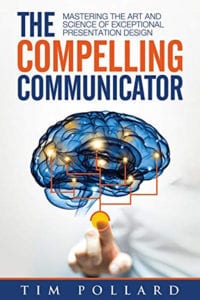
The Compelling Communicator: Mastering the Art and Science of Exceptional Presentation Design
Tim, thanks. What a pleasure. I was so impressed the first time I heard you speak and I’m equally impressed getting to know you personally and to hear your passion. It’s always so much joy for me to share this with my readers and the world when you get somebody else to validate. It’s almost like a parent relying on a friend or a teacher to tell their children something. I keep singing the same song and people believe it. Now to have somebody else singing the same song, even if it’s not necessarily being heard at the same moment by the same ears, contributes to that wonderful tipping point that book is all about. Thanks.
Likewise, it’s fun to encounter people who are like-minded. If I’m not mistaken, you did a podcast with Mr. Cialdini who talked about cross validation from different people reinforcing each other’s messaging. We are perhaps fulfilling a previous podcast.
Full circle, completing the story there about the power of edification. Thanks, Tim.
Thanks, John. See you soon.
Important Links
- Tim Pollard
- The Compelling Communicator: Mastering the Art and Science of Exceptional Presentation Design
- Mastering the Moment: Perfecting the Skills and Processes of Exceptional Presentation Delivery
- YouTube – John Livesay
- Mr. Cialdini – Past episode
- Better Selling Through Storytelling Method Online Course
Wanna Host Your Own Podcast?
Click here to see how my friends at Podetize can help
Purchase John’s new book
John Livesay, The Pitch Whisperer
Share The Show
Did you enjoy the show? I’d love it if you subscribed today and left us a 5-star review!
- Click this link
- Click on the ‘Subscribe’ button below the artwork
- Go to the ‘Ratings and Reviews’ section
- Click on ‘Write a Review’
Love the show? Subscribe, rate, review, and share!
Join The Successful Pitch community today:
- JohnLivesay.com
- John Livesay Facebook
- John Livesay Twitter
- John Livesay LinkedIn
- John Livesay YouTube
Brain+Trust With Tim Hayden
Posted by John Livesay in podcast | 0 comments

In today’s fast-paced world overrun by technology, understanding how the human brain behaves, works, and reacts is an important aspect of digital consumption. John Livesay delves more into this topic with Tim Hayden, the founder of Brain+Trust and chief business strategist at The Next Practice, by discussing how empathy and getting a full grasp of audience emotions can result in a compelling marketing strategy. Tim also explains how data science is being applied to COVID-19 trials as well as the concept of sonic gardens.
—
Listen to the podcast here
Brain+Trust With Tim Hayden
Our guest is Tim Hayden, who is the Founder of Brain+Trust, which is an agency that helps companies use empathy and technology to anticipate how to get inside their customer’s head. He’s also involved with a company called The Next Practice, which is about anticipating what’s coming around the corner. We go into things like how to tend to your sonic garden, a consent management platform, what’s happening in the world of AI, and consent and data privacy. All through a lens of how do we make the world better. Enjoy the episode.
—
Our guest is Tim Hayden, who has many years of marketing and business leadership experience. He’s been the founder of new ventures and a catalyst for transformational progress with some of the world’s largest brands. He is a strategic business executive, studies human behavior and how media and mobility are reshaping all of the business. From operations to marketing and customer service, he assembles technology and communications initiatives that lead to efficiency and revenue growth. He’s an investor and advisor to technology startups. He actively works with entrepreneurs and ventures to capitalize on opportunities and shifts across many different industries. Tim, welcome to the show.
John, thanks for having me. I appreciate that introduction.
Tell us your own story of origin and take us back a little bit. You can go back to childhood. You can go back to your days at Texas State. How did you get interested in being involved in startups in general? It seems to be a part of your path.
Growing up, my mom was a school teacher and later on, she became an executive with several nonprofits including The Hurst Euless Bedford Chamber of Commerce, right in the middle of the Dallas-Fort Worth. My dad on the other hand was in software. That’s probably what made me acutely aware of what was happening with technology and how it was iterating as time went along. Technology got faster. It got better. My dad, I wouldn’t say it was cumbersome, but he was absent for a lot of my formative years because he was working for somebody else. That’s the easiest way. I’ve always thought if I could wake up on Monday mornings knowing that the world is on my shoulders to win, to survive, or to do whatever else, that’s the path I’m going to take. That’s even been the case when I’ve gone to work for a large corporation or somebody else. I’ve always tried to be entrepreneurial in my approach.
Doing my research in preparation for this is, you have a fascination with human behavior and that’s why we’re looking forward to getting to talk with you because I share that passion from my advertising background. That’s what made me get into advertising was, what motivates people to change their behavior or buy one product over another. The same concept to persuade one person doesn’t necessarily work for another. You have certainly done a deep dive into that. Let’s start with what you’re doing at a company where you’re the Chief Business Strategy at The Next Practice? I find that concept fascinating “unlocking what’s next?” This premise that we all have to find what’s coming around the corner, we can’t stay in our comfort zone is what I get from what you’re doing there.
I’ve worked across a number of industries. You take municipalities and state local governments. This comes from even me sitting on the board of the Austin Chamber of Commerce at one time. The art of economic development is always being able to look 5 to 10 years in the future to understand what do you need to do to develop an infrastructure, the systems, the processes, and the environment for business to be conducive for a long period of time. That’s one part of it, but at The Next Practice, we’re all about doing that in terms of marketing customer experience and communications. We think that without calling it digital transformation, how can we help organizations with their endeavors be able to realize revenue growth, find new customers, and experience repeat behaviors from the customers that have already bought from them?
[bctt tweet=”Going on the next level by having empathy is what every entrepreneur should keep in mind.” username=”John_Livesay”]
How can we do that and always be ready for how behavior is going to change? That’s the important takeaway there is that, as the world becomes more automated as immediacy. During COVID, we can buy anything and have it delivered to our house in a matter of minutes, hours or days. That’s been a reality for some time, but we all know it way too well and we expect the rest of the world to be that way. At The Next Practice, we’re about being always on the next level if we can. It doesn’t mean that we’ll overshoot what needs to happen, but it means that we’ll have an understanding or maybe empathy with where things need to go from here.
You were very involved with the Austin Chamber of Commerce. Let’s give a shout-out to Austin and what an amazing community. I live here myself. I’ve been impressed by the friendliness, openness and collaboration that everyone finds here. A lot of people are moving from Silicon Valley here. The city has been voted the number one place to live for a couple of years in a row. There’s so much that it has to offer. From your perspective, both with your experience at the Chamber of Commerce and being an entrepreneur here, what is it that makes Austin special for you?
I went to school in San Marcos about 30 miles South of here. In the early and mid ‘90s, I was exposed to a lot that was happening with Austin. My wife went to UT. Neither one of us grew up here. She grew up in East Texas. I grew up in the DFW area. It’s the vibe that Austin has built on the edge of the Hill Country with a river running through it. It’s between the University of Texas and Ohio State, which has the largest public university in the country. Lots of young people live near the middle of town. You put a state government in the middle of it. The state government that leans a different way than the local government leans. It makes for an interesting mix of developments in terms of culture and business. That’s why Austin is the place for a creative class and for people whether they want to start new companies or they have fresh new ideas, this is a wonderful Petri dish to do that in.
You add in how green it is with an aquifer, the beauty of all the parks, amazing food, and live music. There are many special sauces to it that companies, even Tesla are coming here. It continues to attract and see what makes it unique. The thing you said that resonated with me, Tim, is as it relates to The Next Practice is this concept of empathy. Can you define for everyone reading what empathy is from a business standpoint? How is that a great tool to anticipate what’s coming next?
We look at it through the lens of design thinking about being human-centered, customer-centered in business is to understand exactly the preferences, needs and disposition of your audience. You said it first, “No two people have the same behavior traits, no two people have the same wants and needs, or have that same disposition.” When you talk about empathy, it’s about putting yourself in someone else’s shoes as best as you can. That’s a tall order. It’s an impossibility to do at scale, but thanks to the way we’re connected digitally these days and more so every day, we have the beauty of data turned into insights. That helps us understand how people behave, what their preferences are, what they imply and state, and maybe how they respond to questions we put in front of them.
It’s always about understanding and being customer-centric. That goes for internal communications, as well as understanding teams and business units, how can they better share information, how can they be on the same page having a true north of insight on that customer behavior. We believe at The Next Practice and Brain+Trust partners, that’s the remit for companies that want to not just survive, but want to succeed and grow over the next decade.

Brain+Trust: Being customer-centered in business is to understand exactly the preferences, needs, and disposition of your audience.
Let’s take some companies, maybe Kodak or Blockbuster. They had a little more empathy and been able to take a look at what’s coming. Maybe they would have seen that the business model that they had relied on for so long wasn’t going to stay either because the technology was changing and customer preferences were changing. The hassles of back in the day going to a store. Imagine young people today, they don’t know how to even operate a rotary phone. Let alone the concept of you had to wait for a movie to be returned before you could see it. All that is fascinating to me. You touched on Brain+Trust. As I said, you are busy in many projects. Tell us your role at Brain+Trust and what the story of origin was there?
In 2016, I was in the process of moving back from the Bay Area in California to Austin. I was out there in the Bay Area for two years. I had a couple of colleagues that I knew who had come from large global digital media roles with major companies. We all had a conversation and said, “There’s a wave of new technology coming into the market.” Artificial intelligence, machine learning, automation, not to mention what was happening with social media. Not to mention what’s happening in mobility in the automotive space with cars getting smarter. Some cars are able to drive themselves. All of this and the speed at which it’s happening is extremely confusing to decision-makers and leaders.
We built Brain+Trust, first and foremost, to be a sage counsel and at least a resourceful guide to be able to help business leaders roadmap where they need to make investments and decisions for investing in the future, whether that’s new process and operations or new technologies. Thanks to the pandemic in one way, it accelerated the need for companies in light of customer data privacy laws. In terms of the imminent threat that companies like Amazon and others pose to certain verticals, is to build a direct and personalized experience with your customers and to operate on their terms, which brings us back to empathy. Understanding your customers in their needs and serving those needs, that’s what businesses must focus on.
I spoke at the Coca-Cola CMO Summit and it was the CMOs of all of their quick-service restaurants that serve Coke. I was speaking to the CMO of Domino’s Pizza. He was explaining that their philosophy was creating the perfect pizza experience. Meaning you have a thought, “I’d like a pizza,” and it magically appears and fast. He and his team created that app that tracks the thing. I want to ask you about that whole thing of transparency and that people feeling part of the process is a new behavior. They’re using artificial intelligence.
That’s one of your areas of expertise. They said, “If you tend to order the same pizza at the same time every day, and you open the app or pick up the phone, the AI notices it and says we’re going to take a risk the odds or whatever. Put the pizza order in before you finish completing what you want on it to try and shave off a few seconds of the delivery time.” The bigger picture is the perfect pizza experience, and that’s where I’m fascinated to get your insights on because technology is great. Unless we’re connecting it’s feelings and emotions. What’s coming next and have this overall vision of in this case. I think about a pizza and it shows up and then using AI to make that happen without the customer even knowing it is something that you’re talking about.
We used to call that surprise and delight. KLM Airlines does this in several airports in Europe, where if you put up a signal, if you tweet or back in the days when everybody’s to check in on Foursquare. If you let the world know you’re at the airport and KLM has got their ducks in a row from a technology standpoint. They sense that you’re at the airport because you said you were. They already know what flights you’re on, what gates you’re on. They’re going to surprise you with a gift. They’re going to surprise you with something. We’re going to see more and more of that. What’s fascinating though is that because of the choices that consumers have, in terms of where they can get the goods and services they need. The way they can go about discovering new flavors, new products, and new brands. We got to be careful.
[bctt tweet=”Understanding your customers in their needs and serving those needs—that’s what businesses must focus on.” username=”John_Livesay”]
We need to know that it’s okay when I call my local pizza. I order from East Side Pies a lot here in Austin. If I call them up, I’ll ask, “What did I order last time?” They tell me what I did. I said, “Let’s do it again.” I don’t have to tell them my name. Because of caller ID, they knew who I was. That’s good but understanding that maybe shaving a few seconds off the delivery doesn’t mean that you have to preempt the consumer. Let’s allow our customers to be in control as much as we can. Let them opt-in. You’re required to do that because of data privacy laws that are popping up in 27 states. The bottom line is let’s make sure that they’ve consented, they’re opting in, and they’ve given you the green light to do that thing.
Which leads me to an article you wrote about, “If you can’t give a customer a cookie.” You talk about this premise of Consent Management Platform or CMP. Tell us what that means and how that can help businesses do better marketing.
Most people that are reading this are going to be aware of websites, especially news websites that they visit. That has a little banner that comes up and says, “Will you accept these cookies?” Most of those outlets will allow you to click on a different link and be able to see how your information is used. That’s how global data privacy regulations in Europe, which started a few years ago. That’s how that spelled out and how you’re supposed to do it. That’s how the California Consumer Privacy Act, which went into effect here in the United States. That’s what it says you need to do. What’s happening is Google is no longer going to support third-party cookies, which empowers brands to do so much from tracking a customer from a search result to the website. Maybe to the mobile app, to an eCommerce store, to a physical location and to do so on their terms, not Google’s.
Google is saying no longer will they support third-party cookies or use them in terms of how they do everything from rank searches and guide people to your doorsteps. You’re going to see probably more of investment directly with Google that will be required to leverage the behavior that’s there within Google. Apple at the same time has come out with a new operating system, iOS 14, which puts the customer in total control of who gets access to their data. Who gets to understand where they go with that device, whether an iPhone or an iPad or a Mac. What is consumed on that device, where has it been used, maybe what speed were you going, what direction you were going back to your place. Your point about predictive pizzas, “Does he drive by here every day?”
What we’re seeing is twofold. One, commitments to customer data privacy. That’s what we see there, but we’re also seeing that Apple, Google and others are doing all they can to be able to compete with Amazon. They understand that in Apple’s case with maybe Apple News before but with Apple TV plus, they’re getting more minutes of the day and more hours of the day with you in their ecosystem. You’re consuming media that flows from Apple. You already have the devices. You carry Apple with you all day that, how do we get more of your time while you’re in at home, your vehicle, and other environments. That’s what’s going to be fascinating over the next few years, as we see that shake out alongside more scrutiny to customer data and customer data privacy.
The other thing that I was interested in and impressed by was your Brain+Trust partners are a member of The Next Practice Group and you’re working with the Johns Hopkins University on their trials during the COVID. Can you explain how you’re helping all of that effort that everyone is concerned about?

Brain+Trust: The flip side of understanding consumer human behavior is how to get on the other side with behavior change.
I can’t tell you everything, but I can tell you that we’re employing data science to be able to identify audiences and opportunities to have people enroll in the trials. This is for convalescent plasma. This is a partnership between Johns Hopkins University, UCLA and several other universities. It’s about helping them as quick as possible as the trial needs to run, because with COVID, it’s a race for everybody to get the best possible treatments in place. The best possible vaccines through the approval process and trials. It’s a treatment with convalescent plasma and it’s not different than a company that’s trying to get to market as fast as they can before their competition does. In this case, their competition happens to be a virus.
It’s always a race and this case, the stakes are very high. How wonderful that you and your team have the technology that you used, crafted and honed to help companies have successful launches and anticipate what’s around the corner and play all scenarios out of imagining. What could go right, wrong and how can we mitigate those to help us all lead happier and healthier lives again without this fear hanging over us. There are some to going back to the empathy thing. There’s a toll that we all feel over time that we’re going to start to look at. What is the toll of isolation, depression, and all these other things that are separate from the fear of getting sick? I was talking to people at assisted living and how much longer it’s taking to get people to put their parents in an assisted living home because of those fears. Not being able to visit the parents and all those issues come up into play. You’re at the cutting edge of anticipating what’s going to be needed to help people get through what could be seen as a post-traumatic syndrome situation when this is finally over.
That’s the flip side of understanding consumer human behavior is how do you get on the other side of it with behavior change. How do you be able to temper expectations because there are many statements being made some by the government, some by brands companies that purport to have solutions, whether that’s vaccines, it’s more hospital beds, or it’s certain types of treatment or medicines. In terms of the fear that hangs over us, it’s intimidating or even worse than that it creates anxiety. There’s the associated things that happen there if going to the office was the only time you socialized with others. I think is the case for a lot of people.
There are some problems that can occur in terms of depression and isolation. How do we manage this in terms of a much calmer approach to educating people on how to stay safe. Educating people on when there may be changes to certain protocols, whether that’s businesses reopening, schools reopening, or new types of testing being available in the market. There’s much in the way that we can all learn from this experience on how we should go about education, which is a communications remit. Not only understanding behavior, but helping change results in better outcomes for certain populations or the population at large.
I have to ask you about your concept that we all need to tend our sonic garden. First of all, nobody loves words and can appreciate good writing as much as I do with my advertising background, speaking and helping people become storytellers. That’s what sticks is when our brain goes, “I know where the garden is. I know what sonic waves are. What is a sonic garden?” You have the skill of pulling people in with your words crafts. Tell us what you mean by tending a sonic garden.
People talk about elevator pitches. There are certain tones that when you’re on your couch, in your home, and a TV spot comes up of your favorite fast food restaurant or an automotive brand, you can tell within the first few seconds who that is. Even without looking at the screen, you usually can tell. The same thing with jingles, for shows tones like for Intel Inside, these are all pieces of us at Brain+Trust. I need to give all the credit in the world to my business partner, Tracy Arrington. She comes from years of advertising and has always looked in audio, especially with radio, satellite radio, and podcasting. The opportunity to build more trust with an audience and to do with certain sounds, audio cues, messaging, and the narrative you put forth.
[bctt tweet=”How to forge better relationships with your audience and catch their interest? Understand their needs and emotions first.” username=”John_Livesay”]
Back in the day, television shows used to have a theme song and then they got so frenetic about every second costing money. They’re like, “Can we cut that out and have a show without a theme song, friends, and all that stuff?” A song that people would hear that and they smile. Now because they want more time for ads, they have cut that out. If people want to know more about Brain+Trust or The Next Practice, any other way you want people to follow you? I see you’re big on Twitter.
I don’t know that I’m big on Twitter. I’m @TheTimHayden on Twitter. I always doing a podcast or anything like that would say, “If you had about anything we talked about or want to challenge me on it, please do it out in public. Bring it on Twitter.”
Any last thought or quote you want to leave us with, Tim?
We have a number of things that are going to greatly reshape how the country and our cities and our states are run because of all the different positions and different referendums that are up. The sun is going to come up tomorrow. Saddle up. Know that there’s always a new day.
Thanks so much, Tim.
You got it, John. Thank you for having me.
Important Links
- https://Braintrust.Partners/
- https://NextPracticeGroup.com/
- @TheTimHayden – Twitter
- Better Selling Through Storytelling Method Online Course
Wanna Host Your Own Podcast?
Click here to see how my friends at Podetize can help
Purchase John’s new book
John Livesay, The Pitch Whisperer
Share The Show
Did you enjoy the show? I’d love it if you subscribed today and left us a 5-star review!
- Click this link
- Click on the ‘Subscribe’ button below the artwork
- Go to the ‘Ratings and Reviews’ section
- Click on ‘Write a Review’
Love the show? Subscribe, rate, review, and share!
Join The Successful Pitch community today:
- JohnLivesay.com
- John Livesay Facebook
- John Livesay Twitter
- John Livesay LinkedIn
- John Livesay YouTube