

Exactly What To Say For Influence And Impact with Phil M. Jones
Posted by John Livesay in podcast | 0 comments

 Episode Summary:
Lots of people have a great idea, but they fail to have any understanding of who they want to bring that idea to or exactly who that perfect person might be in the first place. They sit, wish, wait, hope and pray for success as opposed to point themselves in a targeted, directed fashion with the right message towards the right person at the right time. Professional sales trainer and coach, Phil M. Jones, teaches on exactly what to say for influence and impact to close a sale. Phil entered the world of business at the tender age of fourteen. With nothing more than a bucket and sponge, he went from washing cars at weekends to hiring a fleet of friends working on his behalf, resulting in him earning more than his teachers by the time he was fifteen. His career went from strength to strength, as he worked with a host of Premier League Football Clubs to help them agree sponsorship and licensing agreements, to then being a key part of growing a £240M property business. Phil is now on a mission to demystify the sales process and bring simplicity and integrity to an industry where the only thing that seem to matter are short-term results with no thought for the impact on everyone involved.
Listen To The Episode Here
Exactly What To Say For Influence And Impact with Phil M. Jones
Our guest is Phil M. Jones. He’s the bestselling author of Exactly What To Say, Exactly How To Sell and Exactly Where To Start. He had his first business at fourteen years of age. He’s the youngest recipient of the British Excellence in Sales and Marketing Award. Over two million people across 57 different countries have benefited from his lessons and they know exactly what to say and when to say it. Let’s start learning from Phil. Welcome to the show.
It’s good to be here, John. Thanks for inviting me on.
You’re quite prolific to have two separate books. I always like to ask my guest to take us back to their own story of origin and it seems that for you, that might be fourteen years of age.
I’ve been in this game for quite some time. My first business was when I was fourteen years of age. I was knocking on the doors of my neighbors, asking them quite politely whether they wanted their cars washed. Some said yes, some said no. Most asked me how much money I would charge, which I quickly realized meant they were interested providing my prices were fair. I did okay with that little business, so much so that by the age of fifteen I was not going to school quite as often as I should. I remember getting invited in by the said school teachers questioning my attendance saying, “Phil, why don’t you come to school?” My response was simple. It was a question. It was, “Sir, do you mind me asking you a question?” He said, “Yes, sure.” I said, “How much money are you making?” The school teacher refused to tell me at the time, but at fifteen years of age my little car cleaning business was delivering me around £2,500 a month at that time, around $4,000 at that moment.
The reason I didn’t go to school is I had customers that needed servicing, staff that needed direction. I’ve always had this entrepreneurial gene in my body. I built a number of businesses through my teens. At eighteen, I had a dilemma. An offer on the table from one of the most prestigious universities, but I wanted to get my education in the field. The next few years had me working through some nice corporate roles. I was the youngest Sales Manager for a business called Debenhams Department Store. Head of Sales Training and Store Manager for one of the largest furniture retail groups called DFS Furniture Group, a former Head of Retail and Commercial Director for two Premier League soccer clubs. I went from there to build a property business that turned over £240 million at its peak.
In 2008, as the world started to change with this wonderful economic crisis that was going on at the time, what I was seeing was lots of lots of businesses that either we’re doing something good or good at doing something and failing to get the results I knew they were capable of. Struggling in that recession time because of the fact they couldn’t sell anything. What I started doing was delivering small sales training programs to help out the local business community. Ten people in a workshop became twenty people in a workshop, became 50 people in the workshop became, “Can you come deliver this to our sales force?” became big companies coming on board, became first book. Ten years on from now, I’ve written six bestselling books, spoken all around the world and still wondering when I’m going to figure it out what want to do.
The thing that jumps out when I was hearing you talk about your background for me is the soccer aspect of it. I’m curious, if there are any life lessons, do you look at the sales playing field like a soccer field? Are there any lessons from soccer that you apply in your talks and your workshops?
None whatsoever. The only thing I think about, and this is probably relevant to a pitching point of view is when you study those that have been super successful in the world of any sport and then in particular soccer is those who have achieved the best of the best always have ratios attached to their numbers. An example of which is a guy called Alan Shearer, one of the greatest Premier League soccer players of all time. He’s won the Golden Boot, as in most goals scored in the season, more times than anybody else. In his best ever season, his shots to goals ratio was 10:1. Lots of people we meet in the world of sales or when they’re pitching things are saying things like, “I tried three times, it didn’t work out. I tried five times, it didn’t work out.”
[bctt tweet=”Enthusiasm is a catalyst toward decisions” username=”John_Livesay”]
The best of the best of the best have to try ten times to try to get one goal. Better than that also is what did Alan Shearer need to be able to do to score, what he needed to be to be able to take shots, he needed the ball. In the world of sales, our ball is our prospect list, and it’s who we are pitching towards. Lots of people have a great idea, but they fail to have any understanding of who they want to bring that idea to or exactly who that perfect person might be in the first place. They sit, wish, wait, hope and pray for success as opposed to point themselves in a targeted, directed fashion with the right message towards the right person at the right time.
I love that concept of measurement and it’s not just to have a goal, but it’s how many sales calls are you making? How many of these are your closing? Which helps get people’s mindset wrapped around not burning out? If you realize it’s going to take one out of ten shots in sports and it’s going to take one out of ten maybe in what you’re selling to get the yes, then it helps people realize, “I’m only an eight so I have to keep going.” That mindset of an athlete and the mindset of a sales athlete are important and you certainly have that down. Let’s jump in because you not only have one but two books out and another one on the way.
The new one is finished and it launches in October 2018. That one comes together and brings the trilogy to complete.
I’m going to ask you if someone is saying to themselves, “Do I want to start with What To Say or do I want to start with How To Sell? Where would you have them start first?
The third book is probably important to be able to bring into play here, which is called Exactly Where To Start. If you’re wondering where to start, that may well be the place. Let’s look at what all three of them are. Exactly Where To Start is a book to how to turn your big idea into reality. If you sat there thinking, “I’ve got this great product idea, this great service idea. I’ve got something I want to launch as a new arm to my business,” getting that blueprint for success right in the first place is more important than saying, “How do I drive it fast?” Take that race car analogy is, “Before you learn to drive the race car, you need to have a race car.” Building something that works on paper, getting an idea launched and out the ground is probably the place to start if you don’t have an existing business.
If you have an existing business in place, you can probably look at this either way around. For people finding my work the first time, the way in which they’re written is probably the best order. Read Exactly What To Say because it gives you some instant wins, some quick takeaways, but if you read it and you read it right, you’re going to be like, “That was super smart and it was crammed into a short read and it was something that was no fluff, but there was no backup to it.” There was nothing like, “Here are all the articles, all the investigations and all the experience as to why these things are true.” It’s jus, “This is true. Do this. This is how it works.”
For people that then want to back that up with some more sales psychology, they want to back it up with some more understanding of still straight talking principles, then read Exactly How To Sell. If you feel you know nothing about the sales process first time round, then flip those two around, start with Exactly How To Sell, understand the principles of sales and then Exactly What To Say becomes the sprinkling on the top of the cake that says, “How do I make the system run faster?”
Let’s start with Exactly What To Say and it’s the magic words for influence and impact. Who doesn’t want some magic words? One of the big things that a lot of people struggle with is realizing that there are two types of people that you talk about. You talk about this person that’s a professional mind maker upper and that some people as you talk about here leave their professional success in the hands of others. There are some people who judge something before they’ve even tried it. This constant awareness of who you’re talking to and should people adjust the words that they’re saying based on who they’re talking to is my question?
We should adjust the words that we’re saying depending upon the outcome that we want to achieve. When I talk in terms of the outcome that we want to achieve, it might not necessarily be the final outcome. This is a mistake that lots of people make when they’re trying to pitch something is they want to get from A to Z. In a conversation, even if it is a one-sided conversation in the form of a one-way communicative pitch, it still needs landing points and checkpoints to say, “What I want to do is I want to provide this piece of evidence and then this piece of evidence,” where the sum of all those pieces evidence mean, “Of course, they’re going to choose me. Of course, they’re going to do what I ask.” John, you know friends who have invited somebody to marry them? On a scale of one to ten, with ten being somewhere near certain and one being, “I don’t know whether she’s going to say yes,” where do you think most of those people are on that sliding scale of one to ten when they ask the question, “Will you marry me?”
I would say nine and a half. Everyone I know, male or female, depending on who’s doing the asking because we live in a whole different world now, that you’re 95% sure you’re going to get a yes when you went and ask the question, especially in front of a bunch of people.
Somewhere near certain, maybe a niggle of doubt in the back of your mind, but you’re somewhere near certain. What we should be looking to do is to find that same level of certainty before we invite somebody to invest in our idea, buy into our product or service, to be able to move forward with us in a long-term relationship. That same level of certainty should come before the big ask. That’s what we should be looking to be able to do with the evidence that we build through our pitches.
One of the phrases you have in Exactly What To Say is, “I bet you’re like me,” and that phrase allows people to get from being on opposite sides of the table to being on the same side of the table, if not physically at least psychologically because you’re building rapport with that phrase. Would you agree with that?

What To Say For Influence And Impact: Find a way to get anybody to agree with anything you say.
What you’re looking to be able to do is you’re looking to find a way to get anybody to agree with anything you say. Providing you’re reasonable, if you say, “I bet you’re a bit like me,” and then follow that up with a reasonable set of circumstances, you can gain a piece of evidence. “I bet you’re a bit like me, you like to work with a local organization and you far rather prefer to support local, homegrown talent than you would to work with somebody from the other side of the country or the other side of the world.” If what I’m going to do is to present the fact that we’re a local company, I’ve already got the evidence and the agreement, the fact that given the choice they would prefer to work with a local company.
One of the mistakes I see people making often when they give a pitch to get a new client or even get a pitch to get their startup fund it is not planning a good closing. You and I are both keynote speakers so we know how important a good opening and closing is. Most people think, “I’ll just end my presentation or my pitch with, ‘Do you have any questions?” I cringe every time I hear that. You at least have given them a new way to phrase, “If you’re going to ask for questions,” whenever. “What questions do you have for me?” which implies you’ve got to have something there.
It’s more than that as well. If I finish a presentation with the words, “Do you have any questions?” the undertone and psychology is I expected you to have questions. If I say to you, “Do you have any questions?” and you don’t have any questions, a little voice inside of the head says, “What did I miss? What have I not caught here?” It’s an activist, a catalyst, a breeding ground for objections like, “I need some time to think about it.” What you’ve done is you’ve suggested to them that they should have had questions to ask. You’ve told them you don’t believe you’ve given them enough information to make a decision, if you’re saying, “Do you have any questions?” Rephrase that to, “What questions have you got for me?” What you’ve got is you’ve created path of least resistance is for them to come back and say, “No questions.”
If they say, “No questions,” it means they’ve got enough information to make a decision, which means that you’re welcome to ask them for the decision. If you’re looking to be able to invite somebody to take the next step, then that’s all we need to do, is to invite them to take the next step. A close in a pitch environment isn’t this big, “Shall we go for it?” It’s inviting them to take an action that they could only take, had they decided they were going to go for it. It’s an invitation formula to take the next step.
Let’s jump into the other great book, Exactly How To Sell, which is a sales guide for non-sales professionals. If I may be so bold, everyone who is a sales professional should also read this because part of being a good salesperson is like an athlete or an actor is keeping up on your training and skill set. Even if you think you don’t need this, I would like to invite all the readers to reconsider that and say, “I think I might.” The thing that jumped out at me having had a sales career for many decades is where you talk about making the moments count. There’s a lot of great things out there about instead of eating a bagel or a muffin, eat this. Instead of eating pizza, eat this. You’ve done it in the way of talking about the problems. My whole philosophy is the better you can explain the problem to a client, the better they think you have the solution. You do a deep dive into four or five things that we should say instead of this. Instead of saying if, what should I say?
Instead of saying if, if you say the word when, then what you do is you create a vivid image. Think about the example. If I’m to say to you right now, “If you’re not careful, the cup of coffee in front of you is going to fall all over your keyboard.” Your little voice inside your head’s going to say, “It won’t fall. I’m careful.” If I say, “When you turn around too quickly, you’re going to knock that coffee cup, it’s going to ruin your keyboard.” You cannot help but see a visual image of your keyboard covered in coffee, which means that if I can say, “Here’s a mug with a lid on it,” that means that when you knock it over, it doesn’t spill on the keyboard, you’re more likely to be able to move forward with it.
[bctt tweet=”Show Me Your Know Me” username=”John_Livesay”]
The takeaway there is using the word when paints a picture. The word ‘but’ comes up a lot. “Can you do this for us?” “Yes, but,” and your whole philosophy is replacing the word but much like they do with improv with the word and.
What we do is we now create something where all things are true as opposed to negating the thing that was said prior to it. If I’m in a conversation with somebody and I say, “I hear what you’re saying. I agree with the points that you’re making but,” the second I’ve said the word but, what I’ve said is, “Everything you’ve just said is not true.” If you’re saying, “I hear what you’re saying, and I agree with the things that you’re pointing out to me and we’re both in agreement with this and the most important thing is,” then what I can do is shift the conversation and bring everybody with me.
Here’s a big one. It’s always shocking to me when the client will say, “How much does this cost?” We have the ability to reframe that with a different phrase, which you would say would be?
I would swap the word cost for investment. Let’s think about this with some pain, is four letter C words are typically not good to use. How do you feel about the cost in your life? A cost is a bad thing. If you understand what costs are, it’s money out and nothing back. A cost brings zero returns. If we were say in any other set of circumstances, “It costs me,” we would be describing a bad set of circumstances. It was something that left a pain on us. The thing that we’re looking to better provide to them, whether it is some form of involvement into funding a startup, whether it is them buying into a product or service. I’m guessing that thing is going to bring some returns. If that thing is going to bring some returns, it isn’t a cost, it’s an investment. We label it the right way around. The money is easier to spend. It’s easier to spend money on an investment than it is to spend money on a cost.
We’re having a collaborative conversation, they’re on the right track and they say, “When we are working together, X, Y and Z is going to happen,” and your suggestion is instead of saying the word we, we should say, you.
We should say you. We should swap everything that is we focused to you. Let me give you the biggest example of this in the world. In every proposal, every pitch document, every company website that I see, more often than not, what I see is, “We this, We that, We the other.” “We pride ourselves on our customer service. We founded in 2004. We have an experienced team of professionals,” you quite literally we all over your customers. Flip that thing around and what we should be saying is, “Choosing us means that You benefit from over 40 years of experience. What you find from being a customer of ours means that You get the benefit of being able to plug into this, this, and this.” Instead of it we, we, we, it’s choosing us so you. What we also do is we activate the sentence. We put them in possession of the service or the product that we have in their mind’s eye, which means that we move it from a future conditional tense and we bring it towards being an active and current tense.
Some people would be like, “Yes, we know we’re expensive but,” there are two noes there. Let’s say, “Yes, we know we’re expensive,” how would you suggest people reframe that?
Before I jump into the reframing, answer me this question. Do you like expensive things?
No.
I would also challenge that sometimes I believe that would be true.
I like them, I don’t know that I can afford them or want to spend. I’d like to have an expensive car.
Expensive restaurants, suits, shoes, watch, jewelry. In many sets of circumstances, the word expensive is something we’re remarkably proud of. Where it is in scenarios that we’re proud of is when we’re talking about a premium offering. If we swap the word expensive for premium, what we end up doing is we talked to the right side of the brain that considers expensive a good thing as opposed to expensive a bad thing. What is it that truly makes something expensive? The only thing that makes something expensive in my mind is what it’s being compared to. Is a Rolls Royce expensive? Not if you’re shopping for a Bugatti Veyron, it’s not. Until you can find a comparison, the label of expensive is only in relation to what it’s being compared to. If their first offering is the fact that this is an expensive product, we can reframe that it’s a premium offering. What we’ve done is we’ve then allowed them to be able to judge this as not do they or don’t they want the offering, it’s can they or can’t they afford it. That’s a different thing.

What To Say For Influence And Impact: It’s easier to spend money on an investment than it is to spend money on a cost.
When somebody sees something as expensive and the problem is that they cannot afford it, there’s not a great deal that we can do to change that. If you’re looking for $2 million worth of funding and somebody could only put $50,000 in and that’s all they have as disposable liquidity, I don’t care how good your pitch is. Somebody doesn’t have the means to be able to pay, then the game is unfortunately over and it may well be too expensive. However, what we’re looking to do is to build a premium offering, we’re building a premium company, we want to bring on board premium people. All of a sudden that requires a premium level of investment.
On the flip side of expensive is cheap. I don’t think anybody ever usually refers to their offering as cheap. However, the client might say, “We’re looking for the cheapest solution.”
Client says, “Have you got anything cheaper?” Sometimes though, even sales professionals in organizations say, “I have got something here for you. It’s a little cheaper.” The trouble is there would never be an ad agency that was putting a campaign together that used the word cheap in any of the slogans for a company. It’s not going to be the thing that reinforces a conversation the way that we would look for. People do talk about things like budget. Budget would be a way of being able to say it’s a budget offering, but I don’t like that on a personal level. What budget says when you think about the real meaning of the word is that’s the sum of money that’s been allocated towards spending on this. That isn’t what we’re looking to better create as a label on this. We could say that it’s a basic offering because what it is, is without all the bells, whistles and the frills or we could say it’s a value offering.
That gives you what you need, so you’re getting maximum value. If you don’t need all the bells and whistles, that’s just for you. A lot of people are always saying, “The problem we see out in the marketplace that we’d like to solve is this.” What’s your pain point? All those kinds of phrases, it’s too direct. It’s not conversational.
How could you ever answer that question? If somebody says, “What’s your pain point?” Put yourself on the receiving end of it or, “Talk to me about your problems. Why don’t we sit down and talk about your problems?” You’re like, “Screw you. I don’t want to talk about my problems.” In fact, if you ask somebody to describe your problems, you’re going to win about as many friends than saying that somebody has an ugly baby. It’s not going to play out well. What a problem is is a head to head conversation.
Think about the definition of a problem, is about you saying, “I can solve this. You’ve got this,” and then the other person has to wholeheartedly own up to the fact that this problem is all on them and that you are the Holy Grail and the Savior. That’s a big ask on both sides of that conversation. Flip the word problem for the word challenge, now it’s not head-to-head, it’s side–by-side. This becomes something that we can overcome in partnership, in collaboration together, which can have some long-term success where both parties can admit to indifference. Both parties can admit to the fact they’ve got imperfections and both parties can move forward, collaboratively together merely by swapping the word problem for challenge.
The final one is when you say to somebody, “When I sell you this car, when I sell you this product, when I sell you X, Y and Z, you’re going to be happy,” or whatever their promise is.
This is a general shift in everything. You’ll see undertones of this through all the examples that we’ve talked about. We should be shifting when I sell to when you want. When you create that same thing we talked about earlier where instead of creating a future conditional set of circumstances, we create an active, current set of circumstances. What we’re also doing is we’re removing all of the We, we’re shifting into the You. What we shouldn’t be saying is, “When I get your investment, what I’m going to do is this,” it’s, “When you choose to invest, what you’re going to find is it’s going to allow us to be able to do this, which means that what you’re going to then have is a closer step towards this, which then means that what we can do.”
We’re shifting the entire interest into talk about their interests and not yours. In every conversation that you’re looking to have, we’re going to create freedom. It’s not black and white. We’re looking to be able to enjoy the shade of gray in the middthe le. We’re looking to allow the other persons of color in between the lines, yet we formulate the lines. The feeling, the undertone in the other person throughout the entire conversation is, “Show me that you know me.”
[bctt tweet=”We vs You” username=”John_Livesay”]
The biggest challenge I see salespeople having is closing the sale. The reason they can’t close the sale, usually it’s because they can’t overcome the objections. You tackle this in your chapter about how to negotiate like a pro and overcome these objections. What I want to double click on, Phil, is dramatize your idea as a way to negotiate like a pro. Can you explain that for us?
People like big ideas. Enthusiasm itself is a catalyst towards decision. If you cannot bring the outcome that you were looking for somebody to move towards or away from, to a position that is larger than life, yet still unbelievably true, then the chances of you moving that person towards that thing remain into the realms of being rational and being made under the purpose of logic. We all know that the majority of decisions are made on emotion over logic. Emotion always comes first. Something has to feel right before it ever makes sense.
When it comes to whatever our idea is that we’re looking for somebody to be able to move towards, then what we need to do is we need to bring the noise to it. We need to make it into a full feature length production. The dramatization needs to be the very best version of reality. I’m not saying tell lies. I’m not saying to be able to bring in any mistruths. I’m saying what we should be able to do is to polish the truth in the finest possible ways so that the thing we’re asking somebody to move towards or away from is something they’re excited about. They feel enthused about. They feel like a catalyst that kicked off and it’s the thing they want to be a part of.
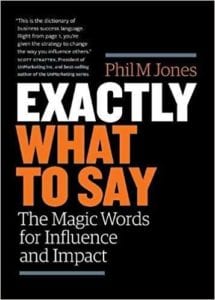
Exactly What to Say: The Magic Words for Influence and Impact
You talked about if you want different results and to be seen different from your competition, which is important that other not in this commodity space, that the real secret to all of it is we all have to start behaving differently. That is such a great way to end your philosophy and this episode. I’m going to ask you if people are like, “I get it, Phil. I need to behave differently,” is there one thing besides buying your books Exactly What To Say, Exactly How To Sell that they should be doing to behave differently?
They need to look at everything from the viewpoint of the consumer and say, “What am I doing to create an experience here that is demonstrably different?” If they want to take one point in time that they can do something that is demonstrably different, it’s the moment in time that is before the consumer gets to be the consumer. It’s the moment before the moment. If you are meeting somebody as a prospect for the very first time and you’re looking to be able to pitch to them, what can you make happen before you get into that first meeting? That would be the number one biggest takeaway that could influence your conversion rates in first meeting is to say, “What can I do to start the meeting before the first meeting happens to give me a fair advantage ahead of everybody else?” That means I shift the start line further forward by starting the relationship with the other person way before everybody else.
You’d go into all kinds of examples on how to do that, whether it’s reaching out on social media or something like that. If anybody wants to hire you, obviously, you’re hugely successful as a speaker. I definitely want to recommend that, but as far as following you on social media so we’d know when to buy your next book?
PhilMJones.com, from the site there you can splinter out to any one of the social channels. I’m pretty active across all of the major platforms. You can plug into the blog. There are loads of free content. You can stay up-to-date with some of my movements. I’d be delighted to hear from anybody that’s taken something from the interview, chose to put it into action and found a way of making it work for them.
Thanks so much for being on the show, Phil.
Thanks for inviting me. It’s great to be here.
Links Mentioned:
Wanna Host Your Own Podcast?
Click here to see how my friends at Brandcasting You can help
Get your FREE copy of John’s latest eBook Getting To Yes now!
John Livesay, The Pitch Whisperer
Share The Show
Did you enjoy the show? I’d love it if you subscribed today and left us a 5-star review!
-
- Click this link
- Click on the ‘Subscribe’ button below the artwork
- Go to the ‘Ratings and Reviews’ section
- Click on ‘Write a Review’
Get Your Sales To Soar By Accelerating The Buying Process with Dave Hubbard
Posted by John Livesay in podcast | 0 comments


Episode Summary
For every company to able to raise revenue, there is a need for the sales process and marketing methods to be aligned. Accelerating sales to 30% annually is an easing thing to do for Marketing Outfield CEO Dave Hubbard because he has an engineering background combined with a sales personality. This allows him to get into the gritty parts of sales and marketing. Instead of focusing on the sales process, what’s important is getting the customers into the buying process quickly. By aligning to what customers are trying to do, the sales process becomes dynamic, effective and gets on the same page with the marketing. Learn more on how to turn a suspect to a qualified lead, into a forecast, into and opportunity and then close deals.
—
Our guest on The Successful Pitch is Dave Hubbard who is the CEO and Founder of Marketing Outfield. Dave is both someone who’s an engineer as well as a sales expert, which is very rare to find one person being able to do both. He wrote an article called CEO Leadership Required to Accelerate Revenue Growth. Regardless if the company is a startup or a big company, there are five symptoms that help the CEO identify that their product team, their marketing team and sales team are not in-sync with the target customer. When the revenue generation team is not working well enough to work across different functions, then the CEO must get involved. They don’t have to be sales rock stars or even marketing gurus to make a massive impact. Enjoy the episode.
Listen To The Episode Here
Get Your Sales To Soar By Accelerating The Buying Process with Dave Hubbard
Our guest is David Hubbard who’s the CEO of Marketing Outfield which is a revenue acceleration expert. He has helped small and medium business sized companies accelerate their revenues by 25% to 50% annually. The way that Dave does this is by collaborating with business to business companies in the design and execution of their successful product launches. Also, he knows how to get you lead gens and how to execute on those leads. What I really love about Dave is his expertise in getting sales up and running. Dave, welcome to the show.
Thank you, John. Pleasure to be here.
Before we get into all your expertise, can you share with us how did you get all these expertise? Did you always know you’re going to be a CEO or a marketing sales guru when you were right out of school? What gave you the experience to get this expertise?
Actually, I became a professional engineer in computer design and systems. I was responsible for a number of computer systems for power utility. I decided I wanted to get in the general management, so I jumped into sales. I was very fortunate to jump into a $16 billion company. They gave me some training to actually sell. It enabled me to become one of their top sales reps in the corporation. A few years later, I decided to go into field marketing. They came along to train me with classical marketing: the product, price, place, promotion. That enabled me to create some and new significant businesses for the company. I went from there being at the field and I moved up to the chain from the field to country level to division, corporate. I did it in a very unique way. I went from sales to marketing all the way along. Sales and marketing field, sales and marketing division, sales marketing corporate and ultimately becoming chief marketing officer at some companies, chief sales officer at others and at a couple of cases, chief revenue officer responsible for all the sales, marketing and product management. I feel strongly that that uniquely qualifies me to help companies better align their sales, marketing and product management to the opportunity and actually accelerate sales.
I’ll say it’s very unique. Back in the day, I sold mainframe computers, Control Data, Amdahl which Fujitsu owned, competing with IBM. It’s a rare bird. It’s like a unicorn in the startup world that has an engineering background and a sales personality. Usually, they’re two very different skill sets and you’ve been able to combine them both. Is that an accurate description of what you do and who you are?
It is. If it wasn’t for the training and support I received early on, that transition wouldn’t happen. You’re right. An engineer that sells is a little bit unique but with all the training and skills, it becomes possible.
Also, sometimes engineers just don’t want to do it. It’s a left brain thing. They want to be in their left brain analyzing, solving problems with design or engineering, whatever it is. Sales people for the most part are not really interested in the tech stuff, “Just tell me enough that I can sell the product but I don’t really want to understand all the nitty-gritty stuff.” The fact that you can go into the nitty-gritty if need be, really gives you a stronger level of confidence and then you’re able to show other people how to get there. Let’s talk about one of the things that is really so important here which is the CEO Leadership Required to Accelerate Revenue Growth that you’ve written about. There are really five barriers to getting your sales up. What’s the first one?
The first barrier has to do with what’s called the sales process. A sales process is nothing more than the things that a salesperson must do to move a suspect into a qualified lead, from a qualified lead into a forecast opportunity, from an opportunity into an actual closed deal. The fortunate part is that a lot of companies don’t have a sales process. That is a big problem because a sales organization without a sales process is just a bunch of independent sellers. It’s not a sales force. They may have the sales process but then it’s rigid. In other words, a competitor does something with a compelling offer and it never gets in the sales process so the rest of the sales team doesn’t know about it. They all get surprised when it happens. The sales process has to be dynamic. If the sales process is not dynamic, it becomes outdated, ineffective and unused. Finally, the worst offender is the sales process should be about the salesperson trying to move the buyer through their purchasing process. It’s not about our sales process. It’s about the customer’s buying process. We want to move them through quickly and end up the winner. If we can do that correctly, and most companies do not, then having a right sales process can accelerate sales by 30% annually just that point alone.
[Tweet “How to go from suspect to customer?”]
The big takeaway here is, A) You need to have a sales process so the information gets shared across the entire team and not just scattered. B) Without this, then there’s no structure of moving someone on having a sense of what the next step is to move them as you called them suspects instead of prospects. I think that’s interesting all the way to them saying yes and really making sure that it’s on their timeframe and their criteria, not yours. Is that a pretty good summary?
Yes. It’s absolutely critical. Something like that wasn’t needed twenty years ago. Now that the buyers are self-educating online doing their own research, they’re making decisions without involving us. Therefore, we really have to make the extra effort to align to what they’re trying to do. If we do that, then we’ll become much more buyer-centric and miracles happen. We all of a sudden start talking about what the customer wants us to talk about. We, all of a sudden, start finding who is impacting that decision process and how we’re going to talk to him. We figure out how to get away from no decisions in half the sales because we’re gauged in the buyer’s process not, “An hour every day I did the sales presentation, I did the download, blah, blah, blah.”
It’s really finding out what’s important to them as opposed to just giving the standard presentation every time, right?

They don’t care about the product. They can find that online. What they want is a solution to their business problem.
Exactly. They will ignore us. They will avoid us. They will go through the whole process up to 70% all the way through their decision process without reaching out to us because we’re product pitching. They don’t care about the product. They can find that online. What they want is a solution to their business problem.
What’s the second barrier here as it relates to lead gens? I’m going to guess it has something to do with qualification and following up. Please tell us.
Lousy marketing leads. That’s always been the complaint between sales and marketing, “Lousy leads or they don’t follow up.” Now that you’ve got a self-educating buyer, the rules have changed. You’re going out looking for leads let’s say. 79% according to research of the leads that come from marketing will never buy. The 21% that will will do so eventually; maybe not this quarter, maybe not this week, eventually. The biggest problem is you can’t have a salesperson running around trying to qualify all these stuff instead of closing deals. When you look at the reasons for this, it’s not because marketing wants to do this. It’s because their strategy is outdated. Twenty years ago, in the old days, you didn’t have to worry about it. The customer would only find out what we told them. Now, they’re online. Marketing is still focused on just creating leads. They’re not focused on helping the sales organization convert and turn those suspects into customers. That’s what they have to do because the buyer is online all the time and they’re reading the competitor information, they’re making decisions so that both of them have to understand what’s going on. The key takeaway on that one is if you align the marketing and sales strategy so it’s throughout the entire buyer purchasing process, you’re going to deliver 38% more deals annually. It’s simple as that.
One of the things that I find really useful when we’re working with the marketing department or if you’re doing your own marketing is to really be clear on who you help and what problem you solve and in the marketing messaging and say, “Who this is for and here’s who this is not for,” so that that can really weed out some leads that aren’t qualified to buy or don’t need what you’re saying or don’t meet your minimum requirement. What are your thoughts on that?
That’s absolutely true. I’m going to talk about the impact of product to this whole process and the impact that marketing also has to be aligned to the entire buyer process to be educated to that. If they’re just doing leads, they have no visibility to what happens to the leads. It becomes magic. They have no possibility of knowing. I think that leads us straight into the third thing. It’s one of the reasons that marketing cannot demonstrate ROI. They cannot demonstrate the contribution to the business. The CEO is not interested in how many clicks and views and eyeballs they got. That didn’t wash it. Marketing can say what the cost to lead is but they can’t say what the cost of customer acquisition is. The reason for that is they can’t tell that a Twitter campaign drives more sales opportunities than an email campaign or a webinar or anything else. It comes back that they’re just doing branding lead generation. If they don’t engage with the whole buyer process, they can’t tell the impact of what they’re doing.
That’s so important what you just said there because if you’re pitching to an investor at any stage whether it’s the entry level or further down the road, one of the questions you’re going to get asked is, “What’s your projected cost to acquire a new customer?” If you’re further along and you’ve got revenue coming in, “What does it cost to acquire a customer and how can you reduce that?” Having that thought through in a way that makes a lot of sense because if they’re going to give you money to spend on marketing, they’re going to want to know how you do it. One of the mistakes people make when they pitch is saying, “If we only get 1% of all the people in China to buy this, we will be rich.”
They don’t go for that.
Do you have a story of how someone you’ve worked with has used your expertise to go from not really having an ROI to marketing to figuring out how to do it better?
I can give you the process. I can’t think of one right off the top of my head. Really it comes down to you have to take the marketing expense and tie it to not leads but how many sales opportunities did you increase? How many of those became sales forecast? How many of those became closed deals? How many of those became upsells? How many of those became cross-sells? How many customers do we retain? All of those points marketing can impact. They can impact with all the technology and approaches they have today. It’s all related to revenue. What’s exciting about that and where I have helped is sales and marketing are getting on the same page. You can get sales and marketing and say, “How do we move opportunities to forecast? Sales, what are you doing? Marketing, what are you doing? What can we do together?”
When the salespeople are talking to leads for marketing, do they ask them, “How did you hear about us? Where did you come from?” Sometimes the answers might be, “First, I saw a Twitter and then I opted in for something and then I got an email.” Then you start to realize, “It’s not just one thing that gets a good lead. It’s an accumulation of marketing efforts,” right?
It is. It’s technology that is available to marketers now that wasn’t twenty years ago. For what your example is called, it’s called attribution software. What it does is track a customer who could be anonymous when they go to the website. Track them and know exactly what they downloaded, what social campaigns they reacted to, what telephone campaigns. You can see the whole reaction. If you’re collaborating with sales, you share that. They’d say, “My customer has done A, B and C. I know they add up to a great qualified lead. I’m going to try to cold-call in there.” Let me give you some examples where this ROI comes in. The studies basically say if you go through this approach I’m talking about and execute it properly, you can deliver 27% faster profit growth. What caught my eye was this study. There was an interesting study of an industry. It showed that if you use the right mix of marketing programs, they increase revenue by 30% a year but get this, they decrease marketing expense by 50%. It comes back to marketing. If they don’t understand what’s working or why, they can’t fix it. Now, they have the technology to do that. They didn’t have before.
[Tweet “Getting the deal is never enough to keep a customer.”]
This whole concept of technology being used to retarget someone, they go to the website and they’re cookied and they’re tagged and they follow them when they go to other websites and they see an ad. That I know has shown great ROI for people who need some frequency. If you’re looking for a trip for example and you’re not ready to book yet but you keep seeing ads, so that when you are ready, you then book that hotel or what have you. Do you have any thoughts on the value marketing provides after someone is a customer? I think that other studies have shown that people tend to keep looking at ads of brands and products that they’re using to reinforce their buying decision so there’s no buyer’s remorse.
You’re absolutely in the right point. If you’re gauging online throughout the complete life cycle of the buyer, you know they’re going to go through that buyer remorse. You want to keep on feeding them messages whether it’s email, because you know who they are now, or online advertising to some degree. You want to actually be productive and try to upsell, cross-sell or get them into becoming an advocate for the company. In other words, it never stops. Just getting the deal is not enough. Sales can’t easily make that happen because sales is off to the next customer trying to bring him onboard. But marketing can because they have the technology. They just put it in there and keep the constant messaging going to those customers afterwards related to the product they bought. That’s powerful. It’s really important for startups particularly in the SaaS environment. Retention is critical. There’s so much more energy trying to get a new customer versus retaining what you have; so much better upselling a customer than trying to get a new one. Sales has not been equipped to do that very well because they’re always going after quota. Marketing can do a lot of fill in for that. All of the things that they used to get customers, all the technologies, all the campaigns are the same tools they can use to keep customers.

There’s so much more energy trying to get a new customer versus retaining what you have.
Barrier number four: Dealing with the product, go-to-market. Explain what that is please.
That one there is part of the biggest problem in companies and particularly in startups. If you have a product launch and sales don’t accelerate or every time you do new features and versions to release but you don’t see a balance in sales, it’s possibly and probably because they don’t have a good product market fit. They didn’t find out who the ideal customer profile is. That work is so critical when you develop a product to absolutely know who you’re targeting, who’s making the decision, what are their business issues and it goes on and on. If you do not do that work correctly, what happens is sales particularly in the startup, they’ll go out and they’ll find the early adopters. For them to accelerate sales, they’re going to find the sweet spot.
You can’t make all your predictions on the early adopters and think that there’s an unlimited number of them because there isn’t, right?
Right. If I was to talk to a CEO, I’d probably shake him and say, “You’ve got to get an experienced product manager involved earlier not later.” Doing this stuff, understanding product market fit, understanding the ICP, understanding product launch cross functionally, understanding go-to-market.
What’s ICP for those people who may not know?
That’s the Ideal Customer Profile. These things are not something you can think about in the weekend and go do. You’re betting the whole company as a startup that the product works. I’ll tell you from experience, it is much harder to find a market for an existing product than it is to design the product for the market correctly in the first place. I’ve seen companies go bust because they have this product but they don’t know where to sell anymore. The market they wanted to is not the right market.
Any example that comes to mind?
Not really except some of the startups I worked that was a problem. They had a product that worked well at the mid-sized side of companies, but it didn’t work well at the enterprise. The features were there. The problem is they didn’t have the robustness and reliability. At the enterprise level, for them that’s important. They don’t want to lose the job. For middle companies, they want to get the job done and they’re willing to take more risk. If you’re in the wrong market and you say, “I’m going to have a sales organization go after enterprise, and this is my product that was really made for the middle market,” you’re going to have a problem.
Keeping up with demand I think is also a big thing I see happening sometimes. If you don’t have the funding to make enough product or you don’t have the staffing to handle the results from a successful ad campaign, that can really be detrimental, right?
[Tweet “How to get you better leads?”]
It is. That comes back to really the four barriers we’ve talked about so far. If you look at moving the buyer through their process, that means you have a much more reliable forecast of what can happen. Marketing can tell you if they generate more leads from social how much revenue that could come out. They’ve tracked it by using attribution software and everything else. They know how many more opportunities could happen, with the right sales closes opportunities and actually have a reasonable forecast of what could happen. Right now, without that, you’re basically guessing.
That brings us to the fifth barrier, which is dealing with leveraging technology.
This one here, this is where the CEOs really got to jump up and get involved. Today, there is over 5,000 marketing technology vendors. That’s not counting the 600 or so advertising technology and the hundreds of sales technology. We have so much technology available to automate everything and anything. The investments on CRM, Customer Relationship Management, marketing automation, the C-level is not seeing the revenue they had hoped to see. There are two basic problems there. One is we’re still automating the outdated broken process that we used to use twenty years ago. That’s not a good thing because what you do is you just get lousy leads at scale because you’ve got outdated process. The second thing is these systems aren’t well-integrated. They suffer. When a salesperson goes to CRM, they see one thing. When the marketing person goes to their platform, they see something else. They’re not looking at the same thing. That makes it hard to align their efforts.
It’s like looking at the elephant, someone is looking at the tail and someone is looking at the trunk and saying, “We’re looking at completely different things.”
Aligning cross-functional processes is very difficult to do. It’s worth 13% faster growth. It’s a lot easier in a smaller company to fix all those stuff than a bigger company that’s got a lot of established bureaucracy per se. The CEO has to get on top of it. He cannot delegate technology, strategy. What he or she should be saying is, “I want a single revenue generation system. I want you to build me a single revenue system so that if we change strategies, I can see what the output is.” Sales looks at it and sees the same thing. Marketing looks at, sees the same thing as product management looks at and the same thing with the C-level.
If the staff doesn’t know how to do that, they can engage you to help them do that. Is that right?
Yeah. It really is straightforward. You really just have to make the commitment that says the CRM becomes a base unit. Everything revolves around it, every tool and you have one view. The marketing people look at the same window with the sales people. They may be looking at different things but they sustain information so that everybody is still on the same page. When it comes to trying to align sales and marketing and product management, it really comes down to give them the same page. Give them the same problem that everybody can work on. You’re looking to have collaboration. All of these people are smart. Sales understand sales they’ve been trained. Very few of them have ever been a marketing specialist especially in the data driven side. Marketers, very few have been in professional sales. They don’t understand. You get two of them in a room, you say, “Let’s communicate.” It’s like having two groups with different languages. They all agreed they want revenue. They all agreed they want customers. Now what?

If I get them focusing on a customer and moving the customer from where we found them to where we want to be, amazing things happen.
You really have to focus them on a common thing. What I found in my experience and in the last twenty years, if I get them focusing on a customer and moving the customer from where we found them to where we want to be, amazing things happen. They really do. You can get them to collaborate. It’s not marketing blaming sales or vice versa. They both have skill sets and they’re both trying to do the same job. I’ve seen it happen where sales and marketing just feel like one team. I see that as a future that has to be done. If we don’t get there, you can’t accelerate sales. You can’t accelerate revenue when you’ve got marketing going one direction, sales going in another. They’re doing their best but they’re not growing in the same direction.
What do you think is the most important thing a CEO can do to accelerate sales? Is it what you just described or is it something more with alignment?
It’s all about alignment. I don’t try to do alignment for enterprises. It’s just too difficult. Alignment is really taking departments, channels and trying to get them aligned. In an enterprise, there are hundreds of channels and departments to align. In a startup, you start out the right way. You get sales marketing and product management on the same page on the get-go. You give them your expectations of what you want to see. You allow them to take the tools and make it happen. The key thing for a CEO is make sure your revenue team is a team from the get-go. Don’t assume just because they get-together in a room, they’re on the same page. You have to make sure that every single person in the company, in the startup understands the buyer journey; what problems they have, how they make decisions, including customer service or customer success as it’s called these days, including financial. Everybody should understand how they’re interacting with a customer. Who else in the company may be interacting at the same point? It helps them understand better.
Dave, how can people work with you and your company Marketing Outfield to help them do all these things or even the services you offer include helping them as a chief financial or revenue officer? What’s the best way for people to decide whether they need you or not?
There are two primary ways. One way is if they’re not getting accelerated sales, I’ll come in and identify the two or three things that can make an impact over the next year that we should fix and collaborate with the existing organization, develop the right strategies and execute them. We take it from soup to nuts to make sure it works. That’s a typical consulting engagement. The one I prefer, the one I recommend and I’m moving more towards is what’s called a fractional chief revenue officer. In other words, you’re getting somebody with the experience that I have in sales, marketing, product management and you bring them in five or ten days a month, not for the full twenty days so you’re paying less, to guide the existing staff with the right strategies or right techniques to deliver acceleration. What it does is when I’d leave whether it’s a year or two years or six months, those people are better equipped and that leadership is better enabled to understand how the revenue engine is working.
You remind me of what a Sherpa does when people are climbing Mount Everest or any of the other big mountains. If you want to get up there faster, bring Dave in.
When I drive consultants in, when I was running companies and a CEO, etc. I wanted them to leave my staff smarter. I wanted them to leave me smarter. They’re bringing an outside perspective, something that when you’re trying to get your company going, you get blinders on unfortunately, and we all do. We’re just trying to execute the plan. Somebody coming in can add so much value. You really want them leaving the company better off, not like the traditional Big League management consultants who come in as a team and leave a PowerPoint behind and say, “Go ahead, do this and you’ll be fine.” It doesn’t execute in, the organization doesn’t get smarter. You’re not really doing the most value you can by getting involved.
I highly encourage people to follow you on Twitter. There are 30,000 people doing it already. You really are constantly giving great information and best practices for getting your sales to take off. It’s @MOutfield. Dave Hubbard on LinkedIn, you can follow him there. Go to the website, MarketingOutfield.com to see how to become more profitable and get those sales up. Dave, thank you so much for being on the show.
It was a pleasure. I hope those listening pick up just one idea that moves them forward in sales acceleration. I think we did a great job if they can just do that.
You did more than one. Thanks again, Dave.
Thank you, John.
Links Mentioned
- Marketing Outfield
- CEO Leadership Required to Accelerate Revenue Growth
- @MOutfield Twitter
- Dave Hubbard LinkedIn
Wanna Host Your Own Podcast?
Click here to see how my friends at Brandcasting You can help
The Successful Pitch – Book Trailer
Share The Show
Did you enjoy the show? I’d love it if you subscribed today and left us a 5-star review!
-
- Click this link
- Click on the ‘Subscribe’ button below the artwork
- Go to the ‘Ratings and Reviews’ section
- Click on ‘Write a Review’