

Punching Above Your Weight: Taking Client Engagement To The Next Level With Heath Barnes
Posted by John Livesay in podcast | 0 comments

One of the key ingredients to having a successful business is having the right clients. In this episode, Heath Barnes joins host John Livesay to share how he’s going above and beyond when it comes to treating his clients. Heath is the Branch Manager at Cardinal Financial and host of the Mortgages Reimagined podcast. Starting with being a heavy-weight boxing champion while attending Texas A&M, where he graduated with a BBA in Business and Marketing, Heath Barnes has always been punching above his weight. Listen to his interesting journey to entrepreneurship and get tips on treating and engaging your clients to maximize retention and increase referrals.
—
Listen to the podcast here
Punching Above Your Weight: Taking Client Engagement To The Next Level With Heath Barnes
Our guest is Heath Barnes, who shares with us his unique and creative ways to show client appreciation. You’ll want to read to find out some tips on not only how to have a client appreciation event but then how there are multi-levels to keep the fun going and keep you memorable. Enjoy the episode.
—
Our guest is Heath Barnes. He has an interesting story to share with all of you on his entrepreneurial journey. Many real estate agents are struggling to get their buyer’s offers accepted, and many home buyers are frustrated that the loan process is tedious and seemingly endless. I know I felt that way. Heath’s story starts with him being a heavyweight boxing champion while attending Texas A&M, where he graduated with a BBA in Business and Marketing. He has always been punching above his weight. The energy and passion that he exudes for the business he’s in, coupled with his competitive spirit, and are apparent even in his downtime. He has hiked to the summit of the Grand Tetons.
He’s a licensed pilot and a six-time Ironman. He’s a seasoned snowed skier, skydiver, fly-fisherman, sommelier, and even taught himself how to play the piano with a bunch of young kids. He was willing to take classes. Since 2002, he has been a consistent top producer as the Branch Manager for Cardinal Financial, closing over $15 million a year in loan volume.
He’s also the host of a successful podcast called Mortgage Lending Reimagine. Real estate agents love working with him because he works his magic to make their buyers’ offers irresistible. Homebuyers love working with him because the process he has is so streamlined and smooth, which allows them to close on time without the usual stress. Heath, welcome to the show.
Thanks, John. It’s a pleasure to be here.
Let’s go back to your own story of origin. I gave a little bit of the tip of the iceberg there. Maybe start with your days at Texas A&M and how you became such a passionate person about making life an adventure, and then we’ll get into how you got into the mortgage business.
It’s an honor to be here. Going back to A&M, I started at Sam Houston State. I went there because my brother was already there. I didn’t have to stay in the dorm. After two years at Sam Houston, my brother had graduated and I had a girlfriend at the time who had broken up with me and I dropped a lot of classes.
My mom came to visit me and said, “If you are going to make these kinds of grades, you need to do it at a real school.” She made me “move” to Texas A&M. In a way for me to fit in with the fraternity that I was transferring to, I decided to join the boxing team. It was in that endeavor that I found a new talent which was my long reach and dedication to be good at something and I ended up winning the heavyweight champ two years in a row.
That opened up a lot of doors for me. It opened up a door of self-confidence. It opened up a door to a new job at a local bar called The Tap, which is still there at Texas A&M. I became a bartender and my life began to flourish in college. It opened many doors of confidence and meeting other people being a bartender. I love talking about it.
[bctt tweet=”Host a client appreciation party.” username=”John_Livesay”]
My first question around that is how did you pick boxing? It’s not a common sport like baseball, football or basketball. Did you watch somebody on TV? Did somebody take you to a match? How did that get into your awareness?
Our fraternity happened to have a guy that had some experience in coaching boxers. I raised my hand trying to fit in and was dedicated to the workouts, practicing and getting better, which started early in childhood. I was a baseball player. I would spend the summers practicing. I always learned that if you are going to be good at anything, it takes a lot of practice. I knew if I was going to be any good at boxing and not get my face punched, then I would so. I didn’t even know my talent. In my first fight, I knocked the guy out in the first round. There were very few fights in which we got past the second round. Just about every one of my fights was a knockout.
That’s a great analogy there for what you are doing now with mortgages. Almost every one of your deals is a knockout. You also talked about the long reach of competitiveness. You are in a competitive field. I understand there’s a story of a very special relative that you saw in the mortgage business that made you want to mirror that. Sometimes we see a dad and go, “I want to follow my dad’s footprints. I don’t want to do that. My dad doesn’t look like he’s having a lot of fun.” Tell us a little bit about who influenced you to get into the mortgage biz? What did you see that he was doing that you wanted to do it?
It’s funny because it’s come full circle because I rehired my actual Uncle Larry, who got me in the business. In the beginning, in 1999, I was in the mobile home business. I remember going to a closing. In a mobile home business, you have two opportunities when you are getting financing. One is to finance the mobile home, which is called a chattel loan or a regular loan, which is not done by a mortgage company.
The second type of loan is what they call a land home package, where you are financing the home with the land. I was sitting at the closing table and I looked at the closing disclosure. I saw how much money the mortgage guy was making. I thought, “I might be in the wrong business.” I remember my grandmother telling me that my Uncle Larry was in the mortgage business. I called him. He flew down. We had a conversation and the next thing you know, I’m doing mortgages. I have never looked back.
If you had to give our audience a tip about breaking into a field that’s competitive and crowded. I talk about it in terms of a lot of people feeling like they are drowning in a sea of sameness. Everyone says, “Doesn’t everyone have access to the same loans? Isn’t the process the same?” What I found over the years of buying and selling homes, but mostly qualifying for the loan and the offers, there are a lot of nuance and differences in a strategy to put through to get your offer to stand out against all the other offers. I think a lot of real estate agents probably think of you as their secret weapon. Would that be fair to say?
For sure, as far as in this market, which if you are not familiar with, is a highly competitive market, especially if you are a buyer, and getting your offer accepted is not about necessarily having the highest price, but it’s having the right team, whether it’s our experienced real estate agent or a loan officer. Our strategy has been how we remove as many contingencies as possible to separate ourselves, so financing contingency.
The way we take the stress out of financing is by having a good interview with the clients and letting them know what’s going on in the market. The second step is getting them completely through the underwriting process because if you are completely through the underwriting process, the stress of getting the loan goes away. The stress of getting a loan is increased when you have something to lose.

Client Engagement: If you’re going to be good at anything, it takes a lot of practice.
If you are not out looking for a house, there’s no stress of losing something. There’s nothing to lose. There’s nothing to lose in the beginning when you don’t have a home. That’s the time you want to go through underwriting. The old way of doing things in the mortgage business has been you wait until they find a home because you want to make sure that your time is spent wisely that they are going to find a home. We said, “We are going to take it a step further. We are going to take the stress out by moving them completely through that process.” That way, when they go out into the market, there’s no fear about securing a mortgage, and you know exactly what they qualify for, and all the paperwork is done.
Reduce stress for your buyer, and that’s true in any business. If you can make the buying process, stress-free or less stress, then that’s going to make you stand out. We are going to reverse engineer this and then we’ll start at the beginning. You now have a very big group of people who’ve worked with you, trust and like you, and send you referrals. We are going to get to how you built that. What are you doing now to make those people feel seen, heard and appreciated? What did you do that was so timely that I thought was memorable and part of your personality? These are the things that make you stand out against your competitors.
I’m always thanking both the people that refer me business but also my clients. How can I provide an enormous amount of value where they would want to continue to do business with me? We do apply for appreciation parties a couple of times a year. We have made it a habit of renting out an entire movie theater and making it fun for previous clients.
We rented out a theater and we invited our top 100 clients or the first 100 that responded to the premiere of Top Gun. I took it a step further by borrowing my friend Jack Swanson’s flight suit and I bought some aviator glasses. I was fully dressed up for the experience. The look on people’s faces when they came into the theater thinking they were just going to see a movie about the sequel of Top Gun. That was my first experience with it.
Life is all about experience and how you make people feel, even in the stories that you tell. I’m trying to bring them into the experience so that when they leave, they are going to be thinking about me moving forward, especially if it’s going to be a memorable movie. What comes up for me now also is like in life, if you are an entrepreneur, it’s utilization. How do you use everything to your advantage, no matter what’s happening? What’s interesting about this experience was I had a dialogue with the movie theater and I said, “Before you start the movie, what I’d like you to do is stop it so that I can share a few announcements. I got a special treat for everyone.”
All the preparation of making sure there’s a mic and making sure we talk to everyone, and then the time comes. At the beginning of the movie, if you see it, Tom Cruise starts to talk and has a special message. They stopped it after that special message. I used that and I said, “Most of you all don’t know but I’m personal friends with Tom Cruise. That’s a personal message for you all. Thank you all for listening.”
The next thing that happened was I was in the middle of thanking all the people that had attended, the people that made this possible, and the mic went out. I thought, “How do I use this to my advantage?” I said, “I’m just going to continue.” I kept the mic in hand and ended up thanking everyone. I then turned around. I said, “One more thing,” and started out singing, “You never close your eyes.” It was a huge hit because I got out of my comfort zone. Everything inside of me was saying, “Don’t do this. Don’t embarrass yourself,” but I went through with it. My wife was like, “I was proud of you.” It made a big impression on everyone.
Let’s unpack that because it’s such a great strategy that you have a client appreciation party scheduled on a regular basis. What separates you from 90% of the people. What makes you in the 1% of that experience is you took the time to dress up. Automatically people go, “This is fun.” The fun starts before the movie starts.
[bctt tweet=”Reduce stress for your buyers.” username=”John_Livesay”]
You are exceeding the expectations, and then you surprise them by singing, which they didn’t expect. If you are willing to be vulnerable and out of your comfort zone, that’s endearing because that is an emotional bond with people. You feel safe enough with them, and you trust them to not make you feel stupid, and so you are building trust in a very subtle subconscious way.
You did one more thing that is brilliant because I have seen the video, which is you took it a step further for people who are fans and said, “I have got $50 gift certificates for the people who can shout out a quote from the first movie.” Now everyone is immersed in the experience. The audience involvement in a dark theater is tricky and you figured out a way to do it, and people are shouting out the quotes. I don’t know if you consciously did this or not, but what I love about the choice of this movie for you is you are the wingman for the agents and the home buyers.
That’s a perfect brand for you to be in the movie, for you to be identified, especially if you are dressed up in the costume or uniform of it. On some level, people are thinking, “Not only was that fun, but he is our wingman.” You can then email all of them and say, “What was your favorite quote from this new movie? I look forward to being your wingman on the next deal.” It allows you to have some momentum and a follow-up where you are not actually pitching.
I’m going to use that, “I’m your wingman,” and follow up with everyone. I’m going to use that moving forward. Thanks for bringing that to my attention.
It’s my pleasure. When you exhibit some creativity and start giving people an experience, they can then repeat that story. That’s the big takeaway for people, whether it’s a client appreciation story or a story of how you help somebody get a deal accepted in a way that is unique. That’s what generates referrals. For people that are looking for new ways to over-deliver service and things, do you have any structured way of either acknowledging and rewarding referrals or encouraging referrals beyond the, “I appreciate your referrals?”
I was taught several years ago by a coach of mine. I remember when I first got into the business, I didn’t want anyone telling me what to do. I spent the first nine years of my career wanting to do it on my own until I realized that there was no original idea per se. That’s when I started getting some coaching. One of the first habits that they pounded into our heads was to acknowledge people for the action, not the results. For the people that are reading, writing a note is a great way.
It will allow you to stand out like writing a handwritten note, not when the transaction is complete but when the action is given. You are rewarding the action. Anytime a person calls me and says, “I have a friend of mine who could use your help,” they give me a name and a phone number, my next action is writing a handwritten note and then dropping in a little $5 Starbucks, and sending that to them. I’m promoting the action, not the result.
That makes people much more likely to keep it coming because you are like, “If you only appreciate it if the person hires me or uses me for their loan, then the odds are much less.” Also, in a world of everything being digital with texts and emails, to go old school and take the time to send a handwritten note makes you stand out from the sea of sameness. Tell us about your podcast. Mortgage Lending Reimagine. How did you come up with the title?

Client Engagement: It’s not necessarily about having the highest price, but it’s having the right team.
The way I came up with the title is it’s for loan officers. It’s for entrepreneurs. It’s thinking of your business in a new way, rather than a new way of thinking about money or a new way of thinking about how you engage with your clients or a new way of thinking about how you engage with the world around you. For you to be relevant, you’ve always got to be shifting and changing into how you are going to provide value.
That’s the focus as a loan officer moving forward. The one thing that most people have a hard time with is changing. We get set in our ways. The one thing in life that is most predictable is that things are always going to change. They change every day. The more you look at that change and say, “This is happening for me,” and see it as a positive way to move your life forward rather than backward. You’ll be able to reimagine yourself and your life in a different way.
Can you tell us a story of a strategy you used where someone had the cash to make an all-cash offer? After the offer was accepted, you were able to say, “You may not want to have all your cash tied up like that. We can offer some financing. Your offer came through because it was cash only.” The seller is confident that you have all the money and there’s not going to be any contingencies, but maybe you want some of the deductions or there are a lot of other ways going on behind that. I don’t think a lot of people are aware of that strategy. How did you come up with doing that? Do you see a lot of people taking advantage of it?
The way I came up with this strategy, not everything, I came up with. I got it from someone else years ago. In these markets, you have to be more creative and have your offer accepted. Whenever I meet with the client looking at their financing, I’m always thinking, “How do I put them in the best position, not only to secure a mortgage but also to get their offer accepted?” If they have enough cash in the bank, the first thing I always mention to them is to look at submitting a cash offer. There’s a space in at least the Texas contracts that are called special provisions.
You submit a cash offer and this special provision is written in that the client has the ability to change their financing and put more or less money down, as long as it doesn’t delay the closing. By doing that, you are putting yourself at the front of the pack by having the opportunity to either pay cash, which is probably not a good idea in this environment to pay cash, and I will explain why in a minute. You can make sure that you are going to secure that offer. In this competitive environment, you need to be able to be at the front of the pack.
What is wrong with an all-cash offer?
The one thing to think about when it comes to financing your money is where inflation is. Right now, the government says it’s at 8.5%. I tend to think that’s probably the best number they can prove. It’s probably more like 15%. If inflation is 15% and interest rates are 5%, that’s 10% below inflation. That means you want to borrow more money because money’s going to be worth less in the future. You take that extra cash and move it into some type of commodities like another house, gold, silver or something that’s going to hold the value of your money. Inflation is the government stealing your money out of your pocket without you even knowing it.
I have never heard that before. I think that’s very memorable. There are three parts that most entrepreneurs forget in terms of growing their business. First of all, you are not restricted to just helping people in Texas. You can help anybody in the country, correct?
[bctt tweet=”Life is all about experience and how you make people feel, even in the stories that you tell.” username=”John_Livesay”]
Correct. All over the country.
A lot of people don’t realize that that’s even possible. They think, “We’ll have to work with somebody local.” That’s a big a-ha for people. The second part is you have to spend some time attracting clients. You have to spend some time converting them. The conversations you have for why someone should pick you versus another person who does what you do, and then finally, you have to deliver. That’s a lot of time and energy.
Most people get so caught up in the delivery aspect of their job, that they are putting out fires and dealing with details, and then they go, “I haven’t spent any time getting new leads or I’m not having that many sales conversations.” You’ve been doing this for a long time. You are at the top of your game. Do you still spend time cold calling or do you not do it?
Yes, totally.
That’s a big surprise. I know that about you and I was impressed that you do. I want to have you talk about why you still do that? Most people think, “I hate it and I will do it until I don’t have to do it anymore, and then I will live on referrals.” You are like, “I’m going to still keep reaching out.”
It still keeps me sharp in the game. It still keeps me in a creative mode. It still keeps the challenge there for me. I have on my calendar every day one hour of outbound prospecting, where I’m calling people that are already sending me business like real estate agents or calling my previous clients for one hour. I’m calling old leads, new leads or cold calling. It’s the same time every day, every week.
It’s that discipline from your sports background applied here, which is great. When you say calling, I want to clarify, you literally mean picking up the phone, not just sending an email. Those are a lot of things that most people don’t feel comfortable doing. They are like, “Nobody wants a phone call. Nobody answers their phone.” You are like, “No, I’m still leaving a message.”
I’m not leaving a message. If I’m cold calling, I’m calling and I’m saying, “Heath Barnes, Cardinal Financial, give me a call when you have a few minutes. I got a couple of questions for you.” They are calling me and it gives me the opportunity to engage in a conversation. The more conversations you have if you are an entrepreneur, the more likely you are to be successful.

Client Engagement: If you’re an entrepreneur, it’s utilization. How do you use everything to your advantage, no matter what’s happening?
How fascinating that they are like, “What in the world questions would he have for me?” You are asking questions about their needs and how things are going. If you find out something, you could help them with possibly, “Are you frustrated that your offers aren’t coming through all the time. Are your buyers complaining to you about how tedious the process is? I can fix that for you and make you look like a hero to your client.” Now you are having a conversation that people want to have. What’s one quote or a book you would recommend to our readers before we say goodbye that you think would help people in their mindset?
One of my favorite books is a book called Reinventing Yourself by Steve Chandler. I’m reading it for the second time, coaching a friend of mine. One of my coaches is Todd Musselman out of Colorado. He recommended it to me. What was evident in that book is we are always reinventing ourselves. There are so many great reminders about life and how we get to show up. It’s a great book. I love it.
If people want to find out more about you, get a quote from you or find out more about the show, what’s the best way that they could track you down?
They can go to my website HeathBarnes.com, or call me on my cell phone at (832) 771-8194.
Heath, thank you so much for telling us about your story of how you are not only not drowning in a sea of sameness but creating memorable experiences for those people who do have the pleasure of working with you.
Thank you, John. I enjoyed your book as well. Thanks for having me.
Important Links
- Heath Barnes
- Cardinal Financial
- Reinventing Yourself
- Better Selling Through Storytelling Method Online Course
Wanna Host Your Own Podcast?
Click here to see how my friends at Podetize can help
Purchase John’s new book
John Livesay, The Pitch Whisperer
Share The Show
Did you enjoy the show? I’d love it if you subscribed today and left us a 5-star review!
- Click this link
- Click on the ‘Subscribe’ button below the artwork
- Go to the ‘Ratings and Reviews’ section
- Click on ‘Write a Review’
Love the show? Subscribe, rate, review, and share!
Join The Successful Pitch community today:
- JohnLivesay.com
- John Livesay Facebook
- John Livesay Twitter
- John Livesay LinkedIn
- John Livesay YouTube
One Page Marketing Plan
Posted by John Livesay in podcast | 0 comments

 Episode Summary:
Small businesses need a small business strategy that works, and that really comes down to direct response marketing. Allan Dib needed to come up with a plan that was fast, effective, and followed direct response marketing principles very closely that would move the needle for his clients. From that need was born the 1-Page Marketing Plan which is a process that’s easy for clients to fill in and literally a single page divided that into nine sections. Allan is a serial entrepreneur, marketer and technology expert. He has started, grown and successfully exited multiple businesses in various industries. He walks us through how to have a marketing plan with just one page. He said, well, your path to profit isn’t getting referrals and that the marketing doesn’t stop once you get a customer.
—
Listen To The Episode Here
One Page Marketing Plan
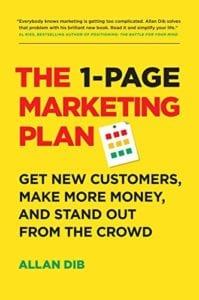
The 1-Page Marketing Plan: Get New Customers, Make More Money, and Stand Out from the Crowd
Our guest is Allan Dib, who was a serial entrepreneur, a rebellious marketer, technology expert and the bestselling author of a book called The 1‑Page Marketing Plan. He started and grown multiple businesses in all kinds of industries around telecommunications and IT. One of his previous business where he faced competition from a big billion-dollar company and he was still able to grow this startup. He was later named by Business Review Weekly as one of Australia’s fastest growing companies and got on their Top Fast 100 list. He’s passionate about helping new businesses find new ways to leverage technology and he is a business coach and consultant and speaker and he is here with us. Allan, welcome to the show.
John, a pleasure to be on the show.
I love hearing people’s story of origin. If you wouldn’t mind taking us back to whatever you want, as far back as childhood, high school, college, university where you said, “There’s got to be a better way to market things and what’s going on.” How did you get interested in what you’re doing?
John, I’m not at all from a marketing background. I’ve got no education in business or training in marketing, whatsoever. It came about by necessity, as many good things do. I was a dead broke IT geek. I was good at what I did. I was running an IT business. I would always try and learn the new technology. Our clients loved what I did, they loved my service. They loved my products, they love our team and everything like that. For the life of me, I could not grow this business. It was stuck and any business that came our way was business that either came by referral or by chance or by some other similar means. It grew out of absolute frustration. That put me on a path to trying to learn marketing for the better part of a decade. Long story short, I learned all I could. I discovered direct response marketing and my life was never the same. It sounds like an overnight success story, but it’s certainly not it. It was probably a decade from start to end.
Let’s figure out if we could have the big takeaways from using The 1‑Page Marketing Plan. Usually marketing plans are known for being thousands of pages if not hundreds. There are three takeaways. You’re going to get new customers, which then you make more money. The big one that I want to jump into is how to stand out from the crowd. One of the things you talked about Allan is why getting your name out there is a losing strategy. That’s such a common thing as like, “We’re starting a company and we’re going to get our name out there and get all kinds of brand awareness and spend money on Facebook and social media. Then when we’re ready to open the floodgates, people will know who we are.” Why does that not work?
“Build it and they will come,” is a great movie plot. It’s not such a good marketing strategy. It comes about because people think that, “I can see Pepsi or Coca-Cola, Apple doing this brand awareness stuff. They’re super successful companies. That sounds like a great strategy for me.” If you’re working on property investment, there are property investors who build skyscrapers and they invest hundreds of millions of dollars in their investment. Then there are investors who buy a single small property somewhere out in the suburbs and rent it out. If the guy who’s trying to do the small investment strategy, who’s working on a small scale, if he tries to do the skyscraper strategy where he’s only got enough money to build one level of the skyscraper that’s not going to work. He needs a strategy that’s going to work on a small scale, not a strategy that works on a large scale.

One Page Marketing Plan: Small businesses need a small business strategy that works.
It comes about because of some of the different motivations behind marketing at a large scale and marketing in a small scale. At a small scale, the only thing that matters is can we get a profit? Can we get a client? At a large scale, large companies, they have completely different motivations. Making a profit is somewhere within there, but I would put to you that above that is things like placing the board of directors, satisfying superiors, biases, winning creative awards, things like that. Things that are completely useless for small businesses. Small businesses need a small business strategy that works and that comes down to direct response marketing.
Let’s walk people through each of your nine grids on The 1‑Page Marketing Plan.
It’s a single page. Where this came about early in my business career, I thought, “I need to hire a consultant to help me put together a business plan.” I did. I paid him thousands of dollars that I couldn’t afford at the time, but I thought, “This is important. All good businesses have a business plan and a marketing plan.” He did what most consultants do. He put together a beautiful looking plan. It was hundreds of pages. It had beautiful graphs and charts and projections and things like that. I took that plan, flick through it, put it in the top drawer of my desk and the next time that I saw it was when I was moving out of our office and we were taking all the things out of the drawers. I looked at it and throw it in the trash and thought, “What a waste of time and money that was.”
I did recall that there was one part of that process, the creating that plan that was very valuable to me. That was the part inside it called The Marketing Plan. It wasn’t the plan itself that was super valuable to me, but it was the process that me and the consultant went through to do that. Part of what we did was look at, “What’s the target market that we’re going after? What’s the message that we’re going to go to that target market? How are we going to reach them? How are we going to position ourselves? How are we going to price ourselves?” That was a super valuable process because it crystallized to me the things that we needed to do as a business and how we needed to present ourselves and how we needed to pitch out our product and our service to differentiate ourselves from some of the competitors that were in the marketplace. That was a super valuable process to me. That stuck in my mind for many years.
Then when I became a coach, one of the things that I started to do with my clients, I started to say, “Let’s do you a marketing plan.” That’s when clients would freeze up and they would procrastinate on that. It feels like something so overwhelming, such a big thing to do. It takes a lot of time, a lot of money. That’s where I needed to come up with a plan that was fast, that was effective and that followed direct response marketing principles very closely because that’s the marketing that would move the needle for my clients. Out of that, they say necessity is the mother invention and I certainly found that to be the case.
From that was born The 1‑Page Marketing Plan. I wanted a process that would be easy for my clients to fill in and literally a single page. I divided that into nine sections. The first three sections are called the before phase, the next three sections are called the during phase, and the last three sections of the after phase. What do we do before we were acquired a client, what do we do during the time that we’re trying to acquire a client, and what do we do after we try and acquire a client? Then within those three major sections, we’ve got three subsections.
You don’t have any revenue coming in and you’re trying to figure out what your prospects are. Then after you’ve got that, those three things done. Your next level is, “How do I capture these leads with my sales funnel?” Then the final one is, “Now, I’ve got a customer, how do I keep them and get referrals and all that good stuff?” I always love to give examples with content and structure because it brings this incredible tool to life.
[bctt tweet=”Path to profit is in referrals.” username=”John_Livesay”]
I am a Co-Founder and CMO of a startup myself and we’re using your tool. I’m a testimonial for you on this podcast. We are helping homeowners who have equity built up in their home and want some cash out, but do not want to take out a second loan and besides selling the house the only way they get access to that cash. That’s our target market. We know that there’s a huge amount of people that want this and either can’t qualify or can’t afford to have a second mortgage payment by taking some cash out to remodel or send their kid to college or whatever they want to do with it.
The message to the target market is we’ll give you the cash in exchange for owning 10% of your house and you can stay in the house as long as you want, and then when you sell the house, that’s when we get our money back based on the percent of the house that we own. Then the third part of this strategy is you talked about what kind of media are we going to use? This is where I want your expertise to come to life is we’re using Facebook ads.
We’ve got an explainer video that explains how to do that. We’re going to be running ads to promote that, to build up an email list of people that are interested. We’re obviously doing PR as part of our marketing with the CEO being interviewed on podcasts and that type of things. That’s our strategy. Is there anything within those three buckets under your before section that you could amplify and say, “You’re good here,” not quite defined enough?
I like to get as niche as possible and it seems counter-intuitive to a lot of people, especially when you’re starting out. Maybe you’ve got a startup, you think, “I’ll cast the widest net possible because I don’t want to miss anyone.” What ends up happening is people say, “Yes, of course I can help you. I can help anyone. My product is for anyone and everyone.” That feels logical, but when you say it’s for anyone, you’re saying it’s for no one. It’s funny, you see so many ads that are a laundry list of products and services. “We do this, we do ABC. We do so on and so forth.” They’re trying to cast the widest net possible. The human brain it has so many stimuli coming at it every day, each day, every minute of the day that it has a filter.
The filter is, “Is this relevant for me?” It tries to actively filter out things that are not relevant for it. If you’re coming at people with a very general message, people’s brains are automatically going to filter that out because your brain wants to find things, “That’s relevant for me,” and then hone in on that. That’s exactly what we want to do. I’ll give the example, if you’ve got a knee problem, do you want to go see a general doctor or do you want to see a knee specialist? Let’s say I’m driving and I see a sign, knee specialist, that’s going to catch my attention. Whereas I might drive past ten signs that tell me about a general practitioner or a general doctor. We want to get hyper specific because we want our message to be so specific that when people read it they say, “That’s for me.” It commands attention.
I’ve had that experience myself where even sometimes in an email marketing. I’ll get an email and it’ll be like, “Are you in my head? This is exactly what my problem is.” I like to tell people that the riches are in the niches, which is a summary of what you said. That’s our challenge sometimes actually is we have found our ideal target market, avatar, whatever you want to call them as a middle-class family who has some teenage kids about to go to college and have been in their homes five plus years or more.
The house has gone up in value 30%, 40% where they could take out $50,000 $100,000 and still have quite a bit of equity left. They don’t want to pay interest rates or have a second mortgage on top of their current mortgage to get that money out. The other target market we could help are senior citizens who have paid their house off, but need some cash but don’t want to reverse mortgage. I said from a marketing standpoint, “Let’s pick one niche and focus on them and not try to have multiple messages going out.” Do you agree with that strategy?
I agree with that. The other thing that you can do is when you do have two obvious markets is have a one-page marketing plan for each. Treat them as completely different segments because the people who are retired who have paid off their house have different worries, they have different things keeping them up at 3:00 AM than the young family who have got a little bit of equity. We want to speak to them very differently.
The big takeaway everybody is have a one-page marketing plan for each of your niche markets. That is gold right there. Let’s go to the second stage, which is, “We’ve focused on people. We’ve got people clicking on our ad. They’re opting in for more information.” You’ve got these great things of what is your lead gen capture system, how do you nurture it, and then how do you convert that to sales? Do you have any examples of how you’ve done that either for your own business or one of your clients?
It comes down very much to who your target market is. In your example, for the older people, I would say things like Snapchat and Instagram may not be the best choice. You’ve got to be thinking about the target market, but when it comes to messaging, you want to hit some of the emotional triggers that people have. Some of the major ones that are universal, things like fear, love, greed, guilt, pride. We want to touch people emotionally in our marketing message. What a lot of people do is they list features and benefits, “This is going to be a low interest rate and this and that.” People think that they make decisions intellectually, but that’s absolutely untrue. People make decisions emotionally.

One Page Marketing Plan: The path to profit is in the after-phase, in the repeat and the referrals.
Those are five emotions that your marketing should encompass, fear, love, greed, guilt and pride. Let’s give our audience an example because that’s going to bring it to life. Sometimes, the fear is, “I won’t be able to send my kid to college or if I take out a second loan, I’m afraid that I might lose my house because that’s too much debt.” Then the love is, “I love my kids so much, I want them to get a good education. I’ve got to figure out a way to do this.”
The greed would be, “This is my money and I’m angry that the bank is so greedy and won’t give it to me without charging me a high interest rate. That’s greedy on their part.” The pride would be, “This is part of a movement that I’m proud to be part of that’s helping people get access to their money that they’ve earned without having to pay a fortune to get it.” Then the guilt is, “If I don’t share this information with my friends who I know are in the same situation, I’m going to feel guilty about it.” Is that helping bring those emotions to life within that scenario?
We want to hit on the things that are keeping your prospects up at 3 AM. What are they sitting there wide-eyed in the middle of the night concerned about, thinking about? What are the thoughts that are racing in their mind when they can’t sleep? We want to hit on some of those emotions because as one of the great copywriters said, “We want to enter the mind of the prospect.”
We’ve got these happy customers and you talked about delivering a world-class experience and how you increase their lifetime value and that was fascinating to me. Finally, how do we get referrals? Let’s take each one of those buckets separately, if we could. A world-class experience, even if you’re not selling something hugely expensive, the example I think of is Banana Republic. They wanted to give a world-class experience to people who come to their big flagship stores by offering them the ability to charge their phones while they shop or remembering their birthdays to their top 20% of their clients. Usually somebody like a Neiman Marcus would do that, but they said, “We could do that for not all of our clients, but the top 20%.” Is that what you’re talking about with world-class experiences, even if it’s not a world class price?
Price has very little to do with it. So many people finish their marketing when they’ve acquired the customer. It’s crazy because all of the money is made in the after phase, after you’ve acquired the customer. Very often, to acquire a customer, your cost of customer acquisition will often not even be covered by your first transaction. It depends on what business you’re in, of course. The path to profit is in the after phase, in the repeat, in the referrals, in all of that phase. What you want to be doing is building a tribe of raving fans.
You don’t want to be transactional. You don’t want to be, “Here’s your product and here’s my money and end of story.” That’s where a lot of businesses and their relationship with their clients. Delivering a world-class experience is all about creating a tribe of raving fans. You want people to become fans and people become fans when you’re easy and fun to deal with. When you create relationships for life, when you create a sense of theater in your products and services. If we think of some of the companies that do that like Apple, you walk into the Apple store, it’s an experience. It’s not just a store.
[bctt tweet=”Build a tribe of raving fans.” username=”John_Livesay”]
It’s interesting because Microsoft has tried to copy that and it feels so sterile and not hip and cool like Apple. It’s a fascinating. It’s like, “You’ve got computers along a wall, but where’s the architecture? Where’s the design of the space to match the design of the product? It’s not even close.” It’s fascinating how that sense of theatrical experience you were talking about is not always easy to even duplicate even if you have money.
It comes down to the DNA of the business and making sure that your marketing is something that’s part of your product. I see this a lot. People will say, “I’ve got XYZ product or this widget. How do I add marketing to it?” At that point it’s pretty much too late. You want to be a thinking about marketing and delivering the world-class experience during the product development phase. You want to say, “This is how we want to end up with a tribe of raving fans rather than clients. How do we do that?” If Apple had already put the store together and then at the end thought, “How are we going to market this thing?” That’s way too late. We want to be delivering a world-class experience and we wanted to have that baked into the DNA of our product and service.
Do you have any tips on how to stimulate referrals? Whether you’re a real estate agent or a company that you know is going to help people get cash out of their home without taking on more debt? How do you encourage those people to refer to their friends? Do you have incentives? What do you think?
A lot of people feel like asking for referrals is like asking for a favor. We feel weird about asking for a favor or we feel like we’re begging for more business or things like that. Certainly, if you’re positioning yourself like that, then that’s going to be a major problem for you. The reason I tackled the last chapter in my book orchestrating and stimulating referrals because it implies something active. It’s not sit and wait for referrals. It’s not beg for referrals or hope that they come to you. We want to plan out how a referral is going to happen in our business. There are a few ways.
First of all, when you’re delivering your product or service you might say, “John, I’m here to deliver you a fantastic experience and part of our business is making sure that referrals are coming our way. I’m going to deliver you a super experienced, but at the end, I’m expecting that you might refer to me to a few friends or relatives or, or whatever.” Making that expectation made upfront and with that expectation upfront, you’ll probably going to be working harder to deliver that world-class experience to the client.
That’s one thing, asking for it. The second thing is, if you think about the last time that you referred one of your friends or family to a movie or to a restaurant that you liked or something like that, were you doing that as a favor to the movie chain or were you doing that as a favor to the restaurant? I highly doubt that. You were doing that because you want to look good. You had a great experience at that movie or that restaurant and you wanted your friend or family to have that same great experience.
Understanding that people are doing referrals for selfish reasons. You want to feed that. You want them to look good and you want their ego to be puffed up or fed. You do that by helping them to understand that they’re going to look good by referring you. There are a few ways you can do that and you don’t have to put a lot of pressure on people. You don’t have to be pushy or anything like that, but giving something of value that they can pass on. An example of that might be a book, it might be a report.
In your case, it could be a free report that tells them how to get cash out of their house without taking out a mortgage. If suddenly hear of a friend who’s saying, “I’m needing cash but I’m struggling to get a home loan or I don’t want to get a home loan because I don’t want to be in more debt.” Then suddenly that’s going to pick up in my mind, ” Hang on. John’s got a report that says how to pull cash out of your home without taking a home loan out.” If I give that to my friend, I’m now helping my friend and I’m looking good.

One Page Marketing Plan: The person with the best pitch, the person who’s the best marketer are the ones who always win.
In case, we’ve created a two-minute video which sometimes people even prefer better than reading a report. It’s like, “Two minutes and it’s a video and it’s animated, I’m in. I can send that link.”
Understanding the psychology behind referrals goes a long way for you to being able to start stimulating and orchestrating those situations that will result in a referral.
Was there any one big mistake that you see people making when they’re doing this one-page? Do you see people getting stuck in either of these quadrants?
Probably the biggest place people get stuck is selecting their target market. A lot of people say, “I’ve got this target market and I’ve got that one and I’ve got that one,” and that’s totally fine. If you’ve got a business that’s got quite a bit of traction and you’re maybe mid-phase in business, that’s totally fine. In that case I would say, “That’s fine. Do a one-page marketing plan for each of those segments, and then deploy campaigns to each of those.” However, when you’re starting out, if you spread yourself too thin, it’s hard enough if you’ve got a single target market, but if you’ve got two or three or four, you’re going to spread yourself too thin. What I say is concentrate on the target market that’s going to give you the most bang for buck and dominate that ad then let’s add another segment and then let’s add the second one, let’s add the third one. First, dominate that target market.
The book again is called The 1‑Page Marketing Plan. We’ve got some great tweets here and takeaways. The path to profit is in the referrals. If you can build a tribe of raving fans by being easy and fun to deal with, some great insights. I can’t thank you enough, Allan, for being on the show. Is there one final thought you want to leave us with?
The last final thought I’d leave you with is become a good marketer. The reason I say that because the best marketer always wins. Many times people think, “I’ve got a great product or I’ve got a great service, so naturally I’m going to make all the sales.” It’s the person with the best pitch, the person who’s the best marketer, they’re the ones who always win. Resolve to be a great marketer in your niche, in your industry rather than being a great technician or delivering the technical thing that you do. The best marketer always wins, so become the best marketer in your industry.
[bctt tweet=”Riches are in the niches” username=”John_Livesay”]
You can even see that sometimes in the entertainment business, “Why is that particular singer more popular than somebody else who’s got a better voice?” They reinvent themselves or they are in the press more or whatever it is. They market themselves better, especially when it comes to technology, you can build the best thing in the world, if nobody knows about it or has an emotional connection to it, Beta versus VHS is always we go back to. How can people follow you on social media, Allan?
I’m on Facebook, @Successwise, and also at my website, Successwise.com. If they want to continue the conversation, just join my mailing list there. You can also get a copy of my book.
Where do you live? Are you in Australia still?
I’m in Melbourne, Australia.
Thanks again, Allan, for being on the show.
It’s a pleasure, John.
Links Mentioned:
- Allan Dib
- The 1‑Page Marketing Plan
- @Successwise – Facebook
- Successwise.com
- book on Successwise website
- www.Quantmre.com
- https://www.YouTube.com/watch?v=rUQezlWp-l0&t=2s
Wanna Host Your Own Podcast?
Click here to see how my friends at Brandcasting You can help
Get your FREE copy of John’s latest eBook Getting To Yes now!
John Livesay, The Pitch Whisperer
Share The Show
Did you enjoy the show? I’d love it if you subscribed today and left us a 5-star review!
-
- Click this link
- Click on the ‘Subscribe’ button below the artwork
- Go to the ‘Ratings and Reviews’ section
- Click on ‘Write a Review’