

Radio And Podcast Marketing In 30 minutes with Jim Beach
Posted by John Livesay in podcast | 0 comments

Episode Summary
One of the great ways to promote your business is through radio shows and podcasts. Jim Beach, entrepreneur and author of Free Radio & Podcast Marketing in 30 Minutes, guides us on how to do it. Helping not only your marketing but search engine optimization as well, Jim talks about making your content searchable and ranking out there. He shares the secret to creating a good pitch, laying down the do’s and don’ts of pitching and why you have to make it both informative and entertaining.
—
Listen To The Episode Here
Radio And Podcast Marketing In 30 minutes with Jim Beach
We have a returning guest whose name is Jim Beach. He’s an experienced author and entrepreneur and he hosts School for Startups Radio. He’s been dubbed the Simon Cowell of venture capital by CNN and he’s been interviewed by hundreds of media outlets including NPR, MSNBC and the New York Times. Jim has a book called Free Radio & Podcast Marketing in 30 Minutes. Jim, welcome to the show.
Thank you so much for having me. It’s an honor to be with you again.
You always bring such incredible energy and content and ideas that it’s always great to have someone like you back. You’ve got such a wide depth of experience in this area of radio and podcast marketing and having so many successful shows yourself. What made you want to write this book for people?
I hadn’t planned on doing it. It was very much serendipity. It had been something that I had put together mentally. I have done some presentations on it and I taught some classes on this. I was interviewing somebody one day for my show, the owner and publisher of the In 30 Minutes series. That series is like For Dummies, but if the For Dummies books are too confusing for you, then you go with In 30 Minutes. The For Dummies books are 300 or 400 pages sometimes. They have a lot of information. Our book was designed to be read in 30 minutes. This was the 21st in the series. I was speaking to the publisher. He was a guest and I said, “I got to talk to you afterward.” We finished the interview and I was like, “I have a book idea and this is it. I believe that this is something that’s valuable for small business owners. It can save them so much money. It’s been so successful for me.” In ten to twenty seconds, he was like, “I get it. I want that book. You’re signed up.” I got a book deal from conception. I had the idea to deal with the publisher in twelve minutes.
[bctt tweet=”Make your pitch unique, compelling and sexy.” username=”John_Livesay”]
That’s under 30 minutes, which is what you promise. One of the things that people have a misconception of is that AM/FM radio is not being utilized or listened to anymore. That’s not the case at all, is it?
Everything in the book is for radio and podcast. It’s the exact same. The methods are 100% the same. I used the words almost interchangeably in the book and in real life. Most podcasters think of themselves as communicators like a radio host. There is no real difference there. The distribution method is a massive distinction there. To your first point, AM/FM is still huge. The number of people who get in their car and simply let the radio wash over them as they drive home, especially with these channels that give the traffic and the weather is still very popular. They’re not growing and they’re having trouble financially. I don’t care if my stations are having trouble financially. That still has listeners. My 24 stations add up to about 200,000 listeners a day. That’s still 200,000 people that I’m reaching. I also do a podcast version of the exact same show and I get double the bang.
What I find so fascinating is how clear this book is of who this is for. It’s for anyone who has a book out, anyone who’s a speaker, but also someone who’s running for office or wanting to get their message out. This book shows the reader how to use radio and podcasting to get on shows and get your message out without having to spend hundreds of thousands of dollars on public relations, for example.
No matter what your business is or what you’re trying to sell, there are bunches of podcasts out there that want to have you as a guest. I was the world’s worst chemistry student. In the 10th grade, Dr. Ramsey kicked me out of chemistry because I was too stupid to take chemistry. A few months ago, I got my first patent for chemistry. I and a bunch of five other people invented a paint that blocks Wi-Fi signals. You will ask, “Why?” The single most detrimental thing worse than mothers smoking, worse than caffeine in your cereal, for a baby is Wi-Fi signal. The data from Harvard and everyone that has studied it has found overwhelming evidence that one of the worst things you can expose your baby to is Wi-Fi. It’s so bad that they have banned Wi-Fi in all schools in France and Europe is about to follow suit. I thought, “We need to solve this problem. That’s a problem. How can we protect my babies?”
[bctt tweet=”Quote the host you are pitching.” username=”John_Livesay”]
I have four children and I don’t want them exposed to this. The idea for a Wi-Fi blocking paint came about. There are over 4,000 podcast and radio shows for parents. How many of them are going to want to talk to me about my Wi-Fi blocking paint? I predict all of them. I get to go on for 12 to 30 minutes and get to talk about how awesome my Wi-Fi blocking paint is. I give out my URL and now I have convinced eight to twelve people to go buy my product. Now 1,000 other people know about it and half of them are going to tell their friends, “You’re not going to believe what I heard on the radio podcast the other day about how horrible Wi-Fi is. I know you’re decorating your new baby’s nursery and maybe you want to think about it.”
It can be an ideal gift for a baby shower, this paint, instead of another pair of booties.
For free, I have gone out there and gotten all of the marketing that I would have paid thousands of dollars for. There’s an additional advantage as well. When I run a commercial, I’m a jerk running a commercial. When I’m on your podcast talking about how much I care about my four babies, I am an expert, a thought leader and someone to be trusted. Therefore, my paint should be bought.
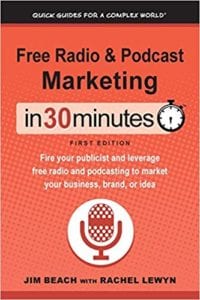
Free Radio & Podcast Marketing In 30 Minutes: Fire your publicist and leverage free radio and podcasting to market your business, brand, or idea
The other thing that your book, Free Radio & Podcast Marketing in 30 Minutes, talks about is that it’s also a great way to get yourself to show up in a Google Search. A lot of people are spending a lot of money on AdWords and they don’t know how to get to their business to pop up. Tell us a little bit about how being on radio and podcast can help our Google Search Optimization.
Every single time you’re on a show, the host or the producer puts up a page about you. It’s where the audio file you can be listened to on the host website. There is also a picture of you, a little bio and a link to your website. That link to your website gives you SEO, Search Engine Optimization, juice. They think that 70% to 80% of Google’s score for you or how high you rank in search engines is determined by how many websites linked to you. It makes sense. If two websites linked to you, are you important? A little bit. If 200 web sites linked to you, are you important? If 200 other people think your website is important enough to link to, therefore you deserve to rank higher. If I’m going on one or two podcasts a week, I go out there and I’m getting a new Google link to my website once or twice a week. These are quality links too, not from a directory or something like that. A podcast link is one of the best links you can get. Let’s say you’ve done 100 interviews over a year. You’re going to have 100 quality links that will drive your SEO juice. I promise you, if you have 100 links, you’re going to be on the first page of almost any search.
I have experienced that myself being on many podcasts and being called the Pitch Whisperer. If somebody googles the Pitch Whisperer, all that content comes up. They don’t have to remember my name or even the name of one of my books. People tend to remember that little hook and they can find me that way. That’s such great value. You also talk about how to use social media as a way to get on radio and podcast shows. Would you mind picking one or two of those platforms and explaining your secret sauce?
The platform is irrelevant, but every time I’d make a post on LinkedIn and someone comments on it, I get an email about that. We all do. That’s the way that the platforms work. I know who is posting about me. Let say if I were to comment on every other tweet, if I make six tweets in a week and you comment on three of them, eventually I’m going to notice that. I’m going to say, “Who is this person? Who likes me so much that every time I tweet, they are giving it a thumbs up or giving it likes?” You’re going to get curious. For example, Ken Blanchard who doesn’t do their own social media. You’re not going to be able to get to him. That’s not going to work with him, but for 99% of the people you want to get in contact with, this works for sales or venture capital or anyone that you’re trying to reach out.
If you follow them and pay attention to their social media, we are such a narcissist that we will notice that. You like five or six of my post, I’m going to know what your name is and then you reach out to me and say, “I’ve been following you on Twitter for six months now and you have some great things to say. I’ve been enjoying getting to know you. I think I’d be a great guest on your show also. I seem to have a lot in common with you, but I’d be a good guest.” The answer is going to be yes because you’ve already done me twelve favors. Every time you liked something of mine, I owe you. The first thing that goes through my mind is, “You’ve done me a bunch of favors. The least I can do is highlight your business for twelve minutes.” It’s a great way of getting on someone’s radar and it all goes back to narcissism. If you like me, I like the fact that you liked me.
[bctt tweet=”No matter what your business is and what you’re trying to sell, there are a bunch of podcasts out there that want to have you as a guest.” username=”John_Livesay”]
It’s almost the micro matching neurons. If somebody smiles, you tend to smile back at them. Except this is done digitally. You have a whole chapter devoted to the do’s and don’ts of pitch writing and you have ten commandments. The one that is so important is to be relevant to topical news stories. Can you explain what that is and how people can use that?
That’s the way to get on a generic radio. That’s not going to work for podcast quite as well because so many podcasts are delayed. Most podcasts are pre-recorded a week, two weeks, a month, three months in advance. It’s hard to be topical there, but if there is another article that comes out about Facebook giving away your data and you are a Facebook company, you should call every radio station in your city or in the United States. You should call them all and say, “I am a Facebook marketing expert. I’m an expert on the news article that you’re going to be talking about on the news. Quote me. I’m available at 7:22 when you do your live segment.” In other words, make yourself available on the topical news of the day and then let the reporters, the people, the podcast host, everyone know that “I’m an expert on this. If that topic ever comes up or if you ever need a hurricane expert because there was a hurricane coming your way, I’m the guy that you should call.”
Remind them when the hurricane is coming by saying, “We spoke six months ago about hurricane preparedness and there’s a hurricane coming in. If you need to get any reports, I’d love to be on your show to talk about it.” You can take this to the limit. It is the National Ice Cream Cone Day. I have a world record for ice cream cone eating. If that’s relevant to me, then that’s your hook. You call up the radio station or the host or the producer. We can talk about how to find that person and say, “I don’t know if you know, but a few weeks from now is national ice cream cone day. I was the eighth-grade ice cream cone eating champion of Dubuque. I think it would be a great segment to talk about that.” That would be the thing that they need. All these people are desperate for content. They have to fill up the time. They need somebody. The unique, compelling and sexy pitch is going to get you on the air. It’s going to get you on the podcast.
There are a couple of things you said there, have a unique, compelling and sexy pitch. You also talk about the importance of a good pitch being both informative and entertaining. Some people have one and not both. That’s a big part. The other thing you said that is so relevant is if you’re going to pitch yourself as the expert in anything from a hurricane to ice cream cones, don’t forget to remind people when that topic is coming up again. You build the relationship up front and then it’s already easy for you to reach out. Don’t wait for the last minute for that to be in the news. If you can build that relationship with a producer or a host before, it makes a big difference.

Podcast Marketing: People have to trust you first, then they like you, and then they decide whether they want to know you or not.
There’s a man here in Atlanta on one of the local TV stations and he’s been doing the news here in Atlanta for 30 years. He interviewed me for a thing. The interview went well and we connected. Six months later, I saw him at a train show. I wasn’t going to the train show. The room next to where I was speaking was a train convention. I bumped into him and said, “I don’t know if you remember me, but we’ve talked.” We had a long conversation about trains. I told him about my train set as a kid. Because we have a relationship, I can get anything I want on the air with him.
Another pitch secret from your book is bust a myth. Tell us what that means.
Anything that the entire world believes, if you tell me the opposite is true and say you can prove it, I want to hear about that. “I’m a little bit of a contrarian. I don’t believe that we’re ever going to run out of gas. I sat down and started researching it and I can prove it. We’re never going to run out of gas. Eventually, we’ll switch to another technology and there still billions of gallons of gas in the Earth.” People hear that and they’re like, “I’ve heard of peak oil, I know about gas. We’re going to run out of gas. We’ve been predicting that for 40 years.” Now the person is interested, they’re engaging and they’re fighting back. “Do you have some data that you can prove that?” “I will give you my seven reasons that were never going to run out of gas on my interview segment with you.” I’m booked. They love that.
They love things with numbers. They love things that are contrarian. The myth is this and this. I’m going to argue the opposite side. There are two guys that wrote a book saying that we’re not going to have twenty billion people 50 years from now on the Earth. The population of the Earth is going to peak twenty years then started going down, which is scarier than it is going up. They’re very contrarian and they’re everywhere now. They’ve done 200 interviews in the last six weeks promoting that book. Because it’s so contrarian, I’ve heard the same thing again and again. I’ve had vanilla every time and now you’re giving me chocolate. Now I want some chocolate because I’m tired of vanilla.
[bctt tweet=”Everyone in the world knows that entrepreneurship is 100% yes.” username=”John_Livesay”]
I loved that as one of the favorite ways of grabbing people’s attention too. The example I use is, the myth is if people know you, then they like you and then they trust you. I said, “That order is completely wrong. People have to trust you first. Then they like you and then they decide if they want to know you or not.” If you start trying to throw a bunch of information that people are thinking, “If they know enough about me and my product, they’re going to buy,” you’re doing it all wrong. That gets people to go, “That’s a myth that the order is wrong.” Anything can be busting a myth there.
My very first book was with McGraw-Hill. The thesis of that book was that entrepreneurship has nothing to do with creativity, risk or passion. Everyone in the world knows that entrepreneurship is 100% creative people taking risks, building businesses that they are passionate about. The thesis of the book was, “No, that’s entirely wrong.” McGraw-Hill said, “I want to see the defense of that thesis.” Then under a week, I had my first book deal with McGraw-Hill because that pitch was so compelling and so unique that they wanted to have it. It’s also sexy because what’s the takeaway? If it’s not about creativity, risk or passion, then anyone can do a sexy thought.
It also has to do with the way our brains are wired. As you said, “Vanilla, vanilla, vanilla. Chocolate, shiny new thing.” Our brain craves new information or looking at something in a different way. That’s how you break people up and break through all the clutter that’s in our brain from the constant barrage of ads and social media posts and tweets and everything else. You alluded that you have some tips on how to get in front of a host or producer. Can you share what those are since you are one? What are some of your favorite ways that people reach out to you?
The last thing I want you to do is to call me. That’s true for most people now. That leaves either the mail or email or what we were talking about before going in the back door through their social media and becoming their Twitter buddy. The easiest and best way to do it is still an old-fashioned email. I used to spend five or six hours every weekend watching football, watching something on television and researching the names of podcast hosts. It’s very simple. You go to Google and type in food health podcasts because I have a food book and I want to be on those podcasts that talk about healthy eating. You will find that there are thousands of podcasts that meet those exact requirements. The trick is to scour them and to try to find the host name. The host of a podcast is a narcissist. I googled food podcasts as I was talking about it and there are 4.2 million hits. That doesn’t mean there are that many shows, but it’s a popular thing to the podcast and talk about.

Podcast Marketing: You don’t buy the first time you see a product; it takes more than that.
Those podcasters or the hosts want to be in communication. Tons of the websites will have a button that says, “Be a guest,” and they’ll give you the instructions on how to be a guest. On my website, you will find it says, “To be a guest, simply email Jim,” and then it gives my email address. They want to be found. They’re not there to be invisible. You’d go through and create a list of 500 podcasts that are appropriate to your market and get the host information. If you’re good at this, you will learn something about the host. I don’t do it that way anymore. I go on Upwork.com and for $50 or even $30, I will have someone there create a list of 500 spirituality podcast host emails. For $30 to $50, I have bought 500 email addresses. They have to do that research. They go out and somehow, they scour the same way I do. Now I have 500 people to contact. I then sit down or hire some pitch whisperer to create the perfect pitch for my product and put together a beautiful email. I send it out to all these hosts. I’m going to say, “I love your podcast.”
They want to know that you have listened to their podcast. If you’re a podcast listener and can prove that you have listened to their show, those people are going to put you on their show. You say, “I listened to your episode with John. He was awesome and I thought he had some good points. I especially liked when he said this. I loved it when you said this.” Quote the host back to himself. He’s going to put you on the show. I build those lists of 500 people. I spend several hours crafting a four or five paragraph email. One of those paragraphs changes for each and every host. “I saw your pitch on your food podcast. I loved when you were talking with Sally Reaves about her no sugar diet. It was the funniest thing ever when you said this and this and I just connected with you. I am working on this and I thought I would be a good guest for your show.” You’re going to get on the show.
That’s specific, not just saying, “I like your show. It’s good. It’s funny.” Quoting the host back when you pitch yourself is the secret sauce that you just gave us. It’s important and few people take the time to do it. Few people know how to do it. Jim, that is gold. Thank you.
I don’t do it. I pay someone to create that moment for me to find the quote. I’m a liar. I didn’t listen to your show. I had someone find me a great quote from your show and I’m quoting it back to you, but I’m doing it in bulk.
[bctt tweet=”Market every day for 30 minutes.” username=”John_Livesay”]
I love stories and you’d have a whole chapter devoted to all in the stories and how people remember stories after we forget everything else. You’ve given us some great stories already, but let’s talk about the one that you talk about in the book, which is about your wife running an Amazon business.
The keyword there is Amazon. A good story is worth telling well. A good story has emotional things like anticipation and fear that I don’t hear the end of the story. If I’m doing an interview on that topic or on entrepreneurship, early in the interview I will drop, “Creativity, that’s totally useless. For example, my wife started a business with $500 on December 26th.” I add in the details because that makes the story truer. “I bought her a book for Christmas on how to start a business. The next day she read it. She was so motivated that she started her business on the 26th. She started making money in January and she made $78,000 in her first year while working a full-time job, while cooking dinner for four kids, while raising four kids, while putting up with an impossible husband like me on the weekends.” I’ll tell you at the end of the interview, “If you remember to ask me, Mr. Host, at the end of the interview, I’ll tell you what the business was.”
That’s an open loop and you were talking about the details of the exposition. What I like about what you wrote in your own book is the impact, what I call the resolution. The unexpected outcome after growing a business like that is and I’m going to let you reveal what that is.
My wife is a shy introvert. We used to go to trade shows together and she would point to something and tell me to go ask about it. Now, she goes to trade shows by herself and comes home with a bag full of 500 booths that she has visited. She now teaches classes on how to run an Amazon business and she organizes and puts it on in our living room. Her career has exploded. She’s had three major promotions and her salary has tripled because of the confidence that she gained by running her small little Amazon business. She now has learned that she can make a living from the living room if she has to.
[bctt tweet=”A good story is worth telling.” username=”John_Livesay”]
That would pull anybody in and that would get any host of any show to want to have somebody come on and talk about that. The outcome of not just making money but the self-esteem going up is what makes that story great in my opinion.
She’s become a whole new woman because of it. It’s amazing to see the progression of her career, her personality and her ability to do all of this stuff. That’s one of the things I love about entrepreneurship. It does that to people. The question you asked is the stories. I know when I go into an interview, I have a basket of ten stories. I’m going to have time to whip out three of them. I do know that a year from now you won’t remember my name, but you will remember the stories that I told.
The last thing that I want to talk about which is in your book, Free Radio & Podcast Marketing in 30 Minutes, is this post show carrot. Since we’re at the end of our time together, you can explain what it is and let us know if you have one for our audience.
The whole point of being on your podcast is to sell my paint, but 99% of the time you have to touch somebody on average seven times before they’re going to buy from you. That’s why ads are repetitious. You don’t buy the first time you see a product. It takes more than that. I can’t market to you if I don’t know who you are. The only way for me to know who you are is to get your email address. I will do anything to trick you into giving me your email address. You see this all the time. We all know about funnel marketing. You have to go and collect the names to start the funnel. How do you do that? You go on radio shows and offer something. I do happen to have a free carrot. If you email me and ask for one of my lists, I will give you my list of 500 sports podcast to be a guest on, 500 relationship podcasts to be on, 500 spirituality podcasts to be on, 500 small business podcasts to be on. I got three or four more topics that I can’t even remember, like religion. I got twelve of these lists that I have built over time. I will send you my list of 500 for whatever category your business is in and help get you started down the path.
The book is called Free Radio & Podcast Marketing In 30 Minutes. Jim, is there any last thought or quote or moments of inspiration you want to leave us with?
Anyone can be successful with this method and use radio and podcast marketing. Don’t worry about your accent. Don’t worry about anything. Sit down and plan out what you want to say. Create a great pitch and I promise this will work for any business. No matter what you’re trying to sell, it will work. I’ve seen it work in every category in the book. In the early chapters, there’s a list of 70 different industries that I’ve seen this work for. We have 10,000 recording opportunities a day for various podcasts. That number has gone up since the research, but that’s 10,000 opportunities a day for you to go out there and get free marketing. Do it. You’re crazy not to do this.
One of my big things is I spend the first 20 to 30 minutes of everyday marketing. Whether I have a business or not, whether I have a project due that day, I know that once the project is going to be turned in, I need a new customer so I better market. I spend fifteen to 30 minutes every day. The first thing I do is I send out three or four requests to three or four podcasters, “I’d love to be on your show.” Two of them say yes and there I am marketing. It works. You can do it. If you’re reading this, I’d love to have you on my show if you can figure out how to get in touch with me.
That is a great offer. I’d be fascinated to see how many people will take you up on that. This concept of scheduling marketing time because if it doesn’t get scheduled, it doesn’t get done. You left us with yet another great tip. Jim, thanks for being on the show.
It’s been my pleasure. Thanks for having me.
Links Mentioned:
- Free Radio & Podcast Marketing in 30 Minutes
- School for Startups Radio
- For Dummies
- Upwork.com
- http://TimelessChair.com/
- http://InternationalEntrepreneurship.com/
- http://SchoolForStartupsRadio.com/
- https://www.Amazon.com/Free-Radio-Podcast-Marketing-Minutes/dp/1641880201
- Quantmre.com
Wanna Host Your Own Podcast?
Click here to see how my friends at Brandcasting You can help
Get your FREE Sneak Peek of John’s new book Better Selling Through Storytelling
John Livesay, The Pitch Whisperer
Share The Show
Did you enjoy the show? I’d love it if you subscribed today and left us a 5-star review!
-
- Click this link
- Click on the ‘Subscribe’ button below the artwork
- Go to the ‘Ratings and Reviews’ section
- Click on ‘Write a Review’
Say Something Entertainment: Pitching For Engagement with Kevin Hekmat
Posted by John Livesay in podcast | 0 comments


Episode Summary:
—
Listen To The Episode Here
Say Something Entertainment: Pitching For Engagement with Kevin Hekmat
Our guest is Kevin Hekmat, who is a talent manager and Founder of Say Something Entertainment, which is best known for managing internationally recognized poet, IN-Q, and New York Times bestselling author and speaker, Cal Fussman. Kevin represents artists who changed the way audiences look at their lives. Say Something is built on the idea that inspirational entertainment can bring the most powerful perspective shift, whether through live shows, keynotes, poetry or podcasts. Kevin has brought this idea to dozens of Fortune 500 companies including teams at Facebook, Google, Lululemon, Nike, General Motors and many more. Kevin, welcome to the show.
Thanks for having me.
I always like to ask my guests to take us back to their own story of origin. You can go back as far as you want. Childhood, school or whatever where you first started saying, “I think I want to get into talent management where I want to be involved with the creative arts.” How did you get to where you are now?
I grew up in Los Angeles. It goes back to my parents. My mom is a piano teacher. She has a piano school and my dad is a dentist. I grew up playing piano and grew up doing musical theater in high school. To be honest, it was never that I was the best artist in the class, that I was a great singer. I enjoyed the arts a lot. As time progressed and I started thinking about what I wanted to do, it became a question of, “Is there something in entertainment, in that world that I can see myself doing and living?” I didn’t want to be an artist and I was looking at all the options. Growing up in LA, a lot of options, a lot of people that I grew up with are doctors, lawyers and more traditional jobs in that way. All I knew is that I didn’t want to do that. I knew from a very early age that I didn’t want to go to medical school or get a law degree. Outside of that, I was looking at the options. I was looking at music, entertainment and I traveled for several months after I graduated from college, solo backpacking through Southeast Asia to really figure out what I liked and what I enjoyed myself. Before that, I had started doing a lot of the more motivational, inspirational speaker world.
[bctt tweet=”Value is not something you own, it is something you bring.” username=”John_Livesay”]
I was drawn to a Tony Robbins event when I was in college and that shifted my perspective. He has an incredible personality. If you go to one of his live events, outside of anything he even says, his ability to shift people’s perspectives and experience in a day or a four-day period of time is powerful. That energy he has on stage and the way he takes you on this emotional journey, a very logical journey through your own life and do what you want to do in your own life. When I went traveling, I went deeper in my own enjoyment, my own passion, one through traveling but also through meditation, through mindfulness. It was my first real dive into that world at the end of the trip. I had never meditated before, but I was curious about it and I did a ten-day silent meditation retreat. I thought it would be a fun idea, “It’ll be a great time. I’ll learn how to meditate.” Little did I know it would be one of the most intense and raw experiences of completely taking away any distractions, any stimulations that we normally have in our everyday lives with phone, music, TV, conversations with friends or strangers, going internal and sitting with your thoughts and learning how to be with your own thoughts.

The Third Door: The Wild Quest to Uncover How the World’s Most Successful People Launched Their Careers
When I came back completely, coincidentally that same month, I met both IN-Q and Cal completely separately. I had been to one of IN-Q shows. A friend invited me and another friend of mine named Alex Banayan, one of my closest friends growing up. I had met Cal that same month because Alex is writing a book called The Third Door and Cal started helping Alex write that book. The same month I met both of them, it took me a little longer to start working with Cal. Cal and I were friends, Cal was helping out with the book. I would see him every couple of months and I sit down for coffee or lunch with them. Hear about some of the stories that you heard on the podcast with Gorbachev and Ali. I was on the edge of my seat, “Who is this guy with these incredible stories in this incredible life experience?” He traveled for ten years earlier in his life, without a home from city to city across the world. At first, I started managing Q and that became the beginning of talent management for me.
I want to ask you about that ten-day silent retreat. Did it get easier or harder as the days went on?
I don’t know that it was a straight line in neither direction. It was more of a rollercoaster where it would get easier, harder and then all of a sudden, you’re flipped on your head. In every moment, you would have a different thought that comes up. The key thing that I remember most about that experience was that there wasn’t any distraction. You almost don’t realize not many distractions you have in your life on a normal basis, on a daily basis. In the workday, there’s every work distraction but then outside of that, even when you go home, you have whoever might be in the home with you, you have every little thing you could be doing in the house. You have your phone, you have the TV, you have food and even eating is a distraction. I use it. I know that I use it as a distraction sometimes when I’m thinking about something. In that experience, you’re forced because there are 100 people that were there and you would sit down.
It was a very intense experience too. You’re waking up at 4:00 AM, you’re meditating for nine hours a day, you’re getting four hours of teachings on meditation a day and they would ask you to sit down for two hours to meditate. I had never meditated. I couldn’t meditate more than twenty minutes and a thought would come in my head. I would try and avoid on a daily basis in my own life, maybe a memory, someone that I was angry at. I realized that typically I would maybe listen to music and I forget about it. I’ll talk to a friend and I forget about it. I would push that thing down and I’m sitting there for two hours, for ten days and that thought is not going to leave your head until you make peace with it. It won’t leave your mind until you figure out some way to make peace with that.
They ruminate or they hide, they pop back up. This could be thoughts of anger, thoughts of grief even. The reason I am so curious about your experience with silence, the old way of selling was asking someone to buy something and then whoever speaks first loses. It became this will of silence and that doesn’t work anymore. People are aware of it and people can feel it. It’s this horrible old school way of trying to sell. The concept of getting comfortable with silence has helped me get people to get more sales. If you ask someone if they want to buy a house for example and you’ve got all this internal dialogue going on like you were referencing of, “I need this commission. If I have to show this person one more house, I’m going to lose my mind.” You say something because that’s so anxiety-provoking to have all those thoughts going on. You’re not used to it.
You say, “If I throw the refrigerator in, would you buy it then?” You’ve missed the moment for people to say yes or no. What I work with people on is saying when you quiet the thoughts in your head either through meditation or going on to something like you did for ten days without speaking, you become comfortable with the silence in the room. That is so key, whether you’re performing in poetry, music or speaking, is getting comfortable with those pauses. You as a talent manager, your ability to be comfortable with silence has probably helped you when you were pitching IN-Q and Cal to people, when you tell them how much their fee is or whatever the issue might be. It’s not a battle of wills of who’s going to speak next but it becomes your ability to be comfortable with that silence. Sometimes you don’t know what they’re going to say next, whether it’s an objection or a yes but if you are uncomfortable waiting then you lose out.
[bctt tweet=”Let go of being right-collaborate.” username=”John_Livesay”]
It’s definitely true and I thought that consciously when you’re pitching and I may be pitching IN-Q or Cal or anyone for engagement with the company. That silence is very important because both sides naturally, you’re going to feel something and the other side is going to feel something. After you say it, it’s so easy to try and follow it up with reasoning or something that explains why you have to be silent.
I’m also fascinated by the combination of a piano teacher because I took piano lessons when I was a kid and a dentist. At one time I thought I wanted to be a dentist. I am going to give you my observations but have the unique inside track because you lived in that world. What they have in common is that clearly piano and music in general is about melody, sound and eliciting feelings based on what the music is doing. The dentistry is an art form. The dentists that I’ve met and have been patient of take such pride in their work and think of themselves as a craftsman. Almost like a person who’s a musician composing a song, those are my teeth and then to have those people create a son like you, who then brings that out into the world. I wanted to get your take on if I’m close to your childhood or the takeaways that you learned from your parents.
It’s funny because dentists are normally thought of as not creative people. When you think about what they’re doing, they are working on the thing that is right at the center of your face. Everyone sees this thing and they’re the ones that are making a beautiful. I love that perspective of they’re artists as much as a piano teacher. My mom was definitely the more creative one between the two of them, but I definitely picked that up from both of them. Another thought, jumping back to the silence. It’s sparked an idea, a thought that I actually don’t think about. I love that comparison you made between the meditation and silence there into the work. Not only does it come in pitching, but it also comes in pitching ideas.
As a manager, a lot of the time it’s focused around bringing ideas, whether it’s to the client or whether it might be another client that I’m working with. It could be a company, it could be creative and it could be an artist that we’re working with to create something. A lot of the time it takes giving your idea and putting your perspective in there but then not trying to convince anyone of that, not trying to sway anyone in your direction. It’s trying to understand what they want, what their vision is, giving your opinion in your idea but then letting it sit in silence. Creatives often have to think about what they want, what they envisioned and that idea has to be there.
If you come up with the idea and you try to sell it and push it on somebody, nine times out of ten it’s not going to work. However, if you have collaborative conversations and brainstorm without an attachment to any one outcome, what I’m hearing you say is that allows the decision maker to take ownership of the idea, pick a direction and see you as a collaborator. When that happens, then your clients are definitely the solution to execute that idea.
You can’t be focused on being right. You have to be focused on collaborating and working together to find the solution. If you have that, then you allow the person to actually come up with the idea that resonates with them and that’s going to be the best solution.

Say Something: Thoughts don’t leave until you process them.
Tell me a story of both IN-Q and Cal, one of your favorite stories of an event or an outcome that happened after someone hired IN-Q.
It was a very interesting moment. IN-Q was performing at a WeWork event and he performed at a global summit. It was 6,000 people in the Microsoft Theater in Downtown LA. A month before that, he was at a smaller event and it was 50 people across North America. We were sitting in a room and he was performing for dinner and he was doing this piece called Home. The first line is, “I want to buy a house where I can make memories in every room.” It’s a beautiful piece about having a family and having a house that’s more about what you put into the house in terms of your energy and who you are and the people as opposed to the physical objects. Value isn’t a thing you own, it’s the thing that you bring.
Value is not something you own. It’s something you bring.
We were sitting there and 50 people are sitting at three tables. IN-Q’s doing this piece and we’re all listening. He finishes it and the guy across from me turns to me and I told him beforehand that I was his manager. Five minutes during our conversation right after IN-Q finished performing, everyone’s like, “That was amazing. I loved that.” This guy turns to me and goes, “How many times have you heard that?” I said, “Between hearing it live, hearing it on video and recordings that we’ve done, I would say maybe 100 times, probably more than 100 to be honest.” He goes, “I looked at you while he was performing. I was watching you. You were smiling as if you were listening to that poem for the first time.” It gave me a perspective on that experience that I didn’t have, which was so beautiful. I didn’t realize that I had that perspective. It was beautiful because it is how I feel every time I hear him, I am hearing it for the first time and I’m hearing new things every time, the hundredth time I’ve heard of one poem.
That’s art. We are different when we look at it and all the energy that goes around it is part of that.
They’re different when you hear it. Every moment that you hear someone say something, it can be the same thing over and over. In your life, you’re having different things going on. You’re having a different experience.
[bctt tweet=”If you are uncomfortable with waiting, then you lose out.” username=”John_Livesay”]
That explains your success because people respond to people who are authentic and passionate. You can’t fake that and you are clearly authentic and passionate. That’s why you’re so successful. Am I still as passionate and authentic about what I’m pitching? If I’ve said it 100 times as it was the first time, knowing if you trust what you’re doing and you have a purpose behind it that keeps you alive and going, I would think.
That definitely is part of the journey. It’s figuring out how you can get excited about it because sometimes you forget. Sometimes I’ll go a month, two months, three months without seeing Cal, IN-Q perform live because I’m in the office in LA and they’re traveling and performing. Sometimes you do get separated from the art. You get separated from what you’re selling and that becomes something where I have to go back to why do I love it? What do I love about it? When I see it live again, for me that’s the clearest dive back into the arts and why I love it so much. You do have to constantly go back to why you feel connected. If you ever don’t, you have to look at that, look at the experience, look what’s going on in your life and look at the art and say, “What am I connected to in that?” Every time I go back to the art, I find that I go deeper into it.
When I hear actors talking about doing the same performance on Broadway for years at a time, they always have to find some nuance or it’s the audience response that energizes them to make it fresh for them. That’s part of being fully present and fully alive, which goes back to one of the takeaways you get from going on a ten-day silent meditation.
When you’re listening to the art, it’s that presence. When you’re trying to help someone understand how powerful it is and how it can really make a huge difference in their event or their experience, it’s the presence of understanding and listening. I learned that presence in that retreat. I’ve learned that presence from Cal. He’s incredibly present. That’s the thing I’ll always say is Cal, when he is talking to you, you feel like you are the only person in the room. Especially when you’re saying something that intrigued him, his jaw drops and his eyes open wide. He is enthralled. There have been times where he’ll finish speaking and we will be leaving and we have a flight to catch. We have somewhere to go and I used to drag him. He’s already done an hour of Q&A afterwards, off stage talking to people, answering questions and I’m pulling him away saying, “Cal, we’ve got to go.”
My experience of him is this bottomless curiosity for life and people’s stories. That’s what made him such a good journalist. He’s taking that same passion and tells the stories of everyone from Gorbachev to George Clooney in a way that makes everyone else curious to know what’s going to happen. What’s your goal next?
There are several things within what we’re building with IN-Q and Cal. I looked a lot at why I was drawn to both IN-Q and Cal. Early on, I was managing IN-Q about a year and a half or two years and then I started managing Cal. When I first started managing Cal, people would ask me, “You represent a poet. Do you represent writers?” Typically, you have a manager that represents actors. They represent screenwriters, musicians, comedians. There’s a lane for everything and people would look at me in this complete confusion of who do you represent?

Say Something: If you feel like you’re an island, then you won’t feel any sense of connection to the purpose of why you’re working.
Actors and performers have a talent manager mapping out their career. They have an agent that negotiates their contracts.
I started going around and people start asking me, “Who do you represent? What’s the common thread between IN-Q and Cal, are they writers?” I said, “What it is more than anything? When you see them, whether IN-Q’s poetry or Cal’s storytelling, they both make you think about your own life in a different way.” They challenge you to think about whether it’s your personal life, your work, your social life, your relationships. Both of their art acts as a mirror in a lot of ways and they both allow you to think about that but not only that, they also entertain. Once you are watching IN-Q’s performance or you’re seeing Cal’s speak, you’re not only inspired to think about your own life in a different, but you’re also entertained.
You’re laughing, you’re crying, you’re going through that journey. It’s the balance of those two things that is more powerful than anything. If it’s the balance of making you think about your own life, acting as that mirror but then also entertaining, making someone laugh and making someone enjoy that experience. If I look forward, it’s creating that experience for more people, allowing more people to have that experience. Most people live double lives. During the day they listen to podcasts, they’re watching YouTube videos, listening to TED Talks.
[bctt tweet=”If you come up with the idea and try to sell it by pushing it on somebody, nine times out of ten it is not going to work.” username=”John_Livesay”]
Most people are enjoying them and then they go home. They go out at night on a Friday or Saturday night with a friend on a date, with their wife, husband, whatever that may be and then they lose that. They lose the part of themselves they love so much, the inspiration because they’re going out to comedy. They’re going out to a bar or they’re going out to dinner. How do you bring an experience together where you can fuse the two things? IN-Q does that so well. When you go to one of his shows, it’s that kind of experience. Cal at 8:00 AM at a corporate event will give you that experience where you go in and all of a sudden not only are you learning, not only are you entertained but you are laughing, crying, you’re feeling every emotion. Every person in that room, you feel closer with because you went through that experience and you feel like you’ve shared that experience together.
That is one of the key objectives almost every speaking engagement that I’ve been. Not only do we want you to inspire them, inform them, give them some new tools but the whole experience is supposed to bond them better together. These are siloed departments and people that don’t see each other that often. They’ve all been brought together for a two-day summit. If your experience of speaking can make them feel bonded together and they can start referencing a story you did, a joke or whatever it is, then you are delivering on the overall connection. People have to feel connected to the people on their team, even if they’re not physically seeing them every day in order to feel part of something beyond what their little job is or big job. If you only feel like you’re an island, then you don’t feel any sense of connection to the purpose of why you’re working and then you burn out really fast. The outcomes of having people think about their lives in a different way impact the bottom line. Is there any last thought, book or quotes you want to leave us with?
What I found more than anything is that the art sells itself. Whether the art is a painting, whether it’s poetry, whether it’s a speaker on stage, whether it’s a podcast or whatever it might be, the art will sell itself if someone experiences it and they are shifted by it. That’s what I try and do more than anything. It’s to allow someone to experience the art. I’m sure you’ve experienced this in your speaking. When someone sees you live, that is the best experience they could ever have. You are probably one of the best people at pitching and selling but if they see you live, they have that experience themselves. When they see you take a group of people through an experience, they’re learning. They’re having takeaways, they’re standing up and clapping, that’s going to be the best sales pitch you could ever have. I try and do that as much as I can and put the art out there. Allow people to experience that art because that’s what’s going to get them bought in more than anything else.
[bctt tweet=”The art will sell itself if someone experiences and are shifted by it.” username=”John_Livesay”]
The more people realize the value of this face-to-face connection, whether it’s one-on-one or you’re speaking in front of 6,000 people, it’s still that intense need to be present and in that moment so that you can have an experience. Otherwise, as you said, you’re in your head and distracted about a bunch of things and we wonder why we’re not having more joy in our life. That’s the reason, we’re not in the moment. Kevin, thank you so much for sharing your wonderful journey and these two amazing artists that you’re representing, IN-Q and Cal Fussman. The world is going to be a better place and I can’t wait to see what you do with them.
Thank you so much for having me, I appreciate it. It’s been a fun conversation.
Links Mentioned:
- Kevin Hekmat – LinkedIn
- Say Something Entertainment
- The Third Door
- http://SaySomething.la/
- Quantmre.com
Wanna Host Your Own Podcast?
Click here to see how my friends at Brandcasting You can help
Get your FREE Sneak Peek of John’s new book Better Selling Through Storytelling
John Livesay, The Pitch Whisperer
Share The Show
Did you enjoy the show? I’d love it if you subscribed today and left us a 5-star review!
-
- Click this link
- Click on the ‘Subscribe’ button below the artwork
- Go to the ‘Ratings and Reviews’ section
- Click on ‘Write a Review’
Pitch Secrets From Top Investor with Vic Pascucci
Posted by John Livesay in podcast | 0 comments

 Episode Summary:
—
Listen To The Episode Here
Pitch Secrets From Top Investor with Vic Pascucci
Our guest is Vic Pascucci, who is the Managing Partner at Lightbank in Chicago. He’s been a venture capitalist with over nineteen years of professional experience including Fintech investing and he has an amazing background with Fortune 130 companies and early-stage ventures. He’s really big in corporate strategy as general counsel. His specialties are Fintech and consumer. He’s got over $650 million in venture capital in M&A transactions. Welcome to the show, Vic.
It’s great to be here. I appreciate it.
I like to always ask my guests to take us on their own story of origin. Are you from Chicago? Did you dream of being a venture capitalist when you were in high school? How did this happen to you?
I think in high school, I dreamed of being in Chicago. Growing up as a kid in Cleveland, I became infatuated with the city like this although I didn’t get accepted to any colleges around here. Once I started working, I became infatuated with becoming a venture capitalist. Just like everything else, nineteen years later, you have an overnight success. When it comes to my career in venture, I like to tell people when they ask how did I get into venture, “I did it in a completely non-traditional way.” I fought, punched, kicked, kneed, elbowed and scrapped my way into it. I didn’t go to school in the right part of the country. I don’t have the right degree. I didn’t work for the major consulting companies. If you look at most venture capitalists, they have this punched pressed resume of Ivy League, consulting startup, went to the right country clubs, and worked their way up. I’m speaking broad-brush just to make it more exciting, but if you look at most people’s resume in venture, that’s what they look like.
[bctt tweet=”What is your unfair competitive advantage?” username=”John_Livesay”]
I started my career as an attorney, which a lot of venture people do. I started as a trial lawyer. I was trying cases right out of school. This is the early ‘90s to mid-‘90s and I was going to court every day and just was tearing things down. I was a trial lawyer. I would go and beat the hell out of everyone, witnesses, statements, and I’ll just destroy. I’ll put on a bunch of drama in front of a jury, go to win and move on. I noticed all these brilliant people around me that I meet, they were in technology. The way I look at it, they were building things every day. They are building technologies, building companies.
I had a midlife crisis in my mid-twenties, “How do I want to spend my life? Building or destroying?” The only way I knew how to get into venture from that standpoint was to teach myself how to do technology law, teach myself about corporate finance, and start my own law firm that did those types of things. From starting my own law firm with no clients, this is in the late ‘90s, beginning of 2000, so after the first technology crash. I was starting a firm with no clients, focused on technology companies. Building that from no clients, no business, to enough work to keep five lawyers busy. One of the guys I was working my ass off to get his business finally said, “I’m not going to give you my business, but I will give you a job as my first general counsel.”
Up into that point, I was doing a bunch of advising on venture and finance. I have always loved the venture side of things, representing some financiers, representing the State of Illinois for their seed stage investing. Before I knew it, I was out there raising money, managing teams. Once I got inside the “the belly of the beast” on the startup side, I loved it. From there, I progressed from one software company got bought by another. I ended up in Texas where I got a job. I sold the software company, then end up with a job with a Fortune 130 company which was the completely other end of the spectrum, working in this huge 25,000-person company. It was highly regulated with all these processes, completely conservative and conventional. I came in as the young guy that was supposed to represent their CTO, CIO, and CISO.
As their lawyer, what I’d see are deals that come across their desks. They would be an early adopter for desktop virtualization or security or some internet-based business. I just kept forcing them to say, “We should do deals with these companies.” They say, “We are.” I’m like, “No, you’re not. You’re just buying stuff. We need to invest. We’re going to rely on them. They’re going to rely on us. The best way to align is by investing.” They said, “No, we don’t do that here. Shut up. You’ll get fired.” After breaking that ice after a couple of years, I turned around and fast forward a couple of years, I’m managing a $330 million venture fund for them. It’s a top performing fund. We have a bunch of IPOs. We have a bunch of acquisition exits and a really active pipeline. That started it all officially. Throughout the course of those investments, I was able to meet my partners here, Brad Keywell, Eric Lefkofsky, this fund that they had started. They traded some deal flows, traded some pings and deals on sectors, and then a couple of years later when they were ready to bring in someone else to manage and run this fund, it’s how I got here.

Pitch Secrets: People just assume that all teams have great relationships, but that’s not the case.
That is quite a journey. I think that there must have been some skills around storytelling being convincing as a trial lawyer that has helped you on your career path because you obviously had to get other lawyers to join your team when you were starting your own firm and then getting people to engage with the vision of other startups.
Getting them to accept my bullshit, specious legal arguments in front of them, it helps to tell when people are telling a story with passion versus the people are just posing in bullshit. When it comes to entrepreneurs and pitching, there are the big picture things I am looking for and then the micro. The big picture, I’m looking for that compelling visionary that truly believes that they’re doing something bigger with this company. When I say something bigger, “I don’t want to sell more loans. What I’m trying to do is sell for the financial security for families everywhere because their incumbent banks won’t take care of them.” I need people to see something bigger and I need them to communicate it and tell that story in a compelling way.
That storytelling capability, I need to know that they’re exceptional at because they need to be able to inspire people to come work for them because I invest at the earliest stage of startups. I have the seed and Series A. These companies go through amazing ups and downs. They’ll face death and go out of business almost on a monthly basis. Unless you are that inspiring leader that can keep people going in the good times and bad, you’re not going to be able to do that. It starts with how well can you pitch. Not only do they need to be convincing me and their employees and their partners, but they’ve also got to convince the later stage investors. They’re going to be the type of person that can tell a compelling story to them. Get those people to part with their funds and invest in the companies, and give them the understanding that this is an incredibly competitive business on both sides. Both with VCs like myself trying to get deals, but also entrepreneurs pitching venture capitalists.
There are hundreds and thousands of deals we’re looking at. What is it that’s going to help them stand out and are they able to tell that story? Storytelling is a critical part of things. On the more tactical side, what I look for in every pitch and entrepreneurs are actually really good at doing this, they’re actually pretty blatant about it. I want to see an unfair competitive advantage. “Why are you going to win versus everybody else?” Tell me, “Why you? Why this company? Why this team? Why?” Unless they can articulate that, then I know they’re not really going to have what it takes to get through. There are so many deals, so many opportunities, so many people chasing financial services or banks or this and that and the other consumers.
Some of that unfair advantage could be a distribution channel. It could be a technology architecture. It could be the team itself in their relationships. It could be their approach. Something has to be there. I invested in Coinbase back in 2014. Those guys were really clear. Fred Ehrsam was like, “Here’s my competitive advantage. We have the best UI. We have more people. We are the biggest Bitcoin company in the world right now. We have the power law of scale on our side and then here’s our roadmap of how we’re going to take that and expand it.” It was clear. They did have an unfair competitive advantage at that point.
I love that you spelled out what the unfair competitive advantages are because so many people will think, “Is this one or is that not one?” It can be something as basic as a distribution channel. A lot of people have Uber on their phone, maybe they’ll do one other one like Lyft, but they’re probably not going to do a lot of other apps. That’s a distribution channel example. When you talk about the relationships that the team has, I think that’s a really interesting angle to take a look at. A lot of people just assume that all teams have great relationships and that’s not the case. Especially if you’ve got really great advisors who also have great relationships who was just part of your team to not overlook.

Pitch Secrets: I’m getting people to engage with the vision of other startups.
Through that storytelling, are they able to bring on great advisors? Through that storytelling, are they able to keep the relationships they have? We just invested in a company, it hasn’t been announced yet. It’s in the legal tax space, bringing automation to the legal field. This founder, this is the second time he’s doing something in that space. He’s got connections throughout the industry. It’s not exactly what he did before, but similar. His people on his team, they worked with him in the past. Then when we mapped the marketplace as to where his technology fits and where it’s going to go and what is his distribution channels, the people he’s going to rely on are the CMOs, the CTOs, the EVP of sales and distribution. All these were major channel partners that he’s going to rely on to go to market. You map it out, you see it and there’s the unfair competitive advantage.
I love that you paint the picture that once you explain what your unfair competitive advantage is, then here’s the roadmap of how we’re going to use that. It’s the next step of connecting the dots for people to really understand it. Sometimes an unfair competitive advantage can be traction that the competitors don’t have. It could be the technology, but also even if it’s just something that is so complex and needs a lot of SCC requirements around it and you figured out how to do that and that’s a barrier to entry to competitors, any of that is considered an unfair competition.
It can even be your subject matter expertise. There’s a company we invested in that I’m on the board of, Clearcover. It’s championing the concept of incidental insurance. I’ve been in insurance and Fintech for a while and everybody comes in to pitch with, “Incumbents are slow. They’re stupid. They don’t have the technology. It’s a huge market and I’m going to win.” Kyle Nakatsuji, on the other hand, has been in insurance for ten plus years. We walked through the entire regulatory roadmap of how he’s going to get his products approved in each of the 50 states. How he’s going to establish the laws of adjustment expense ratios. How is he going to run the rate combined? What is going to be his underwriting factors? His unfair advantage is one, he’s an awesome entrepreneur. Two, he goes deeper on this space than anybody else out there.
Here’s another important qualitative aspect because at the early stage, it’s truly a qualitative game. You’re betting on the non-tangibles because it’s early. We all think we know where these companies are going to go, but at the end of the day you don’t know how the market’s going to react, competitors, regulations, anything like that. For me, when I’m looking for an entrepreneur, you need to see that level of grit. There’s got to be that hustle, that grind and grit because despite what you read in WIRED and TechCrunch and everything else, startups are not fun and glamour. You’re in the trenches biting it. Are these the type of people that at the first sign of difficulty, are they going to turn? Are they going to give up?
[bctt tweet=”Can you tell a great story when you pitch?” username=”John_Livesay”]
I’m always looking for those people that are hustlers, they’re grinders. Are they going to grind it out no matter what? Are they going to see what’s going on in the market and see what’s going on, make the necessary pivots, and also hold their ground when it’s time to maintain those visions? The entrepreneurs, that it was too easy for them or they have layups or they were spoon fed a bunch of opportunities. They look great on paper but again and again, you can stand back and just watch flame out after flame out. We’ll always bet on those grinders and those hustlers that are able to articulate their unfair competitive advantage and can tell a great story.
Especially for you and your background, that makes a lot of sense. You had to be scrappy and not be spoon-fed to get to where you are so you can appreciate that in other people.
Generally, if something turns off an investor in someone’s background, those are usually the things that turn me on like, “What do you mean you’re waiting tables for three years in Brooklyn?” He was doing that to pay back student loans while he figures out this business plan. I’m like, “I’m good with that. That’s what I want to see.” “What do you mean you took two years off between high school and college?” He was selling Cutco Knives in order to pay the bills to help his mom. It doesn’t have to be about dire straits. We have people like, “Yes, I want to pursue my dream of becoming a musical theater actor in New York. I went after it and I realized after two years, I wasn’t that good at it. I went back, got a part-time job, got my MBA and dropped out of there because I thought this was wrong with financial services. I thought I’d go after this untapped market.”
Let’s change gears a little bit and talk about what’s happening in the blockchain since you said you were one of the early investors in Coinbase. I see a lot of investors who are Angel investors of the Seed round or a Series A saying, “ICOs and blockchain stuff are really not our business model, yet we want to get into it but we don’t know how to make it work.” I’m fascinated that you’ve figured out a methodology. Is it a different criterion? How does that all work for you? You’re typically not getting equity in ICOs, you’re getting tokens.
I watched the first craze and bust happened from 1999 to 2000. Then I watched it happen again in 2008 both as an investor as well as an operator. When I see technology that infatuates me at its most nascent stages, I still go back to the very fundamentals. Blockchain itself stepped away from the technology. Not only is it a new technology that enables both incredible things to happen across lots of different aspects of life, but if you’re going to sell through and around anyone, the regulated industries or to larger enterprises, it’s a completely different way for them to do business. When I’m looking at those teams that are getting into it, I keep going back to those fundamentals. Is this the team that has what it takes to change the way an entire industry operates?
If you think about the biggest enterprise sales that are out there, like when Oracle went after their competitors, when IBM tried to sell this, large enterprise sales are incredibly hard to do. That’s just when you’re changing and swapping out technologies. These companies and these product pioneers and their CTOs and the CIOs, they’re all doing business the same, just with different technologies and supposedly technology is supposed to get some lift efficiency. With blockchain technologies, you’re going to change the entire way they do things. You’re going to take out an entire floor of securities traders and replacing them with smart contracts. You better be the best salesperson, the storyteller in the world to get them to do that. Don’t give me like this bullshit of, “We’ll do a pilot. I’ve got a pilot with everybody and they all paid me fourteen cents for a pilot but I’m in everyone’s innovation lab.”
When are you going to see production? Are they even talking to the people that can put you in a production? My point is the people that are going to the blockchain, that we’re going to bet on, are the ones that understand their industry that they’re going into and have that ability to tell the story that can change the way the whole industry works. Those people are few and far in between. The men and women that are doing that, they’re going to be the next Steve Jobs, the next Bezos, the next Elon Musk, the next Eric Lefkofsky, the next Brad Keywell. They’re going to be those special entrepreneurs that can do the unthinkable. It’s just not going to be like, “I wrote a white paper and here’s my use case. Here are all my coins. I’m going to keep 20% for myself and I’m going to sell the rest out.”
[bctt tweet=”Sometimes, an unfair competitive advantage can be a traction that the competitors don’t have.” username=”John_Livesay”]
To me, that’s not going to do it. That’s not how I’m going to invest. I’m going to invest in the people and the companies. Yes, there could be some tokens but at the end of the day, it’s going to be the people and their businesses that I’m going to invest in. There are some interesting enablers going on out there for companies trying to do better trading of tokens and those types of new technologies. The true ones, they want to change how eCommerce works or change how consumer product goods or assets are tracked or securities are traded or insurance is put together. Those are the ones I’m looking for. What’s the next Coinbase going to be at the enterprise level? Coinbase has announced where they’re going with those types of things. It’s going to be those people like Fred Ehrsam that they knew that industry. That guy knew more about money transferring than anybody out there when talking to him. I was already in a financial services business with bankers and treasury offices that had been doing it for four decades. Fred knew it better than they did. It was awesome and so it was great.

Pitch Secrets: You had to be scrappy and not be spoon-fed to get to where you are.
The real takeaway I think is some people are really good at understanding their industry but they’re bad storytellers or vice versa. They might be a great storyteller but they don’t really have a competitive advantage and they don’t really have the expertise to make you feel like they could execute it. When you meet those teams, that’s why most deals are only funded 1%, you hear 2,500 pitches and fund 25. It’s because of that rare combination. It’s almost like a casting agent looking for the next big movie star. It’s like they’ve got to have that it factor, which is great storytelling and expertise combined. A lot of people who are technology-oriented are not really great storytellers. When you get those skills in one person, it is like this incredible hybrid that comes to life.
That’s a great point and that’s spot on. There are also teams that they know it like, “I’m the product person and this is my BD salesperson and we come together. I know the technology. She knows how to sell and build a team. Together, we’re an awesome combination.”
Which goes to the point of complementary skill sets, not the same skill set. It’s a big takeaway. Any last thoughts on recommendations for someone who is looking for Seed or Series A round in addition to all the great things you’ve said? Any last thoughts about being really be prepared for the Q&A in addition to the pitch or anything like that?
Just do your homework. To me, that speaks volume. If you’re talking to a Seed and Series A person, do they write Seed and Series A checks and what’s their definition of Seed and Series A? Is it the same as yours? Start at the most fundamental level. Are you talking to the right type of investor? Then from there, do they do the investments and the types of sectors or the sector of the industry that you’re in? Can you have the conversation with them? Look at the investments they’ve done. The reality is most investors are going to take pitches that come to them through warm introductions. Very rarely do you come in cold. Every now and then, some people do or even the ones that come through like a friend saying, “Will you please take this pitch?” “Fine. I’m happy to.”
[bctt tweet=”We know where these companies are going to go; but at the end of the day, you don’t know how the market’s going to react.” username=”John_Livesay”]
I do like to help people and talk with them and help even if I’m not going to invest. Those have been some of my best relationships. It’s like, “Do you understand what I’ve invested in? Please don’t come with the pitch on how you’re going to try to take out a company I’m on the board of that I lead umpteen millions of dollars in investments in.” Know that you shouldn’t be pitching me if that’s the story. Do your homework on the investor. Know what they invest in. Know how they invest. Know what their style is and know what their track record is so you can understand if you should be in front of them in the first place.
Since you brought it up, I’m sure that everyone is going, “Don’t let him go without answering this one question.” What do you define Seed Round from and where do you think Series A starts because it’s all blurred these days? Is Seed Round $1 million and under for you? What are your parameters?
At the Seed, I’m going to invest anywhere from $500,000 to $1.5 million and to me Seed Rounds are priced anywhere from a $4 million to maybe an $8 million to $10 million. If it’s going up near $8 million, that’s going to be a special type that has some unbelievable traction. It’s just that they took a while to take some outside capital. We still consider A as a traditional A. It’s $5 million to $12 million raise on an evaluation that somewhere around there, they’re going to give up 20% to 30% of the company.

Pitch Secrets: A lot of people who are technology-oriented are not really good storytellers. So when we get those skills in one person, it is like this incredible hybrid that comes to life.
We’re not the type of firm that’s going to take part in a $40 million Series A investment. It’s just doesn’t make sense. We’re fortunate enough that Lightbank is a top performing venture capital firm, one of the top twelve results. When you measure us against our top decile, it’s because we stayed disciplined in the evaluation and we stayed disciplined in our approach. At the Seed stage, I just want to see people that have done the work and have a model that makes sense. It’s mostly hypothetical and notional at that point because you’re maybe not a marketer who just got the supplications. Show me that you’ve done the work, that you’ve got a reasonable financing plan, a reasonable strategic go-to market, how are you going to get the product market fit, and then how you’re going to get to scale from there. We’re looking for a founder-product fit and then just try to get the product-market fit and then it’s scaling out from there.
Thanks so much for sharing your story, your insights, and most importantly the kinds of people that you’re looking for. Now, we have a roadmap. For our audience, it’s much better prepared on how to tell a story, have your competitive advantage and really know who you’re talking to and do your homework. Thanks again, Vic.
It’s my pleasure.
Links Mentioned:
Wanna Host Your Own Podcast?
Click here to see how my friends at Brandcasting You can help
Get your FREE copy of John’s latest eBook Getting To Yes now!
John Livesay, The Pitch Whisperer
Share The Show
Did you enjoy the show? I’d love it if you subscribed today and left us a 5-star review!
-
- Click this link
- Click on the ‘Subscribe’ button below the artwork
- Go to the ‘Ratings and Reviews’ section
- Click on ‘Write a Review’