

How To Get Co-Workers To Like Each Other With Jason Treu
Posted by John Livesay in podcast | 0 comments

Growing a company is not all about generating revenue. It also means honing your employees to work alongside each other to reach a growth goal. On today’s show, John Livesay interviews Jason Treu on the importance of having a harmonious workplace. Jason is the bestselling author of Social Wealth and a TEDx Talk speaker. He teaches on building relationships and shares some tips on how to get co-workers to like each other. He also talks about his free downloadable game called Cards Against Mundanity, a game which builds deep, meaningful relationships with anyone in minutes.
—
Listen to the podcast here
How To Get Co-Workers To Like Each Other With Jason Treu
Our guest is Jason Treu, who’s an Executive Coach. He works with executives and entrepreneurs to maximize their leadership potential and performance. He also helps them build and execute their career blueprint. He’s the bestselling author of Social Wealth, a how-to guide on building extraordinary business relationships. He was featured at the TEDxWilmington where he debuted his breakthrough team-building game, Cards Against Mundanity. Finally, he’s the host of the podcast Executive Breakthroughs, bringing game-changing CEOs, entrepreneurs and experts that share their breakthroughs and breakdowns. Jason, welcome to the show.
Thanks for having me on the show and speaking to your fantastic tribe.
I always like to ask my guests to take us back to their own story of origin. You can go back to childhood, high school, college, wherever you’d like that you could say, “This is when I started to figure out my path.”
It was back in high school and college when I had the foresight to start getting involved in organizations, volunteering and serving other people. Through that, I started to see the glimpses of when we can work together, we can do great things. Also, the opposite when we can’t, we can do little at all. It’s how do we get the best out of other people and then get the best out of us. I even thought to myself about all my teachers that I had and I loved. It was because they could reach me and bring the best out of me so I could get more engaged. Vice versa, you also give them a lot of energy and enthusiasm because of how you show up to their class. Early on, doing all those things manifested in me doing more and more things externally. Even though I’m an introvert, I found a lot of my energy was working with other people.
[bctt tweet=”The magic of building relationships is in groups, not one on one. ” via=”no”]
It’s good to figure that out. That’s a great takeaway. Just because you’re an introvert doesn’t mean you don’t have a career working with other people. It doesn’t mean you have to be in an office doing accounting or something and never talking to anybody.
A lot of times when you talk to introverts, and I’ve been doing this quite a bit, the biggest challenge and biggest gap is they want to have as many conversations as extroverts. It’s the path getting there that is exhausting for them so they hung out. I’ve done this over the last couple of years as a pet topic. If you could instantly have deep vulnerable conversations that mattered to you, would you have considerably more topics around that? Almost everyone said yes. What they don’t like is the small talk and the other things that’s required to get there so they are opt-out. It’s too much work for them mentally and how they’re built in order to get to that point. If they could be transported there, that would be a whole different subject. That’s an interesting thing that people leave out when they talk about the difference between introverts, senile, ambiverts and extroverts.
How did you come up with the title of your TEDx Talk? I know you talk about that every leader needs to show some vulnerability. If there’s anything I’ve learned from giving my own TEDx Talk, which happens to have been at the same location you did, is the need for vulnerability. It’s a different talk than being an inspirational motivational speaker.
A hundred percent, because you’re having to give a speech in a little short amount of time that you have to convey a significant amount of information, meaning entertainment, which is the hardest thing to do. I look at a 45 to 60-minute talk that is much easier because you have a lot of leeways and you can try a lot of things. That’s great but when you’re having a short talk, you can’t. You’re not practicing this and giving this 100 times. You’re doing it once or in front of a small number of people ahead of time. You don’t know what a bunch of strangers are going to think about what it is that you ended up saying.
When I started on the journey doing the talk, one of the things I was looking at doing was to stand out or do something different like a how-to speech. One of the challenges doing TED Talks is because there are so many of them, it’s hard to use it as a solely branding thing. I wanted to do it that it would force me to create something along with it and people could walk out of it doing something with it. That’s the other thing that’s frustrating me with TED Talks. They’re inspirational, motivational and they’re at a higher level or whatever it is they’re trying to convey. The problem is when you do stop listening to it, what do you do with the information? I feel that’s always a shortcoming. It’s the same thing at a conference or anything else you go to. How you make it real is the bottom line.

Building Meaningful Work Relationships: The thing about a group of people is that you have to get them all working together.
That helped me think through how was I going to make it actionable and then I look back to the biggest challenges. My clients, my friends or anyone that I was talking and coming in contact with was about their ability to get the most out of the people that were working around them. Either they were managing their coworkers or managing up, it didn’t matter. I felt that was the problem to tackle because that’s where they felt most out of control. It pretty much controlled a lot of their success, existence, happiness and fulfillment, but they were unsure of how to do it on a consistent basis and how to build the relationships with people, individuals, groups and external however you want them to gather and make that work.
The title of your TEDx Talk, How to Get Coworkers to Like Each Other, is the surprise there because it would be, “How do I get coworkers to like me,” or, “How do I get along with coworkers?” You’ve got an interesting and unique twist here of not trying to get them to necessarily like or get along with me because we’ve had a lot of content on, “How do I get along with somebody I don’t like.” Yours is more focused on, “How do I get coworkers to like each other?” Speak on what’s one of the big takeaways from your TEDx Talk on that.
The thing about a group of people is, you have to get them all working together. At the end of the day, we’re dependent on groups. We talked about this before. You have a podcast team behind your podcast. Getting them to all work together and bought in, thinking strategically, adding in ideas can help you or make your show significantly better. Their relationships with each other are hugely dependent on your success. When you can facilitate that, it’s the key. If you’re with a group of people, which typically happens, or a team working in a company of any size, there are usually some people who get along and some people don’t. You never get to be in that place where you’ve created something great.
I always like to tell people, “Think about a time in your life when you accomplished something that was significant and you were with a group of people that you felt invincible around, either personally or professionally. It happened to all of us at least once in something that we had done. Even if it’s a brief flash, it could even be like a school sports team or something as small as that. Not even having to do with work. If you could recreate that feeling, emotion, communication and success into every single team you are on, imagine what success that would be in your life and what it could do for you.” I thought to myself, “That’s one of the holy grails that people struggle with.” It’s not your relationship with other people. You could have great relationships with all the people you work and interact with but if they don’t have it with each other, you end up having to do significant work. You’ll never be able to do the things that you could do if they had them independent of you.
That leads to what is something that leaders can do because they all get stuck and maybe even hit rock bottom. I wrote an article about going from Rock Bottom to Revenue Rockstar when I got laid off. That’s what my TEDx Talk is all about, how do we pick ourselves back up? You talk about that in terms of uncovering our blind spots
[bctt tweet=”What is your biggest blessing in disguise? ” via=”no”]
One of the things I’ve found when I’m doing any work with a group of people or anything is it comes down to your level of self-awareness. When I’m doing conflict resolution work with people, to take that as an example, you have to stem this trust and build trust. The challenge comes in when you can see your blind spots and the challenges that you have. It’s hard to come to the table and be vulnerable and put them out because that’s what other people see in you, but you can’t see yourself. When you can identify and communicate that to other people, they know that change is real and they know that you’re committed to it, but that’s the problem. We can’t see our own blind spots the way our brain is organized for survival patterns and other things when we’re able to have a deeper conversation.
That becomes the problem because those are the things that hold us back the most. That’s the problem with almost every leader. The data is 95% of people think they’re self-aware but only 10% to 15% are. You can look at all studies and it’s pretty close to that. That’s the problem. The higher you get, the more you overestimate your abilities because you don’t have people around you that are willing to tell you the hard truth because of risks and other things. You never get to the point where you’re constantly iterating and getting better and hearing the truth. We all need to be able to do that. The thing is, you have to look inside yourself and you need to get help from the outside in order to figure that out because we can’t see that. When you can, you can take a massive leap forward because a lot of this stuff has to do with past patterns, things that you grew up on and the blueprint of you seeing the world.
Self-awareness to me is not about all the things I’m not doing well. A lot of that is pattern recognition. Recognizing the things that you’ve been doing that may, in a lot of instances, have helped you. I’ll work with salespeople that are good at dealing with objections because they don’t hear them. They don’t hear no; they hear yes. The problem is when you start being successful. When that happens, you can’t do that in managing people. You become horrible at it and you’re unable to get the best out of other people because you’re not listening to them. You’re trying to direct them to the answers that you think they want or you believe they do.
A lot of that’s illuminating those things for people and sharing things. Perhaps you grew up in a family of six people and you would yell over your siblings to get your parents’ attention. You grew up early on valuing and knowing that listening was not a good thing because if you listened, you would never get hurt and nothing ever would happen. You used to talk over other people. The problem is in business, if you stop listening and asking questions, the higher up you go in, the more successful you want to be. That’s a significant blind spot but it’s not a thing you did on purposely. It’s something you learned because you had to.
Let’s talk about how that comes to life with this free game that you created for everybody. How’d you come up with the name, Cards Against Mundanity?

Building Meaningful Work Relationships: Self-awareness is about recognizing the things that you’ve been doing that may, in a lot of instances, have helped you.
I did a little twist on Cards Against Humanity and I talked to a lot of people. One of the things out of my TED Talk was I wanted to figure out a way to help people build a high level of trust and to get deep conversations with people to move it forward. Essentially, take a complete stranger and be able to have a conversation that you could only have with the closest people in your lives and feel comfortable doing it. I found this research by Professor Arthur Aron. I was looking at a New York Times article and I read about a woman falling in love and going to a bar, asking a guy 36 questions and they end up getting married.
I was like, “That’s pretty interesting.” She had asked him many questions in a bar? I clicked on the study and essentially what he did was he asked vulnerable questions and have complete strangers do it. Over the course of 45 minutes, what happened is 30% of the people created the closest relationship in their lives. To me, it is pretty incredible. To think that that would be possible for someone to do that. They replicated this study so many times with different people and geographies that I wondered if it would work in a group.
The first time I ended up doing it, I took his questions and got together people at a restaurant on a Saturday night and had someone else organize it. I didn’t do it. I found an acquaintance of mine and I asked them to bring people that I didn’t know on Facebook or LinkedIn. I asked the first twelve questions he had. I figured that for an hour I test it out and see what’s going to happen. After an hour, the people were sharing things that I thought it was like in a reality TV show. I’m watching these things and you think to yourself, “I can’t believe these people are sharing all these things with other people.” Some of these people knew each other, but some of these people did not. They didn’t know me at all. I wanted to leave and I said, “Thanks for showing up.” People grabbed me and I couldn’t go. I joke at people who are saying, if I ever had to go to prison, knock on wood or be arrested, I would know how it feels because I couldn’t leave. They wanted to know what the other 24 questions were.
I sat there for three hours and I went through these things. They were getting more excited as you were going along. I did this two more times to see if it was real. At that point, I realized that the magic of how you build great relationships isn’t necessarily one-on-one, it’s in groups. Through groups, the sharing is insulated and you’re protected because if you share it with anyone outside of it, all these people know. It stops you from doing it because you’ll be a pariah. You find connections with at least a couple of people who have similar experiences and emotional experiences about things when you answer the same question. That’s the key. They have to be deep questions such as, “What’s the most important lesson you learned in the last year? Tell me about the person you’d like to thank who helped you become the person you are. Tell me about your biggest blessing in disguise.” When you start to get to that with a group of people, that’s where the magic starts. You can break the trust curve and the relationship-building curve.
Also, “What is your biggest blessing in disguise?” Not your biggest blessing, but for me, what makes that question interesting is because it’s in disguise. When it’s in disguise, people can’t go to the cliché answers like, “The biggest blessing is getting married,” “My kid,” or whatever they might say. If they have to think about what is it that’s in disguise where they’re like, “Getting laid off,” it doesn’t look like a big blessing, but it turns out like it did become a blessing. I’m fascinated by this whole concept. One of the connection questions you haven’t heard, “If you could pick a year of your life to do over, what would it be and why?” I bet people have a lot to say about that.
[bctt tweet=”A big challenge among introverts is having as many conversations as extroverts. ” via=”no”]
People say it honestly. The other thing I’ll have a small percentage of people say, “I wouldn’t do anything over because I got here the way I am.”
That’s a good insight too.
You’ll see a small percentage of people that will mention and say something like that. These can be taken in many different ways with people that every group organically goes in a different direction with it. The other thing that happens too, which is pretty magical and which I didn’t realize until I started doing this in large groups is if you do it in a room with hundreds of people or you could dive in for thousands, but close to that is everyone treats everyone like they’re in their groups. The magic in a group like that is they extend it everywhere because they’re in that moment and they know everyone else did it and they want to talk to them so they treat everyone differently. There’s a complete mind shift in a group when you do this. When you look at good speakers, they do similar type things to this in the entire group. They take variations of this and that’s what they do to build more trust, rapport, likability and other things with other people and great salespeople too.
The best salespeople do this in a different form. In essence, what it does is it allows people to see how you do that at the highest level. Once you get there, like any other tool, you can modify and use it and make your own strategies and implement it the way that works for you. You can use it in a multitude of stuff where you could ask a couple of questions. You can do it in a group, use it for hiring and onboarding. Fifty thousand applications building rapport and sales engagements. I call it like a Swiss Army knife. There’s a place I start off with. At the end of the day, building trust, relationships, teamwork, communication and all these things that he does exceptionally well are the foundation points of every single thing we do in our business and personal lives.
The core to this is psychological safety that people feel they’re not going to be judged, won’t be shared out of the group if they share something confidential and you set that criteria up so everybody has an agreement on the matter.

Building Meaningful Work Relationships: Networking per se is not just the people you’re meeting, it’s the people behind them. The indirect network is really the goal and how successfully you can mine that.
You do, and there’s also a group implicit thing. I’ve gone back with people and I’ve never heard it happen. I follow up with people all the time because the group insinuates it. If you do it one-on-one and you share something, you don’t know whether you get a buy in or not and you don’t know the rest of what was said. If you’re getting 5, 6, 7 people and they’ve all heard it, you have a lot harder time explaining why you shared something in confidence. All those people will self-police because you’ll be so scared of the ramifications for doing that in a group like that. There are some cases that someone could do it somewhere, but we’re talking about the minuscule chance of all the people I’d done it and gone back and doing it right.
I’ve counted at least 25,000 people who have done this so far. I would say probably a little estimate. It’s hard for me to track everyone, but I’ve never gone back and asked for all the groups of people and speaking where it ever occurs. Physiological safety is absolutely a critical thing and people don’t understand the value of that. That’s the higher-level place where magic has gone, especially in business. That’s where the great ideas, innovations and breakthroughs start to happen. You can co-create that with other people in the group or team or organization.
In your book, Social Wealth: How to Build Extraordinary Relationships, you talk about something called your Social Wealth GPS. We all know what a GPS is in terms of getting us from point A to point B. We all know about wealth, money and building tips but you’re talking about something different here. You’re talking about social wealth. What’s a social wealth GPS we can use?
It’s your relationship capital. At the end of the day, it is about having a group of people and networking per se. It’s not only the people you’re meeting, but it’s also the people behind them. It is an indirect network. It’s the goal and how successfully you can mine that is pretty significant. It’s hard too. These are things that are a lifelong thing that you have to put in but at the end of the day, the capital that you have with other people is the most valuable form of capital in the world. They’ll do anything for you and vice versa.
When you can create those relationships that aren’t like a bank account in terms of give and take, but in terms of unlimited resources either way, that’s where you can create a massive level of social capital both professionally and personally. It’s something that once you understand how it works, you can do it successfully. The problem when engaging with people is you don’t know where you’re going to find them and you don’t know whether you’re going to find a giver, a matcher or a taker, like Adam Grant mentions, in any engagement that you have with someone. You have to operate the boundaries and know how to give without attachments. Once you start understanding a blueprint of all this stuff, it’s much easier to operate and to build those types of relationships that you ultimately want and have usually in short supply. You can have them in a significant way. You only have to understand how to do it.
[bctt tweet=”Being curious and learning is what life’s all about. ” via=”no”]
That’s one of my favorite parts about hosting this podcast. It’s the relationships I get to start and create with my guests. I’m sure you have examples and stories yourself of either being a guest on the show or having someone on your podcast and how that’s led to multiple things because you’re in a situation where you’ve got some social wealth starting where you’re saying, “How else can I help you and how else can you help me?” You’re already helping them by having them on your show or whatever. They tend to say, “Who else can I introduce you to as a guest?” or whatever it is that you need at that particular moment.
As a keynote speaker, people will often say to me, “You were great. Do you have any other speakers you can recommend?” There are all kinds of ways that people can give back to you once they have you on their radar, have a rapport with you and feel comfortable about knowing who you are and what you do to help people. They go, “This team could use the card game because you’re having some trouble with the people not getting along and I know the guy.” That’s an example of that coming to life.
This is a long-range thing when you’re building this too. The short-term opportunities is for you all the time but if you keep doing it, partly the greatness is you don’t know who you’re going to need when they need them and you don’t know what someone is going to do 5, 10 15, 20 years from now, especially in a world of social networking. For the first time in the history of doing anything, you can track people because before, you could never do that unless you kept in touch with them. You would never know. If you lived in San Francisco and someone lived in New York City, how would you keep track of them? Before the advent of social, you couldn’t.
Networking, business relationships, and relationships in general, we’re entering a new phase where having a lot of them is more important because you’re going to ebb and flow in your life. You will have something that’s at least somewhat of a warm lead or relationships or at least it’s not completely cold like an introduction where you don’t know anyone. There are a lot of things I don’t think we don’t fully understand because we haven’t gone through a full cycle of someone’s life where they’ve had access to this from start to finish or at least from early adulthood onwards.
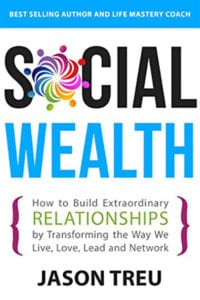
Social Wealth: How to Build Extraordinary Relationships By Transforming the Way We Live, Love, Lead and Network
Before I let you go, I want to ask you about your comment that curiosity is a requirement for long-term success and not short-term success. Can you give us the story around that?
One of the things I found in life is when you’re curious, you start asking questions. One of the things I saw was when I was speaking at a huge HR conference for the State of Maryland, one of the guests there was Buck Showalter who used to be the manager for the Baltimore Orioles when they were better. One of the things that he said that helped him manage, be successful, stay in Major League Baseball and do the things he did was he kept asking questions from people. He was curious on how things had to work.
When he went to Baltimore as a manager and the team wasn’t doing well, he brought them into the corporate office and showed them the ticket sales, walked in and said, “Everything that you do is connected. These people have to eat and feed their families. The phones aren’t ringing. If you don’t play on the field well and when you don’t care, look what happens to this as an entity. You have a responsibility to think bigger.” That’s because he got curious and he always talked about how he asked questions to other people in his managers, leaders and team before he jumped to a lot of conclusions.
When he was going to go recruit baseball players, he would go and meet their parents, their family and ask questions to other people about their character and other things even before the baseball questions came along. He said, “Today’s world of people is obsessed with analytics and everything else.” The difference isn’t there anymore. The difference is in the people, relationships and getting the most out of them and being curious. That’s something that can serve us all well. It’s consistently be curious and learn because that’s what life is all about.
What a great way to end. Jason, let people know how they can find you and your wonderful game card.
You can go on a website. It’s JasonTreu.com. You can get the cards at CardsAgainstMundanity.com and my books on Amazon and through the website. Coaching, teamwork, team building services and other things are on the website too.
You’ve inspired us to figure out new questions to ask and new ways to stay curious.
Thanks.
Important Links
- Jason Treu
- How to Get Coworkers to Like Each Other – Jason’s TEDx Talk
- Social Wealth
- Cards Against Mundanity
- Executive Breakthroughs – Jason’s Podcast
- TEDx Talk – John Livesay TEDx Talk
- Rock Bottom to Revenue Rockstar – John Livesay Article
- New York Times – Article
- Better Selling Through Storytelling Method Online Course
Wanna Host Your Own Podcast?
Click here to see how my friends at Podetize can help
Purchase John’s new book
John Livesay, The Pitch Whisperer
Share The Show
Did you enjoy the show? I’d love it if you subscribed today and left us a 5-star review!
- Click this link
- Click on the ‘Subscribe’ button below the artwork
- Go to the ‘Ratings and Reviews’ section
- Click on ‘Write a Review’
Love the show? Subscribe, rate, review, and share!
Join The Successful Pitch community today:
- JohnLivesay.com
- John Livesay Facebook
- John Livesay Twitter
- John Livesay LinkedIn
- John Livesay YouTube
Croissants Vs. Bagels: Building Meaningful Relationships with Robbie Samuels
Posted by John Livesay in podcast | 0 comments

Episode Summary
Interacting with others in different situations is not as easy as it seems because people vary. Robbie Samuels, a relationship-based business strategist, introduces us to the different ways people interact at events through his bestselling book called Croissants Vs. Bagels. Recognized as a “networking expert” by Inc., Harvard Business Review Ascend, and Lifehacker, Robbie redefines networking and encourages people to stop wasting their time networking and start building meaningful relationships instead. He discusses the three common complaints people have about networking, the downside of being a unicorn, and how to handle bagels versus croissants.
—
Listen To The Episode Here
Croissants Vs. Bagels: Building Meaningful Relationships with Robbie Samuels
Our guest is Robbie Samuels, who’s a keynote speaker and relationship-based business strategist. He’s been recognized as a networking expert by no less than Harvard Business Review and Lifehacker. He’s the author of the bestselling book, Croissants vs. Bagels: Strategic, Effective and Inclusive Networking at Conferences, and has been profiled in the Harvard Business Review, Forbes and Fast Company. His clients include associations in Corporate America like Marriott and General Assembly. He’s been featured in several books, one including Stand Out: How to Find Your Breakthrough Idea and Build a Following Around It by our mutual friend and former guest, Dorie Clark. He has guest lectured at many educational institutions including Harvard. He is the host of his own podcast called On the Schmooze, which features his network strategies. I’ve been lucky enough to be a guest on that. I couldn’t wait to have him on the show. Welcome, Robbie.
Thank you so much for having me, John.
I always like to ask my guest to take us back to their own story of origins and yours is going to be interesting. Were you an outgoing kid or were you shy? How did you get into being this expert in helping people connect and become networking?
I have never been accused of being a wallflower. I am very much an outgoing extrovert. I get energy from being around people. The way I got into this is that I was running a meetup group that grew to thousands of members and hosted hundreds of events. About a year in, I brought the regulars out for coffee and said, “What do you love about this space?” They told me how welcoming we were. They love coming back. They love the people they were meeting. I said, “I need you to be a clique that’s not cliquey.” They were like, “What does that mean?” I said, “Come fifteen minutes early. Greet people who arrive, help hand out name tags. We’ll do all those things. Wander the room and make sure people are comfortable.” That’s when I got a lot of deer in headlights because the people I was talking to, 70% to 80% of them were shy and/or introverted. It did not come naturally to them to do the thing that I was asking of them. Even though they loved the idea, it made them feel nervous. That’s where I did some one-on-one coaching. It led to me doing a workshop and that’s several years ago. That’s where this all grew out of, this idea of how do you create leadership qualities from folks that didn’t think they had it in them to have a host of mindset.
We want to be a clique but not be cliquey. I instantly thought of clicking on something. I bet you’re talking about cliques that used to form in high school, for example. You were either a jock or you were this or you’re that. What’s the inspiration for writing the book? Where did you get that great title?
[bctt tweet=”Think of yourself as being resource rich.” username=”John_Livesay”]
Croissants vs. Bagels is a concept of what I’ve been speaking on since almost the beginning. I had tested the idea through that group and Dorie Clark wrote about it in Stand Out. That was the piece that stood out for her. People started to ask her. When she would present on her books, she would have a slide about me, which she still does this. People would come up to her and say, “Does Robbie have a book?” I didn’t have a book. I’m also a speaker. It’s like a necessary requirement to have a book. I knew I had content, but I being an extrovert, didn’t find it easy to have the discipline to write down everything, sit quietly and do all of that.
Finally, I set a deadline. I had it done in July 2017. I was struggling with the title because that’s an important piece of this. I talked to Dorie and she said, “You have to call it Croissants vs. Bagels.” I was excited about the idea because it’s a concept that’s sticky. In case people reading are now curious, the bagels are those tight networking circles that are impossible to break into, those shoulder-to-shoulder huddle that we hate seeing at conferences and events. If you open up your body language, if you’re in that circle and you make space for others to join, you’re creating a croissant and it’s the croissants that we want to look for.
They’re a little softer, buttery, French, sophisticated and all that good stuff. A lot of people have a negative connotation around the word networking because they perceive it to be either a waste of time or a bunch of people pushing business cards on each other. How do you redefine it?
It’s interesting that you say that because there was a study by Northwestern and Harvard that determined that people do find it icky. It makes them feel dirty. The networking that study was testing was people who were thinking about it as a transactional piece like, “What can I get?” They were going in with a need. They were trying to get things. The people in that study who did not experience it in an icky factor where the senior executives because when they show up, they do not need things. They’re showing up to offer. They have all kinds of resources, referrals, connections, introductions, mentorship and budgets. They’re showing up resource-rich. I believe all of us can think of ourselves as resource-rich. We all have connections and opportunities to support each other. Even if you’re looking for a job, which is one of those moments when you do have a distinct need.
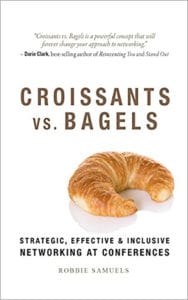
Croissants Vs. Bagels: Strategic, Effective, and Inclusive Networking at Conferences
It’s about finding the right job and the right fit. For the right hiring manager, you’re a dream. It’s about having that in you and thinking, “What’s my experience, passion and how do I present myself?” That is about having a solid pitch, like saying, “I need a job in nonprofit, rings no bells.” My database comes back to null. If you were clear with me about who you were, what your passions were, I could think of people to introduce you to. It’s a win-win for everyone. For me, it’s about relationship building. I want people to stop wasting their time networking and start building great relationships. Most of the time, people aren’t thinking about the real value of being present in a room with others.
Your book, Croissants vs. Bagels, you talk about three common complaints and nobody loves three problems and three solutions more than I do. Let’s attack that from that. The first complaint is meeting strangers is scary. Your solution to that is?
First, you should remember that your best friends started out as strangers. It’s a good reminder. If you think about it, you’ve already had some practice doing this. I’m also doing some research ahead of time so you know who to keep an eye out for what you might have in common with people, conversation starters, things that you can congratulate people on, compliment people on because you know a little bit what’s going on in their life. It makes them less scary, less of a stranger and more of someone that you haven’t met yet.
The second one, which is a big one for most people, is networking is exhausting. How do you help people not feel exhausted or even anticipate the exhaustion so that they avoid it?
This is definitely true for introverts. I could go for days meeting people. It doesn’t mean I’m effective. I might be hugging and air-kissing the whole room and not necessarily making the right connections. For introverts who need to think about how to manage their time and their energy in particular, it’s about knowing what you need to do in the time that you have. If I could tell an introvert, “If you dedicated an hour at the event, had all of your needs met, you did everything you need to do and you can go home after an hour, head held high, not feel like you’re slinking away, would you want to do that?” They’re like, “Yes.” I’m like, “There are a few hours with a prep that you’re going to do before you even get to the event. In that time that you do have the energy that you have, you’re super present. You know exactly who you want to talk to. You know what you’re going to talk about. That you’re not going to show up and hide in the corner. That hour is wasted and you could have stayed home and messaged the people on Facebook. If you don’t talk to people and you write them a message afterward, it’s not a follow-up message, it’s an email.
I love that you give people an exit strategy and that requires some preparation. People, especially if you’re introverted, would rather spend three hours preparing for who they want to talk to and meet and what they’re going to say. That one hour is limited and you can go, “I can survive anything for an hour.” The other big one is people think it’s a waste of time. You have a whole thing about let’s be strategic, which allows us to be effective. You also put in the word inclusive. How does that work so that we don’t waste time?
[bctt tweet=”There is a difference between collecting business cards vs. building relationships.” username=”John_Livesay”]
A lot of times when we head to a conference, which is one of the reasons I talked about that in the book is that we have the experience of going to conferences and organizing all the logistics to get there, travel, hotel, booking the ticket for the actual event. We’re not necessarily clear on the intentions we have around the event. In some way we’re going for the content, that’s what’s driving us to go. You can get content from the comfort and safety of your home. You don’t have to venture across the country to go meet people. If you’re going to do that, leave your house and go across the country, you should be there for connections, not content.
The wasting of our time is when we get to the end of a long weekend, if we’re a shy person, we may not have talked to many people and thought, “This was wasting my time. I’m exhausted.” If we’re outgoing, maybe we’d collect a stack of business cards, but we didn’t prioritize one over the other. They’re all like in a stack, which means they’re not going to be easy to follow-up with, which means we’re probably not going to follow-up, which means we’re thinking, “Whatever. This has wasted my time.” A lot of this is clear. Before you even get to the event, write your follow-up email draft. You’re not sending this to anyone. You are getting clear on why this event, in particular, out of all the events you could’ve gone to, who you’re trying to meet? What inspiration you’re looking for? What information you’re looking for? What can you offer this space?
What is the value that you’re bringing to the space? Write yourself a little draft now you’re going to personalize it when you get home. The other thing I suggest doing is on your calendar putting an hour after the event when you’re going to do the follow-up messages. If you have the draft and you’ve scheduled an hour, within two days of coming back from your event. During the event, you track the cards that were a higher priority conversation, maybe a little more in-depth, a little more engaged. Sometimes we’re standing in those tight bagels circles and someone starts handing out their card and everyone starts handing them out. It feels like you’re in a poker game.
Those shouldn’t have equal weight to the conversation you had for twenty minutes over lunch. I like to because we’re in Western culture, turn the corner of the cards that I want to keep track of. I always carry a pen. I like to jot a little note about the conversation. When I get home, I drop all the cards on the table, the ones that turn corners stand out to me. I have my draft. I have my time set aside. I’m likely to send the messages I need to. Everybody gets a LinkedIn invitation. Those small number of people will get a personalized email message as well. It won’t feel like a waste of time if we have some strategy, thoughtfulness and an intention before we even get there.
I love how you’re pre-loading and post-loading the whole concept. Creating a draft is so much easier to edit than starting from scratch that helps the momentum. If it doesn’t get scheduled, it doesn’t get done. The need to put that hour in a day or two after the event is crucial. One of your quotes in here that’s one of my favorites is “There’s a difference between collecting business cards and building relationships.” Can you give us a story of someone that you met at a convention that turned into a relationship and that paid off for both of you?

Building Meaningful Relationships: Being inclusive and being strategic are tied together.
I was at a big event in the Boston area where I live. It invited a lot of different sectors. It wasn’t nonprofit, business, government or education, it was all of them, which is one of the most difficult spaces to navigate. You’re trying to find your people. We were all there because we love the city. We were a part of this big campaign they were doing. I first told people, at the time I was working in nonprofit so people would turn and point, “No, you should meet so and so.” I’d say, “I do advocacy work.” They would point me to someone who does advocacy work. I’d say, “I do this kind of work.”
Someone said, “You should meet, she’s not here, let me tweet at her.” This guy tweets an introduction to this other woman, who I run into at an event months later, and me. That’s several years ago. We have done events together. She’s hired me. I’ve supported her work. She supported my work. What’s amazing is she wasn’t even in the room. All of that transpired because I was super clear on the people I was trying to meet and use part of that big picture, who I was looking for and assumed that everybody I was talking to was a connector. In some ways that’s true, some people are, but I knew that they knew at least one other person. I wanted an introduction to another person. I hope that I would leapfrog through the event to meet the people I truly needed to. That connection has absolutely paid off.
You talk about being effective once you already have your strategy in mind, but that strategy will only get us so far. What do you mean by that?
I also realized that I might not have talked about inclusion when you asked that question. I want to dovetail into that as well because being inclusive and being strategic are tied together. If you show up at the event and you do walk up to people, but the first thing out of your mouth is something off-putting, makes them feel like in other. Here’s an example that we’ve probably all heard at least if not said, “You’re tall. How tall are you?” If you’re over twelve years old, you should probably stop saying that. It could be about hair texture, skin color, heights, accents, names, things that people get commented on all day, every day. You’re not unique for having pointed out the obvious. That calling out differences is the thing that makes people feel like, “Do I belong here? I don’t feel like I fit. Am I welcome here?” It’s not doing you any good because they may have been a great connection, but you now have fallen into the trap of what everyone always says to them. They’re not going to think highly of you or want to stay engaged.
Inclusion is a strategy, which is why make the effort of going and talking to people and saying the thing that is off-putting? Calm that inner voice and as you get to know each other, I always think at some point maybe I’ll be like trading grandma recipes. I’ll talk to them about the thing that I had noticed or they’ll also be willing to ask me as well. We don’t want to lead with the obvious difference, but instead focusing on ways to engage people and welcome them into the space. That’s the part of the strategy and also the strategy of having your email draft ahead of time, talking to hosts and organizers, and asking for introductions. These are all things, getting there early so that you’re one of the people that everyone meets as they come.
[bctt tweet=”There is a difference between collecting business cards versus building relationships.” username=”John_Livesay”]
It can be a strategy taking on a host mindset so that as you greet people, I always think at a conference in the morning when they have coffee out. Everyone doesn’t know each other yet. They’re registered. There’s a cocktail table where you can lean with your coffee. I always stand at an empty table with my coffee. I look around and anybody who comes by, I wave them over. When I see someone trying to juggle their muffin and their coffee, I say, “Come here. You set it down right here.” Having that host’s mentality gives me an opportunity to talk to people that maybe I wouldn’t have otherwise. I do that at lunchtime. I’ll start a table and waving people over from the buffet. They don’t seem like they have a place to go. For me, it means that I’m going to have interesting conversations that I may not have had the opportunity to do so.
I love what you said about to generate the host table. I would have to say, even for myself, when I’m at those events, I tend to look for a seat that’s open at a table that already has people versus I’m going to sit by myself and try to get people to join me. If nobody does, I feel like a loser. You have a different mindset. You’re like, “No, start your own table, be a host and start inviting people over.”
If you are nervous and wondering where to be in, there are people who are even more nervous is my thought. To me, I also keep an eye out for the demographic outliers as well as the physical outliers. The physical outliers are the wallflowers. If it’s your first time attending the event, I don’t recommend going and talking to wallflowers because even though it may be a great conversation, it’s going to be a super awkward ending because they don’t know anyone and you don’t know anyone. You might be like, “John, it was nice talking to you. I’m going to go to the restroom.” You’re like, “Great talking to you too. That’s a good idea. I’ll join you.” You’re like, “I was trying to get out of this conversation.” If you’re new, go and find the openings in the large groups. For someone who’s been going a few times, it’s a nice thing to go over to the people on the sides of the room and bring them in. Similarly demographic outliers, someone who’s much older or much younger, people of color in mostly white space like going and engage the person who is visibly a little different and helping them feel engaged, not othered is a nice way to continue that host mindset.
Do you have any other graceful exit strategies besides, “Excuse me, I have to go get a drink or go to the bathroom?”
My favorite way to end a conversation is dependent on whether I’m new there or I know a lot of people. If I’m new I’ll say, “I don’t know that many people here. Is there anyone you think I should meet?” Usually, there’s a little bit of brainstorming because they know a little bit about me from the conversation we’ve had. I’ll be like, “That sounds great. Would you make an introduction? Would you introduce me?” Generally, that’s like, “I see them over there.” They walk me over and I get the introduction. I thank them. They can either stay with the conversation or they mostly wander off to do their own thing. Now I had been holding my hand over to that space. I am not left to stand by myself.

Building Meaningful Relationships: It’s exhausting to be a unicorn because you get all these pestering curious questions that make you feel like you’re under a magnifying glass.
The other thing I will tell you, John, is to make a note of how many people are in the circle with you. If there’s a three or four or more and you want to step away, you murmur something. You’re like, “I’m going to go,” you’re going to tap out. You’re like, “Let the person next to you know.” If there are three and one person leaves and it’s not you, now there’s two. When there’s two, you have to think are you inviting someone over? Are you coming up with some elaborate thing? Are you introducing them? Are they introducing you? Part of this is you leave before it’s time. You leave a conversation while it’s still got a lot of energy and makes them want to come and talk to you again. That’s another piece of this.
I have that philosophy with parties too, do not be the last person there when the host is saying, “We’re out of booze.” You talk about being inclusive and that there’s a downside to being a unicorn. Can you first define what a unicorn is? What is the downside?
You’ve heard probably the phrase “Always be yourself unless you can be a unicorn and always be a unicorn.” If you’re picturing what would a day as a unicorn be like? Is it rainbows and sunny skies? It’s probably more like, “A unicorn, I’ve never met a unicorn. Can I touch your?” All these intrusive, curious questions. A unicorn in this example are people who have that difference. It’s visible. They’re in a room that others are coming up to them and be like, “Can I touch your, can I ask you about this? I like your accent.” It can be exciting to be a unicorn, but sometimes it’s exhausting to be a unicorn because you get all these pestering curious questions that make you feel like you’re under a magnifying glass. In some ways, people are like, “I want to examine you.” That’s the downside. We’ve all experienced this to some degree or another. Some of us look like the people in the room more often than not. We also have had moments of being like, “I’m definitely the only blank here. How am I going to find people like me?”
We should call upon that to remind ourselves what it’s like to be in that space. That energy can be used to create a space where people can show up and bring more of their full selves. To clarify this for your audience, it’s not about the difference. A compliment is about something that they have chosen versus who they are. If someone has sunglasses on, a scarf, a piece of jewelry or an awesome jacket, those are compliments saying something nice. A guy has a tie that matches his shirt like a subtle connection. I love that. My dad taught me if you pick up a subtle color and a tie to match this color. I’m like, “You’ve got the style. Where do you shop?” That’s a compliment. If I said to the same guy, “You’re tall. How tall are you?” It’s not a compliment. It’s an observation and one they’ve heard before.
When you’re talking about fashion, I used to sell advertising for W Magazine, a fashion magazine. There was a phrase we had about the readers. It was, “Everyone puts on clothes, but not everyone gets dressed.” The people who read this magazine get dressed. That’s a fun way to compliment somebody who’s looking dapper, whether they’re male or female and say, “You got dressed, didn’t you?” I know you referenced that line and that’s a fun, unique way to connect with someone. Since you’re talking about your dad and you are a dad, do you have any tips for parents who might find that their child is a little introverted in school or in social situations?
[bctt tweet=”We don’t have to be extraordinarily outgoing or an extrovert to succeed.” username=”John_Livesay”]
It’s about finding those strength and working towards that. We put a lot of pressure on ourselves, our children and on each other to be something that we may not. Maybe they’re not the most outgoing kid, but what do they enjoy? If they enjoy it, they’ll put energy into it. They may find leadership doing that thing which they enjoy. Leadership is something that they will take the rest of their life. They don’t have to be extraordinarily outgoing or an extrovert to succeed. There are a ton of examples of people who are quite introverted that have been enormously huge impacts on our lives and our culture. Rather than trying to make them into something that they’re not, that they feel bad about, you can perform being more outgoing. A lot of people have adapted and learn how to do that, but it’s exhausting and not very fulfilling. Instead, guide them towards the things in which they feel good about, they can excel at and help them find leadership opportunities within that space, which will give them the confidence they need to make great decisions going on in life. That’s what I hope to do for my kids is hear them and listen to what they say as opposed to trying to make them the image in which I have for them. That’s difficult as a parent, but I think it’s a good idea to have that goal.
What I find interesting is when you try to force yourself or a child to be something you’re not is exhausting. If you do the old way of networking, that’s exhausting. If you are your authentic self, you’re energized, whether you’re in a networking situation or interacting with anybody. That’s a nice little barometer to see if you’re in the zone or not. You give these great keynotes about the art of the schmooze. Who’s your favorite audience to give this to?
My favorite audience is women at a Women’s Leadership Summit. I’ve gotten invited. I feel privileged to have been invited into that space a few times, maybe a half dozen times. It’s such a pleasure. The work that I do and how I speak about it resonates. My ideal coaching clients are entrepreneurial women in their 50s and 60s. It resonates with the corporate audience as well. Even using the word exhausted, that’s definitely a word women would use more than men for how the experience is. I’ll also make jokes and one of my earliest podcast episodes and blog posts was titled When Will Women Win the Right to Pockets?. You haven’t ever had to think about pockets then that’s a privilege in itself because women struggle with this all the time when they’re trying to get dressed in a nice way, they often have to sacrifice practical things like pockets.
The fact that I comment on that, have strategies for that, and I say things like, “It’s important to wear layers because the room is going to be freezing. The men are wearing suit coats.” The temperature is set for them. You’re in a sleeveless dress. You might want to bring something. They’re so appreciative that I’m naming that reality. I’m giving them tangible things that they can take action on. It’s not asking them to be anything other than who they are that I’m not asking them to reach outside of that. Now it’s outside their comfort zone to some degree to do some of this, but I’m not asking them to be someone else.
How do you develop such empathy for women in their 50s and 60s?

Building Meaningful Relationships: We need to be leveraging, reviewing, and rekindling connections with people that we’ve met.
I am 45 so I am closer to that than I look perhaps. I’m also an out trans guy so I would socialize as a girl and into being a woman. I have a better understanding of that space. It also comes with the empathy I have around introverts and shy people. I’ve never been those things and yet I can still put myself in that place and appreciate where they’re coming from. I learned a lot about being a leader is often about taking a step back. I learned that by having great people around me that I wanted to listen to. If I didn’t make space for them, they wouldn’t be heard. For me, it’s been a real practice.
The reason I love working with these women is that they’re motivated. They’re at a time in their life where they want more. They’re ready to take their business to the next level, but they also have a lot of trepidation about how to do it and feel like they’re starting over. They’re a novice when they’ve got 30 plus years of experience in the world. They forget about that. They, in particular, forget that they have a professional network that will support them in whatever the next level or transition of their business is. That’s my goal is relationship-based business strategies. They do not have to start from scratch. This is not scientific but 80% of who you need to know to be successful, I believe you’ve already met.
That’s such an a-ha moment for people. First of all, it keeps it from being so overwhelming. You think, “How is it that I’ve already met this person? I haven’t thought of asking him the right question or who else they might know?” All those things take it from this overwhelming, exhausting mindset into, “I have to think about who I’ve already met.” That’s a very different proposition.
It changes what networking is because we usually think of networking as having to meet new people. That’s only about 20% of what we needed to be doing. We need to be leveraging, reviewing and rekindling connections with people that we’ve met. It could be someone from five and ten years ago that you used to work with. If you would be happy to hear from them, you should be reaching out to them. If you’d be like, “It’d be so cool to hear from them again.” I do exercises where I have my clients brainstorm twenty names of those kinds of people without any connection to the work they’re doing or how it might benefit them.
Get in the habit of reconnecting because when you do make a great connection, you’ll already have the systems in place to schedule it. You’ll know how to do a Zoom call. You might have scheduling software to make it super easy. You’ll have the mindset to say, “Let’s follow up and make this happen.” When you go to a conference, it’s more likely you’ll follow up when you’re at a meeting when you meet someone at a restaurant. It doesn’t matter where you are. You have some of the habits around that set in place. It is habit forming. We have to get into the practice of our lives.
If you have one last tip you want to leave us with about how to handle bagels versus croissants, what would it be?
When you come into the room, look for the croissants. If you haven’t done the prep, if you haven’t prewritten your email follow up message and you haven’t thought about this space, take that as the moment to do it. If you remember to look for the croissants that will have a networking moment happen a little bit of strategy session with yourself, “Why am I here? Who do I want to meet?” Even that momentary pause before you go into the room can absolutely set some intentions that will create great outcomes. I look for the croissants.
What a great takeaway message. It’s visual, it’s sticky and it reminds you to be one yourself the next time you’re at an event and help other people. Robbie, thanks so much for being a guest on the show. The book is Croissants vs. Bagels. If you want to learn more about Robbie, go to his website, RobbieSamuels.com. Thanks again, Robbie.
Thank you.
Links Mentioned:
- Croissants vs. Bagels: Strategic, Effective and Inclusive Networking at Conferences
- Stand Out: How to Find Your Breakthrough Idea and Build a Following Around It
- Dorie Clark – Past episode
- On the Schmooze
- When Will Women Win the Right to Pockets? – Past episode of On the Schmooze
- RobbieSamuels.com
- www.RobbieSamuels.com/TSP
- https://www.Amazon.com/Croissants-vs-Bagels-Networking-Conferences-ebook/dp/B0746TDZRY/ref=sr_1_fkmrnull_1?keywords=croissants+vs+bagels&qid=1558121830&s=gateway&sr=8-1-fkmrnull
Wanna Host Your Own Podcast?
Click here to see how my friends at Brandcasting You can help
Get your FREE Sneak Peek of John’s new book Better Selling Through Storytelling
John Livesay, The Pitch Whisperer
Share The Show
Did you enjoy the show? I’d love it if you subscribed today and left us a 5-star review!
-
- Click this link
- Click on the ‘Subscribe’ button below the artwork
- Go to the ‘Ratings and Reviews’ section
- Click on ‘Write a Review’
When Science Meets Tech, Lives Are Saved With Jay Goth
Posted by John Livesay in podcast | 0 comments


Episode Summary
 Jay Goth is a fund manager here in the Los Angeles area. He talks about how being direct and specific can get you to a yes or a no in 30 seconds rather than waiting 30 days for an answer. He shares a lot of tips on how to pitch whether for a startup or for a fund. He also shares the exciting things happening in the biotech startup industry, showing that when science meets tech, lives are saved.
Listen To The Episode Here
When Science Meets Tech, Lives Are Saved With Jay Goth
Hello and welcome to The Successful Pitch. Today’s guest is Jay Goth who is a fund manager here in the Los Angeles area. He has always been an entrepreneur and enjoy the success of building large companies. After years of being a consultant and an investment banker, an entrepreneur in resident, a nonprofit director, basically a cheerleader for the startup community, he is now forming a fund where he comes up with new discoveries that literally save lives, reduce treatment costs and eliminate unnecessary surgeries and reduce human suffering. How great is that? He’s going to be a different kind of venture capitalist he says. Instead of raising money and looking for special companies, he works with a core portfolio companies to create new investment opportunities. Jay, welcome to the show. My Goodness, I love what you’re doing.
Thanks, John. I’m having a blast.
I bet. Before you became such a maverick in saving and changing the world, can you talk us back to your early days? I know you graduated from University of Colorado in Boulder. From there, you worked for some energy companies and solar. You’ve always been at the cutting edge of technology it looks like to me.
I’ve always been an entrepreneur. I started basically right out of high school, working for myself. I never really got along with bosses too well. It was the entrepreneurial life for me. Back in the 90s, after being in insurance and real estate, trying all kinds of different things, I started raising money for other people. I was terrible at it. I made a lot of friends and zero investors and learned that sometimes you don’t want friends, you want investors.
Interesting. Let’s do a deeper dive into that. People always learn so much when people are willing to talk about what didn’t work as much as what did work. What do you mean by that? You can’t be friends with the investors or you were just too focused on the relationship and not what they needed for a return?
I wanted to be friends with everybody. Sometimes when you’re getting people to write you a check, you can’t quite be so friendly. You have to take control of the situation. Initially, I generated a lot of leads. I was one of the best lead opening people anywhere I worked. The problem was I wasn’t closing people because I wasn’t really taking control. I was just ceding control over to them and they’d always give me some excuse and I wouldn’t nail them on it. I’d just go ahead and go with the flow.
Jay, I think this is so valuable. I’ve never had anybody in over 90 episodes talk about this. I’m really happy you brought this up. So many times, people get the polite no. “Come back when you have more traction. You’re too early in the market.” Or whatever the excuse is. They never get a yes. I like to say that the longest distance sometimes is between someone’s mouths and their wallet. Give us some techniques or ideas that people can use to not just take the first no.

Science Meets Tech: “I’m looking for investors who are interested in this and are willing to write a check. Is that you?”
It’s really a basic thing, asking for the order. A lot of times, we beat around the bushes. “I’d love to see you as an investor,” or this or that. What I learned is that if I start my conversation with a prospective investor, right up front, “I’m looking for investors who are interested in this and are willing to write a check. Is that you?” I was always afraid to do that. When you start that way, then all of a sudden their guard comes down a little bit. I’m not one of the guys that’s sitting there, calling them, beating around the bush. I’m a real person asking him if he’s interested in making the investment. It’s just as easy to get to no in 30 seconds as it is to get to no in 30 days.
It saves a lot of time when you’re that specific and that direct.
Right.
I love it. Let’s take a dive into what you did at Red Tail Capital. I’m interested to know what lessons you learned from that and what types of things you’re invested in.
Red Tail Capital was an investment banking operation. I was really working on mergers and acquisitions, did some debt financing for people. Really, where I learned how to pitch and the things I learned were really when I started a company called Commonwealth Energy back in the late 90s. I was one of the founding fathers of this company. Basically what had happened is we were looking for investors for a number of other companies. Every time we raised money for one of these other companies, they would blow it. They would take the money and they wouldn’t spend it the way they should and they would be coming back to us looking for more money. Our investors weren’t happen with us and we weren’t happy with the management teams. Finally, we decided, why don’t we just raise money for ourselves? With saw an opportunity in the energy deregulation here in California in the late 90s. We built a company called Commonwealth Energy and we started raising money for ourselves. John, we raised $60 million from 1500 private investors over the course of a couple of years.
Holy cow. What was the average investment to get such a large number?
We were doing it under a special California exemption so that we were using California investors and California companies. We were able to get in people who wouldn’t qualify under the “accredited” investor status. There are some looser regulations for those. We were able to get in a lot of people. The minimum investment was $10,000 but sometimes we’d package one or two investors together if they were qualified. Like I say, we raised a lot of money, but the best thing about it was we actually built a business. We build something that became the largest unregulated supplier of electricity and natural gas in the country. Ran the revenues to up to close to half a million dollars and went public on the American Stock Exchange.
Congratulations. That’s a great exit.
Yeah. All of our investors did well. It was the greatest ride of my life, I’ll tell you. That was about four years of just nonstop excitement. There were times when we thought we were going to lose everything. There were times that we were just really riding high. Of course you get to a point in the company where the entrepreneurs leave and the professional management team comes in. That’s what happened. When I left that, I went into consulting and started doing all kinds of things. The core things I learned when I was raising capital at Commonwealth Energy have always remained in my mind. There were some very simple steps that I found that were taught to me that really can help. You get to a yes a lot faster.
Please share those steps.
The first thing you want to do when you’re talking to a potential investor is you don’t want to tell them a long elaborate story because the longer your story the more confused they get.
That’s a great line. The longer your story, the more confused they get.
[Tweet “Science Meets Tech: The longer your story when pitching, the more you confuse investors.”]
A confused investor never invests.
That’s right.

Science Meets Tech: Get three yeses and then ask for the order.
We would give them a very general idea of what we were doing. Of course you have to frame it in the right way so that it sounds really good. Then we would ask them a couple of very leading questions. Something like, “The pharmaceutical market is a multi-billion dollar industry. If you were come out with a blockbuster drug, don’t you agree that there’d be a lot of money to be made?” You’re asking them questions that they almost have to say yes to. The adage that I was taught was three yeses and ask for the order. You would ask them, “Blah, blah, blah, right?” They would go, “Yeah, that makes sense.” You would ask them something else and they go, “That makes sense.” You’d ask them the third thing and as soon as they agreed with you, you’d say, “Here’s what I suggest we do. Why don’t we go ahead and put you down for an investment?” Right away, you’re taking their temperature. Of course usually they’re going to come up with an objection. “I don’t know about that.” “Let’s just get a gauge of where you’re at, what you would feel comfortable in. If everything I tell you is borne out in writing when I send you all the information that you’re going to have to review before you make the investment decision, how much would invest at this point?”
Nice. Because you’re basically becoming copilot with them and saying, “We’re going to land the plane. We’ve agreed that if everything works, the landing gear goes down and everything in due diligence checks out, that you’re going to write a check.”
Exactly. If they said, “No, I’m not going to write a check.” I say, “No matter what I send you, you’re not going to invest, right?” If they said yes then we’re at zero and it’s a good time for us to shake hands and part friends. Go find somebody who is going to write a check.
[Tweet “Science Meets Tech: Be specific and direct when you pitch.”]
There’s nothing worse in my opinion Jay, than the maybe or let me think about it. That just drags everything out. Like you said, you can get an answer in 30 seconds instead of 30 days by being specific and direct. I love it. You are no longer pitching for money because you’re on the other side of the table now.
Wrong, you’re wrong. I still have to raise money for my fund.
You’re listening to pitches and pitching. What’s the difference between pitching for money for a fund versus pitching to get a startup funded?
There’s absolutely no difference. Whenever you’re asking somebody to write a check to somebody they don’t know, to do something, it’s always a difficult situation. It’s never easy. Whether you’re a startup, a fund, an established company. I’ve worked with public companies before. It’s always the same question. What do you do? How do you make money? How am I going to make money as an investor? When am I going to see it? Those are really the things they want to know. There are a couple of different ways you can approach investing. With the biotech, I’m always talking about the greater good, I’m talking about saving lives, speeding innovation to market and really making a difference in all the people that are suffering today that don’t need to if only we can get them the right drug at the right time in the right dose. That’s what I do. That’s what gets me all fired up about biotech. As much fun as I had at Commonwealth Energy, it’s nothing compared to the rollercoaster I’m on right now.
Let’s just quickly recap. There’s such great questions that you just gave us that you could ask when you’re pitching, whether it’s to raise money for a fund or a startup. The first one I think you said was, how do you make money? One of them is, how do I, as an investor, make money? Correct?
Right.
In other words, what’s your exit strategy? In the case of a fund, I would assume that somebody gives you money for you fund, they make money when one of the companies that you fund that they also own goes public or gets sold, correct? There’s some strategy there that eventually there’ll be an exit for them to make a big return.
In a fund, it’s a little different because we’re investing in a number of companies. It’s not just one. You’re a little more diversified so your risk may be a little lower because if one doesn’t hit maybe another one will. At the same time, we’re a very specially focused, special purpose fund. We’re not out there, I’m not looking for the next investment. I’m helping actually produce the next investment. What we’ve been able to do is put together three core companies that I call our consortium or eco system if you’re in the west coast. I know east coasters don’t like that. Basically, these companies work synergistically to develop new intellectual property assets that we can then package into a new company and take to market. I’m very involved in funding these three companies to keep them going. At the same time, I’m really more focused on these new assets that we’re developing because these are the things that are going to be game changers in the medical industry.
What do you look for when somebody comes to pitch you to fund their medical biotech startup? Are you looking more at the team and their background? Are you looking at their passion for making a difference in the world or that they have a business plan? What is your criteria?
I think if you talk to investors, and I talk to them all the time, the number one thing that we always look for is management. We want to see somebody who has successfully been able to do what they tell me they’re going to do now. When I tell somebody that I started a company and we took it public, I have a little bit of credibility compared to somebody who says, “I started a company and it never really got off the ground.” I’ve done that too, believe me. You’re not an entrepreneur if you haven’t had a couple of spectacular failures. I’ve got those. Really, the management team has to be able to execute.
[Tweet “Science Meets Tech: Show that your team can execute the idea better than anyone.”]
You have two risks in biotech I think. One is the execution risk. That’s the management team. That’s the group of people that are going to make this happen. In biotech, so many times you see a great management team of scientists but you’re missing a business element. A lot of times when I see a biotech deal and I see a bunch of doctors and scientists, I’ll say, “This is all great, but who’s going to make the business part happen?” They’re like, “We all run our own operations. We understand business.” I say, “No, this is a whole different thing.” You got to talk about marketing, scaling, operations. There’s just a lot more involved than simple research. You’re translating a product that you’ve developed in a lab to a commercial product. Management is key.
Number two in biotech is really a regulatory risk. Is the FDA going to approve this or not? One out of ten drugs that starts in the clinical trial process actually makes it to becoming a drug. It takes over ten years and a billion dollars. When you’ve got that risk, that’s a very low success rate. You really got to look at how can we maximize the opportunity and increase the possibility that you’re going to get through clinical trials. Fortunately, that’s one of the things one of my portfolio companies does, is you can actually tell in advance who will respond to a drug and who won’t. So when we go in to clinical trials, we’ll be able to tell what our efficacy rate is going to be ahead of time.
One of the things I’m really interested to hear about Jay, is not only do you give money but you roll up your sleeves and get in the trenches and help these companies be successful. That’s so important.
I think a lot of venture capitalists say that they do that. To an extent, as much as they can, they do. That’s why I kept my fund size very small. I’m not looking for a whole bunch of companies. I really want to help make this happen. I’m intricately involved in all aspects of the companies’ operations, even though I don’t hold a management position and I don’t hold any vote. We do have governance positions where we can take an oversight look at the thing. Really, the key to me is if I want my investors to be happy, I got to make their investment spectacularly successful. What can I do to make that successful?
What are you working on now that you can share that you’re excited about?

Science Meets Tech: We’re coming up with a liquid biopsy that will actually just use a little bit of your blood.
We have a diagnostic that we plan on bringing to market very soon. Right now, if you get a CAT scan of your lung because you’ve had this cough for a long time and you look at the lung and there’s a mass in there, you don’t know what it is. The first thing you do is do a needle biopsy. Go in and you actually pull a piece of that mass out to see if it’s cancerous or benign or what it is. We’re coming up with a liquid biopsy that will actually just use a little bit of your blood from your arm and be able to tell with 100% accuracy whether that mass is benign or cancerous.
Wow. Early detection is everything. To make it so non-invasive is really exciting.
That’s the key. This was actually developed by a surgeon who didn’t want to do unnecessary biopsies. This is just one of the exciting things. We’ve ran the tests on 282 patients and it came out 100% accurate. We’ve done a couple of other tests for validation and they both came back with the same high accuracy rate. We’re really looking at moving this out to the market next year.
What do you do in terms of worrying about barrier to entry from competition?
The competition in the biotech sector is just super intense. Everybody you talk to knows somebody who’s working on something. I was at a conference yesterday and I must have talked to 20 people who are working on exciting biotech things. Some of them overlapped, some of them didn’t. I just talked to a gentleman today on the phone. I thought I was pitching him for an investment. It turns out he was pitching me for an investment. He’s running a diagnostics company and I’m running a fund that funds diagnostic companies. Who knows, we may be able to do something together. There’s just so much competition in the space.
What do you do about barriers to entry? We actually have a very strong intellectual property attorney. The companies have formed a relationship with a gentleman who is one of the top biological attorneys in the country when it comes to intellectual property. You want to not only protect the IP that you’ve developed, but you also want to protect how you got to that IP, what kind of strategies you need to employ to make sure nobody else can say, “We found something that’s very similar and we can use it.” Because you want to walk it up as long as you can from a greedy capitalist standpoint, but at the same time, when you’re looking at intellectual property like this, the research and dollars that go into generating it are so huge that you’ve got to be able to get your money back.

Science Meets Tech: I think what we’re going to see is this turn towards what I call precision medicine
I think, and this is me putting on my political hat a little bit, but I think the FDA is starting to take a different approach to how they look at things. They still want to maintain safety and efficacy, which is the most important thing, making sure people don’t get hurt by a drug and making sure that people are helped by a drug. I think what we’re going to see is this turn towards what I call precision medicine. That’s generally the term. You can call it personalized medicine or individual medicine. Really, we take a little bit more time before we do a diagnosis and treatment. We look at your individual human biology. We look deep into your biology to figure out, “Just because you have diabetes doesn’t mean that your diabetes is as advanced as the next guy’s diabetes and what works for him may not work for you. Why don’t we design a treatment based around you as a specific individual?”
I think we’re going there and I think that this is going to actually end up, even though drug makers won’t be selling as much of a drug because we’d be prescribing different things, I think they can actually, because the drug is going to be working, we’re going to go to a pay for performance model eventually. If I prescriber a drug for you and it doesn’t work, that drug maker is not going to get compensated.
It also sounds like we’re really going into this whole specialized, customized dosage and everything else. It’s much like marketing is very specific and customized, that medicine is going to become the same way. I love it. What impact is artificial intelligence having on medicine and what you’re doing?
It’s a good question. One of the things that we have is a bio informatics engine. It’s not artificial intelligence per se but it’s a whole new way of looking at math. We have a laboratory in Pennsylvania that we’re building right now that will be able to generate 250 million data points off of one single tissue sample. It’s looking at human tissue at a whole different way because it’s looking not only at the genetics but at the proteins, at the lipids and all of the different things that make up that little tissue sample. If you have 250 million things that you know about this sample and you’re trying to find out what is the reason for a specific outcome, why is this a diseased tissue versus a normal tissue, or whatever it is, and you have a dozen different tissue samples, 250 million times a dozen.
These data points are interacting with each other to cause whatever the problem is that you’re looking at, that’s a huge mathematical problem. A lot of people have tried applying artificial intelligence, machine learning, support vector machines, all these advanced ways of looking at math. Nobody has really been able to hit the nail on the head. Luckily I found a company that actually has done that with a whole new way of looking at math. It’s very cool. It’s almost like evolutionary math where the data actually fights itself out to find out who the victor is at the end of the day.
I love it.
It’s really cool stuff. We’re seeing all kinds of advancements. I think it’s this marriage of science and technology that is really causing a revolution in the medical industry right now. We’re right at the beginning of it. It’s very exciting.
[Tweet “Science Meets Tech: It’s causing a revolution in the medical industry.”]
Do you think the result of medicine and technology joining forces is that people will be living longer?
Absolutely. I hear people saying we’ll all be living to 150. The people who are born in the 2020s will be living to 150. I firmly believe it. The application of technology to medicine is allowing us to learn so much more about the human body and how it really interacts and what causes aging. Aging is simply our cells being unable to reproduce themselves the way they did when we were young. Because our bodies are always replenishing itself. We’re always rebuilding our cells. We start losing the ability to rebuild them properly. Why is that? There are some incredibly intelligent people who are looking at that right now, everyone from Craig Venter at Human Longevity to Dr. Michael Rose at the University of California Irvine. You name it. There’s just so many people doing this. There’s no way we’re not going to be able to live not only longer but better lives longer.
The impact that’s going to have on population growth and crowding and people not retiring at a certain age anymore, it’s all just going to be fascinating to watch.
You’re right. It’s going to be pretty incredible. Love being in the catbird seat, being able to watch all this stuff unfold.

How to Be a Power Connector: The 5+50+100 Rule for Turning Your Business Network into Profits
I bet. Is there a book that you would recommend someone who is interested in getting in getting their startup funded or learning to be a better entrepreneur or just learning about how to live a better life that you want to give a shout out to?
I’ll say two. One is self-serving because there’s a lady out there that I’ve met recently that I really love what she has to say and the way she’s able to connect people. You know her very well. Judy Robinett. How to be a Power Connector is killer. I hear she’s coming out with a new book soon. That’s one. When it comes to pitching and doing stuff, you’ve probably had people recommend this book before. Oren Klaff has a book called Pitch Anything that is just out of this world. I’ve read that probably 50 times and I’ll probably read it another 50 because I just love his approach.

Pitch Anything: An Innovative Method for Presenting, Persuading, and Winning the Deal
It’s all about how the brain works and framing everything. It’s really well done. I love it as well. Fantastic. Jay, how can people stay in touch with you on social media, your Twitter handle, all that good stuff?
The name of my fund is Forentis Fund. We have Facebook, Twitter, LinkedIn. Feel free to hit me up there. We post regularly whenever I see something cool in precision medicine. We’re always posting news up there and of course our own stuff. It’s a good way to stay in touch with me. I’m at Forentis.com. If anyone ever wants to get in touch with me, you can reach me right through the website.
Fantastic, Jay. You’ve been a great guest. I love your passion. I love that you have so many great tips on how to be successful and have a successful exit and making a difference all at the same time. Thanks so much for being on the show.
Thanks for having me, John. I really enjoyed it.
Me too. Bye.
Bye.
Links Mentioned
- J Robinett Enterprises
- John Livesay Funding Strategist
- Forentis Fund
- Forentis Fund Facebook
- Forentis Fund Twitter
- Forentis Fund LinkedIn
Crack The Funding Code!
Register now for the free webinar
Fox 11 News Los Angeles John Livesay The Successful Pitch book
Share The Show
Did you enjoy the show? I’d love it if you subscribed today and left us a 5-star review!
-
- Click this link
- Click on the ‘Subscribe’ button below the artwork
- Go to the ‘Ratings and Reviews’ section
- Click on ‘Write a Review’