

Selling To The Point With Jeff Lipsius
Posted by John Livesay in podcast | 0 comments
 Episode Summary:
In a field as competitive as sales, earning high commissions is top priority. Jeff Lipsius is the president and founder of Selling to the Point, which is a sales training and consulting umbrella platform. He developed Selling to the Point sales training during his 30 years of sales training experience. Back in the late ‘70s, he pioneered inside selling for the natural foods industry, successfully training the first sales force of this type in that industry. As a result, Jeff’s sales model is now being used by many natural food industry brands. Learn how to cultivate great relationships and enjoy your career as a salesperson – the Jeff Lipsius way.
—
Our guest on The Successful Pitch is Jeff Lipsius, who is the author of Selling to the Point. He has some great insights about internal conversations and internal confidence and internal choices and internal clarity that need to happen because most people are so focused on the external. He says, “What’s going on is they can’t hear you over your sales pitch,” and the best way to stop pitching is to start listening. Once you start listening, you learn by observing and when that happens, you get less distractions and your performance soars.
Listen To The Episode Here
Selling To The Point With Jeff Lipsius
Our guest is Jeff Lipsius, who is the President and Founder of Selling to the Point, which is a book and a sales training and consulting umbrella platform. He developed Selling to the Point sales training during his 30 years of sales training experience. Back in the late ‘70s, he pioneered inside selling for the natural foods industry and trained the first salesforce of this type in that industry. As a result of that success, his sales model is now being used by many natural food industry brands. He’s trained over a hundred sales people, both inside and outside, as well as sales trainers throughout his career, and the sales people that have been trained by Jeff are some of the highest commission earners in their industries. They are also able to cultivate great relationships and enjoy their career as salespeople and having been a former salesperson myself, I know how important it is to enjoy what you’re doing in order to be successful. The thing that stands out for me is that the salespeople who’ve been fortunate enough to be trained by Jeff have cumulatively sold over a billion dollars worth of products. Jeff, welcome to the show.
Thank you, John. Thank you for having me.
I’m always interested to ask my guests to tell us their own story of origin. You’ve been doing this for quite awhile and you weren’t always a sales expert. Would you mind taking us back to the days when you were working as sales and marketing manager for an allergy research group and how did you decide that you are going to become who you are?
Way back when, even in college when I was discovering who I was, the real theme would have to be applying conscious awareness to performance. These days a lot of people are talking about mindfulness and conscious workplace practices, but I was a little ahead of the curve. When I was nineteen years old still in college, I was pursuing a way to be able to be more conscious on the tennis court and play better tennis matches. I was a college team player and what I found was that as I became more conscious, in other words, as I put my state of mind in a more aware place, I was able to play better tennis and actually practice my state of mind to get mentally tougher on the court. Later, in my professional career, I decided to try the same thing. What if I was consciously aware during my sales performances, during my interactions with my customer? It was a mindfulness approach because I’m a mediator. You put the ego mind aside and focus on the customer and the interaction as it was rather than the distraction of, “Is this going well for me? Is this not going well for me? Do they think I’m smart? Do they think like me?” They were all distracting from what’s taking place in the interaction I discovered.
What that revealed was a second conversation taking place at the same time I was talking to my customer. It would affect the relationship. This second conversation is the internal buying conversation between my customers ears and as I would say one thing which is you could say conversation A, my external conversation with my customer, the customer would hear something uniquely different. They would assign a meaning to what I’m saying and come up with a whole different interpretation that I needed to know. Putting my distracting thoughts aside and really paying attention to the customer, I could begin to discern how the customer is receiving what I’m saying and lo and behold, I felt that was much more important because the goal of selling is buying.
[Tweet “Ask intriguing questions to get attention”]
Nobody’s going to give you credit for, “That was an incredible presentation, but nobody bought,” is what you’re saying there.
You, as a salesperson, don’t get a sale unless the customer decides you’re going to get that sale. It’s really the decision process that determines the salesperson’s success. The way I put it is a good salesperson is going to pay more attention to their customers buying performance, their salespersons’ selling performance.
In the world of startups, for example, if you’re pitching an investor and you’re trying to get that investor to “buy your vision and invest in your company,” then you would be smart to do what Jeff is suggesting, which is to look at what other types of companies that investor has “bought into and invested in.” When I was selling ads for Condé Nast, I would call on brands like Lexus and I would look at where else did Lexus by so that I can get a sense of what their past buying performances is as a criteria that might help me decide, “They liked that. If I can come up with something similar to that, then that might help me with their criteria to buy from me.
That helps when you have a background in the prospect’s buying performance, buying patterns, but I’ll take it one step further. You might have all that background and see that there is a certain type of buying style that this customer has, which is great. What I’m saying though is don’t be wedded to it. Don’t try to steer the conversation to mimic what you’ve learned because who knows? Maybe they had a bad cup of coffee that morning and they’re in a horrible mood. They’re not going to act today the way they normally would under other circumstances. You don’t know that until you begin paying attention at the moment to exactly how things are as it is and the awareness is going to allow us to modify what we need to do in order to make what we have to say well-received.
What you’re saying here is that this conscious awareness, being out of our head, we’re worrying about whether we’re liked or not. Trying to figure out what we think they might want, we can do all the due diligence in the world and preparation, which is great, but in the end we should be present in that moment to be able to zig or zag according to what that person is feeling and giving us this feedback.
Don’t let your preparation be a distraction.
Unfortunately, the majority of salespeople don’t even prepare. Let’s not discount the importance of practicing your pitch or your preparation or your sales presentation or whatever it is you want and what you can do to get your confidence up, but we can add to that of now that you’ve prepared almost like an actor. They memorized their lines, but then when the cameras start rolling for a movie, they are in the moment with the other actor and not wed to what all the rehearsals were, but they still rehearse.
That’s a good analogy. That nails it on the head what I’m trying to articulate. The connection between awareness and performance is learning. What you could say is we perform by learning and we learn by observing, by awareness. If we are less distracted, we’re going to be better observers, which will make us better learners, which will make us better performers. This is true in any performance activity, not just selling, but I’m using selling as a metaphor, and this is my greater purpose, is to be able to show people examples of how conscious awareness could be benefit in the workplace and in our performance so that more people can see the value of living life more consciously, ultimately will be the message I’d like to get out there.
Let’s say you as a salesperson are prepared and you’re in the moment and you’re not distracted and you’re willing to learn and perform at your best, what do you do or what suggestions do you have if the person you’re talking to is distracted? They’re constantly checking their phone while you’re talking. They’re clearly not interested in what you’re saying. What tips do you have to counter someone who’s distracted? Even if you’re playing tennis with him, if your tennis partner isn’t present there’s only so much you can do I suppose. I’d love to hear it in the sales analogy.
The main thing is to be asking questions. Salespeople need to be learners, not the teachers. Salespeople need to be great inquisitors, asking good questions because you see, the buying process that customer’s decision making is an internal process. The salesperson doesn’t know that conversation going on inside the customer’s head, but when you ask questions, that’s the salesperson’s window into getting insight. What is this customer’s decision process or what mood are they in? Like you said, in your example of the customer, it just looks distracted. If a customer’s distracted, it indicates that they’re disinterested, it indicates that for whatever reason, you haven’t established value, the value of paying attention to you. As soon as the customer starts paying attention, they’re no longer distracted. What you want to do with a question is steer the customer’s attention into something that’s going to be relevant to the decision to buying your product. When you ask a question that’s intriguing enough, the customer’s attention is going to shift from their iPhone on to you. How do you ask an intriguing question? You learn the customer’s values and priorities and beliefs and that will allow you to create the kinds of questions that are going to direct the attention.
Going back to the Lexus analogy, I knew from my research that Lexus was trying to get people to perceive Lexus as an emotional buy like they do a BMW as opposed to what they currently had, which is Lexus was rational buy. If I was to ask them a question about if we could show you a way to get people emotionally engaged with Lexus like they would BMW, would that be something that would be useful for our conversation? They’re like, “Now you’re talking about something that’s important to me and now I’m going to pay attention to that because that’s what I’m tasked with doing.” In order to ask smart questions, in my opinion, you have to do your research and be in the moment. Ask intriguing questions to get attention. That’s going to be one of the tweets from the episode. That was great. Let’s jump into this wonderful book Selling to the Point. You have a chapter they are called, “They can’t hear you over your sales pitch.” What a great title and since this is all about pitching for anything to get hired, to get people to buy from you, what have you, tell us what’s going on there when you wrote that? What’s happening when people can’t hear us over our sales pitch?
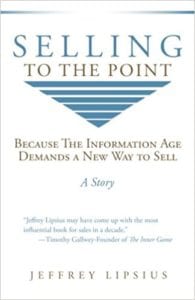
Selling To The Point: Because The Information Age Demands a New Way to Sell
The first thing I want to say overall about my book is consistent with what we’ve been saying so far. My book is one of the first selling books in the form of a fiction novel story. It’s got a plot with romance suspense. The reason I made it a fiction novel instead of a how-to book is because I want to show salespeople how to learn from conversation. I said salespeople are the learners, not the teachers. Where do sales people learn? They learn during the course of interaction, from dialogue. The customers will reveal their beliefs, their values, their priorities, their frustrations. As a salesperson learns his, the salesperson’s able to respond, and of course learning requires awareness, which is getting back to the original skill that I’m saying we need for our performance is good observation, good awareness.
What I was wanting to get across to the salespeople is that you can say whatever you want. If you’re talking to an unreceptive customer, it’s of no use. You could go through all kinds of training at the home office and get your pitch down and talk to the customer and relay all the selling points that you were trained and memorized and got them all out. If the customer is not interested, if the customer’s unreceptive, you haven’t accomplished a thing. Maybe one point that you might consider to be minor or almost irrelevant, you just happen to mention on the side of the customer really grabs on to that. In their own beliefs and values, this is very important. It’s not your pitch, but it’s how your pitch is being heard that’s going to determine whether you get the sale or not. I wanted to get that across in this particular chapter. The best sales pitch is a pitch that’s well received.
That’s also I think with the benefit to the readers of your book is instead of another how to book, you’ve put it into a fiction, so we are entertained while we’re learning as opposed to just learning and that makes it much more interesting and engaging and that’s the main reason for doing this. One of the things in your book and the story along the line is a character, Martin. He writes down that customers make the best buying decisions when they have the three C’s, Internal Confidence, Internal Choice and Internal Clarity. Let’s take a minute and go through each one of those. What is the emphasis on the word ‘internal’ around these three C’s?
The three C’s are what customers need to possess in order to make the best decisions. As a salesperson, you need to be skilled in decision coaching because sometimes you could say all the right things, but the customer still doesn’t buy because they might not be the best decision maker or they have a decision style that might not be optimal for this type of decision. They need to go into a coaching role. You need to shift from salesperson to decision coach, and if you’re going to be a decision coach, you have to gain a higher level of trust, which comes from letting the customer know that your goal is to help them make the best decision. That’s important because usually sales people’s goal is to get the customer to buy the product. The customer doesn’t share that goal. The customer’s own is to make the best decision. If the salesperson and customer are on the same page, then they work together as a team and you can have a coaching relationship.
One of the best things I’ve ever heard people say in the sales conversation is, “This may or may not be a good fit for you, let’s find out together.” That automatically goes, “Then you’re not so attached to me having to buy, that may not be the best decision if you find that I can’t afford it or it’s not what I need or whatever.” That also removes a lot of the pressure.
It does one more thing. It turns the conversation inward. You’re asking me what do I mean by internal with the three C’s and you gave a great example. If the salesperson is urging the customer, “You should buy, because I know this is a great product for you,” that’s outward. That’s about the salesperson’s point of view. If the salesperson says, “I don’t know. Let’s explore this.” Then it becomes more about the customer’s point of view, which is more inner. I’ll give you an example, I’ll start with internal confidence, which is one of my three Cs. If I ask any salesperson about confidence, they’re going to say, “Very important, confidence.” They try to get that, “With every sales call is to have the customer trust me. Customer is confident that what I say is actually what’s going on.” That’s external confidence.
Internal confidence is the customer’s self confidence in their ability as a decision maker. This is primary because the customer’s not going to trust the salesperson unless the customer first trusts themselves to decide if they’re going to trust that salesperson. What I’m trying to get sales people to do with this book and with my courses is turn your thinking around from external, which is about me and my performance to internal, what’s going to make the customers have the best decision performance. If you’re a coach and you’re coaching a customer and that customer has self-doubt in their ability to make a decision, then you’re going to have a compromised buying performance. For example, the customer may make an inappropriately conservative decision because of their self doubt and a salesperson skilled in asking the right questions can prevent this from happening and have the customer make a better decision. That’s internal confidence.
I was talking with someone who was thinking of hiring me to help them as their business coach with their pitch and modeling and they’re in this buyer’s remorse type of thing and it’s exactly what you described. They don’t trust themselves enough to make a good decision because they’re so afraid of making the wrong decision. They said, “On a scale of one to ten, I’m at a nine.” I go, “I’m going to feel so relieved if I get you to help me but then my internal monkey mind kicks in and I’m like, “How do I know he can help me and how does he know he can help me and on and on and on and on.” They just start spinning their wheels in such a crazy way. I have my own way of trying to help them calm that down, I’d love to hear your thoughts on that because that happens so many times no matter what you’re selling.
Ask a coaching question. For example, you could ask the customer, “If my services worked out well, what would you notice happening that would indicate that? Get the customer to start thinking about, “I would have this occurring and my people would be working more as a team with each other and there would be a better communication.” “Really, better communication, how would you measure that? How would you know the communication is better?” Getting them to focus on what they can know. From the scenario you’re describing, that customer is like, “I don’t have a crystal ball.” They want a crystal ball. If you bring it back like a coach would to a tangible, observable things, they realize that, “I can make this decision because I have a handle on the different indicators that would show me if it’s working out well or not.”
[Tweet “Shift from a sales conversation to a decision coach by building trust.”]
It’s future pacing them into things that they can measure, which then allows them to have more confidence in their internal decision process. Let’s jump into this internal choice. Let’s create a scenario. You and I are both keynote speakers. In this situation where the agent has said, “They like what you have to say. They’re just about ready to schedule a time to have a conversation with you before they decide but they think they like another speaker better and if they want to talk to that speaker first and if that doesn’t work out, then they’ll talk to you.” You’re like, “Their internal choice process is not really working in my favor. I have to hope that somebody else’s as opposed to let me get in the game.”
You have to take a little bit deeper dive into, “Why they feel compelled to listen to that person, the next presenters, and as a matter of fact, why don’t they want to hear three presenters, five or six? What’s going on? Typically, the low internal choice is the result of a self-limiting belief. When a customer has a self-limiting belief, it lowers the amount of options they feel they have at their disposal. You say that salespeople are selling options, selling choice. We’re selling solutions that the customer hadn’t previously considered. A lot of the times, it hasn’t been previous considered because there’s a self-limiting belief. An example could be somebody’s going to a company and looking at the org chart and they’re wanting to talk to the highest-ranking executive because they have the most choice, they have the most decision ability. Every salesman knows to do that. You get in front of this VP and start talking to them who extensively has the most choice because they’re ranked so high in the org chart and you hear them say, “I’m pressured by the board and I have regulators are getting in my way now and people are after me so I can’t make any mistakes, the shareholders are angry at me from last quarter so I really don’t want to make any decisions right now.” They have low internal choice even though their external choice, which is their positional power is very high, their internal choice is very low and you’re not going to get the sale.
It was almost like, “My hands are tied.” That’s a low internal choice, right?
Very much so. The self-limiting belief was when the executive said, “People are after me right now, people are wanting to watch me screw up so they could blame me for something.” It’s a self-limiting belief. They feel they don’t have options to choose from when it finds time to look for solutions. Internal choice is also very important to instill in a customer in order for them to make the best decisions. A customer with low internal choice is the most frustrating for salespeople because those are the customers that really liked the product, they really want the product. They think it’s the greatest product, but they won’t buy it because they don’t think they have the option to do so, even though they liked it so much. We all know customers like low internal choice.
Any recommendations on what to do when someone’s who’s got this? Maybe I don’t want to talk to a lot of salespeople. I get overwhelmed by all the choices or what to say?
That’s a perfect lead into my last and third C, which is the most important, which is what I call internal clarity. Internal clarity, if I talk to a salesperson about clarity, “You got to let the customer know about the products, all the features of the product, what it’ll do, how it’s better than the last model we made, and really make them clear.” That’s external clarity. Internal clarity is the customer’s self-awareness. Does the customer know what they need? Are the customers a clear on their goals? Is the customer in touch with priorities and values? If the customer doesn’t know what they need, how in the world can they figure out if your product features will satisfy that need?
I remember helping a real estate agent not waste his time with a bunch of potential buyers who was showing them endless amounts of houses and he hadn’t gotten them to define what would be the ideal house and when they saw it, they would pull the trigger because they didn’t have a criteria. They just go, “They always found something wrong with the house.” I’m like, “We’ve got to figure out the three things that when you see it in one place, you’re going to say yes to.”
The customer has to be clear and the salesperson can help customers get clear. I was talking to a financial planner and he had all these products that he wanted to present to me, but before he did anything, he goes, “What are your needs going to be after retirement?” He started asking me what’s going on with me? Then based on what I said, he was able to pick which product to present. That’s internal clarity. You could be lost, like lost in a mall or lost in a park or something and be looking at the most accurate map. If the map doesn’t have a, “You are here” mark, you’re still lost. You need that internal clarity in order to be able to work with the customer and getting back to your other question, internal clarity also increases internal choice.

Selling To The Point: Internal clarity also increases internal choice.
It’s all connected. Jeff, you have a special gift to offer the audience. Would you please share that?
Anybody that wants to hear more about what I have to say about this, I will have a free fifteen-minute consultation with you over the phone. You can reach me at [email protected]. My Twitter is @JeffreyLipsius. You can reach me anyway. I’ll be glad to talk to you and have a fifteen-minute conversation to see if I could give you any tips to help using the Selling to the Point method.
Who is your ideal audience that you love to give keynote talks to and workshops to?
All kinds of sales, but especially when salespeople have customers that reorder products, reusable products, or the relationship between the customer and the product is really important. That seems to be the sweet spot in terms of companies that really flourish hearing my keynote.
The renewable relationships, not the one-offs. Jeff, I can’t thank you enough for sharing your wisdom, your generosity, and most of all just helping all of us get better with realizing we need to shift from having external thoughts about confidence and clarity and choice to internal and that when we become conscious aware of what’s going on in the moment, it’s going to improve our performance.
Thank you so much, John, for having me on.
My pleasure.
Links Mentioned:
- Selling to the Point
- Selling to the Point – book
- [email protected]
- @JeffreyLipsius – Twitter
Wanna Host Your Own Podcast?
Click here to see how my friends at Brandcasting You can help
Get your FREE copy of John’s latest eBook Getting To Yes now!
John Livesay, The Pitch Whisperer
Share The Show
Did you enjoy the show? I’d love it if you subscribed today and left us a 5-star review!
-
- Click this link
- Click on the ‘Subscribe’ button below the artwork
- Go to the ‘Ratings and Reviews’ section
- Click on ‘Write a Review’
New Heart, New Life with Ava Kaufman
Posted by John Livesay in podcast | 0 comments

Episode Summary:
We’re all being disrupted in our businesses and in our lives, but what happens when we get disrupted in our health? Ava Kaufman was a former dancer who lost almost everything when she suddenly fell ill and ultimately found herself in need of a heart transplant. But she took this negative, turned it around, and created an organization called Ava’s Heart which is a non-profit that helps families of organ transplant patients. Ava shares talks about her new heart and new life in her book, The Transplant Journey, and shares some great insights about how to start a non-profit, the obstacles you have to overcome, and the life lessons you learn when you have a new heart and literally a new start. Find out how she did it and how you can, too.
—
Our guest on The Successful Pitch is Ava Kaufman. She has an incredible story of getting a new heart, a heart transplant. We’re all being disrupted in our business and in our life, but what happens when we get disrupted with our health? She has some great insights about how do you start a non-profit, what obstacles do you overcome and what life lessons do you learn when you have a new heart and literally a new start? Like starting over in your career or starting over and pivoting with your startup. She said, “You’ve got to let go of the small stuff.” She has some real insights in the ability to turn fear into courage. Finally she said, “Your waiting has to turn to patience or you’ll lose your mind.” Find out how she did it and you can too.
Listen To The Episode Here
New Heart, New Life with Ava Kaufman
I have a special guest introduced to me by one of my former guests, Steve Rohr. Her name is Ava Kaufman and Ava is a 60 something year old woman with a seventeen year old boy’s heart, literally. She was living the good life when she suddenly took ill and ultimately found herself in need of a heart transplant. Fortunately, she got one. That’s not always the case for everyone. In the process, Ava who’s a former dancer, she lost almost everything; her successful business, her home, but she took this negative and has turned it around, created an organization called Ava’s Heart, which is a non-profit that helps families of organ transplant patients. It’s AvasHeart.org. This is a great opportunity for everyone who’s listening to deal with whatever disruption you might be experiencing in your personal life and in your business. Ava has literally figured out how to pitch when it gets personal. Ava, welcome to the show.
Thank you so much, John. It’s wonderful to be here. I’m excited to meet you through Steve.
One of my favorite questions to ask my guest is to tell me the story of origin. Paint the picture of where you grew up. You had a dream of being a dancer, which you fulfilled. Take us all the way up until you started to feel ill.
I worked as a professional dancer when I lived in New York. I went to NYU, majored in dance. I toured the world with Gloria Gaynor and Donna Summer and worked in Paris with Johnny Hallyday. I had a wonderful life and then I moved out to California, met a guy, fell in love. He had a small little moving company and we turned it into this mega business, Blue Skies Delivery and Installation, which we sold. I have a beautiful adopted daughter who I adopted at birth. When I was 58 and had just sold our business and I was starting a new business about teen obesity, I developed a rash on my hands. Being the person that I am, I went to dermatologist. She told me I had psoriasis for three months. To make a long story short, I had an autoimmune disease called Dermatomyositis, which went misdiagnosed because no one gave me a blood test.
By the time the disease had progressed and started to weaken my muscles, it came on quickly. I had three months of a rash and then went to my doctor. She did blood work, told me my muscle enzymes were highly elevated. She sent me to a rheumatologist who proceeded to send me for some tests. I was on my way for a test and I dropped dead in my house and ended up at Cedars-Sinai Medical Center with LVAD, a pump and an ECMO machine. I don’t remember any of this at all. I was told I was given days to live and that I would need a heart. That would be the only thing that would save my life because the disease had destroyed all my muscles, including my heart. Because I had been in such good shape before, the muscle weakness of the disease came on quickly. Within two weeks, I put on 35 pounds. While I was in the hospital waiting for a heart, I blew up to 200 pounds. My normal weight is 110. That was a lot.
[Tweet “Fear turns to courage when you know your why.”]
This is all what I’ve been told because I was on life support at the time. They listed me as an experiment because I was at Cedars and they’re a pretty fabulous place. No one ever thought I would live long enough to get a heart and I was too sick to get an LVAD or a mechanical heart, things that they give you now as a bridge to transplant. I ended up getting a heart in ten days on my real birthday.
You literally were considered dead. You dropped dead and they brought you back?
They brought me back with paddles and they put in an LVAD, which is left ventricular advice to keep my left side beating, a pump on the right side, and then an ECMO machine to keep you breathing. Usually, they don’t do a transplant if you’re on ECMO. This was all I’ve got, this was God’s plan. I really feel it was God’s plan because I got a heart so quickly on my birthday. They put me into an induced coma for two months and as I was coming out of the coma I realized that I was trapped in my body and I couldn’t move. I heard people telling me that I had a heart transplant. I was petrified, and I couldn’t communicate anything.
The only thing that I could do was have tears run down my cheeks and then they’d knock me out again. It was one evening, the clock said 6:00 PM but it always seemed like the clock was saying 6:00. I was ready to leave everything. It was too hard, too embarrassing, to debilitating. I literally couldn’t move a finger. I couldn’t move my head, but my mind was clear, and everything was white. The room was white, everything was white. I was dressed in white and I said, “I’m ready to go.” I kept looking for the light, for my mother or my grandmother and nobody was there but the room was white and it was bright lights. I then found myself sitting in this huge palms and I said, “I’d lived a great life but I can’t do this anymore. My mind is going to explode.”
All of a sudden, I smelled my daughter’s dirty hair. She was an equestrian and she used to ride horses. She was eleven and we used to fight over her not washing her hair because she rode every day. I realized that there was no way that I could leave her because we were in the middle of a divorce and many things were going on and she needed me. I knew she needed me. At that moment, I made a deal with God or my higher power, whatever we choose to call what’s there. I said, “If you let me come back to being Jade’s mom again, to being who I was before. To be able to walk, run, and play with her,” because at that moment, I couldn’t move at all and the thought of doing anything was impossible, “I will spend the rest of my life giving back.” At that moment, I didn’t know what that would be, but I say now that that was the beginning of Ava’s Heart.
How long ago was that?
That was eight and a half years ago.
You’ve been having these last eight and a half years be all about helping other people going through your journey because there are a lot of things that have to happen when you need a transplant. Sometimes you’re on a waiting list. What would you say is the biggest lesson you’ve learned over these eight and a half years of having a non-profit charity?
I would say that the only way to get through life is living one day at a time. That life can change on a dime and that you have to look inside of yourself and find out what’s important to you at that time.
Do you find yourself not sweating the small stuff as much as you did before the heart transplant?
That’s exactly perfectly said because if anyone would have told me that I would have started to do something without not without the knowledge of knowing what it was, without the financial backing. I leaped into this without knowing anything and learned along the way.

The Transplant Journey: You have to learn what to say when applying to grants.
That’s what an entrepreneur does. Gather the resources and my passion and vision are strong that I’ll find the right people to support me.
It’s taken me a lot longer than I had anticipated, but that is definitely what’s happening.
What’s the biggest challenge in running a non-profit versus when you had a company that was for profit?
Getting people to believe in what you’re doing, especially because my mission is about something that most people aren’t aware of. They know about it, but they’re not aware of and until your life’s been touched by transplant, you’d had no reason to. I’m a college graduate, my family and my friends are all intelligent, smart people. No one had a clue as to what this journey would be or entail. The doctors tell you so much, but everybody is different.
My personal passion is helping as many people as possible become master storytellers and have a great elevator pitch so that people can instantly get what it is that you’re doing, whether it’s for profit or not. If we’re going to play a little bit, if you’re okay with this, elevator pitch for Ava’s Heart. From what I gather from looking at the beautiful website, we help families find temporary housing so that they can be near their loved ones as well as the person who’s waiting for the heart transplant, who has to be close to the hospital at a moment’s notice to find affordable housing, which is not always easy to do in a place like Los Angeles. Would that be a fair description of what you’re doing?
It would be a partial description of what I’m doing, and a very large part because you cannot get put on the list for a transplant, and I’m not talking about kidneys because kidneys are different, for a liver, for lungs or for a heart, unless you have post-transplant housing. Being that not every hospital is a transplant center and being that Southern California has the best transplant centers in the United States. Cedars is number one in the world for hearts and UCLA does more transplants than any other hospital in the world. Southern California is a destination for people at the end stage of their life and many who had been told to go home and wait, that there was nothing that could be done for them come here because there are special treatments at both of these hospitals, UCLA and Cedars, that had antibody treatments and things that can help people get listed.
You didn’t need this service because you live here, but this is for people who don’t live here, is that correct?
Right.
You need housing if you don’t live in Los Angeles and want to get your surgery in one of these two hospitals, you need to live within fifteen minutes, ten minutes, five miles?
Before transplant, you need to be within three hours. If you live in Nevada, Nevada has no transplant center. Everybody comes here. When you get the call, hop on a plane and you come here. Some people wait at home and some people wait in the hospital.
[Tweet “Let go of the small stuff.”]
The majority is for the post-transplant. How long does that typically take? How long do people need this post-transplant housing?
At least a month or two, they request three. Sometimes if I can’t get someone three months because it is expensive, and my funds are limited, they can stay for two. We have many people from Bakersfield, San Diego, Santa Barbara or Temecula.
That’s painting the picture. I always talk about whether you’re pitching someone to become a client, a customer. You started to get funded or in this case a non-profit, we have to tug at the heartstrings to get people to open their purse strings. We need to tug at some heartstrings here today. Imagine your life was about to end unless you got a heart, but you couldn’t get a heart or even get on the list to get a heart unless you were living close enough to one of these two hospitals and you couldn’t afford the housing. What would you do? This is a big problem that you normally don’t even know exist until you’ve gone through it. We’re asking you to open up your hearts and have compassion for people that you don’t even know who need a place to live so that they can survive the heart transplant.
That’s the beginning of a whole another journey of dealing with the anti-rejection medicine and all kinds of things. It’s not like, “See you later.” There’s a lot of care that’s needed and you can’t stay in the hospital the whole time for that. You need to go on and live your life and build your immune system up. There’s something in the journey and the messaging of literally tugging at heart strings to get a new heart. The kind of person that donates their organ, in your case, it was a seventeen-year-old boy, who made that decision, or his family made that decision that he was willing to give his heart up to someone who could use it like you. It all stems from this concept of sometimes we only want to help people that we can physically see. We’re seeing, “I’m going to go volunteer and serve food,” which is great, but it’s a step above is when the help you’re giving is not someone that you know or probably will ever know.
The other thing that we started to do, we’re helping donor families as well because without the donor families, we have no transplant families. Many of these families are not financially comfortable. There was a sixteen-year-old boy that was shot in a drive-by in downtown LA. His mother was a single mom with four other children. He was a good kid, wanted to go to college. He just was in the wrong place at the wrong time and he got shot. This mother donated his organs and he saved eight lives, and I can’t tell you how many others with tissue and eye donation as well. He was young and strong, had strong lungs and great heart. She did not have the funds to bury him. In my eyes, he’s a hero.
He wasn’t on a battlefield like our vets. He was gunned down in this country in Los Angeles. I feel like he needs to be honored and not even for the world but honored so that his family feels good about what they did. That was the first family that we ever helped and this year, I’m going to announce it at our event on September 14th, we will be starting to help donor families as well. They are the true heroes and I want to thank my donor family right now and every other donor family out there because what you do is heartfelt and amazing. You never know what that person is going to do with that organ. For my donor family, I am passing it forward and I have many other families because you decided to give me a heart.
That’s what inspired you to write your book, The Transplant Journey: A Guide To Transplant: Extraordinary Stories, Hope and Encouragement. What do we find when we buy and read this book?

The Transplant Journey: A Guide to Transplant: Extraordinary Stories, Hope and Encouragement
It’s written by me from my heart. I’m not a professional writer and it’s my thoughts on how fear is such a big part of this whole thing and how I’ve seen it. Not only in myself but in many of the people that I’ve helped, fear really turns to courage. All of these people waiting in hospitals or waiting at home are warriors. They’re courageous warriors and many of them are children. We don’t hear about all that much, but I’ve helped many babies and young children. As a matter of fact, one little girl, her name is Jessica, she’s had two heart transplants and she told me she’s going to take over Ava’s Heart when I get too old, so I shouldn’t worry about it.
She turned thirteen and she’s pretty amazing. We talk and she tells me her outlook on it because it’s different when you’re a child as to when you’re adult. It is the family that we’re helping because it was her parents and her brothers, and you get involved with the families. Fear does turn into courage and it makes you look at life differently because when your life is the thing that’s on the line, you realize how much you want to be here. All of the other things like, “I can’t believe it. I’m waiting here for half an hour and they still haven’t taken me to do my nails. They’re an hour late delivering the sofa. Where are the moving men?” All those little things that bothered people every day, I tried not to let bother me anymore. It doesn’t matter. It doesn’t. Life is such a beautiful gift and once you’ve almost lost it, whether it’d be a transplant or it could be cancer or whatever that you’ve been through, you look at everything differently. The sky’s bluer, the grass is greener, and you don’t sweat the small stuff. Love is the most important thing and friendship. I can say that I decided to live because of the love for my daughter.
What goes into that whole why, which is part of your book. I know it’s this whole concept that whether you’re a startup, working for yourself or working for someone else, you have to do something besides doing it to make money. You have to have a bigger purpose and mission and why you’re here, what you want to do with your life, but also in your business and your customers feel that way as well. When you’re “pitching” someone to support this charity or hire you to do something, if you have a bigger why, let’s say you’re a real estate agent, your bigger why could be I love helping people find their dream home. Something more than, “I just need the commission from selling you a house,” that people then tap into this. You talk about how waiting turns to patience and I want to see if there’s a takeaway that you could give us on how can we all learn to be more patient?
For me, I didn’t have that experience. I got a heart in ten days. I didn’t even know I was getting a heart till after I got a heart. I learnt that from the people that I’ve helped. I’ve gone through two years with some people while they were waiting with artificial hearts or LVADs for a heart or for lungs. That’s how I learned that waiting has to turn to patience. Otherwise, you can lose your mind. It gets back to one day at a time and that whole thing of waiting turns to patience has helped me grow this organization because it’s such a slow process.
[Tweet “Waiting has to turn to patience to stay sane.”]
The experience of waiting for your heart teaches you patience, even if it’s not your own personal experience. You see other people. Then your own patience because everybody, whether you’re working for yourself or another company, profit, non-profit, everybody wants rapid growth. That’s the key criteria for everything. I want to help as many people as possible.
In my life and everything else that I’ve done, I managed a piece, my husband and I built a business together. The growth was fast paced. We were providing a service. I knew how to sell it. It wasn’t as slow as this because number one, you ask for money in a different way. You have to learn what to say when applying to grants. When you’re in the non-profit world and you’re asking people with a lot of money for money, they say, “You don’t have any money, why would I give you money because how do I know you’re going to be able to sustain it?”
It’s similar to what a startup goes through trying to get their initial funding.
I was very fortunate. There’s a family foundation in Orange County called Change A Life Foundation. The gentleman who started it, who no longer is alive, was an amazing man and he wanted to help people make a difference in their lives. He put all this money into this foundation, Change A Life Foundation. They have partners and there are lots of different requirements to being one of their partners. Once you’re a partner, you can then apply for life-saving grants for X amount of people a year. A dear friend of mine who I knew through the horse world with my daughter, after my transplant sent me to this website and said, “Look at it and call Lisa Fujimoto.” I called Lisa Fujimoto who ran it and I told her I was a friend of my friend and we met, and she fell in love with my story. I was starting my 501(c)(3). I didn’t even have a board. She helped me put everything together and I became a partner with Change A Life. That changed my life and the life of the numerous people that we’ve helped throughout the last five years with life-saving grants up to $7,500. With housing, food, guest cards, strollers, baby seats and dental work but mostly housing because that’s what’s needed. My long-term goal is to have housing here in Southern California and also to become the go-to-foundation in this country for transplant patients. As David Foster has a foundation in Canada and he helps every transplant family with whatever they need, whether it’s paying their rent for two months or helping them get back on their feet, that’s what we need in this country and we don’t have it.
You certainly have a big vision, a big passion, and a big heart. If there’s one final thought you want to leave our audience with, what would it be?
Souls go to heaven. Organs don’t.

The Transplant Journey: Souls go to heaven. Organs don’t.
Tell us what that means.
It means to be an organ donor and help save lives because 22 people die every day waiting for life-saving organ. There was a young girl who was waiting for a heart in UCLA. Her mom used to take her into the chapel to pray. One day she looked at her mom and she said, “Am I praying for new heart or am I praying for someone else to die?” No one’s praying for anybody to die but there’s a plan in the universe and things happen. If that does happen to you or someone you love, you can turn that sorrow and that grief into something incredible.
You’ve certainly turned that into something incredible and I’m sure that person whose heart’s beating in you is thrilled to know on the spiritual soul level that it’s going to good work. Thank you so much for sharing your vision, your passion and most of all your story. That’s what we love here at The Successful Pitch.
Thank you so much for having me.
Links Mentioned:
- Ava Kaufman
- Steve Rohr – previous episode
- Ava’s Heart
- AvasHeart.org
- Blue Skies Delivery and Installation
- The Transplant Journey: A Guide To Transplant: Extraordinary Stories, Hope and Encouragement
- Change A Life Foundation
- Lisa Fujimoto
- David Foster
Wanna Host Your Own Podcast?
Click here to see how my friends at Brandcasting You can help
Get your FREE copy of John’s latest eBook Getting To Yes now!
John Livesay, The Pitch Whisperer
Share The Show
Did you enjoy the show? I’d love it if you subscribed today and left us a 5-star review!
-
- Click this link
- Click on the ‘Subscribe’ button below the artwork
- Go to the ‘Ratings and Reviews’ section
- Click on ‘Write a Review’
Avoid Aging Through Technology with Aubrey de Grey
Posted by John Livesay in podcast | 0 comments

 Episode Summary:
The Laws of Physics is the number one cause of aging. This means that it doesn’t matter if the subject is biologically alive or not, everything is subject to aging caused mainly by the damage that occurs through the normal operation of a subject through a natural course of time. As Aubrey de Grey would put it, if we can fix a car or an air plane when its parts are damaged and defective, we can do so too with the human body. But the human is different from a machine so defeating biological aging, while it is possible with today’s technology and as it progresses, will not happen overnight.
—
Today’s guest on The Successful Pitch is Aubrey de Grey, who is the Founder of SENS, Sens.org. His whole research and philosophy is we can stop aging by figuring out how to repair and rebuild the cells in our body, much like a car or an airplane gets replaced with new engines. He has a very controversial premise that we could live to be as long as a thousand years, but it won’t happen overnight. He’s given a TED Talk that has over 3 million views, and he is a speaker around the world talking about how we can deal with aging and then the implications that it may or may not have on overpopulation. He’s got some great insights on whether you should choose to freeze your body or not, and about changing people’s whole thought process of, “Will I be bored if I was to live longer than a certain age?” Find out what he has to say.
Listen To The Episode Here
Avoid Aging Through Technology with Aubrey de Grey
I’m honored to have Aubrey de Grey, who’s a British gerontologist who’s drawn a roadmap to defeat biological aging. As an English biomedical gerontologist, he claims that humans can live for a thousand years. Through his foundation, he’s drawn a roadmap to defeat this biological aging that we all simply take for granted as a given. He first authored research that claimed the indefinite postponement of aging may be within sight back in 2002. In fact, he’s given a TED Talk on this. It’s got over 3 million views. I’ve watched it myself. I’ve had the honor and privilege of sitting next to him at a lunch, and he’s captivating and fascinating. In the fifteen years since, his reputation among the scientists has moved from being one of somewhat of a ridicule to being one of the most powerful and respected in the industry. In 2009, he formed the public non-profit SENS, which stands for Strategies for Engineered Negligible Senescence, and has enlisted millions in support from a handful of billionaires and entrepreneurs including Peter Thiel, Jason Hope, and Michael Greve. Welcome to the show, Aubrey.
Thanks for having me.
You are certainly someone who is disruptive. In the startup world, that’s what everyone is looking for. Let’s start with your own background. I’d love to ask my guests their own story of origin. Take us back to when you were growing up in England and how you first thought of your interest in whether it was biology or aging in general.
My original interest in aging did not begin when I was a kid. The reason it didn’t was because I didn’t think there was any disagreement about it. I went through my first 25 or more years of life assuming that everybody understood that aging is the world’s most important problem, and that people in biology and in medical research would be working as hard as possible to try to fix it. I only became aware that that wasn’t true when I met and married a biologist who’s a lot older than me. She was already a full professor in San Diego, and through her, I met a lot of other biologists. I discovered that none of them thought that aging was particularly important or particularly interesting, and I was completely gobsmacked by this. I had no idea that that could possibly be the case. After a couple of years of gradually coming to terms with it, I came to the conclusion that I had to switch fields. I was previously working in artificial intelligence per se, which is another area where I felt that there was a serious problem for humanity. It’s the problem of having to spend so much of one’s time doing stuff that one wouldn’t do unless one was being paid for it, but we need more automation to fix that. That was clearly only the world’s second most important problem. I was in a fortunate position where I was able to switch fields easily to construct a whole new career for myself in my spare time.
Are there some similarities in what you’re doing with artificial intelligence with your initial interest in anti-aging? I don’t know if anti-aging is even the right term. Is artificial intelligence helping in your research?
In the early stages after I switched fields, it definitely helped a lot. What I was able to do was approach the problem of aging in a way that benefited from my own background. It was a very different background from what everybody else in the field had. All the people had been biologists all their lives. I was able to be more of an engineer, to think in terms of putting two and two together in different ways than what typical career biologists would do. A number of the ideas I put forward in the first few years of my entry into gerontology were things that were well-received. The career biologists were saying, “This guy is from a completely different area and he’s come in and he happens to have the ideas that we ought to have had. He must be very smart,” so I rose to a level of quite general respect very quickly indeed in gerontology. Then after five years or so in the field, I started to become a serious troublemaker, and things changed a bit, but here we are.
Let’s talk about how you got approached to do your TED Talk and tell us that story and why you think so many people have watched it.
I got approached because I was asked to speak in 2003 at a TED-like conference called PopTech, which happens every year in Camden, Maine up in the extreme northeast. Chris Anderson, the guy who runs TED, was there. He was scouting for speakers and he saw my talk and he thought, “This guy could be good,” so that’s how I ended up speaking at TED. It was the combination of a rather rapid sequence over a period of only a year or two of moving from being known only by people who would call themselves futurists through to speaking as increasingly mainstream thing. The reason why it’s been so popular is because everybody wants to know about aging and about whether we’re going to fix it. The problem is that they still also want to maintain some emotional distance from the question, not think about it except as entertainment.
Let’s talk about some of the challenges that people have. When we were talking at lunch, you said you come up with something where you would just say to someone, “What if I could give you an extra ten years, would you be interested then?,” which seems to be a little bit more of a bite-sized concept versus living to be a thousand.
It’s difficult to square the circle for me, because you’re absolutely right that when one talks about modest postponement of aging, one gets a very different reception than if one talks about indefinite postponement. However, I have two difficulties that I have to grapple with if I attempt that. The first one is that there are lots of other people out there talking about modest postponement of aging. I need to get people to listen to me and understand that what I’m proposing is more realistic and has greater potential than what other people are suggesting. The other problem I have is that as a scientist, I have trouble not telling the truth. If I know perfectly well that the technologies that we’re working on do have the potential to deliver indefinite postponement of aging, I cannot go on stage or on camera and say, “This will give us ten years,” and if someone said, “Why wouldn’t it give us a hundred years?,” because I’ve waved my hand.
Have you had to learn or craft your storytelling skills to get people to understand the science?
[Tweet “If you can’t explain it clearly, you don’t understand it.”]
I have. The thing about anything in science or technology is, I think Francis Crick was the person who said this best, he said, “If you can’t explain your work to a waitress or to a non-specialist, then you don’t understand it yourself.” I certainly haven’t found it all that difficult. I have increasingly refined the way in which I tell the story, the way in which I introduce the ideas just by trial and error, but by and large, making it simple enough to be comprehensible to non-specialists has not been too difficult.
Tell us how your organization SENS started.
The first organization that we began was the Methuselah Foundation. That was the organization, 501(c)(3) public charity, that I founded together with a guy named Dave Gobel back in 2003. Back then, I was pretty much unknown. That was a couple of years before my TED Talk. We had no money, so we couldn’t fund research. What we could do was get the word out, to raise the profile of this whole field. The way we did it was by creating this organization that administered a prize. We would say, “If you can beat the world record for mouse longevity, then we will give you some money.” Of course the amount of money that we were able to give would depend on how much money people gave us to increase the prize pot. This worked rather well, and we were able to bring in millions of dollars over the first couple of years in which we ran this thing.
Around 2005 or so, we started to use some of that money to fund research, because we had structured the prize in such a way that there was no way we would need to give it all out, whatever happened in terms of breaking the world record. We got to a point around 2007 to 2008, where we would do these two activities. We were running these prizes, and also we were doing quite a bit of research. We wanted people to give us money for each of those things, and it worked, but we were not bringing very much money in terms of growing the rate of growth. We were not accelerating. This was a source of great surprise to us, because we had in 2006 brought in one very high profile and very large donor in the form of Peter Thiel, who founded PayPal and was an early investor in Facebook. Around 2007 or 2008, he was riding high in other ventures as well. He had a hedge fund that was outperforming absolutely everybody else.
When I brought him on board, my take was that my fundraising job is done. A billionaire will be lining up. Of course it didn’t happen. Eventually around 2008, we decided that the main thing that we were doing wrong was we were giving schizophrenic messaging. We felt that we had to be quite glitzy and populist and superficial while we’re selling the prize, because the idea was to get people interested who didn’t want to know about science and they were just enthused. At the same time, we had to be the opposite. We have to be very staid and serious when we were talking about science that we were funding and getting people convinced that we were funding the correct science.In the end, a solution, which was a bit drastic, but everybody concluded in hindsight that it had been the right thing to do, was to split the foundation in two. We created SENS Research Foundation as an offshoot from the Methuselah Foundation. Both organizations very much still exist and we obviously have identical missions and we talk to each other a lot, but no overlap of personnel. I am the Chief Science Officer of SENS Research Foundation, but I only have an advisory role at Methuselah.
That’s such a valuable takeaway for everybody, because when you are pitching to get someone to join your team, pitching to get hired, or pitching to get your startup funded, if you have schizophrenic messaging, you confuse people. I find, more often than not, that the confused mind just says no without asking for clarification, because people are sometimes embarrassed to ask, “I don’t understand this.” Regarding aging as if I am a fifth grader or a waiter that you’re speaking to, what would you say is the number one cause that causes our bodies to age as we spend more time on the planet?
The number one cause of aging is the law of physics. In other words, aging is not something that is specific to living organism. It is fundamentally the same process in a living organism as it is in any simple inanimate man-made machine like a car or an airplane. It’s just a fact of physics that any machine with moving parts, whether or not it’s alive, is going to do itself damage as a consequence of its normal operation. That damage is going to start to be self-inflicted right from the beginning when the machine is created, and it is going to carry on accumulating throughout the lifetime of the machine. Any machine is set up to tolerate a certain amount of damage without a significant impact in performance, but only a certain amount. Eventually the amount of damage accumulates beyond that threshold, and the machine stops working so well, and eventually it stops working at all.

Defeating Biological Aging: Any machine is set up to tolerate a certain amount of damage without a significant impact in performance, but only a certain amount.
I love that. Your car can get in an accident and still be fixed. You might need new tires, and after a certain mileage, you might need a new engine. In the case of a human, we might need a new heart or this new technology, the stem cells, that might help us fix what’s decaying. Is that accurate?
That is accurate. That means when we want to drill down to the question of how we go about keeping people healthy in old age, we just have to characterize what damage the body is doing to itself in the course of its normal operation, and figure out ways to repair each of those types of damage. Of course the human body is much more complicated than a car or an airplane or any simple man-made machine, and therefore the types of damage are also many and varied. That’s why we haven’t been able to do it yet. The question then is how complicated it is and how hard is it. The central message of SENS, which I first put forward in 2000, is that the damage is complicated, but it’s manageable. We can essentially describe the taxonomy of damage, where all the various types of damage fall into seven major categories, and for each category, there is a generic approach to implementing this repair.
You have this wonderful way of phrasing adding on chunks of time. Your prediction of four digits comes from the second phase, where you say if you’re 60 and you get this therapy that makes you biologically 30. Then by the time you’re biologically 60 again, you’re chronologically 90. Can you expand on that a little bit? Because that whole premise is easier for us to digest in chunks like that and it’s fascinating.
It is very much very often oversimplified and sensationalized and that is one of the big messaging problems that I’ve always had. The therapies that we are working on are therapies that will repair damage in the body fairly well, but they will certainly not be 100% comprehensive and perfect. In other words, they will fix most of the damage that the body does to itself, but there will be bits of difficult damage that the body is still accumulating because the therapies just don’t work on them. That means that if we implement this therapy, it doesn’t matter how often we apply them, we could be applying them every year to the same people and eliminating most of the damage each year. Nevertheless, after the age of 90, the person is still going to be biologically 60 rather than 30, because the difficult damage that the therapy doesn’t work on will have accumulated so that it’s overall load is as much as a regular 60-year old today would have when the difficult damage and the easy damage added together.
That means that by the time this person who gets the therapy at age 60 is chronologically 90, we had better have improved therapies, because the first therapy won’t work anymore. The good news of course is that 30 years is a very long time in technology, including medical technology, which means that the chances are vanishingly low that we will not have made such an improvement enough to be able to ensure that this person will not be biologically 60 for the third time until they are chronologically 150 or whatever. However, what it means is that when people don’t put any of that detail into a description of what I say, then the way it comes over is that I say people alive today have a good chance of living to a thousand. People think that what I’m saying is that within the next couple of decades, we will have the therapies that will allow them to live to a thousand, which in fact I’m not saying that at all. I’m saying that we will simply stay one step ahead of the problem as time goes on.
It’s a huge distinction. Let me ask you another question. How do you see this being implemented? Would it only be the billionaires and people like that who can afford to have these therapies, not the entire population will be extending their lifetime until it gets to a tipping point?
I’m absolutely certain that these therapies will be available to everybody who is old enough to need them almost instantly after they become available to anybody. The reason I’m sure of that is because we will see them coming. The difference between this technology and technologies that have come into existence in the past is that those technologies have come into existence suddenly. Nobody saw them coming. Society hasn’t prepared to make the most of them and we have to get there incrementally by the technology being progressively improved and made cheaper and some of trickle-down effect. Whereas here, everything is happening in the limelight and in the public eye right from the beginning when things are not even being tested in clinical trials yet.
First of all, in the expert biology of aging community and then from there, people in the general public will be increasingly aware of the timeframe of how close we’re getting to having these therapies and how much impact those therapies will have. That of course will alter the extent to which the public advocates for access to these things. It will determine what they vote for. It will determine what the economics are all about. By the time the therapy arrives, all of the chaos and the debate about how to make sure these things are universally available will have already occurred. All the required front loaded investment and infrastructure and training of medical personnel and so on that would be needed in order to make these things available to everybody will have been done.
This is a personal question that somebody else might have as well. What are your thoughts on these people who think, “I’m going to freeze myself, and so 20 or 30 years or more from now when they figured out how to solve whatever my disease is,” do you think that’s viable?
It’s becoming viable. Cryonics, the idea of taking someone who has just been declared legally dead and arresting the process of subsequent decay by cooling with liquid nitrogen temperatures makes perfect sense in principle, because certainly at liquid nitrogen temperatures, no further decay occurs. The difficulty is number one, the person, once they’ve been declared legally dead, they’re fairly sick. You don’t get declared legally dead easily. Secondly, there is a lot of additional damage that is done to the body in the process of solidifying them, getting them down to liquid nitrogen temperatures. There used to be a huge problem of ice crystal formation, which causes huge damage at the molecular and cellular level inside biological tissues. That problem has been solved. We now have elaborate cocktails of cryoprotectants that allow the biological tissue to solidify as a glass rather than as a crystal, which eliminates that problem entirely.
However, those cryoprotectants are very mildly toxic, and that’s bad enough because you have to use very high concentrations of them. We have a completely different problem that’s not a chemical problem, namely cracking. Thermal stresses occurring and causing the fractures. We need to solve better those problems; however, great progress has been made in that area as well. In fact, a company that’s been out from SENS Research Foundation which is being run by the person who used to be our chief operating officer is leading a completely new way of essentially completely avoiding that problem. The reason that has been able to become a company rather than just some long-term charity like the cryonics companies is that they want to sell organ preservation. If you can cryo‑freeze a kidney or a heart or liver or whatever, then you can have whole banks of these things and you can completely solve the problem that we have today of thousands and thousands of people dying because they are on a waiting list, because there’s no one sufficiently immune‑compatible to them that has donated the organ they need. That’s moving forward. As of today, it’s not clear whether anybody who has been cryo-freezed out will ever be able to be woken up, but getting close.
What a fascinating answer because you are one of the most knowledgeable people I’ve ever encountered on this topic, anticipating the problems and already knowing what the solutions are that are coming. It’s also a great example of how fast technology is changing to adapt to fixing these kinds of problems not only around being frozen but also aging. Let’s use an easy example, like “I don’t want to have to wait in line in Las Vegas for an hour to get a cab from the airport to my hotel or standing in the rain in New York.” Now, Uber solves that problem. Or Amazon is going to say, “We can have your products delivered to you with a drone.” “That sounds great. I don’t have to leave my house or get it instantly,” but then the drone problem becomes a problem because suddenly the FAA gets involved. In China, they don’t have the same regulations, so they’re able to do it there before here.
In this particular case, because we’ve never even considered this a problem that could ever be solved, you’re starting to say, “No, aging is solvable. We could live to be a thousand,” then a whole lot of other resistance, once the disbelief gets addressed, comes up. What about overpopulation? Will that restrict the number of kids people have? It just creates a whole another set of objections. Normally you think when you solve a problem, everyone’s like, “Let’s embrace it,” and off and running, but what I see here is that you have double challenges. First, you’ve got to get people to believe it’s possible and then the second part is do we even want it. How do you address this concern of overpopulation?
[Tweet “What if the problems of aging were solved?”]
Let me step back a couple of steps and address the more general question first. You’re absolutely right that when people are confronted with arguments that they think might be correct to do with the feasibility of bringing aging under medical control, they do very rapidly switch as they start to have questions about the desirability of bringing aging under medical control. The problem here is that those two things are very closely intertwined. They don’t sound as though they should be intertwined, but in people’s head, they are. Largely because they don’t want to get their hopes up, people will tend to have extremely violent knee-jerk reaction against either the feasibility or the desirability, basically because they’ve already got an opinion about the other. They will say, “I can’t be bothered to think seriously about whether there will be overpopulation or whether that problem is a serious one because I don’t believe you when you say you could do this.” Similarly, the same people will say, “I don’t want to think about whether there’s any truth in your approach to doing this, because it would be a bad idea anyway.” I spend a lot of my time trying to force people to address these two questions separately from each other. It turns out to be very difficult to do that.
Since you ask about overpopulation, let me just tell you my standard answer, and my answer comes in three parts. We probably are not going to have this problem at all because number one, as people’s status get more prosperous and women got more opportunities in life, it seems that almost universally, women choose to have fewer children in the first place and they choose to have them later. Of course when we don’t have aging, we also won’t have menopause, so women can have children a great deal later if they want to. That’s the first thing. In addition to that, the reason why we’re probably not going to have another population problem is because other technologies are coming along which are going to increase the carrying capacity of the planet far more rapidly than the population of the planet could possibly increase, even if we didn’t have a reduction in fertility. I’m talking about things like renewable energy and artificial meat and desalination and such like. These things are going to reduce the average amount that somebody creates pollution, and therefore they will increase the number of people that the planet can sustain with an acceptable level of environmental impact.
That’s all answer number one. Answers number two and three are not only answers to the other population concern, but answer to all of the other concerns that you might have about whether this is a good idea, whether we might create problems as a side effect of solving the problem we have today. The first of those is sense of proportion. The question is how bad, even in the worst case scenario, could the problems be that we might create? How bad is the problem of overpopulation, even if we didn’t have these advantages I’m talking about, that we therefore ended up having to choose. Choice number one would be having fewer children than we would like and choice number two would be having people carry on and dying of Alzheimer’s disease and all the other things we currently die of. You have to make an honest and sincere case that having fewer children than what we’d like is even worse than everyone getting these diseases of old age. Nobody has ever had the guts to come out and tell me that that’s what they’re genuinely think.
The reason I say this is a generic objection to these concerns is because it applies equally. If your concern is not overpopulation but rather inequality of access or dictators living forever or boredom or whatever.
On top of all that, even if you are not completely convinced that the problem of aging is worse than any of the problems that might replace it could be, there’s also the question of the entitlement to make the choice. If we say, “Overpopulating, let’s not go there. Let’s not develop these therapies,” what’s going to happen is the therapy would be developed at some time, but the development will be delayed. That means that there will be an entire cohort of humanity which would have had access to these therapies if we had gone on and developed them quickly as we could, but which will not have access and will have to suffer an unnecessarily early and painful death just like their forefathers did.
The question is do we have the right to condemn those people to that situation? I say that it’s bleeding obvious that we don’t have that right, but they have the right to choose based on the information available to them. For example, whether or not we have developed those technologies that will revert overpopulation, they have the right to choose whether or how to use these therapies, rather than us making that choice for them.
You hit on one word that jumped out at me, which is boredom. Part of the knee-jerk reaction to living past a certain age is we see people in their 90s and for the few exceptions of the Norman Lear’s and Betty White’s of the world, it doesn’t look like it’s a very happy existence. They’re in a lot of pain and their life is very small, etc. There are other obviously exceptions, I just gave two. If people frame their world around, “I’m going to work until I’m this age, 65, and then I’m going to have maybe another 20 or 30 years to retire and enjoy my life and not have to work and travel and do whatever else I want, so I need to have enough money to last me that long.” If you upend that whole premise, they’re like, “I’ve got to keep working? Or I can’t possibly save enough money to live past that age. What if I get bored after I’ve traveled everywhere?” That boredom factor/running out of money factor is a whole another psychological thing that pushes people’s buttons. I just love that you brought it up. Someone like you obviously would never get bored. What advice do you have for people when someone was honest enough to say, “I’m not sure I want to live a long time, because what if I get bored?” What would you say to them?
There are a couple of ways to answer that question. The first one is my sense of proportion again. One of my friends and colleague, Brian Kennedy, was onstage with me at a debate and somebody asked him this basic question. He said, “If I’ve got the choice between getting Alzheimer’s at age 80 or being bored at 850, I don’t think I was going to choose.” The sense of proportion argument is fairly strong in this regard. I can address the question head on and say yes, there is a problem of people being bored, and we have that problem today. The question is what do we do about it? Of course the answer is we look at who is bored and who is not bored and we identify what the distinguishing characteristics are. The overwhelming distinguishing characteristic is education. The better educated somebody is, the more equipped they are to make the most of what life has to offer. This means therefore that there will be increasing value in investing in not only kid, but of course adult education and retraining and so on, so that people have the opportunity to seek out novelty and do more with their lives and be more inspired however long they live.
Defeating Biological Aging: The better educated somebody is, the more equipped they are to make the most of what life has to offer.
How can people follow what you’re doing? This podcast is heard in over 60 countries. My intent and what I would love to have happen is somebody will hear this, send it to somebody else, who can then say, “I want to donate to what you’re doing with this amazing non-profit.” Tell people how to find you and follow you.
The easiest thing to do is go to Sens.org. Our website has absolutely everything you can imagine. It’s got huge amounts of information about the science that we perform, both written for a specialist audience and for a completely lay audience, depending on what you want. We talk about all the other stuff we do. It’s got lists of where I’m going to be speaking, and it has a nice big friendly donate button on the front page.
Aubrey, I can’t thank you enough for spending your incredibly valuable time with me and the audience of The Successful Pitch. I hope and intend to do my part to get your message out, because what you’re doing is not just revolutionary, but has a huge philanthropic and life-changing message that if we can just keep our minds open and curious enough to follow someone with your sense of integrity and bravery, I want to be part of supporting that vision.
I’m very grateful. You certainly have skills that we could use. We definitely need people who can tell our story in their own way and persuasive ways and bring a greater audience in, and the more we can do that, the better.
Fantastic.
Links Mentioned:
- Aubrey de Grey
- TED Talk – Aubrey’s TED Talk link
- Methuselah Foundation
- SENS Research Foundation
- Sens.org
Wanna Host Your Own Podcast?
Click here to see how my friends at Brandcasting You can help
Get your FREE copy of John’s latest eBook Getting To Yes now!
John Livesay, The Pitch Whisperer
Share The Show
Did you enjoy the show? I’d love it if you subscribed today and left us a 5-star review!
-
- Click this link
- Click on the ‘Subscribe’ button below the artwork
- Go to the ‘Ratings and Reviews’ section
- Click on ‘Write a Review’