

Real Business Connections Network With Ben Albert
Posted by John Livesay in podcast | 0 comments


We all took a hit when COVID-19 struck the world. Many businesses closed, and many more became unemployed. Ben Albert was one of those people. Furloughed from work, he went on a downward spiral towards depression and battling imposter syndrome. Fortunately, this was only the start of his hero’s journey. Now, he hosts a network of five podcasts called Real Business Connections Network and is the owner of Balbert Marketing LLC. What is the key to his success? Join this episode as he sits down with John Livesay to fill in the gaps of his story of reinvention, overcoming his feelings of being unworthy, and starting an incredible marketing firm. You just might find the missing piece to your own success story!
—
Listen to the podcast here
Real Business Connections Network With Ben Albert
Our guest on the show is Ben Albert, who has a real hero’s journey story of how he reinvented himself and overcame the Imposter syndrome to start an incredible marketing firm. He said, “The true key to success is finding your unique combination and unlocking it.” Enjoy the episode.
—
When COVID hit, Ben Albert was furloughed from work. He found himself down and out staring at an empty handle of Jim Beam whiskey. He was unemployed, depressed and felt unworthy. Presently, he opened his MacBook and started reaching out to strangers on LinkedIn. This spearheaded his entrepreneurial journey. The rest is history. Ben hosts a network of five podcasts called Real Business Connections, runs a massively successful marketing firm, Balbert Marketing and has replaced his established sales income in over a year.
Ben found his way. Once an underdog, now a successful entrepreneur. Ben is passionate about helping other underdogs find their way and achieve their dreams. He’s on a mission to move the needle on 1 million lives 1 conversation at a time. I’ve had the pleasure of being on his podcast and I am thrilled to bring him to my audience and readers. Ben, welcome to the show.
John, I’m humbled to be here. Your episode has been one of my favorites and one of my reader’s favorites. You always over deliver and that’s why I love hanging out with you.
Thanks. Let’s talk about your story of origin. Take us back before COVID, if you don’t mind, when you were saying, “I want to get into this business, whether it’s sales or marketing.” What were you doing that got you into the world of marketing in the first place?
Feel free to dissect this because I am here to learn something new every single day in every single conversation. It’s funny because I didn’t see myself as a marketer, promoter or podcaster. When I was a kid, I was the quietest kid in school and very reclusive. I got bullied so I’d make myself even smaller. Everyone starts to hit a growth spurt. I stayed the same height.
I’m the second smallest kid. There was a little Asian girl that was a little shorter. I was always proud of myself for not being the shortest but I also had a basketball jersey for every single day of the week because I wanted to be the next Vince Carter and Michael Jordan. Imagine what happens to the shortest kid in school that’s bullied and is too quiet that wants to be the next Michael Jordan. The probability of getting there was pretty low.
I was always identified as an underdog. I didn’t quite realize it at the time but I was developing this love of learning and a growth mindset. I didn’t have a sense of belonging at the time. It wasn’t until around high school that I started to, as a late bloomer, find my way. It was a friend, Brendon Gansemer, who introduced me to the music industry. I became obsessed with music.
There’s a local band. I don’t know if anyone’s heard of him, Giant Panda Guerilla Dub Squad but I love them. They’re a great band. Before you know it, I was the one handing out flyers, selling merchandise and setting up MySpaces at the time. I found that I was in alignment with great people that uplifted each other and it was something I was passionate about. I was no longer the quiet person. I still wasn’t the best musician per se but my sweet spot was quite amplifying musicians and being the promoter and the marketer.
I wasn’t going to school for marketing. I didn’t even know what I wanted to be when I grew up at the time. I started developing this love of promoting underdogs and at the time musicians. I found my way in marketing by accident. It was a sales job and I wanted to make a lot of money. I realized in that role that I was passionate about connecting with people, taking their businesses and helping them reach the next level by listening first.
[bctt tweet=”Keep doing it to get over feeling like an imposter.” username=”John_Livesay”]
I like to joke, “I get to ask questions for a living.” In the podcast, it’s all about interviewing incredible people like you to learn about storytelling and then learn tangible tips. Learn through their stories and what they have learned throughout. Ultimately, take their wisdom, put it into practice and multiply their wisdom. In the marketing firm, I’m still that curious growth-minded person so it’s asking questions for a living and determining the best fit if I can serve them.
Knowing that I’m not a good fit for everyone and every company’s different, I went in, asked questions and learned that I once had no sense of belonging and was sad with an alcoholic father. They joke about this in psychology. People get into psychology because they’re trying to figure themselves out. I got into podcasting and marketing because I’m trying to figure myself out.
A lot of people will talk about podcasting as a great networking tool or a way to monetize your content. I started my show 450 some episodes ago. I realized that I had some fears about it. I had to put a face on them. For me, it was the fear of, “How do I even do this? I’ve been a guest but how do I be a host?” I found someone that does that for me.
The fear of the unknown of the tech part went away. There was the fear of rejection, “What if I ask people to be on the show and they say no?” I’ve been in sales like you. We don’t take rejection personally and then the fear of failure. “What if I launch it and nobody listens? I’ll waste time and money. I’ll be embarrassed.” Did you have any of those fears, Ben?
At that time, I didn’t have too much to lose because you touched on it in the bio. I was furloughed for my sales executive role. I was able to replace my income by starting my marketing firm but it was because I had been through so much failure and struggle and learning experiences to get me there. I grew up with an alcoholic father. When I started binge drinking when COVID hit, I saw myself. Imagine, you know where the North Star is and you’re running backward in the wrong direction. Since I’m running backward, I can still see that North Star.
I know how to get there but whether it’s binge eating or drinking, I was doing all the wrong things and I knew better. It wasn’t until I started the podcast with nothing to lose. Granted, let’s be transparent. The government was cutting me checks for being unemployed. It was the weirdest time in human history. I was getting these fat checks for being unemployed. What I did is I lived very humbly, took that money from the government and reinvested in the business knowing the power of podcasting.
I didn’t necessarily do it to monetize the podcast. I did know that podcasts don’t make money on their own but I knew that if I could network with the right people and obtain the right knowledge, that would be worth its weight in gold. The rest is history. We’ve got a couple of hundred episodes plus. I’ve built a good community and a great company but it’s by learning from brilliant people like John.
What’s your biggest surprise in hosting a podcast?
No one’s ever asked me that before. The biggest surprise was what you had mentioned as one of your fears and it still is a fear sometimes when you’re stepping out to ask someone out of your league. I’ve had so many people on. You’ll be able to go listen to it. Chris Van Vliet was on my show. He is a four-time Emmy Award-Winning Host. He’s been nominated for eleven. I’m stumbling forward, networking well and learning as I go but I’m no Chris Van Vliet.

Real Business Connections: Part of building a lifestyle business is not working with people that are completely misaligned with your vision and your truth.
He was willing to put his chips on me, the little guy, knowing that there is a high potential that even if we reach 1,000 people and change 100 of those people’s lives, he thinks it’s worth his time to spend 45 minutes with me. I’m humbled every single day at the ability to connect and learn from such brilliant people. You do get the nerves because you have that Imposter syndrome feeling like you’re unworthy sometimes when you reach out to some of these big names.
Let’s talk about Imposter syndrome. I’ve certainly suffered from it. I remember once I was engaged to be one of the speakers at the Coca-Cola Summit for the CMOs of brands that carry Coca-Cola at movie theaters and quick service restaurants. They create this beautiful brochure that’s in the hotel room. I’m reading all the bios of all the other speakers whom all went to Yale and Harvard and have New York Times bestsellers. My Imposter syndrome kicked in big time.
I thought, “I didn’t go to an Ivy League school. I went to a good school, don’t get me wrong but it’s not Harvard or Yale. I have a book that sold well but it wasn’t a New York Times.” I started getting all this anxiety like, “The VP who hired me, she’s going to get fired for bringing me in.” I did talk myself off the ledge and say, “Maybe she knows what she’s doing. She’s been here a long time. Maybe she saw something in your speaker video that she thought she liked.”
I was able to talk myself off the ledge by saying, “Do I care where somebody went to school when I hear them speak? No. Do I care how many books they sold? No. I care about how they make me feel and think and if I learn something that I can use.” That is the only way I was able to get out there and not be so intimidated. What tips do you have for people when they find themselves feeling like an imposter?
First, I’d like to say that it’s not going to get easier but you’ll get better. The number one tip is to go do it. If you do it and you’re not getting the result that you expect, seek a mentor because they can shorten that curve, create a bridge and maybe even connect or introduce that person in some scenarios. Learn because for every single one of these failures, there are great opportunities. Sit back and decompress, “What did I do wrong here? What can I change?” Be a scientist.
Sometimes the Imposter syndrome starts before you even open your mouth or do anything. One of your real strengths is the preparation that you do for each guest. One of my favorite quotes is from Arthur Ashe, the famous Tennis pro, who said, “The key to success is confidence and the key to confidence is preparation.” Internal thoughts are a strong way to dial down Imposter syndrome. Can you speak about the preparation you do as a podcast host, as a template for success? How important do you think it is to do it?
Preparation begins the moment you open your eyes in the morning. Everything beyond that is going to be unique. Brad Lee, a big sales mentor says, “There is no key to success. It’s a combination lock.” The true key is finding your unique combination because no two are alike as how no two fingers are similar. If you were to try to break into my phone, you’d have to cut my finger off and tape it to your finger. I don’t even know if that would work.
It’s possible but it’s not the best route. The preparation begins the moment you open your eyes. You have to ask yourself, “What’s the end in mind? What am I looking to achieve here?” Everyone’s going to be different. I don’t over-prepare but I want to prepare enough that I know at least a little bit about the person’s bios and their audience.
For me, the biggest piece of preparation in a podcast is taking a minute to ask them a couple of questions and get a feeling like, “What are you looking to accomplish? What’s bringing joy to your life? Is there anything that you’d like to promote,” and sudden attention of explaining who the audience is, whom they’re speaking to then go in. John, I used to prepare much more than I did. I’ve got a three-page sheet of questions. I created those questions on episode one. I did come in very prepared for episode one but now, I don’t use that cheat sheet because I know the general narrative.
[bctt tweet=”Create, Connect, and Community.” username=”John_Livesay”]
What’s more important and things that I’ve learned from people like you are giving people permission to tell their unique stories in a way that lights them up. The biggest preparation I can do and I’m not going to go into every little detail is to have a morning routine, work on myself first so I can show up to that podcast interview energized, prepared, ready to go and allow them to be their best self. All I am is a bit of a Sherpa or a guide. I guide the conversation. However, they choose the destination and the story.
You are very excited and grateful about the success you’re having in Balbert Marketing. Tell us who your ideal client is and how you find them.
I joke about this. I don’t work with craps. That’s a start. I immediately get rid of surprisingly a lot of people.
I saw Justin Bieber doing some little meme thing and he was asked to do something. He went, “Immediately no.” That’s my favorite. You don’t have to think about it. It’s like someone said to me, “Would you like to eat raw liver?” “Immediately no.”
I’m not there yet. I’m still on the journey like most people, readers and anyone else. I want to build a lifestyle business. Part of building a lifestyle business is not working with people that are misaligned with your vision and truth and growth-minded people that care about their community. I like to have a little bit of fun. When it comes to growth, community building and fun, those are three major values.
I’ll work with someone that don’t have those three values but for the most part, I’m trying to vet and work with people that have similar alignment and we’re looking to grow this thing and have fun doing it. We do want our pockets to overflow but overflow into everyone we meet and get to affect and collective impact we get to create as business people.
Do you have specific industries that you’ve helped with their brands or is it most individuals that are small business owners?
This is where you see that I’m an entrepreneur who has a new startup. The first thing you do when you’re an entrepreneur, they tell you to do all this planning. No one does it. Honestly, you could plan and fail. I dived in. Small to medium size businesses are 50 employees or less. Once you get to a certain size, there are marketing teams, a lot of checks and balances and hoops.
Part of the lifestyle business is I don’t want to jump through a lot of hoops. I like someone who’s agile, small and an underdog with massive growth potential but you can see that I’m an entrepreneur. I got started in the fact that I would take on about any client. As long as they fit those standards, I work with an aesthetician, a realtor, an eyecare clinic or a tech startup. The goal, which isn’t quite clear yet is to double and triple down on specifically podcasting and LinkedIn. Social selling, in addition to that, how to use podcasting and LinkedIn for social selling because quite honestly, that’s where 98% of my clients come from.

Real Business Connections: The amount of impact we can make is more valuable than the time it takes to do.
Why am I selling all these different services to fifteen different people when I can focus on what drives revenue for my business and teach other businesses how to do it? I’m still in that analysis paralysis working with multiple different companies. I’m very humbly proud to say that everyone I work with, we have an alignment of values. That’s still going to be the most important thing to me but long-term, I’ll niche down.
What’s the biggest mistake people make before they work with you in their marketing?
I’d say the biggest mistake most people make is not acknowledging the fact that it’s a long-term investment. Most marketing professionals guarantee an ROI. I’d have to see the metrics but in most of the cases, they’re crap. They can’t guarantee you to be first on Google unless you’re paying for ads to be there. The moment you stop paying for the ad, if you don’t have organics, you’re not going to come up. There are a lot of misconceptions. A lot of times, it’s salespeople creating a falsified vision of what they’re going to get out of marketing, people get burned time and time again then no one knows whom to trust.
Since you’ve been in sales and then you’re in the marketing side of things, there typically is a lot of animosity between the two departments. Salespeople say, “Marketing is not giving us good enough leads.” Marketing says, “The salespeople aren’t closing. They’re not saying the right message and not consistent.” You’ve been on both sides of the fence able to help your clients with that so that it doesn’t work against each other but work together.
It’s funny because I sold marketing. Since I sold online marketing, day one, I walked in the door and had no clue what I was doing. I had a CRM. We click dial and their name would pop up. I was so nervous and such an imposter and did so uncomfortable that I would try to transcribe every word they said. I’d call John and Elizabeth would pick up, the executive assistant, and say, “This is Elizabeth. How are you?” I’d be writing down the name Elizabeth.
She told me the name. I don’t need to write it down but I was so caught in my head and struggling. Over time, what we learned in this organization was to sell features and benefits. It wasn’t entirely unethical but it was more of a boiler room approach than it was like a Sherpa consultant being a guided approach. I learned to hammer down and create at that time. I didn’t realize what I was saying or know what I was doing. We were creating a false narrative of the results that they were going to get.
The number one reason I started to do well in my job is I started to pivot and not do what everyone else did. I started asking a bit more questions. I was okay jumping up on. If they didn’t buy the first time, I still would follow up. I would do all the friendly essentials and got better at it. I got to a level where I was one of the top producers kicking butt. I started to want to learn more about the products because I’m obsessed with that growth mentality.
I’m researching Google, looking up the keywords and starting to learn not as well as them at the time but what the marketers were doing on their end and fulfilling the orders. I would hear people saying things that were wrong. I would call them out on it and I had the door slammed in my face one time. My sales manager said, “Fix this,” and close the door on me with my trainer. What I was doing was questioning the narrative that was creating sales but we were the issue, John.
We were in the weeds in understanding the wrong way to do things and the value of marketing. Being able to paint a picture and how people realize and see their goals but not doing a great job fulfilling them or creating a false narrative ate away at me. I’m talking about years in the past and we can fast forward. When I started my company, it was to do everything differently from what I was taught. I had been in the weeds so I had seen the opportunity. Marketing creates billionaires when done the right way. My goal is to do it the right way.
[bctt tweet=”The preparation begins the moment you open your eyes.” username=”John_Livesay”]
I see one of your goals is to be a keynote speaker on the power of networking. Talk to us about how did you pick that topic and what your talk was about the topic of networking.
One thing I like to talk about is what I call the CCCCAN system. I didn’t realize the concept of the CCCCAN system when I started my business. I started to quantify everything twelve months later. If I had only known this going in, it would’ve taken me a quarter of the time. There are lots of Cs. I like adding Cs. I’m a big C guy. Create, Connect, Collaborate, Community And Networking. Creation is the reason and purpose for my networking. I can create content and network. We can build community and network.
When you go into a networking conversation with a creation-driven mindset and a can mindset like, “I can collaborate. Let’s look for collaborators,” you put on a different lens. It’s not like, “I do this for this person and I’m looking for this referral. Do you have them? Here’s a business card. If you don’t, maybe you’ll call me.” Who am I alignment with so that I can create something fun? Who can I create and network with?
I like the word fun a lot because it’s part of your culture. In addition to not being crap is, “Let’s have fun while we’re working together.” I believe people buy energy. With your energy and passion, fun comes through any marketing materials or websites. The other thing I want to ask you about is one of your goals is raising money for cystic fibrosis. Is there a story there that makes you pick that charity?
To give you the short version, I spent most of my life not giving back. I was raised Jewish and in Jewish, they call them a mitzvah. Mitzvahs are good deeds. The best mitzvah you can give is the ones that can’t be repaid. For example, in Judaism, helping bury a body is a great mitzvah because there’s no way in the world that they could ever repay you. I was raised on doing good deeds in mitzvahs. I was raised a certain way and then anxiety hits you and you start smoking weed and drinking in college. You’re following all the shoulds that people tell you, “Go to school, get a job this or that.” You forget to give back.
My connection with cystic fibrosis transparently wasn’t a personal one. It was as simple as I was so mad at myself for going so long selfishly that they asked me and I said yes. In doing so, we raised a lot of money and I love it. I raised $3,000 for cystic fibrosis in a grassroots campaign with 60 donors. We raised on under $5,000 for the Alzheimer’s Association. I’m looking to build an event for diabetes. My brother has diabetes. My mother had multiple sclerosis.
This was always within me but I did the wrong thing for so long that quite transparently, Cystic Fibrosis Foundation was the first person that asked and I gave him an emphatic yes. I’m happy I did because I realized the impact I get to make. My time is valuable but the amount of impact we can make is more valuable than the time it takes to.
Let’s double-click on that. Somebody at that foundation had the courage to reach out to you and ask. They happen to catch you at the right time. What a wonderful full circle moment. That’s what marketing is, knocking on the door going, “This is something you want to explore,” and not attached to the results.
To create another circle around that circle, I met him through networking on LinkedIn when I launched my podcast. I was meeting people like crazy. One thing that was happening to me all the time is people were saying yes. They were putting their chips on Ben and coming on a podcast that a lot of people said yes to before it even existed yet. The moment someone came to me with an ask, I said yes.

Real Business Connections: How can I serve you that I maybe haven’t served you yet?
My final question is, is there a question that you wished someone had asked you on a previous podcast or that I had asked you on this show that I haven’t asked you yet?
I ask questions like this once in a while, John. I stump people and I’m stumping myself. I probably thought about a question that hasn’t been asked.
Is there a question that you wish somebody would ask you, whether it’s about networking, charity, marketing, podcasting or anything?
How do I listen to John Livesay on your show?
The whole focus is on how can you be of service. I felt that as your guest and I strived to make you feel the same way. Welcome, cared about and surprise you with questions that maybe other people haven’t asked. That’s always been a goal of mine, doing a little deeper dive than maybe somebody else would’ve done, the preparation we talked about. If someone is intrigued and I’m sure many people are saying, “This guy sounds amazing. I want to have fun. I want some marketing that’s out of the box and someone who’s going to take the time to be empathetic to my needs,” what’s the best way for them to find you?
I want to connect and have a one-to-one conversation. I don’t have anyone running my social media. It’s just me so you’ll speak to me. To touch on that question, people have asked me this before but how can I help you? It always goes both ways. I never want the conversation to end at the end of a podcast conversation.
If there’s any way I can serve you, yes. If there’s any way you can serve me, yes. I want that everybody to be asking that question forever. How can I serve you that I maybe haven’t served you yet and find a way to collaborate? If anyone wants to connect with me, you can go to BalbertMarketing.com. The website is under construction for a little bit. It’s a landing page with all my links in one spot.
In there, you’ll get the podcast, social media and LinkedIn but reach out and send me a DM. Let’s figure out how we can work together. I found this in my past. I would listen to a podcast, I’d love it and six weeks later, nothing happened. Forgot everything about it. If you’re reading this and you haven’t reached out to John yet, reach out to him. Say hello. You can reach out to me as well but subscribe. Start a conversation and we’d be humbled to chat with you.
Ben, thanks for bringing your wonderful story and warmth to the episode. It’s been great.
Thanks, John.
Important Links
- Ben Albert
- Real Business Connections
- Podcast – Past Episode on Real Business Connections featuring John Livesay
- Giant Panda Guerilla Dub Squad
- Chris Van Vliet – Past Episode on Real Business Connections
- Alzheimer’s Association
- Cystic Fibrosis Foundation
- Better Selling Through Storytelling Method Online Course
Wanna Host Your Own Podcast?
Click here to see how my friends at Podetize can help
Purchase John’s new book
John Livesay, The Pitch Whisperer
Share The Show
Did you enjoy the show? I’d love it if you subscribed today and left us a 5-star review!
- Click this link
- Click on the ‘Subscribe’ button below the artwork
- Go to the ‘Ratings and Reviews’ section
- Click on ‘Write a Review’
Love the show? Subscribe, rate, review, and share!
Join The Successful Pitch community today:
- JohnLivesay.com
- John Livesay Facebook
- John Livesay Twitter
- John Livesay LinkedIn
- John Livesay YouTube
Mental Fitness With Rob Roell
Posted by John Livesay in podcast | 0 comments


Who says fitness is all about the physical? Rob Roell, Executive Coach at Equilibrium Coaching, believes we also need the mental stamina to unlock our true potential for professional success. In this episode, he joins John Livesay to talk about mental fitness, what it is, and why we need it. He dives deep into the imposter syndrome, the ways social media amplifies it, and how we can overcome that through mental fitness. Offering some great tools, Rob discusses the book Positive Intelligence, where he highlights how we can be more productive and fight off what is called mental saboteurs. Achieving success is not just about having the physical capacity to work towards our goals. It is also about having the mental part taken care of that helps us see through the challenges along the way, especially in this modern world. Join Rob in this conversation as he helps us become mentally fit.
—
Listen to the podcast here
Mental Fitness With Rob Roell
Our guest is Rob Roell, who is an Executive Coach that helps clients unlock their true potential for professional success so they can increase their performance without all the anxiety and stress. He has created a wonderful book called Positive Intelligence, PQ if you will. It’s a simple yet powerful operating system that allows you to become mentally fit like with physical fitness require some practice. This Positive Intelligence is developed with coaching in mind. He has been able to improve clients’ progress with their goals.
—
Rob, welcome to the show.
Thank you very much. I need to correct you. The book is not my book. The book was written by Shirzad Chamine, which is a great opportunity to give him credit for the foundation that I work from.
I have had some people do that with other people’s work. They give credit, whether it’s Simon Sinek’s Start With Why. It’s so wonderful when someone creates something so valuable that other people can be credited and make it a basis for a foundation and get the training directly from that.
This stuff is incredible work. It’s foundational for me. I use it as a foundation for all of my clients.
Tell us a little about your own story of origin. You can go back to childhood or school. How did you get involved or interested in coaching and helping people?
Years ago, I was at a Tony Robbins program. One of the trainers that I was working with saw something in me that can happen like a bubble went off in my head. This was something that I wanted to do. When it came together like one of those meant to be moments, I was talking to a friend of mine after the program. He’s like, “Rob, have you ever done this before?” Without even blinking or missing a note, I said off the top of my head, “It’s funny. I have been doing this all my life. I’ve never got paid for it.” It’s true. I have always been that person in every group of friends that people come, seek out advice, knowledge from and the shoulder to cry on like, “Rob, can you come over here? I need to talk to you about something.”
It fascinates me because of your background. You have a Master’s in Electrical Engineering. Nothing against engineers but as a species, you guys are exactly known for being right brain, warm and fuzzy. You toggle back and forth.
There is a reason that we use that term binary. Engineers tend to be left-brain cerebral thinkers. History-wise, my last run in the corporate world was what would be called a sales or a systems engineer, which is the person on the sales team that helps the customer to understand technology. That’s something you wouldn’t traditionally think of as an engineering role. It’s one of those places that I have always been in that unusual space between what traditionally I was trained for and what comes naturally to me.
[bctt tweet=”Celebrate your wins.” username=”John_Livesay”]
In a way, you are a translator of tech to something understandable. The same thing seems to be happening to me with this Equilibrium Coaching because a lot of people say, “I’m great at decision making. People like and respect me and yet in my personal life, I feel like I don’t have the same skills.” You can help them translate that.
I’m a little bit of that. What we tend to focus on are those things that aren’t working optimally in the business realm. The beauty is, call it stealth coaching, call it whatever you want, all of those things that they learn to use in the business world to make themselves feel more productive, happier, less stressed, translate over into the personal life, whether it’s a relationship with a partner, with kids or fitness. Whatever it is, it all translates.
Many people, no matter how successful they are, even celebrities, suffer from impostor syndrome. Let’s define what that is and what that looks like. I know I have certainly struggled with it when I was speaking at a Coca-Cola summit. I looked at all the other speakers who had MBAs from Harvard and New York Times bestsellers, I’m like, “That’s going to trigger any insecurities that would do it.” I’m a big proponent of not comparing myself to other people. I find we still all tend to do that sometimes, don’t we?
A lot of it is cultural. Nowadays, we like to bang on social media. Social media is the source of many issues. I’m a fan of the fact that social media is the accelerator. All of that stuff was there. Social media made it easier to put it all out into the public. Impostor syndrome, at the end of the day, it’s a part of what goes on with people. It’s that part of you that doubts, that judges yourself about, “Am I good enough? Have I done enough about this?” It’s that thing that keeps us up at night thinking, “Did I do everything? Did I check all the boxes to move me on powerfully?” Unfortunately, we are in a society that reinforces this idea, “You’ve got to get it done. You’ve got to get through. It’s going to be tough. It has to be tough to be worthwhile.” In some ways, that may be true. It doesn’t have to be tough on you emotionally, physically and mentally. It doesn’t have to be Pollyanna but you can do everything that you do from a positive perspective, rather than trying to attack it from the negative perspective. It’s going to get you there. It’s going to get you some success. Are you going to be happy? Are you going to be fulfilled? Likely, not.
I will never forget. I was friends with an actress when I was living in LA that had the Malibu summer house on the beach with all the other celebrities and was on a sitcom. She was miserable. She said, “No one wants to hear it,” because she’s living the dream of an actor. Getting on a show and having that lifestyle, then you are still miserable. She didn’t like the show, not well written and was embarrassed to do it. The stress of it is going to be canceled or not. Nobody wants to hear that. They want to hear you on Malibu and show. You must be happy. If you are not happy, don’t talk about it.
We could go down a deep rabbit hole about all of our societal issues with mental health. People don’t want to hear when their version of you, what they see of you is everything they think that they want.
You are busting the illusion. As soon as I had this concept, if I had that, I would be happy. I understand why I’m not happy. If you tell me that if I get that, I’m still not going to be happy, you are going to blow my circuits.
A Buddhist saying or wherever it comes from, you think about what comes first is, is success generates happiness or is it happiness that generates success?

Mental Fitness: People don’t want to hear when their version of you and what they see of you is everything they think they want.
We see all these famous people like Kate Spade or that amazing chef who committed suicide, Anthony Bourdain. I ask myself, “There it is again.” If you are not happy, all the money, fame and whatever in the world that you could want, what you are doing is crucially important. If we do this as soon as I get this, I will be a happy game. It’s a zero-some game. We have to be happy where we are, is what I’m hearing you say. Many of us are going to need some coaching to get there.
Honestly, I love it. There was some point in reading your book. There was this one saying that we are kindred spirits here. You talk about this internal voice that tries to protect us. I have the quote here, “The internal voice that tries to protect us by diminishing us and critiquing our performance.” The world I work from the positive intelligence mental fitness, we call those the saboteurs.
It’s valuable to label it. You are like, “Who’s speaking?” If I’m the thinker thinking these thoughts, “Who’s in my head telling me all these horrible mean things?” What I’m fascinated by with positive intelligence is that it’s so measurable. We know if we have worked out, we can measure our waist or our biceps. We go, “I’m getting results.” There are actual ways not to try to boost your mental fitness but measure it. Can you explain how that works?
The way that you can measure your mental fitness, Positive Intelligence gives us some great tools. If you already go to their website, they have several assessments. One is you can measure your PQ score like you can do an IQ test. Nowadays, emotional intelligence and EQ is a big thing, especially in the executive business world. You can also measure your PQ. It’s a ratio of how often you use positive reinforcement and positive perspectives to rule your life versus how much you use the negative. Where it becomes important is you get a score of 0 to 100. The target is you want to be above 75%. If you want, I can go into the science that goes behind it.
Let’s hear a little bit about Science. Here’s what a friend of mine who writes for Inc Magazine told me, anything that they write with a headline or an article about how our brain works get more clicks than anything else. Good to know. I get a chance to interview someone as knowledgeable as you that understands and can give us some valuable information on how our brain works or why something works for our brain. It seems to me that the data is there that people are interested in this. Let’s hear the highlights of it.
Look at that ratio. 75% to 25%, that’s a 3:1 ratio. The idea is that the saboteurs I mentioned live predominantly in that primitive part of your brain. The part that wants to see the leaves rustling out in the jungle just in case there’s a tiger there to come after you. It’s served a purpose at some point in our human development. Not so much now. Aside from Houston, there are not many suburban areas you are going to find a tiger rustling the tree. What that does is your brain is tuned on this 3:1 ratio to look more for something that’s going to go wrong than for something that’s going to go right. You want to be above a 3:1 ratio to be able to have an opportunity to override that tendency of your primitive brain.
It’s a survival mechanism. I heard something similar when I interviewed Steve Rohr, who wrote Scared Speechless talking about you and I are both speakers. Our brain is wired to never be separate from the tribe. When you are standing in front of people, your fight or flight response is kicked in and says, “What are you doing? The tribe is out there. You are all alone. You are going to get picked off.” I think there are some interesting things there. This concept that we are always looking for what’s wrong or could go wrong is part of the pre-wiring. He talks about when you are standing on stage in front of people, your brain is wired to say, “The tribe is out there. You are up here by yourself. You are in danger. You could get picked off by a predator.” We have to override that. That’s why people get so scared to speak. The same thing is true in our everyday life about what is going on that feels like we are not enough. We think hard to try to do this.
Going back to social media as an amplifier, you almost get this badge for being in that negative space. You post something negative on social media and everybody goes, “That’s so cool.” There are a lot of positive voices. It would be interesting to see. Is there a 3:1 ratio in that sense on social media?
[bctt tweet=”Treat mental fitness like it was physical fitness.” username=”John_Livesay”]
In journalism, if it bleeds, it leads. All of that click-through. I wrote something about this whole process of moving. I have done this a few times. Every time, I’m like, “By the time I move in, all the joy has been sucked out.” With the endless requests for the loan, problems with this, delays and you have your house inspected. Your whole focus is on everything that needs to be fixed.
It starts with that 3-inch stack of paperwork you have to sign to finalize the house.
You are thinking, “I am determined.” Ten things need to be fixed in the house, even a new house. That’s part of the process. We always have a choice toggling back and forth of, “Am I going to complain or am I going to be grateful? I have a roof over my head.” It is challenging when you keep getting knocked down or it’s one thing after another. The movers break something. There’s a leak in your roof. The laundry list is huge of what you can focus on to be upset about or you take a breath and go, “You broke something. Take a picture. I will claim, next.”
In the positive intelligence contacts, what you are talking about there is switching. We mentioned these saboteurs. Saboteurs are all within us. Let’s start there. To counter that is another part of us that’s also within us is the sage. It’s that part of us that wants to operate from the good. The sage starts with a sage perspective that everything in life that every challenge brings with it a gift and an opportunity. That resonates where you are now.
I always think this is going to make a great story, even it’s horrible. I can turn this into a story. I have heard people who write for movies go, “They are always looking for all. This is going to make a great script.” With that sage advice for me, I would love your opinion on this about zooming out. I do the 555 thing I made up, which is will this matter in 5 minutes, 5 days, 5 weeks, keep going. You realize, “Five days, zoom out. I’m so upset because this happened.” You are like, “This ability to have a sage perspective.” Ideally, the longer we live, the more of a sage we become. I have lived through this. That’s some good times and bump times. I have seen them all. I’m still here. That philosophy is sometimes difficult if you are younger. I see people get so obsessed with, “I thought I would be more successful by the time I hit this age. I probably making the 30 under 30 Forbes lists,” whatever their mindset is. How do you help people who, even if they are not “older,” are still so unhappy with where they are? You think, “As soon as I’ve got this, I would be happy.” You get that and you are not happy.
When we get there, we tend to focus on the thing we miss. In reality, we haven’t taken account of all the things that we gained along the way. There’s a famous speaker and one of his quotes is, “Shoot for the moon and the worst thing that happens is you land amongst the stars.”
That’s from an old Bette Davis movie.
Realistically, that’s true, especially when you talk about high-achiever mentality people. We look at the goal. If we don’t reach the goal, it’s a total failure. We don’t celebrate our wins along the way. Quite often, we don’t even define clearly what that goal is.

Positive Intelligence: Why Only 20% of Teams and Individuals Achieve Their True Potential and How You Can Achieve Yours
It’s always elusive. I remember when I was ten years old, I thought my dentist was so great. I thought maybe I will be a dentist. I was talking to him about it. He goes, “I settled on dentistry. I wanted to be a plastic surgeon.” I was like, “What? You settled on being a dentist.” Everyone has got this, “I’m still not happy. It’s not my dream.” From the outside looking in, you think it is. As you said, we have similar philosophies. This concept of perfectionism is a curse. I would say we need to reinvent and come up with a new word progressionist. You and I are progressionist to help other people to celebrate their progress.
The human brain and existence are geared around progress like a core coaching tenant are helping clients create progress. We also know it was one of the big personal development quotes. It’s like progress over perfection. You will hear me quote Tony a lot, I volunteer in his environment. I hear his stuff continually in my head. Tony says, “Perfection is the worst goal of attainment because it’s unattainable.”
It creates a barrier. If you come across perfect, no one can relate to you. There’s no connection. I know you pride yourself as a speaker on having this bond with the audience. Talk a little bit about how you do that.
I know you are a fan of the story. For me, my story was speaking. I was speaking in the corporate world. I was very powerful as a systems engineer or sales engineer however, I never felt like I was connected to my audience. I could spew the data, tell good stories and do well in that sales environment. When I first hired my speaking coach, that was the one thing I wanted to tackle more than anything. He’s like, “Rob, it’s very simple.” Throw away all that BS garbage that speaking coaches tell you about looking over everybody’s head. He’s like, “Find one person in the room and have a conversation with them and then find another person and have a conversation with them.” I know you have spoken from stage. Anybody that’s ever spoken from stage, you get the fact that when you speak to that one person, you get that radius effect. 10 to 20 feet out, everybody thinks you are speaking to them and then you feel connected. They feel that. It builds on itself.
Even if you go to a concert where you listen, sometimes the singer will say, “I want to tell you.” You feel like they are talking to you. There are thousands of people that are in the dark. That is fascinating, whether it’s 300 people in a ballroom or how many people Staples Center holds. That successful banter in between the songs creates that emotional connection. The other thing that I’m fascinated to ask you about. I have noticed that people who stay curious are the ones that seem to live long, healthy lives. People who are bored easily seem to be miserable all the time and tend to have unhealthy lives and not live so long. It’s the people who are like, “I decided I learned another language.” You are 80 years old. They are like, “I want to learn something new.” You are constantly up-to-date on what’s going on in the world and staying curious. What are your thoughts on being curious? I know it’s a big outcome of what mental fitness looks like. Are there things that people can do to increase their curiosity if they are not naturally curious?
One is bringing attention to it. Creating intent, when you create intent around wanting to be curious, part of it is like anything else. Creating that mental muscle to be curious takes practice. You have to remind yourself consciously from time to time, it’s being intentional about being curious. I mentioned the sage earlier. The sage has five powers. One of those sage powers is explored. The power game we play around sage explore is the fascinated explorer. Think of yourself as Indiana Jones. You notice how I’m leaning in. It’s having that posture of leaning in, listening closely and intently. Being curious has all of that around it. I get goosebumps talking about that.
The outcome besides being happier is this increase in productivity. Can you speak to how mental fitness helps us be more productive?
We were talking about these negative voices that go on inside of our heads. If you were to sit down and journal about how much of your time you are spending combating that. If you were to minimize those voices in your head, how much more productive would you be? At the end of the day, the studies show us that average people are over 30% more productive when they are coming from a positive mindset rather than a negative mindset in everything they do.
[bctt tweet=”Social media is the source of so many issues.” username=”John_Livesay”]
That’s huge. I didn’t know it would be that high. That’s a very surprising statistic. I would think maybe 10%, but 30%. Imagine, if you decided, “I can start work 30%.” I don’t have to work five days a week if I’m hitting my goals if I’m thinking more positively.
The high achievers out there going, “I still work five more days.”
I would keep Elon Musk. I would go to the moon. I would take us here.
The thing that’s nice about that extra productivity, you are not only more productive, but you are also happier while you are doing it. One of the metaphors that I love that Shirzad loves to talk about. He used to be an instructor at Stanford. He would talk about these concepts at Stanford. His students nicknamed this Jedi Mind training. I remember when I watch Return of the Jedi, Luke training with Yoda out on that planet Dagobah. It’s like, “I want to train with Yoda.” That’s what it was all about. How could Luke be calm, clear and focused in the middle of all the chaos of battle and everyday life?
That reminds me of what I watched in the documentary about Tiger Woods and how his father would constantly distract him while he’s practicing so that he had to get into the zone. When all the pressure was on, he could tune it all out. If athletes have to do that, when we are called on to perform as a speaker, in a business situation, you are pitching to win new business or whatever it is, if you are distracted by the hum or a look someone gave you, 101 things can distract us. Your phone going off and all that. Maybe you turn the distractions off that way. As you talk about laser focus, your ability is so important to mental fitness. That requires some work, doesn’t it? It’s got to get cleaning away some stuff.
Let’s put some foundation around this idea of mental fitness. To state the obvious, it’s based on the idea of physical fitness. When you are physically fit, you can climb a steep hill. You can jog down the street without losing your breath and without having physical stress. The same thing with mental fitness. When you are mentally fit, you can deal with life’s challenges without all the stress, anxiety, doubt and frustration that can come up all of the negative emotions from being in life. To be mentally fit, it’s not something that you can turn on just like that for the average person. To be physically fit, you have to train regularly to be there. Michael Phelps didn’t become a world-class swimmer by going to the pool once a week.
I have a story. When he was young, his coach said to him, “Michael, are you willing to work out on Sundays?” He said, “Yes.” He goes, “We’ve got 52 more workouts from the competition.” People go, “It’s not his physique. It’s not he got lucky genetically. In the end, he put in that extra work.” That’s important for people to realize you don’t suddenly get into shape overnight physically. Why would you think you could mentally with a few affirmations?
At the end of the day, mental fitness is a concept of being more positive than negative. It’s creating a practice around that. It’s something you do regularly. For me, knowing that I was nervous coming in here, I did somewhat we call them PQ reps, positive intelligence reps. There are about ten seconds a piece that help you to become more body-centric and centered. To put it, it helps the part that minimizes those saboteur voices in your head nice. When you are there, that gives you that opportunity to choose to take on the sage perspective.

Mental Fitness: When you are mentally fit, you can deal with life’s challenges without all the stress, anxiety, doubt, and frustration that can come up from all of the negative emotions in life.
I call it stacking your moments of certainty. 2 or 3 times, when you knew you had a good interview, you are like, “I know John likes me. He’s going to make me look good. Whatever saboteur voices I have in my head, this is not one of those gotcha interviews. This is going to be fun. I’m going to be of service. People are going to love what I say. There’s a technical glitch here and there. Who cares? We will figure it out. It’s not the end of the world.” We have the perspective so we can zoom out.
One of the other things I love about your work and what you do is, as you mentioned at the beginning, go from, “I’ve got to get this out and white knuckle it almost,” to the concept of, “I can take action. I move through life with grace and ease. Things always work out for me.” Many people are presenting the concept. I have watched people have visceral, angry reactions. “That’s not true. It’s not about working smarter. You’ve got to work hard. Everything has to be hard.” There’s no such thing about being in the flow. That’s why I love teaching people how to become storytellers. When you tell a story, you are in the flow. You are pulling people in. The action they want to take is like landing a plane. It’s not this surprise push at the end. Speak to how you help people get in the flow.
Let me back up again, add a little bit of science to this. Realistic as to where Shirzad came up with all of this in his studies, he’s worked with hundreds of CEOs around the world. We talked about the Stanford students that he’s worked with. He’s worked with world-class athletes. At this point, hundreds of thousands of people that are participated in his Positive Intelligence program. In working with them, what they did is they work from this idea of what’s called factor analysis, specifically root factor analysis where you are trying to find the root of why things are. What root factor analysis gives us is a radical simplification of why things are and why. That’s what resulted in the nine saboteurs. There are ten. There’s the judge saboteurs, the principal, and nine accomplices and the sage with the five sage powers.
To give you an idea of what root factor analysis is, we all know that of all of the thousands of colors that exist in our beautiful world, three colors exist at the root of all of that, red, green and blue. That’s when you look at a monitor. Those of us that are old enough to remember used to refer to monitors as RGB monitors. It’s a similar thing here with mental fitness. The root factor analysis with all of these people resulted in these ten saboteurs. Be very clear about the 1 sage and 5 sage powers. Also, what we learned from the root factor analysis, three main muscles create mental fitness. The saboteur interceptor muscle. It’s the idea of understanding when a saboteur is in your presence and acting on your mentality. To put it very simply, the saboteur interceptor muscle is a negative emotion. When you recognize your negative emotion, you equate that with the existence of a saboteur.
Labeling that helps take some of the chaos in our head and rip above it, doesn’t it?
It does. Having that interceptor muscle be strong, whether it’s personal development or coaching. The difference between having that a-ha moment and acting on that a-ha moment is like, “What are those things? What are the saboteurs that are keeping me acting powerfully on this?” That comes from, “I’m scared of this or I’m getting stressed. I’m getting anxious about it.” Noticing that you have the opportunity to do something about it. That brings up the second muscle. It’s the sage muscle. Knowing that the sage operates from everything as a gift and an opportunity, you have these five powers of the sage with the power games that go along with them. You can leverage those to help you make that shift as well.
The third muscle is where these PQ reps come from. The idea of the PQ reps is to exercise that third muscle so that you recognize you are in saboteur mode. You can do PQ reps to bring that voice down in your head. Now, you can powerfully bring the sage up. All of these things are all ready, just like your physical muscles are part of you. All of these three mental fitness muscles are already a part of you. You have to exercise them. You have to create a practice around it to strengthen them so that when the saboteurs come up, you can go, “That’s a saboteur.” If you want to identify this saboteur, “That’s the controller or stickler. The stickler wants to get everything right.” You could identify it to that level. The idea of knowing that saboteur is powerful in and of itself, and choosing the sage perspective and making the shift.
If someone wants to get ahold of you, what’s the best way to do that?
[bctt tweet=”Creating that mental muscle to be curious takes practice. You have to remind yourself consciously from time to time.” username=”John_Livesay”]
The best way to get ahold of me is very simply my name [email protected].
Rob, any last thought or quote you want to leave us with?
I would love to offer to anybody that’s reading, if they want to have a conversation with me, schedule 30 minutes with me. You can go to my website, EquilibriumCoach.us/contact. If you go there, it will give you a website/contact/connect. You get access to my calendar. You can schedule a 30-minute. We can sit down and talk about how mental fitness might work for you.
Thank you. It has been fun hearing about how we can all get a little more mentally fit from you, Rob. Thanks again.
Thank you, John. I appreciate you.
Important Links
- Equilibrium Coaching
- Positive Intelligence
- Start With Why
- Steve Rohr – Past Episode
- Scared Speechless
- [email protected]
- EquilibriumCoach.us/contact
- Better Selling Through Storytelling Method Online Course
Wanna Host Your Own Podcast?
Click here to see how my friends at Podetize can help
Purchase John’s new book
John Livesay, The Pitch Whisperer
Share The Show
Did you enjoy the show? I’d love it if you subscribed today and left us a 5-star review!
- Click this link
- Click on the ‘Subscribe’ button below the artwork
- Go to the ‘Ratings and Reviews’ section
- Click on ‘Write a Review’
Love the show? Subscribe, rate, review, and share!
Join The Successful Pitch community today:
- JohnLivesay.com
- John Livesay Facebook
- John Livesay Twitter
- John Livesay LinkedIn
- John Livesay YouTube
Lighten Your Day With Professor Pete Alexander
Posted by John Livesay in podcast | 0 comments


No amount of career success is ever really worth killing yourself for. We need to take stress management seriously if we want to be our best selves and be truly of value to the people who matter in our lives. This message resonates clearly in Lighten Your Day, a book written by the inspirational Professor Pete Alexander. Joining John Livesay for this interview, he shares his own story of how he almost lost everything by being stressed out. He also shares some cool tips on how to deal with pandemic stress and introduces us to the ancient Hawaiian art of Hakalau. Feeling a bit stressed lately? This episode has everything you need to get out of that situation. Listen in and start lightening you day!
—
Listen to the podcast here
Lighten Your Day With Professor Pete Alexander
Professor Pete Alexander is an expert in helping people reduce their stress. His book is Lighten Your Day. He talks about his own story of how he almost lost everything by being stressed out. He said, “When you trade in your health for focusing on your business over your health, that’s always a bad trade.” He has some tips on how to deal with pandemic stress. Don’t try to control what you can’t control.
—
Our guest is Professor Pete Alexander, who’s a recovering hard drive leader with years of sales, marketing, educational and entrepreneurial experience. He successfully battled the negative effects of stress head-on and developed the LIGHTEN Stress Model. He also has a book called Lighten Your Day. He helps people get motivated to take action in a few minutes a day where they learn stress management techniques, which allows them to become better leaders. Professor Pete, welcome to the show.
John, thank you for having me on.
Let me ask you to take us back and hear your own story of origin. You weren’t always a professor. At one time, you were a young lad in school. You can take us back to your MBA days or even before that where you started to experience the stress or were aware that there’s another way to live.
The stress goes way back to when I was a kid because I grew up in a dysfunctional family. I had to deal with a lot of alcoholism, suicide attempts and a suicide that was successful in our family. For me, it was a challenging experience because as a young kid, I had to be the adult in the family. In a lot of cases, it was stressful because I wanted to stay straight. That was my way of figuring that I would be able to get out of this crazy situation. From there, I was grateful in my mid-twenties to come across a twelve-step program. It’s Adult Children of Alcoholics and Dysfunctional Families. When I started that program, it taught me not only to like myself, but to also love myself. My whole life changed after that. It was an amazing experience to be able to realize that there are other people that could understand what was going on with me as a kid.
Career-wise, from a stress standpoint, it continued to be high. I always was putting my career as either one A or one B in terms of my priority list. Doing my sales, doing marketing for different companies, I was always the one driven to be the number one employee. It’s a good work ethic I have. The problem is that when you don’t listen to your body about what stress is doing to it. I didn’t do that in 2008 because not only did I have a business I had to run, my dad was dying and needed to have his affairs taken care of. My mom had major surgery and didn’t have the insurance to have physical therapy afterward. She had to be cared for. I had two small kids at the time. By the way, I had a marriage that was heading for divorce.
[bctt tweet=”There is only one person that you need to compare yourself to and that’s yourself.” username=”John_Livesay”]
All of a sudden, I lost 30 pounds in 30 days. That was in my mid-40s, John. At first, it was like, “Fantastic.” I wasn’t doing any special dieting. I wasn’t doing anything unique in my exercise regimen, but it started coming off. I hadn’t lost weight in twenty years. I thought, “This is fantastic,” until that 30th pound came off. I thought, “I better get it checked out.” Sure enough, it was stress-induced diabetes. I listened to my body about what stress is doing to it. For another ten years, I ended up burning the candle at both ends until I ended up in the emergency room with a severe case of diabetic ketoacidosis. For your readers who don’t know what that is, my body was eating itself alive because of my stress.
Here’s the crazy thing. I got transferred from the emergency room to my first ever and hopefully, last time, stay at the ICU. It was on my second day in ICU when my blood sugar, which was high when I was admitted to the hospital, they were 8 to 10 times higher than they were supposed to be. The doctor said I was an hour from being comatose. It was skyrocketing. My boss knew that I was in the hospital. On the second day, around 6:00 in the morning, they were checking my blood sugar every half hour. I get this text from my boss and he says, “You have a webinar you need to run at 8:00. What are you going to do about it?” I went into fix-it mode. I got to make sure everything is taken care of.
My blood sugar, which had come down into closer to normal range, all of a sudden, 90-degree angle, skyrocketed up. The nurse that was working with me at that time, she happens to say, “You realize this is what put you in this hospital bed in the first place.” That was my epiphany moment. I needed to have a complete stranger tell me that I was killing myself. When you trade your health for your career or other responsibilities, that is one bad trade.
That’s a great line, “When you trade your health for your business, career or responsibilities, that is one bad trade.” It’s such a great analogy when it comes to trading stocks and stuff.
The way to think about it is whenever you are sick, let’s say with the flu or something like that, did you feel like doing anything other than lying in bed?

Stress Management: Most stress is self-inflicted.
No.
If you just want to lie in bed and you don’t have any energy for anything, you’re no good to your business. You’re no good to your spouse. You’re no good to your kids. You’re no good to anybody. Take care of your health.
You were a professor at Berkeley, hence, Professor Pete. What lessons did you learn there? What stresses did you see your students going through those years?
It was a wonderful experience to get the honor to teach students. When I went through college, I’m probably ahead. Ninety percent of my professors and instructors were sadly, forgettable because they would either teach right from the book and teach in a boring way. I always said that if I had the opportunity to teach, I would teach in a much more interactive way, the way that I would like to be taught. When I started teaching back in 1999, the opportunity I had was to experiment with different gaming-like activities. Engage the students and get them to learn what was most important by applying what they were learning.
For me, my stress was always experimenting with different techniques to see if they worked or if they would flop. It’s like a great presenter going out there. As much preparation as you possibly can have, there’s no guarantee that something is going to be delivered the way that you intended to the audience. Every now and then I get some sort of a flop. It was like, “Let me try something different.” For the students, it was almost always about the grade. Sadly, that’s something that we have in life. We’re comparing ourselves to others.
[bctt tweet=”Fear is a four-letter acronym: Fictional Evidence Appearing Real.” username=”John_Livesay”]
The grading system, A through F, if you don’t get an A or B, whatever you expect, you feel like a lesser person. For me, what was awesome about my class and why the students connected is not only because they applied what they learned. If they did the work, they get As or high Bs. They just had to show up and participate and they would learn. It wasn’t about memorization. Let’s apply what you’re learning to a real-life situation because my promise that I would always have to my students was that no matter what career you’re getting into, you’re always going to have to do some marketing. Think of every career.
It even comes to the point where when somebody says, “I’m an accountant,” whatever it happens to be where you don’t think you’re doing any marketing. That’s not true. There’s personal marketing. You have to sell yourself to others, sell yourself to get a job, sell yourself to a client, etc. There’s always marketing. If you learn a couple of techniques that’ll help you improve your career, that’s what I would promise in my classes. I never had a single student say that they didn’t get something that helped them in their career.
There are many things you said there, Professor Pete, that I want to double click on. One is I always tell people, “You’re always selling yourself all the time.” That’s why I’m such a big proponent of whoever tells the best story is the one that gets hired or gets promoted or gets a new client. We’re not taught storytelling techniques in school. Many people think, “Am I ever going to need this algebra?” Nobody is ever going to question you, as a professor, about, “Am I ever going to need to know how to market myself or sell myself or tell my story?” I’m completely in sync with you on that.
The other topic is this concept of comparing ourselves. I tell people all the time, “Let’s not get on that self-esteem rollercoaster where we only feel good about ourselves.” In my case, in sales, making my numbers or not good about myself if I’m not or my dramatic situation of being laid off after fifteen years and then winning an award. If you let yourself go on this self-esteem rollercoaster, comparing, and only looking outside of yourself for how your self-esteem is, it’s exhausting. It’s not consistent. What I love about what you’re doing is you’re teaching people easy real-life skills in both your book and your workshops on how they can get off that rollercoaster because it’s stressful. The other thing you’re tapping into here is the imposter syndrome, comparing ourselves to other people. How do you avoid the imposture syndrome for yourself? Let’s start there.
One thing is you have to get away from comparing yourself to other people because there’s only one person that you need to compare yourself to and that’s yourself. Think about that. You need to prove to yourself and nobody else. I always remind people that the key thing to remember is that most stress is self-induced. We do it to ourselves. When we’re comparing ourselves to others, we’re doing it to ourselves. Let’s say the next-door neighbor, who’s driving the fancy car and has this big house or something like that, you think, “They must be doing well.” Maybe they are. Maybe they’re leveraged to the hilt. If they were to get laid off, the house and car goes and they’re back to square one. You’ll never know.
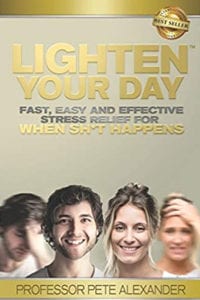
Lighten Your Day: Fast, Easy and Effective Stress Relief for When Sh*t Happens
The only thing you can control is yourself. Comparing yourself to somebody else doesn’t do you any good. It’s going to add stress. The great thing that I like to mention to or have them think about when we get into this imposter syndrome is it’s all fear-based. We’re thinking, “We’re not good enough.” First of all, I like to remind people that fear is a four-letter acronym, Fictional Evidence Appearing Real. We’re doing it to ourselves. We’re assuming something is bad when it isn’t the case. When somebody is thinking, “I want to go for this promotion.” “I want to go for this big fish client.” “I have this important presentation.” That fear of, “Am I good enough?” The question that I always suggest to people is, ask yourself, “What would you do if you knew you couldn’t fail?” What that does, John, when you hear that question, it opens up the world of possibilities.
It turns off our fear mode. We’re always in fight or flight. When you have that question posed to you, you get out of your fear or fight mode in your brain and say, “Let me go to my imagination where storytelling lives and see what all that’s going to be.”
You can be storytelling to yourself, “What would you do if you knew you couldn’t fail?” I asked this of my eighteen-year-old. First of all, trying to connect with a teenager as a parent is a challenge in itself for anyone. However, he was struggling with what he wanted to do for a career. I asked him that and I said, “Think about that but don’t tell me right now. Think about it and let’s talk tomorrow.” The first thing he says to me says, “Dad, that was an interesting question.” First of all, I’m like, “I got through to him.” He came up with three different possibilities, things that were way out there. Instead of being stuck, he was thinking about one of those things and he’s pursuing one of those.
You have something specific for people who might get nervous before they have to pitch or have a big interview and it’s called Hakalau.
It’s a light meditation that comes from the Hawaiian culture. What it’s designed to do is exactly what you said. If any of your readers are about ready to go on stage or go into a conference room, let’s say a Zoom conference where you have to give a good presentation, there’s pressure there and you’re thinking, “What’s going to happen?” A great way to ground yourself is to use Hakalau. This is a minute or two beforehand. What you do is you pick a spot on the wall, a stationary spot anywhere. If your readers want to practice this, I’ll walk you through it.
[bctt tweet=”Gratitude is the best stress reliever.” username=”John_Livesay”]
As you stare at this spot, which is preferably above eye level, if you’re either sitting or standing, you let your mind go loose and you focus all of your attention on that spot. If you notice, within a matter of moments, your vision starts to spread out and you see more of the peripheral than you see in the central part of your vision. As you start to see the peripheral, pay more attention to the peripheral than the center of your vision and you stay in this state for as long as it feels comfortable. Notice how that feels. You do that for 30 seconds or a minute maybe. You open and close your eyes, come back into the room and you’ll notice that you’re calmer, more aware of your surrounding and ready to take on that perceived stressful event.
In a way, it sounds like a little bit of self-hypnosis.
It can be.
Your book, Lighten Your Day: Fast, Easy and Effective Stress Relief tips and you have this whole LIGHTEN Model that you’ve created. Who do you work with for this? Is it individuals? Is it companies? Is it both?
It’s both. Usually, it starts off like a Zoom workshop for an hour. I have a team of people. I walk them through certain activities. Hakalau is one of them that I walk them through. If any particular individual might be struggling and needs a more in-depth stress relief, I’ll work one-on-one with somebody.

Stress Management: Don’t try to control the uncontrollable.
We’re in a pandemic, which a lot of people are experiencing a whole another level of stress from the isolation part of it. Do you have any tips for people on that?
The most important one there is don’t try and control the uncontrollable. This whole COVID thing and having to be stuck at home in many cases. We as humans, our human nature when we’re faced with a stressful situation is that we stress about all aspects of that situation. Inevitably, only some of it is within our control and some of it is outside of our control. We can mentally think about creating two lists, our controllable list and our uncontrollable list.
Let’s take COVID for example. Thinking about that, what can’t we control? We can’t control the government response to it. Let’s say if you have small kids and whether or not they’re going to school physically or online, we have no control over that. You don’t even have control or we don’t even have any control over the person next to us wearing a mask. We don’t have control over that. You list out whatever things you don’t have control over.
On your controllable list, you list things like, “I can wear a mask. I can wash my hands frequently. I can make sure to keep six feet distance from the next person. I can focus on my own mindset to make sure that I’m not worried about or try not to stress about all aspects of this situation.” If you separate those two and you say, “The uncontrollable stuff, I’m going to do my best to forget about that. I can’t do anything about that.” You focus as much of your mindshare on the controllable. What happens is, when we feel like we’re in control, when we can affect change, our stress goes way down.
If somebody wants to reach out to you, your website is PeteAlexander.com. Any last thoughts or a piece of advice you have for people on stress or a quote you like?
People ask me, what’s my favorite stress relief tool? I tell everyone, consistently, “It’s gratitude.” Have gratitude for what you have. What happens is a lot of people think, “That means I have to have gratitude for the big things. I’ve got a great paying job. I have a big house. I have a fancy car,” whatever it happens to be. Gratitude is for the little things in life. My wife and I, every night, we have a gratitude exercise where we ask each other, “What are you grateful for today?” I always start with, “I’m grateful for my health.” All else is secondary. Both of us will bring up things like, “I’m grateful that I got home from work safely. I’m grateful that I got a chance to go out for a walk because the weather was nice. I’m grateful that I had a chance to talk with one of my kids on the phone.”
When we lose track of the small things and think, “I have to win $1 million to be grateful.” We’re not giving ourselves a recipe for success. When we focus on what our own progress is, as opposed to comparing ourselves to other people, that seems to be the big takeaways that you’ve given us. What a great reminder of only compare yourself to your own self. I say, “Focus on your own progress and you win.” That’s the race you have to compete in. Thanks for being who you are in the world and helping us all realize that stress is something that we’re choosing to respond to, as opposed to being victims of any one event.
John, thank you so much for having me on the show. It’s been an absolute pleasure. I appreciate the time of your readers. I hope they got something out of this.
I’m sure they did. Thanks again, Professor Pete.
Important Links
- Lighten Your Day
- LIGHTEN Stress Model
- Adult Children of Alcoholics and Dysfunctional Families
- PeteAlexander.com
- Better Selling Through Storytelling Method Online Course
Wanna Host Your Own Podcast?
Click here to see how my friends at Podetize can help
Purchase John’s new book
John Livesay, The Pitch Whisperer
Share The Show
Did you enjoy the show? I’d love it if you subscribed today and left us a 5-star review!
- Click this link
- Click on the ‘Subscribe’ button below the artwork
- Go to the ‘Ratings and Reviews’ section
- Click on ‘Write a Review’
Love the show? Subscribe, rate, review, and share!
Join The Successful Pitch community today:
- JohnLivesay.com
- John Livesay Facebook
- John Livesay Twitter
- John Livesay LinkedIn
- John Livesay YouTube