

Energize! With Dr. Michael Breus
Posted by John Livesay in podcast | 0 comments


What do we usually do when we feel tired? We may feel like we don’t have enough energy to continue on our daily activities, and that’s the time we know that we need rest! How important is sleep? In this episode, Dr. Michael Breus shares his expertise on sleep medicine and how we can actually maximize and energize our bodies. Dr. Michael shares some of the techniques and methods on where we can get and replenish energy aside from sleeping, and that is through intermittent fasting, diet, exercise, or movement schedule. Not every person is the same. So Dr. Michael shares the different chronotypes of people to identify the correct fasting for you. Listen and be energized!
—
Listen to the podcast here
Energize! With Dr. Michael Breus
The reason we sleep is so we have energy the next day, which makes perfect sense that The Sleep Doctor, Dr. Michael Breus, has written a book about how to energize ourselves through movement, eating, and even intermittent fasting. He said that movement is what prevents stagnation and that when we change our sleep, we change our life. Enjoy the episode.
—
We have a guest that’s very special to me. We were great friends. It’s Michael Breus. He is a PhD. He’s a clinical psychologist who is both a Diplomat of the American Board of Sleep Medicine and a fellow of the American Academy of Sleep Medicine. He’s 1 of only 168 psychologists in the world to have passed the Sleep Medical Specialty Board without going to medical school. He was named the top sleep specialist in California by Reader’s Digest and 1 of the 10 most influential people in sleep. The reason I’m excited for all of you to get to know him is he has a book out called Energize!: Go from Dragging Ass to Kicking It in 30 Days that he co-authored. Dr. Michael, welcome to the show.
Thank you so much for having me. I certainly appreciate it. Everybody should know John and I are dear friends. We have been friends for quite a while. He has been a big supporter of my work, all of my projects and products. I want to thank you from deep in my heart.
Before we get into this wonderful book and congrats on the branding and the colors, I love the bright orange Sutton images and yellow. Let’s know a little about your own personal story. I was reading the opening of the book, and you smartly took the readers to have a dramatic moment in your life. Let’s go back in time. Was sleep always on your radar as a student or as a kid? How did you find your passion?
My dad used to often say he would wander into my room when I was in high school on Saturday morning at 1:00 in the afternoon, which was morning still for me. He would say, “What are you doing with your life? Are you just going to sleep your life away?” I’m doing something that’s not too far away from that. To be fair, I had no interest in sleep.
I went to graduate school to get a degree in Clinical Psychology. I wanted to specialize in sports and Sports Psychology. I want to work with athletes to make them throw faster, run harder, and all these super fantastic, wonderful psychological things but the best program in the country, which is the one that I wanted to go to, was at the University of Mississippi Medical Center in Jackson, Mississippi.
They had a specialty program. I was interested in eating disorders and athletes because I wanted to combine my two areas of interest and see if I could be helpful. To be truthful, if you didn’t go to Harvard, Princeton or Yale, you weren’t getting into this program. It was one of those super high echelon programs but they had a sleep track on the side where they were asking people if they had an interest in sleep.
I had worked my way through graduate school in the Electrophysiology department. I’m the wonky geeky guy that likes to take apart EKG machines, put them back together and make sure that they work. I know how all those signals were coming in and out of the body. That was how I was making my living going through graduate school. They use the same machines for sleep.
[bctt tweet=”You change your sleep, you change your life.” username=”John_Livesay”]
I was like, “This is going to be easy. I’m going to tell them I’m going to be the sleep guy. I get into the program, and then I will transfer as soon as I get there. No problem.” I applied. I’ve got into the sleep track, which nobody from my program had ever done before. As soon as I’ve got there, I raised my hand. I said, “Doctor, I would like to transfer over to that other program.” They said, “Hold tight, Mr. Breus.” I was not a Dr. Breus at that time. They said, “You promised us, and we filled that spot for you. You are going to do six months there, and then you can do six months in whatever you want to transfer to.” I was like, “How tough could this be? It’s sleep, for God’s sake.”
By the third day, I fell in love with clinical sleep medicine, and I knew I was never going to go anywhere else. I help people like this. It’s unbelievable when somebody is suffering, and you can identify something that’s going on with them and give them practical, useful advice to change something that’s important in their life. I say it all the time, “You change your sleep, you change your life.” I’ve got the lucky job of doing that and I love it. It’s a lot of fun. I have been very fortunate. I have gotten a chance to have a varied career. I have done things with WebMD.
I was the WebMD sleep expert for fifteen years. I have been on Dr. Oz for 40 times. It’s crazy when you think about a sleep doctor getting to do all these fun, funky things, and then the book, Energize!, is out and pretty exciting. My fourth book out of all the things that I have done. I can’t believe I’ve got four books on the shelf. That’s fun. You are going to have another one coming out.
My fourth, The Sale Is In The Tale.
You and I were contemporaries in our authorship. We are crawling up that library very quickly. I’m excited to have that out with my co-author, Stacey Griffith. For folks who don’t know, Stacey was the founding trainer of SoulCycle, the indoor bicycle inside the class. She helped us develop a wonderful program looking at movement and why movement is important. The book Energize! is a different program. “Why is a sleep doctor writing a book about energy?” It’s usually the question that most people want to know like, “Michael, you are the sleep guy and not the energy guy.”
Since we are talking business here, as well as personal, one thing is I needed to expand the brand. There’s nothing wrong with sleep but it’s a niche universe. Having been the sleep doctor for a long time, I wanted to expand the brand and go more into energy, how to feel bigger, better, happier, and all of those different things. Let’s be honest, why do we sleep? We sleep to wake up to feel good, to spend time with the people that we love, and to have energy.
I started thinking through that as an idea, and then, to be honest with you, it was a little scary because it’s easy to measure sleep. How do you measure energy? I knew how to measure sleep. I have been trained on it. I have been doing it for many years. EEG, electrodes, and all this crazy stuff. You are playing around with all that stuff. That’s easy, but how do you quantify energy?
We did a lot of thinking and spent some time. We figured out different types of energy, a way to monitor your energy and increase your energy without pharmaceutical help, without external help, all done completely internally, holistically with your own body. That’s what Energize! is. It’s a program that has three specific components.

Energize!: Go from Dragging Ass to Kicking It in 30 Days
We have intermittent fasting to represent nutrition. There are lots of data to show that intermittent fasting helps increase people’s energy. To be fair, this is not a diet book. I want to be super-duper clear. That’s a big topic, and I am not an expert on it. You can do this intermittent fasting with whatever meal plan. If you are a vegetarian, vegan, paleo, keto or Mediterranean, I don’t care. Do it during a certain prescribed time.
There’s the sleep portion. To be also fair, if people got a chance to read my third book, The Power of When, which I know you enjoyed quite a bit, we talked to people about when to go to sleep based on something called their chronotypes. We take a lot of that data, and then we update it into the new books that we have fresh information but people are definitely still following those guidelines. Now we have a movement schedule. It is unique from the standpoint that it’s not an exercise routine. Nobody is getting big muscles from this.
This is to prevent stagnation because sitting is the new smoking. We’ve got to get up and move. I like to use that old physics principle, even though it doesn’t quite apply here, “A body at rest has a tendency to stay at rest but a body in motion has a tendency to be in motion.” We’ve got to be in motion because if we are stagnant and not moving around, we are getting sedentary. When we get sedentary, we gain weight. When we gain weight, nothing good is happening.
I’m not here to shame anybody who’s got weight issues. That’s not what we are talking about here at all. What we are talking about here is moving. You can be big, medium, small, I don’t care. I want you to move because moving helps increase your energy and gets you towards many of those goals that you would be looking for. The book breaks down into those three different categories.
That last one begs the question of what you have in here about The Daily 5×5.
This is the most unique aspect of the book. Thank you for highlighting it. I appreciate that. It’s called The Daily 5×5. Here’s what we do. In the very beginning of the book, Chapter 1, as a matter of fact, we ask people to assess their energy because most people, when they come to me are like, “I’ve got low energy.” I’m like, “When?” “I don’t really realize it until it’s low.” I’m like, “Let’s track it, and let’s see.” We have people take out their cell phones, and we give them five different times throughout the day. One after they wake up, one before lunch, one after lunch, one before dinner, and one before bed. Five different times and they do a rating scale, 0 to 10, on how they feel in terms of their energy level.
What we have to do is figure out, “Is there a time zone where you’ve got low energy?” If there is, we can focus on that. We don’t have to worry about some of those other times. Step number one is doing this energy scale, then about three chapters into the book, we flip things around on people. We say, “Those five times that you were going to be monitoring your energy, we want you to use those five times for movement.” That’s where the 5×5 comes from.
We have five different kinds of movement. I want to emphasize to your audience, this is not an exercise program. This is a movement program to make you feel good and change your energetic profile. The first one is called a stretch. Surprise, you have been lying in bed for 7, 8 or 9 hours, you would probably need to stretch. You can even do this while brushing your teeth if that’s what you want.
[bctt tweet=”We sleep to wake up to feel good to spend time with the people that we love.” username=”John_Livesay”]
We see our animals do that. Instinctively, dogs, cats, they all stretch and I’m like, “What makes humans think we don’t need to do this when they are modeling it for us?” I love it.
I’m glad you brought that up because it’s the perfect segue into the second section, which is the shake. What do animals do after they stretch? They do that crazy big shake. Your dog does that. I have seen him do it. What is that all about? I did it, and I feel more energetic. Shake out your hands and legs. What it does is it move the blood distally out to your extremities, and it causes alertness in you. It increases your energy level. The third one is called a bounce. It’s exactly like it sounds. Maybe you are doing some jumping jacks or you are just jumping up in the air. Skipping is my favorite one of these.
Everybody out there is going to be like, “Really, Dr. Breus, Skipping?” Yes. People on my street have seen me skip down the street. They think I’m crazy. I’m pretty sure they thought I was crazy before but it’s so much fun. If you do it for 2 or 3 minutes, even though you look insane, it changes your entire energetic profile. It makes you feel good, plus it gets you out of the Zoom, out to the outside with a little bit of fresh air, sunshine, and stuff like that.
The fourth one is called the build. This is where you use a major muscle group. Thighs, butt, chest, maybe it’s a pushup, deep knee bend or some crunches, nothing to break a sweat. Just to be clear, this is not an exercise. This is merely to get those big muscle groups moving because they haven’t been moving all day. The final one before bed is a balance. This is where we have people doing like a tree-pose on the side of their bed or standing in a balanced position with their arms out. What it does is it calms you down.
If you are standing there in a tree-pose on one foot, you can’t think of anything other than what you are doing, “I’ve got to stay right here. I can’t move.” It helps clear that mind and things like that. The 5×5 is generated for people who find themselves, “I wish I were more active. I know if I moved more, I would feel better.” Maybe you are stuck at an office job or maybe you are at home.
Maybe you have been secluded to your house now and trying to get the motivation to do something in-between Zoom call after Zoom call. It’s crazy. This is what I do in between the Zoom calls. I will do a shake in between my morning ones. I will do a bounce in between my other ones. I will do a build afterward to give myself something to do to make my body move.
If you are going on camera like you do for live TV, if someone is going into her life pitch or pitching anything, getting a product sold or bought, getting hired, getting your energy up before you are in person or on a Zoom call is key. You can’t start cold. One of the favorite things you said a while ago that has stuck with me around sleep is if we are not burning energy up, then there’s nothing to recover from. I love that so much because I never thought of it like that. If I haven’t exerted any energy, what am I recovering from? Therefore there’s no need to go to sleep.
Perfect example. I have one patient who is not debilitated but doesn’t want to leave their home, a shut-in kind of person. This person has tremendous problems, and I’m constantly turning them and saying, “If you’ve got out of your house, if you were active or did more and used up more energy, then your body would have something to recover from.” Remember, sleep is recovery. If you don’t do anything to recover from it, there’s very little need for your body to do a whole lot of sleeping.

Sleep Medicine: We sleep to have enough energy. We need to move to prevent stagnation.
We try to activate those ideas in people’s minds and have them think through those ideas of like, “It’s COVID. What can I do? I don’t want to go to the gym. Maybe I don’t feel comfortable going to the gym. Maybe everybody there has got a mask on. It’s freaking me out.” I don’t know about you, John, but I don’t like cycling in a mask. It’s weird. Trying to find those things to do just to keep yourself active turns out to be a challenge. This is one of those things that you could possibly do.
Going back to your story of origin there of being interested in eating disorders and athletes. Certainly, we are aware of that with gymnasts sometimes or lean runners. What I find interesting now is in this wonderful book, Energize! that diet is a big part of this. A lot of people have talked about, “I have gained weight during a pandemic. Someone tells me not to eat after 8:00 at night. That’s impacting my sleep. That’s stress eating.”
Let me break it all down for you. I see where you are going with this. It’s a good place to go. It’s important for people to understand. Let’s talk about intermittent fasting, when to eat, fast, and all of these different things. If I had to pick a second unique thing that we learned by putting this book together, it has to do with intermittent fasting. Not only did we learn when but for how long to fast? I will tell you how we learned it. As you know, I have been an intermittent faster for several years. I follow something called my chronotype.
For folks reading, you may not know what a chronotype is. You do. You have just never heard of the word. If anybody out there has ever been called an early bird or a night owl, those are chronotypes. My contribution to the literature is we used to think that there were three. There were early birds, night owls, and people in the middle. We called them hummingbirds, not original. My contribution to the literature was I came up with a fourth chronotype and renamed them completely. The early bird is now a lion. Hummingbird is now a bear. Night owl is now a wolf. Insomniacs, the additional person, are called dolphins.
What we know is we have actually based a lot of things on these chronotypes. When I started doing intermittent fasting, I did it based on my chronotype. I’m a late-night chronotype. I’m what’s called a wolf or a night owl. To be fair, I can’t eat breakfast. I like breakfast food. I love omelets, pancakes, and all that good stuff but I can’t eat early in the morning. I will get sick. My system cannot take it but if I wait until about 11:00 in the afternoon, that’s when I can start.
I can get food in me. It feels good to eat. I started to think about that and I said, “If I’m a night owl for my sleep, I must be a night owl for my nutrition as well.” I started figuring out when to do my intermittent fasting because here’s the problem. Nobody gives you any guidelines. They all say, “You should eat breakfast, have a late lunch, have some dinner,” and then it’s like, “Who can do that?” I can’t do that.
The first thing I tell people is, “Figure out your chronotype. You don’t know what it is. You can go to ChronoQuiz.com, and you can figure that out. It takes about three minutes to do. Once you figure out your chronotype, we tell you when to fast based on your chronotype. The second thing that we learned, which I thought was even more interesting was, how long to fast based on your body type. We haven’t talked about body type but that’s the newest addition to the book. With those four chronotypes, we layered in body types on top of that. You are going to have to go back to high school Biology because you can remember there was the endomorph, mesomorph and ectomorph.
Visualize all of those sizes.
[bctt tweet=”It’s really cool to be able to keep your energy all 24 hours, even when resting.” username=”John_Livesay”]
Those are genetic, and your chronotypes are genetic. They can’t change. That’s who you are. That’s locked and loaded. If readers want to figure out which body type they are, you can actually go to MyEnergyQuiz.com or EnergizeMyself.com but there’s an easy way. I’m going to teach everybody real quick. If you take your thumb and middle finger, you make an okay sign, not the first finger but the second finger. Put that around your wrist. If the hands touch, you are a mesomorph. If they don’t touch, you are an endomorph. If they overlap, you are an ectomorph.
The wrist size determines this. People out there can figure out what their body types are. I’m going to give you a brief description in case you want to remember that. An ectomorph is long and lean people, and it turns out they have very fast metabolisms. It’s going to be an important thing to remember when we are talking about intermittent fasting. I’m a mesomorph.
[bctt tweet=”We sleep to have enough energy, We need to move to prevent stagnation ” username=”John_Livesay”]
We have a tendency to be more V-shaped. Our shoulders have a tendency to be wider than our waist, and then we hang meat on the skeleton that way. The endomorphs are a little bit on the thicker side. Their shoulders and waists are closer. They have a tendency to put weight in their toes, gut and for guys are in the spare tire. This is something that would have been going on since you were a kid.
What’s fascinating about this is your body type tells us how long to fast. Ectomorphs are long and lean people. They don’t need to fast for a long time. They will do 12 hours of eating and 12 hours of fasting. Mesomorphs like myself may want to lose a little bit of weight, but not a lot. What we will do is we will fast for 14 hours, feed for 10. Do you see what I did there? I jostled it around a little bit of time.
The endomorph who are a little bit bigger, who usually are trying to lose weight, we are going to have them feed for 8 and fast for 16. Now you have a starting point. The thing that’s so ridiculous is nobody knows where to start. In telling the story of intermittent fasting, weight loss, and all these things, you’ve got to know who all the characters are and the setting, and the scene. I’m talking your language here.
As a storytelling keynote speaker, I talk all the time about who are the characters in your story. The big a-ha for most people is, “We never thought to put that person as the hero instead of myself as the hero.” Now you have given us characters in the movie of our own life. We can say, “I’m not fasting long enough based on my body type. No wonder it’s not working,” or the classic Oprah saying to Dr. Phil, “How come other people can eat more than I can? It’s not fair.” You are not one of those people. Check your wrist size.
We are super excited to have discovered that. We did a study where we took 5,000 people who had taken my quiz, and we gave them the body type quiz. That’s how we started to learn all of this information about people. It’s very exciting and cool fun stuff. We’ve got the movement schedule, sleep schedule, and intermittent fasting schedule. Being able to keep your energy all 24 hours, even when resting, turns out to be cool.
I did mention that there were a bunch of different types of energy. Here’s the thing, a lot of people don’t think about it. When you think about energy, “How do you metric that? What does that mean?” There might be more but I came up with four different energy categories. There’s eating energy, so fuel. That’s obvious. There’s resting energy. That includes sleep and napping. There is emotional energy and moving energy, which we have talked a little bit about.

Sleep Medicine: A body at rest has a tendency to stay at rest, but a body in motion has a tendency to be in motion.
I also believe that there’s spiritual energy but I wasn’t sure exactly how to wrap myself around that in this book. I felt like I don’t want to go into that realm but I believe that there is a tremendous amount of energy in the spiritual world, and from people out there who are spiritual, don’t disregard that at all. There’s a lot of very positive energy there. Emotional energy, yes. That was it. That’s a tough one.
What I love about your book Energize! is you talk about your round energy, and I have heard you speak and get questioned many times. One of the most common questions, and therefore I feel obligated to ask, is this jet lag thing, because especially people in business traveling all the time, is there a way to have energy with jet lag? Some of that is emotional because I know myself. If I’m going someplace for a vacation versus a business trip, my energy levels are very different.
Let’s break that down. When we look at jet lag, so number one, jet lag is a physical problem that you have when your body moves rapidly across time zones, and your brain doesn’t have a chance to change that dial. It doesn’t have a chance to go from Pacific Time to Central Time to Eastern Time or the opposite way, whichever way you happen to be traveling. The good news is that your body will naturally adjust one day per time zone crossed.
If you happen to go from New York to LA, it’s only going to take you about 2 or 3 days to get used to it. Many people, when it’s that close, don’t even have much jet lag, to begin with. East is least, and West is best. What do I mean by that? When you travel in an Easterly direction, you are basically asking your body to go to bed early.
If I turn to you and I said, “I want you to go to bed at 7:00,” it’s not going to happen. Even though it’s 10:00 New York time, it’s 7:00 in Los Angeles time. East is not as easy. In West, all you are asking somebody to do is stay up a little bit later. When you travel in the Westward direction, it’s a little bit easier. I do have a cheat code for jet lag called Timeshifter. There’s an app called Timeshifter. I have talked to you about it before. Full disclosure, I’m one of the original investors but also one of the designers.
This is an algorithm that gives you a schedule of light, caffeine, napping, and melatonin to be able to sleep for two days before you get to your destination and you will arrive on time. You will arrive at the local destination time. It’s all very straightforward. You use the light at this time, melatonin here, caffeine, napping, and it works well.
What you are asking is something even more interesting, which is that emotional energy that comes with the trip because I get it. I cannot count the number of times that I’m walking down the jetway and I’m thinking, “I can’t believe I’m doing this again.” It’s never a short flight. It’s never a 45 minute or 1.5-hour flight to Dallas type of thing.
It’s like, “Michael is taking a six-hour flight to Boston. He’s going to Lisbon.” It’s unbelievable. The level of excitement is what you are thinking about. That does have a lot to do with emotions. To be fair, sometimes, when I am getting on one of those airplanes, for one of those business trips, it’s like being in emotional vampires. That’s what I call these situations people that come into your life that suck the energy out of you. I call them emotional vampires. We all know these situations because it’s the not-fun situations but we also know these people.
Let’s be honest. We all have at least one person in our life who’s probably an emotional vampire. They suck the life out of you. Every time you deal with them, you feel so drained. There are situations like business travel or there are a lot of people who aren’t too happy about going to the doctor for treatments and whatnot. There’s a lot of stuff that gets caught up in there.
[bctt tweet=”Everything you do, you do better with a good night’s sleep.” username=”John_Livesay”]
Also, to be fair, sometimes those are people in our lives that are hurting, and we are there to help them but sometimes they need so much help. They take so much out of you. You’ve got to do something to save your own positivity and emotional energy. What are some things that you can do? We give a list of them in the book but I’m going to tell you three of my favorites.
My number one favorite is laughter. It’s the easiest one to change and more accessible than you might imagine. My son, Cooper, used to send me a joke a day. It was from this website that he thought was the funniest website in the thick of the Earth. Number one, getting something from my son every day makes me feel better. Think about how you want to set something like that up.
Number two, some of the jokes were pretty funny. I would get a good chuckle, and it would immediately change my entire energetic profile. Here’s another one that’s super easy, even easier than the joke one. Music is the single best way to change your energetic profile literally within seconds. Think about it. When your favorite song comes on, and you are driving around, what do you do? You are bouncing around. Your whole mood changes. You are like, “This is my favorite song.” Energy goes up, emotional baggage goes down, and you are in a great spot.
Another funny story with Cooper during high school, it was hard to wake him up. He only liked to wake up to music. We said, “Cooper, at 7:00 every morning, you are the DJ. Monday, Wednesday, Friday, you get to pick the songs. Your sister gets to pick them Tuesday, Thursday, Saturday.” Cooper would play at 7:00 AM on a volume of 10. You Gotta Fight For Your Right To Party by the Beastie Boys. He’s a throwback kid. We had so much fun. We are bopping around, “You Gotta Fight For Your Right To Party.” We are having a blast. Meanwhile, morning times, which used to suck, turned into something that was completely awesome, full of energy, that type of thing.
Thinking through if you are at work and you’ve got a low energy situation or you are nervous, that’s causing low energy for you being able before you are going to give a pitch or presentation. Being able to find those things and have them in your toolbox, whether it’s on your phone, a phone call to a friend who always cheers you up, whatever it happens to be, you are responsible for your emotional regulator. It’s a thermostat. You are in control of it. I heard somebody say something once that I thought was important. They said, “You don’t have control over your first thought about an issue but you have 100% control over your second thought of an issue.”
That’s that reactive mind. Our frontal cortex gets hijacked. I once had a friend say to me, “This isn’t you. This is your fight or flight response reacting. Take a breath, and you hit the reset button a little bit when you get triggered by anything or anyone.” This concept of teaching us how to energize ourselves, so not only can we get better sleep but bounce back. You have hit on a great formula here for resilience, which as a sales speaker, I’m talking to salespeople who deal with rejection all the time, which is one baby step above depression sometimes.
It sounds like my dating career in high school.
How do I get back up there again and hit the reset button? With all these wonderful tools, the moving, music, stretches, and all of the things you just walked through, we now have tripled the number of things that we have in our toolbox as opposed to another cup of coffee or whatever it might be.
I’m glad you brought up the idea of another cup of coffee, a Snickers bar, a muffin. Those are all quick fixes that don’t really work very well. I can’t count the number of employees who are on their fifth cup of coffee by 11:00 in the morning. There’s no universe where that’s a good idea. We get locked and loaded. We are like, “Quick energy. I’m going to go grab a Snickers.” No. Go outside and get some sunshine if you are tired and start to get rid of some of that excess melatonin. Let it burn off in the morning, and then you will feel a whole lot better. Drink water, not coffee, because sleep is a dehydrated event, and you wake up dehydrated, don’t add caffeine to that mix. There are a lot of bad habits that people didn’t mean to have but they’ve got and it’s having a big effect.

Sleep Medicine: Sleep is recovery. If you don’t do anything to recover from, there’s very little need for your body to do a whole lot of sleeping.
Your subtitles go from dragging ass to kicking it in 30 days. I’m guessing that your whole premise, and that has probably been tested knowing you, that if you do these things for 30 days consistently, you were not going to be feeling like you are running out of energy at those key times because you have measured it. You’ve got steps that are doable, memorable and actionable. That’s what your secret sauce has always been and continues to be with this. Kudos for helping us not only sleep better but get more energy. You are helping us 24/7 now.
I’m trying my best. You are helping them all with business, pitching, and getting their ideas out there. I’m just making sure that they are energized when they do it. We are a perfect team together.
Any last thought or quote that you want to leave us with?
One thing I want to tell people is remember everything you do, you do better with a good night’s sleep. If people want to learn more about me, head on over to TheSleepDoctor.com or you can check me out on social. We put up a lot of tips and tricks out there.
Thanks, Dr. Michael, for joining us and sharing your enthusiasm and energy.
Thanks, John. I appreciate you.
Important Links
- Michael Breus
- Energize!: Go from Dragging Ass to Kicking It in 30 Days
- SoulCycle
- The Power of When
- ChronoQuiz.com
- MyEnergyQuiz.com
- EnergizeMyself.com
- Timeshifter
- Better Selling Through Storytelling Method Online Course
Wanna Host Your Own Podcast?
Click here to see how my friends at Podetize can help
Purchase John’s new book
John Livesay, The Pitch Whisperer
Share The Show
Did you enjoy the show? I’d love it if you subscribed today and left us a 5-star review!
- Click this link
- Click on the ‘Subscribe’ button below the artwork
- Go to the ‘Ratings and Reviews’ section
- Click on ‘Write a Review’
Love the show? Subscribe, rate, review, and share!
Join The Successful Pitch community today:
- JohnLivesay.com
- John Livesay Facebook
- John Livesay Twitter
- John Livesay LinkedIn
- John Livesay YouTube
Talk Triggers: Word Of Mouth Marketing with Daniel Lemin
Posted by John Livesay in podcast | 0 comments

 Episode Summary:
—
Listen To The Episode Here
Talk Triggers: Word Of Mouth Marketing with Daniel Lemin
I am thrilled and honored to have Daniel Lemin. He is a startup co-founder, trusted advisor and the bestselling author on reputation management, digital marketing and social media customer service. He was an early member of Google’s global communications team. Daniel led the launch of products in North America and around the world. He is the CMO and Co-Founder of Selectivor, a food intelligence startup that helps people stay healthy through personalized eating. His book with co-author Jay Baer, Talk Triggers, is going to be a New York Times bestseller. It explores word of mouth marketing and lays out a framework so you can build that in your own organization. You want to have something that’s memorable and Talk Triggers gives you those ways to do it. He’s an expert commentary on television. He has got that anchorman smile. He’s smart and handsome. Daniel, welcome to the show.
Thanks for having me.
Take us back to when you were growing up in Ohio. You can go back to your childhood, high school, college, wherever you want, when you said, “I’m going to get into high tech.” Obviously, Google when you were younger that didn’t even exist. I’d love to hear what your background was of how you got into what you’re doing.
To some degree, I don’t know is the answer. That’s true for many people. You look back and think, “I’m not sure how I got into doing the things I’ve done, but I’m grateful I did.” Part of it though, I’ve always been a curious kid and also a kid that had a curious mind. I always wondered how things worked, why things worked and I tried tinkering with things to make them work better. I was always drawn to technology for that reason. I enjoy the challenges of it and also the gold rush. There’s always something new and bigger. There’s always a moon shot happening somewhere in the tech world, including several happening right now. There’s always been that curiosity for me. I always assumed that I would work in marketing as a kid. That was the only thing I was ever good at. I tried doing other endeavors, but none of them anywhere near with success.
[bctt tweet=”If you are assuming that your best chance to captivate a customer is to be the best in your category, then you’re going to struggle for a long time.” username=”John_Livesay”]
Tell us what it was like to be one of the early members of Google. What was that atmosphere like? What can you say looking back, how the culture has evolved?
I was employee number 400 at the company. I worked on this scrappy little marketing communications team. There were about eight of us in total at the time. The fun part about that was seeing the company explode around us in all different areas, from employee size to new markets, launching internationally new products, and new product space. They’ve launched so many innovations when I was there in the first couple of years.
[bctt tweet=”Nobody ever talks about average so you need to be remarkable.” username=”John_Livesay”]
It solidified for me, in my mind, the value of never resting on your laurels. You never assume that everything is done. The work is never done. You always continue to change things. You continue to think about ways you can do something better. That’s in part how I’ve approached my career after Google in marketing. It’s always looking for better ways to do things. It was a good training ground for me from that perspective. It was also an amazing place to work.
That has led you to your own startup, Selectivor. You’re applying AI intelligence to helping us all get healthier.
The broad mission is to help people stay healthy and well through whatever diets they may be following, both health and personal guidance. We’re building a whole host of AI tools to do that. We’ll help you find recipes that work for you. We’ll help you find restaurants and things that work for you. That’s the mission and the broad story behind that are personal struggles that both I and my co-founder had trying to stay on our diets. In the context of eating with other people, sometimes that conversation’s uncomfortable. You don’t want to tell them about your dietary needs. This has been the biggest buzzkill in the world, “I’d love to go on a date with you. I can’t eat this and I can’t eat that. I don’t eat this and I won’t eat that. Aren’t you looking forward to meeting me?” It’s extracting some of that social friction out of the equation in the process of doing that.
I’ve read some research that if you tend to have overweight friends, you are more likely to be overweight and vice versa. If you tend to have fit, healthy friends, you’re more likely to be fit. Since you’re an expert in data and software, does that ring true? Are you incorporating that into your company?
It completely rings true. There’s a famous landmark study from the ‘60s, the Framingham Heart Study. They wrote about it in that book, Connected. It’s a landmark study looking at how communities impact the health of its members. Obese communities tended to remain obese and lose weight together when they started. It is truly that connected. In fact, one of the things we’re building into our product is the ability to challenge yourself and others to do something, stay on a diet, drink more water, and eat more watermelon, whatever it might be. That notion of challenging each other is a much more playful way to do things together. It impacts how we think about the product.
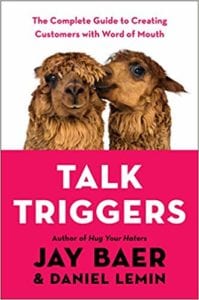
Talk Triggers: The Complete Guide to Creating Customers with Word of Mouth
Let’s dive into Talk Triggers: The Complete Guide to Creating Customers With Word Of Mouth. If there’s anything I’ve learned from my advertising background is word of mouth is much more powerful than any paid ad and commercial. Getting these brand ambassadors to talk about you and spread the word, the trust factor is huge. How did you and Jay Baer decide to work together?
I’ve known and worked with Jay for a decade, even more than that. I hired Jay at an agency I worked at in Downtown Los Angeles. I hired Jay there to help us on the agency side with innovation and bring some outside thinking. I liked working with him so much that I decided to leave that agency and work with him. I’ve worked with him on the consulting side since 2010.
This is a big collaboration with a lot of insights together. The cover of the book looks like two llamas nestling each other. What animals are those?
They’re alpacas nestling. They’re from Peru.
What is the significance of that picture?
It’s a simple story. The first version of the cover from our publisher was less than remarkable. It wasn’t terribly exciting. Widely panned might be a phrase I would use to describe that. We were looking for something that people would remember and talk about. Have you seen another business book with alpacas whispering to each other on the cover? It’s unique. It’s also hot pink. It’s connected to one of the case studies inside. That’s the story behind the cover. We’ve taken it to a ludicrous extreme. We’re all over now alpaca GIFs and memes. We’ve even been to an alpaca farm together, Baer and me.
The premise is you want to say something that triggers a conversation, which is what a good pitch does. The second part for me, from what I can tell that you’re offering people, does not only do it trigger a conversation but it triggers a memorable conversation. Can you give us an example?
The hero insight that led us to write this book was that the economic impact of word of mouth. The things we say amongst ourselves as buyers, investors and consumers of things, the economic impact of that is much more massive than we might assume. 20% of every purchase decision that’s made is directly driven by word of mouth discussion or recommendation. The challenge is few companies have an actual strategy to make word of mouth happen. They assume that it happens. You probably know from a gut feel as well as we did, that doesn’t happen. It’s a gamble you take that someone’s going to talk about your brand. We started looking at examples of companies that do something a little bit different in the delivery of their surface.
[bctt tweet=”Listen to customers to find the gap where a talk trigger can happen.” username=”John_Livesay”]
For example, the UberConference. What’s great about UberConference is if you’ve ever been on a conference call from UberConference, you may be familiar with their country, Twain-y hold music. It’s a hilarious song. It’s all about being on hold. You can go check it out, Google UberConference hold song. You’ll quickly find it. The impact of that when you’re on hold and then end up on the call nearly every single time someone says, “Did everybody else here that hold music? That was amazing.” In fact, if you go on Twitter, even on Google and search for UberConference hold music, people go crazy for that song. What they have done is nothing magical. They built in a slightly different way of filling a customer experience gap, in this case with hold music. That was the spark. That is an actual idea. That’s a Talk Trigger. It generates some material for a consumer to work with. It gives them a story to tell. That’s the hero insight behind it.
It’s an interesting thing that something could be so engaging that people would go listen to hold music while they’re not on hold.
UberConference hired Postmodern Jukebox to do a remix of it in multiple different genres.
You give keynote talks on this topic as well. Who is your ideal audience that needs to know how to have Talk Triggers?
The interesting thing is it spans all industries, even as individuals. We can all benefit from having a personal Talk Trigger. Jay Baer, if you’ve seen him speak, he wears crazy plaid suits. He’s always dressed impeccably. As individuals, we can benefit from it. I do a lot of work with associations, small business owners and corporate workshops to companies looking to try to figure out the best type of Talk Trigger basically to deploy. It’s a wide range but a lot of work with small business owners who frankly can probably benefit from it the most.
To me, it seems with the problem you’re solving here is many of the people that I work with, whether I’m giving a keynote talk on how to be a better storyteller and therefore increase sales is this concept of objection around price. You’re a commodity. We don’t see the value in paying your premium price. I don’t care if it’s food you’re selling or a design of an architecture firm. People have a lot of trouble justifying a premium price. How does your keynote and Talk Trigger help people with that particular challenge?

Word Of Mouth: The economic impact is more massive than how we assumed it to be in terms of the things we say amongst ourselves and buyers, investors, and consumers of our products.
Part of that is if you are assuming that your best chance to captivate a customer is to be the best in your category, you’re going to struggle for a long time. Even the best restaurants in the world, from a technical perspective, still struggle to get butts in seats. What is the reason for that? Is it the price? Maybe, but is lowering the price going to get them across that chasm? It might even hurt you in the end. Robert Cialdini always talks about this, the Pre-Suasion. If by the time someone calls you, comes into your restaurant or opens the door to your store, they’ve already decided they like you. They’ve already decided that they’re willing and able to do business with you. That is a massive benefit to the business.
The way to break in and get someone to see you, to get invited to the pitch, is to have some memorable Talk Trigger. You say there’s a 4-5-6 learning system in the book. Can you walk us through what that is and use the MailChimp example?
We put this learning system together. Many authors have written about word of mouth over the years. Certainly, it’s not a topic that’s new. We wanted to bring a little bit more structure to it to give business owners, companies and even individuals an actual framework for how you can make these Talk Triggers. Generally speaking, sometimes it just happened by accident in companies. We thought there’s got to be a better way for this, it’s so important. The 4-5-6 system wraps itself around a few elements. The 4 is the four mandates for a Talk Trigger, four things that must be true for something to be Talk Trigger worthy. There are five general types of Talk Triggers, which are not necessarily mutually exclusive. The 6 is the six-step system that you can use to build them, create them and deploy them.
[bctt tweet=”There’s always a moon shot happening somewhere in the tech world.” username=”John_Livesay”]
I’ll briefly go over the four. They’re a good place to start exploring Talk Triggers. The four mandates or musts for a Talk Trigger, number one, it must be remarkable by definition. It must be something worthy of talking about. No one talks about average. You don’t say, “Let me tell you about this perfectly adequate salad I had for lunch yesterday.” It’s not remarkable. It has to be a remarkable element in the customer experience or the sales experience. The second is it has to be relevant to the customer experience. Relevance is vital to the delivery and reception of the Talk Trigger by the consumer. If it’s out of left field, it feels almost like a gimmick or a stunt, and that’s not the best way to get people talking about us.
The third is it needs to be reasonable. By reasonable, we mean not over the top. If you go to any DoubleTree Hotel anywhere in the world and check-in, they give you a warm chocolate chip cookie that they baked in the hotel. 75,000 times every single day people get this cookie. It’s a reasonable gesture. People talk about that cookie. It’s a remarkable Talk Trigger for the simple thing that it is. It’s a cookie. It’s not a baby alpaca in your room that you can use while you’re at the hotel. It’s a cookie, but it’s relevant to the product experience. The fourth of the mandates is that it has to be repeatable. This is where we often get trapped. Sometimes we think about Talk Triggers being available to our VIP customers, our top customers and top 10%. If it’s something that isn’t available to every single customer every single time they interact with your product, it can cause dissonance. It can cause frustration and disappointment, which is the negative of word of mouth.
Imagine if I went to a DoubleTree and they’d run out of homemade warm chocolate chip cookies and I’ve been looking forward to that. I might be even angry as opposed to if I had no expectation of it, then that’s fine. If I’ve heard word of mouth and they’re out, it’s not good.
Just say, “I’m sorry, your room rate doesn’t include the cookie because it’s too cheap and you’re a bad person.” It creates this letdown, “Terms and conditions. While supplies last,” and all of that stuff is the enemy of word of mouth.
Don’t you see some of the airlines starting to do that? “That seat doesn’t let you have a free snack,” or whatever they’re doing now. Not only is it crowded but you do have to pay to put a bag in the overhead.
It’s almost like they’re paying someone to tell them how to make this experience worse. That’s what they’re hiring in consultants to do at this point, “Can you help us make this the worst experience for at least a small part of our customers?” We’ll talk briefly about MailChimp. I like this example because I’m a software guy myself. It’s often a little bit harder for us to imagine what you can do in a software environment that’s a Talk Trigger. If you’ve used MailChimp, you know their little chimp. It’s everywhere in the product. He is their mascot, he is their voice. He has a name. His name is Freddie, which a lot of people don’t know.
Freddie has a place in the product. When you submit an email to be sent through MailChimp, you get this big high five from Freddie. He says, “Good job.” He’s everywhere in the experience of the product. People talk about Freddie all the time. The reason it’s interesting is email software is the pits. It’s basically the airline of software. They’ve found a way with Freddie to make the experience better for you and because of that people talk about Freddie. I’m sure it has downstream benefits for them from a loyalty perspective and a lifetime value perspective, but most certainly from that Pre-Suasion perspective. If you’re looking for email software, HubSpot, Emma or MailChimp, some people may have an affinity right away for MailChimp.
[bctt tweet=”Never assume that everything is done. The work is never done.” username=”John_Livesay”]
We have an emotional connection almost like Colonel Sanders. There’s a person with the brand. Let’s go through those four Rs and how MailChimp is doing something remarkable. The fact that there’s a playful tone to the culture with this Freddie, you could say that makes them more remarkable than other email companies that don’t do it. Would that be fair?
That’s fair. SurveyMonkey also has a monkey as its mascot. It’s not used to the extent MailChimp uses Freddie. Freddie is in the product, as part of the product experience. From that perspective, it’s remarkable that they’ve done that.
It’s not a one-off, it’s integrated. It’s relevant because the concept of having a bunch of monkeys working for you in the background, it’s fun and it creates a visual image for me anyway.
Often, small business software is painful to use. Not only is it a relevant brand vision, but it’s also slightly better to use, which feels relevant to you at the moment.
It’s easy a monkey could do it maybe. It’s reasonable, it’s not over the top. It’s not this huge gorilla or something intimidating. Finally, it’s repeatable. That monkey’s there come rain or shine.
He gives you a little pellet award every single time you send an email.
That is remarkable to me because we know how our brains are wired. That’s why people keep playing Words With Friends or keep the addiction to the phone or gambling. It’s the, “I’ve got a little ding. I’ve got a little award.” To incorporate that into the software, to me, triggers the same addictive behavior in a good way.
On the Selectivor side, we are building a cute little dinosaur named Oliver. He’s going to have a lot of that same presence like Freddie does because it’s a little bit more fun to use.

Word Of Mouth: If it’s something that is not available to every single customer every single time they interact with your product, then it can cause dissonance, frustration, disappointment, and negative word of mouth.
Are there any tips besides buying the book that if someone’s saying, “I know I need a Talk Trigger and I understand the four steps of these Rs. What could I do? What’s my next step besides reading this book and seeing how other people are doing it?”
I may be biased but reading the book is helpful. Start looking for them in your everyday life. Think about your own experience in places and look for Talk Triggers because you start to see them in different ways and in different places. It’s fun to spot them that way. It’s educational for yourself because for the most part, almost all of them is in the category of, “Why didn’t I think of that first? That’s crazy. It’s so simple, it’s stupid.”
One of the things that you have in the book Talk Triggers is the six-step process for creating them. We’re not going to go into all six, but give us a little teaser. What’s the first step?
The first one is one almost no company does enough of, which is listening to your customers. We go into a meeting room, a conference room, we sit down and we say, “We need to build a viral campaign to launch our new water flavor.” What few people take time to do is to talk to customers, to get their opinion, to see how they use the product, and to talk to your customer service people about what are they hearing from customers. The first step in that six-step process is a listening tour. You go deep on the listening exercise. What you start to see are these little tiny gaps that you aren’t seeing in formal surveys, you’re not seeing in email feedback, but they are actual gaps where a Talk Trigger can fill.
[bctt tweet=”Word of mouth is much more powerful than any paid ad, commercial, and brand ambassadors. ” username=”John_Livesay”]
I tell people all the time, “If you listen to what your customers are saying and put it in your marketing messages, then your potential customers feel like you’re inside their head.” The example of that is I was working with an architecture firm. They were trying to decide whether they wanted to hire me to come and give a talk and a workshop to them. They said, “The problem is we’re tired of coming in second. We’re not winning enough pitches.” I said, “I can help you with that.” Now, part of my whole pitch is, “Are you tired of coming in second?” and then people go, “We are.” That’s a great example.
It totally changed the entire conversation. If you’ve given people a reason to trust you, like you and want to do business with you, I know they understand where I’m coming from and that makes me feel good.
How can people follow you on social media?
It’s Daniel Lemin there on social media and TalkTriggers.com is where all of the other stuff is. We have a special little bonus for our audience. If you go to TalkTriggers.com/SuccessfulPitch, we’ve got a little download there. You can get the six-step process for free.
Thank you so much for being on. It’s exciting to watch you and Jay launch this book. It’s got a great alliteration, a great cover and great colors. How can it not be a hit? It’s going to be fantastic and entertaining at the same time.
I appreciate it. Thanks for having me on.
Links Mentioned:
- Daniel Lemin
- Selectivor
- Connected
- Talk Triggers: The Complete Guide to Creating Customers With Word Of Mouth
- Jay Baer
- UberConference
- Postmodern Jukebox
- Daniel Lemin – Facebook
- TalkTriggers.com
- TalkTriggers.com/SuccessfulPitch
- Quantmre.com
Wanna Host Your Own Podcast?
Click here to see how my friends at Brandcasting You can help
Get your FREE copy of John’s latest eBook Getting To Yes now!
John Livesay, The Pitch Whisperer
Share The Show
Did you enjoy the show? I’d love it if you subscribed today and left us a 5-star review!
-
- Click this link
- Click on the ‘Subscribe’ button below the artwork
- Go to the ‘Ratings and Reviews’ section
- Click on ‘Write a Review’
TSP030 | Michael Walsh – Slack for Senior Care
Posted by John Livesay in podcast | 0 comments
Listen To The Podcast Here
Episode Summary
Michael Walsh is the co-founder of Cariloop and runs the Health 2.0 Dallas chapter. Cariloop is a program that allows people to help manage their older loved ones’ healthcare and needs from start to finish. Michael has raised $500,000 in funding during his first seed round and has some valuable insights to share on what truly makes a successful pitch.
Key Takeaways
- 01:40 – Who is Michael?
- 04:45 – Why was Cariloop founded?
- 10:15 – How/why did Michael pick his accelerator?
- 12:10 – The knowledge and the contacts Michael made at the accelerator were priceless.
- 16:05 – How can entrepreneurs figure out how much their company is worth?
- 20:25 – How has Michael spent the $500k he’s raised?
- 23:10 – How does Michael handle the competitor question with investors?
- 25:45 – Michael believes telling stories is better than pitching.
- 28:00 – Michael recommends the book Delivering Happiness by Tony Hsieh.
Tweetables
[Tweet “A pitch should be a story that you tell investors.”]
[Tweet “What are pain points of your customer that you solve?”]
[Tweet “When you give a customers control during chaos they buy.”]
Links Mentioned
Delivering Happiness by Tony Hsieh
Michael Walsh LinkedIn
Michael Walsh Twitter
Cariloop Website
Cariloop Twitter
Want the Transcription?
Share The Show
Did you enjoy the show? I’d love it if you subscribed today and left us a 5-star review!
- Click this link
- Click on the ‘Subscribe’ button below the artwork
- Go to the ‘Ratings and Reviews’ section
- Click on ‘Write a Review’