

Punching Above Your Weight: Taking Client Engagement To The Next Level With Heath Barnes
Posted by John Livesay in podcast | 0 comments

One of the key ingredients to having a successful business is having the right clients. In this episode, Heath Barnes joins host John Livesay to share how he’s going above and beyond when it comes to treating his clients. Heath is the Branch Manager at Cardinal Financial and host of the Mortgages Reimagined podcast. Starting with being a heavy-weight boxing champion while attending Texas A&M, where he graduated with a BBA in Business and Marketing, Heath Barnes has always been punching above his weight. Listen to his interesting journey to entrepreneurship and get tips on treating and engaging your clients to maximize retention and increase referrals.
—
Listen to the podcast here
Punching Above Your Weight: Taking Client Engagement To The Next Level With Heath Barnes
Our guest is Heath Barnes, who shares with us his unique and creative ways to show client appreciation. You’ll want to read to find out some tips on not only how to have a client appreciation event but then how there are multi-levels to keep the fun going and keep you memorable. Enjoy the episode.
—
Our guest is Heath Barnes. He has an interesting story to share with all of you on his entrepreneurial journey. Many real estate agents are struggling to get their buyer’s offers accepted, and many home buyers are frustrated that the loan process is tedious and seemingly endless. I know I felt that way. Heath’s story starts with him being a heavyweight boxing champion while attending Texas A&M, where he graduated with a BBA in Business and Marketing. He has always been punching above his weight. The energy and passion that he exudes for the business he’s in, coupled with his competitive spirit, and are apparent even in his downtime. He has hiked to the summit of the Grand Tetons.
He’s a licensed pilot and a six-time Ironman. He’s a seasoned snowed skier, skydiver, fly-fisherman, sommelier, and even taught himself how to play the piano with a bunch of young kids. He was willing to take classes. Since 2002, he has been a consistent top producer as the Branch Manager for Cardinal Financial, closing over $15 million a year in loan volume.
He’s also the host of a successful podcast called Mortgage Lending Reimagine. Real estate agents love working with him because he works his magic to make their buyers’ offers irresistible. Homebuyers love working with him because the process he has is so streamlined and smooth, which allows them to close on time without the usual stress. Heath, welcome to the show.
Thanks, John. It’s a pleasure to be here.
Let’s go back to your own story of origin. I gave a little bit of the tip of the iceberg there. Maybe start with your days at Texas A&M and how you became such a passionate person about making life an adventure, and then we’ll get into how you got into the mortgage business.
It’s an honor to be here. Going back to A&M, I started at Sam Houston State. I went there because my brother was already there. I didn’t have to stay in the dorm. After two years at Sam Houston, my brother had graduated and I had a girlfriend at the time who had broken up with me and I dropped a lot of classes.
My mom came to visit me and said, “If you are going to make these kinds of grades, you need to do it at a real school.” She made me “move” to Texas A&M. In a way for me to fit in with the fraternity that I was transferring to, I decided to join the boxing team. It was in that endeavor that I found a new talent which was my long reach and dedication to be good at something and I ended up winning the heavyweight champ two years in a row.
That opened up a lot of doors for me. It opened up a door of self-confidence. It opened up a door to a new job at a local bar called The Tap, which is still there at Texas A&M. I became a bartender and my life began to flourish in college. It opened many doors of confidence and meeting other people being a bartender. I love talking about it.
[bctt tweet=”Host a client appreciation party.” username=”John_Livesay”]
My first question around that is how did you pick boxing? It’s not a common sport like baseball, football or basketball. Did you watch somebody on TV? Did somebody take you to a match? How did that get into your awareness?
Our fraternity happened to have a guy that had some experience in coaching boxers. I raised my hand trying to fit in and was dedicated to the workouts, practicing and getting better, which started early in childhood. I was a baseball player. I would spend the summers practicing. I always learned that if you are going to be good at anything, it takes a lot of practice. I knew if I was going to be any good at boxing and not get my face punched, then I would so. I didn’t even know my talent. In my first fight, I knocked the guy out in the first round. There were very few fights in which we got past the second round. Just about every one of my fights was a knockout.
That’s a great analogy there for what you are doing now with mortgages. Almost every one of your deals is a knockout. You also talked about the long reach of competitiveness. You are in a competitive field. I understand there’s a story of a very special relative that you saw in the mortgage business that made you want to mirror that. Sometimes we see a dad and go, “I want to follow my dad’s footprints. I don’t want to do that. My dad doesn’t look like he’s having a lot of fun.” Tell us a little bit about who influenced you to get into the mortgage biz? What did you see that he was doing that you wanted to do it?
It’s funny because it’s come full circle because I rehired my actual Uncle Larry, who got me in the business. In the beginning, in 1999, I was in the mobile home business. I remember going to a closing. In a mobile home business, you have two opportunities when you are getting financing. One is to finance the mobile home, which is called a chattel loan or a regular loan, which is not done by a mortgage company.
The second type of loan is what they call a land home package, where you are financing the home with the land. I was sitting at the closing table and I looked at the closing disclosure. I saw how much money the mortgage guy was making. I thought, “I might be in the wrong business.” I remember my grandmother telling me that my Uncle Larry was in the mortgage business. I called him. He flew down. We had a conversation and the next thing you know, I’m doing mortgages. I have never looked back.
If you had to give our audience a tip about breaking into a field that’s competitive and crowded. I talk about it in terms of a lot of people feeling like they are drowning in a sea of sameness. Everyone says, “Doesn’t everyone have access to the same loans? Isn’t the process the same?” What I found over the years of buying and selling homes, but mostly qualifying for the loan and the offers, there are a lot of nuance and differences in a strategy to put through to get your offer to stand out against all the other offers. I think a lot of real estate agents probably think of you as their secret weapon. Would that be fair to say?
For sure, as far as in this market, which if you are not familiar with, is a highly competitive market, especially if you are a buyer, and getting your offer accepted is not about necessarily having the highest price, but it’s having the right team, whether it’s our experienced real estate agent or a loan officer. Our strategy has been how we remove as many contingencies as possible to separate ourselves, so financing contingency.
The way we take the stress out of financing is by having a good interview with the clients and letting them know what’s going on in the market. The second step is getting them completely through the underwriting process because if you are completely through the underwriting process, the stress of getting the loan goes away. The stress of getting a loan is increased when you have something to lose.

Client Engagement: If you’re going to be good at anything, it takes a lot of practice.
If you are not out looking for a house, there’s no stress of losing something. There’s nothing to lose. There’s nothing to lose in the beginning when you don’t have a home. That’s the time you want to go through underwriting. The old way of doing things in the mortgage business has been you wait until they find a home because you want to make sure that your time is spent wisely that they are going to find a home. We said, “We are going to take it a step further. We are going to take the stress out by moving them completely through that process.” That way, when they go out into the market, there’s no fear about securing a mortgage, and you know exactly what they qualify for, and all the paperwork is done.
Reduce stress for your buyer, and that’s true in any business. If you can make the buying process, stress-free or less stress, then that’s going to make you stand out. We are going to reverse engineer this and then we’ll start at the beginning. You now have a very big group of people who’ve worked with you, trust and like you, and send you referrals. We are going to get to how you built that. What are you doing now to make those people feel seen, heard and appreciated? What did you do that was so timely that I thought was memorable and part of your personality? These are the things that make you stand out against your competitors.
I’m always thanking both the people that refer me business but also my clients. How can I provide an enormous amount of value where they would want to continue to do business with me? We do apply for appreciation parties a couple of times a year. We have made it a habit of renting out an entire movie theater and making it fun for previous clients.
We rented out a theater and we invited our top 100 clients or the first 100 that responded to the premiere of Top Gun. I took it a step further by borrowing my friend Jack Swanson’s flight suit and I bought some aviator glasses. I was fully dressed up for the experience. The look on people’s faces when they came into the theater thinking they were just going to see a movie about the sequel of Top Gun. That was my first experience with it.
Life is all about experience and how you make people feel, even in the stories that you tell. I’m trying to bring them into the experience so that when they leave, they are going to be thinking about me moving forward, especially if it’s going to be a memorable movie. What comes up for me now also is like in life, if you are an entrepreneur, it’s utilization. How do you use everything to your advantage, no matter what’s happening? What’s interesting about this experience was I had a dialogue with the movie theater and I said, “Before you start the movie, what I’d like you to do is stop it so that I can share a few announcements. I got a special treat for everyone.”
All the preparation of making sure there’s a mic and making sure we talk to everyone, and then the time comes. At the beginning of the movie, if you see it, Tom Cruise starts to talk and has a special message. They stopped it after that special message. I used that and I said, “Most of you all don’t know but I’m personal friends with Tom Cruise. That’s a personal message for you all. Thank you all for listening.”
The next thing that happened was I was in the middle of thanking all the people that had attended, the people that made this possible, and the mic went out. I thought, “How do I use this to my advantage?” I said, “I’m just going to continue.” I kept the mic in hand and ended up thanking everyone. I then turned around. I said, “One more thing,” and started out singing, “You never close your eyes.” It was a huge hit because I got out of my comfort zone. Everything inside of me was saying, “Don’t do this. Don’t embarrass yourself,” but I went through with it. My wife was like, “I was proud of you.” It made a big impression on everyone.
Let’s unpack that because it’s such a great strategy that you have a client appreciation party scheduled on a regular basis. What separates you from 90% of the people. What makes you in the 1% of that experience is you took the time to dress up. Automatically people go, “This is fun.” The fun starts before the movie starts.
[bctt tweet=”Reduce stress for your buyers.” username=”John_Livesay”]
You are exceeding the expectations, and then you surprise them by singing, which they didn’t expect. If you are willing to be vulnerable and out of your comfort zone, that’s endearing because that is an emotional bond with people. You feel safe enough with them, and you trust them to not make you feel stupid, and so you are building trust in a very subtle subconscious way.
You did one more thing that is brilliant because I have seen the video, which is you took it a step further for people who are fans and said, “I have got $50 gift certificates for the people who can shout out a quote from the first movie.” Now everyone is immersed in the experience. The audience involvement in a dark theater is tricky and you figured out a way to do it, and people are shouting out the quotes. I don’t know if you consciously did this or not, but what I love about the choice of this movie for you is you are the wingman for the agents and the home buyers.
That’s a perfect brand for you to be in the movie, for you to be identified, especially if you are dressed up in the costume or uniform of it. On some level, people are thinking, “Not only was that fun, but he is our wingman.” You can then email all of them and say, “What was your favorite quote from this new movie? I look forward to being your wingman on the next deal.” It allows you to have some momentum and a follow-up where you are not actually pitching.
I’m going to use that, “I’m your wingman,” and follow up with everyone. I’m going to use that moving forward. Thanks for bringing that to my attention.
It’s my pleasure. When you exhibit some creativity and start giving people an experience, they can then repeat that story. That’s the big takeaway for people, whether it’s a client appreciation story or a story of how you help somebody get a deal accepted in a way that is unique. That’s what generates referrals. For people that are looking for new ways to over-deliver service and things, do you have any structured way of either acknowledging and rewarding referrals or encouraging referrals beyond the, “I appreciate your referrals?”
I was taught several years ago by a coach of mine. I remember when I first got into the business, I didn’t want anyone telling me what to do. I spent the first nine years of my career wanting to do it on my own until I realized that there was no original idea per se. That’s when I started getting some coaching. One of the first habits that they pounded into our heads was to acknowledge people for the action, not the results. For the people that are reading, writing a note is a great way.
It will allow you to stand out like writing a handwritten note, not when the transaction is complete but when the action is given. You are rewarding the action. Anytime a person calls me and says, “I have a friend of mine who could use your help,” they give me a name and a phone number, my next action is writing a handwritten note and then dropping in a little $5 Starbucks, and sending that to them. I’m promoting the action, not the result.
That makes people much more likely to keep it coming because you are like, “If you only appreciate it if the person hires me or uses me for their loan, then the odds are much less.” Also, in a world of everything being digital with texts and emails, to go old school and take the time to send a handwritten note makes you stand out from the sea of sameness. Tell us about your podcast. Mortgage Lending Reimagine. How did you come up with the title?

Client Engagement: It’s not necessarily about having the highest price, but it’s having the right team.
The way I came up with the title is it’s for loan officers. It’s for entrepreneurs. It’s thinking of your business in a new way, rather than a new way of thinking about money or a new way of thinking about how you engage with your clients or a new way of thinking about how you engage with the world around you. For you to be relevant, you’ve always got to be shifting and changing into how you are going to provide value.
That’s the focus as a loan officer moving forward. The one thing that most people have a hard time with is changing. We get set in our ways. The one thing in life that is most predictable is that things are always going to change. They change every day. The more you look at that change and say, “This is happening for me,” and see it as a positive way to move your life forward rather than backward. You’ll be able to reimagine yourself and your life in a different way.
Can you tell us a story of a strategy you used where someone had the cash to make an all-cash offer? After the offer was accepted, you were able to say, “You may not want to have all your cash tied up like that. We can offer some financing. Your offer came through because it was cash only.” The seller is confident that you have all the money and there’s not going to be any contingencies, but maybe you want some of the deductions or there are a lot of other ways going on behind that. I don’t think a lot of people are aware of that strategy. How did you come up with doing that? Do you see a lot of people taking advantage of it?
The way I came up with this strategy, not everything, I came up with. I got it from someone else years ago. In these markets, you have to be more creative and have your offer accepted. Whenever I meet with the client looking at their financing, I’m always thinking, “How do I put them in the best position, not only to secure a mortgage but also to get their offer accepted?” If they have enough cash in the bank, the first thing I always mention to them is to look at submitting a cash offer. There’s a space in at least the Texas contracts that are called special provisions.
You submit a cash offer and this special provision is written in that the client has the ability to change their financing and put more or less money down, as long as it doesn’t delay the closing. By doing that, you are putting yourself at the front of the pack by having the opportunity to either pay cash, which is probably not a good idea in this environment to pay cash, and I will explain why in a minute. You can make sure that you are going to secure that offer. In this competitive environment, you need to be able to be at the front of the pack.
What is wrong with an all-cash offer?
The one thing to think about when it comes to financing your money is where inflation is. Right now, the government says it’s at 8.5%. I tend to think that’s probably the best number they can prove. It’s probably more like 15%. If inflation is 15% and interest rates are 5%, that’s 10% below inflation. That means you want to borrow more money because money’s going to be worth less in the future. You take that extra cash and move it into some type of commodities like another house, gold, silver or something that’s going to hold the value of your money. Inflation is the government stealing your money out of your pocket without you even knowing it.
I have never heard that before. I think that’s very memorable. There are three parts that most entrepreneurs forget in terms of growing their business. First of all, you are not restricted to just helping people in Texas. You can help anybody in the country, correct?
[bctt tweet=”Life is all about experience and how you make people feel, even in the stories that you tell.” username=”John_Livesay”]
Correct. All over the country.
A lot of people don’t realize that that’s even possible. They think, “We’ll have to work with somebody local.” That’s a big a-ha for people. The second part is you have to spend some time attracting clients. You have to spend some time converting them. The conversations you have for why someone should pick you versus another person who does what you do, and then finally, you have to deliver. That’s a lot of time and energy.
Most people get so caught up in the delivery aspect of their job, that they are putting out fires and dealing with details, and then they go, “I haven’t spent any time getting new leads or I’m not having that many sales conversations.” You’ve been doing this for a long time. You are at the top of your game. Do you still spend time cold calling or do you not do it?
Yes, totally.
That’s a big surprise. I know that about you and I was impressed that you do. I want to have you talk about why you still do that? Most people think, “I hate it and I will do it until I don’t have to do it anymore, and then I will live on referrals.” You are like, “I’m going to still keep reaching out.”
It still keeps me sharp in the game. It still keeps me in a creative mode. It still keeps the challenge there for me. I have on my calendar every day one hour of outbound prospecting, where I’m calling people that are already sending me business like real estate agents or calling my previous clients for one hour. I’m calling old leads, new leads or cold calling. It’s the same time every day, every week.
It’s that discipline from your sports background applied here, which is great. When you say calling, I want to clarify, you literally mean picking up the phone, not just sending an email. Those are a lot of things that most people don’t feel comfortable doing. They are like, “Nobody wants a phone call. Nobody answers their phone.” You are like, “No, I’m still leaving a message.”
I’m not leaving a message. If I’m cold calling, I’m calling and I’m saying, “Heath Barnes, Cardinal Financial, give me a call when you have a few minutes. I got a couple of questions for you.” They are calling me and it gives me the opportunity to engage in a conversation. The more conversations you have if you are an entrepreneur, the more likely you are to be successful.

Client Engagement: If you’re an entrepreneur, it’s utilization. How do you use everything to your advantage, no matter what’s happening?
How fascinating that they are like, “What in the world questions would he have for me?” You are asking questions about their needs and how things are going. If you find out something, you could help them with possibly, “Are you frustrated that your offers aren’t coming through all the time. Are your buyers complaining to you about how tedious the process is? I can fix that for you and make you look like a hero to your client.” Now you are having a conversation that people want to have. What’s one quote or a book you would recommend to our readers before we say goodbye that you think would help people in their mindset?
One of my favorite books is a book called Reinventing Yourself by Steve Chandler. I’m reading it for the second time, coaching a friend of mine. One of my coaches is Todd Musselman out of Colorado. He recommended it to me. What was evident in that book is we are always reinventing ourselves. There are so many great reminders about life and how we get to show up. It’s a great book. I love it.
If people want to find out more about you, get a quote from you or find out more about the show, what’s the best way that they could track you down?
They can go to my website HeathBarnes.com, or call me on my cell phone at (832) 771-8194.
Heath, thank you so much for telling us about your story of how you are not only not drowning in a sea of sameness but creating memorable experiences for those people who do have the pleasure of working with you.
Thank you, John. I enjoyed your book as well. Thanks for having me.
Important Links
- Heath Barnes
- Cardinal Financial
- Reinventing Yourself
- Better Selling Through Storytelling Method Online Course
Wanna Host Your Own Podcast?
Click here to see how my friends at Podetize can help
Purchase John’s new book
John Livesay, The Pitch Whisperer
Share The Show
Did you enjoy the show? I’d love it if you subscribed today and left us a 5-star review!
- Click this link
- Click on the ‘Subscribe’ button below the artwork
- Go to the ‘Ratings and Reviews’ section
- Click on ‘Write a Review’
Love the show? Subscribe, rate, review, and share!
Join The Successful Pitch community today:
- JohnLivesay.com
- John Livesay Facebook
- John Livesay Twitter
- John Livesay LinkedIn
- John Livesay YouTube
Outbounding: Win New Customers With Skip Miller
Posted by John Livesay in podcast | 0 comments

Enticing people with your offers through cold calling, email marketing, and other business strategies will take more than just mere persuasion. Instead, much more in-depth and carefully thought outbounding techniques are needed. John Livesay sits down with Skip Miller, the President of M3 Learning, to talk about the ingredients that make up an effective outbounding process. Skip talks about connecting with your target audience through emotions, comparing outbounding to a first date, the power of references, and the importance of tapping above-the-line buyers. He also shares his mission to destroy the term decision-maker and how to let go of your fears.
—
Listen to the podcast here
Outbounding: Win New Customers With Skip Miller
Our guest on the show is Skip Miller, the author of Outbounding. He said, “The best sales call in the world is one where you don’t say much. The secret is to get people to be curious when you’re reaching out to them.” He’s on a mission to destroy the concept of there being decision-makers, find out what he means by that as well as a magical question to ask to determine whether someone’s going to take action right away or not. Enjoy the episode.
—
Our guest is Skip Miller, the President of M3 Learning, a pro-active sales management and training company based in the heart of Silicon Valley. He’s also the author of Outbounding. As the President of M3 Learning, Skip has provided training to hundreds of companies in over 35 countries. He created M3 Learning to make a salesperson better on each individual call. M3 Learning signature selling methodology ProActive Selling is unique in its high-definition focus on the tactics of selling and proactive sales controls. Skip, welcome to the show.
It’s a pleasure. Thank you for having me.
It’s my pleasure as well. We were having a wonderful chat pre the show talking about our passion for helping salespeople connect better. Before we get into your expertise and the team you’ve created, I love to ask guests their own story of origin. You can go back to childhood, school, wherever you were, along with this concept of, “I like connecting to people or I love sales,” or anything you want to share about your own particular background would be great.
I’ve got a big family, five brothers and sisters so you can’t avoid people in that situation. In college, I worked part-time at a small sporting goods store in Cleveland, Ohio. My job was to go to school in the mornings. In the afternoon, I’d try to go to high schools and bid on their football uniforms, cheerleading and basketball. We were a small little store about as big as an office. We were small. We were competing against big giant sporting goods stores.
[bctt tweet=”Make me curious.” username=”John_Livesay”]
I figured out that junior highs have as much money as high schools. I would go to these junior highs and pick up these orders because it was below the radar of the senior high schools. I had a good time building my little own business that way. When I left college, I became a salesperson and sales manager and stuff. For about twenty years, I was Sales VPs and stuff. The company I was with was a high-tech market research firm called Data Quest got bought by a company on the East Coast. I’m from Cleveland but I’ve been living in California for many years. I didn’t want to go back to the East Coast.
Not an offense to the East Coast people, but I like California. I said, “I might as well as to try to start my own business.” That was many years ago. The second or third month I started my business, I got a good-sized customer and I never looked back. It’s been a fun ride. To your point in the intro, I love walking away. A few years later, out of nowhere, I’ll get an email or a LinkedIn from somebody saying, “Skip, I took your course five years ago and I still use your tools. I want to drop you a note.” It’s hysterical. If you can make somebody a manager or a salesperson better at the point of attack, I feel great. That’s my reward so it’s been fine.
I’m guessing M3 Learning has a story of origin behind it. What does M3 stand for?
John, like you, you start your business and you’ve got to file a form to the states or whatever else saying the name of your business. I know I didn’t want to name it Skip Miller Consulting. It stands for Miller and his three kids. I’ve got three kids. In every one of my books, I call out my kids. When they were in school, they would take their friends to Barnes & Nobles or somebody and show that their name was in my book. They liked it.

Outbounding Techniques: A manager must know when and how to tweak strategies based on market demand, competition, and everything out there.
You’re a rockstar for that. One of the things that we were talking about is this need to feel seen, heard and appreciated. Kids say that all the time, “Watch me jump in the pool, dad or mom,” or whatever. That need to be seen, heard, acknowledged and appreciated does not go away when we go into our job. It may be subconscious. Let’s talk a little bit about that because that’s something that is unique. You and I both have a big passion for that. An awareness of it having both been in the salespeople’s shoes, in management and see those little acknowledgments as opposed to the once a year.
Let’s stand it on its head. People do need to be heard. They do need to be seen. The best sales call in the world is not where you hang up the phone or you get off the Zoom meeting going, “Nailed that puppy. That was a good call. I was on my game. That was good.” While you’re doing that, the customer is going, “What was that?” The best sales call in the world is where you hang up the phone or you get off the meeting and go, “I didn’t say anything. I didn’t even use a slide.” The customer is going, “They heard me. They feel great.”
As a next step, you can start doing your presentations but if you don’t get that attachment up front, they’ve taken your call, they’re going to take your meeting, they’re going to take your ten seconds of a cold call, whatever else but you want to make them feel like they’ve been heard. That’s a powerful draw. Everybody, managers don’t reward their salespeople enough. They always were telling them what they’re doing wrong and not right. Take what you said about being heard, felt and standing on its head and that’s a powerful drive for when salespeople need to outbound.
One of the things I love about your book, Outbounding, is how you talk about certain actions and certain ones are things that only inbound people are doing versus what outbound people are doing. There are a lot of crossovers but there’s a big difference. Would you speak to what the big difference is?
[bctt tweet=”Consistency wins.” username=”John_Livesay”]
It’s all about the buyer. We spend so much time thinking about ourselves, our approach, presentation, demo and our products. From a buyer standpoint, if you get an inbound lead, data shows they’re about 50%, 55% through their biocycle already. They’ve got an understanding that they got to make a change. They’ve somewhat monetized it. That’s why they’ve approved the budget. They’re about halfway through a sales cycle. They know they have a problem and they have to make a change.
Outbound, it’s like throwing darts. Did we get them at the right time? Is the buy window open? Most of the time an outbound, the buyer doesn’t know they don’t know. Once informed, they’re like, “I know I’ve always had a problem there. I live with it. I didn’t know there was a fix.” The approaches must be different. What we do is wrong. What we tell the outbound people is, “Those inbound templates we’re using are great. Why don’t you use some of those things?”
Let’s go to another three-day class where we could teach them more about our products, features, benefits and competitive advantages so you can use those in your outbounding. I don’t even know I have a problem yet. You’re telling me about your competitor doesn’t do this. Great. I didn’t know I had a problem. The messaging, I’m getting a lot of input regarding we can’t door knock anymore. We can’t walk halls. We can’t go to trade shows. You’re limited to social. You’re limited to email or you’re limited to the phone.
What can we do to get better attention? Change your message, change your cadence and your sequence. John, I went up to a salesperson at a meeting. I said, “You want to learn about outbounding? How has it been going for you?” He goes, “I outbound.” I said, “What have you been doing?” He goes, “I sent two people an email last week and I’m waiting to hear back.” I go, “That’s your outbounding. Good luck with that one.” That’s where we’re at with that. The whole point is inbound and outbound is different. We don’t treat it differently and we don’t have the correct management dashboards to reward the rep correctly. The processes are different.

Outbounding Techniques: The best way to get a hold of somebody is obviously referencing a person.
I hear a lot of people saying that are “inside salespeople” reaching out, trying to get business that they’re measured on how many calls they make as opposed to the quality of the calls or the outcome from the calls. I’m like, “What a bizarre thing to measure? If you don’t make X number of calls in X amount of time, you’re not working hard enough.” It goes back to that old stuff of throw a bunch of spaghetti up against the wall and see what sticks, which is not a strategic way to sell at all.
There are control knobs, John. Companies like Zoom with the pandemic, it’s a numbers game, dial, demands high, low-hanging fruit, whatever we want to call it. For that short timeframe, the pitch is good enough, make contact. In normal business times, you have to control outbound quality with competency. We call them frequencies and competencies. It’s doing a lot or a little bad, good stuff. If the market is in hot demand like when Tableau first came out, the whole market for visual analytics was hot. Dial, get an appointment, throw it over the wall and go and that’s not common. For most of your readers, they’re going to be sitting there going, “I can’t do 100 or 1,000 calls a day.”
Let’s work on quality. There’s a mixture of both in your cadence and sequences. We see people’s quality as poor. It’s all about us, what we do. That’s got to start being worked out but there are control knobs. We see people who do good emails but they’re doing five a week. Can you get it to ten? Can you get it to 100? There are control nubs and that’s a great management dashboard. It’s not about the hike. If I can get a meeting, throw it over the wall, that’s my job. It’s the same ISRs or the same SDRs. I want to get the meeting, talk to both the decision-makers and stuff and then throw it over the wall. It depends on where you’re at in the marketplace but there’s no doubt that quality and quantity are control knobs that managers got to tweak based upon market demand, competition and everything out there.
My background was in advertising sales and they were always talking about frequency and reach. The same concepts apply. Like a car company when I would call on them to advertise with me, they would say, “We never know when someone is in the market to buy a car. We have to advertise all year long. Hoping that our ad in a magazine or a commercial or on a website happens to catch somebody at that magical moment when they think, “I might go test drive this weekend.” If you have millions and millions of dollars to do that, you can do that. As a salesperson, that strategy is not efficient to say the least because you haven’t qualified someone or created some content that maybe somebody would even be intrigued enough to even start the journey. They don’t even know they have a problem until you point out there is a solution.
[bctt tweet=”The best sales call in the world is where you say very little.” username=”John_Livesay”]
John, consistency wins. One of the best people out there we’ve seen, they have a salesperson who does a regular sales job and takes a list of 25 people, puts them in a 12-touch 2-week cadence. At the end of the two weeks, they take that 25 out, take the ones out that didn’t respond or who do respond to write out and put that aside. You take a second 25 for a 2-week 12-touch cadence, take that out. They have three 25-touch cadences. I’m going to touch you for two weeks then I’m off for four and then I come back for two. They have a rotating carousel of three 25-touch cadences. It takes a good outbound salesperson who’s always busy an hour a day. If you get the system down and get your messaging down and stop outbounding like you want to get married, “I’m Skip Miller. We have the best product. I’m the representative for seven. You have to see ours. It’s our first day.” Treat it like the first day. Make me curious. Don’t tell me who you are.
I talk about that in terms of going from invisible to irresistible and if it rungs on a ladder like in dating. He’s where I see a lot of people get stuck and I would love to hear how you help them is in the middle of invisible to irresistible is the interesting. Wrong. In the dating world, maybe you say something to somebody and they like, “I’m interested to keep talking to you. I’m not agreeing to fly with you yet.” Salespeople get all excited and they tell their boss, “They were interested. They asked me to send them information,” and then it’s crickets. They’re stuck in the friend zone at work. They don’t know how to get out of it. I tell people storytelling is one way to get out of the interesting friend zone at work. I know from your book and your expertise, you’ve seen this happen all the time, yes?
Yeah, without a doubt. The best way to get ahold of somebody is to reference a person. You know somebody, I know somebody and that’s going to be instant rapport. That’s going to be hard to break. After that, it ties to your interesting comment. I come up with the big five. Here are the five things that you should look at if you’re going to outbound to try to get somebody’s attention. The top of the list, without a doubt, to you is curiosity. Make me curious about my title, about my industry, about things that my company’s doing.
“I’m going to do some homework on Debbie because I’m going to go after Debbie there and find out about Debbie.” That’s a rifle shot. Good luck with that. It can work but also Debbie’s curious about people at her level in other companies. Debbie is curious about other companies that are in her industry. Make me curious, give me a little dab. Don’t give me, “Here are five attachments.” Curiosity to your interesting level makes me go, “Let’s talk some more.” Same with that interesting wrong so make me curious, the great theme for those outbounding touches.

Outbounding Techniques: The passion must come from the salesperson, as well as their mission to tap into that energy for the prospect they’re talking to.
One of the things that you touched on is this concept of emotions at the start of the Inc. article. I am a big believer that people buy emotionally, even back it up with logic, even if it’s a big purchase or a corporate purchase. You talk about greed, fear and pride. A lot of people overlook the unspoken fear buyers have that if I make the wrong decision or pay too much, I’m going to get in trouble and I’m even fired. That concept of fear, uncertainty and doubt has been around since the ‘80s when IBM used it if you bought anything that wasn’t their product. It broke, they would point the finger at the other vendors that were dealing with that. I wanted to get your take on curiosity is certainly in that world of, “We’re out of people’s heads.” How important is emotion in getting people engaged?
Emotion is going to drive energy. I’m a huge energy person. I believe that a sale, it’s like a rollercoaster. You get to the top of the roller coaster and it’s losing energy and then the deal goes dark. It goes south. It goes quiet. It’s not getting energy at the top of the hill trying to push it over. You should have gotten energy earlier in the sales call. That earlier energy is emotion. It’s not so much what we call pleasure emotion. It’s more away from pain. We all want to look for pain points. A classic question is what’s the size of the problem? If you don’t understand a problem, they’re not going to have to change.
If it isn’t broke, I’m not fixing it. Something broke and what’s the size of the gap? Those are great mission statements to be on. I started writing the book and I was probably about 2, 3 weeks into it and I scrapped it and started over. Attitude is important as you outbound. It’s not, “I hope they take my call. I hope I can make my pitch.” A good outbounder believes, especially in a B2B world, they’re making their company money. They’re losing money daily by me not being able to talk to them about their issues and challenges. You’ve got to have that emotional passion to go out. You also got to try to find that emotional passion. It’s great when you get somebody on the phone or on Zoom or they go now that’s the problem.
That’s where you want to get to but if you don’t have that same emotion, that same energy, you’re not going to find it. Great outbounders are looking for emotion in themselves because they’re the top people. The ones who can speak the most or the biggest alpha dog, they’re on a mission to help the customers. My job is to have you listen to ten minutes of me and if it doesn’t fit any problems or challenges you have, no harm, no foul. The buy window is not open. I’ll call you in six months but you owe me ten minutes because I’ve done some homework on your company.
[bctt tweet=”To get the attention of many, changing your message, cadence, and sequence is important.” username=”John_Livesay”]
I was talking at a speech a couple of years ago to about 100 CEOs. I asked them why they would take a sales call and they said they wouldn’t. At the bar, I asked them, “Why would you take a sales call?” A bunch of them sat back and said, “The problem with salespeople calling us is they’re a solution hunting for a problem.” One of the first things they say is, “We can help.” You don’t even know what my problem is and you’re telling me you can help me.
You got to come up with a passion and my job is to listen to your story, to what you’re up to quickly. Maybe we can help or not but you can’t sit back and say, “I’m here to help. My mission is to help you,” but my first step has got to be, “I don’t know if I help or not.” I get a sales call and the guy calls in and says, “We want to train our salespeople. Can you help?” What’s your problem?” We can help in certain areas in certain areas we don’t. That mission has got to be emotional. The passion has got to be from the salesperson as well as their mission to go tap into that energy for the prospect they’re talking to.
There’s a myth that people think, “I lost the sale in the closing.” What I’m hearing you say is you probably lost it at the beginning because you didn’t bring enough energy and passion.
That’s one of the things we don’t teach is closing skills because the close started happening back at Stage 2. If you’re selling proposals, “John, we have a quick technology sales cycle, initial interest discovery, proposal harass,” that’s what we typically do here. It’s, “I want a presentation. Here’s the demo. Here’s the proposal. Buy now and I’ll give you ten points off if you’d make it by the end of the month.” It’s ridiculous. There’s no energy, no emotion, no anything. You’ve got to get over that.

Outbounding Techniques: A good way to handle objections is to agree with the demand direct where you want to take them.
You talk about that there are two decisions in a business-to-business sale, one above the line and one below the line. I like that formula. First teaching people to identify who’s who and there are meetings that happen after the meeting. This awareness that you’re creating and giving people some skills because they hear a bunch of proposals, a lot of presentations and then the decision-makers, “Now what do we all think?” Let’s talk about the ATL, the Above The Line, the Below The Line and what their needs are and how a rep can start to zoom in on that.
I was into buyer’s personas. You’ve got the user buyer, the fiscal buyer, the technical buyer, the executive buyer. There are too many buyers out there. One day I said, “There are three types of buyers, the user buyer, the fiscal buyer and the executive buyer. The user buyer is a feature function. The fiscal buyers create value for me, the executive buyers, market share, market size and still was messed up. I said, “Why don’t we name this?” We’ll call the user buyer Spaniards, the middle buyers Russians, the top people Greeks. You’ve got Spaniards, Russians and Greeks.
If you have a meeting with three Spaniards and a Russian, what language should you speak? The obvious answer is Russian because they’re the top person. That worked well. People were getting a little like, “Why are the Spaniards on the bottom?” We did some work for a company where the entire senior management team was from Russia. They want to know why the Greeks were ahead of them because they’re broken. It’s a metaphor.
Finally, our friends at Google said, “It’s not politically correct and stuff.” We came up with this above and below the line. John, I am on a mission to destroy the term decision-maker. There are two, the below the line buyer is one who says, “I’m responsible for making this work, the support. If we’re going to bring this on, I want these features. I want this security package. I want this. I want that. That’s their job.” The above the line buyer says, “As I look at 2021, our new product is probably got to generate $50 million. I probably got $20 million in the bank. I’m missing $30 million. If we could do something that can make a dent in that $30 million gap, what was the name of that again? Buy one of those things. I don’t care what features and benefits it has. As long as below the line buyer’s above the line buyers where you’re going to find energy. The above the line buyer is the one who says, “I got a gap. Bob, here’s the $50,000 budget. Go find something to make a dent in my $30 million problem.” I don’t care per se. The above the line buyer does care if they’ve been heard.
[bctt tweet=”Treat outbounding as a first date. Make the other person curious.” username=”John_Livesay”]
As you prospect and outbound of the buyer, the goal is not to give them your below-the-line pitch. They don’t speak Spanish. Go above the line and find out what are their initiatives for the next 3, 6, 9 months? What gaps do they have on those initiatives? We call them trains at the train station. Why is the train in the station? If you can make a dent in 2 or 3 of their trains, you don’t have to fix the whole train. Make a dent in 2 or 3, watch how much energy your deal has. Most salespeople go below the line. They want to talk about us. We want to talk about us. We all talk about us but when you go above the line, I’ll give you an executive overview of all the stuff we’ve been talking to below the line on.
It’s different. We’ve got to understand what an above the line buyer wants. What they want is to be able to mitigate risk. They want to be able to make a dent in their problems, on their initiatives or trains that they have in the train station. It’s two different ways of looking at a sale. Overall sales cycles usually are cut in half when this happens because the above the line buyer goes, “We’ve got to get this. We got it. Let’s go. We’ve got to do this now.” Rather than Bob has taken his time, he’s doing a two-month evaluation. Bob’s got the whole thing going. Sales cycles get shorter when you do it.
We’ve turned your book, Outbounding, into a course. I know one of the lesson sessions is about handling objections. I’d be remiss if I didn’t ask you to touch on how you’re helping people handle objections.
John, objections are always fun because what we hear as you all know, not all the time right now, “Now’s not a good time. We’re fine. We don’t need anything,” those typical objections. What happens is your body’s chemistry wants to go into defense mode, the fight or flight. You’re wrong and here’s why you’re wrong. We have a tool in there called Flow of the River. It’s a martial arts term. Martial arts teaches not to block energy but the flow of energy. When you hear an objection like, “Now’s not the right time,” agree with it, “John, you’re right.” A lot of companies we talked to say, “This is not the right time. However, if you give me ten minutes of your time, you may see where it could be a good time.” I’m asking for ten minutes, John. If you block me, you’re wrong. You’ve got my guard up. If you agree with me, I’m going to let my guard down.
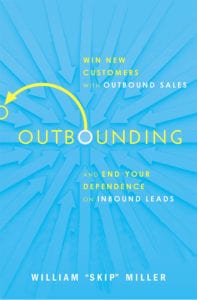
Outbounding: Win New Customers with Outbound Sales and End Your Dependence on Inbound Leads
Call Verizon and AT&T up, “I got a problem with my phone. I can see you’re right. It takes the winds out of your sales and now you’re ready for a conversation. I’m mad. My thing has been out for three hours. What’s your problem? You have a good right to be mad. Thank you.” It puts them defenseless. A good way to think of objection handling right up front is the bottom line is to make sure you think to agree with it and then direct where you want it to take it.
It reminds me of the old statement I heard years ago, “Do you want to be right? Do you want to be happy?”
Let’s put that stake in the ground. That’s not a good stake in the ground.
The book, Outbounding, can be found on Amazon. If people want to learn more about you, they can go to M3Learning.com. You do a lot of speaking to the clients.
We’ve got some training classes. John, I hate writing books. I don’t know about you, but I hate it. It’s 4:00 in the morning stuff for me. It’s Miller time at 5:00 PM. When I see a problem, in 2019, all the low-hanging fruit was going away. People had to start outbounding. You talk to salespeople, “I’d get to 80% of my number. I’m going to have to do a little outbounding.” They wait until November. By that time, it’s late. People were hurting because they’re so fearful of outbounding, fear of rejection, fear of the word no, I got to get six noes before I get a seventh yes. I hate getting noes. Who wants that rejection? I took it as a challenge to try to help the individual salespeople come up.
Don’t be fearful about this. It’s not a big fear thing. Do A, B and C, be on a mission to help your prospects, your customers and managers start measuring the right stuff. You’re measuring old-school stuff. If you want to measure good outbounding practices, given that we’ve got numerous channels, we have mail, social media, direct emails. There are numerous starts putting better dashboards together than the ones you like, “How many calls you make now?” which is hysterically archaic. It’s good but archaic. There are new ways. That’s why I wrote the book, help managers out, help salespeople out. If people want to read it, great. If they’re doing fine, if they don’t have a problem, there’s no reason.
Thanks, Skip, for sharing your knowledge and your insights. I love this concept of being on a mission to destroy decision-makers.
I’m on a mission to destroy the decision-maker because there are two. There’s not one.
That’s a great concept of how to look at all of that and how to reframe it. As you said, “Let go of the fear.” We will let everybody know how to become better at outbounding. Even if your job is not sales, we all have to sell ourselves all the time. There are some real tidbits in that book that will help everyone get over that fear of “the cold call.”
For me, I hate returning things. I go to Target or somewhere and I go, “Did you use this? I’m sorry.” I hate rejection as much as anybody. If I had to overcome it, people will read the book too.
Thanks, Skip.
John, thank you for your time.
Important Links
Wanna Host Your Own Podcast?
Click here to see how my friends at Podetize can help
Purchase John’s new book
John Livesay, The Pitch Whisperer
Share The Show
Did you enjoy the show? I’d love it if you subscribed today and left us a 5-star review!
- Click this link
- Click on the ‘Subscribe’ button below the artwork
- Go to the ‘Ratings and Reviews’ section
- Click on ‘Write a Review’
Love the show? Subscribe, rate, review, and share!
Join The Successful Pitch community today:
- JohnLivesay.com
- John Livesay Facebook
- John Livesay Twitter
- John Livesay LinkedIn
- John Livesay YouTube