

The Digital Seeker With Raj De Datta
Posted by John Livesay in podcast | 0 comments


The eCommerce world teaches companies to look for customers but what they’re missing out on is attracting digital seekers. As Raj De Datta would say, there is a difference between serving a seeker VS serving a customer, and it is a vital factor in creating a whole new experience for your audience. Raj is the co-founder and CEO of Bloomreach, the leading digital experience platform for eCommerce in the US and the UK. He joins John Livesay to talk all about digital and how it transforms the lives of both people and businesses. According to Raj, a seeker is someone who is looking for a quality experience, that magical experience that most companies fail to offer. Creating that magical experience is more than just selling a product or service; it is about building a new world of emotions that are tied to your product or service. Build a winning experience when you learn to focus on serving a seeker over-serving a customer.
—
Listen to the podcast here
The Digital Seeker With Raj De Datta
Our guest on the show is Raj, the CEO of Bloomreach and the author of The Digital Seeker. We talk about the difference between being a seeker versus a customer and how winners are the ones that offer magical experiences. Find out what he means. Enjoy the episode.
—
Our guest is Raj De Datta who is the co-Founder and CEO of Bloomreach which is the leading digital experience platform for eCommerce that powers brands, representing 25% of retail eCommerce in both the US and the UK. He’s a multiple-time entrepreneur before launching Bloomreach. He was the entrepreneur in residence and also served as Cisco’s Director of Product Marketing and on the founding team of Telecom Company, Firstmark Communications. He worked in Tech Investment Banking. He also serves on the Council for the Player Development for the US Tennis Association and has been involved with over twenty Silicon Valley Startups. He holds a BS in Electrical Engineering with a Public Policy Certificate from Princeton and an MBA with no less than Harvard Business School. He has a book out called The Digital Seeker which we’re going to be doing a big deep dive in. Welcome to the show, Raj.
It’s great to be with you, John. I’m excited to be here.
What a fascinating career you have had, taking everything from artificial intelligence, technology and applying all these things together. I would like you to take us back to your own little story of origin. In other words, in childhood or school. You had an engineering focus at one point but even before that, if you want, give us a sense of who you were that you’re like, “I like to take things apart as a kid. I always knew I wanted to have my own company.” Anything along those lines.
I wish I could tell you that I was quite so intentional. Like most of us in life, find our way. Interestingly, I grew up in the Philippines. I spent most of my childhood in the Philippines. I lived there for seventeen years back and forth between the Philippines and spent a number of months in India as well, almost every year. I grew up as an international nomad. My family was not in business in any way. My father is a well-known agricultural scientist. He helped bend a lot of the varieties of rice that we all eat. My mother was an actress and a dancer. I have nothing in my background that would suggest that I should be a Silicon Valley entrepreneur except that I was good at asking questions and good at challenging people and their hypotheses. At the age of seventeen, I came to the US for the first time and went to Princeton, which was the first place I went to and then understood what it meant to live in cold weather and started college.
You took a break from undergrad before he decided to go to Harvard?
[bctt tweet=”Do you have seekers or customers? Go from transactional experiences to magical experiences.” username=”John_Livesay”]
That’s right. I finished up at Princeton. I studied Electrical Engineering. I was always interested in policy and public policy. I was an engineer early on at a pretty well-known lab called Bell Labs in New Jersey. I’ll tell you a funny story about that. In my first project because I was the newbie, the youngest engineer on the team, they were like, “We’re having this problem with processing this thing. This data stuff that’s going through our networks. It’s this thing called the internet but nobody cares about it. We mostly make our money with phone calls. Why don’t you figure it out and everybody else?” I went there, worked on it, came back with a solution. They were like, “We’re over budget. We’re not going to resource this thing. We do a great job making money, selling phone calls.” That was my first job out of college.
Eventually, I spent a few years after that on Wall Street as well, worked in investment banking. I learned about business and then decided I love tech. I loved the idea of creating something. That then took me down the road of my first entrepreneurial endeavor, which was in Europe. After I come to the US for the first time, I picked up and moved to Europe. I was setting up a telecom company over there. It’s selling broadband high-speed internet access. The funders and my cofounders were like, “Raj, you can move anywhere in Europe. Where would you like to go? I was like, “How about Paris?” I picked Paris. I was like, “There’s going to be beautiful women in there.” I moved to Paris then I went and tried to get a cell phone and they were like, “You need a bank account.” I went to try to get a bank account, then they were like, “You need an apartment.” To get an apartment they said you needed a cell phone. I got on the train and moved to London and set up the company in London. Lot’s changed since those days. There’s an entrepreneurial culture there as well but the most important thing which I think is the most formative experience of my career as I got to be an entrepreneur. I stumbled into entrepreneurship at the age of 23. That was before I went to Harvard and then never looked back because I loved it.
A lot of people are always fascinated by A) the people who get to go to Harvard then B) I know it’s probably a little bit impossible. If you had to sum up, what is your big takeaway from going to Harvard and getting your Master’s? Do you have a big insight? Was it the connections you made? Did they teach you something that you think was unique to Harvard for the MBA program?
Harvard is no different than any other university and other than the fact that it was started in the 1600s and had some pretty smart people, free education and lots of workplaces, as I tell my kids. The starting point is, there isn’t anything all that special about Harvard, except for the fact that you’ve got pretty accomplished, motivated individuals who come to try to learn something. For me, the biggest benefit of going and getting an MBA was I learned about business from its academic roots. Most importantly, it’s a very application-oriented school. It didn’t feel theoretical. It was every day you’re reading about actual real-life cases of situations that people are confronting and having to figure out what to do so that one day like riding a bike a lot of times and eventually getting good at it. You hope that your judgment is good when you’re ever in that situation. That’s what I took away from all this.
Let’s go to the story of Bloomreach because it is so rich. Kudos to you and your team for creating in such a digestible format of milestones. I don’t know if that’s your Silicon Valley experience showing but I look at a lot of websites, pitch decks and presentations. What I think you do well is define who you help and what problems you solve. It sounds may be obvious to everyone reading but it’s much harder than you might think unless you’re in that yourself to do that even the choice of words that you use because you and I are both authors. We love words. This premise here is that Bloomreach is that laser-focused. Right off the get-go, I’m thinking, “They’re not trying to be all things to all people. That tells me they might have some expertise.”

The Digital Seeker: A Guide for Digital Teams to Build Winning Experiences
You are painting a picture about having an intersection of eCommerce of what Amazon is. I know what marketing is, promotion, advertising and artificial intelligence. Let’s think about that for a second. As a person stopping by your site for the very first time, people process things and go, ”I know a little bit about each of those things. I know that even Amazon uses some artificial intelligence. If you liked this, you might want to buy that.” I start to feel like, “ I understand a little bit about what you do but then you go on to go, ‘We’re the only ones that take this data with the product the way people behave in the data which you’re not just giving projections or ideas on how to get more people to buy, get stuck in the checkout or you’re trying to deliver an experience.’” I thought to myself, “That I haven’t seen before.” I’ve heard lots of people like, “We’ll help you close more sales at the checkout. We’ll get more sales and things like that.” You’re doing something that you literally say is a magical experience. Please explain what a magical experience is as we combine those intersections.
You said it well, which is we live at the intersection of AI, marketing and eCommerce. We think that this is a golden age of eCommerce in many ways. We come off the pandemic, still with lots of suffering but eCommerce has accelerated by five years. It almost doubled in one year. It became the way we live. You asked about the founding of Bloomreach in many ways. The core insight of the founding of Bloomreach was that the class of AI technology that I became familiar with was being applied to places like Google and Facebook. It was being applied years ago. Mostly, in advertising. I thought to myself, “Do you and I go online because we’re interested in ads?”
I don’t think so. We go online because we’re interested in amazing experiences. We want shopping, reading, dating and all the things that make our life rich, just online. What if we could harness the power of AI and make it so that every webpage you see, email you open, SMS message you receive is exactly on point with what you’re seeking. In doing, the brands of when you over captured your hearts and you, on the other hand, found exactly what you’re looking for. If we can do that, if we can build the platform that made that possible, we touch the lives of seven billion people that all live with their lives online. The mission of Bloomreach was that magical experience. In 2021, many years later, we see those magical experiences. You asked, what do we mean by magical experience? At its core, the magical experience doesn’t just give you what you say you want. It knows what you seek but you haven’t yet set it and delivers that. That is the experience that’s magical.
Let’s get into that because that’s what great relationships do. When someone’s an active listener, they have any intuitive ability or a salesperson that shows some empathy to understand your pain points and can reframe what you are feeling. You haven’t even put it into words of, “That is my frustration.” My whole premise is that whoever describes someone’s problem is more likely to get a sale than someone who doesn’t because people think, “If you can describe my problem, you must have my solution.” This is completely relevant because everyone in retail is using eCommerce. It’s funny when I worked with the Banana Republic, they said to me, “We’re never going to be Neiman Marcus in terms of price point or perception of luxury but we would like to up our game.” We brainstormed about, “How do we define what luxury is beyond price?” We came up with this definition that sounds very close to what you described which is giving somebody something they need before they know they need it.
What’s cool is that we can go industry after industry. I can tell you who is serving the seeker and who is serving the customer. There’s a difference between those two things. To make that distinction clear, let’s imagine that as part of a relationship, you’re organizing a date. You might go out and book a restaurant. You’re a customer at that restaurant. That’s what you’re looking for at that moment as restaurant research but are you seeking a dinner or a great relationship for which the dinner is one step along that journey? You’re a seeker of a great relationship. You’re a customer of the restaurant. The key distinction between these two things, I often say the seeker is the person behind the customer. A higher level of motivation leads you to be a customer.
[bctt tweet=”We’re just coming off the pandemic, still with lots of suffering, but eCommerce has accelerated by five years.” username=”John_Livesay”]
The web is there for years and yet Amazon, for all of its glory, has transferred the work from you walking into the store, having a conversation and somebody recommending a book to read at a bookstore or a shirt to buy. Instead of that, they’ve turned the work and made it your problem to figure that out. You go to Amazon with your list. Like a grocery list you say, “I’m going to go buy this and that.” We used to have physical to-do lists. Now we have digital to-do lists. We go online and we say, “I got to do this.”
If I were out planning a vacation, I’m a customer of a rental car company, flight, hotel and all these different services but what I’m looking for is a memorable vacation with my family. That’s what I’m a seeker. What I have seen in industry after industry is that the winning digital experiences are built for the secret. They’re built for the person looking for a memorable vacation. They’re not built for somebody looking to expedite the car reservation.
I’ve never had somebody describe the difference between a seeker and a customer in such a clear way before because of the loop on that Banana Republic story. We’ll be able to compare that. What they decided was the 80/20 rule, “Twenty percent of our clients and the flagship stores in Manhattan, Banana and Union Square in San Francisco are giving us 80% of our sales. Let’s do something for those people.” They had somebody who walked in and said, “Would you like to charge your phone while you shop? We’ll hit. We have people here guarding it.” Unexpected luxury. They did that to up the experience. The outcome surprised them that sales went up 15% because you may not be surprised but they were. People kept shopping until the phone was fully charged. Not just half-charged, they would come back and go, “I’ll keep shopping.”
Luxury is great. The example you gave the Banana Republic, which is owned by a Gap. We work with so many of the Gap brands and Neiman Marcus is of the world. Behind every one of those shoppers is somebody looking for that quality of experience. Often, in luxury, it’s not about the clothing because everybody knows you can make that piece of fabric for much less money than you just pay for it. The question with the clothing is what it represents about yourself. There’s a reason why some people wear the Banana Republic and some people buy Chanel or Neiman. It represents something about themselves. It’s what they’re seeking at the end of the day.
Luxury is one of those great categories where the distinction between customer and seeker is so clear whether it’s the Banana Republic, Neiman or even some of the modern examples. If we take another luxury example or fashion, a company like Stitch Fix promises you a personal stylist experience. They don’t just say, “You know what brand you’re interested in.” They say, “We know what brand you’re interested in before you even know it. You fill out a profile and we’ll tell you what you should wear to this occasion.”

Digital Seeker: The magical experience doesn’t just give you what you say you want. It knows what you seek, but you haven’t yet set it and delivers that.
That leads us into, I’m going to take a leap off and say, “This is what motivated you to buy the book, The Digital Seeker, which is a guide for digital teams to build winning experiences, AKA magical experiences.”
I have seen this in the 25% of eCommerce companies that we support. People would ask me all the time, “Raj, you see the winners, you see the losers. Tell us why the winners win and losers lose.” To put it simply, I decided to write this book to explain the answer to that question. The winners win because they build magical experiences fundamentally. Amazon happens to be one kind of magical experience. It’s a magical experience, grounded in incredible selection at affordable prices and incredible convenience. There are lots of kinds of magical experiences in the world. The winners win because they figure out what magic represents. They figure out that those experiences are built for the seeker, ultimately not the customer, then they figure out how to go about building those experiences. This is where the tools of AI, machine learning, different org structures and business models all come together to shepherd the building of a winning magical experience.
This is one of the reasons I was excited to get to have you on my show was when I work with the companies and introduce them to the concept of storytelling genres. We look at different genres of storytelling different movies and brands that use it. One of the genres is the choice to go on an adventure or stay home. The movie is The Wizard of Oz. If Dorothy had listened, there it wouldn’t be a story. Expedia uses this genre to not just book cheap flights and hotels but go on this amazing adventure as you were describing with your family, then come back and tell all your friends about it. Like Dorothy did at the end of the movie. It transcends much like a story does transactional experiences into an emotional connection that then makes you want to brag about the experience.
That leads me to my next question. If someone has someone as a customer, let’s go back to your restaurant example and let’s say they have the most amazing date and night. The service was incredible. They brought a little cake, candle and made it extra special. Does someone who goes from being a customer like, “I know this restaurant. I know the food is good but I’m seeking this wow experience.” Suddenly this restaurant gave me that wow experience. I’m now not just a customer but almost a brand ambassador. This restaurant has a meaning to us like if I ended up marrying this person. We’re going to go back on our anniversary and say, “This is where we met or had our first date.” Suddenly, I’m much more than just a customer. I’m seeking that same feeling of magic.
One of the other great points of contrast between being a customer and being a seeker is that being a customer is a left-brain pursuit. Being a seeker is the right brain to pursue this where one is much more rational. The other is much more emotional. If you’re a customer, you might say, “I’m going to count the Yelp Reviews. I’m going to go figure out what’s the lowest price, who has the cuisine I like.” You’ll analyze and figure it out. If you’re a seeker, there’s just going to be something about that experience that stays with you, remains memorable and draws you back. The rational, emotional spectrum is quite different between serving the seeker and serving the customer.
[bctt tweet=”We go online because we’re interested in amazing experiences. We want all the things that make our life rich, just online.” username=”John_Livesay”]
The one that people talk about the most is Apple which is that seeker-centric experience but they’re all over the place. What I love about this approach is it isn’t just about Silicon Valley Startups and incredible creativity on Madison Avenue in New York. Every domain of every business has the opportunity to serve the seeker and win digitally in ways that prior to digital might not have been possible because digital opens up a set of tools that allow you to redefine your business and your brand in ways that in the physical world are much more expensive and often not affordable. Let’s use an example of if we take something like Peloton, which many of us know for an exercise bike. Is Peloton an exercise bike, a spin class or sets of spin classes or is it just for somebody seeking fitness?”
The people who built Peloton said, “People might be customers of exercise bikes but what they’re seeking is a fitness lifestyle. I’m going to give them the full lifestyle, a bike, infinite classes, schedule, great reviews and track it, competitions, the whole thing and put it together.” The best thing about the seeker-centric experience is the magical ones, as you almost can’t put them in a category because you don’t know, “Is Peloton a gym? Is it a bike? Is that a spin class?” Kind of. It’s all of the above. That would have been very hard to do in a pre-digital era.
You’ve tapped into my songbook here where you’re talking about left brain, right brain because the biggest mistake I see people when they’re selling anything whether it’s in person or online is, “I got to get people to know, like and trust me so let me push out a bunch of information.” That left-brain transactional customer thing do you know enough now to buy in how many Yelp Reviews. People buy emotionally then back it up with logic, whether it’s a luxury product, sports car or even a business purchase. Most of the people I have worked with are not aware of that. They don’t lead with stories. They lead with facts and figures and they’re like, “This makes the surgeries go 30% faster. Do you want one?” They wonder why they’re not winning sales.
It’s that ability to make the doctor using the equipment a hero that makes the doctor go, “This is how I see myself now. You reminded me of why I became a doctor for moments like this,” and all of those stories that make people resonate. The other thing that’s taken off is online courses. I’m thinking of talking about the range of Harvard all the way down to community colleges, then everything in between including online course experiences and options that are available to people. People are like, “Am I seeking a solution to a problem I have? Am I seeking a skill to improve myself? Maybe it’s both.” It becomes a whole different framework.
Education is interesting and we talked about how it’s hard to categorize things. Take something like a Coursera or Khan Academy which are online educational tools. What’s interesting is when you go to college or to a university, the question is the one you asked is, “What are you seeking?” If I gave you an option, I said, “John, I’m going to give you two choices. I’m going to either give you a great education on one side or a great credential that gets you a job on the other side but you can’t have the other one. If you pick A, you don’t get B. If you pick B, you don’t get A.”

Digital Seeker: The winners win because they build magical experiences fundamentally, figure out what magic represents, and then go about building those experiences.
It’s behind door number 1 or door number 2.
The interesting thing about identifying the seeker and the underlying motivation is sometimes people want things to cross boundaries. Sometimes people want to break things up. The reason I say that is we all lament in America how expensive college education has become. Many young students are in student debt because of it. Some of that is because universities are an unholy marriage between education on one side, research on another side, credentialing on a third side because if all you wanted to do was put coursework online. Coursera and Khan Academy have shown us that for free. You can create a website with all the knowledge and videos of the world without needing to go to Harvard and pay them $50,000 a year. What you’re paying for there is a fuller experience. It’s the environment, teaching, research, culture, conversations, knowledge and credential. What’s been very interesting about thinking about the world in this way education is a good example is it’s pretty clear you can dis-aggregate universities into the learning and the credentialing in different ways. It’s going to be pretty disruptive for education.
I remember when I was working with Lexus in LA when they were launching. The ad agency had said, “Our target audience is people who buy BMWs and Mercedes.” We have identified two different kinds of people that the behavior looks the same. They buy the BMW or the Mercedes but some people are buying it for external motivation. The same thing I’m sure it’s true of Harvard. I want to say I graduated from Harvard. Some people say, “I need that BMW logo when I pull up to the country club. I want to tell people I drive it.” If you’re an agent in Hollywood, back in the day, that all the agents at CA drove BMWs. It was part of the Armani uniform. It is all that outside motivation to fit in. I’ve arrived at all those statements but then there’s a whole group of people buying Mercedes and BMW that have don’t care about what other people think.
They’re internally motivated instead of externally. They are into the craftsmanship, workmanship and the way it feels, driving it for them is the motivation. That’s who we’re targeting because we can not compete with X number of years of history and branding as we’re launching a new thing. It was a fascinating conversation of the same thing is true of people who buy Gucci or Chanel products. In the fashion magazine, I was representing and saying, “The reason someone’s buying something is either they are trying to impress other people or they feel good in it they like the craft.” That’s another version of seeker versus customer in another lens that allows readers to start thinking of themselves of, “I need to take a look at my languaging on my landing page and the experience I’m giving people,” because there’s a reason why you have such a large percentage of market share. Twenty-five percent is huge.
We’re fortunate to power some of the best brands on the planet. The reason they work with us is it unlocks growth for them but it also allows them to reach customers in a much deeper way than ever before. I don’t want to send a message that analytics, data and math aren’t important in the digital era because it is. It’s not enough. It’s the beginning of reconstituting a magical experience. We have many more signals available to us to understand our consumers than we ever had before. We used to rely on surveys, focus groups and that’s how we would understand. Every click, every purchase and importantly, every non-click and every non-purchase is a yay or nay vote on what you just did online. Intelligent digital marketers are extracting those data points, leveraging the power of AI, figuring that out and then adding creativity and storytelling on top to reach people deeply.
[bctt tweet=”Digital allows you to redefine your business and your brand in ways that in the physical world are much more expensive.” username=”John_Livesay”]
This is the marriage. That is why you’re so successful and why this book is so needed now. I remember when it went from being sell ads in a magazine to a brand like Lexus or Neiman Marcus was all about brand awareness, feeling and the luxury of the magazine would be true. The feeling that someone has as they’re in that mode would be transferred to your ad. The measurability was brand awareness. It wasn’t anything about sales tracking, then it went digital. Now we want to track how many people are buying from the digital ad to programmatic where it’s like, “We don’t even care what the environment is.” One extreme or the other is probably not great, all gut or all numbers.
When you can integrate that final icing on the cake, if we just relied on AI, who’s clicking and who’s not clicking, then you’re just competing with somebody on pricing and technology. What you’ve done and what your book allows other people to do as a digital seeker is to figure out, “How I am going to add in this very important element of emotion and a magical experience to this process, knowing that that’s shifting somebody from just a customer who could be gone tomorrow if they get a better deal to someone who’s seeking an experience and is more likely to not only return but tell their friends about it?”
Sometimes people tend to think that data and technology are the enemies of emotion, humans and the light. I don’t believe that. I think that one is key to the other. If you were to have gone on that Peloton experience and can’t find a spin class, it could be the most emotionally resonant experience in the world. You still won’t like the surface. Technology still has to play its role. When we go on Spotify and it recommends a song to us because it just feels like it knows us. That’s technology reaching us emotionally in ways that are very deep because it knows, “I like this particular band or that genre of music.” No human being could probably figure that out correctly. Technology and AI can play a critical role in reaching us emotionally if we harness them well.
Like a good friend putting something in front of us that we didn’t even know existed or that we didn’t even know we needed, like the phone charging at the Banana Republic. Our brain is constantly craving new things to learn, see, do and experience. That’s what keeps things fresh. If someone wants to buy the book, the title is The Digital Seeker: A Guide for Digital Teams to Build Winning Experiences. If someone is interested in finding out more beyond the book of what Bloomreach can do, they can go to Bloomreach.com. Any last thoughts or quotes you might or a story you want to leave us with?
I think the story I’d leave you with is that all of this, that we’ve talked about. The Digital Seeker, the changing nature of how digital can transform, business life and people’s lives got a lot more interesting after the pandemic. As I say in the book, they are not which is what people talk about, the rate of spread of COVID, the infection rate and how it goes. The rate of spread of digital has just become explosive. I believe we’re almost an economic boom that comes from digital being in the center of a lot of our lives and inventing a lot of things to serve them and in happiness boom because if we do this right then maybe we’re commuting a little less. We’re randomly going on plane journeys a little less. Maybe we’re doing fewer things in the real world that we didn’t enjoy doing. We’re getting a lot more done digitally because the experiences are speaking to us so directly. With all the extra time that we have, we’re enjoying our friends and family that much more, hanging out at local restaurants, going on more pleasure trips if we can afford it, helping more people, transforming education and healthcare in the process. There is a potential happiness boom that I think is that.
Here is a cheer to not only an economic boom but a happiness boom that goes along with it. Raj, thank you for sharing your insights, tips on how we can all become better at giving magical experiences.
Thanks, John.
Important Links
- Bloomreach
- The Digital Seeker
- Coursera
- Khan Academy
- Better Selling Through Storytelling Method Online Course
Wanna Host Your Own Podcast?
Click here to see how my friends at Podetize can help
Purchase John’s new book
John Livesay, The Pitch Whisperer
Share The Show
Did you enjoy the show? I’d love it if you subscribed today and left us a 5-star review!
- Click this link
- Click on the ‘Subscribe’ button below the artwork
- Go to the ‘Ratings and Reviews’ section
- Click on ‘Write a Review’
Love the show? Subscribe, rate, review, and share!
Join The Successful Pitch community today:
- JohnLivesay.com
- John Livesay Facebook
- John Livesay Twitter
- John Livesay LinkedIn
- John Livesay YouTube
Own The A.I. Revolution With Neil Sahota
Posted by John Livesay in podcast | 0 comments

Do you remember when IBM’s Watson, their artificial intelligence, actually beat jeopardy? Meet Neil Sahota, one of the key people behind the team at IBM that made that happen. Like all great ideas, Watson was conceived at a bar where Jeopardy happened to be playing on the TV. On today’s podcast, Neil joins John Livesay to dive into the world of artificial intelligence and its many elements, including artificial empathy. Neil talks about how artificial intelligence can actually make us more human. Tune in to this episode to unpack this insight.
—
Listen to the podcast here
Own The A.I. Revolution With Neil Sahota
Do you remember when IBM Watson’s artificial intelligence beat Jeopardy!? Meet Neil Sahota, one of the key people behind the team at IBM that made that happen. You can only imagine the suspense and the stress they were under if it didn’t work. He also shares what it was like to live in China. He said, “It’s like the Stone Age meets the Space Age.” Find out what he means. Finally, he talks about how artificial intelligence can make us more human and there’s artificial intelligence for empathy. This is an episode you won’t want to miss.
—
Our guest is Neil Sahota. He is an IBM Master Inventor, United Nations Artificial Intelligence subject matter expert, and a Professor at UC Irvine. He’s got many years of business experience. He works to inspire clients and partners to foster innovation and develop next-generation products and solutions powered by AI. His work spans multiple industries, including legal services, healthcare, life sciences, retail, travel and transportation, energy, automotive basically everything.
He is one of the few people selected for IBM’s Corporate Service Corps leadership program that pairs leaders with NGOs to perform community-driven economic development. He lived in China when he was there. He also partners with entrepreneurs to define their products, establish their markets, and structure their companies. He’s a member of several investment groups like the Tech Coast Angels. He’s also served as a judge in various startup competitions. I’m thrilled to have you. Welcome, Neil.
Thanks for having me on, John. I’m excited to be here.
We didn’t even touch on all the other things you do. You have a book called Own the AI Revolution. There are many things going on, and you’re also a speaker. Tell us a little bit about your own story of origin. You can go back to childhood, school, or wherever you want, that gives us a sense of how it all started. Were you always interested in computers? Did you have a robot friend?
No, not at all. I was a kid from the Bronx that loved playing sports. I live a couple of blocks from Yankee Stadium. We’re playing stickball, basketball, and football. My mom got tired of me always playing sports. She felt like I need to be more well-rounded. She insisted to me to try to learn the piano or the violin. I wasn’t into that. One day, she’s like, “You have to do something else.” We had been walking by a little strip mall area and they were teaching computer classes in there. I told my mom as an eight-year-old kid, “I want to learn computers.” She’s like, “What? Seriously?” I’m like, “Yeah.” She marched me right in and signed me up for classes.
If it’s between that and piano, I understand. I took piano lessons. I like music. There’s a big connection between math and music. It’s quite interesting to see how one little choice like that can make such a difference in how that all transpired. There you are taking computers. You liked it and took to it, but they weren’t talking about artificial intelligence back then, I’m guessing. There’s more coding.
Yeah. I was learning. It was on Apple IIe to date myself here. It’s cool to say that I could write these little lines of code and stuff would happen. You could do a calculation and get some graphics, but you essentially are enabling people to be able to do something with the machine. I thought, “That’s creative because I dig that.” Fast forward a few decades there, I was working with a lot of the C-level execs and they’re like, “Business intelligence was taken off. It’s amazing what computers are telling us.” I’m like, “Computers aren’t telling us anything.” There are cool tools to collect tons of data, slice and dice it, and create nice looking reports but machines don’t tell us anything. Could a machine do that? That’s how I looked down this path going like, “I wonder if there’s a way a machine tells us something. Could a machine find insights?”
You spent this illustrious career over twelve years at IBM dealing with their Watson ecosystem. For those readers who may not know much about that, tell us what that was like from the beginning to twelve years later because things move fast.
The thing with Watson started at a bar with all great ideas. There were three IBM Distinguished Engineers. They’re some smart guys. We’re thinking about something cool to do and Jeopardy! happened to be playing on the TV. We’re like, “What if we could create a computer that could play on Jeopardy!?” Most people are like, “How hard could that be?” It’s like playing chess. Jeopardy! will be giving an answer and you have to figure out the question. You think about language. How hard is it to understand people when they talk?
[bctt tweet=”AI will actually make us more human.” username=”John_Livesay”]
If I say I’m feeling blue because it’s raining cats and dogs, everyone knows what I’m talking about. If you tell a machine that, it’s like, “You’re physically the color blue because small animals are falling from the sky?” That does not compute. These were the hurdles and we figured out how to do this. We had to commit to the Jeopardy! challenge two years in advance. At that point, we didn’t even know if we could do this or not. Chris was like, “Of course, we’ll make it happen.” It’s no secret that it’s 50/50 that Watson would work the night of the Jeopardy! challenge.
Nothing like a little drama in a story.
Everyone got the blackberries out and the recipes all ready to go.
It’s visible.
Watson did not start off well. These 6 of the first 7 questions, the execs are a few rows in front, and looking unhappy. Everyone’s like, “I might be in the market for a new job. We have lunch or something.” It’s a testament to how fast AI learns. Watson turned it around. It turned into questions right, applying the strategy, and then it won the whole thing. We’re like, “We did not expect that.”
I’ve read a lot about how it learns fast, even how to bid because it’s not just answering and coming up with the right question for the answer, but also, which thing to bid on and not bid on. It’s fascinating stuff. I’ve worked with quite a few founders in artificial intelligence and trying to work with them on crafting a story around it. For people who aren’t into the weeds of artificial intelligence, there’s this whole thing around structured data and unstructured data, and everybody zones out.
I use the analogy of the tip of the iceberg. What’s above the water is what you can see and that’s what’s structured. This whole premise of how can AI help understand what people are feeling and not just if it’s positive or negative information that you’re trending on social media, but what causes it. My favorite story around this was, you come home and you see your wife crying. You don’t know if it’s tears of joy because she got good news or tears of sadness because something bad happened, or she’s frustrated you left your socks on the floor again. Until we know why someone’s crying, it’s not enough to know if someone’s happy or not happy, especially when you zoom out and look at it from a standpoint of how a company should respond with all this data coming through social media channels. I’d love to have you speak a little bit about how AI has grown past, “Someone’s happy or not,” to “Here’s the reason they’re feeling this way.”
There’s a whole area called artificial empathy in AI. It’s exactly like it sounds like. The machine is trying to figure out the emotional state of a person and dynamically respond to that. People feel emotions. How the world is going to be empathetic?
There are some people that can’t do that.

AI Revolution: Machines can only do what we teach them to do; so far, we have not figured out how to make AI creative or imaginative.
People are like, “Can a machine do this?” The answer is yes. It doesn’t have to feel it. We can teach it things or clues to look for. It’s areas about psychology, kinesiology or body language, and neurolinguistics are clues. It’s things that we, as people, use subconsciously.
Your eyes go up or not. The whole Neuro-Linguistic Programming, you’re trying to remember something or your face gets flustered and you’re angry. It’s not just the computer responding to what you type in. It’s got cameras and can start to see body cues. Ironically, it’s probably better than a virtual world because, for many people during a pandemic, I can’t read body language like I could in person, but the computers are like, “No problem for us.”
That’s a huge advantage. You’re seeing a lot of people build tools to help people connect better in the virtual environment, as well as communicate better. In addition to empathy, the machine has a way to use neurolinguistics to deconstruct language. You learn, “Neil is an auditory learner and John is a visual learner. Neil cares more about the fun factor of a product while John cares more about the value of the product. This is the best way to engage.”
Even the words to use. “You should use these words with Neil and these words with John to help communicate.” A lot started as marketing and sales staff, people realize, “This is an AI communication coach.” If you want to connect better with your kids or you’re wondering why your wife is angry at you, it can help us do that now and respond back. Rather than like, “What’s wrong with you?” The AI is like, “No, don’t say that.” “I feel like something is wrong here. Did something happen today? Tell me.”
There are many questions around just this. I could spend so much time with you. Let’s do it through the lens of marketing and sales. I’m always a big studier of Neuro-Linguistic Programming. I remember that back in the day, that was completely revolutionary information. Especially speakers, you and I are both keynote speakers. When we get up in front of an audience, we know that some of those people are going to be visually-oriented, so you need to paint a picture. Some of them are going to be kinesthetic and some of them are going to be auditory.
My favorite example of that is when I say the car door slammed. Do you see it, hear it, or feel it? I’m always fascinated by the people who feel the door slamming and yet, those people, you can almost predict that they’re going to have an amazing sound system in their car at home and Sonos speakers or whatever. I remember being in a car with a friend of mine and she was driving us around. I just moved up to Northern California in Marin County. She was driving and taking us someplace she’d been before. She’s like, “This doesn’t feel like the right way. Neil, I lost my mind.” I said, “Are you telling me you’re navigating by your feelings? Where’s the map?”
That was my first introduction to not everyone processes the work the way I do. From a sales perspective and speaking perspective, we need to use language that doesn’t make people shift. You’re like, “That resonates with me now because you said it in visual terms or kinesthetic terms.” “Does it ring a bell? Does that feel like the kind of journey you’d like to go on with us?” All those kinds of things are what a good speaker does. Maybe it’s subconscious. If it’s conscious, it takes it to a whole other level. What do you think about all that? How do you use that in your speaking?
It’s about connections. We sometimes lose sight of that. What we’re trying to do is not just this call or making the sale that’s the ultimate thing. We want to be successful. It’s about building relationships and creating resonance. This is a good way to tap into that. People have told me I’m an engaging dynamic speaker and people charged up in a good way. People are like, “What’s your secret?” I’m like, “I don’t know if I have a secret. It’s just that I think about what makes the most sense for the audience. What are the outcomes and the experience that they need?” I’m not at that stage to hear myself talk. How smart I am, I don’t care about that. I’m there because I want to create value for those people so I have to find a way to try and connect with them. That’s why I’m sure you do the same thing I do, John. Every time you’re asked to give a talk, I’m going, “Who is the audience?” All those types of things.
“Let me talk to a couple of people before I get up in front of them.” I can reference that so that there’s some customization to it all. Salespeople do that before they go on a sales call. That preparation pays off. Computers can do way more preparation than we can. What advantage do you think we have over AI from a sales perspective? If they know what language to use and they can do more preparation than we can, what do we have going for us?
[bctt tweet=”The best way to predict the future is to create it.” username=”John_Livesay”]
Machines can only do what we teach them to do. So far, we have not figured out how to make AI creative or imaginative. How do you paint the right picture? How do you tell the right story? AI helps us make sure we’re using the best possible words but they can’t tell us how to craft the story.
Do you think that AI can be a replacement or a substitute for therapy? If people need empathy, someone listening to them, and they can search their database of diagnosis or whatever, “You’re depressed. You need to eat more. Get outside and exercise.” Is that one of the industries that’s probably at risk of being replaced?
I wouldn’t say replaced or substituted but I’d say augmented or supplemented. There’s a lot of focus on this because there are not enough therapists in the world and sometimes, people need outlets. I’m going to tell you something that might blow your mind, John. In Nairobi, Kenya, there’s a project going on called Loving AI. To all the audience, it’s not what you think right away. The goal of Loving AI is to solve the biggest illness in the world, which is loneliness. Before COVID, about 40% of the world suffer from moderate to severe loneliness and they wanted to give these people an outlet. They wanted to create an AI, whether it’s a chatbot or an avatar, or whatever. They want to teach AI, unconditional love. The thought was, “If we can do this, everybody, no matter what time of day or how afraid you are, would have a safe spot to go to.” A substitute for human relationships with a safe spot to go to, engage, feel like they belong to something, and build their confidence so they can go out and engage people. Here’s the mind-blowing part of this. As they try to do this, how do you teach unconditional love to an AI?
It hard enough to teach them empathy, let alone that next step.
The question is, what’s the difference between unconditional love and love?
I know. I have a family. “I love you if you get these grades or if you do that.”
That’s a good example. There are different kinds of love. There’s a love between two spouses, love between a parent and child, and love with your friends. They went from this grandiose idea, which they’re working on to realizing, “This is way more complicated than we thought. We can’t even quite define love. We have to figure out what love means and what conditional love is.” It turned to this deep exploration of what it means to be human. One of the big things that jazz me about AI is that machines, that AI will make us more human.
It does not just free up our time to do higher-value work or do yoga, or whatever. It’s forcing us to think about things. Because we’ve had to teach these concepts to a machine, it’s forcing us to think, “What do these things mean? What is this?” That turns this grandiose exploration and that’s helping us develop better therapists and better psychologists in turn because then we’ll understand some of these things on a deeper level.
That’s what a salesperson is on some level. Even a hairdresser is a psychologist on some level. Anyone who’s interacting with people where they feel like they need to vent their frustrations or open up and share their problems or their fears. Even something like a mortgage broker. You have to say, “Here are my financials.” There’s some level of trust that has to be built. Adweek interviewed me to analyze which Super Bowl commercials told the best stories and it was a fascinating exercise to analyze them all.
AI Revolution: The goal of Loving AI is to solve the biggest illness in the world, which is loneliness.
Google was one of the top because they did that whole thing about the older man losing his memory and using Google to replay their favorite songs of his dead wife and to keep that memory alive. Anytime a product is a Sherpa to help someone be more human. It’s not about the technology. It’s about, “This memory would be lost without it. It helps me grieve and helps me remember someone I love that’s not here. I’m using my own memory.” It’s memories within memories, and then they showed a movie clip, and then you’re like, “Oh my God.”
You’re into the sophistication of stories within stories within a short commercial. That’s what I live for, that kind of analysis, having an advertising background, and all that. What was it like being in China? We can’t let you go without asking a question for goodness sake. Different cultures and different values, your meeting in the world of AI for the common language, I’m guessing. I’ve had some people that live there and said, “We moved to LA to better air.” I’ve never heard of that before, but you probably can relate to that.
China was interesting. I enjoyed my time out there. I lived in a city called Ningbo, which is a small city with seven million people. It was my first time in China, people have always said, “The best way to describe China is the Stone Age meets the Space Age.”
They jump right over the Industrial Age?
You can’t explain the size and scale of China and how things work without experiencing it. That’s true because when I get to China, everything’s on a massive scale. There are many people. The university has 600,000 students. You can’t even fathom that here in the United States. The Space Age meets the Stone Age is, you’ll be in a part of the city and you’ll see these 1,000-year-old buildings. A little bit dilapidated maybe and maybe some wirings. Right next to it is this totally sleek, modern, Platinum LEED-certified skyscraper. It’s such a dichotomy, but you can see the mindset in China.
Living there was immersive. I live like a local and work like a local. I understood how they thought. The thing is they think in terms of long term and in terms of community goals. They’re thinking not so much about what they need to try to accomplish this week or this month. They’re thinking about, “Where does my organization need to be in 10 years or 100 years? What are the steps?” No matter how many small steps they have to take to get there. This has shaped the culture and the mindset out there. They have amazing food.
That takes us to where you’re teaching. What are some of the favorite things you like about teaching?
I never thought I would go down this path, to be honest, but I enjoy connecting with the students, have a chance to share my knowledge, and more importantly, my experiences so that they make new mistakes and not the same mistakes I did.
That’s one of my favorite questions. If you could go back in time to your younger self, what would you say? As a teacher in college, are you saying to them, “AI is the future. You’ve got to learn this and embrace this.” I heard somebody say reading, writing, and coding. When you’re not teaching your children all three, it’s child abuse, to be prepared for the new world.
[bctt tweet=”Entrepreneurs have to be willing to take risks and think differently.” username=”John_Livesay”]
I tapped into Wayne Gretzky. I tell my students out. If you’re not familiar with Wayne Gretzky, he’s probably one the greatest ice hockey player ever. People used to ask him, “Why are you good?” He said, “My secret? I don’t skate to where the puck is. I skate to where the puck will be.”
That’s why people hire you to be the speaker. You help them visualize what’s coming around the corner, even if you can’t predict the pandemic. Maybe they could because it happened 100 years ago. They’re like, “We’re due.” What advice do you give entrepreneurs so that they can be like Wayne Gretzky in their business planning? The traditional business plans from yesteryear don’t even make sense anymore.
Things happen too fast, change too fast. You probably hear the expression all the time, John, “Feel fast. Learn change.” It’s true even in regular business, not just entrepreneurship. I tell entrepreneurs, “You’ve got to be willing to take risks when you have to think differently.” It’s not just you have to have the great idea. You’ve got the idea, build the idea, own the idea and create the infrastructure around the idea. You’ve got to do all these things to be successful. I have a framework I called TUCBO, Think different, Understand different, Create different, Be different and Own different. If one focuses on the team, they think if I get the T, “I’m golden.” Idea by itself is not worth the whole lot if you’re not going to build it, create it, get the buy-in, and build the infrastructure.
I will share the story of Tesla. Why is Tesla successful in electric cars, where everyone else has failed for decades? They have some great technology and they made some great advancements in batteries. That’s not the selling point. They didn’t think differently. They didn’t create differently. One of the big edges they created was they took away the reasons to say no. Are you worried about finding a charging station? They have an app for it that will tell you where they are. Are you worried about infrastructure charging stations out there? We’re building that infrastructure. We’re out there negotiating with the shopping malls, retail centers, theaters and grocery stores to get prime locations for those stations for you.
That’s what the competitors weren’t doing. I remember there was another electric car company right around the time of Tesla. It was like, “That’s just for rich people. It can’t hold the charge to go from LA to Vegas.” “Somebody put a charging station in the middle?” I like that. That’s a great quote. “Take away the reasons for people to say no,” and that’s true whether you’re Tesla pitching. I would be remiss if I didn’t ask you for a tip since you judge and hear many pitches for investment. Any tips on how to give a great pitch to an investor? What mistakes to avoid? Either one, whatever you want to do.
You have to tell a relatable story. You’d love that, John. I’ve heard over 2,000 pitches in my life. You have to tell a relatable story and you have to connect with the investors in the room. I see people come in and they probably have a great idea and they got some traction going on. They’re saying, “Fourteen-year-old kids are going to love this.” If you look at the room, the average person in this room was 52. How are they going to connect with that? If you said, “Your fourteen-year-old kid is going to love this better.” You have to tell the story and have to make it connect and stick. Otherwise, they’re never going to get it.
Also, a good story makes you memorable. Think of hearing 2,000 pitches. You probably remember the ones that have amazing stories because that’s how our brain works and keeps things in our memory because we’re not AI where we can’t just pull all 2,000 up at one time. We’re going to remember the ones that have that emotional story that is not only relatable but hopefully, has some emotional hook to it. I know you’re involved in social causes as well as part of your own purpose and premise. What’s in the book, Own the AI Revolution? That’s the hint. How’s that for a transition? We have artistic intelligence as part of a play on words instead of artificial intelligence on top of artificial empathy. You’ve given us all kinds of great ways to reframe everything, which nobody appreciates that more than I do. What is in your book that can make people intrigued enough to want to go buy it?
My book Own the AI Revolution is geared around what would I call the three Es, Education, Empowerment and Enablement. It’s been for non-technical business leaders, specifically because most of the books were technical or too high-level, too theoretical, or too fearmongering. It gives you a little sense of what exactly is AI? What can it do and not do? The empowerment is to help you answer the question, how do I figure out something to do with AI? Everyone’s like, “I know I should do something but how do I figure that out?”
It empowers you and shares a framework, a set of steps on how to do that. When the enablement is showing you, how do you do it? How do you build a team? How do you go out and put the product to market? It’s woven in with a lot of different real-world stories. It’s non-technical people that have started new business units, new startup ventures with AI to show you that you don’t need to be a smart technologist to do something with this. Most successful ventures I’ve seen were non-technical people. How many technologists know how smart they are? Know the ground problems of a marketer or a doctor or an accountant?
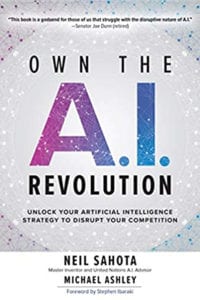
Own the A.I. Revolution: Unlock Your Artificial Intelligence Strategy to Disrupt Your Competition
When I spoke at the Coca-Cola CMO Summit, I was talking to the CMO of Domino’s Pizza. I said, “Your team built the app that tracks pizza from order to delivery.” What I thought was fascinating, Neil, was their overall goal was to give people the perfect pizza experience. From that place, they said, “How can we use AI to cut down a few seconds on the delivery time for the perfect experience?” We have thought if you want a pizza and it comes faster, it’s almost boom. It’s a Space Age stuff.
If you order the same pizza at the same time every day or the same order week after week, then the minute you open the app or pick up the phone, AI goes, “Let’s go ahead and put the order in before they finish completing it. We’ll eat it if they change it.” Those few seconds of getting the pizza started before the order is completed, the predictiveness that might give the consumer a better experience and they may not even notice it. “My pizza is coming here faster,” but maybe they will. I don’t know. That to me was one of my favorite examples of it being used in a way that most people aren’t aware of.
We may not necessarily notice that. If you think they still do some more small changes like that.
“How are they getting those pizzas? They’re fast.” Any last thoughts you want to share with us? Tell people how to find you for speaking. Any last thoughts you want to have to us about what is coming around the corner that you can share, like the puck?
I will tell you there’s a lot of cool things going on but I know a lot of people are wondering, “How can I be in front of the curve?” The best way to predict the future is to create it. We all have a shot or a chance to be a driver but we don’t realize that. Think about something. Even a small thing, a pain point, or an opportunity or something tedious. There’s probably an opportunity there for you. Do something small or big and it’s worth exploring. If you want to learn more about how to do that, definitely come and check out what I have on my website, NeilSahota.com, or you can follow me on LinkedIn and Twitter. I’m always sharing stories or things about what people are up to or I’m doing. Hopefully, you’ll find some inspiration.
I know we will. You’re riveting and thank you for sharing your intelligence, real and artificial, with us all.
It’s my pleasure, John. I had a blast.
Important Links
- Neil Sahota
- Own the AI Revolution
- Wayne Gretzky
- LinkedIn – Neil Sahota
- Twitter – Neil Sahota
- Better Selling Through Storytelling Method Online Course
Wanna Host Your Own Podcast?
Click here to see how my friends at Podetize can help
Purchase John’s new book
John Livesay, The Pitch Whisperer
Share The Show
Did you enjoy the show? I’d love it if you subscribed today and left us a 5-star review!
- Click this link
- Click on the ‘Subscribe’ button below the artwork
- Go to the ‘Ratings and Reviews’ section
- Click on ‘Write a Review’
Love the show? Subscribe, rate, review, and share!
Join The Successful Pitch community today:
- JohnLivesay.com
- John Livesay Facebook
- John Livesay Twitter
- John Livesay LinkedIn
- John Livesay YouTube
Creativity In An Age Of Artificial Intelligence With James Taylor
Posted by John Livesay in podcast | 0 comments

Artificial Intelligence or AI has been taking over varied industries and has become undeniably helpful in today’s fast-paced life. Today, John Livesay interviews James Taylor, founder of C.SCHOOL™ and host of The Creative Life Podcast and TV Show. James talks about creativity and innovation and the use of AI in different professions. He then shares with us his proven five-step creative process that includes preparation, incubation, insights, evaluation, and finally, elaboration. Be inspired by James’ creative mind as he discusses each step and how important it is to do it in the right order.
—
Listen to the podcast here
Creativity In An Age Of Artificial Intelligence With James Taylor
Our guest is James Taylor, who not only has his MBA, but he is a Fellow Royal Society of the Arts, FRSA. He’s an award-winning speaker and an internationally recognized leader in creativity and innovation. For over many years, he’s been teaching entrepreneurs, educators and corporate leaders, writers and literally rock stars, how to build innovative organizations and design the creative life they desire. As the Founder of C.SCHOOL and the host of The Creative Life Podcast and TV show, he’s taught hundreds of thousands of individuals and over 120 countries through his online courses, books, videos and keynotes.
After advising some of the world’s most creative individuals and companies ranging from Grammy-award winning music artists and best-selling authors to Silicon Valley startups, James designed a framework for creativity that helps individuals and organizations achieve exponential growth. Some of his clients have included Apple, Sony, Johnson & Johnson. He’s an in-demand creativity expert. He’s been on hundreds of media outlets. He was a subject of a 30-minute BBC documentary about his life and work. James, welcome to the show.
It’s my pleasure. I always love spending time with you.
[bctt tweet=”Green colors activate idea flow. ” username=”John_Livesay”]
You were always in a different country. I love your passion for sharing all of your insights into what it takes to become a great keynote speaker. I always like to ask my guests what’s your own little story of origin. Your mission is to inspire creative minds. You must have always had one yourself.
I believe we’re all born with unlimited creativity. The problem is as you go through schooling, education and you start work, it gets knocked you a little bit. I see my job is just reigniting that creativity that’s in all of us. Whether that’s the creativity to sell better, to create new products, to change the world, to run companies or countries better. I’m definitely there to re-ignite something I believe was already in you anyway. You need a little bit of help.
Tell us your own story of origin. We talked before that you sold guitars but didn’t play them.
I come from a musical family. My father is a very esteemed music jazz artist. My grandfather was a musician as well. My wife is a professional jazz singer, so I come from the music industry people. My very first Saturday job was working in a music store selling guitars. I don’t play guitar. It taught me the first lesson about selling, which is understanding the customer. It wasn’t about me. It was understanding not so much the technical things a customer wanted, but what did they want that thing to do for them? What transformation do they want?
I was very good at selling very high-end guitars. A lot of the time, it was to the market. They’d have a big 40th or 50th birthday with a zero on the end. I was able to help them reconnect with that thing that they had when maybe they were college and helped use that to sell them a $5,000 guitar. That told me as a fourteen-year-old about the power of selling. I remember reading books by Robert Cialdini and all these wonderful sales experts and that got me initially interested in sales and selling. From there, I moved into the world of managing music artists professionally. I manage a number of Grammy-Award-winning artists.
I’ve managed a band called Deacon Blue, which sold about six million albums. I managed the Rolling Stones. That helped me start to understand how the music industry works about building big global brands, scale, that people can feel passionate and they can feel connected when you can build a tribe and excitement around. In 2010, I received a call from a gentleman in California and he asked if I would move to California to help him grow a technology company. It’s a totally different game. That was the initial start of things.
[bctt tweet=”Breaking down silos is the key to growth. ” username=”John_Livesay”]
What do you see if anything in common between a startup and a musician that’s at a level of winning Grammys?
They’re very good knowing what they do well from that. They’re very good at connecting ideas with people. It always intrigued me spending time with these phenomenal Grammy-Award music artists. They could flip between this quite quiet person sitting there, coming up with ideas, thinking creatively, and then suddenly they would go on stage, it was the same person, but it was like them multiplied by ten. I was always interested in this. My living as a professional keynote speaker, companies bring me in to speak on big stages all around the world. I’ve spoken in 25 countries. I noticed that even looking at the creativity of those, there are a lot of similarities between people like top rock stars and the stuff that I do as a speaker and also when I see great CEOs.
I was speaking at an event in Amsterdam and there was a vice president there. He came up on stage. He is one of the most inspiring speakers I’ve ever seen because he looked around the audience. He could sense this audience was from a group within this company. They were primarily all MBAs, smart people all in their early 30s, mid-30s. He didn’t speak to them about climbing up the corporate ladder, stuff that you might have spoken to maybe someone that was a little bit older, a different generation. He spoke to them about how this company and growing this company could be a vehicle for helping all those people in the room achieve their own personal development, their own genes, their own freedom as well. I thought, “To be able to make that room feel like that, that is phenomenal.” I see that in great leaders. It doesn’t matter whether they are rock stars on stage or great professional speakers or whether that CEO up on stage is inspiring their team.
Speaking of your career, your most popular topic is super creativity, augmenting human creativity in the age of artificial intelligence. First of all, I want to applaud you for putting those two things together because a lot of people think innovation is all about technology and certainly artificial intelligence technology and creativity is a human thing like you’re going to write a song, paint or write. You’ve been able to combine the two. I don’t see anyone else doing this. Talk to us about how you said, “I think there’s something here that artificial intelligence can help us become super creative.”
We all see the stories about artificial intelligence. It’s going to take away everyone’s job. It’s going to be the terminator. Our robots will start taking over the world. That side doesn’t interest me so much. What I’m more interested is about how it changes the future work, what potential it can offer us as humans to augment ourselves. We often meet these terms, creativity and innovation. The way I think about it is there are different sides of the same coin. Creativity is about bringing new ideas to the mind. Innovation is about bringing new ideas to the world. Without creativity, there is no innovation. There are no new products and services. Creativity is the engine of innovation. It starts from there.
If you want to create that next winning company that makes a winning project or product service, it comes from that creativity of you as an individual, but more broadly within the team, the team that you’re working where you assemble to do something together. Where I’m interested in is where I see examples from lots of different industries is you’re going to get lots of jobs disappearing. That’s going to happen. You’re already starting to see that start to take hold.

Creativity And Artificial Intelligence: Creativity is bringing new ideas to the mind. Innovation is bringing new ideas to the world. Without creativity, there is no innovation.
I’m more interested in the people who are in the world of work. How they can start to use some of these technologies like AI and machine learning robotics to augment them, to allow them to do things that in their work, their skillset, their job that they might have thought unimaginable before. The companies I’ve been speaking for, they’ll range from some of the world’s top law firms, accounting firms, sovereign wealth funds, some of the largest financial and banking firms in the world, consumer products, companies, educators, fast food companies, aerospace, all different industries. Within all those industries, you see this happen more and more. Even to explain it from a very simple perspective of myself, my job is to be a keynote speaker.
Companies bring me in or associations bring me on to get on stage. I’m normally, like yourself, either the opening keynote speaker or the closing keynote speaker of a big conference. That’s not often the way. I think about how I use artificial intelligence to augment me in what I do. A few years ago, the way that most speakers had a conversation with the client was they would do a pre-event call and they would say, “Tell me who’s going to be in your audience.” They say, “We have people that are aged 40 to 50. They’re senior managers. They’re 80% men, 20% women, and they would do that.” That’s just the demographics. That’s not that interesting.
I’m more interested in the psychometrics of that room. We can use artificial intelligence. The way that I use it is before I even go in the room as part of my work on understanding the audience in the room, I will use AI to analyze the audience. I will essentially use different ways of doing this. You can use the same technology. If you’re selling and you’re going out and giving a pitch, analyze that key decision-maker in the room. It’s almost exactly the same process. This is how it works. I use IBM Watson, which is one of the many wonderful artificial intelligence systems or programs out there.
All I have to do, if I’m speaking to a large conference, most conferences will have a Twitter handle. I’ll go and give it to the artificial intelligence. What it will do is it will spider all of the accounts where the people are following and tweeting about this conference, for example. It will then give me across 72 different factors, a visual representation of the psychometrics of that particular audience, those people that are going to be attending. It tells me what their needs are, what their values are, what their wants are.
What I can do is I can give the AI my draft keynote presentation and it essentially analyzes that and it can overlay the psychometrics of my presentation with the psychometrics of the audience in the room. It could tell me what I need to work on, what needs to be boosted up, what needs to become down. The way we use this, let’s say, I was giving a pitch to a CEO in New York. The CEO, like many senior executives, didn’t do social media or if they did do social media, someone else is writing it for them. It wasn’t them who’s writing it. What they had done is they’d written an article for one of their trade magazines. All I had to do was I gave the AI 1,000 words that this person had written.
I could use 1,000 words that someone’s spoken. If they’ve done an interview or written, give it to the AI. It automatically told me the psychometrics of that person in the room, that key decision-maker I wanted to influence. I knew having looked at that that this person is authority challenging. As I give my pitch, I want to come across a bit more like a contrarian in my views. I could see that they valued practicality very highly. As I give my pitch, I’m going to say, “Here’s how my service product can be practically applied to help grow your business.” I could also see they valued trust highly, 99% super high.
[bctt tweet=”Caffeine reduces your creativity. ” username=”John_Livesay”]
You might call them case studies. You would call them case stories, which I love. You would tell case stories. You would tell examples because this is going to use more social proof. Robert Cialdini, that trust indicators, social proof and that will help that person feel that the key decision-maker in the room when you’re giving your pitch is going to feel like magic. It’s going to feel like, “This person understands me. He understands this challenge or this issue I’m thinking about, what I’m thinking about in the challenges I’m having in our business.” It’s not magic. It’s data.
You’re speaking their language. If somebody cares about trust being a key factor and that is going to be specific to their personality, whether they want to have proof of your authority or whatever it is. You’re addressing all those issues in advance. Is this something that you have to subscribe to IBM Watson to be able to access and create this analysis from Twitter handle?
If you go into my LinkedIn profile, James Taylor. I have a post there, an article which basically states exactly how it works and how to do it. This is something that you can subscribe to. There is a free version. You can go and test it if you want to go and try out. You can give some written words written by a key decision-maker or somebody who wants to influence. It’s fun. Do it on yourself first of all. If you take this onto the next stage, let’s say if I work in a car showroom, where are we going next with this is if I can take that data. Let’s say I’ve got all of my customers’ social media handles. I’ve had a series of correspondence with them so that is in the system. That will then create the psychometrics for everyone in my customer database, my CRM.
You can start to do very interesting things. Let’s imagine you can have the new Apple glasses that are going to be coming out. Unlike the Google glasses, but much nicer, much cooler. They will be connected to different artificial intelligence. You can connect that to your CRM and you can wear these glasses. Let’s imagine I’m a fourteen-year-old guy in a music store selling guitars. Five people come into the store. I’m wearing my glasses. It’s connected to the CRM of the company, so I know the psychometrics.
Using facial recognition as they come into the room, I can automatically see, “That customer is coming in here. They have a high FICO score. They have a low credit rating. This customer here is being on this webpage a number of times and spending a lot of time on that page about this product. This customer here has spent $10,000 within the past several years.” As a salesperson, who do you go and speak to? It’s all showing a heads up display like a fighter pilot would have. This is happening and I worked with a lot of companies that are starting to build these out across their businesses.
This is the super creativity bit because the AI is not going to write your pitch for you. It’s not going to give you a sales presentation, but it will make you a better presenter of your ideas. Sports teams use AI to analyze their players. Insurance companies use AIs to analyze their brokers. I believe every salesperson should be able to use a tool like this in order to analyze that prospective client, that prospect that they’re going for. When you go and give that pitch, it is absolutely landing on a very emotional level with that person as well. That’s the human bit. The creativity comes from us being able to create story arcs and be great storytellers. They all have side things that you’re brilliant at doing. We augment that with these technologies, which helped provide more data on the analytical side.
[bctt tweet=”Without creativity, there is no innovation. ” username=”John_Livesay”]
You use the AI to give you insights into the data that’s going to emotionally resonate with somebody and turn that data into a story. Would that be a good summary? You said something that I want to capture because I’d love to tweet out. It’s something about artificial intelligence is our mind and creative is the world. Do you remember what you said there?
Creativity is bringing new ideas to the mind. Innovation is bringing new ideas to the world. Without creativity, there is no innovation. Creativity is the engine of innovation. That’s how the two things exist. They cannot sit side by side. Usually what you tend to find is creativity exists more around individuals and teams working together to generate ideas, assumptions, tests, minimal byproducts, those things. Innovation tends to come around to what we call the five-stage of the creative process towards the end. It ends up as being slightly more process-driven, but they go well hand in hand together.
You teased us about the five steps to a creative process. I know that’s a core part of your keynote on this topic, but you’ve been gracious enough to give us a little snapshot of what those five steps are.
The creative process is about how you generate, develop and execute on ideas. Let’s say you have a product and you want to start generating new ideas to get that product to market, or you’re looking to go fundraise. We need to get creative here on the pitch that we’re going to be putting out there into the market or the types of investors that we want to be bringing this deal to. The first stage of the creative process is what we call the preparation stage. This is about generating ideas. It’s about taking and absorbing as much information as possible.
It’s where you’re doing your classic market research. That’s the very first stage. The second stage where a lot of people I see go wrong is they do their research and immediately hope to stop generating ideas. The second stage, which is called the incubation stage, is where you need to put ideas to the back of your mind. It’s almost like forget about it. Go and do something else, switch to another project. You’ll bring and continue working on things in the background. I was going to be looking for patterns, looking for opportunities all the time, but you have to put it to the back of your mind.
One of the fascinating things is even, for example, the colors that you have around you can affect your levels of creativity. There was a study done by the University of British Columbia up in Canada. They found that the color red is the best color to have around you when you do work, which requires high attention to detail. For example, if you’re doing your tax returns, you want to have that color red around you. What they found is the best color to have around you if you’re looking to generate ideas is the color green. One of the reasons we get some of our best ideas when we’re out walking in nature when that color green is all around you. Think about for yourself, do you have that color green around you in your workspace? Are you going out for a walk and talk to me? Are you going to the parks? Places where that color green is activating that part of the brain. You’re basically incubating all of this and this is the stage you’re mulling it over in the back of your mind.

Creativity And Artificial Intelligence: Caffeine is very good at focused work, but not so good for unfocused, open-minded thinking.
I want to give everybody a little story on that because you and I were having a conversation. I said, “I want to show you something to plant the seed in your brain, knowing the way you work.” I didn’t call it incubating, but that’s basically what I was talking about. It’s like let me show you something and I’ll know that will be in your subconscious and that might generate some ideas.
In the US military, at West Point, they teach a version of this. They call it preloading, which is about two hours before you go to sleep at night, ask yourself a question about that challenge that you’re trying to come up with. You sleep on it. You print it at the back of the mind and often when you wake up the next morning, the idea is almost fully formed sometimes. It’s strange. I’ve heard about this. Why is it that I’m a successful X, Y and Z? Fill in the blank.
The brain is a phenomenal, amazing thing. We go to this third stage, which is the insight stage. That’s the a-ha moment, the light bulb moment, however, you want to describe it. When it comes to creativity, it’s the shortest part of the creative process. It’s the bit they make the movies about, when you see the fast action scenes, a big light bulb seems going on. Most creative work is not necessary like that in terms of those moments. There are a couple of things you can do to increase those levels of creativity. One is to understand yourself when you are at your creative peak each day. John, for example, for you, when ideas come easiest to you or you feel that natural idea-generating flow, what time of day does that tend to happen?
First, in the morning, I let myself be open before I even get out of bed or even open my eyes and say, “What am I grateful for? What am I open to receiving? What’s my intention for the day? Are there any insights?” I literally asked myself that question. Are there any insights that I’m open to hearing? It’s amazing. Sometimes it starts and unless you said a few minutes later, I’ll be in the shower. That’s what that joke is about, why do I get all my best ideas in the shower when I can’t write it down? Before all the world comes in and starts with the emails and we’re reacting to everything or the news or whatever it is that distracts us. I’m a big believer of what you’re talking about here, James, which is letting yourself have some time, a little gap of what wants to come up. What is my intuition telling me? What do I want to say or do? Even preparing for this. I started thinking about you and our previous conversations and all the wonderful videos that I watched you do. I’m like, “What would be a great question that would help James get his message across and see what would come up during the conversation. I plant that seed.
You’ve described beautifully from a very poetic standpoint that sensation of what you feel in the morning. We use that time in the morning, that half-awake, half-asleep that other people might be late in the evening or the afternoons after lunch. I’ll describe what’s going on from a chemistry perspective. What’s going on is you’ve been incubating this awesome thing overnight. You might be thinking about it. You’ve been incubating it overnight. In the morning, what’s happening in your brain is fuzzy. You’re open to unconventional thoughts. Alpha waves are rippling through your brain directing your attention inwards to remote associations emanating from the right hemisphere. Also, the brain that says, “That’s a stupid idea,” that hasn’t woken up yet.
This is one of the reasons many people get their best ideas and that half-awake, half-asleep in the morning. Don’t just jump out of bed but give yourself that time to say you’ve been intentional asking those questions, or in the shower in the morning, a lot of people get their best ideas. This is the reason, but the main thing is not everyone’s morning people. Other people get a later in the evenings or the afternoons but know for yourself what time of day you are at your creative peak. As much as possible, use that time to do your deep thinking, your creative thinking, your strategic thinking, move all your calls, emails, meetings outside of that time.
[bctt tweet=”In terms of creativity, there’s a lot of similarities between top rock stars, speakers, and great CEOs. ” username=”John_Livesay”]
We start to generate these insights. It’s funny because even what we eat and drink can affect our levels of creativity. There was a great study done by Martha Farah, who’s a neuroscience professor at the University of Pennsylvania. She found that high levels of caffeine in your diet will reduce your chances of having ideas and insights. I was speaking in Bogota, Colombia and I told this story. I thought 2,000 people in the audience were going to kill me at this stage. Let me give you a little bit of background on that. Caffeine or coffee is very good for the preparation stage, the first stage of the creative process and the last stage because what we’re doing is, we’re looking to absorb what’s the new information. It’s a different thing. When you’re looking to be expansive in your thinking, it would benefit you to dial down your caffeine levels. Switch to tea, water, juices because caffeine is very good at focused work, but not so good for unfocused, open-minded thinking.
That explains it.
There’s stage for generating ideas. We go to this fourth stage of the evaluation stage. I’ve worked with some incredibly creative companies, creative individuals, especially senior advertising industry or some of the high-tech industries. Usually, the biggest challenge is not a lack of ideas. The biggest challenge is around evaluating those ideas and deciding which ones we’re going to pursue and test. That’s the evaluation stage. This is when you start to do things like more ideation, brainstorming sessions. I teach a whole different series of tools. They have to do that well. Also, to break down silos in organizations which is a challenge.
That’s the number one problem I see across every industry I’ve ever spoken, too. Everything is so siloed, no one’s communicating. There’s no database where they could share, the case stories of what’s work at other cities or countries. If you could help people breakdown their silos, then no wonder you’re speaking so often.
It’s also happening on different levels. You’ll see from a generational standpoint where Millennials are communicating in one way sometimes. The Boomers or Gen X are doing it in a slightly different way. Sometimes getting everyone in that same place. I speak a lot in the Middle East and South America where you have a different hierarchy in organizations than you would have in Silicon Valley or in London where it tends to be much more top-down or family businesses. The large family business could be like this as well. I also teach a number of tools there, which is about leveling out the hierarchy a bit so you get the best ideas from everyone in the organization. Not from a senior person that are always dominating the board with their ideas, which is very important. In the final stage is the elaboration, which is like Thomas Edison said, “Success is 1% inspiration, 99% perspiration.” This is the stage that you’re testing your minimum viable products, getting feedback and all these stages, they’re iterative. They go back and forth on this circular. You generate a whole bunch of questions, which then you have to go back to the preparation stage and find out the answers. That’s thinking of the five stages of the creative process.
Thank you for sharing that. To sum up, preparation, incubation, don’t jump right to ideas, insights, evaluation and finally, elaboration. That’s such a great framework for so many different things. We have a mutual friend who is a CMO at Domino’s Pizza. They’re using artificial intelligence to start predicting if you keep ordering the same pizza at the same day and time, the artificial intelligence can start predicting and start the order even before you’ve finished ordering again to help save the time and the delivery. I would love to know a couple of other stories how are lawyers using artificial intelligence?
[bctt tweet=”Creativity is the engine of innovation. ” username=”John_Livesay”]
There’s an event I was doing for one of the top ten law firms in the world and the particular challenge that they were looking at was the customer journey. That stage from someone first having contact with that prospective client all the way to a client for many years. How do you get them to refer other businesses to you to talk about that relationship? This tends to be a long and sometimes complex stage if we choose a couple of different areas that you’re seeing artificial intelligence being used a lot in taking away a lot of the more routine works. For example, there’s a law firm in California called Robot Robot and Hwang. It got started by a young gentleman called Robert Hwang. He trained as a computer scientist. He went and trained as a lawyer and started working for big law firms. He realized how mind-numbingly boring a lot of legal work is, especially the contract side. He would do his law work during the day, and at night, he would go home and he programmed an AI to do the work that he’d been doing during the day. By the end of the first year, he’d essentially replaced himself.
He went and started this new firm called Robot Robot and Hwang. There are three partners in this firm. He is the only human partner. The other two partners are AI. One AI specializes in mergers and acquisitions. The other specializes in intellectual property litigation. This is a very productive, highly profitable type of law firm and very fast-moving. If you have a law firm that you give your business to, asking the question, where are you using AI in your business? If they’re not using an AI, especially to analyze agreements, you might want to be a little bit worried about that because you’re going to start seeing this more and more. It’s a way of reducing risk in the markets. That’s one way. In a completely different way, more from the front end.
I know a lot of your readers come from a more sales perspective and you have things that we call conversational AI. I remember when I was getting started in my career and I was getting inquired for some of my music artists and we’d get ten inquiries a day for them to go and do shows somewhere. I could never quite work. I had to do telephone calls for all these ten people. Some of them had a very little budget, some had a good budget. Some of them it wasn’t right. It wasn’t a good fit. What we can use is a conversational AI to essentially help do the filtering process.
The way that this works, let’s say if you have a website, you have a service or product you provide and you have some online form. Normally what happens is people type in the form. “I’m interested in learning more about this product.” That goes directly to a salesperson. That salesperson picks up a phone and calls you, but it’s much better if you put that through an AI first. What would happen is you give the AI a name. If her name is Barbara and Barbara is your new sales assistant. When Barbara gets the email in, Barbara starts having an email conversation with that prospect. What she’s looking for is an intent, certain keyword phrases that she’s learned over the time that those things put together. Also based upon your email address, which you can tag that to your LinkedIn profile, that shows that your company is perfect for your size. The AI will then say, “Let me schedule a call time with one of our sales team, how is Monday at 2:00 PM or Thursday at 3:00 PM?”
It’s going to feel like a normal human conversation and that AI has access to your calendar so they can put that straight in that salesperson’s calendar. For those people that aren’t a good fit, AI can then recommend, “Here are some other resources, some other training, some other things. You might want to have a look at our blog post, or I’ll put you on our newsletter list,” or whatever the thing is. A salesperson doesn’t want to be doing a call with someone in the wrong stage of the sales process where they are very unlikely to buy.
If you could help salespeople save time on qualifications, then they’re going to be so much more productive and the revenues are going to come in because we are not wasting time on people who don’t plan on buying anytime soon or don’t have the money or whatever the problems are. I want to end this by asking you about why China’s richest man believes that creativity is the most important skill that any one of us are going to need to thrive in this age of disruption.

Creativity And Artificial Intelligence: Your job as a parent is to keep curiosity going in your children because that’s going to set them in a great place when they become adults.
That’s Jack Ma. He’s the Founder of Alibaba. Alibaba did $36 billion in sales in one day. This is massive. You’re having Black Friday or an Amazon sales, that makes that look like small numbers. Jack was very influential in his company in artificial intelligence. He was asked a question, “What skills should we be investing in our young people, in our teams, people at work in our companies, and our citizens and countries?” He said, “Don’t bother trying to compete with a machine on things it could do better, faster and cheaper. You need to focus on that one advantage that you have as a human, your creativity, your curiosity, your ability to innovate. That’s what you need to be focusing on.” That ties in perfectly to some of the things that I’m interested in about this connection between human and machine.
The number one question I get after having spoken at conferences and people come up to me at the end or people ask me on stages like, “I’ve got a son or a daughter and they’re eight years old. What should I be suggesting? What should I be telling them to do in order for them to get prepared for the future?” I say, “Give them exposure to as many different ideas, cultures as possible. Get them as being curious, being creative.” When I say creative, I don’t mean like liberal arts and music. I’m talking about creating a big science perspective as well. That thing that they had when they were very firstborn with of being curious asking why. Don’t let that go away. Your job as a parent is to keep that going in them. When they become an adult, they have that sense of curiosity in their lives and that’s going to set them in a great place.
The Japanese did that in Toyota seven different times. If anybody wants to get more of you besides hiring you as a keynote speaker, you also have products on creativity training. If anyone is interested in music training or speaker training. I’ve been wanting to recommend your speaker training. It’s so in-depth, specific and unique. People can find you at JamesTaylor.me?
That’s it. They can find all those things from there and feel free to connect with me on LinkedIn. I use LinkedIn a lot. That’s exactly how the AI things work that I mentioned. Those are great places to connect.
My big takeaway is we should not be afraid of AI, but we should embrace it and realize that it allows us to be more creative. Thank you, James.
John, thank you so much for having me on your show. It’s been an absolute pleasure.
Important Links
- James Taylor
- C.SCHOOL
- The Creative Life Podcast
- IBM Watson
- LinkedIn – James Taylor
- Better Selling Through Storytelling Method Online Course
Wanna Host Your Own Podcast?
Click here to see how my friends at Podetize can help
Purchase John’s new book
John Livesay, The Pitch Whisperer
Share The Show
Did you enjoy the show? I’d love it if you subscribed today and left us a 5-star review!
- Click this link
- Click on the ‘Subscribe’ button below the artwork
- Go to the ‘Ratings and Reviews’ section
- Click on ‘Write a Review’
Love the show? Subscribe, rate, review, and share!
Join The Successful Pitch community today:
- JohnLivesay.com
- John Livesay Facebook
- John Livesay Twitter
- John Livesay LinkedIn
- John Livesay YouTube