

Take The Icky And Scary Out Of Sales With Hugh Liddle
Posted by John Livesay in podcast | 0 comments


Sales has a bad reputation for being unpleasant while for those who do them, sales can be a terrifying task. Tackling those things in this episode through his book, Take the Icky and Scary Out of Sales, is guest Hugh Liddle. The sales wizard at Red Cap Sales Coaching and Elite Sales Academy, Hugh imparts to us his almost 50 years of experience in the field how we can create a brand that helps us stand out. He shares the right mental preparation you should be doing when having a sales conversation and gives his insights about why people buy based on what they want, not what they need. Allow Hugh Liddle to teach you how to become a great salesperson so you can sell with pride.
—
Listen to the podcast here
Take The Icky And Scary Out Of Sales With Hugh Liddle
Our guest is Hugh Liddle, who is the sales wizard at Red Cap Sales Coaching and Elite Sales Academy. We can learn to make selling easy, fun and profitable. He specializes in helping chiropractors and other service-oriented businesses dramatically increase their conversion ratios, sales, and revenues. Hugh’s sales training and coaching come from almost 50 years of in the field sales and sales management experience. You get real-life experience from his teaching, not something out of a textbook. He is the author of Take the Icky and Scary Out of Sales, which is available in paperback on Amazon. He’s also the radio talk show host of his show Sales Chalk Talk which is also available on iTunes. Hugh, welcome to the show.
John, it’s a pleasure to be here and thank you for that lovely introduction. You read it exactly the way I wrote it so that was good.
I always like to ask my guests to take us back to their own stories of origin. You can go back as far as you want. You can go back to where the red cap came from or something else that led you to your wonderful career.
I got out of the service out of the Air Force in 1970. I had 5 or 6 job offers and one of them was a sales job. I liked it the best because there was no ceiling on income. I thought I would laugh my way to the bank every week and everything is going to be great because I’m a good talker. What I found out is that there’s a lot more to it than being a good talker. It was a real process for me to learn what I needed to know in order to be successful. I’ve been selling for the last 50 years or so. Years ago, I decided it was time to start my own business and start teaching other people the things that helped me be successful after I learned them. Things have changed tremendously in selling over the years and especially in the last few years or so. There have been a lot of changes and I’ve never had so much fun in my life as I’ve had to teach other people how to sell.
The red cap is a fun story. I was in a networking group in Colorado when I first started my coaching business. I was going to people’s offices to coach and I wanted to have a little uniform so I had black slacks on a red or a black shirt with logos of opposing colors. I went to a networking meeting one day and there was a guy by the name of Santa George, who was another member there. Santa George who was a professional Santa Claus in season and a magician offseason. He was wearing a red cap and I thought that it would go great with my uniform. I said, “Santa George, where’d you get that hat?” He said, “At Estes Park, Colorado,” and I happened to be in Estes Park a little bit later that month.
[bctt tweet=”People buy based on what they want not what they need. ” username=”John_Livesay”]
I went to a couple of shops with my wife to shop and found a stack of red hats. I bought some and started wearing them all the time. About a month after that, another member of the networking group asked me to have coffee and he’s a marketing guy. He said, “If you showed up at a meeting with a different colored hat or no hat at all, nobody would know who you are. You need to take that red cap and brand it.” We renamed the business Red Cap Sales Coaching and I’ve worn the red cap ever since then. My wife makes me take it off when I go to bed but that’s about the only time I don’t have the cap on.
I never realized what a powerful brand that was until I went to a Get Motivated Seminar in Denver. There were 25,000 people in the Pepsi Center. People came up to me during the breaks. People I knew and I didn’t know were there but they walked up to me and said, “We saw you right away when we came in all the way across the arena and we could pick you out immediately.” If the purpose of marketing is to be noticed and remembered, the red cap is a real winner. It’s been a great brand for me and the only challenge is when I go out to speak someplace, sometimes people come up to me and they don’t recognize me, they recognize the cap. I have no idea who that is or who they are. Sometimes that’s a bit awkward.
One of the key challenges everybody faces in sales is, how do I become memorable? Especially when they’re pitching against other people. Sometimes it’s within the same day and the buyers start to blur together. There’s nothing memorable about the person or what they’re saying and they go, “I guess we’re going to go with the best price.” You’ve got this red cap to make you stand out against all the other people that are talking about how to take the icky, as you say, out of sales. You talked about in your book, “What if I am a salesperson and people can learn to sell with pride.”
So many people that I talked to, whether they’re architects or lawyers, they know they need to sell. Lawyers, in particular, is a relatively new thing for the industry for the last 10 to 20 years. They now have to sell and not only to get referrals. Many people don’t want to consider themselves salespeople and yet they need to sell. How do you help people like that? What is your philosophy of selling that allows people who are doctors, nurses, MBAs, or didn’t go to school to be a salesperson and yet have to sell?
The truth of the matter is that everybody on the planet is in sales. Everybody sells every day. They don’t know that that’s what it is but that’s what’s going on. In fact, if you stop and think about it, when you were a baby, as soon as you came out of your mom’s tummy, you started selling. You gave those people an opportunity to take care of and love that little person that they created together. When you were hungry, you cried. When you were wet, you cried. They took care of those challenges and they picked you up and they loved you. They made sure you had everything that you needed.
We’ve been selling since we were little babies. If you’re married, have children, work for somebody, somebody works for you or have friends, you’re selling all the time. You’re simply having conversations with people. You’re asking them to participate in some things that are important to you. Sometimes they say yes, sometimes they say no, but you’re always selling. I have to tell you the story about my wife, Priscilla. She would be the first one to tell you, “I’m not a salesperson. I don’t like sales and I don’t like salespeople.” How about that? I’m a sales coach and my wife doesn’t like salespeople.
She’s got the icky attached to it, doesn’t she?
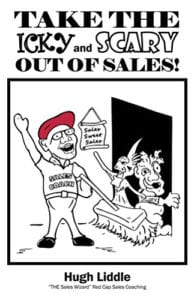
Take the Icky and Scary Out of Sales
Yes. She’s had the unfortunate problem of dealing with some icky salespeople in the past and that’s part of the reason she feels that way. My wife convinced me that it was a great idea to move from Colorado to Florida. I don’t like heat and humidity but she told me about all of the wonderful things that would happen when we moved to Florida. I wouldn’t have to drive in the snow anymore or shovel it. She’d make me a beautiful home down here and the weather would be nice. There would be green on your lawn and it would be awesome. She asked me for the sale. She said, “I’m moving to Florida. Do you want to go or not?” I said, “Yeah. I would like to go.” That is a good example of somebody who thinks they can’t sell and is awesome at it.
I love the assumptiveness of it, “I’m going.” There was no fear in asking that closing question there, was there?
Not a bit.
She also painted a picture of what your life would be like. She used storytelling a little bit about, “You won’t have to shovel snow. Imagine how great that’ll be.”
You asked me about my philosophy of selling and how I respond to people who said, “I don’t feel comfortable selling.” Here’s the philosophy. It’s not our job to get people to do what we want them to do. That’s not sales from my perspective anyway. Our job is to get people or help people do what they want to do. Selling is a process of asking people questions and finding out what they want. It doesn’t matter what they need. People don’t buy because of what they need. They buy because of what they want. They generally want a result of some kind. I always tell chiropractors that the only reason people are sitting in your office is that they want something in their lives that they don’t have yet. They do almost anything to get that thing or there’s something in their life that they don’t want at all and they do almost anything to get rid of it.
That’s true not only of chiropractors but of any type of business. Your customers or your clients have something that they want. It’s not necessarily even that they need it. In some cases, “I don’t need a new car. I’d like to have a new car. I want one.” If I went to talk to a car salesperson, they might talk to me about, “You need a new car.” My response would be, “I don’t need one because my car gets me where I want to go. It starts every morning, so I don’t need a new one. I’d like that new car smell, the new car look and I’d like the way it feels when I’m driving around. I’d like some of the new technology.” I want some things but I don’t need them. If we can find out what our prospects want and why they want it, sometimes you have to go a little deeper than I want this. Why do you want it?
Let’s talk about this in terms of chiropractors. Typically, I would assume most people go to a chiropractor because they want to get out of pain but they also need to get out of pain.
The chiropractors that I work with, most of them don’t treat symptoms anyway. They treat the underlying cause of the symptom so people can have optimal health where they function well, they feel good all the time, and they never anymore.
The difference would be, “I need to get out of pain now so I can turn my neck without pain, but I want to stay healthy. Therefore, that’s why I would keep coming even if I’m not in pain.”
[bctt tweet=”Be present with people to be successful. ” username=”John_Livesay”]
The want is more important than the need when it comes to the sales conversation.
You talk about that mindset is key to success. You have a chapter on it, Let’s Get Ready Preparing to Sell. What do you think is the right mental preparation you should be doing?
When you’re having a sales conversation, your focus needs to be 100% on the other person, what they think, feel, want, need, and their situation is, all of those things. The part of the middle of preparation is letting go of everything that’s been going on in your life before you show up to have that sales conversation. If you’re thinking about the disagreement that you had with your significant other before you left for work, that’s on your mind, that’s not where your focus needs to be. The focus needs to change. If you’re thinking about the stack of bills you have on your desk that you can’t pay and sales haven’t been that great this month, you’re thinking about that while having the conversation. One of my buddies who’s also a sales coach is Gene McNaughton and his favorite phrase is, “Your prospects can smell commission breath five miles away.”
I like that commission breath. I haven’t heard that before.
It’s absolutely true. Even if you’re thinking about after work, “I’ve got to go down and have a few with my friends down at the pub,” your focus is in the wrong place. Everybody that’s ever bought anything from a salesperson has had this experience at some point. The salesperson does a good job of explaining the product or service. It’s something that you want and the price point is okay. They ask you to buy and you get this feeling down in your gut, “There’s something wrong here. I don’t know what it is. I can’t put my finger on it, but I don’t feel comfortable. I’m going to tell him that I want to take a little while to think about it. I’ll call him if I decide I want to do it.” They’ll never call. What is almost always going on when that happens is the salesperson is focused on something besides helping the person get whatever they want. Their focus is someplace else. There’s an energy that passes between the salesperson and the prospect. If that energy isn’t clean, if they don’t feel like you want to help them and that you’re focused on their wants and their needs, they won’t buy from you.
It sounds like the fight or flight response has kicked in and it doesn’t feel safe. You don’t know why it doesn’t feel safe. Part of it is that person is not 100% present.

Sell With Pride: Selling really is a process of asking people questions and finding out what they want.
It’s important before you have the sales conversation to get your focus in the right place. I have a friend out in California who has an evergreen tree by his front door. He’s a great salesman. Every morning when he walks out of the house, he reaches out and taps the trunk of that tree. It’s an NLP thing. What it means to him is forget everything that’s gone on up until right now and focus on helping as many people as you can in the next eight hours. On the way back in the door, he taps the tree again. That’s his cue to forget everything that’s going on in the workday and focus on your family, resting, recreating and getting ready for the next day. I’ve had other salespeople that I’ve managed who actually had to sit in a room by themselves for 30 or 45 minutes to get themselves in the proper mindset to go out and sell. Most of us are between those two extremes. It’s not immediate. It’s not tapping the trunk of the tree and we’re ready to go. It’s not sitting around for 30 or 45 minutes to get ready. All of us need to go through that process before every sales conversation.
It’s some mindset or ritual, it sounds like it’s what you’re recommending. Hugh, do you feel that that’s the most important skill for a salesperson to develop? Is it being present or is it something else you recommend?
The answer to it is most people think that the most important skill that a salesperson needs to have is being able to talk, “She has the gift of gab. She could sell iceboxes to Eskimos. She’s great at talking. She’d be great at sales.” No, maybe not because the most important skill in selling is listening not only with our ears but with our minds and hearts. There’s more going on in a conversation than the words that are said. It’s the way the words are said, it’s the emotion behind what’s going on. I mentioned that there’s an energy that passes between a salesperson and a prospect. The salesperson has to be queued in to what that person is saying, how they’re saying it and what their body language is if they’re able to see them online or in person. The body language that’s going on, and the emotion that’s behind what those people are saying. If you can train yourself to listen carefully, if you can build that skill, people will feel appreciated. They’ll feel like you want to help them. They’ll buy from you if you’re a good listener. If you talk and talk, my wife would kick you out the door after about five minutes of that.
You and I are definitely on the same page about energy. When I was up for speaking engagements to speak to a sales team. The speaking agent called me back after they interviewed me and the other two speakers and they said, “Congrats. They picked you. They liked your energy.” People don’t realize that they liked your energy, enthusiasm and passion. It’s not the fact that you have a book. All those things got you into the final three. When it comes down to who do we want to spend time with? They feel good after hearing me talk and they assume that the audience is going to feel good. What you’re saying is so important. You talked in your book about how to not take rejection personally and not feel like you’re being pushy and aggressive. I’m guessing that’s one of the steps in the sales process you teach. I’m specifically interested in those two issues because many people do take rejection personally and feel pushy. Can you talk about how you help people with that?
First of all, it goes back to the mindset that you’re not trying to get people to do what you want them to do. You want to help them do what they want to do. That sets the tone as you go into the sales conversation. When you get to the point in the conversation, where you’ve asked questions and you know what they want and why they want it, you’ve explained to them that they can have what they want. They can have the result that they’re looking for. If they work with you, they can achieve that, they can have that result and you ask them for the sale. Your responsibility stops right there. If you’ve done all of the early steps in the sales process, you’ve done a great verbal agreement, asked good questions, done a good job of communicating value to them and you’ve asked them to buy, that’s the end for you. Unless an objection comes up, your job is to help them move past the obstacle that they’re seeing in their way to having your product or service.
[bctt tweet=”It’s our job as salespeople to get people do what we want them to do. Our job is to get people or help people do what they want to do. ” username=”John_Livesay”]
I love what you said there because I want to underline that and take a moment and make sure everybody got that before we go on. Many salespeople are afraid to ask for the order because they fear rejection. You gave us great insight. This is your job. If you were getting on a plane to fly from LA to New York, and the pilot makes the announcement, “We’re now landing.” No one stands up and goes, “What? We’re landing?” It’s expected that it’s his job to land the plane. I say it’s our job as salespeople to land the plane, also known as asking for the sale. You’re not doing your job if you’re not doing that. That is crucial what you said, I love it.
If you think about not getting people to buy, but offering them the opportunity to take advantage of what you sell, you’re offering them an opportunity. When you ask for the sale and if you do it the way that I teach it, you give them three different options that they have available to them and ask them which one they think is the best fit for them. Once you ask that question, you shut up. You don’t say anything until they respond. Your responsibility has ended there when you ask for the sale because it’s up to them to make a decision.
Do they want this product or service and the result that it’s going to give them or do they not? Are they willing and able to invest the time, energy and money that it takes to take advantage of the service or the product or do they not? It’s their decision. If they say, “No, I’ve decided I don’t want to do this. It’s too much money and it takes too much time. I want to think about it. I’m not going to even think about or consider making a decision right now.” That’s not anything that you’ve done wrong. It doesn’t make you bad.
If somebody tells you, “No,” it doesn’t say anything at all about your value as a human being, the value of your company, your product or service. It says volumes about the prospect. For one reason or another, they’re not willing to do what it takes to take advantage of your product or service. If you can keep that mindset that you’re offering this to them and not attached to the outcome, there are loads of people who want my product or service. If this person says no, that’s not the end of the world, and it’s not the end of my business.
One of my favorite things about your book is you said, “Stop saying we’re closing the sale because it means that something is ending.” Talk about that. Do you think that’s the most difficult step in the sales process, is closing? If that’s not it, can you tell us what you think is?
I don’t think it’s the most difficult thing. In fact, the easiest thing is asking for the sale, if you’ve done the first four things right, built rapport, done a good verbal agreement, asked good questions, and communicated the value and result that they can have. If you’ve done that, asking for the sales is like falling off a log. It’s easy. The hardest part is probably answering objections effectively. That probably is the most difficult part. The only reason that it’s difficult because the science of it is having a script and knowing what to say when you get a particular objection.

Sell With Pride: Stop saying we’re closing the sale because it means something is ending.
There’s an art to it, though. The art to it is, which question am I going to ask first? How am I going to proceed through this chain of questions that I asked when I get money or time objection? I want to think about an objection or I need to talk to somebody first objection. How am I going to respond to that? There’s a science and an art to being able to do that. That’s the hardest part. The idea of asking for the sale and the reason I call it that instead of closing is because the relationship with your prospect starts at the point where they tell you, “Yes. I want to take advantage of your product or service or no, I don’t.”
It’s not the end of the process no matter what they say. If they say, “Yes,” you’re going to deliver the product or service and you’re going to follow up, going to upsell, and you’re going to do a lot of different things there. If they say, “No,” you still want to follow up and stay top of mind because no doesn’t necessarily mean never. It means not right now. If you stay top of mind when they are ready, they’ll come back to you to buy. They won’t go someplace else. That’s why I don’t call it the close. I call it the opening, the commencement or the beginning, one of those words.
Speaking of an offer and a close because you’ve been generous, you said that anyone who’s reading can get a free strategy session with you about determining whether the Red Cap Sales Coaching could help them. You don’t even charge people. Certainly, people can tell from talking to you, there’s no pressure because you come from such a place of energy, respect, and confidence that what you have to offer is valuable. You’re not trying to pressure anybody into doing anything they don’t want. I can speak firsthand about how friendly and fun you are to talk to. Do you have any last thoughts you want to leave us with about how we can continue to get rid of the icky and scary part of selling?
[bctt tweet=”The most important skill in selling is listening, not just with our ears, but with our minds and our hearts. ” username=”John_Livesay”]
First of all, I want to clarify that the conversation that you mentioned, isn’t a sales conversation. It gives the people who have the strategy session, the opportunity to talk about their business, their sales and ask questions and get some tips, ideas, and strategies that will help them. It is a strategy session and they’ll find out whether continuing coaching after that. There’s no charge, there’s absolutely no pressure at all and no obligation to do anything. It’s a fun and friendly conversation. To answer your last question, the biggest thing that is important in having success in selling is to have a great script for each step of the sales conversation. To memorize, practice and role-play it until it’s a part of you, a part of the way you talk. Somebody could call you up at 3:00 in the morning and wake you out of a dead sleep and say, “Have a sales conversation with me.” You wouldn’t even have to think about it. You go with it. Everybody who sells has a script because you’re going to say pretty much the same thing every time you talk to somebody. It’s a matter of whether your script is effective or whether it’s not. Get a good script.
Hugh, it’s been a pleasure. Thank you so much for sharing your wisdom and your insights on how we can take the icky and scary out of selling.
John, thank you so much for having me on the call. It was fun.
Important Links
- Red Cap Sales Coaching
- Elite Sales Academy
- Take the Icky and Scary Out of Sales – Amazon
- Sales Chalk Talk
- iTunes – Sales Chalk Talk
- Bit.ly/wizard-strategy – Book in time for a free strategy session
- Better Selling Through Storytelling Method Online Course
Wanna Host Your Own Podcast?
Click here to see how my friends at Podetize can help
Purchase John’s new book
John Livesay, The Pitch Whisperer
Share The Show
Did you enjoy the show? I’d love it if you subscribed today and left us a 5-star review!
- Click this link
- Click on the ‘Subscribe’ button below the artwork
- Go to the ‘Ratings and Reviews’ section
- Click on ‘Write a Review’
Love the show? Subscribe, rate, review, and share!
Join The Successful Pitch community today:
- JohnLivesay.com
- John Livesay Facebook
- John Livesay Twitter
- John Livesay LinkedIn
- John Livesay YouTube
Recharge Your Mind Daily With Tom Cronin
Posted by John Livesay in podcast | 0 comments


Believe it or not, meditation can actually save the world. In this eye-opening episode, John Livesay interviews Tom Cronin who is the author of The Portal. Founder of The Stillness Project, a global movement to inspire one billion people to sit in stillness daily, Tom is passionate about reducing stress and chaos in people’s lives. Learn how you can start to figure out ways to get new insights and recharge yourself at the same time through Tom’s meditation techniques.
—
Listen to the podcast here
Recharge Your Mind Daily With Tom Cronin
Our guest is Tom Cronin whom I heard speak in person and couldn’t wait to have him on the show. He has spent over 26 years in the financial markets as one of Sydney’s leading bond and swap brokers. He discovered meditation in the early stages of his career when the anxiety and chaos he was experiencing hit a crisis point and he completely transformed his world both personally and professionally. He’s the Founder of The Stillness Project, a global movement to inspire one billion people to sit in silence daily. Tom is passionate about reducing stress and chaos in people’s lives. He’s ongoing work in the transformational leadership in cultivating inner peace through meditation takes him around the world hosting retreats, mentoring, presenting keynote talks and teaching and creating the portal film book experience all of which are part of his commitment to the current planetary shift. Tom, welcome to the show.
It’s good to be here. Thanks for inviting me along, John.
You are welcome. I would love to take us back to your own story of origin. You can go back as far as you want. You can take us right to the places of the pressure the stress of being in the financial markets or you can take it further back if you want. When did you make a decision that you’re like, “I want to make a lot of money?” Had you had any exposure to any alternative concepts? Whatever you think is a good starting point to your journey would be of interest to me.
It’s funny how we end up in our journeys. I had no interest in finance and never shown any interest in it. Ironically, after school, I wanted to become a journalist and write articles for Time Magazine about capitalistic greed to save the world from the treacherous world of the banking system. I took a year off school backpacking around Europe and blew a lot of my money in Amsterdam. I was eighteen so use your imagination and I got back home. I had quite a few months to fill before my degree doing Journalism and I applied for a bunch of jobs in the paper. I was going to quit those jobs once it was time to go to university and once I got a bit of money in the bank.
Lo and behold, one of those jobs was on a massive trading room floor. I walked onto that floor and immediately felt the energy and I landed the job. Before long I got swept into the excitement, drama and the glamour of the trading room floor in the late ‘80s. This is when Wolf of Wall Street, Jordan Belfort started his career in 1987. I started my career in 1987 and it was the year we had Bud Fox and Gordon Gekko Wall Street film came out as The Bonfire of the Vanities was showing and Sherman McCoy. There was a lot of money greed world of finance came out in 1987. It was the start of a big fueling of a bonfire. I was quickly swept up into that world. I didn’t go end up doing my degree because I was making so much money. I was given a corporate Amex card, a fast corporate car and was told to go out and win the clients’ business. That was the start of the journey.
[bctt tweet=”Create a gap in your day to allow your own insights to happen. ” username=”John_Livesay”]
If Twitter existed, the hashtag would have been Greed Is Good.
Greed is good, lunch is for wimps. I became a fast, effective and efficient broker. I was good at what I did and rose the ranks quite quickly. Before long, you’re swept into that lifestyle. You’re doing lots of drugs, drinking late nights, 2:00, 3:00, 4:00 in the morning, all-nighters with clients, big traders and big cowboys from investment banks. It was fun when you’re 18, 19, 20 but over time, what happens is this lifestyle gets ingrained and deeply embedded into your nervous system and your body. It starts showing up as a sign of wear and tear. My body before long started to show extreme signs of wear and tear, anxiety, depression, and insomnia. This accumulated over time until eventually, in about nine years into the career, it exacerbated to such a point that I started to have what was deemed a nervous breakdown at that particular point in time. Part of the problem was not everyone in the finance industry had a nervous breakdown. I put a lot of fuel on that fire.
Not only was I by day fast, yelling and screaming a lot is the nature of the job and we’re on a busy desk. By nighttime, I got deeply involved in a part of that culture that not everyone got involved in. There was a lot of cocaine, drinking and drugs. On weekends, when a lot of the brokers were playing rounds of golf, relaxing, sleeping and recovering, I got involved in the late ‘80s early ‘90s rave culture. I’ve been to a big warehouse party scene that was opening up in Sydney. It was like a new El Dorado. It was a new frontier for the club scene and I was enamored by this exciting world. My weekends were spending time in warehouse and recovery parties all weekend doing other things that go along with that. There was no break, rest and no ability for my body to recover. That’s why the symptoms started to exacerbate over time.
Would you say you were an adrenaline junkie? Since you were adrenaline high at work and on the weekends was another source of that.
Yes. I was doing a lot of research on it over time. I was looking at biochemistry and I had low dopamine as a result of that. You look for the highs where you can get that boost. It was drugs, drinking, partying, nightclubs, raves or anything that will give you that hit leads you to go back to get more. By seeking it in that environment means that when you’re not in that environment, you’ve got this massive so you need to go back for more. That’s where addiction starts to come in. That was definitely a big part of what was going on looking back in hindsight.
Interestingly, the shift came when I found meditation and the regulation of that biochemistry in my body, this beautiful regulated trickle effect of oxytocin and serotonin seeping into my bloodstream completely changed. It was an absolute game-changer for me and my ability to efficiently and effectively work in that environment. I worked another sixteen years in that career without doing all the addictions. It wasn’t like I became a perfect monk. That was certainly not the case. It meant that the craving and the yearning and those late nights and all the drugs that started to drop away quite quickly and the need to seek those big highs weren’t there.
Was it cold turkey like if someone’s got other addictions, they stopped drinking, doing drugs or sometimes go to rehab? Did you stop doing that from one meditation?
The drugs were quick. The yearning to have those experiences wasn’t there. What was happening with the meditation was profound. I couldn’t believe that I could feel this good quickly. A lot of the anxiety, depression and insomnia simply went away. That’s simply a scientific and biological process of getting your body out of an extreme sympathetic nervous system state because all day you’re in this sympathetic nervous system state response.
For those who don’t know what that means, would you define that for us?
If you think of the sympathetic nervous system and stress, it’s a stress response in the body for an extreme circumstance. If you’re facing a marauding tribe or a saber-toothed tiger, your body is a mechanism to preserve life. The number one priority in your body is to preserve life. Your body doesn’t realize that you’re in a nice highly paid job and it feels that you’re in a dangerous situation. The same symptoms start to prevail if you’re in a life and death or a stressful situation and you’re having that stress response in your body. Your biochemistry in the sympathetic nervous system state is a high level of cortisol, adrenaline, norepinephrine and a reduction of melatonin, serotonin and oxytocin. It’s a simple black and white or flips the switch type of scenario.

Recharging Your Mind: The number one priority in your body is to preserve life.
It’s a basic fight or flight.
We’re in fight or flight but when we get out of fight or flight, which is exactly what happens when we’re in a meditation experience, we move out of the sympathetic and into the parasympathetic and the P for peace is the peace response. The peace response is part of what happens for the body to restore balance, recalibrate and optimize itself and recover from that extreme circumstance. It’s a beautiful design of the body because we’re designed to have optimal well-being that’s normality. Our systems are not designed for most people being happy and healthy. Most businesses are built on the premise that we’re unhappy and we’re unhealthy. If you look at where most of the world’s economies are flourishing are in the world being unhealthy and unhappy.
When you take a look at that because I vividly remember when people were allowed to smoke at the workplace. Even if they were to say, “No. You have to get out or go outside,” I was within the fast-paced world of media sales, I’d go back to the corporate headquarters in New York, and I’d see these people standing outside taking cigarette breaks in the freezing cold. I could not wrap my head around it. I understood it was an addiction but that was their idea of a break. You went from the stressful situation to the phones not stopping, emails and all the other endless voicemails at one point and now, it’s text messaging. It’s a constant on fight or flight, “Let’s take a break and have a cigarette.” It’s not the healthiest form of a break.
Finally, some big tech companies like Google and others are starting to say, “We’ve created a nap room or a mindfulness place.” It’s now starting in those kinds of companies, in particular, to be seen as you can’t go from one unhealthy activity like the martini lunch from the ‘60s or the Mad Men mindset, which is go all the time, is no longer something that people think they can keep doing to themselves. Let’s talk about that. The culture shift in companies big and small, from do whatever you have to do, ends justify the means, take red-eye, hit the ground running, don’t go to sleep, brag about how little sleep you get, take cigarettes and drinking and go to these conventions, burn yourself out of both ends. It’s because we work hard and we play hard. Do you see that starting to change at all?
Absolutely. These are smart companies. They’ve got big businesses to run. They need to report annually back to shareholders to continue to increase profits. That company isn’t a bottom line. It’s not a logo, share price, or a PA. It’s a bunch of people that walk in the front door every day. Those people are grappling with their personal relationships, financial, and health issues. That company knows, the smart ones anyway, that for them to optimize that company, they need to optimize the brains of the people that work in that company. They need to optimize the people that are working for that company because all of the ideas within that company come from someone’s brain. If we’re in the sympathetic nervous system, fight-flight stress response state, our brain and nervous system are severely compromised.
Our ability to be productive, happy, engaged and healthy, which means we’re not taking sick leave. It gets severely compromised if we’re not looking after our staff. This is a big shift that we’re starting to see with those progressive companies realizing that the bottom line is their people are producing the concepts, ideas, the creativity that makes the company flourish. We need to look after those people because they’re our assets. Mental health in Australia has been proven as a great report put out by PwC. It showed that poor mental health is costing Australian Business $11 billion a year. This is a small country. In America, it’s going to be gargantuan. For every dollar a company spends on improving and enhancing the mental health of a company, the return on that investment for general business is $2.30 and for small businesses in the mining sector, it’s up to $14.
Let’s define that. That’s a fascinating return on investment. Mental health, that phrase people go, “Is that going to see a therapist?” We’re talking about a lot of other things. Can you define what mental health means for you? What does $1 look like spent on mental health? Is it a meditation room? Is it a meditation class? What else could it be for a company?
[bctt tweet=”From stillness and silence comes peace and happiness. ” username=”John_Livesay”]
It’s a lot of things. It would come under things like providing yoga. It would come under providing meditation programs. It would come under allowing staff to take effective breaks that are sleep pods. It’s fantastic. Napping is an efficient use of time for companies and in increasing productivity. Think of humans like a phone and we have a battery. If we start to run out of charge, the phone becomes almost redundant. We need to keep rebooting our battery cells. For me, my rebooting prior to this podcast, we were driving for a few hours from Seattle to Bellingham. My director who we’re traveling with will take a meditation break where we’ll reboot our system. We have to go to a screening of the film and we have to do a Q&A and it’s going to go a bit late. We want to make sure that we’re vibrant, energized and clear. Meditation is an efficient way of getting a reboot to our battery cells so that we’re supercharged and ready for the next session.
I’m going to make that one of your tweets from the episode. I love that, “Reboot your mind battery like your cellphone.” People can understand the need for their cellphone. People get desperate when their cell phone starts to go down in batteries. You see everyone at the airport frantically looking to charge and yet there’s nothing anybody’s doing to recharge their own brain. That’s a fantastic analogy. Tom, I’m a big proponent of this and people ask me, “How do you always stay positive or you don’t seem to be stressed out?” I give keynote talks on how are you on for those moments like you’re describing what you need to go do at your screening. If I mentioned meditation, they go, “I don’t want to talk about that or I tried that but I can’t do it. Guided or unguided, I can’t sit still.” I had a conversation with someone and I said, “Have you heard of the monkey mind?” It never stops talking.
What advice do you have for people who say they literally tried it, don’t like it, can’t do it, or want to do it? Even a meditation tape, I feel such pain for people. I get that it’s hard to sit and quiet your mind but your company’s graciously not only having a book and a movie but actual guided meditation so it’s not just listening to music. What is the first thing people can do who maybe are open to it, tried it, hate it or can’t do it? It’s one more thing to beat yourself about, which is crazy.
This is the reason why these techniques have been around for 5,000 to 10,000 years. They’ve stood the test of time and that’s because they work. If they didn’t work, they simply would have been redundant. It’s a matter of finding the technique and teacher that works for you. You can go on an app and you can read and learn from a book but ideally, the most efficient and effective way is to learn with a teacher. They’re qualified in the art of training you into meditation. There are different forms of meditation. Some are a little bit more challenging and some are possibly harder to access than others. I did a lot of research into meditation. I wanted one that can get me deep quickly and it wasn’t going to take me three hours a day of trying to clear my chakras.

Recharging Your Mind: Meditation is a very efficient way of getting a reboot to our battery cells.
What I wanted to do is to transcend and to find a deep state of restfulness and that’s why I chose a particular style of meditation using particular mantras or sounds that would take my mind quite deeply. Also to allow me to get into a deep state within minutes. That’s a technique that I searched for. It comes under different names like primordial sound technique, or Vedic meditation or transcendental meditation, but they’re all using a particular sound or word that you repeat over inside your head silently that takes the mind deeper and deeper.
That’s an effective meditation but it’s not the only one. Other people like the Vipassana or Zen style meditation which is sitting and guided meditations. I do recommend to continue to look and search, there’s not just one. There are multiple forms of meditation. If you find a technique that you resonate with, there might be different teachers and some of you resonate more within that tradition than other ones. Some students love coming to me because of my background and some like going to another type of teacher in that tradition and that’s totally cool as well.
You wrote a book called The Portal: How Meditation Can Save the World. First of all, I’m fascinated that the subtitle of the book is saving the world as opposed to helping you be more productive or help save yourself or something like that. That alone tells me much about you, Tom, and your book, because a lot of people will go, “That’s a lofty goal. I don’t know if I need to buy a book to save the world. I want to make myself better.” Let’s start with that title and where that came from. How’d you come up with Portal? Did you get anybody else surprised that you’re talking about saving the world?
It is. What we didn’t want to provide was a manual because there are so many of them out there already. A step-by-step, that’s not what this is. This is a portal that represents two things. Firstly, it’s your own individual journey through the transitional point, which is what meditation is. It’s the pathway through to a place that already exists and that stillness and silence. Why we want to get some stillness and silence is on a physiological level, it transforms our body and our biochemistry. On a spiritual-mental level, it allows us to find a deep sense of peacefulness and contentedness that exists without that constant yearning, craving mind that is searching for more and more all the time.
The Portal is the process of transcending or going into the journey of meditation but it also represents the transitional point for humanity. We’re on a macro level, transitioning from a state of ignorance, suffering, chaos and confusion through to an awakened period of time for humanity. In Vedic philosophy, it’s called Satya Yuga, which is an era of time where there is collectively a society that’s generally healthy and happy. A lot of things have to change when we get to that point. A lot of systems have to change.
[bctt tweet=”Recharge your mind battery like you do your cell phone battery. ” username=”John_Livesay”]
Let’s talk about mass consciousness in the state of fear. When 9/11 happened here in the States, it was constantly broadcasting planes crashing into the buildings over and over again. People don’t realize watching how it’s addictive. The fear of what’s next, “Are we next? What about the Golden Gate Bridge in San Francisco? Is this building safe?” Unless you consciously choose to go into a portal, where things are peaceful and calm and not at that effect, to me, it’s almost the difference between staying up in the storm on a sea or going under the water. The analogy I also think might be useful and I’d love your opinion if these are useful. If you’re taking off in an airplane and it is stormy, whether it’s snow or rain and you get high enough, you get above all of that. That becomes another portal analogy for me.
That’s a beautiful one.
I think to myself, you described when I heard you speak, and you’re such a good speaker. If anyone’s looking for a speaker, I want to recommend you personally. Where do good ideas come from? Where do insights come from? You describe this wonderful place of peacefulness, calm, insights, innovation and creativity. We’re not going through the portal to get there and we’re staying, if you will, above the sea where it’s stormy and thinking some great ideas are going to come from that. I want to have you expound on that a little bit from what I heard you talk about because that imagery resonated with me.
I was doing a talk at a company. I was taking them through what their standard day would look like. Instead of mirroring back to them roughly what their day might look like. They ensure that their day wakes up and they get on their phone and quickly scroll through their news feeds, get on the bus or the train going to work, go through their emails, go through possibly watching videos on YouTube, get to work, do their emails, and have meetings. They take a lunch break, catch up on their social media, which they haven’t seen for the last few hours. They’ll go back to work and go through some more meetings and some emails and some documents and things like that. On the way home, they’re going through their news feeds. When they get home, they’re watching the TV watching the news, Master Chef and The Bachelor. They might do a final little wrap on their social media before bed. If they’ve got a little bit of time, they might pick up a book and read a book.
If you look at what’s happening in through that entire day, their mind is digesting other people’s words and thoughts. What happens is there are no open windows for their mind to have some level of accessing a field of creative possibility. They might get inspired by some of those podcasts, books or videos that they’ve watched and all of those Instagram posts that effectively had none of their own insights and a-ha moments. There are no gaps in the day. The interesting thing is we’re doing this time and time again day in and day out where 85% of our thoughts are regurgitating recycled thoughts of the day before, which are 85% to 95% of other people’s thoughts. It’s because there are not enough gaps in the day to have any of our own thoughts anyway. Most of those thoughts when we do have them is, “I wonder if I’m going to have a Caesar salad or whether I’m going to have a chicken pizza for lunch.”

Recharging Your Mind: In order for the world to be healthy and happy, we have to be healthy and happy.
It’s fear-based, “Is my marriage ending? Am I going to go broke? Will I be homeless?” If you keep having those fear thoughts and you’re in a loop or if you can’t believe somebody said something that made me mad. Now I’m mad as if it happened and it happened last week. You’re triggered all the time and you’re walking around angry. That’s where I’m thrilled that someone like you is on the planet because if you step back and think how many people are angry behind the wheel of a car, on the subway and at an airport. If no one is meditating or getting out of this anger loop, no wonder everyone’s rude and pushy.
I had a woman on a podcast asked me to speak about the emotional poverty we have on the planet. I said to her, “We need to pause this there because we actually don’t have emotional poverty.” She was thinking that having emotional expression is a healthy thing, but it’s not. What we want to do is transcend even that. It’s okay if we’re having an emotional response that’s authentic and relevant to that particular experience. What we also as well as want to explore is being in the next level of our own evolution where we’re not completely reactive because emotions are reactive to situations. We’re constantly reacting to situations, where that is making me feel this.
We’re not in our own state of autonomy where we’re able to observe those circumstances from the space of compassion, from love, from unconditional love, and from a state of acceptance. I’m moved into action to create change but I’m not having a rapid deterioration in my feeling body as a result of what’s happening in the world around me. That gives us autonomy but it also gives us a power that allows us to move forward in a much more autonomous state where I’m able to be proactive in creating something that’s going to contribute to the improvement of society and my own well-being. As opposed to constantly deteriorating my own state, because other things around me are making me feel that way.
To try and sum up what you’ve said, if we create a gap in our mind and in our day even where we can get quiet and listen to some of our own internal insights. We break that loop of fear, anger, resentment and reaction in a much faster way, which gives us some power and freedom.
We do it daily. We have a daily meditation practice and that is a technique that allows us to sit, withdraw from the world of sense, story and drama to go into a state of stillness and silence. That stillness and silence are dynamic. It’s not empty, it’s dynamic. It’s the field of all infinite possibilities. We use that analogy the phone doesn’t have the internet in it. The internet is around and the phone is on the internet just as we sit within the field of all possibilities. Most of us don’t know how to access that field. When we go into stillness of silence, we now quiet the mind and the mind is open to tuning in to all possibilities. Everything that’s been designed and created by man and woman, suited by humankind was cognized out of the creative intention, possibility and the intention to manifest that. It’s a phone, pen, a brochure, the chair we’re sitting on, it’s the car you’re driving in. It all had a possibility and was in the field of possibility. It took someone to manage to cognize it and turn it into a manifested reality.
Which came first, your movie, The Portal or your book?
The film was first and in the making of the film, we interviewed 9 people, 6 stories and 3 futurists and we took extracts of those interviews, compile them and edited them into a book format. The director and I added extra components to that.
What’s the website for people to go to find out about the film, the book? There will be some other things coming up here including some meditation apps or even the way to hire you to speak or work with you one-on-one if I’m understanding correctly.
[bctt tweet=”The portal is the process of transcending into the journey of meditation, but also represents the transitional point for humanity. ” username=”John_Livesay”]
EnterThePortal.com is all about the film, the book and the online programs and TomCronin.com is for booking for speaking, retreats and coaching.
Tom, this has been wonderful to hear from you again, to get to ask you some specific questions and your overall energy. You can tell that you are walking your talk. Any last thoughts you want to leave us with?
It’s easy for us without social media and news to think the worst is happening in the world. That’s what does sell media but there are some phenomenal exciting things happening in the world as well. We are in the process of transformation. The mere fact alone that we can have a podcast like this beam it out to people all over the world and talk about positive progressive things, it shows that progress is happening and change is happening. To get excited about what lies ahead for humanity. It is complex. There are some major challenges facing us but as we talked about in the film, we all have something wonderful to contribute to the world. Realizing, expressing and sharing that is part of what makes this world a beautiful and colorful place. Beyond where we’re at if we have a vision for what life looks like on an enlightened planet is an exciting world where people are healthy and happy. It’s phenomenal.
In order for the world to be healthy and happy, we have to be healthy and happy.
That’s it. That’s the starting point.
Thanks again, Tom. The book is called The Portal, the movie is The Portal, TomCronin.com and EnterThePortal.com.
It’s good to be here. Thanks for reading.
Important Links
- The Portal: How Meditation Can Save the World
- The Stillness Project
- https://EnterThePortal.com/
- TomCronin.com
- Better Selling Through Storytelling Method Online Course
Wanna Host Your Own Podcast?
Click here to see how my friends at Podetize can help
Purchase John’s new book
John Livesay, The Pitch Whisperer
Share The Show
Did you enjoy the show? I’d love it if you subscribed today and left us a 5-star review!
- Click this link
- Click on the ‘Subscribe’ button below the artwork
- Go to the ‘Ratings and Reviews’ section
- Click on ‘Write a Review’
Love the show? Subscribe, rate, review, and share!
Join The Successful Pitch community today:
- JohnLivesay.com
- John Livesay Facebook
- John Livesay Twitter
- John Livesay LinkedIn
- John Livesay YouTube
Speakers Loft: Elevating Your Value As A Speaker With Kristian Ravn
Posted by John Livesay in podcast | 0 comments

Breaking into an industry and carving your name on its walls is all about mindset. In another inspiring episode, John Livesay chats with Kristian Ravn, a former journalist, philosopher, and the Founder of SpeakersLoft, a tech solution to help prevent loneliness for speakers on the road. Kristian talks about his background in philosophy, journalism, and technology and how it all come together on SpeakersLoft. He shares his idea of trust before everything else and how to negotiate around fees for speaking gigs, and discusses the phases in engaging with people including mirroring.
—
Listen to the podcast here
Speakers Loft: Elevating Your Value As A Speaker With Kristian Ravn
My guest is Kristian Ravn out of Denmark. He’s created something called SpeakersLoft, which is a tech solution to help prevent loneliness for speakers on the road. What a fascinating concept. He talks about his background in philosophy, journalism, technology and how it’s all come together on SpeakersLoft. One of the favorite quotes from the episode that he creates content around is, “If they don’t give you a seat at the table, bring a folding chair.” No matter what industry you’re in and you’re trying to break through or grow your business, that’s the mindset you have to have.
—
My guest is Kristian Ravn. What he does is he has created something called SpeakersLoft. He helps create more business for public speakers who travel for speaking. He is based in Copenhagen, but he is certainly a citizen of the world. Kristian, welcome to the show.
Thank you very much for having me.
I always like to ask my guests to tell their own stories of origin. You can go back as far as you want, in your childhood or your college, university days. I know you didn’t wake up as a young lad and say, “I’m going to launch SpeakersLoft because I see a problem in the speaking industry I can fix.” You’ve had some other training as a journalist and philosophy. Give us a sense of your background and how you got to be a grouper.
Possibly looking back as a young man, I grew up on a farm, the dangerous side of Denmark, Germany border. Everything was going the traditional way until I stumbled upon the philosophy thing, which was mesmerizing to a young mind. I figured we have all these smart Germans and a lot of smart English philosophers. The self-off certainty you have when you’re twenty, I jumped on that and I went to the university. I was like, “I’m going to solve the problem of identity. I’m going to solve the problem of ethics. I don’t see why this is so hard.” I went through some humbling years because those problems are fantastic. I consider it a privilege to have spent time on them, but I also at some point decided that enough was enough and I’m not going to be the one to solve any of that.
I started studying journalism, which I’d say the hardest thing I’ve ever done was going from something so abstract as to try and conceive the boundaries of what can be thought to telling a story, which I know also you’ve dealt with a lot. Storytelling is a fantastic tool, but nobody cares if it doesn’t have structure. It isn’t concrete and it doesn’t have images. There’s no flow. I’m trying to tell people how the world as they perceive it may not be as it is horrible in the storytelling. That was very hard. After that, I worked in publishing for a few years and I felt myself becoming more and more interested in the tech side of things. Working with data sets, finding out what is it that makes a speaker or offer going successful. If you break down all the data, you can find about it and what makes a difference when you go into the marketing side.
I did that for a couple of years. I met the friend of a friend, who runs the speaker bureaus. He said, “The work I do is I have these thousands of speakers across Europe and in North America. They have a very lonesome job because they go out in their own states. They are the center of attention for 45 minutes. They get on the flight back and they prepare and research and try to find the next job. We have to cater to the client, not the speaker because they’re the ones paying.” It always feels like we could possibly create something more, something that creates a sense of meaning in being a speaker. He said, “Do you think you can do that?” We had a beer. I said, “I’m pretty sure I can do that.” Now we’re doing the SpeakersLoft.
I find it fascinating because hearing the backstory of philosophy, which you said one of the topics was identity. Who are we, what’s our purpose, what makes us different than everyone else, yet how do we fit in as a tribe? All of those are issues that people face from time to time depending on where you are in your little journey. Journalism hones in on the who, what, where, when aspect of it. Those journalistic skills are important for crafting a talk and certainly a story. You take it one step further with technology where you have created a tech solution to loneliness. That’s how I define SpeakersLoft.
You’re doing me a great honor by describing it that way. If it becomes that, I will be so insanely proud.
I’m the Pitch Whisperer. I love to come up with a soundbite for people so that they can get people’s attention. They are intrigued to want to know more. If you say that to people, you might get the ideal answer where people say, “What do you do?” It’s like, “I’ve created a tech solution that helps loneliness for speakers on the world traveling.” People might be intrigued enough to want to know more, which is the answer that everybody hopes for when they’re giving their little elevator pitch.

Speakers Loft: The whole business of speaking is about trust.
I’ll be sure to try it out.
Let me know how it goes. Those little nuggets all come from the story of origin, which is why I always tell our audience, it’s so important to have your story of origin ready in a clear, concise way so that people get a sense of who you are. It’s important, Kristian, that people trust and like you before they’re willing to get to know you. What are your thoughts on that?
Trust is everything. We even found hints of trust in the data of speakers. The whole business of speaking is about trust. One thing phenomenally interesting is if you look at the actress in the field around speaking where the bureaus are very central. You could make a strong argument that they are a nonsensical entity in the ecosystem because they are a middleman that takes money from two sides that get along together. I’ve had that set by speakers and it’s going to, “Why should I give my bureau commission? I don’t like to work with bureaus. I don’t see the point.”
If you, as a speaker don’t see the point, then you need to step into the shoes of the client. If the client books through a bureau, they know that their reputation inside the company they’re from is on the line when they hire a speaker. It’s not that they’re hiring the speaker, they are placing that trust and money in a brand who will also fail if they fail. It’s a sharing of the burden. If you have that level of trust and the need for trust as part of your analysis, it makes perfect sense.
You’ve touched on a couple of things that are key here. First of all, the model of a speaking bureau, a lot of us as speakers think. “I can sell myself. I don’t need somebody.” I have come to learn those successful people who have created a brand of being perceived as a thought leader and an expert where people are willing to pay you to come to speak, have a team of people that represent them because you’re too busy doing what you do. Steve Wozniak, for example, does not pitch himself. The same thing is true when I launched my book. I hired a publicist. What the publicist and speaking bureaus offer from my perspective is helping clients de-risk their choice of who they’re going to hire.
[bctt tweet=”Trust and integrity are the keys to success.” username=”John_Livesay”]
If a publicist has a relationship with a journalist at a Fortune or Inc. or what have you, they pitch a story, an idea covering how do you get out of the friend zone at work? Here’s John’s book on how to do that. The journalist respects the publicist enough to know, “That’s an interesting hook. If you think this is good and you think the author would be a good interview, I’ll do it if it helps.” The same thing is true when a client is involved with the speaking bureau. They want to know if this person has integrity, which is one of the things you talked about with ethics. Are they going to do what they say they’re going to do?
The practical issue is, is this speaker going to show up? If you’re a client and you want to hire a speaker, it’s a one-off from the speaker. If they do poorly, it’s probably not going to pursue them that much. If they get all of that gigs through the bureau and the bureau pitch them to the client and they let down both the client and the bureau, they’re not going to get any more from the bureau. All of this is a risk and trust balancing game.
You’ve created SpeakersLoft that is a place that allows speakers from all over the world who are traveling to connect with other speakers while they happen to be in that city or town.
That’s phase one. We can trust anyone we don’t know or we can, but it’d be weird and doesn’t lead anywhere. The idea is when I go to Rome, Berlin or Washington and so can any member of the network, the fashion emails, everyone is saying, “I’m going to be in town. Do any of you have time for a cup of coffee? I’m interested in how the business is going here.” This magical thing happens. This is what happens when people meet. Some people you click with and you’re like, “I like this guy. This woman is inspiring,” or “The conversation we just had over a cup of coffee blew my mind.” These people are going to be people we feel comfortable helping out in the future.
A lot of clients will say to me sometimes, “You did a great job. Thanks a lot. We never bring the same speaker back. Who else do you know that we might consider next?” If you’ve got a relationship of speakers that you’ve connected with through SpeakersLoft or other ways, that’s a fantastic referral source and it works in two ways. You’ve been kind enough because you have this unique perspective of seeing all the different specificities, the expertise that different people speak on that you’re like, “This person might want to know this person.” Some of the introductions you’ve made to me because all these people are on your platform have been life-changing literally.

Speakers Loft: Mirroring is repeating back the last three words somebody says to you but in a downward inflection.
One gentleman, in particular, is our mutual friend, Sameer Somal. He helps people with their digital reputation and specifically in the law industry. He and I were brainstorming and I said, “You’re helping law firms at the beginning of their process of getting a new client.” People are going to search for law firms to see if they even want to interview them. Once they see that they have good results and there are no negative things, they might call them in to interview them. That’s where I step in with my talks and training to help them be better storytellers to win against two other competitors. It was like, “I’ve spoken to this law firm and let me make an intro for you.”
That collaboration is valuable. You introduced me to another gentleman, Fireman Rob. He has this amazing story of he’s a superhero, saving people, fires and 9/11, but he needs some introductions and some help along the way. Some of us are able to mentor other people and make introductions on, “You’re thinking of writing a book or you’re thinking of launching a podcast. Let me give you the people that I’ve already vetted.” That whole energy of creating a place of trust and support. This other factor, unless you’ve experienced it and you did a great job painting the picture of it, people who have to travel for work have an understanding of what it’s like.
Typically, you’re on the road and you don’t know anybody. Sometimes if you’re in sales and traveling or you’re going to a convention, you know other people. When you don’t know anyone, especially if you’re in a foreign country or city. You go from that high of attention and hopefully great feedback and feeling like you made a difference to, “I’m back in my hotel room alone. I’m having dinner alone or the night before,” and all that stuff. How differently that creates the experience for someone if they could tap into SpeakersLoft and say, “I’m going to be here, I’m going to be there,” and start to meet other people who would understand their industry and understand the challenges of being on the road. In fact, one of the jokes I heard from someone was, “We speak for free. They pay us to travel.” Tell us a little bit about the platform and the technology behind it.
Phase one is building this global city guide and it grows whenever we get new members, we have new cities in. The last ones are Heidelberg, Germany, Glasgow and a place in Virginia. We were mostly in North America, but I’m glad to see Europe is picking up and a few places down in Australia as well. That’s one thing. You go into the system. You got a profile. You can send out an email to everyone saying, “I’m going to be in town.” You can talk to them on the Facebook group. Phase two is a structured way to share everywhere we’ve been. What’s strange or fantastic about speaking is that the relationship with the client is typically not going to be for years.
If you’re an ad agency, you’re going to work with a client for years because that makes a lot of sense. As a speaker, you do it once. What we want to create is when you and I, for instance, connect on that. I speak at Carlsberg here in Copenhagen. After that job is done because we’re connected, you’d get a hint saying, “There are these people in Copenhagen. Kristian just spoke there. You’ve spoken on the same topic. Maybe they’d be interesting. Maybe he can introduce you.” You get an automatic warm lead feeling from your connections, which will then make it easier to focus on what to pursue next. The job is probably not going to be next door, but I don’t think I’ve met a lot of speakers who don’t want to travel.
[bctt tweet=”What’s strange or fantastic about speaking is that the relationship with the client is typically not going to be for years.” username=”John_Livesay”]
We are willing to go where they need us.
That’s fantastic because you can get all these leads saying, “There’s this one job in Germany. There’s this one in Tokyo. There is this one down in Ben-Hur in Namibia.” You’re going to pursue him like you would other jobs. Apart from that being a place where you already have a foot in the door, this is all about trust. If you can go somewhere and you can talk to a specific person and say, “I know John and he spoke here. He talked highly of your organization. I was curious to see if you’ve got other things coming up.” That’s a foot in the door. That can take the lead toned down from maybe 1.5, 2 years to maybe half a year or a year. That’s worthwhile there, but it also focuses on the job you have in front of you as a speaker. It can feel like you’re climbing a mountain every day. You’ve got to keep your website updated. You’ve got to be all of these different social media profiles. You’ve got to do your accounts and your expenses. You’ve also got to talk to your bureau and they probably have something they want you to update as well. It’s so many things all the time. “In the sense of a focused approach, I thought we’d try this.”
Is there a phase three or it’s just those two phases?
Phase three is a lot more fluid in my mind, but I imagine it would look something like if you go on the website and say, “I’m going to Rome.” I say, “These five organizations in Rome, the ones the members say are easiest to work with, you should probably call them up in advance and see if you can get another gig while you’re there.” That becomes possible as the community matures because you need some data. You need some relations. It’s definitely doable, but first things first.
Are you familiar with the FICO scores, credit scores here in the US? If you have good credit and you pay your credit cards on time and all that good stuff, you get a good credit score and that determines whether you get a good interest rate for a new car or home. I was thinking since you’re such a data tech guy, and the same thing with Uber, you get rated by the drivers. You rate the drivers and the drivers rate you. Everybody who rides an Uber has a rating on there. You also see what the driver’s rating is. I was envisioning that phase three or four, whatever it’s going to be, that there might be some rating from other fellow speakers. “This person is helpful and/or clients,” that could be an interesting way to keep this growing and incentivize people to keep their scores up. If it incentivizes people to be nicer to their Uber driver, I’m all for it. I would assume the same thing might be happening within this ecosystem.
[bctt tweet=”Fiction an immensely good way to gain a perspective. ” username=”John_Livesay”]
If we can find ways to say, “This organization is nice to work with and this speaker is helpful,” that would only strengthen the community. There is a need for it in the sense that if you don’t have any of these checks, anybody could theoretically come into the system and start spamming everyone in every direction. We don’t want that to happen because that would cost everyone in the system credibility. There needs to be some of you give a little, you get a lot, you give a little more, you get a lot more.
You also have great content on the site and in the emails you send out. In fact, one came in about negotiation tools. Everyone’s always interested in that concept. That’s a very hot topic.
It’s so fascinating. That is a world of its own. I started reading about it years ago and that blew my mind. I was dumb enough to think of it as a trench warfare game. I want to get this. I started reading these books. I lost all the color in my face. I was like, “You have not been a very bright man for a long time,” but it’s fun to learn.
Your wife using it on you, which made me laugh and I thought, “The fact that this concept of mirroring other people, that’s how empathy comes about.” When people do that, even hostage negotiations for the FBI, the negotiation person has to show some empathy for the criminal if they’re going to be able to negotiate with them. We’re not at that level of lives being at stake, but it’s typically you and two other speakers. It can feel like a life or death situation depending on how much you want that particular speaking engagement. This premise of enticing people to keep talking and mirroring where they are as opposed to jumping into what you want. Talk a little bit about your experience, either with your wife or what you’ve seen in business.
The mirroring thing is repeating back the last three words somebody says to do but in a downward inflection. If you do an upwards inflection, it’s going to sound like a question. You don’t have to make that question. You say it and that spurs the moment you’re talking. There are a lot of things that need to be done. You don’t just want to keep people talking. The reason you do it is you’d want to get them saying their fears out loud. There are always concerns. If somebody wants to hire you as a speaker, they probably checked out your YouTube, Facebook and LinkedIn and maybe talk to some people about you. There’s probably still something lingering in their mind.
They might not know what it is until they’ve said it. You’ve probably tried that too, that sometimes we’re a little hesitant to do something and we don’t know why. We’re talking about it and realized when you say, that’s probably what kept me back. The client can feel that too. Mirroring it is a way for them to offer information and you can dig into it and say, “I’ve sensed some hesitation in you when you say this, are you afraid? I don’t know enough about the line of work you’re in. Did you have a bad experience with a previous speaker?” A lot of the times, people say no to the speakers. It’s not because they don’t want that speaker, but because of something they experienced in the past or they’re worried about meeting the fees or something. If it’s not brought to light, you can talk about it. When you do mirroring, you’d get them to talk more so you can find out where they are in this whole discussion.
[bctt tweet=”Mirroring is a great negotiation tool. ” username=”John_Livesay”]
It reminds me of psychotherapy. When you go to see a therapist, let’s say you’re a married couple. You walk in the door and you say, “We’re here because our sex life is bad.” They call that a presenting problem in therapy. That’s what you think is the problem but if the therapist listens enough, mostly some underlying causes for the presenting problem. The reason that’s happening is there are some unspoken resentments or whatever else is going on that’s causing that problem. The same thing is true in business. You have some amazing content on SpeakersLoft about your fees and this great line about, “If they don’t give you a seat at the table, bring a folding chair.”
It seemed fitting. I wanted to say it wasn’t quoted by me, it was by an American woman who wasn’t represented properly in politics. She just kept at it and that’s an admirable way to go about things.
Almost everyone who has to sell anything themselves or product or service, please come up and you have to justify your fees. Do you have any suggestions around either the mindset of the value you’re providing or negotiation around fees?
SpeakersLoft did get the report on that. It depends on where you are in your stage. If you’ve been on stage several times and people are calling you, then a whole to your fee. Stand your ground. You need to get paid for this because what you deliver is a real product. People know that, but I also think people sometimes feel like imposters a little bit. You’re going in front of a lot of people and you’re saying, “I want somewhere between $7,500 or $12,000.” I have a very large data set. Some people get a lot of money for going on stage. One was $250,000, which was well done, well negotiate. It becomes a problem that confidence is an issue. There’s a thing you need to get over. You go from trying it a few times for free to saying, “I want to be paid maybe $3,000, $4,000, $5,000, $6,000,” if you’re in the US. You have to hold to it. If you break through that glass ceiling, it’s going to be easier. The first time is horrible. The first time is full of doubt, fears and stuff, but I generally say if you knew it and you’re in the US state, it takes about $4,000 or $5,000 if you are doing it no directly with the client.
It’s all about getting out of your comfort zone and asking for a little bit more. It’s based on confidence. One of my favorite quotes about confidence is from the tennis pro, Arthur Ashe, who said, “The key to success is confidence and the key to confidence is preparation.” He’d probably do that. You are extremely prepared. Do you have a final quote or a book you want to recommend?
I pretty much read books on anything I can find. I try to read a book about something I don’t know anything about. I’d highly recommend doing that because that makes it very hard to become walled in by preexisting beliefs. That would be my advice. I’m reading Philip Pullman’s books about his dark materials and Lyra, his world of demons and stuff. It’s a fiction. I find fiction an immensely good way to gain a perspective. I would highly recommend doing that as well.
The website is SpeakersLoft.com. If anyone is thinking of becoming a speaker, is the speaker, wants to grow their network, wants to get a little less lonely on the road, or wants to see a great way of creating something new as an entrepreneur, I recommend going to the website. Thanks again, Kristian. It’s been great having you.
It was my pleasure. Thank you.
Important Links
- SpeakersLoft
- Sameer Somal – Previous episode
- Better Selling Through Storytelling Method Online Course
Wanna Host Your Own Podcast?
Click here to see how my friends at Podetize can help
Purchase John’s new book
John Livesay, The Pitch Whisperer
Share The Show
Did you enjoy the show? I’d love it if you subscribed today and left us a 5-star review!
- Click this link
- Click on the ‘Subscribe’ button below the artwork
- Go to the ‘Ratings and Reviews’ section
- Click on ‘Write a Review’
Love the show? Subscribe, rate, review, and share!
Join The Successful Pitch community today:
- JohnLivesay.com
- John Livesay Facebook
- John Livesay Twitter
- John Livesay LinkedIn
- John Livesay YouTube